A Generation Y Russian Entrepreneur:
Cultural Factors in the Managerial System of an Innovative Firm – A Case
Study of Aqualines
Natalia Guilluy-Sulikashvilia
Abstract: The concepts of particularism and hierarchical distance are used to study a Russian enterprise, Aqualines, headed by a Generation Y Russian entrepreneur. Two major questions are addressed: what is the nature and impact of particularism on a Generation Y entrepreneur and how is a Generation Y entrepreneur influenced by historical hierarchical relationship? Using a qualitative case study methodology, semi structured interviews were conducted and thematic analysis of interviews applied.
Findings show that these two issues are strongly connected to power: the power of hierarchical relationships and the power of networks, both determined by Russia’s historical context. These two cultural dimensions have an impact on the managerial and strategic choices of an entrepreneur and force him to adapt to his environment. This adaptation is complex, partly due to corruption, an unavoidable phenomenon which permeates the everyday life of Russian entrepreneurs, however an exchange of services between people (also known, as “blat”) is still acceptable. Generation Y business people support the idea of participatory management but they have to juggle this vision of management with traditional values, most notably seen through paternalism, emotional attachment to the hierarchy and traditional forms of behaviour rooted in people’s minds.
Keywords: blat, Generation Y, hierarchical distance, particularism, Russian entrepreneur JEL Classification: L26, M12
Article Received: 4 February 2017;; Article Accepted: 20 May 2017.
1. Introduction
The understanding of cultural differences, especially in relation to different generations, is crucial when starting up a business in Russia. This study examines the role of national culture on the values and managerial performance of Russian Generation Y entrepreneurs.
Many authors have stressed the importance of culture and its influence on performance in business (Dupont, 1994; Hall & Hall, 1990; Hofstede,
aCorresponding author. Faculty of Arts and Humanities, Université Catholique de Lille, 60. bd.
Vauban, B.P. 109 – 59016 Lille Cedex, France. Email: [email protected]
1994; Trompenaars & Hampten-Turner, 1998; Lopatkin, 2012). Specifically, Hofstede’s theory of the dimensions of national culture establishes a link between a country’s national values and its economic activity. However, it becomes problematic when attempts are made to fit the diversity of Russian culture into categories that have been used to describe phenomena elsewhere.
Using Hofstede’s model, this essay will focus on the relationship with the hierarchy and the universalist or particularist dimension defined by Trompenaars and Hampden-Turner (1998). These two aspects have been chosen because they have a strong impact on managerial performance in Russia.
The goal of this article is to explore the nature and impact of particularism on a Generation Y entrepreneur and how a Generation Y entrepreneur is influenced by the historical hierarchical relationship in Russia?
This research will focus on a Russian company, Aqualines, created and managed by a man typically representative of Generation Y. Aqualines was founded in 2007 by Pavel Tsarapkin, when he was 22 years old and from an education system where the importance of Soviet values was not outlined.
Tsarapkin grew up in an entrepreneurial family and entrepreneurship seemed a natural career choice. Born in 1985, Tsarapkin did not live through the Soviet period but rather experienced its consequences: the free market and the unstable economic environment. A lawyer by training he armed with an MBA from a business school in Stockholm, started by working in the family business before establishing Aqualines. He had a good understanding of the legal and commercial environment of the Russian market, and creating a business was for him a necessary diversification to remain relevant in the market.
Retracing this enterprise’s journey is an excellent way to create new methods for teaching entrepreneurship and business practices in countries where networks, clusters or informal structures replace non-existent or weak institutions. In such countries, entrepreneurial action has to take into account the generational effect in order for professional behaviour to be adapted to each case. This study is based on the identification of values and practices illustrating the evolution of a small Russian business. It is assumed that they are relevant to many other businesses led by Generation Y entrepreneurs.
The first part of this paper is a literature review to expose the socio- economic context of the Generation Y Russian entrepreneur as well as the strength of the Russian cultural inheritance hierarchical distance and particularism. The second part is devoted to methodological aspects while the third section focuses on the results of this inquiry and presents a discussion to support the basic thesis of the project.
2. Literature Review
2.1 The socio-economic and cultural context of the Russian generation Y entrepreneur
Entrepreneurial activity and notably the distinction between the performance of different generations of entrepreneurs has been the subject of several scientific works (Brown, Davidsson & Wiklund, 2001; Martin, 2005; Zemke, Raines & Filipczak, 2000). The generational theory proposes a distinction between the Boomer Generation, Generation X and Generation Y based on the sociocultural perspective on population brackets (Strauss & Howe, 1992).
This theory is supported by the argument that socio-cultural conditions and history strongly influence the creation of shared values and common attitudes for a generation (Pendergast, 2009).
Today, Generation Y represents the youngest sector of workers in the labour market. They consider education as the key to success and are predisposed to continue studying their entire lives (Khor & Mapunda, 2014;
Martin & Tulgan, 2002). They grew up with constant technological innovations (Internet, emails, mobile phones, Skype, social networks, Facebook, Twitter, etc.) and incorporated them into their daily lives (Tapscott, 2008). Described by several authors as confident and optimistic, they like interesting and stimulating work in organisations where the voice of employees are heard and efforts recognised. They wish to be efficient. Thus, a good work ethic for Generation Y includes a 36-hour working week (Sheahan, 2005, Sayers, 2007; Sutton Bell & Narz, 2007). Smola and Sutton (2002) stress that Generation Y have a higher predicted salary, and require greater schedule flexibility and financial stability than Generation X. The professional performance of this generation can be described as a prolongation of the “child king” theory (Strauss and Howe, 1992).
Generation Y’s attitude towards their company is often considered disloyal because they will change jobs as soon as a better opportunity arises. Dejoux and Wechlter (2011) assert that Generation Y interpret “loyalty” as they please. So, they are loyal to the company and get fully involved only if they consider it to be in their own interest to do so.
In Russia’s case, Generation Y never saw the Soviet economy at work.
Generation Y workers were born after perestroika and the events that they experienced played an important role in shaping their values (Bayeva, 2007) more particularly, the consequences of the Chernobyl catastrophe, the dissolution of the former USSR, military conflicts in certain neighbouring countries which resulted in this dissolution, military attacks, financial crises, the devaluation of the currency and the change from a socialist to a liberal market have all influenced them. This was also the period when the young openly admitted they consumed drugs and alcohol regularly (Diachenko,
2013). Parallel to this, digital technology made phenomenal progress in the development of the internet and mobile phones. The young people of Generation Y are fond of this means of communication and are connected through them (Shamis & Nikonov, 2014). A member of Generation Y may have more than one hundred friends on Facebook but admit to not being able to recognise half on them on the street.
According to Evguenia Shamis (2015), this is the first generation in Russia that does not have heroes but idols. Generation X grew up during the Soviet period when the image of the hero was cultivated, such as that of Iouri Gagarine. Generation Y admire their idols, but do not want to become heroes.
They are even criticised for being less patriotic in comparison to previous generations. In reality, they have not experienced the same type of patriotic ideology.
Furthermore, they grew up during a period of access to consumer goods and witnessed ostentatious consumption. This generation grew up with beliefs which revolved around the values of the free market and consumption.
Many young people wanted to work in business because business was linked to having a prestigious status and comfortable purchasing power. The entrepreneur’s image was linked to beautiful cars, trips, and the opportunity to choose one’s own career. However, those of them who grew up in entrepreneur families realised that the daily life of an entrepreneur was linked to the on-going modifications of the market and its risks of instability. The years of transition to a market economy were hard, unstable, and followed by the impoverishment of the population, so entrepreneurship was considered as a remedy.
A survey on the values of young Muscovite students has shown, 58% of respondents indicated that the purpose of higher education was to succeed in life and 32% mentioned a comfortable lifestyle (Sorokina, 2013). Generation Y workers in Russia are very different in comparison to previous generations and sometimes have issues working with previous generations. In professional relationships, they prefer healthy competition, leadership but not submission, partnership instead of obeying orders, exchanging information instead of retaining it, and making decisions in a collegial manner (Diachenko, 2013; Fukolova, 2014). In this context, the question of national cultural practices, particularly hierarchical distance and particularism, and its influence on the managerial practices of Russian Generation Y entrepreneurs emerges. Such practices merit a thorough and nuanced investigation.
2.2 The strength of the Russian cultural inheritance – hierarchical distance and particularism
The level of hierarchical distance expresses the extent to which members with the least amount of power in the organisation accept that this power is divided unequally (Hofstede, 1980). A weak relationship with the hierarchy is associated with structures where decisions are made in a decentralised way with less concentration of authority and horizontal management. A strong relationship to the hierarchy, on the other hand, is common in structures where decisions are made in a centralised way and where the concentration of power is strong with vertical management (Mutarbekova-Touron, 2011).
According to Puffer and McCarthy (2010), employees in Russian organisations tolerate the fact that power is divided unequally. The origins of this fact can be explained historically. The Soviet economic system having as its essential features State ownership of the means of production, centralised planning and job security, has meant that a business has traditionally been organized with a rigid, strongly hierarchized and bureaucratic structure of power, based on mistrust and information control.
In this business environment Russian employees have been conditioned to accept and admire strong leaders. These leaders are supposed to have all the answers and to create a paternalistic environment by attending to the employees’ and their families’ personal needs (Elenkov, 1998). They should possess more knowledge than their subordinates, which represents a typical characteristic of the transactional managerial style (Ardichvili, Cordozo &
Gasparishvili, 1998; Elenkov, 1997; Deloffre et al., 2009). Russian leadership has always been characterised as transactional and paternalistic because Russian and Soviet leaders possessed authoritarian characteristics, which generated a strong dependence in their subordinates. This does not exclude the current presence of other, more open management styles like the collegial or democratic styles (Alexashin & Blenkinsopp, 2005). According to Gannon and Pillai’s (2012) recent study, despite this tradition of authoritarian leadership and the fact that society remains authoritarian on the socio-political level, numerous Russian businesses practice an open management style, teamwork and shared leadership.
Trompenaar and Hampden-Turner (1998) define universalism as applying the same rules and laws to everyone independent of the circumstances. Universalist cultures favour applying rules and procedures in order to ensure fairness in the system. Conversely, particularist cultures promote further flexibility, including adaptation to local situations and to the nature of the relationships people maintain there. According to these authors, Russian managers, unlike their French and other Western counterparts, in general apply the particularlist approach in professional situations or when
resolving ethical dilemmas. In fact, field observations show that situational decisions are applied a lot more often.
Russian managers consider the exchange of favours within their informal business networks blat1 to be normal process, a normal ethic of professional relationships (Ledeneva, 2001; Batjargal, 2007; Ardichvili et al., 2012). It takes the form of a relational contract whilst under the table bribes represent a transaction and do not involve a subsequent relational contract. Bribes are illegal, but blat is not mentioned in the Russian Criminal Code. Blat is perceived as an inherited phenomenon of the Soviet era, although bribes are more and more frequent since the dissolution of the USSR.
In 2000 during Vladimir Putin’s first presidential mandate, entrepreneurship gained momentum. SMEs constituted a small part of the country’s economy but doing business was always linked to the inherited risks of the old system despite the fact that it was supported by the current government. One of these major risks bears the name of corruption. In 2008, the president at the time, Dmitri Medvedev, declared that, “Corruption is the most serious illness in today’s Russian society”. He admitted that the judiciary was the most corrupt of the existing formal institutions. He swore that he would make a particular effort against the common practice of
“corporate raids”2. Despite a certain amount of progress, the corruption of state institutions constitutes a considerable restraint for the development of entrepreneurship.
In the business context, this unstable socio-economic environment has incited Russian managers and entrepreneurs to create new networks and clusters which act as substitutes for the weak or non-existent institutions. It also encourages the development of business performance based on case-by- case considerations for individuals and situations, but not on considerations that would be the same for all (Avtonomov, 2007). It ensures that, compared to those in the West, Russian entrepreneurs and managers place greater trust in their personal networks than in judicial contracts, have a weak respect for private property, and are very tolerant of corruption (McCarthy, Puffer &
Darida, 2010). According to a recent study, only 34% of the top management in Russia, which includes a part of the entrepreneur class, considered compliance with the law compulsory (Chvartsbourb, 2011).
It can therefore be noted that the generational factor is important in the Russian business world. Young entrepreneurs from Generation Y were formed by other socio-economic conditions. They possess more skills in administration and management, and speak foreign languages fluently; they have been able to start up their businesses during the free market period and have not been influenced by Soviet ideology. Due to the socio-political changes, they have another outlook on the situation but are nevertheless influenced by the past and must adapt to these inherited behaviours and attitudes.
3. Research Methodology 3.1 Analytical framework
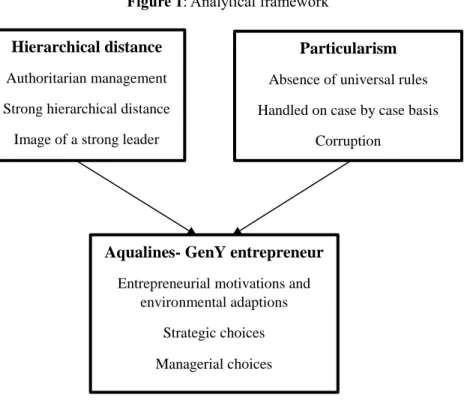
An analytical framework to study the influence of inherited cultural factors (predominately hierarchical distance and particularism) on management and business strategies as well as their interpretations by young Generation Y entrepreneurs was developed for this study. The reasoning behind a leader’s strategic choice reveals a double interplay between the business actors and the business environment. It plays simultaneously on internal preoccupations and on environmental necessities.
Figure 1: Analytical framework
The framework will be applied to conduct and analyse the interviews with the leader of Aqualines, Pavel Tsarapkin, a typical representative of Generation Y.
Hierarchical distance
Authoritarian management Strong hierarchical distance
Image of a strong leader Paternalism Emotional attachment to
leader
Particularism
Absence of universal rules Handled on case by case basis
Corruption
Abuse of administrative power Blat system
Aqualines- GenY entrepreneur Entrepreneurial motivations and
environmental adaptions Strategic choices Managerial choices
3.2 Case study using a qualitative, exploratory approach
A case study method has been chosen to carry out this study. According to Yin (2003a) “the distinctive need for case studies arises out of the desire to understand complex social phenomena” because “the case study method allows investigators to retain the holistic and meaningful characteristics of real-life events,” such as organisational and managerial processes. In fact, case studies represent the preferred strategy when “how” or “why” questions are being posed, when the investigator has little control over events, and when the focus is on a contemporary phenomenon within some real-life context (Yin, 1981).
The advantage of multiple case studies is that a comparison can be made between the companies of the same size. However, the risk is that the researcher is not sufficiently integrated into their business to understand the stakes. In order to access the data more freely, observe various work situations, and carry out semi structured interviews, long-term access to the fields is needed. It has also been determined that the leaders of certain Russian companies were very reticent to speak freely or enable anyone to observe their businesses. This influenced the choice to present a single case study here. The selection criterion was guided by the need to find a representative example of the type of company under scrutiny. Although it focuses on a single company, this study contributes to knowledge about generational entrepreneurs in Russia, particularly Generation Y and their style of management. According to Yin (2003b), “the single case study can represent a significant contribution to knowledge and theory-building. Such a study can even help to refocus future investigations in an entire field”.
The second methodological decision concerned the type of research. The target objective of this study was to investigate in depth the impact of national culture on strategic choices and managerial performances of Generation Y Russian entrepreneurs. It seems that the historical study of the company SME Aqualines, despite its limitations, makes it possible to investigate the influences of cultural factors and their effects (facts and time) on the life of this particular business.
The historical approach together with a thematic analysis of interviews exposes several aspects of the social unit that is the firm. Thus, the firm as an object can be studied with regard to the following dimensions: the legacy of state power on the managerial style of Generation Y, and the importance of informality in the life of an SME in Russia.
To carry out data collection, face to face interviews with the business leader was conducted at times through Skype. The interviews (15 hours in total) and observations were conducted from May to December 2016. The interview guide was designed beforehand. It is composed of 20 questions of which five concerned hierarchical distance and five concern particularism.
The other ten questions concern the history of the creation of the business and other general information about the entrepreneur. Visits to the businesses were made and documentary data collection was also conducted. Data collection consisted of interviews, consulting the archives, business documents, reports on meetings and other direct observations. Some information concerning the strategic and international development of the business was available on the internet and in specialised Russian newspapers.
3.3 Relevance of the choice of this company and its boss
Aqualines is an innovative company which was created by a young and brilliant Generation Y entrepreneur. Despite his young age, this entrepreneur knew how to put together an effective strategy which enabled him to develop a network of foreign dealers. This business incarnates the desire for renewal in Russia and demonstrates the longed-for modernisation, though it is not sufficiently supported by the political power of the country.
It is in companies such as Aqualines that the managerial influence of hierarchy and key values are the strongest. The impact of charisma and the preferences of one man alone or of a limited number of players is well defined. The way that these players perceive the relationship between the company and its environment, as well as the values they communicate and exhibit (especially in their professional lives), often constitutes the core of the company’s identity. These values and representations are, without a doubt, used as a “model” for action although, for this to occur, the company has to have existed for some time. The representations and values reflect to a large extent, the strategic and managerial choices in place during a minimum amount of time. Written traces in the documentation cannot be overlooked:
documents of internal and external communication, business and negotiation reports, business charters, AGM reports, etc.
3.4 Case description
Pavel Tsarapkin studied law at the University of Nijnij Novgorod, where he later earned a doctorate in law. After his doctorate, he received an MBA from the Stockholm Business School and taught at the Higher Business School in Nijniy Novgorod. Entrepreneurship was not his initial career choice; he studied law to become a prosecutor. After numerous internships and a career in judicial enquiry, Tsarapkin found the bureaucracy and rigidity of the government sector at the bank and in public financial organisations were unbearable.
At the age of 27, Tsarapkin wanted a career change and his father suggested that he work with him using his legal skills. The family business was created by his father in the 1990s and, over the years, the small company
grew and developed 2 branches. The first branch is the medical centre network (medical diagnoses) in various cities in Russia. The second branch concerns maintenance and technical services, and the creation and construction of medical equipment. At first, Tsarapkin dealt with the sale of a large building that the company renovated and wanted to sell, which he helped formalise.
At the very beginning of his professional activity, Tsarapkin dealt with the management of the company created by his father and did not bring innovative ideas. He structured the company, and put an efficient management system into place, something essential to keep a business in good working order. Once this order was in place, he became uninterested.
He thought management had become routine and a true entrepreneur had to direct his energy towards searching for new projects, new development ideas.
Tsarapkin started Aqualines in 2007 with the goal of diversifying the activities of the family company. For him, creating such a firm was a logical continuation of his entrepreneurial activity because a true entrepreneur is always creating. Aqualines is based in Nijnij Novgorod, Tsarapkin’s home town. Today, 20 people work for this company which specialises in designing innovative WIG (Wing-in-Ground) aircrafts.
Constructing WIGs had a strong potential according to Tsarapkin which is why he founded the company. His idea was to develop public transport services and to innovate. A WIG is a mix between a plane and a boat. It flies over the ocean surface and can land on water and navigate like a boat.
Although Tsarapkin made inquiries, it was impossible to buy WIGs, so he decided to build them. Subsequently, the prospects of selling this innovative product to Estonia, France, Vietnam, Cape Verde, Iran and Turkey opened up before him.
4. Results and discussion 4.1 Synopsis of interview results
The thematic choice is determined by the aim of the research. Following the analytical framework presented above, two sets of variables are examined.
The first is relative to the choice of strategies and their implementation. The second set of variables is related to the system of cultural values expressed by the key player in question. At the same time, it is the company’s cultural system which is surveyed.
Processing the information pertains to thematic analysis. According to Chiglione and Matalon (1978), it consists of “isolating the themes in a text in order to, on the one hand, reduce them to usable proposals, on the other to enable comparison with other texts processed in the same manner”. This
leads us to establish “a distinction between primary and secondary themes”.
The primary themes make it possible to explain the content of the segment of text analysed. With regards to the secondary themes, they enable us to identify specific aspects of the main themes.
The main elements of this analysis are as follows:
• The significant, tangible or permanent parameters through historical facts and cultural factors;
• Personal judgements, experiences, organisational constraints, and changes over the course of the company’s existence;
• The company’s underlying logic, policies, and strategic actions;
• Evolutionary trends in terms of organization, management, and business approaches;
• The external determinants of strategic moments, that is to say, investment in a new activity linked to innovation;
• Formal or informal practices such as they appear and are experienced in daily life;
• The aspirations and motivations of the principal player.
These elements are further explained in the following table.
Table 1: Most noticeable findings from the interviews Highlights Content of the highlights
Pavel Tsarapkin Generation Y entrepreneur Entrepreneurial motivation and
adaptation to the environment Standing up to a challenge Desire to create
Interest in acquiring new skills Use of formal and informal means Managing the interaction between company and environment by forming
“blat” networks has little use but is acceptable
Highlights Content of the highlights
Pavel Tsarapkin
Generation Y entrepreneur Strategic policies Varying activities
Innovations, responsible entrepreneurship
International sales policy Openness to the world
Table 1: (Continued)
Managerial policies “Participatory” leadership, the degree of participation varying according to the negotiating partner
Adapting the hierarchical distance in relation to employees
The same rules of everyone
A certain freedom and trust in employees
Paternalism towards the employees Cultural heritage Blat is acceptable
Authoritarian management is rarely effective
Strong paternalism of the leader Conditioning subordinates to admire strong leaders
A certain emotional attachment to the hierarchy
Using these highlights, attention is drawn to the company’s key values in relation to cultural factors at a national level. Such an approach can provide knowledge on the changes in entrepreneurial culture and the attitudes of Generation Y towards the evolving market and the entrepreneurial market.
This method sheds light on the cultural heritage, especially on how particularism and hierarchical distance has impacted 3 other areas under study and presented in the table: entrepreneurial motivations, adaptation to environment, and strategic and managerial choices of a Generation Y entrepreneur in Russia. These results will be discussed in the following sections.
4.2 Entrepreneurial motivations and environmental adaptation
The motivation of the key player to create a company is not influenced by external conditions stimulated by the market; it is influenced by the family experience in entrepreneurship. Tsarapkin, coming from an entrepreneurial family, made the deliberate choice of becoming an entrepreneur, which is the opposite to many Generation X representatives in Russia who were forced to take the plunge into business out of necessity in order to make a living and without any training or business administration to fall back on (Guilluy- Sulikashvili, 2014). It is important to note that this is the first generation in Russia since the dissolution of the USSR that could grow up in a family of entrepreneurs and draw from this experience (Laikov, 2010).
In an unstable market economy at the beginning of the financial crisis in 2007, Tsarapkin gladly threw himself into entrepreneurship. Driven by the desire to seek out new ideas, rise to the challenge and make his dream come true, he wished to have a certain status in the company. According to him,
“an entrepreneur must always create something, independent even from the idea of profitability. Certain creations may be profitable, others not, what is essential is to always keep going”. However, neither the state nor the population supports this motivation. The economic environment and the unfavourable image of the entrepreneur in society is an additional challenge:
The entrepreneur is a hunter in the heart of Siberia or in the Wild West which is brave and a bit romantic because he has chosen his setting, but he knows he will always be cold (the State will not take care of him). He is a bit marginalised, outside of society. His image is always associated with speculation (koupi-prodaj) and submitted to judgement.
Adapting to the environment is linked with particularism and handling things on a case-by-case basis.
From a legal and financial point of view, this environment is additionally part of an excessively large administrative system. It operates hand in hand with the abuse of administrative power. Entrepreneurs search for possible solutions and use illegal means, such as not paying or their lowering taxes, or hiring an employee where a part of his salary is paid in cash (Ledeneva, 2001).
Tsarapkin gives us his perception of the day to day life of an entrepreneur and his environment:
To be an entrepreneur is not honourable, the State casts him out from the different fields of activity. Despite all their lack of love, the State is aware of the entrepreneur’s usefulness, it needs him...It sometimes tries to encourage him but in a very clumsy manner. As the state hierarchy is made up of civil servants, the regulations they try to enforce are completely disconnected from life on the ground. Civil servants are administrators but not really managers.
The accountancy and the financial regulations are made in a very complex manner and necessitate a certain “juggling” (Meirovich & Reichel, 2000).
Tsarapkin expresses his vision of this administrative burden:
In accounting we have two parts (accounts and taxes). It is no longer useful to have dual accounting (white and black). Black accounting existed in the past particularly to avoid taxes. The taxes on turnover are currently quite low and it is not necessary to hide them. Accounting is
highly regulated and requires a large amount of pointless paperwork. We have dual accounting but the point is to establish a real management system, and the operation of accounts that does not include unnecessary administrative records.
Adapting to this complex environment partly involves a form of corruption and part of the daily routine of Russian entrepreneurs (Barsukova, 2013). For Tsarapkin, corruption can be characterized as “informal state taxes”:
One entrepreneur concludes that it is better to pay than to be hassled by the health services, firemen, etc.… In my company, we try to be honest and avoid paying these “informal taxes”, but that depends on the level of the negotiating partners. As a recent example, we had the elections for our regional governor. They did not insist or put any pressure on me to contribute, but I know that I have to pay up because if I need help from them tomorrow, they will not be favourable towards me otherwise.
As a general rule, in our economic system, the entrepreneur must share profits with the state otherwise he will not survive. In the long run, if this system does not stop, the Russian economy will go back into decline. Corruption is the evil which stops our country from developing.
On a larger scale, corruption is Russia’s supreme evil.
Another way to adapt is to go through networks or blat. According to Batjargal (2007), the blat system has suffered changes since the Soviet era and today the personal material benefit is one of the key recruitment factors in the network (Batjargal, 2007).
As an entrepreneur of Generation Y, Pavel Tsarapkin shows that the blat system is less efficient in the business world and is perceived by Generation Y as inherited from an old system. His attitude is linked to the generational factor and the pragmatic vision of the company:
Blat is a Soviet term. This system used to provide access to rare goods through an exchange of services. Today blat, in my opinion, already exists in state-run companies. A child of a well-positioned civil servant will have a good position since his father is going to use his network, and so on. I do not think that blat is efficient in entrepreneurship. Blat may be considered as an ethical procedure on the condition that it does not harm the institution or company. If we receive an order via the blat network, that is acceptable. What is essential is that we have not harmed others.
We can observe that in accordance with previous studies (Mutarbekova- Touron, 2011; Ardishvili et al., 2013; Batjargal, 2007) and with Tsarapkin’s comments, blat is an acceptable practice of which Generation Y can make use with ethical consideration.
This particularist approach with regard to corruption always takes into consideration the situation and nature of the relationship between the people involved and is widely used in Russia. Instability and corruption have pushed Tsarapkin to constantly adapt. He is thus always looking for new ways to adapt to the market and avoid corruption for his company and, consequently, he makes new strategic choices.
4.3 Strategic choices
The idea of diversifying business interests is very important in Russia because it enables a company to survive Russia’s economic conditions (Avtonomov, 2006). Tsarapkin’s strategic choices, especially the diversification and the launch of an innovative product, have equally been influenced by particularism:
I had to find another branch rather than the medical field because it is a very competitive sector. The state’s reliability is also a problem. If tomorrow the Ministry of Health issues new legislation, this activity may disappear”. Tsarapkin believes: “An entrepreneur must always innovate, look for new ideas and bring them to life. Even if it is a new activity or technology that he doesn’t know, a true entrepreneur will learn and find out how the mechanism works.
Entrepreneurship in the field of innovation and the process of commercialisation are the transfer channels for scientific development in genuine products and technologies. In the pursuit of diversification and of a less competitive, niche market, Tsarapkin quickly found out that entrepreneurship in the field of innovation is a growing industry which opens up opportunities for international development. Indicators show that the potential for innovative entrepreneurship is not exploited in Russia (Hays report, 2014). Formal institutions play an important role in the development and support of innovative entrepreneurship. They are supported by laws, regulations, capital markets, and educational institutions. Yet, in Russia’s case, institutions are not sufficiently developed and in places heavily corrupt resulting in the informal sector becoming the main agent of progress (Shkel, 2014).
After Dmirti Medvedev’s presidential term, the word “innovation” was more or less pejorative because it was associated with heavy corruption.
Tsarapkin claims to have appealed to several states and ministerial
authorities. He even visited Skolkovo, the centre for start-ups in the field of new technologies. These numerous approaches brought him to the conclusion that he risks falling into the heavy, slow and corrupt system. As a young and dynamic professional, he has not abandoned his idea of working in the field of new technologies, though he has his own way of interpreting the word innovation. According to him, the practical meaning of the word is the search for new methods “to do business differently or to make a new business” in the pre-existing market place.
In his company technological innovations are divided into three sectors.
First, there is simplifying and adapting military technology to civilian needs (passenger transport). Secondly, Tsarapkin made the choice to just target the external market, so he adapted his marketing policies to the international B to B markets. Following this choice, the company must target potential customers and define their international sales policy. According to Tsarapkin,
“this strategy may be considered like an innovation in itself because in Russia people working with innovations address State agencies, ministers and waiting times, with bureaucracy and corruption slowing down the process”.
With regards to commercialisation, Pavel Tsarapkin has created a network of sales representatives who speak English in Europe and other countries to acquire product knowledge through greater human contact.
And finally, the third sector is for the communication policy must be in perfect harmony with external markets. Technical and commercial documentation and the website is available in English. Professional looking business brochures abound with images but provide very little technical information (unlike the Russian aviation and building sectors, where there is a lot of technical text but very little commercial presentation to enhance product attractiveness).
Being a representative of Generation Y, Tsarapkin is concerned with sustainable development. According to him, respecting the environment is an innovation in Russia because the country has been behind on these issues.
WIG, the product that he markets, consumes less carbon than a plane. His engine works with Ethanol—S118 and the metal used to construct it is recyclable.
On par with Tsarapkin’s strategic policies, it can be observed that market instability and the economic situation incite Generation Y entrepreneurs to vary their activities. In some respects, innovation is viewed as the means of doing business differently while still respecting the environment.
Alternatively, collaborating with international businesses opens up more opportunities, allows business to become strong.
4.4 Managerial policies: strong leadership, hierarchical and emotional distance
During interviews, Tsarapkin did not often talk about mistrust, although mistrust, as a general rule, is considered a typical feature of the Russian economic mentality. The Russians express a certain degree of mistrust, not towards individuals necessarily, but with regards to their capacity for action, their initiative, and their moral qualities (Safonova, 2013). Tsarapkin’s attitude is certainly due in part to his generational affiliation, to the fact that he was not shaped by the Soviet system and also due to his Western management training: “I base myself a lot on trust and not on the employees’
official job title. I have a lot of employees and I trust them,” states Tsarapkin.
In keeping with managerial policies, Russians are inclined towards participatory leadership. This fact is also conditioned by the generational makeup and maturity of the market. According to Lutikova (2012), “the Ys cannot bear authoritarian management and the obsession with control.” They don’t want to work for businesses that ascribe to the “old regime”
(Diachenko, 2013). Trained in a management school and not brainwashed by the Soviet ideological heritage, Tsarapkin offers more freedom to his employees and is a supporter of “participatory” management: “Authoritarian management is not effective. It stifles initiative from employees and hinders their professional development. My management style is liberal.” For him, the hierarchical distance cannot be the same for everyone and depends on the employee’s profile. As a result, certain adaptations on the part of the manager are necessary. While Tsarapkin knows and intends to apply Western methods, he tries to combine effective management with traditional reactions and behaviour:
In Russia, you must mix private life and work, it is the way we operate, but the more employees we have, the harder it is. It is important to create a close circle of trusted people with whom the hierarchical distance is going to be short. It will be necessary to father this group to some extent.
Beyond this circle, it is important to establish rules that are the same for everyone. Paternalism must exist but have its limits.
It is equally remarkable that Tsarapkin nuances his position concerning strong hierarchical distance with his employees. According to him, a leader must know how to adapt his behaviour: “Smile with some and be strict with the others, sometimes even speak the language of the street because certain speakers have the habit of using this language and this helps to create a trusting environment”. All the same, he says that a certain distance must be maintained with employees. Nevertheless, the thesis of the strong, paternalistic leader is there in his speech. He believes that the leader has to
be strong and have a certain level of authority: “Basically, an authoritarian leader is authoritarian for the well-being of the employees. He is protecting them in a difficult situation from an economic point of view, like taking care of their lifestyles, so there has to be some paternalism.”
The question of paternalism and respect originates from past Russian culture and in part from the Soviet past (Elenkov, 1997). A strong leader would make decisions for the well-being of the employees and the latter had to follow them. This cultural peculiarity still remains etched in people’s minds and habits (Puffer and McCarthy, 2010). Currently, it is still more linked to the instability of the Russian economy (Hays report, 2014).
Tsarapkin confirms this fact: “If an employee respects a leader, he will do extra hours without expecting to be paid. This is linked to the fact that an entrepreneur can protect an employee, so he will do the extra work out of respect.” This idea of paternalism also remains important for employee loyalty. The turnover in Russian companies is quite strong and employee loyalty does not always go further than a high salary and guaranteed increases (Schrader, 2004). According to Tsarapkin, “It is important to create a positive atmosphere for the employees’ personal development, to protect them and improve their daily life”.
The emotional connection with the hierarchy also has a role to play in the professional context (Elenkov, 1997). In a situation where the worker has to do some work for a hierarchical superior that he does not like, he will do the bare minimum and take little care. Tsarapkin confirms that this link is essential for good management. He perfectly understands his employees’
personal situations; he listens to them and adapts himself to their personal needs. This emotional link is a guarantee for good collaboration. Cultural factors thus have repercussions on Tsarapkin’s paternalistic attitude towards employees. His cultural heritage expresses itself in strong paternalism, subordinates’ admiration of strong leaders, and the dominance of emotional attachment in boss-employee relationships.
5. Conclusion
The value of this study resides in the fact that it sheds light on the subject of Generation Y entrepreneurship in Russia. It explores two important questions: What are the nature and impact of particularism on a Generation Y entrepreneur? How is a Generation Y entrepreneur influenced by the historical hierarchical relationship in Russia?
There appears to be an indisputable link between these two cultural dimensions, because they are united by a strong representation of power (power in hierarchical relations and the power of the network). These two
dimensions are linked to the cultural and socio-economic heritage of the country but they also have new interpretations for the new generation.
The study confirms that the dominance of the State over business and legal authorities, as well as the unstable socio-economic context, has required entrepreneurs to diversify their business activities and to shape and adapt their behaviour to different institutions. The practice of blat is considered to be obsolete although still acceptable by the young generation because it is a part of their cultural heritage.
Nevertheless, Generation Y wishes to break with the tradition of authoritarian management and supports participatory management methods, sharing information, and consulting employees’ opinions but not sharing the task of giving orders. One Generation Y entrepreneur is aware that he is faced with this version of management and also with traditional values which are expressed through paternalism, emotional attachment to the hierarchy and traditional forms of behaviour embedded in people’s minds. He admits he is partly influenced by paternalism and emotional attachment to his employees.
By studying the case of Aqualines and relying on an analytical framework, it becomes obvious that these two cultural dimensions impact the strategic and managerial choices of an entrepreneur and require him to adapt to his environment. These results are interesting in two ways:
1. They make it possible to improve the knowledge on the cultural factors and their impact on Generation Y managers
2. And enable the creation of suitable support arrangements as well as management training programs depending on the age of the entrepreneurs. Additionally, this could lead to the development of new programs designed specifically for certain generations to help young creators.
It is important to conclude with a cautionary remark that a case study approach can lead to generalizing the issue. Within the context of this research, only one entrepreneur operating in the field of innovation has been presented; it would therefore be interesting for future projects to apply a quantitative research method as well using a larger sample of Generation Y Russian entrepreneurs operating in different fields and geographical regions.
Notes
1. Ledeneva (1998) defines blat as “an economy of favours.” In other words, it is a form of social organization or a network which completed the planned economy during the USSR. It was based on a form of mutual assistance to access certain goods or advantages otherwise unavailable (Rehn, Taalas, 2004). Blat is different from
corruption because in the majority of cases there is no payment. It represents an exchange of services between people.
2. Dimitri Medvedev leads a fight against corruption (Dmitri Mevedev nachinaet kompleksnuy bor’by s korruptsiej), http://www.newsru.
com/russia/19may2008/corrupt.html.)
References
Avtonomov, V. (2006). Balancing state, market and social justice: Russian experiences and lessons to learn. Journal of Business Ethics, 4(1), 3- 9. https://doi.org/10.1007/s10551-006-9048-y
Alexashin, Y., & Blenkinsopp, J. (2005). Changes in Russian managerial values: A test of the convergence hypothesis. International Journal of Human Resource Management, 16(3), 427-444.
https://doi.org/10.1080/0958519042000339589
Ardishvili, A., Jondle, D., Kowske B., Cornachione, E., Li, J., &
Thakadipuram, T. (2012). Ethical cultures in large business organizations in Brazil, Russia, India, and China. Journal of Business Ethics, 105, 415-428. https://doi.org/10.1007/s10551-011-0976-9 Ardishvili, A., Cardozo, R., & Gasparishvili, A. (1998). Leadership style and
management practices of Russian entrepreneurs: Implications for transferability of Western HRD interventions. Human Resource Development Quarterly, 9(2), 145-155. https://doi.org/
10.1002/hrdq.3920090206
Batjargal, B. (2007). Comparing social capital: Networks of entrepreneurs and venture capitalists in China and Russia. Management and Organization Review, 3(3), 397-419. https://doi.org/10.1111/j.1740- 8784.2007.00080.x
Bayeva, L. (2007). Cennosti molodeji “Epohi peremen”, vzgliad iz Rossii (Values of models during a “transitional period”, evidence from Russia), research supported by Russian government. Retrieved from http://asu.edu.ru/images/File/ilil/Bayeva_tzennosti_Rossiya.pdf Barsukova, S. (2013). Mutations du Capitalisme et Institutionnalisation de la
Corruption dans la Russie contemporaine. (Mutations of capitalism and institutionalization of corruption in contemporary Russia). Revue Internationale de Politique Comparée, 20(3), 41-63. https://doi.org/
0.3917/ripc.203.0041
Brown, T., Davidsson, P., & Wiklund, J. (2001). An operationalization of Stevenson’s conceptualization of entrepreneurship as opportunity based firm behavior. Strategic Management Journal, 22, 953-968.
https://doi.org/10.1002/smj.190
Chiglione, R., & Matalon, B. (1978). Les enquêtes sociologiques. Théories et pratiques. (Sociological Surveys. Theories and Practices). Armand Colin: Collection U.
Chvartsbourd, Ts. (2011). Malyj biznes v rossijskoj oligopolisticheskoj ekonomike (A small business in Russian oligopolistic economy).
Jurnal Institutsional’nyh Issledovanij, 3(2), 59-97. https://doi.org/
10.3917/g2000.334.0201
Diachenko, I. (2013). Osobennosti psihologicheskogo razvitia pokolenija igrek. (Particularities of generation Y’s psychological development).
Retrieved from http://www.scienceforum.ru/2013/176/5031.
Dejoux, C., Wechtler, H. (2011). Diversité générationnelle: implications, principes et outils de management. (Generational diversity:
Implications, principles and management tools). Management &
Avenir, 43, 227-238. https://doi.org/10.3917/mav.043.0227
Deloffre, G., Bok, H., Demyk, Y., Faibusevitch, S., & Mourot J.P.
(2009). Négociation à l’international: présentation des difficultés et risques de négociation et de communication au travail entre managers russes et français. (International negotiation: the difficulties and risks of negotiation and communication at work between Russian and French managers). Négociations, 11, 63-75.
https://doi.org/10.3917/neg.011.0063
Dupont, C. (1994). La négociation: conduite, théorie, applications.
(Negotiation: process, theories and applications). Paris: Dalloz.
Elenkov, D. (1997). Differences and similarities in managerial values between US and Russian managers. International Studies of Management and Organizations, 27(1), 85-106.
https://doi.org/10.1080/00208825.1997.11656703
Elenkov, D. (1998). Environmental scanning systems and performance: An empirical study of Russian companies. Journal of Management
Development, 16(2), 111-124.
https://doi.org/10.1108/02621719710164283
Fukolova, Y. (2014), Igrek neizvestnyj (Unknown Y). Sekret Firmy, June.
Retrieved from https://rugenerations.su/category/.
Gannon, M. J., & Pillai, R. (2012). Understanding Global Cultures:
Metaphorical Journeys Through 31 Nations, Cluster of Nations, Continents and Diversity, Los Angeles: Sage.
Glass, A. (2007). Understanding generational differences for competitive success. Industrial and Commercial Training, 39(2), 98-103.
https://doi.org/10.1108/00197850710732424
Guilluy-Sulikashvili, N. (2014). Contexte historico-socio-économique au service du parcours atypique de l’entrepreneuriat russe. (Socio- economic and historical context shaping the particular background of Russian entrepreneurship). In G. Kokou Dokou (Ed.), Acteurs
territoriaux, identités et capacités entrepreneuriales, (pp. 327-345).
Paris: Harmattan.
Hall, E.T., & Hall, M.R. (1990). Understanding Cultural Differences.
Germans, French and Americans. Yarmouth, ME: Intercultural Press.
Hofstede, G. (1980). Culture’s Consequences. London: Sage.
Hofstede, G. (1994). Cultures and Organizations. London: Harper Collins Business.
Khor, P., & Mapunda, G. (2014). A phenomenological study of the lived experiences of the Generation X and Y Entrepreneurs, 4th Annual international conference on business strategy and organizational behaviour (Biz Strategy 2014).
Laikov, A. (2010), O psihofisiologicheskih osobennostiah sovremennyh rossijskih predprinimatelej (Psychophilological particuliarities of russian entrepreneurs). Russkaja Narodnaja Linia. Retrieved from www.ruskline.ru.
Ledeneva, A. (2001). Unwritten Rules: How Russia Really Works. London:
Centre for European Reform.
Lopatkin, G. (2012). Ekonomičeskaja kul’tura russkogo predprinimatel’stva (Economic culture of Russian entrepreneurship). Gramota, 9(23), 100-102.
Lutikova, E. (2012). Pokolenie Y: kak poniat, kak upravliat (Generaion Y, how can we understand and manage them). Retrieved from http://www.e-xecutive.ru/management/practices/1649583-pokolenie- y-kak-ponyat-kak-upravlyat
Martin, C.A. (2005). From high maintenance to high productivity: What managers need to know about Generation Y. Industrial and
Commercial Training, 37(1), 39-44.
https://doi.org/10.1108/00197850510699965
Martin, C.A., & Tulgan, B. (2002). Managing the generation mix. Harvard:
HRD Press.
McCarthy, D., Puffer, S., & Darida, S. (2010). Convergence in entrepreneurial leadership style: Evidence from Russia. California Management Review, 25(4), 46-58.
Meirovich, G., & Reichel, A., (2000). Illegal but ethical: An inquiry into the roots of illegal corporate behaviour in Russia, business ethics. A European Review, 9(3), 126-135. https://doi.org/10.1111/1467- 8608.00183
Mutarbekova-Touron, M. (2011). Mutual perception of Russian and French managers. The International Journal of Human Resource
Management, 22(8), 1723-1740.
https://doi.org/10.1080/09585192.2011.565662
Pendergast, D. (2009). Generational theory and home economics: Future proofing the profession. Family and Consumer Sciences Research Journal, 37(4), 504-522.
Puffer, SM., McCarthy, D.J. (2010). Entrepreneurship in Russia and China:
The impact of formal institutional voids. Entrepreneurship Theory and Practice, 34(3), 441-467.
Safonova, E. (2015). Management interculturel: influence de la mentalité russe sur le management des entreprises et des organisations internationales. (Intercultural management: impact of Russian mentality on management of private companies and international organizations). Ph.D thesis. Retrieved from http//tel.archives- ouvertes.fr/ tel-01057886
Sayers, R. (2007). The right staff from X to Y. Library Management, 28(8/9), 474-487. https://doi.org/10.1108/01435120710837765
Sheahan, P. (2005). Generation Y: Thriving (and surviving) with Generation Y at work. Victoria, Australia: Hardie Grant Books.
Schrader, H. (2004), Social capital and social transformation in Russia.
Journal for East European Management Studies, 9(4), 391-410.
Smola, K.W., & Sutton, C.D. (2002). Generational differences: Revisiting generational work values for the New Millennium. Journal of Organizational Behavior, 23(4), 363-382. https://doi.org/
10.1002/job.14
Shamis, E. (2015). Deti, vzroslye, obrazovanie i teorija pokolenij:
strategičeskie vybory 2003-2023 godov (Children, adults, education and generational theory: strategic choices 2003-202), scientific project. Retrieved from https://rugenerations.su/category/
Shamis, E., & Nikonov, E. (2014). Samoe dorogoe. Čto stoit znat’ o cennostiah pokolenij (The most precious things. What should you know about generational values). Nasledniki project, M2M, Private bank.
Shkel, S.N. (2014). Informal institutions in the political process of the Post- Soviet states. Modern Problems of Science and Education, 12, 1582- 1585.
Sorokina, I. (2013). Peremeny v obrazovanii i dimanika jiznennyh strategij studentov. (Changes in education and dynamics of students’ life strategies). Sotsis, 10, 38-50.
Strauss, W., & Howe, N. (1992). Generations: The History of America’s future, 1584 to 2069. New York: William Morrow & Co.
Sutton Bell, N., & Narz, M. (2007). Meeting the challenges of age diversity in the workplace, The CPA Journal, 77(2), 56-59.
https://doi.org/10.1108/01435120710837765
Tapscott, D. (2008). How digital technology has changed the brain. Business Week Online, November 10th, 4.
Trompenaars, F., & Hampten –Turner, C. (1998). Riding the Waves of Culture. London: Nicholas Brealey.
Yin, R.K. (1981). The case study crisis: Some answers. Administrative Science Quarterly, 26(1), 58-65.
Yin, R.K. (2003a). Case Study Research, Design and Methods, vol. 5.
Thousand Oaks: Sage.
Yin, R.K. (2003b). Applications of Case Study Research, vol. 34. Thousand Oaks: Sage.
Zemke, R., Raines, C., & Filipczak, B. (2000). Generations at Work:
Managing the Clash of Veterans, Boomers, X-ers and Nexters in Your Workplace. New York: American Management Association Publication.