G
OVERNMENTL
EADERSHIP ANDC
ENTRALB
ANKD
ESIGNby
Andrew Hughes Hallett and Diana N. Weymark
Working Paper No. 02-W08 May 2002
DEPARTMENT OF ECONOMICS VANDERBILT UNIVERSITY
NASHVILLE, TN 37235 www.vanderbilt.edu/econ
Government Leadership and Central Bank Design
by
Andrew Hughes Hallett
Department of Economics, Vanderbilt University, Nashville, TN 37235, USA [email protected]
Diana N. Weymark
Department of Economics, Vanderbilt University, Nashville, TN 37235, USA [email protected]
May 2002
Abstract
Government Leadershipand Central Bank Design
This article investigates the impact on economic performance of the timing of moves in a policy game between the government and the central bank for a government with both distributional and stabilization objectives. It is shown that both inflation and income inequality are reduced without sacrificing output growth if the government assumes a leadershiprole compared to a regime in which monetary and fiscal policy is determined simultaneously. Further, it is shown that government leadershipbenefits both the fiscal and monetary authorities. The implications of these results for a country deciding whether to join a monetary union are also considered.
Journal of Economic Literature Classification Nos.: E52, E61, F42.
Keywords and phrases: central bank independence, monetary policy delegation policy coordination, policy game, policy leadership
1. Introduction
Over the past ten years, many countries have undertaken significant reforms in their monetary institutions. Most of these reforms have focused on providing central banks with a clear mandate to control inflation and greater responsibility for achieving the desired inflation performance. However, while there has been a common desire for im- proved inflation performance, countries vary widely in the institutional arrangements they have adopted to achieve this end. One of the fundamental differences between these new monetary institutions is the degree to which the government assumes a leadership role in determining the objectives of monetary policy. Our purpose, in this article, is to determine whether government leadershipcan be expected to have a positive or negative impact on economic performance.
Weymark’s (2001) model of monetary policy delegation provides the theoretical framework for our analysis. In this model, the optimal institutional design, defined in terms of central bank independence and conservatism, is the outcome of a two-stage non-cooperative game between the the government and the central bank. In the first stage of the game, the government appoints a central banker and chooses how much independence to grant the central bank. In the second stage, the central bank and the government move simultaneously; the government sets government expenditures and transfer payments and the central bank sets the size of the money supply.
The model that Weymark employs is a better representation of the monetary in- stitutions in some countries than in others. The strategic interaction between the European Central Bank (ECB) and the governments of EMU members, for example, is probably best approximated by a game in which the ECB and national fiscal au- thorities are engaged in a non-cooperative, simultaneous move game. However, the institutional arrangements that have been adopted in other countries, in particular Canada, New Zealand, and the United Kingdom, are characterized by a significant degree of government leadership. Governments that can exert influence over mone- tary policy are likely to take this into account when formulating their fiscal policies.
In order to capture this aspect of government leadership, we amend Weymark’s model
to allow the government to play the role of Stackelberg leader in the second stage of the policy game. We also assume that the central bank’s inflation target is established (exogenously) by government mandate.
In our model, the government chooses an optimal institutional design, conditional on the impact that alternative institutional arrangements are expected to have on its own fiscal policies and the central bank’s monetary policy. Because problems of institutional design necessarily apply to longer-term horizons, the fiscal and mone- tary policies that we consider are best viewed as long-term policy responses, rather than short-term demand management tools. A comparison of the theoretical results of our analysis here with those obtained by Weymark (2001) shows that govern- ment leadershipimproves inflation performance and enhances income redistribution without sacrificing output growth. Furthermore, these improvements in economic performance benefit both the monetary and fiscal authorities.1
In order to assess whether our results are of practical importance, we calculate the losses associated with the two policy regimes, simultaneous moves and government leadership, for nine countries: Canada, France, Germany, Italy, New Zealand, Sweden, Switzerland, the United Kingdom, and the United States. When we express our measure of welfare in output equivalent units, we find that the benefits of government leadership are equivalent to a permanent increase of 1–2 percent in the long run growth rate for all countries. This result is of particular significance to the United Kingdom, which currently has monetary institutions that confer a leadershiprole on its government. If the UK were to join the Eurozone, government leadershipin monetary policy formation would have to be relinquished.
2. Economic Structure
The model used in Weymark (2001) provides a useful framework for the present
1In the literature on policy coordination, institutional arrangements that lead to Pareto improve- ments relative to the Cournot-Nash equilibrium are viewed as coordination devices. See, for example, Hughes Hallett (1998).
analysis. For purposes of exposition, we suppress potential spillover effects between countries and focus on the following three equations to represent the economic struc- ture of any country:
πt=πte+αyt+ut (1) yt=β(mt−πt) +γgt+ t (2) gt =mt+s(byt−τt) (3) where πt is the inflation rate in period t, yt is output growth in period t, and πet represents the rate of inflation that rational agents expect will prevail in period t, conditional on the information available at the time expectations are formed. The variables mt, gt, and τt represent, respectively, the growth in the money supply, government expenditures, and tax revenues in period t. The variables ut and t are random disturbances which are assumed to be independently distributed with zero mean and constant variance. The coefficients α, β, γ, s, and b are all positive by assumption. The assumption that γ is positive may be considered controversial.2 However, short-run impact multipliers derived from Taylor’s (1993) multi-country estimation provide empirical support for this assumption. 3
According to (1), inflation is increasing in the rate of inflation predicted by private agents and in output growth. Equation (2) indicates that both monetary and fiscal policies have an impact on the output gap. The microfoundations of the aggregate supply equation (1), originally derived by Lucas (1972, 1973), are well-known. Mc-
2Barro (1981) argues that government purchases have a contractionary impact on output. How- ever, in contrast to those who argue that fiscal policy has little systematic or positive impact on economic performance, our model treats fiscal policy as important because (i) fiscal policy is used by governments to achieve includes redistributive objectives whose consequences need to be taken into account and (ii) as Dixit and Lambertini (2001) point out, governments cannot precommit monetary policy with any credibility if fiscal policy is not also precommitted.
3For example, using Taylor’s empirical results, Hughes Hallett and Weymark (2002) obtain short- run γestimates of 0.57, 0.43, 0.60, and 0.58 for France , Germany, Italy, and the United Kingdom, respectively.
Callum (1989) shows that aggregate demand equations like (2) can be derived from a standard, multiperiod utility-maximization problem.
Equation (3) describes the government’s budget constraint. In the interests of simplicity, we allow discretionary tax revenues to be used for redistributive purposes only. Thus, in each period, the government must finance its remaining expenditures by selling government bonds to the central bank or to private agents.4 We assume that there are two types of agents, rich and poor, and that only the rich use their savings to buy government bonds. In (3), bis the proportion of pre-tax income (output) that goes to the rich and s is the proportion of after-tax income that the rich allocate to saving. The tax, τt, is used by the government to redistribute income from the rich to the poor.
Using (1) and (2) to solve for πet, πt and yt yields the following reduced forms:
πt(gt, mt) = (1 +αβ)−1[αβmt+αγgt+met+ γ
βgte+α t+ut] (4) yt(gt, mt) = (1 +αβ)−1[βmt+γgt−βmet −γgte+ t−βut]. (5) Equations (5) and (3) then imply
τt(gt, mt) = [s(1 +αβ)]−1[(1 +αβ +sbβ)mt − (1 +αβ−sbγ)gt
− sbβmet − sbγgte + sb t − sbβut] (6)
3. Government and Central Bank Objectives
In our formulation, we allow for the possibility that the government and a fully independent central bank may differ in their objectives in some significant way. In particular, we assume that the government cares about inflation stabilization, output
4Several variations which relaxthe restrictions on how fiscal policy may be financed are considered in Weymark (2001). Specifically, in one variation, bond financing is replaced by income taxes which can be used to finance bothgtandτt. In another variation, income taxes and newly-created general taxes are available to financegtandτt. However, the model’s theoretical predictions are robust to these variations.
growth, and income redistribution, whereas the central bank, if left to itself, would be concerned only with the first two objectives.5 We also assume that the government has been elected by majority vote, so that the government’s loss function reflects society’s preferences over alternative economic objectives.
Formally, the government’s loss function is given by Lgt = 1
2(πt−π)ˆ 2 − λg1yt + λg2
2 [(b−θ)yt−τt]2 (7) where ˆπ is the government’s inflation target, λg1 is the relative weight that the gov- ernment assigns to output growth, and λg2 is the relative weight assigned to income redistribution. The parameterθ represents the proportion of output that the govern- ment would, ideally, like to allocate to the rich. All other variables are as previously defined.
The first term on the right-hand side of (7) reflects the government’s concern with inflation stabilization. Specifically, the government incurs losses when actual inflation deviates from the inflation target. The second term is intended to capture what many believe is a political reality for governments—namely, that voters reward governments for increases in output growth and penalize them for reductions in the growth rate.6 The third component in the government’s loss function reflects the government’s concern with income redistribution. The parameter θ represents the government’s ideal degree of income inequality. For example, in an economy in which there are as many rich people as poor people, an egalitarian government would set
5The assumption that a fully independent central bank assigns a zero weight to income redis- tribution simplifies the algebra involved in solving the policy game without having any significant impact on the qualitative results.
6In adopting a linear representation of the output objective, we follow Barro and Gordon (1983).
In the monetary delegation literature, the output component in the government’s loss function is more often represented as quadratic because the models employed typically preclude any stabilization role for monetary policy when the output term in the loss function is linear. In our model, the quadratic income redistribution term in the loss function allows monetary policy to play a role in output stabilization.
θ = 0.5. Ideally, in this case, the government would like to redistribute output in the amount of (b−0.5)yt from the rich to the poor.
We characterize the objectives of the central bank, which are distinct from those of the government, as:
Lcbt = 1
2(πt−π)ˆ 2−(1−δ)λcbyt−δλg1yt+δλg2
2 [(b−θ)yt−τt]2 (8) where 0≤δ ≤1, andλcbis the weight that the central bank assigns to output growth.
The parameter δ measures the degree to which the central bank is forced to take the government’s objectives into account when formulating monetary policy. The closer δ is to 0, the greater is the independence of the central bank.
In (7) we have described ˆπ as the government’s’s inflation target. The fact that the same inflation target appears in (8) reflects our assumption that the central bank has instrument independence but not target independence.
4. The Policy Game
We characterize the strategic interaction between the government and the central bank as a two-stage non-cooperative game in which the structure of the model and the objective functions are common knowledge. In the first stage, the government chooses the institutional parameters δ and λcb. The second stage is a Stackelberg game in which the government takes on the leadershiprole. In the second stage, the government and the monetary authority set their policy instruments, given theδ and λcb values determined at the previous stage. Private agents understand the game and form rational expectations for future prices in the second stage. Formally, the policy game can be described as follows:
Stage 1
The government solves the problem:
min
δ, λcb ELg(gt, mt, δ, λcb) = E
1
2[πt(gt, mt)−π]ˆ2 − λg1[yt(gt, mt)]
+ λg2
2 [(b−θ)yt(gt, mt)−τt(gt, mt)]2
(9)
where Lg(gt, mt, δ, λcb) is (7) evaluated at (gt, mt, δ, λcb), and E is the expectations operator.
Stage 2
(i) Private agents form rational expectations about future prices πte before the shocks ut and t are realized.
(ii) The shocks ut and t are realized and observed by the government and by the central bank.
(iii) The government choosesgt, beforemtis chosen by the central bank, to minimize Lg(gt, mt,δ,¯ λ¯cb), where ¯δand ¯λcbindicates that these variables were determined in stage 1.
(iv) The central bank chooses mt, taking gt as given, to minimize Lcb(gt, mt,δ,¯ ¯λcb) =
(1−¯δ)
2 [πt(gt, mt)−π]ˆ2−(1−δ)¯¯λcb[yt(gt, mt)]
+ ¯δLg(gt, mt,δ,¯ λ¯cb) (10)
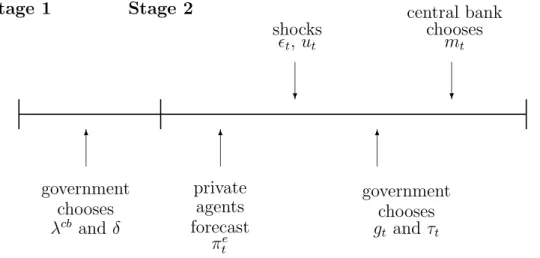
The timing of our two-stage game is illustrated in Figure 1.
Stage 1 Stage 2
✻
government chooses λcb and δ
✻
private agents forecast
πet
❄
shocks
t, ut
❄
central bank chooses
mt
✻
government chooses gt and τt
Figure 1: The Stages and Timing of the Policy Game
This game can be solved by first solving the second stage of the problem for the optimal money supply and government expenditure policies withδand λcb fixed, and then solving stage 1 by substituting the stage 2 results into (9) and minimizing with respect to δ and λcb. The equilibrium for the stage 2 leader-follower game is:
mt(δ, λcb) = βπˆ
(β+γ) + (1−δ)β[β(φ−ηΛ)λg2 + αγ(βη+γ)s2]λcb α(β+γ)[β(φ−ηΛ) +δΛ(βη+γ)]λg2
+ δβ[βφ+γΛ)λg1
α(β+γ)[β(φ−ηΛ) +δΛ(βη+γ)] − (1−γθs)ut α(β+γ)
− (1−δ)βγs2(βη+γ)λg1
(β+γ)[β(φ−ηΛ) +δΛ(βη+γ)]λg2 − t
(β+γ) (11)
gt(δ, λcb) = βπˆ
(β+γ) + (1−δ)β2[(φ−ηΛ)λg2−αs2(βη+γ)]λcb α(β+γ)[β(φ−ηΛ) +δΛ(βη+γ)]λg2
+ δβ[βφ+γΛ)λg1
α(β+γ)[β(φ−ηΛ) +δΛ(βη+γ)] − (1 +βθs)ut α(β+γ)
+ (1−δ)(βs)2(βη+γ)λg1
(β+γ)[β(φ−ηΛ) +δΛ(βη+γ)]λg2 − t
(β+γ) (12)
where
η = ∂mt
∂gt = −α2γβs2 + δφΛλg2
(αβs)2 + δΛ2λg2 (13)
φ = 1 +αβ−γθs (14)
Λ = 1 +αβ+βθs. (15)
Taking the mathematical expectation of both sides of (11) and (12) to obtain met andgte, respectively, and substituting the result, together with (11) and (12), into (4) and (5) yields the reduced-form solutions forπtandytas functions of the institutional variables δ and λcb
πt(δ, λcb) = ˆπ + (1−δ)β(φ−ηΛ)λcb + δ[βφ+γΛ]λg1
α[β(φ−ηΛ) + δΛ(βη+γ)] (16)
yt(δ, λcb) = −ut
α . (17)
From (6), the reduced-form solution for τt is given by τt(δ, λcb) = (1−δ)βs(βη+γ)(λcb−λg1)
[β(φ−ηΛ) + δΛ(βη+γ)]λg2 − (b−θ)ut
α . (18)
Substituting (16)–(18) into (9), the government’s stage 1 minimization problem can be expressed as
min
δ,λcb ELg(δ, λcb) = 1 2
(1−δ)β(φ−ηΛ)λcb + δ[βφ+γΛ]λg1 α[β(φ−ηΛ) + δΛ(βη+γ)]
2
+ λg2 2
(1−δ)βs(βη+γ)(λcb−λg1) [β(φ−ηΛ) + δΛ(βη+γ)]λg2
2
. (19)
Partial differentiation of (19) with respectλcb and δ yields the first-order conditions
∂ELg(δ, λcb)
∂λcb =
[(1−δ)β(φ−ηΛ)λcb+ δ[βφ+γΛ]λg1](1−δ)β(φ−ηΛ) α2[β(φ−ηΛ) + δΛ(βη+γ)]2
− (1−δ)2(βs)2(βη+γ)2(λg1−λcb) λg2[β(φ−ηΛ) + δΛ(βη+γ)]2 = 0
(20)
∂ELg(δ, λcb)
∂δ =
(1−δ)β(φ−ηΛ)λcb+δ[βφ+γΛ]λg1β[βφ+γΛ]
(λg1−λcb){δ(1−δ)ΛΩ + (φ−ηΛ)} α2[β(φ−ηΛ) + δΛ(βη+γ)]3
− (1−δ)(βη+γ)(βs)2[βφ+γΛ]
{(βη+γ)−(1−δ)βΩ}(λg1−λcb)2 λg2[β(φ−ηΛ) + δΛ(βη+γ)]3 = 0
(21) where Ω =∂η/∂δ.
It is evident that [β(φ−ηΛ) +δΛ(βη+γ)] = 0 is not a solution to the minimization problem. When [β(φ−ηΛ) +δΛ(βη+γ)]= 0, (20) and (21) yield, respectively, (22) and (23):
(1−δ)(φ−ηΛ)λg2(1−δ)β(φ−ηΛ)λcb+δ[βφ+γΛ]λg1
− (1−δ)2(βη+γ)2(αs)2β(λg1−λcb) = 0 (22)
(1−δ)β(φ−ηΛ)λcb+δ[βφ+γΛ]λg1(λg1−λcb)
{δ(1−δ)ΛΩ + (φ−ηΛ)}λg2
− (1−δ)(βη+γ)(αs)2β{(βη+γ)−(1−δ)βΩ}(λg1−λcb)2 = 0. (23) There are two real-valued solutions that satisfy the first-order conditions given above and which fall within the permissible range forδ.7 By inspection, it is apparent that (22) and (23) are both satisfied when δ = 1 and λcb = λg1. This solution characterizes a central bank that is fully dependent. The second real-valued solution is δ = λcb = 0. In this case, the central bank is fully independent and exclusively concerned with the economy’s inflation performance.
The solution that yields the minimum loss for the government, as measured by the government’s loss function (7), can be identified by using (19) to compare the expected loss that would be suffered under the alternative institutional arrangements.
Substituting δ= 1 andλcb=λg1 into (19) results in ELg = (λg1)2
2α2 . (24)
Substituting δ=λcb = 0 into the right-hand-side of (19) yields
ELg = 0. (25)
7Becauseηis a function ofδ, (23) is a quartic polynomial inδ. This polynomial has four distinct roots, of which only two are real-valued. Details of the complete solution set for the first-order conditions may be found in Appendix1.
It is evident that when institutional arrangements are such that the government is the Stackelberg leader in the second stage policy game, the optimal central bank design, from society’s point of view, is one in which the central bank required to use monetary policy to achieve the government’s chosen inflation target and is granted full independence to do so. As we show in Appendix 2, central bank leadership does not provide as good a result from the government’s point of view, even ifthe government dictates the inflation target.
Our results show that when there is government leadership, society’s welfare, as measured by the inverse of (19), is maximized when the government appoints central bankers who are concerned only with the achievement of the mandated inflation target, and completely disregard the impact that their policies may have on output growth. However, our results also indicate that full central bank independence is beneficial under more general conditions. Whenδ = 0, βη+γ = 0, and (19) is given by
ELg = 1 2
λcb α
2
(26) for any arbitrary value of λcb, when δ= 0. Clearly, an independent central bank will always produce better results as long as it is more conservative than the government (λcb < λg1), irrespective of the latter’s commitment to social equality (λg2).
In deriving our results, we have assumed that the central bank has instrument independence but not target independence. Consequently, the fact that ELg = 0 can be achieved by setting δ = λcb = 0 indicates that it is instrument independence which matters; and that target independence is ultimately irrelevant when there is government leadership. Neither target independence nor central bank leadership would reduce society’s expected loss to zero (see Appendix 2).
6. The Advantage of Government Leadership
6.1 Implications of the Theoretical Model
In Hughes Hallett and Weymark (2001), we show that if, in the second stage of
the game, government leadershipis removed so that monetary and fiscal policy are implemented simultaneously, then the government’s expected loss is given by
ELg = 1 2
λg1 α
2
(αγs)2 (αγs)2 + φ2λg2
. (27)
As long as the government has some commitment to social equality (i.e.,λg2 = 0), (27) will always be smaller than the loss incurred when government leadershipis combined with a dependent central bank .
A more interesting question in this context is whether government leadership with an independent central bank generally produces better outcomes, from society’s perspective, than those obtained in the simultaneous move game. In the simultaneous move game, the solution to the government’s stage 1 minimization problem is
δ = βφ2λcbλg2 + (αγ)2β(λcb−λg1)
βφ2λcbλg2 + (αγ)2β(λcb−λg1) − φ[βφ+γΛ]λg1λg2.8 (28) The optimal degree of conservatism for an independent central bank in this type of game can be obtained by setting δ = 0 in (28) to yield:
λcb∗ = (αγs)2λg1
(αγs)2+φ2λg2 (29)
It is straightforward to show that (26) is always less than (27) as long as
λcb < λg1λcb∗1/2 (30)
It is also evident that λcb∗ ≤ λg1 for λg2 ≥ 0. Consequently, government leadership with any λcb < λcb∗ will produce better outcomes, from society’s point of view, than any simultaneous move game between the central bank and the government.9 This
8See Weymark (2001) for a full derivation of this result.
9Hughes Hallett and Weymark (2001) also show that λcb∗ is the critical value that is relevant for comparing government leadership to any simultaneous move regime, including those withδ= 0.
This result follows from the substitutability betweenδ andλcb in (28).
is an important observation because many inflation targeting regimes, such as those operated by the Bank of England, the Swedish Riksbank, and the Reserve Bank of New Zealand, operate with government leadership; while several others, notably the European Central bank and the US Federal Reserve System, are better characterized as being engaged in a simultaneous move game with their governments.
Substituting δ = 0 and λcb into (16)–(18) shows exactly where the advantages of government leadershipcome from. We get
πt = ˆπ, yt = −ut
α , τt = −(b−θ)ut
α (31)
as the final outcomes. By contrast, the optimal outcomes for the associated simulta- neous move policy game are
πt∗ = ˆπ + α(γs)2
[(αγs)2 + φ2λg2] (32)
yt∗ = −ut
α (33)
τt∗ = γs(λcb∗ −λg1)
φλg2 − (b−θ)ut
α (34)
Comparing the two sets of outcomes we see that government leadership eliminates inflationary bias and therefore results in a lower rate of inflation. The optimal out- come under government leadershipis also characterized by higher taxes and therefore more income redistribution.10 Moreover, these improvements in inflation control and income distribution can be achieved with no loss in expected growth.
One of the central issues addressed in the policy coordination literature is whether there are institutional arrangements that yield Pareto improvements over the non- cooperative outcome.11 When such institutions can be identified, they are viewed as
10Taxrevenues are lower under the simultaneous move game becauseλcb∗< λg1. Redistribution is positively related to the amount of taxrevenue because (b−θ)Ey∗t = 0, so thatτt∗ determines the amount of income redistribution actually achieved.
11See, for example, Currie, Holtham, and Hughes Hallett (1989); Currie (1990); and Currie and Levine (1991).
a coordination device. In our model, government leadershipin the second stage of the policy game results in better outcomes for both policy authorities and is therefore an example of a rule-based form of policy coordination.12
6.2 Empirical Evidence
Whether or not the theoretical results we have obtained are of practical significance is an empirical matter. In order to assess the magnitudes of the results we have obtained, we have computed the optimal degrees of conservatism and the associated expected losses under the simultaneous move and government leadership regimes for nine countries. The data we have used is from 1998, which is the year the Eurozone was created. The data itself, and its sources, are summarized in the appendix to this article.
Our sample of countries consists of those which have recently reformed their mon- etary policy frameworks with the explicit aim of securing lower and more stable inflation rates without damaging the prospects for growth, stability, or social equity.
The countries selected fall into three broad groups:
(a) Eurozone countries: France, Germany, and Italy
(b) Non-EMU countries with explicit inflation targets: Sweden, Switzerland, and the UK
(c) Inflation targeters outside the EU: Canada, New Zealand, and the US.
Each of these countries (the US excepted) has revised the statutes and the way in which the central bank is required to conduct monetary policy over the past five to ten years. In each case the creation of an independent central bank (whether fully independent or only instrument independent) has been the key feature of the reforms.
In the first group, monetary policy is conducted at the European level and fiscal policy is conducted independently at the national level. Policy interactions in this groupcan be characterized in terms of a simultaneous move game with target as well
12See Currie (1990) for a discussion of the distinction between rule-based and discretionary, orad hoc, forms of policy coordination.
Table 1
Losses under Government Leadershipand Simultaneous Moves Full Government Simultaneous Growth Rate Dependence Leadership Moves Equivalents
δ = 1 δ = 0 δ = 0 Lost
λcb=λg1 λcb= 0 λcb =λcb∗ %
France 5.78 0.00 0.0125 1.26
Germany 16.14 0.00 0.0079 0.79
Italy 1.28 0.00 0.0116 1.16
Sweden 4.51 0.00 0.0098 0.98
Switzerland 4.79 0.00 0.0251 2.51
UK 3.37 0.00 0.0113 1.13
Canada 12.50 0.00 0.0265 2.65
New Zealand 8.40 0.00 0.0104 1.04
USA 6.47 0.00 0.0441 4.41
as instrument independence. The second group of countries has adopted explicit, and usually publicly announced, inflation targets. Central banks in these countries have been granted a high degree of instrument independence. The government either sets, or helps set, the inflation target value. In each case the government has adopted longer term (supply side) fiscal policies, leaving active demand management to monetary policy. These are clear cases in which there is government leadership, with instrument independent for the central bank.13 Of the countries in the third group, New Zealand and Canada can also be described as explicit inflation targeters with government leadership. The US, although not an explicit inflation targeter, is included in this group as a point of comparison because of the success with which monetary policy has been employed in the US over the past decade.
The results of our calculations are reported in Table 1. The first column in this
13Switzerland is included in this group on the basis of the inflation targeting changes made after 1999. See Rich (2000) for a detailed analysis of the inflation targeting process in Switzerland.
table shows the losses that would be incurred with a fully dependent central bank;
these losses are identical under both regimes. Column two reflects the losses that would be incurred under government leadershipwith a fully independent central bank that directs monetary policy exclusively towards the achievement of the inflation target (i.e., with δ =λcb = 0). The third column gives the minimum loss associated with simultaneous decision-making in stage two of the policy game.14
Evidently, complete dependence is extremely unfavourable for all countries. How- ever, the magnitude of the loss varies considerably from country to country. The losses in column three, relative to those in column 2 appear to be relatively small when measured in terms of raw welfare units. However, when these losses are con- verted into “growth rate equivalents”, we find that there are significant losses as- sociated with institutional arrangements in which government leadershipis absent.
The growth rate equivalents reported in the last column of Table 1 were obtained using a standard technique borrowed from the coordination literature.15 Specifically, we have computed the marginal rates of transformation around each government’s indifference curve to find the change in output growth, dyt, that yields the welfare loss given in column four when all other policy variables are held at their optimized values. Formally, we use (7) together with certainty equivalence to obtain
dyt = (dELgt)
[λg2{(b−θ)yt−τt}(b−θ)−λg1]. (35) The minimum value of dyt is attained when the taxτt grows at the same rate as the redistribution target (b−θ)yt. These minimum output losses are reported in column four.
The values in column four show that the losses associated with simultaneous decision-making are equivalent to permanent reductions of 1–2 percent in the long term growth rate of national income. These are significant losses and are roughly
14The losses reported in column 3 were calculated using λg1 = 1 and λg2 = 0.5 for each of the countries in the sample as in Hughes Hallett and Weymark (2001).
15See, for example, Currie et al (1989), Nolan (2002), and Oudiz and Sachs (1984).
Table 2
Central Bank Conservatism –λcb
Government Simultaneous Leadership Moves optimal upper optimal
value bound value
France 0.00 0.0466 0.00217
Germany 0.00 0.0221 0.00049
Italy 0.00 0.0952 0.00906
Sweden 0.00 0.0467 0.00218
Switzerland 0.00 0.0725 0.00525
UK 0.00 0.0579 0.00335
Canada 0.00 0.0458 0.00212
New Zealand 0.00 0.0351 0.00123
USA 0.00 0.0826 0.00682
equivalent to all the gains that might be expected from international policy coordi- nation (Currie et al, 1989), or from introducing the single currency in Europe (EC, 1990).
In Table 1 we have compared the losses associated with government leadership and simultaneous decision-making when the central banking institutions are opti- mally configured within each regime. However, (30) indicates that the government leadership regime does not need to be optimally configured in order to produce out- comes that are superior to those achieved in the simultaneous move regime. In Table 2, we provide estimates of the lowest degree of central bank conservatism (i.e., the highest value of λcb) for which government leadershipcombined with central bank independence will dominate the optimal simultaneous-move regime. Our calculations show that, compared to the optimal simultaneous-move regime, considerably less cen- tral bank conservatism is required to produce good economic outcomes when there is government leadershipin policy formation. For Germany, the losses would be lower
under government leadershipwith λcb values as much as 50 times larger than under an optimal simultaneous-move regime. In the case of Italy, government leadership is beneficial for λcb values of upto 10 times larger than under an optimally config- ured simultaneous-move regime. The remaining six countries fall in between these two extremes. In all cases, the degree of central bank conservatism required under simultaneous decision-making is at least an order of magnitude greater than what is needed when there is government leadership.
The implication of these results is that instrument independence, coupled with government led fiscal policies, allows policy makers a great deal more room for manouevre than do regimes that are characterized by a combination of target in- dependence and simultaneous policy moves. Government leadership expands the fea- sible policy space in that both the central bank and the government can contemplate a wider range of policies to suit their own objectives and still expect to get better out- comes, from society’s point of view, than in other regimes. Conversely, a government leadershipregime is likely to be less sensitive to any variations in the transmission parameters, savings ratios, or targets for social equality that may appear around the economic cycle, or as new governments come into office. This last point may prove to be the greater advantage in practical applications.
7. Conclusion
In this article, we have developed a model of monetary delegation in which the govern- ment plays a leadership role. We find that when the government has the first-mover advantage in formulating fiscal policy, society’s well-being (as we have defined it) is maximized by appointing a central banker whose only concern is the achievement of the government-mandated inflation target.
Our theoretical results show that government policy leadership, coupled with a fully independent, inflation-oriented central bank, will lead to a better economic per- formance, from society’s point of view, than a simultaneous move game between the central bank and the government. In comparing the optimal economic outcomes that
can be achieved under each of the two regimes, we find that government leadership results in Pareto improvements across all objectives for all players. This suggests that the improved outcomes obtained under government leadership come from the greater (implicit) coordination that this regime generates between the two independent policy authorities.
Our empirical analysis indicates that the benefits of government leadership are large enough to allow policy makers to achieve good outcomes with a much wider range of policies than in the simultaneous move regime. Moreover, because the success of the leadershipregime is less sensitive to the precise choice of the degree of conservatism, it provides some protection against the impact of variations in transmission parameters or social objectives on economic outcomes. Our results are of particular significance for countries like the UK and Sweden, who must decide whether the benefits of joining the European Monetary Union are sufficient to justify the cost of giving up monetary sovereignty and government leadershipin policy formation.
References
Barro, R.J. (1981) “Output Effects of Government Purchases,” Journal of Political Economy 89, 1086-1121.
Barro, R.J. and D.B. Gordon (1983) “Rules, Discretion, and Reputation in a Model of Monetary Policy,” Journal of Monetary Economics 12, 101-21.
Currie, D.A. (1990) “International Policy Coordination,” in D.T. Llewellyn and C.
Milner (eds.) Current Issues in International Monetary Economics, Macmillan, London, 125-48.
Currie, D.A., G. Holtham, and A. Hughes Hallett, (1989) “The Theory and Practice of International Economic Policy Coordination: Does Coordination Pay?” in R.
Bryant, D. Currie, J. Frenkel, P. Masson, and R. Portes (eds.) Macroeconomic Policies in an Interdependent World, International Monetary Fund, Washington DC.
Currie, D.A. and P. Levine (1991) “The International Coordination of Monetary Policy – A Survey,” in C.J. Green D.T. Llewellyn (eds.) Surveys in Monetary Economics, Vol. 1, Cambridge MA and Oxford, Basil Blackwell.
Dixit, A.K. and L. Lambertini (2001) “Fiscal Discretion destroys Monetary Commit- ment,” Unpublished Manuscript, Department of Economics, Princeton Univer- sity.
Fischer, S. (1995) ”Central Bank Independence Revisited,”American Economic Re- view 85, 201-6.
Hughes Hallett, A. (1998) “When Do Target Zones Work? An Examination of Ex- change Rate Targeting as a Device for Coordinating Economic Policies” Open Economies Review 9, 115-38.
Hughes Hallett, A. and D.N. Weymark (2001) ”The Cost of Heterogeneity in a Mone- tary Union,” Discussion Paper No. 3223, Center for Economic Policy Research, London; Working Paper No. 01-W28, Department of Economics, Vanderbilt University, <www.vanderbilt.edu/econ>.
Lucas, R.E. (1973) “ Some International Evidence on Output-Inflation Trade-Offs,”
American Economic Review 63, 326-34.
Lucas, R.E. (1972) “ Expectations and the Neutrality of Money,” Journal of Eco- nomic Theory 4, 103-24.
McCallum, B.T. (1989) Monetary Economics: Theory and Policy, Macmillan, New York.
Rich, G. (2000) “Monetary Policy Without Central Bank Money: A Swiss Perspec- tive,” International Finance 3, 437-469.
Nolan, C. (2002) “Monetary Stabilization Policy in a Monetary Union: Some Simple Analysis,” Scottish Journal of Political Economy, forthcoming.
Oudiz, G. and J. Sachs (1984) “Macroeconomic Policy Coordination Among the In- dustrial Economies,” Brookings Papers on Economic Activity 1, 1-64.
Taylor, J.B. (1993) Macroeconomic Policy in a World Economy: From Econometric Design to Practical Operation, W.W. Norton and Company, New York.
Turner, D., and E. Seghezza (1999) “Testing for a Common OECD Phillips Curve,”
Working Paper No. 219, Economics Department, OECD, Paris.
Weymark, D. N. (2001) “Inflation, Income Redistribution, and Optimal Central Bank Independence,” Working Paper No. 01-W02R, Department of Economics, Van- derbilt University. <www.vanderbilt.edu/econ>.
Appendix 1
Solutions to (22) and (23)
The first-order condition (23) can be written as a quartic polynomial in δ. As a consequence, there are four solutions that simultaneously satisfy (22) and (23). By inspection, it is apparent that one of these solutions is δ = 1 and λcb = λg1. When δ= 1 and λcb =λg1, the first order conditions can be written
(φ−ηΛ)λg2(1−δ)β(φ−ηΛ)λcb + δ[βφ+γΛ]λg1
− (1−δ)(βη+γ)2(αs)2β(λg1−λcb) = 0 (A.1)
δ(1−δ)Λ∂η
∂δ + (φ−ηΛ) (1−δ)β(φ−ηΛ)λcb + δ[βφ+γΛ]λg1λg2
− (1−δ)(βη+γ)(αs)2β
(βη+γ) − (1−δ)β∂η
∂δ (λg1−λcb) = 0.
(A.2) But (A.2) can be expressed as
(A.1) + δ(1−δ)Λ∂η
∂δ
(1−δ)β(φ−ηΛ)λcb+δ[βφ+γΛ]λg1λg2 + (1−δ)2(βη+γ)∂η
∂δ(αβs)2(λg1−λcb) = 0. (A.3) Consequently, when δ = 1 and (A.1) is satisfied, (A.2) becomes
δΛ(1−δ)β(φ−ηΛ)λcb+δ[βφ+γΛ]λg1λg2
+ (1−δ)(βη+γ)(αβs)2(λg1 −λcb) = 0. (A.4)
Replacing η with (13) yields (φ−ηΛ) = α2βs2[βφ+γΛ]
(αβs)2+δΛ2λg2 and (βη+γ) = δΛ[βφ+γΛ]λg2
(αβs)2+δΛ2λg2. (A.5) It is evident that (βη+γ) = 0 when δ = 0. Hence δ =λcb = 0 is one solution that satisfies (A.1) and (A.4).
The remaining potential solutions can be found by substituting (A.5) into (A.4) and solving for δ (under the assumption that δ = 0 andδ= 1). We obtain:
δ2 = −(αβs)2
Λ2λg1λg2 . (A.6)
Consequently, there are only two real-valued solutions that satisfy the first-order necessary conditions: (i) δ= 1 and λcb =λg1, and (ii) δ=λcb = 0.
Appendix 2
Central Bank leadership
This appendix summarizes the results obtained when the central bank, rather than the government, is the Stackelberg leader in the second stage of the policy game. Because a central bank that plays a leadership role is almost certain to have target independence, we express the objectives of the central bank as follows:
Lcbt = 1
2(πt−πˆcb)2 −(1−δ)λcbyt−δλg1yt+δλg2
2 [(b−θ)yt−τt]2 (A.7) where we allow the central bank’s inflation target ˆπcb to differ from the government’s inflation target ˆπ.
When the central bank has full target independence and is the Stackelberg leader, the reduced-form solutions for πt,yt, and τt are:
πt = [(β+µγ)φπˆcb + δγ(Λ−µφ)ˆπ
(β+µγ)φ + δγ(Λ−µφ) + (1−δ)(β+µγ)φλcb α[(β+µγ)φ + δγ(Λ−µφ)]
+ δ[βφ+γΛ]λg1
α[(β+µγ)φ + δγ(Λ−µφ)] (A.8)
yt = −ut
α (A.9)
τt = αγs(β+µγ)(ˆπ−πˆcb) [(β+µγ)φ + δγ(Λ−µφ)]λg2
+ (1−δ)γ(β+µγ)s(λg1−λcb)
[(β+µγ)φ + δγ(Λ−µφ)]λg2 − (b−θ)ut
α (A.10)
whereµ = ∂gt
∂mt = −α2βγs2 + φΛλg2 (αγs)2 + φ2λg2 .
Substituting (A.8)–(A.10) into the government’s loss function (7) and differenti- ating with respect toλcb and δ yields the necessary first-order conditions:
∂ELgt
∂λcb = 0
⇒ (1−δ)φλg2−αΓφ(ˆπ−πˆcb) +φ(1−δ)Γλcb+δ[βφ+γΛ]λg1
− (αγs)2Γ(1−δ)α(ˆπ−πˆcb) + (1−δ)(λg1−λcb) = 0
(A.11)
∂ELgt
∂λcb = 0
⇒ φλg2ΓΣ−α(β+µγ)φ(ˆπ−πˆcb) +φ(1−δ)Γλcb+δ[βφ+γΛ]λg1
−(αγs)2Γ2Σα(ˆπ−πˆcb) + (1−δ)(λg1−λcb) = 0
(A.12) where
Σ = [βφ+γΛ](λg1−λcb) + αγ(ˆπ−πˆcb)(Λ−µφ) Γ = (β+µγ).
There are two solutions that satisfy both of the first-order conditions given above.
By inspection, it is apparent that (A.11) and (A.12) are both satisfied when δ = 1 and Γ = 0. When 0 ≤δ <1 and Γ = 0, then (A.11) and (A.12) imply the following relationshipbetweenδ and λcb
δ = (β+µγ)φ2λcbλg2 + (αγs)2(λcb−λg1) − α[φ2λg2+ (αγs)2](ˆπ−πˆcb) (β+µγ){φ2λcbλg2 + (αγs)2(λcb−λg1)} − φ[βφ+γΛ]λg1λg2 .
(A.13)