0
Green and Smart Industrial Estate Model:
Case Study of AMATA City Chonburi, Thailand
November 2019
1
Acknowledgements
This report was executed through the collaboration between Amata Corporation PCL and the Global Green Growth Institute (GGGI) with the goal of guiding planning and design fora Green and Smart Industrial Estate Model and having Amata City Chonburi transitioning into a green and smart industrial estate.
The more details on potential works of Amata City Chonburi, the case study in this report, has been deliberately complemented by estudioOCA, a landscape architecture and urban design studio dedicated to the creation of social and sustainable landscapes, and Anthony Paul Fullelove, a senior professional and leader in the energy industry, with a focus on renewable energy, microgrids and net zero precincts.
Copyright © December 2019 The Global Green Growth Institute
19F Jeongdong Building, 21-15, Jeongdong-gil Jung-gu, Seoul, Korea 100-784
The Global Green Growth Institute does not make any warranty, either express or implied, or assumes any legal liability or responsibility for the accuracy, completeness, or any third party’s use or the results of such use of any information, apparatus, product, or process disclosed of the information contained herein or represents that its use would not infringe privately owned rights. The views and opinions of the authors expressed herein do not necessarily state or reflect those of the Global Green Growth Institute.
Cover photo courtesy of estudioOCA
2
3
Contents
Executive Summary ... 4
1. Introduction ... 6
GGGI Country Approach on Green and Smart Cities ... 7
Amata Corporation and Its Green and Smart Transition ... 8
From Vision to Implementation ... 10
2. Green and Smart Cities ... 12
What is Green and Smart City? ... 12
Transitioning Conventional Industrial Estate into Green and Smart City ... 12
Emerging Trends: A Friendlier Industrial Estate ... 13
Attempts towards Greener and Smarter Estates: Worldwide Examples ... 16
3. Roles of Industries in Green and Smart Industrial Estates ... 22
Role of Industry in Green City ... 22
What Attribute to Green and Smart Industrial Estates? ... 22
Key Categories of Green and Smart Industrial Estates ... 27
4. Amata City Chonburi: A Case Study in Thailand ... 29
Project Methodological Frameworks: Integrating Urban Planning to Industrial Planning ... 29
Site Assessment... 30
Methodology and Selection Criteria ... 35
Recommended Green Projects ... 39
Key Success Factors ... 51
Lessons Learned ... 52
4
Executive Summary
A wide array of challenges increasingly threatens the health and quality of urban and industrial areas. Causing concern at range of scales, the most critical challenges are posed by changing climatic conditions, environmental risks, as well as rapid urban and industrial growth and mixed industrial and residential zoning. Risks most pertinent to industrial lands and surrounding communities range from deterioration of natural resources, natural disasters (e.g. flood and stormwater), and industrial emissions (e.g. air, water and land pollution as well as noise and odor).
To overcome challenges and take advantage of opportunities, decision-makers, and industrial developers in particular, must rethink the way their developments are planned, infrastructures are built, services are offered, systems are linked, and communities are engaged. Given current risks and global conditions, future international industrial
competitiveness will increasingly be linked to sustainability performance. The “Green and Smart Industrial Estate Model” focuses on using sustainable landscape and master planning, namely through green infrastructures, as well as smart management of energy and waste with the assistance of information technologies, to identify, recommend, and outline green projects to implement to overcome relevant risks.
In this report, the emerging trends which can be considered and even incorporated into the estate development masterplan, to enhance the greener and smarter status of an industrial estate are also introduced. These trends include the “Circular Economy” which is a new way of creating value through extending product lifespan and relocating waste from the end of the supply chain to the beginning of another. This could also lead to the “Zero Waste” management concept. The transformation of energy scheme is another trend where the estate could become a “Net Zero Carbon”
precinct by generating and consuming energy entirely from clean and/or renewable resources.
Roles of industrial land developers and attempts towards greener and smarter practices have arisen in many different sites around the world. Reasons and some examples are discussed and presented. The Kalundborg Industrial Estate in Denmark is a role model for industrial symbiosis, i.e. the opportunity for companies to utilize wastes and exchange by- products in an effort to reduce both economic costs and environmental impacts. Qingdao Sino-German Eco Park in China is an excellent example of smart cooperation between governments, businesses and research institutions to achieve a world leading environmentally-friendly and innovative industrial park.
In order to transform or develop a “Green and Smart Industrial Estate Model”, it is important to understand the concept and establish smooth relationship internally and among external stakeholders. The vision of the landowner alone proves hard to achieve this ideal position. There are key attributable aspects, or supporting pillars, to become green and smart including green and smart improvement projects, community Enhancement and support
mechanisms. The report has divided actual implementations into ten key green and smart categories: Green Spaces, Green Buildings and Renewable Energy, Smart Manufacturing and Data Infrastructure, Green & Smart Transportation, Smart Water Management, Smart Waste Management, Industrial Symbiosis, Community Enhancement, Regional Infrastructure Extended, and Economic Value Added.
In order to demonstrate the potential path in transition to smarter and greener industrial park, Amata City Chonburi, one of the biggest industrial estates situated in the middle of the Eastern Economic Corridor (EEC), was selected for the purpose. Amata Corporation PCL, the estate developer, has a vision of not only providing a location with state-of- the-art facilities for businesses, but also creating integrated cities with a range of services and long-term design to support businesses and communities in and around the estate.
5 Ultimately, this report aims to guide the development of a sustainable industrial area that simultaneously improves economic, social, and environmental conditions. Introducing the conceptual idea, researching best practices,
identifying categories of actions/activities, showcasing the process towards greener and smarter Amata Chonburi (the case study), and suggesting challenges and lessons learned, the products and methodology of this report can be used and replicated by any industrial areas to transform into a sustainable development. The methodology and analyses were formulated generally and therefore are replicable for other industrial areas around the world.
6
1. Introduction
The objective of the Green and Smart Industrial Estate Model is to develop guidelines not only to introduce innovative, smart, environmentally industrial estate model but also to transform existing large industrial parks into a sustainable and innovative development. Through a design approach that integrates landscape and industrial ecology planning, the industrial lands will be transformed into a Green and Smart City which will serve as a model of best practices.
It is essential to develop an inclusive framework of green growth development pathway that enables both businesses and communities to grow in a healthy and sustainable manner. A holistic approach to green infrastructure and practices should look at impacts and improvements to the natural environment,
urbanization, transportation networks, climate, housing, and community. With proper vision and planning, green infrastructure can help or mitigate environmental hazards while simultaneously improving safety and quality of life, all while reducing costs and disruptions. Ultimately, comprehensive planning can enhance the business environment and the livability of the community in and around the industrial land areas.
This report presents a development model for industrial areas to follow in order to transition into green and smart estates, with an emphasis on simultaneous economic, social, and environmental improvement. Given current global issues—e.g. human wellbeing, unemployment, pollution, climate change—
and development patterns, sustainability performance will play a significant role in the competitiveness of industrial areas in the future. Existing industrial areas are most often designed with a singular purpose, to promote economic advancement, overlooking opportunities to improve environmental and social conditions. Accordingly, existing and new industrial areas should investigate methods to create and transition their properties to be sustainable estates that exemplify green growth and circular economies.
This report is intended to be used as tools to assist the
sustainable development of industrial areas by providing best practice models, recommending green improvement projects, and evaluating the impacts of projects.
The Green and Smart Industrial Estate Model has been developed during 2018 and 2019 based on the collaboration with Amata Corporation PCL, being key contributor to the case study, and one of its most developed industrial estate in Thailand. This work has been conducted under GGGI Thailand project
‘Transitioning to Green and Smart City: Case Study of Amata’. It was aimed to enhance future green growth projects in the industrial estates in Thailand and internationally, utilizing environmentally conscientious, climate-resilient industrial development.
The objectives of the abovementioned project
‘Transitioning to Green and Smart City: Case Study of Amata’ were to develop green and smart industrial estate as a best practice for Thailand, and to share the experiences obtained from this assessment to
interested parties across public and private
stakeholders nationally and internationally. This report is considered the result of the initial phase which was aimed to convene best practice model and to identify potential smart and green projects to Amata’s pilot site. Based on the accomplishment of this phase, the follow-on phase will be further discussed with Amata, as well as GGGI internally. However, it is expected to advance some of recommended green projects into bankability and experience and knowledge will be shared.
It is expected that the transitioning of industrial estates into green and smart cities will provide reliable
functions and facilitating facilities (e.g. waste treatment, electricity generation, etc.) for both businesses and communities in and around the areas.
Any transition will not only benefit the estate developer and the country’s economy but also contribute to other socio-economic improvements
7 including creation of green jobs; increased access to
clean energy, sanitation and sustainable waste
management; improved air quality; and GHG emission reductions.
GGGI Country Approach on Green and Smart Cities
GGGI’s interventions emphasize change in four priority areas in which we consider to be essential to
transforming countries’ economies. While not limited to these themes, GGGI is maximizing the impact of its products and services in the following areas:
Sustainable Energy, Water and Sanitation, Sustainable Landscapes and Green Cities.
GGGI and Green Cities Activities
Over two-thirds of global population are forecast to live in urban areas by 2050. The implications of this phenomenon are significant. Many of the world’s cities are urbanizing in a largely unplanned manner, which has high negative externalities including poor air quality, infrastructure that is not climate resilient, inadequate provisioning of basic services and a lack of social inclusion and opportunity. Cities have a vital role to play in transitioning from resource inefficient patterns of growth and increasing access to services, and in so doing, supporting the transition to green growth.
Greening cities provides opportunities to create sustainable livelihoods through providing green jobs, reducing GHG emissions, and increasing access to sustainable infrastructure and services.
GGGI’s thematic approach to green cities supports an integrated and cross-sectoral approach and responds to local, national, and global needs and commitments, through its five priority areas, namely:
(a) Mainstreaming green growth into urban planning and management;
(b) Resource efficient and low carbon cities;
(c) Solid waste management: managing waste as resource;
(d) Decentralized sanitation and wastewater solutions;
(e) Sustainable transportation and mobility:
connected and healthy cities.
GGGI aims to address these gaps through responding to demand in policy development at the national and municipal level, with a focus on supporting secondary and emerging cities. To support the change that is needed for urban transformation, we link project ideation to finance and build capacity which both enhances understanding of green growth in relation to cities, but also acts as a platform for identifying innovative projects for implementation. In doing so, GGGI strives to realize pro-poor, smart and inclusive cities in which sustainable urban services and green jobs are created to address the unmet needs of under- serviced and urban poor communities.
Several of GGGI member countries have identified its green urbanization as one of the country’s key elements of economic growth. Taken Rwanda as an example, in order to better distribute economic growth across the country and accomplish the national
urbanization target of 35% by 2024, the Government of Rwanda has identified six secondary cities to serve as growth poles.
However, this project is rather more specific to greening the industrial parks, but undoubtedly
adaptive to the ‘Green Cities’ scheme. The Green Cities activities of GGGI’s have been the basis to the project in Thailand and extended to cover the development of industrial land areas. Below show some experiences on the green / smart industrial zones development in GGGI member states.
Green Industrial Zone Development (Ethiopia)
In Ethiopia, there is currently a big push for the rollout of industrial parks across the country (16 parks by 2025, with 5 already completed and operational).
Accordingly, GGGI has been asked to work on greening strategies for the parks. Our industrial parks program for 2019 has three main workstreams:
8
• Design a road map for greening industrial parks (to be applied to all parks) – policy
• Design a business case for the use of industrial sludge and salt (in two industrial parks) – bankable project
• Design a business case for the use of solar PV (in one industrial park) – bankable project
• For projects #2 and #3, we are in the relatively early stages of project development, confirming the technical aspects to determine the viability and scope of the business cases.
Mapping of Public Spaces to Inform Master Plan Review for Secondary Cities in Rwanda
GGGI is supporting the government of Rwanda to develop secondary cities as competitive economic centers pursuing climate resilience, sustainable &
inclusive growth. GGGI, in close collaboration with Rwanda’s Ministry of Infrastructure and other
stakeholders, has recently accomplished a study on the improvement of public spaces in Rwanda’s secondary cities. The report was developed after the mapping and assessment of 36 public spaces in six secondary cities in Rwanda, through citywide surveys and revision on the master plans for Rwanda’s secondary cities with technical analysis of public spaces.
Amata Corporation and Its Green and Smart Transition
Established in 1989, Amata Corporation PCL is one of the biggest industrial estate developers in Southeast Asia. The selected case study estate, namely Amata City Chonburi1, is located in Chonburi province, in the nation’s Eastern Seaboard region. With a former vision to become World’s Leading Industrial City Developer, Amata has pivoted their business paradigm as an industrial estate developer to focus more on the importance of social responsibility and the impacts created by the estate.
1 More information of Amata City Chonburi can be found in Section 4.
Amata now focuses on developing, managing, and marketing integrated industrial estates. The estate highlights a vision of not only providing a location with state-of-the-art facilities for businesses, but also creating integrated cities with a range of services and long-term design to support businesses and
communities in and around the estate. Currently, high- quality facilities are provided on site including: an international standard road system, a private security system that incorporates support from local police, reliable utilities and waste disposal facilities, and well- maintained green areas.
This collaborative project presents innovative but practical development activities to transition this project’s case study, Amata City Chonburi, into an industrial estate that complements the needs of industries, communities, and the environment.
To achieve Amata’s vision of creating ‘a perfect city where possibilities happen’, the Corporate is working on developing the Chonburi estate into a green and smart city that integrates industrial facilities with the landscape and community, to minimize environmental impacts and enhance social wellbeing. Amata envisions the future Chonburi development as a catalyst of industrialization that ultimately positions the estate as a leading sustainable economic force in the Chonburi region, Thailand, and beyond. Further, given the goals of the estate, Amata has the opportunity to play a leading role in the growth of the Eastern Economic Corridor (EEC) of Thailand from an early stage in its development.
The mission of Amata is to promote sustainable socio- economic and environmental development while accelerating Thailand’s national and regional growth in targeted green industries. To achieve comprehensive green growth, Amata should strive to fulfill economic,
9 social, and environmental improvement goals to
achieve a variety of benefits for the Chonburi estate.
• Economic: Reduce the negative externalities and impacts for the public and environment by abandoning pure commercial development for a new green growth model. A more sustainable development approach strives to provide
economic benefits such as increased property values, reduced infrastructure and operating costs, attraction of new investment sources, and creation of a more competitive and resilient business community.
• Social: Enhance public wellbeing and share improvements with the community by shifting to a sustainable development paradigm.
Application of green growth principles in the industrial estate will offer social benefits including improved health, better work conditions and education opportunities, and enhanced livability by creating excellent work, recreation, and education environments.
• Environmental: Improve ecological performance and health in order to foster
environmental benefits including ecosystem services and environmental resilience. This can be achieved through wise management of resources, application of green growth principles for planning, and investment in nature-based infrastructure solutions.
Figure 1: Bird-eyed View of Amata City Chonburi (Photo credit: www.amata.com
10 Collectively, a new sustainable development model will
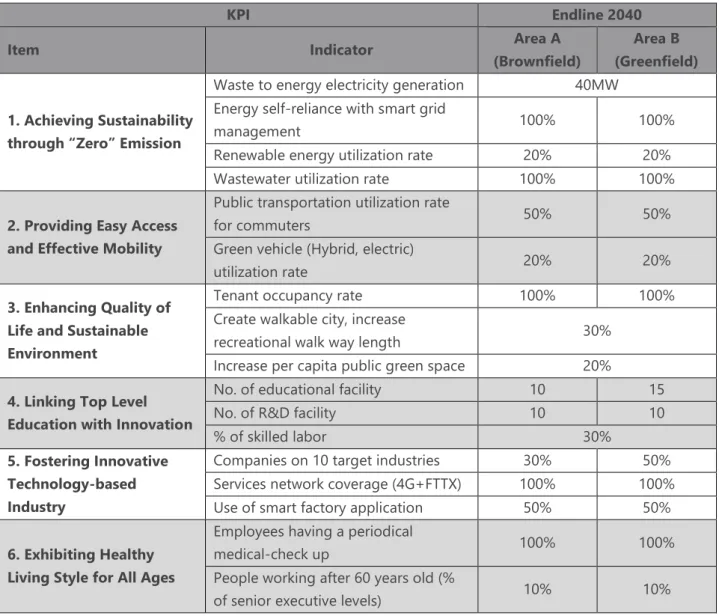
help Amata achieve its vision to be a self-reliant, energy-efficient, and climate resilient city by providing strategies and identifying potential green projects for improvement. By turning its green and smart vision into implementable green projects is believed to create shared prosperity for the estate, its stakeholders and businesses, the general public, and the environment. In September 2018, Amata further showed commitments to its green and smart vision with these key
performance indicators illustrated in Table 1.
From Vision to Implementation
The structure of this report aims to gradually leading the readers from the concept to the actual
implementation.
Section 2: Green and Smart Cities introduces the key conceptual ideas of what Green and Smart City could be meant, why the industrial land developers are moving towards it and what the global development trends are, then coupled with some world-classed case studies.
Table 1: Amata Key Performance Indicators
KPI Endline 2040
Item Indicator Area A
(Brownfield)
Area B (Greenfield)
1. Achieving Sustainability through “Zero” Emission
Waste to energy electricity generation 40MW Energy self-reliance with smart grid
management 100% 100%
Renewable energy utilization rate 20% 20%
Wastewater utilization rate 100% 100%
2. Providing Easy Access and Effective Mobility
Public transportation utilization rate
for commuters 50% 50%
Green vehicle (Hybrid, electric)
utilization rate 20% 20%
3. Enhancing Quality of Life and Sustainable Environment
Tenant occupancy rate 100% 100%
Create walkable city, increase
recreational walk way length 30%
Increase per capita public green space 20%
4. Linking Top Level Education with Innovation
No. of educational facility 10 15
No. of R&D facility 10 10
% of skilled labor 30%
5. Fostering Innovative Technology-based Industry
Companies on 10 target industries 30% 50%
Services network coverage (4G+FTTX) 100% 100%
Use of smart factory application 50% 50%
6. Exhibiting Healthy Living Style for All Ages
Employees having a periodical
medical-check up 100% 100%
People working after 60 years old (%
of senior executive levels) 10% 10%
Source: Amata (2018)
11 Section 3: Roles of Industry and the Green and Smart
Industrial Estates discusses the roles of industries and key attributable aspects to become Green and Smart, then which categories of, within and around the industrial parks should be enhanced.
Last but not least, Section 4: Amata City Chonburi: A Case Study in Thailand presents a specific case study.
Amata City Chonburi is an existing and active industrial estate in the eastern part of Thailand. Here the report looks into its existing conditions, site assessment, challenges and opportunities, gaps and site potential analyses, and how Amata Chonburi can upgrade itself towards Green(er) and Smart(er) status. The lessons learned of this specific case are also be deliberated at the end of this report.
12
2. Green and Smart Cities
To the dawn of Green and Smart Industrial Estate, we shall define what would be considered “Green” and what is the relevance of “Smart” in the context of a city, especially drilling down to industrial estate. This section will first define the meaning of “Green” and
“Smart”, explore the global interest towards greening industrial zones and end with some apparent examples of green and smart industrial parks worldwide.
What is Green and Smart City?
Beginning with the concern of rapid urbanization process, leading to adverse environmental impacts which in turns deteriorating humans’ quality of life,
“Green” city has come into the development pathway to ensure and increase the sustainability and wellbeing in urbanized areas. It is somewhat similar to a common urban planning concept of harmonizing city with nature, restoring the values of urban ecosystem, minimizing resource and energy consumption, and wisely taking advantage of ecosystem services. GGGI defines a Green City as “A city/town/city-region which pursues resource efficient, low-carbon, climate resilient and socially inclusive urban development, generating green job opportunities”.
Being “Smart” can be considered as a set of tools to successfully achieve a city’s goals of sustainable growth, livability and being green. In order to do so, strong understanding and a solid foundation have to be installed to ease and ensure systematic organization and management of the city, with the aim of increasing citizens’ welfare and sustainable growth of the city.
This digitalized system includes infrastructure, datahubs for data sharing and standards for data security and privacy. Most importantly, being smart is intellectual property attached to human resources;
thus, maintaining and enhancing it are vital to the long-term success of the smart city. As such, GGGI views that, both “smart” and “green” concepts ought to go and embed alongside. Thus, a smart, green city is well governed, inclusive, manages its eco-resources sustainably and through ICT is able to provide efficient,
affordable and effective services to all through smart approaches and systems. It is able to efficiently use finances & generate investment to support its plans.
The “Smart” and “Green” fashion is not an emerging trend. It has been visualized, and even materialized, for a few decades. The concept has prevailed in many different labels, such as smart cities, intelligent cities, creative cities, green cities, sustainable cities, cities of the future, etc. In this report, “Green and Smart Industrial Estate” is a community where balance among ecological and social needs are established and harmonized with the economic and industrial development, through appropriate applications of ICT technologies, to ensure a clean, healthy and safe environment for all members of society.
Transitioning Conventional Industrial Estate into Green and Smart City
Aimed to amplify one country’s economic growth, industrial estates development is seen to be a powerful approach, while being in control and having an
advantage over others. However, concerns on environmental and social impacts have strongly emerged. Public resistance towards industrial development may be grueling. Land clearing and transformation of land use are feared to change the natural structure of the ecosystem, as well as social and cultural ways of life of surrounding communities. Over the course of its operations, communities fear of environmental impacts on quality of air, land and water, as well as wastes and pollutants from the manufacturing processes.
Environmental damages resulted from conventional industrial land operations have created pressure to industries and relevant players from both public and private sectors to implement the principles of sustainable businesses. As such, the concept of a
“green [and smart] industrial estate” has been picturized in hopes of enhancing environmental and economic performance in and around industrial areas.
13 As industrial land development market is becoming
more and more competitive, being greener is another feature to attract more investors, especially those large corporates with green vision. It can also be viewed as an economic strategy that seeks to transform the nation’s economy from one reliant on conventional manufacturing to a value-based economy focused on innovation, higher technologies and green industries.
Besides, the demonstration of social responsibilities can also lessen public resistance. Therefore, the creation of more sustainable industrial parks is an enhancement to the bottom-line, while green investment will help people on the ground, including the owners and investors to save costs through energy efficiency and higher productivity from the workforce because they are able to enjoy a better quality of living.
Emerging Trends: A Friendlier Industrial Estate
Reducing risks of environmental damages and human livability is only the foundation of all attempts to shift the industrial parks across the line, these are other initiatives promoting the greener and smarter estates in more sustainable manner.
Net Zero Carbon Initiative
Net Zero Carbon, commonly known as carbon neutrality, refers to the concept where one particular system achieves net zero carbon dioxide emissions (equivalent) by balancing carbon emissions with carbon removal or simply reducing carbon released altogether. Similar initiative on Net Zero Carbon can be applied in various activities such as energy production, transportation, industrial processes, or even
agricultural practices. The concept may be extended to cover other types of GHGs measured in terms of their carbon dioxide equivalence (CO2e).
In the context of Green Industrial Estate, several aspects and activities can contribute to the net zero carbon. Activities ranging from the most valiant GHG
2 Source: http://zwia.org/zero-waste-definition/ [Accessed on 26 August 2019]
emitter to the least may include energy production/consumption to green spaces have different levels of contributions towards the Initiative.
Since energy part is generally the key source of GHGs in each country especially from the consumption in industrial sector, the focus of this Initiative in greening the industrial estate is to focus on energy
transformation. The pathway to low carbon emissions at industrial parks require a systematic decarbonization of all aspects of the energy cycle. Best practice
addresses onsite energy use and only using offsets as a last resort.
Box 1 illustrates facts and lessons learned from Monash University, Australia’s largest university, has committed to reach net zero emissions.
Zero Waste
The definition of zero waste varies widely, with various organizations defining zero waste differently, each with their own interpretation. The Zero Waste International Alliance (ZWIA) has recently had an updated definition of “Zero Waste” which was adopted by the ZWIA board in December 2018. It is defined as, ““Zero Waste: The conservation of all resources by means of responsible production, consumption, reuse, and recovery of products, packaging, and materials without burning and with no discharges to land, water, or air that threaten the environment or human health.”2 Generally, Zero Waste concept focuses on waste prevention, eliminating the generation of waste materials to be sent to landfills, incinerators, or release to nature. Zero waste encompasses more than
eliminating waste through recycling and reuse, it focuses on restructuring production and distribution systems to reduce waste in a long-term, sustainable manner.
14 Circular Economy
The UN Industrial Development Organization has given an explanation of “Circular Economy” as “a new way of creating value, and ultimately prosperity, through extending product lifespan and relocating waste from the end of the supply chain to the beginning [of another chain]—in effect, using resources more efficiently by using them more than once. In a circular economy, however, materials for new products come from old products. As much as possible, everything is reused, re-manufactured or, as a last resort, recycled back into a raw material or used as a source of energy.”3 According to the UN Conference on Trade and Development (UNCTAD), large social gains can be realized from improving resource circularity in multiple sectors, such as in recycling and reutilization of
materials, energy efficiency, value-chain optimization, and in collaborative economy models such as in fast- growing space and vehicle sharing.4
The concept of a circular economy has been strengthened by Ellen MacArthur Foundation Transitioning to a circular economy does not only amount to adjustments aimed at reducing the negative impacts of the linear economy. Rather, it represents a systemic shift that builds long-term resilience, generates business and economic opportunities, and provides environmental and societal benefits.5 The circular economy concept can be applied into various context, ranging from village to national level.
An example of circular economy showcased in Box 2, so-called “Industrial Symbiosis”, is an implementation fit well within the boundary of industrial lands.
3 Source: https://www.unido.org/our-focus-cross-cutting- services/circular-economy [Accessed on 26 August 2019]
4 Source: https://unctad.org/en/Pages/DITC/Trade-and-
Environment/Circular-Economy.aspx [Accessed on 26 August 2019]
5 Source: https://www.ellenmacarthurfoundation.org/circular- economy/concept [Accessed on 26 August 2019]
15
Box 1: Monash University and its Net Zero Carbon Initiative
Monash University, the winner of the 2018 UNFCCC Momentum for Change – Lighthouse award at COP24, has committed to a Net Zero target by 2030 with costed implementation strategy. Monash was the first Australian university to commit to an energy reduction target and proud to be a leader in taking action on climate change. It has been decarbonizing its campuses since 2005 when it became the first Australian university to commit to an energy reduction target.
Monash is Australia’s largest university, also a large energy user. The Net Zero Initiative is based on the ClimateWorks Australia approach which pursues ‘four pillars of decarbonization’: ambitious energy efficiency, renewable energy, electrification/fuel switching, and offsetting residual emissions. To meet increased demand for energy and resources, while reducing emissions, Monash will make considerable improvements to energy efficiency and lead the way to a 100%
renewable future. Monash is transforming its campus infrastructure to demonstrate how the transition to the low carbon economy makes not only environmental but also business sense.
Helping the planet: Monash is pursuing and achieving the goal of net-zero emissions by ending its dependence on natural gas and completely electrifying its Australian campuses. The University has signed a long-term Power Purchase Agreement with a local wind farm to help meet their 100% renewable power target. To unlock solutions to today’s energy challenges through simulating a “smart energy city”, Monash is setting up a market-leading microgrid, that will control how and when energy is used across campus to maximize value for customers.
Helping people: The Net Zero Initiative is dedicated to raising awareness of the benefits of working towards net zero emissions and smart cities. This is undertaken through engagement activities (lectures, events, media presence), and also to efforts to embed sustainability into the university culture and work practices, and to create change champions within the university and beyond.
Spillover effect: Monash and ClimateWorks Australia are working with industry and government to communicate the lessons learned from the Net Zero Initiative, and to encourage other entities to undertake similar initiatives. A strong emphasis is placed on transforming Monash’s campuses into smart cities and creating models that can be replicated well beyond campus boundaries.
Source: https://unfccc.int/climate-action/momentum-for-change/climate-neutral-now/monash-s-net-zero-initiative [Accessed on 23 August 2019]
16
Attempts towards Greener and Smarter Estates: Worldwide Examples
The following case studies were selected based on a number of criteria, including awards, international perception and sustainable development aspects. The model industrial parks Case 1: Kalundborg Industrial Estate, Denmark and Case 2: Qingdao Sino-German Eco
Park, China have been constructed, whereas Case 3:
Oakajee Industrial Estate, Australia is still undergoing development yet nonetheless illustrate optimal green and smart development.
The green and smart practices of these case studies were evaluated based on a selection of the most critical practices. These were designed from green
Box 2: Industrial Symbiosis
Industrial Symbiosis presents the opportunity for companies to utilize wastes and exchange by-products in an effort to reduce both economic costs and environmental impacts. Industrial Symbiosis projects have been implemented at various scales (local, regional, national) around the world as a method for a network of organizations to create shared benefits through exchanges of materials. For industrial estate operator, industrial symbiosis is a potential method to materialize the vision and goal of creating a truly sustainable industrial estate.
Industrial symbiosis is defined as the utilization of surplus resources as a new input into another process. Akin to a circular economy and green supply chain, industrial symbiosis practices focus on reducing waste and utilizing recycled materials over virgin ones. The concept was originally developed for economic purposes but has continually demonstrated the environmental and social benefits it can provide. The co-location of complementary industries has been documented to increase efficiencies and decrease costs and has been applied in industrial parks around the world. Kalundborg Industrial Estate is the pioneer of the industrial symbiosis concept and delivers significant cost savings to firms involved in exchanges.
Figure credit: http://projects.mcrit.com/esponfutures/index.php/home/85-kalundborg-symbiosis-in-denmark-the- world-s-first-working-industrial-symbiosis
17 industrial estate standards and evaluations6 used
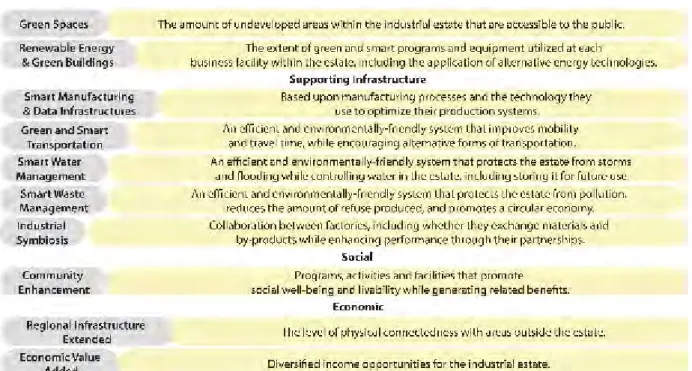
around the world and are redefined as illustrated in Figure 2.
Below, the reviews of selected international case studies and scoring of their performances are defined and briefly discussed. Each case was scored to
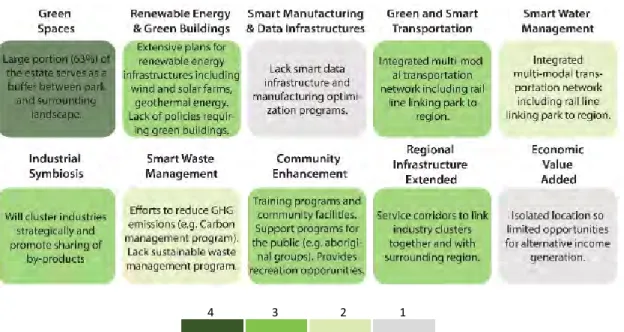
determine their effectiveness in each of the ten categories (referred to Figure 2). It should be noted that the scoring is on comparative basis among these selected world’s best standard. This aims to show opportunities to strengthen their green and smart vision practice. Finally, an evaluation system for the eco-parks is illustrated: classifying their performance in rating scales from 1 to 4, where 1 is the lowest and 4
6 Referred to:
• World Bank Group, United Nations Industrial Development Organization (UNIDO), Deutsche Gesellschaft für Internationale Zusammenarbeit (GIZ), “An International Framework for Eco- Industrial Parks,” 2017.
https://openknowledge.worldbank.org/handle/10986/29110
• United Nations Industrial Development Organization (UNIDO),
“Implementation Handbook for Eco-Industrial Parks,” 2017.
the highest to meet global best practice of the same category.
Case 1: Kalundborg Industrial Estate, Denmark
Kalundborg is the most famous example of a circular economy and by-product exchange in an industrial estate, as it is credited with being the pioneer of industrial symbiosis. The estate did not develop through a large-scale planning process, but rather is the result of a gradual evolution of cooperation and exchanges to create a complex web of symbiotic interactions between eight neighboring businesses and the Kalundborg municipality. Initially for solely cost- saving purposes, the exchange network has evolved, and the estate now demonstrates how green practices can provide social and environmental advantages as
https://www.unido.org/sites/default/files/files/2018-
05/UNIDO%20Eco-Industrial%20Park%20Handbook_English.pdf
• UN Environment, “Green Industrial Policy: Concept, Policies, Country Experiences,” 2017.
http://wedocs.unep.org/xmlui/bitstream/handle/20.500.11822/22 277/Green_industrial_policy.pdf?sequence=1&isAllowed=y
Figure 2: Ten Categories of Green and S mart Industrial Estates
18 well. The estate is independent of fossil fuel energy
and achieves sustainable growth through its framework focused on innovation, new green
technology and resource efficiency. The estate is home to businesses in a variety of industries including energy, pharmaceuticals and biotechnology, clean technology and waste management. This network of recycling and reuse has generated cost savings for companies of roughly USD15 million per year while reducing pollution and waste outputs in the area.
The development of this park was led by private industries, through commercial agreements between
business partners, adding the local municipality as a partner at a later stage. Currently, the park is managed and supervised by a committee consisting of a
representative from each business and the
municipality. The role of the local government is to help monitor exchanges and ensure cooperation between industries. Additionally, it has created local policies and incentives to encourage waste reduction by park tenants.
Apart from its pioneering scheme in industrial symbiosis, Kalundborg Industrial Estate has shown its strengths in renewable and green buildings; and waste
Figure 3: Kalundborg Industrial Estate, Denmark
Figure 4: Performance of Kalundborg Industrial Estate
4 3 2 1
19 management. The lacking is in the areas of green
spaces; and smart transportation (see Figure 4).
Case 2: Qingdao Sino-German Eco Park, China
The Sino-German Eco Park, a 4,060 Hectares industrial park located in Qingdao, China, is an excellent example of a green and smart industrial estate. The project demonstrates cooperation between governments, businesses and research institutions to achieve a world leading environmentally-friendly and innovative
industrial park. The vision of this project, which was designated as a Smart China pilot city, was to create an industrial park that would be a laboratory for
sustainable industrialization and urbanization. The industrial park was initiated through a bi-lateral national partnership between the Chinese Ministry of Commerce (MOC) and the German Ministry of Economic Affairs and Energy (BWMI). The partnership was created to capitalize on the strengths of each nation, pairing China’s rapidly growing economy and lack of green industrial processes with Germany’s advanced technologies and management expertise.
The park is financed through a mixed model PPP (Public-Private Partnership). Investments for the project from China come from the government, while
investments from the German side come from private companies and stockholders as the park is listed on the German stock exchange. The park is managed by a joint venture, the Sino-German Eco Park Development Co., which oversees park operations. The aspects where the Sino-German Eco Park are considered strong including the renewable energy and green buildings; and its smart water management (see Figure 6).
Case 3: Oakajee Industrial Estate, Australia
The Oakajee estate illustrates exemplary integration of an industrial estate with the surrounding environment under an ecological framework. The project is a result of long-term planning and in-depth site analyses for a strategic greenfield industrial development. The site is still in the construction and implementation phase;
however, it will be home to heavy and light industries that are linked to nearby transportation hubs, including a deep-sea port. The development strategy has three goals: protect and incorporate natural values, enhance cultural benefits, and stimulate regional economic growth. One key practice used to achieve these goals is dividing the estate into four areas: Strategic Industry, Coastal, General Industry and a Buffer. The site aims to be a model of local and regional industrial
Figure 5: Qingdao Sino-German Eco Park, China
20 development that provides social and environmental
benefits.
The project was initiated by the government in an effort to enhance economic development in the region, therefore several government entities are participating. This includes the Department of State Development, Western Australia Planning Commission, Western Australia Environmental Protection Authority and the local municipality. However, the estate is
managed, and a majority of the land is owned, by a private development company, LandCorp.
Oakajee estate has undoubtedly had a precious plan for its landscape. However, its data infrastructure is still lacking, while the economic value added is limited due to its isolated location.
Figure 6: Performance of Qingdao Sino-German Eco Park
4 3 2 1
Figure 7: Oakajee Industrial Estate, Australia
21 Key Takeaways from Kalundborg, Qingdao Sino-German and
Oakajee
From the above three examples, planning and development processes are deemed equally important steps towards success. The case of Kalundborg Industrial Estate (Denmark) has proved successful through gradually development, not through a large-scale planning at the early stage. The initial planning at Oakajee Industrial Estate (Australia), through zoning to ensure social and environmental benefits, can advantageously illustrate different
scenarios for considerations, leading to foreseeing risks and potential advancements from the very beginning.
Deep-Green and Smart model of industrial area development highly requires different levels of
cooperation. Qingdao Sino-German Eco Park in China is a good example of intergovernmental partnership matching strengths of China’s rapidly growing economy and of Germany’s advanced technologies
and management expertise together, through an innovative PPP model. Oakajee has planned to involve three-levelled inter-ministerial cooperation: central, regional and local. Kalundborg has actively involved the local government who plays role to ensure smooth cooperation among businesses and municipality in the area.
All in all, the attempts towards greener and smarter status of all three examples are to ensure
environmental sustainability, economic growth, as well as social wellbeing. The industrial symbiosis model at Kalundborg has proved beneficial not only to the businesses (cost saving of USD15 million yearly), but also to the local municipality in terms of both social and environmental advantages. The Qingdao Sino- German Eco Park model aims to provide sustainably harmonization between urban and industries.
Oakajee’s plan has also involved ecological and cultural benefits into its scheme.
Figure 8: Expected Performance of Oakajee Industrial Estate
4 3 2 1
22
3. Roles of Industries in Green and Smart Industrial Estates
Role of Industry in Green City
Presently, each major city around the globe tends to be highly vibrant while facing varieties of political, economic and social challenges in one limited boundary. To distinct some economic activities especially heavy industries away from the cities, the idea of industrial estate development has come into actions.
The government has played an important role in arranging separate areas of land to be developed as sites for factories and other industrial businesses. In doing so, communities will perceive generic benefits from risks of noise, odors, lights and pollutions. While the estate operator shall ensure that the required facilities and factory accommodation are provided to the entrepreneurs to establish their industries there.
Apart from necessary facilities for industrial operation such as water, transport, electricity, steam, wastewater and waste management services, others might also be included such as bank, post office, canteen, hospital and first-aid, or even other special arrangements for technical guidance and common service facilities.
Provided that there are huge working opportunities and necessary provision in and around the industrial zone, while the housing prices in city centers rising, this migration of industry has pushed the working class out to the peri-urban areas. Large numbers of not only workers but also people looking for cheap land, often near these estates, tend to roam and settle in the adjacent area, or even within the estate boundary where space available, leading to emergences of communities, eventually, end up creating conflicts when they start complaining about noise, odor, etc.
Therefore, it is crucial and unavoidable to find
harmonized way to urge industrial development to go hand-in-hand with living societies.
What Attribute to Green and Smart Industrial Estates?
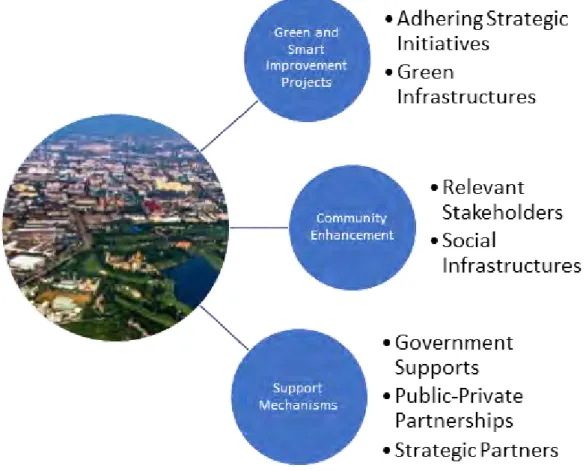
The subsequent section will provide an overview of concerning aspects to pursue green and smart
development: Green and Smart Improvement Projects, Community Enhancement, and Support Mechanisms.
These development categories coupled with specific case studies and global trends (Section 2) will formulate the criteria used for the recommendations for the green and smart Best Practices for the case study Amata City Chonburi (Section 4).
Green and Smart Improvement Projects
For an industrial estate, implementing projects that are environmentally friendly, climate-resilient and
innovative will allow the estate to model sustainable industrial development nationally and worldwide.
Improvement should first focus on adhering to strategic initiatives and implementing varied types of green infrastructure improvement projects.
At international level, the adhering strategic initiatives may be tied to the UN Sustainable
Development Goals, which outline of goals to achieve by 2030 for the creation of the sustainable world.
These goals address the most pressing global challenges, and the UNIDO Green Industry Initiative, where the estate can work with governments to support industrial institutions that provide assistance to enterprises for greening of industry. Attempt to green industries by promoting sustainable economic growth and improving production processes.
Urbanization and changes in land use surrounding the industrial estate may be some of the problems causing concern for the surrounding community. Incorporation of green infrastructures—e.g. permeable pavements, green streets and alleys, green parking space, urban tree canopy, etc.—into the estate can help reduce the negative environmental impacts of development while improving economic opportunities, social conditions and environmental health. Green infrastructures are
23 defined as networks of natural and semi-natural
features and green spaces that intersperse and
connect communities. The green infrastructure projects will ultimately create an enhanced industrial area that harmoniously promotes human welfare, ecological sustainability, and economic prosperity.
The following concept “Sponge City” illustrate an example of a potential green infrastructure project.
Community Enhancement
There is always an opportunity to improve social conditions of the surrounding community and
minimize adverse public impacts from activities within an industrial estate. Social improvement outcomes can be achieved by engaging stakeholders, facilitating community outreach programs, and constructing social infrastructures.
First of all, relevant stakeholders are to be identified.
In general circumstance, stakeholders that should be involved with programs and engagement strategies include industrial estate planners, developers, operators, and management; firms within the estate;
industrial associations and chambers of commerce;
national, regional, local governments; financial sector, funding agencies, and donors; international
development agencies and NGOs; scientific research institutions/universities; and local community.
Figure 9: Aspects in Pursuit of Green and Smart Development
24
Box 3: Sponge City
One acclaimed application of green infrastructure to promote climate resilience and environmentally-friendly communities is the sponge city concept.
Urbanization and land use changes have caused an increase in the incidence of flooding globally. Sponge Cities are an alternative stormwater management method to grey infrastructures. A sponge city is an urban area designed to manage water and mitigate flood damages. This is achieved by increasing infiltration, as well as better managing (delay, store, resist), and purifying stormwater runoff. Common stormwater management plans are made of networks of expensive grey infrastructures, including storm drains and canals. Increased urbanization has causes stress on stormwater infrastructure, since increases in paved areas cause larger amounts of water to accumulate than ever would naturally because this water cannot infiltrate into the ground. This leads to recurrent flooding, surface water pollution, and water shortages.
Sponge Cities are a way to combat these issues with a nature-based solution. A Sponge City is a development that absorbs, cleans, and uses rainfall to reduce flooding and polluted runoff by employing environmentally conscious and nature-based water management solutions. The goals of a sponge city are to absorb, store, infiltrate, and clean excess stormwater, in addition to helping mitigate impacts of too little and too dirty water. These concepts are particularly relevant and useful for areas subject to flooding, since these green infrastructures reduce and slow water during periods of persistent rainfall. Therefore, sponge cities provide economic, social, and environmental benefits when implemented.
Sponge cities are created by constructing a network of green infrastructures and permeable surfaces that control water sheet flow. Accordingly, green infrastructures and sponge cities in particular provide a wide array of benefits for developments where they are implemented. The utilization of green infrastructures in developments yield ecosystem services such as improvements to: air, soil and water quality; energy, nutrient and water cycles; noise and GHG pollution;
public health; biodiversity and environmental health; and climate resilience and regulation.
China is a leader of sponge city development and has created a pilot program to implement these projects in several communities. One successful Chinese project is Minghu Wetland Park in Liupanshui City. This project in a deteriorated peri-urban area restored a formerly channelized river to a meandering river and wetland, in an effort to control flooding and purify water. The project inundates flooding and promotes climatic resilience by storing flood water during periods of high rainfall; however, when flooded areas are empty during the dry season those lands are used as park space. The site is characterized by a network of bridges that connect to several areas of land and permit use during both the wet and dry season, creating public space and enhancing the site’s ecological integrity.
25 Community outreach helps create a productive link
between an industrial estate and the local community.
Therefore, it is important for an estate to establish mechanisms for collaboration and dialogue with stakeholder groups to provide benefits and facilitate connections between all parties. An essential
component of the community outreach program will be public participation and collaboration events. These programs could manifest as using community-based planning tools, facilitating stakeholder engagement workshops and programs, hosting community events, and developing public enhancement strategies.
Building relationships and implementing outreach programs with stakeholders will provide an improved understanding of perspectives, ultimately helping to prioritize development projects and cultivate public support.
Social infrastructures are a mix of facilities, spaces and projects that provide social services and improve the standard of living and quality of life in a
community. Including assets such as school, medical and utility facilities, these areas support the public by providing shared community spaces. These
infrastructures represent an opportunity to improve community health, function, and quality of life by creating structures based on ecologically-friendly and smart designs, which will ultimately make a community a more pleasant and productive place to work, live and learn.
The implementation of social infrastructures promotes numerous benefits for communities. A particular estate should craft an approach that targets specific benefits they would like their social infrastructures to generate.
Potential social benefits include quality employment opportunities; improved working conditions and spaces; training and education opportunities; social inclusion; local and small business assistance; public health and wellbeing; safety; environmental
improvement (air, soil and water quality); recreation and leisure opportunities; diverse transportation options; and flood and disaster resilience.
Support Mechanisms
For industrial estates to effectively transition from a production-based industrial site to an environmentally- friendly estate with high technology and innovation, there are several partnerships and support
mechanisms they could use. This section illustrates the potential partnerships and support mechanisms, including governmental support, public-private partnerships and other strategic partnerships.
Government supports in the form of policies and funding is critical for the creation of a successful and sustainable eco-industrial park (EIP). The following roles, responsibilities, and policies to embrace or enact offer insight into how various levels and agencies of the government can help create a green and smart industrial estate that serves the mutual interests of the estate and communities simultaneously.
Eco-Industrial Parks are especially valuable in developing and emerging countries since they
promote environmental, economic and social benefits;
therefore, it is in the interest of the government to promote their development. Governmental support for eco-industrial park projects can be applied through a variety of methods and activities, including the following roles and responsibilities from EIP projects around the world:
• Participation of national agencies (including in PPP’s) to support EIP development
• Creation of funds, environmental investments, and community programs
• Streamlining of permit processes
• Support of R&D for studies, projects and ongoing programs in the estate
• Facilitate financing from international sources
• Technical support, training and education
• Incentives for recruitment
• Awards for environmental performance
• Creation or amendment of policies and regulations to support EIP development
26 Apart from the variety of government’s supporting
mechanisms for green and smart improvement projects, these supports may be provided at various levels: national, regional and local. Some examples of different supports are provided below.
• National: National Industrial Symbiosis Program (NISP, UK) – Program developed in 2005 to facilitate exchanges of wastes and unused by- products from businesses in a variety of industries by delivering cost savings while reducing reliance on raw materials and waste discharged in landfills. In the first four years of the program, it delivered cost savings of USD166 million to its members as well as prevented the use of 9.4 million tons of industrial water and 7.9 million tons of raw materials.
• Regional: Tertre Eco-zoning (Belgium) – The Walloon regional government designates zones for specific industries to locate.
• Local: Kalundborg Industrial Park (Denmark) – Prompted by water shortages, industrial exchanges have been funded, planned, and supervised by the Kalundborg municipality in partnership with private businesses to save money and promote environmentally-friendly development within the industrial park in support of industrial symbiosis initiatives. The exchange of by-products and resources is done with a primary emphasis on promoting
economic benefits, delivering total estimated savings of USD 91 million per year, while reducing yearly emissions by about 240,000 tons.
Public-Private Partnerships (PPP) are an innovative method for private industries to work with
governments and other institutions. They are utilized when governments want to compensate the private sector for public improvement projects and are most viable when their shared investments create mutual benefits. In PPP’s, public and private sector partners share resources, risks, responsibilities and rewards, and
work together to develop, operate and maintain infrastructures. Typically, PPP’s are used for long-term contracts such as community infrastructures. Specific to industrial parks, PPP’s are an effective method to secure government support for projects that extend or provide benefits outside of the estate, such as green corridors and transportation networks. The Asian Development Bank outlines the basic steps to form a PPP as:
• Discuss financing strategy, development plan, and timing for creating each partnership
• Establish roles for members and channels of communication for coordination of activities
• Create allied nonprofit organization (if applicable to access certain funding)
• Execute established plans and programs with continued monitoring
Forming strategic partnerships is considered another beneficial approach. Key types of strategic partnerships are:
• Educational Institutions: Eco-Industrial Parks can increase their productivity and improve the likelihood of their success by partnering with educational institutions, particularly universities.
EIP’s around the world have formed various types of partnerships with universities for research and development, planning, satellite campus locations, and training courses.
• Other National Governments: Partnerships between two national governments have been a successful mechanism to create sustainable industrial park projects that serve mutual interests. The most productive national partnerships couple the expertise of one country with the weaknesses of the other to create mutually prosperous collaborations.
Nations considering these types of partnerships must objectively evaluate their strengths and weaknesses, then search for a complementary country.
27
• International Organizations: Collaboration with international institutions is a valuable method to create a green and smart industrial park.
These types of institutions can offer support to industrial estates through studies and technical training, planning and policy development, and funding. Non-Governmental Organizations (NGO), development banks and aid
organizations are suitable partners for industrial estates while transitioning into a green and smart development.
• Businesses within the Estate: To ensure a successful and lasting green and smart industrial estate, it is vital to attract and house businesses that buy into the development plan.
Park management should educate companies already established within the park as well as potential recruits on the benefits of being located within a green and smart industrial
estate. Securing commitments to green production practices from businesses in the estate will result in a community of tenants that
is more resilient, cooperative and economically prosperous.
Key Categories of Green and Smart Industrial Estates
The ten key green and smart improvement categories for industrial parks have been identified to gauge performance and guide development of industrial estates, based on the standards, guidelines, and criteria dictated by UNIDO, World Bank, and GIZ, as well as the standards for Eco-Industrial Parks (EIP) in China.
Additionally, critical concepts and strategies from international best practice case studies were researched to further ascertain key categories for sustainable industrial development (Refer to Section 2, subsection Attempts towards Greener and Smarter Estates: Worldwide Examples). The ten key Green and Smart Categories are reappeared in Figure 10, with description that followed.
1. Green Spaces are defined as areas of vegetation dedicated for conservation, recreation, and aesthetic purposes. These can contribute environmental, economic and social
Figure 10: Ten Categories of Green and S mart Industrial Estates
28 benefits when created, particularly if they are
near built environments. Examples of green spaces are parks and conservation areas as well as green corridors and streets.
2. Renewable Energy & Green Buildings investigate applicability of green and smart programs and equipment utilized at each business facility within the estate, including the application of alternative energy technologies.
Buildings can achieve these outcomes through a variety of methods, including efficient use of resources (e.g. water, energy) and renewable energy, reduction of waste, and integration of green infrastructure components.
3. Smart Manufacturing & Data Infrastructures employ computer-integrated manufacturing combining with digital infrastructure in order to promote high levels of adaptability and rapid design changes, digital information technology, more flexible technical workforce training, as well as data sharing and consumption.
4. Green & Smart Transportation networks would include a combination of light rail, local transit routes, high capacity transit lines, feeder buses, shared mobility options,
bikeable/walkable streets. Mobility hubs are locations where transitions between these modes can occur.
5. Smart Water Management is with an objective to create man-made spaces and enhance ecosystems that play an important role in the water cycle by helping to regulate storms and flooding; to store water for future use; as well as to filter water pollutants.
6. Smart Waste Management, with an ultimate aim to apply zero-waste management systems, is an effective method to improve resource efficiency and demonstrate a commitment to sustainability to the public.
7. Industrial Symbiosis is defined as the utilization of surplus resources as a new input into another process. Industrial Symbiosis presents the opportunity for companies to utilize wastes and exchange by-products in an effort to reduce both economic costs and environmental impacts. Industrial Symbiosis projects have been implemented at various scales (local, regional, national) around the world as a method for a network of
organizations to create shared benefits through exchanges of materials.
8. Community Enhancement programs, activities and facilities provide the public with space for various outdoor and recreational activities, which in turn promote social wellbeing and livability while generating related benefits.
9. Regional Infrastructure Extended in order to increase the level of physical connectedness with areas outside the estate. The infrastructure should be linked with sustainable transportation networks to serve as nodes in the system (e.g.
stops along bike and pedestrian routes) that allow users to take breaks and change routes during their journeys.
10. Economic Value Added is an aspect which aims to diversify and extend economic
opportunities for not only the industrial estate itself, but also workers and other inhabitants in the surrounding communities.
29
4. Amata City Chonburi: A Case Study in Thailand
Having focused on “Green Cities” as one of the
emerging areas in green and sustainable advancement, GGGI Thailand has discussed with relevant government and private agencies seeking for promising players in the field. Amata Corporation is one of the most advanced estate companies in Thailand and was recommended by the Industrial Estate Authority of Thailand (IEAT). While its Chonburi site was chosen as it was the pilot site of the Corporate itself at the time of project commencement.
Given GGGI and Amata’s mutual vision on economic and social development, the two bodies clearly share similar objectives to pioneer a green city-industry development model. It is believed that the impacts of this project will lead to a simultaneous growth of both Thailand’s economy and living standard of the
communities in, and surrounding areas, as well supporting a more climate resilient and
environmentally sustainable industrial transformation.
The objectives of the project ‘Transitioning to Green and Smart City: Case Study of Amata’ carried out in Thailand are to work with Amata Corporation PCL (i) to develop green and smart industrial estate as a best practice for Thailand, and (ii) to share the experiences obtained from this assessment to interested parties across public and private stakeholders nationally and internationally. The initial phase of this project covered 2 outputs as followed:
• Output 1. Transitioning to Green and Smart City – by assessing Amata’s Smart vision against other green industrial estate development initiatives, and making
recommendations on necessary supports from relevant governmental bodies in order to formulate a ‘Green and Smart City’ best practice which is adaptable to other industrial lands and to provide recommendations to further
enhance the Amata’s green initiatives
• Output 2. Green Projects Identification – from the reviews under the scope of Output 1, turning the results into realization by working closely with Amata in identifying potential green projects with specific focuses on Community and Environmental aspects of the Smart vision. Among the identified green projects, the spin-offs are focusing on those relevant to environment, green area or others enhancing livability of the community in Amata City Chonburi.
It is planned that the spatial scope of the proposed project is to cover Amata City Chonburi, including communities within the industrial estate. The greater details of the selected estate are discussed in the following section. I