1
Goze
WOMEN, MUSICAL PERFORMANCE, AND VISUAL DISABILITY
IN TRADITIONAL JAPAN
Gerald Groemer
3
Oxford University Press is a department of the University of Oxford. It furthers the University’s objective of excellence in research, scholarship, and education by publishing worldwide. Oxford is a registered trade mark of Oxford University
Press in the UK and certain other countries.
Published in the United States of America by Oxford University Press 198 Madison Avenue, New York, NY 10016, United States of America.
© Oxford University Press 2016
All rights reserved. No part of this publication may be reproduced, stored in a retrieval system, or transmitted, in any form or by any means, without the prior permission in writing of Oxford University Press, or as expressly permitted
by law, by license, or under terms agreed with the appropriate reproduction rights organization. Inquiries concerning reproduction outside the scope of the above should be sent to the Rights Department, Oxford University Press, at the
address above.
You must not circulate this work in any other form and you must impose this same condition on any acquirer.
Cataloging-in-Publication Data is on file with the Library of Congress ISBNs: 978– 0– 19– 025904– 4 (paperback); 978–0–19–025903–7 (hardback)
1 3 5 7 9 8 6 4 2 Printed by Sheridan, USA
Maps ix
Conventions xiii
Preface xv
Introduction: Approaching the Goze 1
1. The Production of Visual Disability 15
2. The Development of Echigo Goze Associations 37
3. Learning the Goze Art and Way of Life 83
4. Touring and Performing in Echigo: Goze and Their Audiences 120
5. Endings: Coerced Liberation 188
6. After the End: Goze Songs in the Postwar Era 205
Appendix 219
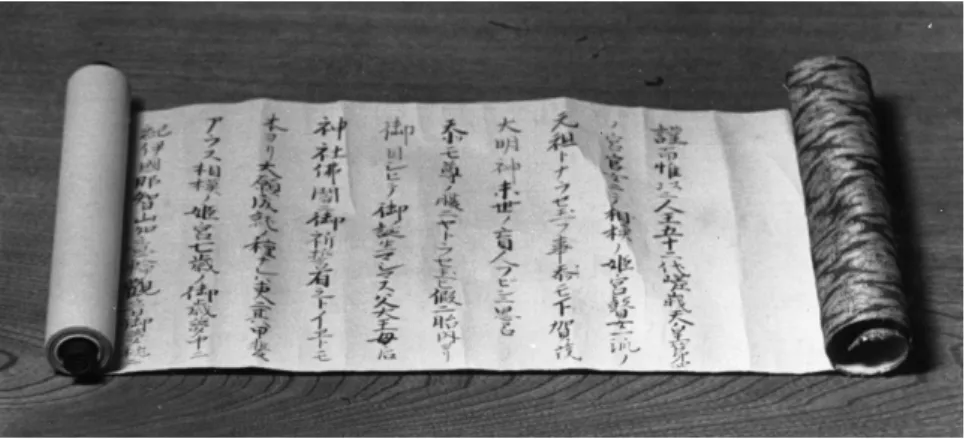
Document 1: “Origins of the Goze,” “Commands of the Retired Emperor,” and the “Goze Code” 219
Document 2: The 1884 “Regulations of the Takada Goze Association” 223
Document 3: The 1901 “Revised Regulations of the Takada Goze” 225 Document 4: The 1898 “Regulations of the Moral Reform Society
of Central Echigo Goze” 226
Notes 237
References 275
Index 297
3, 8, 10, 14, 23, 26, 27 = Kantō area
Japanese terms have been transliterated in a modified Hepburn system. Japanese names follow the standard Japanese order: family name, given name. All transla- tions of interviews and other citations are my own.
Since the late nineteenth century the Japanese government has combined towns and villages to form ever larger administrative units. Geographical designations have changed accordingly. Even during the course of writing, villages with cen- turies of history have been abolished, while cities with new and sometimes bizarre names have appeared seemingly out of nowhere. I have usually let older geographi- cal denominations stand when they are used by the speakers quoted but have added in parentheses the administrative unit to which a town or village belongs today. In other cases I have employed the most recent designation, aware that it will prob- ably not last very long. Modern cities, which may include huge swaths of farmland, mountains, and forests, are usually designated by the suffix shi (e.g. Niigata- shi, Jōetsu- shi). Towns are indicated by the suffix machi (e.g. Agano- machi). I have on occasion used the term “city” to translate shi, “village” to render the word mura, and “county” to refer to what in Japanese is called a gun or kōri. The term chō, when it signifies a ward or section of a town, I have left untranslated.
I have referred to Buddhist religious institutions as “temples,” Shintō ones as
“shrines.” Until the Meiji era, however, both religious traditions were inextricably fused.
Until the twentieth century, age in Japan was normally calculated by assessing how many discrete calendar years a person had experienced. An infant was thus assigned one year at birth and aged one year the following New Year’s Day. For this reason, when ages are converted to the Western system of reckoning, at least one year must be subtracted. I have converted ages to their corresponding Western number, except when translating interviews or historical documents.
Until 1873 the Japanese calendar was divided into months of twenty- nine or thirty days, numbered from one to twelve. Since such a twelvemonth soon became too short to cover the 365- day solar year, intercalary months were irregularly inserted to fill the deficit. I have indicated intercalary months with an asterisk.
Dates up to and including 1872, based on the Japanese lunar calendar, are notated numerically: year/ month/ day (e.g. 1660/ 3/ 27); or, if no year is given: month/ day. The year number indicates the year designation (nengō) comprising the bulk of the days of the corresponding Western year. When the day in question comes close to the end of a Japanese nengō, the Western date may in fact have moved one year ahead.
Such dates have been noted by adding a “+” sign to the year that represents most
of the nengō in question. Dates from 1 January 1873 correspond to their Western equivalents and are granted their English- language names.
The following historical eras or periods are used throughout this volume.
Heian 784– 1185 Kamakura 1185– 1333 Muromachi 1392– 1573
Edo 1600– 1868
Meiji 1868– 1912
During the Edo period the most common coin was the mon, which I have trans- lated as “copper.” A ryō was a large gold coin; a bu was a quarter of a ryō. After the Meiji period monetary values were calculated in yen (initially of consider- able value), the sen (1/ 100 of a yen), and the rin (1/ 10 of a sen). Especially after the Second World War rampant inflation led to a drastic decrease in the value of the yen.
Phrases in musical transcriptions are indicated by letters of the alphabet.
Strophic repetitions are marked by a number and the letter of the phrase being repeated (e.g. 2a, 2b). In many cases I have denoted the start of a new strophe in this manner (e.g. 2a) and then abbreviated what follows. Such abbreviations should be taken to signify repetitions, which in oral/ aural traditions always imply a degree of variation. Microtonal inflections are designated with small arrows pointing up or down. Notes whose pitch is unclear are identified by a note head in the shape of an “x,” placed at the approximate location of the pitch, in so far as I could make it out. Slides are specified by lines linking the notes in question. When the shamisen is struck forcefully, notes sounded on open strings tend to resonate for a considerable time (strings are damped only rarely and for special effect). Such resonances have been indicated by a slurlike mark extending over the following rest.
Full references to sources appear in the bibliography at the end of the volume.
I have not cited specific sources for classic Western works available online.
The initial impetus for writing this book was supplied by a simple question I have often been asked by colleagues, friends, and readers: why do you, a non- Japanese, sighted, urban- bred, middle- class man of the twenty- first century study and write about visually disabled, rural, peripatetic, lower- class Japanese female musicians active from the seventeenth to the early twentieth centuries, women whose personal and cultural attributes you do not share? This query has always seemed to me to be based on the odd presupposition that only identity can generate interest or concern.
Nevertheless, I have often countered it with the half- hearted rejoinder that in an earlier incarnation I too spent many a day eking out a living by performing music for scant rewards, that I struggle with a relatively minor visual problem, or simply that “we are all human.”
These responses have, however, always seemed to me hopelessly feeble. They not only reproduce the dubious presumptions of the question but also fail to address the vast gulf separating me from those who are known in Japanese as goze. Such inadequacies led me to search for a different way of posing the problem. Would it not make more sense to hunt for the source of a possible relation of goze to me— and by extension to the reader and to other non- goze past and present— on the broader terrain of social and political realities rather than in the narrow realm of the individual? Shared personal attributes, not the least of which is the ability to suffer, hardly need to be denied; however, might it not be wiser and more fruitful to admit the glaring differences and asymmetries among us, not the least of which is the fact that goze are no more, while also pointing out that neither the societies in which most goze spent their days (nor the one that I have called home for some three decades) have ever lived up to what, according to their own dominant ideologies, they promise, idealize, or claim to stand for?
Needless to say, Edo- period (1600– 1868) Japan and present- day Japan repre- sent vastly different societies. This is already reflected in the most common terms used to describe them. Whereas the toxic combination of economic, political, and social forces characterizing Edo- period Japan is often labeled “feudalism” (prop- erly noting the peculiar Japanese attributes of the item), the system within which Japan currently plays a major role is more likely to be called “post- industrial global capitalism” (or, depending on one’s conceptions, predictions, or hopes, “late,” “lat- est,” or “neo- ” capitalism). Meiji- period (1868– 1912) Japan and today’s Japan were also distinguished by important differences in their political systems, social insti- tutions, and cultural environment. Nevertheless, the Japan in which the majority of goze were active and the Japan that I inhabit resemble one another in certain
negative qualities, or, to put it more bluntly, comparable failures. Neither society has overcome the fundamental subordination of labor to a dominant class or social group, eliminated a coercive state separate from civil society, abolished patriarchy, done away with massive inequalities of wealth and political power, eradicated the discrimination of those with disabilities, or removed the injurious restrictions that keep so many people from fully realizing whatever cultural potentials they wish to develop (and many potentials are surely best left dormant). Such similarities are by any account a rather hefty slice of social life to simply overlook.
Goze of the past and most non- goze of the present would thus seem to share a rather overloaded plate of comparable social forces they might justifiably seek to oppose. Yet it would be a gross distortion to depict goze as explicit or disguised revolutionaries, even if one admits that they experienced more than enough unnec- essary misery to render such a political position fully defensible. Goze were no less immune to the effects of the hegemonic ideologies of their day than we are to those of our own age. When told to acquiesce to the forces arrayed against them, some Edo- period goze probably grimly mumbled, “There is no alternative.” Others must have derived comfort from the sense that, in the words of Erich Fromm, “Obedience makes me part of the power I worship, and hence I feel strong.”1 Two centuries ago most goze would probably have found it easier to imagine the end of the world than the end of the Tokugawa bakufu. On the other hand, many goze, whether aware of it or not, fought against the discriminatory constraints they faced, both individually and collectively. This struggle and its effects, not some timeless “goze mind,” enig- matic Japanese essence, or immovable “values,” shaped much of the course of goze history. Despite living in a land of authoritarian political institutions, patriarchal social structures, Confucianist calls for social unity, and Buddhist talk of the “end of history,” from the start of the Edo period goze began to actively pursue what I shall call their “emancipatory interests.”
This term perhaps begs for explanation. By “emancipatory interests” I do not mean simply an interest in “liberty” in abstracto, which would include, say, the freedom of private individuals to appropriate social wealth. If the concept “eman- cipatory interests” is not to be turned into a principle that effectively eternalizes and essentializes exchange value, free competition, and the money system, it must be interpreted as dialectically as the concept of freedom itself. For freedom, as even a moment’s reflection indicates, requires enabling institutions that do not on their own constitute freedom. Simultaneously it demands the abolition of constraints that exist for the purpose of economic exploitation, class- based political domina- tion, the maintenance of an unjust social whole, unnecessary cultural limitations, or even the mere self- perpetuation of institutions that ought to exist only as a means to an end. Emancipatory interests are not, as many liberals would have it, primar- ily a matter of individuals, but of a mutual mediation of the individual and the social whole. Wherever and in whatever form they are found, such interests can- not be fully homogeneous, since different individuals and social classes are never positioned in exactly the same way. But they must also be regarded as properly
universal because, as everyone from the ancient Indian bodhisattva to the American civil rights leader Fannie Lou Hamer has understood, “Nobody’s free until every- body’s free.” Emancipatory interests may be contrasted with what I shall at times label “positive” interests (i.e. an interest in gaining specific advantages or utilities).
Certainly the domains of “positive” and “emancipatory” interests overlap, if only because the acquisition of wealth, goods, skills, privileges, or rights is often nec- essary for achieving a degree of emancipation and conversely because successful emancipation ought to lead to tangible “positive” benefits. All the same, an inter- est in exploiting others, even if done legally, is not the same thing as an interest in eliminating the very possibility of exploitation. And that, crudely put, is something of the difference I am after.
Not all societies are equally outfitted with the material and political conditions necessary for their members to pursue their emancipatory interests actively and effectively. Japanese women with visual disabilities, I shall argue, could not easily do so collectively until the fatalistic, fragmented world of the medieval era had given way to the more dynamic, centralized society of “early modern” or Edo- period Japan. Increased production and capital accumulation, a higher degree of divi- sion of labor, more thorough administrative rationalization, and greater consumer demand all worked together to create an environment in which those defined as
“blind” were less apt to believe that pursuing one’s emancipatory interests meant something like turning inward, praying, and making the best of one’s karma.
Instead, goze began to search for ways to organize in order to counter some of the worst effects of the economic exploitation, political domination, social marginal- ization, ability- based discrimination, and cultural restrictions that Tokugawa rule brought on as well. Combating the sources of this matrix of oppression jointly proved an arduous undertaking, for bakufu lawmakers and administrators had their own reasons for encouraging forms of collectivization that advanced only the economic and political interests of the social elite. Nevertheless, as static as the early seventeenth- century socioeconomic and political order may seem compared to full- blown industrial capitalism, it encouraged the emergence of social agents who, to a far higher degree than their medieval predecessors, responded actively to the possibility of removing, surmounting, or circumventing the economic, political, social, and cultural obstacles placed in their way.
An attempt to read goze actions, statements, and songs in a manner that high- lights their emancipatory and dynamic qualities comes with significant advantages, for it allows the conservative quest for grounding understanding on a shared past—
on common traditions, identical pre- understandings and meanings, matching expe- riences, and established “identities”— to be replaced by a turn toward the future.
Instead of positing from the start certain shared positive attributes or experiences, such a turn seeks potential points of contact in a correlation of properly differen- tiated emancipatory interests among individuals or social groups each of whose situation emerges out of an intersection of unalike economic position, political status, geographical location, gender, disability, and other factors. Such a search
for promising alignments, which may be accomplished through verbal, artistic, or practical means, and is not predicated on the presence of an “ideal speech situa- tion” or even a desire for consensus, also implies a quest for new opportunities for mutual transformation and learning, and, in turn, for constructing a stronger and more broadly based critique of oppression and injustice.
Learning from what goze said, sang, or did, like learning from anyone else, becomes an emancipatory endeavor when it begins to bring to light the sources and effects of unnecessary and unjustifiable restrictions placed on the development of human potentials or, alternatively, on the pursuit of tranquility. When partici- pants move each other to reflect, whether through their unique abilities, different experiences, dissimilar positions, or divergent critical insights, they may uncover (sometimes to their own surprise) emancipatory interests they had previously been unaware of. Moreover, participants in such interaction may find that even if their experiences are not identical, they are not alone in being exploited, oppressed, dom- inated, deprived, or unnecessarily limited, and that much of their own understand- ing has been a function of what has previously been kept out of sight. Suffering tacitly assumed to be necessary or natural may be revealed as little more than the product of disproportionate benefits bagged by someone else. Alas, goze can no longer experience in person any advantages of such interaction with others, and, since true dialogue has become impossible, it is easy enough to attribute meanings to goze assertions that do not conform to goze interests. But this grand asymmetry is far less fatal if it is made explicit and subject to critical interrogation than if it is swept under the rug. Even if goze can no longer literally learn from anyone anymore, the words and songs they have left behind can still be mediated in ways that seek to take into account the emancipatory interests that goze assertions imply or embody. When what goze sang, said, or did is successfully presented in such a manner, the center of attention shifts from the misguided question of whether or not what has been recorded and transmitted is fully “authentic” to the problem of how differentiated emancipatory interests might be brought together across vast stretches of time and space in order to generate a more insightful and powerful critique of unjust social and political practices, wherever they are found. It means searching for a relationship that would transcend either bland identity or radical heterogeneity. Doing justice to goze and their songs can only mean something like this. At any rate, that is my, and to the extent that it is valid or defensible, our argu- ment, in a nutshell.
In order to begin to put into practice some of these simple insights, this vol- ume presents a constellation of first- person assertions (both spoken and sung) and third- person eyewitness observations (including photographs and historical docu- ments), both of which are mediated by my own inferences, reconstructions, and reflections. What goze could see, in part because they “were there” and suffered, I cannot hope to spy or feel; what seems clearly visible to me, thanks mostly to far greater access to archival material, they could not hope to make out. The result is a multivoiced argument that strives to avoid becoming either a seamless unity
in which the author controls everything or a collage of individual perspectives in which goze speak at random.
The introduction of this volume is dedicated to an abbreviated review of several portraits of goze painted by various observers, foreign and native, old and new. I have pointed out the shortcomings of these representations and suggested what is necessary to move beyond them. Chapter 1 treats the historical generation of discriminatory notions of visual disability in which, through which, and against which goze became aware of their own emancipatory interests and developed their institutions, practices, and arts. Chapter 2 turns to the formation of the occupa- tional associations that aided goze in resisting enforced passivity and allowed them to cultivate a unique way of life, one that was not just a repository of practices and meanings but also a source of new potentials. In chapter 3, I take up the pedagogi- cal methods that armed the “blind girl” with an art or skill useful for achieving a degree of social autonomy, for becoming a full- fledged member of a community, and for developing self- awareness as a professional musician. Chapter 4 treats the historical emergence of a large musical repertory and the performance practices that permitted goze to correlate some of their emancipatory interests with those of rural audiences. In chapter 5, I consider the challenges faced by goze when rapid modernization and a mandated abstract “freedom” placed unprecedented stress on goze associations and ways of life. The final chapter, which focuses on today’s situ- ation, suggests how emancipatory interests of goze and non- goze may still be cor- related through the sounds and silences of goze songs themselves.
Throughout Japanese history goze were identified and distinguished from the majority of women, including musicians, chiefly on the basis of their “blindness.”2 For this reason, a few comments regarding terminology related to visual disabilities are in order. Any writer carrying on about goze today can hardly avoid replicat- ing “emic” Japanese definitions and identifications that led to the determination of “blindness,” which, as I argue in chapter 1, was shaped by a complex and over- determined field of forces. Economic relations, political interests, social norms and practices, religious traditions, and scientific discourses all played constitutive roles in the historical production of the designation and social meaning of “blind- ness.” The most familiar Edo- period words for “blind” were mekura (literally “eyes dark”) or meshii (“faulty eyes”), terms notated with different ideographs or syl- labic characters from those used to write the term goze. Today such expressions are regarded as intolerably derogatory and discriminatory. Appellations such as mōjin or mōmoku no hito (both meaning “blind person”) and mōjo (“blind woman”) find greater acceptance, though because of a perceived bluntness tend to be replaced with the more technical shikaku shōgaisha (“person with a visual impairment”) or the more colloquial me ga mienai mono (“a person whose eyes cannot see”). The term shikaku shōgai, despite its clumsiness and the inclusion of a Sino- Japanese ideograph (gai) bearing negative connotations, at least highlights the fact that lim- ited vision may range from slight myopia to complete anopia, and includes blurred vision, clouded vision, tunnel vision, peripheral vision, black- and- white vision,
and many other variants and degrees of eyesight.3 When twentieth- century goze of Echigo (Niigata prefecture), the main subject of this book, spoke of themselves or their visual capacities they commonly turned to a number of simple locutions:
mienai hito (“person who can’t see”), me ga mienai (“eyes can’t see”), me ga warui (“eyes are bad”), and later the euphemism me ga fujiyū (“eyes are unfree”). Anyone with average or better vision was usually described as meaki (“open- eyed”), me ga aite iru (“eyes are ‘open’ ”), or just futsū no hito (“normal” or “average” person).
Terminology and concepts relating to visual abilities continues to be contested.
Everyday Japanese parlance bristles with expressions such as mōjū (“blind” obedi- ence), mōmoku- teki sūhai (“blind” reverence), monmō (“letter blind,” i.e., illiterate), or mekura- ban (to stamp one’s seal on a document without reading it), none of which conjure up anything overly commendable. In the West, too, deprecating con- ceptions haunt “blindness,” even if love is notoriously blind, “double blind” testing and “color blind” admission policies are sometimes hailed as examples of fairness, and Nietzsche once questioned social Darwinism by noting that “the blind man may see deeper inwardly, and certainly hear better.”4 Yet disparaging valuations already appear in the Bible, where “blindness” is consistently presented as a physi- cal feature in desperate need of “curing” when not simply relegated to the kingdom of the fiend. Plato described vision as the physical manifestation of the Good and of divine intelligence, and Aristotle announced that “as sight is in the body, so is reason in the soul.”5 From there it is a small step to the proverb that blesses the eyes as “the window of the soul,” to Rimbaud’s demand for deranging the senses in order to “be a seer, make oneself a seer,” and finally to Heidegger’s designation of “sight” as “a universal term for characterizing any access to entities or to Being, as access in general.”6 To anyone with a visual disability the problem of access is more likely to be a matter of building architecture than the nature of Being, but the prejudice that turns “seeing” into the epitome of— what else?— insight continues to be reproduced in countless turns of phrase in everyday language: enlightenment, casting light on a problem, seeing the truth, envisioning alternatives. Someone is far more likely to be chided for being “blind to reason” than praised for being “blind to error.” Influential books may be entitled Blindness and Insight, but no title currently in print construes “blindness” as the contrary of, say, delusion.
Not surprisingly, those who suffered from pejorative estimations of their visual impairments rarely fully shared the preconceptions they were based on. In the mid- eighteenth century, for example, Mademoiselle de Salignac, whose visual disability did not prevent her from steeping herself in mathematics, astronomy, poetry, and music, fancied that “people who see, distracted by their eyes, cannot listen and hear as I can.”7 Diderot once spoke of a “blind man” who found his sighted friends “very much inferior” in certain respects.8 Similarly, in what is now Ehime prefecture, a visually disabled village headman once explained that it was more profitable for him to hear than to see, for by sight “energy might be diverted.”9 Echigo goze, in a rever- sal of “normal” discriminatory appraisals, took sighted guides to be incapable of concentrating properly and becoming full- fledged performers.10 In northern Japan
the great folk shamisen player Takahashi Chikuzan, whose visual impairment was almost total, once argued, “People who can see pity people who can’t. But if you ask me, it’s the reverse: at times I think people who can see are the ones who are disabled. Because of their vision, they see more than they ought to, and end up see- ing everything indiscriminately. In truth some of them perceive nothing at all. After a musical performance they tell you the outfits were fetching or the lighting was splendid, but when you ask them about the performance itself, they say, ‘Well, I’m not quite sure.’”11 Nothing is gained by simplistically inverting negative assessments in order to turn visual disabilities into a marker of superhuman auditory, musical, or mental capacities.12 But as de Salignac, Echigo goze, Chikuzan, and the head- man all realized, every time something is seen something else tends to be occluded.
The relation of what is seen or heard to what is obscured or silenced is neither an eternal metaphysical verity nor an unchanging attribute of human psychology. It is rather a product of how forms of perception and understanding are mediated by historically contingent learning processes behind which stand social institutions and power relations that have always served the interests of one social class, stra- tum, or group at the cost of those of another. Everyone’s vision, including that of the fully “sighted” person, is limited, but this limitation itself often remains invis- ible until exposed by critical interaction with others, including those with visual
“disabilities.”
In order to acknowledge historical precedent, remind readers that vision comes in many degrees, modes, and shades, and pay heed to the current vector of usage, I have avoided labeling anyone “blind” per se. I have, however, availed myself of the word as a common expression of premodern periods. When I speak of someone who was “blind,” I mean “a person who was defined as ‘blind’ during a specific era or labeled as such by a particular writer.” Put differently, by “blind” I do not mean something like the visual ability of a person “whose visual acuity is 20/ 200 or less, or whose visual field is 20 degrees or less, in the better eye, with corrective lenses.”13 Instead, I take the term “blind” to refer to a judgment based on definitions and practices resulting from a tangled web of historical and sociocultural forces, some of which will be isolated in this volume. I am aware of proposed alternatives for
“disability” such as “special,” “challenged,” or “differently abled,” the last appar- ently devised by the US Democratic National Committee in the early 1980s and reflecting a poststructuralist critique of rigid binary oppositions (ability vs. disabil- ity). No doubt such hierarchies ought to be contested wherever they are discovered to be unfairly discriminatory. Yet only unexamined postmodern dogma can lead to the conclusion that replacement of binary oppositions by the proliferation of subtle gradations and multiplicities of difference always and necessarily constitutes an emancipatory move. Unjust discrimination is just as vicious, and often a good deal more pernicious, when it spreads itself out in endless intensities and infinite variations over a large social field.
Finally, a few remarks on transcribing and translating. Thanks largely to the efforts of a handful of postwar Japanese researchers, today’s ethnographers and
historians of goze can draw on a sizable corpus of written documents, visual images, and audio recordings of Echigo goze songs and interviews. In this volume, which seeks to combine the insights of ethnography, ethnomusicology, oral history, and social history, I have relied on a good deal of input from twentieth- century goze whose speech has been frozen in sound recordings or transcripts thereof.14 Since goze took themselves to be primarily musical performers and because their songs allow us to gain insights into historical and sociocultural contexts— and not just vice versa— I have included musical examples and a fair amount of discussion regarding the repertory that goze sang and played. In this way my approach differs from most studies of goze to date, which remain astonishingly reticent on the matter of goze music making and the musical attributes of goze songs. Research relating to goze over the past three or four decades has usually followed the lead of ethno- graphic, anthropological, and popular music studies, which tend to explain music in terms of class, gender, identity, images, and nearly anything else besides musical sounds. This seems to me rather like discussing Benedictine monks without men- tioning prayer or writing about bankers with no reference to money.
To facilitate a discussion of the musical attributes of goze songs I have fashioned transcriptions of music from sound recordings. The oldest recordings of Echigo goze date from the 1950s and represent performances of women born in the late nineteenth century. Some of their teachers thus learned what was transmitted in the late Edo period or shortly thereafter. Since Echigo goze traditions placed great weight on fidelity to the teacher’s model, it is safe to assume that the broad outlines, if not all the details, of the major goze songs recorded in the twentieth century have been transmitted to the present day. Yet here again, I am not so much concerned with establishing criteria for historical “authenticity” as with the possibility of allowing goze to contribute, through their recorded performances, to an argument that addresses emancipatory interests shared at least in part by goze of the past and non- goze today.
I realize that to some of its detractors any sort of transcription seems to “objec- tify” a performance, deprive it of its living presence, and illegitimately sever it from its “original” context. To those who hold such astonishingly phonocentric views, transcribing music, whether from a “live” performance or electronic reproduction, turns sounds into a dead letter. Such anxieties are perhaps justified when provoked by musical or cultural analyses that treat performances as Cartesian objects and reduce them to the discursive requirements of the natural sciences. An across- the- board aversion to transcription seems to me injudicious, however, because it over- looks that music always relies on iterations or structures that, though culturally and historically mediated, maintain a potential to generate meanings transcending any alleged “original” environment. Busoni’s comment that “the performance of a work is also a transcription” remains true even for music not originally notated on paper. A piece of music, as he argues, “exists both within and outside of time”
as something simultaneously ideal and material, each side mediating the other.15 Transcription, which “produces” its original just as much as it “reproduces” it, and
which like any performance always both reveals and obscures, need not betoken a ham- fisted mashing of musical particulars into bland generalities susceptible to scholarly dissection and academic quantification. It may also represent an espe- cially intense and carefully reflected form of experience and notation, one that holds a promise of spawning new significances. Whether a transcription is of value or not depends less on eternal verities regarding the act of transcribing than on the nature and use of the transcription in question.
I cheerfully admit that transcriptions cast in five- line Western staff notation imply certain musical biases, constitute a specific kind of “original,” and in their emphasis on the dimensions of pitch and rhythm may conjure up a spurious sense of familiarity for Western readers. For the purposes of this volume, however, I do not take this to be a mortal sin, for Echigo goze and their usual listenership also valued singing and playing that was properly “in time” and “in tune,” even if their criteria and judgments regarding such matters were not necessarily identical to those of a musician trained in the central European musical traditions of the sev- enteenth to the nineteenth centuries. Five- line staff notation certainly does not eas- ily permit the display of qualitative musical dimensions such as timbre, but this is equally true for a goze song and a Mozart aria. Newfangled forms of music writing, simple enough to devise, lose in readability (at least for the presumed reader of this volume) what they gain in “fit” to a specific instrument, genre, or culture. Because Echigo goze are historically, geographically, and culturally distant enough from the present to require additional alienation, I have chosen to run the risk of rendering goze melodies and rhythms in an easily readable, slightly modified conventional notation, taking the quarter note as the basic unit of pulse.16 And since I was once told by the Echigo goze Kobayashi Haru (1900– 2005) that neither she nor any of her peers took the melodies and accompaniments they sang and played to fall into two- or three- beat “measures,” I have mostly shunned indications of meter.17 Strophic structural units are indicated by repeat marks, but as in all orally transmit- ted music, repetition implies considerable and often spontaneous or unconsciously applied variation.
Much of what holds true for transcription applies equally to translation. To most modern listeners Echigo dialect and archaic phrases in goze song texts pose a formidable barrier to comprehensibility. The long sung narratives known as saimon matsuzaka or danmono, once popular enough, are peppered with antiquated locutions, words of uncertain meaning, and fragments of long dead sociolects.
Salty argot, quaint turns of phrase, and wide- ranging connotations defy Walter Benjamin’s demand that the translator produce the “echo of the original” in the target language.18 A true “echo of the original” of Echigo goze songs would be a complex, multilayered, heteroglot replication of a language whose immediacy to the usual rural, lower- class audiences of the past was in large measure a prod- uct of political marginalization and cultural privation. Resonances issuing from such a sociocultural environment hardly permit direct reproduction in today’s Anglophone world. Any attempt to translate goze renditions of danmono into an
old- fashioned rustic dialect of English would at best reproduce how Echigo goze song texts sounded to those for whom the language of the performance was an alien tongue. It would obscure and create the impression of distance where there was none. On the other hand, diction that seeks full transparency and visibility in order to replicate a goze language that did not parade itself as foreign is bound to radiate a false immediacy. When Benjamin writes that “a translation, instead of resembling the meaning of the original, must lovingly and in detail incorporate the original’s mode of signification, thus making both the original and the transla- tion recognizable as fragments of a greater language,” I interpret the notion of a
“greater language” not as some divine Kabbalistic Ursprache to which we ought to return, but rather a vision of a fundamentally political project of searching for ways in which differentiated emancipatory interests embodied in various narratives may interact in a manner that generates insights and effects none of the speakers could have produced in isolation.19 Translation thereby abandons the hopeless pursuit of complete reproductive fidelity and seeks to become a productive means for releas- ing new critical forces from transformative discursive processes.
Over the last quarter of a century countless people have contributed greatly to the development and transformation of my own thought. First I should like to thank, alas posthumously, two people who guided me as I groped my way forward in my study of goze: both the “last Echigo goze” (at least the last one active as a musician) Kobayashi Haru; and the indefatigable pioneer of goze research Sakuma Jun’ichi. It was Sakuma who insisted that I hurry to meet Kobayashi at the “House of Tranquility in Tainai” (“Tainai yasuragi no ie”), a Niigata prefecture retirement home for some sixty elderly people with visual disabilities. He warned me that this renowned octogenarian would surely not be alive much longer— incorrectly, as it happily turned out— and in July 1988 I traveled by train to Tainai to spend a hot and humid afternoon with one of the few ex- goze still willing to grant interviews.
This was no innocent “first encounter” of the sort typically gracing the opening pages of anthropological monographs. I had previously heard several recordings of goze performances and knew Kobayashi from published books, cassette tapes, photographs, and scholarly articles. The purpose of my short sojourn was merely to ask this “national treasure” a question or two concerning music and perhaps hear a sampling of her favorite anecdotes, already lavishly documented by Kiryū Seiji, Suzuki Shōei, and Sakuma himself. At Tainai I grilled Kobayashi about the long ballads known as kudoki, strained to follow her responses, and then, when the local dialect proved too much for me, let the conversation, guided by Sakuma, drift off to other topics. In time, Kobayashi, perhaps bored with it all, or sensing my ill- concealed wish to hear her perform, took out her shamisen, curtly enjoined me to loosen a stuck tuning peg, and began to sing a good portion of the kudoki
“Suzuki Mondo.” Despite her diminutive size and many years, her voice, steeled by the painful “winter training” she had endured eight decades earlier, still possessed the intensity of a laser beam.
In the subsequent years my understanding of goze and their world was shaped by so many people I scarcely dare list names for fear of leaving out somebody who deserves to be mentioned. I wish to express my gratitude to Suzuki Shōei, who pro- vided not just information, advice, and audio tapes but also several of the photo- graphs used in this volume. My gratefulness extends too to the late Ichikawa Nobuo, who taught me much and kindly permitted me to copy and reproduce some of the photographs his father took and collected in the 1930s. I am likewise indebted to Motegi Kiyoko, who shared with me private recordings of interviews with Takada goze, and to Horiuchi Hiromasa who supplied me with tapes of interviews of the same women conducted in 1976 by the composer Shibata Minao. Kobayashi Haru’s biographer Kiryū Seiji granted me the liberty to translate and reproduce large sec- tions of his invaluable work. Kayamori Naoko, Tsukioka Yukiko, and Tsurusawa Asazō kindly took time to talk with me about their thoughts on goze songs today.
Aiba Kōichi and Itō Yoshio generously presented me with many of the photo- graphs reprinted in the following pages. Finally, to Hugh de Ferranti, who read and criticized sections of an earlier draft, the anonymous readers who offered many valuable suggestions, Andrew Maillet, who aided with the digitalization of musi- cal examples, Adam Cohen, who set the project on its way, the staff at Oxford University Press, and everybody else who made this book possible, I would like to offer a heartfelt arigatō.
APPROACHING THE GOZE
Is there not an echo of what has been silenced in the voices to which we lend our ears?
— Walter Benjamin, “Theses on the Philosophy of History” (1940)— but missing from the standard English translation (see, or rather do
not see, Benjamin 2007a:254; in German, Benjamin 1991:693)
Introducing the Echigo Goze
Echigo province, today known as Niigata prefecture, is located roughly in the center of the western seaboard of Japan’s main island of Honshū. During the Edo period this region afforded the traveler a panorama of verdant rice paddies, thousands of diminutive farming villages, countless dry fields nestled among the hills and in the valleys, some 250 kilometers of ragged shoreline dotted with fishing villages, and here and there a town of respectable size. Niigata (the city from which the prefec- ture took its name) and a handful of so-called castle towns possessed impressive harbors. Additional urban areas were connected to one another by well- manicured roads. Small hamlets could be traversed on pathways winding through fields and mountains. Narrow trails stretched to areas so isolated that electrical lines would not reach them until well after World War II.
Echigo inhabitants, whether urban or rural, male or female, visually disabled or fully sighted, all shared a formidable foe arriving each year with clockwork- like precision. This enemy of the people was an almost unimaginable amount of snow, transported to the area by cold winter winds blasting across the Sea of Japan from the Chinese mainland. So much frozen precipitation blanketed the province each winter that the region was known as the “snow country,” also the title of Kawabata’s famous novel. Late medieval poets visiting the area might be moved to write, “Where in the capital can one see such red autumn leaves in a garden against a background of snowy peaks?” but Suzuki Bokushi, an Echigo native of the early nineteenth century, noted more pragmatically that “unless we dig away the snow, the paths to our homes are blocked and the houses themselves are buried, with no
room left for people to get out.” “Speed is of the essence,” he continued, “because if a second large snowfall arrives while you are clearing the first one, so much will pile up that no human powers suffice to remove it.”1 To combat the “white devil,”
as it was often called, the roofs or eaves of row houses in Takada (today Jōetsu- shi) and other Echigo towns were extended a few feet forward. This strategy produced arcades (gangi) allowing residents to move from one building to the next without ever emerging into the snow- choked streets. Meanwhile, making the best out of a trying situation, children built castles in the snow and adolescents presented the- atricals on stages of ice.2 When spring finally arrived, farmers hastily planted their crops and prayed that no sudden cold spell would spoil the harvest, which, after subtracting tribute exacted by the domanial lord and rent paid to the landlord, was anyhow always far too meager to support a comfortable existence. Then everyone took a deep breath and looked forward to the summertime “bon dance” with its euphoric mood, raucous sounds, and extraordinary social norms.
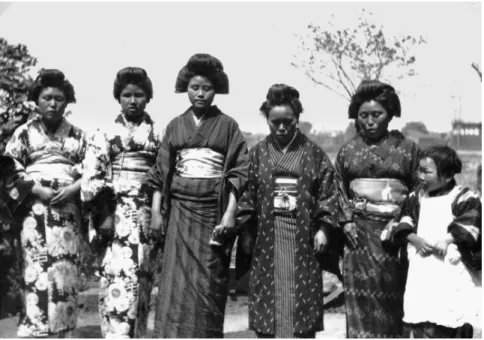
ILLUSTRATION 0.1 Two Takada goze of the Kusama group performing within the gangi of a Takada row house. Note that for such urban performances goze evidently did not wear their typical costume and headgear but preferred more elegant kimono.
Photographed 30 or 31 January 1939 by Hamaya Hiroshi.
From the Edo period until the prewar era an additional form of enjoyment could be relished after the snow began to melt: music performed by goze. The term goze derived from an archaic polite second- person feminine designation (gozen, literally
“honorably afore”), which, when appropriate, might be prefixed by the adjective
“blind” (mekura).3 Already around 1474 a dictionary glosses the ideographs usually read gozen as “blind woman” (onna mōmoku); in 1603– 1604 the Portuguese Jesuits identified the term “goje”— gozen with the final “n” dropped— as “molher cega,” again,
“blind woman.”4 In time the two ideographs used to write gozen were exchanged for ones literally signifying “blind woman” but pronounced “goze” all the same. During the Edo period, a minority of goze in the countryside played or taught the koto (a thirteen- string zither) or earned a living performing and teaching genres of “art music” such as jōruri recitation.5 A far greater number circulated from village to vil- lage, singing outside doorways or performing in parlors. Usually they accompanied themselves on the shamisen, a three- string spike lute played with a large plectrum (bachi).6 Goze also gladly responded to invitations to perform at parties and sounded their instruments at temple and shrine festivals. For farmers, fishermen, and their families the arrival of a party of goze spelled an evening of captivating song, news from the outside world, and perhaps for the children a rehearsal of old folktales.
Thanks to their musical abilities and even the folk- religious efficacy some- times imputed to their songs, their belongings, and their person, goze were often respected. Yet the bulk of their history was shaped by political domination and social discrimination. Already during the late medieval era comic plays (kyōgen) savagely mocked the behavior or words of goze, indicating that such “humor” was relished by many.7 Comparable attitudes were also commonly found offstage. A 1652 injunction from Nagoya prohibited local youths from forming gangs dedicated to molesting urban “blind men (zatō), goze, and indigents (hinnin)” and hurling stones at them.8 Seventeenth- century diaries record the presence of blind men and women alongside outcasts such as monkey handlers, puppeteers, and rainin (people with Hansen’s disease) who came to “beg for coins” at weddings.9 In Echigo province goze might be welcomed and addressed with honorifics— goze- san, goze- sa, goze- bō- sa, goze- don, and the like— by those who eagerly devoured their songs; however, vil- lage officials normally listed goze at the very end of population registers, just above or parallel to outcasts and practitioners of “polluted” occupations.10 In the capital goze were occasionally granted privileges that other women were denied, such as renting a house in their own name, but Edo- period comic haiku poets reflected rampant discrimination when they portrayed urban goze as easily conquered clod- hoppers.11 Some versifiers went so far as to advise men to beat a goze after a sexual encounter to dissuade her from clinging to her seducer.12 And when the shogun ven- tured outside his castle, goze, along with blind men and various other ecclesiastical and long- haired figures, were to be hidden from his majesty’s gaze.13 As we shall see again in chapter 4, goze on the road often suffered from intimidation and violence, sexual or otherwise. As involuntary nonconformists they drew the wrath of those proud to inform others what was “normal.” As scapegoats they were rewarded with
displays of power by those who, often themselves in a painfully subaltern position, wished to imagine themselves superior. Time and again goze recollected how chil- dren pelted them with missiles and showered them with slurs, while adults dispar- aged them as lowly beggars, suspicious drifters, or prostitutes in disguise.
In this social context, from the seventeenth century many goze throughout Japan found it advantageous to establish a large number of durable professional associa- tions. Some twenty goze houses stood in Takayama (Gifu prefecture), each dwelling sheltering a teacher and one or more protégés.14 In Iida (Nagano prefecture) and Kōfu (Yamanashi prefecture) dozens of goze and their pupils organized themselves in a sturdy hierarchical manner to facilitate teaching, touring, and meeting the chal- lenges of everyday life.15 Urban goze who performed mostly in the entertainment districts of what is now Toyama prefecture evidently also created their own unions.16 Another large goze association was found in the post- town of Mishima in Shizuoka prefecture. Here a number of goze households, each embracing perhaps three to five women (presumably a teacher, several students, and perhaps a guide) had been active since the early seventeenth century.17 Close by, in Sunpu (today Shizuoka City) and Numazu, even more capacious goze sororities were established during the first decades of the Edo period or slightly earlier. Yet other groups, sometimes numbering no more than a few individuals, sprung up in other areas of the land from Kyūshū in the south to Hokkaidō in the far north. The goze organizations of Echigo, especially in Takada and Nagaoka, were thus hardly unique. The chief difference was that they continued to function until after World War II and accommodated many women whose life stories and songs were carefully recorded.
Early Encounters with the West: Heine the Observer and Hearn the Interpreter
In 1854 William Heine, drawing navy pay and fortified by a grant from Congress, arrived aboard Perry’s “black ships” on their mission to pry open Japan and render it fit for American use.18 Heine was no navy regular. He had been brought along to observe, study, measure, estimate, sample, record, and describe “the general mass of information” he thought “desirable to collect.”19 As an accomplished illustrator of flora and fauna and an avid collector of ornithological and zoological specimens, he was eminently suited to the task. Almost as soon as he alighted from the vessel that delivered him to Japanese shores he set about assiduously gathering and docu- menting everything that met his inquiring eye.
At Shimoda, in what is today the southern tip of Shizuoka prefecture, Heine stumbled upon a woman who impressed him as warranting inclusion in the account he would pen of his scientific mission:
One day, strolling through the streets, I saw a young blind woman playing one of those three- stringed zithers [sic] I described on a prior page. The neck of
the instrument was uncommonly long and the lowest and highest of the three strings were tuned in an octave, the middle one at a fifth. The strings were not played with the fingers but by means of a piece of wood, like a very short and wide painter’s spatula. The melodies— music entirely in flat— contained snatches of rhapsody that would vanish in sudden shrill chords. Unknown to the blind lady- musician I stood a long time and listened to her unusual songs.
At last a woman came by who told her about me. She broke into bitter tears and would hear nothing to comfort her.20
Heine is clearly describing a goze. In his cool, detached tone, he seeks to paint a portrait that will strike his readers as properly “objective.” His words thus differ markedly from, say, the later fulminations of Sir Rutherford Alcock, Esq., C.B., Her Britannic Majesty’s Envoy Extraordinary, who, on hearing the music of Japanese musicians with visual disabilities, recoiled from the “discord” they emitted “when they set themselves to produce what they call music.” The sounds that assaulted his ears, Alcock howled, baffled all description. Even “marrowbones and cleavers”
were melodious in comparison, and the notes such performers brought out of a
“sort of lute or guitar” were “something too excruciating for endurance.”21 Heine, by contrast, sought to sanitize his acts of observing of any explicit valu- ation. The only overt reference to his subjectivity was a declaration that the music he heard was “unusual” (seltsam)— aberrant to him and his fellows back home, of course, not the woman and her usual audience. Unlike Alcock’s rant, which supplies little besides evidence of nineteenth- century Western prejudices, Heine’s unruffled reportage permits the reconstruction of a number of musical attributes of the wit- nessed performance. The woman clearly played the shamisen. She had evidently adjusted it to a ni- agari tuning (a fourth over a fifth) and sounded the strings not by plucking them with her fingernails but, as was usual, by striking them with a plec- trum. Her song was probably divided into melismatic vocal phrases (“rhapsody”) punctuated by accented double- or triple- stop downstrokes (“shrill chords”). Since the melody evidently included semitones (“entirely in flat”), it was possibly a genre influenced by Edo- period urban styles.
Most mid- nineteenth- century chroniclers, native or foreign, would have regarded such a performer as far too “lowly” to serve as a subject of serious writing. Heine, however, judged her a curiosity worthy of mention. But just as he steadfastly avoided critically reflecting on the notion of objectivity that guided his project of collecting insects and minerals, he wasted little time pondering his relation to the musician he had encountered. Such an effort would easily have led to a critical consideration of the broader interests regulating his project, not to mention the concerns motivating Perry and the US government. That, to him, hardly qualified as science.
This omission of self- reflection came with a price. Heine’s narrative breaks off exactly at the point where the encounter might have led him to ask the sort of ques- tions that could have taught him a good deal about Japanese society, the position of goze within it, and the meaning of goze songs. Why, for example, did the goze
perform at all when she thought she was alone? Who was she, anyhow? Was she tour- ing with others? What was she singing? And what might the flood of tears released by the words of the sighted woman have signified? For Heine all this remained a mystery. The performance and the tears were merely two inert facts among others, duly noted and registered. They did not signal to him that his attempt to compre- hend the situation by erasing himself from the site of observation had failed.
Forty- odd years later, a Greek Anglo- Irish American named Lafcadio Hearn sketched another verbal picture of a goze, one transcending the limits of Heine’s emaciated description and Alcock’s bigoted bluster.22 Entitled “A Street Singer,”
and appearing in the 1896 volume Kokoro, Hearn’s story more or less plausibly depicts a woman and her son who made their way to the author’s home, probably in Kumamoto or Kōbe, to perform songs and vend chapbooks. Hearn relates how the woman tuned her shamisen, played an introduction, and then sang as “only a peasant can sing. … with fractions and semi- fractions and demi semi- fractions of tones never written down in the musical language of the West.” He notes the emotional effect of the song on neighbors, who shed profuse tears. After the recital ends Hearn discovers that the woman is blind. So shocking is this revelation that the eight words announcing the fact command a paragraph of their own. Hearn then interrogates the woman and hears of her poverty and hardship. He grants her a meal, dispenses some coins, and purchases a booklet concerning “a recent double suicide.” These lyrics he estimates as entirely hackneyed: “All the wonder of the performance had been in the voice of the woman.” Hearn muses whether or not the song of the goze was even human at all. Perhaps it was learned “from the cicadae and the wild nightingales.” He concludes that “the chant of a blind woman in this city of the Far East may revive in even a Western mind emotion deeper than individual being,— vague dumb pathos of forgotten sorrows,— dim loving impulses of generations unremembered.”23 Unlike Walter Benjamin, who, as this chapter’s epigraph suggests, advised readers to listen for the echo of the silenced, but who steadfastly refused to turn silence into a positive image of mysterious beauty, Hearn presents muted emotions from the past as an example of the glory of “Japanese cul- ture.” Like Heine, but for different reasons, he persistently declines to ponder why Japanese society so often rendered inaudible and invisible the injustices endured by past generations or why the goze and her child were exposed to such poverty and hardship in the first place. Anguish and misery, like everything else exposed to his inquisitive gaze, were instantly converted into a positive meaning, an inscrutable marvel referring to venerable ancestors and the great national soul.
To his credit, Hearn, unlike the majority of immigrant intellectuals active in Japan at the time, did not take himself as a conduit of Western illumination to a benighted Asian people. He sought instead to assimilate himself to what he took to be “the Japanese” themselves. By wearing Japanese shoes, no matter how tight they might fit, he strove to assume a postulated “native’s standpoint,” one he believed ought to be transmitted to the West and emulated. As the title of his last volume, Japan: An Attempt at Interpretation (1904), suggests, his stance was self- consciously
hermeneutical. He saw himself as a translator of cultures, an intermediary between worlds. His mission did not stop with explaining the scrawny data that was “desir- able to collect,” but moved on to offer “thick,” even bloated descriptions of mean- ing- laden symbols, figures, and manifestations of the “Japanese spirit,” to which the title Kokoro explicitly refers. Where Heine had bashfully concealed his own role in selecting, evaluating, and representing what he observed, and Alcock uncritically took the unexamined values of his own sociocultural background as the basis of what he took as universally valid judgments, Hearn longed to achieve a full unity with “the Japanese” through an almost mystical identification.
Yet Hearn’s image of Japan is best viewed as an inversion of what he detested the most: the shallow materialism and crude, philistine pragmatism that de Tocqueville had already identified half a century earlier when he wrote that “nothing conceivable is so petty, so insipid, so crowded with paltry interests, in one word so anti- poetic, as the life of a man in the United States.”24 The problem was not that American society did not deserve such a contemptuous diagnosis but that Hearn wildly dis- torted Japan itself when he offered its alleged virtues as a cure for American ills. To him the land of the rising sun was characterized by a harmonious, homogeneous society unified by an ineffable, sensual, aesthetic spirit, utterly lacking in the land of stars and stripes and apple pie. Whatever elements of truth such a view contained, it conveniently overlooked the fact that in Japan the interests of landholders and tenants, city folk and country dwellers, and factory owners and workers were just as antagonistic as in the West or anywhere else. This expedient oversight earned Hearn countless fans in his adopted homeland, where his name remains a household word to this day.25 But because everything entering his field of vision was reduced to an undifferentiated, organic “Japaneseness” whose ideological force is bought at the cost of silencing the voices of dissent, doubt, and critique, his portrait of the goze and her son rings sentimental and hollow.
Japanese Encounters: A Brief Overview
Native chroniclers had of course taken note of goze and their habits long before Heine, Alcock, or Hearn set foot on Japanese soil. Medieval authors of Buddhist- inspired tales routinely invoked goze as exemplars of religious piety. An occasional wayfaring diarist registered the appearance of a goze on the road, and poets and essayists often spoke laconically of the pitiable existence of women whose visual abilities were rated as below par. Shogunal and domanial bureaucrats sweated over how to treat goze in legal cases and whether or not to grant them any special privi- leges. Village officials and local administrators busily tabulated goze populations, listed names, and ascertained the locations of domiciles. In household account books farmers jotted down the number of coppers donated to peripatetic goze visi- tors, while Edo- period humorists mocked distinctive goze garb and belittled their provincial songs.
After the start of the twentieth century, when hopes of rejuvenating old tradi- tions were rapidly fading, Japanese descriptions of goze began to take on a new and more urgent tone. Quasi- ethnographic representation, empirical or interpre- tive, often inserted into travel writing, novels, essays, or diaries, sought to reat- tach the writer and reader to a rapidly receding world. For models, authors could reach back to older native ethnographies such as the voluminous writings of Sugae Masumi (b. 1754– d. 1829).26 An ever- increasing stock of imported Western anthropological, ethnological, and folkloristic writings concerning distant isles and foreign tribes also became more accessible and left a deep mark on the intel- lectual world.27 A good example of the new sensibilities is found in a diary entry of Kawahigashi Hekigotō (b. 1873– d. 1937), an Ehime- born disciple of the poet Masaoka Shiki and leader of the modern haiku movement. On 3 June 1909, while on a tour promoting innovative poetic forms and themes, Kawahigashi and his companion Seiyō came abreast a number of Echigo goze in the Iiyama area of Nagano prefecture.
When I arrived at the outskirts of the town I saw a small girl wearing a flat braided hat and playing the shamisen before doorways. She wore leggings and straw sandals, and had a rather big bundle on her back. Two other girls, who could barely have been ten years old, wore the same outfits. They appeared suddenly and joined the first girl, while clumsily strumming their shamisen and unifying their tunings. Then the three of them raised their voices and fell to singing. I didn’t recognize the words but the melody was like that sung by peep- show entertainers. It was a country song, commenc- ing high and thinning out at the end. I stood still to listen, but they soon ended their singing, and one ran off clutching her shamisen in her right hand. The tallest one placed her hand on the backpack of the tiniest girl and was guided away. I asked Seiyō who they were and he answered sim- ply, “Why, they’re goze.” Indeed, the biggest one of the three seemed to be blind. I said, “What tiny goze!” and he explained that at this time of year throngs of goze come around. They arrive from Echigo to earn money.
Usually they seem to come from the Takada area and show up in groups of five or ten.
Before he was finished speaking, three or four groups of two goze each, all mature women, arrived. The blind woman of each pair followed the other one. Both wore identical outfits: straw sandals, leggings, a braided hat with a red strap, a bundle of dark blue cotton cloth on the back, and a shamisen with its body also wrapped in such cloth. A few of them attached their shamisen on top of their bundles in back at an angle. For some reason I called out to them loudly. The blind woman furthest in front turned her head and replied with considerable astonishment. Then they all burst out laughing without reserve. As I consulted with Seiyō about how to get them to sing us a song, they vanished in the direction of the town.
Seiyō told me they would probably come back again and we stopped to rest for a moment at a teahouse at the foot of the Tomikura pass, hoping they would reappear. The woman who ran the teahouse told us they called the goze who came during this season “planting goze” (ta- ue goze). This name arose because such goze brought entertainment to people worn out from planting rice seedlings. … The teahouse woman said goze made a lot of money doing that. Some who came around supposedly wore very stylish outfits, but the ones we saw today didn’t.28
Fifty years earlier most traveling poets would not have wasted much ink on portraying unlettered rural musicians lacking impressive pedigrees. But times were changing. Dusk was rapidly falling on Echigo goze, their arts, and their way of life. Kawahigashi did not see in the goze he met representatives of some timeless Japanese spirit, but his imagination was fired by the presence of the strange among the common. Yet much like Heine, he displayed little desire to hear what goze had to say. To him, the women he encountered remained unfa- miliar examples of a way of life quite unlike his own. His diary entry suggests that he was happy to have made a discovery, even if he was not quite sure what he had discovered.
From around the 1930s Japanese ethnographers, local historians, newspaper reporters, and fiction authors finally did begin to listen to the words of goze, prob- ably in part because it had become abundantly clear that these women and their way of life would not survive the onslaught of modernity.29 Leading the way was Ichikawa Shinji, a native of Takada. Ichikawa had initially ventured to Tokyo to study with the mighty ethnologist Yanagita Kunio and imbibe what he could of the latest trends in folklore studies. Yanagita advised his pupil to return to Takada and examine the dwindling number of goze still active there. Ichikawa followed this advice and from 1932 set about studying the Takada goze. He collected docu- ments and other material (much of which was later lost in a fire) and chronicled the ways and traditions of the twenty- three goze still active in his hometown.30 In 1936, when the number of these women had fallen to eighteen (ten houses divided into five groups), he published the first installment of his “salvage project,” which continued off and on for decades.31 After the war he also helped boost the last three Takada goze into the national spotlight. In 1955 he even orchestrated a meeting in which the German musicologist Eta Harich- Schneider was introduced to these three women: Sugimoto Kikue, Sugimoto (Igarashi) Shizu, and their guide, Nanba Kotomi.32 The information Harich- Schneider gleaned from this brief get- together, and a fistful of errors besides, soon found their way into several short papers published in English- language scholarly journals.33
A few years earlier, in 1953, Machida Kashō, a pioneer of Japanese folk song (min’yō) collection and research, had arrived at nearby Kashiwazaki to interview and tape- record Ihira Take, the last active goze in this region of Niigata prefecture.
Machida was probably the first to transcribe into Western staff notation fragments