
Latinos and Asians are the two largest and fastest growing panethnic groups in the United States. Immigrants and their children make up about a quarter of the population and are a visible presence in the social landscape (Zong and Batalova 2015). These examples illustrate how state and political contexts play a crucial role in the institutionalization of pan-ethnic identities.
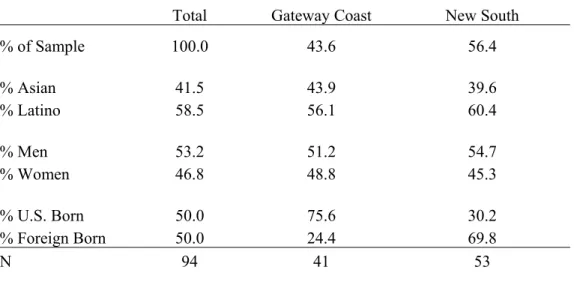
Latinos and Asians often appear in comparative projects (see Jones-Correa and Leal 1996; Kao and Joyner 2006; Masuoka 2006; Pan 2015) because they are the largest and fastest growing minority groups in the United States, respectively. Additionally, nearly 35 percent of Latinos are foreign-born, meaning that most Latinos are born in the United States. Latinos and Asians (both native-born and foreign-born) made up 10 percent and 3 percent of the city's population, respectively (US Bureau of the Census 2013a).
Exactly how these identities are used is explored in the three empirical chapters of this dissertation. Ultimately, I reveal how panethnicity is embedded in the experiences of Asian and Latino community leaders, showing how they use, use, and navigate their identities and how processes are conditioned by contextual and personal factors.
A REAL AWAKENING”: NARRATIVES OF PANETHNIC CONSCIOUSNESS
I think part of it was in college and it was just reinforced when I came to Teach for. While Veronica had a strong Mexican identity (as evidenced by her leadership in the Mexican American student group), it was her experiences in college that marked an awakening of her panethnic consciousness. For both Karen and Paloma, it was partly the understanding that others see them as part of a wider collective that ignited pan-ethnic awareness.
Whether it was an initial job requirement or an unexpected outcome, many respondents gained panethnic awareness in their professional careers. It was offensive because I felt like I was being put into a category instead of, you know, being equal, so I was kind of disadvantaged. So what part of Mexico is Argentina?” You know, stuff like that, and it was kind of weird, it was shocking.
Sometimes it was not simply city demographics and regional patterns that explained an emerging panethnic consciousness. I had just graduated, but I was aware of the movement at the time for identity, because it was the same as the black identity movement, and the same principles, essentially, for the Latino identity.
FROM THEN ON, THAT WAS MY COMMUNITY”
Men were overrepresented in the entrepreneurial path, accounting for nearly two-thirds of these community leaders (65 percent). Turning to differences in context, most of the respondents who used their panethnicity on a facilitated path were from Gateway Coast (58 percent), while the vast majority of community leaders on an entrepreneurial path were from New South (82 . percent). And she gave me the phone number of the guy and the address, and then I called him - he never called me back, but I ended up going to a meeting.
I joined the local chapter board a year after that and have basically been involved ever since. Respondents' participation in these smaller pan-ethnic or ethnic associations helped propel them to leadership opportunities within and outside ethnic organizations. At the time of the interview, Michael had become a member of the organization's executive board.
She credits this work and her mentor's encouragement for her initial and ongoing involvement with the Latino community in New South. It was interesting to see the Filipino community come out the way they did [when I ran for school board]. But when I ran, I mean, people came out of the woodwork for me in the Filipino community, which I just thought was brilliant.
Vince Castillo, a dean at a Gateway Coast law school, described his family's history of activism and civic engagement inside and outside the Latino community. Emilio went on to start one of the largest Latino-serving non-profits in the area, after identifying a significant need within the community. Despite the fact that there was already an active panethnic chamber in New South, Manolo Arenas did not like the structure of the existing Hispanic.
So part of the inspiration that I feel like oh I need to educate people – Chinese are Chinese. Jay and Helen were two of the more explicit examples of leaders who used their experiences and cultural insights to educate the wider New South community. The types of opportunities available to community leaders are conditioned by the particularities of each of the two research sites, and interesting differences between the New South and the Gateway Coast emerged.

A NEEDED AFFILIATION”: PANETHNICITY, GROUPNESS, AND BOUNDARY STRATEGIES
Therefore, the group relations I develop include a more inclusive understanding of belonging that extends beyond the pan-ethnic community. The majority of respondents were located in the center of the spectrum, associated with heavy pan-ethnic commitment and investment. He was the first Hispanic to hold a particularly high-ranking federal position and is aware that many in the Latino community look up to him for this.
Of Latino background, Nico did not necessarily see himself as part of the same Hispanic community that he seeks out. Paloma was aware of the underrepresentation of Latinos in science, and advocated the hiring of co-panethnics. Second, they often use the “people of color” terminology that came out of the 1980s (Hollinger 2005).
He found that many just wanted him to "stay in his lane" and advocate exclusively on behalf of the Latino community. At the time of the interviews, this was a category that was institutionalized even in local government. Bilal, like other community leaders in New South, recognizes the importance of the work being done to advocate for immigrants and refugees, especially “in this part of the country.
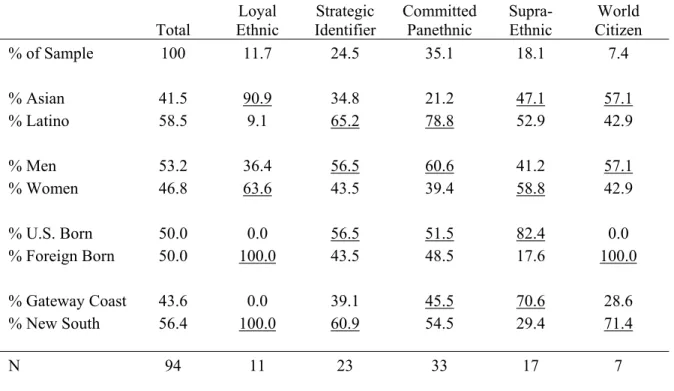
In the New South (which accounted for 29.4 percent of the supras), belonging to a community outside the black-white racial dichotomy easily called someone a newcomer. While they expressed appreciation for many of the cultural elements of their ethnic background (i.e., music and food), all World Citizens were born outside the United States. He used the example of the various chambers of commerce in the New South to illustrate his point.
This chapter revealed several distinct patterns in the intersection of context, panethnic group, and nativity within each of the groups. In contrast, community leaders from the New South were overrepresented in groups that were at opposite ends of the spectrum—ethnic loyalists and global citizens. Respondents from the Gateway Coast, Latinos, and those born in the United States were overrepresented in the center of the grouping spectrum, within the range of panethnic and supraethnic engagement.
Community leaders with a group aligned to a Latino or Asian community (ie, committed panethnics and strategic identifiers) used countervailing strategies that center the needs of the panethnic group. Those at the extreme ends of the group relationship (ie, loyal ethnic, supraethnic) use compensatory strategies that are either narrower or broader in scope.
DISCUSSION AND CONCLUSION
34; Pedagogies of Learning and Living at Home: The Mestizo Consciousness of Chicano Students." International Journal of Qualitative Studies v. 34; Transformations of Tribe: Organization and Self-Conception in Native American Ethnic Groups." Ethnic and Racial Studies. 34; Race and Entrepreneurial Success: Black-, Asian-, and White-Owned Firms in the United States.” MIT Press Books.
Intermarriage, panethnicity, and the black-nonblack divide in the United States. Journal of Comparative Family Studies: 215-237. 34; Latino Racial Choices: The Effects of Skin Color and Discrimination on the Racial Self of Latinos and Latinas Identifications." Ethnic and Racial Studies. 34; The Birth of the "Hispanic" Generation: Attitudes of Mexican American Political Elites Toward the Hispanic label."Latin American Perspectives: 45-58.
34; Growing Up Poor: Family Experiences of Socially Mobile Youth in Low-Income African American Neighborhoods." Journal of Adolescent Research. 34; Constructing the 'Asian American': Reflections on Intermarriage and Ethnic Identity Among Chinese and Koreans." second-generation Americans". Ethnic and Racial Studies. 34; Race, Ethnic Options, and Ethnic Bonds: Identity Negotiations of Second-Generation Chinese and Korean Americans." Sociological perspective.
34;Racialization, Recognition, and Rights: Lumping and Splitting Multiracial Asian Americans in the 2000 Census. " Journal of Asian American Studies. 34; Forming Ethnic and Racial Identities: Stories of Young Asian American Professionals." Ethnic and Racial Studies. Cultural Adjustment and Membership of American and Asian American Students at Predominantly White Institutions." Journal of College Student Development.
34;Conceptualizing and Measuring Ethnic Identity: Current Status and Future Directions." Journal of Counseling Psychology. 34;Political Shocks: On the Legal Auspices of Hispanic Migration to the United States." ANNALS of the American Academy of Political and Social. 34; Latino Self-Employment and Entrepreneurship in the United States: A Review of the Literature and Data Sources.” Annals of the American Academy of Political and Social Science.
34; Mapping and Recontextualizing the Evolution of the Term Latinx: Scanning the Environment in Higher Education." Journal of Latinos and Education: 1-14. 34; Agency and Structure in Panethic Identity Formation: The Case of Latina/a Entrepreneurs." How the United States Racializes Latinos: White Hegemony and Its Consequences: 200-213.
