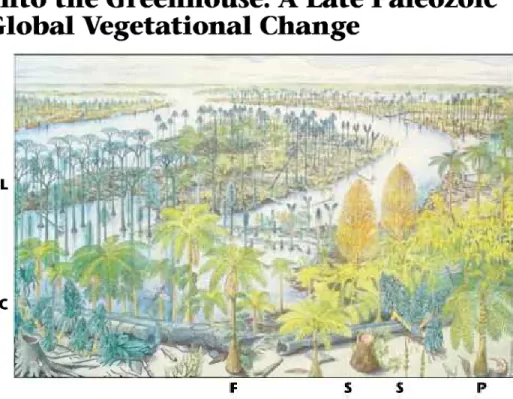
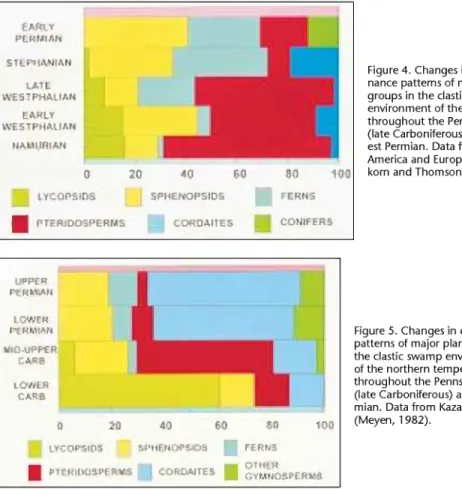
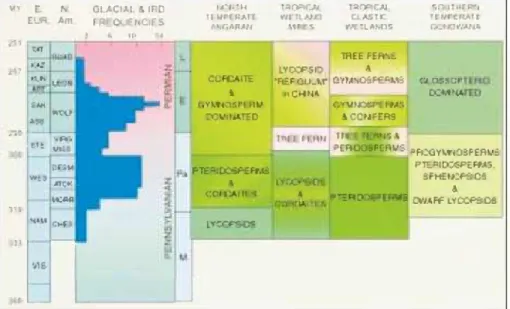
The floristic biogeography and zoning of the late Paleozoic parallel those of today (Ziegler, 1990). Major changes in vegetation have been observed at the base of the Late Carboniferous, within the Early Pennsylvanian (Namurian), near the boundary of the Middle-Upper Pennsylvanian (Westphalian-Stephanian), during the transition from the Carboniferous to the Permian , and near the Sakmarien-Artinskian border. Changes in dominance patterns of major plant groups in the clastic swamp environment of the northern temperate kingdom throughout the Pennsylvanian (late Carboniferous) and Permian.
The dominance of tree ferns in the late Pennsylvanian followed extinctions in clastic wetlands that, although less severe, paralleled the swamps. This indicated the beginning of the division of the landscape into groups of plants. The transition from a wet to a dry biome was not accompanied by extensive mixing of constituent species.
All other parts of the continent were in the temperate biogeographic zone of southern Gondwana. Early glossopterids appeared suddenly, accompanied by the disappearance of many of the Carboniferous elements. In addition, tropical plants appeared in temperate zones in response to higher rainfall and due to the drying of most tropical zones.
The Senate amendment would provide funding in the Navy's Oceanographic and Atmospheric Technology Program in support of the National Oceanographic Partnership Act.
Tools and Technologies Workshop participants identified
Buffer Strips Sub-initiative: Determine the habitat-specific spatial scale of buffer strips and conditions where they may be effective for resource protection, versus where they are inappropriate or ineffective. Land and resource managers lack information on biological and physical environmental modifications, or stressors, that affect their resource responsibilities; Stressor analysis techniques need to be formalized to create ecological risk assessment methodologies that can weigh comparative risks from different and multiple stressors in light of land and resource management practices and policies.
Modeling ecosystem development can enable resource managers to predict how certain types of ecosystems will respond to interactions between natural factors and human activities, to identify systems at risk from certain stressors, and to set priorities for management practices.
1997 John CFrye Environmental
GSAF UPDATE
News of the Second Century Fund Membership Campaign
Next Pardee Coterie Meeting is October 30
Visit GSAF on tiie World Wide Web
Director of Development Appointed
Donors to the Foundation^ July 1996
GSA HONORS
50-YEAR FELLOWS
MEETING ABSTRACTS FOR DENVER '96 SET NEW RECORD
Water Resources
Publications, LLC
Ejecade
To GSA Members only!
How MANY WORDS?
1,800 Web Browsers?!
GSA!
Tin* Ma^iHir FwU\
IViii<'i|)l«> of
LETTERS TO THE EDITOR
USGS RIF
Geological Survey of Canada—Cost Recovery
17 Currently, the long-term regional mandate of the Survey is under serious attack, with the focus shifting towards short-term single client-oriented projects under programs such as the Industrial Partnership Program (IPP) or cost recovery programs. Current management is far more political and focused on the short-term expediency of cuts and does not show a long-term vision for Canada or the Survey. It is clear that industry-oriented projects will have little to do with long-term strategies, as they are driven by the legitimate interest of companies to make a profit in areas that are close at hand.
It seems clear that client-driven projects will only distract and hinder the realization of long-term regional studies for the long-term benefit of Canada. The cost recovery concept is essentially a subsidized entry into private enterprise, with the Geological Survey of Canada competing with the concept. It also impedes, as in the case of short-term and client-driven projects, the ability to focus on the GSC's core mandate, namely to conduct independent research that serves the needs of Canada as a whole.
In light of the above and the current management that has failed to address the major issues, I recommend: To assemble a panel of senior scientists from within and outside the organization (industry, universities, provincial surveys) to mission and objectives, particularly in relation to the cost recovery concept and the role of a federal geological survey within Canada.
Why GSA Todayl
Our Software Bundles will Trans
Earth'nWare is proud to sponsor the Software Fair
Visit us at the Fair and at Booth 6S0
148 Cadish Avenue
GSA Congressional Science Fellow Named for 1996-1997
Congressional
Science Feiiowsliip 1997-1998
CRYSTAL CLEAR AND ROCK SOLID
Acid trauma at the Cretaceous-Tertiary (K/T) boundary in eastern Montana: Comment and Reply
Dalziel Named to
New GSA International Secretariat
GSA Division News
HAVE A PENROSE
CONFERENCE PROPOSAI?
GSA HEACJQUARTERS
EXT.151
Three Named Honorary Fellows
Mentors in Applied Geology
GSA Division and Section Grants for 1996
DIVISION RESEARCH GRANTS
Research Grants Program 1997
Delivering Innovation & Integration Around The World
GSA Penrose Medal, Day Medal, and Honorary Fellows
About the Honorary Fellow Program
THE GEOLOGICAL SOCIETY OF AMERICA
Nomination for Penrose Medal, Day Medal, or Honorary Fellowship
Young Scientist Award (Donath Medal)
GSA Medalists and Honorary Fellows
For the year 7 997, only applicants born on or after January 1, 1962 are eligible for consideration. Nominations for the Donath Medal MUST BE SUPPORTED by signed letters from five (5) scientists in addition to the person making the nomination. The letters may be attached to this nomination form or sent separately to the Executive Director.
Call for
Nominations for 1997 GSA
GSA BOOKSTORE
Call For Nominations
Help Direct GSA's Future
SUBSCRIPI ION ORDER FORM
SOUTHEASTERN SECTION, GSA 46th Annual Meeting
Auburn, Alabama March 27-28, 1997
Salt Mountain Limestone: A Pale- ocene Coral-Algal-Sponge Reef,
Paleogene Boundary Characteristics in the Eastern Gulf Coastal Plain: Biotic and Physical Events. The Undergraduate Research Council will sponsor a student poster session (Topic Session 8, above) to present theses and other undergraduate research projects. First authors must be undergraduate students and responsible for the major part of the research, preparation of posters and presentation of results.
Two half-day theme sessions (theme session 9, above) and one day field trip (field trip 8, above) are planned for introductory geology teachers at primary and university levels. WORKSHOPS FOR STUDENTS The Roy Shlemon Mentors in Applied Geology Program, sponsored by the GSA Institute for Environmental Education, is a new program developed to present workshops to upper-level undergraduate and graduate students. Exhibit facilities for business, education and government institutions will be conveniently located in the Auburn University Hotel and Conference Center, adjacent to the technical sessions.
STUDENT TRAVEL Limited funds to support travel expenses for students presenting papers at the meeting are available from the GSA Southeastern Section. A block of rooms at the Auburn Hotel and Conference Center, site of the meeting, has been reserved for attendees at a special discounted rate of $72 per night for one or two people. The Welcome Party on Wednesday evening will be held in the Auburn Alumni Center Atrium.
All partygoers must be registered; On-site registration is available in the hotel lobby and conference center prior to the party. The GSA Southeastern Section maintains a World Wide Website accessible at http://www.geo.ua.edu/segsa/. More detailed information on fees and registration, hotel accommodations, excursions and other activities will appear in the January 1997 issue of GSA Today and as part of the GSA Southeastern Section Abstracts with Programs for 1997.
Direct questions and suggestions to local committee co-chairs Mark Steltenpohl ([email protected]) and Robert A.
1997 SECTION MEETINGS
Guests may wish to participate in scheduled field trips to the beautiful Callaway Gardens on Thursday and/or Horseshoe Bend National Military Historic Park on Friday.
SECTION RESEARCH GRANTS
October BULLETIN and GEOLOGY Contents
AHENTION AUTHORS
The complete list is available in the Calendar section of the Internet: http://www.geosociety.org.
GSA MEETINGS
1997 ANNUAL MEETING Salt Lake City, Utah
1997 CONTINUING EDUCATION COURSE PROPOSALS
FUTURE ANNUAL MEETINGS
1997 SECTION MEETINGS
CLASSIFIED ADVERTISING
Preference will be given to highly qualified applicants with demonstrated teaching skills, excellent backgrounds in earth and/or environmental science, knowledge of and interest in feminist approaches to interdisciplinary models of education and feminist critiques of science, and data publication in one or more of the above areas. Send all materials to the PROMISE Research Committee, Department of Geosciences; University of Nevada, Las Vegas; Las Vegas, NV 89154-4010. Kathy Coombs, Assistant Dean of the Resident Degree Program, Prescott College, 220 Grove Avenue, Prescott, Arizona 86301.
IOWA STATE UNIVERSITY GEOMORPHOLOGY/GEOPHYSICS The Department of Geological and Atmospheric Sciences, Iowa State University, invites applications for a tenure-track position at the assistant professor level beginning in mid-August 1997. The successful candidate will be expected to integrate their courses and research with the department's existing and emerging programs in hydrogeology and environmental science. The successful candidate will be expected to conduct an active research program, supervise graduate students, attract external funding, and develop and deliver courses at the undergraduate and graduate level in his or her respective field.
Preference will be given to candidates with working knowledge of Geographic Information Systems and who can demonstrate their interest and aptitude in interdisciplinary teaching and research. The University of Illinois Department of Geology invites applications for a full-time (nine-month academic year) tenure-track faculty position in sedimentary geology. We are seeking an outstanding scientist and an enthusiastic teacher for an appointment at the rank of Assistant Professor beginning in August 1997.
The University of Illinois at Urbana-Champaign is a major research university with 37,000 students. Opportunities exist to collaborate with current staff in structural geology, hydrogeology, geochemistry, geophysics, clay mineralogy, and paleontology, both in the department and at the Illinois State Geological Survey. Applications are invited for a PhD student position (starting late 1996) in the Mineral Resources and Processes in the Earth's Interior Group at the Swiss Federal Institute of Technology, Zurich, Switzerland.
The successful applicant will engage in research on the chemical thermodynamics of hydrothermal fluids responsible for the formation of mineral resources in the Earth's crust. These calculations will be combined with analytical data from synthetic and natural fluid inclusions to model metal partitioning in two-phase fluid systems, based on our new ICPMS Ablation Laser system. Heinrich at Institut fur Isotopengeologie und Mineralische Rohstoffe, ETH Zentrum, Zurich, CH-8092, Switzerland, fax E-mail [email protected].
ANNUAL MEETING AND EXPOSITION
EARTH
SYSTEM SUMMIT
VIEWS FROM THE
NORTH AMERICAN CRATON