
No part of this publication may be reproduced, stored in a retrieval system, or transmitted in any form or by any means, electronic, mechanical, photocopying, recording, scanning, or otherwise, except as permitted by section 107 or 108 of the United States 1976. of the State Copyright Act, without the prior written permission of the publisher or authorization by paying the appropriate copy fee to Copyright Clearance Center, Inc., 222 Rosewood Drive, Danvers, MA by fax or online at www.copyright .com.
Contents
Preface
They were interested in the customer dimension of the organization, but from the perspective of adding a new dimension to an already complex structure. In the language of this book, they were creating customer-centric capability and adding it to their existing structures.).
The Author
Previous publications include Strategy Implementation: The Role of Structure and Process (with Rob Kazanjian, West Publishing, 1986); “Designing the Innovative Organization” in Organizational Dynamics (Winter 1982); “Human Resources and Organizational Planning” in Human Resource Management; Designing Complex Organizations (Addison-Wesley, 1973); and organizational design (Addison-Wesley, 1977). Galbraith's recent working papers include 'Managing the New Complexity', 'The Front-Back Organization: A New Organizational Hybrid', 'Designing a Reconfigurable Organization' and 'Organizing Around the Customer'.
INTRODUCTION
By implementing a customer-centric capability, the company can now keep it simple for the customer, eliminate third-party solutions and redirect that errant cash flow. The purpose of this book is to articulate what it means to be customer-centric and to illustrate how to organize accordingly.
SURVIVING THE CUSTOMER REVOLUTION
Perhaps the most striking difference is that a customer-centric entity is on the customer's side of a transaction. A server salesperson at IBM is on the seller's side—the product-centric server business.

CUSTOMER-CENTRICITY
This electronic reconciliation is a slight increase in the cost and effort of cross-unit reconciliation for the customer. An important point of this chapter is that the level of power and authority of the customer-focused organizational units must match the level of the solution strategy.
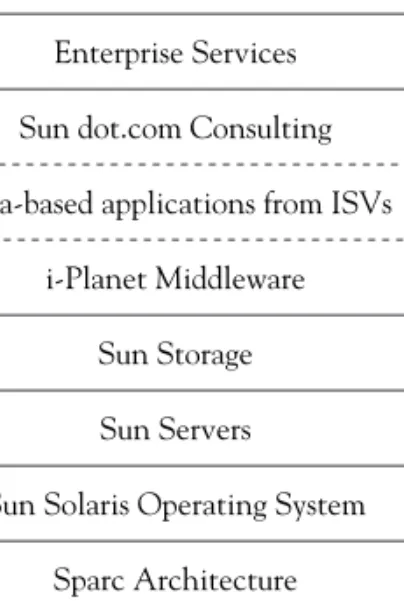
Light-Level Application
Degussa works directly with OEM engine component design engineers. The executive committee consists of the director of the department, the heads of three business units and the functional managers of production and R&D. A third purpose of the customer group is to coordinate the design of new products for new customer platforms.
The core team consists of sales and marketing representatives from each country in which the customer is present and makes purchasing decisions. Canada, South Africa and Germany have all helped kick-start the process in Brazil. Projects are selected by the TQM steering committee chaired by a member of the executive committee.
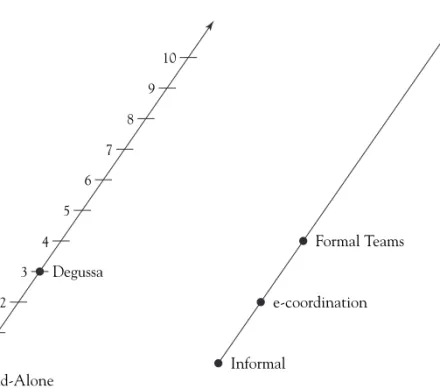
Medium-Level Application
The account manager was a generalist who "owned" the client and the revenue stream and was compensated by the revenue generated from the client's trades. The next task of the global account directors was to coordinate all the account managers and salespeople who were calling the customer. The global account director and head of operations strive to respond to customer needs.
Another key activity of the global account manager is to gain access to the customer for product specialists. Like a global account manager, an IBOL must deliver the business to the customer. Based on customer interaction, global customer directors were able to deliver custom.

Complete-Level Application
The move to the Internet would be led by the newly created Internet division, part of the Software Group. Gerstner laid out his view of services in IBM's 1998 annual report: “The greatest competitive advantage in the information technology industry is no longer technology. The IRC also works through a 'live engagement lab', the Insurance Solution Development Center (ISDC) in La Hulpe, Belgium.
The majority of the offering is in e-business services (see the EMEA organizational chart). Putting yourself in the customer's mind and seeing the customer's business from his or her point of view. But the move away from the command-and-control culture – and the notion of “that's it.”
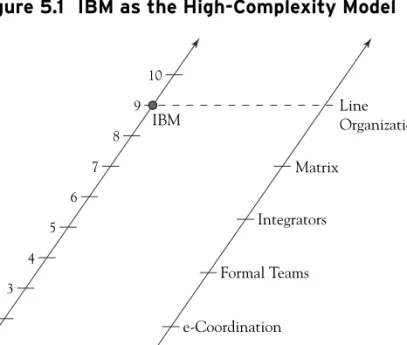
Alternate High-Level Solutions Companies
A Few Customer Teams
An initial step to drive change was the creation of approximately five customer teams to serve customers around the world. With each customer team consisting of 50 to 60 people, between 250 and 300 people are now aware and part of the change effort. There are now 300 people trained in cross-border customer strategies; they understand the needs of the global customer and now have cross-border networks and personal contacts.
Management that sees its task as identifying new leadership will use the teams as an opportunity to do so. The second is the opportunity for management to engage customers in a closer relationship with the company, change the mindset of doubters, train agents of change, build personal networks, select and develop new leaders, and the process improve. Management that seizes the opportunity can use changes to the formal structure and lateral forms to drive and shape organizational change.
More Customer Teams
Global Accounts Coordinator (Network Integrator)
But ultimately, customer teams have information to measure their progress, compare their performance with other teams, and demonstrate global profitability. The two steps can be combined by generating sales and profit targets for customers during the planning process. Each country manager can then set sales and profit targets for local customers and for global accounts.
For example, an account team in Citibank's London office worked for a year to win the banking business of a major United Kingdom. The team was successful, but most of the funding for the next few years would be in North America. subsidiary and in a recent acquisition in Australia. This means that the work plus the costs of acquiring the business were incurred in Britain and the revenues were recorded in North America and Australia.
A Global Accounts Group
With customer profit accounting, the UK can identify revenue and expenses and receive credit. In addition to being a champion for the client, the Global Account Coordinator may create processes and information systems to manage the global client and continue to develop and identify talent and leadership across teams. When the global team for Novartis was established, a banker with experience at Novartis became the Swiss representative on the team.
Based on good performance, the banker accepted an assignment in the United Kingdom, which allowed him to work in the financial center of London. After several years in the team leader role, the banker became the global coordinator for the pharmaceutical customer segment. Based on these experiences and training courses, the banker was qualified to step into the role of global coordinator.
Global Accounts Units in Countries
He was assessed in each task for financial performance and knowledge of the pharmaceutical industry as usual. However, assessments were also made of teamwork, relationship with clients, ability to influence without authority, cross-cultural skills with clients and cross-cultural skills and management of the cross-border team. In these cases, several banks have set up joint ventures between the head office and the local country management.
So after a few years, the local managers notice that the unit is quite profitable.
Customer Profit Centers
It drove the change with formal integration mechanisms such as customer teams and global account coordinators before completing it with the establishment of a new formal structure. At every step there is also the opportunity to drive and shape the change process. But most important is the opportunity for management to select and develop the talent and leadership for the new strategy and structure.
But the other opportunity is to develop processes and information systems to support the new organization. Management therefore has the opportunity at each step to change the soft factors to support the change. The Citibank example also goes into detail about the change process to arrive at customer centricity.
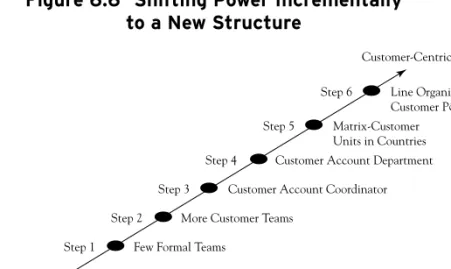
Designing a Customer-Centric Organization
The project team, now a company in the digital signal processor division, pursued these opportunities with the Asian and European sales teams. The business operations of the digital signal processor division (originally business development projects) were spun out of the division to become divisions in their own right. First, there were many disputes between the product divisions and the digital camera business unit.
The CEO and management team supported a “one company” approach to digital camera investing. After that, Chipco starts to operate as "one company". It is the difficult decisions in management processes that create the ability to solve. Initially, informal relations between the Asian sales manager, the business development unit of the digital signal processor division and the general manager of the division led to an agreement.

Leading Through Management Processes
That is, managers must see that all policies for the star model have been changed to align with the strategy. All the processes are still product-centric and not compatible with the new device, or even conflict with it. The other key feature in the organizational design of a front-back organization is the management and business processes that connect the front and back.
It is in these processes that the leadership exercises its strong role and guides the resolution of the inevitable conflicts. And the spreadsheet planning process is the forum for exercising the required leadership. The decision-making group must know the set of opportunities available, the scope of work on the projects for these clients, and the nature of the talent available.

See alsoGlobal account directors; Global account managers Accounting systems: at Chipco, 155; at Citibank, 137–138; at IBank, 84.
Index
Culture: in matrix structures, 114–115; in product- vs. customer-focused organizations, 22–23 Customer accounting system, 39 Customer business units (CBUs), 40 Customer focus: barriers to, 2–3; cool-.