Happiness, Economics and Public Policy
H E L E N J O H N S A N D P A U L O R M E R O D
w i t h c o m m e n ta r i e s by s a m u e l b r i t ta n a n d m e l a n i e p o w e l l
The Institute of Economic Affairs
First published in Great Britain in 2007 by The Institute of Economic Affairs
2 Lord North Street Westminster London sw1p 3lb in association with Profile Books Ltd
The mission of the Institute of Economic Affairs is to improve public understanding of the fundamental institutions of a free society, by analysing and expounding the role of markets in solving economic and social problems.
Copyright © The Institute of Economic Affairs 2007 The moral right of the authors has been asserted.
All rights reserved. Without limiting the rights under copyright reserved above, no part of this publication may be reproduced, stored or introduced into a
retrieval system, or transmitted, in any form or by any means (electronic, mechanical, photocopying, recording or otherwise), without the prior written
permission of both the copyright owner and the publisher of this book.
A CIP catalogue record for this book is available from the British Library.
isbn9780255366007
Many IEA publications are translated into languages other than English or are reprinted. Permission to translate or to reprint should be sought from the
Director General at the address above.
Typeset in Stone by MacGuru Ltd info@macguru.org.uk
Printed and bound in Great Britain by Hobbs the Printers
The authors 7
Foreword 8
Summary 12
List of figures 16
1 Introduction 19
2 Happiness research and economic theory 23
3 Happiness, income and policy 28
Happiness and national income 28
Happiness and life expectancy 31
The problems with the happiness data 31
Happiness and public expenditure 34
Happiness and social conditions 35
Happiness and the distribution of income 38
Individuals adapt to expectations and realisable
aspirations 40
Important contributions from psychology 42
What does affect happiness? 46
4 Happiness and macroeconomics 49
contents
Helen Johns
Helen Johns is an economist specialising in the analysis of envir
onmental policy. She has worked on a broad range of research projects for the UK government, the European Commission and the private sector in areas such as environmental trading schemes, nonmarket valuation, policy appraisal and assessing environ
mental liability. She started her career as a physicist, working with Paul Ormerod at Volterra Consulting before gaining her MSc in Environmental and Resource Economics at University College London under the late David Pearce.
Paul ormerod
Paul Ormerod is an economist and director of Volterra Consulting.
He is the author of three bestselling books, The Death of Economics, Butterfly Economics and Why Most Things Fail, the latter being Business Week US Business Book of the Year 2006. His main inter
ests are complex systems and social networks, and he publishes in a wide range of journals, including Physica A, Journal of Artificial Societies and Social Simulation and Diplomacy and Statecraft.
tHe autHors 6 applications of happiness research 61
Assessment of the value of environmental goods 61
Health and happiness 65
Other policy dilemmas 66
7 Final remarks and conclusions 69
appendix 1: changes in the Happiness Index 75
appendix 2: statistical appendix 77
references 87
commentary: a deceptive eureka moment 92
Samuel Brittan
Postscript on Brave New World 96
References 97
commentary: Happiness, rationality and
welfare 98
Melanie Powell
References 100
a rejoinder 101
Helen Johns and Paul Ormerod
References 107
about the Iea 108
f o r e w o r d
straightforward cause of this phenomenon, of course. In general, politicians follow the courses of action that are most likely to get them elected. In the political market, vested interests and median voters are king. It may increase the happiness of politicians to tell us that they are going to maximise our wellbeing, but it is a task that is beyond their capacity.
The economics of happiness seems just as shaky as the politics. The proponents of the use of happiness measures argue that happiness has not risen with national income. People become happier, it is said, only when they are better off relative to others.
We are therefore in a futile race to become happier, in effect, at the expense of others. On average, happiness does not increase with incomes.
As Helen Johns and Paul Ormerod show, aggregate measures of happiness over time are not, in fact, strongly correlated with any variable we would expect them to be correlated with – and this is unsurprising given the way happiness measures are constructed.
Happiness measures are extremely insensitive indicators. Happi
ness, for example, is not correlated with improved life expectancy, government spending, disability, sexual inequality or unemploy
ment. Relationships between happiness and crime appear, tentat
ively, to throw up a positive correlation! Policymakers have latched on to the apparent need to have a more even distribution of income to raise national happiness – something that many would regard as the legitimisation of envy, a vice that never brings happiness in the long term. Measured happiness has not, however, been affected by the widening of the disparity in incomes over the past 30 years or so, just as it has not been affected by the growth in average incomes.
There is no question that happiness data is being used select
ively to justify preconceived beliefs about policy alternatives.
Foreword
The authors of this monograph have done a brilliant job of
‘unpicking’ the tangled web of the economics of happiness.
It appears that ‘happiness economics’ is becoming influential in political circles. Politicians are running around promising to look after our gross national wellbeing instead of just looking after gross national product. But it is difficult to think of any subject within economics that is built on such insecure foundations.
Furthermore, the translation of the economic ideas into political practice seems specifically oriented towards no purpose other than providing further excuses for interference in the lives of indi
viduals by the political class.
First, let us consider the politics. It is clearly a misconception that governments through the ages have acted to try to maximise gross national product. For most of time, in most countries, gross national product has not been measurable in real time. Ironically, in the UK and the USA, it has only been during the postwar period that gross national product has been observable, yet policies have been followed that reduced growth below its potential by increasing regulation and taxes. The share of national income taken in taxes in nearly all developed countries is significantly above that which would allow economic welfare to be maximised.
Politicians have never tried to maximise gross national product – and, if they have, they have not been very good at it. There is a
Hayek’s The Road to Serfdom (Chapter V): ‘The welfare and happi
ness of millions cannot be measured on a single scale of less and more.’
p h i l i p b o o t h
Editorial and Programme Director, Institute of Economic Affairs Professor of Insurance and Risk Management, Sir John Cass Business School, City University June 2007
The views expressed in this monograph are, as in all IEA publica
tions, those of the authors and not those of the Institute (which has no corporate view), its managing trustees, Academic Advisory Council members or senior staff.
Helen Johns and Paul Ormerod are to be congratulated for their rigorous analysis, sifting through a highly complex subject area and bringing out the key points so effectively. One of those key points is that the happiness data does not tell us anything signific ant as far as economic relationships are concerned.
So if we accept the authors’ conclusions, what are we to make of the use of gross national wellbeing in government policy? It appears clear from the evidence that happiness has much to do with personal values and dispositions. It also seems clear that we adjust our description of happiness according to our aspirations of what is attainable. If we live in a brickbuilt house, with food and clothing but few luxuries, we might feel happy, all other things being equal, in an era where most other people were just able to meet their basic needs. In a later generation, when many people own luxury goods, somebody who had these luxury goods might not feel any happier than a person on a modest living in an earlier generation. This is easy enough to explain. It is the natural human disposition to want to aspire to better things and to be a little restless and ambitious – to attain a little more than we have. As long as this improvement in living standards is not achieved at the expense of general welfare, why should we suppress the natural human desire for selfimprovement just because it throws up some awkward questions for compilers of happiness statistics? In fact, we are simply taken back to the ageold political questions – what political and economic systems and policies are both in harmony with the natural human condition and lead to the highest levels of welfare? The desire by governments to plan our happiness will lead to a loss of liberty and a loss of welfare. Such efforts are as flawed as attempts by government to plan our economic activity.
Or perhaps we can just sum it all up in one phrase from
s u m m a ry
just as with GNP per head, the data on happiness over time shows no correlations with these changes. Even increases in recorded depression have not provoked shifts in recorded happiness. And the sharp rise in income inequality in the USA over the past 30 years has not reduced happiness.
• One could conclude from the lack of correlation over time between aggregate happiness and almost any other socio
economic variable of interest one of two things. Either that attempting to improve the human lot through economic or social policy is futile, or that happiness data over time is an extremely insensitive measure of welfare. The evidence points to the latter.
• A simple but important explanation is the way in which happiness is measured. People are asked to register their level of happiness on a scale that often has as few as three categories (‘not happy’, ‘fairly happy’ or ‘very happy’). As a consequence, noticeable changes in average happiness can come about only through substantial numbers of people changing their categories.
• Much more fundamentally, this way of measuring happiness means there is an upper bound to the level of happiness that can ever be recorded. This creates very serious statistical problems when trying to correlate changes in a series that has an upper limit with one, such as GNP per head, that can in principle rise without limit.
• In addition, the more serious research on happiness has established that people adapt rapidly to changes in both their monetary and nonmonetary circumstances. So the fact that reported happiness over time is not correlated with GNP per head or increased public spending, say, does not necessarily summary
• Surveys on the levels of happiness reported by individuals have been carried out over a few decades in most Western countries. The recorded levels of happiness fluctuate from year to year. But in general there is no trend, either up or down, in this data. Over the same period, average material standards of living, measured by real gross national product (GNP) per head, have shown a very clear upward trend. So economic growth does not appear to improve the human lot.
GNP per head has risen, but happiness has not.
• This finding has been widely publicised. It is used as the basis for widereaching policy recommendations. For example, taxation should be much more progressive, and hours of work should be restricted for everyone, because money does not make people feel better off. People need to be told how to be happier and, for their own good, taxed off their treadmills of overwork and consumption. Further, measures of national happiness should complement, or even replace, GNP as the main target of government policy.
• But there have been many other profound social and political trends over the past 60 years or so which might be expected to have affected happiness for good or ill. Public spending has risen substantially, longevity has increased markedly, and the degree of inequality between the sexes has fallen. But,
acceptable, throwing into doubt its usefulness as an objective measure.
• Democratic decisionmaking already takes into account many desirable outcomes other than economic growth. The dichotomy presented by many proponents of happiness research – that use of GNP implies a narrow, materialistic and selfcentred view of welfare, while use of happiness indicators would imply a more holistic or ethical conception – is a false one.
• The logical conclusion of much happiness research – that individuals’ own judgements about what is good for them can, indeed should, be overridden by experts who can ‘prove’
these judgements did not make them happier – is both undemocratic and unattractively paternalistic. While it is true that individual agents are not in general capable of following the maximising precepts of behaviour of economic theory, the idea that remote policymakers are able to do so in their stead should be treated with a great deal of scepticism.
tell us very much at all. People become accustomed to the new, higher levels and would feel less happy if these were reduced to their previous levels.
• There is a body of research on happiness which is, from a scientific perspective, much more securely grounded. This is based upon the analysis, not of aggregate happiness data over time, but of socalled panel, or longitudinal, data, which tracks specific individuals over time. It shows that stable family life, being married, good health, having religious faith, feelings of living in a cohesive community where people can be trusted, and good governance contribute to happiness.
Chronic pain, divorce and bereavement detract from happiness.
• The idea that GNP needs to be supplemented by a measure of ‘gross national happiness’ or wellbeing is similar to arguments for modifying GNP to account for environmental and other externalities. How such an indicator would actually produce better decisions is, however, rarely spelt out in detail. The use of even a sensitive happiness metric in public policy would be as vulnerable to anomalous and ethically questionable results and losses of information as any other numerical metric subject to crude maximisation.
• As an uncontroversial ‘motherhood and apple pie’ concept, happiness glosses over the very real tradeoffs, creating winners and losers, that exist in any policy decision.
Furthermore, there are areas where happiness arguments or evidence might produce or camouflage morally questionable outcomes. Not everything can be reduced to its effects on empirically observed happiness. Further, it will always be a political and moral call as to what happiness evidence is
FIGures
Figure 1 UK life satisfaction and GDP, 1973–2002 30
Figure 2 Happiness and real public current expenditure in
the UK, 1973–2002 35
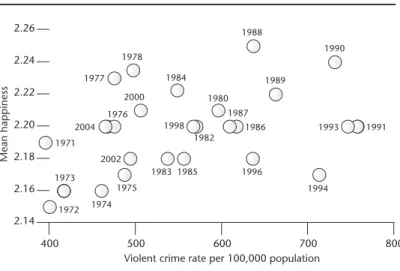
Figure 3 Happiness and the violent crime rate in the
USA, 1971–2004 36
Figure 4 Happiness and female earnings relative to male
earnings in the USA, 1971–2003 37
Figure 5 Mean happiness and income inequality (as measured by the Gini coefficient) in the USA,
1971–2004 40
Figure 6 Mean reported happiness in the USA, 1971–2004 79
Figure 7 Mean US happiness and Gini coefficient,
1971–2004 81
Figure 8 Mean US happiness and violent crime rate,
1971–2004 82
Figure 9 Mean US happiness and property crime rate,
1971–2004 83
Figure 10 Mean US happiness and unemployment rate,
1971–2004 84
Figure 11 Mean US happiness and life expectancy, 1971–2002 85
Figure 12 Mean US happiness and equality between sexes,
1971–2002 86
Happiness, Economics and Public Policy
The concept of happiness and its relationship to economics and politics is a very fashionable one. The 1990s saw an enormous increase in academic research into the concept, with no fewer than 4,351 articles being published by the year 2000 (Veenhoven, 2007). Since then, the flood has become a torrent.1
In the UK, policymakers are devoting increasing attention to happiness. There is, for example, a Whitehall Wellbeing Working Group and a committee on wellbeing research working in conjunc
tion with the Department for Environment, Food and Rural Affairs. The Sustainable Development Commission is promoting research on ‘how policies might change with an explicit wellbeing focus’, and a crossgovernment wellbeing indicators group is developing a set of wellbeing measures for informing policy (to be unveiled this summer).
In one sense, the British government is finally catching up with the United States’ Declaration of Independence of 1776, which regarded it as selfevident that the ‘pursuit of happiness’ was an
‘inalienable right’, comparable with life and liberty. In another, it is clearly debatable whether government should presume respons
ibility for individuals’ emotional states.
1 Many of the key articles are cited in important papers in two of the world’s top academic economic journals, e.g. Frey and Stutzer (2002a), Kahneman and Krueger (2006), Di Tella and MacCulloch (2006).
h a p p i n e s s , e c o n o m i c s a n d p u b l i c p o l i c y i n t r o d u c t i o n
advanced for this in the happiness literature (Layard, 2005) is that it is essentially not the absolute level of income of a person or household which generates happiness, but the level of income relative to that of others. The implication drawn from this is that progressive taxation will reduce such relative disparities and will therefore increase overall happiness.
We take issue with this and with many other findings of happi
ness research. More particularly, we take issue with their inter
pretation. Our principal criticisms are that:
• Timeseries of measured happiness show there has been little variation over the past 50 years. Yet happiness research itself suggests that many of the huge social and economic changes that have taken place should have made a difference to happiness. This indicates that happiness data over time is an extremely insensitive measure of welfare.
• Supposed relationships found between happiness and macroeconomic variables such as unemployment and inflation are far too unreliable and unstable to be of use in policymaking.
• The use of even a sensitive happiness metric in public policy would be as vulnerable to anomalous and ethically questionable results and losses of information as any other numerical metric, and more vulnerable to onesided interpretation.
• The premise implicit in much happiness policy advocacy, that government policy is only concerned with maximising national income, is false.
Happiness research also has implications for economic theory Whatever the driver, the notion of focusing government policy
explicitly on engendering happiness is evidently touching a chord.
This stems from a totally reasonable assessment that human welfare is derived from a great deal more than material goods. It is derived from the quality of one’s personal relationships, from feelings of common cause and shared experience with others, from enjoyment of nature, and from good governance, among other things.
The question of what constitutes happiness has of course been a profound one in both philosophical and religious thinking for over two thousand years. It is not our purpose to enter into these intractable philosophical debates. We simply note that defining happiness is a question that has occupied some of the greatest minds in the Western world and yet it still remains open. So it is questionable whether it can easily be resolved by the application of simple policy recommendations.
It is important to say, however, that the concept of happiness is inherently subjective and is not necessarily connected to what most people would deem moral. For example, ethnic cleansing might well increase the happiness of those who do not like sharing their neighbourhood with people who are ethnically different from themselves, but it is not a course of action that could conceivably be deemed moral. We give specific examples of potential conflicts between morality and happiness at various points in the text.
The main focus of this monograph is on happiness research and public policy, where many strong claims are being made. For example, a key finding of happiness research is that in the devel
oped world over the past 30 or 40 years happiness appears not to have increased despite the fact that real per capita incomes, and material living standards, have doubled. An explanation
2 HaPPIness researcH and economIc tHeory
By far the most publicised finding of happiness research, noted above, is the lack of correlation over time within individual countries between reported happiness and real GDP per head.
We discuss this at considerable length in Chapter 3 below. Two different results from the literature appear, however, to have important implications for economic theory.
Happiness is positively correlated with individual income within a given country in any given year: the rich generally report greater happiness than the poor at any given point in time.
Second, the increase in happiness associated with income within the same country at a point in time appears to get smaller and smaller as income increases.
These two points seem to provide evidence consistent with a basic but essential postulate in standard economic theory, that of diminishing marginal utility. In other words, the additional benefits conferred by each extra unit of consumption of a service or a product, or by an extra unit of income, become smaller and smaller as the level of consumption or income rises. The opinion that happiness research confirms diminishing marginal utility is spreading within the happiness literature (for example, Frey and Stutzer, 2002a).
There are two technical points to be made here. First, what appears to have been established is a relationship between reported and, in particular, the postulates on which individual behaviour
is based in such theory. This work has a much more secure foun
dation, being supported by a wide range of work in experimental economics over the past 25 years. We begin in Chapter 2 with a short discussion of this aspect of happiness research.
We move on in Chapter 3 to discuss at considerably greater length some of the key findings in the happiness literature which are used in the current policy debate. In Chapter 4 we consider briefly the ‘macroeconomic’ policy claims made on the basis of happiness research. Chapter 5 discusses the concept of ‘gross national happiness’ in comparison with the more conventional, economicbased gross national product. Chapter 6 illustrates how happiness evidence might be used in a policy context, using the example of environmental protection; and the final chapter discusses the potential moral ambiguity of some happiness policy suggestions and offers conclusions.
As a final point in this introduction, we note that the terms
‘happiness’, ‘wellbeing’ and ‘life satisfaction’ are used interchange
ably by many researchers, and will also be used interchangeably in this monograph. The term ‘subjective wellbeing’ refers to self
reported happiness. Wellbeing is frequently referred to in the literature as accounting for ‘elements of life satisfaction which cannot be defined, explained or primarily influenced by economic growth’ (SDRN, 2006).
h a p p i n e s s , e c o n o m i c s a n d p u b l i c p o l i c y h a p p i n e s s r e s e a r c h a n d e c o n o m i c t h e o ry
behaviour. It is a theory of how individuals gather information, and the rules they use in processing this information in order to make decisions about allocating scarce resources. In the standard model, people are assumed to obtain all relevant information about a given problem, and then to choose what is for them the best possible decision, the optimal choice. Decisionmakers are, in the jargon of economics, ‘fully rational’.
If in general this were a true description of behaviour, then the value of much happiness research would be lost. Actual deci
sions would reliably reveal individuals’ preferences. People appear to act as if they want more money, as if they want to consume more goods and services and so on. We would infer from this that having more money made them happier, regardless of the lack of correlation between income and spending and happiness levels measured by the responses of individuals in surveys. True prefer
ences would be revealed by people’s actions. By their deeds shall ye know them!
Unfortunately, much of the empirical work in experimental economics over the past couple of decades suggests that we cannot always rely on the assumption that actual decisions and choices accurately reveal preferences. For example, preferences of individuals appear quite frequently to be intransitive. If I prefer product A to B and B to C, then transitive preferences imply that I will prefer A to C. But this is not always the case in practice.1
This does not mean that the revealed preferences of consumers have no value. Rather, we must be cautious in how much weight we place on them. This said, preferences revealed by actual choices made by individuals are more likely to be an indicator
1 An early article on this is Loomes et al. (1991).
happiness and income. We do not, however, know the shape of the function that relates reported happiness to actual happiness.
Andrew Oswald demonstrates that, as a result, we cannot reliably infer diminishing marginal utility from the happiness literature.
His argument, although short, is mathematical and interested readers are referred to his article (Oswald, 2005).
The second point has been made recently by Richard East
erlin of the University of Southern California, in many ways the founding father of modern research on happiness. The lack of correlation between GDP and happiness has been established using data on reported happiness over time (that is, using ‘time
series’ data). The two findings that appear to establish dimin
ishing marginal utility of income emerge from analysis of data at a point in time (that, is using ‘crosssection data’).
Easterlin’s argument, which is empirical in contrast to the theoretical one of Oswald, is again not straightforward for the general reader, and the details can be obtained from his article (Easterlin, 2005). Easterlin essentially shows that there is a
‘disjuncture’ between evidence obtained from analysis of cross
sectional data and that obtained from analysis of timeseries data.
More specifically, ‘as income increases within the range covered in the cross sectional analysis, happiness fails to reproduce over time its pointoftime relationship to income. Instead of diminishing marginal utility of income, there is zero marginal utility’.
So the claim that the results of happiness research support the postulate of diminishing marginal utility in economic theory has to be treated with very considerable caution. There certainly are findings from the happiness literature which do, however, have important implications for economic theory.
Economic theory is in essence a theory about individual
him or her, subject to both the amount of information available and his or her preferences.
Happiness research suggests very strongly that individual pref
erences are not fixed. Instead, they vary over time. The variations may be due to the specific context in which the decision is taken, they may be due to random fluctuations in mood,2 or they may be due to the longerterm process of adapting to different economic circumstances. Whatever the reason, the key point is that they vary.
And once preferences are allowed to vary over time, the postu
late that individuals take the best possible decision given their preferences loses much of its meaning. Is an individual taking a decision now meant to be making the best one given current pref
erences, or preferences that may or may not come into being at some point in the future?
This certainly does not mean that individuals are not influ
enced by the set of incentives, both positive and negative, that they face at any point in time. They may still very well act in a selfinterested way. What needs to be relaxed is the assumption that they are maximisers, that they always take the best possible decision for them.
In this very particular context, happiness research is a useful part of the modern research programme in economics. Its findings fit in with the wide range of evidence in the more general field of experimental and behavioural economics. In general, economics needs different postulates on individual behaviour from the conventional one of utility maximisation.
2 Kahneman and Krueger (2006) cite work that shows, for example, that reported life satisfaction is influenced by the current weather (higher on nice days). An
other of their examples is that the answers to a questionnaire on life satisfaction were affected strongly by whether or not a dime was placed at random by the researchers for the subjects to find before they filled it in.
of ‘true’ preferences than those which are merely stated. So, for example, the revealed preference of millions of people is to shop at Tesco and Sainsbury’s, even though their stated preference when interviewed by pollsters is that supermarkets are destroying the small shopkeeper. In politics, in Britain in the 1980s opinion polls showed a strong majority stated a preference for public spending rather than tax cuts. Yet in their actual revealed preferences the electorate chose consistently a political party dedicated to the latter. Furthermore, either measure of preference – revealed or stated – has advantages over ex post analysis of whether reported happiness seems to correlate with variances in particular goods – an approach currently being proposed for appraisal of environ
mental policy – as it allows for a more specific, ‘higher resolution’
understanding of what contributes to and detracts from indi
viduals’ welfare. This is examined further in Chapter 6.
More generally, the large literature from behavioural economics and psychology, in which Nobel laureates Daniel Kahneman and Vernon Smith are prominent (see Kahneman, 2002; Smith, 2002), finds consistent problems with the standard economic model of individual behaviour. In general, individuals do not act as if they were maximising utility with fixed preferences and full information.
A key theme in modern economics is that of bounded ration
ality, introduced by Akerlof and Stiglitz around 1970 (the seminal reference is Akerlof, 1970). People still make what for them is the best possible choice, but they may not have complete information.
Furthermore, the information available may vary across decision
makers. But whether the decisionmakers are fully or only bound
edly rational, they are assumed to operate with fixed tastes and preferences. Each individual takes the decision that is the best for
h a p p i n e s s , i n c o m e a n d p o l i c y
2 But the increase in happiness associated with income within the same country at a point in time appears to get smaller and smaller as income increases.
3 Within an individual country over a number of years, increases in GNP per head over time are associated at best with small increases in happiness, and the majority of studies find no increase at all as GNP increases.
It is important, at the risk of repetition, to clarify the distinc
tion between points (1) and (2) and point (3).
The first two points relate to evidence obtained within a country at a given time. Happiness researchers usually make use of selfreported survey evidence on life satisfaction or wellbeing.
The questions can be very simple. For example, the US General Social Survey asks: ‘taken all together, how would you say things are these days – would you say that your are: (3) very happy, (2) pretty happy or (1) not too happy’. Di Tella and MacCulloch (2006) plot 1994 mean happiness in the USA against household income per head. Measured on a scale from 1 to 3, the typical increase in happiness from the $10,000–20,000 per head level is 0.09 points, but from the $20,000–30,000 per head level it is 0.05 points. Happiness rises with income, but at a diminishing rate.
The same authors also plot mean happiness and real GDP per head in the USA for each year from 1975 to 1997. Although real GDP per head rises from some $17,000 to around $25,000 over this period, average happiness across the population as a whole is virtually identical in both 1975 and 1997. This illustrates the evidence summarised in point (3) above: happiness appears not to increase over time with GNP.
Some studies do find an increase in happiness over time, but 3 HaPPIness, Income and PolIcy
The seminal article in happiness research was published by Richard Easterlin as long ago as 1974 (Easterlin, 1974). He claimed to show that average happiness in the USA had remained at the same level over the period 1946–70, despite the fact that income per head had doubled. These claims are now being advanced more generally for Western economies, for example by Richard Layard of the London School of Economics, a prominent advocate of happiness research (Layard, 2005).
Happiness and national income
The large empirical literature1 that now exists on happiness has established several propositions. We have already noted these at different points above but, for the sake of clarity, it is useful to list them all together. Their precise quantification varies from study to study, but qualitatively they seem to have very sound support:
1 Happiness is positively correlated with individual income within a given country in any given year; the rich generally report greater happiness than the poor at any given point in time.
1 For a register of happiness surveys across 112 countries, for example, see the World Happiness Database (www1.eur.nl/fsw/happiness).
In many ways, this is the key evidence on which happiness enthusiasts rely. So we will discuss it at length.
Happiness and life expectancy
Before discussing the happiness data specifically, it is worth noting the work of scholars such as Professor Nick Crafts of the University of Warwick on economic growth and life expectancy (Crafts, 2002).
Economic growth promotes life expectancy. More affluent societ ies do not suffer from malnourishment, people are better clothed and housed, basic provisions such as water and sewage disposal are supplied with much less risk, improved healthcare is affordable, and so on. So, as a result of growth extending life, the lifetime total of happiness of an individual will be far greater, even if at any given moment of time he or she may not be happier in a richer society.
Since modern life expectancies are almost twice those of Victorian England, this is a quantitatively significant point.
the problems with the happiness data
Moving now to the happiness data, one of the problems in inter
preting and drawing conclusions from such data over time is a methodological one. Happiness is often measured in surveys using a threepoint scale, where (3) equates to ‘very happy’. Higher levels cannot be given as an answer. Given that the average score in such surveys tends to be around 2.2, many respondents must be answering ‘3’. So even if they were actually reaching higher happi
ness levels, the survey could not track this.3
3 The same point applies equally to somewhat more sophisticated surveys which ask people to rate their happiness on a scale from 1 to 10.
this is small. The lack of any marked increase in average happiness is not confined to the highincome countries of the West. Remark
ably, a sample of 15,000 individuals interviewed by Gallup in China shows no increase in reported life satisfaction between 1994 and 2005,2 despite an increase in real income per head of some 150 per cent.
Figure 1 above plots the evidence for the UK, showing ‘life satisfaction’ (another term for happiness) and real GDP over the period 1973–2002. The chart is taken from a publication by the New Economics Foundation (NEF, 2004).
2 Quoted in Kahneman and Krueger (2006).
1 2 3 4 5 6 7 8 9 10 11 12 13 14 15 16 17 18 19 20 21 22 23 24 25 26 27 28 29 30 Figure 1 uk life satisfaction and GdP, 1973–2002
1973 = 100
Source: NEF (2004)
GDP
Life satisfaction
1973 1978 1983 1988 1993 1998 2002
0 20 40 60 80 100 120 140 160 180 200
h a p p i n e s s , e c o n o m i c s a n d p u b l i c p o l i c y h a p p i n e s s , i n c o m e a n d p o l i c y
of correlation and causal links between economic variables over time.4 A measure of its impact is that two of the principal researchers in this area, Clive Granger and Robert Engel, received the Nobel Prize in 2003.
This literature is large and highly technical. But the relevant point here is that there are potentially very serious problems associated with attempting to deduce correlation and/or causa
tion between a variable such as happiness, which can take values only within strictly defined bounds, and a variable such as real GDP, which can rise without limit. Very little of the happiness literature appears to recognise these problems (a notable exception is the work of Andrew Oswald). A way of trying to illustrate the difficulties, albeit imperfect given the densely mathematical nature of the subject, is as follows.
From the average happiness level of around 2.2, the biggest possible increase in the index is some 35 per cent, when liter
ally everyone answers ‘very happy’ in the happiness survey. If this level were to be reached, even approximately, even if there really were a genuine causal link between real GDP and happi
ness which operated beyond this point, it could never be identi
fied from the aggregate data. By definition, measured happiness could show no further increase.
There are further fundamental doubts about what timeline happiness data means. In the timeline data, there certainly appears to be no correlation with income per head. But, equally, using the same approach, there is no temporal correlation between overall happiness and:
4 The seminal article is Engle and Granger (1987).
With respect to timeline data, the bounded and discrete nature of selfreported happiness also has important implications.
First of all, we can usefully ask what a given change in the value of the overall Happiness Index means for individuals. Measuring happiness on the standard threepoint scale, the average value in most Western countries is around 2.2. What would actually have to happen to get a 10 per cent increase in happiness, assuming a base happiness of 2.2? We set out the mathematical formula required for this in Appendix 1.
The answer is that there would either have to be 22 per cent (net) of people moving up one category, or 11 per cent of people (net) moving up two categories (or some intermediate mixture of the two). This is quite a large proportion of the population who have to get seriously happy. The longrun average rate of growth in real GDP is in fact around 2.5 per cent, so a 10 per cent increase in this variable usually takes place over a short timescale, on average just four years. It is hardly likely that 22 per cent of the population would achieve a quantum leap in their happiness over a period of only four years.
Trying to base policy on this measure would be like the Monetary Policy Committee of the Bank of England, rather than using GDP as an indicator of the state of the economy, relying instead on a measure that classified people on whether they felt rich, moderately rich or poor. Such an indicator would also no doubt not increase anything like as fast as GDP.
The bounded nature of the happiness data gives rise to further problems when trying to relate it to a variable such as real GDP, which, certainly based on the evidence of the past 200 years, appears able to rise without limit. Over the past twenty years or so there have been major developments in the understanding
dedicated public servants? More public spending has not led to increases in happiness.5
Happiness and social conditions
Moving on to the other variables that one might plausibly believe affect human happiness, leisure time, certainly in Europe, has increased. Between 1979 and 2002, OECD figures (OECD, 2006) show that average annual hours worked in the UK fell by 6 per
5 Of course, with regard to public sector, as opposed to private sector, spending, it is possible that the extra spending has not led to much improvement in the qual
ity of the service delivered. This is a separate point but also has uncomfortable implications for those who are the biggest proponents of the happiness research.
• increased leisure time;
• crime;
• declining infant mortality;
• increased longevity;
• unemployment;
• declining inequalities between the sexes;
• public spending.
All these things would be expected by any reasonable person to affect happiness. Yet the happiness data over time is to all intents and purposes constant, despite enormous changes in each of the above set of variables. More detailed evidence is provided in Appendix 2, and below we simply mention the evidence. We also note, for completeness, that the use of multiple regression analysis instead of simple twovariable correlations does not alter the conclusion.
Happiness and public expenditure
Public expenditure, whether represented by absolute levels or growth rates, is not correlated over time with happiness. After allowing for inflation, between 1973 and 2004 public spending in the USA almost doubled. In Britain, it rose by 60 per cent.
Yet in both countries recorded happiness was a mere 2 per cent higher.
To illustrate the point even more clearly, Figure 2 plots the happiness data from 1973–2002 in the way in which it is used in Figure 1. If we were to rely on happiness data as a basis for policy, what would be the point, one might reasonably ask, of all those schools and hospitals? What would be the point of all those
1 2 3 4 5 6 7 8 9 10 11 12 13 14 15 16 17 18 19 20 21 22 23 24 25 26 27 28 29 30 Figure 2 Happiness and real public current expenditure in the uk,
1973–2002 1973 = 100
Public expenditure
Happiness
1975 1980 1985 1990 1995 2000
90 100 110 120 130 140 150
h a p p i n e s s , e c o n o m i c s a n d p u b l i c p o l i c y h a p p i n e s s , i n c o m e a n d p o l i c y
ments are not reflected in any way in the happiness data.
In the USA, life expectancy for whites rose from 72.0 years in 1972 to 78.0 years in 2003. For blacks, the increase was even higher, from 64.6 years to 72.7 years, representing not merely an absolute rise, but a narrowing of the gap with whites. Sex inequality, as measured by the median earnings of women compared with men, has fallen sharply. In 1972, women earned 58 per cent of men’s average earnings and this rose to 75 per cent in 2003. But our old friend the happiness timeseries pays no attention to these dramatic and desirable social changes. Again for illustra
tion, Figure 4 plots happiness and female earnings relative to male earnings over the period 1971–2003, the latter being the latest year for which reliable estimates are available at the time of writing.
cent. In West Germany the fall was even more marked, by 16 per cent; yet happiness fell by 5 per cent over this period.
Crime in European countries is very considerably higher than it was 30 or 40 years ago. Yet this does not seem to have had any discernible negative effect on happiness. Since the early 1990s, crime has fallen noticeably in both the USA and the UK, after very sharp rises over the previous two or three decades. Yet these swings do not register in the happiness data. Figure 3 illustrates this with US data on violent crime and happiness over the period 1971–2004.
So we see that the number of violent crimes per capita almost doubled from 1971 to the early 1990s and has since fallen to a level only 20 per cent higher than in 1971. But these dramatic move
1 2 3 4 5 6 7 8 9 10 11 12 13 14 15 16 17 18 19 20 21 22 23 24 25 26 27 28 29 30 Figure 3 Happiness and the violent crime rate in the usa, 1971–2004
1971 = 100
Happiness Violent crime
1975 1980 1985 1990 1995 2000
80 100 120 140 160 180 200
1 2 3 4 5 6 7 8 9 10 11 12 13 14 15 16 17 18 19 20 21 22 23 24 25 26 27 28 29 30 Figure 4 Happiness and female earnings relative to male earnings in
the usa, 1971–2003 1971 = 100
Happiness Female earnings
relative to male
1975 1980 1985 1990 1995 2000
90 100 110 120 130
a bigger proportion of their income than the poor, but national savings do not tend to rise over time despite increases in overall income. He argued that the poor save at lower rates, because the higher spending of others kindles aspirations they find difficult to meet. This difficulty persists no matter how much national income grows, and hence the failure of national savings rates to rise over time. It is immediately apparent that a similar argument could be applied to data on happiness. More generally, the phenomenon of
‘keeping up with the Joneses’ is very widely attested.
There is, however, no temporal correlation of mean happiness with income inequality. A particular argument made in this context is that taxation should be increased to bring about a more egalit
arian society, in which incomes would not be so widely dispersed (Layard, 2005). Yet the happiness data itself does not appear to be related to movements in income inequality. Figure 5 below plots US data for happiness and the Gini coefficient7 for income inequality. It shows that happiness has both risen and fallen while inequality has increased steadily throughout the period.
If relative income is such a strong determinant of happiness, we would expect to see timeseries of reported happiness change clearly with income inequality over time. There is in fact a slight positive correlation between the two, so that the higher levels of inequality over the past 30 years or so tend to be associated with slightly higher levels of happiness. But the correlation is not signif
icant. In the UK also, income inequality has shown some variation over recent decades: for example, it showed a dramatic increase between the early and late 1980s. It is illogical to simultaneously
tion in economics, such as the permanent income hypothesis.
7 The Gini coefficient is a standard measure of income inequality. The closer it is to 100, the more unequal is the distribution of income.
The chart does not mean that female earnings are on average higher than male earnings, but that they have grown faster over the 1971–2003 period, and the differential between the sexes has narrowed. As the chart shows, on average female earnings grew by 30 per cent relative to average male earnings. But, again, this is not reflected in the happiness data.
Of course, this could be rationalised by saying that while women in general had their happiness increased by this, men on average became less happy as a result of the reduction in differen
tials. But such a rationalisation would merely reveal the subject ive nature of happiness. A moral code that suggested that social welfare is higher if women are paid substantially less than men would be barbaric.
The happiness literature does not draw attention to this lack of correlation with a whole range of other variables. Instead, the focus is simply upon the lack of correlation of happiness with income.
Happiness and the distribution of income
The main rationalisation in the happiness literature for the lack of correlation between real GDP and happiness is that it is relative rather than absolute income which is the more important deter
minant of happiness.
The idea that relative income is important to individuals has been known in economics since the late 1940s, when Duesenberry formulated his relative income hypothesis to explain patterns of income and savings.6 He observed, for example, that the rich save
6 Duesenberry (1948). Duesenberry’s brilliant theory accounts much more success
fully for postwar savings patterns than the more orthodox theories of consump
h a p p i n e s s , e c o n o m i c s a n d p u b l i c p o l i c y h a p p i n e s s , i n c o m e a n d p o l i c y
Stepping aside from economics for a moment, consider the closing scene of George Orwell’s great novel Nineteen Eighty-Four.
Winston Smith, the central character, finally becomes happy. He loves Big Brother. The years of attention devoted to his mental health by the Inner Party member Comrade O’Brien have paid off.
A typical Guardian reader, forever finding some social problem that renders him outraged, Smith is now content and reconciled with the society in which he lives. And all thanks to the Party and its insight into what constitutes happiness!
Of course, this is fiction, but things just as strange have actually happened. The death of Stalin in 1953 created mass grief throughout the Soviet Union. Contemporary accounts make it clear that this was a genuinely spontaneous outpouring of emotion. And this was for a leader who had created a society based on fear and deceit, in which the living standard of the average citizen was scarcely better than that on offer in the labour camps.
The fictional happiness of Winston Smith and the apparently genuine happiness of many of the citizens of the Soviet Union under Stalin suggest that happiness cannot be separated from its social context. People adapt to their circumstances, and it is possible to be happy in dramatically different contexts. That does not, however, mean that these contexts are equally valid or desir
able.
The happiness research we have in the academic literature is largely confined to the experiences of individuals within the Western liberal democracies. But the tendency of individuals to adapt to changes in their circumstances is supported by some of the more serious research within happiness economics itself.
Nobel Prize winner Gary Becker, along with Luis Rayo, has recently proposed a ‘meanreverting happiness function that claim that per capita GDP does not affect happiness and use as
the explanation for this the fact that it is income inequality which is the important determinant of happiness, when timeseries data shows no clear temporal movement in happiness with either of these two variables.
Individuals adapt to expectations and realisable aspirations
Apart from the insensitivity of measures of happiness described above, a convincing explanation for the lack of correlation between happiness and income per head over time is that indi
viduals adapt to changed circumstances.
1 2 3 4 5 6 7 8 9 10 11 12 13 14 15 16 17 18 19 20 21 22 23 24 25 26 27 28 29 30 Figure 5 mean happiness and income inequality (as measured by the
Gini coefficient) in the usa, 1971–2004
Mean happiness
Gini coefficient
1975 1980 1985 1990 1995 2000
2.14 2.16 2.18 2.20 2.22 2.24 2.26
41 42 43 44 45 46 47 48
Mean happiness Gini coefficient
however, considers a wide range of the literature in a 2003 article in the prestigious American journal Proceedings of the National Academy of Sciences. He feels able to draw two conclusions. First, as far as important nonpecuniary changes in individual circum
stances are concerned, such as marriage or serious deterioration in health, the set point theory of psychology appears to be refuted rather decisively. Marriage and divorce have a lasting effect on individual happiness, and we return to this important point below.
The second conclusion which Easterlin draws from the liter
ature is, quite simply, that individuals in general do adapt to changes in their monetary circumstances. Interesting evidence which he cites includes two of his own papers. These show that when asked how happy they were five years ago, people on average systematically understate their wellbeing at that time. In other words, the happiness levels of individuals are tracked over time, and although on average there is no upward trend despite increases in real incomes, at any point in time individuals contra
dict their own previous statements and consider that they were less happy five years ago than they are today.
A possible, and entirely sensible, response to this conclusion is that happiness data over time tells us little, if anything, of any practical use in terms of economic policy. In particular, people would adapt to small undramatic improvements in their welfare before those improvements would have an impact on an insens
itive aggregate happiness measure. Evidence on adaptation to material circumstances is, however, developed by happiness policy advocates into the socalled ‘hedonic treadmill’ argument.
According to this, the fact that happiness does not increase with economic growth is because people quickly get used to the higher is based on a contextdependent reference point’ (Becker and
Rayo, 2006). One way of translating this is as follows: happiness depends upon the context in which individuals find themselves, and measured happiness will have a tendency to move back towards its longrun average.
Becker’s model is purely theoretical, but a lot of empirical evidence exists for the propositions that happiness depends upon context, and that people adapt to changed circumstances quickly.
For example, in psychology Brickman et al. (1978) showed almost thirty years ago that large lottery winners reported comparable life satisfaction levels to nonwinners. In terms of adaptation to non
pecuniary changes in life circumstances, such as a deterioration in health, a much more recent study (Oswald and Powdthavee, 2006) found that although the average life satisfaction of people who sustain a moderate disability initially falls, within two years it has recovered completely.
Important contributions from psychology
There is by now a considerable literature on the extent to which the happiness of individuals adapts to changed circumstances over time. Indeed, there is an entire theory in psychology known as ‘set point’ theory, which maintains that each individual is thought to have a ‘set point’ of happiness determined by genetics and person
ality. Life events such as marriage, loss of a job and serious injury or disease may deflect a person above or below this set point, but in time adaptation will return an individual to his or her initial level.
As so often with empirical research in the social sciences, not every single result points in the same direction. Easterlin (2003),
h a p p i n e s s , e c o n o m i c s a n d p u b l i c p o l i c y h a p p i n e s s , i n c o m e a n d p o l i c y
The fact that the emotions that spur people to achieve these aspirations may eventually wear off or be superseded by higher ambition is not an argument for not seeking to fulfil them: they are stages leading on to better things, and they have impacts on other people – in other words, they have a value beyond the transitory emotional state of the protag onist. Indeed, some deepseated satisfaction may well come out of striving for the next goal – even if people do not regard that satisfaction as the same emotion as happiness.
Second, it is not explicitly clear what the ‘hedonic adaptation’
observations suggest for public policy. It seems to be implicit in the argument that a steadystate economy, or at least one with low growth, would be better than a quickly growing economy, because people would have less to habituate to and would suffer less disappointment. But if it is axiomatic that whatever makes people happy is the ultimate moral end, and a process is observed to make people happier for a while, then surely it would be more valid to argue that the process should be continued at a level at which the ‘wearingoff’ periods are minimised than to argue that the process should not happen at all?
The hedonic adaptation argument is effectively saying that happiness is a function of the rate of economic growth; if this rate is below a certain critical level, then increases in happiness will not occur continuously over time, but will occur only in fits and starts and will be prone to reversal. Assuming for one moment that it were possible to finetune the rate of economic growth, if one accepts that happiness is the goal of economic policy, it would make more sense to argue that economic growth should be at or above this critical level rather than zero.
So the implied ‘low economic growth’ policy argument based living standards that economic growth brings, to the extent that
they are constantly in need of another ‘fix’ to maintain happiness levels: a phenomenon referred to as the ‘hedonic treadmill’.
For example, the Sustainable Development Research Network mentions that: ‘as the wealth of individuals and societies increases, they adapt to new, higher living standards and adjust expectations upwards. This “hedonic adaptation” means that aspirations are never satisfied, and that “increasing pleasure is needed to maintain a steady state of wellbeing”’ (SDRN, 2006). Layard (2005) posits that ‘the secret of happiness is to seek out those good things that you can never fully adapt to’, and suggests that the phenomenon is analogous to nicotine and alcohol addiction, thereby requiring higher taxes on income for our own good – just as politicians try to tax us to reduce the incentive to become addicted to nicotine and alcohol.
While it is reasonable to suggest that the relentless pursuit of material possessions might not be the route to happi
ness, there are two key criticisms of the ‘hedonic adaptation’
argument. The first relates to its underlying assumption that something is not worth doing if the pleasure or interest that it initially stimulates cannot be sustained. But this is the norm, not the exception, in a vast array of human experiences. The fulfilment of many as pirations and ambitions at some point no longer engenders the same excitement that was once expected by the person wishing for them. The intense passion of falling in love is not (always) sustained through 60 years of marriage;
the excitement of being offered a longedfor job wears off with the daily routine of hard work, stress and commuting; repre
senting your county athletics club in competition is no longer an honour once one has one’s heart set on an Olympic medal.
ness. Chronic pain, divorce, unemployment and bereavement detract from happiness.9
The evidence on marriage is especially impressive, as is noted above. The purely economic benefits of marriage have been estab
lished for some considerable time. For example, 25 years ago Gary Becker argued that, at its most basic, there are economies of scale within a household (Becker, 1981). More recently, a number of empirical studies have shown that, even after taking into account other relevant factors, on average married individuals earn more than single people (for example, Loh, 1996). There is now a large literature on the physiological and psychological benefits of marriage. Married people show better physical health, longevity, psychological health and reported happiness. A valuable survey of these findings is contained in Wilson and Oswald (2005).
This survey is particularly useful because it focuses on the studies from which the most reliable inferences can be drawn. A difficult problem, which is general to many empirical issues in economics, lies in disentangling the causality between two factors, in this context marriage and wellbeing. Marriage may promote wellbeing but, equally, individuals who are prone for whatever reason to exhibit high levels of wellbeing may be more likely to become married (for example, they presumably make more attract ive potential mates).
The use of what is known as panel, or longitudinal, data is recognised in statistics and econometrics as offering methodolo
gically the best way of dealing with this issue. Panel data combines both crosssectional data and timeseries data. So such a data set will have information about individuals at a point in time, and it
9 For example, Diener and Suh (1999); Frey and Stutzer (2002b).
on the concept of hedonic adaptation is logically inconsistent.
This is because it is based on an insistence that people should experience only ‘the right type’ of happiness, rather than an acceptance that if happiness is the overall objective of policy, it is not the policymaker’s place to pick and choose which emotional states most resemble a correct definition.
In summary, the timeseries data on happiness seems to contain very little genuine information. Individuals adjust rapidly to changed circumstances, so there is not an absolute standard of happiness. And the data appears to be uncorrelated with a wide range of both ‘goods’ and ‘bads’, such as income inequality, leisure and mortality. There are therefore very serious doubts over the robustness of timeseries data, about the inferences made from it and their use as a basis for policy, as well as grave doubts about the potential for an official ‘Happiness Index’ or measure of
‘gross national happiness’, which is further discussed in Chapter 5. Despite these shaky foundations, the relative income happiness hypothesis, as we might call it, has nevertheless been seized upon for policy recommendations.8
what does affect happiness?
In contrast to the above, the happiness literature provides evidence on various factors that do seem to contribute to or detract from the happiness of individuals. Nontimeline data shows that, generally, stable family life, being married, financial security, health, having religious faith, feelings of living in a cohesive community where people can be trusted, and good governance contribute to happi
8 An interesting critique of the conventional recommendations of happiness re
search can be found in Wilkinson (2007).
h a p p i n e s s , e c o n o m i c s a n d p u b l i c p o l i c y
will also follow such individuals through time. It is not a panacea, but is thought to be the best way of approaching the inherently challenging problems of causality.
The Wilson and Oswald survey considers only results that are obtained from the analysis of panel data. They reference no fewer than 95 papers drawn from a variety of disciplines. The results are striking:
• Marriage makes people far less likely to suffer psychological illness.
• Marriage makes people live much longer.
• Marriage makes people healthier and happier.
• Both men and women benefit, though some investigators have found that men gain more.
• These gains are not merely because married people engage in less risky activities.
• Marriage quality and prior beliefs can influence the size of the gains.
Moreover, not only are the benefits confined to those who are married rather than cohabiting, but they are large. In terms of health, for example, the longevity effect of marriage may even offset the consequences of smoking.
So, insofar as policy conclusions can be drawn at this stage of happiness research, they imply increased support for marriage, reductions in incentives to single parents, and the promotion of religious faith in various ways. This is not a set of policy conclu
sions that most proponents of the happiness research tend to emphasise.
4 HaPPIness and macroeconomIcs
A distinct strand in happiness research claims that macro
economic policy has a strong effect on the happiness of nations.1 For example, several studies examine how much happiness is reduced by increases in both inflation and unemployment, and use the results to suggest better policies. Increases in both these variables allegedly reduce happiness. It is argued that by quanti
fying these reductions, governments can be better informed about the consequences of the tradeoff they can make between inflation and unemployment – the socalled Phillips curve. If governments both understand the quantitative tradeoff between inflation and unemployment and are able to