Hoe and Sons, the Virginia Department of Historic Resources, the staff and reenactors at Wilderness Road State Park, Donna Lock, and everyone in Lee County without whom this thesis would be nothing. Sally McDonnell Barksdale Honors College of the University of Mississippi for providing funds to help make this thesis and research possible. This thesis creates a digital space to preserve the heritage of Lee County, Virginia through community input of stories, values, and beliefs, loosely based on the concept of an ecological museum as described by Corsane, Davis, and Murtas (2009).
Introduction
The creation of www.theleecountystory.com utilizes community input gathered during field research and combines these community-identified needs with archived historical documents, local organizations, and archaeological research completed in Lee County to provide a solid foundation for a flexible digital museum. An analysis of the region's heritage was also essential through ethnographic and field research completed in May and June 2015. The methodologies used during the field research are presented first and then followed by the results of this research, including a description of the virtual space created.
History and Context of Lee County Virginia
Increasing settlement in the region resulted in more border changes in the province in the first half of the nineteenth century. The Confederate victory at Jonesville secured Confederate control in Lee County for the remainder of the war. The proximity of these two areas likely made life difficult in Lee County for the remainder of the war (Figure 1).
Boyd's description of Lee County highlighted the lack of transportation in and out of the county. The completion of the L&N Railroad through Lee County around the year 1886 hastened the development of industry in the area (Lee County History Book 1992).

Heritage Theory
49 Harrison argues that heritage serves as a link between people and objects, both past and present, in a “dialogical model” (Harrison 2012:5). By dialogic he means that the main aspect of heritage, including its immaterial nature, is the interaction of past and present that takes place with material objects. According to Smith (2006:59), “the forms of memory work most commonly associated with heritage are collective or social memory and customary memory”. Memory is the defining factor of heritage, separating it from static material objects and history.
Harrison (2002:14) defines official heritage as "a set of professional practices authorized by the state and motivated by some form of legislation or written charter" and unofficial heritage as, "broad ranges of practices that represent is made use of the language of heritage, but is not recognized by official forms of legislation." The values, beliefs, practices and places are all still present in both types of official and unofficial heritage, but are based on a common Smith (2006:13) further elaborates on the active nature of heritage through "the practice of "heritage". Smith (2006:13) says "the practice of heritage can be defined as the. Smith's summary of the practice of heritage is based on mainly external heritage conservation; however, experts can be found within the local community and participate in the active preservation of local heritage.
The preservation of the object, which can sometimes include architectural structures, archaeological sites and large-scale objects, for public consumption, usually for financial maintenance and economic utility, is quickly becoming part of the local industry in the form of heritage tourism (Maeer 2014:60 ). Heritage tourism is defined by Wells (2006:10) as “the selective use and interpretation of the past (heritage) or aspects of the present (culture) and the transformation of these selected elements into products for tourist consumption.” The profitable side of the tourism industry can prove problematic, sometimes dramatically shifting a group's image to the point of fabrication; However, this is not always the case. The community benefits, which Maeer believes are the basis for economic significance, especially for heritage projects, include the public appreciation of the projects as well as the jobs, income and monetary benefits.
As Kirshenblatt-Gimblett says, “the most ambitious pilgrim can follow the circuit through the entire Indian subcontinent.
Methodology
The second was an open house with the Lee County Historical and Genealogical Society, where members discussed past memories and the impact of small country stores on the community. Two trips to local museums and to Cumberland Gap National Park resulted in the identification of additional resources and individuals, some of whom were already conducting historical research in the area. A separate page has been created for the Lee County Quilters, with two key informants, along with a social media page to better connect existing members.
Creating both quilt pages resulted in many more community interactions and also resulted in the collection of several additional family stories about Lee County and quilting. Due to time constraints, only a few surveys were completed by the end of my time in the field (June 2015), so a second survey was sent out in September 2015. Original records and documents were located in the Virginia Digital Archives. http://www.virginiamemory.com/collections/) and in the collection of the Lee County Courthouse and Lee County Historical Society.
Digital collections were also used from Berea College, the University of Kentucky, and Lincoln Memorial University, all of which have significant information on Lee County through their Appalachian Studies programs. Creating a virtual space for heritage and history for and by Lee County was the original stated purpose of the research for this thesis. The public interest generated by the online resources further aided the heritage interviews with residents as well as later contributions in the form of follow-up emails and surveys.
The final phase, part of my appreciation for the community's cooperation with my research, was to present this thesis's history and heritage section and website to the community in September 2016 and allow the information to be maintained and added to by Lee County beginning in May 2017.
Results
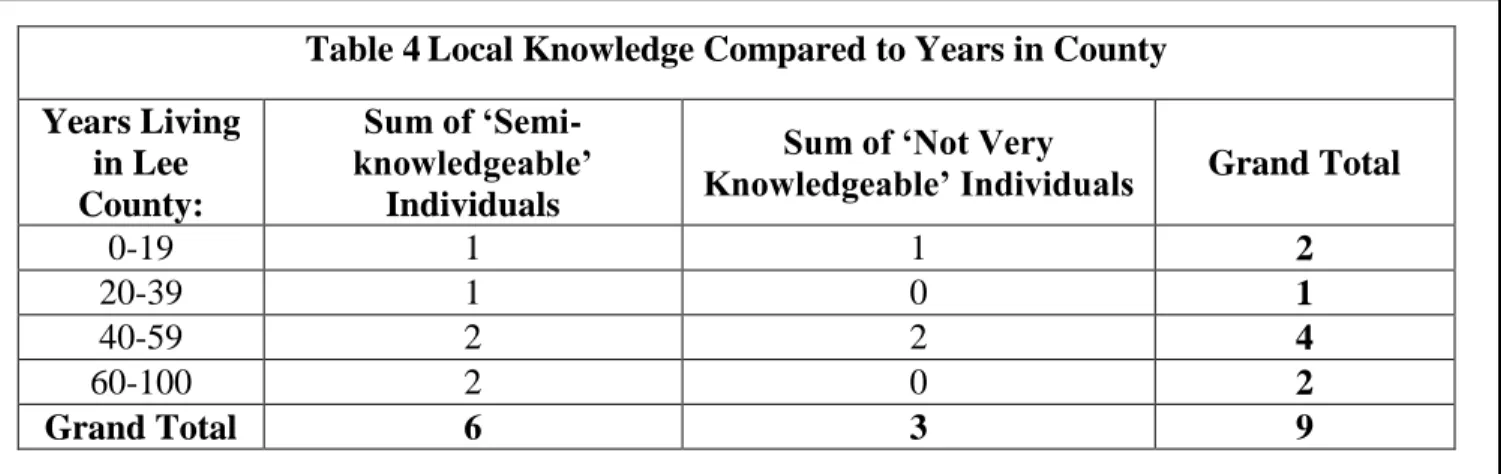
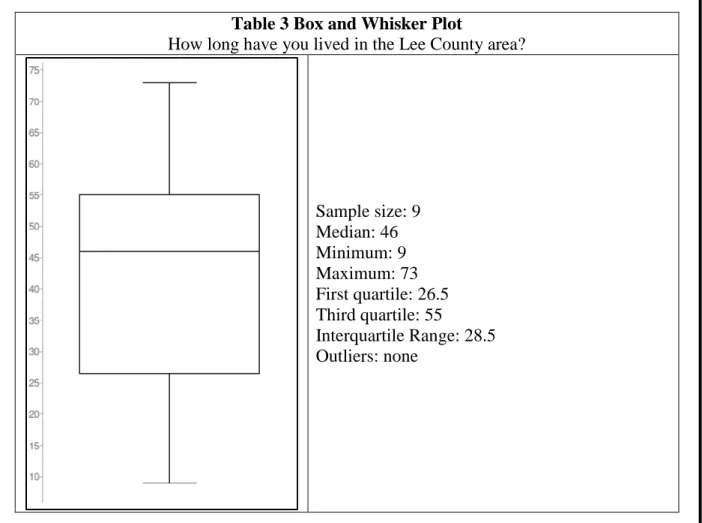
Local organizations were not asked how knowledgeable they felt because their establishment was directly linked to the local character or history of the area. The first open-ended question was "What is most important to you about the history of your community?" This particular question was asked only to the community members and not to the organizations, but provided important information that was used to coordinate various aspects of the website. Lack of time to build the necessary report in the community was a major barrier to the improvement of the sample size, both during and after the survey process in the area.
Preserving information related to the county's distinctive character, both shared among community members and taught to younger members, was listed as an important part of local history and in need of resources in Lee County. After the county field research, I was able to reach out to my contacts in Lee County as well as other organizations in Virginia to further develop the digital space and my knowledge of the community. The park, established in the early 1990s, is located in the western part of the county in Ewing.
Another testament to the importance of kinship ties and the core group that influenced the development of the digital space was the Lee County Quilters group. During my visit, a former resident of the community who had grown up in Lee County spoke about country stores and their importance in the area. Lee County, Virginia is filled with historical organizations and the community is deeply concerned about preserving and communicating the area's history and heritage to the next generation.
Places were also something specifically set up within the surveys, and this particular aspect of the website will enable the community to customize focus areas for different geographic regions in Lee County.
Conclusion
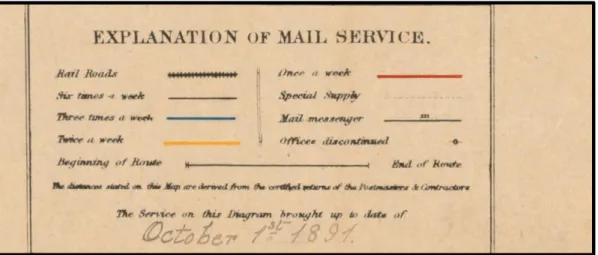
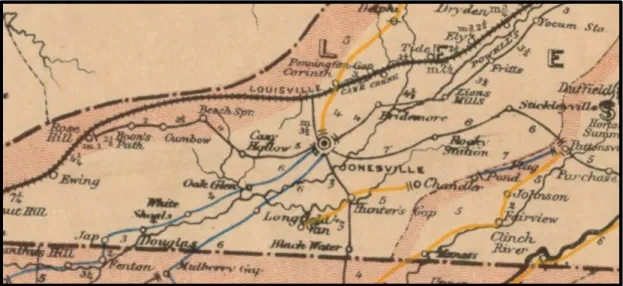
This may include a focus on the bluegrass music tradition of the area and can easily be connected to the state's Crooked Road Music Trail. 1776 A general map of the middle British colonies, in America: containing Virginia, Maryland, Delaware counties, Pennsylvania, and New Jersey: with the addition of New York and the greater part of New England, as also of the adjoining parts of the province of Quebec , improved from several surveys made after the late war, and corrected from Governor Pownall's late map 1776. 1891 Postal Route Map of the States of Virginia and West Virginia, together with Maryland and Delaware, with adjacent portions of Pennsylvania, Ohio, Kentucky, Tennessee, and North Carolina: showing intermediate distance post offices and mail routes in operation on 1 October 1891.
1914 Transportation of Coal: Hearings before a Subcommittee of the Committee on Maritime Affairs, United States Senate, Sixty-third Congress, Second Session pursuant. 1895 Postal Route Map of the States of Virginia and West Virginia Showing Post Offices with Intermediate Distances and Postal Routes in Use on December 1, 1895. The petition of the citizens of Lee County humbly indicates that the court has devised a place to establish the liberty of holding court for this county, on the land of Mr.
That in consequence the said Frederick Jones unofficially relinquished fifty-five acres of land to be disposed of for the use of the County; That your petitioners think that it will add much to their advantage and interest and to the cause and residence of traveller, if a town is established thereon. Legislative Petitions of the General Assembly Accession Number 36121, Box 137, Folder 2. Biographical/Historical Note: Formed from Russell and Scott Counties, and named to honor Virginia Governor Henry Lee. This study will also assist in the awareness of local history, archeology and historic preservation for the Lee County, VA area.
Members of the Institutional Review Board (IRB)—the committee responsible for ethics review, approval, and monitoring of all human research—have authority to access all records. We will not release identifiable study results to anyone without your written consent, unless required by law. The annotations will be used to help create an online resource for the community and to evaluate the connections between you and your artifacts.