Hotel Organisation
6
H OTEL O RGANISATION
The Front Office in a hotel is the department responsible for the sale of hotel rooms through systematic methods of reservation, followed by registration and assigning rooms to customers. The term ‘sale of rooms’ may appear misleading to those unfamiliar with the industry. ‘Sale’ here means the use of hotel rooms at a price. A room is termed ‘sold’ for the day when a guest leases the room for stay in the hotel. “Room tariff” i.e.
rate charged per room is computed for a “revenue day” which begins at noon of a particular day and ends at 12.00 hrs. the next day. In other words room charges are levied for a revenue day which is between noon and noon. Of course, a room may be sold for half-a-day as well, for which special rates are applicable. Such rates are referred to as “half-day” rates.
The front office in a hotel holds prime importance in view of the basic nature of business of a hotel, i.e. to sell rooms.
Revenue collected from the sale of rooms contributes to more than 50 per cent of total hotel sales. The profit percentage from sales of rooms is very high. It has a complementary role of image-building, which is the first and last point of contact of
Principles of Hotel Management every guest. If one looks at each component of a front office role, one could have a better perception of this department.
While the title Front Office is a generic term to include a number of activities, smaller hotels are satisfied to call it simply Hotel Reception. Thus the role of the front office is thus to reserve, receive, register, assign rooms to guests and act as a continuous source of information to guests during their stay at the hotel.
A section of the front office is called the Reservation. This section is the hub of the department. Requests for reservation of rooms from various sources are received and the information is processed, properly documented, stored and retrieved at the appropriate time to ensure a guest his room upon arrival. Room, the chief product of a hotel, being a highly perishable commodity (as its sale is linked with a time element) the reservation department ensures that rooms are not allowed to “perish”.
This activity is handled by the section called Reception. The personnel in this section actually welcome and receive the guests and assign them a room after a few registration formalities.
MEANS OF KNOWLEDGE
The Information section is vital to front office operation. It controls the room keys, mail and messages. It is also equipped with all the information of the Hotel facilities and the city. Though the major functions of the Front Office may seem simple, the actual mechanics to execute them successfully is complicated.
The various systems and procedures on which the front office hinges shall be explained in detail later.
TRAITS OF WORKERS
As the front office is a critical department in a hotel in view of its revenue generating capacity and influence in image-building, the staff working in it assume a special importance.
Great care is taken in the selection of front office staff as they play a key role as:
Hotel Organisation
They motivate the guest to spend more on the various hotel facilities.
Guests invariably approach the front office for help in case they have a problem or complaint. The staff have to be diplomatic and resourceful to solve the problem at the shortest possible time.
Guests who want information or want to pass on information use them for this purpose.
Since they are a reference point, the front office staff are required to coordinate with other departments, airlines, travel agencies and city tour offices to give the guest personalised service.
As an extension to their salesman’s role, front office staff can certainly generate a good image for the establishment in their manner of dress, communication, personal conduct and efficiency.
In view of the important role they play, the front office staff must have the following essential attributes:
Uniforms must be clean and neatly pressed. Hair should be groomed well. It is preferable for ladies to tie their hair up in a bun. Nails should be manicured.
A soft cologne is preferable instead of heavy perfumes. Jewellery should be restricted to one ring and a necklace for ladies. In short, the front office staff must be seem at their best at all times.
This is imperative to front office personnel. As they are constantly exposed to hotel guests, a clean appearance helps to project a good image not only of themselves but of the establishment as well.
This is necessary as front office personnel meet guests of different countries, statuses and cultures. They should be comfortable and feel at ease in dealing with these people.
Principles of Hotel Management It is preferable that front office staff know more than one language. It helps in communicating with guests who cannot speak English or the local language.
Very often there are situations when a guest is irate over something; a diplomatic dealing helps in diffusing the explosive moment. It is quite common for a busy hotel to have no room to offer a guest who has come with a confirmed booking. A diplomatic approach is the only way by which the guest can be pacified.
Being the nerve centre of the hotel, the front office is constantly in touch with guests and therefore invariably comes under tremendous pressure. The guests always expect personalised, priority treatment and the pressure of demand never ceases. Coupled with this are difficult guests who can unnerve a person. The front office staff should thus have a high degree of tolerance for pressure of work and be calm and composed at all times.
This single attribute distinguishes the good from the average amongst the front office staff. Every individual has an ego and his/ her name is most precious and personal to him. If the front office staff can call most guests by their names, this immediately flatters them and personalises the guest experience. The guest begins to feel he is welcome as people recognise him by name.
As the hotel is a meeting place of social elites all the grace and etiquette associated with good society comes into play.
Guests of all statuses come to stay in the hotel and they are used to good manners and politeness. Wishing a guest the time of the day and saying “Thank you” are basic etiquettes shown.
This is very becoming to front office operation. Guests like to be handled by a cheerful staff at the desk. Their smile exudes cheer to the guests and puts them at ease.
Front office operations require the staff to stand for long hours at a stretch. The staff must be sturdy, agile and active.
Hotel Organisation
Guests often approach the Front Desk with problems and requests. Front office staff must be able to decide quickly a course of action that satisfies the guest, at the same time keeping the interests of the organisation alive.
Possessed with the attributes mentioned above, the front office staff could make a fine team that is an asset to the hotel.
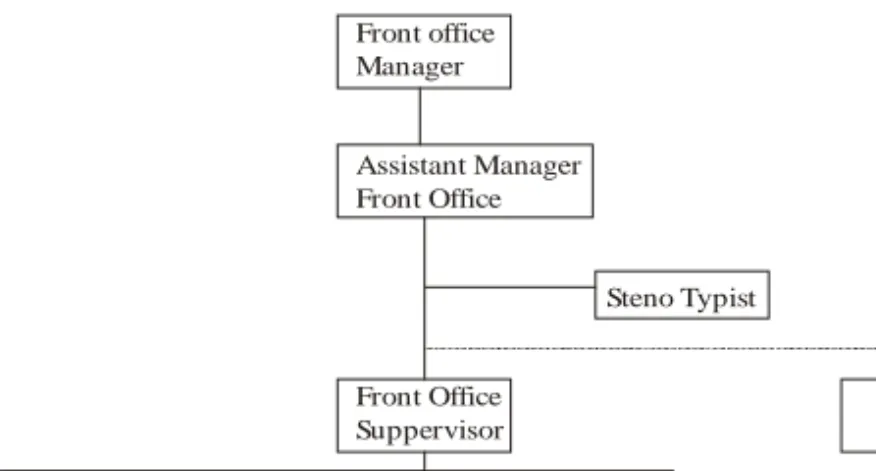
Figure below suggests an organisational hierarchy for a typical large metropolitan hotel.
Front Office Organisational Hierarchy of a Large Hotel
Front office Manager
Assistant Manager Front Office
Steno Typist
Front Office Night
Suppervisor Auditor
Telex Reservation Information Registration F.O
Operator Assistant Assistant Assistant Cashier
or Receptionist
Note: Dotted line indicates operational control relationship as opposed to administrative control relationship.
The figure below suggests hierarchy of a small hotel.
Front Office Organisational Hierarchy of a Small Hotel Front Office
Front Office Front Office
Cashier Assistants
The Assistant : A Job Description, by its very nomenclature is a written description of the job to be performed in a job
Principles of Hotel Management position. It specifies the parameters within which a job is done.
It is thus a realistic guide to any employee recruited for a particular job. These parameters not only include the duties and responsibilities of the job position but also the working hours, reporting relationships, authority, equipment handled, coordinational specifications with other departments and job positions, status within the departmental hierarchy, etc.
Professional organisations would normally hand over a job description to all new recruits. This offers several advantages:
1. The new recruit knows exactly what his job entails. This in itself is a vital part of induction.
2. A job description acts as a basic foundation to set standards of performance. This induces and informs the employees of what exactly is expected of them.
3. The job description ensures that both the superior and subordinate view the job required to be performed in commonality, otherwise this could lead to misperception of the job and thus friction.
4. It acts as a legal document for any disputes arising out of lack of role clarification.
5. It protects an employee from an unreasonable superior who may like to over-burden an employee through unnecessary role deviations.
To enable readers of this book to appreciate the full significance of subsequent chapters, the following pages elucidate typical job descriptions of front office personnel. In order to comprehensively cover the front office operations the job descriptions of the Front Office Cashier and Night Auditor, have been included. These two positions would normally be under the Accounts Department but their roles would take us a step further to complete the cycle of front office actions. It is prudent for hotels to train their front office staff to acquire multiple skills thereby enabling them to handle the reception, reservation and information. Multiplicity of skills gives the
Hotel Organisation
management the flexibility while scheduling staff so that all positions are manned in spite of absenteeism, leave, staff turnover, etc. the front office employee reciprocally views his job as enriched and is saved from the monotony of doing one job only. The job description offered for front office basic staff is common, with subsections provided for the unique activity offered in various job positions in the departments. We have found it important to give the front office cashier and night auditor separate job descriptions in view of their specialised tasks though front office staff in smaller hotels are adept at these roles also.
Job Description of Front Office Assistants Job Position : Front Office Assistants Category : Non-Supervisory
Reports to :1. Front Office Supervisor 2. Front Office Manager
Reserve, register and assign rooms to guests and be a continuous source of information during their stay in the hotel.
Room racks, Arrival-departure register, Guest racks, Reservation racks, Guest room keys, Guest mail.
Front Office: Information, Reception and Reservation Desks.
One shift in 24 hours for 8 hours or as per policy of the Management.
Refuse reservations; give discounts as per policy; assign rooms and deal with guests as found fit; can refuse divulging guest informations to others.
Work Performed : Reservation
1. Promptly and courteously handle all reservation requests.
2. Update regularly the reservation chart and rack.
Principles of Hotel Management 3. Keep all reservations correspondence up-to-date.
4. Keep room availability status board up-to-date.
5. Handle amendments and cancellations of reservations.
Reception
1. Promptly and courteously register guests and assign them rooms.
2. Update the room rack continuously.
3. Calculate room availability position and advise reservation.
4. Issue VIP amenities voucher.
5. Complete pre-registration formalities for VIPs, invalids, old people, groups and airline crews.
6. Execute government formalities regarding foreigners.
7. Coordinate closely with Housekeeping for clearance of rooms to sell.
8 Prepare room-reports and occupancy statistics.
Information
1. Maintain guest-room keys safely and accurately.
2. Provide up-to-date information on the hotel and city to guests.
3. Receive and disburse guest mail.
4. Continuously update the guest rack.
5. Receive messages of guests and forward them correctly and promptly.
6. Liase with lobby to page guests.
Bell Captain
Job Title : Bell Captain Category: Supervisory
Hotel Organisation Reports to
1. Sr. Bell Captain 2. Lobby Manager
To supervise and provide all porter services with efficiency and politeness.
Bell-boys
Principally the lobby area but is authorised to work in any part of the hotel depending upon the errand demanded. One shift of 8 hours in 24 hours, or as per policy of the management.
To check bell boys in their daily operations.
To appraise their performance.
Work Performed
1. Brief all bell boys at the beginning of a shift.
2. Ensure that bell boys in their shifts are well groomed and uniformed.
3. Control the movement of all bell boys.
4. Assign errands to bell boys.
5. Ensure that the bell desk is well stocked with postage.
6. Initiate action again “scanty baggage” guests.
7. Organise paging services in the lobby.
8. Execute formalities regarding “left luggage”.
9. Assist in security vigilance functions.
10. Assist in crew and group wake call procedure.
11. Perform any other duties that are required by management front time to time.
Bell Boy
Job Title : Bell Boy
Category : Non-Supervisory
Principles of Hotel Management Reports to
1. Bell Captain 2. Sr. Bell Captain 3. Lobby Manager
Job Definition : To handle guest baggage at the time of arrival and departure and to do errands as required.
Directly Controls : Guest baggage during transit in the hotel.
Assigned Area of Activity : Principally the lobby area boy is authorised to work in any part of the hotel depending upon the errand demanded.
Hours of Operation : One shift of 8 hours in 24 hours, or as per the policy of the management.
Authority : None Work Performed
1. Carry guest baggage at the time of guest arrival.
2. Carry guest baggage into the guest room and explain all controls in the room to the guest.
3. Issue postage against cash to guests.
4. Deliver guest baggage to “left luggage” room if required.
5. Check the guest room at the time of guest departure.
6. Carry baggage at the time of guest departure.
7. Check guest rooms to validate the Discrepancy Report.
8. Page guests in the lobby area if required.
9. Report “scanty baggage” guests to Bell Captain.
10. Perform any errands as required by guests and management.
Front office: for the arrival and departure of guests to validate Room Discrepancy Report.
Hotel Organisation
Security: for reporting and assisting in dealing with undesirable elements in the lobby.
As is evident from the job description of the Bell Captain, one of his primary functions is to control bell boys. This control is necessary as bell boys are subject to many errands that take them to all corners of the hotel and even outside. To be able to optimise the productivity of the team within a given shift the Lobby Control Sheet is constituted. The purpose of this sheet is to keep a record of and check on the movement of bell boys.
HOTEL XYZ LTD.
LOBBY CONTROL SHEET
Captain... Sheet No...
Date ...198... Shift- from ... To ...
Room Attendant Arr Dep. Room Service Time Comments
No. No. Change Call From To
To
The control sheet above is sell-explanatory. The bell boys are given code numbers to easily record their activities.
Alternatively, the bell boys names may be also used. For an arrival, the room number is filled in after the front office has intimated the same. The “room changed to” column would indicate the number of the new room a guest has been allotted. His old room number is mentioned in the first column.
Principles of Hotel Management Through this sheet the work-load per bell boy is ascertained and the bell captain is able to distribute work-load uniformly. He gets a chance to find out who the lethargic members of the team are through the time control. Of course, the bell boy should know in advance a reasonable time that an errand would take to fill his remarks in the last column.
The Salesmanship : The difference between a successful hotel and an unsuccessful one is the ability of the staff to get a guest to spend an extra rupee and get the value for it. Very often a guest may enter a hotel without an exact idea of how he is going to utilise his free time. A gentle suggestion by an employee at the right time can stimulate a guest to utilise a service and pay for it. The front office staff have a key role to play in hotel selling.
This is one of the most important factors for salesmanship.
Here is a checklist of things that front office personnel should be knowledgeable about:
Location, view it commands, size, type, room rate, decor, guest facilities in the room such as hot/cold water, channel music, telephone, refrigerator, television, weather controls, etc.
Number of outlets, locations, types of cuisine, entertainment, timings, buffet or a’la carte, menu, table reservation procedures.
Service offered by travel agency, bank, post and telegraph office, health club, swimming pool, barber shop, pastry shop, shoe-shine, beauty saloon, drugstore and shopping.
Telephones, party arrangements, baby sitter services, valet and laundry service, reservations for other hotels of the chain, telex, typist facility, doctor service.
City tour facilities, church timings, theatre timings, maps and locations of shopping centres, historical, business and cultural places of interest, railway timings, airline schedule, inter-state bus terminals, nearest location of a 24-hour chemist shop and nearest hospital.
Hotel Organisation
There are many more items of information that front office staff are equipped with to make them living encyclopaedias. The important point to remember is that only with a knowledge of the product can one actually sell it.
Front office staff must be aware that the guest attaches value to the service sold and will be prepared to spend for it.
For example, if a room has a maximum, moderate and minimum rate attached to it, the maximum must be quoted but the value of this rate must be sold. The room may be overlooking the swimming pool, or be away from the noisy elevator foyer, or have soft decor to please a guest on a hot day. Whatever it be, each proposition must be given a value.
After the room is allotted the front office assistant may recommend a suana bath and massage at the health club especially after the guest has returned from a long journey. The assistant may volunteer to reserve his table at one of the restaurants and bars.
The good front office assistant must always give the guest a choice so that he feels that the final decision was his. While offering a room two locations should be given. When recommending a restaurant two are offered to choose from (provided the establishment has more than one dining place).
As individuals have varying needs, a guest may stay in a hotel for comfort, address value, entertainment, convenience of location, standards of facilities offered, etc. It is important to identify the needs of each guest and try to appeal to those needs. Another important aspect of a guest is that he has left his home and would like a home away from home.
It is a question of emotional adjustments to unfamiliar surroundings. An employee should try and make him feel at home and anticipate his needs for home comforts through personalised service. By appealing to a guests’ needs one can stimulate sales.
Principles of Hotel Management This trait could be the cornerstone to successful salesmanship in the hospitability industry—it is essential to be genuine in all communications with guests. The more genuine the front office staff are in their approach, the greater is the desire to be helpful. A guest is sensitive and can see through a “put on” act as against sincerity in words and deeds. Unless an employee enjoys being hospitable, genuine concern becomes act. A simple way of bringing out this genuine concern is to display empathy. Empathy is energised by asking oneself, “what would I expect of the hotel if I were a guest”.
How one speaks is important to all sales efforts. Brusque language is bound to put guests on the defensive and a sale can never be energised. Here are some typical phrases to use:
“May I help you”.
“May I suggest (or recommend)...”
“I beg your pardon”
“May I request you to...”
“One moment please...”
“Would you kindly...”
It is highly recommended that one should avoid the use of slang or abbreviation. Always refer to male guests as gentlemen and female guests as ladies or young ladies. Normally the establishment would select those candidates for the post of front office assistant who have a clear, mellow and proper mode of speech.
BUSINESS HELP
Lobby : The bell boy escorts guests from the main door with their luggage to the front office. After the guest has been registered the front office informs the bell boy of the room number so that the guest may be escorted to his room and his luggage placed in the room.
Hotel Organisation
In most hotels, a guest wishing to check out of the hotel calls the bell desk for a porter to carry his luggage down. The bell desk informs the front office of the intentions of the guest so that the cashier can prepare his bill. It is only after the front office is satisfied regarding the payment of bills and retrieval of room key will they allow the bell boy to remove the luggage outside the premise of the hotel.
Often, a guest requests the front office for a change of room.
The front office intimates the bell desk to send bell boys to help in the shifting of luggage.
“Skippers” are those guests who leave the hotel without paying their bills. This is made possible because the “skipper”
comes with little luggage to avoid bringing the attention of the bell boys to his “secret” check out. Alternatively, if he has just a briefcase, he may leave the hotel under the pretext of a business call. The bell boys have to be alert to notify the front office about guests with scanty baggage so that a necessary advance is taken from them and a close watch is kept on them.
The information section of front office alerts the bell boys to deliver messages received by them for guests in the hotel.
“Paging” is the system of displaying the name of a guest on a small board with a long handle. The board is held above the head of the bell boy and has small bells which are rung to draw the attention of customers to the board.
When a phone call is received for a guest in a specified location, this paging system is used to contact guests. The bell boy does the paging in most public areas especially the lobby.
To keep a tight control on rooms, the housekeeping and front office have to closely coordinate. One way is through the room report whereby the housekeeping staff checks each room on every floor and advises their status through a report.
Principles of Hotel Management HOTEL XYZ LTD
Discrepancy Report
Room Per Room Per House Investigation
Asstt. Keeper Remarks
Asstt. Manager
A discrepancy report is prepared by the front desk on receiving the Room Report from the Housekeeping. The front office compares it with the Room Rack for reconciliation of room status. Discrepancies noticed between room rack and housekeeping room report are noted down on a separate report called the “discrepancy report” which is then handed over to a bell boy for physical check and reporting back of the room under discrepancy. After a physical check of the room the bell boy notes down the correct status which is accepted by the front office and room rack and reconciled accordingly.
When a guest checks out, the front office has to immediately inform the housekeeping desk (which is the central point of information for housekeeping) or the floors, to clean the room so that it is ready for sale again. This information is controlled on a Departure Intimation control sheet. Housekeeping in return would have to inform the front office immediately after a room
Hotel Organisation
has been cleaned and prepared for sale to a guest. In technical parlance when the front desk informs the housekeeping desk about a check out room, it is referred to as giving a “departure room” to housekeeping and when housekeeping informs the front office about rooms which are ready for sale, it is known as “cleared rooms”.
HOTEL XYZ LTD.
Principles of Hotel Management After reconciling the “Room Rack” with the Housekeeping Room Report, the Front Office Reception compile data on the
“occupancy” position of the hotel for the day in the form of a report for the purpose of management information. This compilation and analysis of occupancy data is referred to as
“night room report” and is invariably prepared by the night receptionist.
The front office informs housekeeping to be alert to attend to rooms occupied by groups or VIPs. Service has to be quicker and efficient. Housekeeping provides “flowers” for VIPs in the room on receipt of the Amenities Voucher issued by the Front Desk.
Day Date
Please Send Complimentary Flowers
Full—Single ( )—Double ( )—Special ( )
...
To ... Arriving ...
Room No. ...
...
Authorised by ...
Copy of Auditor MAURYA—FO—021
Accounts : The front office cashier receives payments for a guest’s stay in the hotel. This is the point where all the charge vouchers (bills) generated by the guest are received, to be included in the overall bill. Close liaison between the lobby staff and cashier is imperative. The Bell Captain must inform the cashier about the intended check out of a guest so that the guest’s bills are updated and kept ready for presentation. Also, the cashier is informed of a new arrival by the Reception by
Hotel Organisation
opening and forwarding a new folio in the guest’s name giving room number and time of check in, with defined billing instructions which the cashier places in the bill tray against the appropriate room.
The Night Auditor audits all guest bills received by the front office cashier and prepares and proves for the calendar day.
This is the credit section which receives bills from front office that has extended credit as per previous arrangement between the hotel and the guest. This department follows up with the individual or company for the payment of the bills.
The Room Service is kept closely intimated on arrivals and departures of guests. It is this department that provides food and beverage services to the room and must be informed as to the occupant in order to raise bills accordingly.
The front office informs room service through the Amenities Voucher and a List of the VIPs’ expected to arrive in the hotel so that special service is extended. Also the room service provides a complimentary basket of fruit, liquor, cakes and pastries or whatever gesture the establishment wishes to extend to a VIP as per the policy.
Telephones : This is another department that is informed immediately of the arrival and departure of a guest so that when calls come for a particular guest it is fully knowledgeable about his/her presence in the hotel so that calls may be connected to him/her. Also calls made by the guest are recorded or metered.
The engineering department is responsible for any maintenance of furniture, fixtures and equipment and for rectifying faults in the services provided, like air conditioning, plumbing, etc. Sometimes when guest keys are lost, the workshop of the engineering department makes duplicate keys from key blanks, besides changing the location of the lever by altering the lock and key plan of the hotel. The stores are responsible for supplies of relevant forms, formats and stationery.
Principles of Hotel Management There is very close coordination between the front office and sales especially in soliciting their help in improving room sales on lean occupancy days. The front office also informs sales whenever an important guest, who influences the business of the hotel ‘checks in’, so that special attention can be given to him/her. Sales keeps the front office updated with the new agreements made with travel agents and airline crews and viable accounts.
METHOD OF DEPARTURE
Step 1 : When a guest arrives, the doorman buzzes the Bell Captain Desk for a bell Boy.
Step 2 : The bell boy should wish the guest and collect his baggage and bring it into the lobby via the baggage entrance and place baggage at the bell desk which is located normally opposite the Reception counter. The bell boy should wait for the guest to register at the front office. If the hotel has tags to identify baggage these should be attached to the baggage.
Inform scanty baggage to the lobby manager or front office.
Step 3 : The Information counter at the front office will indicate that the guest has been allotted a room by handing over the errand card which mentions the room number. The room key is also handed over with the errand card. Bring to the guest’s attention any baggage damaged to protect the hotel from blame.
Guest Arrival Errand Card
Bell Boy No. Date
Room No. Name
Suit Case Brief Case Hand Bag Packets Others
Remarks
Bell Boy Sig. Capt's Sig.
Hotel Organisation
Step 4 : Lead the guest to his room along with his baggage.
Some hotels have separate baggage elevators.
Step 5 : The bell boy should open the door of the guest- room and let the guest enter first. After positioning the baggage at the allotted rack in the room, the guest must be told where the floor-lights are located, channel music, air-conditioning/central heating thermostat control, internal locking system, etc. are located.
Step 6 : Offer any other help and if not required, wish the guest a pleasant stay. Do not solicit for tips.
Step 7 : Report back to the bell desk.
Note: A hotel may have different coloured errand cards for arrival and departure of guests.
Departure Procedure
Step 1 : The bell desk will receive a phone call from the guest about his intention to check out. Write the room number carefully on the errand card, a stack of which is kept at the bell desk itself. Inform the Bell Captain and proceed to the room.
Step 2 : Knock on the guest’s door and announce yourself.
Look around the room for any guest articles left, any damaged hotel property and switch off the air-conditioning/ heating, lights, etc. Collect the room key and depart from the room letting the guest lead the way. Ensure that the guest room is locked. If the guest wants to carry the room key himself, permit him to do so.
Step 3 : Place the baggage at the bell desk. Stick on any hotel stickers or publicity tags. Hand over the room key to the Information counter and errand card to the Front Office Cashier.
Wait for the guest to pay the bill.
Step 4 : The bell boy will receive an authorisation to take the baggage out of the hotel only after the Front Office cashier has signed that the guest has paid his bills, and the Receptionist that the room key has been received.
Principles of Hotel Management Step 5 : Take the baggage to the car porch and load it to the transport.
Step 6 : Report back to the bell desk and hand over the errand card with the authorisation signatures.
METHOD AND EXECUTION
Making of Schedules : Briefing is that process at the beginning of a work shift which is provided by management to facilitate a two-way communication between management and staff. It is the one time during a shift that all housekeeping staff are together to share information and feelings before they disperse to their work areas.
Briefing is normally undertaken where all employees have to report on duty at the beginning of the shift. This is after the employees have formally clocked into the hotel at the time office and have already received their fresh uniforms which they change into in their respective locker rooms. All employees must report for briefing properly attired and at the scheduled commencement of the shift or earlier.
In Housekeeping briefing is conducted at a prescribed common Housekeeping Lounge or at the Housekeeping Control Room. Ideally, the Executive Housekeeper must conduct the briefing; however, due to odd shift timings she may delegate this responsibility to her deputy. Here are some issues that should normally be covered in a briefing that should last no longer than 15 minutes.
Housekeeping staff are mostly in guest visibility and contact areas. It is thus important that they are well-groomed and clean.
While grooming projects the image and quality of the hotel, a guest also likes to feel that the people who clean his room are themselves very clean.
It is thus important for the Housekeeper to ensure the following:
Hotel Organisation
1. Personal cleanliness—fingernails should be clean and cut short; men should have shaved and should emit no body odour.
2. Hair should be clean and neatly combed/arranged. Hair nets are suggested but not essential.
3. Little or no make-up.
4. Careful use of lipsticks for maids.
5. No necklaces or bracelets—earrings, if worn, must be small and unobtrusive.
6. Uniforms must be clean and well pressed. They must be of the proper size and well fastened.
7. Stockings (if required) should be clean, of a permitted colour and free of holes.
8. Shoes should be dark in colour, low-heeled and clean.
Any new policies and procedures introduced by management must be made out and explained to the staff.
The names, room numbers and the importance of each VIP staying in the hotel must be communicated to all staff, especially those assigned to their floors.
At a briefing the duties of each staff member and the areas of accountability are explained. This would mean that maids are assigned a floor and allotted their number of rooms. The housemen, likewise, are told which floors or public areas they are assigned to for cleaning. They are also told which supervisor would be in charge.
The Executive Housekeeper must receive any professional or personal grievances of staff. It would help productivity if problems are resolved or at least heard with the intention of resolving them. This can also be an opportunity to test out whether policies and procedures already explained have been understood and implemented.
Briefing is a time which can be used as a training opportunity.
Principles of Hotel Management Simple tasks may be demonstrated so that they can be practiced under supervision at their work place.
An Executive Housekeeper must constantly remind housekeeping staff of the standards expected by management.
Standards could be the number of rooms to be completed by a maid in her shift or the time taken to complete a departure room etc. At a briefing, the housekeeping staff should get a first hand feedback on whether they are maintaining the required standards.
Since all housekeeping staff on a given shift assemble for a briefing, it is the ideal time to give a word of praise or recognition to deserving candidates.
It is important to give information of a general nature, especially of the going-on in the hotel to staff. One normally shrugs off general information as it does not concern staff—
but all information is knowledge and brings in a feeling of pride and a team spirit to the totality of hotel operations.
Information like the gala functions in the hotel, the re-assignment of people in the hotel, promotions, increments, etc. must be shared.
The sale of rooms constitute approximately 50 per cent or more of the total hotel revenue. A ‘sale’ of room would mean the leasing of the room for occupation for 24 hours at a predetermined cost. A room not sold on a particular day has lost its opportunity to earn revenue for that day. Hence rooms are referred to as highly perishable commodities. The loss of an opportunity to sell a room can also be due to inefficiency of housekeeping in having a room ready when required. What does a room mean to a guest?
Hence, hotels spend efforts in ensuring the quality of beds, mattresses; weather, control, channel music, hot and cold water, attached baths, etc. The comforts must be regularly maintained and functioning. It is Housekeeping’s responsibility to ensure this.
Hotel Organisation
The primary security devise that hotels provide is to restrict entrance to the room/suite through only one door; a double locking system from inside; strict control on room keys and master keys; chain locking the door from within to further augment the door locking system; precautions in the room to ensure all electrical wiring is concealed and no equipment in the room is faulty; fire exit layout in the room, etc.
Room windows are provided with curtains. Superior hotels would have daylight curtains and heavy night curtains. Windows would normally overlook good scenic views, away from the prying eyes of others in the hotel or the outside public.
The entrance into a room procedure is well defined to ensure guest privacy. Attached baths are also a measure towards privacy.
A guest is provided entertainment, food and beverage services, telephone services, etc. in his or her room. The guest is thus free to spend all the time towards fulfilling the purpose of his visit—be it a holiday or business. The House keeping Department should ensure such literature in the room as to enable a guest to know how to reach such conveniences and avail of them.
The Housekeeping Department has a pivotal role to play in this aspect.
Hence he demands the highest standards in everything that the room stands for.
In addition to the above, it is important for all housekeeping personnel to know the different types of rooms that hotels provide.
Single Room Meant for a single occupancy. The room has one normal sized bed.
Double Room Meant for double occupancy and has one large bed meant for two.
Principles of Hotel Management Twin Room Meant for double occupancy. The room
provides two single beds.
Hotels may reserve the flexibility to sell it on single occupancy as well.
Studio Room Meant for single or double occupancy.
It has one normal bed and a sofa-cum- bed which acts as a sofa during the day and can be pulled out into a bed for the night.
Single Suite Meant for single occupancy. A suite is a two-room set—one room furnished with drawing-cum-dining facilities and the other as a bedroom with a normal bed.
Double Suite It is the same as a single suite in concept, except that the bedroom has a large double bed, or two normal sized beds to facilitate double occupancy.
Cabana Rooms attached to the pool-side for changing or resting. The room has one sofa-cum-bed.
Duplex Suite Room built on two floors with an inter- connecting staircase.
Such suites normally have two bedrooms.
Triple Room Provided mostly for families. It has twin beds with an extra cot.
All the above rooms may be furnished with extra roll-away cots on the demand of the guest at an extra charge. All rooms normally have attached bathrooms. Exceptions would be in hostel where common bathrooms per floor is more economical for the guest and management for the low charges they levy on rooms.
Hotel Organisation
Prior to commencing work, all housekeeping staff, especially room attendants, must follow some floor rules that lend an air of efficiency and least inconvenience to guests.
The floor and rooms are most private and personal to guests who are concerned by the people who frequent them.
They lay a large trust in the management of the hotel through the room attendants who are privy to their rooms and belongings.
To uphold this trust the following rules must be strictly observed:
1. Speech amongst the floor staff must be restricted to a minimum. In case communication is necessary, this must be done in low tones even when guests are not in sight.
2. Unnecessary movements like running or jumping must be avoided.
3. The passageway must be kept free of equipment, trays or trollies.
4. The floor telephones must be attended to promptly.
5. Room attendants must greet all guests according to the time of the day.
6. Staff must be helpful and readily give required information. Misleading a guest through misinformation must be avoided.
7. Alertness to guest movements is necessary so as to report anything suspicious.
8. Remember the guest is always right. Arguing with a guest is prohibited. If a guest is being unreasonable refer him/her to the next superior.
9. It is prohibited to enter rooms which display a “Do not disturb” sign outside. If a DND sign is on for a long time, this may be reported to the floor supervisor.
10. The door of the room in which the attendant is cleaning should always be kept wide open.
Principles of Hotel Management 11. If the guest returns when the room is being cleaned the room attendant may ask the guest if she can continue or come later.
12. In spite of following the procedure for entering a room, if the guest is inside either sleeping or awake, quickly withdraw, apologising if required and shut the door softly.
13. Always follow the procedure of entering a room even if the room is seemingly vacant.
The maids cart is a trolley meant to stock a given number of linen item, supplies and equipment to service an allotted number of rooms. Each maid, after receiving her room assignment, should check her supplies against a standard list to avoid needless trips. The maid is responsible for the condition, cleanliness and appearance of her cart.
The lower shelf of the cart is used to carry heavier items like mattresses, protectors and bed sheets and night spreads.
The middle and top shelf stock pillow slips and bath linen. Linen will include:
Night spreads 1 for each bed
Sheets 2 for each bed
Pillow cases 2 for each bed
Bath towels 1 for each guest
Face towels 1 for each guest
Hand towels 1 for/each guest
Bath mats 1 for each bathroom
Mattress protectors few to replace as necessary These terms should be arranged in neat stacks, the heavier items below and the lighter ones on top.
The top tray should be neatly arranged with the following guest room supplies and cleaning agents:
Hotel Organisation
Room Bathroom
Water tumblers Gargle tumblers
Service directory Shoe mitts
‘Do not disturb’ cards Soaps/soap dish
Guest stationery Toilet rolls
Ball point pens Toilet tissues
Telegraph forms Blade dispensers
Bibles/Gita Shower caps
Ash trays Soap suds
Match boxes Shampoo bottles
Laundry forms Disposal bags
Laundry bags Clothes hangers Candle stands Scribbling pads Guest house rules Guest comment forms Sewing kits
Breakfast knob cards Plastic shirt bags
“Polish my shoe” card
In addition, there should be supplies of such promotional material as the management of the hotel may from time to time prescribe. In any event, this material should include:
Room service menu.
Room service beverage list.
Tent cards for special promotion.
Principles of Hotel Management In addition, the cart may carry cleaning equipment such as feather brush, dustpan, mops, sponges, dusters, carpet brush or vacuum cleaner, clean scrub bucket, scrub brush on the same end of the maids cart as the trash bag. The exact location is below the trash bag.
The cleaning material will include:
Disinfectants: dettol, deodorizer.
Cleaning agents: Vim, sanitizer (sanifresh), liquid soap (teenopol), naphthealene balls, room freshner and anol.
Polishing material: Brasso, wax polish.
After securing all the supplies and equipment outlined above, each maid should proceed to her duty station and begin the cleaning procedure on the assigned number of rooms with room checklists.
Maid carts are to be placed along the corridor wall on the same side of the corridor where rooms are being serviced. The cart should be so positioned as to service a minimum of two rooms without much movement of the room attendant to minimise trips to the cart and thereby reduce the fatigue factor.
When designing maid carts consideration must be given to the fact that the cart should be lightweight to ensure easy mobility by the maid. Heavy carts also pucker corridor carpets.
The wheels of the cart must be of a good standard and well oiled periodically to ensure smooth movement.
Room Name of Article Room Name of Article Remarks
No. No.
1. Room number 2. Door
3. Lock Operation 4. Threshold
5. Peephole 6. DND-Make my room card
7. Lights -md switches 8. Wardrobe door
9. Micro light 10. Hangers
11. Extra Pillows 12. Laundry bags
Hotel Organisation
Contd...
Room Name of Article Room Name of Article Remarks
No. No.
13. A.C. Operation 14. Luggage chest 15. Lining paper 16. Shoe shine card 17. Wall paper 18. Vestibule ceiling 19. Dresser and stool 20. Ash tray
21. Matches 22. Candle and candle stand
23. Tent card 24. Portfolio
25. Guest house rule 26. Writing material 27. Telegraph form 28. Guest comment form 29. Room service menu 30. Breakfast knobs 31. Laundry and Valet list 32. Sewing kit
33. Plastic bags 34. Waste paper basket 35. TV and TV programme 36. TV Comments form
37. Mirrors 38. Chairs and tables
39. Heavy curtain 40. Sheer curtain 41. Window operation 42. Window Cleaning
43. Safety 44. Safety bar
45. Headrest 46. Bed and mattress
47. Bed cover 48. Studio bed
49. Wall plaques 50. Bedside table
51. Bedside lamp 52. Lamp shade
53. Telephone 54. Message pad
55. Service directory 56. Pen
57. Thermos flask 58. High ball glasses
59. Telephone 60. Gita
61. Bible 62. Light switch
63. A.C. switch 64. Message light 65. Music operation 66. Carpet 67. Skirting 68. Walls & Ceiling 69. Cobweb chicking 70. Toilet door 71. Toilet door latch 72. Bolt
73. Robe hook 74. Bottle opener
75. Washbasin and counter 76. Mirror
Principles of Hotel Management
Contd...
Room Name of Article Room Name of Article Remarks
No. No.
77. Mirror screw caps 78. Tissue & blade box 79. Soap & soap dish 80. Ash tray
81. Toilet tumblers 82. Shower cap 83. Shoe shine strip 84. Soap suds
85. Toilet rolls 86. Spindle
87. Tissue 88. Waste paper basket
89. Disposal bag 90. WC
91. WC Band 92. Flush
93. Drain & C.P. grating 94. Bath tub/Bath tub stopper 95. Bath tub nuts, bolts & caps 96. Tap & shower operation 97. Shower curtain 98. Clothes line
99. Bath mug 100. Towel rack-Towels-Bath mat 101. Chrome fittings 102. Tiles & Ceiling
103. Toilet marble 104. Light fixture
105. Prismatic cover 106. Tidy Guest clothes & belongings
Code G : Good 1 : Needs Improvement P : Poor N : not done Fig. Room Checklist
Prior to reporting on a floor the room attendant already knows the status of a room in her given lot of rooms. The room attendant can prioritise rooms to be attended to first on the basis of immediate needs; however, the normal practice is to attend to vacant rooms first, then departure rooms, “Clean my rooms,” and finally occupied rooms.
For occupied rooms look whether the room has a “Do not disturb” card on the door knob. If it does, then go to a room which does not. Knock at the door firmly with the index finger knuckle announcing clearly “Housekeeping.” When there is no answer, repeat the knock after 10 seconds announcing yourself as before. If there is still no answer open the door with the floor master-key. Push the door again, knock announcing inside
Hotel Organisation
the room “Housekeeping.” When there is no reply and one is relatively sure that there is no one in, open the door wide and keep it that way till the entire cleaning cycle in the room is complete.
1. Switch off the room air-conditioner or heating. Draw all curtains and open the windows for airing the room.
2. Remove soiled linen from beds and bath. Shake out the linen to ensure that no guest articles are lost in the folds of linen. Put the soiled linen in the linen hamper provided in the maids cart.
3. Check for maintenance requirements and report the same to the control desk and enter in room check-list.
4. Check for lost and found in departure rooms and report to supervisor desk.
5. Contact Room Service to remove used trays.
6. Turn the mattress side-to-side on succeeding days followed by end-to-end turning. Smooth out mattress to air it.
7. If a vacuum cleaner is not available, brush the carpet first to enable the dust to settle while doing the next task.
8. Clean bathroom.
9. Empty all ash trays into the waste paper basket in the room. Collect other loose trash on tables and floors and throw them in the waste paper basket.
10. Pick up guest clothes and hang in closet or place in dresser.
11. Collect all loose papers or magazines and stack them neatly on the desk.
12. Clean all the surfaces in single circular motions with a dry cloth. Use a hand dust pan to collect any unwanted matter on the surfaces without lifting dust in the air.
Principles of Hotel Management Ensure that all surfaces are spotlessly clean. Pay special attention to nooks and corners especially those points that may not obviously be visible to the guest eye.
13. Use a stiff upholstery brush or vacuum cleaner (with the appropriate attachment) on upholstered furniture arms, backs and seats.
14. Replace, if necessary, stationery as prescribed by management. The number of items must exactly be as per standard.
15. Dust and replace each item on dressers, bureaus and desks. Special attention must be given to the display of publicity material as prescribed by the management.
16. Clean lamp shades with a clean dry duster. Lift lamps and clean under the base. Replace lamp and adjust the shade.
17. Disinfect telephone mouthpiece with dettol. Wipe balance of the telephone with a damp cloth. Check phone for the dial tone.
18. Clean mirror with a dry cloth first and then with a damp newspaper to make it sparkling.
19. Dust closet, shelves, hangers and rods. Brush the closet floor. Supply new laundry bags and replace missing hangers and drawers/shelf with plastic or paper liners.
20. Dust both sides of all room doors, baseboards, window sills, inside and out, bottom and centre sashes or windows, sash rails and tops of radiators and air- conditioning units.
21. Close windows.
22. If a vacuum cleaner is available then vacuuming of carpet should be done at this stage as against brushing the carpet.
23. Arrange furniture if necessary.
Hotel Organisation
24. Switch on the air-conditioning or heating on the minimum temperature for a departure room and at the same temperature the guest has left it for an occupied room.
25. Have a last look at the room referring to the checklist for completion of work.
Making a Bed
1. Remove soiled sheets and pillow cases and shake out individually.
2. Turn out mattress as previously described.
3. Shake out mattress protector and relay it on the mattress.
Change the protector if soiled or smelling.
4. Open out fresh lower sheet evenly and tuck it securely at the head, foot and sides.
5. Open out fresh top sheet and distribute it evenly over the lower bedsheet. Ensure that the laundry crease is in the same line as the inner sheet for even distribution.
The sheet hem should be evenly pulled up to the headboard. Tuck this sheet at the foot.
6. Open out blanket and distribute it evenly on the top sheet using the crease as described earlier for even distribution. Ensure that the blanket labels are at the foot. Pull the blanket four inches from the headboard.
7. Fold top sheet, at the head of the bed, over the blanket and fold the sheet and blanket once again.
8. The blanket and top sheet are together tucked uniformly on both sides while the corners at the foot of the old are mitred.
9. Cover pillows with fresh pillow slips. Fluff the pillow and even out pillow slips to look neat and tidy. Since pillow slips are larger than the pillow the excess slip should be neatly folded downward. The side of the pillow which has the fold should be away from guest view.
Principles of Hotel Management 10. Cover completed bed with the bed spread ensuring it is right side up and falling evenly all around the bed.
Keep extra bed spread towards the head board to crease in between the pillows so as to make the bed look appealing. The bed spread corners should be aesthetically done.
11. Put spare blankets in plastic bags in the uppermost or lowermost shelf in the guest closet. Blankets are folded in such a manner that the hotel insignia appears on the top.
Certain areas in the room or bathroom elude the maid’s attention and tend to accumulate dust. Such areas are normally hidden from a guest’s eye. However, its cleanliness reflects the standard of cleaning of the hotel. Experience shows that the following areas are overlooked and appropriately called the
“dirty dozen.”
1. Top of door edges and ceiling.
2. Air-conditioning ducts and diffuser grills.
3. Under bathroom counters.
4. Beneath the grab-bar and dresser table.
5. Behind the WC bowl—the Strap.
6. In the toilet roll niche.
7. Faucet nozzle filter.
8. Toilet vents.
9. Top of picture frames.
10. Area above pillow racks.
11. Rear surface of doors.
12. Interior surfaces of drawers.
Cleaning a Bathroom : Basic principles:
(a) Cleaning activity starts from the ceiling downwards to the floor.
Hotel Organisation
(b) Floors are cleaned from the wall farthest to the door to the exit.
1. Open all windows and exhaust vents.
2. Shake out all soiled bathroom linen, e.g. towels, bathroom mats. etc. and deposit in the linen hamper of the maids cart.
3. Collect all trash in bathroom waste basket and deposit in trash hamper of the maids cart.
4. Clean the ceiling and air-conditioning vents for cobwebs.
5. Wipe off light bulbs and shades with a dry cloth.
Check that all bulbs are working.
6. Wipe down the walls using a sponge or damp cloth.
Follow with a dry cloth ensuring that tiles are free of water marks.
7. Clean mirror first with dry cloth, then with damp newspaper and finally with dry cloth. Ensure that the mirror is smudge and scar-free. Clean the medicine cabinet.
8. Wipe dry the shower curtain with a sponge.
9. Scrub dry the area next to the wash basin.
10. Scrub and clean dry the bath tub ensuring that the water faucets and shower are sparkling and in working condition.
11. Scrub the toilet bowl and bidet using the special brush or mop and the prescribed sanitizer. The inner rim should be cleaned. Ensure it is dry and spotless inside. Clean the WC from the outside with a sponge till it is sparkling and dry. Clean the lid and toilet seat of the toilet bowl dry and close them by placing the disinfectant label.
12. Replenish fresh bath linen and guest supplies as per the number of persons in the room at the following number per person.
Principles of Hotel Management
Linen Supplies
One bath towel 2 toilet rolls
One face towel 1 bathroom tumbler per person One hand towel 1 soap dish
One bath mat 2 soaps per guest (25 g each) 1 candle stand with candle 1 ash tray with a match box 1 shoe mit
1 soap sud satchel per person 1 shower cap per person 2 disposal bags
1 blade dispenser 1 face tissue box 1 waste basket Place advertising material as prescribed.
13. Scrub the floor with the prescribed mop and ensure it is dry.
14. Finally close the windows, shut all lights and close the bathroom doors.
Note:In occupied rooms, when cleaning the counter around the wash basin, collect all guest belongings onto one side and clean the other. Shift the belongings to the other side to clean the surface they were occupying. Finally replace all belongings as the guest had left them.
As Housekeeping has contact with all rooms and public areas practically in every shift, it is they who detect, report and ensure the completion of all maintenance work. This requires close coordination with the Engineering Department. It is important for housekeeping personnel to know the exact discipline
Hotel Organisation
under Engineering that various maintenances come. Given below are some suggestions.
Air-conditioning or heating, fused bulbs, lights and lamps not working, defective plugs and plug points, short circuiting of any kind, faulty geysers and refrigerators.
For supply of hot water to guest bathrooms.
Faulty equipment of any kind would come under this category, e.g. vacuum cleaners, ice cube machines.
Faulty taps, showers, drainage systems, water closets, etc.
Any masonry work.
Broken or shaky furniture, mirrors, woodwork, cupboards, etc.
In addition to the above the locksmith is a specialist who attends to locks and keys of any kind.
The moment a housekeeping member detects a maintenance requirement he or she must call the Housekeeping Desk and lodge the complaint, clearly stating the nature of complaint, the kind of assistance required and the exact location of the complaint. The attendant at the Housekeeping Desk will then prepare a “Maintenance Order” which is handed over to the Engineering Control Room. The Engineering Control Room, classifies the complaints and gives “work orders” to the concerned mechanic, carpenter, plumber, etc. who would go on his round of attending to such complaints.
The room attendants role is to open the guest room where maintenance is required and under his/her supervision ensure that the maintenance work is complete in all respects. Only when housekeeping is satisfied will they sign the “work order”
slip in acknowledgement that the work is complete.
From : Housekeeping Dept. To : Engineering Dept.
Please do the Following.
Room ... Date ... Time ...
Principles of Hotel Management Electrical
Passage Bath Long Shaver Switch Fan Room Fire Dresser Light room mirror Socket Plates coil Status alarm
Lamp W.robe Light Light Light sensor
Light socket
Plumbing
Shower Tub Tub Hot Basin Cold Flush Floor
rose stopper mixer water waster water valve drain
tap tap c.p. gr.
Carpentry/Misc. Others (Specify)
Curt: Ward
railing robe
Music/ T.V./ Locks/ Mirrors/ Shade
Fig. Maintenance Order
Job completed by... date... time...
HOTEL ABC Work Order
From : Housekeeping Dept. To : Engineering Dept.
Please do the Following.
Room ... Date ... Time ...
Electrical
Passage Bath Long Shaver Switch Fan Room Fire
Dresser Light room mirror Socket Plates coil Status alarm
Lamp W.robe Light Light Light sensor
Light N E socket
Hotel Organisation Plumbing
Shower Tub Tub Hot Basin Cold Flush Floor
rose stopper mixer water waster water valve drain
tap tap c.p. gr.
Carpentry/Misc. Others (Specify)
Curt: Ward
railing robe
Music/ T.V./ Locks/ Mirrors/ Shade
Job completed by... date...time...
Work Order
In hotels, normally the bulk of room cleaning should have been done in the morning shift. The exception would be rooms with the “Do not disturb” sign. Such rooms are normally occupied by late night/early morning arrivals by international flights. All rooms, however, require an evening service mostly to prepare the room for the night. This service should be done prior to the guest retiring for the night. Following is the procedure:
1. Knock at the door and enter the room as per the procedure mentioned earlier.
2. Put floor lights switch on mainly to ensure that all lamp bulbs are functioning.
3. Draw the heavy curtains.
4. Hang guest clothes if lying around.
5. Take off bed cover, fold neatly and store in the room cupboard, either in the topmost or lowermost shelf.
6. Fold one corner of the blanket to enable a guest to slide into bed.
7. Place the breakfast knob order card along with posette/
chocolate/sweet as prescribed on the pillow.
Principles of Hotel Management 8. Remove soiled glasses and bottles if any. Replenish fresh glasses and fill the water flask with drinking water.
9. Empty and clean ash trays and waste basket.
10. Replace soiled towels.
11. Replenish missing toiletries and other supplies.
12. Set climate control as directed.
13. Turn out all lights except the passage lamp/night lamp as prescribed.
14. Lock the door properly.
This is a service provided on the specific request of a guest.
This normally happens when a guest has/had a party or meeting in his room and would like his room to be put in order as a consequence. The following matters would normally be attended to:
1. Remove soiled dishes, bottles and glasses.
2. Remove room service trays, if any.
3. Wash the room where necessary.
4. Replace used guest supplies.
5. Empty and clean ash trays and waste basket.
6. Arrange the bed properly.
7. Replace soiled bathroom linen.
8. Flush the toilet bowl and dry the area around the sink.
9. Use air-refresher if necessary.
10. Replace water-tumblers and fill water flasks with fresh water.
One of the important qualities of a room attendant is an eye for detail. The management reinforces this quality through training as well as providing a room checklist to ensure that all matters in a room cleaning are covered. Such matters can be handled by the room attendant directly. However, there are certain other matters that a room attendant must report as per rules and
Hotel Organisation
regulations of the department in most cases. This lesson attempts to aid the room attendant in reviewing matters that are required to be reported.
This refers to occupied rooms without luggage. While the housekeeping report would reflect this it is important to immediately report this matter to the Floor Supervisor. A room with this status would either mean an unauthorised occupancy or a person who could slip out of the hotel without paying his bill. The luggage of a guest is normally the only security the hotel has in the event of a guest not being able to- pay his bill.
A guest without luggage is therefore of concern to the hotel management.
This is a room which has small light luggage that could be carried by hand without indicating an obvious departure should a guest walk out with it. Scanty baggage is of the same concern to management as no baggage.
An alert room attendant would know her allotted rooms very well. It is thus easy to detect any damage by guests to hotel property or property missing in a room. Reporting this immediately especially in the case of ”departure rooms” could enable the hotel management to levy a charge on the guest or take any security actions.
A room attendant would know the status of how many people are occupying a room. An obvious way is by the number of beds used in a twin or double room or by clothes and bath linen used. It is quite possible that a room sold as single occupancy shows double occupancy. This must be reported as routine. The guest may legitimately have someone join him or her and is paying for it. But the management is concerned if the guest is paying for single occupancy and the room shows double occupancy.
Hotels as a policy normally do not permit guests to keep pets in the rooms as they disturb other guests. For this hotels have arrangement for kennels for housepets. There are some