BAR E S
& OBLE CLASSICS
Literature
THE HOUSE OF THE DEAD and POOR FOLK
Fyodor Dostoevsky
Introduction by Joseph Frank
Translated by Constance Garnett
U.S.A. $7.95 Canada $11.95
Arrested in 1849 for belonging to a secret group of radical utopians, Fyodor Dostoevsky was sentenced to four years in a Siberian labor camp-a teni
bie mental, spiJitual, and physical ordeal that inspired him to write the novel The House of the Dead.
Told from the point of view of a fictitious narrator-a convict serving a ten
year sentence for murdeling his wife-The House of the Dead describes in vivid detail the horrors that Dostoevsky himself witnessed while in prison:
the brutality of guards who relish cruelty for its own sake; the evil of crimi
nals who enjoy murdering children; and the existence of decent souls amid filth and degradation.
Also included in this volume is Dostoevsky's first published work, Poo'r Folk, a novel written in the form of letters that brought Dostoevsky immediate critical and public recognition.
Joseph Frank is Professor Emeritus of Comparative Literature at Prince
ton University and Professor Emelitus of Comparative Literature and Slavic Languages and Literature at Stanford University.
BAIlNES & NOBLE CLASSICS offers readers quality editions of endUring works at affordable prices. Each edition presents new scholarship with commentaries, viewpOints, chronolOgies, notes, and discussion qu stions.
w\vw. bn .com/classics
Cover design: Dutton & Shennan Cover art: Menshikou in
BenJo=a by Vasily Ivanovich SUlikov © Archivo k'Ono
grafico, S.AJCORBTS
ISBN 1-59308-194-4
FROM THE PAGES OF
THE HOUSE OF THE DEAD AND POOR FOLK
In the remote parts of Siberia in the midst of steppes, mountains, or impassable forests, there are scattered here and there wretched little wooden towns of one, or at the most two, thousand inhabitants, with two churches, one in the town and one in the cemetery-more like fair-sized villages in the neighbourhood of Moscow than towns.
(from The House of the Dead, page 7 ) Our prison stood a t the edge o f the fortress grounds, close to the fortress wall. One would sometimes, through a chink in the fence, take a peep into God's world to try and see something; but one could see only a strip of the sky and the high earthen wall overgrown with coarse weeds, and on the wall sentries pacing up and down day and night. (from The HOllse of the Dead, page 12) I realized that besides the loss of freedom, besides the forced labour, there is another torture in prison life, almost more terrible than any other-that is, compulsory life in common. Life in common is to be found of course in other places, but there are men in prison whom not everyone would care to associate with and I am certain that every con
vict felt this torture, though of course in most cases unconsciously.
(from The House of the Dead, pages 26-2 7 ) Life i n prison was s o dreary, a convict i s a creature by nature s o eager for freedom, and from his social position so careless and reckless, that to "have his fling for all he is worth," to spend all his fortune carousing with noise and music and so to forget his depression, if only for the moment, naturally attracts him.
(from The House of the Dead, page 43) The prison authorities are sometimes surprised that after leading a quiet, exemplary life for some years, and even being made a foreman for his model behaviour, a convict with no apparent reason suddenly
breaks out, as though he were possessed by a devil. plays pranks, drinks, makes an uproar and sometimes positively ventures on serious crimes-such as open disrespect to a superior officer, or even com
mits murder or rape. They look at him and marvel. And all the while possibly the cause of this sudden outbreak, in the man from whom one would least have expected it, is simply the poignant hysterical craving for self-expression, the unconscious yearning for himself, . the desire to assert himself, to assert his crushed personality, a desire which suddenly takes possession of him and reaches the pitch of fury, of spite, of mental aberration, of fits and nervous convulsions.
(from The House of the Dead, pages 8 3-84) The other day the editor of the notes from "The House of the Dead"
received information from Siberia that the criminal really was inno
cent and had suffered ten years in penal servitude for nothing.
(from The House of the Dead, page 255) His name is Gorshkov-such a grey little man; he goes about in such greasy, such threadbare clothes that it is sad to see him; ever so much worse than mine. He is a pitiful, decrepit figure (we sometimes meet in the passage) ; his knees shake, his hands shake, his head shakes, from some illness I suppose, poor fellow.
(from Poor Folk, page 318) The whole family lives in one room, only divided by a screen for de
cency. There was a little coffin standing in the room already-a sim
ple little coffin, but rather pretty; they bought it ready-made; the boy was nine years old, he was a promising boy, they say.
(from Poor Folk, page 352) Why does it happen that a good man is left forlorn and forsaken, while happiness seems thrust upon another?
(from Poor Folk, page 396) What good are frills and flounces? Why, it is nonsense, Varinka! Here it is a question of a man's life : and you know a frill's a rag; it's a rag, Varinka, a frill is; why, I shall buy you frills myself, that's all the re
ward I get; I shall buy them for you, my darling, I know a shop, that's all the reward you let me hope for, my cherub, Varinka.
(from Poor Folk, page 4 2 3 )
THE HOUSE OF THE DEAD
AND
POOR FOLK
Fyodor Dostoevsky
Translated by Constance Garnett
With an Introduction by Joseph Frank Notes by Elena Yuffa
George Stade
Consulting Editorial Director
Jlr
BARNES & NOBLE CLASSICS
NE'" YORK
Jlr
BARNES & NOBLE CLASSICS NEW¥ORK
Poor Folk was first published in 1846 as Bednyye Iyudi.
The House of the Dead was first published in 1861 as Zapiski iz myortvogo doma.
Constance Garnett's translation of The House of the Dead first appeared in 1915;
her translation of Poor Folk appeared in tl1e collection The Gambler and Other Stories in 1917.
Introduction
Copyright © 2004 by Joseph Frank.
Note on Fyodor Dostoevsky; The World of Fyodor Dostoevsky, The House of the Dead and Poor Folk; Notes; Inspired by The House of the Dead; Comments & Questions;
and For Further Reading Copyright © 2004 by Fine Creative Media, Inc.
"The Peasant Marey" from Fyodor Dostoevsky, AWriter's Diary, Vol. I, 1873-1876, translated by Kenneth Lantz (Northwestern University Press: Evanston, IL).
Copyright © 1994 by Northwestern University Press. Reprinted by permission of the publisher.
All rights reserved. No part of this publication may be reproduced or transmitted in any form or by any means, electronic or mechanical,
including photocopy, recording, or any information storage and retrieval system, without the prior written permission of the publisher.
Barnes & Noble Classics and the Barnes & Noble Classics colophon are trademarks of Barnes & Noble, Inc.
The House of the Dead and Poor Folk ISBN 1-59308-194-4 LC Control Number 2003116509
Produced and published in conjunction with:
Fine Creative Media , Inc.
322 Eighth Avenue New York, NY 1000 I Michael]. Fine, President & Publisher
Printed in the United States of America QM
1 3 5 7 9 10 8 6 4 2 FIRST PRtNTtNG
FYODOR DOSTOEVSKY
Fyodor Mikhailovich Dostoevsky was born in Moscow on October 3 0 , 18 21. His mother died when he was fifteen, and his father, a strict but conscientious former army surgeon, sent him and his older brother, Mikhail, to preparatory school in St. Petersburg. Fyodor con
tinued his education at the St. Petersburg Academy of Military Engi
neers and graduated as a lieutenant in 1843. After serving as a military engineer for two years, and inheriting some money from his father's estate, he retired from the army and decided instead to devote him
self to writing.
Dostoevsky won immediate recognition with the 1846 publica
tion of his first work of fiction, a short novel titled Poor Folk. The im
portant Russian critic Vissarion Grigorievich Belinsky praised his work and introduced him into the literary circles of St. Petersburg.
Over the next few years Dostoevsky published several stories, includ
ing "The Double" and "White Nights." He also became involved with a progressive group known as the Petrashevsky Circle, headed by the charismatic utopian socialist Mikhail Petrashevsky. In 1849 Czar Nicholas I ordered the arrest of all the members of the group, includ
ing Dostoevsky. He was kept in solitary confinement for eight months while the charges against him were investigated and then, along with other members of Petrashevsky's group, was sentenced to death by firing squad. Nicholas commuted the sentence to penal servitude in Siberia for four years, and then service in the Russian Army-but only at the last minute. This near-execution haunts much of Dostoevsky's subsequent writing.
The ten years Dostoevsky spent in prison and then in exile in Siberia had a profound effect on him. By the time he returned to St. Petersburg in 1859, he had rejected his radical ideas and acqUired a new respect for the religiOUS ideas and ideals of the Russian people.
He had never been an atheist, but his Christianity was now closer to the Orthodox faith. While in exile he had also married.
Dostoevsky quickly resumed his literary career in St. Petersburg. He
and his brother Mikhail founded two journals, Vremya (1861-1863) and Epokha (1864-1865) . Dostoevsky published many of his well
known post-Siberian works in these journals, including The House of the Dead, an account of his prison experiences, and the dark, complex novella "Notes from Underground."
The next several years of Dostoevsky's life were marked by the deaths of his wife, Maria, and his brother Mikhail. He began to gamble compulsively on his trips abroad, and he suffered from bouts of epilepsy. In 1866, while dictating his novel The Gambler to meet a dead
line, he met a young stenographer, Anna Snitkina, and the two married a year later. Over the next fifteen years Dostoevsky produced his finest works, including the novels Crime and Punishment (1866) , The Idiot ( 1868),
The Possessed (J 8 71- 1 8 7 2 ) , and The Brothers Karamazov (18 79-18 80) . His novels are complex psychological studies that examine man's struggle with such elemental issues as good and evil, life and death, belief and reason. Fyodor Mikailovich Dostoevsky died from a lung hemorrhage on January 2 8, 1881, in St. Petersburg at the age of fifty-nine.
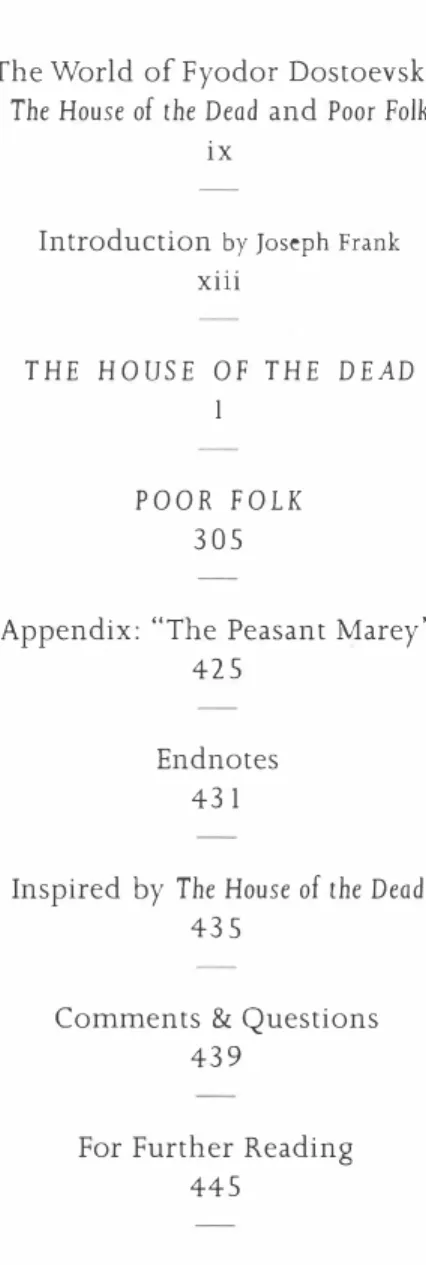
TABLE OF CONTENTS
The World of Fyodor Dostoevsky, The House of the Dead and Poor Folk
ix
Introduction by Joseph Frank xiii
T HE H OUSE O F T HE DEAD
1
P O O R F O L K 305
Appendix: "The Peasant Marey"
425
Endnotes 431
Inspired by The House of the Dead 435
Comments & Questions 439
For Further Reading 445
THE WORLD OF FYODOR DOSTOEVSKY, THE HOUSE OF
THE DEAD AND POOR FOLK
18 2 1 Fyodor Mikhailovich Dostoevsky is born on October 30 in Moscow. The second of seven children, he grows up in a middle-class household run by his father, a former army sur
geon and strict family man.
1 8 3 3 Aleksandr Pushkin's novel i n verse Eugene Onegin i s published.
18 3 7 Fyodor's mother dies. He and his older brother Mikhail are sent to a preparatory school in St. Petersburg.
1 8 3 8 Dostoevsky begins his tenure at the St. Petersburg Academy of Military Engineers, where he studies until 1843 . He be
comes acquainted with the works of such writers as Byron, Corneille, Dickens, Goethe, Gogol, Homer, Hugo, Pushkin, Racine, Rousseau, Shakespeare, and Schiller.
1 8 3 9 Dostoevsky's father is, according to rumor, murdered on his country estate, presumably by his own serfs.
1842 Part 1 of Nikolay Gogol's novel Dead Souls is published.
1843 Dostoevsky graduates from the Academy as a lieutenant, but instead of pursuing a career in the army, resolves to dedicate his life to writing. His first published work appears, a Russian translation of Honore de Balzac's 18 3 3 novel Eugenie Grander.
1844 Dostoevsky begins work on his first novel, Poor Folk.
1845 On the basis of Poor Folk, Dostoevsky wins the friendship and acclaim of Russia's premier literary critic, Vissarion Grig
orievich Belinsky, later author of the scathingly critical "Letter to Gogol" ( 1 84 7 ) .
1846 Poor Folk and "The Double" are published. "The Double" is the first work in which Dostoevsky writes about the psychol
ogy of the split self Dostoevsky meets the utopian socialist M. V Butashevich-Petrashevsky.
1847 Dostoevsky publishes numerous short stories, including
"A Weak Heart," "Polzunkov," and "The Landlady."
ix
x The World of Fyodor Dostoevsky
1848 He publishes the short story "White Nights." The Communist Manifesto, by Karl Marx and Friedrich Engels, is published.
Revolutions break out in France, Germany, Hungary, Italy, and Poland.
1849 Dostoevsky is arrested for his participation in the socialist Pe
trashevsky Circle, only a discussion group but, in the revolu
tionary climate of the time, considered subversive. He first spends eight months in solitary confinement and is then con
demned to death by firing-squad. Czar Nicholas I commutes his sentence to penal servitude in Siberia, but orders this to be announced only at the last minute.
1850 Dostoevsky begins his four-year internment at Omsk prison in western Siberia. His experiences there will influence many of his later works. While imprisoned he abandons the radical ideas of his youth and becomes more deeply religiOUS; his only book in prison is a copy of the Bible.
1852 Part 2 of Gogol's Dead Souls is published.
1 853 The Crimean War breaks out, the cause being a dispute be
tween Russia and France over the Palestinian holy places.
1854 Still exiled in Siberia, Dostoevsky begins four years of com- pulsory military service.
1 85 7 H e marries the widow Maria Dmitrievna Isaeva.
1859 Dostoevsky and Maria are allowed to return to St. Petersburg.
1 861 He and his brother Mikhail establish Vremya (Time) ; the jour- nal publishes Dostoevsky's The House of the Dead, a work based on his experiences in Siberia.
1862 Dostoevsky travels to England, France, Germany, Italy, and Switzerland, a trip that engenders in him an anti-European outlook. He gambles heavily at resorts abroad, losing money.
1863 Dostoevsky makes a second trip to Europe and arranges to meet Apollinaria Suslova in Paris; he had published a story by her in
Vremya the previous year, and the two have an affair. The pro
gressive Nikolay Chernyshevsky publishes the utopian novel
What Is to Be Done?, which Dostoevsky will react against a year later in "Notes from Underground." Vremya is banned for printing an article mistakenly thought to support the Polish rebellion. The serialization of War and Peace begins; it will last through 1 869.
The World of Fyodor Dostoevsky xi
1864 Dostoevsky and his brother Mikhail establish Epokha (Epoch), the short-lived successor to Vremya; the journal publishes
"Notes from Underground," the first of Dostoevsky's master
works. Dostoevsky's wife, Maria, dies from tuberculosis. His brother Mikhail dies three months later.
1865 Burdened with debt, Dostoevsky embarks on another failed gambling spree in Europe. He proposes to Apollinaria Suslova without success.
1 866 Crime and Punishment starts serial publication at the beginning of the year. Dostoevsky interrupts the writing in October in or
der to work on The Gambler, forced to meet the contract dead
line for that book in order to retain the rights to his published works, including Crime and Punishment. He dictates The Gambler to a stenographer, Anna Grigorievna Snitkina, over the course of a month. He and Anna, who is twenty-five years his junior, become romantically involved.
1 867 Dostoevsky marries Anna Snitkina, one of the most fortunate events of his life. To escape debtor's prison, the two live abroad for the next four years, in Geneva, Florence, Vienna, Prague, and finally Dresden. Dostoevsky's epilepsy worsens. He begins work on his novel The Idiot, in which the protagonist is an epileptic.
1868 The Idiot is published in installments.
1869 Tolstoy's War and Peace is published for the first time in volume form.
1 8 71 The Dostoevskys return to St. Petersburg. Serialization of his novel The Possessed begins.
1 8 7 3 Dostoevsky becomes editor o f the conservative weekly Grazh
danin (The Citizen) ; "A Writer's Diary" becomes a regular and popular feature of the weekly.
1 8 75 Tolstoy begins publishing Anna Karenina.
18 76 A Writer's Diary is published as a monojournal-that is, written and edited entirely by Dostoevsky; in i.t he publishes "The Meek One."
18 7 7 "The Dream of a Ridiculous Man" is published in A Writer's Diary.
18 7 9 AWriter's Diary ceases, and serialization begins in another j"our
nal of The Brothers Karamazov, Widely considered Dostoevsky's greatest novel.
xii The World of Fyodor Dostoevsky
1 8 80 Six months before his death, Dostoevsky delivers his famous speech on Pushkin at the dedication of the Pushkin memorial in Moscow.
1881 Dostoevsky dies from a lung hemorrhage on January 2 8 in St. Petersburg. His epitaph, also the epigraph to The Brothers Karamazov, is from the Bible (John 12: 24); it reads, "Verily, verily, I say unto you, Except a corn of wheat fall into the ground and die, it abideth alone: but if it die, it bringeth forth much fruit"
(King James Version) .
1 8 86 The German philosopher Friedrich Nietzsche publishes Beyond Good and Evil, which was greatly influenced by The Possessed.
1 912 Constance Garnett begins her translations of the works of Dostoevsky, introducing his writings to the English-reading world.
INTRODUCTION
If one were asked to select two books of Dostoevsky that represent the variety and range of his literary talent, no better choice could be made than the ones published in this volume. Dostoevsky is best known for his larger and later novels, such as Crime and Punishment and
The Devils (also translated as The Possessed), and an influential critical tradition views him primarily as the unsurpassed chronicler of the moral-psychological dilemmas of the alienated, refractory urban in
telligentsia. This aspect of his work has had the greatest influence on later writers, particularly as he became more Widely read outside of Russia; but it represents much too limited a perspective on the full scope of his creations.
To be sure, there are elements of the later Dostoevsky in Poor Folk,
with its vivid depiction of the St. Petersburg background and its first embryoniC sketch of educated types; but its main character is not a member of the intelligentsia at all and anything but rebellious. He is a humble, SOCially and emotionally downtrodden clerk in the vast Rus
sian bureaucracy ofSt. Petersburg, frightened to death at his temerity in questioning, even in thought, the supreme virtues of the God-ordained order in which he lives.
The House of the Dead, on the other hand, stands alone in the Dosto
evsky corpus as an unprecedented depiction, the first in Russian liter
ature, of the prison gulags of the vast czarist empire. Dostoevsky's initial readers were shocked by the conditions of life he described, but we have since learned from Solzhenitsyn that these gulags were relatively humane compared to their successors under the Bolsheviks.
The book also contains a gallery of Russian peasant types and sketches of Russian peasant life that equal those ofTurgenev and Tolstoy, both of whom admired the book (Tolstoy thought it the best work Dosto
evsky had ever written) . Such peasant types are depicted only fleet
ingly in the major novels; but they were by no means, as we see here, outside Dostoevsky's creative purview.
xiii
xiv Introduction
These two books are thus miles apart in theme and artistic treat
ment. The first initiates Dostoevsky's exploration of guilt-ridden char
acters; the second demonstrates his ability as an objective reporter and observer of a new social milieu. But there is one thing they have in common: Both opened the path to fame (if not to fortune) for their author. Poor Folk brought him to the forefront of the Russian lit
erary scene at the age of twenty-four, and for a brief period he was, quite literally, the talk of the town.
Dostoevsky began The House of the Dead when he was thirty-nine, haVing returned to Russia after serving a prison sentence in Siberia and being absent from the literary scene for ten years. His first cre
ations at this time, the novellas Uncle's Dream and The Friend of the Family,
were received quite tepidly, and it was generally felt that his talent had not survived his exile. His prison memoirs, however, convinced even his detractors that they had been mistaken. These memoirs cre
ated a sensation by opening up a hitherto concealed world for the Russian reader; and the outcast criminal inhabitants of this hidden universe, generally looked down upon as little better than subhuman, were treated by Dostoevsky with respect and even occasionally with sympathy. He made no effort to conceal their sometimes horrendous crimes; but he saw them as sentient human beings whose behavior deserved to be understood if not pardoned.
2
Poor Folk is Dostoevsky's first novel, and the story of its creation, as well as its reception, has become famous in the annals of Russian litera
ture. Both Dostoevsky and his older brother, Mikhail, had made up their minds as adolescents to follow a literary career. Both, however, obeyed the wishes of their father to study to become military engi
neers, and Dostoevsky was still taking advanced courses, though liv
ing independently, in the years just preceding his literary debut. Even before leaving home for their studies, he and Mikhail had steeped themselves in the literature of their time. Indeed, the admiration of the youthful Fyodor for Pushkin was so great that, on hearing of the poet's death in a duel (in 18 3 7 ) , he told his family that if he had not already been wearing mourning for his mother, he would have done so in memory of Pushkin. One of the very last speeches he made in
Introduction xv
his life was a panegyric of Pushkin as equal, if not superior, to the greatest writers of European literature.
Dostoevsky came to maturity during a transition period in Russian culture, a moment when it was evolving from the metaphysical
spiritual influence of German Romanticism toward the more down
to-earth social thematics of the French. His letters to Mikhail are thus filled with references to writers of both types. E. T. A. Hoffmann en
joyed a tremendous vogue at this time in Russia, and in 1 8 3 8 Fyodor writes that he had read " all of Hoffmann in Russian and German." He continued to admire this Romantic fabulist; in 1861 he wrote an article declaring him superior to Edgar Allan Poe. But he was enthusiastically proclaiming Simultaneously that "Balzac is great. His characters are the creations of universal mindl" (letter of August 9 , 1 8 3 8) . Dostoevsky's first publication, as a matter of fact, was a translation of Balzac's Eugenie Grandet, undertaken at the end of 1843 to supplement his income.
No French writer was more important for Dostoevsky than Victor Hugo, who, as the poet wrote of himself, "pleaded for those who are the lowest and the most miserable." In a letter of 1840 Dostoevsky declared Hugo's Christian social Romanticism to be as momentous for the modern world as Homer had been for the ancient; and Hugo's social-Christian radicalism left a permanent imprint on his own ideo
logical views. One of Hugo's works, Le dernier jour d'un condamne (The Last Day of a Condemned Man) , is the diary of someone awaiting execution for an unspecified crime-an intensely moving, and still very relevant, anguished outcry against capital punishment. Dostoevsky knew it by heart; and when he believed he was going to be executed himself, phrases from it came to his mind. Traces of its effect can also be found throughout his novels.
In the early 1 840s, the most prestigious literary genre was still that of Romantic tragedy, with Russians like Pushkin (Boris Godunov) follow
ing in the footsteps of Shakespeare, Schiller, and Hugo. It is thus no surprise to learn that Dostoevsky's first try at literary composition should have been in this genre. In 1841 he read to friends parts of two dramas, Mary Stuart and Boris Godunov, which, alas, have not survived. But the titles are enough to show the range of his literary ambition, which did not hesitate to measure itself against the greatest. Romantic drama, however, was already losing its appeal for the younger generation, and Dostoevsky's own evolution followed the literary trend.
xvi Introduction
The new vogue turned to the social thematics of French Romanti
cism' as well as to the prose forms that were being developed, such as the so-called "physiological sketch," to portray the feel and texture of ordinary life. One of the dominating figures of Russian literature, the impassioned and fiery critic Vissarion Belinsky, had become con
verted to French Utopian Socialism in 1 841, and immediately began to urge Russian writers to follow the French example. Gogol's Dead Souls had been published in 184 2 , and his Petersburg Tales, including
"The Overcoat," in 1843 . Belinsky interpreted Gogol very freely as having pioneered the down-to-earth and SOCially conscious depiC
tion of Russian life that he wished to encourage; and in 1843-as Dr. Riesenkampf, with whom Dostoevsky shared a flat, tells us in his memoirs-Dostoevsky "was particularly fond of reading Gogol and loved to declaim pages of Dead Souls by heart."
Dostoevsky did not immediately surrender the idea of writing for the stage, but his references at this time to a work called The ]ewYankel
(from a character in Gogol's novel Taras Bulba) indicate a shift to a less elevated subject. Whether such a work was ever written remains in doubt; but in the early fall of 1844 he tells Mikhail he is working on
"a rather original novel" which he hopes will bring in 400 rubles.
This is the first reference to Poor Folk; Dostoevsky planned to send the manuscript to Belinsky's j ournal Notes of the Fatherland, but it reached its destination by a much more original route.
3
Dostoevsky was then sharing a flat with D. V Grigorovich, himself a burgeoning writer, and read him the completed work. Grigorovich was so impressed that he took the manuscript to N. A. Nekrasov, destined to become a famous poet and already an active literary editor. Both were so overcome that they rushed to Dostoevsky's apartment at four in the morning-it was a Petersburg "white night"-to congratulate him on his accomplishment. Both were among a group of young writers who, clustered around Belinsky, were known as his pleiade; and Nekrasov took the manuscript to Belinsky the next day. Belinsky's reaction is best de
scribed in the words of P V Annenkov, an important critic and cultural commentator, who visited him two days later. "You see this manu
script7" he said. " I haven't been able to tear myself away from it for
Introduction xvii
almost two days now. It's a novel by a beginner, a new talent . . . but his novel reveals such secrets of life and character in Russia as no one before even dreamed of . . . -it's the first attempt at a social novel we've had" (PV Annenkov, The Extraordinary Decade, translated by Irwin R.
Titunik, Ann Arbor: University of Michigan Press, 196 8 , p. 150) . Belinsky's enthusiasm is quite understandable because, as Dosto
evsky wrote to Mikhail shortly after joining the pleiade himself, he "seri
ously sees in me a public proof and justification of his opinions" (letter of October 8, 1845) . The critic had called for the Russians to follow the French lead, and lower-class Russian life had now begun to be depicted in all its varieties (a famous sketch of Grigorovich , used by Dostoevsky in Poor Folk, was devoted to organ-grinders) . But emphaSiS was placed on the description of externals, on photographic accuracy (the sketches were also called "daguerreotypes," and were accompanied by illustra
tions) , rather than on imaginative penetration and inner identification with the people involved. Also, even when an author collected his sketches in a volume, they were not united by any sort of narrative con
tinuity. Dostoevsky created the first Russian social novel by fUSing such phYSiological sketches into a story about two lonely souls struggling to keep afloat in the sea of St. Petersburg life.
Dostoevsky is once supposed to have said (though the source has never been located) that all of Russian literature emerged from Gogol's
"The Overcoat." Whether or not he ever uttered such a thought, there is no doubt that the dictum applies to Poor Folle Indeed, the reference to Gogol illustrates a more important general point. There has been a strong tendency, espeCially in Western criticism, to focus on Dosto
evsky's quite sensational biography in seeking to explore the sources of his work. But such sources are as much literary and social-cultural as purely personal, and whatever happened in his life was invariably as
similated and interpreted in terms of such a larger context. To under
stand his work, it is thus necessary to keep this larger ideological context constantly in mind.
In Poor Folk, we find the influences not only of Gogol but also of Nikolay Karamzin, the title of whose story "Poor Liza" is immediately evoked. Both works depict the sad fate of the lower classes (in "Poor Liza" a peasant flower-girl is seduced and abandoned by a noble lover) , but Dostoevsky's tone is far grittier than Karamzin's idyllic-sentimental treatment. Parodies are also included in Poor Folk of Romantic historical
xviii Inuoduction
novels, and reference is made to the latest vogue for "physiological sketches." of most importance is the relation of Poor Folk to two stories, Pushkin's "The Stationmaster" and Gogol's "The Overcoat," both of which are read by Dostoevsky's main character, Makar Dyevushkin. The first, like "Poor Liza," again dwells on the misfortunes of the humble and the defenseless when confronted with their betters, and Makar sees his own sad fate prefigured in that of the hapless stationmaster. Gogol's story, however, drives him into a rage; and a good way to approach Poor Folk is to examine the reason for his indignation.
"The Overcoat" is very far from embodying the plea for social jus
tice that Belinsky was now advocating, though it does contain one passage in which such an appeal is made. But the story is as much a car
icature of the main figure, who bears the impliCitly scatological name of Akaky Akakievich, as it is a call for a more benevolent attitude toward those of his inferior status. Gogol's story takes its place in a long line of stories in which such characters, lower-level copyists and clerks in the St. Petersburg bureaucracy, were the butt of comic anecdotes; and his own treatment is no different. Akaky is a human Cipher, perfectly happy to grind away at his routine task and incapable of assuming any other;
the narrator views him with the same relentless mockery that Akaky experiences at the hands of his office-mates. But at one point a younger clerk rebukes the others for mercilessly tormenting their helpless victim, and reminds them that he is, after ali, "their brother." Akaky's life is temporarily enriched when he acquires a new overcoat (hence the title) , which becomes for him the eqUivalent of a loved object. A few days later it is stolen as he is walking home during the night. Un
ceremoniously evicted when he shows up at the home of an official of his district to appeal for aid, he dies shortly afterward.
Dostoevsky's Poor Folk turns this story inside out, as it were, by adopting the form of the sentimental epistolary novel. His two main characters write letters to each other, and we thus become aware of everything through their reactions and responses rather than through the supercil
ious remarks of a narrator. Makar Dyevushkin is a middle-aged copying clerk like Akaky, and his correspondent is Varvara Dobroselov, a young girl barely out of her teens. The two are related in some distant fashion,
Introduction xix
and Makar is trying to protect her from the wiles of a procuress who, in the guise of a friend of the family, has already succeeded in selling her once to a wealthy libertine. Dyevushkin is timidly in love with Varvara himself, but the difference in their ages, if nothing else, makes any such relation impossible; what she feels for him is friendly affection and gratitude, nothing more.
Both are tender, lonely, fragile souls, whose solicitude for each other brings a ray of warmth into their otherwise bleak lives; but their innocent little idyll is soon ended by the pressure of the sordid forces against which they struggle. Dyevushkin reduces himself to ab
ject poverty for the sake ofVarvara, and he suffers agonies of humili
ation, which he tries to conceal, as he sinks lower and lower in the social scale. Finally, Varvara's violator shows up again and churlishly offers her marriage-not out of remorse or even desire but because he wishes to engender an heir to disinherit a nephew. The hopeless
ness of her position, and the chance to reestablish her social situa
tion, compel Varvara to accept a loveless union with a callous mate and a harsh life in the Russian provinces.
This simple story line is surrounded with a number of accessories that enlarge it into a true social novel. Inserted among the earlier letters is Varvara's diary, which introduces the classic contrast between the happiness and innocence of rustic childhood and the dangers and corruptions of the city. In these pages we catch a glimpse of a succes
sion of penniless girls who have suffered the same fate as Varvara, or who, under the guise of beneficence, are being prepared for it by the sinister procuress Anna Fyodorovna. The same insert-diary also con
tains a portrait of the gravely ill tubercular young student Pokrovsky, a devotee of Pushkin, who is Dostoevsky's first delineation of the new young intellectual, a ramochinets (meaning he has no official rank or status) , eventually to evolve into Raskolnikov in Crime and Punishment. As Varvara's informal tutor and intellectual mentor, Pokrovsky stirs her first romantic feelings. He is the illegitimate son of Bykov, the same landowner who raped Varvara, by another of Anna Fyodorovna's "pro
tegees" ; the latter was then married off to a drunken ex-clerk who gave the young man his name.
The relation of the pseudo-father, old Pokrovsky, to his educated son, whose cultural attainments he admires to the point of idolatry, symbolizes as well the aspirations of Makar Dyevushkin himself to
xx Introduction
rise to a higher social-cultural status than the one in which he is placed. The funeral of young Pokrovsky, with the older one running after the carriage in a pouring rain as books fall out of his pockets, ri
vals Dickens in its tragicomic pathos. Belinsky remarked that it was impossible not to laugh at old Pokrovsky; "but if he does not touch you deeply at the same time you are laughing . . . do not speak of this to anyone, so that some Pokrovsky, a buffoon and a drunkard, will not have to blush for you as a human being." Another narrative line in
volves the Gorshkov family, who have come from the provinces so that the father, an ex-clerk, may clear himself of a charge; they live in such heartrending poverty that even the impoverished Dyevushkin cannot resist giving them twenty kopecks to buy some food.
These narrative strands interweave to build up an image of the un
availing struggle to keep afloat humanly in the face of crushing circum
stances. Everywhere is poverty and humiliation, the exploitation of the weak and the helpless by the rich, powerful, and unscrupulous-all this in the midst of crowded St. Petersburg slum life, with its nauseat
ing odors and debris-littered dwellings. Describing his own quarters, Dyevushkin writes: "On every landing there are boxes, broken chairs and cupboards , rags hung out, windows broken, tubs stand about full of all sorts of dirt and litter, eggshells and the refuse of fish; there is a horrid smell . . . in fact it is not nice" (p. 317 ) . Dostoevsky's use of anticlimax here conveys the slightly risible (but nonetheless touching and mOVing) quality of Dyevushkin as a person. Yet amidst all this squalor, there are treasures of emotive responsiveness and moral sensitivity that appear in the most unlikely figures-unlikely, at least, from the point of view of previous Russian literature.
Poor Folk combines these local-color aspects of the physiological sketches with a new and unerring inSight into the tortures of the hu
miliated sensibility. "Poor people are touchy-that's in the nature of things," Dyevushkin explains to Varvara. "I felt that even in the past.
The poor man is exacting; he takes a different view of God's world, and looks askance at every passer-by and turns a troubled gaze about him and looks to every word, wondering whether people are not talking about him, whether they are saying that he is so ugly, specu
lating about what he would feel exactly," and so on. (p. 3 74) . This
" different view of God's world," the world as seen from below rather than above, constitutes the major innovation of Dostoevsky vis-a.-vis
Introduction xxi
Gogol. The situations and the psychology of Poor Folk thus speak for themselves against class pride and class prejudice; but the book also contains a much more outspoken protest, even though cast in terms of an easily comprehended "allegory."
5
Makar Dyevushkin is by no means an uncomplicated character, and he undergoes a distinct evolution. In his early letters, he accepts his lowly place in life without a murmur of protest, even taking pride in performing his unassuming task as conscientiously as he can. He is perfectly content to live in the world as he finds it, although he re
fuses to accept the lowly image of himself that he knows exists in the eyes of his social superiors. But this unquestioned acceptance of the rightness and justness of the social order as it exists is severely shaken by his inability to protect and proVide for Varvara.
At the very lowest point of Dyevushkin's misery-when he is being hounded by his landlady, insulted by the boardinghouse slaveys, and tormented by his ragged appearance-he loses heart entirely and takes to drink. But this is also the moment when a faint spark of rebellion flares even in his docile breast. Walking along one of the fashionable St. Petersburg streets just after leaving the dreary slums in which he lives, he suddenly begins to wonder why he and Varvara should be con
demned to poverty and misery. And he gUiltily finds himself protesting (" I know . . . that it's wrong to think that, that it is free-thinking") against a world in which some people are just born to wealth, "while another begins life in the orphan asylum . . . . And you know it often happens that Ivan the fool is favoured by fortune" (p. 3 96) . Such no
tions are an attack on the entire structure of his own hierarchical soci
ety; and he goes even further by proclaiming the distinctly Utopian Socialist idea that the humblest worker is more worthy of respect, be
cause he is more useful, than any wealthy, idle social parasite.
Dyevushkin's timid revolt against social injustice is embodied in his vision of an apartment house, on whose ground floor lives a poor shoemaker, whose only concern is the "boots" that he makes to feed his family. " His children are crying and his wife is hungry";
why should he not think only of "boots? " But elsewhere in the same building there is "a wealthy man in his gilded apartments," and he
xxii Introduction
also thinks of "boots, that is, boots in a different manner, in a dif
ferent sense, but still boots." Why is there not someone to tell him to stop " thinking of nothing but yourself, living for nothing but yourself. . . . Look about you, can't you see some object more noble to worry about than your boots?" (p. 400) . Such a plea for the wealthy to concern themselves with the plight of the less fortunate, as Dostoevsky formulates it, obviously has Christian overtones; and if we are to de
fine Dostoevsky's political beliefs at all in this period, it would be as a Christian Socialist.
The same motif is dramatized in another scene, but given more than a material significance, when Dyevushkin is summoned to ap
pear before his civil service superior because of some minor error.
His terror and tatterdemalion garments so move the kindhearted General that he gives Dyevushkin a hundred rubles. Refusing to allow
the grateful clerk to kiss his hand, he gives him an egalitarian hand
shake instead; and this respect for his human dignity takes on more importance for Dyevushkin than the money. "I swear that however cast down I was and afflicted in the bitterest days of our misfor
tunes, . . . I swear that the hundred roubles is not as much to me as that his Excellency deigned to shake hands with me, a straw, a worth
less drunkard I " (pp. 405-406) . This tension between the psycholog
ical and spiritual on the one hand, and the economic and material on the other, will run through all of Dostoevsky's later work and eventu
ally receive its unsurpassed expression in "The Legend of the Grand Inquisitor" (in The Brothers Karamazov) .
Another motif timidly broached in Poor Folk, and which also antici
pates the later Dostoevsky, occurs as Varvara is preparing to leave after her marriage. She has placed her fate, she says, in God's "holy, in
scrutable power," and Dyevushkin can only agree. "of course, every
thing is according to God's will; that is so, that certainly must be so-that is, it certainly must be God's will in this; and the providence of the Heavenly Creator is blessed, of course, and inscrutable . . . . only Varinka, how can it be so soon? . . . I shall be left alone" (pp. 415-416) . Dyevushkin's despairingly stumbling efforts to reconcile a belief in God's wisdom and goodness with the tragedy of his own life, and im
pliCitly of human life in general, clearly foreshadow the angUished re
flections of many other Dostoevsky characters assailed by the same conundrum.
Introduction xxiii
6
The French Utopian Socialists who influenced Dostoevsky, and par
ticularly those of the Christian variety, were not advocates of violence or revolution; they believed it possible to change the world by demonstrating the benefits of their precepts. One may well wonder, therefore, why Dostoevsky and all the other members of the discussion group to which he belonged (the Petrashevsky Circle) were arrested in the spring of 1 849. One reason is that the wave of revolution that swept through Europe in 1 848 had frightened Czar Nicholas 1. Al
though the Petrashevtsi as a whole were guilty of nothing more than talk that might be considered subversive, and which they had carried on undisturbed for several years, this was enough now for the Czar to order them hauled in. It was once generally accepted in Dostoevsky scholarship that, like most of the others, he had been an innocent vic
tim of a despotic tyrant; and various theories have been offered as to why, in later life, he seemed to have accepted his condemnation with relative equanimity.
In fact, however, as we now know, he was far from being as inno
cent as was long believed. The Petrashevsky Circle as a whole never made any attempt to conceal their meetings or discussions; but Dos
toevsky belonged to a small secret group within the larger circle whose aim was to foment a revolution against serfdom. The seven members of this small group managed to conceal its existence from the commission of army officers appOinted to investigate the activi
ties of the circle as a whole. But why should a Christian Socialist like Dostoevsky have participated in such a conspiracy?
The answer is probably that he hated serfdom with every bone in his body, and his seething revulsion against it was openly expressed the few times that he spoke at the larger group gatherings. Also, he may well have believed (though this is only inferential) that his father had been murdered by the serfs on their country property. This may help to explain why he agreed to become a member of this activist subgroup, and even acted as a recruiting agent. A friend he visited recalled Dostoevsky (in a document first published in 1 9 2 2) sitting in his nightshirt "like a dying Socrates" unsuccessfully trying to per
suade him to join. Dostoevsky thus lived all his life with the knowledge that he had once himself been a secret revolutionary conspirator, and
xxiv Introduction
his masterful depiction of the psychology of such characters can be attributed to this personal experience.
After his arrest, he was held in solitary confinement for a year and a half, questioned repeatedly (his caste status as a Russian nobleman precluded any physical mistreatment) and finally forced to undergo the ordeal of a mock execution. He believed for about a half hour that he had been sentenced to be shot, but then learned his true sentence
four years in a labor camp, and then service in the Russian Army: This mock execution was one of the most crucial experiences of his life; it was then, standing in the shadow of death, that the religiOUS question so timidly adumbrated in Poor Folk began to take on the supreme im
portance it assumed in his later works. It also conditioned him to open his eyes and his sensibility to the manner in which the Christian ethos had penetrated--or so he came to believe-to the depths of the person
ality even of the most ignorant and illiterate Russian peasant-convicts among whom he was now condemned to live.
Dostoevsky served out his prison term, began life in relative free
dom as a private in the Army, and then, with the help of influential friends in St. Petersburg, was promoted to officer-which gave him the privilege of resigning and resuming his literary career. He pro
duced two novellas, as already mentioned, while still in Siberia, but his major work of this time, The House of the Dead, was written after his return. Dostoevsky had thought of such a work earlier, and mentions it in a letter in 1859 to his brother Mikhail while still on the way back to the capital. "These Notes from the House of the Dead ," he tells him,
"have now taken shape in my mind . . . . My figure will disappear.
These are the notes of an unknown; but I guarantee their interest. There will be the serious and the gloomy and the humorous and peasant conversation with a particular convict coloring . . . recorded by me on the spot [Dostoevsky had kept a notebook in the camp] and the depiC
tion of characters unheard of preViously in literature . . . and finally, the most important, my name." So that while Dostoevsky himself will presumably disappear (he becomes only the editor of a manuscript left by a minor official who murdered his Wife) , in fact everyone will be aware that the editor is talking about himself. Indeed, there are several indications in the text that, unlike the peasant-convicts ac
cused of common-law offenses, the author has been sent to Siberia for a political crime and not for murder.
Introduction xxv
Dostoevsky and Mikhail were planning to bring out a new journal
Vremya (Time) in 1860, a period of relative liberalization of the press.
Most of the book was published there in monthly installments, and it contributed greatly to the success of the magazine. The first several chapters, however, were published in another, rather obscure period
ical. Dostoevsky was worried that his aim of opening the gates of the prison-camp world to public inspection would never pass the censor
ship; and he decided to allow another editor to explore the lay of the land.
His first installment was published without a hitch, but the second ran into trouble-of a kind that often turns the history of czarist cen
sorship into a black comedy. Far from objecting, as might have been expected, that the portrayal of prison conditions was too harsh to be permitted, the censors feared that peasants might be tempted to com
mit crimes j ust to enjoy the amenities of prison life that Dostoevsky portrayed. This objection was overcome by the consideration that the largely illiterate peasants were hardly likely to read the book; and Dostoevsky also wrote a supplement, not included in the final text, explaining that, even if one lived in paradise, " the moral torture" of loss of freedom would make camp life ultimately unbearable.
7
The House of the Dead appears, on the surface, to be an extremely simple book. It contains the memoirs of Dostoevsky's years in the prison camp, and for the readers of his time it brought to public scrutiny a whole world hitherto concealed from their gaze. Here was a gallery of peasant-criminals, most of whom had committed at least one murder, and about whom nobody else had ever written with such in
timate knowledge. The aim of the work was to reveal their lives and their psychology, depicted, so far as possible, from their own point of view. Dostoevsky was in a unique position to accomplish this task be
cause his sentence had placed him, unlike other members of his class, on the same social level as the peasant-convicts (actually on an infe
rior level, since they were better able to perform the physical tasks as
signed) . They thus behaved with him unrestrainedly, as would not have been possible in nonprison conditions, where the class distinc
tion would have governed their conduct and their words.
xxvi Introduction
For the first time the Russian reader was presented with a peasant world possessing its own norms and values, which Dostoevsky de
picts primarily through sketches of the utterances, actions, and be
havior of its inhabitants. The book unleashed a huge debate in the Russian press about the conditions it described, and some of the senselessly cruel regulations it brought to light were angrily chal
lenged. Dostoevsky also stressed that there were different motivations. for a crime such as murder (sometimes it was sordid, sometimes self
defense) , even though all murders were inexplicably punished with the same sentence; and such considerations led to widespread discus
sion of Russian legal anomalies. What predominated in the reaction to the book was a recognition of the author's " humanism." Dosto
evsky, it was felt, had succeeded in "redeeming" a whole class of criminals and outcasts (not all, to be sure, but the vast majority) and, as it were, returning them to the human fold. No attempt was made to lessen their misdeeds, or to sentimentalize over their fate. But in
stead of being seen as aberrant monsters, they were shown rather as human beings whose often desperate crimes could be understood as responses to difficult and tormenting situations.
For present-day readers, the impact of Dostoevsky's book in its own time is of less interest than what it reveals about the author him
self. As we have said, he made superfiCial efforts to conceal his own presence by inventing a fictitious narrator, and his focus is on the world he is portraying rather than directly on himself. But in A Writer's Diary (Vol. 1, 1 8 7 3-18 76; see "For Further Reading" ) , Dostoevsky spoke of these years as haVing brought about "the regeneration of my convictions"-that is, the convictions he had held before his arrest and imprisonment. These were now abandoned-though the process was by no means instantaneous-and replaced by those to which he remained faithful for the remainder of his life. Without approaching this change of heart and mind directly, The House of the Dead can nonetheless, if read with sufficient care, help us to understand the transformation brought about by his prison years in Dostoevsky's ideas and values.
One such transformation involved the relation between the upper, educated class and the people. We now know he had believed in the possibility of fomenting a revolution among the peasantry-a revo
lution led and guided by upper-class superiors like himself. No such
Introduction xxvii
hope could continue to exist, however, after the events portrayed in part II, chapter VII , "The Complaint." Here Dostoevsky describes how he attempted to join a protest organized by the peasant-convicts against the miserable rations they were being fed; but they forcibly led him away to the kitchen where the non peasant convicts, and oth
ers who had refused to join the strike, were gathered. "I had never before been so insulted in the prison ," he writes, even though he de
picts his daily humiliation on other grounds, "and this time I felt it very bitterly" (p. 2 6 5 ) . The quotidian offenses to his dignity were only incidental and personal; but here his rejection cut to the core of what had been a deeply held conviction.
When he questioned a friendly prisoner about this incident, asking why he and other "noblemen" had not been able to join in with them
"as comrades," the peasant-convict replied in perplexity: "But . . . but how can you be our comrades?" (p. 2 70 ) . The gap between the peas
ants and the noblemen was so great, not only in status but i n men
tality, that " in spite of the fact that [the ex-nobles] are deprived of all the rights of their rank . . . [the others] never consider them their comrades. This is not the result of conscious prejudice but comes about of itself, quite Sincerely and unconSCiously" (p. 3 2 ) . The very notion o f them actmg together thus proved to be com
pletely delusory; and never afterward would Dostoevsky believe that the Russian peasantry would respond to any call of revolution issuing from the intelligentsia. Indeed, such calls were often uttered in a vocabulary whose terms the peasants could not even under
stand; and he would continue to maintain that the greatest social problem of Russia, whatever the economic or political situation, was to bridge the yawning gap of incomprehension between the peasantry and the educated class.
Also, Dostoevsky's view of the peasantry itself underwent an ex
tremely Significant evolution. A work like Poor Folk, with its sympathy and pity for the lower classes (even if nor the peasantry) would indicate that Dostoevsky shared the Christian Socialist view of their moral supe
riority to their betters. In a letter to his brother Mikhail, written j ust be
fore departing for exile, he remarked that he was not being sent to a jWlgle but would be with other beings like himself, perhaps even bet
ter than himself Nothing was more shocking and upsetting for him
than to find, in the prison camp. a world that could only be labeled as
xxviii Introduction
one of moral horror. The peasant-convicts stole from each other inces
santly, and Dostoevsky was not spared; every form of vice was available, including female and male prostitution; drunken quarrels were a daily occurrence, and cruel beatings among the convicts themselves were frequent. Dostoevsky's image of this world is painted in appalling col
ors. "Noise, uproar, laughter, swearing, the clank of chains, smoke and grime, shaven heads, branded faces, ragged clothes, everything defiled and degraded" (p. 1 4 ) . Dostoevsky sometimes fled to the hospital, even though not ill and despite the risk of infection, where friendly doctors allowed him to stay. "I was constantly going to the hospital . . . to get away from the prison. It was unbearable there, more unbearable than [the hospital] , morally more unbearable" (p. 214) .
Nonetheless, after a certain amount of time, Dostoevsky's revulsion against the prisoners and their world began to be altered by other im
pressions. For one thing, the more he learned about the circumstances in which many of their crimes had been committed, the more he could see that they were often a response to unbearable oppression or mistreatment. Moreover, what impressed him very deeply was that, whatever their crimes, the peasants unconditionally accepted the tra
ditional Christian morality that condemned their behavior. Indeed, it was only because this morality exercised its effect that the pandemo
nium of the ordinary prison environment was occaSionally replaced, even if only momentarily, by a less revolting atmosphere.
At Christmas, for example, gifts for the prisoners were sent by the lower classes of the town, and these were divided evenly by the con
victs themselves with no quarreling at all. The effect of the holy day was enough to stem the incessant thievery and brutal brawling. At Easter the convicts were relieved of work and went to church two or three times a day. They "prayed very earnestly and every one of them brought his poor farthing to the church every time to buy a candle, or to put it in the collection . . . . When with the chalice in his hands the priest read the words, ' . . . accept me, 0 Lord, even as the thief,' almost all of them bowed down to the ground with a clanking of chains. apparently applying tlle words literally to themselves" (p. 230) . However much they may have violated Christ's commandments, their reverence for them did not diminish. and these continued to remain the standard by which they judged their own behavior. One of Dos
toevsky's most fervent convictions was that-unlike, as he believed.
Introduction xxix
the European proletariat-the Russian people would never attempt to j ustify, or refuse to acknowledge, their violations of the moral law.
What occurred to Dostoevsky at this time is best depicted in a sketch, "The Peasant Marey" (see page 425) , that curiously enough he wrote several years later (see A Writer's Diary, Vol. 1, 1 8 7 3-18 76) . Here he returns to reminisce about his prison years, and though the sketch is not included in his memoirs it symbolically condenses the lengthier internal development that occurred during this time. It is placed in Easter week, when the convicts, after their brief moment of piety, had returned to their usual rowdiness and unruliness. "Dis
graceful, hideous songs; card games in little nooks under the bunks;
a few convicts, already beaten half to death; . . . knives had already been drawn a few times" (p. 425) . To escape this repulsive spectacle, Dostoevsky walks outside and meets an educated Polish convict, also a political prisoner, who says to him in French: "I hate these bandits."
The Pole obviously intuited that Dostoevsky was harboring much the same revulsion against his barbarous fellow-countrymen.
Dostoevsky then returns to his bunk bed and recalls an episode from his childhood. Walking alone in a forest, where his mother had warned him that wolves might be wandering, he thought he heard a cry that a wolf was roaming in the vicinity. Frightened, he ran to one of his father's serf-peasants named Marey, plOWing in a field. The gray-haired Marey assured the terrified child that no cry had been ut
tered and, calming him with the tenderness of "a mother," blessed him with the sign of the Cross and sent him home. This spontaneous kindness on the part of an enserfed peasant with every reason to ab
hor his master and his master's family suddenly resurfaces in Dosto
evsky's memory, transforming his entire attitude to the peasant-world around him as he ponders its meaning. " I suddenly felt I could regard these unfortunates in an entirely different way and that suddenly, through some sort of miracle, the former hatred and anger in my heart had vanished . . . . This disgraced peasant, with shaven head and brands on his cheek, drunk and roaring out his hoarse, drunken song-why he might also be that very same Marey; I cannot peer into his heart, after all" (p. 430) . Dostoevsky was thus capable of ac
knowledging the abhorrent aspects of peasant behavior, but also of seeking for-and finding, as he persuaded himself-the redeeming Christian features lying concealed beneath the repellent surface.
xxx Introduction
At the very same time that the peasant-convicts were thus meta
morphosing into "Marey," Dostoevsky could not find a single re
deeming feature in an upper-class convict named Aristov, referred to in this translation as "A." He had been sent to prison for having falsely denounced others to the authorities as political subversives in exchange for payment to finance a life of debauchery. In prison, he served as a spy on his fellow inmates for the sadistic major in charge of the camp. He was clever, good-looking, well educated, and for Dostoevsky "the most revolting example of the depths to which a man can sink and degenerate, and the extent to which he can destroy all moral feeling in himself without difficulty or repentance" (p. 7 8 ) . Far better the instinctive Christianity o f the peasants, whatever their
crimes, than Aristov's self-satisfied and gloating pleasure in his own ignominy' In Crime and Punishment, the name of Aristov is first given to the character who became Svidrigailov; and Dostoevsky's later decla
ration that, morally speaking, the people had nothing to learn from the educated class, may well be traced to such a recollection.
8
There can be no doubt that one aspect of Dostoevsky's "regeneration of his convictions" referred to this change in his former condescend
ingly upper-class attitude toward the peasantry. But there is another, much deeper feature of this "regeneration" that can be detected in
The House of the Dead, and which involves his own most fundamental re
ligious idea-feelings. It was long thought that Dostoevsky became converted to atheism in the 1 840s and, under the stress of his mock execution and the ordeal of the prison camp, returned to a belief in God and to fidelity to God's anointed, the Czar. Matters are not so simple, however, and there is no evidence that he ever lost his faith in the existence of God and the divinity of Christ, though he was thor
oughly familiar with all the arguments being made against them by such thinkers as Ludwig Feuerbach and D. F. Strauss. But he remained a Christian Socialist, whose ideal was to embody the law of love preached by a divine Christ into the daily life of his own society.
However, the ordeal of the mock execution had brought him face to face with eternity, and observations in the prison camp had also revealed to him the power of the irrational in the human psyche. The