VOL 5, No. 2, 49-74
http://journal2.uad.ac.id/index.php/ijish/index
Human Value Development of Salesteam: An Effort to Strengthen Shari’a Insurance Institution
1Ken Sudarti, 2Olivia Fakhrunnisa
1[email protected], 2[email protected] Universitas Islam Sultan Agung, Indonesia
ABSTRACT
This study aims to build a sales team value improvement model through customer engagement value and jama’ah-oriented leadership in Sharia Insurance. A total of 187 respondents were involved in this study. Data were collected through a questionnaire and analyzed by using SmartPLS.
The results showed that jama’ah-oriented leadership strengthened the influence of customer engagement value on human value development, both values of asking and helping others. This study's results have implications for applying social capital theory as the root of relational capital. The results of this study are expected to strengthen human resources quality in sharia insurance as part of the Islamic Financial Institution. The sales team is important in delivering the product or service’s value to customers. A salesperson with an orientation to building customer engagement and peer engagement will consider customers and colleagues as brothers in Islam. With this value, the salesperson will strive to advance themselves, give well to consumers and give the spirit to do the best for their colleagues so that further, the organization will have the best impact on the community.
This is an open access article under the CC–BY-SA license.
Article history Received 2022-02-14 Revised 2022-08-23 Accepted 2022-10-01 Keywords
Customer engagement value,
values of asking others, values of helping others, jama’ah-oriented leadership
Introduction
Shari’a insurance is one of the Non-Bank Islamic Financial Institutions (OJK, 2019). The development of Islamic insurance companies in Indonesia is experiencing fairly rapid growth, both in terms of the number of insurance companies, the number of gross premiums, and the number of participants. Indonesia’s position in the Global Islamic Economy also shows progress, although it is still far behind Malaysia, which is in the first position (OJK, 2019). Therefore, more attention is needed to foster potential awakening and maintain the sustainability of shari’a insurance, considering that the Muslim population in Indonesia is very dominant (Indonesian Ministry of National Development Planning, 2019) in The Indonesia Masterplan of Sharia Economy 2019-2024.
As an alternative to conventional insurance, shari’a insurance is based on Islamic values, namely takaful (mutual support) and ta’awun (mutual assistance). The Islamic value originates from the philosophy that humans are a large family in the Islamic Brotherhood. Salespeople who market a shari’a insurance product/service should have the same values as the product/service offered, namely Islamic values. A salesperson with Islamic values of takaful will care more about other parties. They do not just think about their success but try to get their co-workers to do as well as they did. He made himself a role model so t his colleagues could accept his da’wah activities. At the same time, ta’awun value in a salesperson will make him care about the team where he joins.
Islamic values make them aware that no one is perfect, so humans must cooperate and help to meet perfection. The basis of Islamic values in strengthening their spirit is to help their colleagues even without expecting anything in return. They do not want to achieve success individually, but those around them can follow their success.
The success of shari’a insurance is determined by its financial performance. One of the determinants of achieving financial performance is by increasing the performance of human resources or salespersons. The Salesperson in shari’a insurance has a vital role because it determines the utilization and management of the potential contained within them to become a competitive advantage in achieving the stated goals. Salespersons can achieve good relations with humans through improving human development from one of the human characteristics, namely values (Sudarti & Fachrunnisa, 2021). Shari’a insurance salespersons in the sales team have a role and responsibility to increase the value and mission of the organization through their efforts to provide service value to customers. Therefore, salespersons must be committed to continuous learning to motivate themselves, invite and help other salespeople in the marketing team to increase their achievement, and foster motivation to help external customers meet their needs.
Besides representing the company to customers, they also represent customers to the company (Ferreira, 2017).
With the value of takaful and ta’awun in salespersons, building enthusiasm to invite and help each other’s colleagues and customers want to do the best as they do on the basis of sincerity. In the perspective of Islam, sincere means the sincere intention of doing good deeds without human self-interest, but only hoping for the blessing of Allah SWT (Surah: Al-MAidah:2; Al-Ahzab:72).
Prophet Muhammad SAW said: “Surely Allah does not accept deeds unless they are done sincerely and hope to be pleased with Allah” (Narrated by Abu Dawud and Nasa’i). Likewise, customers, they get service value that is formed from customer engagement provided by salespersons who have takaful values. So that customers also have takaful values, eager to invite potential customers (family, friends and relatives) to contribute to helping each other provide goodness by joining as shari’a insurance.
Human value development in the sharia insurance ecosystem must be oriented towards customer engagement to deliver service value to the customers. It takes an understanding for salespersons that customers are brothers, so they need the best possible treatment. Customer engagement will drive the quality of customer and sales force relationships. Salespeople who have a high level of engagement with customers will care about customers and are involved in creating customer value (Thuy & Hau, 2010); (Töytäri & Rajala, 2015) such as listening to customer feedback and taking part in solving customer problems (Fachrunnisa et al., 2018); (Sun &
Bunchapattanasakda, 2019). Kasim et al. (2016) have examined the Islamic human value (spirit of caring and sharing) which affects the need for product shari’a insurance to be more universal. But Kasim et al.’s researchares only in terms of ethical value in general, has not led to how to increase human development salespersons and maintain the sustainability of shari’a insurance. Likewise with research by Djafri et al. (2018) on the effect of Islamic spirituality on employees on improving performance on takaful in Malaysia. Their study emphasizes the determinants of takaful performance achievement, not yes focusing on how efforts should be made to increase human value in shari’a insurance (takaful).
The people of various parties involved in the shari’a insurance ecosystem consist of shari’a insurance companies as operators and customers. Shari’a insurance management are all members of the company starting from leaders, managers, team leaders, and especially salesperson as the main spearhead of the success of shari’a insurance. Involvement between salespersons, tam leaders, and managers to provide engagement value to customers will build strength togetherness (jama’ah) to foster the welfare and solidarity in the ecosystem, through asking and helping to share responsibility and cooperation (Khan et al., 2020). Moreover, asking each other to stay away from Allah SWT prohibition, demands the ability of the salesperson to explain the characteristics of shari’a insurance, namely preventing the principles of gharar, maisir/qimar and usury (Hati et al., 2020); (Alshammari et al., 2019);(Akhter & Hussain, 2017);(Sherif & Shaairi, 2013);(Siala, 2013).
In addition, there is also ta’awun value of shari’a insurance, which is a spirit of help based on sincerity to be able to do the best (Sudarti et al., 2018); (Surah: Al-Maidah:2). This requires engagement between salespersons, colleagues and customers to foster complementary values and help to achieve goals in the togetherness.
The Islamic human value of shari’a insurance rests on the strength the togetherness (jama’ah), therefore the role of a leader is very important. The spirit of togetherness is related to the reality that exists among fellow team members. Relational relationships in the team will create cooperative norms (Fachrunnisa et al., 2020), namely a willingness to respect diversity, openness to critical thinking, hope for reciprocity and cooperation (Yu et al., 2013). The strength of this togetherness is very powerful in improving performance. This statement is supported by the word of Allah SWT
that “Being together (united) is love (mercy) and being divided is torture” (Surah Ali Imron:102- 103), “actually fellow Muslims are brothers” (Surah Al-Hujurah:10).
Jamaah oriented leadership acts as facilitator and guide in a consultative manner by asking questions, providing information, and providing suggestions. The existence of jama’ah oriented leadership will help to grow awareness of salespersons to provide the best service value to customers and another salesperson, so as form customer engagement between them. Furthermore, the engagement value will further strengthen the Islamic human value, namely the value of asking and the value of helping others (Surah Al-Hujrat:10; An-Nisa:1). Jama’ah oriented leadership focuses on linkages and woks collectivity and not on individuals. In addition, all members are considered equal and deserve respect (Nelson et al., 2016). With regard to the condition of shari’a insurance and existing research about human value development in salespeople, this paper aims to examine a model of human value development through customer engagement value and jama’ah oriented leadership.
Customer Engagement Value and Islamic Human Value
Salespeople who are members of the shari’a insurance sales team consist of several individuals.
Human values that exist in salespersons become the guidelines for team work to be adopted by team members. This is consistent with (Tajfel, 1972) who uses the term social identity in this theory of how people conceptualize themselves in intergroup contexts, and how the social categorization system “creates and defines the place of individuals in society”. Malik (2019) defines social identity as an individual’s knowledge that he belongs to a certain social group along with some emotional values and values that are important to him from group membership. Salespeople who are members of the sales team and believe that customer engagement is important, along with the awareness that they are part of them, will increase the spirit to make it happen by reminding each other and inviting sales team members to do the best sales activities. Cooperative norms are formed from good relational relationships between team members, causing them to be more open to critical thinking and to respond to diversity Yen et al. (2015). This established norm makes it easier for salespeople to do preaching (da’wah), namely inviting their colleagues to want to do the best sales activities.
The spirit of conducting this da’wah is based on the belief that maintaining customer engagement is not easy. Customer expectations will continue to change very dynamically (Parasuraman et al., 1992), so that to meet these expectations, many parties need to unite to form the strength of the congregation/togetherness (jama’ah). Thus, the potential that exists in each individual can complement each other into a complete and powerful strength. A salesperson who has value for engaged with the customer will be eager to do da’wah. The salesperson does everything in his power to get his sales team members to do their best in order to maintain the
existing orientation. Positive interaction and cohesion between sales team members occurs due to the similarity of identity between salespeople and sales teams which leads to solidarity (Hogg &
Terry, 2000). So, when the salesperson has a unique knowledge of how to manage the market, what he thinks is that the members of his team must also master that knowledge (Wamitu, 2015).
A sales team, each of whose members are capable of engaging with customers, is very concerned with creating customer value. This can be done through solving customers problems (Kara et al., 2013). A wide variety of customer problems can only be resolved if each team member is able to pool the resources, they have available. So, when the salesperson is on a team and has the determination to help customers solve their problems, they will be excited to activate the sales team member’s idle capacity through the “asking activity. The activity of “asking” can be analogous to a da’wah activity. Da’wah is a matter of trust, the values conveyed will be effective if the preacher is able to use good language and set an example first. The salesperson who has the asking spirit believe that knowledge ownership must spread to team members, so that knowledge creation in the team occurs within the framework of cooperation and advances other members. Prophet Muhammad SAW said: “By Allah, if Allah gives to one person thanks to your invitation, then it much better (for you) than valuable wealth (Narrated by Bukhari and Muslim).
H1: There is a Significant Relationship between Customer Engagement Value and Value of Asking
Individuals who are very identified with a team will feel that the success of the team is their success and that the team’s behavior reflects on him personally (Ashforth & Dukerich, 2001;
Kramer, 2006).Therefore, salespeople who are part of team and determined to satisfy their customers will carry out “helping” activities to enable their colleagues to achieve the best results.
Cooperative norms that arise because of strong relational relationships (Yu et al., 2013) increase the enthusiasm of salespeople to work together. A strong religious foundation, making salespeople carry out helping activities sincerely. They realize that the knowledge they have is only entrusted by their Lord, there are other people’s rights in it so they must share it. However, this “helping”
activity must be carried out carefully, because excessive “helping” will make weak team members
“hide” in the team. This can reduce the level of performance orientation practice (Rossberger &
Krause, 2015).
The value of helping is related to team work orientation. Team work orientation was significantly associated with personal learning regardless of the degree of perceived value, appropriateness between individual members and other team members (Mustafa et al., 2017). This is based on the fact that there is a large amount of research on team work orientation, leaving questions about how the human values of each members influence teamwork orientation.
Therefore, it can be concluded that if each individual has a passion for engaged in providing value
to customers, it will influence other team members to do the same. This common goal leads to activities to help each other to make it happen. The feeling of being identical because they are on the same team will increase the enthusiasm of the salesperson to accumulate each team member’s resource into a bigger force. This statement is supported by the results of study by (Henttonen et al., 2016), where the stronger the relationship between team members will be able to increase team effectiveness. Kohli & Jaworski (1990) also stated that organizations with a strong market orientation value system create strong norms for sharing information and reducing consensus about its meaning. Sharing is one of the “helping” activities.
If salesperson who are members of the sales team have the same understanding of customer value, it will further strengthen customer engagement at the individual level. Similar understanding will encourage the collective behavior to make it happen. Each individual is not only passionate about doing his best according to the size of his resources, but also to empower team members voluntarily by helping team members to be able to do the best sales activities.
H2: There is a Significant Relationship between Customer Engagement Value and Value of Helping
Role of Jama’ah- Oriented Leadership
Leaders can use shared values to encourage team members to work together (Elias & Davis, 2018). Cooperation can be realized by asking colleagues to maximize their resources. The control inherent in a leader’s task in the form of management oversight, provides salespeople with guidance and intrinsic motivation to asking each other to goodness. Sales team members who are intrinsically motivated through the role of leader are increasingly eager to expand their knowledge base to include a variety of information. They tend to openly exchange and integrate ideas, knowledge, and insights that are relevant to the task (Wang et al., 2016). This will encourage salespersons in sales team to provide the best service value to internal customers (co-workers/
sales team) and external customers, namely potential customers. So that is relevant skills are created to manage the market to form customer engagement in providing the best service for meeting customer needs and problem solving (Kara et al., 2013; Wamitu, 2015).
Jama’ah oriented leader have inspirational motivation, which is to foster the desire of team members to work cooperatively to achieve common goals (C. J. Wang et al., 2014). Cooperative action can be realized by inviting colleagues to activate their idle capacity. Remanding the leader that each team member is an important part of the sales force’s enthusiasm for mutual respect by using good communication. As individuals who are capable of making decisions, leaders can make various efforts to encourage and facilitate the process of communication and social interaction which facilitates interpersonal communication and solves collective problems (Hislop, 2013).
The action of the leader which emphasizes mutual respect for the achievements of each team member, will indirectly create a cooperative climate. If an atmosphere of cooperation has been formed, then each individual will not hesitate to do da’wah. This statement is supported by the study of Llopis & Foss (2016) which concluded that in group consisting only of employees with low intrinsic motivation to share knowledge, managerial interventions to promote a cooperative climate are important in order to increase intergroup knowledge sharing. Cooperative norms in a team include a willingness to appreciate and respond to diversity, openness to critical thinking, and expectations for reciprocity and cooperation (Yu et al., 2013). Openness to critical thinking includes a willingness to be reminded of targets to be achieved. Through the “asking” activity, mutual expectations rise to receive an invitation to kindness.
The “asking” behavior is a manifestation of the implementation of Islamic values, in which every human being has the responsibility to do preaching (da’wah). This is started in Holy Qur’an (Al- A’raf:164) which means: “And (remember) when a person among them say: “Why do you advise the people that Allah will destroy them? They replied: “So that you have a reason (let go responsibility) to your Lord, and so that they are devout” Prophet Muhammad PBUH said: “Surely as person who shows goodness, then for him (reward) is like a person who does (goodness)”
(Narrated by Tirmizi). Based on the description above, the hypothesis can be formulated as follows:
H3: Jama’ah oriented
Leadership Moderates the Relationship between Customer Engagement Value and Value of Asking
The leader also plays a role in creating group norms. When a group has strong norms for cooperation, members expect each other to engage in various information and affiliation behaviors that increase task completion (Chatman & Flynn, 2001). Jama’ah oriented leadership provides encouragement for cooperative norms that arise because of strong relational relationships (Yu et al., 2013) increasing the spirit of togetherness of salespeople to work together. So that each salesperson on the team tries to increase engagement with customers or colleagues to help each other provide the best service value as they have successfully achieved (Mustafa et al., 2017).
Pearce & Herbik (2004) in their study tried to complement previous studies on the role of leadership and organizational citizenship behavior (OCB). His interest is based on the limited number of studies examining citizenship behavior at the team level. The results conclude that team leader behavior, team commitment and perceived team support are very influential on team citizenship behavior. The fair behavior shown by the leader to team members is the leader’s commitment in carrying out team citizenship behavior. In addition, if team members perceive that management provides the means for their success, then in turn, they will be willing to carry out team citizenship behavior (Decuypere & Schaufeli, 2019).
OCB at the team level is one of the dimensions of Islamic human value, namely the value of
helping, but the difference is in the intention and purpose of doing it. If OCB is carried out on the basis of shared values, the value of helping is based on religious orders to do ta’awun (helping others). The goal is not solely because of empathy (world dimension) but to seek the pleasure of Allah (the afterlife dimension). Allah SWT says: “And please help you in goodness and piety and do not help in committing sins and transgressions” (Surah Al Maidah: 2).
A leader who emphasizes the values of togetherness in team members will generate a very powerful strength of the jama’ah power in increasing team capability. The strength of this togetherness encourages team members to help sales team members in their sales activities. The spirit of togetherness can be strengthened by the team leader through regular discussions by reminding that each individual has different potentials that can actually be collaborated into one big strength. This statement is supported by Nohe & Michaelis (2016) which states that OCB at the team level can be improved through the charisma of the leader and trust in him. Based on the description above, the hypothesis is:
H4: Jama’ah Oriented Leadership Moderates the Relationship Between Customer
Engagement Value and Value of Helping
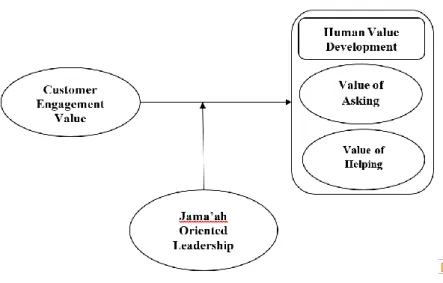
The empirical model of this study can be illustrated in fig 1.
Fig 1. Empirical Model
Data Collection Technique, Population and Sample
The population in this study was shari’a insurance agents or salespeople from 63 insurance companies with shari’a principles in Indonesia that are registered with the OJK (Otoritas Jasa Keuangan), 2019). Shari’a insurance is a potential industry sector because it shows growth and continues to grow, especially in Indonesia, where the majority of people are Muslim (Effendy, 2018). Salespeople are chosen as respondents because most studies involving customer engagement involve developing human values for sales and service activities (Singh & Venugopal,
2015). Data was obtained from the distributing questionnaires to 300 sharia insurance salespersons. The sampling technique used snowball sampling technique with the selection of respondents by using purposive sampling (non-probability sampling). The characteristics of the respondents that fall into criteria are: (1) have worked as a sales force for shari’a insurance products for at least 1 year, (2) have been a member of the sales force team, (3) have a team leader.
The response test could be carried out because it was feared that there would be answer bias during the 3-month data collection process. Respondent’s answer bias may occur due to a change of leaders or the training process which may lead to differences in orientation. Testing of non- response bias was carried out by using the independent simple t-test to see the differences in the characteristics of the answers of respondents who filled out the questionnaire during the first month and a half and the second month and a half. If the value of Levene’s Test for Equity of Variance shows a significant level above 0.05 for two tailed, it can be concluded that there is no difference between the average answer scores of the two groups of respondents, so it can be said that the respondents come from the same group.
In order to meet the face validity for all variables, before doing the survey, the items developed were validated through FGD by experts. After 3 months of the data collection process, only 235 returned or around of 78.33% respond rate. The final evaluation of the questionnaire received a number of 187 data that can be processed further or 62.33% of the questionnaires were eligible for data analysis.
Measurement
The measurement of indicators of all variables in this study uses a Likert scale of 1 to 5 (strongly disagree to strongly agree).
Customer Engagement Value
The concept of customer engagement value refers to the engagement value of the members of the sales team in an effort to fulfill customer needs and desires by creating value and customer satisfaction (Singh & Koshy, 2012; Wong et al., 2015). To measure customer engagement value variable, this study used indicators of: (1) creating customer value, (2) wanting to meet customer needs and desires, (3) wanting to satisfy customers, (4) monitoring customer satisfaction periodically, and (5) wanting to help solve customer problems. One item of the customer engagement value indicator is, for example “a member of the sales team engaged in customer value creation”.
Value of Asking
Value of Asking is defined as the spirit to asking others to do their best as they do on the basis of sincerity. In the perspective of Islam, sincere means sincere intention of doing good deeds without human self-interest, but only hoping for the blessing of Allah SWT (Surah Ali-Imron:104;
Al-Balad:17-18; Al-‘Asr:1-3). Prophet Muhammad PBUH said: “Surely Allah does not accept deeds unless they are done sincerely and hope to be pleased with Allah” (Narrated by Abu Dawud and Nasa’i). Prophet Muhammad PBUH said: “Whoever sees evil, then let him change with his hands, if not able, let him change with his words, if not able to change with his heart, and that is as weak as faith” (Narrated by Bukhari and Muslim).
In an effort to invite goodness there is an element of da’wah. Da’wah is a communication problem. For that reason, using the right language in the right place for the right people is very important. In order for the content of the da’wah to be accepted, the preacher must be able to set an example first (Surah As-Saff :2-3; Al-Baqarah:44). Based on the previous explanation, the indicators used to measure the value of asking are: (1) da’wah intensity, (2) dawah communication dan (3) dawah personality.
Value of Helping
The value of helping is defined as the spirit to encourage colleagues who are based on civility to be able to do their best (Surah: Al-Maidah:2; Al-Ahzab:72); Aydinli, Bender, Chasiotis, et al. (2014);
Olowookere et al. (2016); . Sincerity is a work of the heart. Sincerity is the secret between Allah SWT and his servant, which only angels know. The indicators that can be used to measure the value of helping are: (1) enthusiastic in helping others, (2) initiative in helping spontaneously, (3) initiative in helping without expect return, (4) initiative in helping in extra role.
Jama’ah-Oriented Leadership
The concept of Jama’ah oriented leadership is the perception of sales team members that their leaders emphasize the collective group identity and team achievements rather than individual achievements and identities. We use five items developed by (Nelson et al., 2016). One example of such an item is “leaders emphasize mutual respect for achievement”.
Discussion
Figures and tables along with their interpretation regarding the findings, are completely attached in the appendix.
Respondent Characteristics
Table 1 provides information that most of salespersons, were female, 31-35 years old. With the latest education level dominated by undergraduate, with tenure 1 to 5 year. In terms of religion, the majority of salesperson were Muslims. The majority of salespeople were dominated by non- permanent employees.
Table.1 RESPONDENT CHARACTERISTICS
No. Respondent Characteristics Dimension Total Percentage (%)
1 Gender Female 101 54.01
Male 86 45.99
Total 187 100.00
2 Age <25 years old 16 8.56
26-30 years old 36 19.25
31-35 years old 53 28.34
36-40 years old 50 26.74
41-45 years old 17 9.09
>45 years old 15 8.02
Total 187 100.00
3 Education Senior High School 14 7.49
Diploma 17 9.09
Undergraduate 136 72.73
Post Graduate 20 10.70
Total 187 100.00
4 Tenure 1-5 years old 132 70.59
6-10 years old 28 14.97
11-15 years old 22 11.76
>16 years old 5 2.67
Total 187 100.00
5 Religion Islam 153 81.82
Christian 15 8.02
Catholic 12 6.42
Hindu 5 2.67
Buddhist 2 1.07
Total 187 100.00
6 Employee status Temporary employees 142 75.94
Permanent employees 45 24.06
Total 187 100.00
Descriptive Statistics
All variables in this study were measured using a five-point Likert scale ranging from 1 = strongly disagree to 5 = strongly agree. The mean score lower than two is rated as low, two to four rated as moderate, and higher than four is rated as high perception of understanding each variable (Radzi et al., 2018). The descriptive statistical values of this research are shown (table 2).
Table.2 DESCRIPTIVE STATISTICS
Variables Mean SD
Customer Engagement Value
CEV1 4.289 0.631
CEV2 4.492 0.597
CEV3 4.62 0.585
CEV4 4.62 0.621
Statistical Analysis and Hypothesis Testing
The study used partial least squares (PLS) to analyze the research model. The software to conduct the analysis is provided by SmartPLS (Ringle et al., 2015). PLS application typically occurs in two stages consisting of testing a measurement model and a structural model.
Measurement Model
Evaluation of measurement models is used to test internal consistency (Cronbach alpha and composite reliability); convergent validity (indicator reliability and AVE); and discriminant validity (Fornell-Larcker, Cross Loading, and HTMT). The results of the measurement model (figure 2 and table 3-4) show that validity and reliability are met (Henseler et al., 2016).
Fig 2. Estimation Model Evaluation (after elimination)
Variables Mean SD
CEV5 4.62 0.67
Jama'ah Oriented Leadership
JOL1 4.353 1.036
JOL2 4.465 0.867
JOL3 4.631 0.61
JOL4 4.615 0.586
JOL5 4.62 0.612
Value of Asking
VoA1 4.251 0.543
VoA2 4.235 0.628
VoA3 4.321 0.588
Value of Helping
VoH1 4.193 0.705
VoH2 4.251 0.634
VoH3 4.166 0.628
VoH4 4.193 0.599
Table.3 MEASUREMENT MODEL EVALUATION
Table.4 FORNELL-LARCKER CRITERION
CEV JOL JOL*CEV-->VoA JOL*CEV-->VoH VoA VoH
CEV 0.751
JOL 0.206 0.899
JOL*CEV -->VoA -0.502 -0.218 1
JOL*CEV -->VoH -0.502 -0.218 1 1
VoA 0.32 0.369 0.118 0.118 0.82
VoH 0.196 0.187 0.123 0.123 0.383 0.828
Structural Model
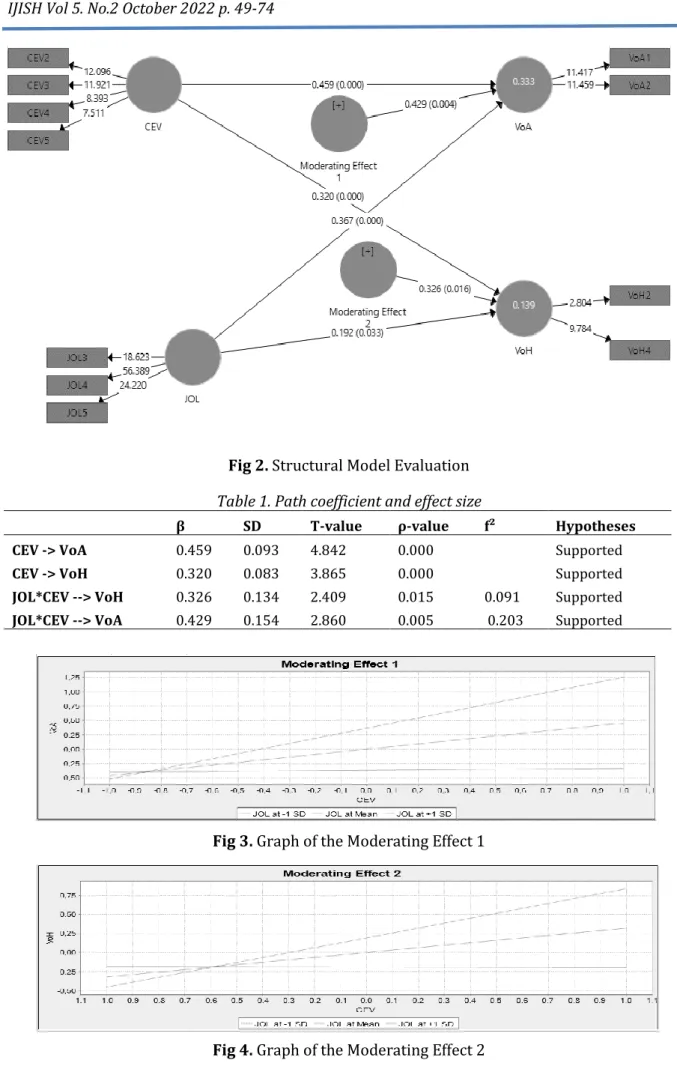
The structural model test includes R2, f 2, Q2 and path coefficient of the model (table 5-6 and figure 3-6) shows that all hypotheses are supported and meet the good-fit model (Hair et al., 2017).
Table.5 COEFFICIENT OF DETERMINATION Latent
variable Indicators
Convergent
Validity Internal Consistency
Reliability Discriminant
Validity Loadings AVE Composite
Reliability Cronbach
Alpha HTMT
> 0.60 > 0.50 > 0.70 > 0.70 < 1 Customer
Engagement Value
2 0.802
0.564 0.838 0.747 Yes
3 0.799
4 0.705
5 0.691
Value of
Asking 1 2 0.836 0.803 0.624 0.804 0.512 Yes
Value of
Helping 2 4 0.687 0.948 0.734 0.810 0.593 Yes
Jama’ah Oriented Leadership
3 0.852
0.808 0.927 0.883 Yes
4 0.938
5 0.905
Moderating
Effect 1 JOL*CEV→VoA 0.999 1.000 1.000 1.000 Yes
Moderating
Effect 2 JOL*CEV→VoH 0.999 1.000 1.000 1.000 Yes
Endogenous Variables R Square R Square Adjusted
VoA 0.333 0.322
VoH 0.139 0.125
Fig 2. Structural Model Evaluation Table 1. Path coefficient and effect size
β SD T-value ρ-value f² Hypotheses
CEV -> VoA 0.459 0.093 4.842 0.000 Supported
CEV -> VoH 0.320 0.083 3.865 0.000 Supported
JOL*CEV --> VoH 0.326 0.134 2.409 0.015 0.091 Supported JOL*CEV --> VoA 0.429 0.154 2.860 0.005 0.203 Supported
Fig 3. Graph of the Moderating Effect 1
Fig 4. Graph of the Moderating Effect 2
Jama’ah oriented leadership role as moderating variable in the interaction between customer engagement value on strengthening the value of asking and value of helping (table 6 and figure 4- 5), provides a high degree of moderation effect with a value of f² 0.203 and 0.091 (Hair et al., 2017).
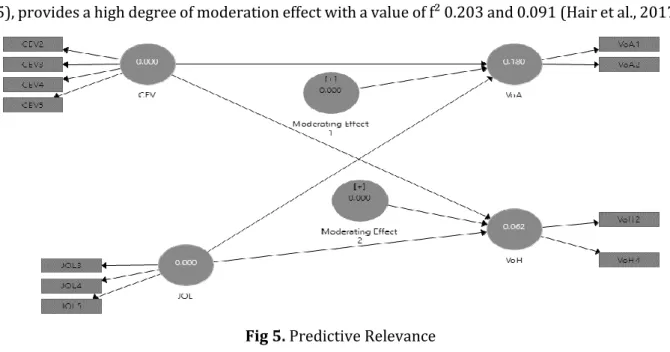
Fig 5. Predictive Relevance
Cross-validated Redundancy (Q²) is a method used to test predictive relevance (figure 6 and table 7). If the Q² value is higher than 0 then the model has an accurate predictive relevance to a construct (Tenenhaus et al., 2005).
Table.6 PREDICTIVE RELEVANCE
Customer Engagement Value and Islamic Human Value Development
Customer Engagement Value and Value of AskingCustomer engagement value establishes a strong, positive, significant effect on value of asking (β = 0.459; t-value > 1.96; ρ-value < 0.05). This means that if the adoption of Islamic human value development can be built through increasing customer engagement value of salespeople in sales team. It can be said that a salesperson who is a member of the sales team, and he has a desire to create value for customers, seeks to engage understanding customer needs and desires, prioritize customer satisfaction, monitors customer satisfaction periodically and is ready to help provide alternative solutions to customer problem solving. Then the salesperson will make it happen by getting more excited about doing, the value of asking through preaching (da’wah) by using good
CV Communality CV Redundancy
CEV 0.272
JOL 0.573
JOL*CEV-->VoA 1.000
JOL*CEV-->VoH 1.000
VoA 0.082 0.180
VoH 0.162 0.062
communication by making himself a role model. Kwon & Adler (2014) stated that salespeople who are members of the sales team must have collective goals. This collective goal is the focus of the salesperson to engage in meeting customer needs and wants. On the other hand, the salesperson also knows the diversity of capacities and characters of each team member. Therefore, in the process of resuscitating co-workers, salespeople use good language and are adapted to the interlocutor. Using good language is an embodiment of Islamic values that are sourced from the Hadith of the Prophet Muhammad, which was narrated by Bukhori: “A Muslim is a person, other Muslim are safe from verbal interference and his hands”. The hadith of the Prophet Muhammad (Peach Be Upon Him) narrated by Muslims: “Whoever believer in Allah and the last day, he should say good or be silent”. To launch the “asking” activity, salespeople make themselves a role model.
Customer Engagement Value and Value of Helping
Customer engagement value also established a strong, positive, significant effect (path coefficient = 0.320; t-value > 1.96; ρ-value < 0.05) on value of helping. Islamic human value development in the form of value of helping can be built through the power of customer engagement value. If the salesperson is in a sales team and he has the desire to create value for the customer, seeks to understand customer needs and wants, periodically monitors customer satisfaction and is ready to help solve customer problems. Then the salesperson will be encouraged to make it happen by being more enthusiastic about helping his colleagues, taking the initiative to help spontaneously without being asked, taking the initiative to help without expecting a reward and taking the initiative to help even though it is not his main task. A salesperson’s biggest challenge is how to manage a very diverse customer base. This diversity requires very detailed handling.
The inseparability inherent in services presents its own challenges because almost all services activities are carried out directly and personally. In addition, very dynamic market movements cause more and more service variables to be considered and cannot be resolved individually. The awareness of this condition will increase the morale of the sales force to help colleague’s voluntarily. The feeling of being identical encourages them to come together to realize the team’s desire to provide excellent service. This statement is supported by Ferreira (2017) which concludes that if each group member feels one unit, mutual trust will emerge and increase motivation to share knowledge and help each other. This spirit of mutual help is the manifestation of Islamic values as stated in QS.Al-Maidah verse 2 which means: “And help you in (doing) virtue and piety, and do not help in committing sins and violations…” The study of Olowookere et al. (2016) also concluded that a person’s level of religiosity predicts a willingness to do additional work outside of their obligations.
The Moderating Role of Jama’ah Oriented Leadership
Jama’ah oriented leadership as moderator variable of interaction between customer
engagement value and Islamic human value which consists of value of asking shows (path coefficient = 0.429; t-value > 1.96; ρ-value < 0.05). This result show that jama’ah oriented leadership has a strong, positive and significant moderation effect on the interaction between customer engagement value to strengthen the value of asking. The study conducted by X. H. Wang et al. (2016) also stated that leaders who always reminded the objectives of the jama’ah, tended to openly exchange and integrate ideas, knowledge, and insights that were relevant to the task. Because in fact, customers have heterogenous characteristics (Floh et al., 2014), so that no single sales method is superior. Jama’ah oriented leadership has a role to support the salesperson to build a relationship between sales team members and customers by emphasizing the values of togetherness (congregation), so that awareness grows to be more engaged in providing the best service value according to customer needs.
This is in accordance with the study of Nelson et al. (2016), the salesperson who has the perception that their leader prioritizes team achievement, will be motivated to raise team because of collective goals. In line with Fachrunnisa et al. (2020) that collective engagement is able to form a social identity to generate the spiritual welfare of the community. The goals of the team or the jama’ah can only be achieved by working together, so the salesperson will remind his colleagues to voluntarily focus on the goals of the congregation by optimizing the resources they have. The behavior of asking is the manifestation of Islamic values as stated in Holy Qur’an (Al-Asra:1-3) that humans must remember each other in patience and piety.
Jama’ah oriented leadership as moderator variable of interaction between customer engagement value and Islamic human value which consists of value of asking also shows (path coefficient = 0.326; t-value > 1.96; ρ-value < 0.05). This result show that jama’ah oriented leadership has a strong, positive, and significant moderation effect on the interaction between customer engagement value to strengthen value of helping. When salespeople perceive that their leader foster the enthusiasm of the team members or congregations (jama’ah) work cooperatively to achieve common goals, this indirectly create a cooperative climate that will increase knowledge sharing behavior. This conducive environment, which is formed from the role of jama’ah leadership, help encourage the desire of salespeople to be involved in creating service value creation to foster customer engagement. The salesperson will help colleagues and customers by explaining how to provide good service, including knowledge sharing activities. Obeying the orders of the leader in accordance with religious values obliged to obey the leadership, “Obey Allah, Prophet and the leader among you” (Holy Qur’an.An-Nissa:59). This statement is supported by the studies of Nohe &
Michaelis (2016) and Babcock-roberson (2010) which concluded that helping behavior outside the role of team level can be increased through the charisma of the leader.
Conclusion
Research on the best way to plan and implement human value development through strengthening the value of asking and the value of helping is urgent, owing this question’s theoretical importance and practical relevance for shari’a insurance. Among these factors, customer engagement value and jama’ah oriented leadership define as a way to establish a clear direction for salespeople to achieve success and maintain the sustainability of shari’a insurance through strengthening human value. This study shows that in the shari’a insurance ecosystem, service value must also be built by salespeople in an effort to increase customer engagement in order to create strengthening Islamic human value, namely value of asking and value of helping. Furthermore, this research demonstrates the role of jama’ah oriented leadership as a moderating variable towards strengthening of value of asking and value of helping in shari’a insurance. Value of asking can be achieved through the role of leader with jama’ah orientation, emphasizing mutual respect, emphasizing team (jama’ah) goals and emphasizing that team members are an important part, then the salesperson is encouraged to grow customer engagement to provide the best service value to internal and external customers. The increase in customer engagement, then has a positive impact on strengthening the value of asking, making salesperson a role model to asking colleagues and customers to achieve team goals (Wang et al., 2016). Likewise, the value of helping, it can be achieved when a salesperson perceived that the leader fosters the enthusiasm of members or jama’ah to work together to achieve team goals. This helps to grow salesperson awareness in delivering the best service value, through creating customer engagement. The finding illustrates that most of the salespeople already have jama’ah oriented leaders.
Theoretical Implication
The results of this study have implications for social capital theory as the parent of relational capital. First, a team has a highly relational, social capital if there is a cooperative norm where all team members respect each other and respond to diversity, openness to critical thinking and mutual expectations and cooperation (Yu et al., 2013). This openness to critical thinking allows individuals to accept invitations to do the best work activities but not yet in a position to invite (da'wah). Therefore, the concept of Islamic human value complements the dimension of the value of asking. This openness to critical thinking allows individuals to accept asking to do the best work activities, but not yet in a position to asking (da’wah). Therefore, the concept of Islamic human value complements the dimension of the value of asking. Through the spirit of asking without being asked, the idle capacity that exists in colleagues in one team can be activated and used optimally. In Holy Qur’an (Al-Asr:1-3) Allah SWT commands His people to remind each other in patience. Prophet Muhammad SAW said: “In principle, humans are negligent and forgetful creatures.” (Narrated by
Thirmizi). Second, the value of helping is different from the OCB (organizational Citizenship Behavior) concept. Altruistic as one of the dimensions of OCB is defined as the desire to help others which start from feeling of empathy that generate motivation to help (Quinn et al., 2010). Even though the behavior is the same, namely helping, altruistic is done to satisfy personal needs and not based on the intention to worship. This is what distinguishes it from the concept of helping in Islamic human value. So, individuals who have high Islamic human values, give help to colleagues sincerely and do not expect reciprocity, on the basis of worship and strengthening of the jama’ah.
Finally, this study succeed in answering the statement of Guillén et al., (2015) that the classical theory of motivation ignores the importance of ethical and spiritual dimension that cause a person to be judged to be selfish, immoral and non-spiritual. Incorporating a spiritual dimension leads to better marketing management practices related to people (sales force) as a major dimension in the service profit chain and improve performance, especially service sales performance.
Managerial Implication
The results of this study contribute to managerial implications related to the role of jama’ah oriented leadership to moderate the relationship between customer engagement value in strengthening Islamic human values. The managerial implication includes: First, increasing the Islamic human value on salespersons. The intention to worship will result in blessings, such as the promise of Allah SWT as stated in Holy Qur’an (Al-A’raf :96_ which means: “And if the inhabitants of the land believe and have faith, surely We will bestow on them the blessings of heaven and earth…” Salespeople also need to be given an understanding that the products, so that the core values that are the basic principles of Islamic insurance, namely helping to help (ta’awun), doing good deeds (tabarru’) and bearing each other (takaful) must become their morale.
Second, in order to increase customer engagement value, Shari’a insurance can implement a policy of forming a sales team consisting of salesperson with customer engagement orientation, namely delivering high service value to customers, in line with Arndt & Karande (2012). Third is the strengthening of jama’ah oriented leadership. To strengthening the value of asking and the value of helping through customer engagement values, this can be achieved by implementing a policy on career requirements or requirements to become a sales team leader. Furthermore, to maintain ownership of this orientation, organizations need to conduct sales leadership training with the main material on monotheism (tauhid) and strengthening teamwork as jama’ah. In the company that sells Shari’a products or services, it is important to foster the concept of the Sharia ecosystem.
The material adhering to religious values in a training will lead leaders to be able to be good examples because the sales team leaders must be obeyed by the sales team. The order to obey the leader is contained in Holy Qur’an (An-Nissa:59);(Grönroos, 1994); (Holy Qur’an.An-Nissa:58).
Limitation and Future Research
However, this research has following aspects of limitations, first, research design of this study is cross-sectional, and the research design is inapplicable of ensuring that the causal relationships set out in the hypothesis; even the results are consistent with theoretical reasoning. Further researcher could solve this issue by applying a longitudinal design. Second, this study analyzes the model to strengthen Islamic human value through the formation of customer engagement values, with jama’ah oriented leadership as moderator. Future research is suggested to include the antecedence variable for internalizing Islamic values, for example the Islamic customer orientation (Zakaria & Abdul-Talib, 2010; Zebal & Saber, 2014) and Islamic leadership (Ahmad, 2013). In addition, further research can also test the antecedent of Islamic human value from a service marketing perspective such as: customer service style (Prior, 2016); entrepreneurial orientation (Oly Ndubisi, 2014); personal value system (Thuy and Hau, 2010); knowledge management (Guchait et al., 2011); Service Oriented (Thomas-Francois et al., 2017) by internalizing Islamic values into these variables. Another weakness in this study is that this study only takes salespeople from shari’a insurance as one of the Islamic Finance Institutions in Indonesia. So that future research is still needed to test a whole different target sample and compare it with other Islamic Financial Institutions. Furthermore, a comparative study of human development between the Islamic Financial Institution and the Conventional Financial Institution is also needed, considering that the concept of Islamic human value of shari’a insurance is universal values.
References
Ahmad, K. (2013). An empirical assessment of Islamic leadership principles. International Journal of Commerce and Management, 21291–318. https://doi.org/10.1108/10569211111165325 Akhter, W., & Hussain, T. (2017). Takaful standards and customer perceptions affecting takaful
practices in Pakistan: a survey. International Journal of Islamic and Middle Eastern Finance and Management, 5, 229–240.
Alshammari, A. A., Alhabshi, S. M. b. S. J., & Saiti, B. (2019). The impact of competition on cost efficiency of insurance and takaful sectors: Evidence from GCC markets based on the Stochastic Frontier Analysis. Research in International Business and Finance, 47, 410–427.
Arndt, A. D., & Karande, K. (2012). Is it better for salespeople to have the highest customer orientation or a strong fit with their group’s customer orientation? Findings from automobile dealerships. Journal of Retailing and Consumer Services, 19(3), 353–359.
https://doi.org/10.1016/j.jretconser.2012.03.009
Ashforth, B. E., & Dukerich, J. M. (2001). Role transitions in organizational life: An identity-based perspective, by Blake E. Ashforth. Mahwah, NJ: Lawrence Erlbaum Associates, 2001. Academy of
Management Review, 26(4), 670–672. https://doi.org/10.5465/AMR.2001.5393915
Aydinli, A., Bender, M., Chasiotis, A., Cemalcilar, Z., & van de Vijver, F. J. R. (2014). When does self- reported prosocial motivation predict helping? The moderating role of implicit prosocial motivation. Motivation and Emotion, 38(5), 645–658. https://doi.org/10.1007/s11031-014- 9411-8
Babcock-roberson, M. E. (2010). Leadership , Work Engagement , and Organizational Citizenship Behaviors. 144(3), 313–326.
Chatman, J. A., & Flynn, F. J. (2001). The Influence of demographic heterogenity on the emerge and consequenses of cooperative norms in work teams. Academy Management Journal, 44(5), 956–
974.
Decuypere, A., & Schaufeli, W. (2019). Leadership and work engagement : Exploring explanatory mechanisms. German Journal of Human Resource Management, 1–7.
https://doi.org/10.1177/2397002219892197
Djafri, F., Bin Noordin, K., & Naail Mohammed, K. (2018). The measurement model of performance determinants: A case study of Islamic insurance (takaful) in Malaysia. International Journal of Ethics and Systems, 34(2), 166–185. https://doi.org/10.1108/IJOES-05-2017-0075
Effendy, J. (2018). Islamic Insurance: A Potential Niche Market of Indonesia. Al-Iqtishad: Jurnal Ilmu Ekonomi Syariah, 10(January), 207–230.
Elias, A. A., & Davis, D. (2018). Analysing public sector continuous improvement: a systems approach. International Journal of Public Sector Management, 31(1), 2–13.
https://doi.org/10.1108/IJPSM-08-2016-0135
Fachrunnisa, O., Adhiatma, A., & Tjahjono, H. K. (2018). Cognitive Collective Engagement: Relating Knowledge-Based Practices and Innovation Performance. Journal of the Knowledge Economy.
https://doi.org/10.1007/s13132-018-0572-7
Fachrunnisa, O., Adhiatma, A., & Tjahjono, H. K. (2020). Collective Engagement and Spiritual Wellbeing in Knowledge Based Community: A Conceptual Model. In L. Barolli, F. Hussain, & M.
Ikeda (Eds.), Complex, Intelligent, and Software Intensive Systems. CISIS 2019 (CISIS 2019, Vol.
993, pp. 837–846). Springer International Publishing. https://doi.org/10.1007/978-3-030- 22354-0
Ferreira, T. S. (2017). Motivational factors in sales team management and their influence on individual performance. Tourism & Management Studies, 13(1), 60–65.
https://doi.org/10.18089/tms.2017.13108
Floh, A., Zauner, A., Koller, M., & Rusch, T. (2014). Customer segmentation using unobserved heterogeneity in the perceived-value-loyalty-intentions link. Journal of Business Research, 67(5),
974–982. https://doi.org/10.1016/j.jbusres.2013.08.003
Grönroos, C. (1994). From Marketing Mix to Relationship Marketing: Towards a Paradigm Shift in Marketing. Management Decision, 32(2), 4–20.
Guchait, P., Namasivayam, K., & Lei, P.-W. (2011). Knowledge management in service encounters:
impact on customers’ satisfaction evaluations. Journal of Knowledge Management, 15(3), 513–
527. https://doi.org/10.1108/13673271111137466
Guillén, M., Ferrero, I., & Hoffman, W. M. (2015). The Neglected Ethical and Spiritual Motivations in the Workplace. Journal of Business Ethics, 128(4), 803–816. https://doi.org/10.1007/s10551- 013-1985-7
Hair, J. F. J., Hult, G. T. M., Ringle, C. M., & Sarstedt, M. (2017). A Primer on Partial Least Squares Structural Equation Modeling (PLS-SEM). In Second edition.
https://doi.org/10.1016/j.lrp.2013.01.002
Hati, S. R. H., Wibowo, S. S., & Safira, A. (2020). The antecedents of Muslim customers’ intention to invest in an Islamic bank’s term deposits: evidence from a Muslim majority country. Journal of Islamic Marketing. https://doi.org/10.1108/JIMA-01-2020-0007
Henseler, J., Ringle, C. ., & Sarstedt, M. (2016). Testing measurement invariance of composites using partial least squares. International Marketing Review, 33, 405–431.
Henttonen, K., Kianto, A., & Ritala, P. (2016). Knowledge sharing and individual work performance:
an empirical study of a public sector organisation. Journal of Knowledge Management, 20(4), 749–768. https://doi.org/10.1108/JKM-10-2015-0414
Hislop, D. (2013). Knowledge Management in Organizations: A Critical Introduction. Oxford University Press.
Hogg, M. A., & Terry, D. J. (2000). Social identity and self-categorization processes in organizational
contexts. Academy of Management Review, 25(1), 121–140.
https://doi.org/10.5465/AMR.2000.2791606
Indonesian Ministry of National Development Planning. (2019). The Indonesia Islamic Economic Masterplan 2019-2024. In The Indonesia Masterplan of Sharia Economy 2019-2024.
Kara, A., Andaleeb, S. S., Turan, M., & Cabuk, S. (2013). An examination of the effects of adaptive selling behavior and customer orientation on performance of pharmaceutical salespeople in an emerging market. Journal of Medical Marketing, 13(2), 102–114.
Kasim, N., Htay, S. N. N., & Salman, S. A. (2016). The Religious Perspective of Takaful as Ethical Insurance. Mediterranean Journal of Social Sciences MCSER Publishing, 7(4), 2039–9340.
https://doi.org/10.5901/mjss.2016.v7n4p
Khan, A., Hassan, M. K., Paltrinieri, A., Dreassi, A., & Bahoo, S. (2020). A bibliometric review of takaful
literature. International Review of Economics and Finance, 69, 389–405.
https://doi.org/10.1016/j.iref.2020.05.013
Kohli, A., & Jaworski, B. (1990). Market Orientation: The Construct, Research Propositions, and Managerial Implications., 54(April), 1–18.
Kramer, R. M. (2006). Social identity and social capital: The collective self at work. International Public Management Journal, 9(1), 25–45. https://doi.org/10.1080/10967490600625316 Kwon, S. W., & Adler, P. S. (2014). Social capital: Maturation of a field of research. Academy of
Management Review, 39(4), 412–422. https://doi.org/10.5465/amr.2014.0210
Llopis, O., & Foss, N. J. (2016). Understanding the climate-knowledge sharing relation: The moderating roles of intrinsic motivation and job autonomy. European Management Journal, 34(2), 135–144. https://doi.org/10.1016/j.emj.2015.11.009
Malik, A. (2019). Strategic Human Resource Management and Employment Relations: An International Perspective. In A. Malik (Ed.), Work Design and HR Planning: A Strategic Perspective (pp. 1–225). Springer Nature Singapore Pte Ltd.
Mustafa, G., Glave-Geo, R., & Rice, P. M. (2017). Teamwork orientation and personal learning : The role of individual cultural values and value congruence. SA Journal of Industrial Psychology, 43(0), 1–14.
Nelson, M. W., Proell, C. A., & Randel, A. E. (2016). Team-Oriented Leadership and Auditors’
Willingness to Raise Audit Issues. The Accounting Review, 91(6), 1781–1805.
Nohe, C., & Michaelis, B. (2016). Team OCB , leader charisma , and organizational change : A multilevel study ☆. The Leadership Quarterly, 27(6), 883–895.
https://doi.org/10.1016/j.leaqua.2016.05.006
OJK (Otoritas Jasa Keuangan). (2019). Laporan Perkembangan Keuangan Syariah Indonesia: Sinergi dalam membagun ekosistem ekonomi dan keuangan syariah. In Laporan Perkembangan Keuangan Syariah Indonesia 2019. https://doi.org/10.1017/CBO9781107415324.004
Olowookere, E., Oguntuashe, K., & Adekeye, O. (2016). Relationship between Religiosity and Citizenship Behaviours in Organizations: Empirical Evidence from Selected Organisations in Lagos State. Mediterranean Journal of Social Sciences, 7(4), 475–484.
https://doi.org/10.5901/mjss.2016.v7n4p
Oly Ndubisi, N. (2014). Entrepreneurship and Service Innovation. Journal of Business and Industrial Marketing, 29(6), 449–453. https://doi.org/10.1108/JBIM-07-2013-0148
Parasuraman, A., Berry, L. L., & Zeithaml, V. A. (1992). Perceived Service Quality as a Customer- Based Performance Measure : An Empirical Examination of Organizational Barriers Using an Extended Service Quality Model. Human Resource Management, 30(3), 335–364.
Pearce, C. L., & Herbik, P. A. (2004). Citizenship Behavior at the Team Level of Analysis: The Effects of Team Leadership, Team Commitment, Perceived Team Support, and Team Size. The Journal of Social Psychology, 144(3), 293–310. https://doi.org/10.3200/SOCP.144.3.293-310
Prior, D. D. (2016). Industrial Marketing Management Boundary spanning and customer service styles in business solutions implementation. Industrial Marketing Management, 56, 120–129.
https://doi.org/10.1016/j.indmarman.2015.11.001
Quinn, C., Clare, L., & Woods, R. T. (2010). The impact of motivations and meanings on the wellbeing of caregivers of people with dementia: A systematic review. International Psychogeriatrics, 22(1), 43–55. https://doi.org/10.1017/S1041610209990810
Radzi, N. A. A., Harun, A., Ramayah, T., Kassim, A. W. M., & Lily, J. (2018). Benefits of Facebook fan/brand page marketing and its influence on relationship commitment among Generation Y:
Empirical evidence from Malaysia. Telematics and Informatics, 35(7), 1980–1993.
https://doi.org/10.1016/j.tele.2018.07.002
Ringle, C. M., Wende, S., & Becker, J. M. (2015). SmartPLS 3.
Rossberger, R. J., & Krause, D. E. (2015). Participative and Team- Oriented Leadership Styles , Countries ’ Education Level , and National Innovation : The Mediating Role of Economic Factors and National Cultural Practices. Cross-Cultural Research, 49(1), 20–56.
https://doi.org/10.1177/1069397114534825
Sherif, M., & Shaairi, N. A. (2013). Determinants of demand on family Takaful in Malaysia. Journal of Islamic Accounting and Business Research, 4, 26–50.
Siala, H. (2013). Religious influences on consumers’ high-involvement purchasing decisions. Journal of Service Marketing, 27, 579–589.
Singh, R., & Koshy, A. (2012). Marketing Intelligence & Planning Article information : Marketing Intelligence & Planning, 30(1), 69–82.
Singh, R., & Venugopal, P. (2015). The impact of salesperson customer orientation on sales performance via mediating mechanism. Journal of Business and Industrial Marketing, 30(5), 594–
607. https://doi.org/10.1108/JBIM-08-2012-0141
Sudarti, K., & Fachrunnisa, O. (2021). Islamic Intrinsic Motivation and Knowledge Conversion Process for Sales Team Performance: A Theoretical Framework. In L. Barolli, A. Poniszewska- Maranda, & T. Enokido (Eds.), Complex, Intelligent and Software Intensive Systems. CISIS 2020.
Advances in Interlligent Systems and Computing. Springer, Cham.
Sudarti, K., Ratnawati, A., Mulyana, & Mubarok, M. H. (2018). Ta’awun: An Islamic Practice to Reduce Voluntary Turnover Intention. 6th Asean Universities International Conference on Islamic Finance (6th AICIF). https://doi.org/10.1109/ICSMB.2010.5735369