Routledge Studies on Asia in the World
HUMOUR IN ASIAN CULTURES
TRADITION AND CONTEXT
Edited by Jessica Milner Davis
Humour in Asian Cultures
This innovative book traces the impact of tradition on modern humour across several Asian countries and their cultures. Using examples from Japan, Korea, Indonesia and from Chinese cultures in Mainland China, Hong Kong and Taiwan, the contributors explore the different cultural rules for creating and sharing humour.
Humour can be a powerful lubricant when correctly interpreted; mis- interpreted, it may cause considerable setbacks. Over time, it has emerged and submerged in different forms in all these countries but even today, con- ventions about what is appropriate in creating and using humour still reflect many traditional attitudes and assumptions. Using close examination, Milner Davis and her colleagues show how forms and conventions that dif- fer from those in the west can nevertheless be seen to possess some elements in common. Examples include Mencian and other classical texts, Balinese traditional verbal humour, Korean and Taiwanese workplace humour, Japanese laughter ceremonies, performances and cartoons, as well as con- temporary Chinese-language films and videos, as they engage with a wide range of forms and traditions.
This fascinating collection of studies will be of interest not only to stu- dents and scholars of many Asian cultures but also to those with a broader interest in humour. It highlights the increasing importance of understand- ing a wider range of cultural values in the present era of globalised com- munication as well as the importance of reliable studies of how cultures that may be geographically related differ in their traditional uses of and assumptions about humour.
Jessica Milner Davis PhD FRSN is an honorary research associate at both the University of Sydney, Australia, and Brunel University London’s Centre for Comedy Studies Research. She is a member of Clare Hall, Cambridge, and a Fellow and Councillor of the Royal Society of New South Wales. She has twice served as president of the International Society for Humor Stud- ies (ISHS) and founded and coordinates the Australasian Humour Studies Network (AHSN: https://ahsn.org.au/). An editorial board member for lead- ing humour research journals and book series, her most recent books are:
Satire and Politics: The Interplay of Heritage and Practice (Palgrave Mac- millan, 2017) and Judges, Judging and Humour (with Sharyn Roach Anleu, Palgrave/Springer, 2018). With Jocelyn Chey, she has co-edited two volumes on Humour in Chinese Life and Culture (Hong Kong University Press, 2011 and 2013). Her 2006 book, Understanding Humor in Japan (Wayne State Uni- versity Press), won the 2008 AATH book prize for humour research. In 2018, the International Society for Humor Studies presented her with its Lifetime Achievement Award for her interdisciplinary research in humour studies.
Routledge Studies on Asia in the World
Routledge Studies on Asia in the World will be an authoritative source of knowledge on Asia studying a variety of cultural, economic, environmental, legal, political, religious, security and social questions, addressed from an Asian perspective. We aim to foster a deeper understanding of the domes- tic and regional complexities which accompany the dynamic shifts in the global economic, political and security landscape towards Asia and their repercussions for the world at large. We’re looking for scholars and practi- tioners – Asian and Western alike – from various social science disciplines and fields to engage in testing existing models which explain such dramatic transformation and to formulate new theories that can accommodate the specific political, cultural and developmental context of Asia’s diverse soci- eties. We welcome both monographs and collective volumes which explore the new roles, rights and responsibilities of Asian nations in shaping today’s interconnected and globalized world in their own right.
The Series is advised and edited by Matthias Vanhullebusch and Ji Weidong of Shanghai Jiao Tong University.
Eldercare Issues in China and India
Edited by Longtao He and Jagriti Gangopadhyay
The Shanghai Cooperation Organization Exploring New Horizons
Edited by Sergey Marochkin and Yury Bezborodov
Humour in Asian Cultures Tradition and Context Edited by Jessica Milner Davis
City, Environment, and Transnationalism in the Philippines Reconceptualizing “the Social” from the Global South Koki Seki
Find the full list of books in the series here: https://www.routledge.com/
Routledge-Studies-on-Asia-in-the-World/book-series/RSOAW
Humour in Asian Cultures
Tradition and Context
Edited by
Jessica Milner Davis
First published 2022 by Routledge
4 Park Square, Milton Park, Abingdon, Oxon OX14 4RN and by Routledge
605 Third Avenue, New York, NY 10158
Routledge is an imprint of the Taylor & Francis Group, an Informa business
© 2022 selection and editorial matter, Jessica Milner Davis; individual chapters, the contributors
The right of Jessica Milner Davis to be identified as the author of the editorial material, and of the authors for their individual chapters, has been asserted in accordance with sections 77 and 78 of the Copyright, Designs and Patents Act 1988.
All rights reserved. No part of this book may be reprinted or reproduced or utilised in any form or by any electronic, mechanical, or other means, now known or hereafter invented, including photocopying and recording, or in any information storage or retrieval system, without permission in writing from the publishers.
Trademark notice: Product or corporate names may be trademarks or registered trademarks and are used only for identification and explanation without intent to infringe.
British Library Cataloguing-in-Publication Data
A catalogue record for this book is available from the British Library Library of Congress Cataloguing-in-Publication Data
A catalog record has been requested for this book ISBN: 978-1-032-00916-2 (hbk)
ISBN: 978-1-032-00918-6 (pbk) ISBN: 978-1-003-17637-4 (ebk) DOI: 10.4324/9781003176374
Typeset in Times New Roman by KnowledgeWorks Global Ltd.
This book is dedicated to Cecil Robert Burnett
Quentin (1917–1979) who first introduced me to
the rich cultural histories of Asia
鼓掌絕塵
Contents
List of Figures xi
List of Tables xiii
List of Contributors xiv
Preface xviii
1 Humour and cultural context: Tradition and practice in
six Asian cultures 1
JESSICA MILNER DAVIS
2 Humour as rhetorical discourse in ancient
Chinese philosophy: The Works of Mencius 19
SHIRLEY CHAN
3 Humour in the huaben novellas of the Ming
Dynasty: The Guzhang Juechen in context 40
ANTONIO LEGGIERI
4 Linguistic devices in traditional forms of Balinese humour 62
NENGAH ARNAWA
5 Pluri-modal poetic performance of banter: The Angama
ritual on Ishigaki Island in Japan 88
MAKIKO TAKEKURO
6 Themes, cultural context and verbal exchanges in the
cartoons of Machiko Hasegawa 117
SACHIKO KITAZUME
7 The makura of rakugo, tradition and modernity 136
M.W. SHORES
x Contents
8 To joke or not to joke?: Politeness, power and the
impact of tradition in Korean workplace humour 170
HEESUN KIM AND BARBARA PLESTER
9 Chinese conversational humour over time: Contemporary
practice and tradition in Taiwanese cultures 188
WEI-LIN MELODY CHANG AND MICHAEL HAUGH
10 We Are Real Friends: Women constructing friendship
via teasing in a Chinese reality TV show 211
YING CAO
11 My Unfair Lady: Gender, sajiao and humour in a
Hong Kong TV series 238
MARJORIE K. M. CHAN
Index 268
(Han Yong 韓勇). 23 耕樂居士雨農
3.2 Illustration from Guzhang Juechen 鼓掌絕塵, 1631. 45 鼓掌絕塵
List of Figures
2.1 Mencius (anonymous artist, 1922). 22
2.2 A shi gentleman, by Gengle Jushi Yunong
3.1 Illustration from Guzhang Juechen 鼓掌絕塵, 1631. 44
3.3 Illustration from Guzhang Juechen , 1631. 57 4.1 Still of wayang kulit performance by Cenk Blonk,
Jembrana District Government News, Bali, 2011. 64 4.2 Photograph of wayang kulit puppets (Nengah
Arnawa, 2019). 72
4.3 Photograph of Cenk Blonk wayang kulit puppets
(Nengah Arnawa, 2019). 73
4.4 Photograph of Cenk Blonk wayang kulit puppets
(Nengah Arnawa, 2019). 79
5.1 Map of Ishigaki, Japan, by Motoki Saito, 2018. 89 5.2 Photograph of angama performance, Ishigaki
(Makiko Takekuro, 2017). 93
5.3 Photograph of angama performance, Ishigaki,
Makiko Takekuro, 2017. 95
5.4 Photograph of angama performance, Ishigaki,
Makiko Takekuro, 2017. 104
6.1 The Wonderful world of Sazae-san (Vol. 12, p. 68;
Sazae-san, Vol. 43, p. 98), by Machiko Hasagawa, 2004. 123 6.2 The Wonderful world of Sazae-san (Vol. 6, p. 100;
Sazae-san, Vol. 21, p. 71), by Machiko Hasagawa, 2003. 125 6.3 The Wonderful world of Sazae-san (Vol. 11, p. 111,
Sazae-san, Vol. 40, p. 126), by Machiko Hasagawa, 2004. 127 6.4 Granny Mischief, p. 29 (Ijiwaru Baasan, Vol. 1, p. 30),
by Machiko Hasegawa, 2001. 129
6.5 Granny Mischief, p. 37 (Ijiwaru Baasan, Vol. 1, p. 41),
by Machiko Hasegawa, 2001. 130
6.6 Granny Mischief, p. 96 (Ijiwaru Baasan, Vol. 1, p. 113),
by Machiko Hasegawa, 2001. 132
笑福亭たま
上方落語協会
五代目桂文三 三代目桂あやめ
我们是真正的朋友 我们是真正的朋友 我们是真正的朋友
不懂撒嬌的女 不懂撒嬌的女 xii List of Figures
7.1 Photograph of Tenma Tenjin Hanjōtei in Osaka
(Kamigata Rakugo Kyōkai ). 141
7.2 Photograph of Katsura Ayame III performing
(Katsura Ayame III ). 153
7.3 Photograph of Katsura Bunza V performing
(Katsura Bunza V ). 155
7.4 Photograph of Shōfukutei Tama performing
(Shōfukutei Tama ). 160
8.1 Photograph of office-workers, Seoul, Korea, by
HeeSun Kim, 2021. 176
9.1 Photograph of office-worker, Yilan, Taiwan, by
Wei-Lin Melody Chang, 2010. 197
9.2 Photograph of office-worker, Yilan, Taiwan, by
Wei-Lin Melody Chang, 2010. 197
9.3 Photograph of office-worker, Yilan, Taiwan, by
Wei-Lin Melody Chang, 2010. 198
10.1 Still from Wo Men Shi Zhenzheng De Pengyou
(We Are Real Friends), 2019. 218 10.2 Still from Wo Men Shi Zhenzheng De Pengyou
(We Are Real Friends), 2019. 218 10.3 Still from Wo Men Shi Zhenzheng De Pengyou
(We Are Real Friends), 2019. 223 11.1 Still from Budong Sajiao De Nüren
(My Unfair Lady), 2017. 251
11.2 Still from Budong Sajiao De Nüren
(My Unfair Lady), 2017. 257
List of Tables
4.1 Sangut and Délem discuss the kidnapping of Rama 71
4.2 Key to bladbadan in Table 4.1 72
4.3 Key to bladbadan in Example 5 74
4.4 Key to bladbadan in Example 6 74
4.5 Rhyming in Wewangsalan 1 and 2 76
4.6 Rhyme and interpretation in Wewangsalan 3 and 4 77
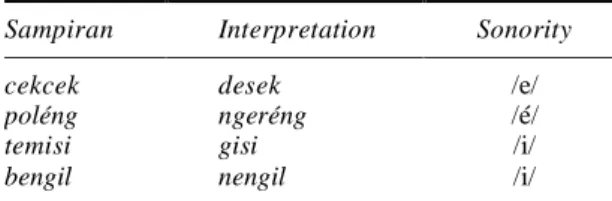
4.7 Sonority in Wewangsalan 5 78
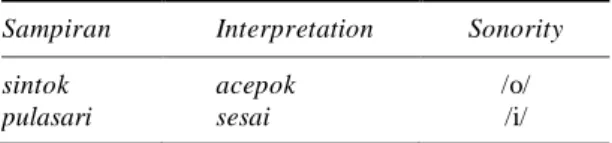
4.8 Sonority in Wewangsalan 6 78
4.9 Tualén and Merdah discuss the cost of education 79
7.1 Selected makura elements 139
9.1 Overview of studies of conversational humour in Chinese 191
10.1 Transcription conventions 234
11.1 Group text messages 242
11.2 Molly warns Cherry about men 243
11.3 Gordon to Molly: “Your boyfriend?” 254
11.4 Cracking Hanson’s Facebook code 258
11.5 Rhyming pun, Example 1 259
11.6 Rhyming pun, Example 2 259
11.7 Molly to Gordon, “You betrayed me!” 260
Contributors
Nengah Arnawa is a Lecturer at the Mahadewa University of Indonesia with research interests in semantics and pragmatics. He is a member of the Indonesian Linguistic Society (MLI) and the Local Language Researchers Association (APBL). Dr Arnawa has made a deep study of linguistic constructions in Balinese, such as bladbadan and cecimpedan which are often used as a medium for humour in traditional theatre, and has written and published articles in both Balinese and English on humorous Balinese discourse.
Ying Cao holds her PhD from the School of Humanities and Communication Arts at Western Sydney University, Australia, and lectures in the School of Foreign Languages at Wuhan Polytechnic University, PRC.
Her research interests focus on humour, gender, (im)politeness and identity construction in the discourse of TV fictional dialogues, Chinese conceptions of humour, and linguistic studies of humour in translation and interpreting. A multiple graduate scholarship winner with the Australasian Humour Studies Network (https://ahsnhumourstudies.
org/), Dr Cao has published with colleagues a study of aggressive humour in Chinese sitcom discourse in The European Journal of Humour Research (Vol. 9/4, 2021).
Marjorie K. M. Chan is an Associate Professor in the Department of East Asian Languages and Literatures at the Ohio State University. She received her BA and MA in Linguistics from the University of British Columbia, PhD in Linguistics from the University of Washington, and was a post-doctoral fellow at UCLA’s Phonetics Lab. Her teaching and research focus on Chinese Linguistics: phonetics and phonology;
dialectology; historical linguistics, especially historical phonology;
the Chinese writing system, including dialect-writing; socio-pragmatic issues pertaining to language and gender as well as to humour and topics dealing with Chinese operatic traditions, especially Cantonese regional opera.
Contributors xv Shirley Chan is an Associate Professor and Head of Chinese Studies in the Department of Media, Communications, Creative Arts, Language and Literature at Macquarie University, Sydney. She is a member of the Macquarie University (MQ) Research Centre for Cultural Heritage and Environment. Dr Chan served as President of the Chinese Studies Association of Australia (2015–2017), and as Editor-in-chief for the
“Journal of the Oriental Society of Australia” (2018–2021). She teaches Chinese language, literature and culture, Chinese history and Chinese philosophy and has published in her broad research interest areas of Chinese culture, Chinese philosophy and textual studies, including humour.
Wei-Lin Melody Chang is a Lecturer in Chinese at the School of Languages and Cultures, University of Queensland. Her research focuses on pragmatics, intercultural communication and business negotiation, especially studying face, (im)politeness and humour. She is the author of Face and Face Practices in Chinese Talk-in-Interactions: An Empirical Analysis of Business Interactions in Taiwan (Equinox, 2016), as well as a number of papers in edited volumes and journals, including the Journal of Pragmatics, Intercultural Pragmatics, International Review of Applied Linguistics in Language Teaching, Journal of Politeness Research, Pragmatics, Multilingua, Lingua and East Asian Pragmatics.
Michael Haugh FAHA is Professor of Linguistics and Applied Linguistics in the School of Languages and Cultures at the University of Queensland.
His research interests include pragmatics, conversation analysis, intercultural communication and humour studies, with a particular focus on the role of language in social interaction. His more than 100 papers and books include the Cambridge Handbook of Sociopragmatics (CUP, 2021, with Dániel Z. Kádár and Marina Terkourafi), Doing Pragmatics Interculturally (Mouton de Gruyter, 2017, with Rachel Giora), Im/
Politeness Implicatures (Mouton de Gruyter, 2015) and Pragmatics and the English Language (Palgrave Macmillan, 2014, with Jonathan Culpeper).
He is the founding Co-Editor of Cambridge Elements in Pragmatics (Cambridge University Press) and was Co-Editor-in-Chief of the Journal of Pragmatics (Elsevier) from 2015 to 2020.
HeeSun Kim is an Assistant Professor in the Department of Business Administration at Yonsei University, Mirae Campus. Her research interests include organisational humour, work-life balance and East- Asian cultural perspectives on organisational behaviour. Dr Kim’s teaching spans across undergraduate, postgraduate and professional level courses, including subjects in international management, organisational behaviour, research methods, business strategy, career development and
xvi Contributors
design management. She is engaged in diverse interdisciplinary research and teaching groups, and her work aims to help bridge the gap between different academic areas and boundaries.
Sachiko Kitazume has authored many papers on English linguistics including
“Middles in English” (WORD: Journal of the International Linguistic Association, 47 (2), 1996) and “A linguistic study of ‘Show the Flag’”
(in The Deep/True Phase of Language, Eihosha, 2004). For the last decade, her research has focused on humour, resulting in How to Do Things with Humor (Eihosha, 2010) as well as “Do the Japanese have a sense of humor?” (Society, 47 (1), 2010). An Emeritus Professor at Kindai University, she served as Mayor of an English immersive facility established in 2006 called “e-cube”, a Japanese pioneering project in communicative English education, reflected in her contribution to Eigomura of Kindai University (Eihosha, 2010). An expert committee member, in 2017 she contributed to the establishment of Tokyo Global Gateway, a large-scale education project initiated by the Tokyo Metropolitan Board of Education. Since 2010, she has been an executive board member of the Kindai Educational Cooperation.
Antonio Leggieri holds a PhD in comparative literature from Beijing Language and Culture University and is currently completing a second Doctorate from the Universities of Salento and Vienna jointly. His main research interest is in late-imperial Chinese literature, especially humour in jestbooks and narratives, but he is also interested in the theory and practice of literary translation between Mandarin Chinese and Italian.
He has published on the connections between Western and traditional Chinese concepts of humour and is a member of the Humours of the Past research group (https://humoursofthepast.wordpress.com/). He currently resides in Taipei.
Jessica Milner Davis FRSN is an honorary research associate at the University of Sydney, Australia, and at Brunel University London’s Centre for Comedy Studies Research, a member of Clare Hall, Cambridge, and a Fellow of the Royal Society of New South Wales. Twice president of the International Society for Humor Studies (ISHS), she coordinates the Australasian Humour Studies Network (AHSN: https://ahsn.org.au/).
Her most recent books are Satire and Politics: The Interplay of Heritage and Practice (Palgrave Macmillan, 2017) and Judges, Judging and Humour (with Sharyn Roach Anleu, Palgrave/Springer, 2018). She co-edited (with Jocelyn Chey) two volumes on humour in Chinese life and culture (Hong Kong University Press, 2011 and 2013) and Understanding Humor in Japan (Wayne State University Press, 2006) won the 2008 AATH book prize for humour research. In 2018, the International Society for Humor Studies recognised her interdisciplinary research in humour studies with its Lifetime Achievement Award.
Contributors xvii Barbara Plester is a Senior Lecturer in the Department of Management and International Business at the University of Auckland, Aotearoa/
New Zealand. Although this is a serious job, she laughs a lot because her research explores workplace humour, fun, play, organisational culture, food rituals and critical perspectives of organisational life. Part of the Organisation Studies group, Barbara teaches Organisational Behaviour, Organisational Theory and HRM infused with humour stories, at both undergraduate and postgraduate levels. Her current research investigates fun and well-being in the social spaces of work. Prior to her academic career, Barbara worked in Publishing and Information Technology companies and has practical experience in Sales, Marketing and Human Resource Management, where she once was accused of laughing too much at work!
M.W. Shores is a Lecturer in Japanese at the University of Sydney, Australia. He is a scholar of Japanese literary arts and entertainment, with a focus on modern comic storytelling (rakugo) and its early-modern precursors, literary and otherwise. His most recent book is The Comic Storytelling of Western Japan: Satire and Social Mobility in Kamigata Rakugo (Cambridge University Press, 2021). After receiving a PhD in Japanese literature from University of Hawai'i at Mānoa, Shores was Director of East Asian Studies and a Governing Body Fellow at Peterhouse, Cambridge’s oldest constituent college. He spent over a decade in postgraduate study in Japan at Tezukayama University as well as undertaking research at Ritsumeikan University’s Art Research Center and Waseda University’s Tsubouchi Memorial Theatre Museum.
He has also undergone two informal rakugo apprenticeships.
Makiko Takekuro is Professor in the School of Law at Waseda University, Japan, where she teaches English and linguistic anthropology. Her research interests include poetics and performance, honorifics and discordance in social relations. Her work and many resultant publications in both English and Japanese explore how cultural practices are brought into being through social interaction, including humour. She has also published a chapter comparing conversational jokes in Japanese and English in Understanding Humor in Japan (ed. J. Milner Davis, Wayne State University Press, 2006).
4 Linguistic devices in traditional forms of Balinese humour
Nengah Arnawa
Humour and the Balinese linguistic background
To begin this study of examples of traditional Balinese oral humour, it is useful to outline some background to the complex linguistic conventions of Indonesian languages, specifically those found in the island province of Bali.
In 2020, the Language Center Office of the national Ministry of Education and Culture noted that Indonesia had 718 regional languages. This may increase in the future because recording and identification of regional languages are still ongoing. Of the present number, there are 14 regional languages with speakers equal to or exceeding 1,000,000, namely Javanese (84,300,000), Sundanese (34,000,000), Malay (13,040,00), Batak (7,045,000), Madurese (6,770,000), Minangkabau (5,530,000), Betawi (5,000,000), Bugis (5,000,000), Acehnese (3,500,000), Balinese (3,300,000), the Makassar lan- guage (2,130,000), the Sasak language (2,100,000), the Lampung language (1,834,000) and the Gorontalo language (1,000,000).
The Balinese language is used by over 3.3 million speakers who live in Bali Province as well as other provinces such as West Nusa Tenggara, Lampung, Southeast Sulawesi and others. The existence of the Balinese language out- side the Province of Bali is related both to historical-cultural factors and to the government’s transmigration policy. As a regional language, Balinese functions as a marker of identity and a social language for members of the Balinese tribes, and as a language in the realm of Hindu tradition, culture and religion. It also supports the Indonesian language and acts as a means of creativity.1 One of the many creative functions of Balinese is to form humour.
Sociolinguistically, the Balinese language has a number of different speech levels called anggah-ungguhing basa. These have been identified and classified from various perspectives. Generalising from these various views, there are three levels, namely Balinese alus (high variety), kepara (general variety) and kasar (low variety). Balinese alus is used to show respect for speech participants in relation to both traditional and modern social status.
Traditional social status reflects caste which is static because it derives from purusa (lineage). The concept of purusa relates to the patrilineal kinship DOI: 10.4324/9781003176374-4
Traditional forms of Balinese humour 63 system which is determined based on the father or male line. In Balinese customary law, purusa has a broader meaning because it includes both men and women who have been given the status of men (Suwitra-Pradnya 2017).
Women being accorded the status of purusa occurs in nyentana marriages (where women propose to men). Purusa lineage in the traditional Balinese stratification has four levels of caste, from high to low, namely: brahman, ksatria, wésia, and sudra. The brahman, ksatria and wésia castes are often classed together as the triwangsa group.
The Balinese alus language is used when the sudra caste speaks with a caste-member of the triwangsa group. Furthermore, modern social status is a dynamic hierarchy which also relates to one’s position or office at any given time in a government organisation, for example, governor, regent, camat (head of the district); or in a customary organisation such as bendésa (customary leader), patajuh (deputy customary leader), panyarikan (cus- tomary secretary). Because respect is also shown to guests and strangers, the Balinese alus variety is used with them. Apart from relating to the par- ticipants, the use of Balinese alus also relates to speech events and topics.
In traditional and religious activities or when discussing something that is purified and sacred, the alus variety of Balinese must be used. Given such sociolinguistic facts, the alus variety of Balinese is quite rare and even more rarely used for humour.
In Balinese, humour is largely an oral tradition that is widely found in satua or folk tales (fairy tales). Bali satua generally use Balinese kepara (gen- eral variety), sometimes mixed with Balinese kasar (low variety). In satua, these varieties are considered the most natural. This linguistic practice can be interpreted as reflecting the social fact that humour in Bali, as in many other places, is widely used in relations between equals, in relaxed and inti- mate settings and when topics are far from things that are holy and sacred.
However, the message behind use of Balinese humour can often be serious, for example, conveying moral advice and even social criticism. This tra- dition of oral humour has been passed down from generation to genera- tion. Balinese humour is found in both kesusastraan Bali purwa (classical Balinese literature) and in kesusastraan Bali nyar (modern Balinese litera- ture), in the forms of paribasa (proverbs) and satua (folk tales). There have been many attempts to inventory this oral tradition of humour. Bagus (1976) and Kardji (1991) both carried out an inventory of satua Bali sané banyol (funny Balinese folk tales), such as those classified by the names of their leading characters, I Belog, Pan Balang Tamak, I Bungkling and others.
Tinggen (1988) and Simpen (1980) inventoried paribasa Bali (the Balinese proverb) which covers a range of humorous linguistic constructs, such as cecimpedan (children’s riddles in Balinese), bladbadan (a form of sound play with meaning transposition), wewangsalan (a kind of rhyme only two lines) and cecangkitan or raos ngémpélin (a puzzle based on ambiguity of mean- ing). In current developments, the oral forms of Balinese humour widely used in traditional theatre performances, such as drama gong (traditional
64 Nengah Arnawa
Figure 4.1 A traditional nightime wayang kulit performance by Cenk Blonk with audience members of all ages, Jembrana District, Bali, August 2011.
Source: News-video still, Pemerintah Daera Kabupaten Jembrana (Jembrana District Government), 25 August 2011, at: https://images.app.goo.gl/qXouuL6aBh5SEcKX8, accessed 13 July 2021.
drama accompanied by a Balinese orchestra, where each character has their own live dialogue), séndratari (drama that combines dance moves with dia- logue, also with musical accompaniment, but where the dialogue between its characters is carried out indirectly via the puppeteer as intermediary), bon- drés (Balinese comic performing art using masks and a Balinese orchestra), and finally wayang kulit. This last is Bali’s famous traditional shadow pup- pet theatre which today is not only performed live (see Figure 4.1) but also widely available in short films posted on YouTube and elsewhere.
The presence of humour in Balinese is also reflected in the availability of several terms related to the actions of using this oral tradition, such as mage- gonjakan (conversations that are not serious are usually punctuated with humour), makedékan (joking), magegiakan (laughing out loud), mabeban- yolan (funny stories)—all meaning “joking with laughter”. The prevalence of humour in Balinese society has encouraged local television stations to broad- cast regular balé kedék (“a vehicle for laughter”) which reflect the various forms of Balinese humour. This study concentrates on the linguistic forms of humour that are common to all these oral, written and performative contexts.
Methodology
This study of bebanyolan (a general term for Balinese humour) uses a lin- guistic anthropological approach (Duranti 1997). It focusses on the unique- ness of the way that humour is implemented through linguistic tools such as lexical items, phrases and other grammatical constructions (Arnawa 2017b).
Examples were collected from various written sources such as a collection
Traditional forms of Balinese humour 65 of paribasa Bali (Balinese proverbs) and a collection of satua banyol’ (funny folk tales); and from recordings of Balinese traditional art performances such as wayang kulit, drama gong, séndratari and bondrés. From the paribasa Bali collection, 37 pieces of data were obtained; the satua banyol collection yielded 23 examples; wayang kulit 8, drama gong 6; sendratari 4 and from bondres 18 were obtained.2
These data were collected applying the document recording method with each item recorded in a single unified context (Sudaryanto 1993; Gunarwan 2002). A selection was made from the whole corpus and, for validation pur- poses, the selection was triangulated by Balinese language and literature experts. After analysis using the anthropological linguistic approach, four linguistic constructs emerged as the most frequent vehicles for humour. In the following sections, discussion is organised according to these four tra- ditional constructs.
Four traditional Balinese joking constructs
Cecimpedan
The first construct to be examined is the cecimpedan. Morphologically, the term comes from the root cimped (guess) to which is added the suffix {-an}
and dwipurwa (reduplication of the first syllable) so that the word becomes cecimpedan which means guessing (Simpen 1980). Reflecting this morpho- logical process, cecimpedan is in fact a Balinese puzzle, generally played by children but also by adults for fun. The game involves two people or groups in opposition to each other. Each group takes turns asking ques- tions to the opposing group. Assessment is given based on the accuracy of the answers within a certain time duration. Semantically, there are two varieties of cecimpedan, one of which has onomatopoeic and the other asso- ciative patterns, and both use Balinese kepara (general variety) (Arnawa 2017a; 2019). Cecimpedan onomatopoeia is constructed using the abbrevi- ation principle by keeping the end syllable as a rhyme to give interpretive support. An example is: Apa cing dag? (What is cing dag?).3
The phrase cing dag is an abbreviation of the two words cicing (dog) and undag (stairs) combined but maintaining the final syllable. Maintaining the final syllable in Balinese is a characteristic of colloquial variety or those speech levels that are generally used in casual and intimate conversation.
Colloquial variety is mostly in the form of kepara but is sometimes mixed with kasar (low variety), depending on the level of familiarity of the partic- ipants. The higher the level of familiarity, generally the more frequent the insertion of kasar-variety vocabulary. In this case, following the principle of rhyme similarity, the meaning of the cecimpedan, Apa cing dag?, can be arrived at when it is paraphrased as Cicing medem di undag (Dog sleep- ing on the stairs). Interpreting the meaning of cecimpedan onomatopoeia in this way involves inductive logic based on phonetic motivation (Sumarsono
66 Nengah Arnawa
2007). Cecimpedan onomatopoeia are generally used and enjoyed by chil- dren under ten years of age, although they are not necessarily meant to evoke humour. The idea is merely a cognitive-linguistic game played in an atmosphere of intimacy and joy. So, what is cheerful and joyful is located in the atmosphere of the game, rather than in the structure of cecimpedan onomatopoeia.
On the other hand, cecimpedan associative are used by children of any age and including adults. They are generally constructed using whole words (without abbreviations) in an interrogative sentence. The formation of cec- impedan associative involves associating ideas with other people, events or things. Linkage of ideas occurs because of the match between one idea and another (Alwi et al. 2001). Interpretation of cecimpedan associative involves declarative reasoning and often causes a humorous reaction. Their challeng- ing nature is shown by some examples collected from written data sources (Simpen 1980; Tinggen 1988) and shown below:
1. Apaké jemuh belus, émbonin tuh?
What is it: wet in the sun, dry in the shade?
2. Apaké medil bataran kena cunguh?
What is it: shoots at the floor, hits the nose?
3. Apaké macelep ka sisi?
What is it: to go into the outside?
4. Apaké majujuk éndép, nyongkok tegeh?
What is it: when standing, short, when crouching, high?
5. Apaké majujuk medem, medem majujuk?
What is it: when standing, asleep, when sleeping, standing up?
6. Apaké ulung betén alihin ba duur?
What is it: falls below but sought above?
7. Apaké celepang kekeh, pesuang kisut?
What is it: when put in, stiff, when removed, withered?
8. Apaké songné cukcuk, jitné égol-égol pesu putih keprat-keprit?
What is it: the hole is poked, her arse is swaying, bringing out something white?
Syntactically, cecimpedan in this format are constructed using the question word apa (what?). In Balinese, the vowel/a/in the open final position is pro- nounced /ə/ so it is read as [apə]. Balinese language has six question words, namely apaké (what), nyén or sira (who?), kuda (how much?), dija (where?), ngudiang or ngéngkén (why?), and pidan (when?). The common usage of apaké (what is it?) in cecimpedan, as exemplified above, reflects the fact that generally the question being asked is, what is something.
Semantically, however, these eight individual cecimpedan are differently constructed. Cecimpedan 1-6 use contradictory logic that creates an imbal- ance of reason and thus rely on incongruity as their source of humour.
Cecimpedan 1 (What is it: wet in the sun, dry in the shade?) contains logical
Traditional forms of Balinese humour 67 contradictions. For example, the verb-form jemuh (dried) should corre- spond to tuh (dry) but is paired with belus (wet); and conversely, the verb- form émbonin (shaded) should correspond to belus (wet) but is paired with tuh (dry). The clever answer to Cecimpedan 1 is lengar (bald). By analogy, if lengar (bald) is dried in the sun, it will eventually get wet with sweat, whereas if it is shaded, the wet sweat will become dry. It is this game of con- flicting logics that causes laughter.
Like the first example, Cecimpedan 2 (What is it: shoots at the floor, hits the nose?) takes advantage of logic drift. The noun bataran (floor) connotes the lower part of the house, while the noun cunguh (nose) is found on the upper part of the human body. On this basis, semantically Cecimpedan 2 asks what is something that hits the floor (bottom) but also hits the nose (top). To that question, the answer is entut (fart). The sound of a fart is anal- ogous to the sound of a gunshot (shoot) and since the anal canal always faces downward, the “shot” will hit the bataran (floor). And when the entut comes out, Balinese people will cover their noses due to the unpleasant smell. This clever logical displacement from the realm of the warrior to that of the body and its natural functions is what triggers humour.
Cecimpedan 3 (What is it: to go in outside?) turns on the verb macelep which in Balinese means “to enter”. Something or someone who has entered something is supposed to be inside, as in macelep ke kamar mandi (going into the bathroom), meaning the person is in the bathroom. However, this cecimpedan reverses that logic, requiring that something is into but is also out. The unexpected and witty answer is kancing baju, “a (shirt) button”.
A button on the shirt works by being inserted into the buttonhole until it comes out behind. The logic here plays with displacement of perspective so as to focus on the flat fabric of the shirt that possesses an “inside” and an
“outside” rather than on an expected three-dimensional container such as a building or a room. This unexpected shift creates incongruity and surprise which are essential ingredients of humour.
Cecimpedan 4 (What is it: when standing short, but when crouching high?), presents two logical contradictions with the verb-form majujuk (standing) paired with the adjective endep (short), and the verb nyongkok (squats) paired with the adjective tegeh (high). Any creature will generally appear taller when standing than when crouching; but here that logic is reversed. The answer to Cecimpedan 4 is a dog, or maybe a cat or a monkey.
The rationale for this is that when the four-legged beast stands up, its head, back and tail are on a horizontal line, whereas if it squats, the head, back and tail are in a vertical line or at least a diagonal one. Thus, the horizontal position causes the dog’s head to be closer to the ground than the higher distance in the vertical position.
In Cecimpedan 5 (What is it: when standing asleep, but when sleeping standing up?), the logical paradox is generated by the word pairs majujuk–
medem (standing–sleeping) and medem–majujuk (sleep–standing). Many Balinese interpret this cecimpedan as almost pornographic because it
68 Nengah Arnawa
suggests an erect penis. However, this is not actually correct: the answer is the telapak batis (the soles of the feet). Isn’t it the case that when a person is asleep, the soles of their feet are vertical to the floor (i.e., they are standing up) and conversely, when the person is standing, the feet are horizontal (i.e., asleep)? In Balinese, there are several cecimpedan which can be interpreted as sexually suggestive, but none of them have any explicitly sexual aspect.
However, the possibility of these multiple interpretations can also cause laughter before the right answer is arrived at. For example, Apaké nyemumuk selem, yén kebitang ngenah barak, yén celek makejengan? (What is it: has a black mound, when opened looks red, if it is plugged in, twitches?). Balinese people are generally ashamed to guess this one because it seems to refer to sexual matters. Balinese people consider such humour to be unethical and therefore inappropriate to be conveyed in public. Thinking in sexual terms, the answer could be the vagina and its mucus lining, but the true mean- ing of the cecimpedan is sumi matunjel (a mound of burnt straw), because a burning mound of straw will look black, if it is opened, it will reveal red embers, and if it is plugged into an electrical current, it will shock the plug.
That is the true, perfectly innocent answer, not at all related to sex. The wittiness in these two examples of cecimpedan occurs in two stages. First, the cuteness occurs when the cecimpedan construct is spoken. In this phase, the audience’s mind seems to be focused on the phonography or pattern of the words and appreciating it which causes laughter. The next cuteness happens after the meaning is explained, which turns out to have nothing to do with the expected sexual meaning. This humour is caused by the partici- pants’ success in tricking the audience’s logical predictions and expectations.
Returning to the list above, the sixth cecimpedan (What is it: fall below, sought above?) introduces a logical contradiction between ulung betén (to fall under) and alihin ba duur (sought above). If something falls, naturally the search for it must be made down below in the vicinity of where it fell, not sought above that point. But the answer is actually a common everyday experience summed up in one word: tuduh (the roof is leaking). When it rains and the roof leaks, water droplets must fall on the floor but residents or construction workers will look for and find their source up on the roof of the house. This simple resolution of the conundrum posed by the cecimpedan surprises and satisfies at the same time, creating laughter.
Based on semantic-cognitive processes, Cecimpedan 1–6 are all con- structed using logical deviations and paradoxes that are perfect illustrations of humour based on incongruity theory, one of the three most widely rec- ognised principles in humour. This theory emphasises that humour occurs when there is a mismatch between natural logic and a given objective, event or situation (Mulder and Nijholt 2002; Gibson 2019). Giving the correct answer to resolve this perception of logical incompatibility succeeds time and again in tricking the participants’ thought-processes, causing laughter from the audience.
Traditional forms of Balinese humour 69 The semantic-cognitive process of Cecimpedan 7 and 8 is different from that of 1–6: these do not use contradictory logic. Both, however, are applica- tions of the relief tension theory of humour. Conceptually, this theory sees humour as a spontaneous release of tension due to various causes (Morreall 2016) such that humour can be used to reduce physical and emotional ten- sion. Many people perceive both Cecimpedan 7 (What is it: when put in stiff, when removed withered?) and Cecimpedan 8 (What is it: the hole is poked, her ass is swaying, bringing out something white?) as sexually suggestive.
For people who think this way, both are interpreted as relating to a husband and wife (or man and woman) having sex. This interpretation perhaps arises because of the natural drive of the human libido, whereas the true mean- ing of Cecimpedan 7 is not related to sexual activity at all: it is simply naar tebu (to eat sugarcane). Aren’t pieces of sugar cane stiff and hard when you put them in your mouth and doesn’t the wilted bagasse get removed from the mouth after the sugarcane is chewed? The answer tricks those who are attracted to sexual thoughts.
In the same way, the meaning of Cecimpedan 8 is anak nepung (woman making flour). In the past, Balinese women made flour by pounding rice in a hollow mortar with a pestle. The process is as follows. First, the rice is put into the hollow mortar. Then the rice is pounded with the pestle and during this crushing process, the woman who is doing the pounding sways her hips and bottom. Lastly, during the pounding process, some white flour usually leaks out. So, this cecimpedan does not relate to the sexual act and its emis- sions. The semantic logic of both these cecimpedan employs an analogy that rests on the physical similarities of processes that could perhaps apply to the sexual act but more exactly matches a purely innocent explanation (Arnawa 2016).
Bladbadan
The second frequently occurring traditional humour construct found in the data examined here is that known as bladbadan. This is a Balinese proverb which is used in intimate and informal situations, very rarely in official speech events. Bladbadan are generally used for joking.
Morphologically, the term comes from the root word badbad, plus the infix {-el-} and the suffix {-an}, forming the word beladbadan. Then by a syncope process with the phoneme/e/, beladbadan becomes bladbadan (Ginarsa 2009). Since in lexical semantics, the word badbad means “being drawn from a spool like a thread” (Warna 1978), bladbadan can be inter- preted as a Balinese proverb form having an elongated morphological construction. Lengthening is done by changing words into phrases.
Reflecting this process of elongation, bladbadan has three elements, namely: giing/bantang (frame), arti sujati (denotative meaning) and sukse- manyané, its associative meaning.
70 Nengah Arnawa
The following saying about a person called Ni Luh Sari is a good example (quoted from Arnawa 2017b):
Ni Luh Sari sesai pesan majempong bebek Ni Luh Sari often has the crown of a duck Ni Luh Sari often sulks
In this example, bladbadan applies to majempong bébék and its three ele- ments are as follows:
Frame: majempong bébék (crested duck)
Denotative meaning: jambul (feathery outgrowth on a bird’s head, i.e., crest)
Associative meaning: ngambul (sulking)
The denotative meaning of majempong bébék is “a crest” or jambul, which is linked with ngambul via an association process that rests on phonetic and rhyme similarities between the two words. Reflecting these three elements, bladbadan is a semantic transposition process with phonetic, lexical and syntactic emotive devices supported by morphological principles (Arnawa 2017b). The logic applied in the semantic interpretation process is an induc- tive analogy that rests on the similarity of form and sound between denota- tive and associative meanings (Sumarsono 2004).
In contrast to cecimpedan where humour arises from logical deviations, bladbadan is very much tied to its broader context of speech, and cannot be used independently or out of context. Speech interaction context greatly determines the intensity of humour in general, as Ortega (2013) has noted.
This concept seems very relevant to bladbadan as can be seen in the dialogue shown in Table 4.1, taken from a wayang kulit episode performed by the well-known Balinese puppeteer Cenk Blonk (the artistic name of I Wayan Nardayana, b. 1966). Cenk Blonk is also the name of his contemporary shadow puppet show, originating from his hometown of Tabanan in Bali.
It is named for two of the traditional clown figures (punakawan) in wayang kulit, Cenk and Blonk. As well as giving live performances, Cenk Blonk has many video recordings available on YouTube and his wayang kulit is one of the most popular in Bali today.
The dialogue presented for analysis in Table 4.1 does not feature Cenk and Blonk but a different punakawan pair called Délem and Sangut, who are present in every Balinese wayang kulit. Their dialogue occurs within the narrative of how the hero, Rama, has had his wife, Dewi Sita, kidnapped by the King of Alengka, resulting in war. The two clowns describe a plan to arrest Rama himself, introducing several bladbadan as they exchange quick- fire questions and answers. Délem is a fat man with an ugly goitre. He is the dominant protagonist of the pair, while Sangut is a thin man with a fickle, changeable character. The difference in character between the two clowns
Traditional forms of Balinese humour 71 Table 4.1 Sangut and Délem discuss the kidnapping of Rama
Délem: Cenek, jeg jemak I Rama ajak ka Buléléng tanggun danginé1 In short, catch Rama and take to the east end of Buleleng Sangut: Dija?
Where?
Délem: Diculik Kidnapped Sangut: Suud diculik?
After being kidnapped?
Délem: Ajak lantas ke Nusa Dua tanggun dajané2 Then take him to the north end of Nusa Dua … Sangut: Dija?
Where?
Délem: Ditanjung Kicked
Sangut: Suud diculik jak ditanjung?
After being kidnapped and kicked?
Délem: Ajak lantas ke dauh kota Negarané3 Then, take him to the west of Negara town Sangut: Kénkén?
How?
Délem: Dicekik Strangled
Sangut: Suud diculik, ditanjung, kén dicekik?
After being kidnapped, kicked, and strangled?
Délem: Cara montor sing misi mesin4 Like a motorcycle without an engine Sangut: Kénkén?
How?
Délem: Séda
Dead
Source: From a video recording of a performance by Wayang Cenk Blonk of the episode Sura Bhuta Gugur, or The Death of Sura Bhuta (at: https://www.youtube.
com/watch?v=eZgI6Q3K42E&t=1097s, accessed 8 May 2019).
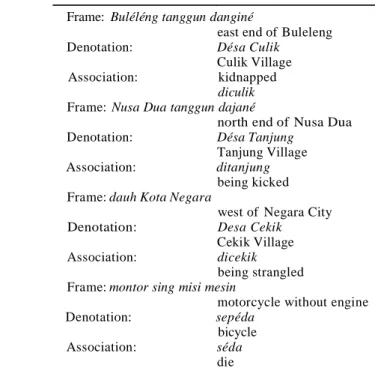
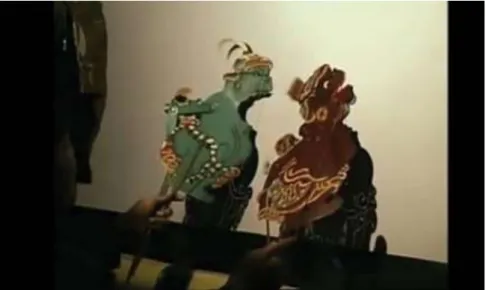
is often used to show off their wit and humour. These two puppets are shown in Figures 4.2 and 4.3; the first is pictured from the audience’s point of view in front of the shadow screen on which the puppets appear, and the second reveals the scene behind the screen showing the hands of the puppeteer con- trolling the two puppets.4 The dialogue in Table 4.1 is shown with numbers attached in bold to individual words to indicate the presence of bladbadan and corresponding to their analyses in Table 4.2 There are four bladbadan in this short excerpt in Table 4.1. They all play on names of places and objects, as is described in the list of elements provided in Table 4.2 and discussed below.
The main narrative of this extract is that Rama will be diculik (kidnapped) by Alengka troops, then ditanjung (kicked), then dicekik (strangled) until he is séda (dead). These four verbs of violent action are expressed using the bladbadan construction, causing laughter in the audience at the incongru- ity between the seriousness of the threatened action and the playful way
72 Nengah Arnawa
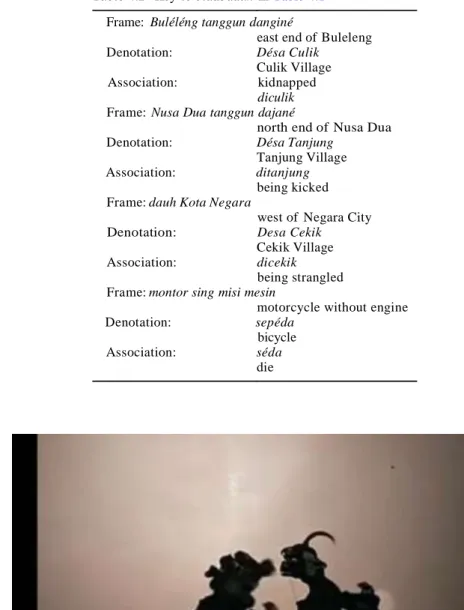
Table 4.2 Key to bladbadan in Table 4.1 1. Frame: Buléléng tanggun danginé
east end of Buleleng
Denotation: Désa Culik
Culik Village
Association: kidnapped
diculik
2. Frame: Nusa Dua tanggun dajané
north end of Nusa Dua
Denotation: Désa Tanjung
Tanjung Village
Association: ditanjung
being kicked
3. Frame: dauh Kota Negara
west of Negara City
Denotation: Desa Cekik
Cekik Village
Association: dicekik
being strangled 4. Frame: montor sing misi mesin
motorcycle without engine
Denotation: sepéda
bicycle
Association: séda
die
Figure 4.2 Délem (on the left) and Sangut, two of the many punakawan or clown characters in traditional wayang kulit, as they appear on the shadow screen for an audience.
Source: Photography by Nengah Arnawa at a live performance in Bali in 2019.
Traditional forms of Balinese humour 73
Figure 4.3 The punakawan characters, Sangut (on the left) and Délem as they appear from behind the shadow screen. Note the hands of the puppeteer as he cleverly manipulates the puppets with their detailed colouring.
Source: Photography by Nengah Arnawa at a live performance in Bali by the puppeteer, Cenk Blonk, in 2019.
in which the words are arrived at. The verb diculik (abducted) is introduced by the phrase Buléléng tanggun danginé (the east end of Buleleng). At the east of Buleleng is Culik Village. The name Culik is then transposed into the verb diculik (abducted), resulting in a construction of Bladbadan 1. The verb ditanjung (kicked) is similarly introduced with a location phrase, Nusa Dua tanggun dajané (the north end of Nusa Dua). At the north end of Nusa Dua is Tanjung village whose name is interpreted as the verb-form ditanjung (kicked) to produce Bladbadan 2. The verb dicekik (strangled) is expressed via another location phrase, dauh Kota Negara (west of Negara town). Here is Cekik village whose name of Cekik is interpreted as the verb-form dicekik (stran- gled), arriving at Bladbadan 3. Finally, the word séda (dies) is expressed via the phrase montor sing misi mesin (motorcycle without engine) which has the denotative meaning of sepéda (bicycle). Such a noun can be used as a basis to arrive at séda (to die) because of their rhyming similarity in this Bladbadan 4.
Given the quite serious narrative content of the extract above, the four bladbadan used in it introduce a number of humorous elements. As noted above, the speakers are two stereotypical clowns who invite the audience to laugh at them, creating elements of both superiority and incongruity. They themselves try to laugh at Rama, the princely character whose predicament is being talked about, by looking down on him and using him as the subject of a quick-fire question and answer session. Additionally, Bladbadan 1–4 all use clever word-play and manipulation of logic to prevent the concept of
74 Nengah Arnawa
Rama’s abduction and death from being taken too seriously. Instead, they direct the audience’s attention to the interplay of rhyming congruence and apparent incongruity as they set up the logic of their associative meanings.
Despite the strong implementation of superiority in the four examples above, not all bladbadan are developed using that theory, as is shown by the following examples taken from a printed collection (Srawana 1978: 34).
Example 5.
Apang paturu malawar gerang, paturu cager (literally, so that both are scarred, dried anchovies, just as faithful i.e., So that both are as faithful as dried anchovies sticking to each other).
Example 6.
Yen ane luh luas, da ja mara madamar di langit, bulanan, kadong kone onggol-onggol cina malakar kedelé, tahunan, apang ane muani nu satia (literally, if women travel for lights in the sky, let alone for months, although Chinese onggol-onggol is from soybeans, for many years the male will remain faithful, i.e., if the wife is away for months or years, the husband will remain faithful).
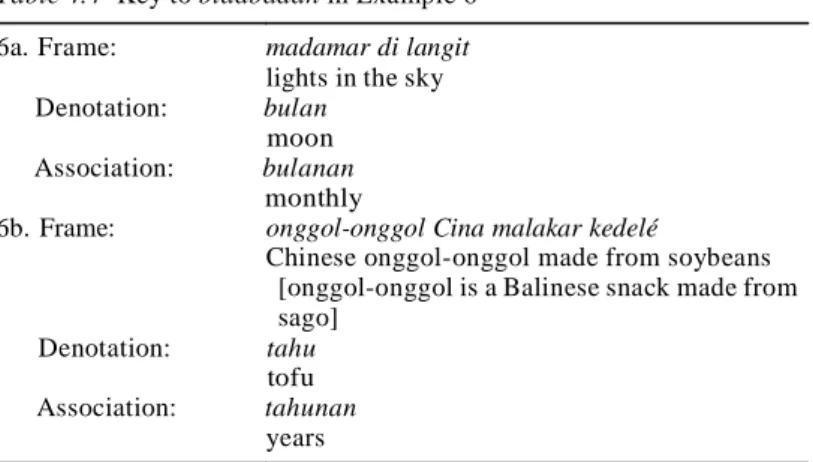
The bladbadan in Example 5 can be described in Table 4.3 and Example 6 contains two bladbadan (6a and 6b), described in Table 4.4.
Table 4.3 Key to bladbadan in Example 5 5. Frame: malawar gerang
making lawar from dried anchovies (lawar is a traditional Balinese dish made with coconut) Denotation: sager
a dish of dried anchovy with coconut seasoning Association: cager
faithful
Table 4.4 Key to bladbadan in Example 6 6a. Frame: madamar di langit
lights in the sky Denotation: bulan
moon Association: bulanan
monthly
6b. Frame: onggol-onggol Cina malakar kedelé
Chinese onggol-onggol made from soybeans [onggol-onggol is a Balinese snack made from sago]
Denotation: tahu tofu Association: tahunan
years
Traditional forms of Balinese humour 75 The purpose in using Bladbadan 5 and 6 is for people to remind each other to remain cager (trustworthy enough to maintain their faithfulness), even if they travel or part ways for bulanan (many months) or even tahunan (many years). In Bladbadan 5, malawar gerang, the adjective cager is expressed through the denotative meaning sager (i.e., lawar made from dried ancho- vies). Because of the rhyming similarity, the noun sager is interpreted as the adjective cager (trustworthy enough to maintain faithfulness). In Example 6a, the adverb bulanan (for many months) is expressed in the bladbadan mad- amar di langit (lights in the sky), for which the denotative meaning is bulan (the moon), associated with bulanan (for many months). The same semantic process occurs in Example 6b, where the adverb tahunan (for many years) is expressed through the bladbadan ongol-ongol Cina malakar kedelé with its denotative meaning of tahu (tofu i.e., made from soybeans) which is then associated with tahunan (for many years).
Paying due observance to equality of relations between the speech partic- ipants, using any of these three bladbadan is an effort to reduce the serious- ness or formality of speech so that the atmosphere becomes more relaxed and less tense. On this basis, using bladbadan such as Examples 5 and 6, is a form of coping humour which is an application of the relief theory of humour. Thus, both in structure and use, bladbadan humour does not rest on only one particular humour theory.
Wewangsalan
Morphologically, wewangsalan derives from the root word wangsal (ward), which lexically means arena (Ginarsa 2009). In ancient times, the arena (or ward) was often used as a gathering place for Balinese people to chat. From the word wangsal, the word wewangsalan is formed through the morpholog- ical process of dwipura (reduplication of the front part of the word) and the addition of the suffix {-an}. The word is interpreted as an expression making fun of someone and pragmatically, wewangsalan are often used to mock or insult someone (Aridawati 2014). Ridicule or satire expressed through the construction of humour helps avoid tensions in social relationships and is found in most human societies, although some (like Japan) have stringent rules about when and where it can be appropriately used. In the Balinese data collected, wewangsalan occurred very frequently. In its pragmatic aspect, this witty humour is based on the relief of tension theory of humour, although it also employs superiority theory. The structure of wewangsalan is identical to that of traditional Balinese poetry consisting of only two lines, consisting of one line called sampiran and a second containing the meaning, with straight- forward poetical rhyme between the two, AA (Pusat Bahasa 2001). The fol- lowing examples from Simpen (1980: 28) illustrate these qualities:
Example 1.
Asep menyan majegau; Myrrh, incense, agarwood [all tree-names];
nekep lengar aji kau covering baldness with a coconut shell
76 Nengah Arnawa
Table 4.5 Rhyming in Wewangsalan 1 and 2 1. asep → nekep end rhymes /e/ plus /p/
majegau → kau rhymes at end with diphthong /au/
consonants /g/ and /k/ are sounds produced by the same articulation 2. buangit → lengit rhymes at end with the syllable—ngit
kaligangsa → gasa rhymes at end with the syllable—sa
Example 2.
Buangit kaligangsa; Buangit [tree-name], kaligangsa [tree-name];
magaé lengit ngamah gasa work lazily, eat strongly
The first line of each wewangsalan is the sampiran which is generally more concerned with form than meaning: even its morpho-syntactic aspects are often neglected. The focus of sampiran is on the aspect of rhyme which will be used as a basis for giving meaning. The second line gives the interpre- tive meaning of each wewangsalan which rests on its rhymes with the first line. Semantically, the concept of meaning based on resonance applies to wewangsalan. Thus, the interpretation of its meaning rests on a phonetic device and it is this phonetic-semantic likeness that triggers laughter.
Wewangsalan 1 makes fun of people with sirah lengar (bald heads). For the Balinese, sirah lengar is identified with the coconut shell and covering a bald head with a coconut shell is considered completely futile work: it may hide the ugliness but it still looks bad. Wewangsalan 2 is used to make fun of those people who are lazy about work but still have strong appetites for eating. The entailment of both wewangslan rests on the following types of rhymes as shown in Table 4.5. Based on such rhymes, wewangsalan asep menyan majegau is interpreted by its audience as nekep lengar aji kau (cover the bald with coconut shells) and wewangsalan buangit kaligangsa as magaé lengit ngamah gasa (lazy to work, [but] so strong).
While in cecimpedan, humour arises because of a contradictory inter- nal logical structure, and in bladbadan as we have seen it emerges from a broader context of use, in wewangsalan, it stems from the relation between sampiran and a meaning that rests on rhyme. Rhyme in wewangsalan can be formed through the processes of assonance and/or alliteration. Assonance is rhyme caused by the repetition of vowels, while alliteration repeats con- sonants (Kridalaksana 1993): both are used in the following Examples 3 and 4 (from Simpen 1980: 29).
Example 3.
Délem Sangut Merdah Tualén Délem, Sangut, Merdah, Tualén [four Balinese punakawan puppets]
medem bangun ngamah dogén sleep and awake, always eating