Ceramics
2
This Time
Ceramics
Glass Processing
Powder Processing: Ceramics and Metals
Homework #5 on Thursday (2/25/10)
Ceramics
General properties
Hard
High wear resistance
Brittle
High compressive strength
High elastic modulus
High temperature resistance
Good creep resistance
Low conductivity
Low thermal expansion
Good chemical inertness
Glasses Clay products
Refractories Abrasives Cements Advanced ceramics
-optical -composite reinforce -containers/
-household
-whiteware -bricks
-bricks for high T
(furnaces)
-sandpaper -cutting
-polishing
-composites
-structural engine -rotors -valves -bearings -sensors
Ceramics: Classification
Al2O3-SiO2
Si3N4 ZrO2 SiC
BN
Al2O3 AlN WC
Diamond ZrO2
Al2O3
Common Ceramics
Oxides: Al2O3, ZrO2
Nitrides: AlN, Si3N4, BN, TiN
Carbides: WC, SiC, TiC, TaC
Glasses: SiO2 + others
Carbon: Graphite, Diamond
Processed as powders
15m
sinter
Whiteware Ceramics
Clay
Quartz
Feldspar
Processing
Water addition, mixing
Air removal
Shaping
Drying
Coating
Firing
Products
Brick
Structural Tile
Drain / sewer pipe
Decorative applications
Bath / kitchen structures
7
Refractory Material
Retain properties at high temperature
Mechanical
Chemical
Products
Fire brick
Insulating fibers
Refractory linings
Coatings
Silica
Alumina
Magnesium Oxide
8
Abrasives
High hardness
Examples
Silicon carbide
Aluminum oxide
Cubic boron nitride
Roughing Applications
Grinding
Cutting
Water-jet
Sawing
Coatings
Super-Finishing
Honing
Lapping
9
Glasses
Amorphous solid
Vitreous (noncrystalline) structure
Amorphous
Cooled to semi-solid condition without crystallization
Subject to creep
Silica Glass
Optical properties
Thermal stability
Products
Window glass
Fiber optics
Chemical containers
Lenses
10
Glass Ceramics
Crystalline solid
0.1 to 1.0 micron grains
Use of nucleating agents
Glass Ceramic
Efficient processing in glassy state
Net shape process
Good mechanical properties versus glass
Low porosity
Low thermal expansion
Higher resistance to thermal shock
Products
Cookware
Heat exchangers
Missile radomes
11
Cermets
Combination of metals & ceramics
“Cemented” carbides
Bound with high temperature metal
Properties
High hardness
High temperature resistance
Improved toughness
Improved strength
Improved shock resistance
Applications
Crucibles
Jet nozzles
High temperature brakes
Production
Press powder in metal mold
Sintering in controlled atmosphere
WC-Co
GLASS
13
Shaping Methods for Glass
Methods for shaping glass are different from those used for traditional and new ceramics
Glassworking: principal starting material is silica
Usually combined with other oxide ceramics that form glasses
Heated to transform it from a hard solid into a viscous liquid; it is then shaped into the desired geometry while in this fluid condition
When cooled and hard, the material remains in the amorphous state rather than crystallizing
14
The typical process sequence in glassworking:
(1) preparation of raw materials and melting,
(2) shaping, and
(3) heat treatment
Glassworking Processes
Piece Ware
Flat and Tubular Glass
Glass Fibers
15
16
Piece Ware Shaping Processes
Spinning – similar to centrifugal casting
Pressing – for mass production of flat products such as dishes, bake ware, and TV faceplates
Blow forming – for production of smaller-mouth containers such as beverage bottles and
incandescent light bulbs
Casting – for large items such as large
astronomical lenses that must cool very slowly to avoid cracking
17
Spinning of funnel shaped glass parts such as back sections of ‑ cathode ray tubes for TVs and computer monitors:
(1) gob of glass dropped into mold; and
(2) rotation of mold to spread molten glass on mold surface
Spinning
18
Pressing of flat glass pieces: (1) glass gob is fed into mold from furnace; (2) pressing into shape by plunger; and (3) plunger is retracted and finished product is removed (symbols v and F indicate motion (velocity) and applied force)
Pressing
19
Blow forming sequence: (1) gob is fed into inverted mold cavity; (2) mold is covered; (3) first blowing step; (4) partially formed piece is reoriented and transferred to second blow mold, and (5) blown to final shape
Blow Forming
20
Casting
A low viscosity glass can be poured into a mold
Uses: massive objects, such as astronomical lenses and mirrors
After cooling and solidifying, the piece must be finished by lapping and polishing
Casting of glass is not often used except for special jobs
Smaller lenses are usually made by pressing
21
Starting glass from melting furnace is squeezed through opposing rolls whose gap determines sheet thickness, followed by grinding/ polishing
Rolling
22
Molten glass flows onto the surface of a molten tin bath, where it spreads evenly, into a
uniform thickness and smoothness - no grinding or polishing is needed
Float Process
23
Forming of Glass Fibers
Products can be divided into 2 categories:
1. Discontinuous fibrous glass for insulation and air filtration, in which the fibers are in a
random, wool like condition‑
Produced by centrifugal spraying
2. Long continuous filaments suitable for fiber reinforced plastics, yarns, fabrics, and fiber optics
Produced by drawing
24
Continuous glass fibers of small diameter are produced by
pulling strands of molten glass
through small orifices in a heated plate made of a
platinum alloy
Drawing
25
Heat Treatment
Annealing to eliminate stresses from temperature gradients
Annealing temperatures are around 500C followed by slow cooling
Tempering to make the glass more resistant to scratching and breaking due to compressive stresses on its surfaces
Heating to a temperature above annealing, followed by quenching of surfaces by air jets
26
Finishing Operations
Glass sheets often must be ground and
polished to remove surface defects and scratch marks and to make opposite sides parallel
Decorative and surface processes performed on certain glassware products include:
Mechanical cutting and polishing operations; and sandblasting
Chemical etching (with hydrofluoric acid, often in combination with other chemicals)
Coating (e.g., coating of plate glass with aluminum or silver to produce mirrors)
Figure 16.1 A collection of powder metallurgy parts (photo courtesy of Dorst America, Inc.).
Powder Processing Parts
27
Powder Processing
1. The Characterization of Engineering Powders
2. Production of Metallic Powders
3. Conventional Pressing and Sintering
28
Powder Metallurgy (PM)
Metal processing technology in which parts are produced from metallic powders
Usual PM production sequence:
1. Pressing - powders are compressed into desired shape to produce green compact
Accomplished in press using punch-and-die tooling designed for the part
2. Sintering – green compacts are heated to bond the particles into a hard, rigid mass
Performed at temperatures below the melting point of the metal
29
Why Powder Metallurgy is Important
PM parts can be mass produced to net shape or near net shape, eliminating or reducing the need for subsequent machining
PM process wastes very little material - ~ 97%
of starting powders are converted to product
PM parts can be made with a specified level of porosity, to produce porous metal parts
Examples: filters, oil impregnated bearings and ‑ gears
30
More Reasons Why PM is Important
Certain metals that are difficult to fabricate by other methods can be shaped by powder metallurgy
Tungsten filaments for incandescent lamp bulbs are made by PM
Certain alloy combinations and cermets made by PM cannot be produced in other ways
Non-equilibrium microstructures possible
PM compares favorably to most casting processes in dimensional control
PM production methods can be automated for economical production
31
Engineering Powders
A powder can be defined as a finely divided particulate solid
Engineering powders include metals and ceramics
Geometric features of engineering powders:
Particle size and distribution
Particle shape and internal structure
Surface area
32
Measuring Particle Size
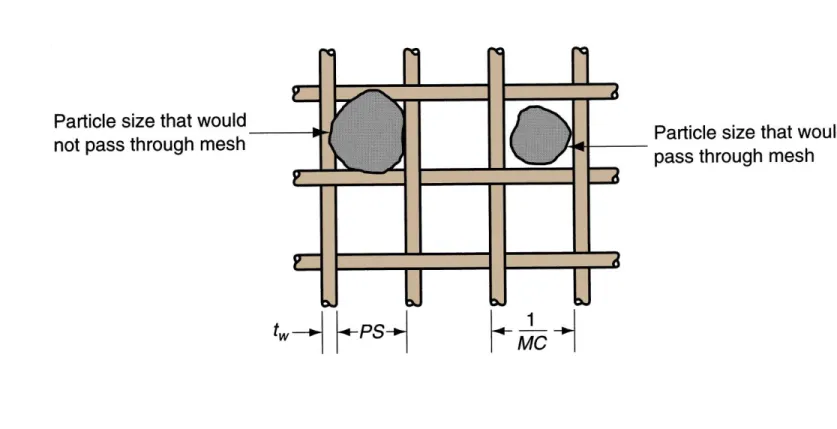
Most common method uses screens of different mesh sizes
Mesh count - refers to the number of openings per linear inch of screen
A mesh count of 200 means there are 200 openings per linear inch
Since the mesh is square, the count is equal in both directions, and the total number of openings per
square inch is 2002 = 40,000
Higher mesh count = smaller particle size
33
Screen Mesh
Figure 16.2 Screen mesh for sorting particle sizes.
34
Particle Shapes in PM
Figure 16.3 Several of the possible (ideal) particle shapes in powder metallurgy.
35
Observations
Smaller particle sizes generally show greater friction and steeper angles
Spherical shapes have the lowest interpartical friction
As shape deviates from spherical, friction between particles tends to increase
Easier flow of particles correlates with lower interparticle friction
Lubricants are often added to powders to reduce
interparticle friction and facilitate flow during pressing 36
Particle Density Measures
True density - density of the true volume of the material
The density of the material if the powders were melted into a solid mass
Bulk density - density of the powders in the loose state after pouring
Because of pores between particles, bulk density is less than true density
37
Packing Factor
Bulk density divided by true density
Typical values for loose powders range between 0.5 and 0.7
If powders of various sizes are present, smaller
powders will fit into spaces between larger ones, thus higher packing factor
Packing can be increased by vibrating the powders, causing them to settle more tightly
Pressure applied during compaction greatly increases packing of powders through rearrangement and
deformation of particles
38
Porosity
Ratio of volume of the pores (empty spaces) in the powder to the bulk volume
In principle
Porosity + Packing factor = 1.0
The issue is complicated by possible existence of closed pores in some of the particles
If internal pore volumes are included in above porosity, then equation is exact
39
Chemistry and Surface Films
Metallic powders are classified as either
Elemental - consisting of a pure metal
Pre-alloyed - each particle is an alloy
Possible surface films include oxides, silica, adsorbed organic materials, and moisture
As a general rule, these films must be removed prior to shape processing
40
Production of Metallic Powders
In general, producers of metallic powders are not the same companies as those that make PM parts
Any metal can be made into powder form
Three principal methods by which metallic powders are commercially produced
1. Atomization 2. Chemical 3. Electrolytic
In addition, mechanical methods are
occasionally used to reduce powder sizes
41
Coventional PM Sequence
Figure 16.7 Conventional powder metallurgy production sequence:
(1) blending, (2) compacting, and (3) sintering; (a) shows the condition of the particles while (b) shows the operation and/or workpart during the sequence.
42
Blending and Mixing of Powders
For successful results in compaction and sintering, the starting powders must be homogenized
Blending - powders of same chemistry but possibly different particle sizes are
intermingled
Different particle sizes are often blended to reduce porosity
Mixing - powders of different elements/alloys are combined
43
Compaction
Application of high pressure to the powders to form them into the required shape
Conventional compaction method is pressing, in which opposing punches squeeze the powders contained in a die
The workpart after pressing is called a green compact, the word green meaning not yet fully processed
The green strength of the part when pressed is
adequate for handling but far less than after sintering
44
Conventional Pressing in PM
Figure 16.9 Pressing in PM: (1) filling die cavity with powder by
automatic feeder; (2) initial and (3) final
positions of upper and lower punches during pressing, (4) part
ejection.
Press for Conventional Pressing in PM
Figure 16.11 A 450 kN (50 ton) hydraulic press ‑ for compaction of PM parts (photo courtesy of Dorst America, Inc.).
46
Sintering
Heat treatment to bond the metallic particles, thereby increasing strength and hardness
Usually carried out at between 70% and 90%
of the metal's melting point (absolute scale)
Generally agreed among researchers that the primary driving force for sintering is reduction of surface energy
Part shrinkage occurs during sintering due to pore size reduction
47
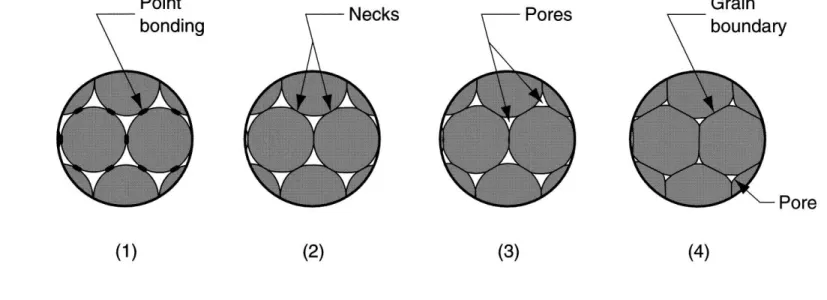
Sintering Sequence
Figure 16.12 Sintering on a microscopic scale: (1) particle bonding is initiated at contact points; (2) contact points grow into "necks"; (3) the pores between particles are reduced in size; and (4) grain
boundaries develop between particles in place of the necked regions.
48
Sintering Cycle and Furnace
Figure 16.13 (a) Typical heat treatment cycle in sintering; and (b) schematic cross section of a continuous sintering furnace.
Limitations and Disadvantages
High costs
High tooling and equipment costs
Metallic powders are expensive
Typically requires a unique material or geometry to justify
Problems in storing and handling metal powders
Degradation over time, fire hazards with certain metals
Limitations on part geometry because metal powders do not readily flow laterally in the die during pressing
This is true for traditional punch and die
Variations in density throughout part may lead to yield issues especially for complex geometries
50
Interparticle Friction and Powder Flow
Friction between particles affects ability of a powder to flow readily and pack tightly
A common test of interparticle friction is the
angle of repose, which is the angle formed by a pile of powders as they are poured from a
narrow funnel
51
Angle of Repose
Figure 16.4 Interparticle friction as indicated by the angle of repose of a pile of powders poured from a narrow funnel. Larger angles indicate greater interparticle friction.
52
Powder Injection Molding
53
shape
flow
dry/
debind
sinter (firing)
powder final
CERAMICS
54
55
(a) shows the workpart during the sequence, while (b) shows the condition of the powders
Ceramics Processing
56
Slip Casting
A suspension of ceramic powders in water,
called a slip, is poured into a porous plaster of paris mold where the water from the mix is absorbed to form a firm layer of clay
The slip composition is 25% to 40% water
Two principal variations:
Drain casting - the mold is inverted to drain excess slip after a semi solid layer has been formed, thus ‑ producing a hollow product
Solid casting - to produce solid products, mold not drained
57
Sequence of steps in drain casting, a form of slip casting:
(1) slip is poured into mold cavity, (2) water is absorbed into plaster mold to form a firm layer, (3) excess slip is poured out, and (4) part is removed from mold and
trimmed
58
SLIP CASTING
59
Tape Casting
Polyester Film Carrier
Slip Dried Tape
Doctor Blade
Polyester Film Roll
Fabrication process for thin ceramic sheets
60
Miniaturization of Complex Circuits
High Temperature Co-Fired Ceramic (HTCC)
Low Temperature Co-Fired Ceramic (LTCC)
Thick film metal traces are printed on several tape layers of ceramic and are co-fired
Tape layers are electrically connected through vias
Significant miniaturization of circuit form factor with this technology
61
Extrusion
Compression of clay through a die orifice to produce long sections of uniform
cross section‑
Products: hollow bricks, shaped tiles, drain pipes, tubes, drill bit blanks, and insulators
62
Extruder Sectional View
Components and features of a (single screw) extruder for ‑ plastics and elastomers
63
Ceramic Extrusion: Examples
cordierite
catalytic converter
50 cells/cm2
64
Powder Injection Molding (PIM)
Ceramic particles are mixed with a
thermoplastic polymer, then heated and
injected into a mold cavity. Polymer provides flow characteristics for molding
Mold-Filling Interactions
65
Air trap Weld-line
Short shot
Flashing Filler-
polymer separatio n
Jetting
Die Pressing
66
Semi-Dry Pressing
67
Semi dry pressing: (1) depositing moist powder into die cavity, (2) ‑ pressing, and (3) opening the die sections and ejection
Joining
68
Next Time
Chapter 30 & 31