The Implications of Legislative Controls on Private Hospitals in Malaysia
Lee, Kwee-Henga, Raja Noriza Raja Ariffinb, Nik Rosnah Wan Abdullahc Abstract: The emergence of proprietary private hospitals in the 1980s has led to a rise in cost of health care services, variation in care and increase in adverse events. These have contributed to societal concerns prompting the authorities to enforce Private Healthcare Facilities and Services Act 1998 (Act 586) that regulates all private hospitals nationwide in 2006. Employing a case study approach, this paper discusses some salient themes on the impact of Act 586 on 15 purposively selected private hospitals in the Klang Valley in terms of achieving the national objectives of accessibility, equity and quality care. This study reveals several interrelated themes such as of policy, power, governance, compliance, and quality of care in achieving the national objective. Findings point to high investment of the state in private hospitals.
Although a private hospital is stipulated to be a physician-led institution, in reality the majority of these hospitals are owned by government-linked corporations. Many private hospitals face major challenges in terms of compliance with the new regulations meant to improve patient safety and quality of care. However, full compliance to the regulations remains an insurmountable challenge as the private providers are influential. Faced with political constraints, asymmetric information and inadequate human resources, the regulatory authority seems hampered in its enforcement capacity.
Keywords: Healthcare Regulation, Private Hospitals, Quality Care, Malaysia
JEL classifications: I 15, I 18, I 19
Article Received: 26 May 2017; Article Accepted: 08 March 2018 1. Introduction
Healthcare market reforms have taken a centre stage in international discourse over the last few decades. Following the calls in the 1980s for less state involvement in the market and the expansion of the private sector, countries around the world are reassessing their service provision roles in the health sector and introducing new regulatory interventions (World Bank, 1987; 1993; WHO, 2000). The role of government in financing and
aDepartment of Administrative Studies and Politics, Faculty of Economics and Administration, University of Malaya. Email: [email protected]
b Corresponding author. Department of Administrative Studies and Politics, Faculty of Economics and Administration, University of Malaya. Email: [email protected]
c Tun Abdul Razak School of Government, Universiti Tun Abdul Razak. Email:
provision of healthcare however remains unchallenged (Saltman & Busse, 2002; Chee and Barraclough, 2007). Despite entrepreneurialism and market reforms in the European healthcare system, there is evidence of concurrent imposition of state regulations to contain escalating cost without compromising on quality of care (Saltman, 1997; Saltman and Figueras, 1997). In contrast, many developing countries have embraced privatisation as part of their economic liberation policies but relatively little is known about how these governments perform their regulatory functions (Hongoros
& Kumaranayake, 2000; Bloom and Standing, 2001). Likewise, Soderlund and Tangcharoensathein (2000) note that in most countries, “paper”
regulations in the form of legislative efforts have been made to regulate private healthcare provision but often with insufficient impetus to implement these regulations at the point of delivery. Besides, the form of regulation is often similar among the countries in spite of divergent health sectors (Soderlund & Tangcharoensathein, 2000; Nik Rosnah, 2002; 2005).
Malaysia embarked on a nationwide privatisation policy in the 1980s which also targeted the health sector, albeit controversies surrounding its gross lack of transparency (Jomo, 1995; Gomez, 1995; Tan, 2008; Rasiah et al., 2009; Lee et al., 2011; Jomo and Wee, 2014). With the state’s encouragement through fiscal policy, fee-for-service private hospitals mushroomed under a loosely regulated framework. The Private Hospitals Act 1971, the governing legal framework for the health sector, did not have any control nor was able to fully regulate the exponential growth of these proprietary private hospitals (Chee and Barraclough, 2007; Nik Rosnah and Lee, 2011; Lee et al., 2017). This unprecedented and unrestrained growth led to issues related to accessibility, equity and quality of care in the healthcare system. The prohibitive private medical care costs, inequitable distribution of resources, and variation in standards of care continued to plague the healthcare sector (Nik Rosnah & Lee, 2011; MOH, 2011; Lee et al., 2017).
In addition, private hospitals have also been reported to employ unregistered healthcare professionals including bogus doctors and which gave rise to grave public health concerns. Furthermore, there was a steady increase in media reports of adverse events, negligence and medico- litigations affecting private hospitals. Examples include denying use emergency services due to financial reasons or non-availability of such services in the private hospitals (Nik Rosnah & Lee, 2011; Lee et al., 2017).
These are major concerns to policy-makers. The government has outlined in the Seventh Malaysia Plan (1996-2000) that it “will gradually reduce its role in the provision of health services and increase its regulatory and enforcement functions” (Malaysia, 1996: 544). The Malaysia Plan is a national five-year social-economic development blueprint that was
introduced after independence. It culminated in the implementation of the historical 2006 Private Healthcare Facilities and Services Act 1998 (Act 586) to regulate all private hospitals (Malaysia, 1998; 2006) except cosmetology to achieve the intended objectives of accessibility, equity and quality care (Abu Bakar Sulaiman, 2006; Ng, 2006; Sirajoon & Yazad, 2008; Nik Rosnah & Lee, 2011; MOH 2011; Lee et al., 2017).
Against this background, the paper attempts to discuss the impact of Act 586 on the performance of private hospitals. It begins with an introduction followed by literature review on the conceptual and theoretical aspects of regulations with specific reference to the healthcare sector. The subsequent section describes the salient features of the Malaysian healthcare system in the pre and post privatisation era with the promotion of corporate private hospitals under a loose regulatory framework. Research methodology is outlined in the next section followed by a discussion of empirical findings on several emergent themes and their policy implications. The final part presents the conclusion of the study by summing up answers to the research questions and relevant recommendations.
2. Theoretical Consideration
Healthcare is complex and unique. It is characterised by uncertainty and an inelastic demand (Arrow, 1963; Folland et al., 2013). As a social good, the provision of healthcare is expected to reach all level of population based on their needs and not on the affordability to pay (WHO, 2000).
Notwithstanding, the market in healthcare is inevitably plagued with failure (Arrow, 1963; Bennett and Tangcharoensathien, 1994). The problem of information imperfection is particularly serious in healthcare especially the asymmetries between less informed patients and the better-informed healthcare providers (Arrow, 1963; Folland et al., 2013). Invariably, most patients have difficulties in gauging the standard of appropriate care and services provided. Studies reveal that healthcare providers tend to exploit their less informed patients with opportunistic practices of unnecessary high transaction costs for their own self-interests (Nguyen, 2011; Morris et al., 2012). This unequal relationship underpins the principal-agency theory where one party depends on the other and often both parties have divergent objectives (Folland et al., 2013). Similarly, the relationship between the state and the private health provider as the regulatory agent further exemplifies the principal-agent relation (Morris et al. 2012). While the state aims toward an equitable access to quality healthcare services, the private sector is often motivated by profit and is represents influential interest groups (Wale and Boyd, 2007). Hence, public policy of state regulatory intervention is seen as a prerequisite in minimising the undesirable
consequences as a result of the commercialisation of the private health sector (Bhat, 1996; Bloom, 2000).
Besides social and economic objectives, public policy on regulation in health sector more specifically addresses critical issues and among others, the performance improvement and governance in the organisational structure (Saltman & Busse, 2002; Leatherman and Sutherland, 2007).
Invariably, organisational structure issues include the setting of minimum standards for patient safety and equitable access to quality care such as the requirement for approval, licensing, and accountability of healthcare providers. In addition, these issues include cost containment and the dissemination of information on quality of care. Besides, the promulgation of healthcare regulation is to protect against the overemphasis on financial returns at the expense of patients’ well-being (Epstein, 1998; Simchen et al., 1998; Saltman and Busse, 2002).
Increasingly over the years, there is much concern over the impact of regulation on for-profit healthcare providers where the phenomenon of state regulatory capture is inevitable. The state authority is perceived to be the weakest in terms of authority, supervision and enforcement capacity (Wale & Boyd, 2007; Laffont & Martimort, 2009). In this context, an important approach to assess the impact of the regulation is to examine and
“enumerate the intended and unintended effects of regulation in terms of their likely positive or negative effects on organizational performance or behaviour” (Wale & Boyd, 2007, 30). Consequently, the state is now expected to “row less and steer more” in its role in driving the health sector (Saltman & Busse, 2002).
3. Malaysian Healthcare System
Malaysia has a dichotomous public and private healthcare system. Since independence in 1957 until 1980s, Malaysia had been a welfare-oriented state in the provision and financing of public healthcare (Chan, 2007; Chee
& Barraclough, 2007; Ramesh, 2007; Lee et al., 2017). The public health sector is predominantly under the Ministry of Health (MOH) which is highly subsidised through central taxation while the private health sector is based on fee-for-service and profit-driven. The out-of-pocket payment, employee medical benefits, and medical health insurance formed the bulk of the private health expenditure (Chee & Barraclough, 2007; Sirajoon &
Yazad, 2008; Chee & Por 2015).
In the early years after independence, the state was committed to providing universal access to primary healthcare with the expansion of network of integrated rural health clinics to cater for the majority of the population in the rural areas where poverty was prevalent, and it remains committed to this objective until now (Malaysia, 1986; Ramesh, 2007). In
the urban areas, public hospitals provide social safety nets to the large population with the prevailing Fees (Medical) Order 1982 of the Fee Act of 1951. Payment is minimal and free of charge for those unable to pay (Sirajoon & Yazad, 2008). Likewise, Safurah et al., (2013:44) argue that
“user fees for public provided services amount to about two to three percent of the MOH‘s actual expenditure”. The government’s success in public healthcare has been commendable based on some impressive and selective health indicators in spite of its low spending (Ng et al. 2014; Chan, 2014).
For instance, in 1997 Malaysia spent about 2.90% of GDP in the provision of health services (World Bank, 1999). Currently, the health expenditure to GDP is at 4.30% of GDP (MOH, 2014).
In the private health sector, the general practitioners played a significant role in the provision of primary care mostly in the urban areas. Adding plurality to this sector, there were a few charitable and non- profit private hospitals established by the early Chinese philanthropists and the Christian missionaries providing medical care for the poor. Subsequently, due to financial constraints these institutions began to cater for the affluent segment of the society to cross-subsidise costs for treatment of the poor (Chee & Barraclough, 2007; Rasiah et al., 2009). In addition, there were a few fee-for-service private hospitals owned by enterprising private medical practitioners in the urban areas. These commercialised medical institutions providing mostly curative care subsequently expanded rapidly either in joint-venture or acquired by corporate capitalists. However, the welfare- oriented role of the government came under critical scrutiny after it embarked on massive privatisation initiatives in the 1980s (Chan, 2007;
2014; Lee et al., 2011; Rasiah et al., 2011; Lee et al., 2017).
3.1 Growth of Government-linked Corporate Private Hospitals
The controversial privatisation policy in the 1980s witnessed three decades of proprietary private hospital expansion from 10 in 1980 to 128 in 2003 (Chee and Barraclough, 2007). Following mandatory licensing under the new legislation Act 586 in 2006, there were a total of 199 registered private hospitals (MOH, 2007). The majority of these private hospitals are owned by government-linked corporations (Chan, 2014). With the implementation of affirmative public policies, government-linked companies (GLC) owned and controlled most of the tertiary care private hospitals through mergers and acquisitions (Lee et al. 2011; Chan, 2013; 2014; Lee et al., 2017). In fact, the GLC-owned private hospitals account for more than 40% of the total private hospital beds in Malaysia (Chan, 2014).
A GLC is a company that has “primary commercial objective and in which the Malaysian government has a direct controlling stake, not just percentage ownership” (Chan, 2014, p.13). For instance, at the federal
level, Khazanah Nasional Berhad, the Malaysian government’s sovereign wealth fund, has controlling stake in Pantai Holdings, (a joint-venture corporation between local healthcare provider and Singapore’s healthcare provider Parkway Group) (Lee et al. 2011; Chan, 2013; 2014; Lee, 2017).
It has nine corporate private hospitals in Malaysia through Integrated Healthcare Holding (IHH).
In recent years, Khazanah is seen as a transnational investor with a new strategic shareholder Mitsui & Company Limited, a Japanese trading corporation owning 30 percent of the IHH with multiple geographical exposure via acquisitions. The IHH is now the biggest private healthcare provider in Asia and has subsequently acquired Turkey’s largest private hospital group Acibadem (Chan, 2014). Currently, IHH is reported to be the second largest public listed private healthcare provider in the world (Chan, 2014; Lee, 2017).
At the state level, the Johor government’s public listed conglomerate KPJ Healthcare Berhad (KPJ) has the largest chain of 26 private hospitals in the country and two private hospitals in Indonesia (Chan, 2014). In Melaka, the state government had also entered into joint ventures with Southern Medical Centre in Melaka and another in Batu Pahat, Johor.
Meanwhile, the Penang state government played supporting role with KPJ in the management of Bukit Mertajam Specialist Medical Centre and Bayan Baru Medical Centre (Chee & Barraclough, 2007).
In addition, the Terengganu government through its State Economic Development Corporation, which owned Kumpulan Mediiman Sdn.
Berhad, has three private secondary care hospitals under the group which include Kuantan Medical Centre, Darul Iman Medical, and Kelana Jaya Medical Centre (Nik Rosnah, 2002; 2005). In 2010, the state government acquired majority shareholding in IHeal Medical Centre located at a popular shopping mall in Kuala Lumpur (Lee, 2017). Sime Darby, another government linked corporation, owns the flagship of 3 tertiary care corporate private hospitals namely, Ramsay Sime Darby Medical Centre, Subang Jaya, Sime Darby Ara Damansara Medical Centre in Subang and the latest Park City Medical Centre in the affluent Desa Park City, Kepong, Kuala Lumpur (Lee, 2017). Likewise, the Employees Provident Fund has a strategic 30 percent stake in the Columbia-Asia Hospitals providing secondary care and facilities at 12 locations in the country.
Furthermore, Malaysia’s national petroleum corporation, Petronas owns the prestigious Prince Court Medical Centre in the heart of Kuala Lumpur.
This luxurious purpose-built 300 bedded international showpiece with multidisciplinary facility was commissioned in 2007 at an exorbitant cost of over RM 1.0 billion. It was initially managed by VAMED of Austria, an international healthcare management corporation in collaboration with the Medical University of Vienna. Prince Court Medical Centre’s vision is to
be the leading healthcare provider in Asia offering comprehensive medical care to the highest standards through world class facilities, innovative technology and excellent customer services (Lee, 2017).
It is argued that the active participation of the government as a corporate investor in the provision of private health care is in direct contradiction of its original role to ensure the welfare and social safety net for the lower income and marginalised groups (Barraclough, 1999; Chee and Barraclough, 2007; Rasiah et. al., 2009; 2011; Chan, 2013; 2014; Chee and Por, 2015). Further, this is also been seen to be in direct contradiction with its stated objectives under its Seventh Malaysia Plan that it would gradually reduce its role in the provision of healthcare services. Instead, it has increased its role in the regulatory provisions and enforcement functions (Malaysia, 1996; Chee and Barraclough, 2007). However, evidence of explicit regulatory and enforcement functions came only after the implementation of Act 586 in 2006 to regulate the private hospitals and all other private healthcare facilities and services (Nik Rosnah and Lee, 2011;
Lee et al., 2017).
Currently, there are 214 licensed private hospitals nationwide (MOH, 2014). Correspondingly, the private hospital beds increased significantly from 1,171 which accounted for 5.80 percent of the total hospital beds in 1980 to 14,033 registered beds or 26.10 percent of the total 53,761 official hospital beds in 2013 (MOH, 2014). Without doubt, the private health sector plays a significant role in the provision of healthcare services in the country. This health sector attracts 11,697 practising doctors which constitute approximately 24.93 percent of the total 46,916 registered doctors in the country. The existing ratio of doctor to population is at 1:
633 (MOH, 2014), and as Malaysia aspires to be a developed nation under the Vision 2020 the target ratio of doctor to population is set at 1: 400 (Malaysia, 2011).
4. Methodology
This study employs a qualitative approach by utilising case studies. This approach enables the assessment of the healthcare complexities and the exploration of how time shapes the regulatory development in the private health sector as argued by Walt et al., (2008) and Gilson (2014). Field studies for this research were done at two levels, the private hospitals and the regulatory body under the MOH based on the following research questions:
i) What is the impact of the Private Healthcare Facilities and Services Act 1998 [Act 586] and its Regulations 2006 on the private hospitals in Malaysia in terms of achieving the intended national objectives of
improving accessibility, correct the imbalances in standards and quality of care, and rationalising the medical charges to more affordable levels?
ii) What are the factors that influence the impact of the Act 586 on the private hospitals?
iii) How is the enforcement capacity of the MOH after the enforcement of Act 586 on private hospitals?
Primary data was gathered from interviews with key informants, focus group discussions, observations and personal communications to elicit opinion on the impact of Act 586 on the private hospitals and the enforcement capacity of the regulatory body. The study was conducted between 2010 and 2011 after seeking approval from the National Medical Research and Ethics Committee, MOH. However, this study excludes the clinical governance and audit in the private hospitals as it is not within the purview of Act 586.
4.1 Study Area and Hospitals
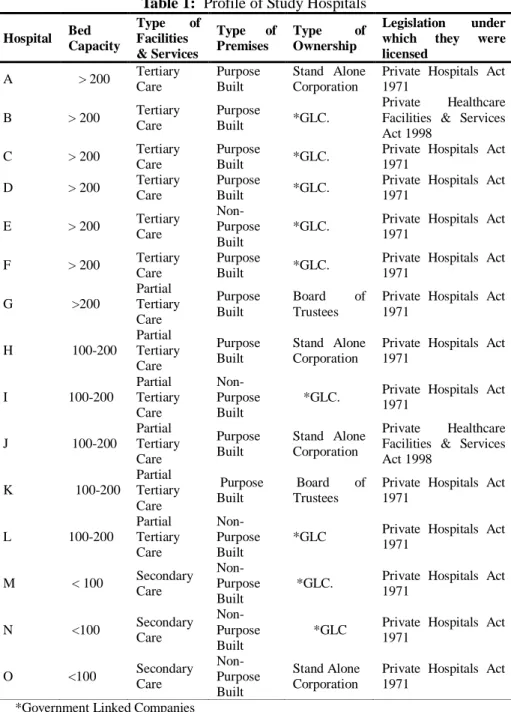
Creswell (2014) argues that the idea behind qualitative research is to purposively select participants or sites that will best help the researcher to understand the problem and answer the research questions. In this context, the Klang Valley (Selangor and Federal Territory of Kuala Lumpur) has been purposively selected for the study area which has the highest density of private hospitals in which 91 private hospitals are been located. These facilities constitute 44 percent of the total number of private hospitals licensed nationwide (MOH, 2008). Fifteen private hospitals have been selected for the study and represent a sampling frame of 7.18 percent of the total licensed private hospitals in 2008. In compliance with research protocols on confidentiality, these hospitals were identified and coded alphabetically. The profile of the hospitals is shown in Table 1.
Table 1: Profile of Study Hospitals Hospital Bed
Capacity
Type of Facilities
& Services
Type of Premises
Type of Ownership
Legislation under which they were licensed
A > 200 Tertiary Care
Purpose Built
Stand Alone Corporation
Private Hospitals Act 1971
B > 200 Tertiary Care
Purpose
Built *GLC.
Private Healthcare Facilities & Services Act 1998
C > 200 Tertiary Care
Purpose
Built *GLC. Private Hospitals Act 1971
D > 200 Tertiary Care
Purpose
Built *GLC. Private Hospitals Act 1971
E > 200 Tertiary Care
Non- Purpose Built
*GLC. Private Hospitals Act 1971
F > 200 Tertiary Care
Purpose
Built *GLC. Private Hospitals Act 1971
G >200
Partial Tertiary Care
Purpose Built
Board of Trustees
Private Hospitals Act 1971
H 100-200
Partial Tertiary Care
Purpose Built
Stand Alone Corporation
Private Hospitals Act 1971
I 100-200
Partial Tertiary Care
Non- Purpose Built
*GLC. Private Hospitals Act 1971
J 100-200
Partial Tertiary Care
Purpose Built
Stand Alone Corporation
Private Healthcare Facilities & Services Act 1998
K 100-200
Partial Tertiary Care
Purpose Built
Board of Trustees
Private Hospitals Act 1971
L 100-200
Partial Tertiary Care
Non- Purpose Built
*GLC Private Hospitals Act 1971
M < 100 Secondary Care
Non- Purpose Built
*GLC. Private Hospitals Act 1971
N <100 Secondary Care
Non- Purpose Built
*GLC Private Hospitals Act 1971
O <100 Secondary
Care
Non- Purpose Built
Stand Alone Corporation
Private Hospitals Act 1971
*Government Linked Companies Source: Lee, Kwee-Heng (2010).
4.2 Data Collection and Analysis
This study attempts to look at key stakeholders’ perceptions, as their rich experiences and expertise are useful in answering the research questions (Yin, 2012; Gilson, 2014). Interviews, focus group discussions and personal communications are important to understand the impacts of the new legislative controls on the private hospitals. Key informants were purposively selected from three categories (a) public health sector (b) private health sector, and (c) members of the professional bodies, universities, non-governmental organisations, media, patients and their relatives. The key informants from the private health sector comprise management executives, medical and nursing professionals from the study hospitals, private medical practitioners and the management staff from the medical health insurance companies. The public health sector respondents include past and present senior officials from the regulatory unit at the Private Division, and other Divisions in the MOH. Furthermore, officials of the enforcement unit from the Federal Territory of Kuala Lumpur Medical and Health Department were interviewed. Information gathered was validated from at least two different sources such as repeat interviews, personal communications or documented evidence. A total of 130 key informants (identified using a coding system) were interviewed for this study. However, their anonymity and confidentiality were maintained in the dissemination of findings for this study.
Secondary data was sourced from official publications such as annual reports, press statements from the MOH, World Health Organisation (WHO), and journal publications as well as from annual international healthcare conference organised by the Association of Private Hospitals of Malaysia (APHM) and healthcare seminars Mainstream media report and patients’ medical bills were gathered for the purpose of triangulation. Data collected were analysed and coded keeping in mind of research questions which had been established earlier in the research study. Several salient themes which are interrelated have emerged from this study.
5. Results 5.1 Policy issues
The empirical findings reveal significant impacts of Act 586 on the performance of private hospitals. The policy of mandatory approval and licensing of private hospitals under Act 586 is historical in addressing the national and societal interests in the provision of quality healthcare services. This prescriptive regulation stipulates explicitly the guidelines on the licensing of private hospital establishments to ensure the minimum
standards for patient safety, equitable access to quality of care and to rationalise the medical cost of care to more affordable levels. The mandatory licensing of a private hospital is valid for a period of two years, and hereafter it is subject to a renewal application, inspection and approval from the Director General of Health. The information gathered from key informants shows that no one is permitted to operate a private hospital without a licence with the enforcement of Act 586.
This study notes that the penalty of hefty fine and imprisonment upon conviction serves as a serious deterrence to unlicensed private hospitals where accessibility, patient’s rights and safety may be compromised. This finding also reveals that the health policy aims to improve accessibility and eradicate all illegal private healthcare establishments with unregistered healthcare professionals including bogus doctors, which may affect public health safety. The previous Private Hospitals Act 1971 which was the governing legislation, did not have provisions for the mandatory licensing and control leading to proliferation and inequitable distribution of private hospitals in the country.
5.1.1 The Accessibility and distribution of private and public hospitals.
One of the major concerns of policy makers in the formulation of Act 586 is to ensure equitable access to quality of care and services in the private hospitals. This finding indicates that out of 209 private hospitals licensed under Act 586 in 2008, the most developed states
1 of Selangor and Federal Territory of Kuala Lumpur have the highest number of private hospitals. These 91 private hospitals account for 43.54 percent of total licensed private hospitals which are located in the densely populated Klang Valley area as shown in Table 2.
1 The classification of most developed states and less developed states is based on the Development Composite Index 2005 as an indicator of level of development of each state under the N inth Malaysia Plan 2006-2010.
Table 2: Total Number of Approved Applications for License to Operate Private Hospitals in Malaysia as of 31st December 2008
State
Private
Hospitals Region
Private Hospitals
Count % Count %
Most Developed
Selangor 51 24.4
Peninsular Malaysia
193 92.34
WP* Kuala
Lumpur 40 19.14
P. Pinang 23 11
Kedah 11 5.26
Perak 15 7.18
Melaka 4 1.91
N. Sembilan 7 3.35
Johor 30 14.35
Sub-total 181 86.6
Less Developed
Kelantan 3 1.44
Pahang 8 3.83
Terengganu 1 0.48
Sabah 7 3.35
Sabah & Sarawak
16 7.66
Sarawak 9 4.31
Sub-total 28 13.4
Total 209 100 209 100
Note: WP*- Wilayah Persekutuan (Federal Territory).
Source: MOH (2008).
There are 15 public hospitals under the MOH and 2 teaching public hospitals under the Ministry of Education in the Klang Valley. These medical institutions serve a population of 6,700,500 which represents 24.17 percent of Malaysia’s population of 27,728,700 in 2008. Furthermore, this study indicates that 181 private hospitals (86.6 percent) are located in the most developed states of west Peninsular Malaysia. In addition, there are 65 public hospitals accounting for 48.87 percent of the total 133 public hospitals in the more developed states of Malaysia as shown in Table 3.
Table 3: Total Distribution of Public Hospitals under Ministry of Health and Population based on the various states in Malaysia as of 31st December
2008.
State
Public Hospitals
Region
Population (Thousand)
Count % Count %
Most Developed States
Selangor 11 8.27
Peninsular Malaysia
5,071.10 18.29
WP# Kuala Lumpur 4 3.01 1,629.40 5.88
Penang 6 4.51 1,546.80 5.58
Kedah 9 6.77 1,958.10 7.06
Perak 14 10.53 2,351.30 8.48
Perlis 2 1.5 236.2 0.85
Melaka 3 2.26 753.5 2.72
N. Sembilan 6 4.51 995.6 3.59
Johor 10 7.52 3,312.40 11.95
Sub-total 65 48.87 17,854.4
0 64.39
Less Developed States
Kelantan 9 6.77 1,595.00 5.75
Pahang 10 7.52 1,513.10 5.46
Terengganu 6 4.51 1,094.30 3.95
Sabah 22 16.54
Sabah & Sarawak
3,131.60 11.29
Sarawak 20 15.04 2,452.80 8.85
WP# Labuan 1 0.75 87.6 0.32
Sub-total 68 51.13 9874.4 35.61
Total 133 100 27,728.7
0 100
Note: WP#- Wilayah Persekutuan (Federal Territory).
Source: MOH (2008); Department of Statistics, Malaysia (2006); Ninth Malaysia Plan (2006).
The west coast states of peninsular Malaysia have a population of 17,854,400 or 64.39 percent of the total population (MOH, 2008). Every
state in Malaysia has a private hospital except for Perlis and Federal Territory of Labuan.
In contrast, the less developed states in Malaysia, namely Kelantan, Pahang and Terengganu in the east coast of Peninsular, and Sabah and Sarawak (Malaysia 2006), have 28 private hospitals (13.4 percent), serving a population of 9,874,400 people or 35.61 percent of the nation’s population. In comparison, there are also 68 public hospitals under MOH and one teaching hospital under Ministry of Education. Further breakdown of the figures indicates that the east coast states of Peninsula Malaysia (Kelantan, Terengganu and Pahang) have a total of 12 private hospitals (5.74 percent) with 25 public hospitals and one teaching public hospital serving a local population of 4,202,400 or 15.16 percent of the national population.
The findings indicate that 16 private hospitals (7.66 percent) are located in the less developed states of Sabah, Sarawak and Federal Territory of Labuan in east Malaysia. Besides, there are 43 public hospitals of which 29 hospitals are categorised as non-specialist serving a population of 5.67 million people. Conversely, 92.34 percent of the total licensed private hospitals providing specialist care are located in urban areas catering mostly for the affluent segment of the population in peninsular Malaysia.
Although the findings reveal there are more private hospitals, in reality, 78 percent of the hospital beds are in the public health sector and attending to 74 percent of the total 2.95 million inpatient admissions.
Notwithstanding the brain drain of health professionals to the private sector, the continuous effort of the government policies over the last few decades have successfully retained 60 percent of the total 25,102 registered doctors in 2008. These statistics clearly indicate that there is gross disparity of resources and inequitable geographical distribution of not only licensed private hospitals but also public hospitals as shown in tables 2 and 3. This is an obstacle to achieving national health objectives of accessibility, equity and quality care in Malaysia.
5.1.2 Approval of new private hospitals under Act 586
This study indicates the policy governing approval of new private hospital establishments under Section 9 of Act 586 among others is to ensure protection of national interests in the development of specific types of private facilities which the Director General of Health’s opinion is relevant.
This policy is pertinent especially in ensuring the equitable distribution or zoning of private hospitals for better accessibility. However, there concern over the wide statutory power vested with the Director General (DG) in the approval which may be prone to potential abuse and lack of transparency in the enforcement of Act 586. Furthermore, the findings show there is limited
safeguard to ensure that the DG acted in accordance with provisions of Act 586. For instance, examination of the total 46 approvals given for new private hospital establishments in 2008 reveals that the most developed states account for 38 approvals (82.6 percent). Further, the findings show that the study area of Klang Valley has been given the majority share with 22 approvals accounting for 47.8 percent of the total approvals for new private hospital establishments. These findings reflect that the intended national objectives have yet to be realised despite the enforcement of Act 586. The impact of this broadly defined regulatory intervention exacerbates the existing perennial problems among others, inequity in access to quality care and services in the private hospitals despite the new guidelines on the mandatory licensing.
5.1.3 Approval or rejection of license
The Director General of Health (DG) is empowered to approve licences which would enable the establishment of a private hospital based on the inspection report received. He may grant a licence that is subject to some terms or conditions. Alternatively, he may also decline the application with or without giving any reason as stipulated under Section 19 of Act 586 (Malaysia, 1998). In such a situation, the aggrieved party may appeal in writing to the Minister under Section 101 of Act 586. This policy has caused great concerns and anxieties among the private medical and dental professionals. Their contention is that the reason for the decline should be disclosed and any shortcomings arising could be rectified without having to file an appeal to the Minister. According to these key informants a mechanism should be in place for a resubmission of application for approval.
5.2 Power issues
This study has shown there is the overwhelming concern over the vast statutory power vested on the Minister and to a lesser extent on the Director General of Health under the provisions of the Act 586. there is a constant fear of the potential abuse of statutory power and the lack of transparency under the new Act 586 which may hamper the enforcement capacity.
According to these key informants granting the wide statutory power to the Minister and the Director General is akin to a “double edge sword” which depends heavily on the personality and temperament of the individual. A key informant (PRI 4) who is a past president of Malaysian Medical Association criticises the vast statutory power vested upon these two personalities arguing that, “Ministers and Director Generals come and go.
Some may be more understanding than others. There is obviously a valid concern over the vast statutory power provided for under Act 586”.
5.2.1 Temporary closure of hospital
Another key informant (PUB 2) discloses that the Director General of Health is conferred with vast statutory power on the temporary closure of any private hospital if in his opinion the existence of such facility would endanger public health in terms of patient safety. This provision is stipulated under Section 52 to Section 53 of the Act 586 (Malaysia, 1998).
Information gathered from the key informants reveals this unprecedented enforcement capacity of regulatory sanction for the temporary closure of any private hospital for non-compliance under the new Act 586 has a significant impact on the private hospitals. The finding indicates that the power of temporary closure is a departure from the Private Hospitals Act 1971 in which the standards were basic and mainly emphasised on the ensuring enough practitioners in these facilities. Furthermore, the Private Hospitals Act 1971 did not have the provisions for enforcement capacity even to the extent of entering and inspecting any private hospital premises.
The new enforcement statutory power under the new legislation serves to overcome the gap of perennial inadequacy of enforcement. In addition, the statutory power also serves to ensure public accessibility towards patient safety and quality of care in the private hospital.
5.2.2 Power of Minister
The vast statutory power granted to the Minister is stipulated under Section 101 to Section 107 of the Act 586 which is a major concern as it is prone to potential abuse of power and lack of transparency. The Minister is a politician who represents the various influential interest groups and may interfere in the decision making of the DG and the enforcement capacity of the MOH. In particular, key informant (PRI 8) asserts that “the Minister may exempt any or any part of a private healthcare facility or service licensed or registered under this Act 586 from the operation of any provisions of this Act” after consultation with the Director General under Section 103 of Act 586 (Malaysia, 1998). The decision of the Minister shall be final and there is no judicial review. This provision has immense impact on the private hospitals in terms of the compliance and non-compliance in achieving the intended national health priorities. In addition, the Minister is vested with wide statutory power to issue general directives, and among others, the power to appoint Board of Visitors in private hospitals, the power to prescribe the types of social welfare contributions, prescribes fee
schedule, and the power to make regulations for the governance of private hospitals.
5.3 Governance issues
Another salient theme based on the interviews is governance in the private hospitals, in terms of authority, decision-making and accountability in the provision of quality medical care and services. The findings indicate that private hospital institutions are mostly owned and controlled by the conglomerate of government linked companies (GLCs) where the state has a large share. These private hospitals have close political connection with the ruling government to have the intended positive regulatory impact.
Although the post-expectation of the enforcement of Act 586 is a physician-led private hospital, it was clear that the private medical professionals do not seem to have the authority and decision-making over governance issues.
Person-in-Charge (PIC)
Interview feedback, focus group discussions and observations indicate that the licensee under Section 31 of Act 586 is highly accountable to ensure that the private hospital “is maintained or operated by a person in charge who shall be a registered medical practitioner under the law” (Malaysia, 1998). Further the new legislation mandates that the PIC “shall be responsible for the management and control of the private health facility or service to which a licence or registration relates” (Malaysia, 1998). In addition, analysing the data collected shows that the PIC must ensure “that persons employed or engaged by the licensed private hospital are registered under any law regulating their registration, or in the absence of any such law, holds such qualification and experience as are recognised by the Director General of Health” (Malaysia, 1998). Furthermore, the PIC is also responsible for the policy statement of its obligations toward patients’
rights using the facilities and services in the private hospital. Data from the study shows that these are some of the major post-licensing expectations of MOH to ensure good governance in private hospitals in terms of ensuring patient’s safety and accessibility to quality of care. In practice, the person in charge is normally designated as a Medical Director who has no control over the management of a corporate private hospital to have the intended positive impact of Act 586. Under the organisational hierarchy, the Medical Director reports directly to the Chief Executive Officer who is the head a corporate private hospital.
By virtue of having specialised knowledge, medical professionals are either employed or engaged mostly as independent contractors (in the case of
medical specialists under a service contract agreement) in the private hospitals. This symbiotic relationship further supports the agency theory where the private hospital as a provider is seen functioning as the principal and has to depend on the well informed medical professionals who act as agents to provide medical care and to ensure business sustainability.
Invariably, the principal and the agent would have different objectives and conflict of interests is often inevitable in terms of compliance.
5.4 Compliance issues
A key informant from the regulatory body (PUB 1) has emphasised that, “it is important to have a good compliance system in the private hospitals to ensure the provision of quality care and services”. With the implementation of the new Act 586, all existing private hospitals, which have been registered under the previous Private Hospitals Act 1971 are deemed to be licensed under Section 120 of the new legislation (Malaysia 1998). In spite of this, , six key informants reveal that many of the private hospitals have encountered various degrees of challenges in terms of compliance with the provision of quality care and services. This phenomenon has occurred because the specific guidelines on the establishment of private hospitals was non-existence under the previous Private Hospitals Act 1971.
This study has shown that Act 586 provides clear guidelines and specifications for the establishment of a private hospital. These are some major challenges faced by the private hospitals in terms of compliance especially on the fresh air ventilation system for critical areas such as the operation theatres and the provision of emergency services. Key informant (PUB 2) from the MOH discloses that, “despite the major challenges, private hospitals have been urged and given encouragement to comply with the regulations before the next licence renewal inspection”.
Similarly, empirical findings reveal that 13 out of the 15 study private hospitals (Hospital A, C, D, E, F, G, H, I, K, L, M, N and O) have encountered challenges in terms of regulatory compliance. These 13 private facilities have been registered under the previous Private Hospitals Act 1971 without mandatory guidelines for hospital establishments. Only two newly established corporate private hospitals (Hospital B and J) have complied with the minimum regulatory requirements under the new Act 586 and its Regulations 2006. Most of the private hospitals that were examined in this study faced major issues especially in complying with building infrastructure regulations.
The findings reveal that one of the most significant impacts of Act 586 on the private hospitals is the legal obligation to provide emergency services
to the public in terms of accessibility, regardless of the patients’ socio- economic status. Despite the major challenges faced by 13 private hospitals under the study in relation to compliance, efforts had been made to comply with the additional special requirements on emergency services albeit the variations in the intensity of care provided. All private hospitals are capable of instituting and making available essential life saving measures at all times.
5.5 Non-Compliance on Fee-Splitting
Nonetheless, one of the controversial themes arising from this study is the non-compliance issues on fee-splitting. Interviews with 16 key informants from the medical profession reveal that over the last two decades, fee- splitting has become a major controversial issue between the medical specialists, the private hospitals and the medical insurers. The issue of fee- splitting has been seen as a widespread and discreet practice in the hospitals under study. Key informant (PRI 3) who is a senior medical specialist argues that fee-splitting is defined under the regulations as “any form of kickbacks or arrangements made between practitioners, healthcare facilities, organisations or individuals as an inducement to refer or receive a patient to or from another practitioner, healthcare facility, organisation, or individual” (Malaysia, 2006). Informants opine that in spite of the legal responsibility sanctioned, the person-in-charge or licensee of private hospital faces huge challenge in terms of overcoming the complex issue of fee-splitting.
5.5.1 Emergence of Managed Care Organisations
The commercialisation of private hospitals have led to the emergence of managed care organisations (MCOs), comprising medical insurance companies and third party administrators, who have become significant stakeholders in the private healthcare sector. The findings show that through the aggressive marketing strategy and cost-containment assurance, these influential MCOs have managed to solicit kickbacks in the form of 10 to 20% discount on the patients’ medical bills. This includes medical professional fees as an inducement before entering into a Hospital Provider Service Contract with the various private hospitals. Examination of the information and observations reveals that in spite of the objections from the medical professionals, the private hospitals do not mind giving discounts to the managed care organisations in return for better business volume. A close scrutiny of the information obtained indicates that it is a win-win strategy as business is extremely competitive in the corporate private hospitals sector. A senior key informant (PRI 16] who manages three
corporate private hospitals [Hospital C, F, and J) reiterates “the emphasis of private hospital is on the financial key performance indicator on profitability which is crucial for the business sustainability and return on investment. We have a high accountability for the profit and loss of the private hospital like any other business corporations”.
Six other senior key informants concurred, adding MCO contribution accounts for about 35 percent of the private hospitals’ gross business revenue while the rest are mostly from out-of-pocket paying patients.
Furthermore, as private hospitals remain highly competitive and lucrative in terms of remunerations, medical specialists are primarily engaged as independent contractors for their expertise and professional services. Their professional income is based on fee-for-service from the patients. While most medical consultants have expressed their deep concern over the practice of fee-splitting, which they considered as unethical, they do not have much choice on management issues. The hospital management has engaged these medical specialists on an individual contractual basis and subject to the provisions under Act 586.
The informants disclose that each specialist clinician is privileged to practice medicine based on his specialty with the respective principal hospital under an agency service agreement among others, to abide by the management’s decision. Besides, there is also an exit clause in the contractual practice agreement whereby either party shall exercise the right to terminate the contract with prior notice which the clinicians feel extremely intimidating [PRI 2 and PRI 3]. Invariably, medical consultants worried about the possibility that their privileges to practice may not be renewed upon the expiry of contract. The agreement of the specialist clinicians to disagree in silence has repercussions.
5.5.2 Conflict between Medical Specialists, Private Hospitals and MCOs
This study reveals that the symbiotic relationship between the medical specialists and the private hospitals over the years has invariably resulted in constant conflict of interests, and subsequent antagonism with the MCOs.
Four key informants from the MCOs and medical insurers alleged specialist doctors charge what they term as outrageous professional fees which contravened the new Fee Schedule under Act 586. Similarly, private hospital ancillary charges are at times outrageous and controversial with questionable padded lump sum items which leads to exorbitant medical bills. According to these key informants, many medical bills have been queried before payments were made causing intense frictions between the parties concerned.
The 11 key informants who are senior medical specialists have accused some of the MCOs of gross interference and transgression in the clinical management of patients which is unacceptable. Under the managed care protocol, the proposed patient medical care has to be approved by the insurers before investigations and treatments are initiated to ensure no potential abuse. However, these specialist clinicians are of the opinion that their professional autonomy on patient care management has been curtailed and their rights infringed. In this context, a senior specialist clinician (PRI 2) argues, “we are very much against insurance companies questioning our medical judgment to do a test when they are not qualified to do so. Even in an emergency life and death situation, where time is of essence, doctors may decide quickly to go ahead with the procedure and explain to the patient and relatives later”.
Similarly, another senior medical specialist (PRI 3) asserts that “the provisions under Section 83 of the Act 586 has expressed explicitly that the healthcare provider cannot enter contract with MCOs that changes the powers of professionals on the management of patient or contravene code of ethics”. Further, information obtained from key informants reveals that healthcare providers must provide details regarding such contracts with the MCOs to the Director General of Health under Act 586, but this statutory provision appears to receive scant attention. Moreover, MCOs dealing with private hospitals must be registered with the MOH under the Act 586, but this has not been enforced effectively. A close scrutiny of Section 86 of the Act 586 indicates that MCOs are mandatory to be registered with the Director General of Health even though these organisations are under the purview of the Central Bank of Malaysia (Malaysia, 1998). The information gathered indicates that the person-in-charge of the respective private hospitals do not provide details of such contracts to the MOH, and MCOs appear to resist registration which is required under Act 586.
5.6 Quality of Care
Analysis from the interviews with 13 key informants reveals a central theme on the issue of quality in the delivery of care in private hospitals.
The fragmentation of private providers, the variation of their care, and adverse events resulting in increasing medico-litigations are complex issues confronting the policy makers. In addition, information from these key informants indicates that the enforcement of Act 586 and its Regulations 2006 is timely to address the minimum standards in provision of quality care in the private hospitals. Key informant (PRI 2) argues that “the provisions under Section 74 of Act 586 mandates quality care initiatives and services in a private hospital”.
5.6.1 Incident Reporting
This study reveals that each private hospital has its own activities to ensure quality of care and appropriateness of healthcare facilities and services including infection control, albeit with wide variation in the delivery of care. For quality improvement, Section 37 of the Act 586 mandates incident reporting in the private hospitals (Malaysia, 1998). However, data on incident reporting of adverse events in private hospitals remains highly confidential and inaccessible. Findings indicate that there is also information asymmetry even at the regulatory body. This is in spite of the legal provision which mandates “information regarding such programmes and activities must be furnished to the Director General of Health as and when required by him” (Malaysia, 1998).
5.6.2 No Systematic Collection of Treatment and Outcome Data The feedback gathered from nine key informants reveals that there is no systematic collection of treatment and outcome data in the private hospitals for the dissemination of public information pertaining to performance of quality care. This phenomenon is in contrast with the public health sector where the National Indicator Approach in the Quality Assurance Program is practised in the MOH hospitals. Similarly, there is no mechanism to enable private hospitals or clinicians to compare outcomes, or for the public to compare health providers when deciding where to seek treatment.
According to a former Director General of Health (PRI 1), there is also an underutilisation of scarce resources in the private hospital sector. In addition, this key informant argues that although “more than 75 percent of the private specialists had at least 10 years of experience, only 25 percent of the cases managed by these medical specialists could be classified as complex cases which justified the expertise of the specialists”. Most of the private patients have direct access to medical specialists care even without referrals and what is termed as “walk in” patients. The long waiting time in public hospitals have also prompted many patients to visit medical specialists for treatment in the private hospitals.
Further, Section 75 of the Act 586 states that “the Director General is to give directions to any private health care providers, in his opinion that any prescribed requirement or standard has been breached”. This study indicates that private providers are influential as well are able to negotiate with the regulatory body for compliance in terms of improving quality care performance.
5.6.3 Quality Assurance Programme
One of the impacts of Act 586 is the adoption of Quality Assurance Programme in tertiary care private hospitals. Although this study indicates that there is scarcity of public information on performance of quality care, 11 key informants assert that it is important to have a benchmark or yardstick to determine whether these private hospitals have some form of accreditation certification. According to them, currently the practice of accreditation is voluntary. In this context, the Malaysian Society for Quality in Health (MSQH) in Malaysia is the accreditation body entrusted to ensure Malaysian hospitals meet accreditation standards. Among the quality dimensions surveyed in this study were patient safety, appropriateness of care, efficiency and competency of the healthcare provider [PRI 1, PRI 29 and PRI 30].
5.6.4 Hospital Accreditation
Nine of the private hospitals (A, B, C, D, E, F, G, I, and M) surveyed in this study had been accredited by MSQH which ensures minimum standards in the provision of quality patient care in a safe environment.
Four of these big government linked private hospitals (Hospital B, C, D, and F) have also been accredited with the prestigious Joint Commission International Accreditation and Certification award (JCI) for high quality assurance. The rest however, have yet to achieve any MSQH accreditations but they have indicated their interest to do so in the future. The reason could be either they are not ready for accreditation or they face financial constraints as it involves very high fees of approximately RM70,000 for the preliminary survey. Despite the variation in care, this study reveals that medical and dental professionals play a crucial role in ensuring quality of care in corporate private hospitals.
6. Discussion
The enforcement of Act 586 on private healthcare providers and their services in 2006 heralds a significant landmark reform in the private health care sector in Malaysia. This historical statute controls and regulates all private hospitals and all other private health facilities and services, except cosmetology, for the first time in the country. The enforcement of the comprehensive healthcare legislation has been much anticipated to address national health concerns, namely better accessibility and increase standard and quality of care in the private health sector. Act 586 also addresses the weaknesses inherent in the previous Private Hospitals Act 1971 particularly
in the enforcement, such as the inability or the power to enter licensed facilities or closed unlicensed facilities.
Legal accountability of the providers and concern over the patients’
rights are included in Act 586 and its related regulations (Abu Bakar Sulaiman, 2006; Sirajoon & Yazad, 2008; Lee et al., 2017). The Director General of Health asserts that from the perspectives of the government and public, the promulgation of Act 586 “is the best thing that has ever happened to our healthcare system” (Mohd Ismail Merican 2008: 20). In addition, this e health policy has also received endorsement from the various stakeholders, particularly APHM and other professional bodies such as MMA. Nonetheless, the enforcement of Act 586 encountered unprecedented resistance and protests from private medical and dental professionals nationwide over some provisions in the legislation which are found to be too stringent and often ambiguous (Ng, 2006; Nagara, 2006;
Jalleh, 2006).
The professionals are concerned that these provisions may adversely affect the delivery of healthcare and the practice of medicine. Furthermore, the regulatory body has been accused of not consulting with the professional bodies adequately and was hasty in introducing such major policy overhaul. Although the professional bodies were privileged to be invited to participate in the Technical Working Committee on the drafting of the Act 586, they argued that all the deliberations were under the cloak of the Official Secrets Act 1972, which prohibited the disclosure of any classified information. This policy has hindered free discussions between members of professional bodies on matters raised and has caused extreme dissatisfactions among them. They lamented that a number of additions which were never discussed were inserted, for instance, the power of the Minister, welfare contribution, grievance mechanism, Board of Visitors, Fees Schedule, and criminalising of the profession. These grievances appear to be crucial in influencing the impact of Act 586 on the private hospitals in terms of compliance and non-compliance.
This supports the principal-agent theory. Arrow (1963) cites the bilateral relationship between the state regulatory authority and medical care providers, which exemplifies the principal-agent theory almost perfectly.
The state has a responsibility to ensure accessibility of healthcare services to all segments of its population (Straube, 2013; Roscam Abbing, 2015).
Nevertheless, a divergence on objectives between the state and the private healthcare providers can be anticipated (Schneider & Mathios, 2006;
Morris et al., 2012; Folland et al., 2013; Bloom et al., 2014). In this context, the state wants to ensure affordability, equitable access and quality healthcare service provisions, while the private entrepreneurial healthcare providers’ objectives are “inevitably seek to segment markets so as to exploit the profitable niches” (Saltman & Busse, 2002, p. 5). Hence, the