To all my friends who joined me in reading books, thank you for the knowledge we gained together. Finally, I thank my partner Shima for all the love we shared.
Abstract
Published Content and Contributions
List of Illustrations
Grayed traces are other states in the 𝑁 = 1 manifold. a) The g-factor 𝑔𝑆𝜇𝐵⟨𝑀𝑆⟩ as a function of the applied electric field. The plotted g-factor is normalized by 𝑔𝑆𝜇𝐵. The black line represents the contour where the 𝑀 = ±1 levels are nominally degenerate.
List of Tables
The variation of the energy obtained from each line is of the order of ~0.0005 cm−1 or less. Wavenumber readings are taken from a HighFinesse WS7-30 wavemeter, which has an absolute frequency error of 0.001 cm−1.
Introduction
Overview
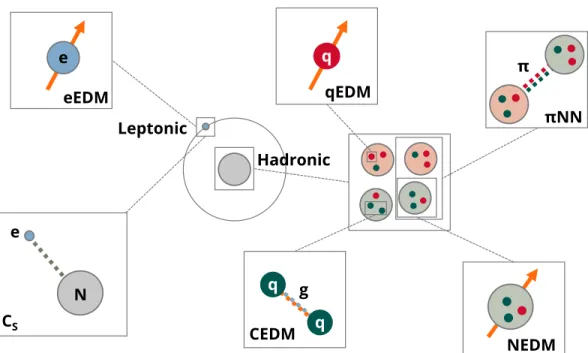
As an example, current state-of-the-art searches for the electron's EDM in diatomic molecules [10, 11] have sensitivity to symmetry violating new physics at ~50 TeV energy scales, beyond the current reach of particle colliders [12] . While the majority of this work focuses on YbOH molecules, the results are extendable to other linear triatomic molecules of the M-OH form (M=Ca, Sr, Ba, Yb, Ra).
Fundamental Symmetry Violation .1 Background.1Background
- Cosmological Motivation
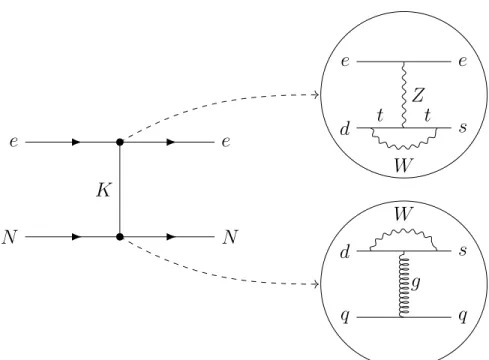
- P, T Violating Moments
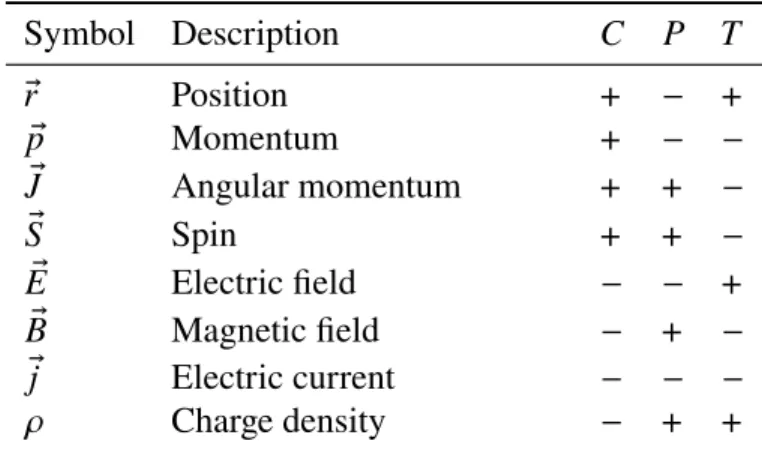
𝐶 𝑃𝑇 is assumed to be an exact symmetry of the universe according to the CPT theorem, a cornerstone of QFT. The quantity M B M𝑧 𝑧 is the “size” of the MQM, which can be seen by eq.
Atoms and Molecules .1 Electronic Enhancements.1Electronic Enhancements
- Atoms
- Molecules
- Connection to High Energy Physics
The quantity𝜉𝑃𝑇 𝑉 represents the magnitude of the 𝑃, 𝑇 violating electromagnetic moment, which can be connected to the high-energy physics scale. Fundamentally, all the nuclear enhancement mechanisms are related to the existence of distorted nuclei [85], which arise from collective proton-neutron interactions14 [86].
Why Polyatomic Molecules?
- Long Term Vision
- Molecular Orientation Control
- Quantum Projection Noise
This advance was made possible by the development of a recipe of the primary ingredients needed for molecular laser cooling [112, 113]. Furthermore, parity doublets enable coherent control of the orientation of the internal core in the laboratory frame. The separation of the ±parity states can vary depending on the choice of polyatomic molecule, allowing some tuning.
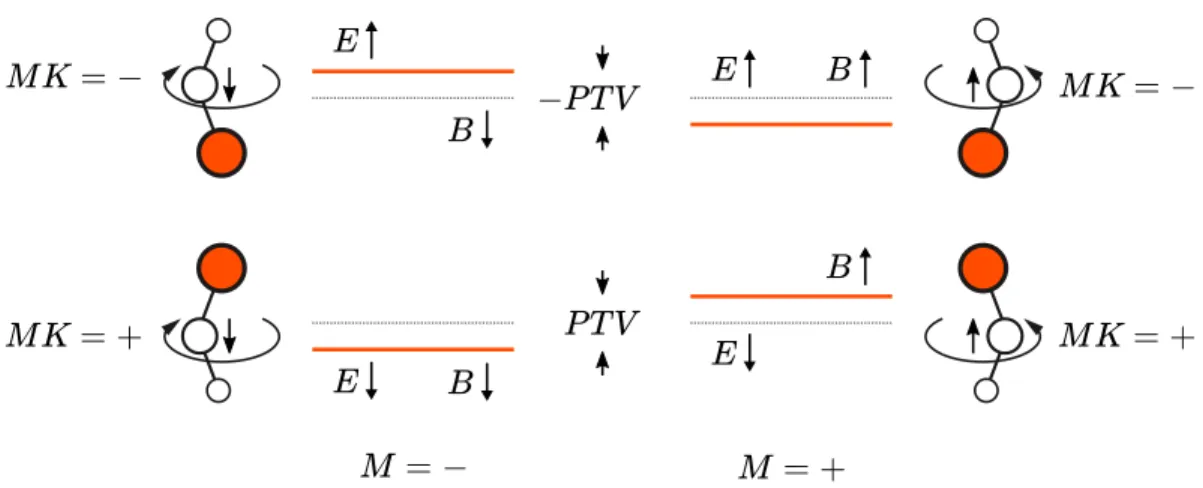
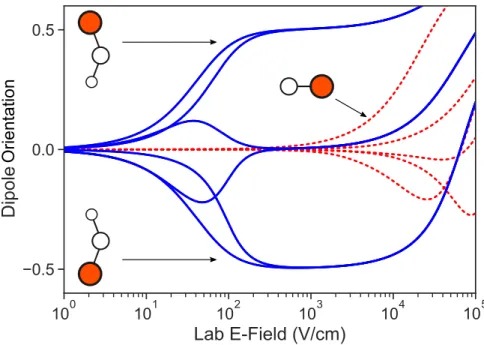
In Figure 1.3, as a function of the applied electric field, we compare the orientation ⟨𝑛ˆ⟩ of a linear triatomic molecule with parity doubling to that of a diatomic molecule without parity doublings. In general, when the molecule is fully polarized, we have 2𝐽 +1 orientations of the internuclear axis, corresponding to different values of 𝑀 in the expected value ⟨𝐀 𝐾⟩. 𝑀 = ± describes the laboratory frame projection of 𝐽odd (see main text), while 𝑀 𝐾 = ± describes the laboratory frame orientation of the internuclear axis ˆ𝑛.
To capture the relationship between increasing measurement time and decreasing measurement speed, we write 𝑁 = 𝑁𝑝𝐷 𝜏−1𝑇, where 𝐷 is the duty cycle of the experiment.
Molecules
Molecular Structure
- Angular Momentum and Spherical Tensors
- Spherical Tensors and the Wigner-Eckart Theorem
- Atomic States
- The Simplest Molecule
- Separation of Energy Scales and Hund’s Cases
- Rotation and Symmetric Top States
- Vibrational States
- Electronic States and Hund’s Cases
Physically, a rotation should preserve the length of the angular momentum 𝐽, so the matrix representation of D (𝜔) for all angular momentum states will be block diagonal in 𝐽, and we can denote a single𝐽 block asD(𝐽)(𝜔). The orientations of the operator are indicated by 𝑝, in analogy with the𝑀projection of an angular momentum. In this section, we will denote the total rotational angular momentum of the molecule generically as 𝐽®.
On the basis of Euler angles, the normalized wave function can be written in the form of D-matrix:. The degeneracy of ℓ then refers to a degeneracy in the direction of the axis orientation of the molecule. We often do not consider 𝑝, but it shows up in the Coriolis couplings of the vibrational angular momentum.
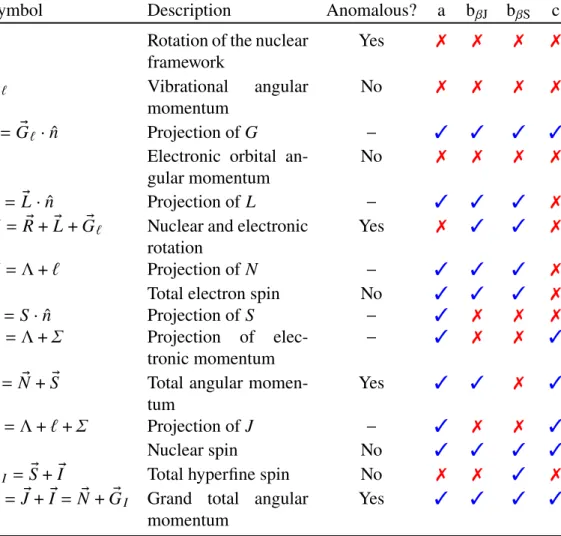
The total angular momentum of the molecule is still given by 𝐽, we just can't divide it between 𝑁 and 𝑆.
Effective Hamiltonians .1 Basic Principle.1Basic Principle
- Details of the Effective Hamiltonian
- Parity Doubling
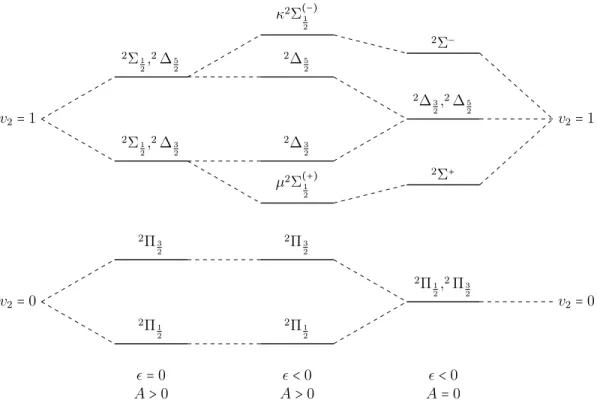
- Renner-Teller Effects
However, in the single valence electron molecules we consider (often the case for laser coolable molecules), the effective Hamiltonian approach is applicable and quite powerful. These operators are simply absorbed into a total energy shift of the electronic state, known as the "origin". We note. We can now obtain effective interactions of the form𝐵𝑥𝑆𝑥+𝐵𝑦𝑆𝑦, where𝑥, 𝑦 are defined in the molecular frame.
At second order, we will always get interactions that can flip an integer projection, that is, we can take 𝑃 =1→ −1. A similar effect can be obtained from parity-dependent spin-rotation terms in the effective Hamiltonian, which we discuss in Chap. Continued means that the phase factor of (−1)𝑝in the symmetrized parity states is linked to the phase factor of the parity doubling operators that flip angular momentum projections.
Therefore, the overall Renner-Teller effect in the effective Hamiltonian is a combination of both dipolar and quadrupolar effects.

Producing Cold Molecules
Introduction
Molecules are Entropically Hard
An alternative technique to oven chemistry is to make molecules in a high-temperature (𝑇 > 1000 K) plasma created by focusing a nanosecond pulsed laser on a solid target, known as laser ablation. This is the approach we will use to produce molecules in all subsequent discussions and chapters. There are currently two primary methods for producing cold (∼1–10 K) free radical samples: supersonic expansion and cryogenic cooling of the interstitial gas.
Both methods are commonly used to produce cold molecular beams as a starting point for a wide range of experiments, from spectroscopy to quantum control. Often, the gas pulse is an inert, monatomic carrier gas, i.e. noble gas, and the broadening is due to the presence of laser ablation to generate interesting free radicals. Vibrational cooling is less efficient, a fact that we will encounter again in cryogenic interstitial gas beams.
To produce slow and bright free radical beams, we work with cryogenic buffer gas beams.
Cryogenic Buffer Gas Beam Sources
- The 4 K Source
- The Beam Extension
- Buffer Gas Dynamics
- Background Gas and Cryopumping
- Ablation Targets and Chemistry
- Heated Fill Line
- Cold Sintering
- Double Ablation
- Diagnostics
- Decay Rates, Branching Ratios, and Cross Sections
- Absorption
- Fluorescence
- Excited State Chemistry
- Enhancement Tests
- Apparatus
- Geometry
- Frequency
- Power
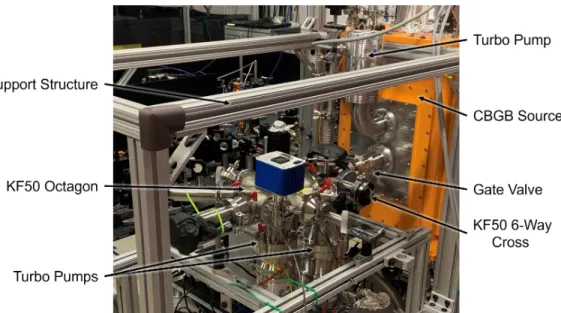
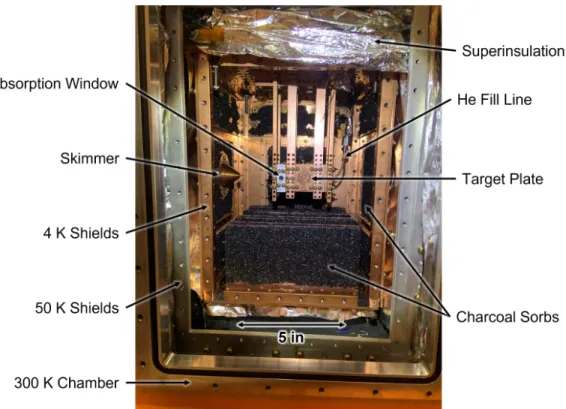
The cell sits in the center of the photo, anchored with vertical bars at the top of the 4 K shields, which are connected to the cold head (not visible). The extraction rate must be balanced with the thermalization and diffusion times of the molecules. Absorption measurements are most useful in the cell or in front of the cell, and can be related to molecular density in a relatively simple way.
As we increase the flux of the incident light, we increase the number of absorbers that are promoted to the excited state. This is the basis of the frequency modulated (FM) absorption technique, which was led by Nick Pilgram in our lab to perform sensitive absorption spectroscopy on vibrationally excited states in a buffer gas cell [220]. The scattering rate of the molecules (or atoms), 𝑅, is directly proportional to the population of the excited state, 𝑅 = 𝛾 𝜌𝑒 𝑒.
At the flow rates considered here, approximately ∼10% of the molecules are extracted, with the remainder lost to the cell walls. Absorption of the probe was used to measure the number density of molecules both inside the cell and. In the final geometry involved, the enhancement light is overlapped with the path of the ablation laser, shown in Figure 3.8(c).
- Timing
- Gas Flow
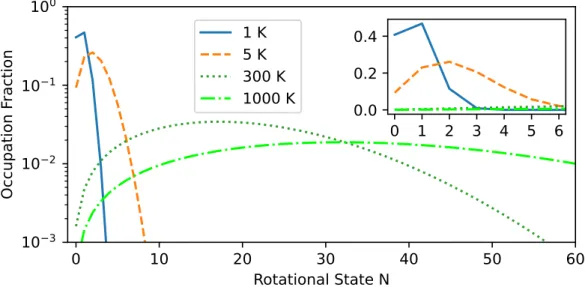
- Rotational Distribution
- Velocity Properties
- Vibrational Distribution
- Studies with Different Isotopologues
- Applications
This observation, combined with the effect of geometry on enhancement, provides evidence that the enhancement occurs throughout the cell, rather than immediately in the region of the ablation plume. We also investigated the effect of the enhancement light on the population of YbOH in different internal states. The width of the resulting line shapes did not show a measurable difference with and without the enhancement.
We attribute this to the fact that most of the enhancement occurs about 1 ms after ablation, meaning that the enhanced molecules leave the cell later than the Yb atoms produced immediately after ablation. We note that the passage assignment (020) is not final, so please ask. c): Enhancement of molecular hyperfine levels in the strange. We used the isotopic selectivity of the enhancement to perform spectroscopy on the strange YbOH isotopologues presented in Ref.
The dependence of the molecular yield on the application of amplification light at a specific time and place can help to study the distribution of the reactive dynamics in the cell.

YbOH Spectroscopy
YbOH Overview
- Ground States
- Excited States
- Transition Notation
In this section, we provide a brief summary of the spectroscopic characterization of YbOH performed by others. The structure is similar to that of isoelectric diatomic fluorides such as YbF or SrF, except for the hyperfine structure of the ligand, which is much smaller in the hydroxides. Such a flip does not occur in ˜𝑋(010), due to the different internuclear orientations of the spins in the symmetric top-like bending state compared to the linear rotor-like absolute ground state.
The vibrational structure of the ˜𝑋electronic manifold was characterized in dispersed laser induced fluorescence (DLIF) measurements [144] at ~5 cm-1 accuracy. Characterization of the ˜𝐴2Π1/2(000) state, including Stark and Zeeman tuning, was performed in an optical study of a supersonic molecular beam [264]. We also performed high-resolution spectroscopy of the [17.68] and [17.64]2 bands, but we were unable to perform a conclusive assignment.
Some of the many unassigned YbOH bands are believed to arise from excited states with holes in the inner 4𝑓 shell.
The Science State
- Apparatus
- Modeling and Theory
- Results
- Field-Free Spectrum
- Stark and Zeeman Spectra
- Perturbations and Quantum Interference
- Summary
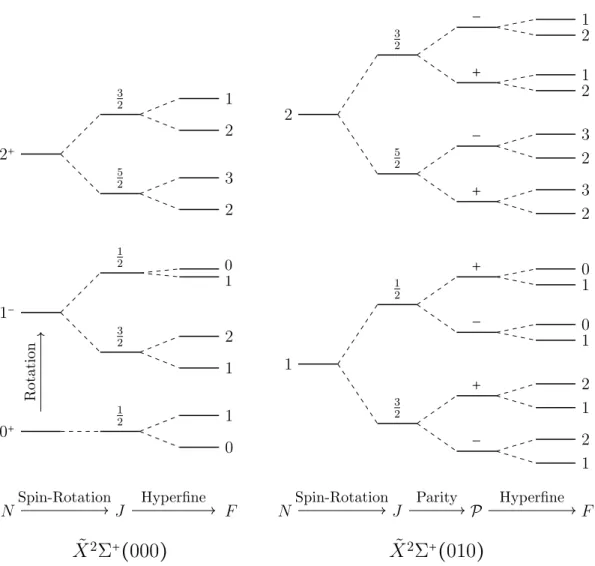
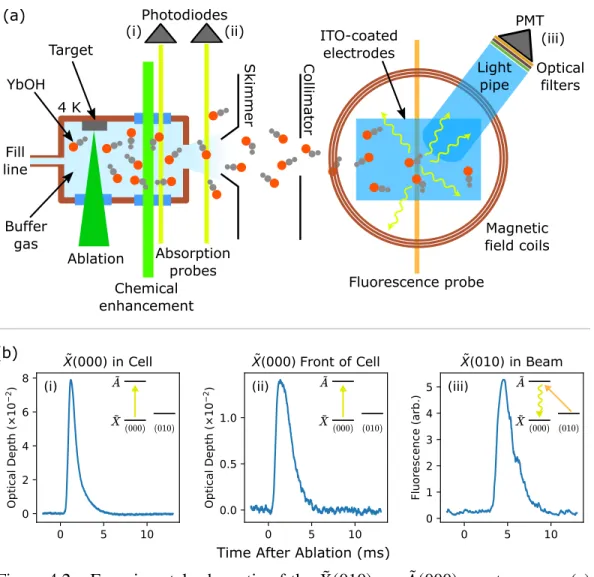
The molecules are entrained in the He gas stream and pulled out of the cell. In the center of the fields, molecules in the ˜𝑋(010) state are excited by a laser (orange line) and their fluorescence is collected through a light tube to a PMT (iii). The effect of the parity-dependent spin-rotation term, 𝑝𝐺, is evident in the asymmetric parity doubling of the 𝐽 =1/2 and 𝐽 =3/2 manifolds.
In an E1 transition, the transition strength is proportional to the square of the transition dipole moment between the ground and excited states,|⟨𝐴˜|𝑇1. In the E1 approximation, ΔΣ = 0, and the molecular frame projection 𝑞of the transition dipole moment determines the selection rule for Λ. Each of these perturbing states contributes to different molecular frame components of the transition dipole moment (TDM).
We modeled the anomalous line intensities of the forbidden band with mixing coefficients representing vibronic perturbations in the excited state.
The Bending Excited State .1 Introduction.1Introduction
- Modeling Renner-Teller Effects
- Apparatus
- Observations
This makes sense, since parity doubling in the effective Hamiltonian actually encodes off-diagonal interactions with other vibrational or electronic manifolds, which it generally does. Put 1 with Λ = 1 in the first ket of the superposition (the one not multiplied by the parity phase), and write deℓ. 2 states with Λ = −1 as the first ket in the superposition. 4.19) Here 𝜃 is the electronic azimuth coordinate, and 𝑞± are dimensionless lifting and falling operators for the vibrational angular momentum 𝐺, with matrix elements available in the literature.
2, which means that spin-orbit effects must be considered at zero order in the derivation of the effective Hamiltonian when considering off-diagonal vibrational perturbations. All these terms arise at second order in the effective Hamiltonian and involve couplings to another electronic state and back. In the limit of mixing with a unique perturber, the Curl relations relate the scale of the two effects by 𝑞 ∼ 𝑝 𝐵/𝐴[167], noting that the 𝑝 effects are dominant with large spin-orbit.
We can think of the combination of spin-orbit and rotational effects, encapsulated in 𝐻Λ, as "quenching" the electronic angular momentum, resulting in only the bending degree of freedom.