Volume 13 • Number 2 • 2023
OTORITAS : Jurnal Ilmu Pemerintahan
Published by the Department of Government Studies,
Faculty of Social and Political Sciences, Muhammadiyah University of Makassar
For further information, please visit: https://journal.unismuh.ac.id/otoritas ISSN: 2088-3706 (Print) | 2502-9320 (Online) | DOI : 10.26618
Firstpublished in April 2011
Please send all articles, essays, reviews, and documents to:
Regular Mail:
Department of Government Studies Faculty of Social and Political Sciences
5th Floor of Menara Iqra, Muhammadiyah University of Makassar Jl. Sultan Alauddin No.259 Makassar, 90221
South Sulawesi, Indonesia E-Mail:
OTORITAS : Jurnal Ilmu Pemerintahan is an internationally peer-reviewed open access journal published triannual in April, August and December, aims to publishes significant
and cutting-edge research drawn from all areas of politics and governmental studies and promotes scholarly, theoretical, pragmatic, and contemporary research, which makes a clear conceptual and methodological contribution to existing international
literature.
OTORITAS : Jurnal Ilmu Pemerintahan indexed by :
OTORITAS : Jurnal Ilmu Pemerintahan have been double blind-reviewed by international peer reviewers. The decision on whether the scientific article is accepted
or not in this journal will be the Editorial Board’s right based on peer reviewer's recommendation.
About the Journal
OTORITAS : Jurnal Ilmu Pemerintahan, with registered number ISSN 2088-
3706 (Print), ISSN 2502-9320 (Online), is an internationally peer-reviewed open access journal published triannual in April, August and December by Department of Government Studies, Faculty of Social and Political Sciences, Universitas Muhammadiyah Makassar in collaboration with Muhammadiyah’s College Association of Government Studies (AIPPTM) and Asia Pacific Society for Public Affairs (APSPA).
OTORITAS : Jurnal Ilmu Pemerintahan aims to publishes significant and
cutting-edge research drawn from all areas of politics and governmental studies and promotes scholarly, theoretical, pragmatic, and contemporary research, which makes a clear conceptual and methodological contribution to existing international literature.
OTORITAS : Jurnal Ilmu Pemerintahan Starting from 2015 it is available in e-
journal version and has been currently indexed by both national and international indexer institutions such as: ESCI Web of Science (International), DOAJ (International), ASEAN Citation Index (International), Dimensions (International), Garba Rujukan Digital (National), Google Scholar (International), Crossref (International), BASE (International), SINTA (National), and Indonesia One Search (National).
OTORITAS : Jurnal Ilmu Pemerintahan Starting from 2016 and for the
upcoming years, the process of manuscript submission and other management processes will be conducted online through Otoritas : Jurnal Ilmu Pemerintahan website and for the betterment of the quality and quantity of Otoritas : Jurnal Ilmu Pemerintahan qualified reviewers and editors are recruited. Besides that in the same year we collaborated with Muhammadiyah's College Association of Government Studies (AIPPTM) on the publication of this journal.
OTORITAS : Jurnal Ilmu Pemerintahan Starting from 2018, we collaborated
with Asia Pacific Society for Public Affairs (APSPA) on the publication and has
been accredited by National Journal Accreditation (ARJUNA) Managed by Ministry
of Research, Technology, and Higher Education of Republic Indonesia.
Focus and Scope
Otoritas: Jurnal Ilmu Pemerintahan (Journal of Political Science and
Government) promotes scholarly, theoretical, pragmatic, and contemporary research, making a clear conceptual and methodological contribution to existing international literature. Its spesific aim is to enhance the broad scholarly understanding of governance, public administration, public law, religion and politics, comparative politics, international studies, and democratic institutions in emerging countries.
Otoritas : Jurnal Ilmu Pemerintahan (Journal of Political Science and
Government) is committed to disseminating rigorous, high-quality research and
debate with a scientific influence on the international society. To that purpose,
the Editorial team follows a meticulous editorial procedure, bringing the most
sophisticated research on modern politics and governance to the academic
community and policymakers. The journal is online and has open access, and its
internal publication procedure enables it to distribute its research findings
internationally promptly.
Editorial Board
EDITOR-IN-CHIEF
Andi Luhur Prianto, Scopus ID: 57208214401, Universitas Muhammadiyah Makassar, Indonesia
MANAGING EDITORS
Nur Khaerah, Scopus ID: 57708938300, Universitas Muhammadiyah Makassar, Indonesia
ACCOCIATE EDITORS
Abel Kinyondo, Scopus ID: 55293738000, University of Dar Es Salaam, Tanzania Abel Polese, Scopus ID: 57201804952, Dublin City University, Ireland
Ilyas Mohammed, Scopus ID: 57221933986, University of Liverpool, United Kingdom Michael Hatherell, Scopus ID: 56433408300, Deakin University, Australia
Nursaleh Hartaman, Scopus ID: 57395318100, Universitas Muhammadiyah Makassar, Indonesia Riccardo Pelizzo, Scopus ID: 6507727385, Nazarbayev University, Kazakhstan
INTERNATIONAL EDITORIAL
Adam Tyson, Scopus ID: 35337925000, University of Leeds, United Kingdom
AKM Ahsan Ullah, Scopus ID: 10043791400, Universiti Brunei Darussalam, Brunei Darussalam Ahmad Harakan, Scopus ID: 57203222670, Universitas Muhammadiyah Makassar, Indonesia Andreas Ufen, Scopus ID: 24280605600, German Institute of Global and Area Studies, Germany
Farida Tadjine, Scopus ID: 57678049100, University of Kasdi Merbah Ouargla, Algeria Mergen Dyussenov, Scopus ID: 57190342068, National University of Singapore, Singapore
Mohd Afandi Salleh, Scopus ID: 55582821500, Universiti Sultan Zainal Abidin, Malaysia Mubashar Hasan, Scopus ID: 45861188500, Oslo University, Norway
Muh Firyal Akbar, Scopus ID: 57210750267, Universitas Muhammadiyah Gorontalo, Indonesia Ni Putu Tirka Widanti, Scopus ID: 57970637000, Universitas Ngurah Rai, Indonesia Nuryanti Mustari, Scopus ID: 57395318000, Universitas Muhammadiyah Makassar, Indonesia
Önder KUTLU, Necmettin Erbakan Universitesi, Turkey
Rudi Hardi, Scopus ID: 57395626900, Universitas Muhammadiyah Makassar, Indonesia Wolfgang Drechsler, Scopus ID: 36840148600, University College London, United Kingdom
EDITORIAL ASSISTANTS
Abdillah Abdillah, Scopus ID: 57697035900, Universitas Muhammadiyah Makassar, Indonesia Hamrun Hamrun, Scopus ID: 57395116400, Universitas Muhammadiyah Makassar, Indonesia
Table of Contents
How does the government improve the competitiveness of SMEs?
lesson learned from Thailand
Andrie Elia1, Basrowi2, Buncha Chinnasri3
1Departement of Sociology, Faculty Social and Political Science, Universitas Palangka Raya, Indonesia
2Department of Management Studies, Graduate Program, Universitas Bina Bangsa, Indonesia
3Faculty of Agriculture Kasetsart University, Thailand
182-202
Indonesia’s pro-people foreign policy: the protection of Indonesian women migrant workers in Malaysia in 2022
Arie Kusuma Paksi1, Pebria Prakarsa Renta2
1,2Department of International Relations, Universitas Muhammadiyah Yogyakarta, Indonesia
203-216
The insignificance of GDP growth rate to people’s welfare: a political economy analysis of China’s impressive GDP
Asmarawati Handoyo1, Yuli Isnadi2
1Graduate Institute of Political Economy, College of Social Sciences, National Cheng Kung University, Taiwan.
2Department of Management and Public Policy, Universitas Gadjah Mada, Indonesia.
217-232
Policy process in Indonesia during COVID-19: a cross-sectoral policy Perspective
Evi Satispi1, Ma’mun Murod2
1Department of Public Administration, Universitas Muhammadiyah Jakarta, Indonesia
2Deparment of Political Science, Universitas Muhammadiyah Jakarta, Indonesia
233-245
How does buy service-based policy attract public transportation customers in Yogyakarta, Indonesia ?
Fitriani1, Achmad Nurmandi2, Muhammad Lutfi3, Mujizatullah4, Abu Muslim5
1,2 Department of Government Affairs and Administration, Jusuf Kalla School of Government,Universitas Muhammadiyah Yogyakarta, Indonesia
3Department of Government Studies, Universitas Muhammadiyah Sinjai, Indonesia
4,5Research Center for Religious Treasures and Civilizations, National Research and InnovationAgency, Indonesia
246-260
Local government strategy in managing traditional markets in The City of Pariaman, Indonesia
Herza Netti1, Erianjoni2
1,2 Department of Public Administration, Universitas Negeri Padang, Indonesia
261-276
Disputing land: argumentative turn in local land policy conflict in Central Java, Indonesia
Laila Kholid Alfirdaus1, Dzunuwanus Ghulam Manar2, Teguh Yuwono3
123Department of Politics and Governance Studies, Faculty of Social and Political Sciences,Universitas Diponegoro, Indonesia
277-288
Policy and innovation network: a study of inter-agency collaboration in post-disaster rehabilitation and reconstruction in the Central Sulawesi, Indonesia
Mohammad Rusli Syuaib
Department of Public Administration, Universitas Sintuwu Maroso, Indonesia
289-301
Local government innovation model in Pekanbaru City, Indonesia: a study of public service mall
Ranggi Ade Febrian1, Khairul Rahman2, Ahmad Fitra Yuza3, Zainal4
1234Department of Government Studies, Faculty of Social and Political Sciences, Universitas Islam Riau, Indonesia
302-314
Civil Service Police Unit principle : no punishment and no taxation without representation
Sarip1, Diana Fitriana2, Absori3, Khudzaifah Dimyati4, Harun5
1 Faculty of Law, Universitas Muhammadiyah Cirebon, Indonesia
2 Faculty of Law, Universitas Bhayangkara Jakarta Raya, Indonesia
3,4,5Faculty of Law, Universitas Muhammadiyah Surakarta, Indonesia
315-332
Declining democracy: autocratization in Indonesia during the Jokowi years
Taufik1,2, Muhamad M.N. Nadzri3, Jamaie Hj. Hamil4
1,3,4 Center for Research in History, Politics and International Affairs, Faculty of Social Science and Humanities,
Universiti Kebangsaan Malaysia, Malaysia
2Department of International Relations, Faculty of Social and Political Sciences, Universitas Pasundan, Indonesia
333-351
The Bretton Woods institutions and the quest for development in Africa
Zekeri Momoh
Department of Political Science, Faculty of Social Sciences, Veritas University, Nigeria
352-363
Article Guidelines
Article Title: Segoe UI, 14pt Bold, alignment centered, single-line spacing and All Caps. Article title should be written briefly and clearly. It shows exactly the issue to be discussed and should not create misinterpretations. Article title is written in capital letters symmetrically and does not contain unusual abbreviations. Express the main idea of a new article and followed by another explanation.
Author Details: Segoe UI, alignment centered, Article title, author's name (without academic degree(s)), and author's affiliate address are written in the center on the first page under the article title. The distance between title and author's name is double-spacing; meanwhile the distance between author's affiliate address and abstract title is single-spacing. Keywords should be written under abstract for each language. It is arranged alphabetically and separated by a semicolon consisted of 3-5 words. For Indonesian article, the title is translated into English at the beginning of English abstract (see the example above).
Corresponding Author should be marked with an asterisk and followed by a comma "*)" as the example above. At the bottom of the left column on the first page/abstract, it is written the Corresponding Author’s mark and his/her email address (see example). Article revisions and final decisions will only be communicated through the Corresponding Author’s email.
If there is more than one author, write the authors’ names separated by a comma (,). If the author's name consists of two words, the first name should not be abbreviated. If the author’s name consists of only one word, write his/her actual name in one word. However, the online version (HTML) will be written in two words consisting of the same name (repeatedly) for metadata indexation purpose (Camdali & Tunc, 2006; Fridman, 2008).
Introduction: Introduction consists of (in sequence) general background, state of the art as the basis for the scientific novelty statement of the article, scientific novelty statement, and research problem or hypothesis. In the end, introduction should mention the purpose of article review.
Literature review is not allowed in the scientific article format, so it is replaced by the state of the art to prove the novelty of the article.
Research Methods: Method is implemented to solve problems, including analytical method.
The method used to solve the research problems is described in this section.
Results and Discussion: This section consists of results and discussion. Every result should be supported by sufficient data. Then, result should be able to answer the research question or hypothesis stated earlier in the introduction.
Conclusion: Conclusion states the answer of the hypothesis and/or research objective or scientific finding. Conclusion is not the repetition of findings and discussion, but it is the summary of findings as expected in the objective or hypothesis. If necessary, conclusion can also be ended with the next idea to be implemented to the study.
Acknowledgment: Acknowledgment are primarily addressed to research funders or donors.
Acknowledgment can also be dedicated to people who contribute in the study.
References: All references used in the article should be listed in the References section.
References should contain reference literature originating from primary sources (scientific journals at least 80% of the entire references) published in the last 10 (ten) years. Each article contains at least 10 (ten) references. It is better to write the reference system in the article and in the references section using the reference management programs such as Mendeley, EndNote, Zotero, or others.
Publication Ethics
Otoritas : Jurnal Ilmu Pemerintahan, with registered number ISSN 2088-3706 (Print), ISSN 2502-9320 (Online) is a peer-reviewed journal, available in print and online and published tri-annual. This statement clarifies ethical behaviour of all parties involved in the act of publishing an article in this journal, including the author, the chief editor, the Editorial Board, the peer-reviewer and the publisher (Department of Government Studies, Faculty of Social and Political Sciences, Universitas Muhammadiyah Makassar in collaboration with Muhammadiyah’s College Association of Government Studies (AIPPTM) and Asia Pacific Society for Public Affairs).
This statement is based on COPE’s Best Practice Guidelines for Journal Editors.
ETHICAL GUIDELINE FOR JOURNAL PUBLICATION
The publication of an article in a peer-reviewed Otoritas : Jurnal Ilmu Pemerintahan is an essential building block in the development of a coherent and respected network of knowledge.
It is a direct reflection of the quality of the work of the authors and the institutions that support them. Peer-reviewed articles support and embody the scientific method. It is therefore important to agree upon standards of expected ethical behaviour for all parties involved in the act of publishing: the author, the journal editor, the peer reviewer, the publisher and the society.
Department of Government Studies, Faculty of Social and Political Sciences, Universitas Muhammadiyah Makassar in collaboration with Muhammadiyah’s College Association of Government Studies (AIPPTM) and Asia Pacific Society for Public Affairs as publisher of Otoritas : Jurnal Ilmu Pemerintahan takes its duties of guardianship over all stages of publishing seriously and we recognize our ethical and other responsibilities. We are committed to ensuring that advertising, reprint or other commercial revenue has no impact or influence on editorial decisions.
PUBLICATION DECISIONS
The editor of the Otoritas : Jurnal Ilmu Pemerintahan is responsible for deciding which of the articles submitted to the journal should be published. The validation of the work in question and its importance to researchers and readers must always drive such decisions. The editors may be guided by the policies of the journal's editorial board and constrained by such legal requirements as shall then be in force regarding libel, copyright infringement and plagiarism.
The editors may confer with other editors or reviewers in making this decision.
FAIR PLAY
An editor at any time evaluate manuscripts for their intellectual content without regard to race, gender, sexual orientation, religious belief, ethnic origin, citizenship, or political philosophy of the authors.
CONFIDENTIALITY
The editor and any editorial staff must not disclose any information about a submitted manuscript to anyone other than the corresponding author, reviewers, potential reviewers, other editorial advisers, and the publisher, as appropriate.
DISCLOSURE AND CONFLICTS OF INTEREST
Unpublished materials disclosed in a submitted manuscript must not be used in an editor's own research without the express written consent of the author.
DUTIES OF REVIEWERS:
Contribution to Editorial Decisions
Peer review assists the editor in making editorial decisions and through the editorial communications with the author may also assist the author in improving the paper.
Promptness
Any selected referee who feels unqualified to review the research reported in a manuscript or knows that its prompt review will be impossible should notify the editor and excuse himself from the review process.
Confidentiality
Any manuscripts received for review must be treated as confidential documents. They must not be shown to or discussed with others except as authorized by the editor.
Standards of Objectivity
Reviews should be conducted objectively. Personal criticism of the author is inappropriate.
Referees should express their views clearly with supporting arguments.
Acknowledgement of Sources
Reviewers should identify relevant published work that has not been cited by the authors. Any statement that an observation, derivation, or argument had been previously reported should be accompanied by the relevant citation. A reviewer should also call to the editor's attention any substantial similarity or overlap between the manuscript under consideration and any other published paper of which they have personal knowledge.
Disclosure and Conflict of Interest
Privileged information or ideas obtained through peer review must be kept confidential and not used for personal advantage. Reviewers should not consider manuscripts in which they have conflicts of interest resulting from competitive, collaborative, or other relationships or connections with any of the authors, companies, or institutions connected to the papers.
DUTIES OF AUTHORS Reporting standards
Authors of reports of original research should present an accurate account of the work performed as well as an objective discussion of its significance. Underlying data should be represented accurately in the paper. A paper should contain sufficient detail and references to permit others to replicate the work. Fraudulent or knowingly inaccurate statements constitute unethical behaviour and are unacceptable.
Originality and Plagiarism
The authors should ensure that they have written entirely original works, and if the authors have used the work and/or words of others that this has been appropriately cited or quoted.
Multiple, Redundant or Concurrent Publication
An author should not in general publish manuscripts describing essentially the same research in more than one journal or primary publication. Submitting the same manuscript to more than one journal concurrently constitutes unethical publishing behaviour and is unacceptable.
Acknowledgment of Sources
Proper acknowledgment of the work of others must always be given. Authors should cite publications that have been influential in determining the nature of the reported work.
Authorship of the Paper
Authorship should be limited to those who have made a significant contribution to the conception, design, execution, or interpretation of the reported study. All those who have made significant contributions should be listed as co-authors. Where there are others who have participated in certain substantive aspects of the research project, they should be acknowledged or listed as contributors. The corresponding author should ensure that all appropriate co- authors and no inappropriate co-authors are included on the paper, and that all co-authors have seen and approved the final version of the paper and have agreed to its submission for publication.
Disclosure and Conflicts of Interest
All authors should disclose in their manuscript any financial or other substantive conflict of interest that might be construed to influence the results or interpretation of their manuscript. All sources of financial support for the project should be disclosed.
Fundamental errors in published works
When an author discovers a significant error or inaccuracy in his/her own published work, it is the author’s obligation to promptly notify the journal editor or publisher and cooperate with the editor to retract or correct the paper.
203 Otoritas : Jurnal Ilmu Pemerintahan Vol. 13, No. 2, 2023
DOI: https://doi.org/10.26618/ojip.v12i2.8989
Indonesia’s pro-people foreign policy: the protection of Indonesian women migrant workers in Malaysia in 2022
Arie Kusuma Paksi1*), Pebria Prakarsa Renta2
1,2Department of International Relations, Universitas Muhammadiyah Yogyakarta, Indonesia
Abstract
Keywords: migrant workers, human rights, human exploitation, foreign policy
Introduction
Due to Indonesia's large population and low employment opportunities, the government of Indonesia has moved its informal sector workers abroad. Because of their limited education and experience, Indonesians often prefer to work overseas to fill employment gaps. This is known as employment migration in Indonesia. In order to reduce unemployment in Indonesia, the Indonesian government has therefore decided to send Indonesian Women Migrant Workers, who can also contribute in the form of national currency. The Law Number 18 of 2018 contains a definition of the word
"migrant worker" (Indonesian Women Migrant Workers). Indonesian Women Migrant Workers candidate is defined by the law as any member of the Indonesian labor force who meets the requirements to be an employee who will work overseas and who has registered with the districts, cities, and government offices in charge of that employment. Any Indonesian person who will, is, or has previously worked for pay on Indonesian soil is referred to as an Indonesian Women Migrant Workers. The low level of education of Indonesian women's migrant workers makes it difficult for the Indonesian government's plan to send them to the unorganized sector abroad where they can work in the informed sector. State money may also be added by sending Indonesian Women Migrant Workers to the overseas informal economy (Qobulsyah, 2013). The high population in the Republic of Indonesia has an impact on the availability of employment. The high rate of unemployment and poverty in Indonesia is
*) Corresponding Author
E-mail : [email protected]
This study investigates the Indonesian government's strategies to safeguard its informal sector in Malaysia, which has experienced considerable human rights violations and exploitation. Such incidents breach both the Memorandum of Understanding (MoU) and Law No. 18 of 2017 on the Indonesian migrant workers' protection. Utilizing the pro-people foreign policy theory and the citizen protection concept, this research explores the government's responses to these issues as a protective measure for its citizens. Employing a qualitative descriptive method, data was gathered through library studies. The findings reveal that the Indonesian government, in its bid to protect indonesian women migrant workers in malaysia by 2022, has publicly criticized the Malaysian government, implemented a Moratorium, and pushed for immediate bilateral meetings between the two nations. Hence, the study concludes that these efforts have positively influenced the protection of indonesian women migrant workers in malaysia in 2022.
204 required by the law of the state to ensure survival and employment. As stipulated in Article 27 Paragraph 2 of the 1945 Constitution of the Republic of Indonesia, “every citizen has the right to a decent job and livelihood”. According to Indonesia Central Statistics Agency, in March 2022, the poverty percentage in Indonesia reached 9.54 and 6.49 percent of unemployment in August 2021, that’s why women are Indonesian Women Migrant Workers (Gunawan, 2022). It is highly challenging to be a Indonesian Women Migrant Workers, but it is a rewarding career. Indonesian Women Migrant Workers are responsible for assisting individuals, families, and groups of people to cope with problems they are fronting to improve their patients’ lives (Aliyu et al., 2017).
The Indonesian Women Migrant Workers target countries are mainly countries in Southeast Asia, East Asia as well as the Middle East. Many of the difficulties produced by Indonesian Women Migrant Workers in the Middle East nations so that the government has made policies to limit Indonesian Women Migrant Workers placement in Middle Eastern countries, which has resulted. The increase in Indonesian Women Migrant Workers placement in Asian countries. The increasing interest of Indonesian Women Migrant Workers in working in Asian countries is driven by the information they obtain related to legal protection in those countries is already better than countries in the Middle East. The Asian countries, including Hong Kong, Taiwan, and Malaysia, are countries that in recent years have become the main target of Indonesian Women Migrant Workers to complain about fate. Based on Indonesian Migrant Workers placement data for 2021, a total of 72,624 people were recorded including 16,809 formal and 55,815 informal Indonesian Migrant Workers. Informal Indonesian Migrant Workers placement exceeds 75 percent, the majority of Indonesian Migrant Workers sent abroad is informal, while based on gender, its composition is male Indonesian Migrant Workers as much 8,769 people and a Indonesian Migrant Workers of 63,855 women. The countries with the most Indonesian Migrant Workers placement in July 2022 are Hong Kong, Taiwan, and Malaysia. Various attractions are offered by the three largest Indonesian Migrant Workers placement countries: Hong Kong, Taiwan, and Malaysia.
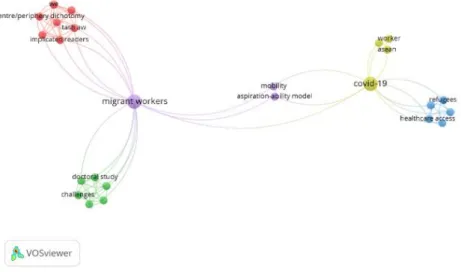
Figure 1. Network Visualization Migrant Workers in Malaysia
Source: (Sudarmanto, 2022).
Indonesia and Malaysia have a crucial and complex bilateral relationship. This relationship has existed for a long time since both countries became independent in the mid-20th century. These countries have much similarity in terms of culture, history, religion, and language. However, despite having many similarities, they also differ in
205 several ways, such as the political, economic, and legal systems. As neighboring countries that are close to each other in Southeast Asia, Indonesia and Malaysia have many common and interrelated interests (Nidatya et al., 2023). Malaysia accepts the use of migrant labor from countries like Indonesia, Bangladesh, the Philippines, India, and Vietnam to fill labor demand in the country's informal sectors, which began in Malaysia.
The majority of foreign employees in Malaysia are Indonesian, and they have a long history of doing so. In an effort to lessen the economic gaps between Malaysians and ethnic Chinese, Malaysia implemented a “New Economic Policy" in 1971 that aggressively promoted export-oriented industrialization and public sector expansion.
This was done to fill the sectoral labor shortages caused by Malaysian economic policies. Due to this legislation, there are more job openings in the city and a significant influx of villagers from Malaysia. Additionally, as a result of industrial development, there is a greater need for labor in the manufacturing and construction industries than can be filled by domestic workers. Labor shortages in the agriculture industry and the strong demand for domestic workers among the expanding middle class sped up the surge of immigrant labor up until the early 1980s.
Malaysia serves as a favoured location for migrant female labourers originating from Indonesia. There are several factors contributing to Malaysia's status as a destination country for Indonesian women migrant workers, one of which is the geographical proximity between Indonesia and Malaysia. This will have to do with relatively simple, affordable, and quick transportation. This facility has a connection to the available air and maritime transportation. Additionally, the availability of adequate transit supports both travel options. The weather in the nation is influenced by another geographic aspect. There are only two seasons, rainy and solely rainy, making the weather of Malaysia and Indonesia very similar. The majority of Indonesian Women Migrant Workers take the weather into account. They believe that choosing locations where the weather is hot, such as the Middle East, is wise.
Additionally, Malaysia's appeal as a destination for Indonesian migrant workers in the informal sector is influenced by cultural considerations. There aren't many cultural differences between Malaysia and Indonesia. There is a common language, the Malay language, in particular. Compared to other Indonesian Women Migrant Workers target nations like Saudi Arabia, Taiwan, and Hong Kong, it is different. The nation speaks a language that is significantly unlike to Indonesian. Language equality has started to influence Indonesian Women Migrant Workers decision to choose Malaysia as a workplace. These cultural parallels also make it simpler for Indonesian Women Migrant Workers to adjust to the new environment rapidly. This is due to the fact that language has the ability to hasten a person's rapid adaptation to a new environment.
Communication can be directly understood when speaking the same language. Next, religious fellowship is a further consideration. Malaysia's population is overwhelmingly Muslim. The Qur'an and Sunnah have similar relationships. The ease with which Indonesian migrant workers can practice their religion at home and in public spaces is another element (Pasetia, 2012).
The incidence of violence experienced by Indonesian women migrants is likely to rise in tandem with the growing deployment of female labourers in the informal sector to different countries. This also applies to Malaysia's informal economy, when Indonesian Women Migrant Workers may be exploited, tortured, or have their salaries withheld, among other issues. On April 1st, 2022, the governments of Malaysia and Indonesia agreed to a Memorandum of Understanding to lessen the issue. President Joko Widodo and Malaysian Prime Minister (PM) Ismail Sabri bin Yaakob were present
206 as the MoU was signed at Jakarta's Merdeka Palace. The Memorandum of Understanding (MoU) is a document that commits Malaysia and Indonesia to using the One Channel System for Indonesian Women Migrant Workers recruiting (Kementerian Luar Negeri Republik Indonesia, 2022). However, by altering the old Indonesian Women Migrant Workers recruiting system without an agreement with Indonesia, the Malaysian government has contravened the Indonesian Women Migrant Workers recruitment procedure that has been made a clause in the Memorandum of Understanding (MoU).
Indonesia reacted by imposing a moratorium (temporary stoppage) and making some steps to safeguard Indonesian migrant workers employed in Malaysia's informal sector as a result of Malaysia's violations of the Memorandum of Understanding (MoU) reached on April 1st, 2022. This article seeks to clarify the Indonesian government's initiatives to safeguard Malaysia's unofficial economy.
This article uses Pro-People Foreign Policy Theory and Citizen Protection Concept. There are three sections to the subject of pro-people foreign policy. The first is Indonesia's foreign policy. Second, a pro-people foreign policy will be implemented with organizational and structural components. The third is the implementation of pro- people diplomacy, which is a manifestation of a people-centered foreign policy. Since gaining its independence in 1945, Indonesia has based its foreign policy on the goals outlined in the Opening of the UUD 1945, which the government is obligated to carry out through the use of its employees, ministers, and departments. The goal is to
"protect the entire Indonesian people and all Indonesian bloodshed, and to advance the common good, to enlighten national life, as well as to participate in the establishment of a world order based on freedom, eternal peace, and social justice."
The need of safeguarding the entire country and giving its inhabitants a sense of security is also emphasized by foreign policy. According to the new paradigm, case management involves more than just how many cases are handled; it also involves being proactive rather than reactive, as well as how the head's supporting tools are arranged. The Ministry of Foreign Affairs' structure demonstrates how the framework has been reinforced to promote Pro-People Foreign Policy.
The execution of Pro-People Foreign Policy, in Bunyan's opinion (2017), genuinely refers to the diplomatic role of reporting, negotiating, protecting, and advancing. Serving citizens who are overseas or who are traveling abroad is one of these functions that is most intimately tied to people. Pro-People Foreign Policy is the application of a people-focused foreign policy carried out by the government through a number of initiatives. Based on the conceptual framework for defending Indonesian migrant workers in Malaysia through foreign policy, the Pro-People Foreign Policy model was created. The model is also useful for researching Indonesian foreign policy in general. The principles of environmental policy, policy background, policy structure, policy actors, policy processes, and policy outcomes serve as the foundation for this approach. Jerel A. Rosati's (1981) model of links between the components of decision- making at each stage served as the conceptual foundation for this modeling.
Additionally, James N. Rosenau's (1981) conceptual approach on foreign policy is used, and Gustavsson (1999) provided the model that mentions both home and foreign concerns.
Foreign policy-making can be broken down into two stages: formulation and implementation. The defense of the WNI abroad, which subsequently translates as
"people's diplomacy," was part of Ministry of Foreign Affairs early translation of what would ultimately become the government of Joko Widodo. The Joko Widodo administration's approach of formulation started with the implementation of
207 Indonesian national interests. The Ministry of Foreign Affairs then provided a detailed translation while the policy was still being developed. This description, known as Pro- People Foreign Policy, demonstrates how the Joko Widodo administration exerts pressure on policymakers to prioritize the interests of the people both at home and abroad. The Ministry of Foreign Affairs has diplomats stationed in Malaysia throughout the implementation phase. It is clear from the field talks that when foreign policy formulation is created as Pro-People Foreign Policy, the implementation includes the service and protection of Indonesian citizens and the Indonesian Legal Body. Ministry of Foreign Affairs has organized the program from a national priority into a strategic target program, with a focus on safeguarding Indonesian individuals and the Indonesia Law Agency. One of the goals of the Indonesian government is this strategic purpose.
Retno Marsudi, the minister of foreign affairs, has given particular attention to the strategic goal of positioning protection for Indonesian people.
Pro-People Foreign Policy is a manifestation of the state's presence in the protection of citizens, it is constantly expressed in numerous foreign policy declarations. The appropriate organizational frameworks within the Directorate-General for Consular and Consular Protection then support this policy. Following this concept, foreign policy became a factor in shaping both the domestic and global environments.
It contributed to the domestic labor delivery policy in a number of situations involving the protection of Indonesian nationals in Malaysia. In addition to the Ministry of Foreign Affairs, other domestic agencies including the Ministry for Labour and Indonesian Migrant Worker Protection Agency are also responsible for this. The appraisal of the domestic and international environments will become apparent after Pro-People Foreign Policy is put into practice and monitored. The policy context that will be applied by the structure that makes policies is then revealed by this environment. As long as the policy is used to make adjustments or improvements, such entries will remain in effect (Setiawan, 2019).
Preventing something from something harmful or more detrimental, which could be an interest or thing or object, is the general definition of protection.
Protection can also refer to advice that is offered to someone who is weaker than another (Hadjon, 1988). From the standpoint of international law, citizen protection presumes that the person has a nationality. In exceptional instances, notably when traveling abroad, conservatives can receive aid from the state. It should be underlined that access to justice is frequently impeded by a foreign national's legal situation, necessitating the "guard" of the nation in which he is a citizen to help remove the obstacle. A state's ability to defend the rights of people or organizations that have been affected by another nation's violations of international law is known as diplomatic protection. According to the first point of view, theoretically, the moratorium policy is a sort of diplomatic protection, and the state agency is authorized to take action to safeguard the rights and interests of its residents overseas. The justification for using the power to intervene and safeguard citizens overseas is the violation of those citizens' rights. A moratorium is defined as the action taken by the State's authorities, in conformity with international law and local law, to safeguard its nationals when their legal rights and interests are violated while they are abroad (Duc, 2020).
The Pro-People Foreign Policy Theory and the Citizen Protection Concept are used by the author in this essay because they are pertinent to the issues the Malaysian informal sector faces and since the moratorium policy is imposed as a kind of protection for that sector. Pro-People Foreign Policy refers to the nation's citizens who are having issues abroad, so taking into account the challenges the Malaysian informal
208 sector has, this foreign policy is on the side of the people. The idea of citizen protection also safeguards those who are exposed to dangers in their country. This is consistent with the Indonesian government's imposition of a Moratorium Policy in 2022 as a measure to protect its citizens because the Memorandum of Understanding (MoU) in 2022 was ineffective, as demonstrated by Malaysia's violations, including its decision to replace the One Channel System with the Maid Online System without Indonesia's consent, which led to an increase in the exploitation of the informal sector. Thus, the use of the Citizen Protection Concept and the Pro-People Foreign Policy Theory will be very helpful in analyzing the efforts made by the Indonesian government to protect Indonesia's informal migrant workers in Malaysia as a form of actions to protect its citizens from all the problems faced by Indonesia women's migrant workers in the Informal Sector.
Figure 2. Network Visualization Migrant Workers in Malaysia Source: Processed from the Scopus Database to VosViewer
Figure 2 presents an analysis of the current research on the topic being investigated. The data is organized into distinct clusters, each represented by a different color, to highlight the main subjects. The red cluster focuses on commonly discussed topics concerning the entre/periphery dichotomy, implicated readers, and the survivors. Cluster 2 encompasses subjects such as doctoral study, challenges, and the experiences of natives living abroad. Cluster 3 explores themes related to refugees, the right to health, and migrant health. Cluster 4 delves into topics like migrants, ASEAN, and Covid-19. The Purple Cluster specifically represents the issue of Migrant Workers. However, it is crucial to acknowledge that this single topic alone does not fully elucidate the complexities of the challenges faced by Migrant Workers in Malaysia.
Therefore, this research makes a valuable contribution by shedding light on the specific problems encountered by Migrant Workers in Malaysia.
Research Methods
The researchers employed a qualitative research methodology in their study.
Qualitative research is a methodological technique that centres on the examination of social phenomena through the exploration of interconnected dimensions, including temporal, spatial, actor-related, and phenomenological features. (Satori & Komariah, 2013). To complete the data, the authors use library research data collection techniques using secondary data collected from libraries, journals, books, articles, electronic media,
209 and websites which will then be integrated into data to be classified and then compiled, summarized, analyzed and concluded according to the problem of the article under study.
Results and Discussion
Memorandum of Understanding (MoU) between Indonesia and Malaysia in 2022 Collaboration is a type of social contact that takes place between people or groups of people in order to achieve one or more shared objectives. Cooperation, in the opinion of Charles H. Cooley, begins when individuals recognize that they have common interests and that they also have the self-awareness and knowledge to pursue those goals (Soekanto, 2006). In this instance, Indonesia and Malaysia established a partnership with the goal of lowering the exploited Indonesian Women Migrant Workers. A Memorandum of Understanding (MoU) governs how Indonesia and Malaysia will cooperate. There are many ways to translate the Memorandum of Understanding (MoU) into Indonesian, including “notice of agreement”, “nota of understanding”, “cooperation agreement”, and “preliminary agreement”. It might be referred to as a “statement of consent”, "letters of agreement," or "letter of intent" in English. Several publications define MoU differently, with Black's Law Dictionary being one of them: “A written statement detailing the preliminary understanding of parties who plan to enter into a contract or some other agreement; non-committal writing preliminary to a contract. A letter of intent is not meant to be binding and does not hinder the parties from bargaining with a third party. Business people typically mean not to be bound by a letter of intent, and courts ordinarily do not enforce one, but courts occasionally find that a commitment has been made”
A Memorandum of Understanding (MoU) is, therefore, generally speaking, an agreement between the parties to negotiate in order to reach a settlement at a later time, when unclear circumstances have been feasible. What is written in the MoU script is a declaration that both parties have, in theory, comprehended and will act in line with the terms of the MoU. It is clear from the aforementioned remarks that I am discussing the following:
1. A MoU is a tentative alliance.
2. Only trees are contained in the content/content of the MOU's material.
3. The MoU is only in effect for a limited period of time.
4. There is no requirement for explicit commitments to be made in MOU’s, which are typically not formally made.
5. Because there are still lingering ambiguities between the parties, the MoU was created to prevent cancellation issues (Munawaroh, 2022).
A memorandum of understanding (MoU) is a legal document that one party (a legal subject) uses to inform the other party of its intentions about whatever it has to offer or already owns. A Memorandum of Understanding (MoU) is typically created to establish a legal relationship. For example, one party may write a letter with a will addressed to the other party, and the other party may use that letter as the basis for a letter of intent to demonstrate its own intentions. Additionally, it is consistent with the MoU's objectives as described by Iowa State University, namely: “The purpose of establishing a process for resolving issues involving the Memorandum of Understanding (MOU) is to provide a method of open communication and early resolution of issues. Parties should have equal interest in reaching resolution in a timely and efficient manner. Sometimes the current issue is not necessarily the real source of the issue. Designating a system of standardized process for resolution tends to create
210 more consistency and objectivity”. The new MoU is a principle agreement when delivered in writing, so it has not yet been able to give rise to a formal relationship. As a result, the written MoU established a new foundation upon which to build future legal ties and agreements. The Governments of Indonesia and Malaysia have committed a legal act with the signing of the Memorandum of Understanding or MoU on the Placement and Protection of Indonesian Migrant Workers in the Domestic Sector in Malaysia on 1st April 2022. This legal act is essentially a preliminary agreement that regulates and gives both countries the opportunity to conduct an eligibility study before making a more detailed and binding agreement between the two co The agreement or memorandum of understanding that the two nations agreed upon and signed has been appropriately implemented in order to sustain long-standing bilateral relations (Permana, 2022).
Malaysian Prime Minister Dato' Sri Ismail Sabri Yaakob paid Indonesian President Joko Widodo a working visit on April 1st, 2022, at Jakarta's Merdeka Palace.
Minister of Foreign Affairs Retno Marsudi, Cabinet Secretary Pramono Anung, Minister of Law and Human Rights Yasonna Laoly, and Minister of Labour Ida Fauziyah represented Indonesia at the meeting. The head of Annuar Haji Musa, the Malaysian Minister of Village Development Dato' Seri Mahdzir bin Kholid, the Malaysian Minister of Human Resources Dato' Sri M. Saravanan, the Minister of Communications and Multimedia Tan Sri Dato' Sari, and the Deputy Minister of Foreign Affairs Dato' Kamarudin Jaffar all attended the event. President Jokowi and Prime Minister Ismail Sabri Yaakob entered the Credencial Room following the identification of each delegation to take a group photo and sign the guest book. The two presidents then held a discussion on the terrace of the Merdeka Palace in Jakarta's back door. This time, the two nations will sign an employment-related memorandum of understanding (MoU) during the visit of the Malaysian prime minister. The Malaysian Minister of Human Resources, Dato' Sri M. Saravanan, and the Indonesian Minister of Labor, Ida Fauziyah, will sign the document (RI, 2022).
The use of a one-channel system or one-Channel system as a recruitment system is regulated by the Memorandum of Understanding (MoU) between the two nations up to supervision. The chief of state determined that using this approach would give Indonesian migrant workers (Indonesian Women Migrant Workers) the best possible protection. It is anticipated that the agreement outlined in the MOU would be carried out successfully in practice. The newly signed Memorandum of Understanding will ensure all recruitment and protection procedures for Indonesian Women Migrant Workers Indonesia in Malaysia, according to Prime Minister Ismail Sabri. In Article 3 and Appendix C of the Notice of Undertaking (MOU) on the Placement and Protection of Indonesian Migrant Workers in the Domestic Sector in Malaysia, the Memorandum of Understanding (MoU) between Indonesia and Malaysia addresses the Indonesian Women Migrant Workers recruitment system known as the One Channel System. It was stipulated in the agreement of understanding, specifically in Article 3 and Appendix C, that the One Channel System would be used to place domestic migrant workers from Indonesia in Malaysia. The only legal method for bringing domestic migrant labor from Indonesia to Malaysia became this system. Three parties Indonesian Women Migrant Workers candidates, employers, and distributor agents in both Indonesia and Malaysia, exchange data through the One Channel System. It is asserted that the One Channel System has stringent measures, particularly for parties that conduct recruitment outside of this system. The One Channel System's benefit is that it prevents individuals who do not participate from having their applications processed (including Indonesian Women
211 Migrant Workers, employers, and distribution agents that operate in both Malaysia and Indonesia). This helps to prevent the abuse of migrant workers who are Indonesian women.
Malaysia violates Memorandum of Understanding (MoU)
After three months, the Indonesian government, specifically the Embassy of the Republic of Indonesia in Kuala Lumpur, Malaysia, realized that the Malaysian government was not implementing the regulations agreed upon in the MoU. With a firm attitude, Hermono immediately imposed a moratoriumon sending Indonesian workers to Malaysia. The Indonesian ambassador in Kuala Lumpur expressed disappointment with Malaysia, which appears to have underestimated the MoU attended by two heads of state (Clarissa et al., 2023).
In Article 3 and Appendix C of their Memorandum of Understanding (MoU), Indonesia and Malaysia agreed that a single channel, or “One Channel System”. would be used to place domestic migrant workers from Indonesia in Malaysia. Malaysia, however, is in violation of the Memorandum of Understanding (MoU) that Indonesia and Malaysia have committed to. Without Indonesia's consent, the one-channel system that eventually became the exclusive Indonesian Women Migrant Workers recruitment mechanism was replaced with a new one. With the Maid Online System (SMO), the Malaysian government has established a covert system for hiring migrant workers from Indonesia. SMO is a method of migrant worker recruitment that goes beyond the terms of the Memorandum of Understanding (MoU). This isn't in line with the One Channel System-based terms of the MoU that the parties have jointly signed. Additionally, the Malaysian Maid Online System (SMO) has never received approval from Indonesia's Ministry of Foreign Affairs. Malaysia previously used the technique to Indonesian Women Migrant Workers recruit migrant workers from Indonesia. The claim made by the Malaysian side that Indonesia has consented to connect the One Channel System (OCS) with the Maid Online System (SMO) is untrue, according to Indonesia's Ministry of Foreign Affairs, Director of WNI Protection and Indonesian Legal Agency (BHI).
According to the protocols, which in this case include the creation of employment contracts and documentation as well as the training process, the Maid Online System will disregard the Indonesian Women Migrant Workers leaving process. Therefore, Indonesian Women Migrant Workers positions will be open to exploitation when Indonesian Women Migrant Workers enter Malaysia on travel visas that have been converted to work visas (Karina, 2022).
Additionally, the Law Number 18 of 2017 on the Protection of Indonesian Migrant Workers is violated by the Maid Online System (SMO)'s existence. Malaysia's actions unmistakably show that it is not abiding by the Memorandum of Understanding (MoU) that has been reached with Indonesia. With its continued operation, the Maid Online System (SMO) has had a negative impact, and the impact on Malaysia's unorganized sector is increasingly being exploited. Indonesian migrant workers in Malaysia's informal economy face numerous issues in addition to exploitation. As can be seen from the data, Malaysia received the most complaints in March 2022, totaling 61.
212 Table 1. Compare the Number of Complaints about the Problem of Migrant Workers
Women Indonesia Informal Sector in Five Countries Country Number of Complaints Malaysia 61 complaints (35 %) Saudi Arabia 23 complaints (13 %) Taiwan 22 complaints (12,5 %)
Japan 13 complaints (7,5 %)
Poland 11 complaints (6,2 %) Source: (BP2MI, 2022)
In 2022, 250 Indonesian migrant workers in the informal sector in Malaysia were returned to Indonesia for several reasons, such as: illegal status, overstay, drugs, illness, even criminal activity (Kadir, 2022). The Sovereign Migrant Labour Coalition also stated that by 2022, numerous Indonesian Women Migrant Workers have passed away in jail cells. According to The Sovereign Migrant Labour Coalition study, 149 Indonesian Women Migrant Workers died away at 5 immigration detention facilities in Sabah, Malaysia (Wahyu, 2022). A total of 190 Indonesian Women Migrant Workers out of 3,200 kids would be expelled from Malaysia in 2022. The head of the Indonesian Migrant Workers Protection Agency (BP2MI), Benny Rhamdani, personally picked up 190 Indonesian Women Migrant Workers in Malaysia and brought them back to Indonesia. This happened at Tangerang's Soekarno-Hatta International Airport. Many issues, including persecution, exploitation, and victims of human trafficking, lead to Indonesian Women Migrant Workers being recalled (Ma’arif, 2022). The unpaid Indonesian Women Migrant Workers wage is an additional incident that happens in Malaysia's informal economy. According to Judha Nugraha, Director of Civil Protection of Indonesia and the Indonesian Legal Body of the Ministry of Foreign Affairs of the Republic of Indonesia, 16 Indonesian Women Migrant Workers had their wages unpaid from February to March 2022, saving us 1.1 billion rupiah (Shalimar, 2022).
Indonesian diplomacy to make Malaysia re-obey Memorandum of Understanding (MoU)
The Indonesian government did not remain silent in the face of Malaysia's breaches. In response to Malaysia's transgressions, the Indonesian government took action and launched a number of diplomatic initiatives to persuade Malaysia to adhere to the One Channel System once more. The response and actions taken by Indonesia are intended to protect its population, particularly from Malaysia's misuse of the Maid Online System against the unorganized sector. Some reactions and efforts made by the Indonesian government to make Malaysia use the One Channel System, among others:
1. Malaysia has come under fire from Indonesia in response. This is due to Indonesia's perception that Indonesia has an interest in sending Indonesian migrant workers to Malaysia's unregulated industries in order to lower unemployment and strengthen the country's currency. Indonesia, however, dared to fault Malaysia. For instance, Malaysia will lose its informal sector of Indonesian migrant workers if it refuses to follow the agreement that has been reached, notably the One Channel System in the Memorandum of Understanding (MoU). This will be a dilemma for Malaysia because the country's informal economy is in desperate need of migrant labor from Indonesia (Ris, 2022). According to Hermono, the Indonesian ambassador to Malaysia, Malaysia need between 1.1 and 1.2 million migrant workers. The main source of migrant workers from Malaysia has been Indonesia. In the unorganized sector, migrant Indonesian workers play a key role. The Indonesian Ambassador
213 (Harmono) in Kuala Lumpur verbally accused the person in question of the charge.
Speech by the Indonesian Ambassador in Kuala Lumpur: “Apa gunanya menandatangani MoU ini di depan presiden saya jika tidak dihormati?”, Soalnya sederhana, MoU yang ditandatangani harus dihormati, apalagi melibatkan dua negara terkait, sebenarnya semua informasi dan detail tentang kesepakatan itu tertuang dalam MoU”, dan Kalau tidak setuju, putus saja (batal), Anda bisa menulis surat untuk membatalkan perjanjian, serahkan ke kedutaan dan kami akan sampaikan ke pemerintah, tidak masalah” (Yunuar, 2022).
2. The Malaysian government has been charged with imposing a moratorium (temporary suspension) on the supply of Indonesian Women Migrant Workers to Malaysia's unregulated labor market. The Latin word "morari" (which means "delay") is the source of the Indonesian word "moratorium," which is said to signify
"moratorium." A moratorium is a period of time during which certain actions are prohibited. Another definition of a moratorium is a period of time during which a legal duty or debt payment is postponed. A moratorium can also be thought of as a pause in action ordered by the government (Webster, 2011). In the context of international law, a moratorium is a delay or suspension of an action that takes into account the importance of cooperation and compromise in international relations and serves as a "yes" or "no" option. Moratoria have qualities that can offer highly applicable answers to challenging and complex issues. In other words, when faced with a dilemma, legislators and attorneys should seriously consider a moratorium as a possible solution.
In theory, a moratorium can only be started and ended if it has been formally created by a body or bodies who are qualified to do so. In reality, there are a number of circumstances that call for the imposition of a moratorium, including:
• Agreement: States may impose a legally binding moratorium through bilateral or multilateral agreements. The subject matter of the agreement granted by the Moratorium can be categorized into other groups, such as: furtherance of claims, due rights and obligations, and specific activities.
• International resolutions or declarations: Moratorium may be made through declarations or resolutions of international organizations or international meetings.
• Unilateral acts: Moratorium can be carried out with unilateral action.
Moratorium is divided into two categories: voluntary commitment and unilateral suspension of discharge obligations (Yin, 2012).
President Joko Widodo finally made the decision to halt Indonesian Women Migrant Workers deliveries to Malaysia because Malaysia had violated the Memorandum of Understanding (MoU) of 2022 by using the One Channel System to recruit Indonesian women as migrant workers to the Maid Online System without Indonesia's permission. KBRI Kuala Lumpur has formally filed the decision to halt domestic sector Indonesian Women Migrant Workers to the Malaysian Ministry of Human Resources (Teguh Firsmansyah, 2022). On July 13th, 2022, Indonesia announced a moratorium on Indonesian Women Migrant Workers to Malaysia in all industries. In the past, Indonesian domestic workers were being promoted on social media by free recruitment agencies. One of the points in the Memorandum of Understanding (MoU) between Indonesia and Malaysia about the placement and protection of Indonesian Women Migrant Workers in the domestic sector was neglected, which is the foundation of this issue. The policy to halt the distribution of Indonesian Women Migrant Workers was in place until there was a promise from
214 Malaysia to stop hiring domestic helpers through the Maid Online System (SMO), according to Hermono, the Indonesian ambassador to Malaysia (Sos & Junaidi, 2022). According to the rules of the moratoirum on the point agreement, the State may establish a legally enforceable Moratory through bilateral or multilateral agreements. Based on the violations made by Malaysia, the Moratorium may be put into effect. The conditions of the agreement made possible by the moratorium in 2022 can be divided into three categories: due rights and obligations (rights and duties), furthering of claims (continuation of disputed claims), and specific activities.
Additionally, the moratorium that will take effect in 2022 is also based on unilateral acts, whereby the moratorium may be implemented through the category of unilateral suspension of discharge duties.
3. The Indonesian government demanded that the two nations meet bilaterally right away to find a solution to the issue. In order to reinstate Malaysia to the one- channel system, which has since become the terms of the Memorandum of Understanding (MoU), the Indonesian government requests a bilateral meeting (Karina, 2022). Because opposition Malaysian parliamentarian Lim Guan Eng urged Prime Minister Datuk Seri Ismail Sabri Yaakob to take direct control of bilateral talks with Indonesia in order to advance Malaysian national interests, Indonesia's efforts to request a meeting with Malaysia were successful. Malaysia is experiencing a labor shortage due to the embargo. In addition, a number of industries that significantly rely on migrant labor are anticipated to spearhead Malaysia's post-pandemic economic recovery, according to Lim Guan Eng. Malaysia also urgently needs the bilateral meeting in order to strengthen ties with Indonesia and assist its own economic growth in order to combat the current global economic slowdown.
Malaysia is working to find a solution to this issue.
To sum up, the Indonesian authorities have reacted and instigated diplomatic procedures in response to Malaysia's transgressions and to safeguard its citizens from abuse through the Maid Online System. These infringements led to a pause on deploying Indonesian female migrant workers to Malaysia, which can be legalized via bilateral or multi-venue agreements. President Joko Widodo suspended the dispatch of migrant labor until Malaysia agrees to discontinue the use of the Maid Online System without permission. In addition, Indonesia has called for a bilateral discussion with Malaysia to devise a solution and reestablish the single-channel method described in the agreement. Malaysia admits the conference's necessity to tackle its labor shortage and bolster its economic rebound. Both nations are diligently working towards resolving the dispute.
Conclusion
Some of the government of Indonesia's initiatives to safeguard Indonesian Women Migrant Workers in Malaysia have been successful. Giving verbal complaints to the Malaysian government, imposing a moratorium (temporary cessation) so that the Malaysian government can self-intropection, and encouraging bilateral meetings to find solutions to Malaysia's problems with the informal sector are some of the steps the Indonesian government has taken to protect its citizens. The return of the informal sector of Indonesia's migrant workers to Malaysia on August 1st, 2022, was the result of the three initiatives made by the Indonesian government. By involving appropriate institutions/departments in their respective governments, both sides have undertaken