THE INFLUENCE OF WORK CONFLICT, PERSONAL VALUES TOWARD INTENTION TO WORK:
MODERATED BY SOCIOEMOTIONAL WEALTH
Maria Henny Setiowati, Damelina Basauli Tambunan Universitas Ciputra Surabaya, Indonesia
Abstract: The background of this study is that many family businesses have difficulty surviving from generation to generation due to the difficult deci- sions taken to maintain business continuity which failed in the succession process. Therefore, the aim of this research is to test the influence of work conflicts, personal values toward intention to work in family business mod- erated by socioemotional wealth. The sample used totaled 40 samples which choose by using purposive sampling method with some criteria. Data ana- lyzed by using partial least square (PLS) and the results of this study con- clude that work conflict in family business (X1) has a significant but nega- tive effect to intention to work in family business (Y); personal values (X2) has a positive and significant effect to intention to work in family business (Y); and socio-emotional wealth (M) affects and strengthening the rela- tionship between X1 and X2 toward Y.
Keywords: work conflict in family business, personal value, socioemotional wealth, intention to work in family business
A. INTRODUCTION
In the development of the world economy, family firms play an essential role. Family firms have dominated the world economy. The statistical data of PricewaterhouseCoopers (2021) concludes that from 2,801 family firms from 87 countries, more than 50% of business families account for the world’s GDP.
However, the number of sales fluctuated every year in 2020. Sales in family firms decreased in the same year (2020) before the Covid-19 Pandemic from 55% to only 28% due to the global Covid-19 virus pandemic. The percentage of
*Corresponding Author.
e-mail: [email protected]
successional success from the first to the second generation is 30%, and the success rate from the second to third generations is 10–15% (Porfírio, Felício, &
Carrilho, 2020). The possibility of Indonesian family-owned businesses surviving into the second generation is higher 37% of family firms are still in operation after two generations. The third generation is in second place with 33%, then the first generation is 23%, and no family company can transition to leadership until the fourth generation (Aulia & Setiawati, 2020). In a survey conducted by PricewaterhouseCoopers (2018), only 12% of family companies in the world made it to the third generation, and this is due to the emergence of family problems rather than work problems in the business, while 77% of the next generation hope to be able to continue the family firms one day. Later, as many as 60% of transitions between generations fail, and one of the biggest reasons is a lack of communication (PricewaterhouseCoopers, 2018). The price waterhouse coopers survey tells an audit firm from the United States shows that 95% of businesses in Indonesia are owned or controlled by family members.
An effective succession process is critical to determining business continuity.
Family business survival and succession issues are becoming a major factor and continue to jeopardize the success and continuity of the family-owned business (Utami, 2019). Meanwhile, a survey conducted by PricewaterhouseCoopers in 2016 stated that family firms in Indonesia are confident about their firm’s future.
Approximately 88% of respondents target growth in the firm, and approximately 44% predict rapid and aggressive growth. In Indonesia, 13% of family-managed businesses have a solid and well-communicated succession. A documented succes- sion of 81% in Indonesia family-managed businesses plan succession to the next generation, and 30% do not involve the next generation in preparation for this change; approximately 57% of family-owned businesses employ members of the following generation. 72% of Indonesian family-managed businesses clearly understand the values and agreed-upon goals as a company, although only half have written company values or missions. As many as 66% of family members communicate regularly about the business (PricewaterhouseCoopers, 2018).
There are three main focused factors that will be discussed in this research, work conflict in family business, personal value, socioemotional wealth.
According to a survey conducted by PricewaterhouseCoopers (2021) using 2,801 samples of family-managed businesses from 87 countries all over the
World stated that conflict in the family-managed business is unavoidable because as many as 77% of family members have experienced work conflict in the family- managed business and 47% were able to reach an agreement. It is important to manage conflict In family-owned business because good amount of conflicts in family firm needed to make the company grow in management but if the conflict worsen and the family no longer able to take care of the conflict the family needed to seek an opinion from a professional third party to avoid protected conflict that can the decision of a family member leave the company because and persuade another career resulting lesser succession to run the family-owned business or the destruction of the company.
Personal values can contribute to socioemotional wealth in the family because they can strengthen trust between family members, loyalty, respect between family members, honesty, integrity, humility, wisdom, tolerance, and a good work ethic (IFB Research Foundation, 2019). (IFB Research Foundation, 2019) Personal values in the family that are well built result in good communi- cation relationships within the family and the family-managed business. In its survey, PWC found that 68% of respondents from family members who were not on the board of directors said that they trusted family members who worked in the family-managed business. As much as 58% of family members share the same value to the value and direction of the family company, thereby strengthening the intention to continue working in the family-managed business and reinforcing the potential of the family commerce to successfully transition the family-run firm to the following generation, Therefore, having a personal value can reduce family members’ risk of leaving the family-managed business (IFB Research Foundation, 2019).
Socio-emotional wealth is significant in contributing to emotional wealth in a family or family-managed business because it can strengthen the formation of each individual’s values so that it can be a guide in making choices in life and in the decision to work in a family-managed business. Good socio-emotional wealth (having bonds between members of family and business, appreciating family members and the family farm with respect, having the desire to carry on the family firm, and many more) in a family can also weaken the occurrence of unexpected conflicts in the family/family-managed business. Thereby reducing the risk of mental fatigue at work or called burnout. Therefore, having a good
socio-emotional can reduce family members’ risk of leaving the family-managed business (IFB Research Foundation, 2019). The researcher wanted to examine the variables of work conflict between family members in a family company and personal values (as an extension of additional variables) on the intention to work in a family-managed firm with socio-emotional wealth variables as moderating variables.
B. LITERATURE REVIEW 1. Theory of Planned Behavior
This research centre on the theory of reasoned action (TRA), which was initiated by Ajzen in 1975 and was later deepened by (Ajzen, 1991) into the theory of planned behaviour (TPB). TRA is a study of social psychology literature that discusses the role of subjective attitudes and norms in determining behavioural intentions. The dimensions used in TRA are attitude toward the behaviour and subjective norms. While in its development, TPB is an adaptation of TRA and is specially designed to understand individual behaviour with one additional vari- able, namely perceived behavioural control (Ajzen, 1991).
According to TPB, a person’s behavioural intention is based on three determi- nants: attitude toward or attitude toward the behaviour, subjective form or per- sonal form, and perceived behavioural control. Attitude towards behaviour is an attitude that arises from an individual who acts as a vessel to guide someone in behaving. The subjective form is the social pressure the individual feels to perform or not perform the behaviour, the higher the value of the attitude dimension to- wards behaviour, personal form, and perceived behavioural control, it will produce the firm intention to perform a behaviour because these three dimensions are con- ceptually independent determinants of intention (Ajzen, 1991).
Work in the family firms: In a study of a family-managed business, emotions are crucial to the firm’s wealth and finance, which manifests in terms of socioemotional, various studies in non-family enterprises demonstrate that work- family conflict, defined as a disagreement with relatives at home and work colleagues or superiors at work, can affect productivity and satisfaction in a work career, influencing burnout or emotional tiredness at work and the desire to leave
(Wu, et al., 2020). The process of behaviour formation is also influenced by the socioemotional wealth owned by the family. The concept of socioemotional wealth was first proposed and developed from research on family firms and related to affective non-financial inheritance in family firms (Gomez-Mejia et al., 2012; Debicki, et al., 2016). Berrone et al., (2012) developed five dimensions known as the FIBER: dynastic succession, the emotional bond among family members, identification of family members with the business, binding social relationships, and family influence and control (Swari & Melinda, 2019).
2. Intention to Work in Family Business
According to Effendi (2020), work intention is the desire of an individual to remain in a job or field or his family firms. Work intentions also have the power to change individual personalities, attitudes, and views. Work intention can be determined by three factors, namely individual (psychographics), social (family assistance, cultural context), and condition of economic (job opportuni- ties, social network) (Ljubotina et al., 2018). The intention to work in the family- managed business is a tendency for family-managed business members to choose their family company as a career place (Ljubotina & Vandjal, 2017). The indicator of intention to work in a family firm used in this study is that I would like to stay in this organization and will willingly continue to work for this company until retirement (Effendi, 2020).
3. Work Conflict in Family Business
Work conflict between family members is a situation where conflict occurs in the family as an unbalanced condition between work and family relationships.
Conflicts that arises between the work and family domains cannot support each other and contradict each other in several ways that can arise from a mismatch of role demands between family and work as a result of time, tension, or behaviour (Effendi, 2020). There are three types of workplace conflict. The first family tension is time-based. Time-based conflict arises when a single individual spends more time executing one role over another, thereby reducing the allotted time in another role. Time-based conflict can also occur when the demands of
one function restrict a person from meeting the demands of another. For example, overtime takes hours that parents should be able to spend with their children (work to family conflict), Working hours might also be restricted if a family member is ill and needs care (family conflict to work) (Kossek & Lee, 2017). The second are Tension-based conflict arises when pressure or tension in one job limits an individual’s ability to perform other roles, affecting perfor- mance or performance in other roles (Effendi, 2020). Burnout and anxiety from work could extend to family or living domains (work to family conflict), which restricts individual role performance, according to a study of professionals, in contrast, younger parents could not get enough rest to care for their children. It will affect their performance to concentrate at work (family to work conflict) (Kossek & Lee, 2017). The third work conflict is behaviour-based. According to Kossek & Lee, (2017), When events in one role alter the behaviour of an individual working in another, a behaviour-based conflicts arise, behaviour-based conflict can occur when an individual with multiple roles treats colleagues the same way as someone in the family (Kossek & Lee, 2017). The third one are Inter-role conflict can also result from the expectations of managers and co- workers and the expectations of family members that cause family conflict in their decisions (Soltani et al., 2013). The indicator of work conflict in a family- managed business used in this study is cognitive conflict (which describes the tension created when new evidence is acknowledged by family members and contradicts previous knowledge), process conflict (a social process between two or more or more groups in which one party tries to get rid others by destroying him or making him powerless), the relational process (personal differences of opinion involving differences in personality, religion, politics that cause discom- fort to work in groups) (Effendi, 2020).
4. Personal Value
Values are a set of important ideas or principles that are used. Guideline values for making decisions or setting priorities in one’s personal or professional life indicate that they are parameters or indicators of whatever an individual deems important or desirable in life or work (Saputra, 2018). Personal values are viewed as a motivator and guiding principle in everyday life, which leads to the
conclusion that people who adhere to these principles will be inspired to make decisions and behave following these values. Their conduct will be able to communicate those values. These indicators will determine the principles and decisions that will be decided in life or in the decision to continue working in the family-managed business, so these indicators are also used in this study, namely: Family values (values that grow and develop in the family), shared values (values that shared among family members), embedded values: (values that are attached to individuals personally) (Camfield & Franco, 2019).
5. Socioemotional Wealth
Socioemotional wealth is the term used to describe non-financial assets held by businesses that serve the family’s non-financial requirements, such as preserv- ing reputation and image and family identification, the ability to influence relatives, while also ensuring the survival of the ruling family. Socioemotional wealth comprises five aspects known as FIBER (Effendi, 2020; Razzak, Mustamil,
& Bakar, 2020) Measure of socioemotional wealth Indicators in this study includes family involvement and influencing control, the identity of members of the family with strong ties, and family-binding social interactions as a result of engagement in the company: Family members’ bond attachment: the roles and feelings that exist in the family-managed business, including activities, history, and shared experiences; the establishment of ties within families through heredi- tary succession; and the eagerness of members of the family to participate in the process of succession of family members (Effendi, 2020; Razzak et al., 2020).
6. Relationship between Work Conflicts in Family Business and Intention to Work in Family Business
Work conflicts between family members in family firms are vulnerable to their different characteristics from the non-family firm. Due to generational differences, family firms operated by families have a higher risk of conflict. Work conflicts will make family members in a family-managed business company less have the intention to keep working in the family-managed business (Effendi, 2020). Work-family conflict gives a significant impression on individuals or families, so solutions are needed to reduce the intention to stop working. Work
conflict between family members in a family-managed business arises when a person cannot balance the roles between work and family, which results in tension in the family and work, which causes the intention to leave the family- managed business (Dusmezkalender & Secilmis, 2020).
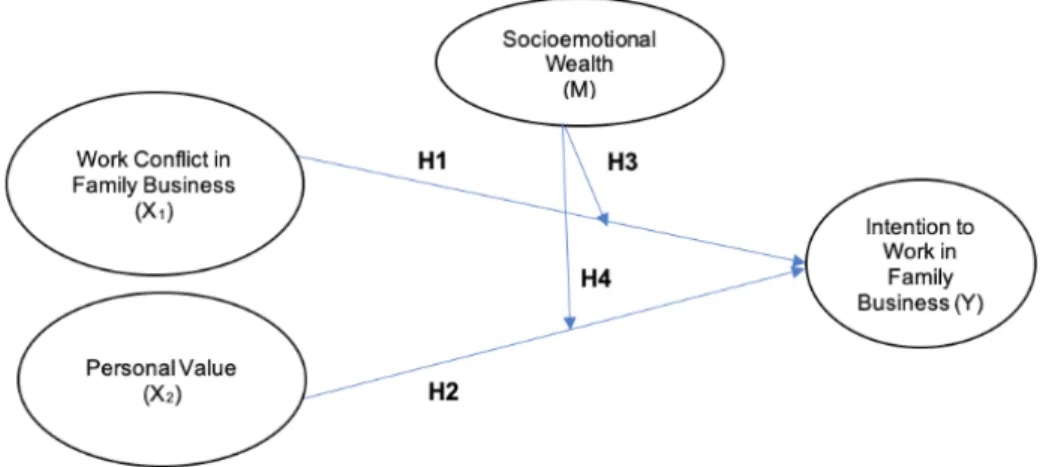
H1: Family conflict significantly affects the intention to work in the family firm.
7. Relationship Personal value and Intention to Work in Family Business Personal values are those attached to and owned by a person in living a life that comes from family and workplace conditions and can be related and valuable in the family-managed business succession process (Susanti & Sundiman, 2020). Personal values are related to the management of family companies.
However, they can also interfere with human behaviour, so personal values play an essential role in family companies’ decision-making process and management (Effendi, 2020). Personal values are directly related to the management of family companies. In the family-managed business succession process, personal values influence management decisions in maintaining the company to the next genera- tion (Camfield & Franco, 2019).
H2: Personal significantly affect the intention to work in the family firm.
8. Relationship Moderating effect of Socioemotional Wealth on Work Conflicts in Family Business and Intention to Work in Family Business
Work conflicts in family-managed businesses are vulnerable because of their different characteristics from non-family firms. Family firms controlled by families have more potential for conflict to arise, which will affect the emotional formation of families towards family companies (Effendi, 2020). Socioemotional wealth is wealth in the non-financial aspects of each individual in a family firm (the aspect of affection, family identity, and strong continuity that is a form of contribution to each individual’s emotional wealth) to be able to weaken conflicts that occur in families and conflicts (Riznika & Stefanus Kaihatu, 2021). work in the family firm to contribute to the intention to continue the family firms.
H3: Moderation of socioemotional wealth weakens the effect of work conflict in the family firm on the intention to work in the family firm.
9. Relationship Moderating effect of Socioemotional Wealth on Personal Value and Intention to Work in Family Business.
Personal values are referred to the management of family companies.
However, they can also interfere with human behaviour, so personal values play an essential role in family companies’ decision-making process and management.
Personal values are intimately tied to family firm’s management (Camfield &
Franco, 2019). Socioemotional wealth is wealth in the non-financial aspects of each individual in a family firm which is affection, family identity, and continuity of business which is a form of contribution to the emotional wealth of each individual in the family firms to be able to strengthen the formation of personal values for each individual. Individuals contribute to the intention to continue the family firms (Riznika & Kaihatu, 2021).
H4: Moderation of socioemotional wealth strengthens the effect of personal value on the intention to work in a family firm.
Figure 1 The Conceptual Research Framework
C. RESEARCH METHODS
Researcher uses inferential research. Inferential research analyses, interprets, predicts, and draws conclusions on data, phenomena, and broader problems (Rinaldi, et al., 2020). The research approach used is quantitative to analyse research data in the form of numbers and statistical analysis by processing raw data into useful information using inferential research (Rinaldi, et al., 2020).
This research will be carried out on master of management students with a family firms’ concentration, using a questionnaire in September-December 2021.
This research sampling is using purposive sampling, purposive sampling refers to a group of non-probability sampling techniques in which features are selected because the sample has desired properties (Lou, 2021). This research using smart PLS as a tool to generate this data research because there is moderation variable in this study (socio-emotional wealth) and the sample size is only 40 samples. The research population is master of management students from the School of Business, Ciputra University, Surabaya, who take the concen- tration of family firms from the 20–23 class.
Table 1 Number of Students (Family Business) Batch Number of Students from
a Different Batch
20 15
21 24
22 26
23 23
Total 88
Table 2 Sample Criteria and Parameters
Criteria Information Parameter The amount of families employed by a family-
owned firm. >2 1
Have experienced work conflicts in family firms Yes 1 Engaged in the family firms Yes 1
Total Parameter 3
The sampling method in this study used a non-probability sampling method, and the sampling technique used in this study was purposive sampling. Purposive sampling is a sampling technique based on specific characteristics or traits that have a close relationship with previously known population characteristics or traits, this research use purposive sampling because the sampling that needed in this study is specific which is master student of school of business from batch 20–
23 who had taken concretion on family business and the member of Family business must engage in family firms and must at least once have experience in
work conflict. To find out the sample in this study, the rule of thumb formula used by Hermawan & Yusran (2018) considers the number of existing para- meters.
The formula of the rule of thumb is:
N = (n) – 1 X 20………... 1 Where:
n : Total Parameter N = (1+1+1) – 1 X 20 N = 40 samples
Results:
Table 3 Respondent Data
x Frequency Percentage
Gender Male 19 47,5%
Female 21 52,5%
Business fields
Trade 20 50%
Manufacture 5 12,5%
Service 15 37,5%
Engaged in the family-manage business
Yes 40 100%
No - 0%
Have experienced work conflicts in the family-managed business
Yes 40 100%
No - 0%
The amount of families employed by a family-owned firm
1 0 0%
2 0 0%
>2 40 100%
Position in Family-managed Business
Director 17 42,5%
Managerial 11 27,5%
Finance 3 7,5%
Marketing 9 22,5%
Number of the student from a different batch
23 9 22,5%
22 8 20%
21 11 27,5%
20 12 30%
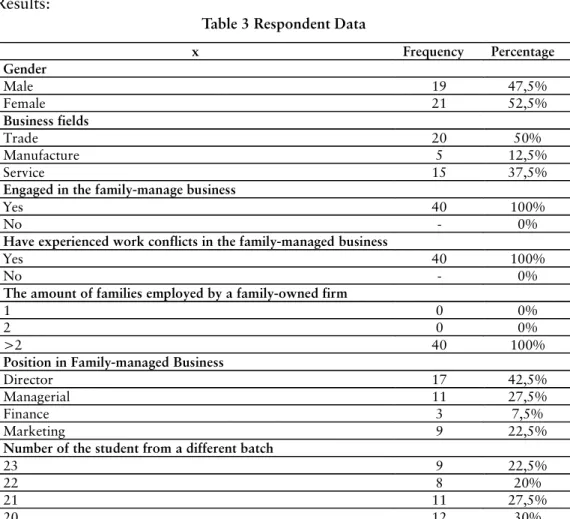
This study shows more female respondents than male respondents because women want to improve their education than their brothers because they want
to be recognized and considered equal to the candidates. The trade sector is still a priority because it is easy to run by many family members. However, the trading business sector is more at risk of conflicts because it involves many family members. After all, the size of the company tends to be medium and small, so family firmness in the trade sector is still often encountered have many family members working in the family firms. In manufacturing companies, family members are in the position of commissioners, so the possibility of involvement is slight; manufacturing companies employ more professional employees to run their companies because the company’s capacity is relatively large, so it requires reliable workers in their fields. Service companies have more workers who are not family members because service families are more focused on providing services that can meet consumer demand.
Table 4 Indicator Loadings and Latent Variable Coefficient Item Factor
Loading P Value Cronbach's
Alpha Composite Reliability WC1 0.708 <0.001 0.902 0.923 WC2 0.833 <0.001
WC3 0.803 <0.001 WC4 0.832 <0.001 WC5 0.907 <0.001
WC6 0.810 <0.001 0.902 0.925 PV1 0.727 <0.001
PV2 0.876 <0.001 PV3 0.769 <0.001 PV4 0.873 <0.001 PV5 0.818 <0.001
PV6 0.845 <0.001 0.941 0.949 SW1
SW2 0.733
0.796 <0.001
<0.001 SW3 0.838 <0.001 SW4 0.731 <0.001
SW5 0.846 <0.001 0.831 0.921 SW6 0.874 <0.001
SW7 0.717 <0.001 SW8 0.881 <0.001 SW9 0.877 <0.001 SW10 0.751 <0.001
IW1 0.940 <0.001 IW2 0.908 <0.001
In service business sector, consumer demand is difficult to fulfil with just a few people; in some cases, it requires a group of professional teams so that family members in the service sector are less frequent. Involved/reluctant to enter the workforce because of the large number of consumer requests and inability to carry out their duties properly. Better than the previous generation. Respondents in this study were involved in the family firms to gain preparedness for continuing the family firms. The family firms are a place for successor training so that they are ready and better know and understand their company so that in the future, they become reliable successors and can pass the company to the next generation, bringing the company to the point of glory. Work Conflicts in Family firms sometimes occur because Family firms have emotional relationships be- tween family members. Work conflicts need to occur to get productive conflicts, but excessive conflicts will be destructive for the company as well if the conflict is not resolved.
Table 5 Correlations among Latent Variables and Errors FC PV SW IW AVE 0.651 0.668 0.672 0.854
√AVE 0,807 0.817 0.819 0.924
Table 6 Structural Model Test
Model R Square R Square Adjusted Y 0,727 0,687
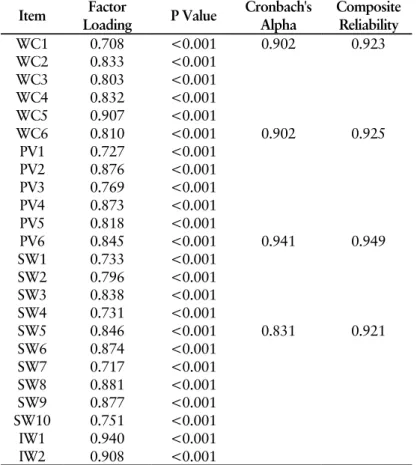
Table 5 displays the convergent validity test; each statement in this research is deemed valid because each AVE statement’s average variance extracted (AVE) value is > 0.5, and the outer loading value of each statement is > 0,7. Table 4 display the discriminant validity test, the outer loading value of each statement is accepted because the cross-loading value is > 0.7, and the value of each indicator is greater than the correlation between other indicators. So that every statement in this study is declared valid, all variables have good discriminant validity because all √ AVE >
R Square values so that all indicators are valid. Reliability test, the composite reli- ability value> 0.7 so that the data states all reliable variables, and the value of Cronbach’s alpha > 0.7 so all variables were declared reliable.
Table 7 Relationship Test
Variable t-statistic Description X1 -> Y 2,208 Significant
X2 -> Y 2,019 Significant
Moderating Effect 1 -> Y 2,040 Significant, Moderating Effect Moderating Effect 2 -> Y 2,337 Significant, Moderating Effect M -> Y 3,468 Significant, Moderating Effect
Table 6 display R square value reached 0.727 or 72.7%, so this research model can explain the magnitude of the diversity of research data the structural model can explain is 72.7%. In comparison, 27.3% is explained by other factors outside the structural model in this study.
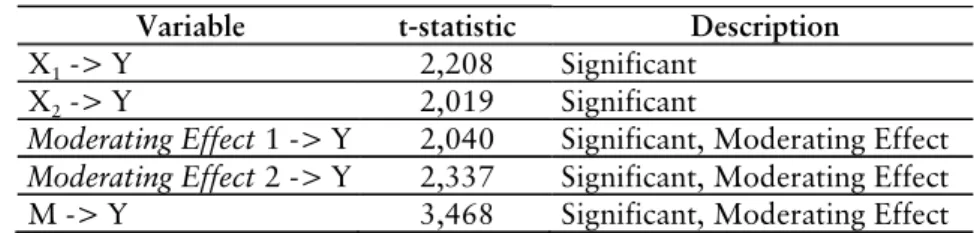
Table 7 displays that the significance test between the tested variables can be concluded from the t-statistic value. It can be seen that all variables have an excel- lent t-statistic value because the t-statistic>1.96, which indicates that the relation- ship between the path variables is significant. The independent variables (X1 and X2) have a significant relationship with the dependent variable (Y), t-statistic >
1.96, so the independent variables (X1 and X2) and the dependent variable (M) are both moderated by the moderating variable (M).
Table 8 Descriptive Analysis of Variables Variables Mean Category Work conflict 2.706 High Personal value 3.741 High Socioemotional wealth 3.938 High Intention to work 3.825 High
Table 9 Path Coefficient
Moderation M1 M2 FC PV IW Moderation
M1 M2 WC PV IW
0.378
0.406
0.378
-
0.359
0.332
Descriptive analysis in Table 8 shows that all the variables which are Family Conflict, Personal Value, Socioemotional Wealth, and Intention to Work have mean in high category.
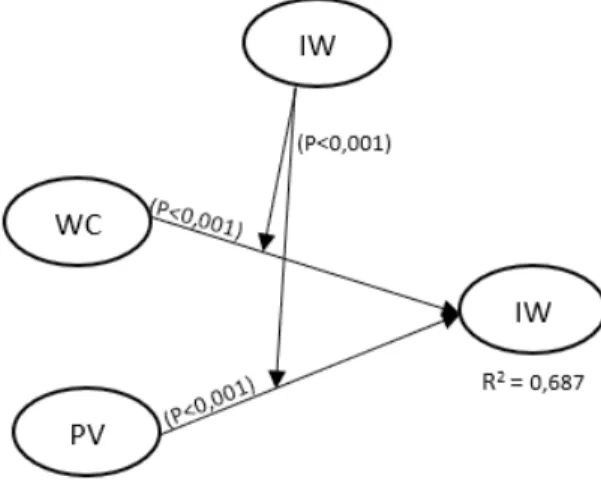
Figure 2 Outer Model Framework
1. The path coefficient of variable family conflict (FC) (p < 0.01) on intention to work coefficient value -0.359 has negative relationship, If the work conflict in the family firms increases, the intention to work in the family firms will decrease and vice versa. H1 hypothesis which states work conflict (WC) has a significant effect on intention to work (IW) is accepted but the relationship effect is negative.
2. Personal value and intention to work has positive relationship with Intention to work work (p < 0.01) and the coefficient value is 2,019. H2 hypothesis which states personal value (PV) has a significant effect on intention to work (IW).
3. Moderating effect 1 significantly strengthen effect on work conflict and intention to work (p < 0.01) The direction of the relationship is positive (2,040). H3 hypothesis which states socioemotional wealth (SE) has a strengthen effect between work conflict and intention to work (IW) is accepted.
4. Moderating effect 2 significantly strengthen effect on personal value and intention to work (p < 0.01). The direction of the relationship is positive (2,337). H4 hypothesis which states socioemotional wealth (SE) has a strengthen effect between personal value and intention to work (IW) is accepted.
D. RESULTS
1. Work Conflict in Family Business on Intention to Work in Family Business Table 7 displays a t-statistic value > 1.96 (2.208 > 1.96), the path coefficient value is -0.359. When workplace tension in the family-owned com- pany increases, the intention to work in the family firm also decreases. The family company suffers when there is more work friction in the family company, and the desire to work in the family firm develops (Effendi, 2020). The low mean value (2,076H”2) of the work conflict in family business (X1) variable is caused by the infrequent occurrence of conflicts among the respondents of this study, and the statements in the questionnaire tend to disagree (negative). The respondents of this study are Indonesian citizens who tend to cover up family problems and business so that other parties do not know (Swari & Melinda, 2019). Work conflict in the family business negatively influences the intention to work in the family firm, which could be accepted since the t-statistic value is more than 1.96 (2.208>1.96). The path coefficient value is -0.359, indicating that the relationship’s direction is negative, i.e., if the workplace conflict is in the firm. If the family firm increases, the intention to work in the family-managed business will decrease, and vice versa; if the work conflict in the family-managed business decreases, the intention to work in the family firm will increase. Conflict is essential in a family-owned business because it may spark productive debate and strategic aid planning. However, protracted and excessive conflict can lead to a breakdown in the family-managed business or successor’s decision to leave the family firms. The findings of this study confirm those of earlier studies (Effendi, 2020); Swari & Melinda, 2019).
2. Personal Value on Intention to Work in Family Business
Personal values are values that have been attached to and owned by a person in life that come from family and workplace conditions and can be related and valuable in the family firm’s succession process. Table 7 displays that Personal values affect the intention to work in the family-managed business and have a significant and positive outcome on the intention to work in the family firms.
The findings of this study are new and extend earlier studies (Susanti &
Sundiman, 2020; Camfield & Franco, 2019). It has a significant t-statistic value (2.019> 1.96) and a path coefficient value of 0.332 / an influence. There is a positive connection between the variables X2 and Y, so the higher the personal value (X1), the higher the intention to work in the family business (Y). Because family firms’ members are driven by their values and beliefs, which result in their dedication to growing the family firms, personal values play a significant part in the professionalization of family enterprises. In their roles as motivators and guiding concepts in people’s daily lives, personal values are thought to impact perceptions, attitudes, and conduct in personal and professional situations. Guide future generations’ decisions so they may more effectively discover their identity in the family and family company and facilitate commitment to work in the family firms. Family firms strive want preserve the values within family and teachings learned from their predecessors (Susanti & Sundiman, 2020; Camfield
& Franco, 2019).
3. Moderation of Socioemotional Wealth on Work Conflict and Intention to Work
Table 7 displays the moderating of socioemotional wealth on the determi- nants of a work conflict. The intention to work in a family-managed company is acceptable because emotional wealth moderating influences strengthening personal values on the intention to work in the family firm (2,040>1.96). A smooth succession allows for intentions to continue working in the next generation in a family. As an emotional value, socioemotional wealth has a binding influence on the family firm, making it viable. Respondents in this survey expressed a “deep sense of belonging, confidence in the family company, strong emotional bonds and ties, and a desire to carry on family traditions and
“heritage. Even to the next generation, by having good emotions, the stronger the family’s socioemotional wealth, the family members are not easily affected by existing conflicts because they have good emotional well-being. Therefore, emotional wealth helps make respondents more likely to stay in the family company and less likely to want to quit. The findings of this investigation back up prior research (Effendi, 2020; Ghosh & et al., 2015).
4. Moderation of Socioemotional Wealth on Personal Value and Intention to Work
Table 7 displays that the moderation of socioemotional wealth on personal values and intentions to work in a family firm is acceptable because moderating emotional wealth strengthens personal values on intentions to work in a family firm (2.337> 1.96). The socioemotional wealth “improves the effect of personal values on the intention to work in the family company because the path coefficients value gives positive findings of 0.387. Personal values impact a person’s behaviour and decision-making processes in a family company; personal values are frequently generated from ideals established and socialized in children at a young age, particularly from parents. Socioemotional wealth is a set of non- financial benefits related to family members’ welfare and affective needs derived from operating a business firm. The findings of this research, Socio-emotional riches the critical motivation of family firms is the desire to preserve a family’s socioemotional wealth. If Socio-emotional wealth in a family decreases, there is a significant emotional loss in the family, so family companies try to avoid the decline in socio-emotional wealth at all costs. The personal values instilled in families who have family firms are responsible attitudes. Pride in the family is the most important thing that children have so that children have a desire to preserve the socio-emotional wealth that exists in the family and avoid decreasing socioemotional wealth at all costs—strengthening an individual’s socio-emotional wealth and personal values in a family firms (Ruf et al., 2020). The results of this study are new findings for the extension of previous research (Susanti &
Sundiman, 2020; Camfield & Franco, 2019; Riznika & Stefanus Kaihatu, 2021;
Ruf et al., 2020).
E. DISCUSSION
1. Work Conflict in Family Business on Intention to Work in Family Business Work conflict in family firm (X1) negatively affects the desire to work in a family business (Y), meaning that there is a conflict in the respondent’s family firms in this study. However, the work conflict does not affect the respondent to leave the family company. If the work conflict in the family firms increases, the
intention to work in the family firms will decrease and vice versa. The desire to work in the family company is growing. If work conflict in the family company lessens, work conflict in the family firms decreases. However, productive conflict is good for finding new ideas in business development, but if the conflict cannot be resolved and tends to be destructive, a mediator is needed to reach a middle ground, and the conflict can be resolved decreases and the successor will be willing to continue the family firms (Swari & Melinda, 2019).
2. Personal Value on Intention to Work in Family Business
Personal Value (X2) has a significant and significant influence on the intention to work in a family firm (Y) variable means having an excellent personal value (X2) so that it supports the intention to work in a family business (Y). The higher the personal value (X2) is owned, the higher the intention to work in the family-managed business (Y). It is vital to the family to gather together and talk about wrong values in the family and eliminate these values to the next generation, as well as choose good values and develop these values to become personal values that will be instilled in future generations so that they will support in the desire to become a successor, building good relationships between family members, assigning competent family members on the board of directors by giving equal treatment to employees who are not family members by looking at the performance of each individual (fair even if family members and non-family members), building business strategy planning with planning mature taking into account the company’s objectives, strengthening the personal values of the family by means of communication by improving a comfortable and healthy family and work environment and emphasizing that the family is the most important thing that family members have and a place to be open (to discuss personal problems, be more open) and to build a more honest and honest character. Open (transparent), professionalism (not mixing business problems and family problems), continuing the legacy and tradition in the family firms (which is still relevant), and instilling that the goal of the family firms is a transfer of succession is a crucial goals in a family firms (Camfield & Franco, 2019;
Susanti & Sundiman, 2020).
3. Moderation of Socioemotional Wealth on Work Conflict and Intention to Work
Socio-emotional Wealth Moderation Variable strengthens the relationship between work conflict in family business (X1) and Intention to work in family business (Y). It means the more vital socio-emotional wealth (M) owned by a family, the stronger the relationship between work conflict in family business (X1) on Intention to work in family business (Y). Social-emotional wealth is the wealth of the non-financial aspects of each person in a family business, which are aspects of affection, family identity, and business continuity, a form that contrib- utes to each person’s emotional wealth and that social-emotional wealth can undermine, conflicts within the family and labour management conflicts in the family business contribute to the will to continue the family business (Riznika &
Stefanus Kaihatu, 2021). It is important to hold meetings or meetings to produce productive work conflicts. It can also be with family members involved and with certain divisions concerned to discuss problems that exist in the company and come up with valuable ideas for company strategy, maintain good values that already exist, and add new personal values that are relevant to the family firms to create a good environment, building good socio-emotional wealth and main- taining good socio-emotional wealth in the family so that the family firms can be sustainable for future generations business (Swari & Melinda, 2019; Camfield &
Franco, 2019; Susanti & Sundiman, 2020).
4. Moderation of Socioemotional Wealth on Personal Value and Intention to Work
Socioemotional wealth moderation variable strengthens the relationship between personal value (X2) on intention to work in a family business (Y) which means that the more vital socioemotional wealth (M) owned by a family strengthens the relationship between personal value (X2) and intention to work in a business family (Y). Social-emotional wealth is the wealth of the non- financial aspects of each person in a family business, which are aspects of affection, family identity, and business continuity, a form that contributes to each person’s emotional wealth and that social-emotional wealth can undermine, conflicts within the family and labor management conflicts in the family business
contribute to the will to continue the family business. Instilling aspects of personal value and socioemotional wealth in the family firms and adding personal value and socioemotional wealth that is suitable for the family and corporate culture to the next generation because it is vital to building the character and values that are instilled to be a provision to be able to make decisions in everyday life. Days or decisions in determining a career path (to work in the family managed-business or to leave the family firm) these values can be carried out by building good relationships with children and parents so that there is harmony, thus creating a comfortable situation in the family. Make a potential successor love his family and have good characteristics such as being honest, responsible, and having an attitude of transparency between family members and decisions (Effendi, 2020; Kalm & Gomez-Mejia, 2016).
F. CONCLUSION
Work conflict variable in family business (X1) negatively affects the inten- tion to work in a family business (Y), meaning that was the conflict in the respondent’s family business in this study, but the work conflict did not affect the respondent to leave the family company; if the work conflict in the family firms increases, the intention to work in the family firms will decrease (vice versa). The intention to work in a family-managed business is increasing. If work conflict in the family firm decreases, then the work conflict in the family-managed business decreases. In several cases, it was stated that even though the successor did not have the will to continue the family firms (not according to passion) or had a family conflict or work conflict in the family firms, the successor still wanted to continue the family firms by force because if he did not continue the company, the succession to the next generation would fail and the company would fail.
Will be destroyed (Silva et al., 2021). the respondents in this study, who are Indonesian citizens, often cover up family problems so that they have the potential to cause conflict if the conflict occurs and is difficult to resolve so that a third party/mediator is needed to resolve the problem in order to achieve a middle ground. The conflict can be resolved so that conflict is not more protracted and does not cause destruction to the company.
Personal value (X2) has a positive and beneficial influence on the intention to work in a family firm (Y) means having an excellent personal value (X2) so that it supports the Intention to work in a family business (Y), the higher the personal value (X2) is owned, the higher the intention to work in the family business (Y). Families need to gather together and talk about wrong values in the family and eliminate these values for the next generation, as well as choose good values and develop these values to become personal values that will be instilled in future generations so that they will support in the desire to become a successor determinant to work in the family firms or a career in other businesses.
Socio-emotional wealth strengthens the relationship between work conflict in family business (X1) and intention to work in family business (Y) which means the more vital socio-emotional wealth (M) owned by a family, the stronger the relationship between work conflict in family business (X1 ) on intention to work in family business (Y)—building good relationships between family members, assigning competent family members on the board of directors by giving equal treatment to employees who are not family members by looking at the perfor- mance of each individual (fair even if family members and non-family members), building business strategy planning with planning mature by considering the company’s objectives and the company’s financial position.
Socioemotional wealth strengthens the relationship between personal value (X2) on intention to work in a family business (Y) which means that the more vital socioemotional wealth (M) owned by a family strengthens the relationship between personal value (X2) and intention to work in a business family business (Y). Strengthening the values of the family utilizing communica- tion by improving the family environment and a comfortable and healthy work environment and emphasizing that the family is the most important thing that family members have and a place to be open (to discuss personal problems, be more open) and build a more honest and honest character. Open (transparent), professionalism (not mixing business problems and family problems), continuing the legacy and tradition in the family firms (which is still relevant), and instilling that the purpose of the family firms is succession transfer is a fundamental goal in family companies.
G. LIMITATION
This research was conducted at the School of Business, Ciputra University, namely Master of Management students who took the Family Business Concen- tration with the criteria of having experienced work conflicts in the family business, having family members working in the family business >2 and being involved in the family business, so the number of samples was limited. In this study, researchers were unable to explore the level/health of the respondents’
socio-emotional wealth and the level of the conflict phase experienced by the respondents. In addition, the limitations of this study can open further research in the sense of expanding variables. Some variables that might be interesting to study are the decision to leave the family business and other moderating variables such as cultural values.
H. REFERENCES
Ajzen, I. (1991). The theory of planned behavior. Organizational Behavior and Human Decision Processes, 50(2), 179–211. https://doi.org/10.1016/0749- 5978(91)90020-T.
Aulia, M. L. & Setiawati, C. I. (2020). Identifikasi Perencanaan Suksesi dan Mentoring pada Perusahaan Keluarga di PD Bina Pratama Putra. Fakultas Komunikasi dan Bisnis, Universitas Telkom, Vol. 7, No. (ISSN/ : 2355- 9357), 6177.
Berrone, P., Cruz, C., & Gomez-Mejia, L. R. (2012). Socioemotional Wealth in Family Firms: Theoretical Dimensions, Assessment Approaches, and Agenda for Future Research. Family Business Review, 25(3), 258–279. https://
doi.org/10.1177/0894486511435355.
Camfield, C. & Franco, M. (2019). Theoretical framework for family firm management: Relationship between personal values and professionalization and succession. Journal of Family Business Management, 9(2), 201–227.
https://doi.org/10.1108/JFBM-06-2018-0020.
Debicki, B. J., Kellermanns, F. W., Chrisman, J. J., Pearson, A. W., & Spencer, B.
A. (2016). Development of a socioemotional wealth importance (SEWi)
scale for family firm research. Journal of Family Business Strategy, 7(1), 47–57. https://doi.org/10.1016/j.jfbs.2016.01.002.
Dusmezkalender, E. & Secilmis, C. (2020). Relationship between Work-Family Conflict and Turnover Intention: A Meta-Analysis of the Researches on Tourism. Organizational Behavior Challenges in the Tourism Industry, 1, 15. https://doi.org/10.41018/978-1-1474-0.ch020.
Effendi, L. V. (2020). The Impact of Family Conflict toward Intention to Stay in the Family Business: The Moderating Effect of Socioemotional Wealth.
Journal of Applied Management, 18(1).
Ghosh, A. Al. & Tang, C. Y. (2015). Assessing financial reporting quality of family firms: The auditors’ perspective. Journal of Accounting and Eco- nomics, 60(1), 95–116. https://doi.org/10.1016/j.jacceco.2015.03.002.
Hermawan, A. & Yusran, H. L. (2018). Penelitian Bisnis Pendekatan Kuantitatif (1st ed.). Depok: KENCANA.
IFB Research Foundation. (2019). Maintaning Family Values. IFB Research Foundation, (2), 8.
Kalm, M. & Gomez-Mejia, L. R. (2016). Socioemotional wealth preservation in family firms. Revista de Administração, 51(4), 409–411. https://doi.org/
10.1016/j.rausp.2016.08.002.
Kossek, E. E. & Lee, K.-H. (2017). Work-Family Conflict and Work-Life Conflict. Journal of Oxford. Retrieved from https://oxfordre.com/business/
view/10.1093/acrefore/9780190224851.001.0001/acrefore-9780190224851- e-52.
Ljubotina, Predag, & Vandjal, J. (2017). Succeeding a family business in a transition economy: is this the best that can happen to me? Kybernetes, 46(8), 1366–1385. Retrieved from https://www.emerald.com/insight/con- tent/doi/10.1108/K-06-2016-0148/full/html.
Ljubotina, Predrag, Omerzel, D. G., & Vadnjal, J. (2018). Succeeding a family business in a transition economy: Following business goals or do it in my own way? Serbian Journal of Management, 13(1), 29–46. https://doi.org/
10.5937/sjm13-14474.
Lou, D. C. (2021). The Effect of Price, Promotion, and Packaging towards Purchase Intention of Stacks Food in Surabaya. Review of Management and Entrepreneurship, 5(2), 75–92. https://doi.org/10.37715/rme.v5i2.1619.
Porfírio, J. A., Felício, J. A., & Carrilho, T. (2020). Family business succession:
Analysis of the drivers of success based on entrepreneurship theory. Journal of Business Research, 115(July), 250–257. https://doi.org/10.1016/
j.jbusres.2019.11.054.
PricewaterhouseCoopers. (2018). The Next Gen Club for Family Business Heirs.
Retrieved from http://www.yardeni.com/premiumdata/mb_180926.pdf.
PricewaterhouseCoopers. (2021). 10th Global Family Business Survey: From Trust to Impact. 1–32.
Razzak, M. R., Mustamil, N., & Bakar, R. A. (2020). Research gaps in family owned businesses: A conceptual link between socio-emotional wealth, family commitment and firm performance. International Journal of Busi- ness Excellence, 20(2), 205–222. https://doi.org/10.1504/IJBEX.2020.
105345.
Riznika, I. & Stefanus Kaihatu, T. (2021). Sustainability of Family Business:
Millennials Intention To Stay in the Family Business As the Result of Stewardship Climate, Mediated By Successor’s Trust and Socioemotional Wealth. Jurnal Aplikasi Manajemen, 19(1), 82–91. https://doi.org/10.21776/
ub.jam.2021.019.01.08.
Ruf, P. J., Moog, P. M., & Rius, I. B. (2020). Values as antecedents of socio- emotional wealth behaviour in family firms. International Journal of Entrepreneurship and Small Business, 40(1), 83–113. https://doi.org/10.1504/
IJESB.2020.106944.
Saputra, N. (2018). Value-Based Leadership Development: a Case Study from PT Xyz. Review of Management and Entrepreneurship, 1(2), 1–10. https://
doi.org/10.37715/rme.v1i2.603.
Silva, R., Coelho, A., Sousa, N., & Quesado, P. (2021). Family business manage- ment: A case study in the Portuguese footwear industry. Journal of Open Innovation: Technology, Market, and Complexity, 7(1), 1–26. https://
doi.org/10.3390/joitmc7010055.
Soltani, I., Hajatpour, S., Khorram, J., & Nejati, M. H. (2013). Investigating the effect of role conflict and role ambiguity on employees’ job stress/ :Articu- lating the role of work-family conflict. Management Science Letters, 3(7), 1927–1936. https://doi.org/10.5267/j.msl.2013.06.036.
Susanti, S. & Sundiman, D. (2020). the Influence of Personal Value on Family Business Professionalism (Sme Case Study in Batam). Jurnal Terapan Manajemen Dan Bisnis, 6(2), 34. https://doi.org/10.26737/jtmb.v6i2.2279.
Swari, I. A. I. & Melinda, T. (2019). Socio-emotional Wealth, while Family Conflict and Family Firm Governance Both Exist in Family Business. Liceo Jurnal of Higher Education, 28.
Utami, C. W. (2019). the Difference Pattern of Succession Between Second Generation and Third Generation Family Business in Indonesia (a Review of the Medium-Size Family Business). Review of Management and Entrepre- neurship, 3(2), 133–154. https://doi.org/10.37715/rme.v3i2.1204.
Wijaya, A., Rinaldi, A., Mutiara, R., & Sinaga, O. (2020). Finding Revolutionary Road To Industry 4.0 for Women’S Small-Scale Business. PalArch’s Journal of Archaeology of Egypt/Egyptology, 17(5), 792–804. Retrieved from https:/
/scholar.google.com/citations?view_op=view_citation&hl=en&user=
owz7ARcAAAAJ&cstart=100&pagesize=100&citation_for_view=owz7 ARcAAAAJ:t6usbXjVLHcC.
Wu, M., Coleman, M., Abdul Rahaman, A. R., & Edziah, B. K. (2020). Successor selection in family business using theory of planned behaviour and cogni- tive dimension of social capital theory: evidence from Ghana. Journal of Small Business and Enterprise Development, 27(6), 905–926. https://doi.
org/10.1108/JSBED-05-2019-0152.