The Influence of Digital Marketing and Social Media on Product Creativity and Empowerment of Women's Culinary Group of Bojong Kulur Village, Bogor
Elfa Setiawan 1, Ahmad Junaidi 2*, Dinda Aulia Rahman 3
a1,2,3Institut Ilmu Sosial dan Manajemen STIAMI, Jakarta, Indonesia
1 [email protected] 2 [email protected] *; 3[email protected]
* corresponding author
1. INTRODUCTION
In the era of globalization, information technology plays an important role in human life.
Information technology is a powerful resource to compete globally. Information is the main key in advancing science and technology, which is the main pillar in a country's development. Currently, the use of information technology has become an essential need for everyone, from children to adults. The development of information and communication technology is taking place rapidly, including advances in communication via mobile devices, the internet, television, and others. This has made access to information easier, so that information becomes faster and easier to obtain.
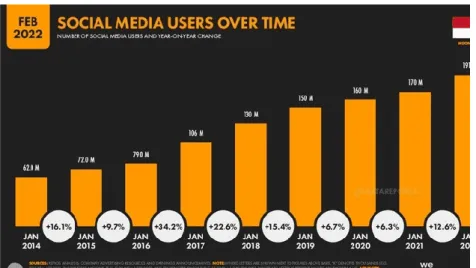
Various aspects of human life have been affected, even changed, due to the current adoption of information and communication technology. We are currently experiencing the industrial revolution 4.0 period which is characterized by the dominance of digital technology. The advent of this era of disruption has simplified, accelerated, and saved many things, which in turn has influenced changes in consumer behavior patterns. Applications such as WhatsApp or WA, Instagram, Facebook and TikTok have become popular among social media users, especially among women. These applications are often used for business, for example by uploading images of the products being offered. Since 2014, the number of social media users in Indonesia has continued to increase.
A R T I C L E I N F O A B S T R A C T
Article history
Received :15 September 2023 Revised : 20 September 2023 Accepted : 24 September 2023
This study investigated the impact of digital marketing and social media on the creativity of products and the empowerment of culinary groups of women in Bojong Kulur village, Bogor. It also aimed to identify the most important factor in increasing product creativity and culinary group empowerment. A total of 180 respondents were purposefully selected from April to August 2023. Purposive sampling was used to collect questionnaires from producers and consumers. Descriptive statistical analysis using SPSS version 22 was used to analyze the data.The research results showed that digital marketing and social media have a significant impact on creativity empowerment. The study found that the significance value (Sig) of digital marketing strategy (X1) on creativity empowerment (Y) is 0.000, which is less than the significance level of 0.05. This means that there is a statistically significant relationship between digital marketing strategy and creativity empowerment. The study also found that the significance value (Sig) of the effectiveness of using social media (X2) on creativity empowerment (Y) is 0.001, which is also less than the significance level of 0.05. This means that there is a statistically significant relationship between the effectiveness of using social media and creativity empowerment. Based on these findings, the study concluded that digital marketing and social media have a simultaneous effect on creativity empowerment. This means that both digital marketing and social media can independently and jointly influence creativity empowerment.
Keywords:
Digital marketing;
Social media;
Product creativity;
Empowerment;
Women’s culinary;
Figure 1. Graph of social media users in Indonesia in 2022.
Source: Kepios Analysis Company Advertising resources & Earning Announcements.
Based on the data shown in the graph above, in 2014, the number of social media users reached 62.0 million people. In 2015, this figure increased to 72.0 million people, and so on until it reached 191 million social media users in 2022. Other data also reveals that internet users in Indonesia have several main reasons for using the internet. These main reasons include the fact that 80.1% of them use the internet to search for information, 72.9% look for it to find new ideas and get inspiration, 68.2% use it to interact with friends and family, 63.4 % spend their free time on the internet, 61.4% follow the latest news and developments, while 58.8% use it to watch videos, television programs and films, among other purposes.
Most social media users currently meet all the criteria listed in the data above, especially those in the culinary business and food and beverage industry. In Indonesia, food and beverage supply businesses have actively used various methods to promote their businesses and products. With ongoing changes in times, online media has become the most used promotional tool. According to data from the Central Statistics Agency (BPS), in 2020, around 71.74% of food and beverage providers relied on online media as the main tool to market their products or businesses. Apart from that, around 36.64%
used banners as a promotional tool, and 30.16% chose brochures. Another small portion, around 8.65%, still relies on television and radio as promotional tools. In addition, around 7.41% of businesses use promotion through newspapers or magazines, and around 10.07% use various other media to promote their business. BPS also noted that in the current digital era, most of the food and beverage providers have shifted to online sales, reaching around 85.55%. In online sales, around 61.69% of them use ordering services from third parties, 49.69% use social media, and only around 17.62% rely on their own website as a sales platform.
Figure 2. Promotional media graphic for marketing businesses/products.
Source: Badan Pusat Statistik (BPS) tahun 2020.
Developing a culinary business is an attractive business opportunity, especially for women, especially housewives. If someone has an idea for a unique food product, this can be a profitable home business, especially for housewives. Cooking has become part of the daily tasks of housewives, and this can be the basis for starting a culinary business. Especially if the housewife has a love for cooking and can create delicious dishes. The culinary business is a form of creative business that suits the situation of housewives. Some options include selling snacks, processed food products, or even cakes. However, the activities carried out by several culinary business actors have not been able to improve their economy. According to Hamdi (2019: 44), these businesspeople still have low knowledge about the activities that can be said to be the home industry they are involved in. Apart from that, there is still a low level of understanding among home industry players about the importance of the internet for support business activities and lack of knowledge about the use of information technology in marketing the products produced due to not knowing the benefits of the internet and feeling that the benefits of the internet do not match the costs incurred. Hamdi also stated that the problems experienced by culinary businesspeople are (1) Lack of knowledge about the home industry, (2) Low understanding of home industry players about the importance of the internet to support business activities, 3) Lack of knowledge about the use of the internet in marketing the products they produce.
In this digital era, running an online business can be accessed by anyone, including housewives who can use technology and the internet to make a profit. One effective way is to promote food products online, focusing on processed foods, modern dishes, healthy drinks, and others. Online food businesses are currently increasingly in demand for entrepreneurs who want to start a culinary business. This is because culinary businesses tend to always have customers, even though competition is high. The existence of the internet also provides advantages in terms of marketing. The internet has helped make many aspects of life easier, and in the business world, online technology can help in marketing efforts and brand building. The profile of the Bojong Kulur village which is the focus of the author's research is a village located in the Gunung Putri sub-district, which is under the Bogor district, in the province of West Java. Even though this area is called a village, not a sub-district, it has a very urban atmosphere, unlike villages in general. In the Bojong Kulur area there are many housing developments with urban, minimalist, Mediterranean concepts, and so on, such as Vila Nusa Indah 1, 2, 3 and 4 housing, Bumi Mutiara housing, Mahkota Pesona Vila housing, and others. The Bojong Kulur area measures 477,977 ha, with a population of approximately 52,000 people. When village head elections were held in 2008, there were approximately 27,000 people registered in the DPT. This village is divided into 6 hamlets, 41 Neighborhood Units, and 218 Neighborhood Units. The author carried out sampling by selecting mothers who lived in several housing complexes in Bojong Kulur village. They are considered representatives of the residents of Bojong Kulur village which borders Jatiasih in Bekasi to the north, Ciangsana village to the south, Bantar Gebang in Bekasi to the east, and Jatiasih sub-district in Bekasi to the west.
This research focuses on mothers from Bojong Kulur village whose daily activities are housewives. Along with advances in social media technology, especially WhatsApp, many communities or associations of citizens have emerged who are creative in various fields. The creativity of processed food products is the most prominent home business compared to the creativity of other products such as clothing, drinks, and there are also service products such as home repairs, air conditioning, vehicles, etc. The author is interested in finding out whether digital marketing, the use of social media are factors in increasing product creativity and empowering the culinary group of women in Bojongkulur village, Bogor. The author hopes that the results of this research will contribute to the field of social sciences, especially the field of marketing home culinary products through community empowerment programs using theoretical and technical training methods related to increasing sales of community creative products.
Based on the problem context that has been explained, the formulation of the problem in this research can be described as follows.
1) Does digital marketing have an effect on increasing product creativity and empowering the culinary group of women in Bojongkulur village, Bogor?
2) Does the use of social media have an effect on increasing product creativity and empowering the culinary group of women in Bojongkulur village, Bogor?
3) Do digital marketing and the effectiveness of using social media have a joint effect on empowering the creativity of women in Bojongkulur village, Bogor?
2. LITERATURE STUDY Digital Marketing Strategy
A good strategy is really needed by companies when entrepreneurs or leaders want to achieve the goals and targets that have been set in an organization or business entity. Having the right strategy which will certainly guide the plan maker more effectively and can be executed well will bring success to the company.
Strategy is a plan or direction of action used to achieve certain goals. The strategy must consider internal and external factors, such as the company's strengths and weaknesses, opportunities and threats in the market, and economic and political conditions. More generally, strategy is a series of policies designed by the highest leadership of a company to achieve its long-term goals. This strategy must be translated into appropriate plans, decisions, and actions. Basically, strategy is a company's way of competing and winning the competition. A good strategy will help a company achieve competitive advantage and achieve success. (Prasetyo & Febriani, 2020).
Marketing
Marketing is an activity carried out by individuals, groups, or companies to fulfill their needs and desires by creating and offering products or services of value to others. (Saleh & said, 2019). An alternative definition of marketing is the core activities contained in every business, including small and medium industrial businesses or home businesses, which aim to maintain business continuity and development and ensure success in achieving goals and making profits.
Digital Marketing
The unlimited dissemination of marketing information opens opportunities for products to be bought and sold all over the world. Like now, for example, skincare products, frozen food, clothing and so on originating from Indonesia are starting to be known by people from other countries. Digital marketing is a marketing activity that uses digital technology to communicate with consumers and promote products or services. Digital technologies used in digital marketing include the internet, social media, email, and mobile devices. (Sasongko et al., 2020). In general, digital marketing is a marketing activity that utilizes digital technology, such as the internet and social media, to achieve marketing goals. Digital technology allows businesspeople to communicate with consumers and promote products or services more effectively and efficiently.
Social media
Social media is a means of online communication that allows individuals and groups to share their information, knowledge, and views. Social media uses digital conversation platforms, which are web-based applications that allow users to create and share content in a variety of formats. Solis and Breakenridge (2009) explain that social media is a phenomenon that allows individuals and groups to share information freely and easily. Social media is supported by web 2.0 technology, which allows users to become agents of information dissemination. Thus, social media has changed the way information is distributed, from a broadcast model to a many-person-to-many model. Definition of social media according to Solis and Breakenridge (2009):
a. A phenomenon that reflects freedom in sharing information
b. Changes in the role of individuals in the process of accessing and disseminating information.
c. Supported by web 2.0 technology.
Social media influence:
a. Give power to the community to become agents of information dissemination.
b. Changing the way information is distributed, from a broadcast model to a many-person-to-many model.
Digital Marketing Media
In digital marketing, of course there are media that support so that digital marketing can run well.
The following are supporting media according to Chole and Dharmik in the Marketing Management book (2018), namely:
1. Cellular phone
The use of mobile devices has become almost universal among companies offering a variety of products and services, including shopping products, specialty products, luxury products, and so on.
These companies use mobile devices to promote their products or services via text messages (SMS) or mobile applications such as WhatsApp, Line, and the like.
2. Social Media Marketing
The use of social media as an online marketing strategy is growing rapidly compared to other marketing methods. Many companies today utilize various platforms such as Facebook, Instagram, Twitter, YouTube, and others to communicate with customers and market their products or services.
3. Search Engine Marketing
Search Engine Marketing is the optimal option for searching for information on the internet. There are various sources of website traffic, but the best traffic comes from the major search engines, especially when attracting pre-targeted visitors. The strategy used in search engine marketing is to increase the visibility of a website and rank it high in search engine results. However, keep in mind that this strategy also requires certain investment costs.
4. Search Engine Optimization
It is a process that influences the appearance of a website on search engines such as Google, Yahoo, and Bing. The website can be optimized with certain keywords so that it can appear on the first page of search results for internet users.
5. Email of Marketing
Email marketing is the practice of sending messages to individuals or potential customers via email containing information about products or services. The message can be an advertisement, video, or other type of message aimed at increasing customer awareness or knowledge about the product.
6. Text Messages
This is the only easy and efficient marketing way to send messages containing information about products, both goods and services, using mobile devices.
Empowerment
Empowerment is a concept that emphasizes the granting of power, which can apply to individuals, groups, or associations. Empowerment can be initiated by the community itself or by the local government. In the context of village communities in accordance with Law of the Republic of Indonesia Number 6 of 2014, especially Article 12, empowerment refers to efforts to increase community independence and welfare. This is done by increasing knowledge, attitudes, behavioral skills, awareness, and utilization of resources through policies, programs, activities, and guidance that are in accordance with the problems and priorities of the Village community. Thus, empowerment is a process towards empowerment that gives people the ability to control their own lives through empowerment efforts.
Empowerment is a concept that includes both processes and goals. As a process, empowerment involves a series of activities aimed at increasing the capabilities or empowerment of vulnerable groups in society, including those in conditions of poverty. As a goal, empowerment refers to the results achieved through social change, namely individuals who have the authority, knowledge, and capabilities to meet their various needs, such as physical, financial, and social needs. This includes
increased self-confidence, the ability to communicate clearly, have a stable livelihood, actively participate in social activities, and be independent in carrying out their life responsibilities (Edi, 2005 as cited in Halil 2022).
Empowerment has two different meanings. The first meaning is giving power or authority to individuals or groups, while the second meaning is giving them abilities or opportunities. The first meaning includes actions such as giving, handing over, or transferring power to individuals or groups who initially had little or no power. Meanwhile, the second meaning involves providing skills or capabilities to other people and giving them the opportunity to do something. In the context of the concept of society, Paul B. Hartono as quoted by Bagja Waluya defines society as a group of people who are relatively independent, live together in a certain area for a long period of time, have a similar culture, and generally carry out most of their activities as members of the group. In this research, the community in question is the community of Bojong Kulur Village, which is in Gunung Putri District, Bogor Regency, West Java.
Thus, community empowerment can be described as efforts or steps aimed at strengthening capabilities by encouraging, providing support, increasing awareness of existing potential, and trying to develop it. In this research, the author discusses empowerment which is a process or initiative carried out by a group of mothers in Bojong Kulur Village, Bogor Regency. This is done through training activities with the aim of increasing community knowledge and skills.
Creativity
Creativity is a pattern of active behavior possessed by students which is characterized by great curiosity, the inability to remain silent in an activity, and the motivation to grow and develop both within themselves and in interactions with others. Some experts also define creativity in a similar way.
According to Suyanto & Asep Djihad quoted by Istirani and Intan Pulungan (2017:131), creativity can be interpreted as an effort to create something new and different.
Based on the description of the problem above, the author contains a hypothesis for this research, namely:
H1: Digital marketing has an effect on increasing product creativity and empowering the culinary group of women in Bojongkulur village, Bogor.
H2: The use of social media has an effect on increasing product creativity and empowering the culinary group of women in Bojongkulur village, Bogor.
H3: Digital marketing and the effectiveness of using social media jointly influence the empowerment of creativity of women in Bojongkulur village, Bogor.
3. METHOD
Researcher uses a conclusive research approach with a causal type of research. Conclusive research is a type of research design characterized by the measurement of a marketing phenomenon that has a clear definition. On the other hand, causal research is a form of conclusive research which mainly aims to collect data about correlation or cause-effect relationships (Malhotra, 2005:90). Conclusive research is a type of research that is more formal and structured compared to exploratory research. The goal of conclusive research is to test specific hypotheses and analyze specific relationships.
The researcher chose to use a conclusive research approach, with the application of causal research as the core focus. Conclusive research is recognized as a research method characterized by the measurement of marketing phenomena that have been clearly defined. On the other hand, causal research is part of the conclusive research category which has the main aim of collecting data related to cause-effect relationships or correlations (Malhotra, 2005:90). This conclusive research has a higher level of formality and structure when compared to exploratory research. The main goal is to test specific hypotheses and carry out in-depth analysis of existing relationships.
In connection with this research, the variables used are Dependent Variable and Independent variables. The dependent variable focuses of attention study. According to (Sugiyono, 2012) the dependent variable is often referred to as the output variable, criterion, consequent or dependent
variable. The dependent (bound) variable is a variable that is influenced or is a result of the existence of the independent variable. In this research the dependent variable is Creativity Empowerment (Y).
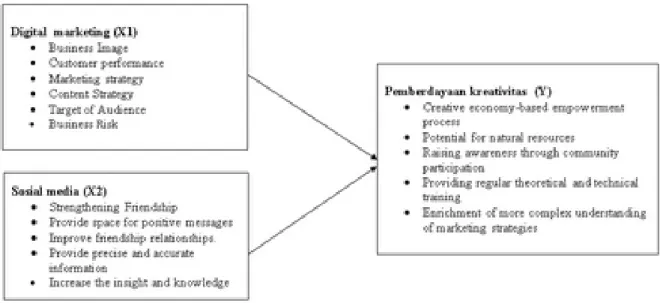
Meanwhile, the independent variable is a variable that influences, or which is the cause of the change and the emergence of the dependent (dependent) variable (Sugiyono, 2012). The independent variables in this research are: Digital Marketing (X1) and Social Media (X2).
Figure 3. Model of the research
This research is based on the use of a large sample that represents the population, and the data collected is analyzed using quantitative methods. Conclusive research is a type of research that is generally used by companies and academics because the results are based on statistical data, so they can be used as a reference in the decision-making process. Typically, conclusive research is used to measure market potential, analyze markets (such as market size, supplier availability, and customer or consumer profiles), evaluate sales (for example, the impact of packaging on purchasing levels), and is also used for market test purposes. Researchers use a Likert scale to measure the factors that will be evaluated through a questionnaire containing questions given to respondents. The Likert scale is used to measure the views, suggestions and perceptions of individuals or groups of individuals regarding social phenomena.
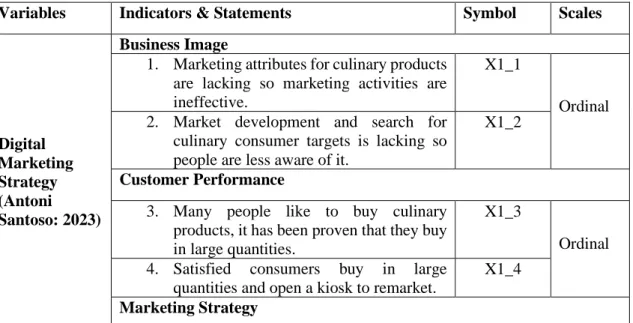
Table 1. Variables, Dimensions, Indicators and Research Scales
Variables Indicators & Statements Symbol Scales
Digital Marketing Strategy (Antoni Santoso: 2023)
Business Image
1. Marketing attributes for culinary products are lacking so marketing activities are ineffective.
X1_1
Ordinal 2. Market development and search for
culinary consumer targets is lacking so people are less aware of it.
X1_2
Customer Performance
3. Many people like to buy culinary products, it has been proven that they buy in large quantities.
X1_3
Ordinal 4. Satisfied consumers buy in large
quantities and open a kiosk to remarket.
X1_4 Marketing Strategy
5. Culinary businesspeople need to innovate their business products so they can compete with similar competitors.
X1_5
Ordinal 6. Businesspeople must carry out marketing
strategies by utilizing and understanding advanced technology and social media.
X1_6
7. The marketing carried out must be different from other products even though the products sold are all home culinary products.
X1_7
Content Strategy
8. Carry out direct marketing, namely by spreading word of mouth.
X1_8
Ordinal 9. Culinary businesspeople must start
utilizing social media as a means of digital/online marketing.
X1_9
10. Culinary businesspeople share product photos, price discounts, and make Ready Stock videos on WhatsApp social media, both personal chat and group chat.
X1_10
11. Businesspeople also need to place promotions on other social media, such as Instagram, Tiktok or the Facebook platform.
X1_11
Target of Audience
12. Target sales of culinary products via social media can be limited to certain age groups.
X1_12
Ordinal 13. Limited marketing targets can be
expanded by including products to other community groups in other areas.
X1_13
Business Risks
14. Most people have switched to large retail companies which automatically offer higher quality products and services such as Alfarmart or Indomaret.
X1_14
Ordinal 15. The profit percentage tends to be smaller
even though there are many products sold because the target consumers for these culinary products are aimed at all groups.
X1_15
The Effectivity of using social media
(Arum Wahyuni:
2017)
Strengthening Friendship
1. Creating good relationships between businesspeople and consumers due to the existence of social media.
X2_1
Ordinal 2. The use of social media is effective in
strengthening brotherly and friendly relations even though they are far from each other.
X2_2
Provide space for positive messages
3. Applications on social media such as Whatsapp, Instagram, etc. are very easy and applicable for all groups to use.
X2_3
Ordinal 4. The use of social media has been widely
used by religious figures, motivators and also ulama.
X2_4
Improve friendship relationships
5. The existence of social media makes it easier to make friends without having to meet physically.
X2_5
Ordinal 6. Social media can strengthen friendship or
business relationships between culinary practitioners and their customers.
X2_6
Provide precise and accurate information 7. Social media can provide precise and
accurate information regarding the food/drink products offered.
X2_7
Ordinal 8. The information obtained by customers
on social media is very detailed, clear, and easy to access.
X2_8
Increase the insight and knowledge
9. Several social media applications such as Instagram, TikTok and Whatsapp are very easy to learn and use.
X2_9
Ordinal 10. Several applications on social media can
provide new knowledge or insight into information technology in developing culinary businesses.
X2_10
Creativity Empowerment (Hermanto Halil: 2022)
Creative economy-based empowerment process 1. The idea for making culinary products
started from the community's need for a different type of product from the existing ones.
X3_1
Ordinal 2. The process of ideation, creation and
marketing of products involves young people and culinary practitioners.
X3_2
3. Culinary businesspeople must follow culinary trends and the latest developments in the world of IT and social media.
X3_3
There is potential for natural resources, human resources, and potential for local wisdom
4. Culinary practitioners must make a lot of observations, innovations and product creations using ingredients available around them.
X3_4
Ordinal 5. Culinary practitioners can make local
culinary products, food and drinks that are in demand in the region.
X3_5
Raising awareness through community participation
6. Form small groups in society to mobilize their potential.
X3_6
Ordinal 7. Providing counseling, training, and
assistance to the community on a regular basis can increase active participation in the culinary business.
X3_7
Providing regular theoretical and technical training
8. The training provided to culinary business players is in accordance with the needs and potential of existing natural resources and human resources.
X3_8
Ordinal 9. Businesspeople or groups who have
attended training are able to develop results for their group friends.
X3_9
Enrichment of more complex understanding of marketing strategies 10. There is still a need to add more complex
marketing strategies, such as digital or online marketing through marketplaces and social media.
X3_10
Ordinal 11. Provide space and opportunities for the
community to innovate in entrepreneurship to increase local community income.
X3_11
Source: Taken from several previous researches.
The population in this research is culinary business actors, groups of women who offer food product services and also individuals or groups who buy food products in the Bojong Kulur village area, Bogor, West Java. The dependent (dependent) variable in this research is an increase in food sales, so that the population used is producers and consumers of food products made by mothers in the Bojong Kulur village area.
Supranto (2006:70) explains that what is meant by sample is part of the population to be studied.
Meanwhile, the method for collecting data is called sampling. Data collection during sampling is not comprehensive or comprehensive. Meanwhile, according to Ferdinand (2006), what is meant by an adequate sample will provide information and this is done by sorting the sample to people who are easy to contact or find. Meanwhile, the determination of the minimum number of samples to be studied is based on the formula below:
n = (5 x number of indicators used) n = 5 x 36 indicators
n = 180 samples
By referring to the guidelines previously mentioned, the researcher chose to use a sample of 180 respondents in this research.
The researcher decided to apply the Purposive Sampling method, namely a sample selection technique based on certain considerations, as explained by Sugiyono (2016: 85). The use of Purposive Sampling technique was chosen because it is in accordance with the nature of quantitative research which does not aim to generalize findings, in accordance with Sugiyono's explanation (2016: 85). The decision to use the Purposive Sampling method was taken because not all samples met the criteria relevant to the variables being studied. These criteria became a guide in selecting the samples used in this research. The samples used in this research were consumers who were active in the food business in the Vila Nusa Indah residential area, Bogor, West Java. The data collection method applied in this research is as follows:
Questionnaire
Sugiyono further explained that a questionnaire refers to a data collection method carried out by researchers by giving respondents a number of written questions that must be answered. In the process of creating this questionnaire, researchers used an ordinal scale, which involves numbering relevant objects. Typically, in research in the field of marketing, ordinal scales are used to measure relative attitudes, opinions, perceptions and tendencies.
Interview
In this research, the author conducted face-to-face interviews with respondents, came to the respondent's location, and asked questions verbally. As explained by Sugiyono (2016: 147), in quantitative research, the data analysis stage is carried out after all data from respondents and other data sources have been collected. This data analysis process involves grouping data based on variables and types of respondents, creating data tables that organize data based on variables and types of respondents, presenting data for each variable studied, calculations carried out to answer questions in problem formulation, as well as calculations used to test hypotheses. which have been set out in the introductory chapter.
Instrument Test
The author uses three test analyses, namely instrument testing, prerequisite testing and hypothesis testing. In order to meet the accuracy and correctness of instrument tests, validity tests or validity tests and reliability tests or reliability tests are used.
a. Validity test
The measure that shows the level of validity of an instrument is called Validity. It is said to be valid if an instrument can measure what is desired. In order to find out the extent to which the data collected in the research does not deviate from the picture of validity being studied, it can be seen from the high and low levels of instrument validity. Because the purpose of this validity test is to guarantee that the results of the instrument being measured are appropriate. Calculating the validity of an instrument can be done using the Product Moment formula. Using the SPSS data measurement tool, the calculation results are compared with the r table value at a significance of 5%. The Product Moment formula used in this research is as follows:
Notes:
𝑟count = correlation coefficient N = number of respondents ΣX = total item scores ΣY = total score
ΣX2 = sum of squares of item scores ΣY2 = sum of squares of total scores
ΣXY = the sum of the product scores and the total score
The calculation results are compared in the critical table 𝑟 product moment correlation with a significance level of 5%. If 𝑟count ≥ 𝑟𝑡𝑎𝑏𝑒𝑙
then the item is valid and 𝑟count < 𝑟𝑡𝑎𝑏𝑒𝑙 then the item is Invalid.
b. Reliability Test
Reliability is the level or degree of consistency of the instruments tested in research. An instrument has a high reliability value if the tests carried out have consistent results. Testing reliability is by using the Alpha-Crobach formula. The stages in finding the reliability value using the Alpha formula are as follows:
Calculate the score variance for each item using the formula:
2) Add up the variance of all items with the formula:
3) Calculate the total variance withf the formula:
Note:
= number of variants of each item
= variant items of 1, 2, 3, … n
= total of variants
= sum of squares X total Note:
Hypothesis Test
In this research, a T test or T-test was carried out. The T-test technique is a statistical method used to test the significance between two distributions. This technique is applied after the testing process is complete, and a post-test has been carried out. The T-test is used to analyze the suitability of the test results with the hypothesis proposed by the researcher. The steps in hypothesis testing are as follows:
1. Formulate a hypothesis.
2. Set a significance level, usually α = 0.05, and calculate the critical value with degrees of freedom df = N - 2.
3. Carry out testing using the T-test.
4. Next, data analysis is carried out to evaluate the results of the test and check their conformity with the hypothesis that has been proposed.
4. RESULTS AND DISCUSSION Validity and Reliability Test Results Validity test
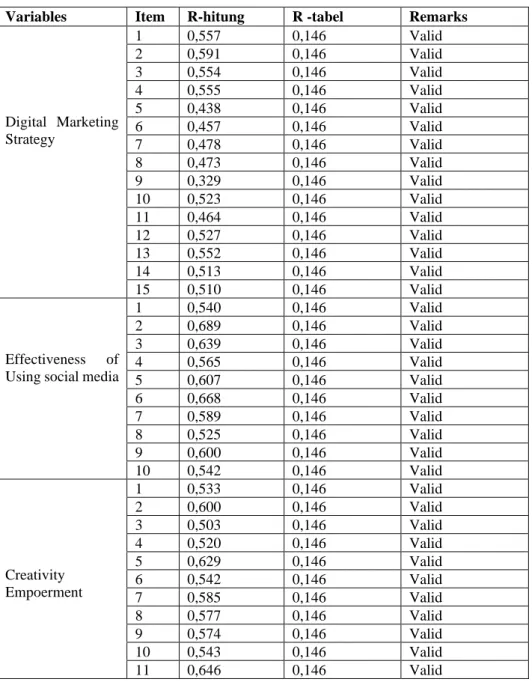
Table 2. Results of research indicator validity tests
Variables Item R-hitung R -tabel Remarks
Digital Marketing Strategy
1 0,557 0,146 Valid
2 0,591 0,146 Valid
3 0,554 0,146 Valid
4 0,555 0,146 Valid
5 0,438 0,146 Valid
6 0,457 0,146 Valid
7 0,478 0,146 Valid
8 0,473 0,146 Valid
9 0,329 0,146 Valid
10 0,523 0,146 Valid
11 0,464 0,146 Valid
12 0,527 0,146 Valid
13 0,552 0,146 Valid
14 0,513 0,146 Valid
15 0,510 0,146 Valid
Effectiveness of Using social media
1 0,540 0,146 Valid
2 0,689 0,146 Valid
3 0,639 0,146 Valid
4 0,565 0,146 Valid
5 0,607 0,146 Valid
6 0,668 0,146 Valid
7 0,589 0,146 Valid
8 0,525 0,146 Valid
9 0,600 0,146 Valid
10 0,542 0,146 Valid
Creativity Empoerment
1 0,533 0,146 Valid
2 0,600 0,146 Valid
3 0,503 0,146 Valid
4 0,520 0,146 Valid
5 0,629 0,146 Valid
6 0,542 0,146 Valid
7 0,585 0,146 Valid
8 0,577 0,146 Valid
9 0,574 0,146 Valid
10 0,543 0,146 Valid
11 0,646 0,146 Valid
After analyzing the data by testing the questions in the research and assessing the validity of these indicators, it was found that the r-table value in this study with a sample size of n=180 and a significance level (sig.) of 0.05 was around 0.146. From the analysis results, the calculated r-value for each variable item is greater than the r-table value. This indicates that all statements used in this research are valid and reliable as measuring tools.
Reliability Test
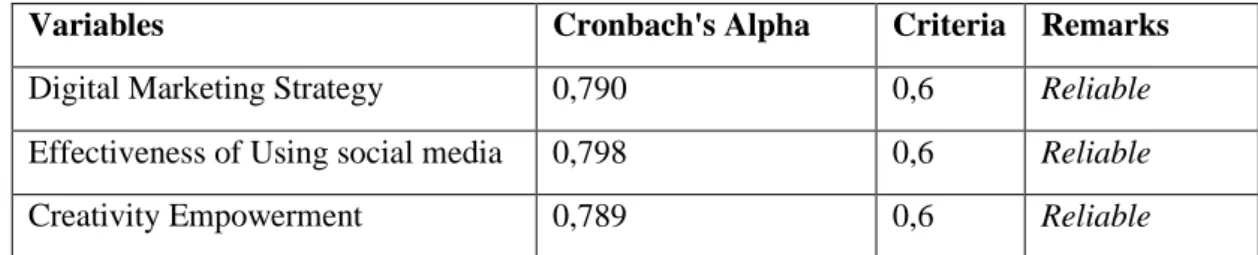
Table 3. Results of research indicator reliability tests
Variables Cronbach's Alpha Criteria Remarks
Digital Marketing Strategy 0,790 0,6 Reliable
Effectiveness of Using social media 0,798 0,6 Reliable
Creativity Empowerment 0,789 0,6 Reliable
The Cronbach's Alpha value for the Digital Marketing Strategy variable is 0.790, for the Effectiveness of Using social media is 0.798, and for Creativity Empowerment is 0.789. These values exceed 0.6, which indicates that the statements used in this study can be considered reliable or have a good level of consistency.
Descriptive Statistics
Tabel 4. Descriptive Statistics
N Minimum Maximum Mean Std.
Deviation
Digital Marketing Strategy 180 42 75 61.75 5.528
Effectiveness of Using social media 180 30 50 40.77 4.376
Creativity Empowerment 180 35 55 45.69 3.971
Valid N (listwise) 180
In the table above, the amount of data used in this research was 180 data obtained through a questionnaire. For the Digital Marketing Strategy variable, the data shows that the lowest value (Minimum) is 0.42, the highest value (Maximum) is 75, the average (Mean) is 61.75, and the standard deviation is 5,528. Meanwhile, the Effectiveness of Using social media has an average value (Mean) of 40.77, with the lowest value (Minimum) being 0.30 and the highest value (Maximum) being 0.50. The standard deviation for Effective Use of social media is 4.376. Creativity Empowerment, on the other hand, has an average (Mean) value of 45.69, with the lowest (Minimum) value being 35 and the highest (Maximum) value being 55. The standard deviation for Creativity Empowerment is 3.971.
Normality test
Table 5. Normality test results . One-Sample Kolmogorov-Smirnov Test
N 180
Normal Parametersa,b Mean .0000000
Std. Deviation 3.63414411 Most Extreme Differences Absolute .062
Positive .054
Negative -.062
Test Statistic .062
Asymp. Sig. (2-tailed) .088c
a. Test distribution is Normal.
b. Calculated from data.
c. Lilliefors Significance Correction.
d. This is a lower bound of the true significance.
Based on the results of the Kolmogorov-Smirnov test, it was found that the data followed a normal distribution. It can be strengthened by a significance value (sig.) of 0.088 which is greater than the alpha significance level (0.05), indicating that the standardized residual value has a normal distribution.
Multicollinearity Test
Table 6. Multicollinearity test results Coefficientsa
Collinerity Tolerance
Statistic
VIF Keterangan
(constanta)
Digital Marketing Strategy .942 1.061 Multicollinearity free Effectiveness of Using social media .942 1.061 Multicollinearity free
From the output results related to collinearity, the tolerance value for the Digital Marketing Strategy variable is 0.942, and likewise for the Effectiveness of Using social media which also has a tolerance value of 0.942. Apart from that, the VIF (Variance Inflation Factor) value for these two variables is 1.061. This shows that in this regression model, there is no indication of a multicollinearity problem between the research variables.
Heteroscedasticity Test
Table 7. Heteroskedasticity test results Unstandardized
Coefficients
Standardized Coefficients
Model B Srd. Error Beta T Sig.
(Constant) 2.164 1.964 1.102 .272
Digital Marketing Strategy -.027 .028 -.074 -.961 .338
Effectiveness of Using social media .022 .035 .047 .615 .540
From the table above, it can be concluded that no heteroscedasticity problems were detected. This can be seen from the significance value (sig) for Digital Marketing Strategy of 0.338 (which is greater than 0.05) and for the Effectiveness of Using social media of 0.540 (also greater than 0.05). These results indicate that there is no indication of heteroscedasticity in the data.
Autocorrelation Test
The requirement for using the Durbin-Watson test is that positive autocorrelation occurs if the DW value is below 2 (DW < -2). Test results can be seen in the following table:
Table 8. Autocorrelation test results Model Summaryb
Model R R Square
Adjusted R Square
Std. Error of the
Estimate Durbin-Watson
1 .403a .162 .153 3.655 1.818
After that, autocorrelation was tested using the Durbin-Watson method. To detect positive autocorrelation, we check whether the DW value is below 2 (DW < -2). Test results are documented in the following table:
Multiple Linear Regression Test
Table 8. Multiple linear regression test results Coefficientsa
Unstandardized Coefficients
Standardized Coefficients
model B Std.Error Beta
1 (Constant) 24.787 3.588
Digital Marketing Strategy .195 .051 .272
Effectiveness of Using social media .217 .064 .239
The "Coefficients" table above contains an explanation of the multiple regression equation used in this research. The regression equation formula in this research can be detailed as follows:
Y= α + β1X1 + β2X2 + ε Y= 24.787- .195X1 + .217X2
From the regression equation above, the following conclusions can be drawn:
1. The constant value (α) is 24.787, and has a positive sign. This shows that if the variables Digital Marketing Strategy and Effectiveness of Using Social Media are considered constant, the Y value will be 24,787.
2. The regression coefficient for the Digital Marketing Strategy variable (X1) is 195, and has a positive sign. This indicates that if the level of Digital Marketing Strategy increases by one unit, assuming other variables remain constant, then Creativity Empowerment will increase by 195.
3. The regression coefficient for the Effectiveness of Social Media Use variable (X2) is 217, and also has a positive sign. This illustrates that if the level of Effectiveness of Social Media Use increases by one unit, assuming other variables remain constant, then Creativity Empowerment will increase by 217.
Coefficient of Determination Test (R2)
Table 9. Coefficient of determination test results Model Summaryb
Model R R Square
Adjusted R Square
Std. Error of the Estimate
1 .403a .162 .153 3.655
From the table above, the R value is 0.403 and the R square value is 0.162. This indicates that the percentage contribution of the independent variables (Digital Marketing Strategy and Effective Use of social media) to the dependent variable (Creative Empowerment) is around 16.2%. This means that around 16.2% of the variation in Creativity Empowerment can be explained by the independent variables in this model, namely Digital Marketing Strategy and Effectiveness of Using social media.
The remainder, around 83.8%, was influenced or explained by other factors not included in this study.
Hypothesis testing
Table 10. Hypothesis test results t test
Model Unstandardized
Coefficients
Standardized Coefficients
B Std. Error Beta t sig
1 (Constant) 24.787 3.588 6.909 .000
Digital marketing Strategy .195 .051 .272 3.839 .000
Effectiveness of Using social media
.217 .064 .239 3.372 .001
From the table above, the impact of each independent variable on the dependent variable can be described as follows:
1. Test the impact of Digital Marketing Strategy (X1) on Empowering Creativity (Y):
Null hypothesis (Ho): β2 = 0, indicating that Digital Marketing Strategy does not have a significant positive impact on Creativity Empowerment.
Alternative hypothesis (H1): β2 > 0, implying that Digital Marketing Strategy has a significant positive impact on Creativity Empowerment.
Based on the Significance value (Sig) of the Digital Marketing Strategy variable in the SPSS output, it was found that the Sig was 0.000. Because the Sig value (0.000) is less than 0.05, the conclusion is that H1 is accepted and Ho is rejected. This shows that there is a significant impact between Digital Marketing Strategy (X1) and Creativity Empowerment (Y).
2. Test the impact of the Effectiveness of Using Social Media (X2) on Empowering Creativity (Y):
Null hypothesis (Ho): β2 = 0, meaning that the Effectiveness of Using Social Media does not have a significant positive impact on Creativity Empowerment.
Alternative hypothesis (H2): β2 > 0, implying that Effective Use of Social Media has a significant positive impact on Creativity Empowerment.
From the significance value (Sig) of the Effectiveness of Using Social Media variable in the SPSS output, it was found that the Sig was 0.001. Because the Sig value (0.001) is less than 0.05, it can be concluded that H2 is accepted and Ho is rejected. This shows that there is a significant impact between the Effectiveness of Using Social Media (X2) and Empowering Creativity (Y).
f Test
Table 11. Anova test results ANOVAa
Ho: Taken together, Digital Marketing Strategy and Effective Use of Social Media have no impact on Empowering Creativity.
H1: Taken together, Digital Marketing Strategy and Effective Use of Social Media have a significant influence on Creativity Empowerment.
From the SPSS "Anova" output table above, it is found that the Significance (Sig) value is 0.000, which is less than 0.05. Therefore, it can be concluded that the hypothesis is accepted. In other words, both Digital Marketing Strategy (X1) and Effectiveness of Using Social Media (X2) together have a significant effect on Empowering Creativity (Y).
Model Sum of
Squares
df Mean
Square
F Sig
1 Regression 458.141 2 229.070 17.151 .000b
Residual 2364.054 177 13.356
Total 2822.194 179
Frequency Test Results of Respondent Characteristics
Table 12. Gender frequency test results Gender
Frequency Percent Valid Percent
Cumulative Percent
Valid Male 60 33.3 33.3 33.3
Female 120 66.7 66.7 100.0
Total 180 100.0 100.0
From the table, it is known that the respondents involved in this research were 60 (33.3%) men and 180 (66.7%) women. This proves that women have a higher tendency to carry out food sales or purchasing activities online using social media.
Group of Ages
Table 13. Age Group Frequency Test Results
Frequency Percent Valid Percent
Cumulative Percent
Valid <20 14 7.8 7.8 7.8
21 s.d 38 86 47.8 47.8 55.6
39 s.d 50 42 23.3 23.3 78.9
51 s.d 69 38 21.1 21.1 100.0
Total 180 100.0 100.0
From the table above, it is known that the age group of respondents < 20 years old was 14 (7.8%) people, 21 to 38 years old was 86 (47.8%) people, 39 to 50 years old was 42 (23.3%) people. , and 51 to 69 years as many as 38 (21.1%) people. People between the ages of 21 and 38 years are the age group that engages in the most sales or purchasing of food online using social media.
Last formal Education
Table 14. Frequency test results of last formal education
Frequency Percent Valid Percent
Cumulative Percent
Valid SMA/MA or equivalent 44 24.4 24.4 24.4
Diploma (D1/D2/D3) 56 31.1 31.1 55.6
Bachelor’s degree (S1) 66 36.7 36.7 92.2
Postgraduate (S2) 14 7.8 7.8 100.0
Total 180 100.0 100.0
From the table above, it is known that respondents based on their last formal education were 44 (24.4%) respondents with a SMA/MA or equivalent education, for Diploma (D1/D2/D3) as many as 56 (6.3%) people, Bachelor (S1). ) as many as 66 (36.7%) people, and Postgraduate (S2/S3) as many as 14 (7.8%) people. Respondents with a bachelor's degree (S1) are the group of people who carry out the most sales or purchasing activities online using social media.
Amount of expenses
Table 15. Frequency test results Amount of expenditure Frequen
cy Percent Valid Percent
Cumulative Percent Valid < 3 millions 44 24.4 24.4 24.4
3 – 5 millions 79 43.9 43.9 68.3
5,1 – 8 millions 46 25.6 25.6 93.9
> 8 millions 11 6.1 6.1 100.0
Total 180 100.0 100.0
It is known that respondents with expenditures < 3 million were 44 (24.4%) respondents, 3-5 million were 79 (43.9%) people, 5.1-8 million were 46 (25.6%) people, and > 8 million as many as 11 (6.1) people. Respondents who spent 3-5 million were the group of respondents who carried out the most activities selling or purchasing food online using social media.
Long time to make online purchases
Table 16. Online purchase frequency test results
Frequency Percent Valid Percent
Cumulative Percent
Valid <1 year 73 40.6 40.6 40.6
1s/d 5 years 91 50.6 50.6 91.1
>5 year 13 7.2 7.2 98.3
Never 3 1.7 1.7 100.0
Total 180 100.0 100.0
From the table, it is known that 73 (40.6%) respondents have been making online purchases for
<1 year, 91 (50.6%) people have been making online purchases for 1 to 5 years, and 13 (7.2%) people have been >5 years. , never as many as 3 (1.7%). Respondents in the 1 to 5 year interval are the group of respondents who carry out the most sales or purchase of food online using social media.
Long time doing online sales
Table 17. Online sales frequency test results Frequency Percent Valid Percent
Cumulative Percent
Valid <1 year 74 41.1 41.1 41.1
1s/d 5 years 61 33.9 33.9 75.0
>5 years 4 2.2 2.2 77.2
Never 41 22.8 22.8 100.0
Total 180 100.0 100.0
From the table, it is clear that 74 (41.1%) respondents have been doing online sales for <1 year, 61 (33.9%) people have been doing online sales for 1 to 5 years, and 4 (2.22%) have been >5 years, and 41 (never) have 22.8). Respondents who are at intervals of less than 1 year are the group of respondents who carry out the most sales or purchase of food online using social media.
Frequency of purchases/sales
Table 18. Purchase/sales frequency test results
Frequency Percent Valid Percent
Cumulative Percent
Valid Everyday 12 6.7 6.7 6.7
Once a week 34 18.9 18.9 25.6
2-3 times a week 27 15.0 15.0 40.6
Once a month 98 54.4 54.4 95.0
Never 9 5.0 5.0 100.0
Total 180 100.0 100.0
From the table it is known that respondents with a frequency of buying/selling every day were 12 (6.7%) people, once a week were 34 (18.9%) people, 2-3 times a week were 27 (15.0%) people, 1 times a month as many as 98 (54.4%) people, and never as many as 9 (5.0%). Respondents who purchase or sell online once a month are the group of respondents who use social media the most.
5. CONCLUSION AND DISCUSSION
Based on the above analysis it has been both research objectives were answered partially and simultaneously. Partially from both independent variables, the two variables, namely digital marketing, and social media, have a positive and significant effect on empowering creativity. Simultaneously, digital marketing and social media variables together have a significant influence on creative empowerment. Digital Marketing Strategy shows that this ratio has the lowest (Minimum) value of .42, the highest (Maximum) value of 75, the average value (Mean) of 61.75 while the standard deviation for Digital Marketing Strategy is 5.528.
Effectiveness of using social media which shows an average value (Mean) of 40.77, this means that the sample average fulfills obligations, and the lowest value (Minimum) is .30 which means the lowest value of Effectiveness of Use of social media is .30 and the value (Maximum) or maximum value is .50 while the standard deviation value is 4.376.
Empowerment of Creativity shows an average value (mean) of 45.69 while the lowest value (Minimum) is 35 while the highest value (Maximum) is 55 and the standard deviation value for Empowerment of Creativity is 3.971.The analysis results show that the Significance value (Sig) of the Digital Marketing variable is 0.000, which is lower than the significance level of 0.05, so it can be concluded that there is a significant influence between Digital Marketing Strategy (X1) on Creativity Empowerment (Y).
From the description of the digital marketing variable, the distribution of respondents' answers was mostly agree, taken from an average percentage of 52 percent, which means that according to respondents digital marketing has had a large and significant influence on empowering the creativity of culinary products of the women's group in Bojong Kulur village, Bogor. The digital marketing variable has 6 sub-variables or dimensions consisting of Business Image, Customer Performance, Marketing Strategy, Content Strategy, Target of Audience, and Business Risks. According to the respondent's statement, the lowest average value is the dimension of creativity empowerment 3.971 > 3.00 which means that the creativity empowerment variable is statistically satisfactory. Then according to the respondent's statement, the average value for the digital marketing dimension, the standard deviation is 5.528 > 3.00, which means that the digital marketing variable is statistically very satisfactory.
Meanwhile, the standard deviation value for the social media dimension is 4.376 > 3.00, which means that the social media variance is also statistically satisfactory. The analysis results also show that the Significance value (Sig) of the Digital Marketing variable is 0.000, which is lower than the significance level of 0.05, so it can be concluded that there is a significant influence between Digital Marketing Strategy (X1) and Creativity Empowerment (Y). the significance value (Sig) of the Effectiveness of Using Social Media variable is 0.001, which is lower than the significance level of 0.05, so it can be concluded that there is a significant influence between Effectiveness of Using social media (X2) and Creativity Empowerment (Y). and the Significance value (Sig) is 0.000, which is lower than the
significance level of 0.05, so it can be concluded that Digital Marketing (X1) and the Use of social media (X2) simultaneously have a significant impact on Creativity Empowerment (Y).
Conclusion
Based on the analysis that has been carried out to answer the objectives of this research, it can be concluded that Digital Marketing and the Use of Social Media have a significant impact on Empowering the Creativity of food products produced by groups of women in Bojong Kulur village, Bogor, West Java. The analysis results can be summarized as follows:
1. There is a positive and significant impact between Digital Marketing and Creativity Empowerment of food products managed by a group of women in Bojong Kulur village, Bogor, West Java. The analysis results show that the Significance value (Sig) of the Digital Marketing variable is 0.000, which is lower than the significance level of 0.05, so it can be concluded that there is a significant influence between Digital Marketing Strategy (X1) and Creativity Empowerment (Y).
2. There is a positive and significant impact between the use of social media and the empowerment of creativity in food products produced by groups of women in Bojong Kulur village, Bogor, West Java. The results of the analysis show that the significance value (Sig) of the Effectiveness of Using Social Media variable is 0.001, which is lower than the significance level of 0.05, so it can be concluded that there is a significant influence between Effectiveness of Using Social Media (X2) and Creativity Empowerment (Y).
3. Overall, Digital Marketing and the Use of Social Media together also have a significant impact on Empowering Creativity (Y). The results of the "Anova" analysis show that the Significance value (Sig) is 0.000, which is lower than the significance level of 0.05, so it can be concluded that Digital Marketing (X1) and the Use of Social Media (X2) simultaneously have a significant impact on Creativity Empowerment ( Y).
Suggestion
For online food business people
1. Culinary product business people in the form of food and drinks, especially housewives who use their free time to be creative in making food or drinks, must study the theory and application of marketing using digital marketing more often and intensively.
2. Food business people must be able to make maximum use of social media technology and also study other social media in order to carry out online promotions effectively and efficiently.
Culinary business people can take advantage of marketing platforms such as Tokopedia, GrabFood, GojekFood, and others apart from just using applications on social media. Food business people must be willing to learn or take part in training from business practitioners who are more competent and up to date in terms of knowledge and experience.
For the next Research
This research is not the end of the entire series of research that can be carried out in this context.
For researchers who will continue this study, the following suggestions can be considered:
1. Direct further research to more specific or special topics related to empowering culinary groups of mothers. This research can be scaled up to a higher and broader level, such as the sub-district or provincial level, to deepen understanding of the dynamics of empowerment.
2. Considering the growing number of food business actors and the diversity of problems that may arise, future research could consider using a larger and more representative sample. This will enable a more comprehensive analysis of the factors influencing empowerment.
3. For researchers who want to explore the factors that influence effectiveness and empowerment in questionnaires
REFERENCES
Chole, N., Dharmik, K. M. (2018). Digital Marketing & social media. International Conference Business Remodeling: Exploring New Initiatives in Key Business Functions. Nagpur: Tripude Institute
of Management Education.
Ferdinand, Augusty. (2006). Metode Penelitian Manajemen. Semarang: Badan Penerbit Universitas Diponegoro
Halil, Hermanto. (2022). Pemberdayaan Masyarakat Berbasis Ekonomi Kreatif dalam Meningkatkan Kemandirian Ekonomi Masyarakat Desa Kaduara Timur Kecamatan Pragaan Kabupaten Sumenep,
Jurnal IBRAH.
Istirani, dan Intan Pulungan. (2017). Enslikopedia Pendidikan Jilid I. Medan: Media Persada.
Hamdi, Khairil dan Dorris Yadewani (2019), Strategi Pengembangan Usaha Kuliner Home Industri Sebagai Peluang Kaum Perempuan Menuju Industri Kreatif, Prosiding Seminar Nasional
Hasil Pengabdian Kepada Masyarakat Tahun 2019.
Kepios. (2022). Analysis Company Advertising resources & Earning Announcements.
Malhotra, N. K. (2005). Marketing Research: An Applied Orientation (5th ed.). New Jersey: Pearson Education, Inc.
Prasetyo, Bambang D dan Febriani, Nufian. (2020). Strategi Branding-Teori dan Perspektif Komunikasi dalam Bisnis, UB Press. Malang.
Saleh, Muhammad. dan Miah Said. (2019). Konsep dan Strategi Pemasaran, CV Sah Media. Makassar.
Sasongko, Dimas, et al. (2020). Digital Marketing Sebagai Strategi Pemasaran UMKM Makaroni Bajak Laut Kabupaten Temanggung, Universitas Trunojoyo, Madura.
Sugiyono. (2016). Metode Penelitian Pendidikan Bisnis (Pendekatan Kuantitatif, Kualitatif dan R&D).
Bandung: Alfabeta.
Solis, Brian dan Deirde Breakenridge. (2009). Putting the Public Back in Public Relations, USA, 2009.
Supranto. (2006). Pengukuran Tingkat Kepuasan Pelanggan. Jakarta: Rineka Cipta.
Waluya, B. (2009). Sosiologi: Menyelami Sosial di Masyarakat. Jakarta: PT. Pribumi Mekar.