Vol. 8 No. 3 (2020), pp. 567-588, DOI: 10.15408/jch.v8i3.18297
The Influence of Human Capital and Welfare on the Quality of Democracy in Indonesia
Mohd Nasir Mohd Saukani,1 Iing Nurdin,2*Rizqon Halal Syah Aji3
1Universiti Kebangsaan Malaysia
2Universitas Jenderal Ahmad Yani, Cimahi, West Java, Indonesia
3Universitas Islam Negeri Syarif Hidayatullah Jakarta, Indonesia 10.15408/jch.v8i3.18297
Abstract:
Indonesia is the third-largest democratic nation in the world. Democracy is viewed as a constitutional structure capable of achieving human progress, since political rights, civil liberties and the State's responsibility for achieving human development reside in a democratic system.
The objectives of this analysis are, firstly, to describe and analyze the state of democracy in Indonesia using indicators of the democracy index (political rights, civil rights, and democratic institutions); secondly, to explain and analyze the basis, policy, execution of democracy and human development; and, thirdly, to evaluate and analyze basic decisions and policies through indicators of human rights and human development. This research uses qualitative approaches based on primary data and secondary data (literature review) but also accompanied by quantitative data and triangulation analysis techniques. The findings of the study indicate that, firstly, Indonesia has largely developed a stable political structure, although there is still a great deal of frustration with the weak capability of democratic institutions. Democracy in Indonesia is still marked by unethical behavior; secondly, Indonesia's democracy continues to step forward, yet still places Indonesia in the category of procedural democracy, not yet in the category of substantive democracy; thirdly, there is a clear and constructive relationship, but not explicitly and steadily, between democracy and human progress, especially human development. The implication is that numerous ideas and arguments can be confirmed that democracy can foster human development; while Indonesia cannot yet be classified as a truly democratic country as a condition for being a welfare state.
Keywords: Democracy, Renewal, Welfare, Human Development.
Received: January 14, 2020, revised: April 22, 2020, accepted: July 27, 2020, Published: December 5, 2020.
1 Mohd Nasir Mohd Saukani is a Professor at Universiti Kebangsaan Malaysia.
2 Iing Nurdin is a Senior Lecturer at Universitas Jenderal Ahmad Yani, Cimahi, West Java, Indonesia.
3 Rizqon Halal Syah Aji is a Senior Lecturer at Universitas Islam Negeri Syarif Hidayatullah Jakarta, Indonesia.
*Corresponding Author: [email protected]
Pengaruh Sumber Daya Manusia dan Kesejahteraan terhadap Kualitas Demokrasi di Indonesia
Abstrak
Indonesia adalah negara demokrasi ketiga terbesar di dunia. Demokrasi dilihat sebagai sistem politik yang mampu merealisasikan pembangunan manusia, karena dalam sistem demokrasi terdapat hak politik, kebebasan civil dan tanggungjawab negara untuk merealisasikan pembangunan manusia.
Tujuan kajian ini yaitu, pertama, untuk menjelaskan dan menganalisis keadaan demokrasi di Indonesia dengan menggunakan penunjuk indeks demokrasi; kedua, menjelaskan dan menganalisis dasar, strategi, pelaksanaan yang berkaitan dengan demokrasi dan pembangunan manusia; ketiga, menilai dan menganalisis keputusan dasar dan strategi melalui penunjuk indeks pembangunan manusia serta menganalisis hubungan antara demokrasi dan pembangunan manusia di Indonesia. Kajian ini menggunakan kaedah kualitatif berdasarkan data primer, dan data sekunder turut didukung oleh data kuantitatif serta teknik analisis triangulasi. Hasil kajian menunjukkan bahwa; pertama, Indonesia pada umumnya telah mengukuhkan sistem politik demokratis, walaupun masih banyak ketidakpuasan terhadap kemampuan institusi demokratik yang lemah. Demokrasi di Indonesia juga bercirikan oleh perilaku korupsi; Kedua, demokrasi Indonesia cenderung bergerak ke depan, tetapi masih terus memposisikan Indonesia dalam kategori demokrasi prosedur, belum mencapai kategori demokrasi substantif; Ketiga, ada hubungan yang signifikan dan positif walaupun tidak secara langsung dan lambat antara demokrasi dan pembangunan manusia, yaitu melalui kenaikan indeks pendidikan, indeks kesehatan, indeks kuasa beli. Implikasinya adalah dapat disahkan pelbagai teori dan alasan bahwa demokrasi dapat menggalakkan pembangunan manusia; walaupun Indonesia belum dapat dikategorikan sebagai negara demokrasi seutuhnya sebagai syarat untuk menjadi negara kesejahteraan.
Kata Kunci: Demokrasi, Pembaharuan, Kesejahteraan, Pembangunan manusia Влияние Человеческих Ресурсов и Благосостояния
На Качество Демократии В Индонезии Аннотация
Индонезия - третья по величине демократическая страна в мире. Демократия рассматривается как политическая система, способная реализовать человеческое развитие, потому что в демократической системе есть политические права, гражданские свободы и ответственность государства за реализацию человеческого развития. Цели этого исследования: во-первых, описать и проанализировать состояние демократии в Индонезии с использованием показателей индекса демократии; во-вторых, объяснить и проанализировать основы, стратегии и реализацию, связанные с демократией и человеческим развитием; и, в-третьих, оценить и проанализировать основные решения и стратегии с помощью показателей человеческого развития и проанализировать взаимосвязь между демократией и человеческим развитием в Индонезии. В этом исследовании используются качественные подходы, основанные на первичных и вторичных данных, но также сопровождаемые количественными данными и методами триангуляционного анализа. Результаты исследования показывают, что, во-первых, в Индонезии в значительной степени сложилась демократическая политическая система, хотя по- прежнему существует большое разочарование по поводу слабости демократических учреждений. Демократия в Индонезии также отличается коррупционным поведением; во-вторых, демократия Индонезии продолжает шагать вперед, но все же относит Индонезию к категории процедурной демократии, не к категории субстантивной демократии; в-третьих, существует значительное и позитивное отношение между демократией и человеческим развитием, хотя правда, не напрямую и медленно, а именно за счет увеличения индекса образования, индекса здоровья, индекса покупательной способности. Подразумевается, что можно подтвердить различные теории и причины того, что демократия может способствовать человеческому развитию; хотя Индонезию пока нельзя отнести к категории полностью демократических стран, что является предпосылкой для того, чтобы стать государством всеобщего благосостояния.
Ключевые слова: демократия, обновление, благосостояние, человеческое развитие
A. INTRODUCTION
Humans are the nation's real riches. Human beings should be the key focus of creation. The progress of development can be measured not only by high economic growth but also by an increase in the welfare of its inhabitants. The advent of this new model was prompted by the collapse of the development concept, which concentrated exclusively on economic growth. Development performance was calculated only by the growth rate of the Gross National Product prior to the 1970s (GNP). The truth is that countries with high GDP growth rates are still always listed, but the standard of their human beings is still poor.
According to UNDP (1990), human growth is conceived as an attempt to increase opportunities for the population and at the same time as the degree attained by these efforts. "Expansion of options" will only be understood if the community has at least: the ability to enjoy a long and stable life, sufficient education and expertise, and the opportunity to realize the knowledge they have in profitable practices. In other words, the level of fulfillment of these three components should at least represent the level of success of human growth in the field.
Many political scientists claim that the goal of democracy is to provide welfare to its citizens. The relationship between democracy and welfare has long been a long debate among scholars of political science and economics. The debate is based on two questions: can democracy lead people to prosper? Is democracy the single path to a welfare state? The conclusion of the long debate remains speculative-hypothetical because it depends on several basic assumptions and statements that must be fulfilled so that democracy can pave the way to achieve prosperity and create a welfare state.
Various studies show that about 80 percent of developing countries in the transition period to strengthen democracy often experience failures in the economic and development fields (Haggard & Kaufman 2008). The classic argument raised by Seymor Martin Lipset (1956) reverberates, that democracy can only develop well if it is supported by adequately educated citizens and a strong and independent middle class. Lipset's overall argument starts from the article that "the higher a person's education, the more likely he is to believe in democratic values to support democratic practice".
High levels of welfare are indeed often found in countries that apply democratic political systems, such as the United States and countries in Europe.
Therefore, Joseph Siegle (2004) loudly states that “democracy in industrialized countries is known as the most dynamic, innovative, and the most productive
economy in the world; this democracy has allowed developed countries to accumulate and maintain an improved quality of life for their citizens over several generations ”. During the four decades since the 1960s, economic growth statistics in developed democracies have grown 25 percent higher than authoritarian countries (Halperin, Siegle & Weinstien; 2004).
However, the experience of Singapore, China which is spectacularly able to achieve economic prosperity with a semi-authoritarian or semi-democratic government system confirms that there are other ways outside of democracy to achieve prosperity. The glorious achievements of South Korea, Malaysia, and Taiwan today cannot be separated from the semi-authoritarian government system until the three countries fully embrace democracy. China is another example, which has experimented with adapting authoritarian political systems by absorbing free- market economic systems, such as those adopted by liberal democracies. With exception of Indonesia, which has a moderately high democracy index, the option of a representative political structure has not been able to lead to the well-being of its people. Poverty rates are still rising, unemployment is rising, horizontal and vertical tensions are still ongoing today (Freedom House 2014).
According to Ross H. McLeod (2010), the performance and growth of the Indonesian economy are considered by some groups and observers to be less encouraging than the New Order regime under President Soeharto. The key indicator is the average annual growth rate, which not only reflects broadly improvements in living standards but is also of much greater importance in reducing poverty. The average economic growth during the New Order era for three decades (until 1997) was 7.4 percent, but since the fall of Soeharto and the early reform era (which began with the economic crisis), the growth rate has decreased to 4.7 percent. In terms of average growth in per capita income, this decline was much larger and more widespread.
This study focuses on the analysis of the relationship between democracy, the welfare state, and human development during the reign of President Susilo Bambang Yudhoyono. A study on the implementation of welfare is carried out by focusing on the role of the state in the welfare of its citizens through various social policies or public policies implemented by the government. Social policy is a policy instrument used to ensure that citizens have access to basic services, such as health services, education, social protection, and economic and income access. This social policy is reflected in three types of instruments: I the legislation or regulation; (ii) the scheme of social services; (iii) the method of taxation. Besides, this instrument also includes various social security programs (social protection); various social assistance schemes; various universal benefits given to all residents.
The essay reflects on the relationship between democracy and human progress in Indonesia. In particular, the purpose of this article is to address the issues to be examined, namely: to explain the policies adopted by the Government of Susilo Bambang Yudhoyono in the light of the creation of prosperity, in particular the increase in the Indonesian human development index. Evaluating the impact and contribution of democracy to human progress in Indonesia.
Literature Review
Democracy studies in post-Soeharto Indonesia represent the views of numerous experts. Many comparative policy analysts agree that post-1998 Indonesia's democracy has been included in a satisfactory list of global democracy systems, and they also contend that there are still significant obstacles to ongoing democracy. Despite the extent and significance of Indonesia's democratic transformation, comparative political scientists initially showed little interest in it.
The International Conference on Indonesia in Jakarta in August 1998 – three months after Suharto's collapse – brought together leading democracy and delaying thinkers such as Alfred Stepan, Juan Linz, and Donald Horowitz to launch the study of Indonesia's political transformation (Liddle 2001).
Edward Aspinall & Marcus Mietzner (2010) separated the two classes of academics who published studies and analyses on the upheaval of Indonesia's electoral transition, as well as its social and political circumstances. First, primarily comparative political science scholars who have published in-depth analyses of Indonesia and other, predominantly Southeast Asian countries, but have not been able to put Indonesia on the map of global political theory (Case 2002; Smith 2007;
Slater 2008). The second group is made up of the so-called 'Indonesianists,' academics with a long study emphasis in the region. And when theoretical debates on democratization and political reform have taken place, their work on post- Soeharto regimes has appeared primarily in academic journals in Asia-Pacific or Southeast Asia, struggling to impact the broader discourse on foreign political developments. In the meantime, influential comparativists study Indonesia only in passing, incorporating it into multi-country and quantitative comparative analyses and seldom dwelling on the country itself.
Although the democratic transition in Indonesia is considered important and great, comparative political scientists initially paid very little attention to what was happening to Indonesia. Broadly speaking, studies on Indonesia, particularly on democracy in post-New Order Indonesia, according to Aspinall and Meitzner (2010), may be grouped into several major schools of thought.
First, a significant number of scholars maintain that the existence of institutional reform, democratic changes are made or engineered with the core structure of power unchanged. In this perspective, the elite oligarchs who held control during the New Order era remained in power and did not change and continued their efforts to obtain various benefits. (Robinson & Hadiz 2004), (Boudreau 2009).
Second, there are some experts and observers who believe that Indonesia has indeed carried out an extraordinary consolidation of democracy, especially from a comparative point of view. (MacIntyre & Ramage 2008). It is important to state, with what was expected at the beginning of 1998, that the democratic transformation in Indonesia will collapse and that it will suffer the devastation that has taken place in the Soviet Union and Yugoslavia, that under foreign guidance and assistance, Indonesia is now successful in becoming one of the third largest parliamentary democracies in the world (Freedom House 2009).
Third, several experts stressed in the ground-based research analysis that success in the political process in Indonesia also left several systemic problems, including those related to law enforcement and the eradication of corruption. This divergence in opinion means that the findings of the sample can vary from one another, based on the subject of interest of each researcher.
The discussion and debate on democracy and welfare have been going on for a long time, but it is still limited to the ties between democracy and economic growth. Seymor M. Lipset (1959) created a report that concluded that economic growth was a requirement for democratic development. Lipset is questioning the existence of a relationship between the democratic organization of the regime and the general economic system of its society. Lipset assumes that an advanced economic structure will be able to increase the standard of education of an individual and, in turn, will be able to create a democratic society and a citizen's behavior.
Scientific work, which explores the relationship between democracy and human progress, is primarily carried out by scholars and clinicians, including Matthew A. Baum & David A. Lake (2013), Sebastian Vollmer and Maria Ziegler (2009), John Gerring, Strom C. Thacker & Rodrigo Alfaro (2012). Matthew A. Baum
& David A. Lake (2013) claim that democracy is more than just a limitation or stimulus to the economy. Baum & Lake (2013) suggests that there is a major indirect influence of democracy on development by public health and education.
Where analysts use life expectancy and schooling as proxies for human resources, government becomes a significant determinant of the level of public services as seen in this predictor.
In addition to the direct impact of democracy on development, this study predicts an indirect effect, namely through public policies that conditions levels of human capital in different societies. Baum & Lake (2013) found that the benefits of democracy are mainly indirect due to improved life expectancy in poor countries and increased secondary education in non-poor countries. Other results indicate that the degree of democracy is a significant determinant of public health and education, of two common determinants, and human capital. More democratic countries aim to have higher levels of public health, as measured by different performance metrics, including child mortality, life expectancy and immunization, and higher levels of schooling, often measured by indicators such as primary, secondary, and tertiary enrolment rates and adult literacy.
In line with the above view, Sebastian Vollmer and Maria Ziegler (2009) conducted a static panel study between 1970 and 2003 to analyze the relationship between democracy and human growth. Their findings indicate that living in a democratic society has a beneficial impact on human growth, calculated by life expectancy and literacy rates, and also controls on Gross Domestic Product (GDP).
Through evaluating the relationship results, they find that democracy functions marginally independently of democratic countries. Democracy, though, leads to further redistribution to provide wellbeing in a more segregated world.
Vollmer and Ziegler (2009) differentiate between two forms of policies that can favor human growth, namely policies for the defense of property rights and policies for redistribution. Democracy is understood as a democratic mechanism whose institutions and processes allow for the control of the people. What counts are free and repeated voting, electoral competition, the rule of law, political and civil liberties. These elements form the basis for democratic discussion and deliberation on community governance. It is believed that the representative political system is the most effective system to ensure redistribution that meets the needs of society. Democracy is known to have the highest results in all respects:
defense of property rights and redistribution. If one or the other is more reliant on the desires of the people and the formal and informal face of the democratic exercise.
There are four potential causal mechanisms connecting democracy and human development (McGuire 2004; Ross 2006 in Gerring, C. Thacker & Alfaro 2012) taking into account the likely time-dependent existence of this relationship.
Second, the rivalry between elites for the interests of the people must lead to a situation in which the elite is responsible for citizens-or, at the very least, to a majority of voters. Second, political institutions tend to help a well-developed civil society. This is because human rights and civil rights are closely connected and the
presence of civil rights generally contributes, over time, to dense networks of voluntary associations, which can be religious or secular, national or regional, unique to concerns, or widely defined (Parker 1994). Fourth, democracy will help to reinforce a tradition of inclusion that empowers disadvantaged groups.
Fourthly, a more developed and older society would benefit from greater institutionalization of the political domain.
There are quite a several studies exploring the relationship between democracy and human development in Indonesia. These studies base their study on the role of local councils in the provision of a welfare fund, in particular, the Human Development Index. Among the studies is a study by Nadia Ayu Bhakti, Istiqomah, Suprapto (2014), which aims to examine factors that affect HDI, namely GRDP, dependence ratio, household food intake, APBD for schooling, and APBD for health. This research is an associative study of panel data regression analysis techniques of 33 provinces in Indonesia over the period 2008-2012. The findings revealed that GRDP and APBD had a positive and significant impact on HDI for wellbeing, whereas the combination of dependency and household intake for food had a negative and significant effect on HDI.
The research results of Iing Nurdin & Rijal M. Yakoop (2016) concluded that democracy can encourage welfare through community control of the process of making and implementing policies related to welfare. Meanwhile, the results of the study by Astri et al. (2013) found that the APBD for education has a positive effect on HDI. The greater the budget provided by the government for education, the more facilities available for education will increase. The educational facilities provided by the government originating from the APBD are expected to increase literacy rates and the average length of schooling.
Vivi Alatas (2011) who conducted a review of the Indonesian government's attempts to minimize poverty and raise the human development index in Indonesia concluded that there was a substantial decline in the poverty rate during the reign of Susilo Bambang Yudhoyono (2004-2011). According to Vivi Alatas (2011), Indonesia has made considerable strides in eliminating poverty over the last decade. With sustained economic prosperity, the poverty rate declined from 23.4% in 1999 to 12.5% in 2011. Susilo Bambang Yudhoyono's government is committed to maintaining this trend and plans to further eliminate poverty by 8- 10 percent in 2014.
The findings of Aung Kyaw Phyo (2012) state that economic development and human development trends in Indonesia before and after democratization are not much different. Both periods experienced relatively high economic inflation, the GDP growth rate was found to be relatively lower after democratization than
before democratization. In human development, the income inequality shown by the GINI index is almost the same from 1984 to 2002 and in 2005 inequality has increased. Educational attainment has improved, albeit at a slower rate than in other low-middle-income countries. The most consistent increase over the 1966–
2010 study period was the reduction in infant mortality.
Various studies conducted on human development have several drawbacks. First, most of them only rely on one particular area or area, (except the study of Vivi Alatas and Aung Kyaw Phyo). It is of course doubtful whether specific studies (certain areas/regions) can be generalized and applied to the national case or in Indonesia as a whole; Second, this study focuses on (regional) government policies through government spending to improve human development so that it does not directly look at the role or connection between democracy and human development, so it is difficult to conclude that there is or is not a relationship between democracy and human development.
B. METHODS
To analyze the relationship between democracy and human development in Indonesia, the research approach used in this study is a qualitative approach supported by quantitative data. Qualitative research is undertaken to explain, examine the relationships between phenomena, and determine the quality of variables. Besides, qualitative research aims to create knowledge through understanding and discovery (Sudarwan Danim 2002).
According to Lexi Moleong (2005) there are five main characteristics in qualitative research, namely having provisions or provisions as direct data sources and the researcher is the main instrument in research; descriptive nature, namely the data collected in the form of words, pictures, field notes, interview transcripts, personal documents. Although there are supporting figures; more emphasis on the work process, which all the phenomena faced are translated into daily activities, especially those directly related to problems; tend to use an inductive approach, where abstraction consists of existing data; emphasizes meaning, the study base is directly related to the problems of life.
Following Lawrence Neuman (2000), the choice of data collection technique is largely determined by the type of research being carried out and the type of data required. Based on these considerations in the context of examining the relationship between democracy and welfare in Indonesia, the data collection technique uses the triangulation method (Denzin 1978), which combines quantitative and qualitative methods with a special design so that data obtained
from one method will validate (cross-validate) data obtained by other methods.
The methods used in data collection in this study are Deep Gathering Gathering (in-depth Interview), Media Review (analysis of the big news content), Document Review (analysis of the contents of official documents issued by the state administration).
In-depth interviews in the scientific research method are included in the category of qualitative data collection techniques. In-depth interview techniques are usually carried out, including: (1) incidents of events, feelings, and motivations, (2) incidents of events experienced in the past; (3) project the things that are expected in the future; and (4) validating data and providing information obtained from other sources (Moleong, 2005) The main in-depth interview technique is also used to obtain more in-depth information - or to focus the informants' views/perspectives, related to the issues being studied. (Guion 2006; Berry 1999).
In a more concrete formulation, Berry (1999) asserts that an in-depth interview involves asking informants open-ended questions, and probing wherever necessary to obtain deemed useful data by the researcher.
In the context of research on the relationship between democracy and the progress of the human development index (virtue) in Indonesia, in-depth interviews are used to validate and deepen the information obtained through media and document reviews. Therefore, in-depth interviews are not used as the main method in the data collection process but are complementary because three other methods have been completed. Therefore, although in-depth interviews are a complement to data collection methods, they have an equally important role because they act as the final "complement" in the qualitative data test. Other than that, in-depth interviews often serve as filters to minimize bias in knowledge relevant to aspects, variables, and study completion guidance.
When referring to the category of data collection methods by Neuman (2000), media and document studies are included in the collection of qualitative techniques. This method is usually used to obtain data and information related to research variables and indicators through content analysis of written and symbolic material, such as pictures, photos, song lyrics, films, laws, etc. In scientific research collections, media reviews, in particular, are used extensively in exploratory research and explanatory research. Media and document studies were chosen as one of the data collection techniques because media and documents are considered the most realistic sources of information for obtaining quantitative data (the observation period of Susilo Bambang Yudhoyono's administration) relating to aspects of democracy and virtue. The use of documents as data sources does not
require much explanation. Official documents are good sources of data and are commonly used in many studies.
As for this type of document, official documents issued by the government and the DPR are used - such as laws, government regulations, presidential regulations, ministerial regulations, decrees, and other official documents such as data from Bappenas, related Ministries, and others. Besides, secondary data obtained came from the Universiti Kebangsaan Malaysia Library (Tun Seri Lanang Library and the Library of the Natural and Tamadun Malay Institute), the Universiti Kebangsaan Malaysia Library (Central Library and Library of Social and Political Sciences), the Center for Strategic and International Library. Studies (CSIS) Besides, several Indonesian government libraries are also used to support this research, such as data from the Ministry of Home Affairs (Ministry of Home Affairs), Ministry of Social Affairs, Ministry of Politics, Law and Human Rights, Bappenas, Central Bureau of Statistics (BPS) and (LIPI).
The data analysis technique is the process of recording and compiling interview transcripts and materials or materials that have been collected. This is done so that the researchers can refine their understanding of the data and then explain to others more clearly what has been found or obtained from the field.
Based on sources, there are several types of data used to assess democracy and welfare in Indonesia. The data is an in-depth bullshit meeting that complements the media review data and document review and is used as information to provide interpretations (qualifying information) whether the democratic state as shown in the results of the media review and document review is indeed true, and as if it reflects the democratic state good or bad. Besides, data from in-depth interviews were also used for certain clues that could not have been obtained from documents and media reviews.
The results of data collection from the field were then collected in meeting transcripts and combined with materials obtained from relevant literature/literature. The data collected and compiled are then analyzed to explain and analyze the relationship between democracy and welfare in Indonesia during the reform era. The combination of primary data and secondary data is used to produce two things: first, an overall picture of democracy in Indonesia and its effects on welfare development, especially the human development index; second is check and cross-check of existing data. By reviewing various information from the two sources, the validity and reliability of this study can be justified. Likewise, past research will provide opportunities for researchers to complement and fill in gaps in the analysis of previous researchers.
C. RESULT AND DISCUSSION
1. Democracy, Welfare State and Human Development
To find the linkage between democracy, a welfare state, and human development, there are four of the many possible causal paths that link democracy and human development (McGuire 2004; Ross 2006 in Gerring, C. Thacker &
Alfaro 2012) by considering the possible time-dependent nature of this relationship. First, competition among elites for the interests of voters must result in a situation in which the elite is accountable to citizens - or, at the very least, to a plurality of voters. Democratic leaders may be more inclined to concern themselves with human development issues than leaders who defend their positions through other means (Lake and Baum 2001). Secondly, political systems tend to promote a well-developed civil society. This is because human rights and civil rights are heavily connected, and the presence of civil rights generally contributes, over time, to dense networks of voluntary organizations, which can be religious or secular, national or regional, unique to concerns, or widely based (Parker 1994). Third, democracy can function to inaugurate a culture of equality that empowers oppressed groups. Fourth, a more established and older democracy will benefit from greater institutionalization in the political sphere. To discuss the relationship between democracy and human development, the researcher tries to juxtapose data on IDI and HDI from 2009-2014, to answer the relationship between democracy and HDI. After that, by using the causal relationship that is practiced by Gerring, C. Thacker & Alfaro (2012), the investigator will descriptively explain this relationship.
Graph 1: Development of IDI and HDI (2009-2014)
BPS (2014), processed by researchers.
67.3 63.17 65.48 62.63 62.63
75.81
70.76 72.77 72.77 73.29 73.81 73.9
0 10 20 30 40 50 60 70 80
2009 2010 2011 2012 2013 2014
IDI IPM
From the graph above, it can be seen that the democracy index in Indonesia fluctuates, which is mirrored in the ups and downs of the democracy index from 2009 to 2014. Meanwhile, the human development index shows a gradual rise even though the increase is very small. It was only in 2014 that there was a correlation between the rise in the index experienced by both the democracy index and the human development index. In that sense, it can be inferred that there is no constructive interaction between democracy and human progress. When the IDI in 2009 decreased by 67.3 to 63.17 (2010), increased to 65.48 (2011), decreased again to 62.63 (2012, 2013) and increased again to 75.81 (2014), while the HDI continues to rise.
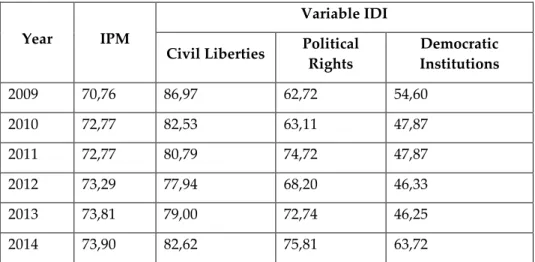
The investigator tries to use a causal or linkage model according to Gerring, C. Thacker & Alfaro (2012), by first describing the variables of Indonesia's democracy index, namely Civil Liberties, Political Rights and Democratic Institutions, as in the schedule below:
Table 1. Comparison of HDI with IDI Variables (2009-2014)
Year IPM
Variable IDI Civil Liberties Political
Rights
Democratic Institutions
2009 70,76 86,97 62,72 54,60
2010 72,77 82,53 63,11 47,87
2011 72,77 80,79 74,72 47,87
2012 73,29 77,94 68,20 46,33
2013 73,81 79,00 72,74 46,25
2014 73,90 82,62 75,81 63,72
Source: Kemenkopolhukam & BPS (2015), compiled.
The table above illustrates that the increase in the HDI level is not directly proportional to the increase in the variable figures for civil liberties, political rights, and democratic institutions. The relationship between HDI and the democracy index variables can be explained through the graph below:
Graph 2. The Relationship between HDI and IDI Variables (2009-2014)
Source: Kemenkopolhukam & BPS (2015), compiled.
Using the linkage model of Gerring, C. Thacker & Alfaro (2012), it seems, first of all, that rivalry between elites for the gain of voters must result in a condition in which the elite is accountable to citizens-or, at least, to voters. If we juxtapose the political rights index and the HDI, it can be shown that there is a favorable relationship where the political rights component has improved even though it declined in 2012, but then increased again in 2013 and 2014. This means that the right granted to all people to engage in political competition and decision- making has a positive effect on the rise in HDI. This could happen because, with the involvement and influence of people over government or political leaders, the government or political elites would be under pressure from citizens.
The political choices of citizens in general elections are often influenced by their level of satisfaction with the social policies implemented by the government and the schemes offered by the opposition. Within this framework, the SBY government in 2007 and 2008 provided social assistance (PKH, PNPM, BOS, BSM).
This may mean that democracy through its democratic institutions must be accountable to the demands of the people as well as a strategy for them to be re- elected. So democracy, in this case, the political choices of the people, will determine the electability of the political elite based on the programs the people want, namely virtue and human development. Apart from the debates and conflicts of opinion in Parliament on the writing of the constitution, it can be inferred that the engagement and involvement of the citizens in the achievement of the good or the effects of human progress is essential in a democratic society.
Since there are engagement and the needs of the public in the policy-making process.
70.76 72.77 72.77 73.… 73.81 73.9
86.97 82.53 80.79 77.94 79 82.62
62.62
63.11
74.72
68.2 72.74 75.81
54.6 47.87 47.87 46.33 46.25
63.72
0 20 40 60 80 100
2009 2010 2011 2012 2013 2014
IPM Kebebasan Sivil Hak - Hak Politik Lembaga Demokrasi
Second, political institutions tend to help a well-developed civil society.
As presented in Figure 2, the Civil Liberties vector index fluctuates or fluctuates.
However, the Civil Liberty Index has gradually risen from 2012 to 2014. This means that there is a good relationship between democracy and human growth. The deterioration in the Civil Liberties Index component does not mean that there is no space for people to meet, assemble and express views, but rather that the method of expressing opinions or the freedom of speech of the public is frequently expressed by protests that lead to violence. In comparison, the fall in the Civil Liberties Index was more due to violence against minority groups.
Third, a more established and old democracy will benefit from greater institutionalization in the political field, which means that democratic institutions such as governments, parliaments, political parties, and judiciary institutions must carry out their duties and jobs following their respective functions. Graph 2 shows that when the performance of democratic institutions is good and increases, the HDI will also increase. So there is a positive correlation between HDI and democratic institutions. How does this linkage take place in a democratic country, that the Government and Parliament in the current reform era have a role in encouraging the realization of better human development? The government certainly should realize the interests of the people, and the parliament which has the task of making laws and state budgets and exercising control over the government must take the side of the public at large.
The degree to which ties between political institutions can affect human progress can be seen from the point of view of democracy's goal of stability, and democracy is a mechanism to achieve this. Welfare can be realized if all democratic instruments (civil liberties, political freedom, the performance of democratic institutions) required by democracy have been successfully fulfilled. If all these instruments are running well, then basically welfare becomes a necessity.
Indonesia is already on the right democratic path, but its development seems slow.
The test results of the two variables, namely the democracy index variable with the human development index, showed a significant positive correlation.
That is, both of them can be compared and mutually related to one another. In this case, the higher the democracy index of a region, the higher the welfare index. Vice versa, the higher the welfare index of a region, the higher the tendency for the democracy index to be. Besides, the relationship pattern that is formed also shows the causality between the two. What seems prominent is that welfare is a determinant factor that enables the quality of democracy to be formed. However, in other places, it is also seen that democracy is a determining factor in the development of welfare. However, this model of causality does not automatically
become an accurate base because other factors are also indicated which should be present in shaping the quality of democracy.
Based on the data and description above, it can be believed that democracy is the best way to achieve the welfare of the wider community. The processes of consolidating democracy are important issues that must be encouraged and strengthened to realize a substantive democracy. Democracy can promote prosperity, because in an authoritarian system the direction of policy is difficult to read, even though there is still oligarchy, dynastic politics, but at least we don't buy the cat in the sack. Democracy makes directed programs and policies that can continue to side with the people. The role of parties in the DPR is important to exercise control, because of this lack of control, control from the community is also needed. Democracy equals welfare, with policies that have outputs and outcomes that do not represent party interests.
Since the implementation of HDI as a development indicator, the focus of development in Indonesia has been encouraged to improve the quality of health, the quality of education, and the purchasing power of the people through various policies in the fields of health, education, and economy. In the health sector, for example, the government encourages the development of health service facilities and infrastructure that includes health services from birth. So that the life expectancy of Indonesian people in 2014 reached 73.9 years. In addition to improving health services, the government also encourages increased health services through the social security program implemented by BPJS. In the education sector, the government has boosted the improvement of educational facilities and infrastructure by allocating an education budget of 20% of the APBN/APBD. Likewise in the field of increasing people's purchasing power, the government continues to strive through community economic empowerment programs, credit distribution, job vacancies, and other empowerment programs that are community-based and regional.
Despite the shortcomings and weaknesses of President Susilo Bambang Yudhoyono in realizing human development, the OECD (2015) still provides a positive assessment of President Yudhoyono's achievement, that Indonesia has made impressive breakthroughs in human development, supported by high growth in per capita income and fairly good poverty alleviation program and well- targeted. despite large income inequality and has even increased over the last decade. Annual per capita income is around USD 9,300 as measured by purchasing power parity. Given these conditions, Indonesia is still in the stage of catching up with the growth of its human development.
A positive assessment of the performance of the Yudhoyono administration was also given by INDEF 92015), which stated that during the decade of SBY's leadership, what should be legitimized his success was the reduction of poverty. Although there have been fluctuations for some time, the trend in the number and percentage of poor people in Indonesia has decreased from 2005 to 2014. In general, the value of Indonesia's Human Development Index (HDI) has experienced positive developments. This can be seen from the increasing value of Indonesia's HDI. In 2004, the HDI figure was only 68.7. In 2013, this figure increased by 7.45 percent to 73.45. The SBY era government program is considered successful. Programs such as PNPM, 9-year compulsory education, National Health Insurance, and others, provide many benefits for the community. One that has received attention is the Social Security Administering Body (BPJS) program.
If we look at these conditions, it is clear that democracy is very closely related and contributes to its development. In areas with a good democracy index, it shows that the development process is more pro-community. while democracy itself can develop optimally when it grows in an environment with a high level of economy and education.
D. CONCLUSIONS
To promote the production of healthcare, as calculated by the human development index, the Government of Susilo Bambang Yudhoyono implements a policy by numerous laws, both legislation and government regulations, as required by the Constitution of 1945. Such laws or different regulations are used as a legislative framework for the introduction of pro-poor, pro-job, and pro- growth programs. Besides, efforts to realize welfare are also carried out through government spending through direct assistance to the community, such as Poor Student Scholarships, School Operational Costs in the field of education; the family hope program, PNPM Mandiri in the economic sector as well as the Health Insurance program which includes health care and services for poor citizens.
Although the increase in the human development index seems slow, the overall administration of Susilo Bambang Yudhoyono has succeeded in raising the standard of living (human development index) of the Indonesian population to be relatively better.
Indonesia's human development continues to progress from year to year. During the 2009-2014 period, Indonesia's HDI had increased by 2.37 points, from 66.53 to 68.90. During that time, Indonesia's HDI grew 0.89 percent per year.
This progress still places Indonesia at a "medium" level of human development.
The progress of human development in Indonesia is driven by progress in the
indicators that shape the HDI. Life expectancy at birth (AHH) in Indonesia in 2014 has reached more than 70 years, while on average the population aged 25 years and over has received an education equivalent to grade 2 SMP (not yet completed), and residents aged 7 years and over have the opportunity studied up to Diploma I.
Based on the results of the test, it was validated against two variables, namely the democracy index variable with the human development index, both of which showed a positive correlation, although not too significant or weak. This means that they can be paired and followed by one another. If the index is structured in a regional or regional ranking, then there may be a relationship, the higher the democracy index abroad, the higher the welfare index. Conversely, the higher the regional welfare index, the higher the tendency for the democracy index to be.
Besides, the relationship pattern that is formed also shows the relationship between the two. What stands out, welfare is the determining factor that allows the quality of democracy to be formed. However, it appears that democracy is a determining factor in human development. Only such a model of causality does not have to be the right footing because other factors that must be present in the formation of democratic qualities must also be considered. In the case of Indonesia, the relationship and impact of democracy on human development is indirect and depends on the policies and strategies of a President as head of government.
The study found that democracy protects political rights, civil rights, property rights, and redistributes income to the public, especially the poor. The administration of President Susilo Bambang Yudhoyono also provides public services, social assistance (BOS, PKH, BSM, PNPM Mandiri, BPJS, Jamkesmas, and others) which directly affects the level of human resources in society. The conclusion is that the impact of democracy on human development is positive, quite important, although indirectly, through education services, health services, increased life expectancy for a better and longer life.
REFERENCES
Acemoglu, D., S. Johnson, J. A. Robinson and P. Yared (2008): Income and Democracy, in American Economic Review, Vol. 98, No. 3, pp. 808-842.
Alatas, Vivi. 2011. Leaving Poverty Behind: Policy Responses to Help Indonesian Families Overcome Vulnerability to Poverty, 1, 69-81.
Aspinall, E. dan Mietzner, M., (2010), “Problems of Democratisation in Indonesia;
An Overview”, in Aspinall, E. dan Mietzner, M (ed), Problem of Democratisation in Indonesia; Elections, Institutions, and Society.
Aspinall, E., Mietzer, M., & Tomsa, D. 2015. The Yudhoyono Presidency: Indonesia's Decade of Stability and Stagnation. Singapore: Institute of Southeast Asian Studies.
Aspinall, Edward & Marcus Mietzner. 2014. Bulletin of Indonesian Economic Studies. Indonesian Politics in 2014: Democracy's Close Call, 50, 347-369.
Astri, M., S. Nikensari, dan Kuncara. 2013. Pengaruh Pengeluaran Pemerintah Daerah pada Sektor Pendidikan danKesehatan terhadap Indeks Pembangunan Manusia di Indonesia. Jurnal Pendidikan Ekonomi dan Bisnis 1(1):77-102.
Bappenas, 2014. Menata Perubahan Mewujudkan Indonesia yang Sejahtera, Demokratis dan Berkeadilan Pencapaian Kinerja Pembangunan KIB I (2004- 2009) dan KIB II (2009-2014)
Baum, Matthew A. & Lake, David A. 2003. The Political Economy of Growth:
Democracy and Human Capital. American Journal of Political Science, 47:2, 333- 347.
Besley, T. and M. Kudamatsu (2006): Health and Democracy, in AEA Papers and Proceedings, Vol. 96, No. 2, pp. 313-315.
Bhakti, Nadia Ayu. 2012. Analisis Faktor-faktor yang Mempengaruhi Indeks Pembangunan Manusia di Indonesia Periode 2008-2012. Jurnal Ekonomi dan Keuangan. 80 : 452-469, (ISSN) 1411 – 0393.
Badan Pusat Statistik. 2010. Susenas Kesejahteraan Pengeluaran Rumah Tangga.
BPS Indonesia.
Badan Pusat Statistik. 2012. Indeks Pembangunan Manusia di 33 Provinsi di Indonesia. BPS Indonesia.
Badan Pusat Statistik. 2013. Indeks Pembangunan Manusia di 33 Provinsi di Indonesia. BPS Indonesia.
Badan Pusat Statistik. 2014. Indeks Pembangunan Manusia di 33 Provinsi di Indonesia. BPS Indonesia.
Boix, Charles. (2001): Democracy, Development, and the Public Sector, American Journal of Political Science, Vol. 45, No. 1, pp. 1-17.
Bollen, Kenneth A., and Pamela Paxton. 2000. ‘‘Subjective Measures of Liberal Democracy.’’ Comparative Political Studies 33 (February): 58–86.
Bollen, Kenneth A. 1991. “Political Democracy: Conceptual and Measurement Traps.” In On Measuring Democracy: Its Consequences and Concomitants, ed. Alex Inkeles. New Brunswick: Transaction Publishers, 3–20.
Brown, David S., and Wendy Hunter. 2004. ‘‘Democracy and Human Capital Formation: Education Spending in Latin America, 1980–1997.’’ Comparative Political Studies 37 (September): 842–64.
Dahl, Robert A. (1971), Polyarchy. Participation and Opposition. New Haven: Yale University Press.
Democracy Index 2010 - Democracy in Retreat: A Report from the Economist Intelligence Unit. The Economist Intelligent Unit, 2010
Denzin, N.K. (1978), The Research Act: A Theoretical Introduction to Sociological Method (2nd ed.), New York: McGraw-Hill.
Diamond, L., Fukuyama, F., Horowitz, D.L., & Plattner, M.F. 2014. Reconsidering the "Transition Paradigm". Journal of Democracy, 25, 86-100.
Diamond, L., (2010), “Indonesia’s Place in Global Democracy”, in Aspinall, E. dan Mietzner, M (ed), Problem of Democratisation in Indonesia; Elections, Institutions, and Society.
Direktorat Jenderal Perimbangan Keuangan. 2012. APBD Realisasi.
http://www.djpk.kemenkeu.go.id/data-series/data-
keuangandaerah/setelah-ta-2006. Diakses 24 Agustus 2014.
Djalal, Dino Patti. 2008. Harus Bisa ! : Seni Memimpin ala SBY. Jakarta : Red and White Publishing.
Elgstrom, Ole, and Goran Hyden. 2002. Development and Democracy: What have we Learned and How. London and New York: Routledge and ECPR.
Enny Sri Hartati, Bustanul Arifin (Peny.), 2014. Proyeksi Ekonomi Indonesia 2015:Tantangan Kabinet Kerja Memenuhi Ekspektasi, Jakarta INDEF Ginting, C. K., I. King, dan N. Roy. 2008.Pembangunan Manusia di Indonesia dan
Faktor-Faktor yang Mempengaruhinya. Jurnal Perencanaan dan Pengembangan Wilayah 4(1): 17-24.
Gosta, Esping-Andersson. 1999. The Three Worlds of Welfare Capitalism, Cambridge, Polity Press.
Haggard, Stephan, and Robert R. Kaufman. 2008. Development, Democracy and Welfare States: Latin America, East Asia, and Eastern Europe. New Jersey:
Princeton University.
Haq, M. U. 1996, Reflections on Human Development, 1st Edition. Oxford University Press. New York.
Holmwood, John. 2000. Three Pillars of Welfare State Theory: T.H.Marshall, Karl Polanyi and Alva Myrdal in Defence of the National Welfare State. Europian Journal of Social Theory, 3, 23-50.
Huntington, Samuel. 1991. The Third Wave: Democratization in the Late Twentieth Century, Oklahoma, University Oklahoma Press.
Iing Nurdin & Mohd Rizal Mohd Yakoop. 2016. Democracy and Welfare in Indonesia's Reform Era. Scientific Journal of PPI-UKM, 3, 232-245.
Lake, David A., and Matthew A. Baum. 2001. ‘‘The Invisible Hand of Democracy:
Political Control and the Provision of Public Services.’’ Comparative Political Studies 34 (August): 587–621.
Lipset, Seymour Martin. 1959. ‘‘Some Social Requisites of Democracy: Economic Development and Political Development.’’American Political Science Review 53 (March): 69–105.
Maswadi Rauf, Syarif Hidayat, Abdul Malik Gismar, Siti Musdah Mulia, 2015.
Indeks Demokrasi Indonesia 2014, Jakarta, Bappenas
Maswadi Rauf, Syarif Hidayat, Abdul Malik Gismar, Siti Musdah Mulia, 2014.
Indeks Demokrasi Indonesia 2013, Jakarta, Bappenas
Mietzner, Marcus. 2015. Reinventing Asian Populism: Jokowi's Rise, Democracy, and Political Contestation in Indonesia. Policy Studies, 1-74.
Munck, Gerardo L. (2009). Measuring Democracy: A Bridge Between Scholarship
& Politics. The John Hopkins Press: Maryland.
Olson, Mancur. 2000. Power and Prosperity: Outgrowing Communist and Capitalist Dictatorships. New York: Basic Books.
Potter, David, David Goldblatt, Margareth Kiloh, Paul Lewis. 2003.
Democratization, Cambridge, Polity Press
Pratowo, I. Nur. 2012. Analisis Faktor-Faktor yang Berpengaruh terhadap Indeks Pembangunan Manusia. Jurnal Studi Ekonomi Indonesia 1(1):15-31.
Prisma. 2017. Negara, Kesejahteraan dan Demokrasi. Jurnal Pemikiran Sosial Ekonomi. Vol. 36. Depok: LP3ES.
Przeworski, A., Alvarez, M.E., Cheibub, J.A., & Limongi, F. 2000. Democracy and Development: Political Institutions and Well - Being in The World, 1950 - 1990.Cambridge: Cambridge University Press.
Przeworski, Adam, and Fernando Limongi. 1997. “Democracy and Development.”
In Democracy’s Victory and Crisis, ed. AxelHadenius.New York:
CambridgeUniversity Press, 163– 94.
Rock, Michael T. 2008. Has Democracy Slowed Growth in Asia? 37, 941-2009.
Sen, A. K. (1999a): Development as Freedom. Oxford: Oxford University Press.
Sen, A. K. (2000): A Decade of Human Development, in Journal of Human Development, Vol. 1, No. 1, pp. 17-23.
Soerensen, Georg. 2003. Demokrasi dan Demokratisasi : Proses dan Prospek dalam Sebuah Dunia yang Sedang Berubah: Yogyakarta : Pustaka Pelajar.
Todaro, M. 2006. Pembangunan Ekonomi. Erlangga. Jakarta.
Tomsa, Dirk. 2011. Indonesian Politics in 2010: the Perils of Stagnation. Bulletin of Indonesian Economic Studies, 43, 309-328.
UNDP. 1990. Human Development Report 1990. Oxford University Press. New York.
UNDP. 1996. Human Development Report 1996, Economic and Human Development, Published for United Nations Development Programme.
Oxford University Press. New York.
UNDP. 2013. Human Development Report 2013. Oxford University Press. New York.
UNDP. 2010. The Real Wealth of Nations: Pathways to Human Development.
Human Development Report, 1-6.
Vollmer, Sebastian & Ziegler, Maria. 2009. Political Institutions and Human Development: Does Democracy Fulfill its Constructive’ and ‘Instrumental’ Role?.
The World Bank.
Yudhoyono, Susilo Bambang. 2003. Revitalisasi Ekonomi Indonesia : Bisnis, Politik, dan Good Governance. Jakarta : Brighten Press.
Yudhoyono, Susilo Bambang. 2014. SBY : Selalu Ada Pilihan. Jakarta : Penerbit Buku Kompas.