Advances in Food Rheology and Its Applications. http://dx.doi.org/10.1016/B978-0-08-100431-9.00014-0 355
Copyright © 2017 Elsevier Ltd. All rights reserved.
Influence of Sugar Substitute in Rheology of Fruit Gel
S. Basu, U.S. Shivhare, P. Chakraborty
Dr. S.S. Bhatnagar University, Institute of Chemical Engineering & Technology, Panjab University, Chandigarh, Panjab, India
14.1 INTRODUCTION
Rheology is the study of the deformation and flow behavior of matter (Steffe, 1996; Rao, 2007). Rheological properties are considered to be impor- tant not only in design of food processing equipment and handling systems such as piping system, pumps, evaporators, heat exchangers, sterilizers, and mixers, but also in product development and quality control of foods (Saravacos, 1970;
Rao, 1977, 1987; Kokini and Plutchok, 1987). Understanding and precise con- trol of rheological behavior during the manufacturing and storage of food prod- uct has a major impact on its quality.
Fruit gels are manufactured by boiling fruit pulp in the presence of sugar, acid, and pectin. Most common fruit gels are jam, jelly, marmalade, and leathers pre- pared from various fruits. Jellies, jams, preserves, and marmalades are primarily distinguished by the form in which the fruit component is incorporated. In jellies, only strained fruit juice is used, whereas jams are made with crushed or ground fruit material. Preserves are manufactured with whole fruit (if sufficiently small) or large pieces of fruit (Ahmed, 1981). Marmalades are basically clear jellies in which slices or shreds of (usually) citrus peel are suspended. Regardless of their form, all types of fruit gels are sugar–acid–pectin gels. Their structure, appear- ance, and mouthfeel result from a complex interaction between pectin level and functionality, acidity, sugar type, and amount and setting temperature whereas cal- cium content controls the gel made from low-methoxyl pectin (Baker et al., 2005).
Rheological understanding of fruit gel–based products is gaining interest presently, due to their increasing importance in the modern day diet focusing on wellness and lower calorific intake. The dietary awareness of consumers has resulted in the reduction of the sugar content of commercially prepared foods and its replacement by alternative sweeteners. The advent of a large number
of new sweeteners over the past three decades has also led to the development of various new sugar free products focusing on people with diabetics and spe- cial needs (Sandrou and Arvanitoyannis, 2000; Nabors, 2001). Sucrose is the primary sweetener used for manufacturing fruit gel–based items (jam, jelly, marmalade, fruit leather, etc.). It is technologically feasible to manufacture low calorie fruit gel–based products by partial or full replacement of sucrose with other carbohydrate-based or noncarbohydrate-based sweeteners (fructose, high fructose syrup, xylitol, sorbitol, aspartame, acesulfame-K, cyclamate, stevio- side, sucralose, or combinations of these) (Hyvönen and Törmä, 1983). There- fore, manufacturing products with low sugar concentrations in the fruit gel is a challenge for the food technologist to make a product comparable to the sugar- based product in terms of textural and rheological profiles.
14.2 FOOD GELS
Food gels are basically assorted complex systems of multiple components hav- ing solid-like properties (Fig. 14.1). They typically contain dispersed particles and macromolecules in considerable amounts of an aqueous phase (>80%) and undergo liquid–solid transition (Dickinson, 1992; Nishinari et al., 2000;
Renard et al., 2006; Hermansson, 2007). Gel-like structures are omnipresent among most high-moisture processed foods like jam, jellies, yogurt, processed meats, etc. Food gels usually consist of a large range of ingredients, including
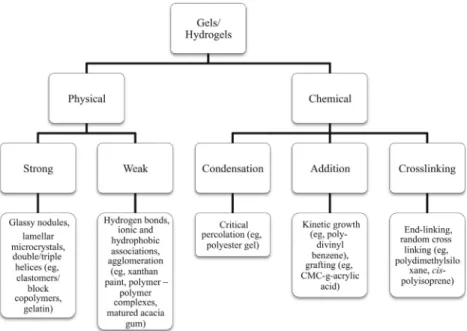
FIGURE 14.1 Classification of gelation mechanism and relevant examples. (Adapted from Gulrez et al., 2011)
solubilized material, accumulated particles, dispersed throughout the final prod- uct due to which it exhibits a great diversity of rheological characteristics. Food gels can behave like viscoelastic materials exhibiting both a viscous and an elastic nature (eg, salad dressings, cream), or plastic materials (eg, butter, mar- garine) (Dille et al., 2015). This diversity of the food gel comes from the out- come of the organization and rearrangements of the food constituents—mainly polysaccharides, proteins, and lipids during processing and storage.
Flory (1953) defined gel as a soft, solid, or solid-like material of two or more components, one of which is a liquid present in substantial quantity. It is com- posed of crosslinked polymeric molecules to form tangled interconnected net- works immersed in liquid medium. At the molecular level, gelation is the process which imparts stress resisting bulk character (solid properties) due to continuous framework of networks of polymer chains that extends throughout the gel phase.
Flory (1974) later proposed a classification of gels based on structural criteria:
1. well-ordered lamellar structures, including gel mesophases;
2. covalent polymeric networks; completely disordered;
3. polymer networks formed through physical aggregation; predominantly dis- ordered, but with regions of local order; and,
4. particulate, disordered structures.
Most food biopolymers form physical gels, structured by weak hydrogen-, hydrophobic- and electrostatic-interactions (Clark and Ross-Murphy, 1987;
Ross-Murphy, 1995a,b; Rao, 2003). Gelling of food biopolymers is divided into
“cold setting” and “heat setting,” based on the gelation mechanism. In the for- mer, gelation is induced by cooling (agarose, carrageenans, pectin, whey pro- tein, etc.) whereas in the latter, gelation occurs due to heating (bovine serum albumin, myosin, etc.).
Almdal et al. (1993) further refined definition of the solid-like character- istics of gels in terms of the dynamic mechanical properties, namely a storage modulus G′(w), exhibiting a pronounced plateau extending to times at least of the order of seconds, and a loss modulus G0(w), which is considerably smaller than the storage modulus in the plateau region. Food gels in terms of mechanical viscoelastic characteristics can again be classified into two types: strong- and weak gels. Both strong- and weak gels behave as solids at small deformations.
However, strong gels behave as solids, whereas the weak gels are structured fluids at large deformations.
Ross-Murphy (2005) reviewed the structure/property relationships for bio- polymer (including food biopolymer) solutions and gels. He described how small deformation oscillatory measurements enable distinction between “strong” and
“weak” gels, applicable for the food thickeners, gels, and stabilizers. At small strains, both strong and weak gel systems exhibit essentially the same mechanical spectrum, with G′ > G0, and with both moduli largely independent of frequency.
However, the deformation dependence of these two classes of materials is differ- ent. At large deformations, strong gels rupture and fail, whereas weak gels flow
without fracture and show recovery of solid (gel-like) character (Clark and Ross- Murphy, 1987). In a weak gel, the dynamic modulus is frequency dependent, sug- gesting the occurrence of relaxation process even at small time scales and lower difference in values between G′ and G0. Several researchers have identified weak gel–like behavior of food biopolymer gels and solutions ( Doublier et al., 1992;
Ross-Murphy, 1995a,b; Mleko and Foegeding, 2000; Ikeda and Nishinari, 2001;
Löfgren et al., 2002). A promising and new approach of describing foods as a weak gel is found in recent studies (Rao and Cooley, 1992; Tunick, 2000;
Gabriele et al., 2001; Ng and McKinley, 2008; Basu et al., 2011).
From processing to consumption of food, food gels are exposed to a number of deformations that may cause irreversible deformation of the food or fracture failure. Traditionally “gel strength” has been measured to characterize gel systems based on rupture tests, but it cannot represent the overall mechanical behavior of gels. Therefore food gels are characterized by various rheological tests like steady state rheology, time dependence, small angle oscillatory shear (SAOS) rheology, or large angle oscillatory shear (LAOS). Several types of rheological testing pro- cedures are used to evaluate the food gels at different temperature conditions to understand food gels mechanical behavior, fracture, and deformation behavior.
14.2.1 Fruit Gels
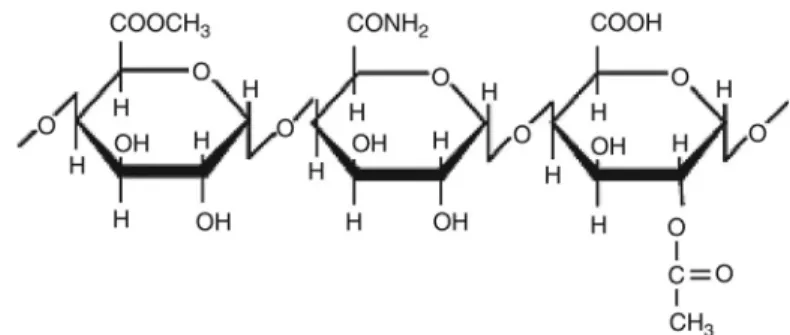
Fruit gels are made by boiling fruit pulp or juice with sugar and pectin at suit- able concentration levels. Pectin acts as a gelling agent in the manufacture of different fruit gel type food products (jam, jelly, marmalade). Pectins are a class of complex polysaccharides. Pectin consists of chains of 300–1000 galact- uronic acid units, joined with α-1→4 linkages partially esterified with metha- nol, and interrupted by (1→2) linked α-d-rhamnopyranosyl residues (Thakur et al., 1997). The structure is stabilized by steric factors with a possible contri- bution from intramolecular hydrogen bonding (Oakenfull, 1991). Some of the galacturonic acid units in the pectin molecule are esterified and are present as the galacturonic acid methyl ester (Fig. 14.2).
FIGURE 14.2 Representation of different substituents potentially present in commercial pectins (respectively, methyl-ester, amide group, and acetyl group).
Pectin is characterized on the basis of jellying power, degree of methoxyl- ation/esterification, and rate of solidification of the jellies. Based on the degree of methoxylation/esterification, it is classified as low methoxyl (LM) pectin and high methoxyl (HM) pectin. Degree of esterification (DE) of the pectin mol- ecule is defined as the ratio of esterified galacturonic acid units to total galact- uronic acid units in the molecule. The DE of HM- and LM pectins are 50% and above, and below 50%, respectively. Depending on the pectin type, coordinate bonding with Ca2+ ions or hydrogen bonding and hydrophobic interactions are varied in gel formation (Figs. 14.3 and 14.4).
In LM pectin, gelation results from ionic linkages via calcium bridges between two carboxyl groups belonging to two different chains in close contact with each other (Fig. 14.3) (Oakenfull and Scott, 1984; Cardoso et al., 2003).
The affinity of pectin chains toward calcium increases with decreasing DE or ionic strength, and with increasing polymer concentration (Kohn, 1987; Garnier et al., 1994). Besides the influence of the charge density of the polygalacturo- nate chain, the distribution pattern of free and esterified carboxyl groups has also an important effect on the strength of calcium binding (Powell et al., 1982).
In HM pectin, the crosslinking of pectin molecules involves a combination of hydrogen bonds and hydrophobic interactions between the molecules (Fig. 14.4) ( Morris, 1986; Lopes da Silva et al., 1992). Physical characteristics of the gel are the consequence of the formation of a continuous three-dimensional net- work of crosslinked pectin molecules.
FIGURE 14.3 Low methoxyl pectin gelation mechanism in the presence of calcium ions.
(Adapted from Hoefler, 2003)
14.3 FRUIT GEL RHEOLOGY
Flow behavior of fruit gels containing high or moderate levels of sugars and/or very small amount of gelling agent have been widely studied (Saravacos, 1970;
Mizrahi and Firstenberg, 1975; Carbonell et al., 1991a,b; Costell et al., 1993;
Raphaelides et al., 1996; Basu et al., 2007; Basu and Shivhare, 2010). Major- ity of the studies on fruit gels (jam, jelly, marmalade, or preserve) investigated effects of formulation and temperature on steady state- and time dependent- rheological behavior. Studies on rheology of fruit jam are rather limited ( Carbonell et al., 1991a,b; Costell et al., 1993; Grigelmo-Miguel and Martin- Belloso, 2000; Gabriele et al., 2001; Álvarez et al., 2006; Basu et al., 2007). It has been established that the rheological properties of jam are mainly affected by the amount and type of sugar added, proportion and kind of gelling agent used, fruit pulp content, and process temperature (Abdullah and Cheng, 2001; Gajar and Badrie, 2001; Acosta et al., 2008). Systematic studies on rheological behav- ior during gelation and molecular level understanding of gelation mechanism in fruit jam are lacking (Basu and Shivhare, 2010, 2013; Basu et al., 2013).
For fruit gels, it is important to understand the relationships between the fruit gel texture and product structure (Renard et al., 2006). Rheological properties are useful in defining functionality of ingredients in quality con- trol, and correlation of food texture to sensory attributes (Saravacos, 1970;
Kokini and Plutchok, 1987; Dervisi et al., 2001). Mechanical measurements (textural and rheological) in combination with sensory analysis could repre- sent the fruit gel quality more accurately. Rheological behavior of jam and
FIGURE 14.4 High methoxyl pectin gelation mechanism. (Adapted from Hoefler, 2003)
with varying sugar contents has been widely studied (Carbonell et al., 1991a,b;
Gabriele et al., 2001; Álvarez et al., 2006; Basu and Shivhare, 2010, 2013; Basu et al., 2013). However, little scientific information is available in the literature on variation of rheological and textural properties and microstructure of fruit jam with ingredients composition.
Scientific literature on textural properties of jams (Suutarinen et al., 2002;
Singh et al., 2009; Basu et al., 2011), marmalade (Moghaddam et al., 2009), and jellies (Moritaka et al., 1999; Khouryieh et al., 2005; Royer et al., 2006) are available. Some researchers have also studied the flow behavior of these prod- ucts (Costell et al., 1993; Miguel et al., 1999; Yildiz and Alpaslan, 2012). The studies on these structured products lead to the possibility of establishing quality control methods for fruit-derived products, based on their viscometric proper- ties (Fugel et al., 2005). Some researchers have studied the viscoelastic proper- ties of jams (Dervisi et al., 2001; Gabriele et al., 2001; Basu et al., 2011, 2013;
Basu and Shivhare, 2013).
14.3.1 Steady State Rheology
Steady state relationship between shear stress–shear rate of food materials is expressed in terms of power-law model or Herschel–Bulkey model. Herschel–
Bulkley model is used for fruit gels with yield stress. Yield stress fluids behave like a solid until a minimum stress, known as yield stress, is overcome for beginning of the flow of the material.
τ=Kγ
Power-law model: n (14.1)
τ τ γ
− = +K
Herschel Bulkley model: o n (14.2)
where τ is the shear stress (Pa); τo is the yield stress (Pa); γ is the shear rate (s–1); K is the consistency index (Pa.sn); and n is the flow behavior index (dimensionless) signifying the extent of deviation from Newtonian behavior.
Dependence of the flow behavior of fruit gels on temperature can be described by the Arrhenius relationship (Saravacos, 1970; Rao, 1986; Steffe, 1996):
=
K AKexp(E RTK/ ) (14.3)
where AK is the frequency factor (Pa.sn); EK represents activation energy (kJ/mol); R is the gas law constant (R = 8.314 J/mol.K); and T is the absolute temperature (K).
Carbonell et al. (1991a) studied rheological characteristics of apricot, peach, plum, and strawberry fruit jams and found that flow behavior was adequately described by the Herschel–Bulkley model. Flow behavior of sheared jam was time dependent, and could be quantified by the Weltman model.
Costell et al. (1993) studied the effect of formulation factors on Casson yield values measured at low (γ01)- and medium (γ02)-shear rates in previously
Power-law model: τ=Kγ˙n
Herschel−Bulkley mod- el: τ=τo+Kγ˙n γ˙
K=AKexp(EK/RT)
γ˙01 γ˙02
sheared strawberry and peach jams. Twenty three samples of each fruit jam were prepared according to a second-order composite rotatable design. Com- position ranges were as follows: fruit content 25–55%; soluble solids content 60–70oBrix; and pectin 0.3–0.7% in strawberry jams and 0.1–0.5% in peach jams. Variation of γ01 in strawberry jams depended mainly on the interactions between fruit and soluble solids and between fruit and pectin, whereas in peach jams, it depended on fruit-soluble solids and soluble solids–pectin interactions.
Variation of γ02 with composition was similar to that observed for γ01 in both strawberry and peach jams.
Álvarez et al. (2006) studied the rheological behavior of selected jams at 20–40oC in a rotational viscometer. The rheograms were fitted with power- law, Carreau, Carreau–Yasuda, Herschel–Bulkley, and Cross models and it was found that all the models explained rheological behavior of jam. It was observed that the jams exhibited pseudoplastic behavior and that the suspended solids influenced the consistency index as depicted in Fig. 14.5a,b.
14.3.2 Thixotropy/Time Dependent Behavior
Many food products are thixotropic in nature and are characterized by decreas- ing shear stress/ viscosity with shearing time (Holdsworth, 1993; Barnes, 1997).
Recovery of stress occurs for some food products under rest. Thixotropy results due to structural reorganization with time of shearing and coupled with reduced resistance to flow. Commonly used method to characterize thixotropy is to apply a constant shear rate at a particular temperature and study the variation of shear stress/viscosity with time. Time-dependent rheological models for food materials have been developed by several researchers (Weltman, 1943;
Hahn et al., 1959; Tiu and Boger, 1974; Figoni and Shoemaker, 1981; De Kee et al., 1983; Baravian et al., 1996).
γ˙01 γ˙02 γ˙01
FIGURE 14.5 a Shear stress versus shear rate for fruits jam at all temperatures: 20°C (▼), 25°C (●), 30°C (◆), 35°C (■), and 40°C (▲); b. Shear stress versus shear rate for fruits jams at 30°C:
prune (▲), apricot (∆), strawberry (●), fruits (■), peach (□), and raspberry (○). (Adapted from Álvarez et al., 2006)
14.3.2.1 Weltman Model Weltman model (1943) is expressed as
τ = −A B tln (14.4)
where τ is the shear stress (Pa) at any given time of shearing (t). The param- eter A represents the initial stress whereas B is the time coefficient of structure breakdown.
14.3.2.2 Hahn Model
Hahn et al. (1959) evaluated the Weltman model and found plots of τ versus ln t for the mineral oil to be sigmoidal but not linear. They argued on theoreti- cal basis that stress decay of thixotropic substances follows the first-order type relationship,
τ τ− = −P at
log( e) (14.5)
where τe is the equilibrium shear stress value which is reached after a long shearing time; P represents initial shear stress; and a indicates rate of structural breakdown for the sample.
14.3.2.3 Figoni and Shoemaker Model
Figoni and Shoemaker (1983) proposed the thixotropic model based on their work on transient rheology of mayonnaise.
τ τ= e+(τmax−τe)exp(−kt) (14.6) where τmax is the initial shear stress; (τmax − τe) represents the quantity of break- down structure for shearing; and k is a kinetic constant of structural breakdown.
14.3.2.4 Structural Kinetic Model
Time-dependent flow behavior of the food materials is also modeled using the structural kinetic approach, which has been successfully employed by several researchers (Nguyen et al., 1998; Abu-Jdayil, 2003) This model postulates that the change in the rheological properties is associated with shear-induced breakdown of the internal fluid structure in the food. Using the analogy with chemical reactions, the structural breakdown process may be expressed as
→
(Structured) (Non-Structured)
The rate of breakdown of the structure during shear depends on the kinet- ics of the aforementioned reaction. Based on the experimental results from the transient measurements at constant shear rates, and from the step change in shear rate measurements it may be assumed that the thixotropic structure in food breaks down irreversibly without significant buildup.
τ=A−Blnt
log(τ−τe)=P−at
τ=τe+(τmax−τe)exp(−kt)
(Structured)→(Non-Structured)
Let Ψ = Ψ( , ) be a dimensionless parameter representing the structured γ t state at any time t and under an applied shear rate γ. The rate of structural break- down may be expressed as
−dΨ= Ψ − Ψα
dt k( )m (14.7)
where k k( ) is the rate constant; = γ α is the function of shear rate (γ); and m is the order of the breakdown “reaction.” Initially, at the fully structured state, t = 0: Ψ = Ψo; and, at steady state, t = 0: Ψ = Ψα. At a constant applied shear rate, integration of Eq. 14.7 from initial time (t = 0) to a time (t) yields
Ψ − Ψα − = m− kt+ Ψ − Ψα −
( )1 m ( 1) ( o )1 m (14.8)
To apply Eq. 14.8 to the experimental transient viscosity data, a relationship between Ψ and measurable rheological quantities needs to be specified. Ψ may be defined in terms of the apparent viscosity (η) as
γ η η η η
Ψ = −
− αα ( , )t
o
(14.9) where ηo is the initial apparent viscosity at t = 0 (structured state); η is the apparent viscosity at time t; and ηα is the final or equilibrium apparent viscos- ity at t →α (equilibrium structured state). Both ηo and ηα are functions of the applied shear rate only.
Substituting Eq. 14.9 into Eq. 14.8 we obtain, for a fixed shear rate:
η η− α − = m− kt+ η −ηα −
( )1 m ( 1) ( o )1 m (14.10)
The form of Eq. 14.10 allows a simple way for testing the validity of the model and determination of the model parameters m and k. Eq. 14.10 is valid only under the constant shear rate condition (Nguyen et al., 1998).
Time-dependent rheology of fruit pulps has been investigated by several researchers (Mizrahi, 1979; Lozano and Ibarz, 1994; Ramos and Ibarz, 1998;
Krokida et al., 2001). Thixotropic characteristics of mango pulp have been studied by Bhattacharya (1999), while several researchers have studied the thixotropic characteristics of fruit jam (Carbonell et al., 1991a,b; Basu et al., 2007; Basu and Shivhare, 2010, 2013). The time required to restructure a fruit gel product like jam is of the order of hours-days and cannot be tested reliably in the currently available instrument setups due to the drying effects.
Therefore, restructuring is likely to occur during storage rather than during processing.
Carbonell et al. (1991b) investigated the influence of fruit content (25–55%), soluble solids content (40–70oBrix), and added pectin (0.3–0.7% in strawberry jams and 0.1–0.5% in peach jams) on time-dependent parameters in previously sheared jams. Twenty three samples of each fruit jam were prepared. Weltman Ψ=Ψ(γ˙,t)
γ˙
−dΨdt=k(Ψ−Ψα)m k=k(γγ˙)˙
(Ψ−Ψα)1−m=(m−1)kt+(Ψo−Ψα)1−m
Ψ(γ˙,t)=η−ηαηo−ηα
(η−ηα)1−m=(m−1)kt+(ηo−ηα)1−m
A values depended mainly on fruit content and on its interaction with soluble solids and added pectin for both fruit jams. Weltman B values depended on the three variables and on fruit–pectin interaction for strawberry jam, whereas for peach jam samples B values depended also on fruit-soluble solids interaction.
Predictive power of time-dependent parameters for estimation of fruit content was low, but considering them in conjunction with soluble solids content and total pectin values explained 91.7% of the variability of fruit content in straw- berry jam samples and 83.7% of same in peach jam samples.
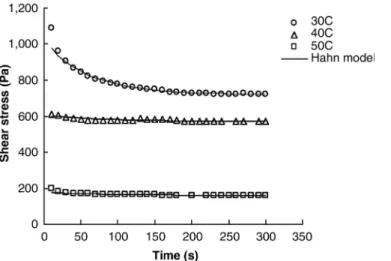
Basu et al. (2007) studied the effect of sugar and pectin concentration, pH, shear rate, and temperature on time-dependent rheological properties of pineap- ple jam. Thixotropic behavior of pineapple jam was influenced by the shear rate employed, temperature, and composition. Hahn model described adequately the time-dependent flow properties of pineapple jam (Fig. 14.6).
14.3.3 Dynamic Rheology
Dynamic rheological studies on fruit gel are rather limited (Gabriele et al., 2001;
Basu et al. 2011; Peinado et al., 2012). Many foods particularly fruit gels can be considered as viscoelastic gels, characterized by a three-dimensional network where weak interactions (hydrogen bonding or Van der Waals interactions) ensure the stability of the structure. This type of approach, called weak gel model, was found suitable for gelled food systems like fruit jam. This model provides a direct link between the microstructure of the material and its rheological properties. The most important parameter introduced is the “coordination number”, z, which is the number of flow units interacting with each other to give the observed flow response.
FIGURE 14.6 Shear stress–time relationship for pineapple jam (68.5°Brix) at particu- lar temperatures for constant shear rate = 50/s (pH-3.0, pectin-1%, and sugar concentra- tion-60%). (Adapted from Basu et al., 2007)
Above the Newtonian region, there exists a regime characterized by the following flow equation:
= ′ + ′′ =
G* G w( )2 G w( )2 Aw1/z (14.11) where A is a constant which can be interpreted as the “interaction strength”
between the flow rheological units. Material functions of food system in the lin- ear viscoelastic regime can be well described by only two parameters (A and z).
Several empirical relations have been proposed to relate the viscometric func- tions to linear viscoelastic properties. The Cox–Merz rule is one such relation:
η*( )w =η γ( ) for w=γ (14.12) The Cox–Merz rule is a simple relationship that predicts that the complex viscosity η*( )w and steady shear viscosity η γ( ) are equivalent when the angu- lar frequency (w) is equal to the steady shear rate (γ).
Compared to synthetic polymers, rheological behavior of food materi- als may deviate from Cox–Merz relation to a larger extent. However, in many cases, it has been found that the foods follow the same general behavior when a shift factor, A, is introduced (Bistany and Kokini, 1983; Yoon et al., 2004):
η*( )w =η γ(A ) w=γ (14.13) Basu et al. (2011) demonstrated that mango jam did not follow Cox–Merz rule but followed the modified Cox–Merz rule in the low shear rate and fre- quency region.
Sagdic et al. (2015) studied viscoelastic properties of rosehip marmalade by SAOS measurements. The G′ (storage modulus) values were found to be higher than G0 (loss modulus) values in different temperatures. This behavior indicated that the rose hip marmalade had a weak gel–like structure with solid- like behavior. Storage and loss modulus, and η* (complex viscosity) values decreased with increase in temperature level. Modified Cox–Merz rule was found to be satisfactory to correlate apparent and complex viscosity values of the rose hip marmalade at all temperatures studied.
Basu et al. (2011) studied the gelation process with increasing total solu- ble solids (TSS) upon boiling pulp–pectin–sugar–acid mix during production of mango jam. The gel became more elastic solid–like material than a flow- able liquid mix with increasing TSS. Within the linear viscoelastic region, the frequency dispersions of storage (G′)- and loss (G0)-moduli of mango jam (pH = 3.4, pectin concentration = 1%) with selected sugar concentrations (60%) at different TSS at 30°C were approximately straight lines with different slopes (Fig. 14.7). The dependence of G′ and G0 on frequency (w) was adequately described by the power-law function.
The gelation process during jam manufacturing is attributed to alignment and stretching of the pectin polymer chains in sucrose and fruit pulp mix, G*=G′(w)2+G0(w)2=Aw1/z
η*(w)=η(γ˙) for w=γ
η*(w)
η(γ˙) γ˙
η*(w)=η(Aγ˙)
resulting in more sites that become available for the formation of intermolecu- lar hydrogen bonding. In this process, the polymeric pectin chains hydrogen bond to each other to form an interconnected three-dimensional gel network.
Sucrose molecules are held within these three-dimensional structures of pectin gel network. As a result, a stronger elastic characteristic developed with increas- ing TSS (gelation process) in fruit jam (Fig. 14.7).
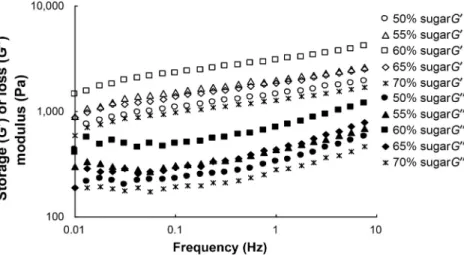
Basu et al. (2011) studied the frequency dependence of storage and loss moduli of mango jam at selected sucrose levels (Fig. 14.8). The storage and loss moduli increased with sucrose concentration up to 60%, but decreased thereaf- ter. Pectin forms a network of fibrils with water, and sucrose acts as a dehydrat- ing agent in fruit jam which disturbs the equilibrium existing between water and pectin. The barrier to self-association of pectin chains into gel junctions is inter- molecular electrostatic repulsion between charged carboxyl groups in pectin, and polymeric pectin–water interactions acting in competition with polymer–
polymer interactions (Evageliou et al., 2000b). Progressive increase in sucrose concentration partially reduces the water available in pectin–sucrose–acid mix and thus reduces the chance of formation of hydrogen bonds and possible asso- ciation of water with polymeric pectin chain (Evageliou et al., 2000a,b; Bayarri et al., 2004). Sucrose provides additional hydroxyl groups to stabilize the struc- ture of junction zones and promote hydrogen bonds to immobilize free water (Nishinari et al., 1990). However, this phenomenon took place up to a certain level of sucrose concentration (up to 60%). Higher sucrose concentrations (65 and 70%), however, weakened the pectin gel network. It appears, therefore, that limited availability of water and enhanced hydrogen bonding between the polyhydric sucrose and remaining watermolecules destabilized the rigid pectin
FIGURE 14.7 Variation of storage and loss moduli of sugar jam (pH = 3.4, sugar concentra- tion = 60%, pectin concentration = 1%, temperature = 30oC) with frequency at selected TSS.
(Adapted from Basu et al., 2011)
gel network above a sucrose concentration of 60%. As the amount of sugar increased above 60%, more amount of water was released in jam thereby ren- dering it softer.
14.4 EFFECT OF SUGAR SUBSTITUTES IN FRUIT GEL RHEOLOGY
Reduced calorie products are gaining importance in the food industry worldwide due to considerable awareness of the consumers for the reduced intake of fat and calorie in diet (Sandrou and Arvanitoyannis, 2000). Technological problems are being faced while replacing sugar in processed food systems, since sugar has multiple other functions apart from imparting the desired sweet taste (Sandrou and Arvanitoyannis, 2000). In fact, health conscious consumers and especially those suffering from diabetes demand reduced or no-sugar added products or substitution of high calorific sweeteners with low calorific sweeteners. Low calorie food products of good quality can be made by incorporating combina- tions of noncaloric and carbohydrate sweeteners (Nabors, 2001). Sucrose can be replaced by other sugars such as fructose and/or isomaltulose or alternative sweeteners (aspartame, acesulfame-K, sorbitol, maltitol, sucralose, stevioside, etc.). Alternative sweeteners (xylitol, sorbitol, aspartame, acesulfame-K, cycla- mate, stevioside, sucralose, or combinations of these) can be used for partial or full replacement of sucrose to prepare fruit gels with lower amounts of sucrose (Hyvönen and Törmä, 1983). Stevioside and sucralose are nonnutritive high intensity sweeteners, acid- and heat-stable, and can be used for low calorie jam preparation (partial sucrose substitution) without compromising taste (Basu et al., 2013).
FIGURE 14.8 Frequency sweep of mango jam samples (pH = 3.4, pectin concentration = 1%) at 30oC. (Adapted from Basu et al., 2011)
Peinado et al. (2012) showed full replacement of sucrose with healthier sug- ars such as fructose and/or isomaltulose is possible in spreadable strawberry products. These products formulated with different types of sugars (sucrose, isomaltulose, sucrose–glucose, and fructose–isomaltulose) were rheologically analyzed. Static tests characterized them as Herschel–Bulkley fluids. The val- ues of the consistency index (K) and yield stress were influenced by the type of sugar, the elaboration method, and the pectin levels, whereas the flow behavior index (n) was not affected by sugar type, but by the elaboration method and the pectin level. The dynamic tests permitted classification of some of the products as weak gels. The strength of the network “A” increased with the pectin level, whereas the “coordination number” (z) did not show a clear trend depending on the different process variables.
Systematic studies on low calorie fruit jam development by different alter- native sweeteners are done by our group (Basu et al., 2011, 2013; Basu and Shivhare, 2013). The group systematically worked on partial and full substi- tution of sucrose to develop low calorie mango jam with selected sweeteners (sorbitol, stevioside, sucralose). The rheological and textural parameters of the fruit jam were systematically studied and related to product sensory attributes.
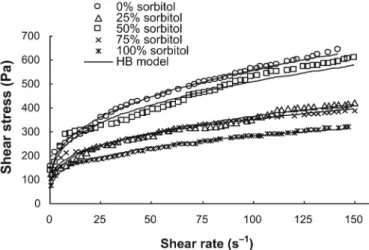
Effect of various levels of sorbitol substitutions (0–100% sorbitol) on rheologi- cal behavior of jam (pH = 3.4, pectin concentration = 1%) is shown in Fig. 14.9 (Basu and Shivhare, 2013). Shear stress value at a given shear rate decreased when sugar was replaced with sorbitol. That is, incorporation of sorbitol, either partially or completely, resulted in softer texture of jam.
Yield stress influences the spreadability of mango jam and is an additional parameter for quality control. Spreadability is a measure of how easily and uni- formly jam can be deformed and spread at end-use temperatures. Consequently,
FIGURE 14.9 Effect of sorbitol substitution in 70% sugar jam (pH = 3.4, pectin concentra- tion = 1%) on rheological behavior at 20oC. (Adapted from Basu and Shivhare, 2013)
while low yield stress in jam sample indicates high spreadability, the ability to resist deformation at low strains can result in poor spread uniformity. Moder- ate level of yield stress is therefore required for jam to exhibit both elastic and viscous behavior, that is, an ideal soft solid–like character.
Daubert et al. (1998) suggested that spreadability should not only be related to yield stress alone but also to the yield strain. Material strain at the yield point provides information on how much deformation a sample can withstand prior to flowing. A mango jam sample might have a low yield stress but may be able to withstand large degree of deformation prior to yielding; thus, making it difficult to achieve uniform, smooth distribution upon application. The yield stress behavior of partially- or fully substituted sorbitol jam samples (pH = 3.4, pectin concentration = 1%) at 65% sucrose concentration level during gela- tion is shown in Fig. 14.10. The yield stress values decreased substantially with increasing amounts of sorbitol. This is due to enhanced hydrogen bonding effect of polyhydroxy sorbitol with water which competes with the pectin–water interactions present in the pectin–pulp–sorbitol mix. The hydrogen bonding of sorbitol with water was more pronounced than sucrose and the remaining water destabilized and weakened the pectin gel network (Bayarri et al., 2004).
Sorbitol, therefore, formed a weak gel compared to sucrose and the water was present in more free form in the final product compared to normal jam prepared with sucrose under the similar processing condition. Hardness decreased with increasing sorbitol concentration because of weaker junction zones in pectin gel network.
FTIR spectra of the samples were analyzed to understand the molecu- lar level interactions in the jam. Results indicated that the nature of spec- tral bands was similar for jam manufactured with sucrose or sorbitol. The
FIGURE 14.10 Effect of TSS on yield stress of jam (pH = 3.4, pectin concentration = 1%, sugar concentration = 65%, temperature= 20oC) at different sorbitol substitution levels.
(Adapted from Basu, 2009)
intensity of C–C and C–O stretching vibrations (900–1150 cm−1) was similar for jams with 50, 75, and 100% sorbitol, but were higher for 0 and 25% sor- bitol jams. Similarly, the intensity (peak area) at 1632 cm−1 (for free COO−), 1200–1480 cm−1 (bending of O–C–H, C–C–H, and C–OH), and 750 cm−1 (anomeric region) decreased with increasing sorbitol substitution. These spec- tral features are indicative of strong network formation in jam manufactured with sucrose compared to jam made only with sorbitol. The C–O and C–C stretching vibrations are indicators of the gel strength because pectin poly- meric chain network formation in fruit jam is due to hydrogen bonding and hydrophobic interactions. The FTIR spectra recorded for sorbitol substitutions demonstrated that gelation is a physical phenomenon and the molecular bond- ing pattern remains similar for sucrose or sorbitol used during jam manufac- turing (Fig. 14.11).
Basu et al. (2013) studied the effect of sucralose and stevioside substitution on rheological properties in mango jam developed. The effect of sucralose sub- stitution on rheological behavior of sucralose jam under steady state is shown in Fig. 14.12. The rheological behavior of sucralose jam was well described by Herschel–Bulkley model.
Increased substitution of stevioside/sucralose resulted in reduced TSS in the final product. For a given stevioside level, K and yield stress (τ0) decreased with increasing stevioside substitution. Further, n increased with decreasing TSS values, signifying the shift toward Newtonian behavior of jam. Jam prepared
FIGURE 14.11 FTIR spectra of jam (pH = 3.4, pectin concentration = 1%).
with more than 25% stevioside and sucralose exhibited thick liquid-like charac- teristics and therefore cannot be considered as jam. This phenomenon indicated weaker network formation by pectin in these samples and the samples remained in “sol” state. For occurrence of gelation, a minimum amount of cosolute is needed for pectin to gel (Morris et al., 1980; Oakenfull and Scott, 1984). Jam prepared with 50, 75, and 100% stevioside/sucralose substitution did not meet the desired textural and rheological characteristics of mango jam due to low TSS in the final product. Manufacture of mango jam with desired soft solid characteristics was feasible only with approximately 25% stevioside or sucra- lose substitution (Basu et al., 2013).
14.5 SUMMARY
Fruit gels are popular processed intermediate moisture food products because of their low cost, all year long availability, and organoleptic properties. Commercial manufacturing of low calorie fruit gels is gaining importance due to dietary awareness of consumers throughout the world.
Therefore, there is a need to develop low calorie fruit gel type products (jam, jelly, marmalade, fruit leather). Scientific understanding of the effects of composition on textural attributes, micro-structural properties, and sensory properties is needed in order to manufacture low calorie fruit gels with the desired textural and rheological attributes. This will further aid in optimi- zation of the ingredient interactions for best quality low calorie fruit gel manufacturing.
FIGURE 14.12 Effect of sucralose substitution on steady state rheological behavior of sucralose jam (pH = 3.4, pectin concentration = 1%, sucralose level = 60) at 30°C. (Adapted from Basu et al., 2013)
REFERENCES
Abdullah, A., Cheng, T.C., 2001. Optimization of reduced calorie tropical mixed fruit jam. Food Qual. Prefer. 12, 63–68.
Abu-Jdayil, B., 2003. Modeling the time-dependent rheological behavior of semisolid foodstuffs.
J. Food Eng. 57 (1), 97–102.
Acosta, O., Vĭquez, F., Cubero, E., 2008. Optimisation of low calorie mixed fruit jelly by response surface methodology. Food Qual. Prefer. 19, 79–85.
Ahmed, G.E., 1981. High methoxylpectins and their uses in jam manufacture—a literature survey.
The British Manufacturing Industries Research Association. Sci. Tech. Surv. (127), July.
Almdal, K., Dyre, J., Hvidt, S., Kramer, O., 1993. Towards a phenomenological definition of the term “gel”. Polym. Gels Netw. 1, 5–17.
Álvarez, E., Cancela, M.A., Maceiras, R., 2006. Effect of temperature on rheological properties of different jams. Int. J. Food Prop. 9 (1), 135–146.
Baker, R.A., Berry, N., Hui, Y.H., Barrett, D.M., 2005. Food preserves and jams. In: Barrett, M., Somogyi, L., Ramaswamy, H.S. (Eds.), Processing Fruits. second ed. CRC Press, Boca Raton, FL.
Baravian, C., Quemada, D., Parker, A., 1996. Modelling thixtropy using a novel structural kinetics approach: basis and application to a solution of iota carrageenan. J. Texture Stud. 27, 371–390.
Barnes, H.A., 1997. Thixoropy: a review. J. Non-Newtonian Fluid Mech. 70, 1–33.
Basu, S., 2009. Development of jam using alternative sweeteners. PhD Thesis, Panjab University, Chandigarh, India.
Basu, S., Shivhare, U.S., 2010. Rheological, textural, microstructural and sensory properties of mango jam. J. Food Eng. 100, 357–365.
Basu, S., Shivhare, U.S., 2013. Rheological, textural, microstructural and sensory properties of sorbitol substituted mango jam. Food Bioprocess Technol. 6, 1401–1413.
Basu, S., Shivhare, U.S., Raghavan, G.S.V., 2007. Time dependent rheological properties of pine- apple jam. Int. J. Food Eng. 3 (3), 1556–3758.
Basu, S., Shivhare, U.S., Singh, T.V., 2013. Effect of substitution of stevioside and sucralose on rheologi- cal, spectral, color and microstructural characteristics of mango jam. J. Food Eng. 114 (4), 465–476.
Basu, S., Shivhare, U.S., Singh, T.V., Beniwal, V.S., 2011. Rheological, textural and spectral char- acteristics of sorbitol substituted mango jam. J. Food Eng. 105, 503–512.
Bayarri, S., Duran, L., Costell, E., 2004. Influence of sweeteners on the viscoelasticity of hydrocol- loids gelled systems. Food Hydrocoll. 18, 611–619.
Bhattacharya, S., 1999. Yield stress and time-dependent rheological properties of mango pulp.
J. Food Sci. 64, 1029–1033.
Bistany, K.L., Kokini, J.L., 1983. Dynamic viscoelastic properties of foods in texture control.
J. Rheol. 27, 605–620.
Carbonell, E., Costell, E., Duran, L., 1991a. Rheological behavior of sheared jams: relation with fruit content. J. Texture Stud. 22, 33–34.
Carbonell, E., Costell, E., Duran, L., 1991b. Rheological indices of fruit content in jams: influence of formulation on time-dependent flow of sheared strawberry and peach jam. J. Texture Stud.
22, 457–471.
Cardoso, S., Coimbra, M., Lopes da Silva, J.A., 2003. Temperature dependence of the formation and melting of pectin–Ca2+ networks: a rheological study. Food Hydrocoll. 17, 801–807.
Clark, A.H., Ross-Murphy, S.B., 1987. Structural and mechanical properties of biopolymer gels.
Adv. Polym. Sci. 87, 57–192.
Costell, E., Carbonell, E., Duran, L., 1993. Rheological indices of fruit content in jams: effect of for- mulation on flow plasticity of sheared strawberry and peach jams. J. Texture Stud. 24, 375–390.
Daubert, C.R., Tkachuck, J., Truong, V.D., 1998. Quantitative measurement of food spreadability using the vane method. J. Texture Stud. 29, 427–435.
De Kee, D., Code, R.K., Turcotte, C., 1983. Flow properties of time-dependent foodstuffs. J. Rheol.
27, 581–604.
Dervisi, P., Lamb, J., Zabetakis, I., 2001. High pressure processing in jam manufacture: effect on textural and color properties. Food Chem. 73, 85–91.
Dickinson, E., 1992. An Introduction to Food Colloids. Oxford University Press, Oxford.
Dille, M.J., Draget, K.I., Hattrem, M.N., 2015. The effect of filler particles on the texture of food gels. Woodhead Publishing Series 9, Cambridge, UK, pp. 183–200.
Doublier, J.L., Launay, B., Cuvelier, G., 1992. Viscoelastic properties of food gels. Viscoelastic Properties of Foods, E.A.F.S. Series, Elsevier Applied Science Publishers, London.
Evageliou, V., Richardson, R.K., Morris, E.R., 2000a. Effect of pH, sugar type and thermal anneal- ing on high-methoxy pectin gels. Carbohydr. Polym. 42, 245–259.
Evageliou, V., Richardson, R.K., Morris, E.R., 2000b. Effect of oxidised starch on high methoxy pectin-sucrose gels formed by rapid quenching. Carbohydr. Polym. 42, 219–232.
Figoni, P.I., Shoemaker, C.F., 1981. Characterization of structure breakdown of foods from their flow properties. J. Texture Stud. 12, 287–305.
Figoni, P.I., Shoemaker, C.F., 1983. Characterization of time dependent flow properties of mayon- naise under steady shear. J. Texture Stud. 14, 431–442.
Flory, P.J., 1953. Principles of Polymer Chemistry. Cornell University Press, Ithaca.
Flory, P.J., 1974. Gels and gelling processes: introductory lecture. Faraday Discuss Chem. Soc. 57, 7.
Fugel, R., Carle, R., Schieber, A., 2005. Quality and authenticity control of fruit purées, fruit prepa- rations and jams—a review. Trends Food Sci. Technol. 16, 433–441.
Gabriele, D., De Cindio, B., D’Antona, P., 2001. A weak gel model for foods. Rheol. Acta 40, 120–127.
Gajar, A.M., Badrie, N., 2001. Processing and quality evaluation of a low-calorie christophene jam (Sechiumedule(Jacq.)) swartz. J. Food Sci. 67, 341–346.
Garnier, C., Axelos, M.A.V., Thibault, J.F., 1994. Selectivity and co-operativity in the binding of calcium ions by pectins. Carbohydr. Res. 256, 71–81.
Grigelmo-Miguel, N., Martin-Belloso, O., 2000. The quality of peach jams stabilized with peach dietary fiber. Eur. Food Res. Technol. 211, 336–341.
Gulrez, S.K.H., Al-Assaf, S., Phillips, G.O., 2011. Hydrogels: methods of preparation, characteri- sation and applications. In: Prof. Carpi, A. (Ed.), Progress in Molecular and Environmental Bioengineering—From Analysis and Modeling to Technology Applications. InTech, Croatia.
Hahn, S.L., Ree, T., Eyring, H., 1959. Flow mechanism of thixotropic substances. Ind. Eng. Chem.
51, 856–857.
Hermansson, A.M., 2007. Structuring water by gelation. In: Aguilera, J.M., Lilford, P.J. (Eds.), Food Materials Science. Springer, New York, USA.
Hoefler, A.C., 2003. Effect of calcium concentration, degree of amidation, soluble solids, and car- bohydrate type on the gel strength of low ester citrus pectin. MS Thesis, University of Dela- ware, USA.
Holdsworth, S.D., 1993. Rheological models used for the prediction of the flow properties of food products: a literature review. Trans. IChemE 71C, 139–179.
Hyvönen, L., Törmä, R., 1983. Examination of sugars, sugar alcohols and artificial sweeteners as substitutes for sucrose in strawberry jams (product development). J. Food Sci. 48 (1), 183–185.
Ikeda, S., Nishinari, K., 2001. Weak gel”-type rheological properties of aqueous dispersions of non- aggregated k-carrageenan helices. J. Agric. Food Chem. 49 (9), 4436–4441.
Khouryieh, H.A., Aramouni, F.M., Herald, T.J., 2005. Physical, chemical and sensory properties of sugar-free jelly. J. Food Qual. 28, 179–190.
Kohn, R., 1987. Binding of divalent cations to oligomeric fragments of pectin. Carbohydr. Res.
160, 343–353.
Kokini, J.L., Plutchok, G.J., 1987. Viscoelastic properties of semisolid foods and their biopolymers components. Food Technol. 41 (3), 89–95.
Krokida, M.K., Maroulis, Z.B., Saravacos, G.D., 2001. Rheological properties of fluid fruit and vegetable puree products: compilation of literature data. Int. J. Food Prop. 4 (2), 179–200.
Löfgren, C., Walkenström, P., Hermansson, A.M., 2002. Microstructure and rheological behavior of pure and mixed pectin gels. Biomacromolecules 3 (6), 1144–1153.
Lopes da Silva, J.A., Goncalves, M.P., Rao, M.A., 1992. Rheological properties of high-methoxyl pectin and locust bean gum solutions in steady shear. J. Food Sci. 57 (2), 443–448.
Lozano, J.E., Ibarz, A., 1994. Thixotropic behaviour of concentrated fruit pulps. LWT—Food Sci.
Technol. 27 (1), 16–18.
Miguel, N.G., Ibarz-Ribas, A., Martín-Belloso, O., 1999. Flow properties of orange dietary fiber suspensions. J. Texture Stud. 30 (30), 245–257.
Mizrahi, S., 1979. A review of the physicochemical approach to the analysis of the structural viscos- ity of fluid fruit products. J. Texture Stud. 10 (1), 67–82.
Mizrahi, S., Firstenberg, R., 1975. Effect of orange juice composition on flow behaviour of six-fold concentrate. J. Texture Stud. 6, 523–532.
Mleko, S., Foegeding, E.A., 2000. pH induced aggregation and weak gel formation of whey protein polymers. J. Food Sci. 65 (1), 139–143.
Moghaddam, T.M., Razavi, S.M.A., Malekzadegan, F., Ardekani, A.S., 2009. Chemical composition and rheological characterization of pistachio green hull’s marmalade. J. Texture Stud. 40 (4), 390–405.
Moritaka, H., Naito, S., Nishinari, K., Ishihara, M., Fukuba, H., 1999. Effects of gellan gum, citric acid and sweetener on the texture of lemon jelly. J. Textural Stud. 30, 29–41.
Morris, V.J., 1986. In: Mitchell, J.R., Ledward, D.A. (Eds.), Functional Properties of Food Macro- molecules. Elsevier Applied Science Publishers, London.
Morris, E.R., Rees, D.A., Robinson, G., 1980. Cation-specific aggregation of carrageenan helices:
domain model of polymer gel structure. J. Mol. Biol. 138, 349–362.
Nabors, L.O’B., 2001. Alternative sweeteners: an overview. In: Nabors, L.O’B. (Ed.), Alternative Sweeteners. Marcel Dekker, New York, pp. 1–12.
Ng, T.S.K., McKinley, G.H., 2008. Power-law gels at finite strains. J. Rheol. 52 (2), 417–449.
Nguyen, Q.D., Jensen, C.T.B., Kristensen, P.G., 1998. Experimental and modelling studies of the flow properties of maize and waxy starch pastes. Chem. Eng. J. 70, 165–171.
Nishinari, K., Watase, M., Williams, P.A., Phillips, G.O., 1990. k-carrageenan gels: effect of sucrose, glucose, urea, and guanidine hydrochloride on the rheological and thermal properties.
J. Agric. Food Chem. 38 (5), 1188–1193.
Nishinari, K., Zhang, H., Ikeda, S., 2000. Hydrocolloids gels of polysaccharides and proteins. Curr.
Opin. Colloid Interface Sci. 5, 195–201.
Oakenfull, D.G., 1991. The chemistry of high-methoxylpectins. In: Walter, R.H. (Ed.), The Chem- istry and Technology of Pectin. Academic Press, New York.
Oakenfull, D.G., Scott, A., 1984. Hydrophobic interaction in the gelation of high methoxylpectins.
J. Food Sci. 49 (4), 1093–1098.
Peinado, I., Rosa, E., Heredia, A., Andrés, A., 2012. Rheological characteristics of healthy sugar substituted spreadable strawberry product. J. Food Eng. 113 (3), 365–373.
Powell, D.A., Morris, E.R., Gidley, M.J., Rees, D.A., 1982. Conformations and interactions of pec- tins II. Influence of residue sequence on chain association in calcium pectate gels. J. Mol. Biol.
155, 517–531.
Ramos, A.M., Ibarz, A., 1998. Thixotropy of orange concentrate and quince puree. J. Texture Stud.
29, 313–324.
Rao, M.A., 1977. Measurement of flow properties of fluid foods—developments, limitations, and interpretation of phenomena. J. Texture Stud. 8, 257–282.
Rao, M.A., 1986. Rheological properties of fluid foods. In: Rao, M.A., Rizvi, S.S.H. (Eds.), Engineering Properties of Foods. Academic Press, San Diego, U.S.A.
Rao, M.A., 1987. Predicting the flow properties of food suspensions of plant origin. Food Technol.
41 (3), 85–88.
Rao, M.A., 2003. Phase transitions, food texture and structure. In: Mckenna, B.M. (Ed.), Texture in Food: Vol 1: Semi-Solid Foods. Woodhead Publishing, Cambridge.
Rao, M.A., 2007. Rheology of liquid foods—a review. J. Texture Stud. 8 (2), 135–168.
Rao, M.A., Cooley, H.J., 1992. Rheological behavior of tomato pastes in steady and dynamic shear.
J. Texture Stud. 23, 415–425.
Raphaelides, S.N., Ambatizidoo, A., Petridis, D., 1996. Sugar composition effects on textural parameters of peach jam. J. Food Sci. 61 (5), 942–946.
Renard, D., van de Velde, F., Visschers, R.W., 2006. The gap between gel structure, texture and perception. Food Hydrocoll. 20, 423–431.
Ross-Murphy, S.B., 1995a. Structure–property relationships in food biopolymer gels and solutions.
J. Rheol. 39, 1451–1463.
Ross-Murphy, S.B., 1995b. Rheological characterization of gels. J. Texture Stud. 26, 391–400.
Ross-Murphy, S.B., 2005. Gelation kinetics-problems and prospects. J. Macromol. Sci. B 44 (6), 1007–1019.
Royer, G., Madieta, E., Symoneaux, R., Jourjon, F., 2006. Preliminary study of the production of apple pomace and quince jelly. LWT—Food Sci. Technol. 39, 1022–1025.
Sagdic, O., Toker, O.S., Polat, B., Arici, M., Yilmaz, M.T., 2015. Bioactive and rheological proper- ties of rose hip marmalade. J. Food Sci. Technol. 52 (10), 6465–6474.
Sandrou, D.K., Arvanitoyannis, I.S., 2000. Low-fat/calorie foods: current state and perspectives.
Crit. Rev. Food Sci. Nutr. 40, 427–447.
Saravacos, G.D., 1970. Effect of temperature on viscosity of fruit juices and purees. J. Food Sci.
35, 122–125.
Singh, S., Jain, S., Singh, S.P., Singh, D., 2009. Quality changes in fruit jams from combinations of different fruit pulps. J. Food Process. Preserv. 33, 41–57.
Steffe, J.F., 1996. Rheological Methods in Foods Process Engineering, second ed. Freeman Press, East Lansing, Michigan.
Suutarinen, J., Honkapaa, K., Heinio, R.L., Mustranta, A., Liukkonen-Lilja, H., Mokkila, M., 2002.
Modeling of calcium chloride and pectin methylesterase prefreezing treatments of strawberries and jams. J. Food Sci. 67 (3), 1240–1248.
Thakur, B.R., Singh, R.K., Handa, A.K., 1997. Chemistry and uses of pectin—a preview. Crit. Rev.
Food Sci. Nutr. 37 (1), 47–73.
Tiu, C., Boger, D.V., 1974. Complete rheological characterization of time dependent food products.
J. Texture Stud. 5, 328–338.
Tunick, M.H., 2000. Rheology of dairy foods that gel, stretch, and fracture. J. Dairy Sci. 83 (8), 1892–1898.
Weltman, R.N., 1943. Breakdown of thixotropic structure as a function of time. J. Appl. Phys. 14, 343–350.
Yildiz, O., Alpaslan, M., 2012. Properties of rose hip marmalades. Food Technol. Biotechnol. 50 (1), 98–106.
Yoon, W.B., Gunasekaran, S., Park, J.W., 2004. Evaluating viscosity of surimi paste at different moisture contents. Appl. Rheol. 14, 133–139.