Information and Communication Technologies: Impact on Poverty Reduction 2
ICT and Economic Growth 2
Empowering the Poor 3
Improving Products and Services to Benefit the Poor 5
Government Services 5
Environmental Monitoring 5
Education 6
Health Care 6
Conclusion 7
Operations 8
The infoDev Work Program 8
The Information and Communication Technologies Portfolio 8
infoDev Conference Scholarship Fund 9
Program Statistics 9
Projects 10
Proposal Evaluation Process 13
The Y2K Initiative 13
Scope of Grant Program 14
Grants to Non-Government 14
Technical Assistance 15
Rollover Facility 15
Knowledge Dissemination and External Activities 15
The New Networked Economy Symposium 16
infoDev Working Papers 16
Partnerships 16
The Stockholm Challenge 17
ICT Stories Project 17
Global Knowledge Partnership and GK-AIMS 17
Development Market Place 17
African Connection 17
Organization 18
Governance 18
Donors’ Committee 18
Technical Advisory Panel 18
Private Sector Participation 19
Administration 19
Finances 20
Contributions 20
Expenses 22
Cash Position 22
Annex 1. infoDev Web site 25
Annex 2. Summary Proceedings of the 1999 Annual Meeting of the Donors’ Committee 29
Annex 3. Disbursements of Projects as of June 30, 2000 35
Annex 4. Status of infoDev Proposals received in Fiscal Year 2000 41
infoDev Staff 51
of infoDev in international efforts to define the place of information and communication technologies (ICT) on the development agenda were some of the highlights of the year.
On November 10-11, 1999, infoDev held its annual symposium at the World Bank headquarters in Washington, D.C. on the theme of The New Networked Economy: What is At Stake for the Developing World? More than 500 participants, including experts in economic and social development, the Internet, and telecommunications exchanged views on salient ICT issues such as univer- sal access to telecommunications, regulatory policies and the development of applications to bridge knowledge gaps. How to con- nect those on the wrong side of the digital divide was another major topic. The Symposium emphasized the need for a greater focus – at a policy level and in the context of public-private partnerships – on access for the poor to modern information infrastructures and technologies. It also helped to highlight the growing relevance of ICT for the development agenda.
Over a two-year period of operations, the Y2K Initiative to address the "millennium bug" received a total of 161 requests for plan- ning, implementation and other Y2K-related grants. In response to those requests, 140 grants, of which 55 in FY00, were award- ed and more than 100 governments in the developing world, including 75 countries eligible to assistance from the International Development Association (IDA), launched and conducted successful national Y2K programs. On request of governments, techni- cal teams were sent by infoDev to assess national or sector risks and support the development of contingency plans. The Y2K Initiative also sponsored a series of global and regional seminars and organizations–e.g., the International Y2K Cooperation Center–setting the standards for international cooperation to address ICT-related risks in the global economy.
The growing visibility of infoDev resulted in an increasing number of requests to help with the development of new ICT initia- tives, such as the Global Development Gateway. The Global Development Gateway being developed under the leadership of the World Bank Group, is expected to be the premier Web "portal" to facilitate partnerships, promote Internet-based activities in devel- oping countries and lower transaction costs for searching quality information useful to the development community. infoDev has also been called upon by several partners–for example, the United Nations Economic and Social Council (ECOSOC) and the G8 Summit of Heads of States, and Governments–to share its experience and to provide inputs into international efforts designed to close the digital divide.
The new institutional setting under which the Program now operates facilitated infoDev activities. On January 1, 2000, infoDev became part of the new Global ICT Department in the World Bank Group. This department combines the policy-focused expert- ise and financial instruments of the World Bank and the investment capability of the International Finance Corporation. As a result, the synergies between infoDev grants and other World Bank Group instruments are being strengthened, further contribut- ing to the innovative use of ICT in the fight against poverty.
Information and Communication Technologies: Impact on Poverty Reduction
What is poverty?
Poverty is hunger. Poverty is lack of shelter. Poverty is being sick and not being able to see a doctor. Poverty is not being able to go to school, not knowing how to read, not being able to speak properly. Poverty is not having a job, is fear for the future, liv- ing one day at a time. Poverty is losing a child to illness brought about by unclean water. Poverty is powerlessness, lack of repre- sentation and freedom.
The World Bank1 The infoDev 1998 Annual Report emphasized that "there is growing recognition that telecommunications and Internet access are no longer luxuries for developing countries but rather strategic factors of development and poverty reduction.". Last year’s Annual Report examined the growing digital divide and identified measures that countries can take to close the digital gap. This year we focus on the role and contribution of the evolving information infrastructure and accelerated distribu- tion of ICT resources to poverty reduction.
ICT AND ECONOMIC GROWTH
A historical correlation exists between higher rates of econom- ic growth and technological innovation. During the industrial revolution in England from 1780 to 1860, the rate of econom- ic growth increased from 0.5 percent per year to more than 2 percent per year. In the late nineteenth century in the United States, the advent of electrification, new power generation and transportation infrastructure resulted in high growth rates sur- passing 4 percent per year. Now, a similarly profound techno- logically based economic revolution seems to be occurring.3 In the United States.
The recent period has been marked by a transformation to an economy that is more productive as competitive forces become increasingly intense and new technologies raise the efficiency of our business. With the rapid adoption of information tech-
nologies, the share of output that is conceptual rather than physical continues to grow. While these tendencies were no doubt in train in the "old" pre-1990s economy, they accelerat- ed over the past decade as a number of technologies with their roots in the cumulative innovations of the past half-century began to yield dramatic economic returns. 4
Recent econometric studies have found strong evidence of a causal link between telecommunications development and eco- nomic growth. Other studies document high returns on invest- ment in telecommunications equipment, especially within the telecommunications sector. The use of the Internet increases the economic value of a telephone connection, suggesting that the economic benefits of networking will increase. At the micro-level, the Internet provides new opportunities for businesses to reduce costs and increase market coverage (both at home and abroad), facilitating the achievement of economies of scale and scope.
Technological innovation streamlines production and enhances global communications outreach. There is growing evidence that ICT is the gateway for taking part in global exchanges.
•Outreach.The use of the Internet and advances in ICT unlock opportunities in all areas, from product development to mar- keting, to purchasing, to distribution, and to customer service, regardless of geographical restrictions.
•Information-based products.Knowledge gathering, previously one-dimensional, is now escalating exponentially.
•Resource Tools.Business functions can be outsourced via the Internet, virtually globally, reducing the cost of intra and inter-firm transactions.
•Streamline Communications. Where Internet penetration is strong, traditional go-between functions can be eliminated;
and Internet-based procurement systems, auctions, and busi- ness-to-business exchanges can get the job done. Supply chains are more efficient owing to faster and more direct interaction with customers and suppliers.
•New intermediaries.As an alternative to traditional intermedi- aries, new firms help users navigate the vast amount of infor- mation now available to bring buyer groups with a mutual interest, closer together, at a lesser cost.
Although the use of the Internet offers more opportunities for economic development, it also threatens those economies that
1http://www.worldbank.org/poverty/mission/up1.htm.
2The following discussion draws heavily from C. Kenny, J. Navas-Sabater, and C. Z. Qiang. 2000. ICT and Poverty. World Bank, Washington, D.C.; and from The Networking Revolution: Opportunities and Challenges for Developing Countries. World Bank, Washington, D.C.; http://www.infodev.org/library/NetworkingRevolution.doc.
3F. Caron. 2000. "Internet, c’est la Troisieme Revolution Industrielle." L’Express International April 27: 2000, pages 10–13.
4Alan Greenspan. 2000. "Structural Change in the New Economy." Remarks before the 92nd Annual Meeting, National Governors’ Association, , State College, Penn., July 11;
http://www.federalreserve.gov/BoardDocs/Speeches/2000/20000711.htm.
do not adjust. Many developing countries are still lagging behind the information revolution. However measures that can be taken to close the gap are parallel prescriptions to those that foster economic growth (e.g. trade liberalization, human resource development and transparency procedures that foster a competitive environment). Countries with an inadequate ICT infrastructure will be disadvantaged, as will countries that do not put into place essential policies, institutions, and resources that help them join the information revolution.
As much as one-half of the difference between Africa’s and East Africa’s manufactured exports (as a share of GDP) has been attrib- uted to the weakness of communication networks in Africa.5 For a review of these studies, see the Analysis report commis- sioned by infoDev, The Network Revolution and the Developing World available at http://www.infodev.org/library/working.htm.
EMPOWERING THE POOR
Poverty is like heat You cannot see it You can only feel it
So to know poverty you have to go through it.
A poor man, Adaboya, Ghana (from Voices of the Poor, World Bank, Washington, D.C., 1999) Currently, 1.2 billion people in the world live with a purchas- ing power of no more than $1 per day per person, and 2.8 bil- lion have no more than $2 per day per person. Poverty reduc- tion means increasing incomes and consequently decreasing the number of people living on such low incomes.
Three salient arguments that support information and com- munication technologies (ICT) development and their effect on poverty reduction can be summarized as follows:6
•That the revolutionary advances in technology are changing the rate of growth of economies -by fostering productivity- and have the potential to reduce poverty.
•That ICT can directly empower the poor to increase their incomes and to deal with poverty.
•That ICT help produce goods and services that directly benefit the poor.
Direct access to ICT can be crucial to the effort of the poor to escape poverty. As Figure 1 shows, the poor in Chile spend nearly four percent of their income on telecommunication (including radio, television, and posts), more than they spend on water. Poor people use ICT to find ways to market their products at higher prices, to buy goods at lower prices, to save expenses on unneeded trips, to find out about the weather, and of course to communicate with others.
Figure 1
Percentage of Expenditure on Utilities by Category of Customers in Chile, 1998
Source: C. Kenny, J. Navas-Sabater, and C. Z. Qiang. 2000. ICT and Poverty. World Bank, Washington, D.C.
Policies and institutions created to promote public access to communication services have a central role to play in empow- ering the poor to reduce their own poverty. By providing pub- lic access through a telephone line or an Internet terminal, countries can aggregate demand and enable more people to benefit from telecommunications connections. For example, pay phones and telecenters derive higher revenues than resi- dential lines –- so operators can achieve commercial viability and ensure continued provision of service. In Senegal, there are now more than 6,000 privately operated telecenters and public access to a telephone has more than doubled in per capita terms. India, Peru, South Africa, and Thailand have also seen dramatic growth in privately owned and operated telecenters.
These telecenters provide people in rural areas with access to new information sources as well as commercial and education- al opportunities.
GrameenPhone, in Bangladesh, is a good example of a cost- effective method for bringing telephone access to the rural poor
5Ibrahim A. Elbadawi. 1999. "Can Africa Export Manufactures? The Role of Endowment, Exchange Rates, and Transaction Costs." Policy Research Working Paper 2120. World Bank, Washington, D.C.
6The following discussion draws heavily from C. Kenny, J. Navas-Sabater, and C. Z. Qiang. 2000. ICT and Poverty. World Bank, Washington, D.C.; and from The Networking Revolution: Opportunities and Challenges for Developing Countries. World Bank, Washington, D.C.; http://www.infodev.org/library/NetworkingRevolution.doc.
0 2 4 6 8 10 12
Poorest Quintile Average
Richest Quintile Telecom
Water Electricity
Percentage of Income
and for addressing the existing gender gap in access and use of ICT. Grameen Bank has provided more than 1,100 telephones to rural poor women through micro-credit loans averaging US$350. Those loans cover equipment and start-up costs for them to become local village operators. These woman operators make a profit by reselling airtime to others in the village. New phones lines allow rural farmers to check livestock prices, communicate with their families and better address their health needs.
Moreover, the use of telephones in Bangladesh villages has chal- lenged the traditional power that wealthy landowners and intermediaries have held over rural economies and politics. In addition, the phone lines represent an important source of new business generation, creating jobs and income in sectors that never existed before. Further information on GrameenPhone and on its founder, Muhammed Yunnus, can be found at http://www.rdc.com.au/grameen/impact.html
ICT also empowers artisans in cottage industries and tradi- tional handicrafts. These artisans are discovering how ICT can assist them in marketing and distributing their arts and crafts to a worldwide client base. For example, in Kenya, the Naushad Trading Company sells local wood carvings, pottery, and baskets through their Internet web site (http://www.ntclimited.com/). Peoplink (http://www.peo- plink.org), a project supported by infoDev, is seeking to encourage and empower similar cottage industries and crafts organizations to sell products in other parts of the world. Novica (http://www.novica.com/) is another website that offers arts and crafts from a number of developing countries around the world. The Virtual Souk (http://www.elsouk.com/), one of the Stories Project and Global Development Marketplace winners in 2000, is work- ing on establishing a web presence for artisans from countries in the Middle East and North Africa. Maker to Market, anoth- er Development Marketplace winner, with the assistance of Aid to Artisans (http://www.aid2artisans.org/) is helping African artisans sell to world markets and to use the Internet.
ICT also enables the poor to obtain better access to financial services. In South Africa, AutoBank E developed a fully auto- mated savings system to benefit the poorest segment of the population. Customers can open an account with a deposit equivalent to roughly US$8 and gain access to an array of elec-
tronic banking services. In order to keep transaction costs to a minimum, deposits and withdrawals are completed through Automatic Teller Machines (ATMs). The bank uses data col- lected on depositor’s bank accounts to analyze credit worthiness in order to provide more equitable credit access for the coun- try’s poorest citizens. The program is extremely popular, with 2.6 million depositors and 50,000 more accounts being added each month. The Autonomous System for Interactive Electronic Commerce, project based in Ghana and supported by infoDev, pilots a Computerized Mobile Bank to use ICT to expand the outreach of formal banking service to SMEs and lenders in the informal sector to reduce transaction cost and improve financial services.
ICT spurs the development of innovative programs and research in the agricultural sector. Farmers around the world are increasingly using ICT to obtain market information, to bypass intermediaries and to charge higher prices for their products. In addition, small farmers can source badly needed supplies and equipment at lower prices. In Chile, the national agricultural extension created an Internet-based rural informa- tion service for farmers’ groups, cooperatives, government offi- cials, and non-governmental organizations (NGOs). As the Food and Agricultural Organization (FAO) reports, "It was estimated that transmitting price and market information in this way cost 40 percent less than using traditional methods. In addition, the information was more timely, reaching farmers much faster. In the past, the publication and distribution of a printed bulletin took 45 days.”
(http://www.fao.org/waicent/faoinfo/sstdev/cddirect/cdan0018.htm) However, unless small and medium enterprises fully engage in exploiting digital opportunities, the benefits of the information revolution will be inequitably dispersed leaving millions of peo- ple feeling disenfranchised while others prosper. Entrepreneurs in developing countries often face a number of obstacles in gaining access to ICT. There is a general lack of knowledge on how Internet business models operate; and how Internet-based busi- nesses can obtain financial assistance, technical expertise and reach new markets. There is a shortage of qualified people to train local entrepreneurs in technical research, Internet marketing tools, website design and management of IT resources.
7Khan, M. and Swanborough, R., Information Management, IT and Government Transformation: Innovative Approaches in the New South Africa Information Systems for Public Sector Management. Working Paper Series No. 6 IDPM, University of Manchester.
Efforts to empower the poor must pay special attention to gen- der gap issues. The great majority of ICT users in less devel- oped countries (LDCs), especially users of advanced ICT, are men. This point raises the notion that modern ICT could be one more element in the exclusion of women from economic development opportunities. This suggestion underscores the need for the design and implementation of programs to specif- ically target women. However, womens organizations are increasingly relying upon ICT resources to support the empowerment of women. In Africa, groups such as the African Women’s Network of the Association for Progressive Communications have conducted training workshops to sup- port electronic networking among women’s groups. In Uganda, the Forum for Women in Democracy uses the Internet and e- mail to research issues for the country’s female MPs. Women’s Net is a similar initiative in South Africa.
IMPROVING PRODUCTS AND SERVICES TO BENEFIT THE POOR
Government Services
There is growing evidence that the use of ICT offers increased opportunities to improve the living conditions of the poor through better government services, enhanced environmental monitoring and more efficient education and health care services.
Governments are using ICT to improve the quality and effi- ciency of public services delivery systems. To this end ICT helps governments strengthen internal information flows, accountability and transparency, and procurement of goods and services. Governments that properly use ICT can raise the quality standards for information technology (IT) suppliers.
Networked computers are being used in a number of developing cities and regions to improve systems that have a significant impact on the lives of the poor. In Andhra Pradesh, India, ICT applications focus on the government’s effort to become SMART (simple, moral, accountable, responsive, and transparent). One example where the state government makes full use of ICT is in the registration of deeds and stamp duties. Using traditional registration methods, the Indian government had to go through cumbersome steps and take up to 15 days to register each of the 120 million documents processed per year. This highly opaque process encouraged bureaucratic delay and corruption practices. Today, by using a networked system, the same
task is accomplished in just over two hours, with improved trans- parency and better administrative controls.
Not all governments implement ICT operations successfully. In fact, the complexity of introducing ICT into government opera- tions has prevented successful implementation of programs in some countries. In South Africa, for example, more than 80 percent of the information system projects have fallen short of expectations -- not being delivered on time, not within budget, not effectively implemented.7 Similarly, a program established by the Indian National Informatics Center to help local governments use ICT for the storage of land records and to monitor Ministry of Agriculture programs, was reported to have only a marginal impact after 15 years. In these cases government administrative cultures had not adapted sufficiently to accommodate to new ICT processes.8 Therefore, one key lesson learned is that ICT applications must be introduced within the context of a broader reform program and not be counted on as a substitute for those reforms.
Environmental Monitoring
Environmental monitoring, inherently data-intensive, can be significantly enhanced through use of ICT resources.
Geographic information systems are becoming less expensive and are very useful tools for regional planning. These systems provide early warning signals of weather patterns that can lead to floods, hurricanes and other natural disasters. The informa- tion from environmental monitoring can help local and munic- ipal government prepare for natural disasters and to organize community data for local decision making. Sound environ- mental management requires more than analysis and publica- tion of environmental threats.
Several case examples from Indonesia and Mexico illustrate how ICT played a key role in the administration and management of environmental programs. Government officials, discouraged by weak enforcement of water pollution standards in Indonesia, developed a publicly accessible database that rated the degree to which companies were in compliance with these emission stan- dards. Companies immediately reacted to this initiative and start- ed taking steps to improve their ratings even before survey results were made public. Civil organizations used these ratings to identi- fy factories that were not compliant with existing regulations, urg- ing them to follow environmentally safe practices. In the first 15 months of the program, approximately one third of the unsatis-
8Heeks, R., Information Age Reform of the Public Sector: The Potential and the Problems of IT for India Information Systems for Public Sector Management. Working Paper Series No. 6 IDPM, University of Manchester.
factory performers became compliant with existing regulations. In Mexico the use of satellite generated images and digitized data from the field dramatically improved the capacity of the govern- ment to detect fires in the wilderness. This early warning detec- tion enabled the government to mobilize resources for immediate intervention thereby reducing by more than 50 percent all areas affected by fires.
ICT is an invaluable resource that can help governments chan- nel resources to combat environmental problems in a number of developing countries where the poorest segments of the pop- ulation are the most vulnerable to natural disasters.
Education
ICT complements traditional educational infrastructure and has multiple applications in and out of the classroom. In rural areas ICT can be used as a cost effective tool to alleviate shortages of teachers, desks and instruction materials. In the urban slums of Brazil, for example, the Committee to Democratize Information Technology (CDI) has created 110 sustainable and self-managed community and volunteer-based Computer Science and Citizenship Schools. The CDI schools train more than 38,000 young students per year in ICT skills, enhancing their education- al and employment opportunities. CDI cites numerous cases in which participants have, as a result of this training, not only great- ly increased their self-esteem but have a renewed interest in for- mal schooling. In addition, many of the program’s graduates are putting their computer skills to work in various community activities, including health education programs and AIDS aware- ness campaigns.
Similarly the African Virtual University that received one of the first infoDev grants in 1996, improves educational efficiencies while providing more equitable access to tertiary education on the continent. Courses made available through the Virtual University in computer technology, economics, and language are in high demand and meet especially acute educational needs.
In Mexico, over 700,000 secondary-school students in remote vil- lages now have access to the Telesecundaria program. This pro- gram provides televised classes and a comprehensive course cur- riculum through closed-circuit television, satellite transmissions, and teleconferencing between students and teachers. Although students from rural areas enter the program with substantially
lower mathematics and language test scores than their counter- parts at traditional urban schools, by graduation time they equal their urban counterparts in math scores and cut their language- score deficit in half. This successful program has been accom- plished with a relatively smaller student/teacher ratio (than in urban areas) and with only a 16 percent increase in cost per pupil.
In order for countries to most effectively harness ICT resources for educational outreach there are basic steps that need to be taken by the communities at large. First, the Internet cannot function well in schools without the presence of effective teachers. Nor can it operate in an environment where school buildings are unsafe or dilapidated. Internet access requires infrastructure support includ- ing electrical outlets, equipment and manpower to handle techni- cal matters. Communities must have the budgets required to be able to pay for using the Internet. In the case of Singapore with a population of only 3 million people, the government had to spend $1.2 billion over 5 years to bring computers and broad- band access into all schools. China, by comparison, would have to spend 50 percent of its GDP if it were to provide equal per capita access and connectivity to all its schools.
Health Care
Although health applications of ICT are being slowly diffused throughout the sector there is a great potential for improving access to vital information for health care providers and patients.
One very interesting case in point is the role that ICT played in the creation and implementation of programs to control river blindness in West Africa. Data collected by sensors along 50,000 km of rivers were fed into computers and beamed to a network of entomologists by satellite radio. These com- munication facilities combined with state of the art technology has enabled health experts to eliminate river blindness in seven countries, protecting 30 million rural people from the disease and opening up 25 million hectares of land to settle- ment and cultivation.
Governments still need to carefully evaluate priorities in the health care sector related to national data systems. There is a great need for better diagnostic, preventive and curative care for con- stituencies in developing countries. ICT can act as a catalyst in the development of those agents to make them affordable to the poor.
CONCLUSION
A digital divide continues to exist between rich and poor coun- tries and those who are "wired" and those who are not "wired"
within countries. Governments and institutions must develop programs that help developing countries adopt and adapt to ICT applications in order to foster economic growth. All countries in their ICT development policies should consider the poverty reduction potential of access to modern informa- tion infrastructure and related ICT applications. It is especially important to institutionalize means by which appli- cations of ICT indirectly benefiting the poor, can be financial- ly supported.
Reform agendas typically include adoption of measures to lib- eralize telecommunications services and to create a legal and regulatory framework that fosters competition and ensures universal access to basic communication services. Countries should capitalize on the potential provided by new ICT to help poor segments of the population gain greater access to new markets, financial services, health care and public services.
Naturally , the degree to which developing countries can mobi- lize ICT for greater economic growth with equity will depend in large part on their understanding of the issues involved infoDev actively encourages the use of ICT to provide better goods and services benefiting the poor more efficiently through pilot, demonstration, and best practices projects. In the next section on infoDev operations in FY 2000, we highlight proj- ects that strengthen institutional and human capacity allowing ICT to be fully employed in the development and production of goods and services for the poor.
Operations
Fiscal year 2000 continued to be a very dynamic period for infoDev. In its fifth year of operation, infoDev received 142 new project proposals under the core grants program repre- senting the largest number since the first year of operation (see Annex 4) . Especially noteworthy is the fact that the millenni- um date change passed without major disruption of comput- er and communications systems in developing countries due, in large part, to the full-scale operation of the Y2K Initiative.
These successful accomplishments have propelled infoDev into new project areas including the Global Development Gateway initiative (www.worldbank.org/gateway) that encourages peo- ple to use the power of the Internet to act locally through coun- try web-based gateways of information. infoDev actively par- ticipated in the formation of the new and integrated Global Information and Communication Technologies Department in the World Bank, and has prepared new flagship projects for possible funding by donors.
THE infoDEV WORK PROGRAM
The year began with a core portfolio of 49 active projects.
During FY00, infoDev funded 34 new projects in its core pro- gram, 34 projects were completed, a project funded in FY99, Tele-Medecine in Ethiopia, was canceled and the Kenya Rural
Telecom project was closed. Total projects funded to date equal 115, of which 67 have been completed (see Annex 3).
Moreover, under the Y2K Initiative, infoDev awarded 55 addi- tional Y2K grants to governments. Table 1 presents project funding by region in FY00.
This year infoDev also funded two of the projects submitted to the Development Marketplace - a World Bank–sponsored program intended to introduce new ideas into World Bank programs.
The Information and Communication Technologies Portfolio
The 115 active or completed projects funded by infoDev are listed in Annex 3 and summarized by category in Table 2. The table high- lights several major areas that reflect the priorities of the ICT Portfolio. This year project classification parameters have been enhanced to accurately reflect project content.
Projects related to telecommunications and use of the Internet rep- resent a significant share of the ICT Portfolio in FY00. Many proj- ects have focused directly on policy issues, reflecting infoDev’s strong support for the participation of developing economies in the WTO Telecommunications Agreement and in ITU related activities.
Capacity building projects, primarily under the infoDev Conference Scholarship Fund, have been a vital building block in the infoDev strategy, representing more than one-third of all projects funded.
Table 1 Project Funding by Region in Fiscal Year 2000
Number of Funded Projects Percentage of Total Funding
Region Regular Program Y2K Initiative Total Regular Program Y2K Initiative Total
Sub-Saharan Africa 8 12 20 23.5 21.8 22.5
Latin America and the Caribbean 8 11 19 23.5 20 21.3
Middle East and North Africa -- 4 4 -- 7.3 4.5
Eastern Europe and Central Asia 3 14 17 8.8 25.5 19.1
Asia and Pacific 7 5 12 20.7 9 13.5
Global/Multiple Regions 8 9 17 23.5 16.4 19.1
Total 34 55 89 100 100 100
Note: Figures reflect number of grants awarded. Associated projects (e.g., initiatives in partnership with the EU) and Y2K grants to national governments are not accounted for in this table.
Table 2 Active and Completed Projects by Category and Main Activity as of June 2000
Telecom Internet Education Health Environment Government e-Commerce Total
Networks and
Communities of Interest 1 4 2 1 2 1 11
Policy 14 5 1 20
Capacity Building 10 16 4 1 4 3 38
Pilot and demonstration 1 9 7 7 7 6 9 46
Total 26 34 13 9 13 6 14 115
The demand for infoDev funds continues to focus on raising aware- ness of ICT benefits and applications in the areas of health, educa- tion, environment, government, and e-commerce. This year infoDev witnessed a strong demand for e-commerce pilot projects in emerg- ing markets. Nine e-commerce pilot projects were funded in FY00 in comparison to four projects in previous years. Pilot and demon- stration projects represent almost half of all infoDev projects – a trend that is consistent with the innovation objectives of the program.
infoDev Conference Scholarship Fund
The infoDev Conference Scholarship Fund (iCSF) continues to facilitate the attendance of developing country participants at conferences related to the use and applications of informa- tion and communications technology. Applications are judged on the basis of conference content, relevance to infoDev’s mis- sion and qualifications of the proposed Fellows.
The fiscal year 2000 iCSF Call for Applications was posted on October 15th, 1999 and closed on February 11th, 2000. iCSF received 22 eligible proposals, of which ten were eventually approved and funded. Five other conferences were supported with grants in FY00, based on proposals submitted in FY98.
Total funding in FY00 for the 15 conferences amounted to roughly US$370.000. The funding covered the travel expenses of a total of 269 iCSF Fellows. An average of 18 iCSF Fellows participated in conferences that received grants for a total of 1,145 conference-days.
In terms of geographic representation, 40 percent of the iCSF Fellows came from Africa and 49 percent from Latin America and the Caribbean. Figure 2 below highlights the distribution of iCSF Fellows by region of origin.
Figure 2
iCSF Fellows By Region of Origin
Two online post-conference discussions were initiated this year for Cesii’99, and for the Latin American Forum on Communications.
Four others on-line discussions have been prepared for Bamako2000, IAALD Xth World Congress, Pan-American Seminar/Workshop, and Commsphere2000.
Program Statistics
Figures 3, 4, 5 and 6 (which do not include proposals under the Y2K Initiative) highlight infoDev proposals received by propo- nent from FY95 to FY00, by proponent for FY00, by region from FY95 to FY00, and by region for FY00. As can be seen, the proposals come from a similar distribution of public sector, NGO, and academic institutions. Fewer proposals were received from international organizations this year.
Figure 3
infoDev Proposals by Proponent- FY95 through FY00
Figure 4
infoDev Proposals by Proponent FY00
East Asia ECA
Sub-Saharan Africa
South Asia LAC
MENA
Academic/Research 25%
Private Sector 23%
Government 9%
International Organization 14%
Non Governmental Organization 26%
World Bank Group 3%
Academic/Research 28%
Private Sector 23%
Government 11%
International Organization 7%
Non Governmental Organization 31%
Figure 5
infoDev Proposals by Region- FY95 through FY00
The geographic distribution of proposals has stayed relatively unchanged with the exception of a slight increase of proposals from European and Central Asian and South Asia this year.
Africa and Latin America continue to represent the largest share of grant proposals. The trend towards growing number of multinational/regional proposals has been reversed.
Figure 6
infoDev Proposals by Region FY00
Projects
Of the 115 projects funded under the infoDev core program (not including those under the Y2K Initiative), 48 were active at the end of the fiscal year. A complete list of funded projects is in Annex 3. Several projects active in FY00 are profiled below to illustrate ways in which infoDev encourages the use of ICT to reduce poverty.
Middle East and North Africa 4%
East Asia & Pacific 9%
Europe &
Central Asia 9%
Latin Ameria &
The Carribbean 22%
Multiple Region or Non-Region Specific 26%
South Asia 6%
Sub-Saharan Africa 24%
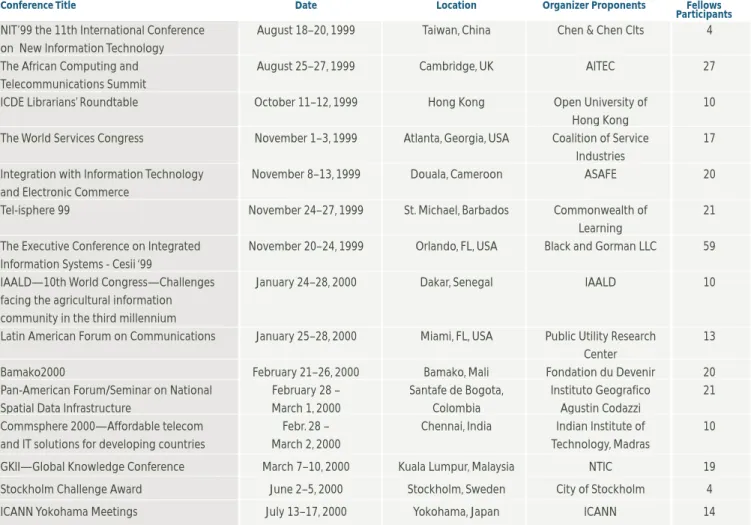
Table 3 iCSF Conferences for FY00
Conference Title Date Location Organizer Proponents Fellows
Participants NIT’99 the 11th International Conference August 18–20, 1999 Taiwan, China Chen & Chen Clts 4 on New Information Technology
The African Computing and August 25–27, 1999 Cambridge, UK AITEC 27
Telecommunications Summit
ICDE Librarians’ Roundtable October 11–12, 1999 Hong Kong Open University of 10
Hong Kong
The World Services Congress November 1–3, 1999 Atlanta, Georgia, USA Coalition of Service 17 Industries
Integration with Information Technology November 8–13, 1999 Douala, Cameroon ASAFE 20
and Electronic Commerce
Tel-isphere 99 November 24–27, 1999 St. Michael, Barbados Commonwealth of 21
Learning
The Executive Conference on Integrated November 20–24, 1999 Orlando, FL, USA Black and Gorman LLC 59 Information Systems - Cesii ‘99
IAALD—10th World Congress—Challenges January 24–28, 2000 Dakar, Senegal IAALD 10
facing the agricultural information community in the third millennium
Latin American Forum on Communications January 25–28, 2000 Miami, FL, USA Public Utility Research 13 Center
Bamako2000 February 21–26, 2000 Bamako, Mali Fondation du Devenir 20
Pan-American Forum/Seminar on National February 28 – Santafe de Bogota, Instituto Geografico 21
Spatial Data Infrastructure March 1, 2000 Colombia Agustin Codazzi
Commsphere 2000—Affordable telecom Febr. 28 – Chennai, India Indian Institute of 10
and IT solutions for developing countries March 2, 2000 Technology, Madras
GKII—Global Knowledge Conference March 7–10, 2000 Kuala Lumpur, Malaysia NTIC 19
Stockholm Challenge Award June 2–5, 2000 Stockholm, Sweden City of Stockholm 4
ICANN Yokohama Meetings July 13–17, 2000 Yokohama, Japan ICANN 14
Middle East and North Africa 6%
East Asia & Pacific 9%
Europe &
Central Asia 12%
Latin Ameria &
The Carribbean 20%
Multiple Region or Non-Region Specific 24%
South Asia 9%
Sub-Saharan Africa 20%
As mentioned in the first section of this report, efforts to reduce poverty are most effective when they empower people to work productively. Several pilot and demonstration projects utilize ICT in innovative ways to generate new jobs for poor people in developing countries. PeopLink, which had already been funded by infoDev in FY97, received another grant this year, in partnership with the Leland Initiative and the African Development Foundation. This new grant is earmarked to the development of a globally connected network of grass-roots organizations that will promote and market via the web a wide range of crafts and agricultural goods. PeopLink pilot centers are located in Kenya, Bangladesh, and Guatemala. The pilot centers have access to Internet-mediated markets in richer countries that allow artisans to receive better prices for their products, thus increasing their incomes, and creating new jobs as production levels increase. Other organizations are launch- ing similar networks, modeled in part after PeopLink’s innova- tive approaches.
Approximately five million Central Americans are disabled.
Although half of them are at prime working age, most cannot find jobs. They are often among the poorest of the poor. Under a new pilot project, IT: Employment for People with Disabilities, Net Corps Americas utilizes ICT to empower people with dis- abilities to enter the workforce. Volunteers -with and without disabilities- train disabled people to use computer programs and to acquire work-related technology skills. Net Corps Americas uses the Internet to connect these people to the out- side world so they can learn about more about educational and employment opportunities.
Women are often relegated to poverty due to lack of training and employment opportunities. ICT training programs target- ing women contribute to ameliorating their ability to effective- ly participate in civil society. In 1999, infoDev funded Project SITA (Study of Information Technology Applications) to create a computer skills training program for low-income women in India. According to India’s Department of Electronics more than 745,000 job vacancies for computer-trained woman exist, yet a small percentage (roughly) 45,000 women possess the necessary qualifications to fill these vacancies. This project, based on a cost-effective, high-quality training model, helps women become ICT professionals. In the first phase of the pro- gram, 250 students are selected for training from two regions, Kerala and Karnataka. The training instruction kit includes
multimedia resource tools (audio, video, book and disk). The video segments are telecast over popular TV channels in India;
and successful students will be given a certificate and placed in organizations that agree to make a contribution to support the continuity of the program. Although a nominal fee is assessed to cover course materials, 50 percent of the students from the poorest segments of the population receive scholarships.
Small and medium enterprises (SMEs) are a major source of employment for the poor. Guatemala MicroNet is a demonstra- tion project using ICT-based business development services to help SMEs increase their business skills, market access and competitiveness. Using a for-profit, private-public sector, joint- venture model, MicroNet proposes to help at least 25,000 SMEs raise their earning potential. MicroNet is managed by PRONACOM, a public-private Guatemalan partnership. This project will enable micro-businesses to expand outside of their local environments; and to establish market linkages with high- er income segments in a national and, in some cases, interna- tional market. MicroNet can be replicated in other countries, including Mexico, Ecuador and Jamaica, whose governments have recently expressed interest.
Access to credit and other micro-finance services is absolutely essential for SMEs to be productive and to create employment for the poor. A new infoDev project, PlaNet University Information System, uses ICT resources to promote micro- finance services. PlaNet University is an international non-gov- ernmental institution that provides support to the micro- finance sector through the Internet. The PlaNet University Information System offers a cost-effective platform for linking companies to financial services on-line:
•A customer and donation module
•An information center: PlaNet University Virtual Library pro- viding information about micro finance, micro-projects and micro-enterprises
•A training center: PlaNet Online University providing specif- ic training to the micro finance industry (practitioners, stu- dents, and consultants).
Connectivity and Commerce: Accelerating Electronic Commerce in Uganda and Tanzania provides enterprises with a better chance to capitalize on opportunities for electronic commerce through the Internet. Six to ten start-ups, located in Uganda and Tanzania, will
receive mentoring from well-established companies to develop their technical, financial and marketing capabilities. This project will enhance the capacity of local Internet Service Providers (ISPs) and Internet Solutions Service Providers (ISSPs) to support Ugandan businesses that, in turn, should be able to compete effectively with foreign enterprises in emerging international markets.
Access to appropriate technology and knowledge is paramount to improving productivity and management. A newly funded project, Knowledge Network for Augmenting Grassroots Innovations, (www.sristi.org), will create a knowledge network for members of the agricultural community to exchange information on grassroots innovations in South Asia. The Knowledge Network (KN) is estab- lishing an experimental network of farmers, rural extension workers and researchers in agricultural institutions in the state of Gujarat to share results of field experiments and other innovations in the sector.
Information and research findings will be made available to scien- tists, investors, entrepreneurs and consumers. To facilitate commu- nication with illiterate farmers, data will be transmitted by sound or picture files. In the future, this knowledge network will expand to other countries.
Last year’s review of infoDev’s education projects concluded that"infoDev should increase the proportion of its total portfo- lio devoted to education projects, given the central role of edu- cation and training in the increasing knowledge-based and global economy. But to leverage this increased investment, a greater portion should be invested in projects involving policy formulation and research, and both should include built-in evaluation and dissemination components."
Over the long term, education has proved to be the most important instrument for poverty reduction, which justifies infoDev’s emphasis on promoting innovative use of ICT in education, targeting the poor. The Conexiones project, completed during the fiscal year, (http://www.conexiones.eafit.edu.co) creat- ed a pilot computer communications network linking 60 public and private Colombian schools in urban and rural areas. It deploys low cost technology and educational tools in dissemi- nation of traditional educational content and supports class- room teachers in the areas of management, pedagogy, didactics and technology. Technology applications in a multimedia envi- ronment are used to create interactive learning teams in the classroom and in community programs.
Networking for Innovation in Technology and Teacher Training is developing nine case studies on the use of ICT, notably the use of the Internet for in-service teacher training in developing countries. This project focuses on schools serving the poorest families where the teachers are at a disadvantage with respect to training opportunities.
Direct health interventions to protect the poor are among the most effective tools for alleviation of poverty. By the end of FY00, infoDev had funded a total of nine health projects, eight of which were still active.
The Use of Information Technology for Delivering Quality Health Care to the Rural Population Project is testing the use of Personal Digital Assistants (PDAs) to help rural health workers in India increase their efficiency in delivering health information. This project aims to reduce redundant data entry prevalent in paper registers through automatic generation of monthly reports from Auxiliary Nurse Midwives. Health care providers and workers (including those who are semi-literate) will be trained in the use of Personal Digital Assistant (PDAs) to process data with ease. It is anticipated that, if successful, the project con- cept will be extended to other areas of the country. One imme- diate benefit of the project is less time spent by health care workers on administrative tasks and more time for them to interact with patients.
With a grant from infoDev, SatelLife and SatelLife Healthnet Kenya have created a Regional Information Technology Training Center (RITTC) in Nairobi, Kenya. During the 1999-2000 academic year, the RITTC offered full scholarships to 70 health professionals in Eritrea, Ethiopia, Kenya, Tanzania and Uganda to take training courses on use of information and technology communication. RITTC facilitates communication and information exchange among physicians, researchers, med- ical librarians, and other health professionals through use of e- mail, CD-ROM, and the World Wide Web/Internet. With four sessions completed to date, the response of participants has been overwhelmingly positive. Many participants have commented that the use of IT is revolutionizing their approach to health care. The challenge ahead is to transform RITTC from a short-term grant-funded project into a sustainable insti- tution that will serve the health community for years to come.
(8)Peter T. Knight , "Lessons from infoDev Education Projects", Knight-Moore Telematics for Education and Development/CDI, June 2000. http://www.knight-moore.com/.
Proposal Evaluation Process
During the fiscal year, infoDev has reviewed 288 proposals for its main program, including 120 proposals for the core pro- gram, 69 pre-proposals for the Development Marketplace, 22 proposals for the infoDev Conference Scholarship Fund (iCSF) program, and 55 applications for the infoDev-Motorola University project to be funded in FY01. In addition, 46 sub- missions prepared under the Forward project were screened to identify those of possible interest for infoDev funding.
Publicity for infoDev competitions, targeted at developing countries, appeared on the Internet through pamphlet dissem- ination and announcements at conferences. This publicity resulted in a 172 percent increase in proposals submitted as compared to FY99. The forms for proposal submission were revised and streamlined. Electronic links to instructional mate- rials on proposal development and presentation are now included in the guidelines.
The review process for the core program is a two stage process, with the opportunity for those submitting proposals to clarify points raised by reviewers during the first stage. Second stage reviews are conducted by an external agency. Simplified, more rapid review processes are used for the iCSF program and other special initiatives. A proposal has been submitted by the Technical Advisory Panel and Donors’ Committee on further revisions of this proposal evaluation process.
Table 4 summarizes the status of all proposals received, includ- ing iCSF proposals, for the core program since the inception of infoDev in 1995. The table does not include the proposals reviewed under the Development Marketplace, the infoDev- Motorola University project and the Y2K Initiative.
THE Y2K INITIATIVE
Starting in 1998, infoDev designed and implemented a pro- gram to help developing countries and emerging economies address the Year 2000 (Y2K) computing problem. The Y2K Initiative was funded by donations from the United Kingdom, the United States, Canada, Sweden, The Netherlands, Australia, Italy, France, and Switzerland, for a total of over $39 million over the period 1998-2000.
After designing a tool kit for governments to help them address the problem, infoDev developed an overall Y2K strategy to help governments manage the risks and to develop contingency plans. The infoDev Y2K Initiative focused on the following areas:
•Raising awareness among governments on the seriousness and implications of the problem
•Sharing information through a web site (www.worldbank.org/y2k), a listserv, and the dissemination of publications, including the original Y2K Tool-Kit for public sector organizations
•Providing grants to help governments design national plans and implement remediation activities
•Providing technical assistance on cross-border issues, econom- ic sector risks, and contingency planning
•Guiding the conversion of Y2K resources to valuable use after the rollover.
Table 4 Processed Proposals as of June 30, 2000
Seminars Website Y2K Toolkit
Regional Coordination
Awareness Raising Planning Implementation Validation Recovering
Planning Grants Implementation Grants
Information-sharing
Contingency Planning Technical Assistance Public information
sharing
Rollover Facility Post-Y2K Grant Amendments
Figure 7
infoDev Y2K Assistance Strategy
FY95-99 FY00 Total
Proposals received 391 144 535
Proposals not accepted 287 106 393
Proposals funded 81 34 115
Proposals completed 33 34 67
In a second phase of its Y2K Initiative, infoDev provided grants to national Y2K coordinating agencies to assist with planning and implementation of remediation programs. Planning Grants funded the development of worldwide Y2K National Action Plans. Implementation Grants funded remediation, testing, and evaluation of targeted critical systems.
From May 1998 until December 1999, infoDev received a total of 161 requests (of which 18 in FY00) for planning, imple- mentation, and other Y2K-related grants. In response to those requests, a total of 140 grants were awarded (of which 55 in FY00). Seventy-four of those grants went to the least developed countries (that is, countries eligible to receive financing from the International Development Association (IDA)). As a con- sequence, more than 100 governments in developing countries launched and conducted successful national Y2K programs with support received from infoDev.
In a third phase of the program, infoDev provided technical assistance for contingency planning. On request of client coun- tries, technical teams were sent out into the field in order to conduct national and sector risk assessments. Thirty-five coun- try missions were conducted. In addition, five special projects were funded with matching private sector funds.
Figure 8
Program expenditures by activity
Planning and implementation grants amounted to 75 percent of the total resources allocated from donor funds. Technical assistance accounted for 8 percent of the total and included contingency planning missions, the development and deploy- ment of toolkits, and funding for the rollover facility.
Coordination represented 8 percent of the expenses, and cov- ered program administration as well as funding of an International Y2K Coordination Center.
Scope of Grant Program
infoDev allocated nearly $26 million in grants to 106 countries and nine non-governmental organizations (NGOs) under the Y2K initiative (Table 5). These grants ranged in value from
$69,000 to $700,000. The average value of the planning grant was $99,000. The average value of the implementation grant was $329,000. Applications were considered on a first- come/first-serve basis. However, preference was given to the poorest countries—IDA eligible countries—and to higher cal- iber work programs.
Grants to Non-Government Entities
Although the program was oriented toward government agen- cies, it appeared that several issues would be best tackled by non-governmental organizations and industry consortia.
Consequently, infoDev provided nine grants to NGOs to address specific tasks, three of which funded the establishment of regional Y2K coordination centers in Africa, Europe and Central Asia, in Latin America, three went to organizations working on specific sectors including health and power, and three others were administered under the main infoDev program for training and public information purposes (see Annex 3).
Coordination 8%
Seminars 8% Grants 75%
IDA Countries Grants 44%
Non-IDA Countries Grants 32%
Technical Assistance 8%
Table 5 Requests and Grants by Region (Millions of United States Dollars)
Region Requests for grants Grants approved Requests from IDA countries Grants approved to IDA countries
Sub-Saharan Africa 52 43 44 36
Latin America 30 26 10 9
Middle East and North Africa 11 10 2 2
Eastern Europe and Central Asia 41 37 16 16
South Asia 7 5 7 5
Eastern Asia and Pacific 11 10 7 6
Global Initiatives 9 9 — —
Total 161 140 86 74
Total ($ millions) 43.917 25.811 23.848 14.260
Technical Assistance
The infoDev strategy for the end of 1999 and the beginning of 2000 focused on contingency planning in high-risk sec- tors, including cross-border issues. On request of client governments, technical teams were sent to conduct nation- al and sector risk assessment. The technical teams were drawn from a database of Y2K specialists from a variety of sectors. Special procurement procedures were established to expedite the deployment of resources including consulting firms in response to countries’ applications for assistance.
Such procedures included an adaptation of the World Bank thresholds for engaging consultants and consulting services through sole sourcing and competitive contracts. The countries had the option of requesting assistance from alternative service providers, including local consultants.
To facilitate information sharing, these assessments made use of the infoDev Y2K Contingency Planning Methodology and Guide where applicable.
Rollover Facility
For technical problems after the rollover to the year 2000, infoDev worked with the International Y2K Cooperation Center (IY2KCC), the G8 countries, and a number of international organizations to provide assistance as and when needed. This assistance was to be rolled out in phas- es depending on the nature of problems encountered and participation of funding sources. The first Y2K-caused dis- ruptions were to be handled by by national governments with the assistance of regional experts. To address problems that could not be solved by the country itself, even with regional support, infoDev had helped establish a referral and evaluation process. This measure help to build confi- dence among governments and institutions that potential disruptions could be handled promptly and effectively. This response framework did not need to be exercised since the world passed through the 2000 year date change with only minor problems.
KNOWLEDGE DISSEMINATION AND EXTERNAL ACTIVITIES
Knowledge dissemination and information exchange con- tinues to be an important part of infoDev’s mandate to pro- mote deeper understanding and public awareness of the
benefits of ICT applications, especially as they relate to the poor. Lessons learned from information collected from infoDev projects is a fundamental asset of the program.
Knowledge and information is disseminated through differ- ent channels reaching key target audiences. The web site, www.infodev.org (see Annex 1), is the main source of exchange and dissemination. The infoDev Quarterly Report highlights new and current project developments. The infoDev eXchange is a quarterly publication that analyzes salient trends in ICT management through interviews with key players in the field. Both publications are also accessi- ble through the infoDev web site. The infoDev Bulletin is an electronic newsletter distributed through the infoDev-L list- serv. An e-mail discussion group, on ICT-related topics, reaches over 1,200 members.
infoDev representatives participated in several conferences and seminars during FY00 to continue to promote ICT for devel- opment, to provide information on the program and increase its visibility. These international conferences and meetings with infoDev participation included the following:
•International Telecommunication Union Telecomm ’99 Forum in Geneva, Switzerland (infoDev joined UNDP, UNCTAD and IICI)
•13th Annual Conference on Science and Technology in Kingston, Jamaica
•Global Knowledge II Conference in Kuala Lumpur, Malaysia
•UN Secretary-General’s Panel on Information Technology in New York, United States
•2nd Global Forum, Democratic State and Governance in the 21st Century in Brasilia, Brazil
•Health and ICT conference in Cambridge, United States
•Third Consultative Expert Meeting of the Technical Center for Agricultural and Rural Cooperation Observatory on Information and Communication Technologies in Wageningen, The Netherlands
•Stockholm Challenge in Stockholm, Sweden
•Indonesian International Telecommunications, Media, and Information Technology Conference–Exhibition 2000 conference in Jakarta, Indonesia.
infoDev also participated in the selection committee of the fifth call for proposals of the Fonds Francophone des Inforoutes, the ICT program of the Agence de la Francophonie.