STILL INNOCENTS ABROAD: THE RELATIONSHIP BETWEEN ANTI-‐AMERICANISM AND AMERICAN FOREIGN POLICY IN THE MIDDLE EAST
by Kelly Kennedy
A thesis presented in partial fulfillment of the requirements for completion Of the Bachelor of Arts degree in International Studies
Croft Institute for International Studies Sally McDonnell Barksdale Honors College
The University of Mississippi
University, Mississippi May 2015
Approved By _________________________________________________
Advisor: Professor Jeff Carter
________________________________________________
Reader: Professor William Schenck
________________________________________________
Reader: Professor Yael Zeira
________________________________________________
Reader: Professor Melissa Graves
© 2015 Kelly Kennedy ALL RIGHTS RESERVED
ACKNOWLEDGEMENTS
The author would like to thank her advisor, Dr. Jeff Carter, for his guidance throughout the thesis writing process, and her three readers, Dr. Yael Zeira, Dr. William Schenck, and Melissa Graves, for their continued support and patience.
The author would also like to thank Dr. Kees Gispen for his advice that greatly helped during the initial writing process and Wesley Yates who offered his take on any and all theoretical tangents.
Finally, the author would like to especially thank her parents, Mike, Kathy, and Jim, for making it possible for her to travel and study abroad freely in the Middle East. Without those experiences, the inspiration for this thesis would never have been found.
ABSTRACT
KELLY KENNEDY: Still Innocents Abroad: The Relationship Between Anti-‐Americanism and American Foreign Policy in the Middle East
In this thesis, the author examined the relationship between anti-‐American sentiment and U.S. foreign policy in the Middle East. The author first constructed a literature review on anti-‐Americanism, including sections discussing its definition, conceptualization, measurement techniques, and known sources. From this literature review, the author created her own definition of anti-‐Americanism and a hypothesis that anti-‐Americanism is endogenous to U.S. foreign policy—anti-‐Americanism may increase or decrease depending on changes to U.S. foreign policy in the Middle East. The author then used a quantitative comparison of survey data and two qualitative case studies to test her hypothesis. The comparison of survey data concluded there is a correlation between anti-‐
Americanism and U.S. foreign policy. Data measuring anti-‐American sentiment and positive views of American policies had a negative relationship, indicating high anti-‐
American sentiment correlated to disapproval of policies. However, the methods used to show this correlation were not capable of indicating the direction of the relationship. In the case studies, the author showed that spikes in anti-‐Americanism over time correlated to shifts in American policies that had a real or perceived adverse effect on the populations within the Middle East. The results from the case studies was much more clear, and they indicated both a correlation between the two factors and the endogeneity of anti-‐
Americanism. The author concluded with the results of her research, as well as recommendations for how future research might benefit from her difficulties.
TABLE OF CONTENTS
LIST OF FIGURES...vi
LIST OF ABBREVIATIONS...vii
INTRODUCTION...1
CHAPTER 1: ANTI-‐AMERICANISM AS AN ATTITUDE...3
CHAPTER 2: ANALYSIS...18
CONCLUSION...41
BIBLIOGRAPHY...44
LIST OF FIGURES
Figure 1 Average Anti-‐American Sentiment in Middle Eastern Countries (2002 to
2014)………...22
Figure 2.1 American Sentiment v. Support for U.S. Democracy………..25
Figure 2.2 American Sentiment v. Approval of U.S. Use of Drones………26
Figure 2.3 American Sentiment v. U.S. Positive Impact on Middle East Stability………….27
Figure 2.4 American Sentiment v. Faith in Barack Obama’s Foreign Policy………28
Figure 3.1 Anti-‐American Sentiment: Jordan v. the Average………30
Figure 3.2 Inset map: Jordan and Iraq Border………...31
Figure 3.3 Anti-‐American Sentiment: Egypt v. the Average………..37
LIST OF ABBREVIATIONS
BBC British Broadcasting Corporation, a news corporation GAP Global Attitudes Project
HAMAS Harakat al-Muqawamah al-Islamiyyah; (Trans.) Islamic Resistance Movement ISIS Islamic State of Iraq and Syria
NATO North Atlantic Treaty Organization UAV Unmanned Aerial Vehicle
UN United Nations
U.S. United States of America
Introduction
While on my study abroad in Jordan, I was confronted by the reality of America’s political image in the Middle East. Jordanians are amazingly hospitable, and most people I met were encouraging of foreigners studying Arabic. However, in discussions of politics and internal affairs, people’s opinions of specific nations, America in particular, were much more negative. I often heard one phrase repeated throughout most political conversations:
“[We/Jordanians/Palestinians] understand that the actions of the American government do not always reflect the [thoughts/wishes/wants/feelings] of the American people.”
For the most part, the phrase was followed by another statement explaining how much the speaker liked the Americans he/she had met or how they loved American movies and products. I initially questioned why the people I met seemed so eager to think the U.S.
government was oppressing Americans, but I eventually realized the statement was meant to be more respectful than deprecating. Many who made the statement thought well of Americans, but disagreed with our government and its actions. What I interpreted as a misunderstanding of the American political system is really an explanation of the complex feeling many in the Middle East have towards the United States. While many of my friends from Jordan enjoyed American culture and wanted to visit, they found it difficult to justify why they liked a country that they also disagreed with.
When I was in Jordan, I often felt uncomfortable with my identity as an American.
There is a tangible level of anti-‐Americanism in the Middle East currently, and Americans who live there frequently hide their support of the U.S. to better fit in. Collecting data from those who feel negatively toward the United States has helped researchers achieve insight
into the reasons for anti-‐Americanism. However, there are many causes of anti-‐
Americanism, and it is unlikely one cause has a large enough effect on public sentiment to account for all of anti-‐Americanism. I personally have a number of questions on how anti-‐
Americanism began in the Middle East and why it is so important. My experiences with anti-‐Americanism varied among the communities I visited. While I anticipated anti-‐
American sentiment in more conservative communities, I often felt more initially unwelcome among peers, who more often expected specific stereotypes.
In this thesis, I focus on American foreign policy choices as a possible cause. My thought is that unpopular American policies could influence people’s individual opinions toward the U.S., which results in negative public opinion and anti-‐Americanism overall. I begin with a discussion of anti-‐Americanism itself and explain how it acts as an attitude of public opinion. Then I analyze survey results and qualitative sources to answer a central research question: is there an endogenous relationship between anti-‐Americanism and American foreign policy? I end with a focus on intelligence analysis and how the U.S.
government is looking into social media as a possible source for quick snapshot estimates of public sentiment on popular topics.
Ultimately, I hope the argument presented in this thesis will expand upon current research and encourage others to look for relationships hidden just beneath the surface.
This thesis is a combination of my favorite subjects—Middle Eastern studies, public opinion, and security studies—and is the culmination of my studies at the University of Mississippi. I want my research to inspire further questioning of anti-‐Americanism and how the United States as a country addresses it.
Chapter 1: Anti-‐Americanism
Anti-‐Americanism is a broad concept, and discussing it requires some unpacking of the term. In the media, anti-‐Americanism is often tied to public opinion. When referred to in general terms, this can make anti-‐Americanism seem like a simple construct, whose influences and components rarely change. In truth, anti-‐Americanism is nuanced, and the study of it requires a hodge-‐podge of various observations and calculations, all focusing on one theme: distaste for America.
In the next section, I will discuss the literature available on anti-‐Americanism as well as how to define it in a global context. It is sometimes difficult to logically connect sources discussing anti-‐Americanism, as authors choose to discuss the concept using different methods. However, I have organized my literature review into three distinct parts, which I hope will illuminate the common themes in the literature. In this review, I first discuss the challenge of conceptualizing “anti-‐Americanism”. I include discussions of both past criticisms of the term and modern attempts to establish its context. I then describe the process political scientists and other researchers use to measure anti-‐
Americanism throughout the world, as well as methods that allow for bias and how current researchers have attempted to correct for past mistakes. In the final section, I shed light on the current debate within the literature on the reasons for anti-‐Americanism and the role America plays in perpetuating the discrimination against it.
Defining “Anti-‐Americanism”
“Anti-‐Americanism” must first be defined as a concept before it can be understood and evaluated scientifically. Unfortunately, there is somewhat of a disagreement within the
literature on the exact language to use. Scholars who study anti-‐American sentiment agree that “anti-‐Americanism” refers to systematic and comprehensive hatred of America and its identity (Friedman 2012). But people who declare their disapproval of the U.S. may in the same breath discuss their love of American food, culture, and TV shows (Chiozza 2009). As journalists and political pundits use “anti-‐Americanism” to describe the roots of terrorism, the term has experienced resurgence in popularity. Use of the word has trickled down from academia to common political discourse. It has taken on a meaning that refers to any and all negative statements against America, and the misuse of “anti-‐Americanism” has consequences on the legitimacy of the term while minimizing the reality that America could deserve well-‐founded critique.
Oddly enough, issues with usage of “anti-‐Americanism” likely appeared in tandem with the term. Though the first known use of the word dates back to 1765, “Anti-‐
American” initally appeared in Webster’s American English dictionary in 1828 (“Anti-‐
American”, Merriam-‐Webster Dictionary). At the time, American authors used “anti-‐
American” to describe foreign writers’ tendency to depict American manners and culture as rude or stupid (Katzenstein & Keohane 2007). However, the term quickly took on other interpretations. Alexis de Tocqueville was the first to discuss Americans’ liberal use of
“anti-‐American” to explain any criticism at all (Katzenstein & Keohane 2007). De
Tocqueville ascribed the liberal use of the term to Americans’ “inability to take censure”
that competed with their “desire for praise” (Katzenstein & Keohane 2007).
As the United States’ prominence in world affairs grew, the use of “anti-‐
Americanism” shifted from a response to cultural commentary to something more serious and security related. Military conflicts, like the Cold War and Vietnam, and a fear of the
ideological movements behind them increased the discussion of “anti-‐Americanism” in regard to national security concerns (Friedman 2012 & Rubin 2002). McCarthy and his oppression of “un-‐American” activities exemplify the height of this fear mongering
(Friedman 2012). After the September 11, 2001 attacks on the World Trade center, use of
“anti-‐Americanism” as a buzzword continued to increase in American politics (Friedman 2012). Many pundits and politicians used “anti-‐Americanism” with such fervor that any questions about the oversimplification of the concept were likely drowned out (Friedman 2012). In its first chapter, the 9/11 Commission Report declared “anti-‐Americanism” as a primary reason for the September 11 attacks and reaffirmed the need to defend all that was “American” and defeat anyone who was “against” it (The 9/11 Commission Report, 2004). America saw the reemergence of an “us v. them” ideology, this time in reference to
“terrorism” and our ideological war to end it.
Currently, “anti-‐Americanism” is defined very broadly and often includes any type of action, speech, or opinion that is negative or hostile toward the United States. This could be detrimental to the public’s understanding of anti-‐Americanism if most available sources rely on this definition. Wikipedia, the free encyclopedic source available on the Internet, uses the broadest definition of anti-‐Americanism possible, with no references to the very comprehensive nature of research (“Anti-‐Americanism”, 2014). News sources, which many Americans rely on for factual political information (Zaller 1992), also tend to use the broad definition. Some political scientists have highlighted the problems resulting from the sensationalization of anti-‐Americanism in the media, and they believe this may be a reason for the rise in fear and isolationism within the U.S. population (Friedman 2012 & Rugh 2006). Research, however, has benefitted from the fear associated with anti-‐American
sentiment, as policymakers place a greater importance on determining its root causes.
After the terrorist attacks of September 11, 2001, lawmakers and academics searched for reasons why extremists specifically targeted the United States in such a violent attack.
Many of the resulting studies pointed to an increase in anti-‐American sentiment as the reason (Rubin 2002).
As I have come to understand it, a statement being anti-‐American depends largely on the topic of conversation. Individuals can be anti-‐American when discussing politics but pro-‐American when discussing TV shows (Chiozza 2009). This distinction is particularly apparent for salient political or social issues and when an individual has less connection to the topic (Rugh 2006 & Blaydes & Linzer 2012). For these reason, I assess that anti-‐
American sentiment has more to do with an individual’s pre-‐formulated feelings on a topic and the U.S. than America itself. Anti-‐Americanism is an overall tendency to have negative views of the United States in most things, regardless of the issues’ correlation to the U.S.
(Friedman 2012). However, my own experiences suggest that anti-‐Americanism manifests more often in political sentiments more than cultural ones. If individuals are more likely to be anti-‐American about political issues than cultural issues, how does anyone distinguish
“anti-‐Americanism” from political critique? It is intriguing to think that what Americans may be again falling into the same trap as their predecessors, by labeling anything negative towards the U.S. as “anti-‐American”. What if anti-‐Americanism is in some way legitimized by the U.S.’s actions? I hope that in-‐depth research into what is known about anti-‐
Americanism and my own examination of trends in anti-‐Americanism over the last decade can shed some light.
Conceptualizing Anti-‐American Sentiment: “Us” v. “Them”
Popular theories on the causes of anti-‐Americanism are attributed to one of two sources: “them” or “us”. “Them” theorists describe the origins of anti-‐Americanism as opposition or hostility to the America due to the U.S.’s position in the international
community; America is not an active player in anti-‐Americanism (Chiozza 2009, Jamal 2014
& Friedman 2012). Those who attribute the same problems to “us” see the origins of anti-‐
Americanism as opposition or hostility to the actions of the U.S. (Friedman 2012). In the
“us” theories, America takes an active role in generating anti-‐American sentiment through its actions and policies (Friedman 2012 & Jamal 2014). Realistically, both views are simplifications of a much more complex situation. There are many examples to suggest that both theories could be right, and so studies tend to shy away from declaring one superior to the other (Katzenstein & Keohane 2007 & Friedman 2012). Research is not blind to common sentiments on anti-‐Americanism, though, and many researchers test these popular concepts against accepted understandings of public opinion to gain a better appreciation of anti-‐Americanism. In my review of the literature, I studied a number of sources that each approached the question of anti-‐Americanism’s sources in a slightly different way. A few of the sources stood out as together they present a multi-‐faceted view of anti-‐Americanism that allowed me to better define the concept.
One of the authors who address these popular theories is Giacomo Chiozza. Chiozza tackles oversimplification of anti-‐Americanism by breaking down feelings about the U.S. in a multi-‐faceted approach. Chiozza collected data from multiple databases of worldwide public opinion surveys (such as Pew Global Attitudes Project and Zogby International) and
separated the responses on the U.S. into topical categories (2009). These categories were based on the question asked but all focused on aspects of American society (Chiozza 2009).
In his analysis of the responses, Chiozza found that “anti-‐Americanism” is not a singular concept but rather one with multiple perspectives (2009). He explained that respondents who initially voiced negative opinions on the U.S. overall frequently
responded favorably when asked about aspects of American society and culture (2009).
This shows that negative opinion of the U.S. on the whole, or anti-‐Americanism, does not translate to similar opinions on a personal preferences level. Chiozza’s analysis suggests that anti-‐Americanism cannot be an unjustifiable, singular prejudice of the United States, as many choose to see it. Anti-‐Americanism more likely arises because of environmental stimuli that put pressure on groups to find a scapegoat for problems; by blaming the U.S., governments can benefit by diverting the public’s gaze from the real problems in a country, at least for a little while (Chiozza 2009). The same stimuli could also encourage the same groups to distance themselves from the U.S. in order to gain benefits, perhaps in the form of popular support or alliances with states in opposition to the U.S. (Chiozza 2009).
Giacomo Chiozza’s analysis supports the claim that anti-‐Americanism arises due more to the actions of the U.S. than due to mere prejudice, and other authors support this conclusion. Peter Katzenstein and Robert Keohane published a book in 2007 redefining anti-‐Americanism as an umbrella definition with different manifestations based on the situation in which they arise. The authors recognize a total of four “typologies” of anti-‐
Americanism in their analysis— liberal, social, sovereign-‐nationalist, and radical. The name of each typology refers to the reason a group takes issue with the U.S. (Katzenstein &
Keohane 2007). Katzenstein and Keohane’s four typologies describe the actions of states as
opposed to individuals (2007). The authors assume states function as a collective and that their actions reflect the attitudes of the public and not the attitudes of specific individuals.
However, Katzenstein and Keohane do leave room for a constructive argument for their anti-‐Americanism typologies. The anti-‐American sentiment within a state can be defined using multiple typologies at once (Katzenstein & Keohane 2007). This indicates that groups with varied opinions and political sentiments could live within the same state and give the state multiple layers of anti-‐American sentiment, which is exhibited in different ways.
Liberal anti-‐Americanism sits at the lowest end of the spectrum. In this case, states similar to America dislike the U.S. for not “living up to its own ideals” (Katzenstein &
Keohane 2007). Social anti-‐American states dislike the U.S.’s lack of social welfare;
Keohane recognizes that many states in this group are European Christian democracies, like Germany (Katzenstein & Keohane 2007). Sovereign-‐nationalists may not be concerned with the U.S.’s ideology, but they feel America is disrupting their own national goals and ambitions (Katzenstein & Keohane 2007). An example of a sovereign-‐nationalist anti-‐
American state is Iran. On the other end is Radical anti-‐Americanism, where groups with very different ideologies from that of America take issue with the U.S. as a perceived threat to their ideological cause (Katzenstein & Keohane 2007).
Keohane’s conceptualization of anti-‐Americanism is particularly good at
distinguishing between different causes of anti-‐American sentiment. While Chiozza shows how it can be hard to connect anti-‐American sentiment with specific reasons for the
disdain, Keohane explains that differences in ideology could actually make a base for anti-‐
Americanism. Ideological differences may not be the origins of anti-‐American sentiment
within a state or group, but they can be the reason why certain groups are upset by America’s actions and others are not.
The last author in my review of anti-‐Americanism’s conceptualization is Max Paul Friedman. Friedman writes on the sociological toll anti-‐American sentiment takes on Americans and America’s allies. Though Friedman’s approach to anti-‐Americanism is less quantitative than that of Chiozza or Katzenstein and Keohane, he attacks the tendency to generalize anti-‐American sentiment as one principle in much the same way. Friedman cites a disconnect between the definition of anti-‐Americanism used in academic circles and that which is used in public discourse, either on the news or in political forums (2012). The author explains this is likely due to ignorance of anti-‐Americanism’s complexity, or a decided tendency to view anti-‐American rhetoric as part of a larger “clash of civilizations”
between the “one true superpower” and its “haters” (2012). Friedman writes that most modern historians and political scientists prefer a much more comprehensive and nuanced version of anti-‐Americanism than “haters gonna hate”1 (Friedman 2012). Instead, he characterizes anti-‐Americanism as a complicated prejudice of “American” things (Friedman 2012). In order for an action or opinion to be anti-‐American, it must be both
“particularized”, or toward the U.S. in particular and not similar nations, and “generalized”, or toward multiple facets of American identity and not a focused critique on one element (2012).
Friedman makes a careful distinction between an outright prejudice against the U.S.
and a well-‐founded critique of its policies or culture, but he would ultimately likely agree with Chiozza and Katzenstein and Keohane. Friedman suggests that a critique may be well
1 Quote from Lynch 2013 in bibliography
founded, but it does not have bearing on an individual’s opinion of “America”. Anti-‐
Americanism involves an emotional response to stimuli and is unrelated to critique, though they may support one another. The best conceptualization of anti-‐Americanism is likely a combination of many findings all at once. It is nuanced, as Chiozza insists, variegated, as Katzenstein and Keohane show, and refers only to a respondent’s opinion of general
“America”, as Friedman demands. Multiple groups across the globe may illustrate “anti-‐
Americanism”, but the vehemence or relation to critiques of the U.S. is unclear until further contextualized. While this conceptualization might support my original understanding of anti-‐Americanism, it brings up the question of how good current measurements of “anti-‐
American sentiment” really are.
Anti-‐Americanism as a Public Opinion
The methods of analysis used for anti-‐Americanism can be divided into two
categories: qualitative and quantitative. Qualitative methods resemble those used by Max Paul Friedman, and involve analysis of historical documents and news articles or personal accounts from officials who worked in the country at the time. Quantitative methods of analysis for anti-‐Americanism most resemble those used by Giacomo Chiozza. The most popular quantitative method for gathering data on anti-‐American sentiment is surveying, but other types could include coding the sources used in qualitative analysis and
conducting further analysis quantitatively. A mixed methods approach is a combination of both quantitative and qualitative methods, and often offers the clearest results.
Authors writing on anti-‐Americanism in today’s context frequently take advantage of respected, easily accessible data sets from large global opinion surveys. These surveys, like the Pew Global Attitudes Project, are funded and carried out by think tanks,
universities, or private companies with the goal of gaining insight into global trends for research or business purposes (Tessler 2011). Upon completion of their own research, the institutes usually publish the original data sets for public use. Researchers analyze the surveys and determine which questions within them could function as indicators for their research. These indicator questions are then combined in multiple ways to provide insight on research questions that may not be directly asked about in the surveys (Tessler 2011).
Using the data provided for the indicator questions, researchers can analyze it and extrapolate an answer to their research question.
Researchers use public opinion surveys because anti-‐Americanism functions and fluctuates as an attitude within public opinion. The Nature and Origins of Mass Opinion, written by John Zaller in 1992, explains how public opinion is formed and that it can be changed quickly or over long periods of time. Zaller argues that all people have internal belief systems, which allow them to formulate opinions on certain topics (1992). Changing these opinions can take a very long or very short period of time, depending on how tied the formulation of the opinion is to an individual’s belief system (Zaller 1992). Due to lack of personal knowledge or interest, there are always a few topics people are unable to
formulate an opinion on (Zaller 1992). For these topics, people will defer to “elites”— the media or public figures that drive changes in opinion— for more information or an
agreeable substitute opinion (Zaller 1992). If an elite’s message deals with a particularly salient issue, then the public will respond to it more (Zaller 1992). The United States has a heavy presence in the world, both politically and culturally (Rugh 2006 & Chiozza 2009).
But for the majority of the world, too few people have prolonged enough contact with Americans or America to develop a strong opinion about them (Rugh 2006 & Chiozza
2009). Therefore, as the U.S. grows in importance, elites’ opinions on America become more important to the public.
Views on the United States are more susceptible to changes in the short term due to elites’ influence and their tendency to use the U.S. as a scapegoat. We can see this with anti-‐
Americanism in the Middle East in particular. Lisa Blaydes and Drew Linzer, political scientists, examined the motivations of elites influencing anti-‐American sentiment in the Muslim world. The authors used opinion surveys and news databases from every available Muslim country, including those outside the Middle East (Blaydes & Linzer 2012). They searched for indicators of high anti-‐American sentiment in each country as well as examples of influential elites speaking against the U.S. (Blaydes & Linzer 2012). Initially, Blaydes and Linzer hypothesized a high level of religiosity, or religious fervor, in Muslim countries increased individuals’ receptiveness of elites’ anti-‐American messages (2012).
However, they did not find proof of a high level of religious fervor in many of the Muslim countries (Blaydes & Linzer 2012). Some elites were quite religious, but anti-‐American statements were also common among non-‐religious elites (Blaydes & Linzer 2012).
This reality is consistent with earlier research by Pippa Norris and Ronald Inglehart (2004). Norris and Inglehart discovered only a very small percentage of Muslim
populations are extremely religious, so the prevalence of anti-‐Americanism in the Middle East is not reflective of religosity (2004). As Katzenstein and Keohane described, radical anti-‐Americanism, or the most severe hatred of the U.S. that we often associate with the Middle East, requires a high level of religiosity (Katzenstein & Keohane 2007). The study by Norris and Inglehart dispels many of the preconceived notions associated with anti-‐
American sentiment in the Middle East, much like the research by Giacomo Chiozza.
Something other than religiosity must have been driving elites creation of anti-‐American messages and the public’s reception of them.
Through further study, Blaydes and Linzer found evidence of higher anti-‐
Americanism in countries where elites, political or religious, had incentive to denounce the United States (2012). The authors described the behavior as “scapegoating” and explained competition among elites gave them the incentive to steadily increase the severity of their statements against the U.S. (Blaydes & Linzer 2012). The more bombastic and
inflammatory the elites’ statements were, the more press and exposure they received (Blaydes & Linzer 2012). People in Muslim countries were already sensitive to topics about the U.S., as many Muslims felt they were under attack by the United States after the Iraq War (Blaydes & Linzer). Because of this sensitivity to the U.S., people in the countries Blaydes and Linzer studied were more receptive to the messages of the elites who
incentivized to make anti-‐American statements (Blaydes & Linzer 2012). The combination of these two factors caused an increase in anti-‐Americanism, as Zaller described.
Sources of anti-‐Americanism
The sources of anti-‐Americanism are difficult to identify. Sources of its increase or decrease over time are extrapolated from the definition of anti-‐Americanism as a prejudice and a function of mass opinion as described by John Zaller (1992). However, because anti-‐
American sentiment is an opinion, there are likely a number of reasons for its appearance throughout the world. Many theories on the origins of anti-‐Americanism involve America’s status and actions in the international community (Friedman 2012, Lynch 2013, Jamal 2014, Katzenstein & Keohane 2009, Telhami 2013). The position of the United States as a global enforcer and influencer has never been higher than it is now, and America’s
prominent position likely translates to global dissatisfaction with the U.S. (Chiozza 2009, Rubin 2002, Rugh 2006). Where the arguments differ is which aspect, America’s position or America’s actions, contributes more to the creation of anti-‐American sentiment.
Those who believe the position of the U.S. encourages the creation of anti-‐
Americanism often use the concept of a “clash of civilizations” to support their argument.
The “clash” concept describes an evitable conflict between Western and Islamic
civilizations based on deep-‐seeded ideological differences (Huntington 1996). Samuel P.
Huntington repopularized the idea of the clash of civilizations in the early 1990’s to describe what he saw as a shift in America’s adversary, from the Soviet Union to the Arab states. His concept of a “clash” piggybacked off another, much earlier theory by the British historian Arnold Toynbee. In the mid-‐twentieth century, Toynbee declared that there had been twenty-‐six civilizations since the beginning of human history (Huntington 1996). Of these original twenty-‐six, only six remained, two of which are “Western Civilization” and
“Islamic Civilization” (Huntington 1996).
Those who believe the U.S.’s position in the international community leads to anti-‐
Americanism rather than U.S. actions agree with Huntington’s logic because it puts the responsibility of increasing anti-‐Americanism on an unchangeable situation. However, the concept that there is a fixed ideological divide between East and West is now regarded as slightly outdated. Huntington’s theory of a “clash of civilizations” was heavily influenced by the ideological warfare of the Cold War. He fully believed that the same type of conflict would continue into the 21st century, just now between the U.S. (representing the West) and the Islamic world (Huntington 1996). Unfortunately, Huntington made these claims without consulting Middle Eastern sources and using historical evidence whose
interpretation is now disputed (Jamal 2014). Huntington also made sweeping
generalizations about an “Islamic Civilization” that does not adequately account for myriad differences among Islamic societies (Norris & Inglehart 2004). The result was a theory that was very popular throughout the U.S. and was read by influential people but lacked
substantive evidence. Though it is still widely referenced, the conclusions of some
studies— like those conducted by Giacomo Chiozza (2009), Amaney Jamal (2014), Norris &
Inglehart (2004), and Nisbet & Myers (2011)— strongly refute the Clash of Civilizations theory.
The other side of the origins debate argues that anti-‐Americanism results from America’s actions abroad. Supporters argue America’s actions abroad are directed toward securing U.S. interests and are generally unconcerned with the impact on other societies.
This lack of concern results in dissatisfaction with the U.S., which ultimately turns into anti-‐
American sentiment. Many researchers of public opinion in the Middle East, like Amaney Jamal of the Arab Barometer Project and Shibley Telhami of the University of Maryland, support this claim. Jamal has even determined what she believes to be the genesis of anti-‐
Americanism in the Middle East. She argues a lack of American support for Arab self-‐
determinism in politics perpetuates anti-‐Americanism in the Middle East (Jamal 2014).
Disagreements between the U.S. and Arab countries on the acceptable form of democracy in Arab countries have led America to withdraw support from democratically elected governments in the Middle East on numerous occasions (Jamal 2014). By “going back” on our promises multiple times, America has created mistrust between Arabs and the United States, leading to anti-‐Americanism (Jamal 2014). Shibley Telhami’s research supports Amaney Jamal’s argument. Telhami has researched public opinion in the Middle East for a
decade, since 2003, and points to America’s continued ignorance of Arab opinion as the main reason for the U.S.’s inability to predict shifts in anti-‐Americanism (Telhami 2003 &
Telhami 2013).
Of the two arguments for the origin of anti-‐Americanism in the Middle East, current administration supports the second argument, involving America’s actions in the region, more. Beginning in 2008, the new administration made multiple changes to U.S. foreign policy in the Middle East. These changes focused on generating public support for the U.S.
and boosting America’s soft power in the region (Indyk et al, 2012). The President has continued some hard power objectives, like UAV strikes in Yemen, Pakistan, and Iraq.
However, his administration has worked to re-‐frame these policies and decrease their association with the United States through a multilateral approach to military action (Indyk et al, 2012). The Obama Administration hopes these changes will affect the way America is perceived in the Middle East, which shows they associate support for America in Middle Eastern public opinion with success in the region.
The Obama administration hopes the changes to policy and policy framing will make up for the perceived mistakes of the Bush era (Indyk et al, 2012). However, the
administration’s choice to focus on multilateralism and reframing of foreign policy brings up some interesting questions about the relationship between American foreign policy and anti-‐American sentiment. Public perception of American foreign policies and elites’
reaction to them should have some effect on anti-‐American sentiment. According to supporters of the second origin argument, like Telhami and Jamal, U.S. foreign policies could serve as the genesis of anti-‐American sentiment in the Middle East, if foreign policy is the source of dissatisfaction with the United States in the region. In the next chapter, I
investigate this possible connection and examine some of the possible implications of a relationship between anti-‐Americanism and American foreign policy.
Chapter 2: Analysis
In the past chapter, I discussed several studies that focus on the conceptualization and characteristics of anti-‐Americanism in the Middle East. I explained that anti-‐
Americanism is vulnerable to change because of many different factors. Research on anti-‐
Americanism often focuses on the factors contributing to the attitude overall, however fewer studies examine the effects of anti-‐American sentiment in the Middle East on the United States itself and its goals abroad. In the next chapter, I hope to address this deficit by discussing just one way in which anti-‐Americanism has an impact on the U.S.
I hypothesize that there is an endogenous relationship between anti-‐American sentiment and opinions of U.S. foreign policy. In my model, anti-‐Americanism responds to changes in American foreign policy. Anti-‐Americanism is an endogenous variable that changes according to the exogenous variable, American foreign policy. If the U.S. enacts foreign policy that is deemed unfavorable in the Middle East, then anti-‐American sentiment should subsequently increase, as attitude toward the U.S. becomes negative. However, this negative attitude should also result in a decrease in support for U.S. policies in general or higher rates of disapproval for policies, as anti-‐Americanism is a general dislike of America and an increase in it should increase disapproval for anything “American”.
The endogeneity of anti-‐Americanism could prove very important for international relations and U.S. national security. If high disapproval for an American policy correlates to
high anti-‐American sentiment, then this could affect the success of U.S. foreign policy goals abroad. As the United States comes closer to a decision on action against the Islamic State in Iraq and Syria (ISIS), knowing the level of anti-‐Americanism in key countries and how it will affect the success of our policies will allow policymakers to make the appropriate choices in policy. In the end, I hope to provide a baseline of research on this relationship that may be extended later.
Methodology and Sources
I created my analysis using roughly the same method that Giacomo Chiozza used in Anti-‐Americanism and the American World Order. Chiozza utilized data from the Pew Research Global Attitudes Project (GAP) survey from 2003. Chiozza selected one question, describing the respondents’ opinion of America independent of other variables, as an indicator of the level of anti-‐Americanism in a country and organized the countries in which Pew surveyed into regional groups. He then compared the recorded anti-‐American sentiment to the responses from other questions indicating respondents’ opinions of aspects of American culture. Chiozza represented the outcome of his comparison for each of the questions on culture in a scatter plot, where each case represented a different country. By presenting his data this way, Dr. Chiozza could easily show a correlation, or lack there of, between anti-‐American sentiment and opinion of specific aspects of U.S.
culture.
In addition to using roughly the same method, I also chose to use the same data source. The Pew GAP survey is a great resource because it is politically non-‐partisan and aims to conduct surveys in order to provide “comprehensive [and] internationally
comparable” data for journalists, researchers, and policymakers to use in their own
analyses (U.S. Global Image 2014). Pew’s data are also more suitable for my investigation than other sources because they concentrate on asking some questions on current topics and other questions on recurring issues. This means that Pew has built a database of hundreds of questions over the last decade, the most central of which have a yearly record of responses for several countries. Pew also asks its questions in nine Middle Eastern countries, including the Palestinian territories. The consistency of Pew’s surveying combined with the geographical diversity of the survey allows for a comprehensive analysis of anti-‐Americanism and U.S. foreign policy.
My analysis is broken up into three parts. The first part consists of a chart mapping anti-‐American sentiment in the Middle East from 2002 until 2014. For my chart, I rely on the data collected from GAP survey question 844. The question asks, “Please tell me if you have a very favorable, somewhat favorable, somewhat unfavorable, or very unfavorable opinion of...the United States.” I chose this question as opposed to another (number 824) that has similar language (“United States” is replaced by “Americans”) due to my review of the literature on anti-‐Americanism. Views of Americans as a group of people can differ from views of the United States as a whole, and I wanted to focus on America’s image in the Middle East, not that of its citizens. I combined the responses to question 844 of
“somewhat unfavorable” and “very unfavorable” for a total calculation of anti-‐Americanism.
For the second aspect of my analysis, I compared opinions on the United States and opinions of U.S. policies. The questions pertaining to policy also came from Pew’s full bank of survey questions. I originally chose a number of questions from Pew’s archives.
However, after some further consideration, it became clear that only a few of them were specific and different enough to create a full view of the relationship between anti-‐
Americanism and American foreign policy. From my original group of questions, I was able to narrow it down to four questions:
1. “And which of these comes closer to your view? I like American ideas about democracy, OR I dislike American ideas about democracy.” (Asked in 2013, 2012, 2007, 2003, and 2002) 2. “Do you approve or disapprove of the United States conducting missile strikes from
pilotless aircraft called drones to target extremists in countries such as Pakistan, Yemen and Somalia?” (Asked in 2014, 2013, and 2012)
3. “Do you think US policies in the Middle East make the region more stable or less stable?”
(Asked in 2003)
4. “Overall, do you approve or disapprove of the international policies of President Barack Obama?” (Asked in 2014, 2013, 2012, 2010, and 2009)
All four address an important topic, and all (except number 3) were asked multiple years, showing their salience. Together they explain the relationship between anti-‐
Americanism and U.S. foreign policy.
The end of this chapter will culminate in case studies of anti-‐American sentiment in Jordan and Egypt. These cases studies connect changes in anti-‐Americanism and U.S.
foreign policy and show that unfavorable policy can correlate to higher rates of anti-‐
American sentiment.
Mapping Anti-‐Americanism in the Middle East
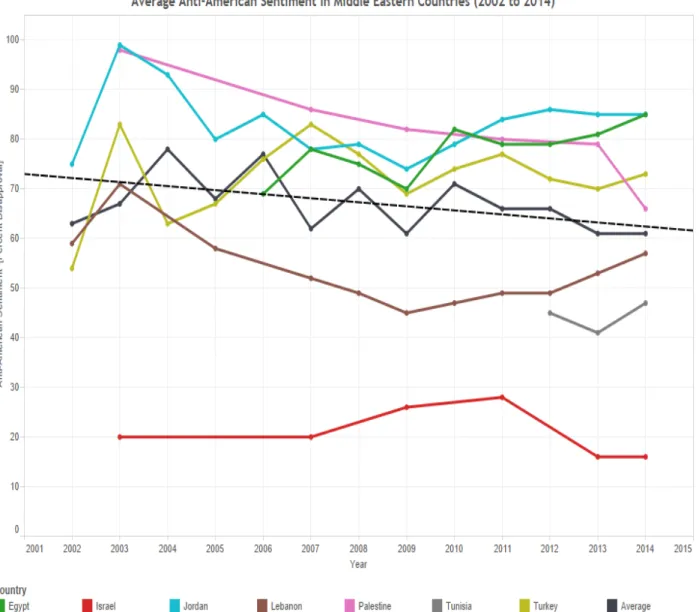
In Figure 1, I have graphed the percentage of disapproval of the U.S. for each Middle Eastern country where the survey was conducted at least twice between 2002 and 2014 (the actual graph follows on next page).
Figure 1: Graph of anti-‐American sentiment in the Middle East from 2002 to 2014 with a dashed average trend line. (Data from Pew Research, expressed using Tableau software)
Looking at Figure 1, we can see that the overall trend in anti-‐American sentiment has decreased about 10 percentage points in twelve years. However, not all countries have experienced this downturn in disapproval. Egypt, Tunisia, Turkey, and Lebanon all show a considerable increase in anti-‐American sentiment from 2013 to 2014. Another, Jordan, did not experience an increase in anti-‐American sentiment, but its percent disapproval has remained in the high 80’s for the last four years. Even with an extreme low (just 16%)
from Israel included, Middle Eastern average disapproval of the U.S. was 61 percent in 2014. At no point during the 12 years of Pew’s surveying in the Middle East has
disapproval of the U.S. dipped below 60% of the respondents. The region also experienced average highs over 75% twice during the survey history, in 2003 and again in 2006.
As we can also see from the graph, a country’s strong ties to the United States does not equate to positive views of the U.S. Both Turkey and Jordan are military allies of America; Turkey is a member of NATO, and Jordan is a partner. However, both have consistently high levels of anti-‐American sentiment. In 2014, the percent disapproval of the United States in Jordan (85%) and Turkey (73%) was more than ten percentage points higher than the regional average. Facts like this lead to an important question: if we see high levels of anti-‐Americanism in countries we cooperate with on issues like
counterterrorism and NATO security, how can we ensure these relationships will continue in the long run?
Anti-‐Americanism and Foreign Policy
In the following graphs, I compare pro-‐ and anti-‐American sentiment to positive or
“approve” responses to four questions. These are the graphs that utilize Giacomo Chiozza’s method, as mentioned in the beginning of this chapter. The responses to question 844,
“Please tell me if you have a very favorable, somewhat favorable, somewhat unfavorable, or very unfavorable opinion of...the United States,” are divided into “Pro-‐American Sentiment”
and “Anti-‐American Sentiment” and are located on the x-‐axis. “Pro-‐American Sentiment”
contains data from two responses to question 844: “very favorable” and “somewhat favorable”. “Anti-‐American Sentiment” contains data from two negative responses to question 844: “somewhat unfavorable” and “very unfavorable”. I did not include data from
the response “don’t know”, which never exceeded more than about five percent of the respondents.
On the y-‐axis, I show only positive responses to each of the four questions indicating opinion on U.S. foreign policies. I did this in an effort to make reading the graphs easier.
The same pro-‐ and anti-‐American sentiments compared to the negative responses to the four questions looks the same when graphed, just upside down. Each circle in the scatter plots represents a different case, which is defined as each year the question was asked in the GAP survey in one of the countries I designate as “Middle Eastern”. Each of the
following countries is represented by a color: Egypt (orange), Israel (green), Jordan (red), Lebanon (purple), Palestine (brown), Tunisia (pink), Turkey (gray), and the average of the data for each year (blue). I have also included dark black trend lines in each graph
indicating the average path of the data.
Figure 2.1
Figure 2.1 compares American sentiment to responses of “like” to: “And which of these comes closer to your view? I like American ideas about democracy, OR I dislike American ideas about democracy.”
Figure 2.2
Figure 2.2 compares American sentiment to responses of “approve” to: “Do you approve or disapprove of the United States conducting missile strikes from pilotless aircraft called drones to target extremists in countries such as Pakistan, Yemen and Somalia?”