Center for Systematic Entomology, Inc., Gainesville, FL
Date of issue: April 30, 2021
0861
The lycaenid butterfly fauna (Lepidoptera) of Cosñipata, Peru:
annotated checklist, elevational patterns, and rarity
Gerardo Lamas
Museo de Historia Natural, Universidad Nacional Mayor de San Marcos Apartado 14-0434, Lima-14, Peru
Michael L. McInnis
3620 Eagles Trace
Floyds Knobs, Indiana 47119-9103, USA
Robert C. Busby
9275 Hollow Pine Drive Estero, Florida 34135, USA
Robert K. Robbins
Department of Entomology
NHB Stop 127, National Museum of Natural History, Smithsonian Institution Washington, DC 20560-7012, USA
I nsecta A journal of world insect systematics M undI
Page Count: 34
Lamas et al.
Published on April 30, 2021 by
Center for Systematic Entomology, Inc.
P.O. Box 141874
Gainesville, FL 32614-1874 USA
http://centerforsystematicentomology.org/
Insecta Mundi is a journal primarily devoted to insect systematics, but articles can be published on any non-
marine arthropod. Topics considered for publication include systematics, taxonomy, nomenclature, checklists, faunal works, and natural history. Insecta Mundi will not consider works in the applied sciences (i.e. medi- cal entomology, pest control research, etc.), and no longer publishes book reviews or editorials. Insecta Mundi publishes original research or discoveries in an inexpensive and timely manner, distributing them free via open access on the internet on the date of publication.
Insecta Mundi is referenced or abstracted by several sources, including the Zoological Record and CAB Abstracts.
Insecta Mundi is published irregularly throughout the year, with completed manuscripts assigned an individual number. Manuscripts must be peer reviewed prior to submission, after which they are reviewed by the editorial board to ensure quality. One author of each submitted manuscript must be a current member of the Center for Systematic Entomology.
Guidelines and requirements for the preparation of manuscripts are available on the Insecta Mundi website at http://centerforsystematicentomology.org/insectamundi/
Chief Editor: David Plotkin, [email protected] Assistant Editor: Paul E. Skelley, [email protected] Layout Editor: Robert G. Forsyth
Editorial Board: Davide Dal Pos, Oliver Keller, M. J. Paulsen
Founding Editors: Ross H. Arnett, Jr., J. H. Frank, Virendra Gupta, John B. Heppner, Lionel A. Stange, Michael
C. Thomas, Robert E. Woodruff
Review Editors: Listed on the Insecta Mundi webpage
Printed copies (ISSN 0749-6737) annually deposited in libraries
Florida Department of Agriculture and Consumer Services, Gainesville, FL, USA The Natural History Museum, London, UK
National Museum of Natural History, Smithsonian Institution, Washington, DC, USA Zoological Institute of Russian Academy of Sciences, Saint-Petersburg, Russia Electronic copies (Online ISSN 1942-1354) in PDF format
Archived digitally by Portico
Florida Virtual Campus: http://purl.fcla.edu/fcla/insectamundi
University of Nebraska-Lincoln, Digital Commons: http://digitalcommons.unl.edu/insectamundi/
Goethe-Universität, Frankfurt am Main: http://nbn-resolving.de/urn/resolver.pl?urn:nbn:de:hebis:30:3-135240
Copyright held by the author(s). This is an open access article distributed under the terms of the Creative Commons, Attribution Non-Commer- cial License, which permits unrestricted non-commercial use, distribution, and reproduction in any medium, provided the original author(s) and source are credited. http://creativecommons.org/licenses/by-nc/3.0/
I nsecta M undI
The lycaenid butterfly fauna (Lepidoptera) of Cosñipata, Peru:
annotated checklist, elevational patterns, and rarity
Gerardo Lamas
Museo de Historia Natural, Universidad Nacional Mayor de San Marcos Apartado 14-0434, Lima-14, Peru
Michael L. McInnis
3620 Eagles Trace
Floyds Knobs, Indiana 47119-9103, USA [email protected]
Robert C. Busby
9275 Hollow Pine Drive Estero, Florida 34135, USA
Robert K. Robbins
Department of Entomology
NHB Stop 127, National Museum of Natural History, Smithsonian Institution Washington, DC 20560-7012, USA
Abstract. Peru’s Cosñipata Region in Cuzco and Madre de Dios Departments is a valley between Manu National Park and the Amarakaeri Communal Reserve that ranges from 400 to 4,000 m elevation. A team of experienced lepidopterists sampled the butterfly fauna of this valley for more than a decade (7,440 field person-hours). We analyze the data for Lycaenidae (Lepidoptera: Papilionoidea), a family for which we have taxonomic expertise. After adding data on the fauna from museums and the literature, we present an anno- tated checklist of the 340 Lycaenidae species recorded from the Cosñipata Region with notes for each species on the elevations and seasons at which it occurs, adult behavior, and sampled relative abundance. Species richness is twice that recorded for Trinidad or Brazil’s Parque Nacional do Itatiaia, each of which also has a mix of low, mid, and high elevation habitats. There was an average of 8.3 adult specimens per species in the fieldwork sample. For those species with more than 8 specimens, the median elevational range was 1,100 m.
Species richness in low elevation habitats was greater than that at mid or high elevations, which is contrary to findings for some other Neotropical insects. We present evidence why further sampling is likely to increase this difference. Maximal adult species richness occurs during the transition from dry to wet seasons (Sep- tember to November) at all elevations, but there is little evidence that adults of species occur only during this season. Sampled relative abundances were skewed so that 70% of the species were encountered less frequently than average (1/340). These results are consistent with the observation that most species are rarely encoun- tered using standard sampling methods.
Key words. Encounter rates, Eumaeini, mid-domain effect, seasonality, species richness.
ZooBank registration. urn:lsid:zoobank.org:pub:592A45E8-2A57-4C47-B6BD-880E46F7CCAA
Introduction
Documenting the composition and structure of species-rich faunas is difficult because most species are rare
(Kunin and Gaston 1993). For Neotropical butterflies, faunal studies require significant, long-term sampling (e.g.,
Hoffmann 1940, 1941; Zikán and Zikán 1940, 1968; Ebert 1969; DeVries 1987, 1997; Brown 1992), oftentimes
accompanied by prodigious taxonomic effort (e.g., Robbins et al. 1996). For Neotropical Lycaenidae, taxonomic
expertise is necessary, whether documenting a hilltop fauna of territorial males (Prieto and Dahners 2006, 2009)
or the fauna of a political region (Duarte et al. 2010; Robbins et al. 2012; Cock and Robbins 2016).
The Lepidoptera of the Cosñipata Region in southern Peru have been sampled for almost two centuries (Lamas 1989). French naturalist Claude Isidore Gay collected Cosñipata butterflies in 1839–1840 and was fol- lowed by Henry Whitely Jr., who collected some Lycaenidae (Druce 1876). Sporadic subsequent collections indicated that the Cosñipata Region has a rich lepidopteran fauna. Further, habitat access via a road through the steep valley suggested that the Cosñipata Region might be an excellent place to quantify elevational patterns of a butterfly community. For these reasons, we initiated a project to sample the Cosñipata Region adult butter- fly fauna at a variety of elevations and seasons. The primary focus was on Lycaenidae, especially the Eumaeini (Theclinae). After 7,440 person-hours of fieldwork over 12 years, during which we sampled 2,692 lycaenid adults, we address the following questions.
First, is lycaenid species richness greatest in low or mid elevation habitats? Species richness generally declines with increasing elevation, but whether richness peaks at low or mid elevations has been controversial (McCoy 1990; Rahbek 2005; Beck et al. 2017 and included citations). In particular, the random distribution of elevational ranges would lead to a mid-domain effect (Colwell and Lees 2000). Focusing on elevation gradients in Neotropical Lepidoptera, species richness of Costa Rican Geometridae is greatest between about 1,000 and 2,000 m elevation (Brehm et al. 2007). Species richness of Peruvian Sphingidae peaks at about 600–800 m eleva- tion (Ignatov et al 2011; Sublett et al. 2019). Species richness showed no evident mid elevation peak in Mexican (Meléndez-Jaramillo et al. 2019) or Brazilian (Pires et al. 2020) butterflies, albeit the gradient in the latter paper was restricted to 800–1,400 m elevation. Elevational species richness gradients have not been assessed for Neo- tropical lycaenids.
Second, what is the median elevational range of a Cosñipata Region lycaenid? Although lycaenid eleva- tional ranges are anecdotally documented in generic revisions (e.g., Robbins and Busby 2008; Busby et al. 2017), they have not been quantified for a Neotropical community, such as that in the Cosñipata Region.
Third, are lycaenid elevational ranges narrow at higher elevations? Satyrine butterflies have been reported to be stratified in narrow elevational ranges at higher elevations (Adams 1985; Pyrcz and Wojtusiak 2002), and we assess whether this pattern occurs in lycaenids.
The fourth question concerns seasonal variation in lycaenid species richness. In some Neotropical lowland sites, species richness is greatest during the dry season (Bates 1875; Robbins and Small 1981), but in Amazonian Peru, it appears to be greatest during the transition between the dry and wet seasons (Robbins et al. 1996). We ask when species richness is greatest in the Cosñipata Region and whether it is dependent upon elevation.
A related fifth question is whether lycaenid adults fly only during one season of the year, and if strict sea- sonality does occur, whether it tends to occur at lower or higher elevations.
Sixth, how frequently is each species encountered? Whereas the concepts of rarity and commonness have a variety of meanings (Gaston 1997), relative abundance in a sample is heuristically easy to understand. A spe- cies with a sampled relative abundance of 1/100 has been encountered, on average, once for every 100 sampled individuals. The significance of encounter rate is that it determines, in part, the ability to accumulate information about a species. A practical consequence is that species of conservation concern are generally rare species (Kunin and Gaston 1993).
Seventh, what proportion of the community’s species and individuals are sampled less than the average relative abundance? We ask this question as a way to quantify how relative abundances, as measured by sampled encounter rates, are skewed towards rarity. It is a way to quantify the “most species are rarely encountered”
description.
Butterfly diversity samples are biased. The number of sampled individuals of a species depends upon the abundance of that species and the interaction between its behavior/morphology and the sampling method. For example, “apparency” in butterfly size and color biases samples (Dennis et al 2006). As another example, some species are attracted to decaying fish baits while others are not (Busby et al. 2017). The interaction between behavior/morphology and sampling method biases the answers to the questions just posed. For this reason, we specifically note potential biases in sampling and analyses in the answers to these questions.
Given the rarity with which most Neotropical lycaenid butterfly species are encountered, long-term faunal
studies such as this one, as well as museum collections, are often times the only sources of information about the
majority of species. It is the biological raison d’être for this paper.
Materials and Methods
Study Area
The Cosñipata Region is an interconnected complex of valleys in Cuzco and Madre de Dios Departments, Peru (Fig. 1). It is comprised of the Cosñipata Valley, the Pilcopata Valley, the lower parts of the Tono and Piñi Piñi Valleys, and the upper portion of the Alto Madre de Dios Valley. Drainage from Abra Acjanaco creates the head- waters of the Río Cosñipata, which flows into the Río Pilcopata just upstream from Pilcopata. The Río Pilcopata then merges with the Río Tono and Río Piñi Piñi to form the Río Alto Madre de Dios. This region is located between Manu National Park, Biosphere Reserve and World Heritage Site and the Amarakaeri Communal Reserve (Fig. 1).
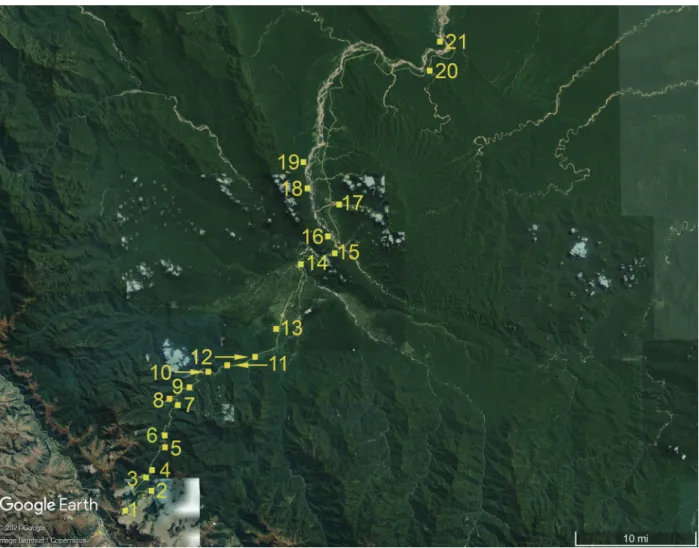
We focused sampling along a 126 kilometer stretch of the Paucartambo-Shintuya road (Fig. 2–4), from Abra Acjanaco (3,600 m) to Pantiacolla Lodge (400 m). We list and map the primary field sites with their eleva- tions, coordinates, and plant communities (Table 1). The road runs from Abra Acjanaco (3,600 m) to Shintuya (400 m), a road distance of 126 kilometers (Fig. 2–4). There is virtually continuous access to undisturbed grass- land and forest (Fig. 3–4) from Abra Acjanaco to Chontachaca (970 m). Disturbed habitat predominates from Chontachaca to Atalaya (500 m, on the southeastern bank of the Alto Madre de Dios River). From Atalaya to
Figure 1. Location of the Cosñipata Region (yellow box) in southeast Peru. © Amazonia Lodge.
Table 1. Major Cosñipata Region sampling localities for Lycaenidae. LocalityElevation (m)CoordinatesLocation Figure 2Plant Communities Abra Acjanaco3,600–3,50013° 11′ S, 71° 38′ W1Puna with bunchgrasses (Poaceae), tola shrubs, and small trees along quebradas. Wayquecha2,95013° 10′ S, 71° 35′ W2Mossy elfin forest in mesic situations and more xeric ericaceous brush on slopes. Pillahuata2,585–2,60013° 09′ S, 71° 35′ W3Elfin forest with xeric ericaceous brush on open slopes. Quebrada Buenos Aires2,41013° 09′ S, 71° 36′ W3Montane forest with stands of Alnus. Quebrada Yanamayo2,35013° 08′ S, 71° 35′ W4Montane forest with patchy stands of bamboo. Quebrada Morro Leguía2,13513° 07′ S, 71° 34′ W5Montane forest with patchy stands of bamboo and xeric ericaceous brush on open slopes. Rocotal1,97013° 06′ S, 71° 34′ W6Montane forest with stands of bamboo and Miconia. El Mirador 1,72013° 04′ S, 71° 33′ W7Montane forest with stands of Miconia and roadside promontories. Puente Unión1,60013° 04′ S, 71° 34′ W8Montane forest with stands of Miconiaalong the Unión River. San Pedro1,37513° 03′ S, 71° 33′ W9Lower Montane forest with large trees covered in epiphytes, and a dense understory composed of bamboo, tree ferns, palms, and small trees. Quebrada Santa Isabel1,19413° 02′ S, 71° 31′ W10Lower Montane forest on ridges with tropical riparian growth. Quebrada Quitacalzón1,05013° 01′ S, 71° 30′ W11Lower Montane forest on ridges with tropical riparian growth and bamboo. Chontachaca95013° 02′ S, 71° 28′ W12Disturbed lowland forest with two trail systems and many open areas. Patria68012° 58′ S, 71° 26′ W13Disturbed lowland forest with many open areas. Pilcopata (including Villa Carmen)58012° 54′ S, 71° 24′ W14Predominantly secondary lowland rain forest. Atalaya50512° 54′ S, 71° 22′ W15Riparian habitat at the junction of the Alto Madre de Dios and Carbón Rivers. Amazonia Lodge500–80012° 52′ S, 71° 23′ W16Primary and secondary lowland rain forest. The secondary forest floods each year. Salvación500–60012° 50′ S, 71° 21′ W17Disturbed lowland rain forest with many open areas. Erika550–65012° 49′ S, 71° 24′ W18Primary lowland rain forest with a few riparian open areas. Mascoitania52012° 47′ S, 71° 24′ W19Primary lowland rain forest with a few riparian open areas. Shintuya45012° 41′ S, 71° 14′ W20Primary lowland rain forest with some unflooded open areas. Pantiacolla Lodge40012° 39′ S, 71° 13′ W21Primary lowland rain forest on unflooded terra firma.
Figure 2. Location of major sampling sites. The numbers reference Table 1.
Figure 3. The Cosñipata Valley, view from 1,650m, looking towards the northeast.
Shintuya, roadside habitat on the eastern bank of the river is moderately disturbed, but we accessed primary and secondary forest on the western bank of the Alto Madre de Dios River.
We also sampled three lowland areas with extensive trail systems, the Villa Carmen Biological Station, the Amazonia Lodge and the Pantiacolla Lodge. Villa Carmen is managed by the Amazon Conservation Association (ACCA or Asociación para la Conservación de la Cuenca Amazónica). It encompasses 3,035 hectares (7,500 acres); and is located 1.4 km NNE of Pilcopata in Cuzco Department. The Amazonia Lodge consists of 350 hectares (865 acres) and is located 3 km downstream of Atalaya on the west bank of the Río Alto Madre de Dios in Madre de Dios Department. The Pantiacolla Lodge has 900 hectares (2,200 acres) and is located across from Shintuya on the northwest bank of the Alto Madre de Dios in Madre de Dios Department.
The study area comprises approximately 1,000 hectares. There is a 20-meter strip along the 126 km Acja- naco-Shintuya road, 1.6 km
2at the Amazonia Lodge, 1.7 km
2at Villa Carmen, 1.5 km
2at Pantiacolla Lodge, and small areas near the villages of Chontachaca and Patria).
The Cosñipata Region has marked seasonality with the wettest months from November through March and the driest from June through August (ONERN 1976). The transition from the end of the dry season to the begin- ning of the wet season occurs from September to November. A portion of the Cosñipata Region, the Pantiacolla Range, has the highest annual rainfall in Peru (>8,000 mm).
Sampling Methods
Fieldwork localities and person-hours. Fieldwork was done at multiple elevations during each season with the
goal of systematically surveying the butterfly fauna of the Cosñipata Region (Table 1, Fig. 2). We visited the study sites for two to three-week periods during January, February, March, April, May, June, August, September, Octo- ber, and November. We used field stations/lodges as bases of research. Lodges are located at Wayquecha (2,950 m), San Pedro (1,375 m), Pilcopata (540 m), Atalaya (491 m), and Pantiacolla (400 m).
Survey participants were experienced lepidopterists (see Acknowledgments). All lycaenids encountered that could be collected were sampled with the exception of Arawacus separata (Lathy) and Ocaria ocrisia (Hewit- son), which were common and easily recognized lycaenids. As one way to assess collector bias, we calculated variation among the collectors in the rate at which they sampled lycaenids.
Figure 4. El Mirador (red marking), a site occupied by territorial males at 1,720m (image courtesy S. Kinyon).
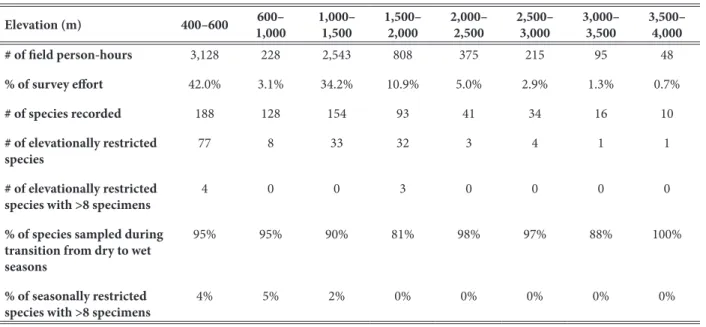
Field survey person-hours were recorded during weather when butterflies were active at various eleva- tions in the Cosñipata Region (Table 2). Due to frequent cloud cover, butterfly activity was less frequent above 2,000 m elevation resulting in fewer field person-hours at these elevations. The proportion of field person-hours at low elevation habitats between 0–1,000 m (45.1%) was similar to that at mid elevation habitats between 1,000–
2,000 m (45.0%).
Sampling was influenced by locality constraints. At elevations higher than 950 m (Chontachaca), survey efforts were largely restricted to roadsides and roadway promontories because there were few trails through the forest. At Chontachaca and lower elevations, there were extensive trail systems that provided better access to for- est species. These trails were also more conducive to the use of bait traps.
Insect net sampling. When the survey began, efforts were primarily focused on the use of insect nets. Due to the
steep slopes on each side of the Acjanaco-Shintuya road, long telescoping nets (up to 8 m in length) were a neces- sity. At lower elevations long nets were used to capture specimens at higher forest levels.
Male hairstreaks set up mating territories for two hours or more at a place and time that is characteristic of that species (Prieto and Dahners 2006, 2009). Indeed, males of a particular species were often sampled at the same spot at the same time on successive days. Many promontories along the winding road were occupied by males after 11:00 AM when the sun illuminated the side of trees facing the road (Fig. 4). The vegetation along and above quebradas (small streams) also served as mating territories for males.
Many hairstreak butterflies landed within a meter of the ground in dappled shade on hot, clear days between 11:30 AM and 2:00 PM. This presumed thermoregulatory behavior was observed only at elevations below 1,100 m and facilitated sampling.
We found limited nectar sources in the Cosñipata Region, but the Acjanaco-Shintuya road has several spe- cies of Miconia (Melastomataceae) that bloomed during different months at elevations between 1,000 and 2,600 m. These flowers are well-known for attracting insects (Kriebel and Zumbado 2014). For lycaenids, the most attractive
Miconia trees bloomed during the wet season (January and February) between 1,100 and 2,000 m.These trees were often less than 10 m high. Many lycaenid species were recorded nectaring on Miconia flowers and were not otherwise seen in the Cosñipata Region.
Bait trapping. Baiting efforts evolved during the survey. Initially, efforts were restricted to traps deployed 10–20
m above ground, baited with decaying fish. This type of trapping attracted both male and female lycaenids. As opposed to butterflies that usually enter traps, lycaenids primarily land on exterior trap surfaces (top and sides, Busby et al. 2017). Traps were positioned in dappled or nearly-full sunlight in proximity to the forest canopy.
Table 2. Sampling partitioned by elevation.
Elevation (m) 400–600 600–
1,000 1,000–
1,500 1,500–
2,000 2,000–
2,500 2,500–
3,000 3,000–
3,500 3,500–
4,000
# of field person-hours 3,128 228 2,543 808 375 215 95 48
% of survey effort 42.0% 3.1% 34.2% 10.9% 5.0% 2.9% 1.3% 0.7%
# of species recorded 188 128 154 93 41 34 16 10
# of elevationally restricted
species 77 8 33 32 3 4 1 1
# of elevationally restricted
species with >8 specimens 4 0 0 3 0 0 0 0
% of species sampled during transition from dry to wet seasons
95% 95% 90% 81% 98% 97% 88% 100%
% of seasonally restricted
species with >8 specimens 4% 5% 2% 0% 0% 0% 0% 0%
Since hairstreaks alighted on the outside of the trap, care was taken to lower the trap without disturbing the but- terfly. Trapping for hairstreaks was most successful in the Cosñipata Region at elevations below 600 m, where 50 or more specimens/person were on occasion sampled in a single day. The lack of bait trapping success at higher elevations may have been due to a lack of forest access rather than sampling method. In Ecuador, baited traps attracted lycaenids at elevations up to 1,600 m (Busby et al. 2017).
A modified baiting technique was effective. We mixed urine with decaying fish, which produced an odifer- ous and easily dispensed bait. This mixture was sprayed or sprinkled on vegetation along trails to attract butterflies of all families. This method was a relatively efficient means of attracting Lycaenidae to ground level, where they could be collected.
We also used simulated bird droppings (Lamas et al. 1993). We chewed paper and placed the paper/saliva residue on leaf surfaces. Butterflies from all families (particularly Hesperiidae) were attracted to these baits from 400 to 2,200 m elevation. These baits attracted Lycaenidae on occasion, such as Arcas imperialis (Cramer).
Compiled Data
Field person-hours and the data for each sampled specimen were recorded in an electronic spreadsheet. Each specimen was identified, which sometimes necessitated genitalic dissection, based on the taxonomy in Lamas (2004), Robbins (2004b), and subsequent revisions. Vouchers for fieldwork are deposited in the Museo de His- toria Natural, Universidad Nacional Mayor de San Marcos, Lima, Peru (MUSM) and in the National Museum of Natural History, Smithsonian Institution, Washington, D.C. USA.
The Cosñipata Region Lycaenidae fauna consisted of the fieldwork sample and of data from the scientific literature and museums, especially MUSM.
We tabulated the Lycaenidae fauna of the Cosñipata Region in an annotated checklist (Appendix 1). Each species account in the Appendix includes elevation range and temporal distribution. In addition, information is given regarding relative abundance, ratio of males to females, nectar preferences, male behavior, and attraction to traps/bait.
Data Analysis
We partitioned the Cosñipata Region into eight elevation zones of 500 m or less and recorded the number of species in each zone, noting how many were found only at that elevation (Table 2). To determine the elevational range of a species, we assumed that each species occurred throughout the zones in which it was collected and in all zones between the highest and lowest at which it was collected. The biases of this method are discussed below.
We did not do statistical tests. Virtually all statistical tests, whether parametric or not, assume independent samples. As noted in the introduction and discussed below, samples are highly biased. We know of no evidence to support the hypothesis that samples are independent. In place of supporting conclusions with questionably appropriate statistical tests, we instead focus on assessing the biases of sampling methods and data analyses.
To assess the hypothesis that species richness is greatest at mid-elevations, we partitioned the Cosñipata Region into lowland habitats (up to 1,000 m), mid-elevation habitats (1,000–2,000 m), and high elevation habitats (2,000–4,000 m) (Table 3). We then tabulated the number of species in each habitat, the number of species in each habitat represented by only one specimen in the field sample, and the number of species in each habitat not represented in the field sample, but which had been collected by others, usually before the project was initiated.
Table 3. Species distributions partitioned by low, mid, and high elevation habitats.
Habitat (elevation) Low
(0–1,000 m) Mid
(1,000–2,000 m) High (2,000–4,000 m)
# of Species 205 196 56
# of species with one specimen (%) 48 (23%) 24 (12%) 4 (7%)
# of species not in field sample (previously sampled) 12 4 0
% of species with relative abundance less than average 70% 65% 63%
The basic data for temporal occurrence was the number of species sampled in each month (Table 4). We assessed adult seasonality using the following reasoning. As sample size for a species with adults that occur only in one season increases, it will continue to be recorded only in that season. For a non-seasonal species, other sea- sons will be recorded as sample size increases. As a potential maximum measure of adult seasonality, we tabulated the number of species with more than eight specimens (the average number of specimens per species) collected in only one season at each elevation (Table 2).
With 340 species, the average relative abundance of lycaenid species in the Cosñipata Region, by definition, was 1/340. To estimate the number of species with a smaller relative abundance than average, we counted the number of species in the total sample that had a smaller relative abundance. We then did an analogous calculation for each habitat zone (Table 3).
Table 4. Monthly occurrence of Lycaenidae in the Cosñipata Region.
Month Jan Feb Mar Apr May Jun Jul Aug Sep Oct Nov Dec
% of field
survey effort 5.5% 10.2% 2.1% 5.9% 9.2% 5.6% 0% 3.5% 9.4% 22.4% 26.2% 0%
# of species in
field sample 71 112 27 43 80 85 2 57 129 208 222 13
Results
Annotated checklist. We list the 340 lycaenid species fauna of the Cosñipata Region (Appendix), of which 324
species were sampled during the fieldwork part of this project. We found 136 previous records of Cosñipata Region lycaenid species in museums and the literature, of which 16 were not sampled during the fieldwork.
Taxonomy and identification remain a problem. About one of every six species is undescribed. Correct names remain unresolved in genera in which it is difficult to associate the sexes until DNA samples for both male and female types can be obtained.
Fieldwork sample. We sampled 2,692 specimens of 324 Lycaenidae species (321 Eumaeini, 3 Polyommatinae)
in the Cosñipata Region over 12 years and 7,440 person-hours of fieldwork. One lycaenid was sampled on aver- age every 2.8 person-hours in the field. The collector most focused on lycaenids averaged one lycaenid every 1.3 person-hours. Because two common species were ignored, the actual time to encounter a lycaenid was lower.
The fieldwork sample contained an average of 8.3 and a median of 4 specimens per species. As one measure of encounter rarity, 81 species (24%) in the fieldwork sample were collected once. Another 16 species that were collected by others in the Cosñipata Region were unsampled. Since previously unrecorded species are still being discovered, a minimum of 29% of the Cosñipata Region lycaenid fauna was sampled one or fewer times in 7,440 person-hours of fieldwork.
Elevation. The number of species in the entire sample in each elevation zone is presented in Table 2. For the more
common species (those with nine or more specimens), the median elevational range was 1,100 m, and only 7 were restricted to one elevation zone (Table 2).
Low, Mid, and High Elevation Habitats. The number of species in the entire sample were partitioned by eleva-
tion habitat (Table 3). Marginally more species were sampled in low (205 species) than mid (196 species) elevation habitats with approximately equal person-hours (Table 2). The number of species represented by one individual, however, is greatest in low elevation habitats (Table 3). The number of species previously collected, but not found in the fieldwork, is also greatest at low elevation (Table 3).
Seasonality. Maximum species richness occurred from September through November during the transition from
the dry to the wet season (Table 4). Almost 87% (295 species) were recorded during this seasonal transition.
Maximal species richness from September through November occurred at all elevations (Table 2). The low num-
ber of species in July and December (Table 4) is an artifact because we did no fieldwork for this project during
these months.
As a measure of strict adult seasonality (occurrence during only one season), 121 species (36%) were recorded only during the transition from dry to wet season, but only eight of these species had nine or more sampled specimens (the average number of specimens per species). All occurred under 1,500 m elevation (Table 2). Forty-three species (13%) were recorded only from December to August, but none had nine or more sampled specimens.
Relative abundances. The average and median relative abundances, respectively, in the total sample were 2.9 ×
10
−3and 1.3 × 10
−3, with 237 species (70%) having a relative abundance less than the average. Each of these 237 species would be encountered, on average, less than once for every 743 specimens encountered. We repeated these calculations for low, mid, and high elevation habitats (Table 3). The 237 species that were encountered less often than average contained 24% of specimens sampled.
Discussion
Species richness. The Eumaeini lycaenid fauna of the Cosñipata Region with 337 recorded species (Appendix) is
richer than other comparable Neotropical sites, albeit comparative data are scanty. Brazil’s Parque Nacional do Ita- tiaia (Rio de Janeiro state, ~12,000 hectares) has low, mid, and high elevation habitats, as in the Cosñipata Region, but only 176 described and undescribed species were recorded after decades of collecting (Zikán and Zikán 1940, 1968). In fact, all of Rio de Janeiro state (~4,365,000 hectares), which includes elevations above 3,000 m, has 203 recorded eumaeine species (Duarte et al. 2010). The recorded eumaeine fauna of Trinidad (~480,000 hectares), which also has low, mid, and high elevation habitats, is 127 species (Cock and Robbins 2016).
Of 1,058 Eumaeini recognized in the Neotropics from Mexico to Chile (Robbins 2004a), 32% are recorded from the Cosñipata Region. The 76 Eumaeini species represented by one individual each in the combined field- work and museum/literature samples indicate that the Cosñipata fauna is not yet fully documented.
Is lycaenid species richness greatest in low or mid elevation habitats? The number of species in low elevation
habitats (1,000 m and below) is slightly greater than that in mid elevation habitats (1,000–2,000 m) (Table 3).
Sampling efforts in low and mid elevation habitats were equivalent (Table 2). However, the number of low eleva- tion species in the fieldwork sample with zero or one specimen is more than double that at mid elevations (Table 3). Additionally, another 40 lowland species recorded at Pakitza (Fig. 1, 100 km north of the Cosñipata Region, 356 m) were unrecorded at Cosñipata (Robbins et al. 1996). Based on this evidence, we expect the species rich- ness in low elevation habitats to increase with further sampling more quickly than that in mid elevation habitats.
This finding suggests that lycaenid elevational ranges are not distributed at random, which would lead to a mid- domain effect (Colwell and Lees 2000).
What is the median elevational range of a Cosñipata Region lycaenid? Cosñipata Region lycaenid species have
a median elevational range of 1,100 m, but the calculation of elevational range suffers from three sources of error.
First, a single outlier record, such as a historical record for Panthiades paphlagon (C. Felder and R. Felder) from H. Whitely at 3000 m, overestimates elevational range for a few species. However, the use of median ranges obvi- ates this kind of error. Second, elevational range is overestimated because we assumed that a species found in an elevation zone occurred throughout that zone. Third, elevational range is underestimated because further sam- pling can increase the range of zones in which each species is found. Regardless of how these latter two sources of error offset each other, there is no comparable published median estimate of elevational range in a Neotropical lycaenid community.
Are lycaenid elevational ranges narrow at higher elevations? Of the 26 species sampled at least nine times
above 2,000 m elevation, none had an elevational range under 1,000 m. There is little apparent evidence to sup- port the hypothesis that high elevation lycaenid species are stratified in narrow elevational ranges.
At what season is adult species richness the greatest? Nearly 87% of the Cosñipata Region lycaenid species
were recorded with 58% of the sampling effort during the transition from the dry to wet seasons (September to
November), (Table 4). This seasonal pattern occurred at all elevations (Table 2). A similar pattern was found in
the lowland parts of Manu National Park (Robbins et al. 1996).
Are lycaenid adults strictly seasonal? There is little evidence that adult lycaenids are restricted to one season in
the Cosñipata Region. For the 103 species represented by at least nine specimens (the average number of speci- mens per species), eight occurred only during the transition from the dry to wet seasons, and none occurred only at other times. It remains to be seen if the eight species currently known only from the dry to wet season transition continue to be seasonally restricted with further sampling. All eight occur under 1,500 m elevation (Table 2).
How frequently is each lycaenid species encountered? The median relative abundance in the entire sample was
0.0013, which is an encounter rate of one individual, on average, in a sample of 744 specimens. It would take the most efficient collector of lycaenids in this project (one lycaenid encountered every 1.3 field-hours) nearly 14 weeks of 70-hour field weeks to accumulate a sample of 744 specimens.
Another way to assess sample relative abundances is that 94% (321 species) of the lycaenid species at Cosñipata were encountered one or fewer times, on average, in a sample of 100 individuals.
What proportion of the community’s species and individuals have less than average relative abundance?
Relative abundances in the sample are skewed towards rarity. In the entire sample, 237 species (70%) represent- ing 24% of all individuals, have a relative abundance less than the average (1/340). This skew in sample relative abundances occurs in low, mid, and high elevation habitats (Table 3).
An evident bias in the unevenness of sampled relative abundances was that a few common and easily rec- ognized species were ignored. Similarly, if specimens of two species were seen simultaneously, the less frequently encountered species was likely collected. Lastly, species are still unsampled. All three of these biases suggest that that unevenness in the distribution of sampled relative abundances underestimates the distribution of uneven- ness in nature.
Conclusion
Studying the biology of most species is problematic because most are rarely encountered. For biologists con- cerned with species at risk of extinction, it is unclear how one distinguishes between rarity and being in danger of extinction. Given the rarity with which most lycaenid species are encountered, museum specimens and compiled observational information, such as that in the Appendix, are the primary sources of information for the vast majority of species. It is the major reason why faunal studies and museum collections are biologically significant.
Acknowledgments
We gratefully acknowledge the cooperation and assistance provided by the Ministerio de Agricultura, Dirección de Gestión Forestal y de Fauna Silvestre, whose permission made this project possible. We also acknowledge and thank our institutional sponsors, Museo de Historia Natural, Universidad Nacional Mayor de San Marcos (MUSM) and the National Museum of Natural History, Smithsonian Institution (NMNH), for their assistance and support.
We are indebted to the contributions that our colleagues and numerous photographers have made in sur- veying the butterflies of the Cosñipata Region. Those contributors include, Daniel Bolt, Dan Bogar, Gunnar Brehm, James P. Brock, José Cerdeña, Charles V. Covell, Bill Dempwolf, Douglas Cotrina, Marcelo Duarte, Rich- ard Egoavil, Jackie Farfán, Christophe Faynel, Kim Garwood, David Geale, Loran D. Gibson, Juan Grados, Brian Harris, Don Harvey, Richard Hoyer, Ken Kertell, Catharine and Steve Kinyon, Ellis Laudermilk, Richard Lind- strom, Deborah McInnis, Olaf H. H. Mielke, Andrew Neild, Juan José Ramírez, Shirley Sekarajasingham, Jon D.
Turner, and James Vargo.
We very much appreciate the assistance provided by Fernando Araoz, Enrique Ortiz, Renzo Piana, Adrián Tejedor and Carlos Zariquiey for permitting us to work at the Villa Carmen and Wayquecha Field Stations; Raúl Montes, the former owner of the Paradise Lodge; Ian Segabarth and Douglas Cotrina, the current owner/operator of the Paradise Lodge; Marianne van Vlaardingen for allowing us to study butterflies at the Pantiacolla Lodge;
Ulrike Maennig for use of the Amazonia Lodge map; and the Yábar family for allowing us to survey butterflies at
the Amazonia Lodge. Lastly, we thank Hilmar, our driver and a fine companion, for tirelessly transporting us and safely extricating our group from many situations encountered on the Cosñipata road.
We are especially indebted to Matthew Cock, Carlos Prieto, and Richard Vane-Wright, who kindly reviewed the manuscript and made numerous valuable suggestions.
Literature Cited
Adams MJ. 1985. Speciation in the pronophiline butterflies (Satyridae) of the northern Andes. Journal of Research on the Lepidoptera. Supplement 1: 33–49.
Bates HW. 1875. The naturalist on the River Amazons. Third Edition. John Murray; London. 394 p.
Beck J, McCain CM, Axmacher JC, Ashton LA, Bärtschi F, Brehm G, Choi SW, Cizek O, Colwell RK, Fiedler K, Francois CL, Highland S, Holloway JD, Intachat J, Kadlec T, Kitching RL, Maunsell SC, Merckx T, Nakamura A, Odell E, Sang W, Toko PS, Zamecnik J, Zou Y, Novotny VF. 2017. Elevational species richness gradients in a hyperdiverse insect taxon: A global meta-study on geometrid moths. Global Ecology and Biogeography 26(4): 412–424.
Brehm G, Colwell RK, Kluge J. 2007. The role of environment and mid domain effect on moth species richness along a tropi- cal elevational gradient. Global Ecology and Biogeography 16(2): 205–219.
Brown KS Jr. 1992. Borboletas da Serra do Japi: Diversidade, hábitats, recursos alimentares e variação temporal. p. 142–187, 18 figs. In: Morellato LPC (ed.). História natural da Serra do Japi. Ecologia e preservação de uma área florestal no Sud- este do Brasil. Editora da Unicamp/Fapesp. Campinas. 321 p.
Busby RC, Faynel C, Moser A, Robbins RK. 2017. Sympatric diversification in the Upper Amazon. A revision of the Eumae- ine genus Paraspiculatus (Lepidoptera: Lycaenidae). Smithsonian Contributions to Zoology 649: i–vii, 1–65.
Cock MJW, Robbins RK. 2016. Annotated checklist and biogeographic composition of the Lycaenidae (Lepidoptera) of Trinidad, West Indies. Insecta Mundi 0506: 1–33.
Colwell RK, Lees DC. 2000. The mid-domain effect: geometric constraints on the geography of species richness. Trends in Ecology and Evolution 15: 70–76.
Dennis RLH, Shreeve TG, Isaac NJB, Roy DB, Hardy PB, Fox R, Asher J. 2006. The effects of visual apparency on bias in butterfly recording and monitoring. Biological Conservation 128: 486–492.
DeVries PJ. 1987. The butterflies of Costa Rica and their natural history. Papilionidae, Pieridae, Nymphalidae. Princeton University Press; Princeton. xxii + 327 p.
DeVries PJ. 1997. The butterflies of Costa Rica and their natural history. Volume II. Riodinidae. Princeton University Press;
Princeton. xxvii + 288 p.
Druce H. 1876. List of the butterflies of Peru, with descriptions of new species. With some notes by Edward Bartlett. Proceed- ings of the Zoological Society of London 1876(1): 205–250, pls. 17–18.
Duarte M, Robbins RK, Freitas AVL, Brown KS Jr, Monteiro RF, Casagrande MM, Mielke OHH, Nascimento MS, Alves TG. 2010. Borboletas da Mata Atlântica do Estado do Rio de Janeiro: Lycaenidae. Arquivos do Museu Nacional, Rio de Janeiro 67(3/4): 291–302.
Ebert H. 1969. On the frequency of butterflies in Eastern Brazil, with a list of the butterfly fauna of Pocos [sic] de Caldas, Minas Gerais. Journal of the Lepidopterists’ Society 23(Supplement 3): 1–48.
Gaston KJ. 1997. What is rarity? In: Kunin WE, Gaston KJ (eds.). The biology of rarity. Population and community biology series, vol 17. Springer; Dordrecht. xiv + 280 p.
Hoffmann CC. 1940. Catálogo sistemático y zoogeográfico de los lepidópteros mexicanos. Primera parte. Papilionoidea.
Anales del Instituto de Biología. Universidad Nacional de México 11(2): 639–739.
Hoffmann CC. 1941. Catálogo sistemático y zoogeográfico de los lepidópteros mexicanos. Segunda parte. Hesperioidea.
Anales del Instituto de Biología. Universidad Nacional de México 12(1): 237–294.
Ignatov II, Janovec JP, Centeno P, Tobler M, Grados J, Lamas G, Kitching IJ. 2011. Patterns of richness, composition, and distribution of Sphingidae moths along an elevational gradient in the Andes-Amazon region of southeastern Peru.
Annals of the Entomological Society of America 104(1): 68–76.
Kriebel R, Zumbado MA. 2014. New reports of generalist insect visitation to flowers of species of Miconia (Miconieae:
Melastomataceae) and their evolutionary implications. Brittonia 66(4): 396–404.
Kunin WE, Gaston KJ. 1993. The biology of rarity: patterns, causes and consequences. Trends in Ecology and Evolution 8(8): 289–301.
Lamas G. 1989. “Viaje al Cuzco”, de Claude Gay. Boletín de Lima 11(63): 23–28.
Lamas G. 2004. Checklist: Part 4A; Hesperioidea – Papilionoidea. In: Heppner JB. (ed.). Atlas of Neotropical Lepidoptera.
Volume 5A. Association for Tropical Lepidoptera; Scientific Publishers, Gainesville. xxxv + 439 p.
Lamas G, Mielke OHH, Robbins RK. 1993. The Ahrenholz technique for attracting tropical skippers (Hesperiidae). Journal of the Lepidopterists’ Society 47(1): 80–82.
McCoy ED. 1990. The distribution of insects along elevational gradients. Oikos 58(3): 313–322.
Meléndez-Jaramillo E, Cantú-Ayala C, Sánchez-Reyes UJ, Sandoval-Becerra FM, Herrera-Fernández B. 2019. Altitudi- nal and seasonal distribution of butterflies (Lepidoptera, Papilionoidea) in Cerro Bufa El Diente, Tamaulipas, Mexico.
ZooKeys 900: 31–68.
ONERN (Oficina Nacional de Evaluación de Recursos Naturales). 1976. Mapa ecológico del Perú. Guía explicativa. Ofi- cina Nacional de Evaluación de Recursos Naturales; Lima. 274 p.
Pires, ACV, Barbosa, M, Beiroz W, Beirão MV, Marini-Filho OJ, Duarte M, Mielke OHH, Ladeira FA, Nunes YRF, Negreiros D, Fernandes GW. 2020. Altitudinal variation in butterfly community associated with climate and vegeta- tion. Anais da Academia Brasileira de Ciências 92(Suppl. 2)(e20190058): 1–13.
Prieto CH, Dahners HW. 2006. Eumaeini (Lepidoptera: Lycaenidae) del cerro San Antonio: Dinámica de la riqueza y com- portamiento de “hilltopping”. Revista Colombiana de Entomología 32(2): 179–190.
Prieto CH, Dahners HW. 2009. Resource utilization and environmental and spatio-temporal overlap of a hilltopping lycae- nid butterfly community in the Colombian Andes. Journal of Insect Science 9(16): 1–12.
Pyrcz TW, Wojtusiak J. 2002. The vertical distribution of pronophiline butterfies (Nymphalidae, Satyrinae) along an eleva- tional transect in Monte Zerpa (Cordillera de Mérida, Venezuela) with remarks on their diversity and parapatric dis- tribution. Global Ecology and Biogeography 11(3): 211–221.
Rahbek C. 2005. The role of spatial scale and the perception of large-scale species-richness patterns. Ecology Letters 8(2):
224–239.
Robbins RK. 2004a. Introduction to the checklist of Eumaeini (Lycaenidae). p. xxiv–xxx. In: Lamas G (ed.). Checklist: Part 4A. Hesperioidea - Papilionoidea. In: Heppner JB (Ed.), Atlas of Neotropical Lepidoptera. Volume 5A. Association for Tropical Lepidoptera; Scientific Publishers; Gainesville. xxv + 439 p.
Robbins RK. 2004b. Lycaenidae. Theclinae. Tribe Eumaeini. p. 118–137. In: Lamas G (ed.). Checklist: Part 4A. Hesperioidea - Papilionoidea. In: Heppner JB (ed.), Atlas of Neotropical Lepidoptera. Volume 5A. Association for Tropical Lepidop- tera; Scientific Publishers; Gainesville. xxv + 439 p.
Robbins RK, Anderson RA, Sullivan JB. 2012. The Nicaraguan hairstreak butterfly fauna (Theclinae: Eumaeini), its bioge- ography, and the history of Nicaraguan collectors. Journal of the Lepidopterists’ Society 66(2): 61–75.
Robbins RK, Busby RC. 2008. Phylogeny, taxonomy, and sympatry of Timaeta (Lycaenidae: Theclinae: Eumaeini): An Andean montane forest endemic. Tijdschrift voor Entomologie 151(2): 205–233.
Robbins RK, Lamas G, Mielke OHH, Harvey DJ, Casagrande MM. 1996. Taxonomic composition and ecological structure of the species-rich butterfly community at Pakitza, Parque Nacional del Manu, Perú. p. 217–252. In: Wilson DE, San- doval A (eds.). Manu. The biodiversity of southeastern Peru. Smithsonian Institution; Washington DC. 679 p.
Robbins RK, Small GB. 1981. Wind dispersal of Panamanian hairstreak butterflies (Lepidoptera: Lycaenidae) and its evolu- tionary significance. Biotropica 13(4): 308–315.
Sublett CA, Cook JL, Janovec JP. 2019. Species richness and community composition of sphingid moths (Lepidoptera:
Sphingidae) along an elevational gradient in southeast Peru. Zoologia (Curitiba) 36(e32938): 1–11.
Zikán JF, Zikán W. 1940. Introdução para o catálogo da insetofauna do Itatiaia e da Mantiqueira. Rodriguésia (Rio de Janeiro) 4(13): 155–165.
Zikán JF, Zikán W. 1968. Inseto-fauna do Itatiaia e da Mantiqueira. III. Lepidoptera. Pesquisa Agropecuária Brasileira (Agronomia) 3: 45–109.
Received March 9, 2021; accepted March 26, 2021.
Review editor Shinichi Nakahara.
Appendix 1. Cosñipata species checklist
Species Elevation
range (m) Monthly
occurrence Notes and observations
1 Eumaeus toxana (Boisduval, 1870) 400–550 Oct–Nov Occurs in Cuzco and Madre de Dios below 550 m.
All specimens to date have been solitary and half of all observations were at fish/urine bait.
2 Theorema dysmenia Draudt, 1919 1350–1450 Oct–Nov Two of the four known specimens of this species are from the Cosñipata Region. The other two are from Colombia. One individual was encountered near the Paradise Lodge sitting on a small tree trunk and the other was flying around a small sapling between San Pedro and Puente Unión.
3 Paiwarria telemus (Cramer, 1775) 950–1100 Jun,
Sep–Nov Uncommon up to 1,100 m. Females are most fre- quent on Chontachaca trails and are strongly at- tracted to bait.
4 Paiwarria episcopalis (Fassl, 1912) 1150–1250 Jan Known only from a worn female at Quebrada Santa Isabel.
5 Paraspiculatus orobia (Hewitson, 1867) 400–1050 Jan, Nov All Paraspiculatus observations have been on fish- baited traps or fish/urine bait sprayed on foliage. P.
orobia and P. colombiensis are the most commonly encountered Paraspiculatus. Individuals will remain on traps despite heavy rains or strong winds.
6 Paraspiculatus colombiensis K. Johnson
and Constantino, 1997 400–950 Jun, Nov Uncommon and only found on traps or bait.
7 Paraspiculatus azul Busby, Robbins and
Faynel, 2017 400–950 Jan, Jun,
Nov Uncommon and only found on traps or bait.
8 Paraspiculatus sine Busby and Robbins,
2017 800–1000 Oct–Nov Uncommon and only found on traps or bait.
9 Brangas getus (Fabricius, 1787) 400–450 Nov This widespread species is very rare in the Cosñipata, with a single specimen from the Pantiacolla Lodge.
10 Brangas caranus (Stoll, 1780) 450–550 Oct Another widespread species that is rare in the Cosñipata. Both specimens were seen the same day at the Amazonia Lodge, perching at 7m between 14:00 and 15:00 h.
11 Brangas polonus Bálint, 2008 1100–1750 Jan–Feb, Apr, Jun, Sep–Nov
This is the most frequently encountered Brangas in the survey area. Males perch at the Mirador, in a wide bend of the road between Acjanaco and San Pedro, at 1,720 m. This locality is frequented by many hairstreak species from 11:30 to 16:30 h when sun is available.
12 Brangas insolitus Bálint and Faynel, 2008 1700–1750 Feb A rare species in the study area with all three speci- mens observed over a four–day period, during February 2010. All were nectaring on blooming Mi- conia trees between Puente Unión and the Mirador.
13 Thaeides theia (Hewitson, 1870) 1000–1750 Jan–Feb,
Nov Most specimens (80%) were seen during population booms in 2010 and 2013, nectaring on Miconia, be- tween Puente Unión and the Mirador. None were recorded from February 2013 through November 2018 and only two individuals have been seen since November 2018, indicating a severe population de- cline since the relative abundance of 2013.
14 Thaeides muela (Dyar, 1913) 2400–3500 Feb, May–
Jun, Aug, Oct
Occurs in dryer areas. Most frequently encountered at nectar or on foliage less than 2 m high.
Species Elevation
range (m) Monthly
occurrence Notes and observations
15 Enos myrtea (Hewitson, 1867) 500–600 Oct Known from a photograph of an individual on fish/
urine bait at Villa Carmen, outside Pilcopata.
16 Enos polka Lamas and Robbins, 2009 500–1100 Feb, Nov Uncommon species occurring from the Pantiacolla Lodge to Quitacalzón. This species is attracted to bait.
17 Annamaria lathyi Bálint, 2005 1000–1100 Aug, Oct An uncommon species (not recorded since 2010) that occurs at and just below Quitacalzón. This species perches above Quebrada Quitacalzón on western facing slopes between 13:00 and 15:00 h.
18 Annamaria rhaptissima (K. Johnson,
1991) 950–1200 Apr, Nov A spectacularly beautiful species that is strongly
dimorphic. Known only from mid-elevations. Fe- males are more common than males. The only male was seen at Quitacalzón, above the quebrada at 13:00 h.
19 Evenus coronata (Hewitson, 1865) 1700–1750 Feb A single specimen of this species encountered dur- ing the height of the rainy season in February 2010, while visiting Miconia blooms.
20 Evenus felix Neild and Bálint, 2014 1350–1400 Nov The sole specimen was found dead in the road af- ter being hit by a passing vehicle, during November 2016.
21 Evenus floralia (H. H. Druce, 1907) 400–450 Jun A single specimen from one of the lower trails at the Pantiacolla Lodge, on a fish–baited trap.
22 Atlides carpophora (Hewitson, 1868) 1700–1750 Jan–Feb, Jun, Sep–
Nov
This is the most common Atlides species in the Cosñipata. All known specimens have been found hilltopping at the Mirador or nectaring on Miconia between Puente Unión and the Mirador.
23 Atlides halljasoni Bálint, Kertész and
Wojtusiak, 2006 1700–1750 Feb, Jun All specimens of this uncommon species have been hilltopping at the Mirador.
24 Atlides cf. rustan (Stoll, 1790) 1400–1750 Feb, Nov Another uncommon species with 5 males hill- topping or nectaring on Miconia (during the rainy season in January and February) at the Mirador (1720m). There is one female specimen known from 1,400m at San Pedro.
25 Atlides havila (Hewitson, 1865) 2550–2600 Mar, Sep An interesting high–elevation Atlides. All specimens from the Cosñipata come from the area immedi- ately above the Pillahuata landmark. They perch on the tips of downslope trees such that they are at road elevation 8 to 10m from the road.
26 Arcas imperialis (Cramer, 1775) 450–1100 Sep–Nov A relatively frequent species up to 1,100m. Individ- uals are frequently found on paper lures, moistened with salt water to attract Hesperiidae. They are also attracted to nectar. This species is attracted to traps in Ecuador, but has not been seen on a trap in the Cosñipata yet.
27 Arcas tuneta (Hewitson, 1865) 500–550 Oct This widespread species is seemingly rare in the survey area. The sole record is a photograph at Villa Carmen during October 2014. This species is also attracted to traps and bait elsewhere.
Species Elevation
range (m) Monthly
occurrence Notes and observations 28 Arcas alleluia Bálint, 2002 1700–1750 Feb–Mar,
Jun, Oct A. alleluia is frequently encountered at mid-eleva- tions. All observations have either been hilltopping at the Mirador or visiting Miconia blooms during Jan./Feb.
29 Pseudolycaena marsyas (Linnaeus, 1758) 450–600 May, Sep A normally common species that is very rarely seen in the Cosñipata. Only two individuals have been encountered, both below 600m at Villa Carmen and the Amazonia Lodge.
30 Theritas mavors Hübner, 1818 450–1750 Jan–Feb, Apr–Jun, Aug–Nov
A common species up to 1,100m. Females (78%) are much more frequently encountered than males (22%). Females are often found on vegetation at heights less than 2m.
31 Theritas paupera (C. Felder and R.
Felder, 1865) 1000–1100 Nov This common species reaches its southernmost
limit in the Cosñipata Valley, where it is rare. Only two specimens have been seen, both at Quebrada Quitacalzón.
32 Theritas harrietta (Weeks, 1901) 1050–2000 Jan–Feb, Apr–Jun,
Oct–Nov
This normally rare species is frequently seen in the Cosñipata, although the Region represents its northernmost limit. To our knowledge, the Cosñipata represents the only area where T. har- rieta and T. paupera are sympatric. There are more T. harrieta specimens known from the survey area (24) than from the balance of T. harrieta’s range. In addition, the only known males of the species are from the Cosñipata.
33 Lucilda danaus (C. Felder and R. Felder,
1865) 1100–2250 Feb,
May–Jun, Aug, Nov
An uncommon species from San Pedro to Que- brada Morro Leguía. Most specimens have been encountered at blooming Miconia trees. Females are much more common than males, with a single male recorded during the first 12 years of the survey.
34 Lucilda dabrerus (Bálint, 2002) 1950–2000 Oct–Nov A rare species known only from the Rocotal area during the transition period between the dry season and the rains in October/November. In contrast to L. danaus only males are known from the Cosñipata.
35 Aveexcrenota anna (H. H. Druce, 1907) 1700–1750 Feb, Jun Uncommon. All specimens were encountered hill- topping at the Mirador or nectaring on Miconia during January/February.
36 Denivia hemon (Cramer, 1775) 400–1100 Apr–Jun,
Sep–Nov This widespread species is common from the low- lands to Quitacalzón.
37 Denivia phegeus (Hewitson, 1865) 400–1100 Mar, Jun,
Sep–Nov Another common Denivia, at elevations as high as Quitacalzón.
38 Denivia arene (Goodson, 1945) 1350–1750 Feb An uncommon species found at higher elevations than either D. hemon or D. phegeus.
39 Denivia monica (Hewitson, 1867) 450–1750 Feb, Jun,
Aug–Nov The most common Denivia in the Region, with the greatest elevation range.
40 Denivia silma (Martins, Faynel and
Robbins, 2016) 550–650 Sep This species is known from a single specimen, a paratype, from the Erika Lodge in 1989.
41 Denivia lisus (Stoll, 1790) 400–1400 Feb, May–Jun,
Sep–Nov
Another widespread species that is commonly en- countered between 400 and 1,100 m (with strays to San Pedro). It is most common at Quebrada Quita- calzón, downstream from the bridge.
Species Elevation
range (m) Monthly
occurrence Notes and observations 42 Denivia orsina (Hewitson, 1877) 1100–1400 Feb,
Apr–May, Aug–Oct
Very similar to, and formerly considered conspecific with, D. lisus. In the Cosñipata it has been found be- tween Quitacalzón and San Pedro.
43 Johnsonita pardoa (D’Abrera, 1995) 2900–3000 Oct All known specimens (4) were encountered during October 2010 at Wayquecha.
44 Johnsonita sp. n. 1 1050–2250 Jan–Feb,
Apr–May, Aug–Dec
Similar to J. auda (Hewitson, 1867). This species occurs commonly between Quitacalzón and Morro Leguía. It may represent an undescribed species or a geographical variant of auda.
45 Johnsonita sp. n. 2 1350–2950 Jan–Feb,
Apr–Jun, Aug, Oct–
Nov
Very similar to J. johnbanksi Bálint, 2003 and J. par- doa, this species has been found at lower elevations than J. pardoa, from the Mirador to Morro Leguía.
46 Brevianta undulata (Hewitson, 1867) 1050–1750 Nov Known from a photograph at Quitacalzón (Nov.
2016) and a sight record from the Mirador.
47 Micandra platyptera (C. Felder and R.
Felder, 1865) 1050–1800 Jan–Feb,
May–Jun, Aug–Nov
The most common Micandra in the Region, occur- ring from Quitacalzón to just above the Mirador.
96% of observations have been females, with most flitting above low vegetation, looking for sites to oviposit.
48 Micandra comae (H. H. Druce, 1907) 1700–2950 Jan–Feb, Apr, Oct–
Nov
Males comprise less than 25% of individuals ob- served. Most specimens have been seen in the vicinity of the Mirador and quebradas at Morro Leguía and Yanamayo. The nomenclature for these individuals is unsettled. There appear to be two spe- cies referable to “comae”, one east and one west of the Andean divide. Since the type of M. comae is from Muzo, Colombia, it is uncertain as to which species the name comae applies. In addition, there are four females from the Mirador and Rocotal that may represent M. ion (H. H. Druce, 1890) or M. ex- trema (Draudt, 1919). They have been placed within M. comae since no males of either M. ion or M. ex- trema have been encountered in the Region.
49 Micandra aegides (C. Felder and R.
Felder, 1865) 2100–2950 Feb, May,
Oct–Nov Uncommon and known only from females. Occurs in the same localities as M. comae. Not observed since 2012.
50 Micandra dignota (Draudt, 1919) 1970–2950 Feb–Mar, May, Aug, Oct–Nov
The second most frequently observed Micandra.
This species was common from 2010 through 2012, but has not been seen since 2017.
51 Micandra sp. n. 1 1950–2150 Nov Known from a male and female flying between
Rocotal and Quebrada Morro Leguía, both during November.
52 Timaeta timaeus (C. Felder and R.
Felder, 1865) 1350–3400 Jan–Feb,
May, Aug–
Nov
This species exhibits a wide elevation range, oc- curring from the San Pedro bridge to 2 km east of Acjanaco Pass. Males are more frequently encoun- tered than females and perch during early afternoon (12:00–14:00 h) on shrubs/saplings 2–3m high.
Species Elevation
range (m) Monthly
occurrence Notes and observations 53 Timaeta molinopampa (Bálint and
Wojtusiak, 2000) 2950–3550 Feb, Apr–
Jun, Oct T. molinopampa can be common between Wayque- cha and Acjanaco. Males perch in trees of 5–8 m height along ravines in the “elfin” forest above 3,000 m. Females are infrequently encountered, with a single individual known from the Wayque- cha Field Station. Individuals of this species were described as an endemic Cosñipata species, T.
boyero pampa (Bálint and Wojtusiak, 2010). Some of the characters used to separate boyeropampa from molinopampa occur in both populations. Further research is necessary to determine whether popu- lations occurring from Ecuador to Southern Peru represent one or two species.
54 Timaeta trochus (H. H. Druce, 1907) 1550–1650 Feb A single specimen from Puente Unión, during Feb- ruary 2013.
55 Timaeta roberti Busby and Robbins,
2008 1700–2150 Feb, Oct Known from the Mirador (nectaring on Miconia) to
Morro Leguía. Three of four specimens were seen during February. The fourth was located in October.
This species has not been seen since 2013.
56 Timaeta aepea (Hewitson, 1874) 1000–1100 Aug–Sep Known from two specimens at Quitacalzón, the most recent in 2014.
57 Timaeta pilosa Robbins and Busby, 2008 2300–2400 Nov A single specimen from at Quebrada Morro Leguía, during November 2012.
58 Timaeta cospata Robbins and Busby,
2008 1950–2150 Apr, Aug This is an endemic Cosñipata species. The holotype was taken during light rain at Quebrada Morro Leguía in August 1989. A second specimen was located at the same locality, in April 2015. Unfortu- nately, this locality suffered a landslide that scoured the vegetation along the quebrada in 2016.
59 Rhamma familiaris (K. Johnson, 1991) 1950–2600 Feb, Aug,
Oct–Dec Normally encountered as solitary individuals along the roadside between Rocotal and Pillahuata. Most Individuals have been observed during the start of the rains in October and November, sitting on low vegetation.
60 Rhamma inexpectata K. Johnson, 1992 2500–3400 Jan, May Rarely encountered (2 specimens) between Pilla- huata and Acjanaco.
61 Rhamma livida Torres and K. Johnson,
1997 2550–2950 May,
Oct–Nov Occurs between Pillahuata and Wayquecha. The Pillahuata specimens were nectaring on an uniden- tified flowering bush with white blossoms. Easily confused with R. aurugo.
62 Rhamma aurugo (Draudt, 1919) 2550–3550 May–Jun,
Oct Frequently encountered between Wayquecha and Acjanaco. Males perch is short trees and females are attracted to nectar.
63 Rhamma hybla (H. H. Druce, 1907) 3350–3450 Jun A single specimen was found below Acjanaco, dur- ing June 2019. The dry season is the best time to observe high elevation lycaenids, as sun is often scarce above 2,500 m at other times of the year.
64 Rhamma arria (Hewitson, 1870) 2100–3500 Jan–Mar, Aug, Oct–
Nov
The most common Rhamma, occurring primarily at and above Pillahuata.
65 Rhamma nigrasarotina K. Johnson, 1992 2350–2850 Feb, Aug,
Oct–Nov Occurs from Quebrada Yanamayo to Wayquecha.
Most common on nectar at Pillahuata.
Species Elevation
range (m) Monthly
occurrence Notes and observations
66 Rhamma tarma K. Johnson, 1992 3450–3550 Aug, Oct Rarely encountered and seemingly confined to the highest elevations of the study area near Abra Ac- janaco.
67 Phothecla margarita (Draudt, 1920) 1400–2000 Oct–Nov Only three specimens encountered over a four-year period (2014–2017), at mid-elevations between San Pedro and Rocotal.
68 Phothecla thespia (Hewitson, 1870) 400–500 Oct–Nov More common than P. margarita, with most speci- mens attracted to traps or fish/urine bait.
69 Salazaria sala (Hewitson, 1867) 1150–1250 Mar A single specimen from Quebrada Santa Isabel.
70 Temecla tema (Hewitson, 1867) 400–800 Jan–Feb,
Sep, Nov An uncommon lowland species that is attracted to fish–baited traps.
71 Temecla bennetti (Dyar, 1913) 1600–2000 Sep, Nov Three males and a female with a range from Puente Unión to Rocotal.
72 Temecla cf. heraclides (Godman and
Salvin, 1887) 1350–1750 Feb, Nov All specimens have been seen hilltopping at the Mirador except for a single female sitting on low vegetation near San Pedro.
73 Temecla sp. n. 2 1350–2150 Feb, May,
Oct A male and a female from San Pedro with an ad- ditional male almost 1,000 m higher at Quebrada Morro Leguía.
74 Temecla sp. n. 3 1950–2050 Oct A single male from Rocotal, in 2013.
75 Temecla sp. n. 4 1350–1400 Aug, Nov Known from a photograph and a single specimen (from the garden at the Paradise Lodge).
76 Ipidecla schausi (Godman and Salvin,
1887) 500–1050 May, Oct A single specimen from the Amazonia Lodge and a
photo of a male attracted to fish/urine bait at Qui- tacalzón.
77 Ipidecla crepundia (H. H. Druce, 1909) 800–850 Nov Known only from a photo of a specimen attracted to fish/urine bait, on the Ticary Amazon Lodge Trail below Chontachaca.
78 Penaincisalia loxurina (C. Felder and R.
Felder, 1865) 2100–3550 Feb–Mar,
May–Aug, Oct–Nov
The most common high-elevation hairstreak, found abundantly from Pillahuata to Acjanaco. Individu- als are attracted to both flowers and cow manure (a rather strange blend of nutrition). Males have been observed perching from mid-morning into early af- ternoon.
79 Penaincisalia magnifica (K. Johnson,
1992) 2900–3000 Oct Known from a single specimen, collected along the
road above the Wayquecha Research Station.
80 Penaincisalia purpurea (K. Johnson,
1992) 2950–3550 Feb, Apr–
Jun, Aug, Oct–Nov
The second most frequently encountered Penain- cisalia. It can be dependably observed perching on short trees in ravines just below Abra Acjanaco.
It flies in the same habitats and same trees as Ti- maeta molinopampa. Males of both species can be observed engaging in aerial fights in an attempt to obtain the best perch sites on a given tree.
81 Penaincisalia libertada J. Hall, 2005 1950–2000 Sep Known from a single specimen, tapped from an un- identified blooming Miconia tree between Rocotal and the Mirador. This species of Miconia blooms during the transition from the dry season to the rains in September. It is a different species than the Miconia sp. that blooms in profusion at the same el- evation during the rains in Jan/Feb.
Species Elevation
range (m) Monthly
occurrence Notes and observations 82 Penaincisalia amatista (Dognin, 1895) 2950–3550 Apr, Jul,
Oct–Nov Not uncommon and occurring at the same locations as P. loxurina.
83 Penaincisalia culminicola (Staudinger,
1894) 3450–3550 May,
Sep–Nov All observed individuals have been found in the vi- cinity of Abra Acjanaco, on the western side of the pass. They avidly come to nectar (only observed on white flowers) and often sit on rocks or soil in this very windy area.
84 Penaincisalia duviolsi (Bálint, Boyer and
Wojtusiak, 2006) 2900–3000 Apr, Oct A species endemic to the Cosñipata Valley. The ho- lotype was taken at “Acjanaco vers Boca Manu at 3000 m” in 2005. More recent specimens have all come from the vicinity of the Wayquecha Research Station.
85 Penaincisalia acjabamba (Bálint, Boyer
and Wojtusiak, 2006) 2850–3550 Apr–May,
Oct Another species described from “Acjanaco vers Boca Manu at 3000 m”. The species flies with T. mo- linopampa and P. purpurea below Abra Acjanaco on the east side of the pass. Like those species, it perches on small trees that grow in ravines in this area of Puna grassland.
86 Podanotum sp. n. 1 1950–2950 Oct–Nov Known from two specimens, one each from Rocotal and Wayquecha.
87 Podanotum sp. n. 2 2950–3550 May, Aug,
Nov Five specimens from Wayquecha to Acjanaco. This species occurs in the same ravines as T. molino- pampa and P. purpurea.
88 Thereus gabathana (Strand, 1918) 1350–1450 Feb Three males, all nectaring on the same Miconia tree during one afternoon of the same day.
89 Thereus ortalus (Godman and Salvin,
1887) 500–950 Jan, Apr This common wide-ranging species is scarce in the
study area, with only two specimens observed.
90 Thereus pedusa (Hewitson, 1867) 800–850 Nov Known only from a photo of a specimen attracted to fish/urine bait on the Ticary Amazon Lodge Trail, below Chontachaca.
91 Thereus timoclea (Hewitson, 1870) 450–550 Oct–Nov A rare species in the study area. Both known specimens came from the Amazonia Lodge, just downstream from Atalaya.
92 Thereus endera (Hewitson, 1867) 500–950 Oct–Nov Another uncommon Thereus, with single specimens known from the Amazonia Lodge and Chontachaca.
93 Thereus columbicola (Strand, 1916) 400–600 May,
Sep–Nov The most common Thereus in the Cosñipata region, with specimens known from Pilcopata to the Ama- zonia Lodge. Most individuals have been seen at a single perch site, along one of the Amazonia Lodge’s trails in early afternoon.
94 Thereus sp. n. 1 1050–1150 Nov A single specimen, from Quitacalzón.
95 Thereus sp. n. 2 1950–2000 Nov A single specimen, similar to T. wojtusiaki Bálint, 2005, from Rocotal.
96 Rekoa meton (Cramer, 1779) 450–1400 Sep–Oct A common widespread species that is infrequently encountered in the Cosñipata.
97 Rekoa palegon (Cramer, 1780) 450–1400 Feb,
Sep–Nov A common species, from the lowlands to San Pedro.
98 Rekoa marius (Lucas, 1857) 950–1200 Jan, Nov Uncommon, with only two individuals observed.
One was nectaring on a Miconia tree at the west end of the Quebrada Santa Isabel bridge.