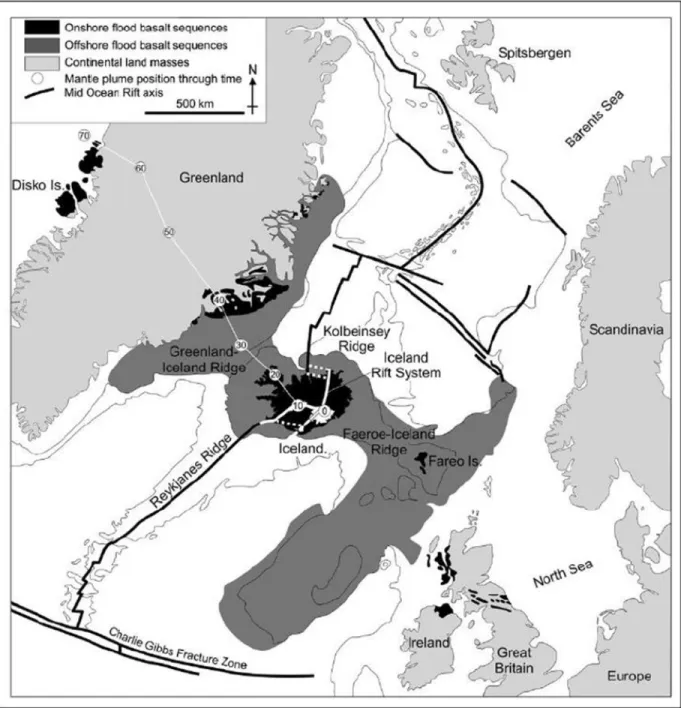
It is the Earth's largest oceanic island, atop one of the Earth's largest oceanic plateaus (Thordarson and Hoskuldsson 2002), a result of voluminous magma production occurring at the junction of a focal point and an actively spreading mid- ocean ridge (Vink 1984; Thordarson and Larsen) 2007; . Bjarnason 2008). If this is indeed the case, a better understanding of Icelandic felsic petrogenesis will explain the origin of the Earth's earliest continental crust (cf.
Significance and Rationale
Cathodoluminescence (CL) images of zircon can reveal a history of closed system, monotonic growth, or a history of open system recycling and rejuvenation (Hanchar and Miller 1993; Corfu et al. 2003). The timing of zircon growth can be determined and the lifetime of magmatic systems can be explored using in situ radiometric dating (Davis et al.
Icelandic Geologic Background
Schmitt and Vazquez 2006; du Bray et al. . 2010; Fohey-Breting et al. 2010) and can provide information on other aspects of the magmatic environment, such as zircon growth temperature (Watson and Harrison 2005; Hafnium isotopes can distinguish mantle contributions to the magma from which the zircon grew (Patchett et al.
Zircon Sampling Scheme
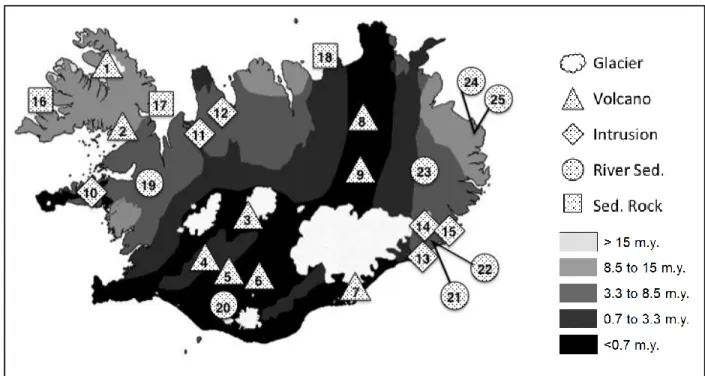
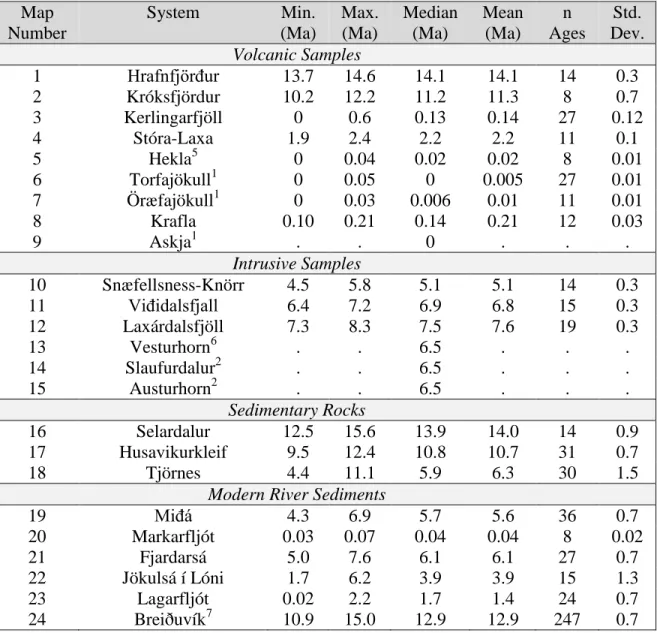
The spatial distribution of zircon-bearing samples is of great importance to this research, as the local tectonic environment in which magmas are generated (and zircon grows) can strongly influence the origin and evolution of the magma body. The temporal distribution of samples containing zircons (old rocks to modern times) is also quite important.
Components of this dissertation
By considering data from the full range of tectonic and temporal conditions in Iceland, I will have an opportunity to critically evaluate this compelling petrogenetic hypothesis while simultaneously exploring my own research questions.
Iceland is not a magmatic analogue for the Hadean Earth: Evidence from the zircon record”
While conducting this study, I am adding important chronological details to the Icelandic geologic record (something that has been very limited in the past). The possibility of comparing Breiðuvík with the Icelandic zircon database resulting from this dissertation was invaluable in making such comparisons and conclusions.
14 CHAPTER 2
Iceland is not a Magmatic Analog for the Hadean: Evidence from the Zircon Record
Abstract
Introduction
Only 2% of Earth's mid-ocean ridge system is subaerially exposed (Wright et al. Iceland's extremely thick crust (average 25 km, reaching 40 km; Bjarnason 2008) provides rare subaerial access to young oceanic crust. Harrison et al. 2008; Hopkins et al. .al. 2008; Harrison and that a better understanding of Icelandic felsic petrogenesis will clarify the origin of Earth's earliest continental crust (cf.
Materials and Methods
- Icelandic samples and mineral separation
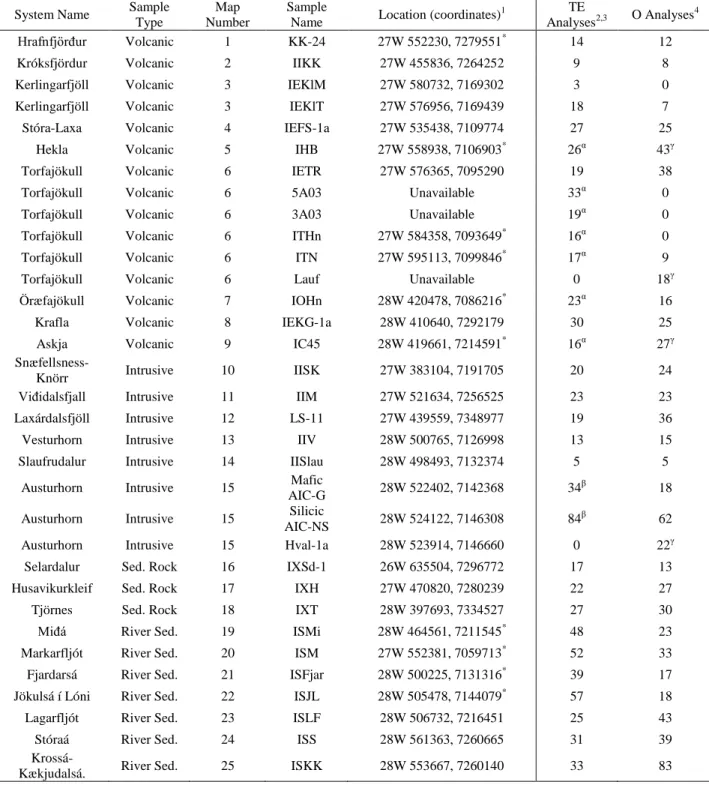
In this paper, we present a greatly expanded study of zircon in Iceland as a basis for comparison with the Hadean record, providing a powerful test of the “Iceland as a Hadean analogue” hypothesis. 1 All coordinates presented in this thesis were measured using the WGS 1984 datum, unless marked with "*" which indicates the Hjorsey 1955 datum.
20 2.2: Analytical Methods
- Data Compilations from Literature
- Treatment of Ti-in-Zircon Data
- Results and Discussion
- Comparing Hadean and Icelandic Zircon Populations
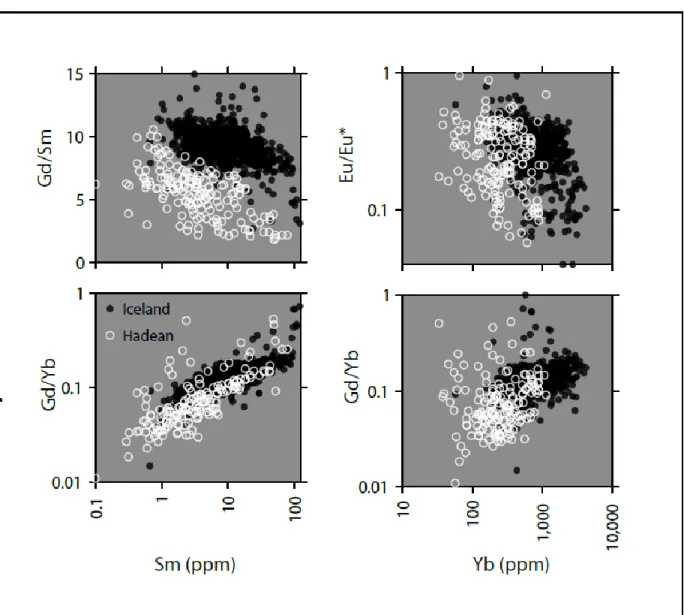
- Comparison of chondrite normalized REE compositions in Hadean (n=167) and Icelandic (n=781) zircons
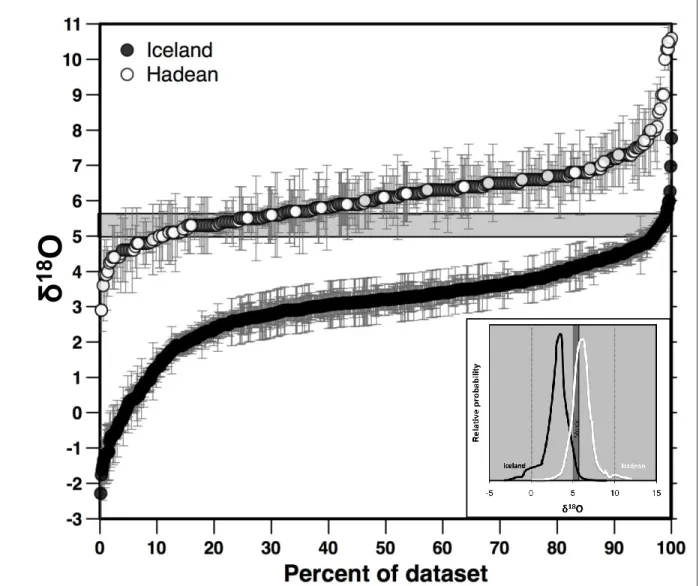
Ninety percent of the analyzes are between +0.2 ‰ and +4.7 ‰ (5th and 95th percentile of the data set, respectively). Although 64% of the Icelandic oxygen dataset overlaps the Hadean, with values ≥2.9‰, the difference in the distribution of values between the two populations is striking.
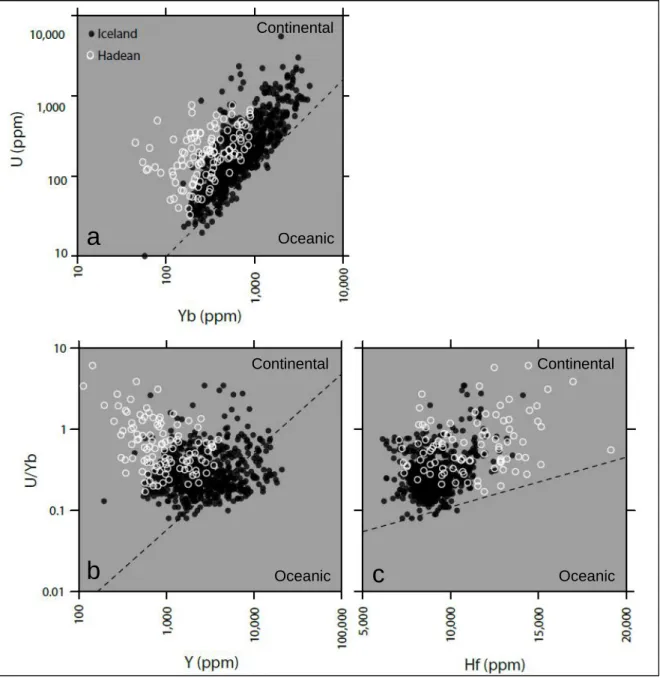
34 3.1.4: Trace Element Discrimination
Hadean and Icelandic Zircon Trace Element Compositions in a Global Context
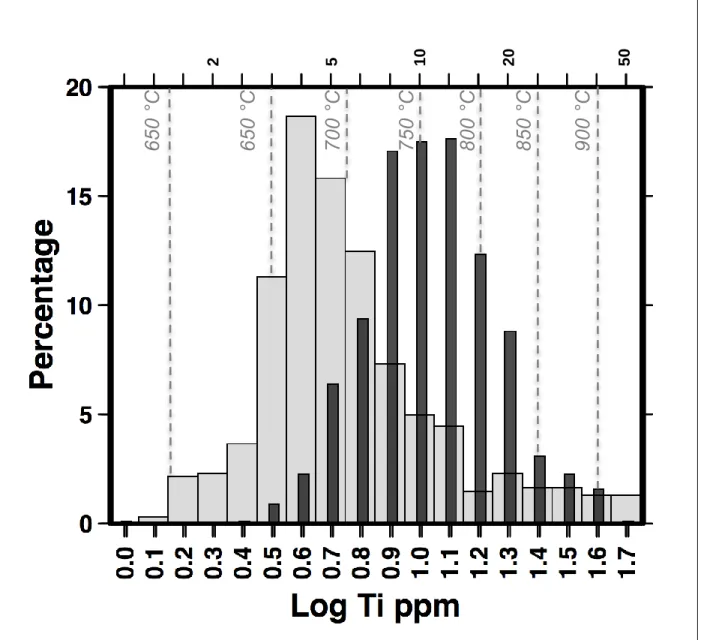
- Titanium
As noted in the previous sections, oxygen isotopes and trace element compositions reveal significant differences between Icelandic and Hadean zircon populations: in particular, Icelandic zircons have much lower δ18O and higher Ti concentrations (suggesting higher crystallization temperatures) and are more strongly enriched in HREE. In the following sections and figures, we compare the Ti concentrations (Fig. 7), and discriminating elemental concentrations and ratios (Gd/Yb, Sm, Yb; Fig. 8 [cf.
MORB
The lower bound of each box represents the 25th percentile and the upper bound represents the 75th percentile (i.e., box represents middle 50% of zircon compositions for each population).
38 3.2.2: Rare Earth Elements (REE)
40 3.2.3: Trace Element Discrimination
Elemental Contrasts: Possible Petrogenetic Implications
It is plausible that the mantle from which the Hadean magmas ultimately emerged was essentially primordial (undepleted). Harrison and appear to reject interpretations that the magmas from which the Hadean zircon grew were products of impact melting ( Darling et al. 2009 ) or partial crystallization of MORB-like basalt ( Coogan and Hinton 2006 ).
Conclusions
This implicitly implies that the compositions of Hadean zircon suggest magmas that were dramatically different from those of modern Iceland: similar to, but perhaps even cooler and wetter than, modern subduction zone magmas (cf. The range of δ18O of Hadean zircon is more compatible with normal mantle and small sedimentary sediments). contributors, similar to Phanerozoic continental and island arc magmas (Harrison 2009).
46 CHAPTER 3
Isotopes through Time: Using Zircon to Add Critical Detail to Iceland’s Silicic Past
Introduction and Background Motivation
The island of Iceland is much larger than seems possible given its ∼18 million year subaerial history and ∼1 cm/year half-spreading rate ( Martin et al. 2011 ). Kemp et al. . 2007), and oxygen isotopes, which reveal evidence of surface contributions to magmas (Valley et al.
Goals and contributions of this work
Zircon-based research, which has been fundamental to studies of magma origin and evolution elsewhere, is lacking in studies of Icelandic geology (see recent work by Carley et al., 2011; Martin et al., 2011; Bindeman et al., 2012). This is especially true for Hf isotopes, which can illuminate contributions from various mantle and crustal materials to magmas (Patchett et al. 1982;.
Approach and Methods
High spatial resolution oxygen isotope analyzes were performed using the CAMECA ims1270 microprobe at the UCLA-NSF facilities (methods closely following Trail et al., 2007; see also Chapter 2). These analyzes were performed at the Radiogenic Isotopes and Geochronology Laboratory at Washington State University using a Thermo-Finnigan MC-ICP-MS following the dissolution and analysis methods described by McDowell et al. in preparation; see also methods in Chapter 4).
53 4. Results
Western Volcanic Zone), Viđidalsfjall (intrusion associated with the extinct Snæfellsness-Skagi rift), and Öræfajökull (active erupted volcano; bottom right): Isotopic compositions extracted from the lower left panel for samples that have a negative correlation between Hf and tone O.
![Figure 2: Isotope compilation plots. [Top Left]: Hafnium and Nd isotope compositions from this study overlain on an Icelandic compilation modified from Peate et al](https://thumb-ap.123doks.com/thumbv2/123dok/10732658.0/64.918.119.806.174.789/isotope-compilation-hafnium-compositions-overlain-icelandic-compilation-modified.webp)
56 5. Discussion
Previous studies of Hf isotopes in Icelandic basalts do not extend below ~11 εHf (Peate et al., 2010 and references therein). Northern Volcanic Zone, on top of the same mantle source, although Breiðuvík has since moved off-rift to its current location (Martin et al. 2011). The degree of heterogeneity that we observe in the εHf record in zircon and that other researchers (e.g. Kempton et al. 2000, Kitagawa et al. 2008, Peate et al. 2010 and many references therein) observe in other isotope systems, are absent from the O isotope record averaged over time.
![Figure 3:Oxygen and Hafnium isotopes through time. [Top]: Oxygen isotopes in zircons vs](https://thumb-ap.123doks.com/thumbv2/123dok/10732658.0/67.918.207.711.103.856/figure-oxygen-hafnium-isotopes-time-oxygen-isotopes-zircons.webp)
61 6. Conclusion
62 CHAPTER 4
Using Detrital Zircon to Resolve the Origin and Longevity of Abundant Silicic Magmatism at Breiðuvík Volcano, East Iceland
Geologic setting
Several Neogene volcanic systems in eastern Iceland are aligned in a north-south direction, with their ages ranging from 4 Ma in the south to 15 Ma in the far north (Martin et al. However, the concepts of central volcano and volcanic systems as proposed by Walker for other Neogene silicic centers may not be applicable to Breiðuvík and vicinity While the volcanic systems described by Walker and colleagues (Walker Gibson and Walker 1963; Carmichael 1964) further south along the East Fjords were mainly formed in divergent tectonic regimes, the Breiðuvík area may well be related to a rift zone and a propagating rift segment as suggested by Martin et al. 2011), not much different from what is observed in the Torfajökull area today.
Methods
- Sampling Approach
- Samples
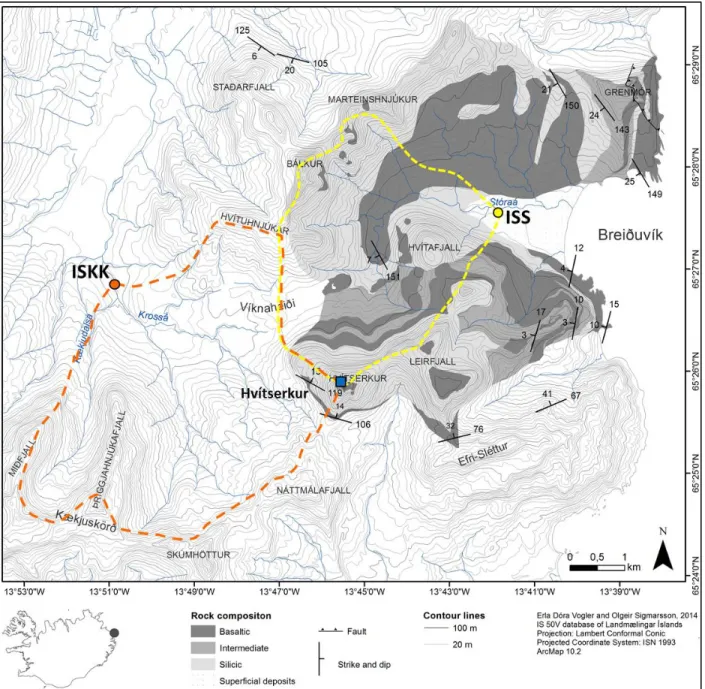
The ISS sample comes from the Stóraá River, a braided stream whose catchment lies entirely within the edges of the Breiðuvík caldera. The sand, consisting mainly of fragments of rhyolitic rocks, was collected from a poorly sorted bank on the steep side of the stream. Middle bottom right]: view down Stóraá River and ISS sampling site (white field); photo taken near the town of Brunkolla (see map).
70 3.2: Sample Preparation
Analytical Methods
71 3.3.1: Oxygen Isotopes
Trace Elements
72 3.3.3: U-Pb geochronology
- Hafnium Isotopes in zircon
- Hafnium isotopes in bulk pumice
- Results
- Zircon Model Ages
- Oxygen Isotopes
- Hafnium Isotopes
- Age Ma
We performed Hf isotope analyzes last in the analytical series because the ~50 µm spot affected most of the analyzable space on grains and often destroyed entire zircons. Following the method of Patchett and Tatsumoto 1981, we eluted Hf at the beginning of the procedure in 1M HCl/0.1M HF. The higher oxygen signature in the bulk rock sample can be explained by low-temperature changes after the eruption of the devitrified ignimbrite.

84 4.5: Trace Elements
Rare Earth Elements (REE)
Ti ppm
89 5. Discussion
The similarities between ISS and ISKK
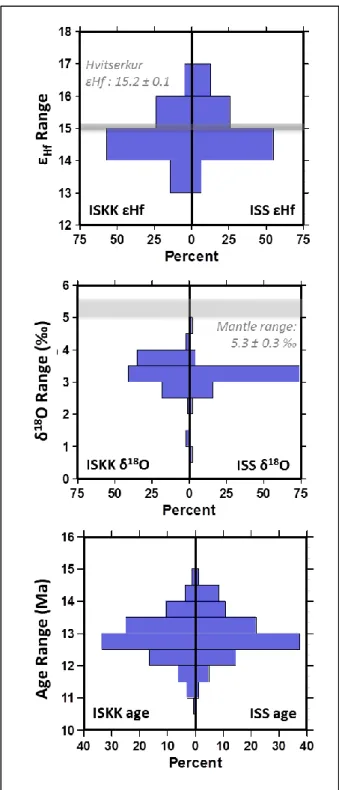
In all cases, the bin width is approximately equal to the average analytical error for each type of analysis: εHf bin width is ~1 ε unit, O and age bin width are ~0.5 ‰ and Ma, respectively). The εHf composition of Hvítserkur pumice, as well as the typical range for mantle zircon composition (Valley et al. 1998;.
91 5.2: Oxygen Isotopes and Partial Melting
Comparing Breiðuvík to the modern central volcanoes Torfajökull and Krafla
- ε Hf comparison
- δ 18 O comparison
All hafnium isotope analyzes from Torfajökull (from two lava samples) fall within the lower 30% of the bulk area of Iceland, with values ranging from ~9 to ~12 εHf. Together, the Krafla and Breiðuvík εHf (excluding the lowest 5% to protect against the effect of outliers) fall within the upper 40% of the greater Icelandic area, unlike the Torfajökull zircon population. The Greater Iceland database includes the values of Breiðuvík, Krafla and Torfajökull; the low end of the Greater Iceland data set does not extend to the Torfajökull distribution because Torfajökull represents the bottom 5% of the data set.
101 5.4: Breiðuvík: A long-lived silicic center
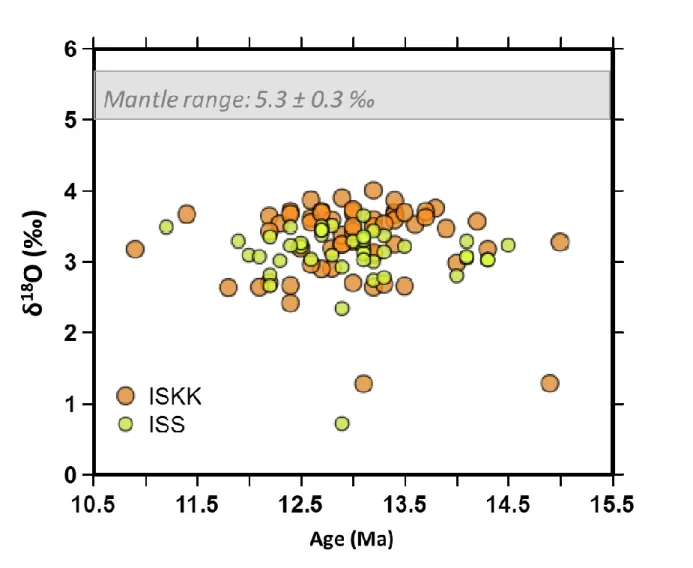
The time window is represented by two standard deviations (1.4 Ma) from the mean (12.9 Ma), which captures 95% of the detrital zircon age span: 2.8 million years. We then replicate our detrital zircon samples and dates by randomly selecting ages and errors from within their respective distributions a realistic number of times (e.g., we measured 83 ages from the ISS sample, so we can select 83 .. age and random errors in our Monte Carlo analysis). While the activity (at least as captured by the zircon record) may not have been very lively in a time window exceeding 1.4 million years (one standard deviation from the mean age), statistical Monte Carlo modeling gives us confidence that the full range of measured ages (even those suggesting a lifespan of > 3 million years) are plausible based on our sample size.
105 Table 3
Implications
- The value of detrital studies
- Great concentrations of silicic material
- Never-before evidenced longevity of an Icelandic central volcano
107 . albeit with apparently different thermal regimes, possibly due to the different distances from the upwelling mantle plume) are crucial for generating large volumes of pebbly material. Limiting the lifespan of Icelandic volcanoes has important implications for better understanding the rhyolitic centers that are active and potentially hazardous today. This finding of the extremely long lifetime of silicic magma-generating activity at Breiðuvík has important implications for better understanding silicic magmatism at central volcanoes in Iceland in general, and perhaps for anticipating long-term magmatism in modern systems.
108 CHAPTER 5
Conclusions
Icelandic felsic petrogenesis; (2) increased variability in Hf isotopes suggests changes in Iceland's mantle source over time, but uniformity of O isotopes indicates neither changes in processes nor influence of climate change on magmatism throughout Iceland's history; (3) Icelandic zircons are quite distinct from Hadean zircons; Iceland is not a suitable analogue for Early Earth; (4) there is extremely little evidence in support of regions of Iceland affecting the ancient crust; (5) zircons reflect tens of thousands of years of activity preceding individual rhyolitic eruptions and suggest a lifetime of a central volcano extending up to three million years in some cases; (6) trace elements in Icelandic zircons are globally unique, forming a compositional category distinct from typical continental and oceanic zircon populations.
APPENDIX A: Oxygen Isotopes
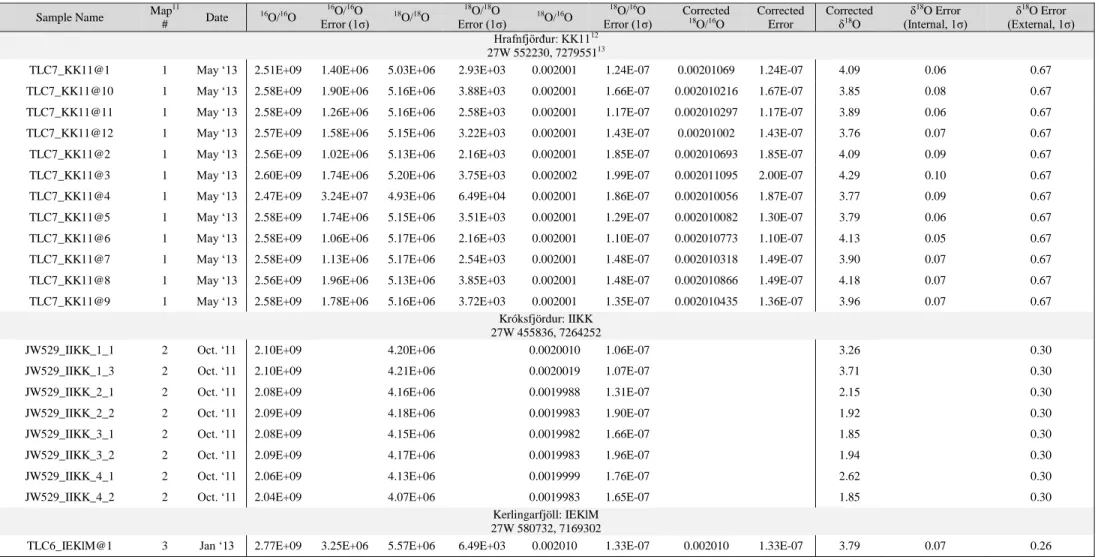
Appendix A.1: Oxygen isotopes in Icelandic zircon UCLA ims1270 in situ measurements UCLA ims1270 in situ measurements. 13All coordinates are UTM WGS 1984 except samples with "*" which indicate Hjorsey 1955 Sample Name Map11. 2012; data collected at Center de Recherches Petrographiques et Geochimiques (Nancy, France) Sample name card.
Appendix A.2: Oxygen Isotopes in Bulk Phases
APPENDIX B: Zircon Trace Element Compositions
Appendix B.2: Zircon Trace Element Concentrations (Atomic Number ≥ 22)