Digital Repository Universitas Jember
Digital Repository Universitas Jember
REVISTA DE GESTÃO SOCIAL E AMBIENTAL
SEARCH ABOUT CURRENT BACK ISSUES PUBLICATION FEE INDEXING & ABSTRACTING
ALTMETRICS CITATIONS (GOOGLE ACADEMICS) H5 INDEX (GOOGLE METRICS) QUALIS CAPES RANKING SYSTEM EDITORIAL POLICIES TEMPLATE
HOME ARCHIVES Vol. 17 No. 7 (2023)
Vol. 17 No. 7 (2023)
PUBLISHED: 2023-07-18
/ /
The Freedom to Sue in Vietnam’s Civil Procedure
ARTIGOS
MAKE A SUBMISSION
SCIMAGO JOURNAL RANKING
LANGUAGE
English
Register Login
Vol. 17 No. 7 (2023) | Revista de Gestão Social e Ambiental https://rgsa.emnuvens.com.br/rgsa/issue/view/67
Digital Repository Universitas Jember
Digital Repository Universitas Jember
Analyzing the Relationship Between Public Debt and Poverty Reduction in Developing Countries: An Empirical Study
Organic Milk and Sustainable Development: Evidence from Galicia/Spain
PDF PDF (PORTUGUÊS (BRASIL))
Preferences of Food Consumption - Local Food vs Organic Food
Personal Profiles and Stressors of Teacher Education Students: Implications for Stress Management Programs
The Characteristics of the Population Affected by Cancer Diseases in the Middle Euphrates Governorates for the Year 2022
Nguyen Vinh Hung, Tran Cong Thinh, Nguyen Thi Khanh Ly e03652
Sattoriy Fayzullokh , Sanakulova Barnogul, Abdikarimova Dinara, Kayumov Sardor e03257
Carlos Cândido da Silva Cyrne , Júlia Elisabete Barden, Fernanda Cristina Wiebusch Sindelar, Ibán Vázquez González, Rafaela Danieli
e03289
Ritu Pandey, M Rajeswari, R Magesh e03642
Celiaflor R Ferrer e03581
Português (Brasil)
CURRENT ISSUE
KEYWORDS
Management
EnvironmentPerformance
COVID-19
Emotional Intelligence Public Policies
Brazil
Circular Economy
Innovation
Pandemic
Recycling Blockchain
Vietnam
Remote Sensing
Cooperatives Risk
2030 Agenda Mangrove
sustainability
Gestión
Production
Estuaries
Vol. 17 No. 7 (2023) | Revista de Gestão Social e Ambiental https://rgsa.emnuvens.com.br/rgsa/issue/view/67
Digital Repository Universitas Jember
Digital Repository Universitas Jember
Social Environment and its Effects on Domestic Violence
Effect of Knowledge Sharing Barriers on the Quality of Private University Education Performance: An Analytical Study of Faculty Members in Private Universities in the Middle Euphrates Region
Extension, Popular Education and Agroecology in Family Agriculture:
Experience Report of Students and Graduate Teachers
PDF PDF (PORTUGUÊS (BRASIL))
Ethnos with Turkish Ancestry in the Toponymic Background of the Territory of Azerbaijan
Rahim M. Al -abdali, Sahar A Al-Sharifi, Buthaina Rahim e03530
Huda S Abdel Wahhab, Safaa M Almudhafar, Ahmed S Alalaq, B A Almayahi e03536
Beidaa Naser Amana, Firas Adnan Abbas Al-Tabtabae e03537
Vilmar Alves Pereira , Marisete dos Santos Brandalize, Simone Grosko, Irene Carniatto de Oliveira, Jaime José Zitkoski, Fábio Corbari, Wilson João Zonin
e03479
Natig Gubad Babayev , Zaur Tahir Imrani, Aynur Ramazan Zakirova e03512
Vol. 17 No. 7 (2023) | Revista de Gestão Social e Ambiental https://rgsa.emnuvens.com.br/rgsa/issue/view/67
Digital Repository Universitas Jember
Digital Repository Universitas Jember
Rationality of Developing the Protected Mangrove Forests as Ecotourism
Quality Study of Potato Chips for Sale in the Uruguayan Market
PDF PDF
Strategic Entrepreneurship Under the Chaos Theory
Water: A Fundamental Resource for Ensuring Sustainability
Stakeholders Mapping in Election Management in West Nusa Tenggara Province
The Role of Madrasa Superintendents in Improving the Education Quality of Baubau 1 Public Middle School and Al-Syaikh Abdul Wahid Madrasah
Suadi Zainal, Iromi Ilham, Nirzalin, Fakhrurrazi, Rizki Yunanda e03591
Nadia Segura, Maria Noel Villar e03216
Alaa Abdulhussein Kzar , Alyaa Jassim Mohammed e03864
Márcia Sostmeyer Jung, José Antonio Gonzalez da Silva, Juliana Maria Fachinetto, Ivan Ricardo Carvalho, Osório Antônio Lucchese, Natiane Carolina Ferrari Basso, Camila Morizzo Copetti, Larissa Greco da Silva
e03661
Agus e03618
Vol. 17 No. 7 (2023) | Revista de Gestão Social e Ambiental https://rgsa.emnuvens.com.br/rgsa/issue/view/67
Digital Repository Universitas Jember
Digital Repository Universitas Jember
Tsanawiyah, Baubau City, Southeast Sulawesi
The Impact of Strategic Thinking on Organizational Excellence an Analytical Model for the National Security Advisory
Social Development Strategies of English as Second Language Learners for International Management
New Theoretical Perceptions of the Control of State Powers in Building the Rule- of-Law State
Thriving Amidst Change: BEEd Student's Coping Strategies and Insights in the Modular Distance Learning Modality
Maruf, Salim Basalamah, Baharuddin Semmaila , Andi Bunyamin e03596
Muhammad Yahya Shamkhi, Khalid Mahdi Saleh e03624
Samah Abduljawad e03519
Nguyen Quoc Suu, Bui Huy Tung e03704
Regie Mino Bangoy , Virgie Pama Tan e03774
Vol. 17 No. 7 (2023) | Revista de Gestão Social e Ambiental https://rgsa.emnuvens.com.br/rgsa/issue/view/67
Digital Repository Universitas Jember
Digital Repository Universitas Jember
Cigarretes, Betel Leaves, and Areca Nuts in the Activities of the Tolotang Community of Benteng Indonesia
The Impact of Teacher Evaluation on Professional Development and Student Achievement
Exploring the E-learning Supporting Systems for Students with Special Needs
Measurement of Water Matriial Potential in the Soil Through Instrumented Tensiometers with Pressure Sensors and Puncture Device
PDF PDF (PORTUGUÊS (BRASIL))
Facing Global Challenges and a New Post Pandemi Era in Indonesia: Curriculum Changes and Innovations in the Bachelor of Islamic Education Management Program
Andi Muh Rusdi Maidin , Rajamemang, Wahyudi Putera , Wahyuti, Muhammad Sabir, Andi Tenri Ulmi , Saripuddin
e03657
Suad Abdalkareem Alwaely, Mohamed Elsayd El-Zeiny , Hatem Alqudah, Emad Farouq Mohammad Alamarnih , Osama KamalEldin Ibrahim Salman , Mona Halim , Mohamad Ahmad Saleem Khasawneh
e03484
Abdullah Saleh Alanazi , Abdullah Ahmed Almulla , Mohamad Ahmad Saleem Khasawneh e03917
Tadeu Miranda de Queiroz, Rigoberto Moreira de Matos, Santino Seabra Júnior, Carlos Luiz Vieira, Minéia Cappellari Fagundes
e03324
Vol. 17 No. 7 (2023) | Revista de Gestão Social e Ambiental https://rgsa.emnuvens.com.br/rgsa/issue/view/67
Digital Repository Universitas Jember
Digital Repository Universitas Jember
Model of Institutional Strengthening Based on Management Function and Sharia Compliance: Exploration of Islamic Cooperative Institutions in Jember Regency, Indonesia
The Sustainable Benefits of Construction and the Perception of Cement Workers
PDF PDF (PORTUGUÊS (BRASIL))
Administrative Liability Arising from Damage Caused by a Public Road Facility:
A Comparative Study
A Study on the Growth and Determinants of Agricultural Production in Mizoram
Irawan, Hary Priatna, Neng Gustini, Heny Mulyani e03644
Novi Puspitasari, Dewi Prihatini, Ana Mufidah, Imam Suroso, Abdul Muhsyi e03583
Marcus Vinícius Peixoto Carvalho e Lucena, Janaque Nunes Passinho, Sandra Cristina Serra Theodosio, Paulo Leonardo Santos Gouveia, Fernanda Costa Rosa, Wolia Costa Gomes
e03985
Ahmed Shakeeb Abdalla Al-Hashmi , Abu Bakr Ahmad Othman Al-Nuaimi e03986
Lalengkima, Konthoujam Gyanendra Singh, Khawlhring Angela Lalhmingsangi e03779
Vol. 17 No. 7 (2023) | Revista de Gestão Social e Ambiental https://rgsa.emnuvens.com.br/rgsa/issue/view/67
Digital Repository Universitas Jember
Digital Repository Universitas Jember
REVISTA DE GESTÃO SOCIAL E AMBIENTAL
SEARCH ABOUT CURRENT BACK ISSUES PUBLICATION FEE INDEXING & ABSTRACTING
ALTMETRICS CITATIONS (GOOGLE ACADEMICS) H5 INDEX (GOOGLE METRICS) QUALIS CAPES RANKING SYSTEM EDITORIAL POLICIES TEMPLATE
HOME Editorial Team
Editorial Team
Editor-in-Chief
Lattes - Orcid
/ MAKE A SUBMISSION
SCIMAGO JOURNAL RANKING
LANGUAGE
English
Register Login
Editorial Team | Revista de Gestão Social e Ambiental https://rgsa.emnuvens.com.br/rgsa/about/editorialTeam
Digital Repository Universitas Jember
Digital Repository Universitas Jember
Christian Luiz da Silva, Universidade Tecnológica Federal do Paraná - UTFPR, Curitiba, Brazil
Scientific Committee
Anete Alberton, Universidade do Vale do Itajaí - UNIVALI, Santa Catarina, Brazil
Carlos Alberto Cioce Sampaio, Fundação Universidade Regional de Blumenau - FURB, Santa Catarina, Brazil
Celso Funcia Lemme, Instituto COPPEAD de Administração, da Universidade Federal do Rio de Janeiro - COPPEAD/UFRJ, Rio de Janeiro, Brazil
Charbel José Chiappetta Jabbour, Faculdade de Economia Administração e Contabilidade Ribeirão Preto - FEA, São Paulo, Brazil
Francisca Farache, Brighton Business School, United Kingdow
Francisco Correia de Oliveira, Universidade de Fortaleza - UNIFO, Fortaleza, Brazil
Hans Michael van Bellen, Universidade Federal de Santa Catarina - UFSC, Florianópolis, Brazil
Isabel Soares, University of Porto, Porto, Portugal
Isak Kruglianskas, Universidade de São Paulo - FEA/USP, São Paulo, Brazil José Carlos Barbieri, Fundação Getulio Vargas - FGV/EAESP, São Paulo, Brazil
Português (Brasil)
CURRENT ISSUE
KEYWORDS
Sustainability
Management
Environment Performance
COVID-19
Public Policies
Brazil
Innovation
Pandemic
Recycling Blockchain
Customer Satisfaction Family Farming
Vietnam
CooperativesRisk 2030 Agenda Catadores
Mapping
Gestión
Legal Protection
Editorial Team | Revista de Gestão Social e Ambiental https://rgsa.emnuvens.com.br/rgsa/about/editorialTeam
Digital Repository Universitas Jember
Digital Repository Universitas Jember
José Célio Silveira Andrade, Universidade Federal da Bahia - UFBA, Salvador, Brazil Luiz Alberto Nascimento Campos Filho, Faculdades Ibmec Rio, Rio de Janeiro, Brazil
Luis Felipe Nascimento, Universidade Federal do Rio Grande - UFRGS, Rio Grande do Sul, Brazil
Marcos Cohen, Pontifícia Universidade Católica do Rio de Janeiro - PUC Rio, Rio de Janeiro, Brazil
Maria Cecilia Coutinho de Arruda, Fundação Getulio Vargas - EAESP/FGV, São Paulo, Brazil
Maria Gracinda Carvalho Teixeira, Universidade Federal Rural do Rio de Janeiro - UFRRJ, Rio de Janeiro, Brazil
Miguel Angel Gardetti, Center for Study of Corporate Sustainability - CSC, Buenos Aires, Argentina
Mônica Cavalcanti Sá de Abreu, Universidade Federal do Ceará - UFC, Ceará, Brazil Mozar José de Brito, Universidade Federal de Lavras - UFLA, Minas Gerais, Brazil Raquel da Silva Pereira, Universidade Municipal de São Caetano do Sul - USCS, Brazil
Roberto Patrus Mundim Pena, Pontifícia Universidade Católica de Minas Gerais - PUC, Minas Gerais, Brazil
Sema Yılmaz Genç, Yıldız Technical University, Istambul, Turkey
Editorial Team | Revista de Gestão Social e Ambiental https://rgsa.emnuvens.com.br/rgsa/about/editorialTeam
Digital Repository Universitas Jember
Digital Repository Universitas Jember
Editorial Board
Eliana Andréa Severo, Universidade Federal de Pernambuco - UFPE, Recife, Brazil Isak Kruglianskas, Universidade de São Paulo - FEA/USP, São Paulo, Brazil
Jacques Demajorovic, Centro Universitário FEI, São Paulo, Brazil
José Antonio Puppim de Oliveira, Fundação Getulio Vargas (FGV EAESP e FGV EBAPE), Brazil
José Carlos Barbieri, Fundação Getulio Vargas - EAESP/FGV, São Paulo, Brazil José Célio Silveira Andrade, Universidade Federal da Bahia - UFBA, Salvador, Brazil
Lilian Soares Outtes Wanderley, Universidade Federal de Pernambuco - UFPE, Recife, Brazil
Luis Felipe Nascimento, Universidade Federal do Rio Grande - UFRGS, Rio Grande do Sul, Brazil.
Maria Tereza Saraiva de Souza, Centro Universitário FEI, São Paulo, Brazil.
Environmental and Social Management Journal (Revista de Gestão Social e Ambiental e-ISSN: 1981-982X)
Editorial Team | Revista de Gestão Social e Ambiental https://rgsa.emnuvens.com.br/rgsa/about/editorialTeam
Digital Repository Universitas Jember
Digital Repository Universitas Jember
This work is licensed under a Creative Commons Attribution 4.0 International License
Editorial Team | Revista de Gestão Social e Ambiental https://rgsa.emnuvens.com.br/rgsa/about/editorialTeam
Digital Repository Universitas Jember
Digital Repository Universitas Jember
Rev. Gest. Soc. Ambient. | Miami | v.17.n.7 | p.1-16 | e03583 | 2023.
RGSA – Revista de Gestão Social e Ambiental ISSN: 1981-982X
Data de submissão: 24/04/2023 Data de aceite: 21/07/2023
DOI: https://doi.org/10.24857/rgsa.v17n7-026 Organização: Comitê Científico Interinstitucional Editora Chefe: Christian Luiz da Silva
Avaliação: Double Blind Review pelo SEER/OJS
MODEL OF INSTITUTIONAL STRENGTHENING BASED ON MANAGEMENT FUNCTION AND SHARIA COMPLIANCE: EXPLORATION OF ISLAMIC
COOPERATIVE INSTITUTIONS IN JEMBER REGENCY, INDONESIA
Novi Puspitasari 1 Dewi Prihatini 2 Imam Suroso 3 Ana Mufidah 4 Abdul Muhsyi 5
ABSTRACT
Purpose: Sharia cooperative practices in Jember Regency, Indonesia generally do not perform well. This study explores the Islamic Cooperative Institution (ICI) practices based on management functions, the role of stakeholders, and sharia compliance at ICI in the Jember Regency.
Method: This research uses a qualitative method with a case study approach. Data mining using in-depth interviews with seven informants managing the ICI who are still active and an informant from the Cooperatives and MSMEs Office in Jember Regency
Findings: The results show that the ICI in Jember Regency is still not operational using the sharia concept because there are weaknesses and limitations in the application of sharia rules, especially knowledge and understanding of the concept of Islamic finance. Therefore, the proposed study model focuses on strengthening institutions so that ICI can maintain its sustainability. The proposed model also links the involvement of the government and universities.
Originality: This study proposes a model for strengthening sharia cooperative institutions that relevant parties can adopt in developing suitable sharia practices in various regions in Indonesia and even the world.
Implication: Increasing the role of the government in providing training to ICI administrators or managers to improve the implementation of management functions so that ICIs have a good performance.
Keywords: Sharia Cooperatives, Management Functions, Sharia Compliance.
MODELO DE FORTALECIMENTO INSTITUCIONAL COM BASE NA FUNÇÃO DE GESTÃO E CONFORMIDADE COM A SHARIA: EXPLORAÇÃO DE INSTITUIÇÕES DE COOPERAÇÃO
ISLÂMICA EM JEMBER REGENCY, INDONÉSIA RESUMO
Objetivo: As práticas cooperativas da Sharia na Regência de Jember, Indonésia, geralmente não têm um bom desempenho. Este estudo explora as práticas da Instituição Cooperativa Islâmica (ICI) com base em funções de
1 Management Department, Universitas Jember, Jalan Kalimantan, Jember, Indonesia.
E-mail: [email protected] Orcid: https://orcid.org/0000-0003-1412-199X
2 Management Department, Universitas Jember, Jalan Kalimantan, Jember, Indonesia.
E-mail: [email protected] Orcid: https://orcid.org/0000-0002-5689-4416
3 Management Department, Universitas Jember, Jalan Kalimantan, Jember, Indonesia.
E-mail: [email protected] Orcid: https://orcid.org/0000-0002-7300-9319
4 Management Department, Universitas Jember, Jalan Kalimantan, Jember, Indonesia.
E-mail: [email protected] Orcid: https://orcid.org/0000-0002-7644-8392
5 Management Department, Universitas Jember, Jalan Kalimantan, Jember, Indonesia.
E-mail: [email protected] Orcid: https://orcid.org/0000-0002-2640-1203
Digital Repository Universitas Jember
Digital Repository Universitas Jember
Model of Institutional Strengthening Based on Management Function and Sharia Compliance: Exploration of Islamic Cooperative Institutions in Jember Regency, Indonesia
___________________________________________________________________________
Rev. Gest. Soc. Ambient. | Miami | v.17.n.7 | p.1-16 | e03583 | 2023.
gestão, o papel das partes interessadas e a conformidade da sharia na Regência de Jember.
Método: Esta pesquisa usa um método qualitativo com uma abordagem de estudo de caso. Extração de dados através de entrevistas aprofundadas com sete informantes que gerem o ICI que ainda estão ativos e um informante do Gabinete de Cooperativas e MPMEs em Jember Regency
Constatações: Os resultados mostram que o ICI na Regência de Jember ainda não está operacional usando o conceito sharia porque há fraquezas e limitações na aplicação das regras sharia, especialmente conhecimento e compreensão do conceito de finanças islâmicas. Portanto, o modelo de estudo proposto se concentra no fortalecimento das instituições para que o ICI possa manter sua sustentabilidade. O modelo proposto também vincula o envolvimento do governo e das universidades.
Originalidade: Este estudo propõe um modelo para fortalecer as instituições cooperativas da sharia que as partes relevantes podem adotar no desenvolvimento de práticas adequadas da sharia em várias regiões na Indonésia e até mesmo no mundo.
Implicação: Aumentar o papel do governo no fornecimento de formação aos administradores ou gestores de ICI para melhorar a implementação de funções de gestão de modo que os ICI tenham um bom desempenho.
Palavras-chave: Cooperativas da Sharia, Funções de Gerenciamento, Conformidade com a Sharia.
RGSA adota a Licença de Atribuição CC BY do Creative Commons (https://creativecommons.org/licenses/by/4.0/).
1 INTRODUCTION
The existence of cooperatives as Sokoguru of the economy in Indonesia is guaranteed by the 1945 Constitution article 33. The role of cooperatives as economic institutions aimed at the community’s welfare has been widely exemplified by cooperatives in various developed countries such as the United States, where cooperatives provide 80% of electricity availability in rural areas. Another success story is shown by dairy farmer cooperatives in Australia and New Zealand that can supply 75% of the world's total fresh milk needs. However, in Indonesia, the performance of cooperatives has yet to show signs of significant improvement, as expected.
Various fundamental problems are still faced by cooperatives, such as the low quality of human resources, the amount of capital owned, managerial abilities, and awareness of cooperative members (Tirto, 2019). Information about cooperative failures and irregularities committed by cooperative administrators has also reduced the community's interest in becoming cooperative members. Because of this lack of understanding, the form of a sole proprietorship or company is more widely chosen even though this form of business requires more outstanding capital. On the other hand, the need for cooperative capital can be pursued jointly by all cooperative members so that the strength of the cooperative lies in the participation of its members both as cooperative owners and as consumers of the products produced by the cooperative (dual identity). For that, the cooperative must reform itself, abandoning the properties of the cooperative as a cooperative of management to become a member cooperative in the true sense of the word. Thus, the cooperative must plan suitable programs/activities related to the members’ needs.
Indonesia, which adopts a dual economic system, which is showed by the practicing of Islamic banking in Indonesia has been running for 30 years (Puspitasari, et al., 2023) has committed to cooperative practices using Islamic concepts. Islamic beliefs, traditions and values represent a comprehensive dealing with the environment, which outlines the importance
Digital Repository Universitas Jember
Digital Repository Universitas Jember
Model of Institutional Strengthening Based on Management Function and Sharia Compliance: Exploration of Islamic Cooperative Institutions in Jember Regency, Indonesia
___________________________________________________________________________
Rev. Gest. Soc. Ambient. | Miami | v.17.n.7 | p.1-16 | e03583 | 2023.
of environmental protection and the preservation of natural resources (Katterbauer et al., 2022).
This is very reasonable because Indonesia has an Islamic majority population with a proportion of 87%. Beliefs, especially religion, greatly influence the behavior and life of their adherents.
As a collection of individuals, the company cannot be separated from religious influences.
Companies that declare themselves as companies that use Islamic rules must act and comply with all Islamic laws.
Shariah enterprise theory (SET) states that companies have vertical and horizontal responsibilities (Triyuwono, 2015). Islamic rules are implemented vertically on the company's responsibility, namely accountability to God, who owns the universe. This form of responsibility is realized by the company’s compliance and submission to Islamic principles.
This requires Muslims to fulfil their promises and obligations to both God and man (Katterbauer et al., 2023). This is in line with Islamic Theory which argues that religion will lead people to behave well. Religion will influence people's beliefs, values, behaviors, and lifestyles down to how they conduct business transactions with others. Islam emphasizes that humans must have a good relationship with their God and must foster good relations with other humans, as well as with their environment (Hamidu et al., 2015), which is following the concept of horizontal responsibility in SET that companies also have responsiba ility to fellow humans and nature (Triyuwono, 2015).
The existence of sharia cooperatives in Indonesia began with the emergence of BMT (Baitul Maal wat Tamwil) in 1992. BMT is a sharia-based financial institution that operates like a bank. There are several legal statuses of BMT, namely BMT incorporated as a cooperative, foundation, and Non-Governmental Group (KSM). BMT included as a collective must comply with the Cooperative Law and the Decree of the State Minister of KUKM Number 91/Kep/M.KUKM/IX/2004 to carry out its business activities by sharia principles. BMT is classified as a Sharia Financial Services Cooperative (KJKS) which the Ministry of KUKM supervises. Based on the Regulation of the Minister of KUKM RI Number 16/Per/M.KUKM/IX/2015 concerning the Implementation of Savings and Loans and Sharia Financing Business Activities by Cooperatives, KJKS is better known as the Sharia Savings and Loans and Financing Cooperatives (Islamic Cooperative Institution/ICI). ICI is a cooperative whose business activities include deposits, loans, and financing by sharia principles, including managing zakat, infaq/alms, and waqf. The involvement of ICI in building the national economy is significant to help the poor (Wulandari et al., 2021). However, the provision of access and services to poor households can threaten the sustainability of ICI if it is not managed correctly (Purwanto et al., 2020).
The ICI establishment program in Jember Regency began in 2016 and there were around 80 ICI formed then. However, from the results of field studies that have been carried out, the number of ICI that still exists today is approximately only 10 percent. This shows that the existence of ICI is still low, which means there are weaknesses in its management. These weaknesses can come from both internal and external ICI. The non-operation of management functions can cause management weaknesses of the internal KSPSS. Meanwhile, externally sourced defects can be caused by external stakeholders.
Previous investigations that examined ICI have been carried out on several topics. These research are published in both domestic and international journals. However, study published in international journals is almost all carried out by Indonesian researchers and uses BMT objects in Indonesia, where BMT can be classified as a form of sharia cooperative by the Regulation of the Minister of KUKM RI Number 16/Per/M.KUKM/IX/2015. Most research on ICI /BMT by Indonesian researchers published in international journals is normal because Indonesia is a Muslim country with high ICI /BMT practices. Based on researchers' searches from 40 articles published on Google Scholar and Emerald, research on ICI or BMT is divided into 13 themes, namely financing, the role of the Sharia Supervisory Board, governance in
Digital Repository Universitas Jember
Digital Repository Universitas Jember
Model of Institutional Strengthening Based on Management Function and Sharia Compliance: Exploration of Islamic Cooperative Institutions in Jember Regency, Indonesia
___________________________________________________________________________
Rev. Gest. Soc. Ambient. | Miami | v.17.n.7 | p.1-16 | e03583 | 2023.
sharia cooperatives, studies on ICI strategies, productive waqf management, implementation of Sharia Compliance, the part of financial technology, commitment and trust in ICI/BMT members, community behavior in participating as members of ICI /BMT, the influence of religiosity on the decision to become a member, risks, the role of ICI in reducing poverty, and the financial performance of ICI . The most discussed theme of the 13 pieces is a theme related to financing at ICI or BMT which is carried out by Bonita and Anwar, 2018), (Fadilah, 2022), (Nugroho et al., 2020), (Khaerul, 2021), (Fadilah, 2022), (Suhartono & Tjahjono, 2021), (Imron et al., 2020), (Lisa, 2016), (Wulandari et al., 2016), (Wardiwiyono, 2012), (Wulandari &
Kassim, 2016), (Nasir & Abdullah(Imron et al., 2020), (Imron et al., 2020), (Wulandari et al., 2016), (Wulandari et al., 2016), (Wardiwiyono, 2012).
These previous studies generally researched one research object, especially studies published in Indonesian domestic journals. Previous studies that used objects in athingsare still limited. In addition, the discussion of prior studies on the role of stakeholders and sharia compliance still limited on ICI practice, theoretical studies, and previous research results. This study aims to explore ICI practice based on management functions, the role of stakeholders, and sharia compliance in ICI in Jember Regency. The result of this research is a proposed model of institutional strengthening of ICI which is expected to be applied in various regions in Indonesia. This research contributes to science by adding empirical evidence of the application of SET, Islamic Theory, and Institutional Theory. The contribution of this study practice is to provide guidelines in an organization for strengthening the management of ICI based on sharia management and compliance functions.
2 THEORETICAL FRAMEWORK
2.1 Sharia Enterprise Theory
Sharia Enterprise Theory (SET) in this study is used as the main supporting theory in sharia compliance which places Allah SWT as the highest stakeholder for all social and economic activities carried out. The placement of Allah as the highest stakeholder will increase the awareness of all parties to continue to be mandated in carrying out business with the sharia system. This theory was developed and modified from enterprise theory so that it is a company theory that has been internalized with Godhead values (Meutia, 2010). The principle of sharia cooperatives is more appropriate to use SET (Harahap, 2016) because it covers social aspects and is oriented towards the interests of stakeholders rather than stockholders so that it matches the institutional characteristics of sharia cooperatives including the Sharia Savings and Loans and Financing Cooperatives (ICI ).
The concept of SET is God as the Creator and Sole Owner of all the resources in this world. In such resources is attached a responsibility in the use, manner and goals set. The basis of understanding of the concept of SET is the existence of other people's rights in the property we have so that this concept will encourage people to create true justice and welfare for all humans and the natural environment. Thus, the SET concept focuses on benefits for shareholders (company owners), stakeholders, the community, and the environment. In principle, the main form of accountability in the SET is to God (vertical accountability), while the elaboration of accountability to humans and the natural environment is called horizontal accountability. The essential success in business is the achievement of well-being which includes happiness (spiritual) and prosperity (material) at the level of individuals and society (Triyuwono, 2015).
Digital Repository Universitas Jember
Digital Repository Universitas Jember
Model of Institutional Strengthening Based on Management Function and Sharia Compliance: Exploration of Islamic Cooperative Institutions in Jember Regency, Indonesia
___________________________________________________________________________
Rev. Gest. Soc. Ambient. | Miami | v.17.n.7 | p.1-16 | e03583 | 2023.
2.2 Islamic Theory
Islamic Theory this states that religion will basically lead people to behave well.
Similarly, religion will affect people's beliefs, values, behaviors, and lifestyles to how they conduct business transactions with others. Islam emphasizes that humans must not only have a good relationship with their God but must also foster good relations with other humans and with their environment (Hamidu et al., 2015). In this regard, activities in the organization including governance in the sharia view will run based on taqwa, which is driven by the desire to do the best before the Creator.
2.3 Institutional Theory
Institutional (institutional) theory is a theory that addresses how organizational establishments and changes are based more on functional considerations, symbolic actions and external influences compared to previously assumed theories (Meyer and Rowan, 1977). As institutional theory developed, it moved closer to behavioral theory. Discussions from various perspectives have been initiated by researchers who note that the process of organizational change is determined by behavioral theory and institutional context (Wezel and Saka- Helmhout, 2006).
Thornton (1995) says some of the discussions in institutional theory concern institutional logic, which can be seen as a source of managerial decision-making rules.
Institutional theory introduces a unique approach regarding the study of social, economic, and political dynamics (DiMaggio & Powell, 1983). Every institution both formal and informal will form the rules of the game in society (North, 1991). New institutional insights are built on traditional sociological theories (DiMaggio & Powell, 1983); Scott, 1995). This new insight emphasizes the role of the institutional context of operations that are considered to shape the company and the behavior of entrepreneurs (Scott, 1995).
A well-run institutional structure will reduce transaction costs, uncertainty, and risks for business actors. Conversely, the presence of gaps in institutional structures can create space for arbitrary behavior. This can lead to the emergence of corruption and objective behavior of entrepreneurs (Puffer, McCarthy, & Boisot, 2010; Smallbone & Welter, 2001). In addition, another consequence of institutional constraints is the strengthening of informal relations, such as local networks (Khanna & Palepu, 2010) which triggers many new business activities that are not legally recognized (Klapper et al., 2006).
2.4 Cooperative Management
Cooperative management is essentially the application of management science in the operational implementation of cooperative business activities, where people who are authorized and responsible for managing cooperatives carry out management functions starting from the process of planning, organizing, and controlling resources owned by cooperatives to achieve cooperative goals, namely improving welfare based on cooperative values and principles. As we know, the International Co-operative Alliance (ICA) in 1995 defined cooperatives as, "...
autonomous associations of self-declared people join voluntarily to meet common economic, social and cultural needs and aspirations through jointly owned and democratically controlled enterprises" (Azmah et al, 2008). A cooperative company is one unique form of social institution that promotes and improves the welfare of all their poor members. It differs from a company owned by traditional shareholders, or a company owned by an investor. It is also different from the corporate ones that are not for profit or non-profit entities. According to Tim Mazzarol (2009), there are five key principles that define cooperatives.
Digital Repository Universitas Jember
Digital Repository Universitas Jember
Model of Institutional Strengthening Based on Management Function and Sharia Compliance: Exploration of Islamic Cooperative Institutions in Jember Regency, Indonesia
___________________________________________________________________________
Rev. Gest. Soc. Ambient. | Miami | v.17.n.7 | p.1-16 | e03583 | 2023.
1. It must be a voluntary formation of members, as opposed to a communist collective or a government-imposed organization.
2. It must be governed by democratic principles in which the "one member one vote"1 rule exists. It is compared to shareholders of owned companies in which voting rights are determined by the size of shareholding.
3. It must be independent of government control and owned only by its members.
4. It can be formed by individuals or organizations (e.g., other businesses).
5. Existing business activities are primarily aimed at fulfilling the interests of its own members. It cannot be used to benefit the wider community for charitable reasons or political or religious purposes.
One type of cooperative business that is in great demand by cooperative members is a business in the field of savings and loans. With the increasing public awareness related to the usury law, savings and loan cooperatives have also transformed into Sharia Savings and Loans Cooperatives (ICI ) which are regulated in the Regulation of the Minister of KUKM RI Number 16/Per/M.KUKM/IX/2015 concerning the Implementation of Savings and Loans Business Activities and Sharia Financing by Cooperatives. Sharia Savings and Loans and Financing Cooperatives (ICI ) are cooperatives whose operational systems use sharia principles using a profit sharing concept that is different from the concept of an interest system as applied to conventional savings and loan cooperatives (Fatah et al., 2021); (Hidayat Farid, 2016).
3 METHODOLOGY
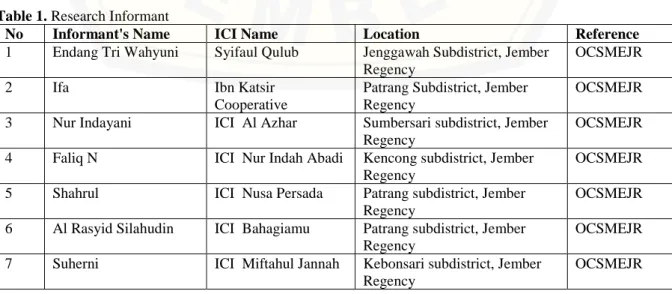
The type of this research is qualitative with a case study approach. Case study is a method to understand the individual that is carried out in an integrative and comprehensive manner to obtain an understanding of the individual and the problems he faces with the aim that the problem can be solved and obtain good self-development. This research was conducted in the Jember Regency area with the object of research being the Sharia Savings and Loans and Financing Cooperative Institute (ICI). This study used the snowball method to determine the informants of the study. Researchers have conducted a preliminary interview with the first informant, namely Mrs Endang as the manager of ICI in Jenggawah, Jember Regency, for get an overview of the ICI in Jember Regency. This study got information on ICI which is still active from the Jember Regency Cooperatives and SMEs Office. Furthermore, researchers dug up information from other ICI managers based on information provided by the Office of Cooperatives and Small and Medium Enterprises Jember Regency (OCSMEJR). This study got eight informants, consist of seven ICI managers who were recommendated by OCSMEJR and a head of the OCSMEJR. Table 1 contains details of the informants of this study.
Table 1. Research Informant
No Informant's Name ICI Name Location Reference 1 Endang Tri Wahyuni Syifaul Qulub Jenggawah Subdistrict, Jember
Regency
OCSMEJR
2 Ifa Ibn Katsir
Cooperative
Patrang Subdistrict, Jember Regency
OCSMEJR 3 Nur Indayani ICI Al Azhar Sumbersari subdistrict, Jember
Regency
OCSMEJR 4 Faliq N ICI Nur Indah Abadi Kencong subdistrict, Jember
Regency
OCSMEJR 5 Shahrul ICI Nusa Persada Patrang subdistrict, Jember
Regency
OCSMEJR 6 Al Rasyid Silahudin ICI Bahagiamu Patrang subdistrict, Jember
Regency
OCSMEJR 7 Suherni ICI Miftahul Jannah Kebonsari subdistrict, Jember
Regency
OCSMEJR
Digital Repository Universitas Jember
Digital Repository Universitas Jember
Model of Institutional Strengthening Based on Management Function and Sharia Compliance: Exploration of Islamic Cooperative Institutions in Jember Regency, Indonesia
___________________________________________________________________________
Rev. Gest. Soc. Ambient. | Miami | v.17.n.7 | p.1-16 | e03583 | 2023.
Source: Primary Data
The technique used in collecting data was an in-depth interview supported by observation methods and written conversations through whatshap. Data analysis of qualitative methods is carried out from before entering the field, while in the field, and after completion in the field. Activities in qualitative data analysis are carried out interactively and take place continuously until complete and the data is saturated which includes data reduction, display data, and conclusion drawing/verification data.
The stages in this study include the field exploration, the data analysis, and the reporting.
The stage before going to the field was preliminary data mining to observe the ICI phenomenon in Jember Regency. At this stage, researchers also explore previous studies from books and articles in various journals that can be related to the findings of the phenomenon. The second stage is for researchers to begin exploring in the field while analyzing the data obtained from the exploration. These two activities are carried out together in this second stage because as previously written, the analysis in qualitative research is carried out continuously during the data mining process until saturated data is obtained or the data has been considered complete.
The third stage is the reporting stage, which is the writing of reports on the findings in the field and data analysis tailored to the research objectives.
This research uses internal validity techniques or also known as credibility as a measurement of data validity. This requires affirmation of research results to provide assurance that reliable research has credible attributes. Credible means that researchers are trusted to have collected real data in the field and interpreted the authentic data accurately. Researchers choose internal validity techniques of triangulation type which include triangulation of data collection techniques, triangulation of data sources, and triangulation of theory.
4 RESULTS AND DISCUSSION
4.1 Data Analysis
The results of field exploration received information that showed that human resources at the ICI have not received a trainning from either the East Java provincial government or Jember regency. This is reflected in the results of interviews with informants as follows:
"The Sharia Cooperative joined the Sharia Cooperative in East Java Province to obtain information. This is due to the infrequent procurement of trainings by the Jember District Cooperative Office"
"Training activities are not often carried out. The implementation of these training activities is rarely carried out, even the possibility of being carried out 1 time within 1 year"
The informant mentioned that even if the government provides training, the implementation of training is only once a year. This of course is still lacking to improve understanding and skills in running ICI. ICI really need human resources who is proficient in managing organizations. This is to support the implementation of other management functions.
In the field of financing, there has been a ICI that applies sharia contracts such as murabahah and mudharabah contracts. In fact, a ICI at Jenggawah subdistrict area applies an infaq system to members for financing management services. The information is contained in
8 Suhartini Head of the
Cooperatives and SMEs Office
Jember Regency ---
Digital Repository Universitas Jember
Digital Repository Universitas Jember
Model of Institutional Strengthening Based on Management Function and Sharia Compliance: Exploration of Islamic Cooperative Institutions in Jember Regency, Indonesia
___________________________________________________________________________
Rev. Gest. Soc. Ambient. | Miami | v.17.n.7 | p.1-16 | e03583 | 2023.
the informant's answer from ICI, AA, in the dialogue as follows:
Researcher: "Why use murabahan, murabahan buying and selling?
ICI (AA): "Because for the materials needed such as business tools, which means the customer's tool needs".
Financing activities often experience obstacles, mainly the inability of members to make installment payments and until there is a bottleneck. When this happens to ICI, ICI does not immediately use abusive methods, but ICI employees go to members in good faith to give early warning of the congestion. This is found in the following interviews:
"A lot of the way it's been done, and it's still being visited. Sometimes this happens due to the lack of field trips. Most are still in the first half of the visit. But there are also those who are late in payment so that becomes an obstacle".
In fact, there are ICI that do not ask for collateral in financing activities because ICI already knows its members well. Here's the informant's answer tothe condition.
"There is no need for a guarantee to borrow to the Muhamadiyah Happy Cooperative"
“Saving-loan products only. There is a desire to provide necessities but there is no capital yet because all funds are still funded for saving-loan”
Meanwhile, related to financial management, ICI generally receives the main capital from members in the form of principal and mandatory deposits. This is reflected in the informant's statement, NP. as follows:
"The existence of members is very helpful in providing an injection of funds for the cooperative to bepreached again in providing services to the members of the cooperative through member dues".
When there are a lot of funds, it turns out that ICI is not allowed to invest these funds.
All funds are mandatory to be channeled through financing. This is contained in the informant's statement from ICI, NIA which states as follows:
"It is not allowed to invest. It just so happens that we have a lot of funds because we got a loan from a financing institution, and it was only for financing".
ICI is a cooperative that uses Islamic concepts that should show compliance with sharia rules. The findings in the field show the opposite condition, namely that there are ICI that have shown sharia compliance but there are KSPSS that have not shown this. Sharia compliance is shown, one of which is the existence of the Sharia Supervisory Board (DPS), reflected in the informant's answer as follows.
"There is a board of Trustees. "Sharia supervisors oversee their products, so they pay more attention to the needs of members. Then about the contract and a lot of combinations as well"
Meanwhile, the most common thing found in the field is that there are still many members who do not understand the concept of Sharia Cooperatives. Some consider the concept
Digital Repository Universitas Jember
Digital Repository Universitas Jember
Model of Institutional Strengthening Based on Management Function and Sharia Compliance: Exploration of Islamic Cooperative Institutions in Jember Regency, Indonesia
___________________________________________________________________________
Rev. Gest. Soc. Ambient. | Miami | v.17.n.7 | p.1-16 | e03583 | 2023.
of sharia to be complicated so that members are still familiar with the interest system, and even doubt that the practice of ICI is really sharia. The answers of some informants who support this condition are as follows:
"The complexity of applying sharia principles, because there are still many people who are used to the interest system as in the conventional financial system"
"There are still members who doubt whether sharia principles are really sharia-compliance"
"Must educate members regarding the concept of sharia in the sharia financing system"
"Many still do not understand the concept of sharia. That money should not be the object transacted”
"Islamic cooperative already understands a little bit of the concept of islamic economics and doesn't know how to run it technically. From the Office of Cooperatives and Small and Medium Enterprises, there is also no a trainning related to this matter."
"ICI is formed by the Jember Regency Government (its formation because there is a government program)". It has not applied sharia principles, aka it is still the same as conventional cooperatives. What's different is only the use of the term."
"It already is called as ICI, but the implementation is not ICI"
However, it turns out that there are still ICI managers in the Jenggawah area who really want to apply the sharia concept correctly because there is an uncomfortable feeling in the heart when using the concept of interest. This is reflected in the informant's statement as follows:
Another sharia compliance is reflected in the use of sharia-compliant financing agreements, namely mudharabah. Here are the informant's answers related to this condition.
"A mudorabah is card exists and is not 10 months. He does not pay every month but within a period of 3 months pays". Idul Fitri pastry business, his brother is cosmetic make up, so it bought cloth again and refunded.
Agriculture also exists".
The daily operations of ICI have shown obedience to the command of Allah SWT that every beginning of mandatory activities begins with prayer. The use of the sharia concept has an influence on the operation of one of the ICI, namely NIA, that all employees are required to perform prayers contained in the organization's SOP. The following is an excerpt of the results of an interview with an informant.
"It usually starts with praying. Each office is collected by its branch and indeed there is already an SOP".
Planning, organizing, actuating, and controlling (POAC) organizations have gone well in almost all ICI that are the object of research. This is found in some of the informant's answers below.
"Yes, right. So, this month has begun to compile future work plans
Digital Repository Universitas Jember
Digital Repository Universitas Jember
Model of Institutional Strengthening Based on Management Function and Sharia Compliance: Exploration of Islamic Cooperative Institutions in Jember Regency, Indonesia
___________________________________________________________________________
Rev. Gest. Soc. Ambient. | Miami | v.17.n.7 | p.1-16 | e03583 | 2023.
including in November and December. Then there was a work meeting"
" Controlling every 3 months from the manager then the supervisor".
"Through meetings held every month".
"The strength is in the group system so that monev runs well and the potential for bad receivables is minimal"
"Alhamdulillah, the annual member meeting is routine here. Its members are also growing every year".
The organization should have developed. This is also the case with ICI which has been operating for several years and is capable of many years. There is a desire for ICI to be able to develop business in the consumer sector because the number of members has begun to be large and ICI should be able to meet the needs of members. However, this cannot be done because it is bumped up against binding regulations. The following is an informant's statement that indicates an opportunity for business development but is constrained by the rules and the informant's expectations for the government to be able to revise the current regulations so that they can be adjusted to the needs of the Sharia cooperative industry.
"Thanks God, the progress is good. Yesterday there was a discourse that we changed the consumer cooperative from KPRI but the savings and loans regulation. The ministry wants it to be focused if consumers then consumers only, if savings and loans then savings and loans only. When there is a Head of the Provincial Cooperative Service, it is not just savings and loans because we are formed by the regulation. And it's a pity that we have many cooperative members. Unless the consumer serves anything.
But the regulations don't support either".
"If the savings and loans are greater, ICI will eventually be transferred.
Therefore, I had asked about how to change the regulatory system so that it can support it. Because of this larger savings and loans in the old days.
Is it ok to change the regulatory system? Because there is a concern if it has changed consumers but when the articles of association there are more changes related to regulations."
"The information obtained, for the regulation cannot be changed. So if you save and borrow, then just save and borrow, and if you are a consumer, only consumers. For example, yesterday I had a question at the Trikopol Cooperative. The focus of consumers and savings and loans is also there and provided in relation to all existing businesses".
"It is true that consumers can save and borrow but can also finance. So the main business is retail while the additional business is savings and loans and financing".
"I want to expand my business to retail and animal husbandry"
Another hope expressed by informants to the government to improve the performance of ICI is the provision of training to the management and managers of sharia cooperatives.
Here's an excerpt of the informant's answer.
"Training on sharia cooperatives. Related to the theory and the contracts because the pasuruan area is more numerous and more developed. And in Jember and nothing because it was entered by outsiders"
Digital Repository Universitas Jember
Digital Repository Universitas Jember
Model of Institutional Strengthening Based on Management Function and Sharia Compliance: Exploration of Islamic Cooperative Institutions in Jember Regency, Indonesia
___________________________________________________________________________
Rev. Gest. Soc. Ambient. | Miami | v.17.n.7 | p.1-16 | e03583 | 2023.
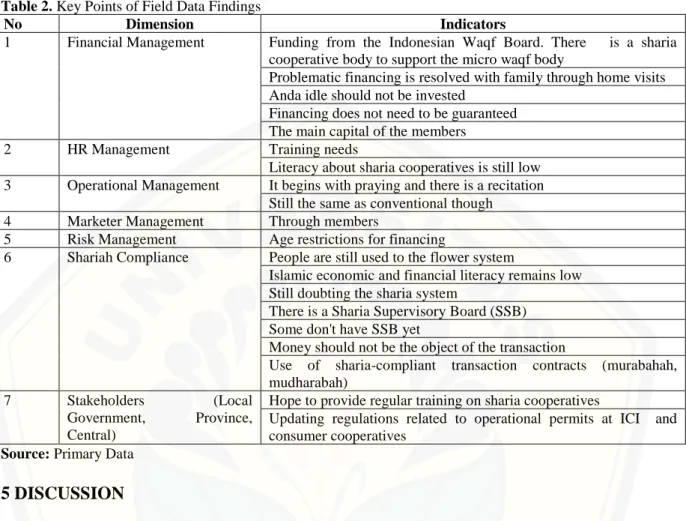
Based on field data from interviews, this study found the main points as indicators of the dimensions of management functions, Sharia compliance, and the role of stakeholders.
Table 2 contains the main points of field data findings.
Table 2. Key Points of Field Data Findings
No Dimension Indicators
1 Financial Management Funding from the Indonesian Waqf Board. There is a sharia cooperative body to support the micro waqf body
Problematic financing is resolved with family through home visits Anda idle should not be invested
Financing does not need to be guaranteed The main capital of the members
2 HR Management Training needs
Literacy about sharia cooperatives is still low 3 Operational Management It begins with praying and there is a recitation
Still the same as conventional though
4 Marketer Management Through members
5 Risk Management Age restrictions for financing
6 Shariah Compliance People are still used to the flower system
Islamic economic and financial literacy remains low Still doubting the sharia system
There is a Sharia Supervisory Board (SSB) Some don't have SSB yet
Money should not be the object of the transaction
Use of sharia-compliant transaction contracts (murabahah, mudharabah)
7 Stakeholders (Local
Government, Province, Central)
Hope to provide regular training on sharia cooperatives
Updating regulations related to operational permits at ICI and consumer cooperatives
Source: Primary Data
5 DISCUSSION
The findings in the field provide a variety of information related to the implementation of management functions, sharia compliance, and relationships with stakeholders in this case local and provincial governments. Based on the main points that have been summarized from the results of interviews with informants, the main funding at ICI is sourced from members. In addition, problematic financing is resolved by family through home visits. When Sharia cooperatives have more and idle funds, these funds should not be invested because the character of ICI is to maximize financing activities. In some ICI, there is no need for collateral.
Meanwhile, in the field of human resources, ICI has low literacy of Islamic financial concepts so that it urgently needs training on Islamic finance and specifically on ICI s. This can be seen when researchers conduct interviews with informants that there is still confusion when explaining the mudharabah and musyarakah agreements. In addition, most of the management and managers of ICI are not familiar with Islamic financial terms in Sharia cooperatives. This condition is actually a common problem in the Sharia cooperative industry.
Meanwhile, operations at ICI are recognized by most managers as the same as conventional cooperative operations, especially in Sharia cooperatives that are still small and do not have a Sharia Supervisory Board. However, one of the ICI has started working with morning prayers in each branch. This shows that the application of the sharia concept to organizations has an impact on increasing the religiosity of organizational members. For the field of marketing, ICI has been relying on members to inform the public.
Furthermore, risk management in ICI is carried out by limiting the age of financing activities. This is in accordance with the theory of health that increasing age will increase the
Digital Repository Universitas Jember
Digital Repository Universitas Jember
Model of Institutional Strengthening Based on Management Function and Sharia Compliance: Exploration of Islamic Cooperative Institutions in Jember Regency, Indonesia
___________________________________________________________________________
Rev. Gest. Soc. Ambient. | Miami | v.17.n.7 | p.1-16 | e03583 | 2023.
risk of health care so that ICI minimizes the risk of financing by determining age limits. ICI as a financial institution that has identic characteristics with the concept of Islam should comply with sharia rules. Islam does not recognize risk-free in a transaction because it contains ribawi elements that are prohibited in Islam (Puspitasari et al., 2022). In the field data findings, this study found that it is included in sharia compliance behavior, namely that ICI already has a Sharia Supervisory Board (SSB) and the use of transaction contracts that are in accordance with Islamic financial concepts (e.g., murabahah, mudharabah, qardh), and the understanding that money should not be the object of transactions. However, it turns out that there are contrasting findings that members still consider ICI likes conventional cooperatives so that they still consider the application of interest. This shows that members and the surrounding community have low Islamic economic and financial literacy. In fact, there are ICI members who still doubt the sharia system. This condition is supported by the existence of ICI which does not have SSB so that no one can share knowledge about Islamic finance either with the management or members. The existence of DPS can at least provide literacy to managers, administrators, members, and the surrounding community.
The existence of ICI is also related to stakeholders, especially the government. Based on the findings in the field, the local and provincial governments still have not carried out maximum guidance to the ICI, especially in Jember Regency. ICI fully hopes for local and provincial governments to be able to continue to help in the sustainability and development of ICI. In addition, ICI, which has reached a "mature" period, hopes to develop its business in the consumer sector so that it can carry out buying and selling activities to meet the increasing needs of members.
Other stakeholders who must be involved in ICI practices are universities. Although this study did not use informants from universities, researchers knew the problems that occurred in the field, so researchers thought that the role of the academic world was needed to help improve the performance of ICI. Universities that have the resources of educators or lecturers in the field of Islamic finance should conduct socialization and assistance at ICI as an effort to improve the performance of ICI .
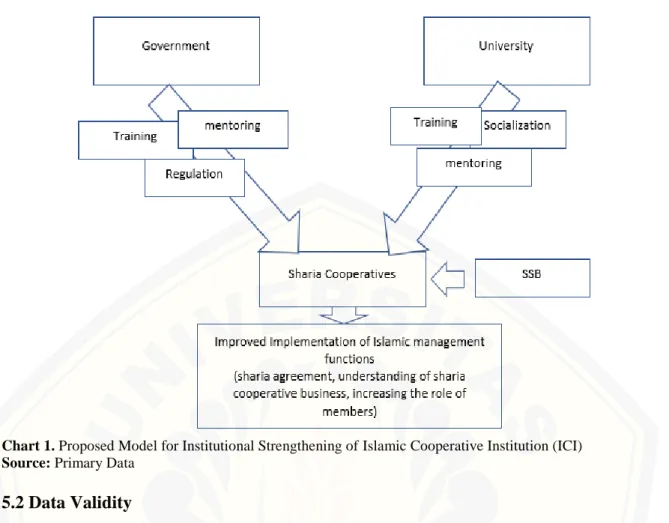
5.1 Proposed Model for Institutional Strengthening of ICI
Based on the findings of field data and discussions, this study proposes a model of strengthening ICI in general which is based on sharia management and compliance functions and linkages with stakeholders. The model proposal refers to the relationship between stakeholders and ICI. Local and provincial governments as stakeholders urgently need to help and provide training to improve Islamic economic and financial literacy and facilitate regulations that are in accordance with the needs of the development of ICI. Meanwhile, universities can socialize Islamic finance and assist in the management of ICI, especially ICI which is still newly formed through community service programs. If the functions and roles of the two external stakeholders are implemented, the managerial function of ICI will be able to run well. The main thing that must be met is DPS because DPS is an important organ in Islamic financial practice. DPS will oversee ICI operations so that sharia compliance can run. In addition, ICI will have qualified human resources so that it can improve organizational performance by implementing good management functions. The model proposal is in Chart 1.
Digital Repository Universitas Jember
Digital Repository Universitas Jember
Model of Institutional Strengthening Based on Management Function and Sharia Compliance: Exploration of Islamic Cooperative Institutions in Jember Regency, Indonesia
___________________________________________________________________________
Rev. Gest. Soc. Ambient. | Miami | v.17.n.7 | p.1-16 | e03583 | 2023.
Chart 1. Proposed Model for Institutional Strengthening of Islamic Cooperative Institution (ICI) Source: Primary Data
5.2 Data Validity
The data validity of this study uses the theory triangulation method which is carried out by adjusting field data with relevant theories, Table 3 shows theory triangulation as a form of validity of this research.
Table 3. Data Validity with Theory Triangulation
No Informant Field Data Findings Related Theories
1 ICI Nusa Persada "The existence of members is very helpful in providing an injection of funds for the cooperative to be rotated again in providing services to cooperative members through member dues”.
Cooperative Management
2 ICI Nur Indah Abadi "It usually starts with praying". Islamic Theory 3 ICI Miftahul Jannah "The ICI formed by the Jember Regency
Government (its formation is because there is a government program
It has not applied sharia principles, aka it is still the same as conventional cooperatives. What's different is only the use of the term."