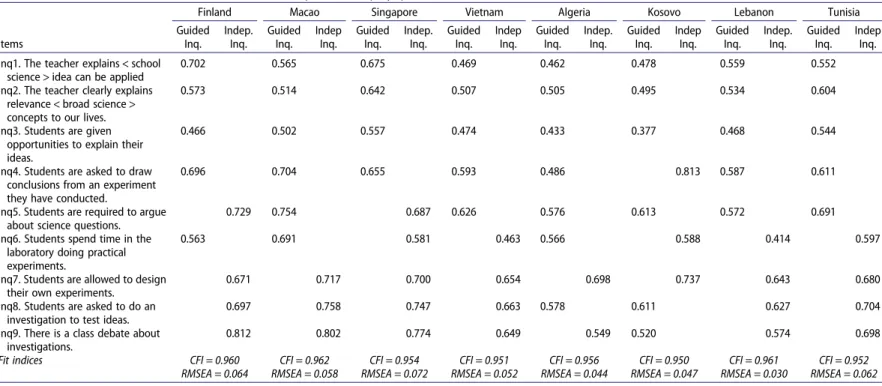
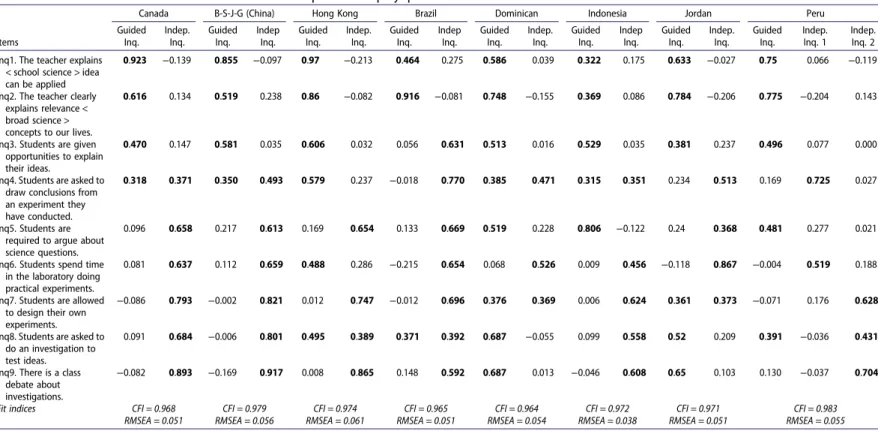
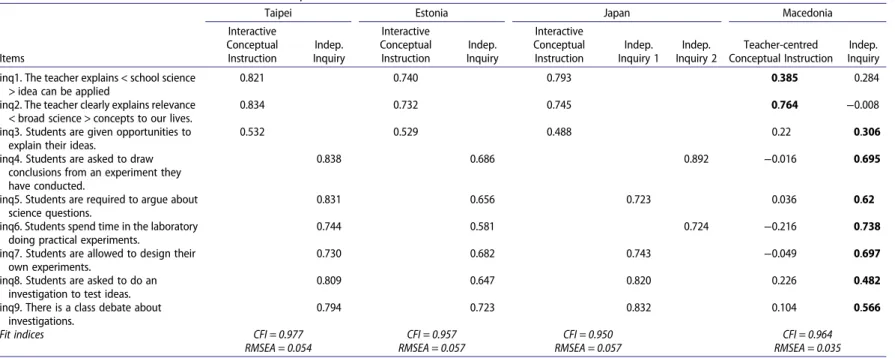
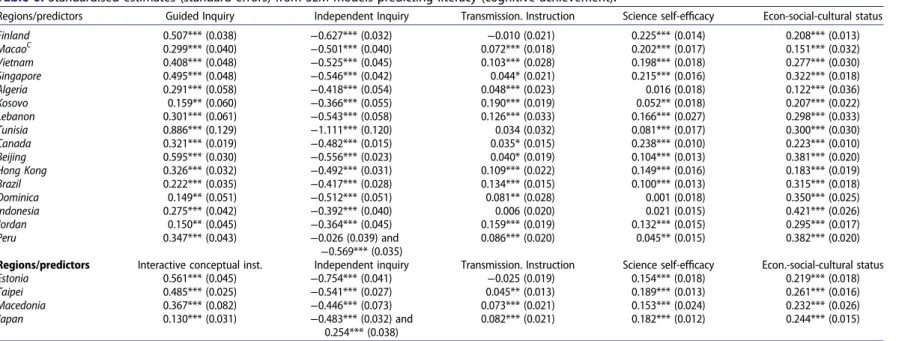
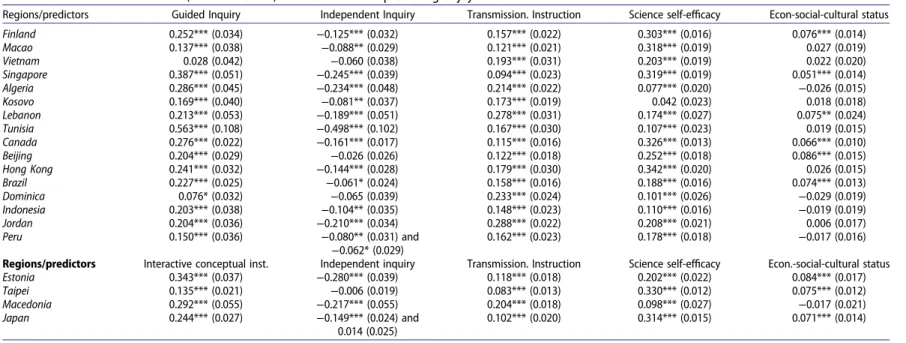
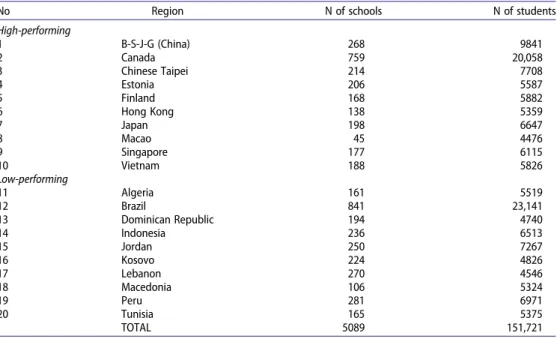
Multi-group confirmatory factor analyzes found that measurement invariance could not be established, suggesting considerable regional variation in the pattern of inquiry-based instruction. In the following sections, we first summarize theoretical perspectives that link inquiry-based teaching and student learning. Incorporating this variable as a predictor in the models provides a measure to aid interpretation about the magnitude of associations between inquiry-based instruction and learning outcomes.
On the contrary, there is substantial variation in the pattern of inquiry-based science teaching across the 20 regions. The current study takes a nuanced look at the measurement of inquiry-based instruction and how it relates to learning outcomes in the best and worst performing regions of PISA 2015. Previous studies have assumed, without testing explicitly, that the structure of inquiry-based instruction is the same in all regions.
The associations between inquiry-based teaching and learning outcomes found in most regions in this study are comparable to the effect sizes summarized in meta-analyses of educational effectiveness studies (Kyriakides, Christoforou, & Charalambous, 2013; Scheerens, Luyten, Steen, & Luyten, Steen, & -De Thouars, 2007). In none of the regions did all nine items intended to measure inquiry-based teaching form a single dimension. This indicates the need to design instruments that explicitly assess the use of scaffolding and guidance in the context of inquiry-based teaching.
Effects of inquiry-based science teaching on science achievement and interest in science: Evidence from Qatar. Journal of Educational Research Reforms to Increase Teacher Effectiveness in Developing Countries.
International Journal of Science Education
Celebrating the life of John Kenward Gilbert
Rosária Justi
Because of his experience, John was asked to give a lecture on Nufield 'A' Level schemes to members of the Science Education Association. At the University of Surrey's Institute of Educational Technology, John took part in the creation of an innovative course which combined physics (or chemistry) with education and awarded a University degree and a teaching certificate. The research program on students' conceptions of science concepts was certainly one of the most successful in science education, not only because of the amount of empirical studies developed – summarized in a series of reviews and books (e.g.
From 1994 I had the privilege of becoming a member of CMISTRE, one of the most remarkable experiences I have had during my Ph.D. One of the seminal publications of CMISTRE was the book Developing Models in Science Education (Gilbert & Boulter, 2000). Mainly due to John's comprehensive view of knowledge, which he disseminated among the members of the group, the book drew on ideas from disciplines such as philosophy, history, sociology and the language of science and psychology for science teaching and learning.
An example of the integration of ideas from separate disciplines was the concept of the hybrid model, first published in one of the papers originating from the Ph.D. This led us to study the philosophy of science and the history of the development of some scientific ideas, as well as John Clement's (1989) ideas on modeling in science education – all of which inspired and informed our ideas. Such discussions also resulted in the production of the new version of the Modeling Model (Gilbert & Justi, 2016).
Two of the topics discussed in the book showed how he tried to think outside the box by approaching a given topic from clear and innovative perspectives. The second topic discussed in one of the chapters of our book that permeated John's previous projects and publications is teacher development. At the interface of the research on models and modelling, on visualization and on chemistry education, John also devoted special attention to the problems that students (and teachers) face when dealing with the three types of representation of chemical knowledge: macro , sub-micro and symbolic (Johnstone, 1982).
The great reception of the book in the chemistry education community led John to think that the knowledge and teaching and learning of the other major sciences (Physics and Biology) should be approached from the same perspective. On the other hand, he always maintained that technology (rather than science) was the main interest of the general public. including most students). Because of his leadership in modeling and modeling and his knowledge of the lack of pioneering publications in the field, in 2003, after the book on chemical education was published, John suggested to Springer that the series of books Models and Modeling be made into science education.
John was also invited by Routledge to edit four volumes of the Major Themes in Education series on science education (Gilbert, 2006). As the title of the series suggests, some of the most important issues debated in the field are addressed from different perspectives in four volumes comprising 74 articles: 'Science, Education and the Formal Curriculum', 'Science Education' and Assessment in the Formal curriculum', 'Teaching and learning in science education' and 'Conceptual and teacher development in science education'.