P ART S IX
P
art Six looks at a range of applications that operate over the Internet.699
Internet Applications
ROAD MAP FOR PART SIX
Chapter 21 Network Security
Network security has become increasingly important with the growth in the number and importance of networks. Chapter 21 provides a sur- vey of security techniques and services. The chapter begins with a look at encryption techniques for ensuring confidentiality, which include the use of conventional and public-key encryption. Then the area of authentication and digital signatures is explored. The two most impor- tant encryption algorithms, AES and RSA, are examined, as well as SHA-1, a one-way hash function important in a number of security applications. Chapter 21 also discusses SSL and the set of IP security standards.
Chapter 22 Internet Applications—Electronic Mail and Network Management
The purpose of a communications architecture is to support distributed applications. Chapter 22 examines two of the most important of these applications; in each case, general principles are discussed, followed by a specific example. The applications discussed are electronic mail and net- work management. The corresponding examples are SMTP and MIME;
and SNMP.
700
Service and World Wide Web
Chapter 23 looks at several important modern application areas for the Internet. The Domain Name System (DNS) is a directory lookup service that provides a mapping between the name of a host on the Internet and its numerical address; it is a required application as specified in RFC 1123.
The Hypertext Transfer Protocol (HTTP) supports the exchange of requests and responses between Web browsers and Web servers.
Chapter 24 Internet Applications—Multimedia
Chapter 24 examines key topics related to multimedia. The chapter begins with a discussion of audio and video compression. The Session Initiation Protocol (SIP) is an application-level control protocol for setting up, mod- ifying, and terminating real-time sessions between participants over an IP data network; these include telephony and multimedia sessions. Finally, this chapter examines the Real-Time Transport Protocol (RTP).
701
CHAPTER
N ETWORK S ECURITY
21.1 Security Requirements and Attacks 21.2 Confidentiality with Symmetric Encryption 21.3 Message Authentication and Hash Functions 21.4 Public-Key Encryption and Digital Signatures 21.5 Secure Socket Layer and Transport Layer Security 21.6 IPv4 and IPv6 Security
21.7 WI-FIProtected Access
21.8 Recommended Reading and Web Sites 21.9 Key Terms, Review Questions, and Problems
701
21
To guard against the baneful influence exerted by strangers is therefore an elementary dictate of savage prudence. Hence before strangers are allowed to enter a district, or at least before they are permitted to mingle freely with the inhabitants, certain cere- monies are often performed by the natives of the country for the purpose of disarming the strangers of their magical powers, or of disinfecting, so to speak, the tainted atmos- phere by which they are supposed to be surrounded.
—The Golden Bough, Sir James George Frazer
KEY POINTS
• Network security threats fall into two categories. Passive threats, sometimes referred to as eavesdropping, involve attempts by an attacker to obtain information relating to a communication.Active threatsinvolve some modification of the transmitted data or the cre- ation of false transmissions.
• By far the most important automated tool for network and communi- cations security is encryption. With symmetric encryption, two parties share a single encryption/decryption key. The principal challenge with symmetric encryption is the distribution and protection of the keys. A public-key encryption scheme involves two keys, one for encryption and a paired key for decryption. The party that generated the key pair keeps one of the keys private and makes the other key public.
• Symmetric encryption and public-key encryption are often combined in secure networking applications. Symmetric encryption is used to encrypt transmitted data, using a one-time or short-term session key.
The session key can be distributed by a trusted key distribution center or transmitted in encrypted form using public-key encryption. Public- key encryption is also used to create digital signatures, which can authenticate the source of transmitted messages.
• The Secure Sockets Layer (SSL) and the follow-on Internet standard known as Transport Layer Security (TLS) provide security services for Web transactions.
• A security enhancement used with both IPv4 and IPv6, called IPSec, provides both confidentiality and authentication mechanisms.
The requirements of information security within an organization have under- gone two major changes in the last several decades. Before the widespread use of data processing equipment, the security of information felt to be valuable to an organization was provided primarily by physical and administrative means. An
21.1 / SECURITY REQUIREMENTS AND ATTACKS
703
example of the former is the use of rugged filing cabinets with a combination lock for storing sensitive documents. An example of the latter is personnel screening procedures used during the hiring process.
With the introduction of the computer, the need for automated tools for protecting files and other information stored on the computer became evident.
This is especially the case for a shared system, such as a time-sharing system, and the need is even more acute for systems that can be accessed over a public tele- phone or data network. The generic name for the collection of tools designed to protect data and to thwart hackers is computer security. Although this is an important topic, it is beyond the scope of this book.
The second major change that affected security is the introduction of dis- tributed systems and the use of networks and communications facilities for carrying data between terminal user and computer and between computer and computer.Network securitymeasures are needed to protect data during their transmission and to guarantee that data transmissions are authentic.
The essential technology underlying virtually all automated network and computer security applications is encryption.Two fundamental approaches are in use: symmetric encryption and public-key encryption, also known as asymmetric encryption. As we look at the various approaches to network security, these two types of encryption will be explored.
The chapter begins with an overview of the requirements for network security. Next, we look at symmetric encryption and its use to provide confi- dentiality. This is followed by a discussion of message authentication. We then look at the use of public-key encryption and digital signatures. The chapter closes with an examination of security features in SSL, IPSec, and Wi-Fi Pro- tected Access.
21.1 SECURITY REQUIREMENTS AND ATTACKS
To understand the types of threats to security that exist, we need to have a definition of security requirements. Computer and network security address four require- ments:
• Confidentiality:Requires that data only be accessible by authorized parties.
This type of access includes printing, displaying, and other forms of disclosure, including simply revealing the existence of an object.
• Integrity:Requires that only authorized parties can modify data. Modification includes writing, changing, changing status, deleting, and creating.
• Availability:Requires that data are available to authorized parties.
• Authenticity:Requires that a host or service be able to verify the identity of a user.
A useful means of classifying security attacks (RFC 2828) is in terms of passive attacksandactive attacks.A passive attack attempts to learn or make use of infor- mation from the system but does not affect system resources. An active attack attempts to alter system resources or affect their operation.
Passive Attacks
Passive attacks are in the nature of eavesdropping on, or monitoring of, transmis- sions. The goal of the opponent is to obtain information that is being transmitted.
Two types of passive attacks are release of message contents and traffic analysis.
The release of message contentsis easily understood. A telephone conversa- tion, an electronic mail message, or a transferred file may contain sensitive or confi- dential information. We would like to prevent an opponent from learning the contents of these transmissions.
A second type of passive attack,traffic analysis, is subtler. Suppose that we had a way of masking the contents of messages or other information traffic so that opponents, even if they captured the message, could not extract the information from the message. The common technique for masking contents is encryption. Even with encryption protection in place, an opponent might still be able to observe the pattern of these messages. The opponent could determine the location and identity of communicating hosts and could observe the frequency and length of messages being exchanged. This information might be useful in guessing the nature of the communication that was taking place.
Passive attacks are very difficult to detect because they do not involve any alteration of the data. Typically, the message traffic is sent and received in an appar- ently normal fashion and neither the sender nor receiver is aware that a third party has read the messages or observed the traffic pattern. However, it is feasible to pre- vent the success of these attacks, usually by means of encryption. Thus, the emphasis in dealing with passive attacks is on prevention rather than detection.
Active Attacks
Active attacks involve some modification of the data stream or the creation of a false stream and can be subdivided into four categories: masquerade, replay, modifi- cation of messages, and denial of service.
Amasqueradetakes place when one entity pretends to be a different entity. A masquerade attack usually includes one of the other forms of active attack. For exam- ple, authentication sequences can be captured and replayed after a valid authentica- tion sequence has taken place, thus enabling an authorized entity with few privileges to obtain extra privileges by impersonating an entity that has those privileges.
Replayinvolves the passive capture of a data unit and its subsequent retrans- mission to produce an unauthorized effect.
Modification of messagessimply means that some portion of a legitimate mes- sage is altered, or that messages are delayed or reordered, to produce an unautho- rized effect. For example, a message meaning “Allow John Smith to read confidential file accounts” is modified to mean “Allow Fred Brown to read confi- dential file accounts.”
The denial of serviceprevents or inhibits the normal use or management of communications facilities. This attack may have a specific target; for example, an entity may suppress all messages directed to a particular destination (e.g., the secu- rity audit service). Another form of service denial is the disruption of an entire net- work or a server, either by disabling the network server or by overloading it with messages so as to degrade performance.
21.2 / CONFIDENTIALITY WITH SYMMETRIC ENCRYPTION
705
Active attacks present the opposite characteristics of passive attacks. Whereas passive attacks are difficult to detect, measures are available to prevent their suc- cess. On the other hand, it is quite difficult to prevent active attacks absolutely, because to do so would require physical protection of all communications facilities and paths at all times. Instead, the goal is to detect them and to recover from any disruption or delays caused by them. Because the detection has a deterrent effect, it may also contribute to prevention.
21.2 CONFIDENTIALITY WITH SYMMETRIC ENCRYPTION
The universal technique for providing confidentiality for transmitted data is sym- metric encryption. This section looks first at the basic concept of symmetric encryp- tion, followed by a discussion of the two most important symmetric encryption algorithms: the Data Encryption Standard (DES) and the Advanced Encryption Standard (AES). We then examine the application of symmetric encryption to achieve confidentiality.
Symmetric Encryption
Symmetric encryption, also referred to as conventional encryption or single-key encryption, was the only type of encryption in use prior to the introduction of pub- lic-key encryption in the late 1970s. Countless individuals and groups, from Julius Caesar to the German U-boat force to present-day diplomatic, military, and com- mercial users, have used symmetric encryption for secret communication. It remains by far the more widely used of the two types of encryption.
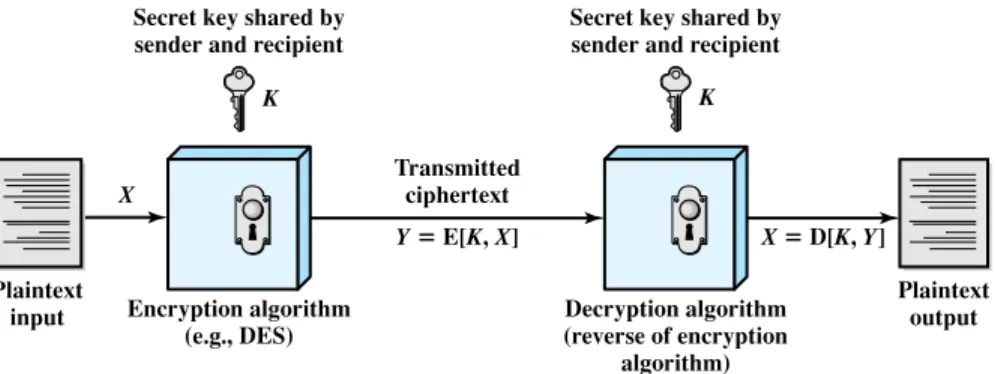
A symmetric encryption scheme has five ingredients (Figure 21.1):
• Plaintext:This is the original message or data that is fed into the algorithm as input.
• Encryption algorithm: The encryption algorithm performs various substitu- tions and transformations on the plaintext.
• Secret key:The secret key is also input to the encryption algorithm. The exact substitutions and transformations performed by the algorithm depend on the key.
Plaintext input
Transmitted ciphertext
Plaintext output Encryption algorithm
(e.g., DES)
Decryption algorithm (reverse of encryption
algorithm)
YE[K,X] XD[K,Y]
X
K Secret key shared by sender and recipient
Secret key shared by sender and recipient
K
Figure 21.1 Simplified Model of Symmetric Encryption
• Ciphertext:This is the scrambled message produced as output. It depends on the plaintext and the secret key. For a given message, two different keys will produce two different ciphertexts.
• Decryption algorithm:This is essentially the encryption algorithm run in reverse.
It takes the ciphertext and the secret key and produces the original plaintext.
There are two requirements for secure use of symmetric encryption:
1. We need a strong encryption algorithm. At a minimum, we would like the algorithm to be such that an opponent who knows the algorithm and has access to one or more ciphertexts would be unable to decipher the ciphertext or figure out the key. This requirement is usually stated in a stronger form: The opponent should be unable to decrypt ciphertext or discover the key even if he or she is in possession of a number of ciphertexts together with the plaintext that produced each ciphertext.
2. Sender and receiver must have obtained copies of the secret key in a secure fashion and must keep the key secure. If someone can discover the key and knows the algorithm, all communication using this key is readable.
There are two general approaches to attacking a symmetric encryption scheme.
The first attack is known as cryptanalysis. Cryptanalytic attacks rely on the nature of the algorithm plus perhaps some knowledge of the general characteristics of the plaintext or even some sample plaintext-ciphertext pairs. This type of attack exploits the characteristics of the algorithm to attempt to deduce a specific plaintext or to deduce the key being used. If the attack succeeds in deducing the key, the effect is catastrophic: All future and past messages encrypted with that key are compromised.
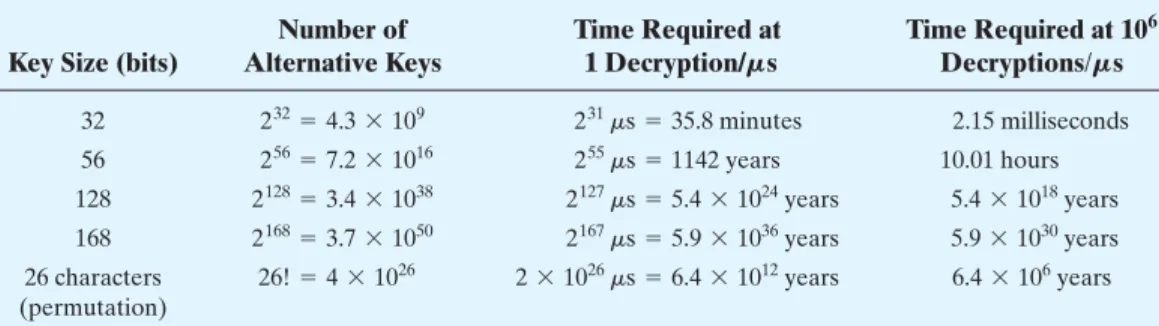
The second method, known as the brute-forceattack, is to try every possible key on a piece of ciphertext until an intelligible translation into plaintext is obtained.
On average, half of all possible keys must be tried to achieve success. Table 21.1 shows how much time is involved for various key sizes. The table shows results for each key size, assuming that it takes to perform a single decryption, a reasonable order of magnitude for today’s computers. With the use of massively parallel organi- zations of microprocessors, it may be possible to achieve processing rates many orders of magnitude greater. The final column of the table considers the results for a system that can process 1 million keys per microsecond. As one can see, at this per- formance level, a 56-bit key can no longer be considered computationally secure.
1ms
Table 21.1 Average Time Required for Exhaustive Key Search
Number of Time Required at Time Required at Key Size (bits) Alternative Keys
32 2.15 milliseconds
56 10.01 hours
128 168 26 characters (permutation)
6.4 *106 years 2 *1026ms=6.4 *1012 years
26!= 4* 1026
5.9* 1030 years 2167ms=5.9 *1036 years
2168= 3.7* 1050
5.4* 1018 years 2127ms=5.4 *1024 years
2128= 3.4* 1038
255ms=1142 years 256= 7.2* 1016
231ms=35.8 minutes 232= 4.3* 109
Decryptions/Ms 1 Decryption/Ms
106
21.2 / CONFIDENTIALITY WITH SYMMETRIC ENCRYPTION
707
Encryption Algorithms
The most commonly used symmetric encryption algorithms are block ciphers. A block cipher processes the plaintext input in fixed-size blocks and produces a block of ciphertext of equal size for each plaintext block. The two most important sym- metric algorithms, both of which are block ciphers, are the Data Encryption Stan- dard (DES) and the Advanced Encryption Standard (AES).
Data Encryption Standard
DES has been the dominant encryption algorithm since its introduction in 1977. However, because DES uses only a 56-bit key, it was only a matter of time before computer processing speed made DES obsolete. In 1998, the Electronic Frontier Foundation (EFF) announced that it had broken a DES challenge using a special-purpose “DES cracker” machine that was built for less than $250,000. The attack took less than three days. The EFF has published a detailed description of the machine, enabling others to build their own cracker [EFF98]. And, of course, hardware prices will continue to drop as speeds increase, making DES worthless.The life of DES was extended by the use of triple DES (3DES), which involves repeating the basic DES algorithm three times, using either two or three unique keys, for a key size of 112 or 168 bits.
The principal drawback of 3DES is that the algorithm is relatively sluggish in software. A secondary drawback is that both DES and 3DES use a 64-bit block size. For reasons of both efficiency and security, a larger block size is desirable.
Advanced Encryption Standard
Because of these drawbacks, 3DES is not a reasonable candidate for long-term use. As a replacement, the National Insti- tute of Standards and Technology (NIST) in 1997 issued a call for proposals for a new Advanced Encryption Standard (AES), which should have a security strength equal to or better than 3DES and significantly improved efficiency.In addition to these general requirements, NIST specified that AES must be a symmetric block cipher with a block length of 128 bits and support for key lengths of 128, 192, and 256 bits. Evaluation criteria include security, computa- tional efficiency, memory requirements, hardware and software suitability, and flexibility. In 2001, AES was issued as a federal information processing standard (FIPS 197).
In the description of this section, we assume a key length of 128 bits, which is likely to be the one most commonly implemented.
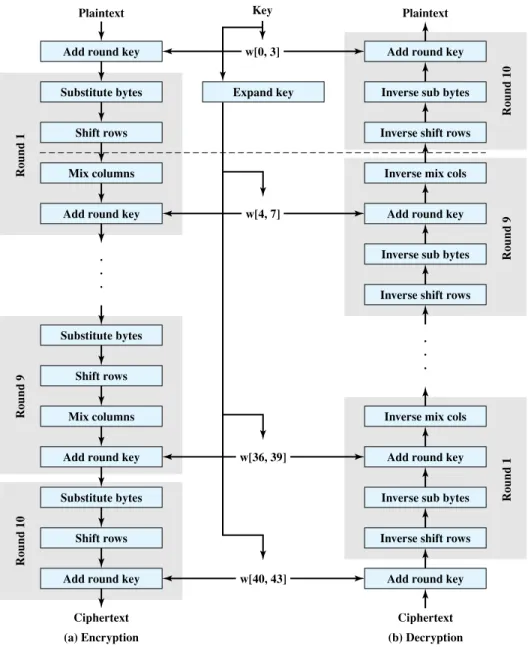
Figure 21.2 shows the overall structure of AES. The input to the encryption and decryption algorithms is a single 128-bit block. In FIPS 197, this block is depicted as a square matrix of bytes. This block is copied into the State array, which is modified at each stage of encryption or decryption. After the final stage, State is copied to an output matrix. Similarly, the 128-bit key is depicted as a square matrix of bytes. This key is then expanded into an array of key schedule words; each word is 4 bytes and the total key schedule is 44 words for the 128-bit key. The ordering of bytes within a matrix is by column. So, for example, the first four bytes of a 128-bit plaintext input to the encryption cipher occupy the first col- umn of the inmatrix, the second four bytes occupy the second column, and so on.
Add round key
w[4, 7]
w[0, 3]
Plaintext
Substitute bytes Expand key
Shift rows
Mix columns
Round 1 Round 9 Round 10
Add round key
Substitute bytes
Shift rows
Mix columns
Add round key
Substitute bytes
Shift rows
Add round key
Ciphertext (a) Encryption
Key
Add round key Plaintext
Inverse sub bytes
Inverse shift rows
Inverse mix cols
Round 10Round 9 Round 1
Add round key
Inverse sub bytes
Inverse shift rows
Inverse mix cols
Add round key
Inverse sub bytes
Inverse shift rows
Add round key
Ciphertext (b) Decryption w[36, 39]
w[40, 43]
Figure 21.2 AES Encryption and Decryption
Similarly, the first four bytes of the expanded key, which form a word, occupy the first column of the wmatrix.
The following comments give some insight into AES:
1. The key that is provided as input is expanded into an array of forty-four 32-bit words,w[i]. Four distinct words (128 bits) serve as a round key for each round.
2. Four different stages are used, one of permutation and three of substitution:
21.2 / CONFIDENTIALITY WITH SYMMETRIC ENCRYPTION
709
1The term S-box, or substitution box, is commonly used in the description of symmetric ciphers to refer to a table used for a table-lookup type of substitution mechanism.
• Substitute bytes: Uses a table, referred to as an S-box,1 to perform a byte- by-byte substitution of the block
• Shift rows: A simple permutation that is performed row by row
• Mix columns: A substitution that alters each byte in a column as a function of all of the bytes in the column
• Add round key: A simple bitwise XOR of the current block with a portion of the expanded key
3. The structure is quite simple. For both encryption and decryption, the cipher begins with an Add Round Key stage, followed by nine rounds that each includes all four stages, followed by a tenth round of three stages. Figure 21.3 depicts the structure of a full encryption round.
4. Only the Add Round Key stage makes use of the key. For this reason, the cipher begins and ends with an Add Round Key stage. Any other stage, applied at the beginning or end, is reversible without knowledge of the key and so would add no security.
S SubBytes
State
State
State
State
State ShiftRows
MixColumns
AddRoundKey
S S S S S S S S S S S S S S S
M M M M
r0 r1 r2 r3 r4 r5 r6 r7 r8 r9 r10 r11 r12 r13 r14 r15
Figure 21.3 AES Encryption Round
5. The Add Round Key stage by itself would not be formidable. The other three stages together scramble the bits, but by themselves would provide no security because they do not use the key.We can view the cipher as alternating operations of XOR encryption (Add Round Key) of a block, followed by scrambling of the block (the other three stages), followed by XOR encryption, and so on. This scheme is both efficient and highly secure.
6. Each stage is easily reversible. For the Substitute Byte, Shift Row, and Mix Columns stages, an inverse function is used in the decryption algorithm. For the Add Round Key stage, the inverse is achieved by XORing the same round key to the block, using the result that
7. As with most block ciphers, the decryption algorithm makes use of the expanded key in reverse order. However, the decryption algorithm is not identical to the encryption algorithm. This is a consequence of the particular structure of AES.
8. Once it is established that all four stages are reversible, it is easy to verify that decryption does recover the plaintext. Figure 21.2 lays out encryption and decryption going in opposite vertical directions.At each horizontal point (e.g., the dashed line in the figure),Stateis the same for both encryption and decryption.
9. The final round of both encryption and decryption consists of only three stages. Again, this is a consequence of the particular structure of AES and is required to make the cipher reversible.
Location of Encryption Devices
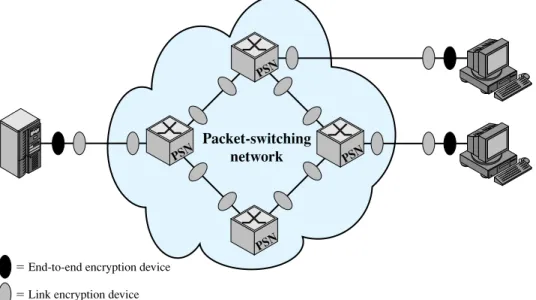
The most powerful, and most common, approach to countering the threats to net- work security is encryption. In using encryption, we need to decide what to encrypt and where the encryption gear should be located. As Figure 21.4
AAB = B.
Packet-switching network
End-to-end encryption device Link encryption device PSN Packet-switching node
PSN
PSN
PSN
PSN
Figure 21.4 Encryption across a Packet-Switching Network
21.2 / CONFIDENTIALITY WITH SYMMETRIC ENCRYPTION
711
indicates, there are two fundamental alternatives: link encryption and end-to-end encryption.
With link encryption, each vulnerable communications link is equipped on both ends with an encryption device. Thus, all traffic over all communications links is secured. Although this requires a lot of encryption devices in a large network, it provides a high level of security. One disadvantage of this approach is that the mes- sage must be decrypted each time it enters a packet switch; this is necessary because the switch must read the address (virtual circuit number) in the packet header to route the packet. Thus, the message is vulnerable at each switch. If this is a public packet-switching network, the user has no control over the security of the nodes.
With end-to-end encryption, the encryption process is carried out at the two end systems. The source host or terminal encrypts the data. The data, in encrypted form, are then transmitted unaltered across the network to the destination terminal or host. The destination shares a key with the source and so is able to decrypt the data. This approach would seem to secure the transmission against attacks on the network links or switches. There is, however, still a weak spot.
Consider the following situation. A host connects to a frame relay network, sets up a logical connection to another host, and is prepared to transfer data to that other host using end-to-end encryption. Data are transmitted over such a network in the form of frames, or packets, consisting of a header and some user data. What part of each packet will the host encrypt? Suppose that the host encrypts the entire packet, including the header. This will not work because, remember, only the other host can perform the decryption. Each frame relay node will receive an encrypted packet and be unable to read the header. Therefore, it will not be able to route the packet. It fol- lows that the host may only encrypt the user data portion of the packet and must leave the header in the clear, so that the network can read it.
Thus, with end-to-end encryption, the user data are secure. However, the traffic pattern is not, because packet headers are transmitted in the clear. To achieve greater security, both link and end-to-end encryption are needed, as is shown in Figure 21.4.
To summarize, when both forms are employed, the host encrypts the user data portion of a packet using an end-to-end encryption key. The entire packet is then encrypted using a link encryption key. As the packet traverses the network, each switch decrypts the packet using a link encryption key to read the header and then encrypts the entire packet again for sending it out on the next link. Now the entire packet is secure except for the time that the packet is actually in the memory of a packet switch, at which time the packet header is in the clear.
Key Distribution
For symmetric encryption to work, the two parties to an exchange must share the same key, and that key must be protected from access by others. Furthermore, fre- quent key changes are usually desirable to limit the amount of data compromised if an attacker learns the key. Therefore, the strength of any cryptographic system rests with the key distribution technique, a term that refers to the means of delivering a key to two parties that wish to exchange data without allowing others to see the key.
Key distribution can be achieved in a number of ways. For two parties A and B,
1. A key could be selected by A and physically delivered to B.
2. A third party could select the key and physically deliver it to A and B.
3. If A and B have previously and recently used a key, one party could transmit the new key to the other, encrypted using the old key.
4. If A and B each have an encrypted connection to a third party C, C could deliver a key on the encrypted links to A and B.
Options 1 and 2 call for manual delivery of a key. For link encryption, this is a reasonable requirement, because each link encryption device is only going to be exchanging data with its partner on the other end of the link. However, for end-to- end encryption, manual delivery is awkward. In a distributed system, any given host or terminal may need to engage in exchanges with many other hosts and terminals over time. Thus, each device needs a number of keys, supplied dynamically. The problem is especially difficult in a wide area distributed system.
Option 3 is a possibility for either link encryption or end-to-end encryption, but if an attacker ever succeeds in gaining access to one key, then all subsequent keys are revealed. Even if frequent changes are made to the link encryption keys, these should be done manually. To provide keys for end-to-end encryption, option 4 is preferable.
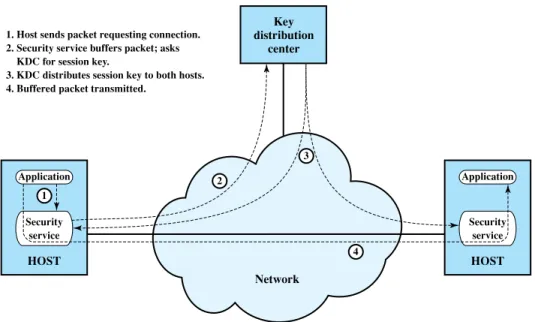
Figure 21.5 illustrates an implementation of option 4 for end-to-end encryp- tion. In the figure, link encryption is ignored. This can be added, or not, as required.
For this scheme, two kinds of keys are identified:
• Session key:When two end systems (hosts, terminals, etc.) wish to communi- cate, they establish a logical connection (e.g., virtual circuit). For the duration of that logical connection, all user data are encrypted with a one-time session key. At the conclusion of the session, or connection, the session key is destroyed.
Key distribution
center
Network 1. Host sends packet requesting connection.
2. Security service buffers packet; asks KDC for session key.
3. KDC distributes session key to both hosts.
4. Buffered packet transmitted.
HOST Application
Security service
HOST Application
Security service 2
3
4 1
Figure 21.5 Automatic Key Distribution for Connection-Oriented Protocol
21.3 / MESSAGE AUTHENTICATION AND HASH FUNCTIONS
713
• Permanent key:A permanent key is a key used between entities for the pur- pose of distributing session keys.
The configuration consists of the following elements:
• Key distribution center:The key distribution center determines which systems are allowed to communicate with each other. When permission is granted for two systems to establish a connection, the key distribution center provides a one-time session key for that connection.
• Security service module (SSM):This module, which may consist of functional- ity at one protocol layer, performs end-to-end encryption and obtains session keys on behalf of users.
The steps involved in establishing a connection are shown in the figure. When one host wishes to set up a connection to another host, it transmits a connection- request packet (step 1).The SSM saves that packet and applies to the KDC for permis- sion to establish the connection (step 2).The communication between the SSM and the KDC is encrypted using a master key shared only by this SSM and the KDC. If the KDC approves the connection request, it generates the session key and delivers it to the two appropriate SSMs, using a unique permanent key for each SSM (step 3). The requesting SSM can now release the connection request packet, and a connection is set up between the two end systems (step 4).All user data exchanged between the two end systems are encrypted by their respective SSMs using the one-time session key.
The automated key distribution approach provides the flexibility and dynamic characteristics needed to allow a number of terminal users to access a number of hosts and for the hosts to exchange data with each other.
Another approach to key distribution uses public-key encryption, which is dis- cussed in Section 21.4.
Traffic Padding
We mentioned that, in some cases, users are concerned about security from traffic analysis. With the use of link encryption, packet headers are encrypted, reducing the opportunity for traffic analysis. However, it is still possible in those circumstances for an attacker to assess the amount of traffic on a network and to observe the amount of traffic entering and leaving each end system. An effective countermea- sure to this attack is traffic padding.
Traffic padding is a function that produces ciphertext output continuously, even in the absence of plaintext. A continuous random data stream is generated.
When plaintext is available, it is encrypted and transmitted. When input plaintext is not present, the random data are encrypted and transmitted. This makes it impossi- ble for an attacker to distinguish between true data flow and noise and therefore impossible to deduce the amount of traffic.
21.3 MESSAGE AUTHENTICATION AND HASH FUNCTIONS
Encryption protects against passive attack (eavesdropping). A different require- ment is to protect against active attack (falsification of data and transactions). Pro- tection against such attacks is known as message authentication.
Approaches to Message Authentication
A message, file, document, or other collection of data is said to be authentic when it is genuine and came from its alleged source. Message authentication is a procedure that allows communicating parties to verify that received messages are authentic.
The two important aspects are to verify that the contents of the message have not been altered and that the source is authentic. We may also wish to verify a message’s timeliness (it has not been artificially delayed and replayed) and sequence relative to other messages flowing between two parties.
Authentication Using Symmetric Encryption
It is possible to perform authentication simply by the use of symmetric encryption. If we assume that only the sender and receiver share a key (which is as it should be), then only the genuine sender would be able successfully to encrypt a message for the other participant.Furthermore, if the message includes an error detection code and a sequence num- ber, the receiver is assured that no alterations have been made and that sequencing is proper. If the message also includes a timestamp, the receiver is assured that the message has not been delayed beyond that normally expected for network transit.
Message Authentication without Message Encryption
In this section, we examine several approaches to message authentication that do not rely on message encryption. In all of these approaches, an authentication tag is generated and appended to each message for transmission. The message itself is not encrypted and can be read at the destination independent of the authentication function at the destination.Because the approaches discussed in this section do not encrypt the message, message confidentiality is not provided. Because symmetric encryption will provide authentication, and because it is widely used with readily available products, why not simply use such an approach, which provides both confidentiality and authenti- cation? [DAVI89] suggests three situations in which message authentication without confidentiality is preferable:
1. There are a number of applications in which the same message is broadcast to a number of destinations. For example, notification to users that the network is now unavailable or an alarm signal in a control center. It is cheaper and more reliable to have only one destination responsible for monitoring authenticity.
Thus, the message must be broadcast in plaintext with an associated message authentication tag. The responsible system performs authentication. If a viola- tion occurs, the other destination systems are alerted by a general alarm.
2. Another possible scenario is an exchange in which one side has a heavy load and cannot afford the time to decrypt all incoming messages. Authentication is car- ried out on a selective basis, with messages chosen at random for checking.
3. Authentication of a computer program in plaintext is an attractive service. The computer program can be executed without having to decrypt it every time, which would be wasteful of processor resources. However, if a message authentication tag were attached to the program, it could be checked when- ever assurance is required of the integrity of the program.
Thus, there is a place for both authentication and encryption in meeting secu- rity requirements.
21.3 / MESSAGE AUTHENTICATION AND HASH FUNCTIONS
715
Message Authentication Code
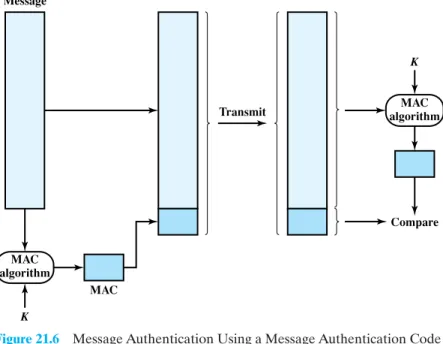
One authentication technique involves the use of a secret key to generate a small block of data, known as a message authentication code, that is appended to the message. This technique assumes that two communicat- ing parties, say A and B, share a common secret key When A has a message Mto send to B, it calculates the message authentication code as a function of the message and the key: The message plus code are transmitted to the intended recipient. The recipient performs the same calculation on the received mes- sage, using the same secret key, to generate a new message authentication code. The received code is compared to the calculated code (Figure 21.6). If we assume that only the receiver and the sender know the identity of the secret key, and if the received code matches the calculated code, then1. The receiver is assured that the message has not been altered. If an attacker alters the message but does not alter the code, then the receiver’s calculation of the code will differ from the received code. Because the attacker is assumed not to know the secret key, the attacker cannot alter the code to correspond to the alterations in the message.
2. The receiver is assured that the message is from the alleged sender. Because no one else knows the secret key, no one else could prepare a message with a proper code.
3. If the message includes a sequence number (such as is used with X.25, HDLC, and TCP), then the receiver can be assured of the proper sequence, because an attacker cannot successfully alter the sequence number.
A number of algorithms could be used to generate the code. The National Bureau of Standards, in its publication DES Modes of Operation, recommends the
MACM = F1KAB,M2.
KAB.
Message
MAC
K
K
Transmit
MAC algorithm
MAC algorithm
Compare
Figure 21.6 Message Authentication Using a Message Authentication Code (MAC)
use of DES. DES is used to generate an encrypted version of the message, and the last number of bits of ciphertext are used as the code. A 16- or 32-bit code is typical.
The process just described is similar to encryption. One difference is that the authentication algorithm need not be reversible, as it must for decryption. It turns out that because of the mathematical properties of the authentication function, it is less vulnerable to being broken than encryption.
One-Way Hash Function
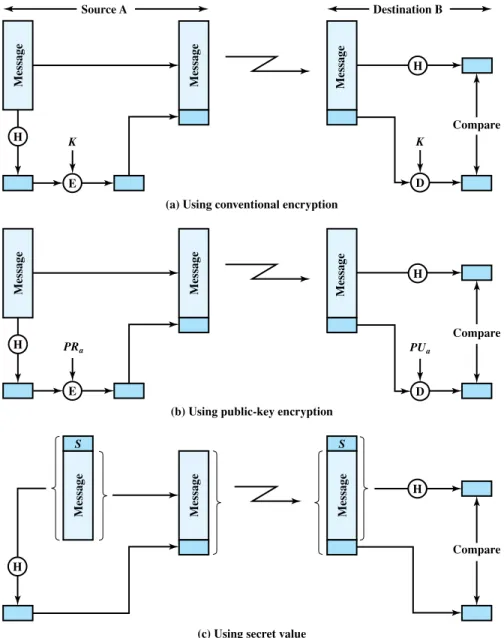
A variation on the message authentication code that has received much attention recently is the one-way hash function. As with the mes- sage authentication code, a hash function accepts a variable-size message Mas input and produces a fixed-size message digest H(M) as output. Unlike the MAC, a hash function does not also take a secret key as input. To authenticate a message, the mes- sage digest is sent with the message in such a way that the message digest is authentic.Figure 21.7 illustrates three ways in which the message can be authenticated.
The message digest can be encrypted using symmetric encryption (part a); if it is assumed that only the sender and receiver share the encryption key, then authentic- ity is assured. The message digest can also be encrypted using public-key encryption (part b); this is explained in Section 21.4. The public-key approach has two advan- tages: it provides a digital signature as well as message authentication, and it does not require the distribution of keys to communicating parties.
These two approaches have an advantage over approaches that encrypt the entire message in that less computation is required. Nevertheless, there has been interest in developing a technique that avoids encryption altogether. Several rea- sons for this interest are pointed out in [TSUD92]:
• Encryption software is quite slow. Even though the amount of data to be encrypted per message is small, there may be a steady stream of messages into and out of a system.
• Encryption hardware costs are nonnegligible. Low-cost chip implementations of DES are available, but the cost adds up if all nodes in a network must have this capability.
• Encryption hardware is optimized toward large data sizes. For small blocks of data, a high proportion of the time is spent in initialization/invocation overhead.
• Encryption algorithms may be covered by patents. Some encryption algo- rithms, such as the RSA public-key algorithm, are patented and must be licensed, adding a cost.
• Encryption algorithms may be subject to export control.
Figure 21.7c shows a technique that uses a hash function but no encryption for message authentication. This technique assumes that two communicating parties, say A and B, share a common secret value When A has a message to send to B, it calculates the hash function over the concatenation of the secret value and the
message: 2It then sends to B. Because B possesses
it can recompute and verify Because the secret value itself is not sent, it is not possible for an attacker to modify an intercepted message. As long
MDM. H1SAB7M2
SAB,
[M7MDM] MDM = H1SAB7M2.
SAB.
27denotes concatenation.
21.3 / MESSAGE AUTHENTICATION AND HASH FUNCTIONS
717
(b) Using public-key encryption
Message Message Message
PRa
E
PUa
Compare
D H
H
(c) Using secret value
Message Message Message
Compare H
H S
S
(a) Using conventional encryption
Message Message Message
K
E
K
Compare
D H
H
Source A Destination B
Figure 21.7 Message Authentication Using a One-Way Hash Function
as the secret value remains secret, it is also not possible for an attacker to generate a false message.
This third technique, using a shared secret value, is the one adopted for IP security; it has also been specified for SNMPv3, discussed in Chapter 22.
Secure Hash Functions
The one-way hash function, or secure hash function, is important not only in message authentication but in digital signatures. In this section, we begin with
a discussion of requirements for a secure hash function. Then we look at one of the most important hash functions, SHA.
Hash Function Requirements
The purpose of a hash function is to produce a“fingerprint” of a file, message, or other block of data. To be useful for message authentication, a hash function H must have the following properties:
1. H can be applied to a block of data of any size.
2. H produces a fixed-length output.
3. H(x) is relatively easy to compute for any given x,making both hardware and software implementations practical.
4. For any given code h, it is computationally infeasible to find x such that
5. For any given block x, it is computationally infeasible to find with
6. It is computationally infeasible to find any pair (x, y) such that
The first three properties are requirements for the practical application of a hash function to message authentication.
The fourth property is the one-way property: It is easy to generate a code given a message, but virtually impossible to generate a message given a code.
This property is important if the authentication technique involves the use of a secret value (Figure 21.7c). The secret value itself is not sent; however, if the hash function is not one way, an attacker can easily discover the secret value: If the attacker can observe or intercept a transmission, the attacker obtains the messageMand the hash code The attacker then inverts the hash function to obtain Because the attacker now has bothMand it is a trivial matter to recover
The fifth property guarantees that it is impossible to find an alternative mes- sage with the same hash value as a given message. This prevents forgery when an encrypted hash code is used (Figures 21.7a and b). If this property were not true, an attacker would be capable of the following sequence: First, observe or intercept a message plus its encrypted hash code; second, generate an unencrypted hash code from the message; third, generate an alternate message with the same hash code.
A hash function that satisfies the first five properties in the preceding list is referred to as a weak hash function. If the sixth property is also satisfied, then it is referred to as a strong hash function. The sixth property protects against a sophisti- cated class of attack known as the birthday attack.3
In addition to providing authentication, a message digest also provides data integrity. It performs the same function as a frame check sequence: If any bits in the message are accidentally altered in transit, the message digest will be in error.
The SHA Secure Hash Function
The Secure Hash Algorithm (SHA) was developed by NIST and published as a fed- eral information processing standard (FIPS 180) in 1993; a revised version was issued as FIPS 180-1 in 1995 and is generally referred to as SHA-1.
SAB. SAB7M,
SAB7M = H-11MDM2. MDM = H1SAB7M2.
H1x2 = H1y2. H1y2 = H1x2.
y Z x H1x2 = h.
3See [STAL06] for a discussion of birthday attacks.
21.3 / MESSAGE AUTHENTICATION AND HASH FUNCTIONS
719
SHA-1 produces a hash value of 160 bits. In 2002, NIST produced a new ver- sion of the standard, FIPS 180-2, that defined three new versions of SHA, with hash value lengths of 256, 384, and 512 bits, known as SHA-256, SHA-384, and SHA-512.
These new versions have the same underlying structure and use the same types of modular arithmetic and logical binary operations as SHA-1. In 2005, NIST announced the intention to phase out approval of SHA-1 and move to a reliance on the other SHA versions by 2010. Shortly thereafter, a research team described an attack in which two separate messages could be found that deliver the same SHA-1 hash using operations, far fewer than the operations previously thought needed to find a collision with an SHA-1 hash [WANG05]. This result should hasten the transition to the other versions of SHA.
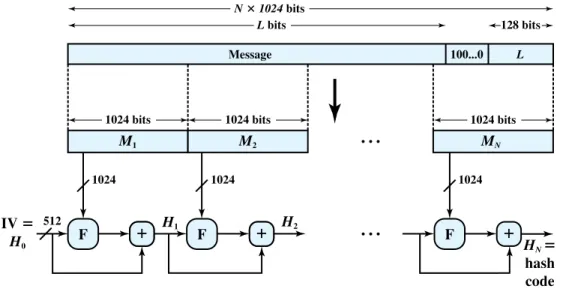
In this section, we provide a description of SHA-512. The other versions are quite similar. The algorithm takes as input a message with a maximum length of less than bits and produces as output a 512-bit message digest. The input is processed in 1024-bit blocks. Figure 21.8 depicts the overall processing of a message to produce a digest. The processing consists of the following steps:
Step 1: Append padding bits. The message is padded so that its length is congruent to 896 modulo 1024 [length mod ). Padding is always added, even if the message is already of the desired length. Thus, the number of padding bits is in the range of 1 to 1024. The padding consists of a single 1-bit followed by the neces- sary number of 0-bits.
Step 2: Append length. A block of 128 bits is appended to the message. This block is treated as an unsigned 128-bit integer (most significant byte first) and contains the length of the original message (before the padding) The inclusion of a length value makes more difficult a kind of attack known as a padding attack [TSUD92].
The outcome of the first two steps yields a message that is an integer multiple of 1024 bits in length. In Figure 21.8, the expanded message is represented as the
1024 = 896
2128
280 269
Message
1024 bits 1024 bits 1024 bits
M1 M2
H1
MN
HN hash code
100...0 L bits
N1024 bits
L
1024
512
F
1024
F
128 bits
H2
1024
F
word-by-word addition mod 264
IV H0
Figure 21.8 Message Digest Generation Using SHA-512
sequence of 1024-bit blocks so that the total length of the expanded message is bits.
Step 3: Initialize MD buffer. A 512-bit buffer is used to hold intermediate and final results of the hash function.
Step 4: Process message in 512-bit (16-word) blocks. The heart of the algorithm is a module that consists of 80 rounds of processing. The 80 rounds have the same struc- ture but vary some constants and logical functions.
Step 5: Output. After all N1024-bit blocks have been processed, the output from theNth stage is the 512-bit message digest.
The SHA-512 algorithm has the property that every bit of the hash code is a function of every bit of the input. The complex repetition of the basic function F produces results that are well mixed; that is, it is unlikely that two messages chosen at random, even if they exhibit similar regularities, will have the same hash code.
Unless there is some hidden weakness in SHA-512, which has not so far been pub- lished, the difficulty of coming up with two messages having the same message digest is on the order of operations, while the difficulty of finding a message with a given digest is on the order of operations.
21.4 PUBLIC-KEY ENCRYPTION AND DIGITAL SIGNATURES
Of equal importance to symmetric encryption is public-key encryption, which finds use in message authentication and key distribution. This section looks first at the basic concept of public-key encryption, followed by a discussion of digital signa- tures. Then we discuss the most widely used public-key algorithm: RSA. We then look at the problem of key distribution.
Public-Key Encryption
Public-key encryption, first publicly proposed by Diffie and Hellman in 1976 [DIFF76], is the first truly revolutionary advance in encryption in literally thousands of years. For one thing, public-key algorithms are based on mathematical functions rather than on simple operations on bit patterns. More important, public-key cryp- tography is asymmetric, involving the use of two separate keys, in contrast to sym- metric encryption, which uses only one key. The use of two keys has profound consequences in the areas of confidentiality, key distribution, and authentication.
Before proceeding, we should first mention several common misconceptions concerning public-key encryption. One is that public-key encryption is more secure from cryptanalysis than symmetric encryption. In fact, the security of any encryp- tion scheme depends on (1) the length of the key and (2) the computational work involved in breaking a cipher. There is nothing in principle about either symmetric or public-key encryption that makes one superior to another from the viewpoint of resisting cryptanalysis. A second misconception is that public-key encryption is a general-purpose technique that has made symmetric encryption obsolete. On the contrary, because of the computational overhead of current public-key encryption schemes, there seems no foreseeable likelihood that symmetric encryption will be
2512 2256
N * 1024
M1,M2,Á,MN,
21.4 / PUBLIC-KEY ENCRYPTION AND DIGITAL SIGNATURES
721
abandoned. Finally, there is a feeling that key distribution is trivial when using pub- lic-key encryption, compared to the rather cumbersome handshaking involved with key distribution centers for symmetric encryption. In fact, some form of protocol is needed, often involving a central agent, and the procedures involved are no simpler or any more efficient than those required for symmetric encryption.
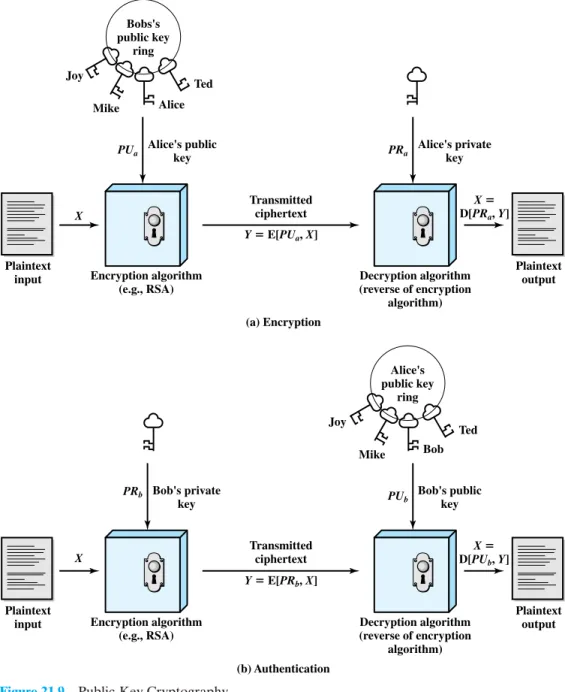
A public-key encryption scheme has six ingredients (Figure 21.9):
(a) Encryption
(b) Authentication
Mike Bob
Plaintext input
Transmitted ciphertext
Plaintext output Encryption algorithm
(e.g., RSA)
Decryption algorithm (reverse of encryption
algorithm) Bob's private
key
Bob's public key Alice's public key
ring
Joy Ted
YE[PRb,X]
X D[PUb,Y]
X
PUb PRb
Plaintext input
Bobs's public key
ring
Transmitted ciphertext
Plaintext output Encryption algorithm
(e.g., RSA)
Decryption algorithm (reverse of encryption
algorithm) Joy
Mike
Ted Alice
Alice's public key
Alice's private key
YE[PUa,X]
X D[PRa,Y]
X
PUa PRa
Figure 21.9 Public-Key Cryptography
• Plaintext:This is the readable message or data that is fed into the algorithm as input.
• Encryption algorithm: The encryption algorithm performs various transfor- mations on the plaintext.
• Public and private key:This is a pair of keys that have been selected so that if one is used for encryption the other is used for decryption. The exact transfor- mations performed by the encryption algorithm depend on the public or pri- vate key that is provided as input.
• Ciphertext:This is the scrambled message produced as output. It depends on the plaintext and the key. For a given message, two different keys will produce two different ciphertexts.
• Decryption algorithm:This algorithm accepts the ciphertext and the matching key and produces the original plaintext.
As the names suggest, the public key of the pair is made public for others to use, while the private key is known only to its owner. A general-purpose public-key crypto- graphic algorithm relies on one key for encryption and a different but related key for decryption. Furthermore, these algorithms have the following important characteristics:
• It is computationally infeasible to determine the decryption key given only knowledge of the cryptographic algorithm and the encryption key.
• For most public-key schemes, either of the two related keys can be used for encryption, with the other used for decryption.
The essential steps are the following:
1. Each user generates a pair of keys to be used for the encryption and decryp- tion of messages.
2. Each user places one of the two keys in a public register or other accessible file.
This is the public key.The companion key is kept private.As Figure 21.9 suggests, each user maintains a collection of public keys obtained from others.
3. If Bob wishes to send a private message to Alice, Bob encrypts the message using Alice’s public key.
4. When Alice receives the message, she decrypts it using her private key. No other recipient can decrypt the message because only Alice knows Alice’s private key.
With this approach, all participants have access to public keys, and private keys are generated locally by each participant and therefore need never be distrib- uted. As long as a user protects his or her private key, incoming communication is secure. At any time, a user can change the private key and publish the companion public key to replace the old public key.
Digital Signature
Public-key encryption can be used in another way, as illustrated in Figure 21.9b. Suppose that Bob wants to send a message to Alice and, although it is not important that the mes- sage be kept secret, he wants Alice to be certain that the message is indeed from him. In
21.4 / PUBLIC-KEY ENCRYPTION AND DIGITAL SIGNATURES
723
this case Bob uses his own private key to encrypt the message. When Alice receives the ciphertext, she finds that she can decrypt it with Bob’s public key, thus proving that the message must have been encrypted by Bob. No one else has Bob’s private key and therefore no one else could have created a ciphertext that could be decrypted with Bob’s public key. Therefore, the entire encrypted message serves as a digital signature.
In addition, it is impossible to alter the message without access to Bob’s private key, so the message is authenticated both in terms of source and in terms of data integrity.
In the preceding scheme, the entire message is encrypted, which, although validat- ing both author and contents, requires a great deal of storage. Each document must be kept in plaintext to be used for practical purposes.A copy also must be stored in cipher- text so that the origin and contents can be verified in case of a dispute. A more efficient way of achieving the same results is to encrypt a small block of bits that is a function of the document. Such a block, called an authenticator, must have the property that it is infeasible to change the document without changing the authenticator. If the authenti- cator is encrypted with the sender’s private key, it serves as a signature that verifies ori- gin, content, and sequencing.A secure hash code such as SHA-1 can serve this function.
It is important to emphasize that the digital signature does not provide confi- dentiality. That is, the message being sent is safe from alteration but not safe from eavesdropping. This is obvious in the case of a signature based on a portion of the message, because the rest of the message is transmitted in the clear. Even in the case of complete encryption, there is no protection of confidentiality because any observer can decrypt the message by using the sender’s public key.
The RSA Public-Key Encryption Algorithm
One of the first public-key schemes was developed in 1977 by Ron Rivest, Adi Shamir, and Len Adleman at MIT and first published in 1978 [RIVE78]. The RSA scheme has since that time reigned supreme as the only widely accepted and imple- mented approach to public-key encryption. RSA is a block cipher in which the plaintext and ciphertext are integers between 0 and for some n.
Encryption and decryption are of the following form, for some plaintext blockMand ciphertext block C:
Both sender and receiver must know the values of n and e, and only the receiver knows the value of d.This is a public-key encryption algorithm with a pub- lic key of and a private key of For this algorithm to be satisfactory for public-key encryption, the following requirements must be met:
1. It is possible to find values of e, d,n such that mod for all 2. It is relatively easy to calculate and for all values of
3. It is infeasible to determine dgiveneandn.
The first two requirements are easily met. The third requirement can be met for large values of eandn.
Figure 21.10 summarizes the RSA algorithm. Begin by selecting two prime num- bers,pandq,and calculating their product,n,which is the modulus for encryption and
M 6 n.
Cd Me
M 6 n.
n = M Med
PR = 5d,n6. PU = 5e,n6
M = Cd mod n = 1Me2d mod n = Med mod n C = Me mod n
n - 1
4It can be shown that when nis a product of two primes,pq, then f1n2= 1p -121q-12.
Selectp,q p and q both prime, pq
Calculatenpq
Calculated Public key Private key
Plaintext: Mn
Ciphertext:
Calculatef(n) (p 1)(q 1)
Select integer e gcd(f(n),e) 1; 1 ef(n) de mod f(n) 1
PU {e,n}
PR {d,n}
CMe (mod n) Key Generation
Encryption
Ciphertext: C
Plaintext: MCd (mod n)
Decryption
Figure 21.10 The RSA Algorithm
decrypti