
And for companies, some of these issues will be more critical than others depending on their size, the nature of their business and where in the world they operate. Fundamental to the OFR is the recognition that companies must be directed in the best collective interests of shareholders.
THE BACKGROUND TO CORPORATE SOCIAL RESPONSIBILITY
In the early 1980s, a wide network of large businesses came together to create Business in the Community (or BITC), which is a respected and influential force within the business community. Furthermore, after the Enron, Andersen and WorldCom scandals, there is a greater recognition by businesses that CSR can help to restore public confidence in the corporate world.
WHAT IS CSR TODAY?
These campaigns marked a sharp rise in expectations about the company's role in society and a decline in confidence in the power of national governments to address social and economic problems that spread across geopolitical borders. NGOs such as Amnesty International suggest that “the business community also had a wider responsibility – moral and legal – to use its influence to promote respect for human rights.
THE CURRENT CLIMATE
In the US, 80 percent of bosses believe that the CEO's reputation has a big impact on the company's reputation, although interestingly, this figure is only 56 percent in the UK. According to Business in the Community, more than 70 percent of business leaders believe that incorporating responsible business practices makes businesses more competitive and profitable.
FUTURE DEVELOPMENTS IN CSR REPORTING
After the recent spate of corporate scandals in the US, it is highly likely that rules will be tightened there to ensure better corporate behavior. The corporate governance disasters of 2001 saw a shift away from the philanthropic tradition that CSR had in the US to a greater alignment of CSR with business strategy and the greater realization of the potential impact of NGOs.
THE KEY DRIVERS OF CSR
The corporate scandals affecting Enron, WorldCom and the like have undoubtedly increased the perception of greed among senior business people. As a result, in the US as in the UK there has been a shift away from philanthropy in approaches to CSR and a movement towards a greater alignment of CSR with business strategy and corporate governance.
CONCLUSION
We are a movement of prosperity that is the only long-term answer to social problems. For answers to why such a transformation took place, one must go back to the 1980s and the Thatcher government.
WHERE IT ALL STARTED
But such a broad concept as corporate responsibility can be understood more easily if explained through the experience of an organization, starting with the first awareness of the need to think beyond the walls of the company and developing through a series of CSR initiatives and programs. as an integral part of the character of the business. The examples and ideas that follow are grown from several sources, but I have relied primarily on the experience and approach of the company whose data is closest to this writer.
BUSINESSES AND VISIONS CHANGE AND GROW
In Seychelles, for example, 13 percent of the government's tax revenue currently comes from the Diageo brewing business in the islands.' More than half of the company's cash added value goes to the government in excise and taxes.
WHY CHARITY IS NOT ENOUGH
Many of these efforts began in the United States and spread throughout the world as Seagram expanded. In the US, 20 percent of Diageo's advertising budget is dedicated to brand responsibility advertising.
MULTIPLE RELATIONSHIPS
It is in the area of manufacturing that Diageo has a real impact on the environment. So the effort is concentrated on the areas that have the greatest impact: energy consumption, water management, materials and recycling – in many markets return and refill bottles are used.
INDUSTRY LEADERSHIP
The local markets ultimately own the initiatives and the toolkit is adapted to take into account the culture and trade climate. Projects must be managed locally, because a crucial part of corporate citizenship is the consideration of all the different stakeholders: investors, consumers and the government.
LOCAL SUPPORT
Companies must also strive for consistency in areas of the industry where there is no competitive advantage. And that is why it is necessary to clearly and transparently say what its purpose is, so that people know what the company thinks it can achieve.
THE NEED FOR INTEGRITY
DIAGEO AT A GLANCE
Governments clearly appreciate the role these companies can play in the development of society, while the activist community can point to the growing importance of CSR as a clear victory for the pressure they have placed on companies' activities. This analysis does not pay attention to the very good work that companies have done in the past and their contributions to society.
THE CHALLENGES FOR BUSINESS
Seventy percent of CEOs worldwide agree that corporate social responsibility is critical to profitability (Fifth Global CEO Survey, PricewaterhouseCoopers/World Economic Forum). It suggested that reputation accounted for an average of 27 per cent of the market capitalization of FTSE 250 companies.
THE CHALLENGES FOR ACTIVISTS
They have also made companies much more aware of the issues they need to consider as part of being involved in wider society. As part of the settlement, Nike agreed to make additional workplace-related investments of $1.5 million to the Fair Labor Association (FLA).
THE CHALLENGES FOR GOVERNMENT
The European Commission then launched a Green Paper on CSR in July 2001, followed by a public consultation. A follow-up communication in July 2002 established the European Multi-Stakeholder Forum on CSR, bringing together trade unions, employers' organisations, civil society organizations and business networks for discussion.
THE WAY FORWARD
Companies must identify their risks, prioritize them, address them (where possible) and then communicate them.1 Companies must clearly demonstrate that they systematically manage their risks. 1 See Dr. Tauni Brooker's work from ORM2 (www.orm2.com) for more details on the non-financial issues that companies need to consider when dealing with the financial community.
FURTHER READING
The main impetus for this in Great Britain was the introduction of the Pensions Act in 2000, which introduced the concept of the pension law. Socially responsible investing (SRI) takes into account the same criteria of company growth (share value), performance (return on capital) and prospects (future plans and the likelihood that these will be realised), but includes a further dimension of responsibility or impact of the company on ethical and environmental areas, as well as sustainability and corporate governance.
SRI RESEARCH AT A CROSSROADS
DEVELOPING CSR INTENTIONS REQUIRE BETTER
DEVELOPED MEANS TO MEASURE ACTIVITIES AND RESULTS
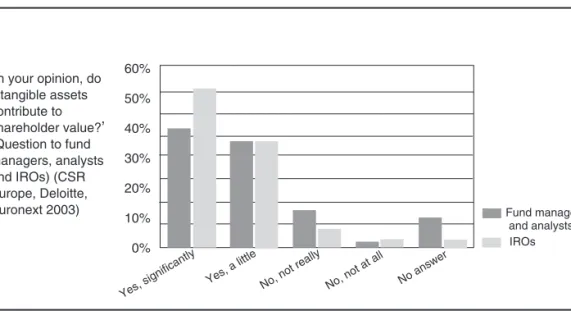
52 percent of respondents believe that social and environmental considerations will become a significant aspect of mainstream investment decisions in the next two years. 76% of fund managers and analysts interviewed by CSR Europe see a clear link between non-financial risks and shareholder value and systematically consider issues such as the ability to innovate (65%), corporate governance and risk management (54%) and governance of customer relations (49%).
MATERIALITY
The relationship between key sustainability issues and investment value drivers is clearly critical for SRI and mainstream investors interested in the financial performance of their investments. Identifying these sustainability issues and understanding how they relate to investment value drivers in many ways represents the 'holy grail' [for people and organizations seeking to define and quantify criteria against which CSR performance can be judged and planned].
IN A DEVELOPING DISCIPLINE, THE YARDSTICKS MUST BE REGULARLY REVIEWED
In those circumstances, the CSR will be subject to business failure and there is nothing liable to any stakeholder in this. As research organizations continue to focus on sector-specific issues and risks, the need for a deeper understanding of how business operates in different sectors will be crucial.
THE VOLUNTARY QUALITY STANDARD FOR CORPORATE SUSTAINABILITY AND RESPONSIBILITY RESEARCH
As more research organizations seek to introduce mainstream elements into their methodologies by incorporating financial business models and evaluating issues and impacts against investment value drivers (along with increasing engagement with clients' financial analysts), a greater understanding of financial concepts and - be techniques. be required. One of the key issues that companies have raised with SRI analysis is the lack of understanding of their unique business issues and impacts.
THE ROLE OF MULTINATIONAL COMPANIES IN SUSTAINABLE DEVELOPMENT
They often need to be able to operate in a way that is compatible with sustainable development. It can certainly be said that sustainable development is in the interests of companies.
CHALLENGES FOR MNCS IN CARRYING OUT THEIR BUSINESSES IN A WAY THAT IS COMPATIBLE WITH
The sustainable development challenges facing extractive companies, and their responses, represent in microcosm the fundamental challenge facing multinational companies: whether, and how, to conduct their business in a manner compatible with sustainable development.
SUSTAINABLE DEVELOPMENT
Companies are likely to follow a different approach to sustainable development depending on the sector and the business model they are pursuing. It is easy to imagine that many companies are put off from pursuing a sustainable development approach.
HOW AND WHY DO COMPANIES RESPOND TO THESE CHALLENGES?
Not engaging: The company refuses or fails to engage with the sustainable development agenda, beyond operating according to minimum legal requirements. In addition to these inherent factors, which are largely within the company's power to change, there will be other barriers to following a sustainable development approach, even when a company has decided it wants to.
WHAT WOULD MOVE THE GOALPOSTS?
External pressure from other stakeholders: for example, the decision by the IUCN to declare protected area categories I–IV as no-go areas for extractive companies (see the box "Extractive companies, biodiversity and protected areas: sustainable development means different things to different stakeholders"', page 62 ) has strongly influenced the debate. This is best done when they conduct their normal business in a way that is consistent with the Sustainable Development Goals – the 'sustainable development approach'.
PAYMENTS TRANSPARENCY IN THE EXTRACTIVE SECTORS: SAME PROBLEM, DIFFERENT APPROACHES
In the absence of global rules, global companies must make up the rules as they go along. The main companies in the initiative were all based in the UK – the government lead in the EITI process – and most had been the subject of NGO campaigns on various issues over the past decade.
EXTRACTIVE COMPANIES, BIODIVERSITY AND PROTECTED AREAS: SUSTAINABLE DEVELOPMENT MEANS DIFFERENT
THINGS TO DIFFERENT STAKEHOLDERS
Few companies based in developing countries address the issue at all.7 Although the debate on protected areas is itself complex, biodiversity issues also often draw international attention to projects taking place outside protected areas, calling into question the relative role of government and MNCs pull. the management of development and its secondary environmental and social impacts.
THE PARADOX OF GLOBAL RESPONSIBILITY: WHERE THERE’S A WILL THERE’S A WAY
In the oil industry, one company agreed with ICMM's position, some assess their projects on a case-by-case basis and others leave governments to decide. The paradox of these issues is that, while the outcome of sustainable development may be in the long-term interest of a company, legitimate short-term considerations make early or unilateral action self-defeating.
ACCESS TO MEDICINES – THE BENEFITS OF PREDICTING WHEN GOALPOSTS WILL MOVE
However, historically, mainstream institutional investors have unquestioningly accepted the conventional industry 'wisdom' that excellent environmental and social performance could only be achieved at the cost of lower financial returns for both companies and investors. There is now incontrovertible evidence that superior environmental and social performance actually has direct impacts on risk levels, profitability and stock price performance of public companies.2 The recent pension fund law reform in
A LEGITIMATION CRISIS FOR TRADITIONAL INVESTMENT APPROACHES
The 'prudent fiduciary' equation is slowly but surely being turned on its head; increasingly, fiduciaries are seen as failing in their responsibilities if they do not ensure that environmental and social risks are addressed.
FOUNDATIONS MADE OF SAND
With a single changed assumption, the combined earnings of Intel, Cisco, and Dell, for example, would have changed in an instant from a profit of $4.4 billion to a loss of $1.4 billion for the first three quarters of 2002. Another accounting device - the increasingly popular use of 'pro forma' accounting techniques - allowed the top 100 companies on the US NASDAQ stock exchange to show their investors a combined profit of $82 billion in 2001.
THE ‘ICEBERG BALANCE SHEET’ OF INTANGIBLE VALUE
Yet accounting statements can shed virtually no light on these intangible value and investment risk factors. Among the most powerful of these intangible value drivers are four of the key pillars of CSR, shown in Figure 6.1.
Financial Capital
What is needed instead is a new, more dynamic, 'iceberg balance sheet' approach, one that focuses investors' and senior management's attention where it belongs, on the roughly 80 percent of companies' real value that cannot be explained by traditional not. , Accounting-driven securities analysis: in short, one that provides a focus on leading indicators of performance, not laggards. Yet, despite this, the overwhelming majority of institutional investors find that companies' performance on environmental and social issues is virtually irrelevant to the companies' performance as investments.
CSR: MAKING THE INVESTMENT CASE
Supported by the outperformance of the real CSR index portfolio, the simulation results are impressive and are beginning to attract interest from other public funds in the United States. What makes Contra Costa's results particularly compelling is that they debunk one of the standard rebuttal arguments of CSR investment skeptics in the mainstream investing community.
THE RISE OF ‘FIDUCIARY CAPITALISM’
In some ways, an even more remarkable development was the creation in late 2003 of the Investors Network on Climate Risk (INCR) in the United States. A significant broadening of the scope of what is considered legal fiduciary responsibility to include companies' performance in these areas.
ETHICALLY SCREENED FUNDS AND SEE ENGAGEMENT
Just as ethically screened funds grew in the 1980s and 1990s, a new investment philosophy has entered the socially responsible investing (SRI) arena in the new millennium. The combination of these codes and regulations means that shareholders in the new millennium will enter into an active dialogue with companies' management about their management of SEE risks.
WHAT ARE SEE RISKS?
As a company's shareholder, the investor has both a right and a duty to engage the company in active dialogue about its management strategy and performance. The OFR is likely to suggest that companies should report annually on the material risks facing the business and that the concept of materiality should be broadly drawn.
WHO ARE THE PRACTITIONERS?
It is likely that the discussion about what constitutes materiality will become much clearer when the UK government publishes its operational and financial review (OFR) guidance in 2004.
ELEMENTS OF A SUCCESSFUL ENGAGEMENT?
If the SRI engagement works well, it should be because the interests of the shareholders and management are identical – that the company should be financially successful. The investor may need to develop or demonstrate the significance or business case to the company, and this must be based on a good understanding of the issues.
THE EQUATOR PRINCIPLES
The most successful engagement is not through the media or publicly naming and shaming companies that do not operate according to good JVE standards, although such methods may be a last resort, as can filing shareholder resolutions or voting against the board. Because if you finance something that is dirty or something that harms people, chances are the host government or local people will interfere or even take it from you.'
THE INVESTORS’ STATEMENT ON TRANSPARENCY IN THE EXTRACTIVES SECTOR
The banks "believe this will lead to safer investments on the part of our customers and safer loans on the part of the banks," said Chris Beale, head of Citigroup's global project finance business.
BIODIVERSITY AND THE PALM OIL INDUSTRY
WAL-MART AND NON-DISCRIMINATION
If the investor starts the engagement dialogue with very clear and specific goals, it becomes easier to demonstrate success on one level: that is, the company doing what the investor asked. However, at a deeper level, the question is whether this has really affected the value of the company or the share price, either in the short or long term.
HOW DO COMPANIES RESPOND?
The answer SRI analysts are looking for is that companies that manage SEE risks poorly or not at all need to improve their practices. In assessing whether this has been achieved, and to clearly communicate to companies what the expectations are, it is important to have very clear objectives.
MANAGING PRIORITIES
Encourage all companies to have policies in place and define and implement a process for managing biodiversity impacts. Encourage companies to improve performance in access to medicines, in line with the ISIS best practice framework.
HOW EFFECTIVE IS IT? CASE STUDIES OF SUCCESSFUL ENGAGEMENT BY INVESTORS
GLAXOSMITHKLINE AND DIRECTORS’ REMUNERATION
CORPORATE GOVERNANCE: THE MOST VISIBLE SIGN OF SHAREHOLDER ACTIVISM
CONCERNED INVESTORS REJECT ITV’S ‘GREEN’ POLICY
As with engagement in SEE issues, this tends to be more fruitful than simply voting against management, as it is rare for shareholder decisions to gain enough support to compel a company's management to act. The net result of this activity is that shareholders can have a very significant influence on a company's corporate governance, as demonstrated by the case studies in this chapter.
LIKELY DEVELOPMENTS
It is this experience and logic that puts governance collaboration on the same team as SEE risk or SRI collaboration. We can also expect biodiversity to emerge strongly as an issue in the coming year.
THE END OF THE BEGINNING
For businesses, the big advantage of mutual benefit is that it's not all one-way - it benefits the business too. In many cases, the benefit to the business will be immediate and achieved quickly enough to meet the needs of operational managers.
SUPPLIERS AND CONTRACTORS
Expensive replacements had to be imported and delivery times were often a serious problem for the company. Another mining company worked with a small catering company to help them improve their offering – and then hired them to run the canteen for the company.
DISTRIBUTORS AND RETAILERS
The result was a cheaper and faster solution for the mining company and good business for the engineering workshop. Furthermore, continuing the spirit of cooperation in the construction phase not only saved more – bringing the project significantly under even the revised budget – but brought the oil field into operation about nine months early, with additional benefits to the company's cash flow.
EMPLOYEES
This very successful initiative also led us to work on other possible arrangements to provide consulting skills for the benefit of international development, and we now have a non-profit organization within Accenture – Accenture Development Partnerships. The underlying reason for this was the combination of mutual benefit – they were inclined to give well.
CUSTOMERS, COMMUNITY AND OTHER COMPLEMENTORS
It just goes to show that it's surprising what people will come up with when they're well motivated. It is perhaps also worth mentioning that the mutual benefit approach offers two further benefits when it comes to deciding which corporate community engagement or 'corporate philanthropy' projects and initiatives are right for the company.
HOLISTICALLY SPEAKING
First, the company is looking at issues and concerns it knows about and is thus in a better position to make informed decisions - and to avoid unwittingly getting involved in charity issues that are controversial. And second, it provides a reasonable basis for deciding between different requests for assistance – the company can support those that provide mutual benefit, confident that this will actually promote benefit to the community.
FINALLY
These are just a few examples of how a mutual benefit approach can help solve problems, both for companies and others in society.
MUTUAL BENEFIT AND THE BUSINESS CASE FOR CORPORATE CITIZENSHIP
If the two companies were challenged on what they have spent on protecting the environment, it would be ironic if the less responsible 'clean-up company' was seen as making the biggest contribution. The assessment of the business case for any concrete initiatives can then be made on a more rational basis.
CO-OPETITION
We are very used to thinking about the kinds of games that are played on the school playground. But we are all familiar with team games in which one side could win by making sure the other side performs poorly and, despite efforts to establish rules against fouls etc, this can be a feature of the sport.
BPTT – A CARIBBEAN COLLABORATION
As the old lady said: 'I never vote - she only encourages that.' The voter does have another choice - not to participate in the game - and that is not good for democracy. BP has been instrumental in establishing a bond program that improves capital markets on the islands.
WHAT IS CORPORATE RESPONSIBILITY?
This section looks at the way in which corporate responsibility and a company's framework for corporate governance interact.
CORPORATE RESPONSIBILITY THEMES
These are issues that we now consider to be at the heart of any company's approach to corporate responsibility. Corporate responsibility clearly has a formal side, which provides a strong link in a company's approach to corporate governance.
CORPORATE RESPONSIBILITY AND THE BOARD
These examples show that an effective approach to corporate governance must cover all aspects of corporate responsibility if it is to ensure the long-term viability of the company. Of course, the board also has a less formal role in ensuring the company's approach to social responsibility.
THE CONTEXT FOR CORPORATE GOVERNANCE
Likewise, the company will definitely be more profitable to have employees at work who make the full contribution to the business. By linking the overall approach to corporate responsibility to the long-term goals of the company, the underlying policies have significantly more relevance and context.
BOARD REVIEW OF CORPORATE RESPONSIBILITY
Providing reassurance to the board is a key step in the approach to corporate governance. This two-pronged line allows for independence of advice to the board on the performance of management.
SUMMARY
Providing assurance to the board about the management controls put in place to minimize the risks to the business is an integral part of an effective approach to corporate governance.
WHY ARE COMPANIES AT RISK?
The policies that companies can adopt – and are being adopted by a growing number of companies – are set out in Human Rights: Are You Concerned?, a joint publication between Amnesty International and the Prince of Wales International Business Leaders' Forum. Any company engaged in any economic activity may face the risk of involvement in human rights abuses and the consequences in terms of loss of reputation, business or financial loss.
WHY ARE EXTRACTIVE COMPANIES AT RISK?
The product of this research is a series of mappings of business risks published under the title Business and human rights: a geography of corporate risk, extracts from which have been used as the basis for this chapter. Inadequate handling of security arrangements, real or perceived, underpins many criticisms of the industry's human rights record.
WHY ARE HEAVY MANUFACTURING AND DEFENCE COMPANIES AT RISK?
Companies pursuing such third-party schemes will increase their exposure to allegations of complicity in human rights abuses. There is a lesson here for all companies found to be contributing to human rights abuses through their relationships with oppressive governments – sooner or later they may be held accountable.
WHY ARE INFRASTRUCTURE AND UTILITIES COMPANIES AT RISK?
The rule of law is a prerequisite for the protection of corporate property and human rights. This is most likely to happen when projects in which they are involved are themselves a cause of human rights violations, such as the forced displacement of communities.
WHY ARE PHARMACEUTICAL AND CHEMICAL COMPANIES AT RISK?
The right to health is expressly proclaimed in the Universal Declaration of Human Rights and in Article 12 of the International Covenant on Economic, Social and Cultural Rights. The actions of the chemical industry today can have major consequences for shareholders in the future and are thus a risk management issue.
WHY ARE INFORMATION TECHNOLOGY HARDWARE AND TELECOMMUNICATIONS COMPANIES AT RISK?
The reputation of the chemical sector has suffered significant damage over a number of years as a result of legal action and allegations of negligence over the health effects of its products and operations. Many of the world's Coltan reserves are believed to lie in Africa, with a large concentration in the war-torn Democratic Republic of the Congo.
WHY ARE FOOD AND BEVERAGES COMPANIES AT RISK?
The trend of outsourcing makes it more difficult for some companies to exercise administrative control over the circumstances in which human rights violations occur. They should therefore take steps to integrate human rights into their relationships with suppliers, subcontractors and joint venture partners.
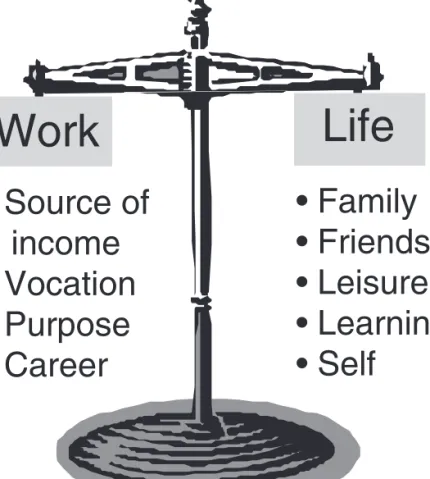
WORK–LIFE BALANCE: A SENSIBLE BALANCE BETWEEN WORK AND LIFE CAN HELP RETAIN THE BEST WORKERS
WORK-LIFE BALANCE: WORK-LIFE BALANCE CAN HELP RETAIN TOP WORKERS. A feature of work-life balance is that it offers staff options to deal with the occasional family crisis or school meeting.
FROM A SLOW START…
TO INCREMENTAL DAMAGE
A FINITE WORLD
However, if the problem was to be properly addressed, the same planning and implementation of strategies through policy needed to be applied to waste management as was applied to the processes that generated it. Waste was as much a part of the economic process as the goods and services provided and had to be treated as such.
WHAT IS WASTE?
Perhaps our definition of waste today should be: something for which no further productive or useful use can be found. If we take that as a definition, then the challenge of waste management is to minimize the amount of waste, because if no productive or useful application can be found, waste becomes a dead weight for the environment, something that fills the space or the entire space takes possession. energy, costs and facilities without commensurate returns.
A WASTE STRATEGY
But no matter how it's done, when packaging is done, the intention is that someone will throw it away. For example, when a motorcycle tire no longer meets the legal requirements for a minimum tread depth, there is a legal requirement to discard it.
DUTY OF CARE
If it is collected by a commercial contractor and not on behalf of a local authority, it is considered commercial or industrial waste, depending on the nature of the business generating the waste. Does the company understand what biodegradable waste it produces and from which parts of the business processes it originates?
WASTE MANAGEMENT
Companies will not have permits or licenses for their production of biodegradable waste; the only reimbursement will be the local authority. If not, why not, and if so, how can these levels be reduced or eliminated in any revision, redesign or update of the process or output?].
WHY ALL THE FUSS?
MAKING MARKETS
If used items from the developed world can be made available at low or no cost as a means of starting these markets, this will ultimately benefit everyone, including the businesses that may have provided the items in the queue. first and that now they will see a new market for their main products. Many charities will recycle used items to help economically disadvantaged members of our society to start their own businesses which, in turn, will bring them back into economically active society and add them to the local market.
BETTER TO THINK AHEAD AND GET AHEAD
It may also be possible to improve the products or services offered by the company, thereby creating a further marketing advantage over the "halo" of a progressive and forward-looking approach attributed to companies perceived by the public as acting in an environmentally responsible manner. It is no coincidence that BMW is one of the first engine manufacturers to comply with this requirement and has had hammers licensed to dispose of or recycle its end-of-life products in the manner for which they were designed.
PREVENTION IS BETTER THAN CURE
The new attitude can be summarized in the phrase 'make the polluter pay', but can also be extended to the new willingness to sue organizations that have engaged in activities that harm people and that have changed the business economy with regard to consequences of human activities on the environment. . In light of this new way of thinking, it is now a much better business practice to consider building environmental risk management into the company's operations, alongside marketing, production, distribution and all the other processes that make up the modern business model.
SO, WHAT IS ENVIRONMENTAL RISK?
The taxpayer, through governments elected to manage tax expenditures, has drawn the line and, with so many other and more legitimate demands on the already stressed expenditure budgets of any country, has chosen not to divert resources that could be used in construction, for example better healthcare to clean up what are now considered avoidable environmental disasters and damage. What it means is that the costs associated with any activity (including those associated with pollution, erosion or other environmental damage caused by waste resulting from the activity) must be borne by those who expect to make a profit from those activities.
SOME COMMON EXAMPLES OF RISK AND CONSEQUENCES
To protect them from the effects of those fumes, employers provide masks with multiple filters and ensure that powerful exhaust fans remove most of the fumes from the spray shop to a safe container. As well as being morally correct, this proper management of the risk will help to avoid prosecution from the health and safety authorities, as well as removing the grounds on which an employee can bring a civil case against the business.
ENVIRONMENTAL DAMAGE AS A BUSINESS RISK
Environmental risk management is about that part of the process and an equally important part as the extraction, collection and distribution of the material extracted from the quarry.
THE PRECAUTIONARY PRINCIPLE
THE CONSEQUENCES OF GETTING IT WRONG
Gone are the days when workers would accept health deterioration or injury or even discomfort as 'part of the job'. In some ways, whether or not a case can be filed or won is less important than the reputation of the business.
WHAT IS RISK ASSESSMENT?
Likewise, the Health and Safety Executive and the various safety agencies that deal with the needs of the railways, airlines and other sectors have also developed a range of risk assessment models that can be adapted to environmental risk assessment. The presence of the IPPC has added some measurable goals to the risk assessment and management process, as part of the risk will be not reaching the IPPC standards, while part of the management will be ensuring that those standards are reached.
RELATIONSHIP TO OTHER MANAGEMENT SYSTEMS
The real reason for putting environmental risk management at the heart of business is that it is good for business to be at the forefront of this area as much as it is in marketing, product design or even budget allocation. The aim of the research was to capture the views of those at the forefront of corporate governance developments so that we could evaluate current practice in this area and its impact on the investment process.
OVERALL TRENDS AND FINDINGS
Another third of institutions have integrated corporate governance specialists into their asset management teams. IROs are unclear about the influence that corporate governance ratings have on the investment process.

INVESTMENT INSTITUTIONS
Perhaps surprisingly, two-thirds of IROs say they have not conducted any formal evaluation of their corporate governance or actively sought investor feedback. Although we have two dedicated employees for corporate governance, our work is largely integrated.
Establishment of specialist function/department
We have increased the team and expanded their responsibilities, partly in response to customer questions. Now it requires that you both talk with companies – in which we invest – and with customers about what is happening.
Reporting line of corporate governance within investment institution
Responsibilities of corporate governance function
Support from third parties and research agencies
There is no point in maximizing shareholder value in the short term if it leads to the destruction of the company in the long term.” You have a long-term perspective and seek long-term, trusted relationships with companies.
Key parameters of good governance
Good corporate governance must avoid the centralization of too much power in one individual and promote fair treatment of all shareholders.'. When you're managing millions of employees' money for their old age, you want a system to be stable and last.
Excellent corporate governance
Common characteristics
I always assume that if someone doesn't want to talk about something, maybe they're not very proud of it; perhaps he prefers the world not to know.' Long-term relationships with shareholders are key, building mutual understanding and trust.'
Importance of corporate governance criteria
Usually they are companies with a long-term approach, companies whose horizons extend beyond the next quarter, companies that invest in their future and do not make short cuts to increase profits in the short term.' At every beauty parade we go to these days, we need to demonstrate that we have resources in the field of corporate governance.
Interaction between corporate governance specialists and fund managers
For the socially responsible funds, the integration of this type of criteria is systematic, for the others not yet, but it is becoming increasingly important.'
Inclusion of governance ratings into valuation models
Link between corporate governance and stock performance
In general, investors demand a higher level of disclosure and want to be informed earlier and more frequently about important matters, such as new appointments and changes in board structure. The information in the annual report could also be expanded through strict disclosure requirements and include more details about individual persons or committee structures.
Increased disclosure in specific areas
Corporate governance and investor relations
Corporate governance in five years
Convergence of standards and codes
The principles of the OECD and ICGN (International Corporate Governance Network) should be the guiding principle of a common European code. Several respondents expressed the view that introducing a single set of codes from the UK or US for Europe or Japan would be inappropriate and potentially counterproductive.
Company compliance and investor confidence
You can adhere to a code and still be greedy and unethical; you can tick all the boxes, but supervision is only on the surface.
Driving force for corporate governance improvements
IR PROFESSIONALS
We have a cross-functional team, including legal, compliance, compensation, accounting, investor relations and corporate communications.”
Reporting lines
Liaison with investor relations
For most IROs, good corporate governance is associated with independent board structures and an appropriate composition of the board. Others expressed the view that corporate governance can be an asset that secures brand value for the future.
Perceived concerns of investors
We must never forget that the most important thing is how you improve the economy, how you drive growth, how you create shareholder value – the sideshow is governance.
Reasons for active engagement in corporate governance
Corporate governance and share price performance
Some participants were convinced that good corporate governance can greatly influence the share price. This year we have independent reports for good corporate governance in our annual report package.
Current focus