Hjh Salma Hj Abdul Latiff∗
1. Introduction
‘We have now come to the moment we have been waiting for, after such a long wait for that which we have been wanting to achieve or possess as conscious Muslims’
These words form part of a royal address of His Majesty The Sultan and Yang Di Pertuan of Brunei Darussalam during the launching ceremony of the Islamic Bank of Brunei Berhad in 1993. It represents the very aspiration of the leader, the government and the people of Brunei Darussalam to have a bank whose method of operations blends with the teachings of Islam – the official religion of Brunei Darussalam.
Brunei Darussalam is an independent Islamic Sultanate situated on the northern coast of Borneo Island. With an area of 5,765 square kilometres, it is home to about 350,000 people. Its economy is dependent on the immense reserves of petroleum and natural gas. With such resources, it allows the people to enjoy one of the highest per capita incomes in Asia. The Sultanate of Brunei Darussalam goes back to the 14th century, and the presence of this long-established monarchy provides the enviable political stability for Brunei.
The way of life in Brunei is very much encircled around its religion. The country has no nightclubs, no serving of alcohols in restaurants and public places, and the ‘halalness’ of food is ensured by the relevant Government departments. With such features, the cardinal concept of ‘Melayu Islam Beraja (MIB)’ or ‘Malay Islam Monarchy’ is maintained and upheld.
Therefore, it is not surprising that His Majesty The Sultan, decreed such
∗ Faculty of Business, Economics and Policy Studies, Universiti Brunei Darussalam.
12
Islamic Banking in Brunei and The Future Role of Centre for Islamic Banking, Finance
and Management (CIBFM)
words as quoted above, when he launched the official opening ceremony of the first Islamic bank. This bank would provide the people of Brunei a step-a giant step, towards living a life that adheres to the teaching of Shari[ah law.
Islamic bank not only abolish the element of ‘riba’ or interest, but also it provides a better socio-economic foundation for the country.
2. Brunei’s Banking Industry
When banking first began in Brunei in 1935,1 with the establishment of a Post Office Savings bank, Islamic bank was non-existent. This establishment did not last due to the Japanese occupation in Brunei and they destroyed all the bank’s records. After the Second World War in the mid forties, Hong Kong and Shanghai Banking Corporation began to operate in Brunei and registered as a branch of a foreign bank. This was followed by Standard Chartered Bank in May 1958. During this time, due to lack of financial regulations, the banks' practices were solely based on English law. With the vast revenues emanating from the oil and gas production which fuelled the Brunei economy with rapid momentum, other regionally registered banks such as Malayan Banking (1960), United Malayan Banking Corporation (1963), and Overseas Union bank (1973) were attracted to joining the viable banking sector. Citibank made their presence in Brunei in 1971. Two local banks, National Bank of Brunei Berhad (1964) and Island Development Bank (1980) were also set up to enlarge the banking industry. However, due to malpractices, National Bank of Brunei was closed down in mid 1980s. Since then the only other local conventional bank that has been established in Brunei is Baiduri Bank Berhad in 1994. The other newly established local banks are based on the Islamic Shari[ah method of operations. Currently, there are ten main banks operating in Brunei, three of which are Islamic based banks.
3. The Development of Islamic Banks
His Majesty The Sultan of Brunei initiated the formation of Islamic bank in Brunei. In his royal speech to the Islamic Religious Council Meeting held in September 1990, he stressed that the establishment of an Islamic bank is important because it is a ‘fard kifayah’ obligation for each Muslim country and Negara Brunei Darussalam. This command initiated the beginning of many more meetings organised by the Islamic Religious Council which resulted in the setting up of a committee known as Formation of Islamic Bank Committee.2
Given the natural setting of Brunei, a Malay, Muslim Monarchy, the introduction of Islamic banking is in fact a preferred method of operating banking transactions. The last two decades have witnessed rapid changes in the banking sector with the emergence of Islamic banking. As mentioned before, there are now three Islamic banks operating in Brunei.
3.1 Tabung Amanah Islam Brunei (TAIB)
Brunei’s first significant commitment to developing a complete Islamic system began in September 1991 with the official opening of Tabung Amanah Islam Brunei (TAIB).3 In his opening address, His Majesty stressed the importance of inculcating Islamic methods of banking. Spoken in Malay, he said, as translated in English.4
‘In the bands of Islamic believers, you will find expertise and wealth, including the expertise of executing Islamic banking rules. The Islamic people have established their own bank. This is evidence that Islamic banking rules can be executed if we wish to have it, an achievement which is considered impossible without the interest element. Such an achievement also confirms that Islam transcends in all time and place.’
(Di tangan umat Islam terdapat kemahiran dan kekayaan, termasuk kemahiran untuk melaksanakan hukm.Orang orang Islam sudah menubuhkan banknya sendiri, iaitu bukti jelas bahawa hokum Islam dapat melaksanakan apabila kita mahu, di mana perkara ini dahulunya dianggap mustahil jika tanpa riba.Kemudian di satu aspek yang lain, kejayaan seperti ini juga membuktikan bahawa ugama Islam adalah sesuai bagi setaip-tiap zaman dan tempat.)
To further stressed the country’s commitment to Islamic banking and finance, His Majesty, in his royal address assured the people of Brunei that His Majesty’s Government will bear all the risk in the event of unexpected consequences. With the grace of Allah S.W.T., this has not proved necessary as the organisation has managed very well in administering the bank.
TAIB is not a commercial bank but is an Islamic trust fund. It offers, to the public, services that comprise of mainly savings and loans accounts. TAIB has been successful because of its concentration in this niche market of savings. The public has a variety of options to choose from when opening a savings account; ranging from accounts such as ‘Akaun Simanja’ (for children below 12) to ‘Akaun Belia’ (for youths) and accounts for adults. Another popular form of savings account is ‘Tekad Haji Akaun’ which is especially for
prospective pilgrims to save for the ‘haj’ pilgrimage. Savings accounts are based either on ‘al-mudarabah’ or ‘al-wadi[ah’. The loan account, which is mainly based on the principles of ‘bay[ bithaman [ajil’, is extended for the purchase of cars, pieces of land, building and renovation of houses, computers and others. To encourage the young Bruneians to aspire to higher educational levels, ‘Akaun Galakan’ has been introduced and it extends loans for tertiary education. As an incentive, if the students succeed in getting excellent results, the Ministry of Education will pay a certain portion of the principal financing amount. More recently, TAIB has responded to the call of the local businessmen and started to offer loans for small and medium size business as well as corporates. Since savings accounts are liable for payment of zakat, TAIB ease the obligations of savers by ensuring that the appropriate zakat payments are deducted at source. TAIB financing to local businesses is normally for the purchase of assets such a machinery and equipments where a term loan is extended to cater for such financing. This is because TAIB, being a trust fund, does neither offer trade- financing facilities nor current account facilities.
Currently, TAIB has five branches across Pan Brunei and two subsidiaries. One of the subsidiaries, Insuran Islam TAIB Sdn. Bhd. provides Takaful insurance services, and the other subsidiary, Darussalam Holdings, provides packages for those who wish to perform ‘[umrah’ or ‘haj’. Both of these subsidiaries have been successful in their operations and they provide invaluable services to Bruneians.
3.2 The Islamic Bank of Brunei Berhad (IBB)
Two years after establishing the trust fund, Brunei officially opened its first fully-fledged Islamic commercial bank called ‘The Islamic Bank of Brunei Berhad’ (IBB). The opening of this Bank was an event that the Government of Brunei and its people were awaiting for as reflected by the Sultan’s royal opening address (Baki, 2000).
Alhamduillah, this dream has now come true from the blessing of our good intentions to comply with the demands of the shara’ which are very challenging…Personal Muslim customers will surely be more confident and relieved with the presence of this system of Islamic banking, as a way out of transgressions due to riba, apart from hoping for lawful benefits and profits from it all which are more barakah (blessed).
Similarly, the departments and agencies of my government will be able to concentrate their financial business
management in this system of Islamic banking as a method or step in practising Islamic regulations and hukm (rulings) within the administration and the financial business of the country.
IBB was initially incorporated on the 2nd July 1980. It was then known as
‘Island Development Bank Berhad’. In June 1986, with the appointment of local Directors to the Board and the reshuffle in management structure, the name was changed to International Bank of Brunei Berhad. Although there were management changes, it was still practising the conventional method of banking. The bank was renamed again in 1993 to its present name, when it started practising Islamic banking principles. The bank began concentrating on becoming a bank for the laymen of Brunei as well as a bank for the local businessmen. This was to assist the locals to use Islamic banking facilities and to deposit their funds in a bank that is 100 per cent owned by the Government.
Although there were teething problems, the bank managed to successfully attract the public to use its facilities. Other than Muslims customers, the bank has also successfully attracted non-Muslims through its current accounts, based on al-mudarabah, which allow the customers to receive a share of the Bank’s profits. This feature is not available in the conventional banks where current account is basically an account that receives and pays on demand with no interest paid to the customer.
The conversion to Islamic banking should not be based solely on replacing interest with profit sharing concept. It must also assist in achieving the socio-economic objectives of an Islamic society. To achieve this objective, IBB has participated in many community services where finance is needed, it also extends ‘qard hasan’ facilities where loans are extended to those who are in grave need of funds without any charges whatsoever and period of repayment is very generous. Other than that, the bank is also in the process of opening a ‘zakat’ counter and act as an [amil (agent) for easing the general public in fulfilling their obligations of paying zakat.
IBB has 13 branches across Pan Brunei, it is currently the bank with the largest number of branches. This strong network across the country enables the bank to reach the public at large from the prominent businessmen in the main business centres to the farmers in the remotest places, such as the Temburong District. Each branch provides the complete range of commercial banking facilities from the basic saving accounts to the more sophisticated trade financing facilities. With a strong and experienced local workforce of 360 officers and staff, the bank has managed to keep abreast
with the developments of the banking industry internationally and the benefits arising from these developments are passed on to the customers.
Besides being a commercial bank, IBB has invested in other related financial activities through its subsidiaries. Currently, there are four subsidiaries and each of them specialises in separate distinct activity as shown in Table - 1.
Table – 1: List of Subsidiaries as at 31st December 20025 Name of
Subsidiary Principal Activity IBB Share of Ownership IBB Capital Asset
Management Funds Management by 2 Equity
Fund companies6 100%
Saujana Sdn Bhd Aircraft leasing of 2 Boeing 767 to RBA on Al-Ijarah principle of financing.
52.5%
IBB Transport
Sdn. Bhd. Vehicle leasing of 21 fuel tankers to Brunei Shell Marketing based on Al- Ijarah
100%
IBB Kredit
Berhad Lease financing on the principle of
Al-Ijarah Thumma Al Bay[ 100%
3.3 Islamic Development Bank of Brunei (IDBB)
Islamic Development Bank Berhad (IDBB) was initially established as a conventional bank in March 1995. It was then known as the Development Bank of Brunei (DBB), a fully government owned banking institution. It was formed to take over the functions of the then Economic Planning Unit whose main task was to assist the local Bumiputras to setup businesses by extending specifically tailored loans to meet their individual business needs.
In order to progress more actively and effectively in this direction, His Majesty ordered that the unit be transformed to a properly structured development bank so as to better meet the demands of the local businessmen.7
On 4th April 2000, The Sultan instructed the bank to operate on Islamic banking principles. The conversion required changes in transactions processing system, and accounting system. Malaysia’s experience and the available technology were studied. Appropriate software were chosen that accommodate the conversion of the extant system with the ease modification.
It took two months to install the new system for savings, current and deposit accounts, which comprise the main database for the Bank. Trainings were also arranged for all management and staff to understand the Islamic concepts of banking. Successfully conversion of IDBB as the second Islamic bank in Brunei was completed on 1st July 2000.
A year after the conversion, in February 2001, IDBB opened its first subsidiary company, Takaful IDBB Sdn Bhd. The company is wholly owned by the Bank and acts as the insurance arm, providing a wide range of Islamic insurance products that cover for property and life, in conformity with Shari[ah principles, including General Takaful Business and Family Takaful Business. Now, about three years after the conversion, IDBB has introduced many new Islamic products such as Eze-Net Islamic Internet Banking and more recently the first Islamic credit card in Brunei.
4. Brunei Financial Regulatory Setup
The regulation of financial and banking sector in Brunei falls under the authority of the Ministry of Finance. Financial Institutions Division (FID), a division within the Ministry, has the task of supervising all banks and financial institutions operating in the country, including Islamic banking. All banks in Brunei operate within the operational framework as regulated by the Banking Act of 1956. However, for the Islamic banks they also have to satisfy the regulatory framework set by the Islamic Banking Act Cap 186.
The Brunei Currency Board (BCB)8 is also another division within the same Ministry. Other than issuing currency notes and coins, its other salient role is to control and maintain the circulation of Brunei currency whereby the external and liquid assets must exceed the statutory limits of 70 per cent and 30 per cent respectively9. A currency inter-changeability agreement exists between Brunei and Singapore that allows the currency to be interchangeable at par value. It must be noted that prior to the establishment of FID in 1993, banking matters were under the supervision of the currency board. Whilst this Board handles the local currency issues, the Brunei Investment Agency (BIA), another division established in 1995, is entrusted to handle the foreign investments and the country’s reserves.
Organisational Structure of Ministry of Finance10
Brunei International Financial Centre (BIFC) is another division within this Ministry which provides the infrastructure to conduct regional and international business. Under this department, various international legislations have been introduced in recent years such as the International Banking Order (2000), International Business Companies Order (2000)11, Securities Order (2001) and International Insurance and Takaful Order and others. These legislations provide the legal framework for Brunei to establish global business partners.
As described above, there is no central bank in Brunei and the Ministry of Finance holds jurisdiction over financial activities of the country and regulates the banks operating within the country through the various Banking and Finance Acts.
5. Evaluation of the Performance of the Islamic Banks vis-à-vis Conventional Banks in Brunei
It is now about thirteen years since the first Islamic financial institution was established in Brunei. During this period we have witnessed a rapid growth as evident by the number of branches that have been opened throughout Pan Brunei, subsidiaries extending related banking and financial activities such as insurance, al-ijarah vehicle financing and also al-rahn pawning. Furthermore, the range of Islamic products offered by Islamic banks has also grown remarkably. Another perhaps more effective method of evaluating the performance of Islamic banks in Brunei is to analyse the
MINISTRY OF FINANCE
FISCAL INT’L AFFAIRS MONETARY
BCB BUDGET FID BIFC
& POLICY BUDGET
&
POLICY REV.
&
POLICY
STATE TENDER BOARD
ADMN
movement of assets and deposits shifting from the conventional banks to the Islamic banks. Such empirical study is useful as it is no longer a speculation since it is supported by key data. However, obtaining such data is difficult since not all statistics are available for in-depth studies. In the following analysis, I shall try to show trends in the movement of key variables, but would advise that in some cases the data is incomplete.
5.1 Total Deposits
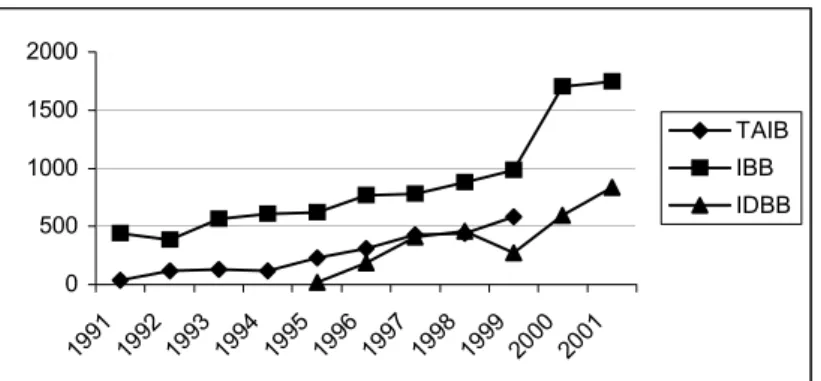
Total deposits, in this context, comprise of current, fixed, savings accounts and other deposits. It does not include amount due to banks (within or outside Brunei) or other miscellaneous liabilities. The records for these diagrams are sourced from the respective Islamic banks’ annual reports, Brunei Darussalam Statistical Yearbook and reports from the Financial Institution Division in the Ministry of Finance. Detail breakdowns of deposits can be found from 1998 onwards, however records based from the Statistical Yearbook go as far back as 1991. Due to the constitution of TAIB, which is considered as a trust fund rather than a commercial bank, the figures from the Government sources normally exclude TAIB records.
Firstly, looking at Islamic institutions, we see a steady increase of total deposits (Diagram 1). The diagram also shows that after the conversion IBB (1993) and IDBB (2000), there is no negative effect on total deposit; on the contrary, there is continuous upward trend for all the Islamic banks. There is a sharp increase in deposits in year 2000, which is not only contributed by IDBB conversion, but in fact largely due to a sharp increase in IBB’s deposits by 73 per cent of its previous year deposit. This trend in deposits did not cut off at year-end but in fact, remained consistent into the end of the following year, hence we can assume the increase to be a long-term.
0 500 1000 1500 2000
1991 1992
1993 1994
1995 1996
1997 1998
1999 2000
2001
TAIB IBB IDBB
Source: Compiled data from Annual Reports of Respective Banks
Diagram 1: Total Deposits of the three Islamic Institutions
Secondly, we make comparisons of the Islamic banks total deposits vis- à-vis the conventional banks. Although there is a marked increasing trend in deposits of current, fixed and savings account for both Islamic and conventional banks (see Diagram 2), the level has stagnated in the last two years. The market share of the Islamic banks for deposits stood at around 25 per cent, but we must be reminded that this does not take into account TAIB’s deposits.
0 2000 4000 6000 8000 10000
1992 1993 1994 1995 1996 1997 1998 1999 2000 2001 2002
Conventional Islamic Total
Source: Brunei Currency Board, and Ministry of Finance.
Source: Brunei Currency Board, and Ministry of Finance.
Diagram 2: Breakdown of Conventional and Islamic Banks Total Deposits.
Diagram 3: Market Share of Deposits of Islamic Banks (IBB & DBB)
Market Share
0.00%
5.00%
10.00%
15.00%
20.00%
25.00%
30.00%
1992 1993
1994 1995
1996 1997
1998 1999
2000 2001
2002
Market Share
0.00%
5.00%
10.00%
15.00%
20.00%
25.00%
30.00%
1993 1994 1995 1996 1997 1998 1999
Market Share
Market
Share(excl.TAIB)
TAIB’s annual report is available up to year ended December 1999 therefore we can only ascertain its effect on the banking industry up to that year. Up to 1999, IDBB was then still a conventional bank and hence the Islamic bank’s share during the period of 1993 to1999 as shown in Diagram 4, comprised of TAIB and IBB. We highlight that with TAIB figure added on, the market share as at 1999 is a high 26 per cent. We can therefore deduce that if we can project and include TAIB’s share of deposits into the diagram for 2002 (given that TAIB performance since 1999 to current has been steady), the current market share of total deposits would be higher than the current 25 per cent.
Sources : Brunei Currency Board, MoF, and Annual Reports of TAIB and IBB.
5.2 Total Equity and Reserve
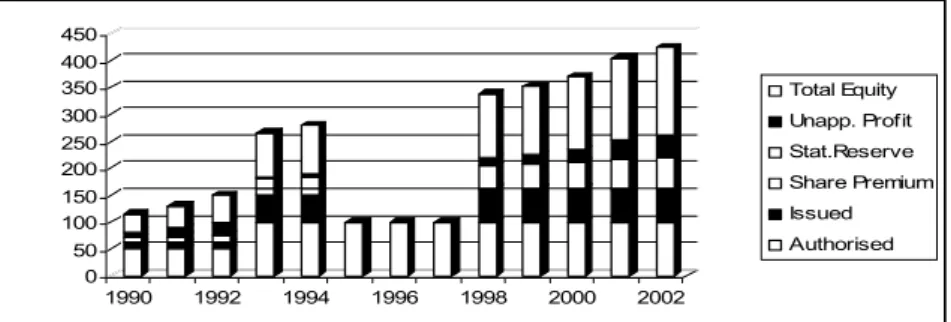
Total equity which comprise paid up capital, reserves and undistributed profit, measures the financial strength of the bank. For Trust Fund, this would comprise of reserve carried forward, profit and dividend paid out.
5.2.1 TAIB’s Reserve
TAIB started with slight teething problems and then managed to overcome the difficulties and then continue to grow in strength up to the present time. With a Government fund of Brunei Dollar (BND)10 million for initial reserve fund, the trust fund is showing a high total reserve of BND26 million in 1999 and expected to be much higher than this figure by now.
Dividend paid out during the 9-year period ending 31st December 1999, averaged at BND11.2 million per year, an impressive performance for a trust fund that began with some difficulties.
Diagram 4: Market Share of Total Deposits with and without TAIB’s share
-30 -20 -10 0 10 20 30 40
1991 1992 1993 1994 1995 1996 1997 1998 1999
Balance c/f
Profit/Loss for the year Dividend pay out TOTAL RESERVE FUND
0 50 100 150 200 250 300 350 400 450
1990 1992 1994 1996 1998 2000 2002
Total Equity Unapp. Profit Stat.Reserve Share Premium Issued Authorised
There is no current annual report at hand to analyse the present performance of the Trust Fund. However, with the increasing number of customers opening accounts in particular for Haj pilgrimage and no adverse reports, we can anticipate continuing progress and stronger performance for the future.
5.2.2 IBB’s Equity
Issued capital of BND12 million was increased in 1993 by way of bonus share issued by capitalising its unappropriated share by BND24 million and by issuing 14 million ordinary shares for cash at a premium of BND1.00 per share by public offer. The authorised and issued share capital were also sub- divided in 1993 from shares of BND10.00 each into shares of BND1.00 each, and an increase in the authorised share capital to BND100 million at BND1.00 each. The increases in both authorised and issued share capital was to support the growing activities of the bank – in terms of rising deposits on one hand and affording of loans and advances on the other.
Diagram 5: TAIB’s Reserve Funds (1991-1999)
Source: Compiled from TAIB Annual Reports 1991-1999
Source: Compiled from Annual Reports of IBB. No info for 1995 to 1997
Diagram 6: Total Equity of IBB (BND Millions)
-100 0 100 200 300 400 500 600 700
1995 1996 1997 1998 1999 2000 2001
Total Equity Accu. Profit/(Loss) Statutory Reserve Issued Share Cpaital
In 2002, the bank boosts a high total equity of BND162 million which far exceeds its extant authorised capital and will facilitate further growth in terms of expanding its branches or creating new subsidiaries to fuel the country’s financial activities.
5.2.3 IDBB’s Equity
IDBB started off as a conventional bank in March1995, with an authorised share capital of BND400 million. As with most organisations it started with a loss, of slightly more than half a million, but immediately bounced into profit the following year. Since then the Bank has strengthened year after year. The gradual increase of issued share capital from BND139 million to its present BND271 million indicates the country’s commitment to assist businessmen in undertaking developments for economic growth.
Overall, all the Islamic banks have performed remarkably well with the shareholders’ funds strengthening year after year. This facilitates the banks to invest further in new subsidiaries and new products.
Source: Compiled data from IDBB’s Annual Reports.
Diagram 7: IDBB’s Equity Capital from 1995 to 2001 (BND Million)
5.3 Loans and Advances
0 500 1000 1500 2000 2500 3000
1998 1999 2000 2001 2002
Conventional Bank Islamic Banks
The diagram above provides evidence of a marked shift in affording of loans and advances to the public. The market share for loans extended by Islamic banking in 1998 is 23 per cent, but within two years, it increased to 49 per cent. However, in the next following years, the growth has remained stagnant at the same level. A further analysis of the breakdown of lending (see Diagram 9), indicates that although the high growth in the loans and advances took place it is more in the direction of consumption rather than production. Lending to manufacturing sector for the total five years averages at a low BND6.7 million as opposed to BND99 million by the conventional banks.
0.00
% 5.00
% 10.00
% 15.00
% 20.00
% 25.00
% 30.00
% 35.00
% 40.00
% Personal loans
Transportation Construction General Commerce Mortgage Others
2002 2001 2000 1999 1998
Source: Financial Institutions Division, Ministry of Finance.
Diagram 8: Loans and Advances by Conventional and Islamic Banks for 5 years, 1998 to 2002 (BND Million)
Diagram 9: Breakdown of the market share of Islamic Banks to main lending sectors.
0 1000 2000 3000 4000 5000 6000 7000 8000 9000
1998 1999 2000 2001 2002
Conventional Banks
!slamic banks
Islamic banks have to shift its lending direction to productive projects such as agriculture, construction, general commerce and professional services.
Islamic banks have to be active in lending to these sectors which will assist the Brunei Government in its effort to diversify Brunei economy and facilitate local businessmen to venture into these sectors.
Islamic banks have maintained a close scrutiny on the provisions of bad and doubtful debts. The policies practised by the banks for provision of debts are similar to international standards. Loans are divided into substandard, doubtful and loss provisions. High provisions of 55 to 100 per cent are made on doubtful and loss loans after taking into account all realisable collaterals to back the lending. Currently, the provision for bad debts as a percentage of total loans and advances for the Islamic banks group is in single digit. This is a good indication of cautious lending and the banks must continue to practise due care to ensure that the provision for bad debts do not turn to double digits. Stringent credit lending policies and firm covenants must continue to be the cornerstone of lending to ensure that the lending portfolio comprises of performing loans.
5.4 Total Assets
Total assets comprise of cash, placements and balance with banks in and outside of Brunei, loans and advances, investments and other miscellaneous assets. Although we have the information of banks’ assets from 1991, the subdivision between Islamic and conventional banks is only available from 1998 to 2002 as shown in Diagram 10.
Overall banks assets increased by 27 per cent between 1998 and 2002, but Islamic banks growth rate of total assets during the same period had been a remarkable 210 per cent. In 2000-2002, the trend in the conventional banks
13% Total Asset
31% Total Asset
Diagram 10: Total Assets of Islamic Banks vs. Conventional Banks
Source: Ministry of Finance.
0%
10%
20%
30%
40%
50%
60%
70%
1991 1992 1993 1994 1995 1996 1997 1998 1999 2000 2001
% amt due to fr out.
ROE -IBB
0.00%
5.00%
10.00%
15.00%
1997 1998 1999 2000 2001
ROE- I DBB
0 .0 0%
1.0 0%
2 .0 0%
3 .0 0%
4 .0 0%
5 .0 0%
1997 1998 199 9 200 0 2 001
as a group shrank slightly by 12 per cent. A plausible reason is IDBB’s conversion to Islamic bank in 2000. However, we must be again reminded that the above figures, which are derived from Government Statistics, excludes TAIB, which, in fact, if included, will raise the figures for Islamic banks even higher than what is shown above.
However, although total supply of funds is growing, a large proportion of the funds are parked outside of Brunei, in overseas banks (see Diagram 11).
This may indicates either lack of lucrative local investments or the more attractive investment rates offered by banks outside Brunei or both. Most banks in Brunei parked their overnight surplus funds in neighbouring country Singapore to gain from interest given for overnight deposits.
5.5 Profitability Ratio – Return on Equity (ROE)
Source: IBB, compiled from Annual Reports Source: IDBB, compiled from Annual Reports Source: Brunei Currency Board, Financial Institution Division, Ministry of Finance.
Diagram 11: Percentage of Amount due from Banks Outside over Total Assets from 1991 to 2001.
Diagram 12: ROE of IBB and IDBB
The above diagrams traced the ROE of both IBB and IDBB. ROE is measured by taking the profit after taxation and zakat over ordinary share capital and reserves. The amount of zakat is calculated based on a set formula on net profit before income tax to comply with the principles of Shari[ah.
IBB, after 10 years of operating as an Islamic bank has maintained an upward trend in ROE. The average rate of return on equity for the period 1997-2001 for IBB was 9.5 per cent. The benchmark for rate of return on equity for the Top 1000 banks in the world was 15.08 per cent during 1994- 1998.12 Iqbal (2000)13 conducted a survey on 12 Islamic banks operating in various Islamic countries and stated that only six out of the twelve Islamic banks scored higher rates than 15.05 per cent. Although the period is not the same, it gives us an objective benchmark of IBB performance on profitability.
The rate of return on equity confirms that IBB has built the foundation for going forward with success for the second ten years.
IDBB has also performed well given that it only had two years of experience as an Islamic bank. Similar to IBB, the bank has had its fair share of teething problems. In 2001, IDBB earnings from operating income after tax was recorded at BND10 million. As a new Islamic bank, IDBB is building a strong footing in Islamic banking and will progressively achieve positive growth.
As for TAIB, it is not plausible to apply the rate of return on equity for measuring its profitability. There are a couple of reasons to this; firstly, as stated in their annual report, TAIB does not pay zakat because the Syariah Advisory Council is of the opinion that it is not subject to zakat, and secondly the trust fund is funded by reserve which is the cumulative effect of income over expenses over the years of operations. Nevertheless, based on its latest available audited accounts of 1999, the trust fund reported a profit of BND24 million. If we were to date back to its humble beginning, the trust fund started off in 1991 with BND 10 million as opposed to a reserve of BND26 million in 1999.
6. The Next Step Forward
Overall, Islamic banks have proved to be successful and active participators of the banking industry. Their presence in the industry has grown in strength year after year since initiation. The analysis of their financial performance has indicated that Islamic banks can be serious competitors to the conventional banks.
However, the next step forward is very important in terms of sustainability. What would be the right direction for Islamic banks to adopt?
This depends on how the Government intends to expand its economic activities.
The Government of His Majesty has many times expressed its plan to make Brunei a financial hub for Islamic banks. This intention was first mooted in the Government's Fifth National Plan. There are strong incentives for the investors to invest in Brunei, for example, there is no restriction on importing capital from any country, or on overseas remittances of capital or profit. Non-resident accounts can be maintained and there is no restriction on borrowing by non-residents. Furthermore, over the last fifteen years, Brunei Darussalam has poised itself as a Muslim country, where Muslims around the world can expect that activities conducted are adhered to Islamic principles, from the food and drink that they consume to social gatherings and business dealings. This in itself presents a competitive edge.
However, the present level of development of Islamic finance in Brunei is not sufficient to attract the investors since it does not offer any new Islamic instruments nor Brunei Darussalam has an Islamic financial market to facilitate Islamic investments. Brunei Darussalam has to develop a financial intermediary market for the transaction of Islamic bonds and other money market instruments.
An example would be to initiate sukuk al-ijarah (leasing bonds) or sukuk al-mudarabah bonds. Sukuk al-ijarah can be used for the purchase of large capital assets such as oil tankers or aircrafts where the bond is asset-backed and a fixed income stream is established through a master ijarah agreement via a SPV. Sukuk al-mudarabah is another bond facility where the Government or venture capitalist may issue revenue bonds to finance certain Government projects, for example, the construction of a highway. The income is derived from the fees collected from users of the facility, for example, toll fees can be steadily collected from the users of the highway.
However, to open up a bond market, several measures have to be undertaken to lay the groundwork. To develop an Islamic inter-bank money market for buying and selling of Islamic financial instruments would require a more sophisticated financial market environment with legislation to form the legal framework and financial intermediaries to support and undertake the transactions. The vision in setting up an Islamic inter-bank money market by linking the Islamic institutions and the instruments will give Brunei Darussalam the depth to the Islamic financial system.
Another pre-requisite of Islamic banking and finance is capacity building.
To design, develop and implement Islamic financial instruments, Brunei Darussalam requires the necessary skill and manpower. Here, the Centre for Islamic Banking, Finance and Management (CIBFM) can play an important role in the development of Islamic banking in Brunei Darussalam.
7. The Centre for Islamic Banking, Finance and Management (CIBFM)
The establishment of the Centre for Islamic Banking, Finance and Management (CIBFM), was first initiated in early 2000. The previous Vice- Chancellor, Allahyarham Dato Paduka Seri Setia Professor Dr. Hj Awang Mahmud Saedon Bin Haji Othman, showed great enthusiasm in setting up of this Centre and together with the Ministry of Finance began to form the initial its idea. This enthusiasm is very much shared by the present Vice- Chancellor, Dr Haji Ismail Bin Duraman who has continued in supporting plans to develop the Centre by ensuring that the groundwork for the Centre is progressing as scheduled. The mission statement of the Centre is to provide necessary support for Brunei Darussalam to create, propagate and maintain a unique Islamic foundation for banking, finance and management operations. This mission is in line with the University’s aspiration to not only play an academic role but more importantly, to assist the Government in their national development plans.
The Centre is considered an important endeavour for the University as well as for the country because of the goals that it aims to fulfil, which are:
• To provide a foundation of learning for the people of Brunei in their ongoing pursuit for the establishment of an Islamic financial and banking hub, regionally and internationally;
• To provide the necessary infrastructure for Brunei to propagate and maintain Islamic banking, finance and management institutions;
• To act as a centre for the implementation of Islamic knowledge by working in coalition with the Government Ministries as well as with the banking and business communities.
The Centre will be under the umbrella of the University in the same capacity as other faculties. It will be autonomous in so far as managing its own activities, but the monitoring of academic standards and the awarding of certificates are centralised at the University senate level.
• Educational foundation
In order to provide opportunities for learning, the Centre has initiated several structured programs at various levels which will require the approval of the University academic planning committee. However, to set the learning in progress, a minor in Islamic banking and finance has been introduced two years ago, offering the students at undergraduate and post-graduate levels the opportunity to learn Islamic business knowledge such as Islamic accounting, Islamic management ethics, Islamic business and finance, Islamic jurisprudence, Islamic transactions and many others. This program is currently being set up as part of the specialised and minor program offered by the Department of Business Studies, one of the three departments which formed the Faculty of Business, Economics and Policy Studies. Other departments and faculties within the University are also offering Islamic knowledge, and the Centre will pull together the teachings relating to business, management and banking under the roof of the Centre to gain from the synergy of combined knowledge.
Other than offering programs to undergraduate and postgraduate levels to University students, the Centre has the mission to provide short courses and programs to those outside the University’s community. These target groups are the bankers, businessmen, young professionals and the interested public at large in Brunei and abroad, who wish to pursue knowledge in Islamic banking, business and management studies. In order to ensure the practical relevance of the course, the Centre will ensure the participations of the professionals and experienced businessmen and bankers to provide valuable practical knowledge and information of the business world.
• Resource Unit
The Centre will be equipped with a resource unit which will be accessible to University students as well as the business and public at large. The plan is to equip the resource unit with the latest technology in terms of accessing information via internet and other electronic devices. This would allow networking with other Islamic centres and agencies as well as the banking and business communities. The resource unit will be housing books, journals and magazines from publications over the world. The Centre would also plan to get the collaboration of the banks in Brunei to participate in maintaining the resource unit as one of the best resource centres in the region.
• Forums, conferences and seminars
This Centre has established relationships with many Universities from abroad as well as organisations that are promoting Islamic knowledge. The
networking will set the foundation for the Centre to organise conferences and seminars by securing eminent speakers and practitioners. A good example is this conference itself where Universiti Brunei Darussalam and Islamic Development Bank, Jeddah join hands to make this meeting possible. The gatherings of eminent scholars and practitioners such as this is very rare and its value is immeasurable – it is a meeting of minds and Insha’ Allah the experienced and the new-comers of this discipline will intermingle and learn and nourish one another.
• Research Centre
Perhaps one of the most important roles that the Centre will play is to promote research work in the area of Islamic banking, finance and management. It is suggested that banks, in particular the Islamic banks, can play a role here which will help in developing the Islamic financial market. As mentioned earlier, Brunei needs to create a more sophisticated financial centre. Endowment from banks to recruit researchers in this area will be one of the first stepping stones towards this direction. Government departments such as Ministry of Finance can also benefit in this area by financing researchers to work in depth on certain projects that can assist in implementing Islamic financial instruments.
• Strategic partners with Brunei banking and business community Currently, banks and business organisations look to the neighbouring countries for the training of their human resources which is costly. With the presence of the Centre, banks and business organisations can discuss their training needs and custom made courses can be designed to close the knowledge gaps of each individual organisation. Working as strategic partners with these organisations is a win-win situation, because not only will the organisation incur less expenses, the Centre will be able to understand the problems encountered by the organisations and assist in reaching solutions.
Publications
A long-term objective is also hopes to have the Centre take lead in publicity in the area of its interest. We expect students and researchers to write papers and project assignments that are of quality and that are useful for public consumption.
For the Centre to achieve its objectives as listed above, it would require a staff of high calibre that is willing not only to serve the University’s community but also to work closely with the public. At the initial stage, the Centre will work with adjunct lecturers from various other Faculties, in particular the Faculty of Business, Economics and Policy Studies and the
Sultan Haji Omar Ali Saifuddien Institute of Islamic Studies Lecturers from these faculties will be required to assist with the teaching requirements. In the long run, the Centre will have its own permanent staff to support its activities. Currently there are several permanent lecturers who have been recruited for the Centre. However, these lecturers will be able to contribute most effectively on their return after obtaining a doctorate level qualification.
In the meantime, the Centre will depend on lecturers that will be recruited from abroad, those who are well acknowledged in their respective fields of specialisation. Researches will also be given teaching responsibilities and to transfer their specialised area of knowledge to the students. Since the Centre will be running in full force in 2006, a complete team of specialised lecturers would be on hand to provide the necessary support as required by the Centre.
8. Conclusion
This paper documents the progress that Islamic banking has achieved in Brunei since its introduction twelve years ago. It presents a detail analysis of the financial performance of the Islamic banks of which it confirms that the first step in the development of Islamic banking has taken place in Brunei Darussalam. The paper further states that the country is ready to take the next giant step; which is for the country to develop an international Islamic financial market. One of the prerequisites needed to carry out such a noble plan is to ensure that the country develops its capacity building requirement so as to put in place the skills and knowledge needed for creating and implementing a more sophisticated financial environment. In this respect, the Centre will contribute and play an important role of ensuring that skills and knowledge are acquired by the people of Brunei Darussalam to support the Government’s National Development Plan of making the country an Islamic financial hub. However, other prerequisites such as legal framework, standardising Shari[ah compliance regulations, introducing new Islamic financial instruments, establishing rating agencies and other infrastructures are essential to turn this into reality.
Islamic banking is rapidly growing in Brunei Darussalam. Since the introduction of Islamic banking, the banking industry has experienced tremendous change. Based on the principle of fard kifayah (religious obligations), we have to ensure that Islamic banking continues to grow. This is to sustain its existence and to present itself as a proven alternative to conventional banking. To keep the momentum going, the next giant step as mentioned above must be taken seriously. Twelve years ago, we never
thought it possible for Islamic banks to thrive and prosper. Are we now ready for the next step?
To conclude this paper, it would be most appropriate to quote the royal address made by His Majesty during the launching ceremony of the Islamic Bank of Brunei, in 1993:
The system of Islamic finance that we are striving at is a vision and a far-reaching mission which extends beyond the demands of this life. It will Insha’ Allah be inherited by our descendants. May it last and remain strong and successful so as to stand as proof in front of Allah that we have indeed been steadfast and sincere in carrying out Islamic regulations in Negara Brunei Darussalam.
Notes
1 Ebrahim (2001).
2 Baki (2000), pp 87.
3 Salma L. (mimeographed).
4 Salma L., Razali M. Z. and Ismail D. (2003).
5 IBB Annual General Meeting Report 2003, pp 16.
6 Based on two Equity Funds, namely Global Equity Fund and IBB Asia Equity as certified on the seal of Trust Deed dated November 1995 and December 1996 respectively.
7 Salma L. (mimeographed).
8 BCB was established by the 1967 Currency Act in Chapter 32 of the Laws of Brunei
9 http://www.finance.gov.bn/bcb/bcb_index.htm (20th December 2003).
10 http://www.finance.gov.bn (20th December 2003).
11 This legislation contains provision for tax-free facilities at highly competitive cost levels. Brunei is more concerned with attracting a critical mass of good business than a fee-based income stream at a high cost to end-users. For details see http://www.bifc.finance.gov.bn/ (20th December 2003).
12 Iqbal (2000), p. 379.
13 Iqbal (2000), p. 379.
References
Economic Development Planning Unit (2003), Brunei Government Statistical Data 2003.
DSS Awang Hj Metussin Bin Haji Baki (2000), Quranic Verses on Transactions, Published by State Mufti’s Office, pp 87.
Ebrahim S. M., et al. (2001), "Islamic Banking in Brunei Darussalam", International Journal of Social Economics Vol.28, No.4, pp 327, MCB University Press.
IBB, Financial Reports and Annual General Meeting Report.
IDBB, Financial Reports and Annual General Meeting Report, http://www.finance.gov.bn/bcb/bcb_index.htm (20th December 2003).
Iqbal, Munawar (2000), “Islamic and Conventional Banking in the 1990s: A Comparative Study” in Islamic Banking and Finance: Current Developments in Theory and Practice, Leicester, UK: The Islamic Foundation, pp 379.
Salma, L. (mimeographed), “Issues Arising in the conversion of an Interest- based Bank to an Islamic bank- A study of IDBB”, delivered in a conference in Brunei 2002. To be published.
Salma L., Razali M. Z. and Ismail D. (2003), The Prospect of Islamic Business Transactions in Negara Brunei Darussalam, Brunei: Universiti Brunei Darussalam.
TAIB, Financials and Annual General Meeting Report.