Vol. 4 No. 2 (2022), 209-238; DOI: https://dx.doi.org/10.21580/jiafr.2022.4.2.12633 Received 2022-09-02 Accepted 2022-10-29
Journal of Islamic Accounting and Finance Research– Vol. 4 No. 2 (2022)
JIAFR | 209
Islamic household accounting: romance discussion in accounting curriculum
Krisno Septyan,1 Iwan Triyuwono,2 Rosidi,3 Aji Dedi Mulawarman,4 Achdiar Redy Setiawan5
1Universitas Pembangunan Nasional Veteran Jakarta, Indonesia
2,3,4Universitas Brawijaya Malang, Indonesia
5Universiti Sains Malaysia, Malaysia email: [email protected] Abstract
Purpose - This study aims to formulate an Islamic household accounting model that should be part of the accounting curriculum.
Method - The method used is grounded theory in constructivism.
The first step is self-consciousness, then consideration of participants, followed by data collection, coding, and theory building. Data were collected from 22 informants, 19 of whom were already married whose educational background is in accounting and who were employed in accounting-related positions.
Result - The results show that households consider that household accounting needs to be included in the formal accounting curriculum, while most of the heads of the household see it as not mandatory. Discussion revolves around household life, how love springs in the household all the way through, as well as an argument that household accounting must be put as a subject (of curriculum). It is also noted that communication in households must cover both material and spiritual aspects in order to pursue true happiness (a serenity state of a household or sakinah).
Implication - Practically, household discussion in classrooms is mandatory for accounting students; this discussion serves as a foothold on how to lead a household life all the way through.
Theoretically, for accountants, a household is a life priority in order to shape a better civilization.
Originality - This topic of romance in the accounting curriculum has never been specifically addressed in classrooms of undergraduate accounting programs.
Keywords: accounting curriculum; household accounting, love, the Qur’an
JIAFR | 210
Introduction
Accounting has adopted the external culture that renders the majority of financial accounting standards in favor of certain groups. A myriad of theories presented to students such as agency theory, positive accounting theory, and economic principles are all directed to ingrain students with the idea of self- interest, in other words, the campus instills egoistic traits in students and takes sides with companies (Kamayanti, 2013; Mulawarman & Kamayanti, 2018, pp. 34–35). Graduates are prepared only to fulfill certain power needs (Mulawarman, 2019, p. 9). They are prepared to become competent in the field of accounting such as becoming auditors, tax consultants, accounting, and the like (Reinstein, Churyk, Taylor, & Williams, 2019). Meanwhile, taken from a humanistic perspective, graduates (accountants) are also human beings assuming other roles as a husband, a wife, a father, a mother, and a child in a small social reality called a household. This fact presents itself with a much larger significance compared with other learning outcomes; yet, unfortunately, the accounting department fails to facilitate that aspect.
Accounting education has been immersed in the perspective of public professionalism and hedonism, meaning that accounting education implies that happiness can be achieved only if material goods (namely money) are generated. Indirectly, this educational pattern will erode sensitivity or conscience in the hearts of accounting students and graduates, that is they have tendencies to bear psychopathic personalities (Bailey, 2017; D’Souza &
Lima, 2015). Although it may sound strange, psychopathy is one of the problems of the Dark Triad (Psychopathy, Machiavellianism, and Narcissism) in psychology which has generated interest in accounting studies. Students are able to understand complex business realities but fail to understand simple private domains such as the household. (Walker & Llewellyn, 2000).
The household is a unique entity formed with love, where the heart resides (Walker & Llewellyn, 2000). Unfortunately, the discussion on household accounting is limited to research or other social programs conducted by lecturers. Lecturers do not teach household accounting directly
JIAFR | 211 in their classes. We note that this is already a topic for discussion in
postgraduate programs, yet limited only to the students taking up that research topic. In fact, undergraduate students need a discussion on household accounting badly, considering their age. More ironically, due to the professional public perspective, the majority of household accounting discussions have been contaminated by the logic of corporate accounting, that the discussion does not go far beyond discussing financial problems (Dewi, Suputra, Sudana, & Gayatri, 2022; Ramlugun, Ramdhony, & Poornima, 2016;
Tamanni & Mukhlisin, 2018; Wahyudi, 2021; Yuliana, Setiawan, & Auliyah, 2020). Indeed, households have economic activities such as production, consumption, and conflict area, and all these are not paid for (Hirway, 2015), and twenty percent of energy consumption in the world also comes from households (Chen, Wu, Guo, Meng, & Li, 2019), but that doesn't mean that one has to be trapped with the way of thinking regarding efficiency and effectiveness adopted by companies. See also, for example (Gustiningsih, Mediaty, Alimuddin, & Kusumawati, 2022) argue that everyone in the household has the role of being a source of income, even though Islam asserts that men and women are different, thus assuming different tasks in household accordingly.
Given that accounting is discursive in nature, that is both influencing and being influenced (Triyuwono, 2012), accounting has different forms in different places (Walker, 2010). Thus, accounting that is born from love must provide information that can inspire love to flourish further. For the sake of a nobler purpose, accounting must support the household goal, which is Sakinah mawadddah wa rahmah (A family with peace, love, and mercy).
Therefore, it is impossible for the discussion to only dwell on finances. To make matter worse, classical references such as (Haskins, 1903, p. 5) have also been abandoned. In fact, he is the earliest reference arguing that the discussion of household accounting requires not only a calculative technique but also other moral and social sciences. Household also stipulates trust, mutual openness, and communication between a husband and a wife (Musdalifa & Mulawarman, 2019; Ramadhani, Purwanti, & Mulawarman,
JIAFR | 212
2021). This is not just about who plays what role, but communication of love needs to be established there, including financial management communication in the household. There are limitations, however, that husbands and wives need to realize (Raharjo & Kamayanti, 2015). The discussion is no longer pursuing material things but has a transcendental nature, that is financial management and other activities in the household are geared toward a grander ideal: to seek rewards from God (Anggraeni et al., 2022). Accounting requires a spirit of love, not material love; even if there is love, love is there to decorate a company's financial statements (McKernan &
Kosmala Maclullich, 2004). So, teachers and students must not fail to prioritize what should be made a priority in this life.
Ontological questions finally emerge to invite readers to reflect on what is the happiest thing in our lives, and whether it is worth fighting for. It is a shame if accounting graduates are able to maintain corporate clients, but fail to maintain their households. The term lovely payable was coined by an auditor and consultant, who has chosen to spend much of his time on his work rather than with his family (Beasley, Buckless, Glover, & Prawitt, 2015, p. 60). This term does not refer to a debt that must be paid but a form of regret that cannot be undone.
The same phenomenon also unfolded when I was conducting pre- research by interviewing one of the informants who actually asked me questions. "Is the wife considered as an asset or a liability?" the question arose when I asked whether accounting education should discuss household accounting. The term "Liquid love" represents an illustration describing the irony of this phenomenon (Bauman, 2003). Household personnel has turned into homo economicus who seek as much wealth as possible overlooking their respective roles at home. The house has a capitalist aura, that is, those in power are those in possession of money. Family absence can be tolerated as long as the reason is financial. The form of household accountability is affected by the style of commercial accounting accountability, namely giving and demanding (Hassan Basri & Nabihah, 2010). For example, a child whose education and life have been paid for by his parents is expected to contribute
JIAFR | 213 to the family income in the future (Bauman, 2003, p. 41; Laksono &
Wulandari, 2019). Another example, the wife's sincere love at home can also be estimated as an economic value after her passing (Spencer, 1913, pp. 162–
163). In short, it is all about how much household accounting can contribute to the modern econom (Walker & Llewellyn, 2000, p. 426). From the wife's point of view, she, who has given her "life" to her husband, has the right to demand more money. In fact, this can lead to corruption and embezzlement on the pretext of family demands; this results from a family not being properly educated by the head of the household. That answers the statement from (Walker & Llewellyn, 2000) suggesting that household accounting has as much impact as accounting practiced by public organizations, or on a macro scale, family resilience is a factor of a country's resilience (Arif, 2018, pp. 173–175; Majdi, 2020, p. 3).
Thus, using the Grounded Theory method, this study attempts to formulate a form of household accounting based on the data collected.
Household accounting must be based upon both the material and spiritual aspects of pursuing happiness. The informants are household actors; they have an educational background in accounting and work as academic accountants as well as practitioners. Some of the informants had backgrounds as auditors at Delloite and Ernst and Young. The rest are accounting graduates who work in accounting fields such as public sector accountants, internal accountants, tax, auditors, and consultants in private companies.
Literature Review
Islam greatly values science. Allah uplifts the status of those who are faithful and knowledgeable in this world and in the hereafter (QS. Al- Mujadallah: 11). The goal of Islamic-based education is not only to educate man but also to uphold ta'dib or civilization or courtesy (Al-Attas, 1992)a more noble goal. In the field of accounting, accounting majors must generate cultured accountants. This culture consists of courtesy towards oneself, the teacher, the teaching process, and most importantly courtesy or adab,
JIAFR | 214
towards God (Alim, 2013; Husaini, 2013; Jama’ah, 2018). This means that Allah's commands exceed any rules, and in this case accounting education essentially must be put as such, as stipulated in the Qur’an. In short, an accounting educational institution (particularly if its authority is held by a Muslim, and the majority of students are also Muslim, even though the department does not use an Islamic label such as the case in the sharia accounting department) must put forward what God wants instead of what the market wants. This is stipulated for example in QS. Ali-Imran: 14 concerning the order of human priorities in this world. It indicates that we must prioritize family over other assets, including work; thus, accounting related to the family must be included in accounting education. The West has made a system based on human nature, yet they regret this and it is reflected in the term “lovely payable” (Beasley et al., 2015, pp. 160–163). By referring to the source of absolute truth, it means that accounting education should lead to ideal well-being and happiness in life, not aspiring to something that is very relative and artificial.
If we aspire to seek an ideal household, it is not enough to discuss merely finances, it is true that halal finance is indeed the basic foundation of a serenity life (Tamanni & Mukhlisin, 2018, p. 5). Another factor to be considered is the non-financial aspect; the fact that husband and wife must understand each other's rights and obligations. All personnel at home must work together, understand each other's obligations to fulfill the rights of their partner, and not demand their own rights per se. For example, the role of a husband is as qawwam, a leader in the house whereas that of a wife is to take care of household affairs (Ashari, 2019; Gustiningsih et al., 2022).
Accounting education requires innovation to express feelings. This is one aspect that is rarely considered in accounting. Rationality dominates accounting education while in the end, students are taught to maximize their efforts and pray to God after experiencing an impasse. This can be seen from the teaching materials and research processes such as Y=a+bx+e. In this equation, God is symbolized by error (e) or guilt (Kamayanti, 2016, p. 5).
Thus, love needs to step in and become part of accounting educatio (Amri,
JIAFR | 215 2017). Epistemologically, humans are endowed with the reason and heart to
explore knowledge more thoroughly. This means that if accounting only relies on either rationality or feelings, the science of accounting is not optimal.
One of the interesting entities and is of concern to researchers is that a household is based on love and almost all feelings exist therein. Household accounting cannot be equated with accounting in business organizations. We can see how the two are formed distinctly. Business organizations start from a group of people aiming to make a profit (Ramlugun et al., 2016) whereas the household is an entity that is built with love so that love grows in it leading to a life that is sakinah mawaddah wa rahmah. Accounting has different forms in different places (Walker, 2010).
Household accounting must not be contaminated by accounting logic in business organizations. Otherwise, it will turn everyone in the household to be profit-oriented, and they will be mobilized to seize as many assets as possible. In such a scenario, leaders are appointed because of the money they possess. That is if one has money, he is then in charge. In short, the capitalist aura is strongly felt in that household bookkeeping, not an Islamic one. In the end, the function of each husband and wife is lost, and this makes us farther away from ideal happiness. After all, wealth and offsprings are something (artificial) to be proud of and a pseudo pleasure (QS. Al-Hadid: 20).
Materialistic accounting is a warning to those who are ready to live rich but not ready to live poor. Even though the condition of being rich and poor is not an absolute measure of goodness (Septyan & Mintoyuwono, 2022), this will have an impact nevertheless on the beginning of a marriage. This is because one’s consideration before marriage is to look at the number of the partner's assets, instead of his (true) wealth: religion. If this continues, the next generation will be the same (as today). The household is the onset of the development of civilization (Majdi, 2020, p. 4). With that in mind, improving the household means improving society.
JIAFR | 216
Research Methods
This study uses the grounded theory method proposed by Charmaz.
Charmaz is the originator of the grounded theory which is constructivist (Charmaz, 2006). The first step that needs to be done in this method is methodological self-awareness. This initial step sets it apart from classical foundational theory (Glaser & Strauss, 1967; Simmons, 2014). The first step is the researcher's self-awareness molded from the experience and the results of the researcher's reflection that experience and knowledge cannot be separated from the researcher himself. Researchers cannot hide their identity; instead, they must know what their self-concept is first (Charmaz, 2019), who the researcher is, and why this topic is so valuable for the researcher (Charmaz & Thornberg, 2020). The grounded theory method is also widely used in accounting research as was done by (Gurd, 2008), (Joannidès & Berland, 2008) who examined the consistency of the use of this method in 23 accounting studies.
The stages of the grounded theory method for constructivists are explained by (Charmaz, 2014), namely: (1) Self-Awareness Methodology, (2) Consideration of Participants. (3) Data Collection (4) Analysis: Constant Comparative Analysis. Coding by connecting one data with other data. (5) The last stage is theory building since we know that non-positivists do not aim to confirm a theory but to build one. To ensure data validity, the researcher also conducted data triangulation or source triangulation to key informants for supporting data and source triangulation for transaction evidence. Data collection from the field and documentaries should be completed when data saturation is reached.
Information was obtained from 22 people, the number suggested by (Creswell, 2013). They have an educational background in accounting, and only three informants are single, while the rest are married. Their profession is still closely related to accounting. Interviews were conducted in various ways, either in person, by telephone, or via online chat. Researchers were forced to conduct interviews via online chat because some of the informants contracted Covid-19, and had to rest completely, making it impossible to have
JIAFR | 217 a conversation via video call let alone meet in person. Their throat hurt when
they spoke, and for that reason, media chat was the most effective way to do that. digging information. However, they responded positively to every question I asked them. They answered in detail and gave their best answer, they also threw back my questions to their colleagues. I also interviewed several other informants by calling them up, in order to get first-hand information and to discuss the topics under study.
Reflexivity is always present in the research process, not just when interpreting data. Provisions that have been designed at the beginning of the study directly help to build sensitivity in obtaining data. In constructivist Grounded Theory, sensitivity theory is not only a collection of experiences but also a dynamic construct in which researchers may have different views (Orland-Barak, 2002). After making observations and interviews with informants, researchers will find meanings. From these meanings then the researchers make coding. The researchers then carry out a comparative constant on all this coding and categorize which codes and categories may have connections with one another so as to form a new formulation of how household accounting discussions should be conducted in the accounting curriculum.
Self-Consciousness
Self-Consciousness, this stage is something that cannot be separated from the researcher himself (Charmaz, 2019). Researchers interact with informants based on their experiences. Knowledge and experience also serve as a two-way dialogue to make the conversation enjoyable. For a married person, marriage is a sacred and loving relationship. Peace in the household does not come from material things. Unless one really believes in this notion, he must be prepared to accept the destruction of his life if the material he possesses thins out or even disappears.
Accounting needs to adapt itself according to where it is born. Accounting takes different forms in different places. As for household, it is described in the Al-Quran Surah Ar-rum verse 21 stating that the purpose of marriage is to
JIAFR | 218
achieve a calm, loving, and affectionate life (Sakinah, mawaddah wa rahmah).
In another verse, peace (Sakinah) is gained not from matters but from God1. This is so without overlooking the financial aspect, as finance also plays an important part in building a serenity household life.
Ontologically, the husband-wife relationship has the strongest relationship compared to the principal-agent relationship, yet some accountants see it the other way around. Finally, accounting fails to prioritize what should be a priority in life. I assert that this strong, husband-wife relationship rests on absolute truth, namely The Koran. God uses the diction of Mitsaqon ghalidha only in three places in The Qur’an. The term (Mitsaqan Ghalidha) itself means a firm agreement. This term also includes the covenant between Allah and His Messengers. So the husband-wife relationship is not a trivial relationship. There must be a logical consequence when the relationship disintegrates, and that will be the destruction of civilization. In comparison, if one principal-agent relationship ends, humans can survive as long as they have a partner who still supports them and still wants to continue living with them. On the other hand, if one husband-wife relationship is destroyed, the impact is not only on the husband and wife, but also on their children psychologically, not to mention the impact on extended family, work, and others. After all, a harmonious household also affects harmony in the company. The sustainability of the household also affects the sustainability of a company. Running companies are not only supported by direct stakeholders (those directly involved in seeking profits such as managers, employees, owners, and stockholders), but also supported by indirect stakeholders such as nature, the people around them, and abandoned stakeholders, namely family. They give support in the form of prayers, wishing for the company to run well, and this, in turn, will result in the smooth payment of wages for its workers. Also, as a result of prayers from its workers and families for the company, the company may last for a long _______________
1 “He is the One Who sent down serenity upon the hearts of the believers… (QS. Al-Fath: 4)”
JIAFR | 219 time. God will build the infrastructures of fortune to be granted to the
employees through the company.
Epistemologically, the process of seeking knowledge based on truth does not only rely solely on rationality but also needs to be integrated with the heart where all feelings and love reside. Because it is based on absolute truth, the household is an ideal ground for discussing romance in accounting education. The feeling of love in the hearts of accounting students needs to be awakened after having been dormant all this time. Further, as accounting is discursive in nature, and born out of love, it must generate information based on love and even needs to inspire love so that it continues to grow.
Results and Discussion Empirical Data
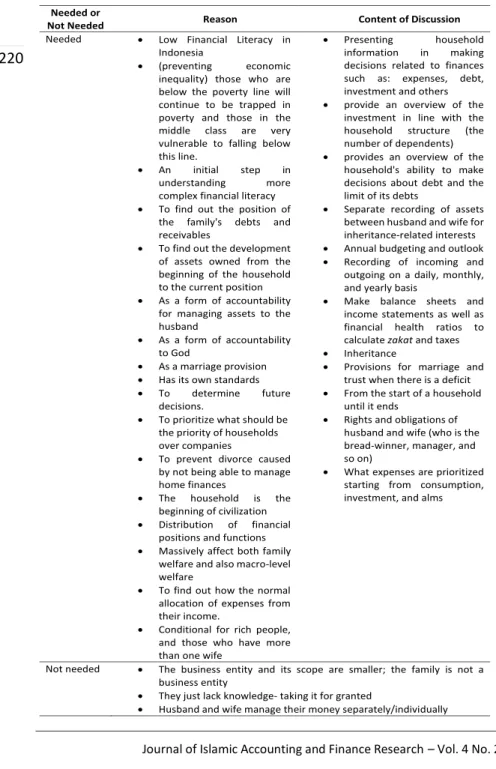
Empirical data gained indicate that household accounting is very much needed in married life and needs to be formally included in the accounting curriculum. This particular statement (data) originated more from wives than it did from husbands. The wives have different work histories; they used to be auditors, accountants, and other professions, but now they prefer to be housewives instead. Having much leisure time to spare at home, they feel that they really need household accounting. The reason behind this is to reduce the gap between the poor and the rich. The gap is caused by very low family financial literacy in society, which finally leads to a divorce. Just like accounting for business organizations that seek going concern for their business, households also expect longevity and comfort in it. For that, household accounting needs to help build family harmony. Does it make sense if a worker of a company is able to manage the company's finances to keep it going but is unable to manage his family's finances and is unable to maintain family happiness? Household accounting is a top priority.
Furthermore, a household is also a place where civilization begins. Hence, good financial management is the first step to producing quality human resources.
JIAFR | 220
Table 1. The urgency of household accounting subject
Needed or
Not Needed Reason Content of Discussion
Needed • Low Financial Literacy in Indonesia
• (preventing economic inequality) those who are below the poverty line will continue to be trapped in poverty and those in the middle class are very vulnerable to falling below this line.
• An initial step in understanding more complex financial literacy
• To find out the position of the family's debts and receivables
• To find out the development of assets owned from the beginning of the household to the current position
• As a form of accountability for managing assets to the husband
• As a form of accountability to God
• As a marriage provision
• Has its own standards
• To determine future decisions.
• To prioritize what should be the priority of households over companies
• To prevent divorce caused by not being able to manage home finances
• The household is the beginning of civilization
• Distribution of financial positions and functions
• Massively affect both family welfare and also macro-level welfare
• To find out how the normal allocation of expenses from their income.
• Conditional for rich people, and those who have more than one wife
• Presenting household information in making decisions related to finances such as: expenses, debt, investment and others
• provide an overview of the investment in line with the household structure (the number of dependents)
• provides an overview of the household's ability to make decisions about debt and the limit of its debts
• Separate recording of assets between husband and wife for inheritance-related interests
• Annual budgeting and outlook
• Recording of incoming and outgoing on a daily, monthly, and yearly basis
• Make balance sheets and income statements as well as financial health ratios to calculate zakat and taxes
• Inheritance
• Provisions for marriage and trust when there is a deficit
• From the start of a household until it ends
• Rights and obligations of husband and wife (who is the bread-winner, manager, and so on)
• What expenses are prioritized starting from consumption, investment, and alms
Not needed • The business entity and its scope are smaller; the family is not a business entity
• They just lack knowledge- taking it for granted
• Husband and wife manage their money separately/individually
JIAFR | 221 One husband also mentioned that although household accounting does
not need to use financial accounting standards such as in commercial accounting, it is still badly needed for relatively complex households; for instance, for men with more than one wife. Every wife has a post for financial management. They also expect to know the development of their assets and know their debt position. From a spiritual perspective, household accounting is a form of a wife's accountability to her husband in managing their finances.
Transcendentally, it is also her accountability to God. In some phenomena, husbands give their wives freedom to manage household finances. As argued before, accountability to the husband also has dimensions as accountability to God. In this regard, Allah needs to be positioned as the highest stakeholder in the household; thus, any financial problems that arise in the family can be easily resolved (Allah’s willing). These financial problems may include financial deficits, debts, and other family financial problems. The foundation needs to be built beforehand on what kind of household it is and who needs to be involved if financial problems in the family arise.
On the other hand, five informants thought that household accounting did not need to be studied because they said that they did not understand family matters and had forgotten about accounting, and just let everything run its course. Every one of them works without giving too much thought to how household finances are managed. Household accounting is viewed by the informants as a very simple financial system; thus, household accounting can be discussed under subjects like basic accounting, financial management, or sharia accounting. However, if the discussion is very broad, like that of a long process from the initial establishment of a company until it closes, then household accounting should be made a separate subject.
The simplest household accounting discussion is the normal allocation of expenses by adjusting household income, financial planning for consumption, investment, and alms. As for the advanced discussion, household accounting must start from the time the household is formed until it ends, due to either divorce or the death of a spouse. In the accounting of business organizations, there is a separation of functions for each department. Similarly, household
JIAFR | 222
accounting also requires the separation of the functions of who is in charge of earning a living, managing, and making decisions. For example, the husband serves as the breadwinner while the wife is the manager. Of course, it must be flexible in a way that it does not necessarily mean that the wife can't work.
Wives can work under certain conditions.
When an entity cannot survive due to divorce, household accounting can be very helpful in terms of the division of assets and the consequences of prenuptial agreements. What's more, the informant suggested that comprehension of the division of inheritance is necessary. He compares it with practices at the Faculty of Law which covers inheritance as a distinct subject. From a non-material perspective, lack of wealth is not seen as the root of household problems or disturbs peace because peace comes from God. God's role is of paramount importance in pursuing household happiness.
Household financial management must also be handled with patience and gratefulness.
Discussion of Household Accounting in Accounting Curriculum The Beginning of a Romance and Wedding Ceremony
Household accounting needs to discuss how households are formed so that the accounting adopted should be full of peace, love, and affection. Halal money is the foundation of peace (Tamanni & Mukhlisin, 2018, pp. 4–6), but money alone is not enough to express true peace. As we know that households have many kinds of conflict. As such, the solution to these conflicts is greatly determined by how a person expresses his pleasure when he falls in love and is under the condition that one initiates a household through a marriage institution.
Introduce yourself to Allah when you are happy, Allah will introduce Himself when you are sad” (HR. Bukhari)
Marriage is a solution and utmost happiness for two people in love. In addition, their expressions of happiness will determine how God plays His role in saving their households in times of trouble. Even so, in the process of marriage and pre-marital marriage, violation of Sharia rules can still be found,
JIAFR | 223 such as (1) committing riba (unjust, exploitative gain) debts (Carnegie &
Walker, 2007; Copur & Eker, 2014) which causes disharmony in the household as they are burdened with marriage debts. (2) cohabitation, namely living together under the same roof without marriage ties before actually getting married; this phase does not guarantee the continuation of marriage (Stevenson & Wolfers, 2007). (3) It is allowed though, to examine potential partners from the worldly side such as marrying foreigners on grounds of better economic factors (Kim, Yang, & Torneo, 2012), and marrying based on race (Seitz, 2002); however, the main factor when choosing one’s spouse should be his/her religion. Everything that underlies the formation of households is the basis for the formation of household accounting which is Sakinah, Mawaddah, and Rahmah.
Separation of Functions Qawaam functions
Father and or husband are men referred to in the Qur'an with the Qawwam function. Ibnu Katsir explained that the word qawwam has several meanings; as a leader, head, judge, and educator of women and the family.
Qawwam serves as a life support because it has the duty to meet the needs of the family. Therefore, the figure of a father turns into a respected person and a judge in the household. The whole family needs to realize the important position of the father. When the qawwam function is slightly disregarded by the family, they slowly reach disharmony.
Qawwam describes the authority of a father or husband, entitled to him due to his function as a breadwinner, feeding wives and children. It is therefore of great importance that the stream of income is halal as a key to serenity life. Halal income will justify fathers to lead the family members.
Ensuring the halal stream of income and its use now turns out to be a topic in public discussion on sharia accounting and finance. So, it’s important to bear in mind that qawwam function deals not only with the financial issue but also with the psychology of the family members. In addition, qawwam acts as a leader, a judge, and a decision-maker at home.
JIAFR | 224
Function of Umm
The Arabic word Amma can change into Umm which means a mother functioning as a role model. The root of this word has several branches that lead to Ummah which means congregation (Mulawarman, 2019, p. 58). As a result, mothers are the first source of civilization as they are role models and the first teacher to their youngsters. They are in charge of preparing the future of their children. Tafarrugh is a requirement for a woman to be a mother which means that she should devote her time to taking care of the household chores and the children (Baharits, 2007, pp. 14–15).
Unfortunately, what really happens does not meet the ideal concept of the functions mentioned earlier; about four million children in America most of the time are left unattended by their working parents, so when they get home from school, their houses are empty. The absence of parents will in turn lead the children to misbehavior. WHO recommends that mothers devote their full time to their babies during their first three years. Although it may not be enough, at least mothers are present during their child’s golden period (Baharits, 2007, pp. 18–19). This recommendation is in line with the research conducted by (Stephiana & Wisana, 2019). The findings suggest that children whose mothers work during their golden period turn to have poor development. Modern life makes a house merely a shelter where mothers can be replaced by babysitters. A home is regarded as a place to relax and have fun (Spencer, 1913, p. 160). The presence of a mother is essential as she is supposed to spend more time at home than a father. That way children can see their mothers’ activities and make them role model.
However, courtesy should be taught at home. Wives as mothers will internally contribute the biggest to building their children’s characters which eventually will bring about changes to the external space of the household. It is the wife’s nature to be at home while men or husbands are empirically supposed to earn a living as their main task outside the house as we can see the history (Rico-Bonilla, 2020). The presence of wives contributes to the household, especially in household accounting. Studies in household
JIAFR | 225 accounting identify that wives have a role in managing household finances
(Carnegie & Walker, 2007). What they feel will influence the control over finances and household management (Thaler, 1999), and vice versa. Wives have to ensure that the money earned is used wisely (Tamanni & Mukhlisin, 2018) and the use is consulted with their husbands as the decision makers in a household budget.
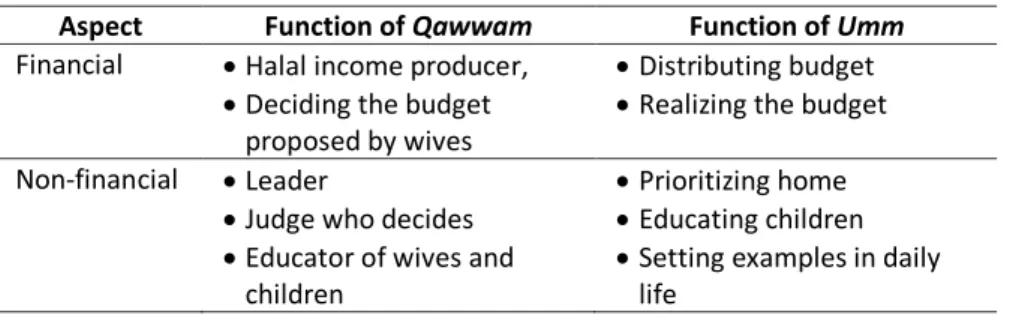
Tabel 2. The Integration of Qawwam and Umm Functions
Aspect Function of Qawwam Function of Umm
Financial • Halal income producer,
• Deciding the budget proposed by wives
• Distributing budget
• Realizing the budget Non-financial • Leader
• Judge who decides
• Educator of wives and children
• Prioritizing home
• Educating children
• Setting examples in daily life
The foundation in household accounting is integrating qawwam and umm functions. In the financial aspect, qawwam is the breadwinner and decides the budget proposed by wives. The budget decided is administered and managed by wives as agreed by husbands. The separation of functions is not a matter of who does what or of connecting two characters; husbands give some money and wives and children spend it. There should be an intimate dialog between husbands and wives about how the husbands earn a living in a halal way and how the wives spend the money wisely with the consent of the husbands. Both financial and non-financial aspects should be a part of the discussion in order to reach harmony in the household.
In some cases, routine small financial expenses do not require the husband's consideration, except for large expenses (Raharjo & Kamayanti, 2015). Naturally, wives have a right to receive money from their husbands, instead of giving. An informant said that when women are income producers, they will gradually take the function of qawwam from their husbands.
Women tend to disagree with and turn down their husbands’ decisions by
JIAFR | 226
saying "I'll pay, you don't have to think about it". The nature of wives staying home is supposed to stimulate husbands to be more creative and work harder outside the home. Somehow it does not justify wives to be demanding.
They have to be grateful for what their husbands give.
Financial Management
This concept is made simple for all levels of society, both rich and poor.
Choosing the best partner to marry, as the foundation of a household, will result in good financial management. Responsible husbands will earn a halal living, work hard to make ends meet, and put aside a certain amount of their income to meet their own needs, especially those for self-improvement. In addition, the money can be allocated for buying some gifts for wives as well.
On the other hand, trustworthy and loving wives will prioritize family needs.
They will secure their husband’s wealth and property and keep their dignity in the absence of their husbands at home.
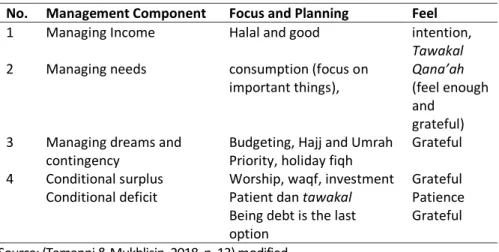
Tabel 3. Toward Holistic Sakinah Finance
No. Management Component Focus and Planning Feel
1 Managing Income Halal and good intention,
Tawakal 2 Managing needs consumption (focus on
important things),
Qana’ah (feel enough and
grateful) 3 Managing dreams and
contingency
Budgeting, Hajj and Umrah Priority, holiday fiqh
Grateful 4 Conditional surplus Worship, waqf, investment Grateful
Conditional deficit Patient dan tawakal Being debt is the last option
Patience Grateful Source: (Tamanni & Mukhlisin, 2018, p. 13) modified
After ensuring the source of income and the expenses are halal, each component of financial management needs to be affective. For example, after the head of the family earned a certain amount of money, he needs to have
JIAFR | 227 sincere intentions because of Allah and believe that his income is merely a
blessing of Allah. Islam also teaches that the sustenance of every human being has been ordained by God. Therefore, it is a must for a husband to his source of income and to feed his family with a halal one.
In managing household expenses, managing needs is a priority for the sustainability of the family life. Daily need expenses should be based on priority and accompanied by a qanaah feeling which does not require us to be stingy, but instead to be grateful to God for what He has given us.
Managing dreams means putting costs and time into consideration. For example, a family can allocate a certain budget for taking hajj which costs less than investing in property. So, the family can decide to put taking hajj in their budget. Let alone, if they join the regular program, they are going to be on a waiting list for a long period of time. Other things to consider are that taking hajj is a must for a Muslim, that the cost is quite affordable for some, and that there is a big time gap between the payment and the execution.
An informant said that, after spending on daily needs, his family could still realize their dreams at the same time, for example, their desire to have another house and their intention to go on a vacation. For him, the destination is not a big deal; spending quality time with his family is what matters more.
“I never think of going on a holiday abroad; Indonesian scenery is a lot more beautiful. I don’t mind where to go for the holiday, as long as I can spend some time with my family. Going on a picnic in the city won’t matter.
Besides, I want them to hold on to Indonesian culture. As an overseas graduate, I have the experience of living abroad in a totally different culture.
I feel insecure to see my family members get exposed to phenomena they may not be able to understand whether or not they are good for them”
(Novi as a housewife, Academic Accountant, and ex Accountant in a Shipping Company)”
After spending some money with some consideration like priority and time, we can see whether there is money left or not. When there is a surplus, we must be grateful to Allah by sharing it with a charity, like sadaqah or waqf, and by investing it into pension plans. And when the income is not enough,
JIAFR | 228
the family members just need to be patient and remember that it is predestined by Allah. The feeling of gratitude should always be present even in times of hardship. They have to focus on other blessings given, such as health, a happy family, and so forth. Another informant believes that in times of need due to insufficient income, it is no need to cover it with debt.
Borrowing money should be the last resort.
“In my point of view, conventionally people will borrow some money. In fact, when a man understands his religion very well (even though he does not understand accounting), he will seek Allah’s help (tawakkal). For sure, he is not going to put himself in a debt to make ends meet”. The informant noticed people around him and told me the condition of one of his friends. ”A friend of mine has low income; it is even below the minimum regional pay, but he manages to support his wife and his two kids. When we refer to accounting, living with that income just does not make sense. However, it just suffices them because Allah helps.” I said yes because I have experienced the same thing quite often. I remember talking with a driver whose salary is very low, but surprisingly Allah gives him the ability to support his wife and nine children. (Adit, single as an Internal Auditor in a Private Company)
“Patience and gratitude need to be built together with increasing material abilities” (Vina as housewife, ex Auditor in Audit Firm, ex Academic Accountant)
Relying on God is a core element in achieving peace of life. Islam believes that the serenity of life comes from Allah, and just remembering Him will put us at ease. Therefore, financial management must always involve Allah from the beginning. Sometimes humans see themselves in a lower position in this life when they are in a poor condition. In fact, in that condition, they have the opportunity to draw closer to God, and it is precisely the best moment in their life.
JIAFR | 229
Figure 1. Discussion of Islamic Household Accounting The end of the household
Discussions of household accounting should also address how households end up for example, in terms of inheritance distribution in the event of a death of a family member. In some cases, the heirs fight over and leverage their kindness to the deceased and are certain that they are entitled to a larger share than the others. Studying inheritance is useful for maintaining harmony in a family so that nobody will take something that is not his right. A household may end due to a divorce. And when that happens, household accounting will help figure out how much will each person get from the prenuptial agreement. The rights of a husband and a wife have to be clarified; starting from the cost of living to the cost of holding a wedding party for children when they grow up. I figured out why one of my female informants works. I talked to her and confirmed her mom. It turned out that her mother is the reason why she works.
Her mother said, "I don't want my daughter to experience the same thing."
She had a bad experience with her household. She found her husband had an affair but she did not dare ask for a divorce because she had no income. "If what happened to my mother happens to me, I will be ready to split"
JIAFR | 230
(anonymous as a housewife, ex Tax Consultant, Ex. Intern Accountant, Ex Academic Accountant).
“I do not work to anticipate a divorce, but instead the death of my husband.
When he leaves me, I have to be financially independent” (Novi as a housewife, Academic Accountant and ex Accountant in Shipping Company).
The first case is an irony happening to her mother (anonymous) who chose a separation. She preferred a divorce to maintaining her marriage.
From the very beginning, she had a suspicion on her husband. She works to support herself in case her husband divorces her someday. Working women understand that they must be financially prepared when separating from their husbands. Islam also regulates divorce, which requires a husband and a wife to live separately. The ex-wife has custody of her children, and the ex- husband is obliged to provide for his children, not the ex-wife. However, ex- wives should also receive compensation for the upbringing of their children.
Imagine if the husband who earns the money takes custody of his children. He will definitely hire a babysitter. This is definitely very different when biological mothers raise their children directly. That's why mothers and wives have the nature to be at home. Although divorced, the Islamic system regulates that life. You don't need to think about your financial condition (except in cases where your husband's income is very low). A woman has a more noble task than making money; it is to produce a good generation.
Under certain conditions, for example, if the ex-husband dies later, then the obligation is transferred to the parents of the ex-husband.
The case of ending a household is quite complex, it is not just what is stated in a prenuptial agreement. In the case of divorce, even though the two are separated, both of them still have the same responsibility for the child.
This complexity should awaken husbands and wives to maintain their households. This is not just about providing a living for children who are raised by the ex-wife, but there are children's rights that are not fulfilled by ex-husbands. The husband will become the ex-husband, but he will still be the father of his child. This once again emphasizes that household accounting is indeed important. Do accounting students know this? Are they ready to live a
JIAFR | 231 household life with various conflicts in it? Most students have been thinking
about their sweet life with their partners, being proposed to by men kneeling at them, wearing wedding dresses and suits. The most important thing for them is to prepare the money to buy a house and car and then get married.
Accounting students need to wake up from that beautiful dream. Marriage is not just being king and queen in the aisle. Marriage is a lifelong struggle that requires us to be grateful to have found a partner and to be patient with all our shortcomings.
Conclusion
Household accounting needs to be part of the accounting curriculum.
Technically, if the discussion of household accounting is still very simple, one session in certain subjects for example, basic accounting, financial management, cost accounting, and sharia accounting. will be enough, However, when the discussion gets broader, let alone reaching a discussion on the division of inheritance, then household accounting needs to become a separate subject. The contents of the discussion start from the beginning of how love grows, the period of getting to know (ta'aruf), expressing happiness in marriage, the separation of functions between husband and wife, and the consequences of ending the household that might end either due to divorce or separation in the event of death of one of the spouses. Each of these phases must be seen from both financial and non-financial aspects.
From this discussion, students are expected to have provisions and principles in their lives to prioritize what should be a priority. Human has rights for each party. Accounting graduates must understand that they and all their time are not exploited by companies even though they are paid a high price, because other parties such as spouses, children, and parents definitely prefer our presence to our money. The principle can be practiced if household accounting has been implemented so that each family member is not exposed to capitalist traps.
The limitations of this study are that the main informants in this study were selected by taking into account that they start a household by not dating
JIAFR | 232
so that they qualify for the term of Islamic household accounting. Other informants who do not meet this requirement are used as supporting informants to see the logical consequences of a disharmonious home.
However, we need to understand that there must be a husband and wife who start their household in a way that is not in accordance with sharia, but it is possible that in the middle of their household journey, they repent and make drastic changes to achieve piety and better understand the rights of their partners.
References
Al-Attas, S. M. N. (1992). Konsep Pendidikan dalam Islam. (H. Bagir, Ed.).
BAndung: Mizan.
Alim, A. (2013). Ilm udan Adab. In Filsafat Ilmu: Perspektif Barat dan Islam (pp. 187–210). Jakarta: Gema Insani.
Amri, N. F. (2017). Mengungkap praktik akuntansi berbasis cinta: sebuah studi kasus pada rumah makan aroma coto gagak. Makasar: Universitas Hasanuddin.
Anggraeni, R. N., Jurana, J., Febrianti, D., Haryani, S., Marwana, M., & Raheni, C.
(2022). Application of Household Accounting in Improving Islamic Life (Survey of Housewives on Jl Puro). International Journal of Health, Economics, and Social Sciences, 4(3), 168–172.
Arif, S. (2018). Islam dan Diabolisme Intelektual (2nd ed.). Jakarta: INSISTS.
Ashari, B. (2019). Sentuhan Parenting. Depok: Pustaka Nabawiyyah.
Baharits, A. H. S. (2007). Mendidik Anak Laki-laki. Jakarta: Gema Insani.
Bailey, C. D. (2017). Psychopathy and Accounting Students’ Attitudes Towards Unethical Professional Practices. Journal of Accounting Education, 41, 1–18. https://doi.org/10.1016/j.jaccedu.2017.09.004 Bauman, Z. (2003). Liquid Love: On the Frailty of Human Bonds. Cambridge,
Malden: Polity Press.
Beasley, M. S., Buckless, F. A., Glover, S. M., & Prawitt, D. F. (2015). Auditing Case: An Interactive Learning Approach (6th ed.). New York: Pearson.
Carnegie, G. D., & Walker, S. P. (2007). Household accounting in Australia Prescription and practice from the 1820s to the 1960s. Accounting,
JIAFR | 233 Auditing and Accountability Journal, 20(1), 41–73.
https://doi.org/10.1108/09513570710731209
Charmaz, K. (2006). Constructing Grounded Theory: A Practical Guide Throught Qualitative Analysis. London: Sage Publications.
Charmaz, K. (2014). Constructing Grounded Theoy (2nd ed.). London: Sage Publications. Retrieved from https://uk.sagepub.com/en- gb/eur/constructing-grounded-theory/book235960
Charmaz, K. (2019). “With Constructivist Grounded Theory You Can’t Hide”:
Social Justice Research and Critical Inquiry in the Public Sphere.
Qualitative Inquiry, 26(2), 165–176.
https://doi.org/10.1177/1077800419879081
Charmaz, K., & Thornberg, R. (2020). The Pursuit of Quality in Grounded Theory. Qualitative Research in Psychology, 18(3), 305–327.
https://doi.org/10.1080/14780887.2020.1780357
Chen, G. Q., Wu, X. D., Guo, J., Meng, J., & Li, C. hui. (2019). Global Overview for energy use of the world economy: Household-consumption-based accounting based on the world input-output database (WIOD). Energy Economics, 81, 835–847. https://doi.org/10.1016/j.eneco.2019.05.019 Copur, Z., & Eker, I. (2014). The Relationship Between Financial Issues and
Marital. International Journal of Arts and Science, 7(5), 683–697.
Creswell, J. W. (2013). Qualitative Inquiry and Research Design: Choosing Among Five Approaches. Los Angeles: Sage Publications.
D’Souza, M. F., & Lima, G. A. S. F. de. (2015). The Dark Side of Power: The Dark Triad in Opportunistic Decision-Making. Advances in Scientific and
Applied Accounting, 8(2), 135–156.
https://doi.org/10.14392/asaa.2015080201
Dewi, N. P. D. S., Suputra, I. D. G. D., Sudana, I. P., & Gayatri, G. (2022).
Household accounting during the COVID-19 pandemic in phenomenology perspective. Linguistics and Culture Review, 6, 449–
479. https://doi.org/10.21744/lingcure.v6ns1.2078
Glaser, B. G., & Strauss, A. L. (1967). The Discovery of Grounded Theory:
Strategies for Qualitative Research. Chicago: Aldine Transaction.
Gurd, B. (2008). Remaining Consistent With Method? An Analysis of Grounded Theory Research in Accounting. Qualitative Research in
JIAFR | 234
Accounting & Management, 5(2), 122–138.
https://doi.org/10.1108/11766090810888926
Gustiningsih, D. A., Mediaty, M., Alimuddin, A., & Kusumawati, A. (2022).
Wife’s Accountability in Islamic Household Accounting. Sentralisasi, 11(1), 88–98. https://doi.org/10.33506/sl.v11i1.1580
Haskins, C. W. (1903). How to Keep Household Accounts: A Manual of Family Finance. New York and London: Harper & Brothers Publishers.
Hassan Basri, A., & Nabihah, S. (2010). Towards Good Accountability : The Role of Accounting in Islamic Religious Organisations. World Academy of Science, Engineering and Technology, 66, 1133–1139.
Hirway, I. (2015). Unpaid Work and The Economy: Linkages and Their Implications. In Annual Conference of the Indian Society of Labour Economics. New York: Levy Economic Institute.
Husaini, A. (2013). Makna “Adab” dalam Perspektif Pendidikan Islam. In Filsafat Ilmu: Perspektif Barat dan Islam (pp. 211–230). Jakarta: Gema Insani.
Jama’ah, B. I. (2018). Tadzkiratus Saami’ Wal Mutakallim Fii Adabil ’Alim Wal Muta’alim: Adab Penuntut Ilmu & Orang yang Memiliki Ilmu (Terjemahan). Beirut: Pustaka AL-Ihsan.
Joannidès, V., & Berland, N. (2008). Reactions to Reading “Remaining Consistent With Method? An Analysis of Grounded Theory Research in Accounting”: A Comment on Gurd. Qualitative Research in Accounting &
Management, 5(3), 253–261.
https://doi.org/10.1108/11766090810910254
Kamayanti, A. (2013). Riset Akuntansi Kritis: Pendekatan (Non) Feminisme Tjoet Njak Dhien. Jurnal Akuntansi Multiparadigma, 4(3), 361–375.
https://doi.org/10.18202/jamal.2013.12.7203
Kamayanti, A. (2016). Metodologi Konstruktif Riset Akuntansi: Membumikan Religiositas. Jakarta: Yayasan Rumah Peneleh.
Kim, J., Yang, S. B., & Torneo, A. R. (2012). Marriage immigration and gender in South Korea: Accounting for gender disparitiesin international marriages. Asia-Pacific Social Science Review, 12(2), 14–32.
Laksono, A. D., & Wulandari, R. D. (2019). “Anak adalah Aset”: Meta Sintesis Nilai Anak pada Suku Lani dan Suku Aceh. Jurnal Kesehatan Reproduksi, 10(1), 11–20. https://doi.org/10.22435/kespro.v10i1.933.11-20
JIAFR | 235 Majdi. (2020). Mahkota Pengantin: Bingkisan Istimewa untuk Suami Istri. (A.
Yunus, Ed.) (Indonesia). Jakarta: Pustaka At-TAzkia.
McKernan, J. F., & Kosmala Maclullich, K. (2004). Accounting, Love and Justice.
Accounting, Auditing & Accountability Journal, 17(3), 327–360.
https://doi.org/10.1108/09513570410545777
Mulawarman, A. D. (2019). Akuntansi Pertanian. Jakarta: Yayasan Rumah Peneleh.
Mulawarman, A. D., & Kamayanti, A. (2018). Islamic Accounting Anthropology: A Constructivist Methodological Alternative.
International Journal of Business and Society, 19(2), 302–311.
Musdalifa, E., & Mulawarman, A. D. (2019). Budaya Sibaliparriq Dalam Praktik Household Accounting. Jurnal Akuntansi Multiparadigma, 10(3), 413–
432. https://doi.org/10.21776/ub.jamal.2019.10.3.24
Orland-Barak, L. (2002). The Theoretical Sensitivity of the Researcher:
Reflections on a complex construct. Reflective Practice, 3(3), 263–278.
https://doi.org/10.1080/1462394022000034523
Raharjo, A. P., & Kamayanti, A. (2015). Household Accounting Values and Implementation Interpretive Study. The Indonesian Journal of Accounting Researchhe Indonesian Journal of Accounting Research, 18(1), 74–96. https://doi.org/10.33312/ijar.365
Ramadhani, F. N., Purwanti, L., & Mulawarman, A. D. (2021). The Emancipation of Household Accounting: A [Non] Feminism Critical Study of Tjoet Njak Dien. Jurnal Ilmiah Akuntansi Dan Bisnis, 16(2), 218.
https://doi.org/10.24843/jiab.2021.v16.i02.p03
Ramlugun, V. G., Ramdhony, D., & Poornima, B. (2016). An Evaluation of Household Accounting in Mauritius. International Journal of Accounting
and Financial Reporting, 6(2), 62–76.
https://doi.org/10.5296/ijafr.v6i2.9840
Reinstein, A., Churyk, N. T., Taylor, E. Z., & Williams, P. F. (2019). Using Accounting Department Advisory Councils and Higher Quality Continuing Education Requirements to Improve The Accounting Profession’s Ethical Reasoning Skills. In Advances in Accounting Education: Teaching and Curriculum Innovations (Vol. 23, pp. 177–
193). Emerald. https://doi.org/10.1108/S1085- 462220190000023012
JIAFR | 236
Rico-Bonilla, C. O. (2020). Making Women Visible in The (Accounting) History of Colombia. Accounting History Review, 30(2), 207–232.
https://doi.org/10.1080/21552851.2020.1763410
Seitz, S. N. (2002). Accounting for Racial Differences in Marriage and Employment. Queen’s Economics Department, (1009).
Septyan, K., & Mintoyuwono, D. (2022). Muhasabah Program Pengabdian Kepada Masyarakat Bidang Akuntansi dan Agenda Kolaborasi Ilmu Pengetahuan, 7(2), 21–38.
Simmons, O. E. (2014). What is Grounded Theory? Retrieved from www.groundedtheory.com/what-is-gt.aspx
Spencer, A. G. (1913). Woman’s Share in Social Culture. New York and London:
Mitchell Kennerley.
Stephiana, O., & Wisana, I. D. G. K. (2019). The Mother’s Tole in Child development: The Effect of Maternal Employment on Cognitive Development. Pertanika Journal of Social Sciences and Humanities, 27(4), 2571–2583.
Stevenson, B., & Wolfers, J. (2007). Marriage and Divorce: Changes and Their Driving Forces. Federal Reserve Bank of San Francisco Working Paper Series, 3. https://doi.org/10.2139/ssrn.1007827
Tamanni, L., & Mukhlisin, M. (2018). Sakinah Finance. Solo: Tinta Media.
Thaler, R. H. (1999). Mental accounting matters. Journal of Behavioral Decision Making, 12(3), 183–206. https://doi.org/10.2307/j.ctvcm4j8j.8
Triyuwono, I. (2012). Persepektif, Metodologi dan Teori Akuntansi Syariah.
Jakarta: Rajawali Pers.
Wahyudi, I. (2021). Everyday Life of Accounting Disclosure - Exploring Home Accountants’ Practices in Indonesia. The Indonesian Journal of Accounting Research, 24(01), 1–20. https://doi.org/10.33312/ijar.494 Walker, S. P. (2010). Child Accounting and “The Handling of Human Souls.”
Accounting, Organization and Society, 35(6), 628–657.
https://doi.org/10.1016/j.aos.2010.07.001 Digital
Walker, S. P., & Llewellyn, S. (2000). Accounting at Home: Some Interdisciplinary Perspectives Home. Accounting, Auditing and
Accountability Journal, 13(4), 425–449.
https://doi.org/http://doi.org/10.1108/09513579910270129
JIAFR | 237 Yuliana, R., Setiawan, A. R., & Auliyah, R. (2020). Akuntansi Keluarga Sakinah
Sebagai Manifestasi Pengelolaan Keuangan Rumah Tangga Syariah.
Jurnal Akuntansi Multiparadigma, 11(3), 479–499.
JIAFR | 238