SERIAL PUBLICATIONS OF THE SMITHSONIAN INSTITUTION Emphasis on publications as a means of disseminating knowledge was expressed by the first secretary of the Smithsonian Institution. Physical description 85 Distribution and habitat 85 Burrows and microhabitat 85 Activity and thermoregulation 87 Annual cycle and reproduction 88 Feeding and food intake 89 Ethology of hemicentetes 90 General maintenance behavior 90 Social behavior 94 Parental care behavior 97 Ontogeny of behavior 97 Social organization 9 8 Stridulation in hemicentetes 102 Stridulation phenomenon 102 Introduction 102 Motivational basis for stridulation 102 Light intensity and ridge erection 103 Arousal and stridulation 105 Sound intensity and ridge erection 105 Stridulation and occurrence circumstances 106 Playback experiments 108 Introduction 108 Preliminary tests 108 Orientation test 110 The role of maternal stridulation in nature I l l Others stridulation functions 112 Comparisons and extensions 116 Evolutionary trends among Tenrecidae 116 Comparison of behavioral categories 117 Insectivora: consideration of evolutionary boundaries 119 Configurations in space and time 121 References 124 Appendix A: Collection localities and study areas 127 Appendix B: List of observations and sample collections 128 Appendix C: Thermoregulation Techniques and Measures 128 Appendix D: Encounter Techniques and Open Field Tests 129 Appendix E: Speed Tests 130 Appendix F: Activity Measurements 130 Appendix ix G: Predator Odor Tests 130 Appendix H: Audio Recording and Playback Techniques 130 Appendix I : Care and Maintenance of Captive Tenrecidae 132 Index 135. The biology of Tenrecidae is described through field and laboratory studies focusing on comparisons of social behavior and communication in several species.
F. Eisenberg
Corbet kindly assisted us and allowed us to research the Madagascar collection at the British Museum. As one moves inland towards the eastern slope, the character of the vegetation changes considerably. Depending on the latitude, such a tropical evergreen forest extends well above the eastern slope.

There are 19 genera of rodents in Panama and 10 genera, including the recent introductions, found in Madagascar. It is instructive to note that primary insectivore-secondary frugivore niches are mainly occupied by lemurs and true insectivores in Madagascar, while such a niche is occupied in Panama. The herbivorous and fruit-eating niche is occupied by primates, edentates, rodents and ungulates in Panama, while in Madagascar it is mainly occupied by the primates and two species of rodents.

THE RAINFOREST AND PLATEAU
The apparent absence of ungulates in Madagascar has resulted in partial occupation of the niche by rodents and, more recently, by the now-extinct ground lemurs of the Magadapidae family. Thus we see in the warmer northern regions, Hemicentetes semispinosus occurring at higher altitudes; Hemicentetes nigriceps has completely disappeared; Setifer setosus is expanding its range into the rainforest zone and Lemuroid diversity increases with the addition of Indri.
THE MADAGASCAR FAUNA IN PERSPECTIVE
PREDATORS AND COMPETITORS OF THE TENRECIDAE
She then proceeded to eat the head and body down to and including the contents of the chest. An inspection of the preceding information clearly shows that within the behavior types (2) and (3) we find 3 size classes from small to moderate size and large (less than 60 mm head). - and body length, 60 to 85 mm head and body length, greater than 90 mm head and body length). Nesting material is collected in the nest box, and the turning movements of the animal's body are sufficient to form a cup.

39 procedure and then male stands while female touches
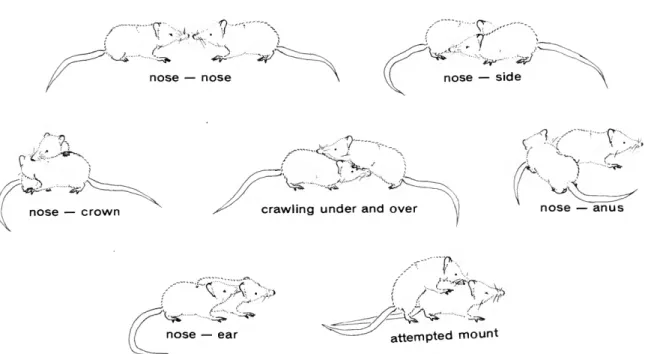
Grooming involves biting or grooming very often with one animal's front paws resting against it. the other's body holds him down slightly. Rather, the cooperation of the male is essential to bring the female into a fully receptive state. This species is restricted to multi-layered tropical evergreen forests, usually near streams.
Rest and sleep. - The postures and associated behavior are similar to those described for Microgale dobsoni. Care of body surface.-The behavior is essentially the same as described for M. Urination on the part of the female appears to be a chemical indicator for the male.
In addition, the reader will note the use of the hind leg by the male to stimulate the cloacal orifice of the female prior to intromission. Rest and Sleep.^The animal usually sleeps in a curled position with the head up. In the early stages of breeding, the female licks the cubs mainly in the genital area.
The animals can thus be found in the rainforests in the east and in the gallery forests bordering the river systems in the west.
1 DAWN
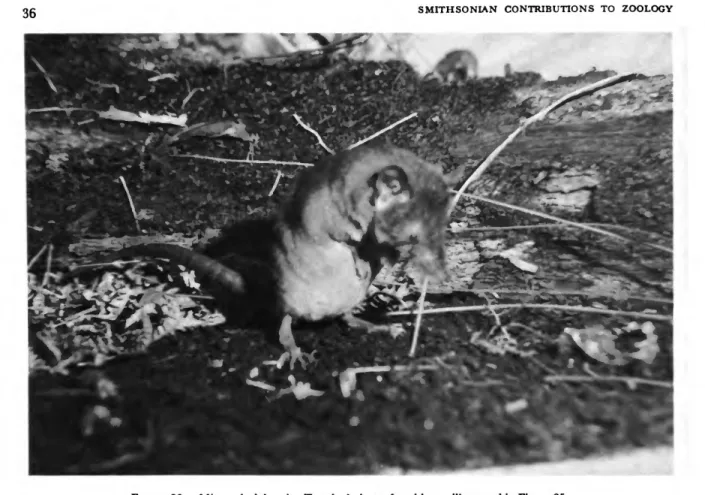
NIGRICEPS-^GENERAL ECOLOGY Physical Description
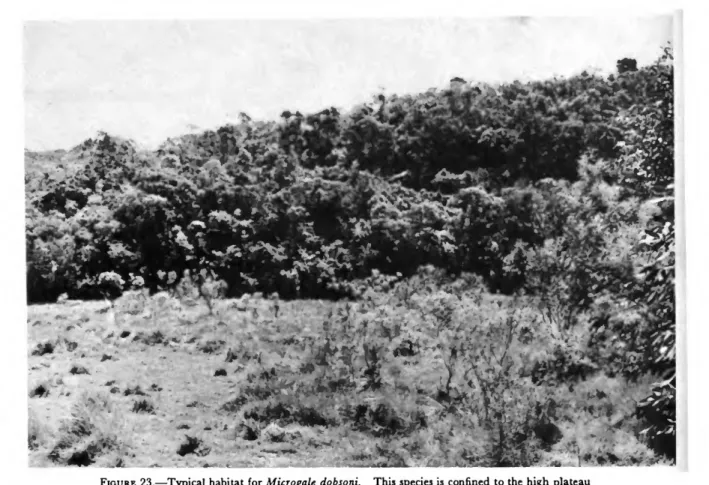
This plateau-dwelling species is very similar to the rainforest species, except for the difference in color and the fact that the pelage tends to be less spiny. There are no noticeable differences between the sexes and the age classes can be defined based on total height. Its habitat can be characterized as the plateau edge near the transition between eastern rainforest and plateau savannah.
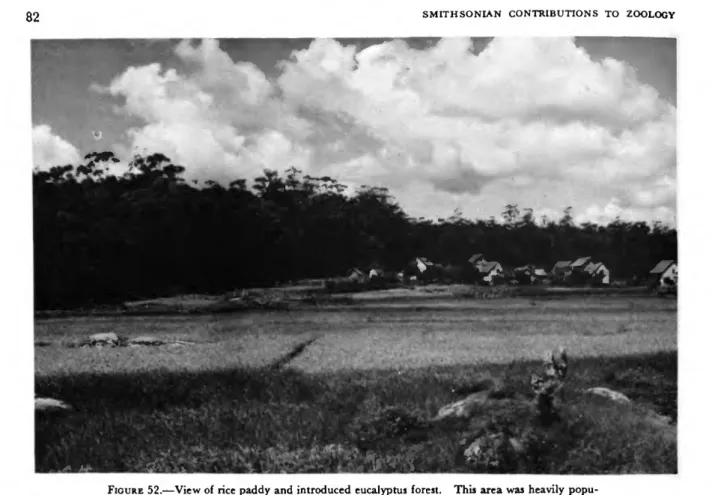
Animal burrows can be found near brush and are generally never far from open water. Rice cultivation has apparently opened up suitable habitats for these animals and they are often found near rice fields. When animals use farmland for foraging, they may adopt quite atypical habitats for foraging sites; indeed, in one area (i.e. Manandroy) almost all burrowing sites were placed in introduced eucalyptus forest, but their foraging took place near paddy fields and areas of cassava cultivation (see Figure 52).
Let's look at a typical example of Manandroy in Eucalyptus forest: although they are in another Eucalyptus growth habitat, tree ferns and other primary elements can still be found on the fringes of this introduced forest. Coleopteran larvae, potential food items, were found in rotten logs under which the animals dug tunnels. In addition, maggots were found outside eucalyptus mats in red-brown soil near paddy fields.
Studies of diel variations in thermoregulation were made in Madagascar both in captivity and in the field.
Annual variations in weight and activity were studied both in the field and in the laboratory. Weights were determined for adult animals in the field from January 31 to February 3, 1966. For the purposes of our discussion, we have referred to animals in the overall length range of 60 to 90 mm as infants.
A similar sample of 33 taken at Manan-ndroy from 6 to 7 April 1966 showed 8 individuals in the juvenile age class and 25 remaining as adults. In the following year from 4 to 5 February 1967, the Manandroy population was sampled again and a total of 48 individuals were measured. This would seem to confirm our contention that some breeding takes place in December; however, an examination of animals in the 130 to 150 mm age class (based on coat color and coat) suggests that some births may occur as early as November.
Favorable conditions for earthworms in the tropics include undisturbed soil with a regular and sufficient water supply. We sampled the earthworm population in the soil that forms the floor of the eucalyptus forest at Manandroy and found that earthworms were virtually absent. On the other hand, earthworms did occur in the vicinity of the rice fields and other fields.
With recaptures, we were able to assess growth in the field and found that a fry in the 104 mm age class can increase in total length by approximately 31 to 36 mm over a 2-month period.
SEMISPINOSUS—GENERAL ECOLOGY Physical Description
The entrance to the den was at the base of a steep ridge in the top center of the photo and framed by arching vines. These measurements were taken in the morning during the theoretical low of the oil activity cycle. They carefully collect leaves in the vicinity of the nest and transport them there in their mouths.
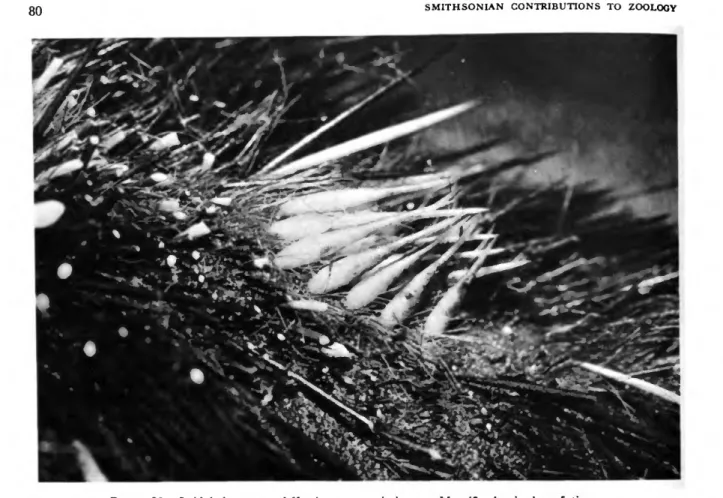
After the young were 19 days old, the adult female generally showed little defense of the nest. There is therefore only a limited correlation between the degree of arousal that the animal shows and the quality of the stridulation. The degree of erection of the crest is not necessarily an indicator of the quality of stridulation produced.
In seven tests, the animals stayed near the speaker and showed varying degrees of comb erection. Our results indicate that, after cessation of stridulation, the animals would orient themselves to the location of the last heard stridulation. These inter-individual distances were plotted as a function of the distance of a given individual from the nest.
Afterwards, several objects were placed behind it at the end of a stick and the turning frequency of the animal was also measured. We considered the possibility that stridulation could be a mechanism to attract earthworms to the surface of the soil. We could see no tendency in the earthworms to come to the surface.

A COMPARISON OF BEHAVIOR CATEGORIES
117 previously, have undergone great modification within
SUMMARY OF YOUNG ANIMALS' RESPONSE TO MOTHER
The response of the young to the mother appears to be similar for all sexes studied in that the young follow the mother for the first few nights on their foraging excursions. The formation of the colony leads to the use of the same digging space by several females, possibly related by descent, and one male. Later, as selection for signal enhancement promoted the evolution of shrill, a concomitant selection favored lowering the threshold for stridulation;.
The information conveyed in the signal is non-specific; nevertheless, it serves as an indicator to the young of the position of the female. Furthermore, the following response exhibited by a number of primitive mammals involves specific selection of capacities of the young to respond to specific inputs from the female's body itself. This subsequent response has evolved repeatedly and must be of extreme importance to the survival of the young, even if it is short-lived.
As in the case of the tenreker, morphological diversity has been achieved in other Madagascan mammals, which started from a conservative morphological framework. For example, in the Lemuridae, the original ancestor of the lemurs of Madagascar was probably a small nocturnal form; probably able to estimate and exhibit a slightly unstable thermoregulatory pattern. CONFIGURATIONS IN SPACE AND TIME The study of tenrecs brings out several points.
In order to appreciate the importance of many behavioral patterns, it is necessary to reconsider the pace of the life cycle.

121 novel stimulus, such as an alien individual, is intro-
To study the social interaction of different tenrec species, a standard encounter technique was developed. We found that bright light would severely inhibit the activity of one of the tenrec species. In addition to the previous method, a cloth cushion was left in the cage of one of the captured Galidia elegans.
As with the previous tests, the strength of the animal's response could be noted. In addition to this recording technique, the ultra-frequency sounds of the animals could be monitored using an ultrasonic microphone, monitor and headphones. Playback to Tenrec ecaudatus families was achieved in the 2.4 by 1.2 meter arena by placing the nest box of the animals in the arena and allowing them to become accustomed to it for several days before playback.
In this way, the animals were subject to very little perturbation and their initial state of arousal could be recorded by an observer before the onset of the test signal. The timing and duration of the dry period is entirely a function of local conditions (see text). Separation of the male from the female after mating appears to be essential for the successful breeding of Setifer setosus and Tenrec ecaudatus.
For measures and weights, use the metric system instead of (or in addition to) the English system.