Agricultural Implements and Machines in the Collection of the
National Museum of History and Technology
JOHN T. SCHLEBECKER
^^^MW
SMITHSONIAN INSTITUTION PRESS • CITY OF WASHINGTON • 1972
Agricultural Implements and Machines in the Collection of the
National Museum of History and Technology
by
JOHN T. SCHLE8ECKER
SMITHSONIAN INSTITUTION PRESS City of Washington
1972
S E R I A L P U B L I C A T I O N S O F T H E S M I T H S O N I A N I N S T I T U T I O N The emphasis upon publications as a means of diffusing knowledge was expressed by the first Secretary of the Smithsonian Institution. In his formal plan for the Insti- tution, Joseph Henry articulated a program that included the following statement:
"It is proposed to publish a series of reports, giving an account of the new discoveries in science, and of the changes made from year to year in all branches of knowledge."
This keynote of basic research has been adhered to over the years in the issuance of thousands of titles in serial publications under the Smithsonian imprint, com- mencing with Smithsonian Contributions to Knowledge in 1848 and continuing with the following active series:
Smithsonian Annals of Flight Smithsonian Contributions to Anthropology
Smithsonian Contributions to Astrophysics Smithsonian Contributions to Botany Smithsonian Contributions to the Earth Sciences
Smithsonian Contributions to Paleobiology Smithsonian Contributions to Zoology Smithsonian Studies in History and Technology
In these series, the Institution publishes original articles and monographs dealing with the research and collections of its several museums and offices and of professional colleagues at other institutions of learning. These papers report newly acquired facts, synoptic interpretations of data, or original theory in specialized fields. These pub- lications are distributed by mailing lists to libraries, laboratories, and other interested institutions and specialists throughout the world. Individual copies may be obtained from the Smithsonian Institution Press as long as stocks are available.
S. DILLON RIPLEY Secretary
Smithsonian Institution
For sale by the Superintendent of Documents, U.S. Government Printing Office Washington, D.C. 20402 Price 70 cents
Stock Number 4700-0209
Page
Introduction 1 T h e Use of Farm Machinery in America 2
Catalog of Agricultural Implements and Machines in
the Collection 6 Index to the Catalog 51 Publications on Farming by the Staff of the
Division of Agriculture and Mining 58
Agricultural Implements and Machines in the Collection of the
National Museum of History and Technology
T H E A U T H O R : John T. Schlebecker is curator in charge, Division of Agriculture and Mining, Museum of History and Technology, Smithsonian Institution.
Introduction
T h e art and science of agriculture embrace most intentional human efforts to control biological activity so as to produce plants and animals of the sort wanted, when wanted. Rubber plantations, cattle ranches, vegetable gardens, dairy farms, tree farms, and a host of similar enterprises all represent human efforts to compel nature to serve man.
Those who undertake agriculture have had, from time immemorial, a variety of names, not all of them complimentary. T h e people involved in at- tempted biological control have been called farm- ers, planters, ranchers, and peasants. Farmers carry on a complicated business in which they use a variety of tools, implements, and machines. They also employ land, chemicals, water, plants, and animals. Their business, however, focuses on living things. N o matter how crude their attempts, or how uncertain their successes, those who try to grow living things rank as agriculturalists.1
For the most part, a museum cannot show the essential biological aspects of agriculture. Agricul-
1 Of course, the definition excludes brewers, distillers, bio- logical supply houses, and others, such as zoo curators, who manage living things. Agriculture takes place on a piece of land widely and commonly known as a farm.
tural production involves the farmer in the course of nature in its seasons, and in the peculiar laws of living things. In these respects, agriculture stands rather apart from transportation, manufacturing, and artistic industries where the tools, machines, and raw materials remain fairly inert as men work on them. Machines move but do not live, and therein lies the major difference between agricul- ture and the other arts. Farmers deal with plants and animals but the museum can show only the things a farmer uses as he accommodates to and regulates nature. Some of the objects, in themselves, give a fair idea of how the farmer used them. Most people, after all, know about edged blades and digging tools. Nearly anyone can grasp what a man might do with a scythe or a plow. Even the work- ing of a modern reaper needs only a little explana- tion. But museums cannot well show cross-breeding of plants and animals. Museums seldom can show the results of that cross-breeding. Bags of fertilizer can be put on display, as can vials of penicillin, and jars of herbicide. Although some may find these interesting, such items show little in and of them- selves.
Unfortunately, the things that cannot be shown 1
SMITHSONIAN STUDIES IN HISTORY AND TECHNOLOGY
in any easily intelligible way surpass in importance the items that can be shown. T h e sheep shears, which anyone can understand, represent less to the farmer than do the sheep. Sheep shears, no matter how sophisticated and no matter how necessary, do not explain sheep husbandry. T h e shears tell little about the wool industry, and nothing much about sheep breeds. And so on through the list of agri- cultural enterprises.
Museums must collect and exhibit the tools, implements, and machines which farmers use in their business. These items, however, seldom make u p the core of real agricultural activity. T h e catalog here presented shows something of the range of items that farmers use and that can be preserved and shown. T h e variety nearly equals the volume.
Most museums try to avoid duplication. Even so, few museums manage to collect a continuous series of things showing any one line of development.
T h e discontinuity of farm objects on hand virtually rules out the telling of a coherent and complete history of agriculture. Nevertheless, the museum can show something about the major technological developments in agriculture. T h e evolution of the plow, the reaper, or the tractor can be suggested even if not fully illustrated. Hitting the highlights has to suffice.
T h e full history of technological change also involves several social and economic conditions.
First, changes in implements, tools, and methods result from the accumulation of knowledge. Device builds upon device: first came the wheel, and then, much later, the tractor.
Secondly, the potential user of the device must feel a need for it. T h e new method or device not only must save him work b u t must clearly increase his well-being. If any device or change merely in- creases the wealth of someone else (a tax collector or a landlord for example), the farmer seldom will adopt the new technology.
Thirdly, since, at first, the new technology almost invariably costs more than the old, the user must have or be able to get the capital to buy and use the newer devices and methods.
Of these conditions for technological change, only the cumulative nature of the knowledge can be shown by the objects. Even here, however, miss- ing objects make it possible to present only the most obvious changes, and then not all of them.
Still, seeing the things once used—no matter how crude or how few—can sometimes help us under- stand the way changes took place. Also, this knowl- edge sometimes can help us guess how other changes will take place:
T h e sequence of inventions also d e p e n d s u p o n the changing needs of a society. Needs a n d circumstances vary m o r e t h a n d o degrees of talent. T h u s w h e n need and knowledge merge, inventors quickly a p p e a r . Indeed, several m e n in several places are likely to work on the same p r o b l e m s at the same time, a n d they often solve it in almost identical fashion. Nearly simultaneous in- ventions or discoveries occur with astonishing frequency in the history of technology.2
2 " T h e C o m b i n e Made in Stockton," Pacific Historian, no.
10 ( A u t u m n , 1966) , p . 14.
The Use of Farm Machinery in America
T h e part of America that was destined to become the United States started its history at the very time when the parent European civilization began to make major breakthroughs in science and tech- nology. Thus, Americans became the automatic beneficiaries of the achievements of others. Because of peculiar opportunities and needs, Americans could and did push on to unique achievements.
Nowhere, however, did this building on the past appear as early, or as impressively, as in the agricul- tural sector of the economy. American inventors
of farm implements made important strides earlier than those in any other field. In turn, American farmers made more and better use of discoveries and inventions.
From the 1650s onward Europeans expanded their activities in all fields and in all directions. By that time Europeans had already discovered the New World, and had seized or bullied most of the Old. European trade and industry increased, and as these grew so also did population and urbanization.
People multiplied, and an increasingly greater pro-
portion of them began to live in towns and cities.
Simultaneously, the Europeans increased in wealth;
indeed, most of their activities created more wealth.
T h e ever-increasing number of people called for more food, and for changes in European farming.
T h e Europeans' growing wealth also allowed them to buy luxury items from around the world: silk and spice and everything nice. T h e goods came not only from the Far East and Africa but also from the New World. When Europeans began to settle America, they almost at once had the advantages of a large and growing metropolitan market in western Europe. This market provided opportuni- ties for wealth, but only if the American farmers developed appropriate commodities and produced them at reasonable prices.
T h e English, Dutch, Swedes, French, and Spanish settled in North America at trading and exploring stations. So located, they could direct the flow of products to Europe. T h e English chiefly sought rare products such as gold and spices, and they sent back furs. T h e Dutch concentrated on furs. All European pioneers, however, had to feed them- selves. This took a bit of doing, which at first in- volved a merging of European technology with Indian crops and methods. Later, the settlers adapted European crops and animals. In spite of starving times in almost every colony from Virginia to New England, the new Americans at least mas- tered the art of feeding themselves.
European technology used animals for draft and employed plows, harrows, and similar implements.
This technology fit European crops better than it fit American crops. Thus, European implements and draft animals did not appear until compara- tively late. As long as they depended chiefly on Indian crops, Europeans simply substituted iron hoes for stone hoes, and iron axes for stone axes.
But methods such as girdling, slash and burn, and the rest, came almost directly from Indian tech- nology. T h e Pilgrims of Plymouth Plantation went 12 years without a plow; Virginians went almost as long. T h e hoe of corn culture served well enough to keep men alive. H u n t i n g and fishing, of course, supplemented the food supply, as it did for the Indians.
From north to south the story was largely the same in the 17th century. Everywhere the new Americans pursued a subsistence agriculture which supported some other major economic activity.
Pennsylvania developed possibly the most flourish- ing subsistence farming. T h e commercial produc- tion of tobacco, an American crop with American methods and uses, began early in Virginia and Maryland. This specialty developed commercially almost exclusively in the upper South. Farmers and planters of the lower South had hesitantly begun rice culture, but as the 17th century ended men in the Carolinas still found hides and furs the most rewarding commodities. Meanwhile, rapid changes took place in the European metropolitan centers, and in the West Indian islands. T h e growth of population in both places created consumers for more and cheaper food. Markets for American foods definitely began to increase as the 18th century got under way.
Europeans, of course, primarily wanted European foods rather than exotic Indian crops. T h e foods also had to be comparatively nonperishable and easily transported. Grains, particularly wheat, and processed meat (hams, salt pork, and such) espe-
cially met European preferences. Commercial pro- duction of these commodities compelled American farmers to embrace the best European technology insofar as that technology fit the American scene.
T h e plants, animals, methods, and tools all de- rived from Europe. Contrary to a common Euro- pean view at the time, the immigrants did not bring
the worst available methods to the New World.
Nor did the Americans allow any deterioration of stock or plants without good economic reasons.
Most European criticism about American farming centered on things of no consequence to American farmers, who were selling in a world market. T r u e , Americans tended toward slovenly cultivation, but niceness of method mattered little if the land yielded an abundant exportable surplus. Americans paid less attention than Europeans to fertilizer, but Americans at first had less need for it. Livestock, in spite of nearly continual importations from Europe, tended to decline from a European stand- point. Still, the animals yielded meat of a quality suitable for export. T h e hardy American animals could survive in spite of casual care. Americans had few barns and sheds, but the world market for meat did not demand barns, stalls, and fancy feed- ing. American dairy cows yielded ridiculously low volumes of milk, butter, and cheese, but dairy products, after all, served only the resident Ameri- cans. T h e corn- and mast-fed hogs of America pro-
SMITHSONIAN STUDIES IN HISTORY AND TECHNOLOGY
vided ham that was equal to any in Europe. If the European consumer bought American food, the American farmer thought it pointless to consider the comfort and emotional well-being of his animals.
New Englander-s tended to concentrate on ani- mals, the middle Atlantic on grains, the upper South on tobacco, and the lower South on rice and indigo. T h e Revolutionary War disrupted the mar- keting from the farmer's view, but the major com- mercial commodities remained largely unchanged in the years immediately after the war. Indigo de- clined and then disappeared as a major export commodity, but cotton almost at once replaced it.
In the 19th century men everywhere made great technological advances. In America, the advances took place in a sort of reciprocal action with three major historical series and events dominating the story: the westward movement, urbanization, and industrialization.
T h e greatest westward expansion in American history took place during the 19th century. Ameri- can farmers and stockmen conquered, and almost entirely settled, a continent. They did this in a single century, 1801-1900. Nothing quite like it had ever happened before. Starting from a thin line of people on the eastern seaboard (with a few incur- sions across the mountains as of 1800), farmers and herders pushed into a nearly empty land, dis- possessed the Indians, and exploited the country.
And in course of time the American pioneers wanted and received political organization. Cali- fornia entered the Union in 1850, the Plains states mostly in the 1880s, and more states, such as Ari- zona, New Mexico, and Oklahoma, came into the Union in the 20th century.
At the same time, a nation that was weak and underdeveloped in 1801, had, by 1900, become the world's leading industrial nation. From virtually no industry in 1801, America rose to leading industrial power in 1900, with more railroads and more manu- factured goods per capita than any other nation.
Involved in the industrialization, and importantly so, was the farm implement and machinery indus- try. Factories everywhere supplied farmers with the sophisticated tools and machines of the new agri- culture.
In these years urbanization also went forward rapidly. Cities of the east grew fantastically, and even in the interior cities rose from wilderness out-
posts to gigantic metropolises. Within one man's lifetime Chicago increased from 350 people in 1830 to 1,099,000 in 1890. Simultaneously, tremendous developments in transportation kept the nation and its economy tied together. All of these develop- ments had a profound influence on farming and farmers. T h e rich cities provided ever greater mar- kets for the farmers' produce. T h e transportation system, rapidly moving farm commodities, made farming profitable in remote regions far distant from the coast. Farmers also felt the advantages of the return flow of goods and services: the mail order catalog, the industrially made reapers and threshers, and countless other items. City people made a countless range of devices for farmers—
from steel plows to steam engines.
Meanwhile, as these events altered the life of the farmer, a burst of activity took place in invention and discovery. These activities had a delayed but considerable impact on farm methods and tech- nology. T h e list of inventions and discoveries could hardly fit in this narrative, but this catalog of items reflects fairly well what men accomplished in the 19th century. T h e changes included such diverse elements as the invention of the cotton gin by Eli Whitney in 1793, the introduction of Mexi- can Upland cotton in 1805, the discovery of the cause of Texas fever in cattle in 1889, and the in- vention of the internal combustion tractor in 1892.
These and many other achievements substantially changed the farm enterprise in two major direc- tions: first, advances in technology allowed farmers to do more in less time; second, discoveries in science allowed farmers to increase the yield from the land. Farmers got more from each acre, plant, and animal.
Farmers could use the savings in time brought by better implements and new machines to increase the amount of land farmed and the number of ani- mals cared for. Presumably, the farmer could also use the saved time for greater leisure. In fact, how- ever, they usually used the extra time for more work. In the 20th century they often used the saved time for outside employment. Farmers did this in the 19th century, but not so commonly as later.
Greater man-hour efficiency gave the farmer more time to devote to managing his enterprise, to keep- ing records, and to studying his business.
Technological efficiency also allowed farmers to use more land and more animals. T h e average size
of farms steadily increased across the century. Fur- thermore, the new machines and the pure-bred livestock cost money which could be most profitable only if the farmer specialized in one, or at most two, types of enterprise. So the greater efficiency created by technology impelled farmers to greater speciali- zation, and with specialization came even greater efficiency. Anyone who specializes will likely be more efficient because of the mastering of skills. He will also have a minimum of other cares to distract him. Of course, for the consumers, foreign or do- mestic, greater farming efficiencies resulted in abundant food at comparatively low cost.
Plant and animal importation, improvement of breeds, and discoveries in genetics, soil chemistry, the use of fertilizers, and in controlling plant and animal diseases all helped the living things which form the basis of farming yield. Grain farmers not only had to have a wheat which yielded well but a wheat which resisted the attacks of nature. For example, Turkey Red wheat, introduced in 1873 by Mennonites from Russia, not only survived drought and yielded well but provided the genetic elements for newer breeds of wheat. T h e farmer not only wanted good-producing meat cattle, such as the Herefords, but had to control diseases and predators which killed the animals. Sick animals do not grow properly or, in the case of dairy ani- mals, give much milk. Steady advances in disease control for both plants and animals brought fewer losses and greater productivity to farmers.
T h e 19th century also brought scientific discover- ies in both plant and animal nutrition. Fertilizer and soil chemistry made great advances through scientific experiments, at first by farmers and later by government servants. T h e first experiment sta- tion in the modern era began in Connecticut in 1875, and in 1887 the Congress established such stations in every state in conjunction with the agri- cultural Land Grant colleges. Scientists at many of the stations also made discoveries in animal nutrition. For example, as a result of animal feed- ing experiments E. V. McCollum discovered vita- mins A and B at the experiment station in Wis- consin in 1915.
None of these scientific advances left much resi- due in the form of artifacts for museums, but the
reality of the changes should not be obscured by the lack of objects on exhibit. Even so, some of the related equipment survived. For example, the
centrifuge used in the butterfat test, discovered in 1890 by Stephen M. Babcock, survived in several forms. Manure spreaders and tree sprayers, reflec- tive of advances in biochemistry, also survived. But these only suggest the more important biological control activities for which these machines and tools served merely as agents in some way.
T h e 20th century introduced Americans to total war. World Wars I and II demanded the total mobilization of all resources by all contenders. In both conflicts America became the food reservoir of the Allies. From a technological view, the wars engendered a level of prosperity which both allowed and encouraged farmers to adopt new methods and devices. T h e principal technological change in farms was the widespread adoption of the internal combustion tractor, first used in 1892. Inventors and manufacturers gradually but constantly im- proved tractors along with the various devices at- tached to them. Most notable were the corn picker, in 1909, and the cotton picker, in 1942. (Dates are for commercial production in each instance.) Farm- ers found both machines impracticable until a power source independent of the ground wheel had been developed. More than anything else the tractor and its related equipment finally set men free from the worst drudgery of farming. It also set many farmers free from the need to farm at all.
T h e tractor and its equipment accomplished several other remarkable things, some obvious and some not so obvious. First, it allowed the farmer to get rid of horses and mules, and these animals steadily declined—to such an extent that in the 1960s the census did not even bother to count them.
As a result of this decline, land that farmers had used to raise feed for animals could grow food for people or fodder for dairy animals. T h e amount of land thus released for other needs finally amounted to perhaps 60 million acres, and maybe even more.
T h e change took place with increasing rapidity into the 20th century.
Also, the tractor sharply reduced labor needs for the major crops of the United States. Even dairy- ing, least susceptible to this sort of improvement, felt the impact of the tractor in such things as har- vesting fodder and storing silage by running loaders off the tractor power-take-off. Since the very found- ing of agriculture men had discovered only one way to prosper in farming. T h e farmer had to exploit somebody or something. Animals, serfs, slaves, ten-
ants, sharecroppers, or whatever, including the farmer's family and farm, had at various times been exploited on the farmer's way to success. After the age of machinery, however, the farmer tended to exploit the machine instead of other people or things. People had to leave farming, b u t in the long run they benefited from their removal. T h e machine had set them free. Chief of the machines was the gasoline tractor.
T h e influence of science and technology inside a free society may have been even more profound than seems at first glance. T h e farming of the 20th century, with its chemicals, genetics, machines, and all, required not only vast infusions of capital but brains and a considerable knowledge. Farmers had to be literate at the very least. Elitist systems, where one group of people get educated and the others get worked, could not accomplish much in the modern agricultural world. Furthermore, notions of two kinds of education—one for the better sort who think, and another for the inferiors who do the work—could and did seriously impede the develop- ment of a modern agriculture. T h e backwardness
SMITHSONIAN STUDIES IN HISTORY AND TECHNOLOGY
of most of the world, the poverty of the under- developed countries, stemmed in large part from the impediments created by an ignorant population.
A country like the United States with its highly technical and scientific farming could not afford, simply could not endure, limited educational op- portunities for its people. Neither could it long endure any class structure which placed farmers in an inferior position; for when men feel inferior because of their work they tend to shift to some other task, leaving the despised work to those who cannot avoid it. A highly developed agricul- ture in the hands of the truly inferior, the stupid and uneducated, would simply collapse. America, the land of plenty, had to maintain a high level of education open to all and a society where men reached status, at least partly, by effort and talent.
In 20th century America the comparative social and economic equality continued, in large part, because the level of technology and science used in America demanded it. T h i s equality may be one of the most important consequences of the techno- logical and scientific advances in agriculture during the years 1607-1972.
Catalog of Agricultural Implements and Machines in the Collection
I n the following catalog the items are listed numerically in the order in which the museum received them, with the earliest first and the latest last. This arrangement permits expansion and re- issue of the catalog simply by adding new entries;
a n d the user of the catalog can easily find every- thing acquired in any given year. I n effect, the catalog thus presents an historical account of the development of the museum collection. Following the item's title appears the National Museum ac- cession number (USNM number); year of acces- sion, if known; description; a n d donor.
T h e index to the catalog has several major cat- egories of cross-referenced entries. I n addition to the general object class, such as "Tractor," it in- cludes use-entries, such as "Plant husbandry," the names of donors, vendors, and those who arranged for the gifts.
1. KOREAN SKETCH OF FARMING IN T H E LATE 18TH
CENTURY. USNM 19048; 1887. Korean farmers plowing and breaking clods of earth. Painted by H a n Chin U. Gift of G. Goward, Washington, D. C.
2. KOREAN SKETCH OF THRESHING IN THE LATE
18TH CENTURY. USNM 10948; 1887. Ko- rean farmers threshing rice. By H a n Chin U. Gift of G. Goward, Washington, D. C
3. KOREAN FISHING SCENE OF THE LATE 18TH
CENTURY. USNM 19048; 1887. Koreans using a fish trap. By H a n Chin U. Gift of G. Goward, Washington, D. C.
4. SCENE OF KOREAN FARMERS CHOPPING T O - BACCO IN 18TH CENTURY. U S N M 19048;
1887. Korean farmers chopping tobacco after it has been cured. By H a n Chin U.
Gift of G. Goward, Washington, D. C.
5. SCENE OF KOREAN FARMERS WORKING ON FARM BUILDINGS IN LATE 18TH CENTURY. USNM
19048; 1887. Korean farmers doing carpen- try work, including roof repair. By H a n Chin U. Gift of G. Goward, Washington, D . C .
6. SCENE OF A KOREAN BLACKSMITH AT WORK IN LATE 18TH CENTURY. USNM 19048; 1887.
A Korean blacksmith working at his forge and anvil. By H a n Chin U. Gift of G.
Goward, Washington, D. C.
7. A KOREAN FARRIER SHOEING A HORSE IN THE LATE 18TH CENTURY. USNM 19048; 1887.
By H a n Chin U. Gift of G. Goward, Washington, D. C.
8. CENTRIFUGAL CREAM SEPARATOR, 1868. USNM
23744; 1890. T h e first centrifugal cream separator used commercially in the United States. T h e Deerfoot Farm at South- borough, Massachusetts, used this machine, patented by D. M. Weston of Boston. Gift of Deerfoot Farm Company, Southborough, Massachusetts.
9. MODEL OF BLOUNT'S DAISY PLOW, 1890. USNM
23873; 1891. This model of a one-horse plow shows Blount's Daisy steel plow as pictured in the catalog of Henry F. Blount.
Gift of Henry F. Blount, Evansville, Indi- ana.
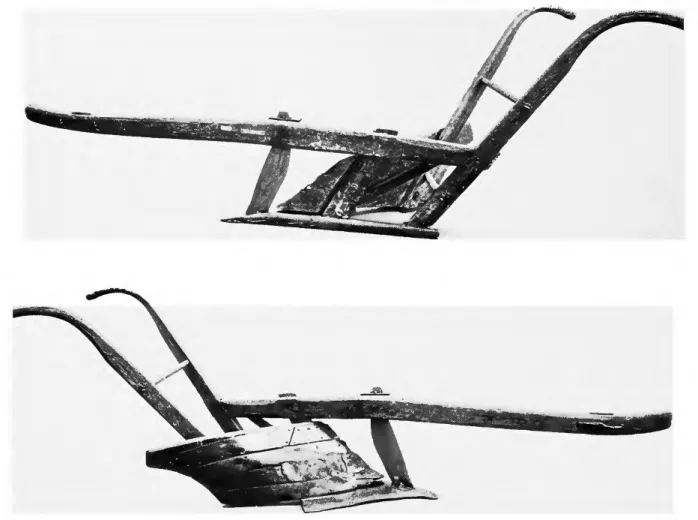
10. O L D COLONY STRONG PLOW, 1732. USNM
34769; 1899. In 1732 Peter Hardy of Ray- mond, New Hampshire, made this plow for Henry Lamprey of Kensington, New Hamp- shire. Gift of T. P. Lamprey, Kensington, New Hampshire.
11. WINNOWING BASKET, 1799. USNM 37441;
1901. A winnowing basket, or pan, made of willow woven over wide sprints; eliptical in shape, with a frame of thick rods. Noah Rogers bought this pan in New York in
1799 or 1800. Gift of Frank A. Brown, Savage, Maryland.
12. MODEL OF FLAIL THRESHING MACHINE, 19TH
CENTURY. USNM 46812; 1906. T h e frame of this wooden model is 7i/2 inches high and 5 by 6 inches, restangular. T h e levers, 14 inches long, project from the frame and strike the floor much as a flail would. Pins set in the shaft of a hand crank act as cams, raising the flails which
then fall to the ground by gravity. Gift of United States Department of the Interior.
13. MODEL OF GALLIC GRAIN HEADER, about A.D.
70. USNM 46812; 1906. A wooden box on wheels, 12 by 5 inches, has metal teeth set at the front end. Shafts extend to the rear, where an ox is yoked. T h e forward movement of the cart causes the grain to lodge against the teeth, which pulled the heads off. T h e grain then fell back into the box. Gift of United States Department of the Interior.
14. MODEL OF T E N EYCK GRAIN HARVESTER, 1825.
USNM 46812; 1906. Model is made of wood and iron, 15 inches by 8 inches. Long knives on a drum were rotated by belt shaft on traveling wheels. Long projecting points gathered the straw. Iron shafts at the rear allowed animals to be harnessed to push the machine. James T e n Eyck pa- tented the harvester on November 2, 1825.
Gift of United States Department of the Interior.
15. MODEL OF MANNING GRAIN HARVESTER, 1831.
USNM 46812; 1906. Model of horse-drawn reaper measures 16 inches by 8 inches, with a wheel diameter of 6 inches. Projecting iron points at the front end gather the grain, and vibrating knives, powered from the hob of the wheel, cut the grain. Patented by William Manning on May 3, 1831. Gift of United States Department of the Interior.
16. MODEL OF BOYCE GRAIN HARVESTER, 1799.
USNM 46812; 1906. This model, made of wood and iron, is 15 inches long, 6 inches wide, and 5i/2 inches high. Six rotating knives radically positioned on a vertical shaft rotate by level gearing on the wheel axle. T h e whole is mounted on a two- wheeled cart with shafts for draft animals.
English patent number 2324 granted to James Boyce in 1799. Gift of United States Department of the Interior.
17. MODEL OF NEWBOLD PLOW, 1797. USNM
46812; 1906. This model of a metal plow, with wooden beam and handles 14 inches
long, represents the plow patented by Charles Newbold on June 26, 1797, the first American patent for a cast-iron plow.
Moldboard, share, and landside were cast
SMITHSONIAN STUDIES IN HISTORY AND TECHNOLOGY
FIGURE 1.—Views of Old Colony Strong Plow, about 1732. (Catalog No. 10.)
in one piece. If the plow broke, it became totally useless. Not until the parts were made in separate pieces did the iron plow come into wide use. T h e cast iron broke more readily than did the later wrought- iron plows. Gift of United States Depart- ment of the Interior.
WINNOWING BASKET, about 1750. USNM 54513; 1912. Used by the three Richardson
brothers, the first settlers of Wobrun, Massa- chusetts. T h e threshed grain could be win- nowed in two ways. It could be poured slowly from the edge of the basket in a breeze, where the heavier grain fell to the ground while the chaff blew away. More commonly, the farmer tossed the grain into
the air and caught it in the basket, while the chaff blew away. T h i s rectangular basket measures 50 inches by 30 inches.
Gift of Mrs. Clarissa W. Samson, West Med- ford, Massachusetts.
19. CENTRIFUGAL CREAM SEPARATOR, 1914. USNM
56432; 1914. Carl Gustav De Laval of Sweden invented this successful continuous- flow cream separator in 1879. Loaned by De Laval Separator Company, New York, New York.
20. MODEL TRACTOR, 1919. U S N M 64098; 1919.
N o particular manufacturer seems repre- sented by this spring-driven toy, which merely represents tractors of around 1919.
FIGURE 2.—De Laval centrifugal cream separator of 1879. (An earlier version of Catalog No. 19.)
T h e heavy-duty field tractor has four wide- ly spaced iron wheels. Gift of Toy Manu- facturers of the United States, New York, New York.
21. MODEL TRACTOR WITH PLOW, HARROW, AND ROLLER, 1919. USNM 64098; 1919.
Spring-driven, toy tractor. T h e plow, har- row, and roller, as well as the tractor itself, represent a typical machine of the period.
T h e product of no particular firm seems to have been copied. Gift of T o y Manu- facturers of the United States, New York, New York.
22. M E A T GRINDING MACHINE, about 1810.
USNM 110326; 1930. Hand made of wood and iron, with six parts held together by two iron bolts. T h e cutting edges are set in the sides of a box parallel to each other and about one-quarter inch apart. A shaft, set in the center of the box, is turned by a
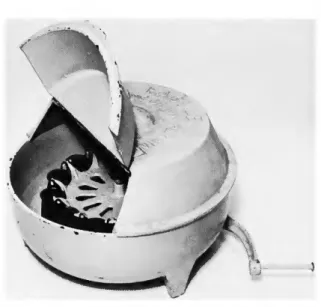
crank. T h e horizontal shaft has iron slugs, graduated from coarse to fine, set into the shaft in a helical pattern. T h e meat enters through the square hole at the top and the iron teeth press it against the knife edges;
thus, the meat is cut smaller and smaller until it comes out a small hole in the bot- tom of the machine. T h e device is very
ancient in design and could still be found in common use in the United States as late as 1860. Gift of R. C. Fairhead, Rushville, Nebraska.
23. CAREY PLOW, about 1815. Received from Division of Ethnology in 1931. A Carey plow with a slot in the beam for a colter.
T h e landside handle passes through the beam. Usually, the beam tenon passes through a mortise in the handle. Possibly made by the farmer. Replication of a com- mon and popular American plow of the
18th century. Donor not known.
24. H O E , about 1830. USNM 115122; 1931.
Wrought-iron, handmade hoe made in Ohio and attributed to very early 19th century. T h e hoe's blade is 5 inches wide and its handle is 6 feet long. Gift of Mrs.
Grace M. Swiggett, Washington, D. C.
25. REAPER SICKLE BAR, about 1847. USNM 115878; 1931. Sickle bar from a McCor- mick reaper. T h e blade style suggests a comparatively sophisticated stage of de- velopment, most surely after 1833. David Cromer of Seneca County, Ohio, used this sickle bar on a McCormick reaper. T h e blade is 5 feet long and 5 inches deep.
Gift of Frank Hepp, Berwick, Ohio.
26. BORDEN VACUUM PAN, 1853. USNM 119188;
1932. T h e original vacuum pan used by Gail Borden in 1853 for condensing milk by concentrating it in a vacuum. H e pat- ented the process on August 19, 1856.
Borden borrowed this pan from nearby Shaker farmers who had used it for canning.
Borden did his early work at New Lebanon, New York. Borden at first failed to get a patent because the process was not deemed useful. There is nothing exceptional about this pan except that Borden used it. Gift of Borden Milk Company, New York, New York.
27. MODEL OF MCCORMICK REAPER, 1834. USNM 121105; 1932. Scale model of the grain reaper patented by Cyrus McCormick on J u n e 21, 1834. Roderick Davis constructed the model from the specifications of the patent. Gift of Charles G. Abbot, Wash- ington, D. C.
28. MODEL OF MCCORMICK REAPER, 1845. U S N M
10 SMITHSONIAN STUDIES I N HISTORY AND TECHNOLOGY
FIGURE 3.—Gail Borden's v a c u u m p a n of 1853, used to m a k e condensed milk. (Catalog N o . 26.)
124615; 1933. Scale model of the reaper patented by Cyrus H . McCormick on Jan- uary 31, 1845. Roderick Davis constructed the model from the specifications of United States patent 3895. Gift of McCormick Historical Association, Chicago, Illinois.
29. MODEL OF MCCORMICK REAPER, 1847. U S N M
124615; 1933. Cyrus McCormick patented this reaper on October 23, 1847. Roderick Davis built the model from specifications of United States patent 5335. Gift of Mc- Cormick Historical Association, Chicago, Illinois.
30. WHEELED PLOW, 1769. U S N M 127755; 1934.
Wheeled plow made by Matthew T h u m b in 1769 at Palatine, New York, for Henry Kloch. It has an almost flat, wooden mold- board; wrought-iron share and colter; a two- wheel truck in front for the beam; and one handle. T h e large wheel ran in the furrow and the small wheel on the land. T h e wooden parts of the hitch and the draft chain have been restored. T h e plow is
probably a copy of a German one. Gift of Sir Henry Solomon Wellcome, London, England.
31. MODEL O F GRAIN SEPARATOR, 1875. U S N M
129836; 1934. Working model of a grain separator for a threshing machine made by Daniel Garver. T h e model represents in- ventions covered by three patents issued to Daniel a n d Cyrus Garver: the grain sepa- rator, patent 114546, issued May 9, 1871;
the fan blast regulator, patent 114547, issued May 9, 1871; and the bag holding device, patent 161501, issued March 30, 1875. Loaned by Miss Melchora Garver, Hagerstown, Maryland.
32. WALDRON CRADLE BLADE AND SNEAD, about
1840. USNM 129789; 1934. T h e blade has holes for attaching the cradle. T h e wooden frame, or snead, supports the cradle fingers, now missing. Gift of Sydney S. Stabler, Washington, D. C.
33. SETTLING CAN CREAM SEPARATOR, a b o u t 1890.
USNM 129789; 1934. Cooley brand creamer, used for separating milk from cream prior to churning. T h e milk and cream were set in a cool place for several hours while the cream rose to the top. T h e farmer drew skim milk off through a spigot at the bottom, after which the cream could be drawn off. Used on farms before the hand centrifugal separator came into wide use. By 1890, in butter-producing areas,
the centrifugal separator had already caused the disuse of the Cooley and similar sepa- rators. Gift of Sidney S. Stabler, Wash-
ington, D. C.
34. WOODEN HAYFORK, about 1879. USNM 137459; 1936. Hayfork of second-growth white oak, made by J o h n Heiss, Lima Town- ship, Lagrange County, Indiana. I t was used for feeding stock a n d for handling clover and short straw of all kinds. Gift of E. W . Heiss, Washington, D. C.
35. WOODEN MEASURE, 1845 or earlier. USNM 137960; 1936. Small, round wooden mea- sure used in 1845 by William Heiss, La- grange County, Indiana, to feed small grain or mill feed to livestock. William Heiss was a grandfather of the donor, E. W . Heiss of Washington, D. C.
36. HALF-BUSHEL MEASURE, about 1829. USNM 38.
137960; 1936. Made and used by William Heiss on his farm in Lagrange County, Indiana, about 1829. Probably used in local barter and trade in such items as beans, corn, and seeds for various crops.
Loaned by E. W. Heiss, Washington, D. C.
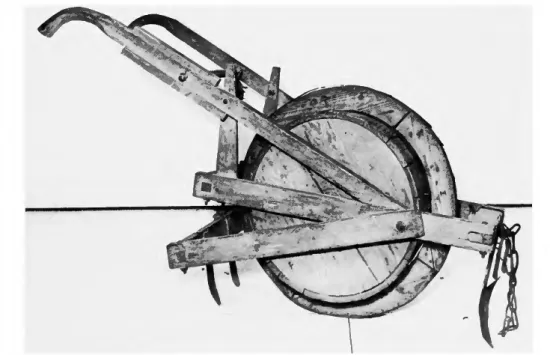
37. WOODEN DRUM COTTON PLANTER, about 1895.
USNM 14557; 1937. All wood except for a duckbill furrow opener in front and two duckbill row coverers in the rear, both
made of metal. T h e drum of soft wood measures 20 inches in diameter and 13 inches wide. About the center of the drum
is a wooden, metal-rimmed wheel which 39.
ran down the furrow, keeping the seeder on course. Near the wheel, and all around the drum, are 13 evenly spaced holes through which the cotton seeds fell into the furrow as the drum revolved. N o counting or tripping mechanism was in- volved, so the device undoubtedly wasted seed. A mule or a horse pulled the planter and the farmer walked behind it. James Nelson of Greenwood, South Carolina, made this planter about 1895. Gift of Ruben
F. Vaughn, Honea Path, South Carolina.
CAST-IRON PLOW, 1854. USNM 150396; 1938.
A cast-iron plow made by Stephen Mc- Cormick of Fauquier County, Virginia, in 1854. T h e plow embodies features covered by patents issued to Stephen McCormick on February 3, 1819, January 28, 1826, and December 1, 1837. Plows of this type, made chiefly between 1826 and 1850, in- volved interchangeable parts. T h e first patent precedes that of Jethro Wood by seven months, but the principle of inter- changeable parts had been worked out and patented as early as 1813. Gift of Leander McCormick-Goodhart, Silver Spring, Md.
MEHRING'S MILKING MACHINE, 1884. USNM 148530; 1938. Original working model of a hand-powered milking machine built by William M. Mehring in 1884. Mehring subsequently improved and patented the machine in 1892. T h e improved machine did not work well because it created con-
tinuous suction for the length of the stroke.
T h e successful application of intermittent suction, necessary so as not to injure the cow, was worked out in Scotland in 1902.
Gift of Mrs. Bessie D. Mehring, Keymar, Maryland.
FIGURE 4.—Cotton planter, about 1895. (Catalog No. 37.)
12 SMITHSONIAN STUDIES IN HISTORY AND TECHNOLOGY
40. HAND-POWERED MILKING MACHINE, 1892.
USNM 148530; 1938. Practical hand-pump milking machine designed and built in 1892 by William M. Mehring, who was granted patent 488282 on December 28, 1892. This milker, which injured cows when used rapidly, represents an effort to solve the problem of machine milking, al- though the use of h u m a n power also limited its usefulness. Gift of Mrs. Bessie D.
Mehring, Keymar, Maryland.
41. Ox YOKE, 1838. USNM 148675; 1938. Ed- ward Scoville (1813-1887) used this ox yoke when driving an ox cart from T r u m b u l l County, Ohio, to De Kalb County, Indiana, in 1838. Until well after the Civil War, oxen pulled most of the wagons going west, and this yoke is typical of all used in the westward migration, in the North as well as in the South. Gift of Reign Scoville, Poplar Bluff, Missouri.
42. DEERE PLOW, 1838. USNM 148904; 1938.
John Deere made this plow, with steel share and polished wrought-iron moldboard, at Grand Detour, Illinois, in 1838. Joseph Brierton bought it and used it on his farm, and the Deer Company obtained it fh 1901.
It is one of three plows made by J o h n Deere in 1838, and presumably it is identical to his first steel share plow, made in 1837 at Grand Detour. Called the singing plow, it proved especially effective in prairie coun- try after the sod had been broken because the earth did not adhere to the share and
moldboard. T h e implement could also be used as a breaking plow. Gift of Deere and Company, Moline, Illinois.
43. MODEL OF SULKY PLOW, 1899. U S N M 156653;
1940. Working model of the Hy-Lift sulky plow invented by Niels O. Starks of Madi- son, Wisconsin, and made by the Fuller and Johnson Company around 1900. Starks received patent 616984 on January 3, 1899.
T h e land wheel on this plow automatically raises and lowers the plow at the end of a furrow. Gift of S. O. Strucksberg, St.
Joseph, Missouri.
44. BARBED RIBBON W I R E , 1879. U S N M 159858;
1941. Specimen of barbed wire made with saw teeth cut out of twisted ribbon wire.
Gift of B. F. Arthur, Winchester, Virginia.
45. CHINESE PLOW, date unknown. USNM 161555; 1941. T h i s primitive, one-handled plow has an iron hook on the end of the beam. Apparently it h a d an iron shoe for a share, which is now missing. T h i s style of plow is typical of the kind used in rice- growing sections of China. Gift of United States Department of Agriculture.
46. CAREY PLOW, about 1820. USNM 161555;
1941. T h e share and landside of this small cultivating plow are in one piece of wrought iron with sockets for the left handle and the standard bar share. It has a flat wood- en moldboard. Used in Northumberland County, Virginia, until 1855 or 1860, for cultivating corn and other row crops. Gift of United States Department of Agriculture.
FIGURE 5.—John Deere plow, one of the three plows made by Deere in 1838. (Catalog No. 42.)
47. PLOW, about 1790. USNM 161555; 1941. 51.
Only the share, colter, and beam of this plow are original, the rest having been reconstructed. T h e original parts came from Northumberland County, Virginia.
Gift of Edwin Brown, Brown's Store, Vir-
ginia. 52.
48. O L D COLONY STRONG PLOW, 1740. U S N M
161555; 1941. T h e moldboard of this plow is made of wood and covered with thick pieces of iron. T h e plow has a lock colter and wrought-iron share fitted on the end of a wooden beam. Pelatiah Kinsman of Ips- wich, Massachusetts, had the plow made in
1740. It represents the New England open- 53.
drawn plows of that time. Gift of United States Department of Agriculture.
49. O L D COLONY PLOW, 1783. USNM 161555;
1941. T h i s plow resembles the Old Colony Strong Plow (No. 48) b u t it is not as large and the moldboard is covered with uniform,
narrow iron straps. Farmers used this 54.
plow for cross-plowing after initial breaking by the Strong Plow and for cultivating. I t probably was drawn by oxen. John Foster, a corporal in the Revolutionary Army, had this implement made at Ipswich, Massa- chusetts, in 1783. Gift of United States Department of Agriculture.
50. TAVENNER PLOW, between 1810 and 1860.
USNM 161555; 1941. T h e Tavenner plow 55.
has a cast-iron moldboard and a wrought- iron share and colter. Plows of this type were made and used widely in Loudon County, Virginia. Gift of United States Department of Agriculture.
SMITH PLOW, about 1800. USNM 161555;
1941. This sod-turning plow has its land- side, moldboard, and colter in separate pieces. I t was built on the lines of a plow patented by Robert Smith in 1800. Gift of United States Department of Agriculture.
GIDEON DAVIS PLOW, about 1825. U S N M 161555; 1941. Gideon Davis received a patent in 1825 for his improvements of the Newbold plow patented in 1797. I n tests in 1825 to determine the efficiency of differ- ent plows, the Davis plow took first place
in a competition with five others. Gift of United States Department of Agriculture.
WOODCOCK PLOW, about 1848. USNM 161555;
1941. T h e Woodcock plow has separate landside, moldboard, share, cutter, and point. This plow has the first reversible point. Woodcock plows were first used in 1847, in Maryland. Gift of United States Department of Agriculture.
EAGLE PLOW, 1849. USNM 161555; 1941.
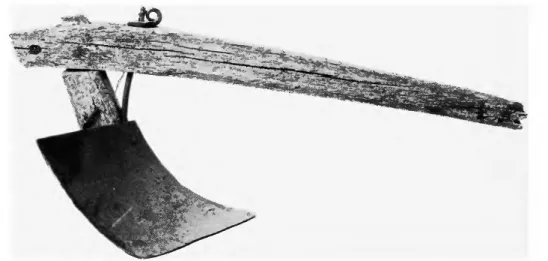
T h e Number 25 Eagle Plow, which first appeared in the catalog of the J. Nourse Company in 1849, became the standard plow of New England after the middle of the 19th century. Its moldboard was based on a design worked out by Thomas Jeffer- son. Gift of United States Department of Agriculture.
MEXICAN PLOW, about 1890. USNM 161555;
1941. This Mexican bull tongue plow has an iron shoe on the point and it closely re- sembles Spanish plows of the 16th century.
It was intended to be pulled by an ox and to break the soil for only three or four
FICURE 6.—Eagle plow, a b o u t 1849. (Catalog N o . 54.)
14 SMITHSONIAN STUDIES I N HISTORY AND TECHNOLOGY
inches at the most. Gift of United States Department of Agriculture.
56. BUTCHER'S SAW, 1879. USNM 130572; 1942.
This saw is part of a set of butcher's tools (Nos. 56-67) presented to William H.
Hoover by the Washington Light Infantry Corps in 1879. All the tools have a silver presentation plate on the handle and have nickel plating. A. Nittinger, Jr., of Phila- delphia, made the set. Gift of N. Auth Provision Company, Washington, D. C.
57. SPLITTING CLEAVER, 1879. USNM 130572;
1942. Butcher's tool. Gift of N . Auth Provision Company, Washington, D. C.
58. CLEAVER, 1879. USNM 130572; 1942.
Butcher's tool. Gift of N . Auth Provision Company, Washington, D. C.
59. MEAT A X E , 1879. USNM 130572; 1942.
Butcher's tool. Gift of N. Auth Provision Company, Washington, D. C.
60. KNIFE, 1879. USNM 130572; 1942. Butch- er's knife. Gift of N. Auth Provision Com- pany, Washington, D. C.
61. KNIFE, 1879. USNM 130572; 1942. Butch- er's tool. Gift of N. Auth Provision Com-
pany, Washington, D. C.
62. TRIANGULAR SCRAPER, 1879. USNM 130572;
1942. Butcher's tool. Gift of N . Auth Provision Company, Washington, D. C.
63. HAND M E A T H O O K , 1879. U S N M 130572;
1942. Butcher's tool. Gift of N . Auth Provision Company, Washington, D. C.
64. M E A T HOOKS, 1879. U S N M 130572; 1942.
Butcher's tool. Gift of N . Auth Provision Company, Washington, D. C.
65. CARCASS SPREADER, 1879. USNM 130572;
1942. Butcher's tool. Gift of N . Auth Provision Company, Washington, D. C.
66. CARCASS SPREADER, 1879. USNM 130572;
1942. Butcher's tool. Gift of N. Auth Provision Company, Washington, D. C.
67. M E A T PINS, 1879. U S N M 130572; 1942.
Butcher's tools. Gift of N. Auth Provision Company, Washington, D. C.
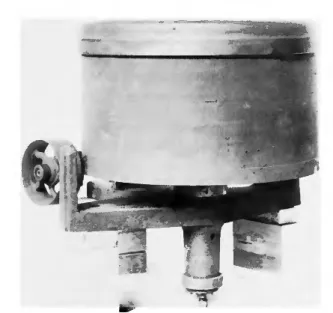
68. BABCOCK BUTTERFAT TESTER, about 1895.
USNM 173353; 1946. A machine used in determining the amount of buterfat in milk or cream. T h e Vermont Farm Machine Company of Bellows Falls, Vermont, made the centrifuge, which mixed sulphuric acid
with the milk in order to produce a read- ing of the amount of butterfat tested. T h e Brighton Farm at Patuxent River, Mont- gomery County, Maryland, used this ma- chine around 1895. Stephen M. Babcock developed this tester in 1890 and released it to the public, without patent, in 1891.
T h e device had far-reaching effects in the dairy industry, because for the first time it allowed accurate payment to farmers for the actual amount of butterfat in their milk; also, it allowed farmers to test their cows to discover which ones produced the most butterfat. Gift of Sidney S. Stabler,
Hyattsville, Maryland.
FIGURE 7.—Babcock b u t t e r f a t tester, a b o u t 1895.
(Catalog N o . 68.)
69. BUGGY RAKE, 1840. U S N M 175393; 1947.
T h e buggy rake harvested grain after it had been cut with a cradle. T h e rake has han- dles and a wheel, like a wheelbarrow, with long wooden tines in front to scoop u p the grain. W h e n the binder stepped on a bar at the back of the buggy the tines would move u p and allow the grain to slide back against the uprights in a convenient posi- tion for binding. Although it undoubtedly reduced the physical labor of binding, this rake would not have been very efficient and would have allowed the reaper to get far
ahead of the binder. Gift of F. B. Day, Owosso, Michigan.
70. MODEL OF PLOW, about 1885. USNM 179841;
1949. T h e model has a share, standard, and moldboard of metal with a gauge wheel on the beam. T h e beam pivots on the
standard, allowing adjustments of the angle 73.
of draft. T h e end of the beam is fastened to a brace which extends to the back of the moldboard. T h e share and point are in one piece; and the moldboard is one piece.
T h e model resembles the plows of James 74.
Oliver, which by 1885 had been widely known and were quite possibly copied.
Donor unknown.
71. DIORAMA OF TROPICAL BANANA PLANTATION, late 19th century. USNM 186623; 1950.
T h e diorama shows bananas being harvested and trees being cut. T h e banana bunches get to the railroad cars on burros. At the bottom, bananas are shown in various stages of growth and ripening. Gift of
United Fruit Company, Washington, D. C. 75.
72. DIORAMA OF TROPICAL COFFEE PLANTATION, late 19th century. USNM 186553; 1950.
T h e diarama shows coffee berries being
dried in the sun and in the shade in prep- aration for marketing the coffee. At the bottom, various stages of growth and ripen- ing of the coffee berries are depicted. Gift of T h e Great Atlantic and Pacific T e a Com- pany (A & P ) , New York, New York.
FOOD-SLICING MACHINE, mid 19th century.
USNM 188878; 1950. Cutting knives, set in helix in a wooden axle, move the meat through the box, cutting it finer and finer.
Gift of George Murphy, Washington, D. C.
FANNING MILL, about 1860. USNM 192872;
1951. A hand-crank operated the winnow- ing mill for separating grain from chaff and beans from hulls. A four-blade, wooden fan, shaped like a paddle wheel, blows a draft below oscillating screens. T h e chaff is blown off from the threshed grain, and the grain or beans fall from the screens into the path of the draft. T h e screens catch any straw left after threshing. Gift of Arden Wilson, Harrisville, West Virginia.
T w o - R o w CORN PLANTER, about 1854.
USNM 193259; 1952. T h i s hand-operated planter, of a type patented by S. Malone on January 3, 1854, was sold by William
FIGURE 8.—Two-row corn planter, about 1854. (Catalog No. 75.)
16 SMITHSONIAN STUDIES IN HISTORY AND TECHNOLOGY
M. Plant, a dealer in seeds, tools, and machines at St. Louis, Missouri. When the planter was dropped to the ground, the
two handles moved about 8 inches in a slot toward the outside. This movement opened a space for the corn to drop into the shoe, where a small piece of wood opened and the corn fell to the ground. Gift of Warren Hammond, Fayette, Missouri.
76. MODEL OF FERGUSON TRACTOR, 1952. USNM
193939; 1952. This plastic and metal model of a Ferguson tractor operates a Ferguson hitch. Gift of T o p p i n g Models, Inc., Akron, Ohio.
77. MODEL OF T W O - D I S K PLOW, 1952. U S N M
193939; 1952. A plastic and metal model of a two-disk plow for a Ferguson tractor.
Gift of T o p p i n g Models, Inc., Akron, Ohio.
78. MODEL OF N E W IDEA MOWER, 1952. U S N M
193939; 1952. A cast-iron model of a New Idea mower with an operating pitman for use behind a tractor. Gift of T o p p i n g Models, Inc., Akron, Ohio.
79. MODEL OF N E W IDEA MANURE SPREADER, 1952.
USNM 193939; 1952. A plastic and metal model of a New Idea, tractor-drawn manure spreader. Gift of T o p p i n g Models, Inc., Akron, Ohio.
80. MODEL O F N E W IDEA CORN PICKER, 1952.
USNM 193939; 1952. A plastic and metal model of a one-row, tractor-drawn corn
picker. Gift of T o p p i n g Models, Inc., Akron, Ohio.
81. TILING SPADE, 1952. USNM 193940; 1952.
T h i s hand-forged steel spade has a bit with three tines. This style spade was invented around 1895 and was widely used for dig- ding trenches for drain tiles on sticky or mucky soil. T h e Osmundson Forge Com- pany of Webster City, Iowa, made these spades as late as 1952. Gift of A. G. Os- mundson, Webster City, Iowa.
82. GLASS CHURN, about 1900. USNM 193941;
1952. T h i s German-made churn, of 4-liter capacity, has a hand crank which drives a metal propeller at the bottom in one direc- tion while paddles on the shaft turn in the other direction. Gift of A. G. Osmundson, Webster City, Iowa.
83. CEDAR SAP SPOUTS, about 1800. U S N M
194893; 1952. Sap spouts, made of cedar, about 15 inches long. Spouts like these were made and used by settlers of upper New York about 1800 to gather the maple sap after the trees h a d been tapped. Gift of Frank E. Olmstead, Potsdam, New York.
8-1. CEDAR SAP SPOUTS, about 1800. USNM 194893; 1952. Sap spouts for maple tree tapping, about 15 inches long and made of cedar. T h e maple syrup and sugar indus- try provided some income for frontier farms, as well as providing sugar for do- mestic use. Although maple syrup often sold at high prices, the industry never achieved major importance even in the localities where it flourished. These spouts are of the sort used in the pioneer period in New York. (See also Nos. 83, 85-87.) Gift of Frank E. Olmstead, Potsdam, New York.
85. IRON SAP SPOUT, possibly late 19th century.
USNM 194893; 1952. A cast-iron maple sap spout, about 3 inches long, used for gathering the sap into buckets. Possibly factory-made and used later than the fron- tier period, after maple syrup manufac- ture had become a commercial enterprise.
T h e leading areas for maple syrup have long been Ohio, New York, Vermont, and New Hampshire. Gift of Frank E. Olm- stead, Potsdam, New York.
86. IRON SAP SPOUT, possibly late 19th century.
USNM 194893; 1952. A thin, metal trough, plated, and about 3 inches long, used to convey maple sap from the tap in the tree to the sap bucket. T h i s is the type spout most commonly used today in those areas where farmers supplement their income with maple syrup production. Gift of Frank E. Olmstead, Potsdam, New York.
87. SAP BUCKET SPIKES, possibly late 19th century.
USNM 194893; 1952. Hand-made iron spikes used to hold buckets for maple tree sap. They had to be hooked somewhat so the bucket could hang on them well. Gift of Frank E. Olmstead, Potsdam, New York.
88. DIAGRAM O F JEFFERSON MOLDBOARD, 1798.
USNM 198605; 1953. A three-dimensional wire diagram, at half scale, illustrating Thomas Jefferson's design of a plow mold-
FIGURE 9.—Grain cradle in use in the field. International Harvester Corporation photo.
(Catalog No. 91.)
18 SMITHSONIAN STUDIES IN HISTORY AND TECHNOLOGY
board as he described it in a letter to Sir John Sinclair in 1798. I n the same year Jefferson read a paper to the American Philosophical Society that was titled "De- scription of a Mold-Board of the Least Resistance and of the Easiest and Most Cer- tain Design." T h e wire diagram was con- structed by the Division of Crafts and In- dustries, Smithsonian Institution.
89. MODEL OF JEFFERSON MOLDBOARD, 1798.
USNM 198605; 1953. T h e model consists of four separate blocks of wood cut to show the progressive steps in the construction of the Jefferson moldboard: (1) the block of wood marked for sawing with the rear sec- tion cut out, and in two parts; (2) the block of wood sawed on two diagonals, with the rear section cut out, and in three parts;
(3) the block of wood sawed transversely on guide lines down to the diagonals, with the wood between the transverse cuts removed and leaving the face of the moldboard roughly shaped; (4) the rear surface of the board produced in the same manner as the front, resulting in a completed mold-
board. T h e models were constructed by the Division of Crafts and Industries, Smithsonian Institution, after Jefferson's original moldboard, located at the Natural History Museum, Paris, France.
90. WOODEN CURD BREAKER, about 1860. USNM 198617; 1953. T h i s curd breaker is made of wood with iron pegs in the cylinder and hopper. Gift of Laurence Hathaway, Eas- ton, Maryland.
91. GRAIN CRADLE, about 1844. USNM 198620;
1953. Caleb Paul Duval used this cradle on his Glen Echo farm near Baltimore, Maryland. Gift of Virginia Duval, College Park, Maryland.
92. BARREL CHURN, about 1860. USNM 198620;
1953. A wooden barrel churn with iron crank and paddles. Such churns were of
too small volume to be used on commercial dairy farms, and they were not at all useful in creameries, which first appeared in 1861.
Gift of Virginia Duval, College Park, Mary- land.
93. COOKIE ROLLER, about 1860. USNM 198620;
1953. A wooden, grooved, one-handled
cookie roller, about 14i/2 inches long and about 314 inches in diameter. T h e roller added an esthetic touch to home-made cookies b u t was of little importance in the history of commercial food processing.
Gift of Virginia Duval, College Park, Mary- land.
94. MEAT GRINDER, 1859. U S N M 198620; 1953.
This iron, hand-cranked meat grinder was patented August 2, 1859. Gift of Virginia Duval, College Park, Maryland.
95. BUTTER PRINTS, about 1860. USNM 198620;
1953. T w o butter prints. One is circular, with a tri-lobed leaf design and about 3 inches in diameter; the other is a box mold with two five-point star designs a n d about 5 inches long, 2i/2 inches wide, and 4 inches high. T h e butter was pressed into these molds before being served, or, sometimes,
before being rolled in paper and sold in towns. T h i s aspect of farm dairying quickly disappeared after the creamery dominated the industry. Gift of Virginia Duval, College Park, Maryland.
96. SHOE LAST, possibly mid 19th century.
USNM 196820; 1953. A small last, to fit either foot, for a shoe about Sy4 inches long and 214 inches wide. Such an imple- ments were useful in frontier communities and generally were owned by itinerant cob- blers who went from house to house. Gift of Virginia Duval, College Park, Maryland.
97. MODEL O F FANNING M U L L , 1857. USNM
198620; 1953. This is a working model of a fanning mill invented by Joseph and James Montgomery and covered by patents 10324, issued in 1853; 13062, issued in 1855;
and 16447, issued in 1857. T h e crank handle and the slide, which governed the flow into the hopper, are missing. James Montgomery took the model on sales trips as a demonstrator. Gift of R u t h Mont- gomery, Peoria, Illinois.
98. MODEL OF MCCORMICK REAPER, 1831. U S N M
121526; 1953. A scale model of the 1831 reaper of Cyrus McCormick, built long afterwards from descriptions by the in- ventor. Gift of McCormick Historical As- sociation, Chicago, Illinois.
99. B E E COLONY, 1953 (renewed yearly). A 3-
-
r; ^ . "
y' '
J?
FIGURE 10.—McCormick reaper (1831) in use in the field. Photo courtesy of International Harvester Corporation.
(Catalog No. 98.)
cft'ilM
story bee hive with about 60,000 bees. T h e hive was designed by experts at the Depart- ment of Agriculture Research Station, Belts- ville, Maryland. T h e United States Depart-
ment of Agriculture donated the hive and 102.
the Italian bees.
100. MODEL O F Ox-POWERED SUGAR CANE M I L L , 1925. USNM 200380; 1954. Model of a mill of a type used in Puerto Rico as early as 1523. It took ten men and four yoke of oxen to operate the mill, which could crush about four tons of cane in a 12-hour day.
This type of mill extracted about 40 to 45 percent syrup based on the weight of the
cane, compared to 80 to 85 percent ex- 103.
traded by modern mills. Gift of Daniel Thompson, Petersburg, Virginia.
101. MODEL O F WATER-LIFTING W H E E L , 1884.
USNM 200380; 1954. A model of a wind-
driven waterwheel used for raising water 104.
into the evaporating beds in salt works.
This type of device lifted water from the ocean in Puerto Rico. Gift of Daniel Thompson, Petersburg, Virginia.
MODEL OF GRIST M I L L , 1883. USNM 200380;
1954. This model of a water-powered grist mill resembles those used throughout Amer- ica in the 19th century before the discovery of the gradual reduction process and the consequent centralization of the milling in- dustry. This particular mill, known to have operated from 1883 to 1940, ground corn in Puerto Rico. Gift of Daniel Thompson, Petersburg, Virginia.
FARM COPYBOOK, about 1840. USNM 209042; 1955. Wells Forbes, who had a farm near Alexandria, Virginia, kept this book for about a year in the 1840s. Gift of Bessie W. Palm, Washington, D. C.
GRAIN CRADLE, about 1900. U S N M 210597,
20
105.
106.
107.
108.
109.
1956. Grain cradle used before 1900. Gift of Jennie Sabrosky, Sturgis, Michigan.
MODEL O F HUSSEY R E A P E R , 1833. U S N M
212910; 1956. A model of the 1833 reaper patented by Obed Hussey and based on the specifications of the patent. Constructed by the Office of Exhibits, Smithsonian In- stitution.
HORSE SPURS, possibly late 19th century.
USNM 211312; 1956. Gift of Catholic University of America, Washington, D. C.
BRIDLE BITS, possibly late 19th century.
USNM 211312; 1956. A rugged type of bridle bit with steel rings used to control horses. T h i s particular bridle bit may have been used in Texas and Mexico in the cattle industry. Gift of Catholic Uni- versity of America, Washington, D. C.
Cow BELL, possibly late 19th century. USNM 211312; 1956. Gift of Catholic University of America, Washington, D. C.
BRAIDED W H I P , possibly late 19th century.
USNM 211312; 1956. A home-made horse- whip. Gift of Catholic University of America, Washington, D. C.
SMITHSONIAN STUDIES IN HISTORY A N D TECHNOLOGY
110. TOBACCO CLIPS, possibly late 19th century.
USNM 211312; 1956. Seven clips, each different, denoting a brand for labeling tobacco. Gift of Catholic University of America, Washington, D. C.
111. BAR SHARE PLOW, 1807. U S N M 214608;
1957. A left-handed wooden moldboard plow. Most American plows cast the fur- row to the right. T h e Reverend Christian Lesher brought this rare sort of plow from Lancaster County, Pennsylvania, to Wash- ington Township, Pennsylvania, in 1807.
Gift of Daniel Lesher, Waynesboro, Penn- sylvania.
112. SAUSAGE STUFFER, about 1820. USNM 213816;
1957. T h i s hand-lever sausage stuffer, mounted on a bench, may have been made in England in the early 19th century and later brought to Brampton, Ontario. Not all parts are of the same age. T h e replaced parts seem to be those most subject to wear and tear. T h i s style sausage stuffer was quite common in the 18th and 19th centuries.
Gift of Tee-Pak, Inc., Chicago, Illinois.
113. MEAT GRINDER, about 1830. USNM 312816;
FIGURE 11—Sausage stuffer, early 19th century. (Catalog No. 112.)
1957. A hand-cranked meat grinder made of wood with iron slugs to push the meat against stationary knives. Overall, 14 inches long, 10 inches wide, and 10 inches high. Gift of Tee-Pak, Inc., Chicago, Illinois.
114. SAUSAGE STUFFER, early 19th century. USNM 213816; 1957. This hand-cranked sausage stuffer, made of wood and with an iron screw, fits on a small bench with lard press.
It is 20 inches long, 8i/2 inches wide, and 11 inches high. Gift of Tee-Pak, Inc., Chicago, Illinois.
115. LARD PRESS, late 19th century. USNM 213816; 1957. A lard press made of cylin- drical perforated metal, with a screw press to be mounted on a small bench. T h e press is 11 inches in diameter and 10 inches high. T h e bench is about a yard long, 8 inches wide, and 18 inches high. Gift of Tee-Pak, Inc., Chicago, Illinois.
116. BUTCHER'S TABLE, late 19th century. USNM 213816; 1957. A heavy, low table made of two thick slabs of wood with a gutter cut along the edges of the table. Used in cut- ting u p animal carcasses. Some 6 feet long, 34 inches wide, and 24i/£ inches high. Gift of Tee-Pak, Inc., Chicago, Illinois.
117. CHOPPING BOWL, late 19th century. USNM 213816; 1957. Eliptical wooden chopping bowl, some 30 inches long, 1714 inches wide, and 7 inches high. Gift of Tee-Pak, Inc., Chicago, Illinois.
118. THRESHER, about 1855. USNM 214890; 1957.
A threshing machine marked "J. and P.
Flickinger, Hanover, Pa., No. 4 1 . " I t once had a drive for a vibrating straw separator.
Gift of James W. Brown, Brookeville, Mary- land.
119. GRAIN CRADLE, about 1870. USNM 214890;
1957. A grain cradle made at Brighton, Maryland, by William Nickerson, Jr. T h e cradle fingers are of ash, and the braces of hickory. This type of cradle continued in use in many places even after the advent of harvesting machinery. Farmers with only small acreages in bread grains or who farmed rough or hilly soil could not effec- tively use the reapers and harvester of the
middle 19th century. Gift of James W.
Brown, Brookeville, Maryland.
120. BINDER'S RAKE, about 1870. USNM 214890;
1957. T h e binder followed the cradler.
This hand rake, used by the binder for gathering the grain before binding and later shocking, had teeth rived out of hickory. Such a rake could also be used by a binder who followed those the early reapers used before the invention of the twine binder. Gift of James W. Brown, Brookeville, Maryland.
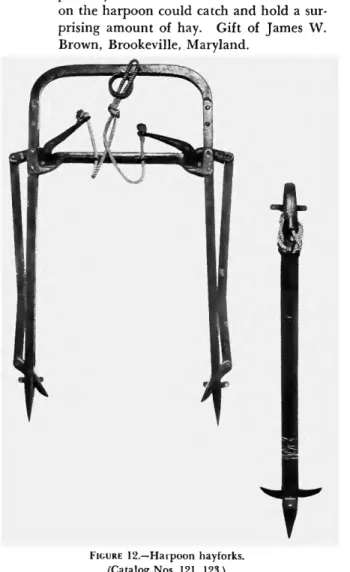
121. HARPOON HAYFORK, late 19th century.
USNM 214890; 1957. A double-harpoon hayfork and pulley for lifting hay from a wagon to a barn hayloft. Power was sup- plied by horse or mule. T h e small barbs on the harpoon could catch and hold a sur- prising amount of hay. Gift of James W.
Brown, Brookeville, Maryland.
FIGURE 12.—Harpoon hayforks.
(Catalog Nos. 121, 123.)