PROCEEDINGS
JOINT INTERNATIONAL SCIENTIFIC DIVING SYMPOSIUM
AMERICAN ACADEMY OF UNDERWATER SCIENCES
and
EUROPEAN SCIENTIFIC DIVING PANEL
Michael A. Lang and Martin D.J. Sayer
Curaçao, October 24-27, 2013
The American Academy of Underwater Sciences (AAUS) was formed in 1977 and incorporated in the State of California in 1983 as a 501c6 non-profit corporation. Visit: www.aaus.org.
The AAUS Foundation was incorporated in the State of Alabama in 2012 as a 501.c.3 not-for-profit organization.
The mission of AAUS is to facilitate the development of safe and productive scientific divers through education, research, advocacy, and the advancement of standards for scientific diving practices, certifications, and operations.
Divers Alert Network provided major financial support.
Copyright © by AAUS
Published by American Academy of Underwater Sciences
Dauphin Island Sea Lab, 101 Bienville Boulevard, Dauphin Island, AL 36528 www.aaus.org
Text and images in this publication, including cover and interior designs, are owned either by AAUS, by contributing authors, or by third parties. Fair use of materials is permitted for personal, educational, or noncommercial purposes. Users must cite author and source of content, must not alter or modify copyrighted content, and must comply with all other terms or restrictions that may be applicable. Users are responsible for securing permission from a rights holder for any other use.
Lang, M.A., and M.D.J. Sayer, editors. 2013. Proceedings of the 2013 AAUS/ESDP Curaçao Joint International Scientific Diving Symposium, October 24-27, 2013, Curaçao. Dauphin Island, AL:
American Academy of Underwater Sciences.
ISBN
1
CONTENTS
FOREWORD
Michael A. Lang, and Martin D.J. Sayer ….………5 THE ROLE OF VOLUNTEER DIVERS IN LIONFISH RESEARCH
AND CONTROL IN THE CARIBBEAN
Fadilah Ali, Ken Collins, and Rita Peachey …………7 DEEP REEF OBSERVATION PROJECT (DROP):
A SMITHSONIAN-SUBSTATION CURAÇAO COLLABORATION
Carole C. Baldwin …..………………13 RESEARCH DIVING VERSUS RESEARCH DIVING:
A MODEL FOR TRAINING TECHNICIANS AND NON-SPECIALISTS
Alex Brylske ……….………17 FUNGAL DIVERSITY IN MARINE SPONGES FROM HIGHLY DIVERSE
AREAS IN THE ISTHMUS OF PANAMA
Catherina Caballero-George, Jessica Bolaños, Luis Fernando De León,
Edgardo Ochoa, José Darias, Luis D´Croz, Huzefa Raja, and Andrea Porras-Alfaro …………23 SCIENTIFIC DIVING FOR GEOLOGICAL RESEARCH: EXAMPLES FROM ITALY
Giorgio Caramanna ……….………31 RESTORATION OF CRITICALLY ENDANGERED ELKHORN CORAL
(ACROPORA PALMATA) USING SEXUALLY PRODUCED RECRUITS
Valérie F. Chamberland, Dirk Petersen, and Mark J.A. Vermeij ………43 EXPLORATION OF DEEP HOLE, MYAKKA RIVER STATE PARK, FLORIDA
James K. Culter, Curt Bowen, John Ryan, Jon Perry, Rene Janneman, and Weiqi Lin ….…………49 BIOLOGICAL ACTIVITY INVESTIGATIONS OF SPONGES
COLLECTED FROM HAWAII AND MAUI
Jaaziel E. Garcia Hernandez, Kehau A. Hagiwara, Nicole Tabanera, Nicole de Voogd,
Dovi Kelman, and Anthony D. Wright ……………61 SCIENTIFIC DIVING IN COASTAL GEORGIA:
8000 YEAR-OLD TREES, PREHISTORIC SHELL MIDDENS AND SEA LEVEL CHANGE
Ervan G. Garrison, Jessica W. Cook Hale, and Michael K. Faught ………65 AN IMPROVED NEW CLASS OF DECOMPRESSION MODELS
THAT ARE RELEVANT TO SCIENTIFIC AND RECREATIONAL DIVING
Saul Goldman ……….………77 SCIENTIFIC DIVING WITH COASTAL AND OCEANOGRAPHIC ENGINEERING:
A STUDENT'S PERSPECTIVE
Uriah Gravois ………..………87
2
USING RISK MANAGEMENT PRINCIPLES TO OPERATE A SAFE SCIENTIFIC DIVING PROGRAM
Vallorie Hodges, and Dennis Nixon ………………91 DEVELOPING A CULTURE OF SAFETY IN SCIENTIFIC DIVING PROGRAMS
Vallorie Hodges, and Jenna M. Walker….………101 ENVIRONMENTAL RESPONSE TEAM STANDARD OPERATING PROCEDURES
FOR CONTAMINATED WATER DIVING OPERATIONS
Alan Humphrey, Scott C. Grossman, and Jonathan McBurney ………107 CAVERNS, COMPRESSED AIR AND CRUSTACEAN CONNECTIVITY:
INSIGHTS INTO HAWAIIAN SPINY LOBSTER POPULATIONS
Matthew Iacchei, and Robert J. Toonen .………115 MINING- AND STORM-INDUCED BENTHIC DISTURBANCES
IN NORTON SOUND, ALASKA
Stephen C. Jewett ……..………………125 SCIENTIFIC DIVER REBREATHER FATALITY: AN INCIDENT REVIEW
Kenneth D. Johns ………..………………139 THE EFFICACY OF USING A HYPERLITE™, HYPERBARIC STRETCHER
FOR THE TREATMENT OF SERIOUS DECOMPRESSION ILLNESS: A CASE REPORT
Douglas E. Kesling, and John Selby ..…………..………147 RESEARCH AND DISCOVERIES: THE REVOLUTION OF SCIENCE THROUGH SCUBA
Michael A. Lang, Roberta L. Marinelli, Susan J. Roberts, and Phillip R. Taylor …….……………159 DIVING MEDICINE RESEARCH REVIEW
Michael A. Lang, Peter Germonpré and Karen B. Van Hoesen ……………………………161 PERSONAL UNDERWATER TABLETS BRING NEW POSSIBILITIES TO
DATA COLLECTION, COMMUNICATION, GEOLOCATION AND DIVER MONITORING
Jouni Leinikki, Juhani Kanerva, Panu Oulasvirta, and Juha Syväranta ..……..………..…………163 JUNKYARD DAMSELFISHES:
SPAWNING BEHAVIOR AND NEST SITE SELECTION
Lisa K. Lobel, and Phillip S. Lobel …………..……….…………167 THE “CHORAL REEF”: THE ECOLOGY OF UNDERWATER SOUNDS
Phillip S. Lobel ……….……179 STALKING SPAWNING FISHES
Phillip S. Lobel, and Lisa K. Lobel ……….…………185 BASELINE SIZE-STRUCTURE SURVEYS OF REEF-FISH POPULATIONS
EXPLOITED BY A PAPUA NEW GUINEAN SUBSISTENCE COMMUNITY
Ken Longenecker, Ross Langston, Richard Pyle, David Pence, and Simon Talbot …..……………199
3
THE BELGIAN SCIENTIFIC DIVING TRAINING PROGRAM
Alain Norro ….……….…………207 APPROACHES TO THE ARCHAEOLOGY OF SUBMERGED LANDSCAPES:
RESEARCH ON THE ALPENA-AMBERLEY RIDGE, LAKE HURON.
John O’Shea, Ashley Lemke, Robert Reynolds, Elizabeth Sonnenburg, and Guy Meadows ………211 SCIENTIFIC DIVING AS A RESEARCH TOOL
FOR MAPPING REEFS IN THE NORTHEASTERN BALTIC SEA
Merli Pärnoja, Jonne Kotta, Kaire Kaljurand, and Georg Martin ……….…………217 VIKING DRYSUIT DECONTAMINATION STUDY
E. Rob Pedersen, Stephanie Harris, Sean Sheldrake, Stephanie Bailey, and P. Bruce Duncan ..…221 OCEAN ACIDIFICATION EFFECTS ON BENTHIC MEDITERRANEAN ORGANISMS
ALONG A NATURAL CO2 GRADIENT
Fiorella Prada, Erik Caroselli, Francesco Zaccanti, Bruno Capaccioni, Giuseppe Falini,
Oren Levy, Zvy Dubinsky, and Stefano Goffredo ……..………..………231 DIVING IN THE COLUMBIA RIVER: CHALLENGES AND TECHNIQUES
Katie Rathmell, Michael P. Wilkin, and Antonio M. Baptista ……...……….………235 SUPPRESSION OF UPWELLING ALONG THE WINDWARD SHORE
OF POINT REYES, CALIFORNIA
Matthew J. Robart ……….……….…………241 FROM OPEN TO CLOSED CIRCUIT: PROS AND CONS FOR STUDYING CORAL REEF
ORGANISMS IN THE CARIBBEAN
Juan A. Sánchez, Edgardo Ochoa, and Julio Andrade ………….……….…………265 DOCTORS UNDER PRESSURE: INTERESTING CASES AND DIAGNOSTIC DILEMMAS
Robert W. Sanders ………..……….………269 DECOMPRESSION MANAGEMENT BY 43 MODELS OF DIVE COMPUTER:
SINGLE SQUARE-WAVE EXPOSURES TO BETWEEN 15 AND 50MSW
Martin D.J. Sayer, and Elaine Azzopardi ……….……….…………275 COMPARATIVE ANALYSIS OF FEDERAL PROGRAM POLLUTED WATER PROTOCOLS Sean Sheldrake, Rob Pedersen, P. Bruce Duncan, and Alan Humphrey ……….……….…………281 EXPLORING THE MESOPHOTIC ZONE: DIVING OPERATIONS AND SCIENTIFIC
HIGHLIGHTS OF THREE RESEARCH CRUISES ACROSS PUERTO RICO AND US VIRGIN ISLANDS
Clark Sherman, Richard Appeldoorn, David Ballantine, Ivonne Bejarano, Milton Carlo, Doug Kesling, Michael Nemeth, Francisco Pagan, Hector Ruiz, Nikolaos Schizas, and
Ernesto Weil ………..………..……….…………297 IT’S JUST A FLESH WOUND:
NON-LETHAL SAMPLING FOR CONSERVATION GENETICS STUDIES
Derek J. Skillings, and Robert J. Toonen …..……….……….…………313
4 LIFE SUPPORT INVESTIGATIONS
Gregg Stanton, Joerg Hess, Jonathan L. Conard, and Paul Haynes …..…..……….…………321 MAPPING OF ARTIFICIAL REEF HABITATS BY SIDE SCAN SONAR AND ROV
IN THE NORTHWESTERN MID-ATLANTIC COASTAL OCEAN
Peter F. Straub, Steven Evert, Tara L. Harmer Luke, and Mark C. Sullivan ……...…….…………331 NUTRITIONAL EXCHANGE IN THE ANEMONEFISH-ANEMONE SYMBIOSIS:
WHAT NEMO DID NOT TELL YOU
E. Alan Verde, Ann Cleveland, and Raymond W. Lee ……….………..……….………339 MESOPHOTIC SURVEYS OF THE NORTHWESTERN HAWAIIAN ISLANDS
WITH NEW RECORDS OF BLACK CORAL SPECIES
Daniel Wagner, Robert J. Toonen, Yannis P. Papastamatiou, Randall K. Kosaki,
Kelly A. Gleason, Gregory B. McFall, Raymond C. Boland, and Richard L. Pyle .……...…………341 DO EPIFAUNAL COMMUNITIES IN BRITISH COLUMBIA SEAGRASS MEADOWS
VARY WITH ENVIRONMENTAL GRADIENTS?
Ross Whippo, and Mary I. O’Connor ………..……….………347
5
FOREWORD Michael A. Lang1 Martin D.J. Sayer2 Co-Chairs 2013 AAUS/ESDP Curaçao Joint International Scientific Diving Symposium
1The Ocean Foundation 1990 M Street NW, Suite 250 Washington, DISTRICT OF COLUMBIA 20036 U.S.A.
2NERC National Facility for Scientific Diving Scottish Association for Marine Science Dunstaffnage Marine Laboratories Dunbeg, Oban, Argyll PA37 1QA, SCOTLAND [email protected]
The American Academy of Underwater Sciences (AAUS) and European Scientific Diving Panel (ESDP) Joint International Scientific Diving Symposium in Curaçao, October 24-27 2013, marks the third time that the AAUS has held its annual meeting in partnership with other international scientific diving organisations. Jointly sponsored AAUS symposia occurred in 1985 with CMAS (Confédération Mondiale des Activités Subaquatiques; Mitchell, 1985) and in 1998 with the Canadian Association for Underwater Science (CAUS; Hartwick et al., 1998).
The AAUS and the ESDP share commonalities in their mission and objectives. They both represent a considerable number of scientific divers performing diving-based research covering the full range of scientific disciplines. Underwater scientific research is often conducted on an international scale in regions that frequently face growing pressures on resources and increased threats of pollution, urbanization of habitats, invasion by alien species, extreme weather events and sea-level change. The relatively shallow and multifaceted nature of many coastal areas can restrict the types of platforms that can be deployed in support of relevant research. Scientific diving is a cost-effective high-quality research tool that can sustain a wide range of scientific disciplines within operationally expedient timeframes. It has particular use in complex environments such as subtidal rocky substrates or urbanized habitats (marinas, wrecks, offshore wind farms, etc.) that are routinely inaccessible for study by other methods.
Scientific diving has also provided unique multidisciplinary datasets that add value to other ocean observation platforms (Lang et al., 2013).
This symposium convenes scientists of multiple nationalities in an attempt to reduce insularity, encourage exchange of ideas and operational protocols, and expand the worldwide network of scientific divers. This joint initiative provides a forum that will highlight some of the research findings from within the international research communities. We are experiencing a developmental period of large-scale multi- national research programs established to observe, record and monitor change over various geographical scales. Engendering a research framework for scientific divers that facilitates multi-national collaboration is of immediate and long-term benefit.
6
Irrespective of the symposium venue selected, the diving scientist increasingly experiences cutbacks in research funding, extreme pressure in travel budgets and intense competition for proposal-dependent funding, not to mention government shutdowns. The island of Curaçao was identified for this symposium because of its historical ties to Europe, its proximity to the Americas and as a desirable venue for workshops such as coral reef ecology, performance freediving and a post-symposium field trip to Bonaire.
The presence of Substation Curaçao’s CURASUB provides delegates the opportunity for deep-reef observation dives and CARMABI and CIEE are local research organizations in Curaçao and Bonaire providing perspective on long-term coral reef research in the Caribbean. We are hopeful that the connections created through this joint international symposium will advance scientific diving as a research platform on a global scale.
We wish to acknowledge the Divers Alert Network for major symposium support. We also thank the following: Dutch Grier and Laureen Schenk for sponsorship of the CURAÇAO SEAQUARIUM reception and making CURASUB dives available to symposium participants; Nolo Ambrosi of OCEAN ENCOUNTERS for diving support; the Curaçao Tourism Board; AAUS scholarship-sponsoring organizations and individuals, in particular Kathy Johnston English for her signature artwork. Thanks are also due the presenters and authors for their contributions to the symposium program and proceedings.
Finally, a special thanks to Heather Fletcher for outstanding symposium support and organizational efficiency.
References
Mitchell, C.T., ed. 1985. Proceedings of the Joint International Scientific Diving Symposium, Oct. 31- Nov. 3, 1985, La Jolla, California. Costa Mesa: American Academy of Underwater Sciences. 330 pp.
Hartwick, E.B., E. Banister, and G. Morariu, eds. 1998. Diving for Science…1998. Proceedings of the AAUS 18th Annual Scientific Diving Symposium in Association with the Canadian Association for Underwater Science Annual Meeting, Oct. 8-11, 1998. Vancouver, BC: Simon Fraser University. 117 pp.
Lang, M.A., R.L. Marinelli, S.J. Roberts and P.R. Taylor, eds. 2013. Research and Discoveries: The Revolution of Science through Scuba. Smithsonian Contributions to the Marine Sciences, Vol. 39.
258 pp.
Lang and Sayer (eds.): 2013 Curaçao AAUS/ESDP Joint International Symposium
7
THE ROLE OF VOLUNTEER DIVERS IN LIONFISH RESEARCH AND CONTROL IN THE CARIBBEAN Fadilah Ali 1,2
Ken Collins1 Rita Peachey 2
1 Ocean and Earth Science University of Southampton, National Oceanography Centre Southampton SO14 3ZH, UNITED KINGDOM [email protected]
2 CIEE Research Station Bonaire Kaya Gobernador Debrot 26 Kralendijk, Bonaire, DUTCH CARIBBEAN
The Indo-Pacific lionfish (Pterois volitans) is a venomous, voracious predator that is currently causing ecological and economical harm throughout the Caribbean. Their generalist diet and habitat preference coupled with their rapid growth rate and lack of natural predators has allowed their population to explode throughout the Caribbean. As a means to control lionfish populations, countries have designed lionfish removal programs which, in some instances, depend primarily on volunteer divers. Activities such as lionfish tournaments or specified lionfish removal trips and events are another platform whereby volunteer divers help to remove substantial quantities of lionfish. These removal events are important for lionfish control, and they contribute greatly to research.
In Bonaire, since October 2009, almost 5,000 lionfish have been submitted to CIEE Research Station Bonaire by volunteer divers for research on lionfish morphometrics, sexual maturity and feeding ecology. This submission of specimens has contributed to one of the most in-depth and long-term studies of lionfish feeding ecology in the Caribbean. Staff from CIEE have also attended lionfish hunting tournaments in Curaçao to collect data on lionfish ecology and make comparisons. During the first tournament in 2012, 317 fish of the 1,069 caught were analysed, whereas in 2013, 1,500 fish out of 2,403 caught were dissected. Thus, within two days an extensive sample size was attained from various depths throughout various locations in Curaçao, an achievement that would have taken a small group of researchers many weeks or even months. Thus, volunteer divers have the ability to play an instrumental role in lionfish research and control and should be implemented into further lionfish management strategies throughout the Caribbean.
Introduction
Lionfish signify the first marine fish invader from the Western Pacific to the Atlantic and are believed to have been introduced via intentional and/or unintentional aquaria releases (Morris, 2009). They are usually benthically associated and in their native range they occur over coral, sand and hard-bottom substrates from the surface to 50 m (Whitfield et al., 2002; 2007; Vasquez-Yeomans et al., 2011). In their invaded range, they have occupied all major seafloor and substrate types and occupy a range of depths, from the shoreline to more than 300 m deep. During the day, lionfish linger under ledges and crevices, but
Ali et al.: Caribbean lionfish research and control
8
may hunt small fish, shrimps and crabs in the open water at night (Ruiz-Carus et al., 2006). Lionfish are adaptable to many habitats and have colonised areas ranging from 1 to 140 m on reef walls, patch reefs, rocky areas, hard bottoms, ledges, crevices, mangrove creeks, isolated coral heads, blue holes, ship wrecks, and man-made structures (NOAA’s Coris, 2009). Lionfish tend to live in small groups as juveniles and during reproduction but disperse and hide in reef shadows when they are adults (Fishelson, 1997).
Based on captured specimens in the Caribbean, lionfish are reproducing throughout the year (REEF, 2012). Their reproduction shows no apparent timing relative to moon and tidal regimes, and a continuous supply of propagules is generated (Department of Marine Resources, 2008; Morris, 2009). Lionfish are prolific breeders with one female being able to eject up to 15,000 eggs during a single mating event, of which she can have at least three per month (Bervoets, 2009). The eggs are bound in an adhesive mucus that disintegrates a few days later, allowing the embryo and/or larvae to become free-floating (Hare and Whitfield, 2003; Morris et al., 2009). As they are not thermally limited in their native range, they can continuously reproduce throughout the year. The actual larval distribution of lionfish still remains unknown but has been estimated to be between 25-40 days (Morris, 2009). Laidig and Sakuma (1998) reported a larval growth rate of 0.33 mm day-1 for Scorpaena, a genus in the Scorpionfish family.
Applying this estimate to the estimated 25-40 day larval duration, it can be suggested that larvae are in the water column and consequently susceptible to transport by ocean currents for approximately one month (Hare and Whitfield, 2003). Settling from the water column to the benthic habitat is proposed to occur at a total length of about 12 mm (Hare and Whitfield, 2003). The juveniles develop rapidly and begin to actively hunt at approximately 7 cm total length and have been observed to consume prey up to two-thirds their body length (Bervoets, 2009).
Lionfish are principally piscivorous but are known to feed on invertebrates (Morris, 2009). In their native range they occupy the higher levels of the food chain (Hare and Whitfield, 2003; Bervoets, 2009).
In the Bahamas, the occurrence of teleosts in lionfish diets is size-dependent with larger lionfish feeding on teleosts and smaller lionfish feeding more heavily on crustaceans (Morris, 2009; Morris and Akins, 2009). Bervoets (2009) suggested that lionfish consume 10% of their body weight every day, whilst Morris (2009) proposed that lionfish have the ability to consume 2.5 to 6.0% of their body weight per day at 25-26oC. Lionfish stomachs can expand to more than 30 times in volume (Freshwater et al., 2009).
Lionfish are adept in undergoing periods of starvation of over 12 weeks without mortality because of their capability of long-term fasting (Fishelson, 1997; Morris, 2009). They can employ a diverse range of feeding strategies making them well suited for feeding on benthic and cryptic prey. Prey species in the Atlantic region are naïve to lionfish’s novel predation strategies, resulting in lionfish having higher predation efficiencies in the invaded range compared with its native range.
Since their invasion of the North Atlantic/Caribbean region, various management measures have been instilled to quell lionfish populations (Morris et al., 2010). Lionfish management has been an evolutionary process in terms of the schemes established, the tools used, and the means to increase removal efforts (De Leon et al., 2011). At the beginning of the lionfish invasion, scientists and government or state department officials were the primary persons involved in lionfish removal. However, because of the invasion characteristics of lionfish, there is need for a larger, community effort to enhance the chances of more successful removal (Morris et al., 2012). Removal activities were introduced to dive operators and professionals and further extended to volunteer divers, no matter what their dive certification level (BNMP, 2010); this has been instrumental in the successful control and management of lionfish in some islands in the Caribbean.
Lang and Sayer (eds.): 2013 Curaçao AAUS/ESDP Joint International Symposium
9 Case Studies Bonaire
Bonaire is a prime example of how the use of volunteer dives can be a successful means to control lionfish populations. The control, management and monitoring of lionfish in Bonaire is achieved through an intricate partnership between STINAPA (nature enforcement agency on the island), CIEE Research Station Bonaire, dive operators and volunteer divers. Not only do volunteer divers remove considerable quantities of lionfish, but they also submit a large proportion of their catch so that research can be conducted. Since the first lionfish sighting on 26 October 2009, more than 5,000 lionfish have been submitted to CIEE Research Station Bonaire. This represents one of the largest and most long-term lionfish datasets in the Caribbean; this would not have been possible without the commitment of volunteers. Time and especially monetary restrictions mean that scientists themselves are unable to achieve such a large sample size. However, for research purposes, large sample sizes are desired especially for dietary studies because a large proportion of the stomach content already tends to be too digested for analysis (Cocheret de la Moriniere et al., 2003). A larger sample size is also able to reveal the full spectrum of prey items in lionfish diets and any temporal changes (Hyslop, 1980; Pierce et al., 2004).
Research has focused on lionfish ecology, primarily their feeding preferences, their growth rates, their reproductive status and their habitat and depth preferences. Conducting research on lionfish and monitoring any changes in their growth rate, diet, habitat and depth preferences helps to predict and quantify how lionfish may impact on the ecosystem, especially when coupled with prey density surveys (Morris et al., 2012).
Conducting research also acts as an important education and training tool. In Bonaire, all findings are communicated to the public via lectures, newsletters and postings on social media. There is also high involvement with the local schools with educational workshops whereby students get educated on the lionfish invasion and are then given the opportunity to view live lionfish and conduct research through an interactive dissection workshop. Getting the locals, especially the youth, involved is imperative as they can act as ambassadors and educate others. In Bonaire there is also a fantastic partnership between CIEE and the STINAPA Junior Rangers. This program targets the young people of Bonaire in the 12-21 age group. All Junior Rangers have received a lionfish education whilst those over the age of 18 have received training on lionfish removal. These Junior Rangers diligently attend lionfish removal trips offered by CIEE and GOOODIVE and have improved tremendously; they are now the top hunters on these trips. These Junior Rangers act as ambassadors to other youngsters who are aspiring to learn more about lionfish and become lionfish hunters themselves.
Klein Bonaire
Bonaire is renowned as being a shore diving heaven, which makes lionfish removal in Bonaire so convenient. However, Klein Bonaire is only accessible via boat, which accounts for a lower hunting pressure. As a result, a research and removal program was initiated in early 2012 whereby the entire island of Klein Bonaire would be covered. On each trip, a group of 8-10 hunters would remove lionfish from a particular dive site but also keep track of data such as the depth of capture, how many lionfish were missed, lionfish aggregation and behavior. Following the dives all lionfish were measured, weighed, dissected and their reproductive status and stomach contents analysed. Following analysis, lionfish were either sold to restaurants or used personally by hunters.
Figure 1 reveals a reduction in the number of lionfish seen at Klein Bonaire, from 2,240 in 2012 to 854 in 2013. The lionfish hunters in Bonaire have become more efficient at removing lionfish. Improving from a 40% successful capture rate in 2012 to 63.5% in 2013 is especially commendable because lionfish themselves have become ‘smarter’ and have learnt to associate divers with danger, thus making removal activities more difficult.
Ali et al.: Caribbean lionfish research and control
10
Figure 1. Comparison of the number of lionfish seen and caught at Klein Bonaire in 2012 and 2013
Curaçao
Lionfish were first confirmed in Curaçao on 27 October 2009 (NACRI, 2009). Since 2012, three lionfish tournaments have been hosted in Curaçao (Table 1). Personnel from CIEE Research Station Bonaire were present at the 1st and 3rd tournament, whilst scientists from CARMABI were on-hand to conduct research during the 2nd tournament. During the 1st tournament, 317 lionfish were analysed whereas during the 3rd tournament, an impressive 1,497 lionfish were analysed by CIEE staff.
Table 1. Diver participation and number of lionfish caught during tournaments in Curacao.
Tournament No. Scuba divers No. Freedivers No. Lionfish Caught
1) March 2012 20 4 1084
2) August 2012 11 0 1591
3) April 2013 44 0 2403
Lionfish collected during the tournaments in Curaçao were used for an analytic comparison with fish collected at Klein Bonaire and Bonaire. Despite the close proximity of these islands to one another, there were some interesting differences with respect to lionfish feeding preferences, differences that may not have been discovered with a smaller sample size. Similarities of the top prey species in lionfish’s diet were also observed amongst the three islands, which helped to confirm and also understand how lionfish feed which could provide a basis for predicting what their future impacts may be.
Importance and benefits of volunteer divers and lionfish tournaments
Lionfish tournaments allow for large numbers of lionfish to be eradicated in quite a short space of time. The fish caught from these activities provide valuable research specimens for scientists to examine lionfish growth characteristics and their feeding and reproductive ecology, among other aspects. The large quantities of fish caught can also be used as a means to encourage the locals and the general public to eat lionfish whilst also acting as an important vehicle for public education and raising awareness (Morris et al., 2012).
0 500 1000 1500 2000 2500
Seen Caught 2012
2013
Numberoflionfish
Lang and Sayer (eds.): 2013 Curaçao AAUS/ESDP Joint International Symposium
11
Acknowledgements
Many thanks are extended to CIEE Research Station Bonaire and its entire staff for allowing, supporting and participating in this research. Thanks to STINAPA and the Bonaire National Marine Park and its staff for their dedication to lionfish management in the Caribbean. Special thanks to Mr. Menno De Bree of GOOODIVE Bonaire for pioneering and enabling the research at Klein Bonaire and continuously supporting lionfish research. Thanks also to Mr. Allie El-Hage (Zookeeper Lionfish Containment Unit) and Mr. Jeff Schanze for enabling research partnerships between Bonaire and Curaçao. And finally thanks to all the volunteer divers and dive operators in Bonaire and Curaçao for sustaining lionfish research on these islands. Without you none of this research would be possible.
References
Bervoets, T. 2009. Lionfish Response Plan, St Eustatius National Marine Park, [Online]. Accessed 16 February 2010 from: http://www.nacri.org/downloads/STENAPALionfishResponsePlan2009.pdf Bonaire National Marine Park (BNMP). 2010. Lionfish Update [Online] Accessed 27 June 2010 from:
http://www.stinapa.org/news/pressreleases/100503e.html
Cocheret de la Moriniere, E., B.J.A. Pollux, I. Nagelkerken, M.A. Hemminga, A.H.L. Huiskes, and G.
Van der Velde. 2003. Ontogenetic dietary changes of coral reef fishes in the mangrove-seagrass-reef continuum: stable isotopes and gut content analysis, Marine Ecology Progress Series, 246: 279-289.
De Leon, R., K. Vane, M. Vermeij, P. Bertuol, and F. Simal. 2011. Overfishing works: A comparison of the effectiveness of lionfish control efforts between Bonaire and Curacao, Proceedings of the 64th Gulf Caribbean and Fisheries Institute.
Department of Marine Resources. 2008. Bahamas Invasive Lionfish Informational, [Online]. Accessed 8 February 2011 from:
http://www.breef.org/Portals/0/Bahamas%20Invasive%20Lionfish%20Informational%20DMR%20sh ort%2008.pdf
Fishelson. L. 1997. Experiments and observations on food consumption, growth and starvation in Dendrochirus brachypterus and Pterois volitans (Pteroinae, Scorpaenidae) Environmental Biology of Fishes, 50: 391-403.
Hyslop, E.J. 1980. Stomach contents analysis – a review of methods and their application, Fish Biology, 17: 411-429.
Laidig, T.E., and K.M. Sakuma. 1998. Description of pelagic larval and juvenile grass rockfish, Sebastes rastrelliger (family Scorpaenidae), with an examination of age and growth. Fisheries Bulletin, 96:
788-796.
Morris, J.A. 2009. The Biology and Ecology of the Invasive Indo-Pacific Lionfish, Ph.D. Dissertation, North Carolina State University.
Morris Jr., J.A., and J.L. Akins. 2009. Feeding ecology of invasive lionfish (Pterois volitans) in the Bahamian archipelago, Environmental Biology of Fishes, 86: 389-398.
Morris, J.A., J.L. Akins, A. Barse, D. Cerino, D.W. Freshwater, S.J. Green, R.C. Munoz, C. Paris, and P.E. Whitfield. 2009. Biology and Ecology of the Invasive Lionfishes, Pterois volitans and Pterois miles, Proceedings of the 61st Gulf and Caribbean Fisheries Institute.
Morris, J.A., K.W. Shertzer, and J.A. Rice. 2010. A stage based matrix population model of invasive lionfish with implications for control, Biological Invasions, 13: 7-12.
Morris, J.A. 2012. Invasive Lionfish: A guide to control and management, Gulf and Caribbean Fisheries Institute Special Publication Series Number 1, Marathon, Florida, USA, [Online], Accessed 4 October 2012 from:
http://lionfish.gcfi.org/manual/InvasiveLionfishGuide_GCFI_SpecialPublicationSeries_Number1_20 12.pdf
Ali et al.: Caribbean lionfish research and control
12
Netherlands Antilles Coral Reef Initiative (NACRI). 2010. Lionfish invasion continues unabated, [Online], Accessed 27 June 2013 from http://www.nacri.org/news1.html
National Oceanic and Atmospheric Administration Coral Reef Information System [NOAAs CoRIS].
2009. The Indo-Pacific Lionfish Invasion of the U.S. South Atlantic Sea Coast and Caribbean Sea, [Online], Accessed: 21 December 2009 from http://coris.noaa.gov/exchanges/lionfish/
Pierce, G.J., M.B. Santos, J.A. Learmonth, E. Mente, and G. Stowasser. 2004. Methods for dietary studies on marine mammals. In: Understanding the role of cetaceans in the marine ecosystem. CIESM Workshop Monograph. Monaco: Commission Internationale pour l’Exploration Scientifique de la mer Méditerranée.
Reef Environmental Education Foundation (REEF). 2012. Lionfish Research Program, [Online] Accessed 3 October 2012 from: http://www.reef.org/programs/exotic/lionfish
Ruiz-Carus, R., R.E. Matheson Jr., D.E. Roberts Jr., and P.E. Whitfield. 2006. The western Pacific red lionfish, Pterois volitans (Scorpaenidae), in Florida: Evidence for reproduction and parasitism in the first exotic marine fish established in state waters. Biological Conservation, 128: 384-390.
Vasquez-Yeomans, L., L. Carillo, S. Morales, E. Malca, J.A. Morris, T. Schultz, and J.T. Lamkin. 2011.
First larval record of Pterois volitans (Pisces: Scorpaenidae) collected from the ichthyoplankton in the Atlantic, Biological Invasions, 13: 2635-2640.
Whitfield, P.E., T. Gardner, S.P. Vives, M.R. Gilligan, W.R. Courtenay, R.C. Ray, and J.A. Hare. 2002.
Biological invasion of the Indo-Pacific lionfish Pterois volitans along the Atlantic coast of North America. Marine Ecology Progress Series, 235: 289-297.
Whitfield, P.E., J.A. Hare, A.W. David, S.L. Harter, R.C. Munoz, and C.M. Addison. 2007. Abundance estimates of the Indo-Pacific Lionfish Pterois volitans/miles complex in the Western North Atlantic.
Biological Invasions, 9: 53-64.
Lang and Sayer (eds.): 2013 Curaçao AAUS/ESDP Joint International Symposium
13
DEEP REEF OBSERVATION PROJECT (DROP):
A SMITHSONIAN-SUBSTATION CURAÇAO COLLABORATION Carole C. Baldwin Smithsonian Institution National Museum of Natural History Washington, DISTRICT OF COLUMBIA 20560 U.S.A.
[email protected] Scientists have studied shallow Caribbean reefs for more than a century. In contrast tropical mesophotic and deep reefs, which are below the depths accessible by traditional scuba gear and above the depths typically visited by deep-diving submersibles, are underexplored ocean ecosystems that science has largely missed. Little is known about the diversity of life on deep reefs, how it changes over space and time, and what role deep reefs may play in the survival of shallow reefs above. Shallow reefs are in peril circumtropically but what is the status of deep reefs? Are water temperatures on deep reefs rising and are these ecosystems exhibiting degradation and loss from major agents of environmental impact?
Are shallow reef inhabitants moving deeper in response to warming surface waters? Are deep-reef populations re-seeding shallow populations that have been impacted by reef demise?
In 2011 the Smithsonian initiated Deep Reef Observation Project (DROP), a research effort that utilizes Substation Curaçao’s Curasub submersible (http://www.substation-curacao.com/, Fig. 1) to address questions related to biodiversity and conservation of deep reefs. DROP’s three main research objectives are to (1) document local biodiversity to a depth of 300 m in a small, 0.2 km2 “plot” of water directly off the Curaçao Seaquarium shoreline (the “Seaquarium plot”) and create specimen and DNA libraries for diversity and monitoring studies; (2) implement standardized sampling methods for monitoring long-term changes in environmental and biological conditions on deep and shallow reefs off Curaçao; and (3) transport the Curasub to other Caribbean deep reefs to obtain comparative samples to broaden the evolutionary and biogeographic research questions that can be addressed.
Figure 1. The Curasub submersible. Photo by Barry Brown.
In 2011-2013 Smithsonian marine scientists made 32 exploratory submersible dives in the Seaquarium plot and collected approximately 600 deep-reef specimens. Samples were photographed, processed for genetic analysis, and exported for archiving into Smithsonian collections. This material
Baldwin: Curaçao Deep Reef Observation Project
14
contains at least 30 new species of fishes and invertebrates (e.g., Baldwin and Robertson, 2013) and, for fishes, each submersible dive has yielded species new to the DROP project. This is remarkable considering the small size of the study area and it demonstrates the need for additional sampling. The increasingly comprehensive collection of specimens and DNA sequences resulting from specimens collected during submersible diving is invaluable for ongoing and future diversity and monitoring studies.
Progress also has been made in implementing standardized sampling methods for monitoring deep and shallow reefs in the Seaquarium Plot. In 2012, DROP broke new ground by deploying nine autonomous reef monitoring systems (ARMS) at depths up to 224 m using the hydraulic arms of the Curasub (Fig. 2). Three additional ARMS were placed on the shallow reef for comparative purposes and 11 oceanographic temperature loggers (set to record hourly temperatures) were deployed along a transect at regular intervals from 15 to 250 m. All of this equipment will remain in place for one year and then be retrieved, processed and redeployed. Successful acquisition of annual data on temperatures and invertebrate/algal diversity on a reef slope from 15 to 250 m will be a unique scientific accomplishment:
there is no comparable dataset from anywhere else in the world. Repeated over time, these standardized sampling methods will provide information on long-term changes in temperatures and biodiversity on shallow and deep reefs off Curaçao.
Figure 2. Deploying autonomous reef monitoring structure (ARMS) with the hydraulic arms of the Curasub submersible off Curaçao. Photo courtesy of Substation Curaçao.
Figure 3. Deploying the Curasub at Klein Curaçao from the R/V Chapman. Photo by Barry Brown.
Lang and Sayer (eds.): 2013 Curaçao AAUS/ESDP Joint International Symposium
15
Regarding transporting the Curasub away from its home port at the Curaçao Seaquarium to investigate other southern Caribbean deep reefs, renovations to a former NOAA ship, the R/V Chapman, were completed in 2012 and sub dives are now being made from the shipboard platform (Fig. 3). Smithsonian marine scientists have participated in Curasub dives at Klein Curaçao, a 1.7 km2 uninhabited island southeast of Curaçao, and off Bonaire. Putative new species were collected at both sites and additional dives at Klein Curaçao are planned. Genetic data from dives at the three localities will enable preliminary assessment of genetic connectivity among certain taxa inhabiting geographically distinct reefs.
Ultimately, given sufficient submersible collections from numerous Caribbean deep reefs, biogeographic patterns of shallow and deep taxa can be compared.
In conclusion, facilities and staff at Substation Curaçao are enabling exploration and monitoring of deep reefs off Curaçao. Deep and shallow reefs are not isolated ecosystems and their interconnectedness may be significant. Like shallow coral reefs Caribbean deep reefs should be candidates for designation as marine-protected areas but such management decisions require scientific data on a multi-year basis.
Results of DROP research will be used as a foundation for establishing Curaçao as a permanent site in the Smithsonian’s Marine Global Earth Observatory (SI MarineGEO) and to inform international marine policy related to the establishment of deep reefs as marine protected areas
Literature Cited
Baldwin, C.C., and D.R. Robertson. 2013. A new Haptoclinus blenny (Teleostei, Labrisomidae) from deep reefs off Curaçao, southern Caribbean, with comments on relationships of the genus. Zookeys, 306: 71-81.
Baldwin: Curaçao Deep Reef Observation Project
17
RESEARCH DIVING VERSUS RESEARCH DIVING:
A MODEL FOR TRAINING TECHNICIANS AND NON-SPECIALISTS Alex Brylske Florida Keys Community College 5901 College Rd.
Key West, FLORIDA 33040 U.S.A.
Many scientific diving programs are geared to training undergraduates in the latter stages of their degree, graduate students and practicing scientists. The primary objective is to train them to perform safely in an underwater environment. In this case, given the students’ technical background, it is often perceived as unnecessary, perhaps even condescending, to emphasize or even include topics such as the nature of science, the scientific method, data collection, experimental design and other basic concepts/techniques covered in the early education of a scientist. Programs with this perspective might be referred to as Research DIVING courses where diving, rather than research, is the priority. However, other programs have a very different task of taking a relatively competent diver who has no prior scientific education, and training them to perform effectively underwater as a scientific technician. Students in this case are normally first or second year undergraduates, or perhaps not college students at all. In this case, if students are to fully understand their role in a scientific context, they must be given a grounding in basic scientific theory and practice. Because science, rather than diving, is the priority in this case, these programs might be referred to as RESEARCH Diving courses. This latter approach is used in the Marine Environmental Technology degree program at Florida Keys Community College for a required sophomore-level interdisciplinary science course entitled ISC 2132: Basic Research Diving. This paper provides an overview of the FKCC program as a model for others who have a similar goal of training students very early in their careers. The model may be useful as well for programs training “citizen scientists” in a non-academic setting.
Introduction
Scientific diving in the United States developed in the early 1950s to enable and support underwater research operations and the first “scientific divers” were scientists and graduate students. Even today many, if not most, of those who enroll in scientific diving courses are scientists, graduate students or upper-level undergraduates. This population typically has a strong background in their respective scientific disciplines, as well as subjects such as research design and statistical analysis. On the other hand, they often lack a similar depth of understanding and skill in diving. Facing the scenario of “strong scientific, but weaker diving background,” scientific diver curricula often emphasize the diving aspect while deemphasizing the science side of the equation. For many scientific diver programs, particularly those at research universities, this approach is valid and appropriate. However, this is not the case in all instances.
Another characteristic of the early days of scientific diving is that programs were based almost exclusively at large research universities, making the profile of the typical scientific diver relatively homogenous. Yet, in the intervening years both scientific diving and scientific divers have become much
Brylske: Research diving versus diving research
18
more diverse. As evidence one merely needs to review the organizational membership of the American Academy of Underwater Sciences (AAUS). While large research universities still represent a major portion of AAUS Organization Members (OM), the Academy membership is now much more inclusive than it was at its inception. Today, entities as diverse as public aquaria, consulting practices, government agencies and community colleges fill the AAUS membership rolls. There are even several OMs that deal exclusively with high school-age students.
Students enrolling in scientific diving programs from these more non-traditional organizations represent very different constituency and program needs. In addition, some students now come into scientific diving courses with extensive diving credentials and experience. However, these students often have little, if any, formal scientific training. This is especially true in the case of the “citizen science”
diving programs at public aquaria and other organizations that deal largely with non-specialists. Thus, rather than “researchers,” students in this category are probably better viewed as research “technicians.”
Unlike traditional scientific diver programs, the needs and goals of this technician group require that the training experience focus on science education as much as, if not more than, diving. Such is the case at Florida Keys Community College (FKCC), which may provide a useful model for other scientific diving programs with similar goals and diver characteristics.
The Marine Environmental Technology Program at FKCC
Given its location in Key West, FKCC has long had a strong commitment to marine science and underwater technology education. The College’s Department of Marine Science offers two degrees. One is a traditional Associate of Arts degree in marine and aquatic biology, with a curriculum not unlike that of many other institutions. It also offers a unique Associate of Science degree in Marine Environmental Technology (MET).
The MET degree is designed to prepare students for diverse employment opportunities in marine- oriented careers. During the program students acquire the skills and knowledge necessary to enter the work force in a variety of ocean-based occupations including technicians at research laboratories, environmental consulting companies, public aquaria, marine tourism venues, aquaculture/mariculture facilities and marine restoration projects. A strong foundation in theoretical knowledge is applied through field study in the various marine habitats throughout the Florida Keys. At the conclusion of the program graduates are able to: (1) collect marine related data above and below the water (i.e. on scuba), (2) write technical reports, (3) navigate and operate marine vessels, and (4) understand basic business and management concepts. A steering committee comprised of employers in the marine sciences and environmental industries, as well as state and federal resource management agencies, meets regularly to provide input to FKCC faculty and administrators ensuring that the MET curriculum matches workplace demands.
An overview of the MET curriculum is provided here:
General Education Requirements (15 credits)
• ENC 1101 English Composition (3)
• MAC 1105 College Algebra (3) OR
MGF 1106 Math for Liberal Arts I (3) OR
STA 2023 Introduction to Probabilities & Statistics (3)
• SPC 1608 Introduction to Speech Communication (3)
• Any course from Humanities/Fine Arts (3)
• Any course from Social/Behavioral Science (3)
Lang and Sayer (eds.): 2013 Curaçao AAUS/ESDP Joint International Symposium
19 Core Requirements (36 credits)
• BSC 1010 Principles of Biology I (3)
• BSC 1010L Principles of Biology I Lab (1)
• GEB 2112 Introduction to Entrepreneurship (3)
• ISC 2132 Basic Research Diving (4) *
• MTE 1053C 2 & 4 Cycle Outboard Engine Repair and Maintenance (3)
• MTE 1811 Basic Seamanship (2)
• OCB 1000 Introduction to Marine Biology (3)
• OCB 2102C Marine Data Collection (4)
• OCB 2721C Survey of Mariculture (4)
• OCB 2263C Coral Reef Biology and Management (4) *
• OCE 1001 Introduction to Oceanography (3)
• PCB 2030 Environmental Biology (3) Area of Specialization (9 credits)
Monitoring & Restoration Track:
• OCB 2107C Monitoring of Caribbean Reef Fish (3) *
• OCB 2132C Restoration of Coral Reefs (3) *
• OCB 2133C Restoration of Seagrass (3)
• OCB 2262C Assessment of Coral Reef Habitats (3) * Marine Aquaculture Track:
• FAS 1419 Aquaculture Best Management Practices (3)
• OCB 2722C Mariculture Systems and Design (3)
• OCB 2723C Nutrition of Mariculture Species (3)
• OCB 2724C Tropical Ornamental Mariculture (3)
• OCB 2725 Disease and Parasites of Mariculture Species (3)
• OCB 2725L Disease and Parasites of Mariculture Species Lab (1) Marine Mammals Track:
• OCB 1301C Dolphin Laboratory (3)
• OCB 1311 Marine Mammal Care and Basic Training I (3)
• OCB 2310 Cognitive and Behavioral Research with Marine Mammals (3)
• OCB 2313 Marine Mammal Training and Enrichment II (3)
• OCB 1315 Marine Mammal Rescue (3)
• OCB 2316 Cetacean Anatomy, Physiology and Pathology (3) Total Credits Required: 62
* Denotes courses that have labs requiring scuba diving activities falling under the FKCC Dive Control Board.
Students completing all five of these courses typically have between 50 and 70 logged dives as part of their required lab hours.
Scientific Diver Training at FKCC
At FKCC full Scientific Diver certification requires completion of two courses: 1) EMS 2081C:
Scuba Rescue and Emergency Medicine; and 2) ISC 2132: Basic Research Diving. This two-phased approach enables the learning experience to concentrate on diving and emergency management skills in EMS 2081, while allowing ISC 2132 to emphasize the research aspect of scientific diving. This strategy also allows time in ISC 2132 to concentrate on other topics not addressed, or not emphasized, in traditional research diving courses.
As described in the course description, ISC 2132 is an interdisciplinary science course designed to expose students to the tools and techniques for collecting scientific data under water. This course includes
Brylske: Research diving versus diving research
20
a review of the theory and practical application of scientific diving through the use of scuba diving skills and research methodology as applied to the fields of marine biology, physical oceanography and marine archaeology. It carries four semester credit hours. The course objectives include:
1. demonstrate the theoretical and practical understanding of: the nature of science and scientific investigation, what data is and how it’s collected, the role of the research diver and various methods used in conducting underwater research;
2. demonstrate the skills necessary to collect data as part of an underwater research team;
3. demonstrate how to plan and organize dives for underwater scientific research; and
4. identify the problems and hazards of research diving, and demonstrate the techniques and procedures needed to minimize their occurrence or impact.
The topics explored during the 60-hour theory and field lab of ISC 2132 include the following:
• The Role of the Research Diver
• The Nature of Science and Scientific Investigation
• Understanding Data and Research Design
• Research Methods
• Underwater Survey Methods
• Advanced Diving Theory
• Introduction to Underwater Photography & Photo-Documentation
• Submerged Cultural Resources & Marine Archeology
• Introduction to Coral Reef Ecology
• Protocols for Coral Reef Monitoring & Assessment (Reef Check)
One advantage to offering a program such as the MET degree at FKCC is that it houses the James E.
Lockwood School of Diving and Underwater Technology. The campus contains facilities specifically designed for diver education, such as an Olympic-size pool, a 3,000 square-foot dedicated dive locker capable of outfitting 35 scuba divers and six surface-air-supplied divers and a 1,500 square-foot hyperbaric facility with two recompression chambers.
Open water training at FKCC is facilitated by an on-campus, five-acre 45-foot deep Underwater Training Area (UTA). This facility was originally a quarry dug for construction fill before the campus was built in 1966, and offers complete protection from adverse weather and sea conditions enabling open water training 365 days per year.
For ISC 2132, the UTA allows effective skill diving skill assessment and remediation before entering the more challenging offshore environment. Navigation training and a rescue workshop are held, as well, in the UTA before any offshore diving activities. About 20 years ago the treasure hunter Mel Fisher placed 24 timbers excavated from the wreck of the Nuestra Senora de Atocha in the UTA for use in training FKCC students in underwater archeology. The Florida Keys National Marine Sanctuary (FKNMS) has also placed in the UTA several historic artifacts confiscated from illegal salvors. These are all used during ISC 2132 to teach underwater surveying, trilateration and photo-documentation. The UTA is also used to provide training to research diving students in more advanced diving technologies such as full-face mask systems, and in showing how diving operations can augment remote sensing technologies such as sector-scan sonar.
The offshore portion of ISC 2132 is facilitated by an agreement between FKCC, NOAA and the Florida Department of Environmental Protection for access to the 55-foot Research Vessel Dante Fascell.
In this portion of training students dive several sites within the FKNMS. Also, since 2010, as part of the maritime archeology component of ISC 2132, students have been working in cooperation with the Mel Fisher Maritime Museum documenting an historical shipwreck (the largest vessel ever built in the
Lang and Sayer (eds.): 2013 Curaçao AAUS/ESDP Joint International Symposium
21
Bahamas) in Key West Harbor, the schooner Marie J. Thompson. In addition, students have the option of interning at the Museum’s conservation laboratory.
Students are introduced to the biological aspects of research diving through the coral reef monitoring protocol, Reef Check®. They are also taught quadrat use and rugosity calculation. Each semester students complete a team research project entitled, A Comparison of the Community Structure and Condition of a No-Take Reserve and Unprotected Site Within the Florida Keys National Marine. The culminating activity of the course is an oral presentation of research results, and submission of a report using appropriate scientific structure and formatting. The project is graded using both a rubric- and peer- evaluation. Depending on weather conditions, ISC 2132 students make between 12 and 18 open water dives during the term.
Conclusion
Although some of the ISC 2132 curriculum is specific to FKCC’s program goals, location and facilities, the course content and approach do have broader applications for other scientific diving programs. While programs at research universities may have no need for a course with such extensive treatment of basic science education, this template may have great utility for programs geared to lower- division undergraduates who have not yet completed much formal course work in a scientific discipline.
Programs training citizen scientists at non-academic institutions may also find ISC 2132 a useful training template.
Note: Copies of all ISC 2132 course materials are available by contacting the author.
Brylske: Research diving versus diving research
23
FUNGAL DIVERSITY IN MARINE SPONGES FROM HIGHLY DIVERSE AREAS IN THE ISTHMUS OF PANAMA Catherina Caballero-George1
Jessica Bolaños1 Luis Fernando De León1 Edgardo Ochoa2 José Darias3 Luis D´Croz4 Huzefa Raja5 Andrea Porras-Alfaro6
1Institute for Scientific Research and High Technology Services Apartado 0843-01103 Panama, REPUBLIC OF PANAMA [email protected]
2Smithsonian Tropical Research Institute Apartado Postal 0843–03092 Panama, REPUBLIC OF PANAMA
3Instituto de Productos Naturales y Agrobiología Tenerife, ESPAÑA
4University of Panama Panama, REPUBLIC OF PANAMA
5Department of Chemistry and Biochemistry The University of North Carolina Greensboro, NORTH CAROLINA 27402 U.S.A.
6Department of Biological Sciences Western Illinois University Macomb, ILLINOIS 61455 U.S.A.
Fungal diversity studies using cultured-based and isolation-independent methods have shown that fungi occupy an important ecological niche in the marine environment.
Although it has been suggested that the culture-based approach overlooks a large diversity of fungi, this method is still favored by research programs aimed at studying the biotechnological potential of fungi. Interactions between fungi and marine sponges are far less studied when compared with interactions between sponges and bacteria in terms of host specificity and microbial diversity. Living, apparently healthy, marine sponges were collected by scuba from 12 sites along the Caribbean and Pacific coasts of the Isthmus of Panama, at depths between 3 and 30 m. Sponges were collected in an area of ca. 3 m2 at each site. Measures were taken to prevent cross contamination among samples during collection and isolation of the fungi. Total genomic DNA was extracted from 570 representative fungal strains and the ITS and LSU regions of the nuclear
Caballero-George et al.: Panamanian marine sponge fungal diversity
24
ribosomal DNA were amplified and sequenced bidirectionally. Sequences were compared against the NCBI GenBank database using BLAST to estimate taxonomic placement. A total of 198 Operational Taxonomic Units (OTU) was found with 58% of the OTUs represented by singletons. Marine sponges were highly dominated by fungi within the Ascomycota (80.9%), with a minority within Basidiomycota (2.8%). Ascomycota fungi were represented by several major lineages, including Sordariomycetes, Dothideomycetes and Eurotiomycetes. Species accumulation curves for both geographical region and sponge orders indicated no obvious saturation. Several unique clades were found during phylogenetic analysis. Our results indicated that marine sponges from Panama could be a “hot spot” of fungal diversity as well as a rich resource for capturing, cataloguing, and assessing the pharmacological potential of previously undiscovered fungi associated with marine sponges.
Introduction
Fungi occupy an important ecological niche in the marine environment. This is revealed by phylogenetic analysis of increasingly available molecular data which promise to unravel the yet to be described marine fungal diversity (Manohar and Raghukumar, 2013). Sponges can harbor microorganisms that are either acquired by the surrounding water or by parental sponges through reproductive stages (Taylor, 2007). Interactions between sponges and bacteria are well studied and characterized in terms of host specificity and bacterial diversity (Taylor, 2007; Simister et al., 2012;
Taylor et al., 2012),; studies regarding archaea and fungi interacting with sponges are far less numerous.
Although, it has been suggested that culture-based methodology overlooks a large diversity of fungi, this method is still favored by research programs aimed at studying the biotechnological potential of fungi (Blunt et al., 2009; Caballero-George et al., 2010; Kjer et al., 2010; Liu et al., 2010).
The Pacific shelf of Panama is wide and is divided by the southward projecting Azuero Peninsula, into two large areas: the Gulf of Panama (east-side) subject to strong seasonal wind-driven upwelling, and the Gulf of Chiriquí (west) where high mountains block the wind and prevent wind-induced upwelling (D’Croz and O’Dea, 2007). In contrast, the Caribbean coast of Panama is relatively straight with a narrow continental shelf exposed to ocean water except for the Bocas del Toro Archipelago on the west side, where rainfall and river discharge are higher (D’Croz et al., 2005; Collin et al., 2009). Thus, Panama´s
“four oceanic zones” provide unique opportunities for understanding how and why low-latitude marine ecosystems vary and function as they do (Robertson et al., 2009). We used these widely differentiated oceanographic zones to compare fungal communities associated with 39 species of sponges collected by scuba in areas of high biodiversity.
Methods
Living, apparently healthy, marine sponges were collected by scuba at depths between 3 and 30 m from 12 primary sites locations along the Caribbean and Pacific coasts of the Isthmus of Panama (Figure 1). Three individuals of each sponge species were collected in an area of ca. 3 m2 at each site. To prevent cross contamination among samples, each sponge was cut and sealed in situ (Figure 2) in an individual plastic bag after removing excessive water; they were processed for fungal isolation within 2 h. Sponges were identified following Zea (1987); Hooper and Van Soest (2002); and Collin et al. (2005). Collected sponges represented the following orders: Chondrosida, Dendroceratida, Dictyoceratida, Hadromerida, Halichondrida, Haplosclerida, Homosclerophorida, Lithistida, Poecilosclerida, Spirophorida, and Verongida.
Isolation of sponge-associated fungi was carried out under sterile conditions in a laminar flow cabinet (Portable Clean Air Unit, Liberty Industries). Whole fresh sponges were placed on a sterilized strainer
Lang and Sayer (eds.): 2013 Curaçao AAUS/ESDP Joint International Symposium
25
and washed thoroughly with sterile artificial seawater (ASW, adjusted to 36 g/l for Caribbean sites and 32 g/l for Pacific sites). Samples were pressed on sterile, absorbent paper and cut with a sterile scalpel into ca. 1 x 0.5 cm pieces, making a cross section from the osculum to the holdfast. Pieces were washed three times with sterile ASW and dried as above. From the cleaned mesophyll of each sample, 50 cubes of 2-3 mm3 were cut. Ten cubes were placed onto each of five solid isolation media (P15, P30, EM, M1D, SNA) prepared prior to sterilization in 1 l volumes of distilled water (Caballero-George et al., 2010).
Figure 2. Diver cutting and sealing sponge individually in situ.
Caballero-George et al.: Panamanian marine sponge fungal diversity
26
Total genomic DNA was extracted from 570 representative fungal strains; the Internal Transcribed Spacers (ITS) and Large Subunit (LSU) of the nuclear ribosomal DNA were amplified in a single reaction using ITS5 (or ITS1) and LR3 (or ITS4) primers (White et al., 1990) and sequenced bidirectionally.
Sequences were grouped at 97% similarity, 40% overlap in sequencher as a proxy for species definition.
OTUs were confirmed comparing the sequences against the NCBI GenBank database using BLAST analysis. The following criteria were used to interpret the sequences of the GenBank database: for sequence identities ≥97%, the genus and species were accepted; for sequence identities between 91% and 96%, only the genus was accepted; and for sequence identities ≥90%, isolates were labeled as the order or family name. All three criteria were defined on the basis of sequence similarity over shared sequence lengths with at least 80% overlap. We used the Shannon-Weaver diversity index in order to estimate the diversity of isolated fungal species from different regions (Caribbean, Pacific) and from different sponge orders. We used analysis of variance (ANOVA) to compare relative abundance of fungal species as a function of regions and sponge orders. Finally, we generated accumulation curves to test for the cumulative number of fungal species in relation to our sampling effort. These analyses were performed using the R (R Development Core Team, 2008).
Results
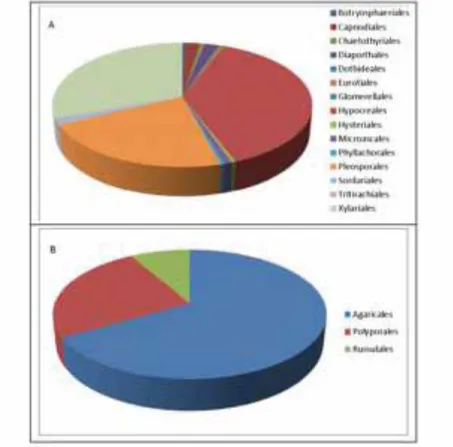
A total of 198 different species were found as defined by the Operational Taxonomic Units (OTU) with 58% of the OTUs found only once (singletons). The majority of the isolated fungi were Ascomycota (80.9%), with a minority within Basidiomycota (2.8%). Ascomycota fungi are represented by 15 orders dominated by Hypocreales, Xylareales and Pleosporales (Figure 3a) while Basidiomycota was represented by Agaricales, Polyporales and Russulales (Figure 3b).
Figure 3. Graphical representation of isolated sponge-associated fungi from Ascomycota (A) and Basidiomycota (B) grouped by orders.
Lang and Sayer (eds.): 2013 Curaçao AAUS/ESDP Joint International Symposium
27
Shannon-Weaver diversity index revealed a high diversity of cultivable fungi, and this diversity was comparable between the two geographical regions (3.51 for Caribbean, 3.52 for the Pacific). The following diversity indices were found for fungi isolated from different taxonomic orders of sponges:
Dictyoceratida (1.20), Chondrosida (1.68), Hadromerida (1.68), Haplosclerida (2.74), Haplosclerida Verongida (2.55), non-identified species from the Caribbean (N.I.C) (3.40), Spirophorida (1.09), Homosclerophorida (2.45), Halichondrida (2.10), Poecilosclerida (3.02), non-identified species from the Pacific (N.I.P) (1.53). The analyses of variance indicated significant differences in the relative abundance of fungal species between geographical regions (F(2)= 31.2, P<0.001) and among sponge orders (F(10)= 7.55, P<0.001). Finally, our species accumulation curves for both geographical region and sponge orders indicate an increasing trend of species accumulation with no obvious saturation (Figure 4).
Figure 4. a) Species-accumulation curves per site of collection; b) Species-accumulation curves per taxonomic order of host sponge.
Effect of isolation media on isolation of sponge associated-fungi
In general, isolation media based on malt extract (Baker et al., 2009; Caballero-George et al., 2010) like EM appeared as a good culture media to obtain a high number of fungal isolates. Nevertheless, the question remains whether these high numbers also involve a high diversity. Figure 5 shows that EM media allowed isolation of the highest number of different fungal species (25%) followed by P15 and P30 (20%), which are based on glucose, peptone and yeast extract (Caballero-George et al., 2010). However, fungal species like Armillaria tabescens and Microdiplodia hawaiiensis were only found in M1D culture media, and Colletotrichum gloeosporioides, Microdiplodia miyakei, Corynespora cassiicola and Eutypella kochiana were only found in PD culture media. In the present study, fungi from the order Hypocreales, particularly the genera Acremonium and Hypocrea would grow more readily on EM than the other five media. Interestingly, the genus Fusarium showed equal preference for media P15, SNA and EM, while Lecanicillium kalimantanense showed no preferences. The order Dothideales and unidentified strains of Ascomycota had equal preference for media EM as well as P30. Fungi from the order Xylariales had equal preference to grow in EM and P15. This was also the case for Eutypa consobrina. However, Eutypella sp. was isolated mainly from P15. Interestingly, Annulohypoxylon stygium, Anthostomella conorum, Arthrinium phaeospermum and Cryptosphaeria eunomia var. eunomia were isolated from medium EM and Daldinia cf. loculatoides was isolated only from PD and SNA. Fungi from the order Pleosporales were isolated mainly from media P30. The order Diaporthales was isolated in media EM, P30 and PD and the order Eurotiales was only isolated with PD and EM. The order Agaricales showed no preference for any media.
Caballero-George et al.: Panamanian marine sponge fungal diversity