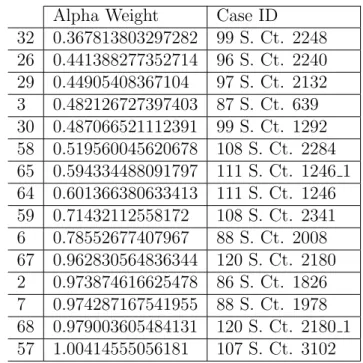
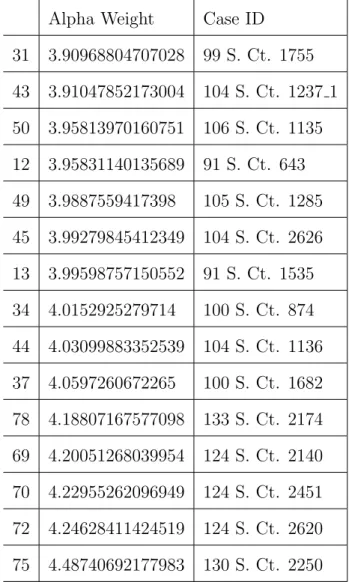
The approach taken here centers on the attitude model, as well as the court's ability to make policy with its decisions. A similar approach is also taken by Segal and Spaeth in "The Supreme Court and the Attitudinal Model Revisited", where their preferred model, as well as mine, is the attitudinal model, where decisions are made based on ideological (attitudinal) preferences regarding liberal or conservative politics doctrine.
The Warren Court
The court ruled that his earlier trial was also effectively inadmissible because "the same principle that prohibits the use of illegally obtained confessions also prohibits the use of any testimony induced by it (Harrison v. United States, 1968)." The court also places the burden of proof on the government that the defendant would have testified the same if the illegal statements had never been admitted, writing instead: “The government must prove that its illegal act did not result in the petitioner's testimony and that no such showing occurred here ( Harrison v. United States, 1968).'
The Burger Court
The court agreed with this lower court decision with another five to two majority in favor of the government. The arrest and conviction of the respondent preceded Miranda, and the court conceded that the full procedural guarantees were not afforded to the respondent. The court also held that "the failure to inform respondent of his right to appointed counsel had no bearing on the reliability of Henderson's testimony (Michigan v. Tucker, 1974)." Ultimately, the court ruled that the evidence obtained was admissible and Tucker's conviction was upheld.
In Hale, the Supreme Court agreed with the appellate court and granted the respondent a new trial on the grounds that the "respondent's silence during police questioning lacked significant probative value, and under these circumstances any reference to his silence had a intolerably prejudicial impact (United States v. Hale, 1974).” The court believed that using one's right to remain silent in a contradictory manner was a violation of the law. After the petitioner gave false testimony, the court found that such testimony was not entitled to the grounds, since no effective warning of the fifth amendment warning had been given. The Court further held that the Fifth Amendment does not condone perjury, which is not justified.
The court found this to be unconstitutional as it essentially compelled testimony from the respondent. Hass (New Jersey v. Portash, 1979)." The court once again had to balance the interest in truthful testimony by a jury against an individual's right to testify under duress. In a seven-to-nil decision, the court held that the admission of the refusal does not violate his Fifth Amendment rights because the test is legitimate.
The state offers another option to refuse a test with associated policies for that choice (South Dakota v. Neville, 1983).” The court expanded its opinion on this issue by holding that the police's failure to warn the suspect that his refusal could be used against him, is not fundamentally unfair. The court answered the first question by a six-to-three majority that the records were not privileged under the Fifth Amendment.
The Rehnquist Court
In Illinois, petitioner was convicted and the state sought to declare him a "sexually dangerous person." The court relied on the psychiatrist's testimony, among other witness testimony and evidence, to make the case in court and ultimately win. The court noted that "the Miranda rules were designed to protect defendants from being compelled to make statements by the government, and also to give defendants the right to choose between speaking and remaining silent (Connecticut v. Barrett, 1987)." The court's unanimous vote sent a strong signal that if you choose to voluntarily give up your right to free speech, your Fifth Amendment rights are not automatically enforced. United States, where the court ruled that corporations are not entitled to Fifth Amendment rights.
The court, in this five-to-four conservative decision, also expressed concern about the government's ability to prosecute white-collar crime and enforce regulations. The Court once again limited the application of the Fifth Amendment, limiting it to only individuals with its decision in Braswell. In a five to four decision, the court held that the warnings given to the suspect were sufficient and that as long as they "reasonably conveyed the suspect's constitutional rights" the exact language of Miranda was not necessary (Duckworth v. Eagan, 1989). Eagan marked another conservative ruling, giving police more leeway in what constitutes adequate warnings. The Supreme Court once again had to rule on police conduct and if it violated a person's Fifth Amendment rights as guaranteed by the Constitution.
In Perkins, the court had to decide whether testimony gathered by an undercover officer violated a suspect's Fifth Amendment rights as outlined in Miranda. Mississippi, the next Fifth Amendment case to be heard, the court expanded the rights of the criminally accused. The court held that there was a violation of Davis's Fifth Amendment rights, and Evans v.
The Roberts’ Court
The Liberal and the Conservative
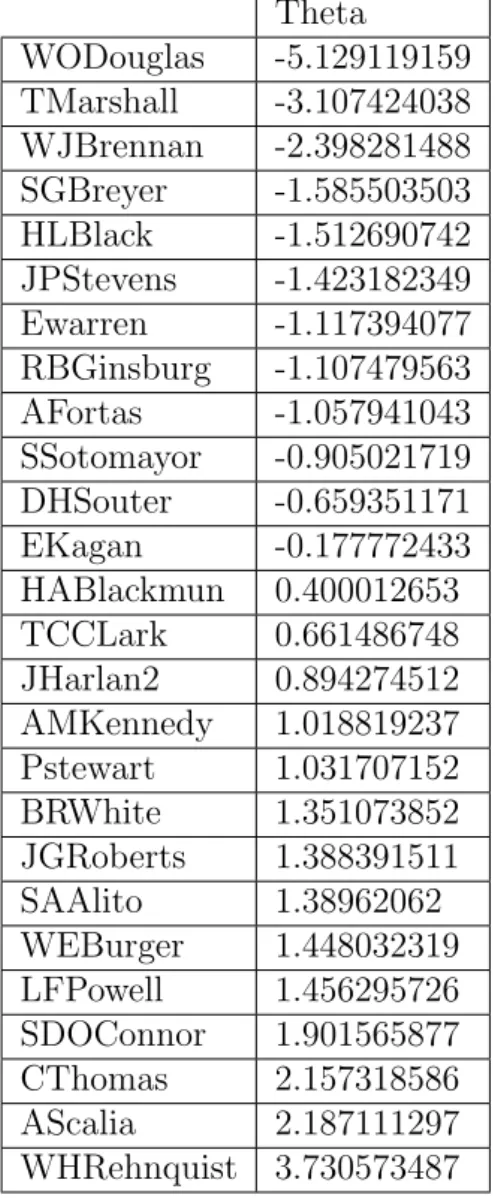
The theta scores are shown in the table below (Table 1), from most liberal to most conservative. An important validity marker for my score was that Judge Douglas scored as the most liberal judge on the court at (theta = -5.129). This finding provides an important measure of face validity because Douglas is consistently the most liberal justice in other Bayesian models of the Supreme Court.
While the Segal-Cover results do not have Douglas as the most liberal justice, these results are developed from editorials written before the nomination and do not reflect actual voting results on the Supreme Court. While other measures of judicial ideology do not rank Rehnquist as the most conservative, they also do not produce consistent results about who is the fairest justice. In Rice et al, Rehnquist was the second most conservative justice, while in Martin-Quinn he was the most conservative ever, but has the second most conservative mean and median.
The Segal-Cover scores, on the other hand, have Scalia as the most conservative justice, followed again by Rehnquist, while Thomas is the fourth most right-leaning justice. The benchmarks of conservative ideology are much more tightly clustered than compared to how much more liberal Douglas is than any other justice, making it entirely plausible for Rehnquist to be the most conservative on a single issue. These three have always ranked as some of the most conservative judges on the court, which again adds validity to my measure despite the relatively small data size.
Comparing ✓ and Rice through Residuals
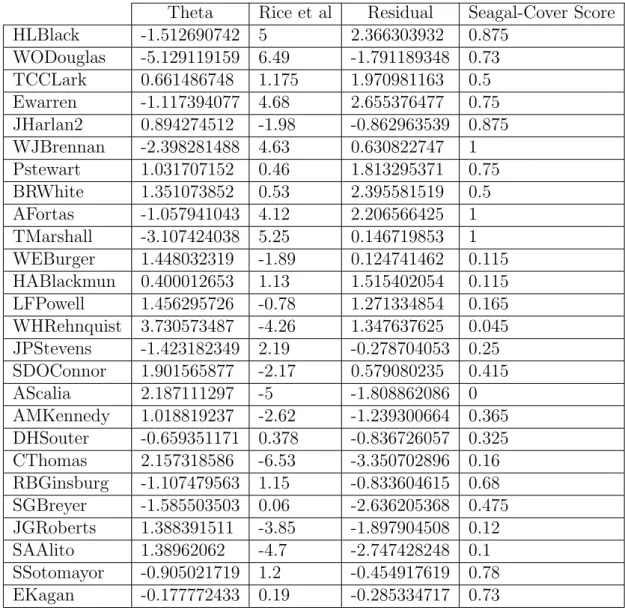
The relevant justices discussed are highlighted and labeled, as well as providing a regression of the two scores to see how they stack up on an almost one to one ratio. Together with figure two, table two is presented, which shows the theta scores of justice, Rice et. These two judges are consistently regarded as two of the most conservative judges, both qualitatively and quantitatively, on the court.
The case created a sweeping and broad liberal doctrine that over time right-leaning justices shied away to create a much narrower, much more conservative interpretation of the Fifth Amendment. Thus, the large residuals for uber-conservative justices like Thomas and Scalia reflect that they are very similar to other conservatives on the issue of Miranda compared to most issues where they fall much farther right than the average conservative. Compared to their respective scores on other issue areas, these two justices are significantly more conservative with Chief Justice Warren having a residual of 2.655 and Justice Black having a residual of 2.366.
Moreover, the preferences of Warren and Black are much closer to the preferences of other liberal justices where on issue areas they are much further to the left than the typical liberal justice. Moreover, both of these justices did not sit on the court until shortly after Miranda, with neither hearing more than twelve cases. Whether the justices behave as they typically do, with residuals approaching zero, as is the case with Burger or Marshall, or if large residuals exist and atypical behavior persists, these quantitative observations and subsequent qualitative analysis continue to shed light on judicial ideology. and behavior.
A Discussion on the Alpha Term
Although this Kennedy opinion is substantively irrelevant, it is nevertheless interesting because Kennedy is the average voter in the natural court, as well as the average justice of the Miranda doctrine in the court at this time. In an opinion written by Potter Stewart, the court defined what constitutes an interrogation for purposes of the Miranda rule and was written into law in that decision. Innis is one of the cases that both narrowed and defined uncertain terms such as interrogation found in the Miranda doctrine.
This case was a six-to-two ideological decision with a liberal outcome; Judge Powell did not participate in the discussion or decision of the case. Furthermore, the appearance of litigation and conduct rather than a pure bill of rights alters the court's preference. A final feature of the data worth discussing in this analysis is the median justice in the natural court.
The median justice builds o↵ from the median voter statement where the court's expressed policy preference will be that of the justice's views which are ideologically centered compared to the rest of the court. While this may be true across all doctrines, Kennedy is once again the median voter on Miranda, and he remains so throughout the rest of the Court's iterations. Supreme Court Justices as Strategic Decision Makers: Aggressive Grants and Defensive Denials in the Vinson Court.” The Journal of Politics.