305
Walking the Talk, from Online to Offline? Analyzing Predictors of Political Engagements in the Case of Cebu City, Philippines
Pembahasan, dari Online ke Offline? Analisis Keterlibatan Politik di Kota Cebu, Philipina
Noe John Joseph E. Sacramento
University of the Philippines Cebu- College of Social Sciences Gorordo Ave., Lahug, Cebu City 6000 Philippines
* Author Corespondency: [email protected]
A R T I C L E I N F O R M A T I O N Keywords
Political engagement;
Offline;
Online ; Extraversion;
Openness to experience;
Political efficacy;
AB S TR AC T
The political engagement of individuals has complexly evolved in a borderless world brought by various developments in technology. This study revisits how various predictors, including personality traits such as extraversion and openness to experience, political efficacy, and online (FB) engagement, influence offline political engagements. Using quantitative techniques, the data gathered from a survey with 120 respondents in Cebu City, Philippines, was analyzed using the R software to generate descriptive statistics, correlation, simple linear regression, and multiple regression. A salient finding shows that the respondents’
level of extraversion, openness to experience, and political efficacy is high, while the level of political engagement is low online and offline. While online (FB) political engagement alone highly predicts offline political engagement behavior, all other independent variables (extraversion, openness to experience, and political efficacy) modeled as one attributes a very low effect towards offline political engagement. The model that includes all predictors have produced significant result that strongly supports this study’s central claim. Further, the study discussed the non- engagement of Cebuanos and commenced with suggestions on how Facebook (FB) can further influence an individual’s political engagements as a social media platform. While the publics’
engagements on political issues are vital to democratic societies, the study stressed social media's crucial influence on safeguarding democracies, human rights, and social justice.
Kata Kunci
Keterlibatan politik;
Offline;
On line;
Ekstraversi;
Keterbukaan untuk mengalami;
Kemanjuran politik;
A B S TR A K
Keterlibatan politik individu telah berkembang secara kompleks dalam dunia tanpa batas yang dibawa oleh berbagai perkembangan teknologi. Studi ini meninjau kembali bagaimana berbagai prediktor, termasuk ciri-ciri kepribadian seperti ekstraversi dan keterbukaan terhadap pengalaman, kemanjuran politik, dan keterlibatan online (FB), memengaruhi keterlibatan politik offline. Dengan menggunakan teknik kuantitatif, data yang dikumpulkan dari survei dengan 120 responden di Kota Cebu, Filipina, dianalisis menggunakan software R untuk menghasilkan statistik deskriptif, korelasi, regresi linier sederhana, dan regresi berganda. Sebuah temuan penting menunjukkan bahwa tingkat ekstraversi, keterbukaan terhadap pengalaman, dan efektivitas politik responden tinggi, sedangkan tingkat keterlibatan politik rendah saat online dan offline. Sementara keterlibatan politik online (FB) saja sangat memprediksi perilaku keterlibatan politik
306
offline, semua variabel independen lainnya (ekstraversi, keterbukaan terhadap pengalaman, dan kemanjuran politik) dimodelkan sebagai salah satu atribut efek yang sangat rendah terhadap keterlibatan politik offline. Model yang mencakup semua prediktor telah menghasilkan hasil signifikan yang sangat mendukung klaim utama studi ini. Lebih lanjut, studi ini membahas ketidakterikatan Cebuanos dan dimulai dengan saran tentang bagaimana Facebook (FB) dapat lebih mempengaruhi keterlibatan politik seseorang sebagai platform media sosial.
Meskipun keterlibatan publik dalam masalah politik sangat penting bagi masyarakat demokratis, studi tersebut menekankan pengaruh penting media sosial dalam menjaga demokrasi, hak asasi manusia, dan keadilan sosial.
Article History Send 21th May 2020 Review 09th July 2020 Accepted 29th December 2020
Copyright ©2021 Jurnal Aristo (Social, Politic, Humaniora) This is an open access article under the CC–BY-NC-SA license.
Akses artikel terbuka dengan model CC–BY-NC-SA sebagai lisensinya.
307 Introduction
The political engagement of citizens is essential to democracy and is defined as “the ability to express political opinions and assert political influence in both the online and offline world” (Towner, 2013). Evidence from the study of Bowler et al. (2007) provides that citizens have considered participation via direct democracy as a mechanism to review the state's performance and check the use (or abuse) of power of the representatives in public offices. Today, most political engagement and activities have shifted to online platforms. In a rapidly changing world, people learn to adapt to technological developments. More and more people worldwide have shifted their media consumption from the traditional (i.e., newspaper, television, radio, among others) to a new form, using online social media platforms. These transformations towards a new practice of mediated sociality have brought an alteration of
“relations between citizenship and the media and the facilitation of new forms of political participation as well as a new means of imagining our political futures” (Fenton & Barassi, 2011).
Therefore, almost all the issues and stories in our society are accessible and available in the online world. With the aid of online portals' technological development, people use Social Networking Sites (SNS) to engage and show their support, sentiment, and dissent on various issues. Fenton and Barassi (2011) supported this by saying that SNS has become a glaring platform for political activities. For example, political discussions are no longer limited to in-person debates since the SNS can accommodate and extend its reach to a larger audience. Also, SNS caters to the timely and real-time delivery of news on pressing issues that heighten discussions on public health, economy, politics and politicians, elections, environment, territorial rights, law, justice, and human rights. Fenton and Barassi (2011) also added these platforms have become more critical to an individual’s political participation.
Thus, it is important for citizens to keenly understand the nature of their political participation and patterns attached to it in the new form of a “mediated sociality” brought by the consumption of SNS.
The Philippines, as a global south country, has been trying to cope with the technological advancement trend of the developed world. Also, this have made many Filipinos cope with the social media consumption trend. Based on the report of Hootsuite and We Are Social on Digital 2019, Filipinos are heavy internet users who spend on an average, four hours and 12 minutes online, specifically on Facebook as being the most preferred form of SNS. We Are Social has reported that in 2018 Facebook reached 2.6 billion users, and interestingly, the Philippines ranked at the top, having 73.170 million Facebook users by the
308
Napoleon Cat (2020) in January of 2020. According to Inocian et al. (2017), “as voters are getting techno-savvy, the use of social media becomes the instant outlet for personal and political life.” Facebook, as a social media platform, gave an avenue for a broader opportunity to engage politically. People use engaging activities such as postings, discussions, comments, chatting, live streaming, among others. It also becomes a driver of online users or what they call “netizens” to actively participate in a political and non-political discussion. The innovations in technology have triggered society's social and political dynamics anew and provided an avenue for studies concerning political behavior and technology (Del Vicario et al., 2017).
Various studies have considered looking into the influences of social media on political engagement, including online groups relationship to offline political engagement (Conroy et al., 2012), social media, political engagement, and misinformation (Valenzuela et al., 2019), and social media as a platform for youth to voice out their concerns (Keating &
Melis, 2017). However, the context of eastern societies, like the Philippines, are less explored given that most studies on the growing literature of political engagement (Conroy et al., 2012;
Feezell et al., 2009; Andersen & Medaglia, 2009; Kushin & Kitchener, 2009) are mainly based on the global north and western experience. This study aspires to enrich the discourse on political behavior and dynamics in the context of the global south, specifically, the Southeast Asian region where limited studies have explored the link between political engagement both in Facebook and offline (de Zúñiga et al., 2014; Lande, 1973; Zhang &
Lallana, 2013; Pang & Woo, 2020). Limited literature in Facebook studies has shed light on the ability of social media (Facebook) platform for political engagement to link it with the individual’s capacity to engage politically in the real world (Sreekumar & Vadrevu, 2013;
Vadrevu & Lim, 2012). Evidences in this study will help determine significant ways to cultivating a culture of higher level of political engagement and in identifying ways forward in political education in communities. Since this work mainly identifies and analyzes the factors and the relationship between Facebook political engagement and offline political engagement, the study aims to provide an understanding of the following objectives: a) to survey and descriptively present the results on the political engagement online and offline, along with various pre-existing conditions as other predictors, b) to explore the relationship between variables that influences political engagement or non-engagement offline, c) to elucidate on the reasons of political engagement or non-engagement of the individuals.
309 Literature Review
Political engagement refers to activities affecting politics by an individual or collective action that supports or opposes structures, authorities, and decisions at the national or local levels (Van Deth, 2014). Today, the definition of political engagement is not limited to actions and behaviors of political participation within the government's structures;
however, it encompasses a broad definition that includes various activities and opinions of people towards authorities' actions and decisions on issues that affect people’s lives. Political engagement also concerns offline or online activities by ordinary citizens that have the intent or effect of influencing government action or some political outcomes (Valenzuela et al, 2012). These activities take various forms, whether verbal or written, violent or non-violent, or of any intensity. However, the developments in information and communication technology or ICT created an avenue for borderless political engagement today through political debates, arguments, and opinions online. Before, mass interaction was the sole means of political engagement. Be that as it may, other factors also contribute to how individuals politically engage, which includes the extent to which the individual receives political stimuli, the individual’s psycho-socio-political characteristics, and the political setting of the environment in which the individual finds himself (Margetts et al., 2015).
Indeed, political engagement is a complex phenomenon that encompasses social, psychological, economic, and political dimensions.
While global citizens have been trying to adapt to these technological advances and changes, it is interesting to look into how these affect their personal and political lives.
Theocharis (2015) pointed out the theory of networked participation that stipulates that every action that an individual does online has wider relevance to the impact its environment brings. To further expound on this, an individual's online and offline political engagement is determined by various socio-political cues, including personality traits. Quintelier and Theocharis (2013) emphasized that among the “Big Five” personality traits, extraversion, and openness to experience substantially influence political engagement.
As the significance of online-based political participation increases, several scholars attempted to understand individuals’ online political engagement. More and more people are becoming active in online social media that stimulates their social interaction. They see the internet as an avenue to tell their stories, share creations, and interact with peers, friends, and other people (Kahne et al., 2012). On a similar note, Conroy et al. (2012), David (2013), Vaccari et al. (2015), and Vaccari et al. (2013) claimed that web political engagement is relevant to offline civic engagement and political action in the context of the western
310
societies. Ideally, the level of political efficacy influences the capacity of action on something believed to cause change, or better yet, positive change. As considered to be one of those specific types of self-efficacy, political efficacy is often defined as an individual’s perceived ability to influence political processes not only in an offline setting but also in the online world (Sarieva, 2018).
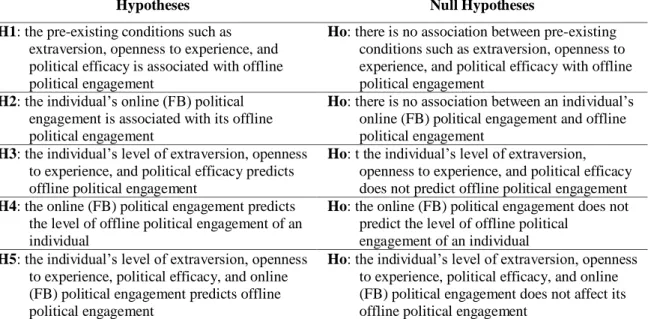
Gil de Zúñiga et al. (2010) and Shrestha (2013) further pointed out that internet use is a predictor of offline political participation since the spread of political information online increases the probability of engaging politically offline. Moreover, various empirical evidence shows that the internet has a significant role in transforming patterns of political participation. More recently, Valenzuela et al. (2012) identified that political engagement online is indeed related to offline engagement; however, there were variances in the relationship demanding further research. More so, various sub-modes of online participation are comparable to that of offline; thus, the way people act in the online world can relevantly translate to how it acts offline. Gerber et al. (2011), Macnamara (2012), and Quintelier and Theocharis (2013) identified the indicators on both political engagement activities that can aptly determine an individual’s participation. Theocharis (2015) even urged that there is a need to study this phenomenon as it essential to be explored in a vastly changing social and political world that we have today. With all these being said, the study curiously wanted to prove the following hypothesis:
Table 1. Hypotheses
Hypotheses Null Hypotheses
H1: the pre-existing conditions such as extraversion, openness to experience, and political efficacy is associated with offline political engagement
Ho: there is no association between pre-existing conditions such as extraversion, openness to experience, and political efficacy with offline political engagement
H2: the individual’s online (FB) political engagement is associated with its offline political engagement
Ho: there is no association between an individual’s online (FB) political engagement and offline political engagement
H3: the individual’s level of extraversion, openness to experience, and political efficacy predicts offline political engagement
Ho: t the individual’s level of extraversion, openness to experience, and political efficacy does not predict offline political engagement H4: the online (FB) political engagement predicts
the level of offline political engagement of an individual
Ho: the online (FB) political engagement does not predict the level of offline political
engagement of an individual H5: the individual’s level of extraversion, openness
to experience, political efficacy, and online (FB) political engagement predicts offline political engagement
Ho: the individual’s level of extraversion, openness to experience, political efficacy, and online (FB) political engagement does not affect its offline political engagement
311 Method
In terms of design, this study is non-experimental quantitative research that utilized a deductive approach. Data were collected from a survey administered to n=120 respondents purposively selected based on a) availability to answer the questionnaire and b) willingness to participate. The data gathering was done from August to December of 2019. Respondents participating in this study are 18 years old and above. The age of 18 is set as the minimum age since it is the Philippines' legal age. Individuals of this age participate in most political activities, and it is imperative to measure and know their actions concerning their political responsibility.
The respondents were drawn from different households in 3 small communities, or
“barrio” in one of the densely populated villages or “barangay” in Cebu City, Philippines.
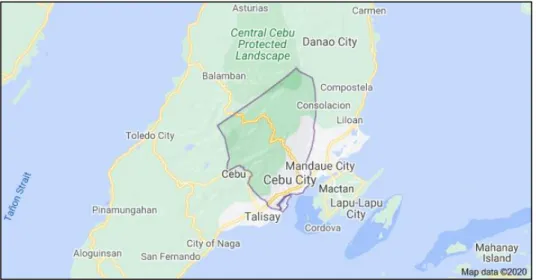
Aside from being an industrial hub and a center for Information and Communication Technology (ICT) Business Processing Outsourcing (BPO), Cebu City and its residents, was then active and vocal about supporting Rodrigo Duterte as a presidential candidate in the last 2016 polls where he garnered 1.4 million votes comprising the 16 million total votes for his winning (Mayol et al., 2016). Cebuanos, or those people living in Cebu, have rallied for progress and change during the previous polls and mostly have brought their support to various social media platforms, especially Facebook. It is equally important to examine how they politically engage in Facebook and offline as the country faces various political concerns under the Duterte administration.
Figure 1. Map of Cebu City, Philippines Source: Google Map (2020)
312
The survey includes various parts that measure the variables involved in this study, which was pilot tested to check the alpha of the measurement for each variable and the clarity of questions. The descriptive statistics gathered includes the demographic profile, educational attainment, and perceived socioeconomic status. This was underscored in Valenzuela et al.
(2012) on studying political engagement. On the other hand, two of the five personality traits on the “Big Five” personality traits (Quintelier & Theocharis, 2013) were included in the study: openness to experience and extraversion, which were identified as highly influential to political engagement. The study utilized the instrument developed by Soto and John (2017) and tested for reliability with Cronbach’s α on both extraversion (α = 0.797) and openness (α
= 0.902). However, the study deleted three items (“I am who is reserved,” “I am who tends to be quiet,” and “I am who is shy”) to reach the acceptable level of alpha. The respondents answered the instrument by rating the items from 1= strongly disagree to 5= strongly agree.
The level of political efficacy was also one of the factors that influence an individual’s political engagement. This study utilized the scale for the perceived political efficacy by Sarieva (2018) and tested for the reliability of α = 0.921. Bandura (1977) and Bandura (1997) have first developed the theory of political efficacy, where it refers to the person’s evaluation of their ability to reach desired outcomes (Sarieva, 2018). Scholars in psychology and politics further developed the theory (Van Stekelenburg & Klandermans, 2010; Klandermans, 2008) that later led to the differentiation of various political efficacy measures such as the personal, group, and external from the perspective of the individual.
The questionnaire is composed of 12 items which measure: 1) the ability to influence the enactment of new laws and political decisions, 2) the ability to facilitate the election of a political leader, 3) the ability to demand that existing laws and observe political decisions, and 4) the ability to express political opinions freely and publicly from internal personal, internal group, and external perspectives. The study asked the respondents to rate from a scale of 1= strongly disagree to 5= strongly agree.
On activities concerning political engagements online (FB) and offline, the study considered the instruments by Gerber et al. (2011), Macnamara (2012), Quintelier and Theocharis (2013), and Valenzuela et al. (2012). The indicators used by these instruments were listed and compared to come up with a new simplified instrument best suited for this study. The instrument was peer-reviewed and further improved to fit in the context of the current research. The final instrument contained 12 questions measuring the activities an individual does online, including supporting, sharing, posting, commenting, liking, creating, uploading online political materials, engaging in political discussion threads, among others.
313
On the other hand, offline political engagement involved 13 indicators such as engaging in political groups, attending political meetings, speaking to public officials, participating in protests, signing petitions, and voting, to name some. Both instruments passed reliability analyses (online political engagement, α = 0.924; offline political engagement, α = 0.921).
The R software was used in the data analysis. According to R Core Team (2013), “R is a language and environment for statistical computing and graphics, where it provides a wide variety of statistical (linear and nonlinear modeling, classical statistical tests, time-series analysis, classification, clustering, …) and graphical techniques, and is highly extensible.”
The data set was prepared as “Engagement” with four independent variables, one dependent variable, and five demographic (qualitative) variables. To note, the study focuses mainly on the five quantitative variables, and that the qualitative variables are vital in providing background about the context and respondents for the study. In doing the succeeding processes, the study utilized the “psych” package (Revelle, 2020). Descriptive statistics and moments were generated from the data where it specifically identifies the frequency, variance, standard deviation, mean, median, minimum, maximum, skewness, and kurtosis. The code “summary(Engagement)” and “describe(Engagement)” was used to generate the results for the statistics mentioned above. Additionally, the kurtosis and skewness are essential towards running for correlations and regressions. Given the acceptable value for skewness and kurtosis (see Table 1) of not less than -1.5 and not more than 1.5 (Tabachnick & Fidell, 2013; Dalgaard, 2008) that denotes normality of the data; thus, thi s study considered utilizing the Pearson correlation in examining the association among the variables to answer hypothesis 1 and 2. In this stage, the codes below are instrumental in running the Pearson correlation to test the association of variables:
my_data <- Engagement[, c(2,3,4,5,6)]
head(my_data) res <- cor(my_data) round(res, 2)
Furthermore, to prove hypothesis 3, 4, and 5, the study utilized simple linear regression to test the effect of online (FB) political engagement alone towards offline political engagement; and multiple regression for testing the effects of a) openness to experience, extraversion, and political efficacy combined towards offline political engagement, and b) openness to experience, extraversion, political efficacy, and online (FB) political engagement combined towards offline political engagement, as guided by the
314
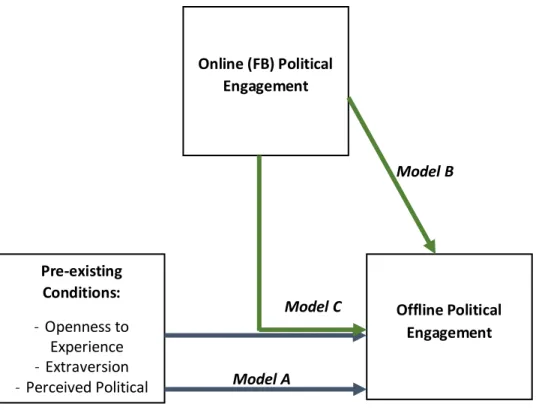
theories involved in this study. To illustrate the arguments in this study, Figure 2 presents the predictors of online (FB) and offline political engagement.
Figure 2. Predictors of Online (FB) and Offline Political Engagement Source: Conceptual framework formulated by the author
Three arguments are seen to be relevant in this study and in doing the regression analyses. First is that the level of offline (FB) political engagement of an individual (whether high or low) can be predicted by his or her pre-existing conditions such as two crucial personality traits (level of extraversion and openness to experience), and level of political efficacy. Secondly, the level of online (FB) political engagement alone greatly predicts the individual’s offline political engagement. Lastly, the level of online (FB) political engagement together with the level of extraversion, openness to experience, and political efficacy predicts the offline political engagement of the individual. As such, the following codes are used to test the models:
Pre-existing Conditions:
- Openness to Experience - Extraversion - Perceived Political
Efficacy
Offline Political Engagement Online (FB) Political
Engagement
Model A Model C
Model B
315 For Model A:
### Off Pol Eng ~ Pre-existing Conditions (Multiple Regression) modelA <- lm(Off_Eng ~ Pol_Efficacy + Open + Extrav, data = Engagement, use = "complete.obs") summary(modelA)
# error assumption test par(mfrow = c(1,1))
hist(modelA$residuals,
main= "Multiple Regression Model A", xlab = "FB_Eng~Pol_Efficacy+Extrav+Open Model Risiduals")
# regression plot par(mfrow = c(2,2)) plot(modelA)
For Model B:
### Off Pol Eng ~ FB Pol Eng (Simple Linear Regression) modelB <- lm(Off_Eng ~ FB_Eng,
data = Engagement, use = "complete.obs") summary(modelB)
# error assumption test par(mfrow = c(1,1))
hist(modelB$residuals,
main= "Multiple Regression Model B", xlab = "Off_Eng~FB_Eng
Model Risiduals")
# regression plot par(mfrow = c(2,2)) plot(modelB) For Model C:
### Offline Pol Eng ~ All ID Variables (Multiple Regression) modelC <- lm(Off_Eng ~ FB_Eng + Pol_Efficacy + Open + Extrav, data = Engagement, use = "complete.obs")
summary(modelC)
# error assumption test par(mfrow = c(1,1))
hist(modelC$residuals,
main= "Multiple Regression Model B",
xlab = "Off_Eng~FB_Eng+Pol_Efficacy+Extrav+Open Model Risiduals")
# regression plot par(mfrow = c(2,2)) plot(modelC)
To supplement the discussion in this study, the survey questionnaire also asked a few qualitative questions. Two open-ended questions aims to elucidate on the context of motivations towards engaging or non-engaging politically online, which was patterned from the study of Inocian et al. (2017). These questions were peer-reviewed and pre-tested to ensure clarity and coherence. Specifically, the study utilized word cloud in analyzing the
316
responses of the respondents on what factors contribute and influence their political engagement online (FB) and offline. While R software is still used in this stage of data analysis, specific packages were utilized to generate the word cloud such as: “tm” for text mining (Feinerer et al., 2008), “SnowballC” for text stemming (Bouchet-Valat, 2020),
“wordcloud” for word-cloud generator (Fellows, 2018), and “RColorBrewer” color palettes (Neuwirth, 2014). The following codes were used to run the word cloud/ qualitative data analysis from:
text <- readLines(file.choose()) docs <- Corpus(VectorSource(text)) inspect(docs)
toSpace <- content_transformer(function (x , pattern ) gsub(pattern, " ", x))
docs <- tm_map(docs, toSpace, "/") docs <- tm_map(docs, toSpace, "@") docs <- tm_map(docs, toSpace, "\\|")
# Convert the text to lower case
docs <- tm_map(docs, content_transformer(tolower))
# Remove numbers
docs <- tm_map(docs, removeNumbers)
# Remove english common stopwords
docs <- tm_map(docs, removeWords, stopwords("english"))
# Remove your own stop word
# specify your stopwords as a character vector
docs <- tm_map(docs, removeWords, c("blabla1", "blabla2"))
# Remove punctuations
docs <- tm_map(docs, removePunctuation)
# Eliminate extra white spaces
docs <- tm_map(docs, stripWhitespace)
# Text stemming
# docs <- tm_map(docs, stemDocument) dtm <- TermDocumentMatrix(docs) m <- as.matrix(dtm)
v <- sort(rowSums(m),decreasing=TRUE) d <- data.frame(word = names(v),freq=v) head(d, 10)
par(mfrow = c(1, 1)) set.seed(1234)
wordcloud(words = d$word, freq = d$freq, min.freq = 1, max.words=200, random.order=FALSE, rot.per=0.35, colors=brewer.pal(8, "Dark2"))
This research has undergone an ethics review. All research instruments used were als o peer-reviewed. The suggestions from the ethics committee and peer reviewer were considered and integrated into the research. The study observed ethical considerations from planning to data gathering, data analysis, and research report writing. The study also adhered to data privacy and maintained the confidentiality of the answers and personal information shared by the respondents. Some of the limitations include the small sample size, which may not totally capture a result or understanding of the population's problem. Another is the use of limited
317
variables. The study only patterned the independent variables highlighted in the literature;
however, this does not mean that the predictors towards offline political engagements are confined to these variables as mentioned. Future studies may explore big sample size to test the generalizability of the hypothesis or arguments and may consider additional variables that may explain the predictors of political engagements.
Results and Discussion Data Analysis
As an overview of studying social science phenomena, knowing the respondents’
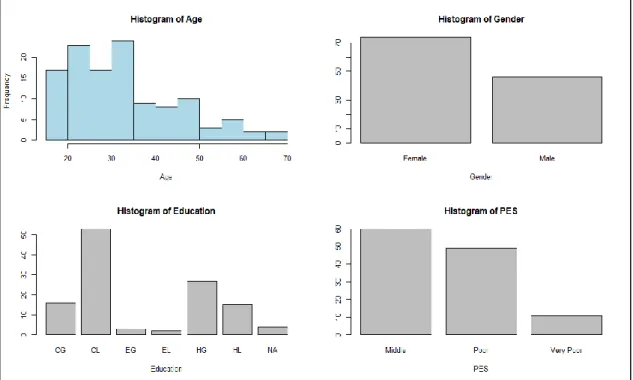
demographic characteristics is essential to understanding the case or problem in focus. These demographic characteristics include a) gender male=46 and female=74; b) age x̅ =33.13; and c) education on whether the respondents qualify as elementary level (EL) n=2, elementary graduate (EG) n=3, high school level (HL) n=14, high school graduate (HG) n=28, college- level (CL) n=53, college graduate (CG) n=16, or no response (NA) n= 4. The respondents’
perceived socioeconomic status was measured as suggested by Milbrath (1977) as it can be an influencing factor to his or her political engagement or non-engagement. This study utilized a survey and asked the respondent to rate a scale of 1 -very poor n=11; 2-poor n=49;
3-middle n=60; 4-rich n=0; and 5-very rich n=0, on their perceived socioeconomic status.
These data were illustrated in a histogram, as showed in Figure 3.
Figure 3. Histogram of Demographic Characteristics of Respondents Data Source: From the survey conducted with the respondents
318
Facebook (FB) usage has been part of the lives of every individual. This social media platform has been a growing and preferred social networking by people across the globe.
While the Philippines ranked as the heavy internet user in 2019, the use of Facebook has become part of the internet behavior of the Filipinos. This study unveiled that the participants are likely to spend long hours in access to the web daily, much more with Facebook, which has been part of most people’s lifestyle. 78.33% of the 120 respondents in this study said that they are visiting Facebook every day. 10.83% of them said that they only access Facebook one to three times a week, and the remaining 10.84% said they only access Facebook if they have internet data or whenever necessary.
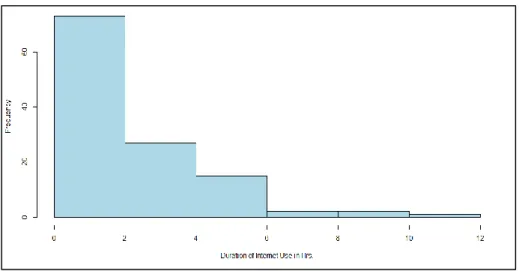
Figure 4. Histogram of the Duration of Internet Use Data Source: From the survey conducted with the respondents
Furthermore, the respondent’s average number of hours using Facebook hit 2.47 hours, with a big part of the sample size spending 0 to 6 hours (see Figure 4). In this sense, both the high duration and frequency of accessing Facebook and the nature of the platform for social networking stipulates that people have been socially interacting digitally; thus, there is a significant reason for discussing the social and political engagements online (FB) and how these behaviors translate to offline political engagement.
319
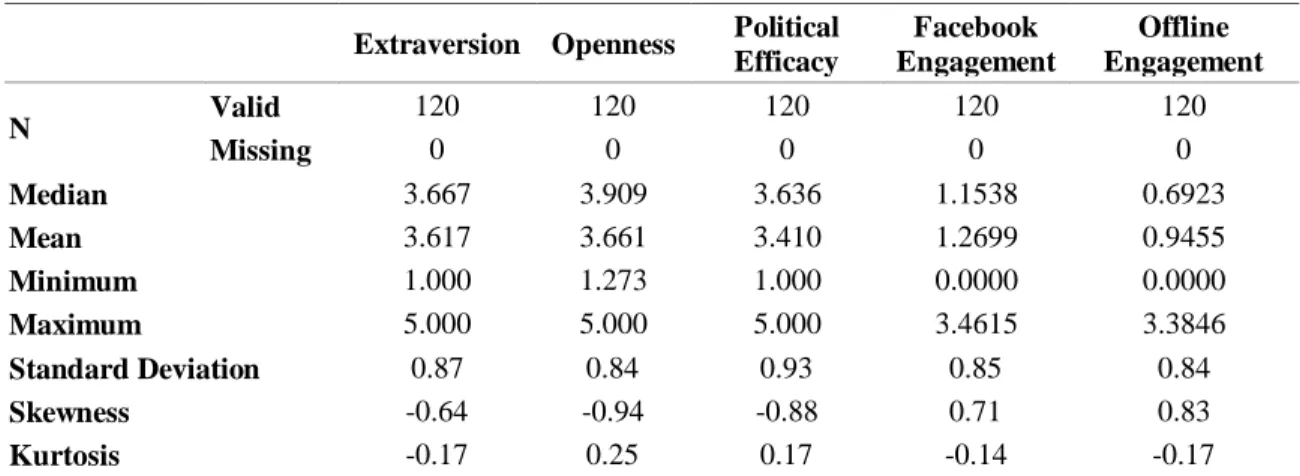
Table 2. Descriptive Statistics
Extraversion Openness Political Efficacy
Facebook Engagement
Offline Engagement
N Valid 120 120 120 120 120
Missing 0 0 0 0 0
Median 3.667 3.909 3.636 1.1538 0.6923
Mean 3.617 3.661 3.410 1.2699 0.9455
Minimum 1.000 1.273 1.000 0.0000 0.0000
Maximum 5.000 5.000 5.000 3.4615 3.3846
Standard Deviation 0.87 0.84 0.93 0.85 0.84
Skewness -0.64 -0.94 -0.88 0.71 0.83
Kurtosis -0.17 0.25 0.17 -0.14 -0.17
Source: Statistical results generated from the data gathered based on the responses of respondents in the survey
Furthermore, the survey’s descriptive results (see Table 2) show that the participants’
extraversion, openness, and political efficacy were high. This resulted in a negative skew to the data distribution. The respondents generally have a high level of extraversion, which means that most of them are outgoing, much interested in social engagements, and action- oriented activities. Also, the respondents’ high level of openness suggests that they are more liberal, appreciative of new and unusual ideas, and accepting to change. Lastly, the respondents showed a high level of political efficacy, which means that they believe that they can create political change along with the help of their group and other people. However, their responses to questions about offline political engagement and Facebook political engagement were low. The responses were positively skewed, where most of them were less likely to engage in any political activities on Facebook or offline. To further analyze the data, the study utilized Pearson’s correlation to test the association of variables. The results from the data analysis will best describe the political behavior of the respondents.
Table 3. Correlation Table
Extraversion Openness Political Efficacy
Online (FB) Pol.
Engagement Offline Political Engagement
(Sig.) 0.23*
(0.011)
0.30**
(0.000)
0.35**
(0.000)
0.59***
(0.000) Source: Statistical results generated from the data gathered based on the responses of respondents in the survey Notes: * low; ** moderate; *** high correlation
Correlation is significant at the 0.01 level (2-tailed); p-value (Sig.): 0.01 ≥ p ≥ 0.00
As can be gleaned from the correlation test results in Table 2, it clearly shows that there is a significant association between extraversion, openness, political efficacy, and the individual’s offline political engagement. The study also presents that online (FB) political
320
engagement is highly associated with the individual’s inclination towards offline political engagement. This means that the study accepts that the pre-existing conditions such as extraversion, openness to experience, and political efficacy is associated with offline political engagement (H1) and that the individual’s online (FB) political engagement is associated with its offline political engagement (H2); thus, rejecting the null hypotheses. And to further make sense of these results, the test for the causal relationship among variables was conducted through simple linear and multiple regression. Three models for multiple regression were created to answer the arguments presented in this study, as presented in Figure 2.
Table 4. Regression Table
Model Estimate Pr(>|t|) Adjusted
R-Squared P-Value Model A (Multiple
Regression) EX + OP + PE → OfPE
Political Efficacy Openness Extraversion
0.24289 0.13278 0.02019
0.0146*
0.3072 0.8578
0.1172
(11.72%) 0.0005577***
Model B (Simple Linear Regression) OnPE → OfPE Online (FB) Political Engagement
0.58837 0.000000000000904***
0.3468
(34.68%) 0.0000000000009038***
Model C (Multiple Regression) EX + OP + PE + OnPE → OfPE Online (FB) Political Engagement Political Efficacy Openness Extraversion
0.523816
0.107004 0.066192 0.001551
0.00000000134***
0.218 0.553 0.987
0.354
(35.4%) 0.0000000003876***
Source: Statistical results generated from the data gathered based on the responses of respondents in the survey Notes: * low; ** moderate; *** high significance at the 0.01 level (2-tailed); p-value (Sig.): 0.01 ≥ p ≥ 0.00 Legend: EX = Extraversion; OP = Openness; PE = Political Efficacy;
OnPE = Online (FB) Political Engagement; OfPE = Offline Political Engagement
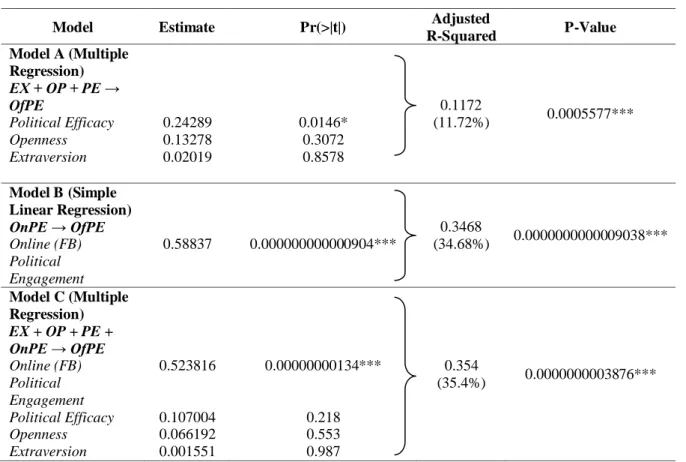
Table 4 presents the results of regression for Models A, B, and C. Firstly, the results proved that Model A is valid with extraversion, openness, and political efficacy as causing variable at 11.72% effects towards offline political engagement with 0.0005577 p-value or chances that such model is an error. Furthermore, this proves that the individual’s extraversion level, openness to experience level, and political efficacy level are predictors of an individual’s political engagement offline (H3); thus, rejecting the null hypothesis.
321
Secondly, the results from simple linear regression in Model B presents that online (FB) political engagement is a valid predictor of offline political engagement (H4); thus, rejecting the null hypothesis. This is supported by the adjusted r-squared value (or the effect attributed to the independent variable) at 34.68%. There is also a little chance that such a model is an error given the p-value of 0.0000000000009038. Lastly, the results from Model C presents a strong argument that the individual’s level of extraversion, openness to experience, political efficacy, and online (FB) political engagement are predictors of its offline political engagement (H5); thus, accepting the alternative hypothesis, and rejecting the null. The multiple regression analysis results show that 35.4% of this model predicts an individual’s offline political engagement. There is a very small chance that the model is an error, given the p-value of 0.0000000003876.
Discussions
How are Personality, Political Efficacy, and Online Political Engagement Associated with Offline Political Engagement?
As earlier stated, Quintelier and Theocharis (2013) mentioned that personality profoundly influences political behavior, specifically on an individual’s political engagement.
Their study identified that both openness to experience and extraversion are significant predictors of political engagement. This study claims differently since the results showed a low or weak to no significant relationship between extraversion and offline political engagement (see Table 3). The results are thus contradictory to the claim from the studies of Mondak et al. (2010), Quintelier and Theocharis (2013), and Valenzuela et al. (2012).
Nonetheless, it should be noted that the level of extraversion of the respondents was significantly higher (see Table 2). This means that the respondents are interestingly sociable, outgoing, and action-oriented. Soto and John (2017) presented that extraversion is an energetic approach that includes sociability, assertiveness, and positive emotionality to the social and material world. Mondak et al. (2010) further asserted that extraversion is associated with actions like contacting politicians, attending political meetings, political manifestations, distributing leaflets, having relations with politicians, and working for a political party.
On the other hand, the test of association between openness to experience and offline political engagement (see Table 3) both showed a moderate (positive) correlation. The openness personality trait of an individual is highly associated with its political engagement offline. The high level of openness (see Table 2) denotes that an individual is highly liberal
322
towards actions and possibilities and highly imaginative on things that might lead to more innovative and unusual ideas. The results from the study of Quintelier and Theocharis (2013) adheres to the argument that individuals who have high “openness trait towards new alternatives were more likely to engage in online politics in general” (Quintelier &
Theocharis, 2013). However, it is essential to note that openness is positively skewed on the one hand, and offline political engagement is negatively skewed on the other (see Table 2).
This suggests that though the respondents have a high level of openness, explicitly engaging offline is something that they consider less, and though they have innovative and unusual ideas to share, they are much more conscious about interfering in the political sphere.
Remaining in an individual’s safe zone instead of participating in the political world is necessary for the respondents to do.
Additionally, political efficacy also plays a vital role in an individual’s political engagement or non-engagement. Sarieva (2018) mentioned that political efficacy as an individual’s perceived ability to influence political processes is an essential factor in political engagements. Results show that political efficacy has a significant association with offline political engagement. Various studies on political behavior have underscored (Blackwood &
Louis, 2012; Cakal et al., 2011; Cohen-Chen et al., 2014; Sarieva, 2018; Tausch & Becker, 2013) that political efficacy is a significant factor that predicts people’s willingness to engage in various forms of behavior, from voting to street action (Sarieva, 2018). Political engagement is often motivated by an individual’s belief that a person or a group can change the existing system towards a better one for the efficient and effective delivery of social services. Interestingly, the level of political efficacy is negatively skewed (see Table 2), which suggests that the respondents have high regard for the government and that they, together with other people, can influence governance and politics. In contrast, offline political engagement is positively skewed (see Table 2), signifying that they are less likely to participate in any political activities offline. This explains further that the respondents have an established belief that they can influence existing structures and systems to improve them best; however, putting those into action may not be feasible for them.
On a side note, a significant finding from the responses of the respondents is their low level of online (FB) political engagement, which also resonates with their low level of offline political engagement (see both in Table 2). The low mean scores from both variables suggest that most of the respondents are uninterested in meddling on political issues, and they tend to disengage in any political activities online and offline. This cynical behavior among the respondents is best explained by how people perceived politics as something that is a “dirty
323
game” in the 1970s and 1980s after martial law, which can still be relevant until now (Maboloc, 2020; Sanchez, 2017). People even lose the initiative and drive for political action and change because they perceive how hopeless the Philippines’ state is in recalling experiences under different administrations after the martial law and EDSA people power revolution. On the other hand, the cynical attitude towards politics connects to how people perceive politicians and the local elites in the country who monopolize the government’s political power and authority. People would opt to remain neutral over political issues and tend not to care or give any comment to protect their safety and security.
Significantly, an individual’s online (FB) political engagement is strongly associated with offline political engagement. Quintelier and Theocharis (2013) even mentioned that people’s actions online relate to what they do offline. In fact, Vitak et al. (2011) also noted that the more people use Facebook for the political purpose, the more the political participation is offline as tested among college students in the west in which this study confirms that their claim is also relevant to data drawn from a different context
Predictors of Political Engagement
The three models tested in this study explicitly suggest that the identified variables predict an individual’s offline political engagement behavior. Seemingly, when extraversion, openness to experience, and political efficacy were tested on its effect on offline political engagement, the results show that the model is valid; however, offline political engagement attributes an effect of 11.72% from that model. Upon testing a simple linear regression on the effect of online (FB) political engagement towards offline political engagement, this gives a significant result, which suggests that 34.68% of offline political engagements can be attributed to online political engagement. On the other hand, Model C attempts to know how all the independent variables affect how an individual politically engages offline. When the online political engagement was combined with political efficacy, extraversion, and openness to experience, the results show that 35.4% of this model affects offline political engagement.
Interestingly, online (FB) political engagement hugely contributes to this effect (refer to Model C). As can be gleaned from Table 4, online (FB) political engagement has an estimate of 0.523816 or 52.3816% contribution to the model, while other variables play along 0.015551% (extraversion), 6.6192% (openness to experience), 10.7004% (political efficacy).
The remainder can be attributed to other variables or influencing factors not mentioned in this study that affect offline political engagement. Remarkably, this study’s results forward the core argument that online political engagement, specifically in FB, is crucial towards how an
324
individual politically engage offline. Further, this study’s results underscore that though political efficacy, extraversion, and openness to experience, as identified by previous literature, have a weak effect on offline political engagement. Instead, if these variables combined with online (FB) political engagement can positively contribute a substantial effect towards offline political engagement behavior of an individual. However, results from these analyses are only central to the case of people living in the identified areas in Cebu City, Philippines.
To further elucidate these arguments, the propositions highlighted are not always to be treated as positive in such cases. This means that while it is true for others that an increase in the level of online (FB) political engagement, level of political efficacy, level of extraversion, and level of openness predicts a high level of offline political engagement, other people may experience the reverse of it.
Putting into context, Filipinos have hopelessly responded to the long history of the state of graft and corruption (Quah, 2011), which results in the lack of people’s motivation towards engaging in political discussion, lobbying of issues, joining public forums, among others, which are essential towards democracy. Filipinos tend to be more conscious and careful about transparently exposing their political stands and preferences (Gallego &
Oberski, 2012; Hibbing et al., 2011). Even protests and rallies on the streets consider being taboo in Filipino society. Though reformations and revolutions (Macaspac, 2019; Reyes, 2014; San Juan, 2011) have been part of the rich history of the Filipino nationhood where people believe that the power of the government emanated from them, people today are disengaged towards politics (Hjorth & Arnold, 2011) despite pressing issues that concern the collective.
Historically, the Philippines and the Visayan region have had enough political prosecution experience by dominating political clans and elites (Querubin, 2016). Though the participants were identified as socially engaging and active towards social action, they are more reserved towards activities that involve political agenda. As a result, they tend to keep a distance from these political activities. Over time, some people have even refused to show their political agendas and interests. This leads to the next part of the discussion that illuminates the question that despite having a positive result on how online (FB) political engagement effects offline political engagement, why is it that Filipinos choose to be silent and less care about engaging politically offline?
325 Non-Engagement, Fear, and Avoidance
As discussed in the earlier parts, the study also attempts to establish support that will elucidate in this section’s previous discussion. One of the observations highlighted is that the level of political engagement, both offline and online, are low (see Tables 2 on mean, median, and skewness). In contrast, other variables have a high response from the respondents, not to mention the level of political efficacy. This raises the inquiry that why does Filipinos, or specifically, Cebuanos choose to care less about engaging politically. From two qualitative questions at the end of the survey that inquired about the respondents’
motivations or factors that influences political engagements online and offline, the following word clouds were generated based on their responses (see Figures 5 and 6).
There are salient concepts that can be observed from both word clouds such as
“politics” or “political” or “pulitika” in the local language, “wala” or “nothing,” “comment,”
“dili” or “no,” “conflict,” “gubot” or “chaos,” “friends,” “family,” “relatives,” among others.
Comparatively, a substantial impression from the responses of the respondents based on the word cloud is that they choose to less likely or not to engage politically either online and offline due to concerns regarding their personal life, fear for safety, security, family, conflict, and judgments from other people. Consequently, people choose to become apolitical, which often translates to becoming individualistic towards their own survival and interest. People would even prefer to care much more about their livelihood, income, living, family, health, etc., compared to caring and giving much of their time towards engaging in politics.
Figure 5. Word Cloud (A) on Motivations or Factors that Influences Online (FB) Political Engagement Data Source: From the responses of respondents on the qualitative question at the end of the survey
326
Figure 6. Word Cloud (B) on Motivations or Factors that Influences Offline Political Engagement Data Source: From the responses of respondents on the qualitative question at the end of the survey
According to Bericat (2016), fear involves feelings such as worry, anxiety, panic, terror, or horror, that may vary in terms of content and intensity. Also, a person may feel fear if it lacks sufficient power and the other way around if they see themselves to have excess power. Bericat (2016) added that while fear indicates that an actor is threatened, fear is also associated with heightened vigilance and behavioral avoidance. The experiences of people often cause fear in engaging in politics. From the 1500s until the early 1900s, the Filipinos experienced various socioeconomic and political marginalization, leading to this attitude.
Much more during the time, the country strived for full sovereignty and independence. Not to mention the rise of local political elites and the abuse of power during the transition from an American colony (Dressel, 2011; Karadag, 2011). The martial law era propelled the continuous abuse of power, exploitation, and marginalization that only benefit the few interests. These have contributed to how people view politics in today’s society as a “dirty game” for the politicians that made them distance themselves from engaging in it. Filipinos have been silent victims to the socio-political prosecutions that existed and continuously prevailed overtime.
Avoidance behavior is likewise associated with fear. In this case, people think negatively about engaging in politics due to the experience they observed in the past. The culture of fear has been part of Filipino society over time because of the unaddressed issues on government and governance. However, Gutierrez (2014) asserted that experiencing fear translates to a decrease in the sense of efficacy; thus, it points out that overcoming fear transforms into anger, which results in addressing the issues of the society. People have these
327
tendencies to believe that they can do something despite being disengaged from politics. The high political efficacy or the belief they can influence and change something in the government shows that the people’s action will take its place when fear transforms into anger.
How Social Media Platforms Engage People Politically?
On a positive note, Facebook can help the circulation and flow of political information, and this can be essential towards activating various interest groups and circles online in forwarding certain causes and interests. Onstad et al. (2012) and Casteltrione (2016) even noted that “a ratcheting process over the long term gradually reinforces the activism of the active.” The mobilization and spread of factual political information online can potentially engage less politically involved users and strengthen politically active people.
Casteltrione (2016) further claims that Facebook engagement contributes significantly to the ways people react and express their views, as well as putting their thoughts into action on various issues that concern them. Various studies were such that of Bimber et al. (2015), Casteltrione (2016), and Towner (2013) support that the engagement of people in various forms of information such as the Facebook, often leads to more active forms of political participation. Political information was made much accessible with the aid of emerging social media platforms such as Facebook. Macnamara (2012) even pointed out that social media are mainly being influential to a very dynamic public sphere and traditional institutionalized forms of political communication and participation.
Conclusion
Culturally, western societies have a higher sense of value towards democratic principles, rights, and interests (Merkel, 2014). Given the influence and the long history of democracy in the country, the Philippines have experienced a lot of drastic, if not, disastrous events (Dressel, 2011) in terms of its people’s history and struggle, which made the people think differently and hopelessly on the country’s politics and governance. The study revisited Filipinos’ offline political engagement behavior, specifically among Cebuanos, in the age of the rise of social media platform Facebook. While the relevant literature has supported that personality traits such as extraversion and openness to experience and level of political efficacy predict political engagement, the study underscored that it only brings a small effect.
On the other hand, the level of online (FB) political engagement hugely predicts individuals’
offline political engagement. Interestingly, the model that combines all variables (including
328
extraversion, openness to experience, political efficacy, and offline political engagement) significantly predicts offline political behavior.
While it is clearly noted that political engagements (both offline and online) among Cebuanos are relatively low, this study’s results cannot only be treated in a negative light.
Political expressions, opinions, and activities can even more impact other people who are receivers of this information. The political engagement and activities are not solely confined to a politically active individual, but the individual himself or herself can, therefore, influence others who are less active to participate or engage politically (Schlozman et al., 2010; Vaccari et al., 2013). Further, the study suggests that online platforms and the mobilization and spread of factual information can promote active political engagement in direct and representative democracies. Even more, Facebook can establish an avenue for people to participate politically and engage in political discussions and discourses. It is even a potential towards reinforcing political participation and mobilization, which is more necessary to social justice and the advancement of human rights.
Further studies may consider rigorous thematic research on the reasons for the non- engagement in politics, both online and offline, in various cultures and settings. With the use of a broader and bigger sample size, future studies may explore the relationship between other factors that contributes to both online and offline political engagement (i.e., other personality traits, time spent online, frequency of visiting political sites, among others) that is potential in contributing to political psychology and political behavior literature.
Acknowledgement
The author would like to thank the University of the Philippines Cebu and the College of Social Sciences for supporting this study under the 2018 Academic Program Improvement (API) Research Grant. Similarly, the author would like to thank the people behind the ARISTO Journal. Thank you so much to the reviewers for their constructive comments to improve the manuscript and editorial members for incessantly providing updates throughout the review and publication process.
References
Andersen, K. N., & Medaglia, R. (2009). The use of Facebook in national election campaigns: politics as usual?. In International Conference on Electronic Participation (pp. 101-111). Springer, Berlin, Heidelberg.
329
Bandura, A. (1977). Self-efficacy: Toward a unifying theory of behavioral change.
Psychological Review, 84, 191-215.
Bandura, A. (1997). Self-efficacy: The exercise of control. London: W.H. Freeman.
Bericat, E. (2016). The sociology of emotions: Four decades of progress. Current Sociology, 64(3), 491–513. https://doi.org/10.1177/0011392115588355
Bimber, B., Cunill, M. C., Copeland, L., & Gibson, R. (2015). Digital Media and Political Participation: The Moderating Role of Political Interest Across Acts and Over Time.
Social Science Computer Review, 33(1), 21–42.
https://doi.org/10.1177/0894439314526559
Blackwood, L. M., & Louis, W. R. (2012). If it matters for the group then it matters to me:
Collective action outcomes for seasoned activists. British Journal of Social Psychology, 51(1), 72–92. https://doi.org/10.1111/j.2044-8309.2010.02001.x
Bouchet-Valat, M. (2020). SnowballC: Snowball Stemmers Based on the C 'libstemmer' UTF-8 Library. R package version 0.7.0. https://CRAN.R- project.org/package=SnowballC
Bowler, S., Donovan, T., & Karp, J. A. (2007). Enraged or engaged? Preferences for direct citizen participation in affluent democracies. Political Research Quarterly, 60(3), 351–
362. https://doi.org/10.1177/1065912907304108
Cakal, H., Hewstone, M., Schwär, G., & Heath, A. (2011). An investigation of the social identity model of collective action and the “sedative” effect of intergroup contact among Black and White students in South Africa. British Journal of Social Psychology, 50(4), 606–627. https://doi.org/10.1111/j.2044-8309.2011.02075.x
Casteltrione, I. (2016). Facebook and political participation: Virtuous circle and participation intermediaries. Interactions: Studies in Communication and Culture, 7(2), 177–196. https://doi.org/10.1386/iscc.7.2.177_1
Cohen-Chen, S., Halperin, E., Porat, R., & Bar-Tal, D. (2014). The differential effects of hope and fear on information processing in intractable conflict. Journal of Social and Political Psychology, 2(1), 11–30. https://doi.org/10.5964/jspp.v2i1.230
Conroy, M., Feezell, J. T., & Guerrero, M. (2012). Facebook and political engagement: A study of online political group membership and offline political engagement. Computers in Human behavior, 28(5), 1535-1546.
Dalgaard, P. (2008). Introductory statistics with R. New York: Springer.
David, C. C. (2013). ICTs in political engagement among youth in the Philippines.
International Communication Gazette, 75(3), 322–337.
https://doi.org/10.1177/1748048512472948
de Zúñiga, H. G., Copeland, L., & Bimber, B. (2014). Political consumerism: Civic engagement and the social media connection. New Media and Society, 16(3), 488–506.
https://doi.org/10.1177/1461444813487960