Volume 8
Issue 1 Democracy and Indonesian Politics Article 2
3-31-2022
The Incumbent’s Curse, Party Institutionalization, and Competitive The Incumbent’s Curse, Party Institutionalization, and Competitive Factionalism in the Candidacy for South Halmahera Election in Factionalism in the Candidacy for South Halmahera Election in 2020
2020
Eko Bagus Solihin
Universitas Islam Negeri Raden Fatah Palembang, Indonesia, [email protected] Krisna Rettob
Universitas Gadjah Mada David Effendi
Universitas Muhammadiyah Yogyakarta
Follow this and additional works at: https://scholarhub.ui.ac.id/politik
Part of the Other Political Science Commons, and the Political Theory Commons Recommended Citation
Recommended Citation
Solihin, Eko Bagus; Rettob, Krisna; and Effendi, David (2022) "The Incumbent’s Curse, Party
Institutionalization, and Competitive Factionalism in the Candidacy for South Halmahera Election in 2020,"
Jurnal Politik: Vol. 8: Iss. 1, Article 2.
DOI: 10.7454/jp.v8i1.485
Available at: https://scholarhub.ui.ac.id/politik/vol8/iss1/2
This Article is brought to you for free and open access by the Faculty of Social and Political Sciences at UI Scholars Hub. It has been accepted for inclusion in Jurnal Politik by an authorized editor of UI Scholars Hub.
Institutionalization, and Competitive Factionalism in the Candidacy for South Halmahera Election in 2020
E K O B A G U S S H O L I H I N
Department of Politics, Faculty of Social and Political Science, Universitas Islam Negeri Raden Fatah Palembang, Indonesia
Jl. Prof. K. H. Zainal Abidin Fikri No.Kel, Pahlawan, Kec. Kemuning, Kota Palembang, Sumatera Selatan, 30126
Email: [email protected]
K R I S N A R E T T O B
Department of Politics and Government, Faculty of Social and Political Science, Universitas Gadjah Mada, Yogyakarta, Indonesia
Jl. Sosio Yustisia No.1, Karang Malang, Caturtunggal, Kec. Depok, Kabupaten Sleman, Daerah Istimewa Yogyakarta 55281
D A V I D E F E N D I
Department of Government, Faculty of Social and Political Science, Universitas Muhammadiyah Yogyakarta, Indonesia
Jl. Lkr. Selatan, Geblagan, Tamantirto, Kec. Bantul, Bantul, Daerah Istimewa Yogyakarta 55183 ABSTRAK
Artikel ini menginvestigasi kutukan petahana dalam proses kandidasi pilkada di In- donesia dengan menggunakan studi kasus kekalahan Bahrain Kasuba pada kandidasi Pilkada Halmahera Selatan Tahun 2020. Artikel ini mencoba keluar dari tradisi literatur tentang kutukan petahana yang fokus pada tahapan pemilihan. Sebaliknya, kami fokus pada tahapan kandidasi. Kandidasi dan pemilihan merupakan dua kejadian politik yang berbeda. Keduanya memiliki perbedaan dalam tiga hal, yaitu target penentu keme- nangan, mekanisme, dan proses politik yang menentukan. Tiga perbedaan tersebut membuat studi petahana pada proses kandidasi menjadi penting untuk dianalisis. Ar- tikel ini meminjam kerangka teori kelembagaan partai dan faksionalisme kompetitif, di mana lemahnya kelembagaan partai dan faksionalisme kompetitif intra partai me- nyebabkan kegagalan petahana dalam kandidasi. Metode penelitian yang digunakan berupa studi kasus dengan melakukan wawancara mendalam dengan tim pemenangan Bahrain Kasuba dan kompetitor sekaligus mendalami data sekunder dari pemberitaan media dan literatur yang relevan. Hasil penelitian ini menunjukkan bahwa kekalahan Bahrain Kasuba dalam kandidasi disebabkan oleh faktor institusional, yaitu lemahnya kelembagaan partai dan faksionalisme. Dalam kasus ini, Lemahnya kelembagaan partai dicirikan dengan ketiadaan ikatan ideologis antara partai dan kader dan tidak solidnya partai sebagai organisasi. Sedangkan faksionalisme terjadi dalam dua arena sekaligus, yaitu intra partai dan intra keluarga Keluarga Kasuba, yang merupakan elit politik do- minan di Maluku Utara. Dua hal tersebut membuat Bahrain Kasuba berkonflik dengan elit partai politik, yang menjadi penentu utama dalam kandidasi
Kata kunci: kutukan petahana, kandidasi, pilkada, kelembagaan partai politik, faksio- nalisme kompetitif
ABSTRACT
This article investigates the incumbent’s curse in the candidacy process in Indonesia by using Bahrain Kasuba’s failure in the running for re-election in South Halmahera in 2020 as its case study. This study diverges from the traditional scholarship on the in- cumbent curse, which focuses on the election stage. Instead, we focus on the candidacy stage. Candidacy processes and elections are two different political events. Both have differences in three things: their victory targets, mechanisms, and political processes.
These three differences urge the study of the effect of incumbency on candidacy, an important aspect to analyze. This article uses the party institutionalization and com- petitive factionalism frameworks to analyze how both factors affect the incumbent’s candidacy. We employed a case study method by conducting in-depth interviews with Bahrain Kasuba’s winning team and their competitors and exploring secondary data from media coverage and relevant literature. The study’s findings indicate that Bah- rain Kasuba’s failure in the candidacy was caused by institutional factors, namely the weakness of party institutionalization and factionalism. In this case, the weakness of party institutionalization is characterized by the absence of ideological ties between parties and cadres and the lack of the party’s solidity as an organization. Meanwhile, factionalism occurred within parties and the Kasuba family, a dominant political elite in North Maluku. The factionalism in these two arenas placed Bahrain Kasuba in conflict with political party elites, which dictate the outcomes of candidacies.
Keywords: incumbent’s curse, candidacy, regional election, political party institutio- nalization, competitive factionalism
DOI: https://doi.org/10.7454/jp.v6i.485
I N T RODUC T ION
While studies of incumbents in Indonesia generally focus on defeat during the voting period (Nurlinah, Darwin, and Haryanto 2019; Wi- andi 2019; Aji 2020), this study analyzes the failure of incumbents in the candidacy process. This article analyzes incumbent failures in the Pilkada candidacy process, with a case study of the incumbent Bahrain Kasuba’s loss in the 2020 South Halmahera Pilkada candidacy, one of the areas where the incumbent regent failed to advance in the second term. The Regent of South Halmahera for the 2015-2020 period, Bah- rain Kasuba, failed to advance in the second term after his political efforts to attract political party nomination during the candidacy pe- riod failed to meet the threshold requirement of 20 percent of regional representative assembly seats.
Studies of incumbents’ failures in the candidacy process tend to be overlooked in Indonesia. Studies of incumbency and candidacy have been one of the main focuses of the scholarship on local electoral poli-
tics in Indonesia. Nevertheless, no study in Indonesia has analyzed the dynamic process of the incumbent’s nomination and candidacy. Incum- bents’ studies have widely analyzed the gains and losses of the candidate (Nurlinah, Darwin, and Haryanto 2019; Aji 2020). In contrast, candi- dacy studies have so far focused on analyzing the candidacy mechanism and found that the candidacy mechanism in Indonesian local politics is centralized and closely related to money politics (Buehler and Tan 2007; Aspinall and Berenschot 2019). The failures and successes of in- cumbents in the candidacy process are exciting topics for analysis. For example, in terms of numbers, a considerable number of incumbents have failed in the candidacy process. In the 2020 simultaneous region- al elections, five incumbents failed in second-term district elections, namely the District of Kendal, Limapuluh Kota, Deli Serdang, East Belitung, and South Halmahera (Utama 2020).
The lack of literature on this topic is because there is no significant difference between the process of candidacy and election, leading to the assumption that assessments of the two events would lead to the same conclusion. However, candidacy processes and elections have dif- ferent political characteristics and natures regarding their victory aims, mechanisms, and determining political processes. The three differences above make the study of the incumbent’s failure in the candidacy pro- cess enjoyable to discover. First, the candidates’ targets in elections are voters, while in the candidacy process, it is the nomination of political parties. Second, the election mechanism is carried out in a one-man- one-vote manner. The candidacy process in Indonesia is carried out in a centralized and closed or undemocratic manner (Aspinall and Berenschot 2019). Third, the political process determining the win- ner in the regional elections can vary, from patronage and clientelism, populism and identity politics, and money politics, to programmatic politics (Aspinal and Sukmajati 2015; Hadiz 2018; Nurlinah, Darwin, and Haryanto 2019). Meanwhile, in the candidacy, the political process is mainly shaped by material exchanges between candidates with party elites (Buehler and Tan 2007) and party leadership decisions (Beren- schot and Aspinal 2019).
Several studies argued that an incumbent’s advantage or disadvan- tage is measured through electoral votes. Incumbents with more votes are declared to have the incumbent’s advantage. At the same time, those who lost elections are called the incumbent’s curse. These assumptions are problematic as, before being nominated as an electoral candidate, a prospective candidate must undergo the candidacy process. As dis- cussed earlier in the introduction, the candidacy process has distinct political characteristics, which are not the same as the voting process (Aspinall and Berenschot 2019; Prasetyo 2019). As there are differences in the political characteristics and nature of the candidacy and vot- ing phases, findings and conclusions may also differ. Therefore, the dynamics of incumbents in the candidacy process are no less critical to analyze.
As an incumbent, Bahrain Kasuba had the opportunity to kick an early start in the candidacy process. He has a “campaign discount,”
meaning they do not need significant capital to do personal brand- ing, which conveys his advantage in popularity and electability surveys.
Good survey results give them more substantial bargaining power to get party nominations (Gordon and Landa 2009). Unfortunately, Bahrain Kasuba failed to take advantage of his position to run in his second term election.
Empirically, Bahrain Kasuba’s case is interesting to analyze because of two conditions. The first condition, Bahrain Kasuba’s failure to reach the 20 percent threshold, which occurred after one of its nominating parties: the Indonesian Justice and Unity Party (Partai Keadilan dan Per- satuan Indonesia or PKPI), issued recommendations for both Bahrain Kasuba and Usman Siddik & Ali Bassam, and the South Halmahera Regional Election Commissions (KPUD) endorsed PKPI’s nomination for Usman-Siddik. This situation led to a demonstration by Bahrain Kasuba’s supporters in front of the South Halmahera KPUD office, rejecting the KPUD’s decision (Malut Kabar Daerah 2020). Second, the tension between Bahrain Kasuba as the prospective candidate and KPUD was the only case in the 2020 Pilkada that reached the Elec- tion Organization Ethics Council (DKPP) judge. Bahrain Kasuba and
his running mate, who did not accept the South Halmahera KPUD’s decision, reported the South Halmahera KPUD and General Election Supervisory Agency (Bawaslu) to the DKPP and demanded that the DKPP disband the South Halmahera KPUD and Bawaslu.
This research tries to answer the question, “what factors caused Bah- rain Kasuba to fail in candidacy for his second term of the Regional Election in South Halmahera in 2020?” This article consists of four parts. The first section outlines the background and existing studies related to the failure of incumbents during the candidacy stage. The theoretical framework is provided in the later section. Then, the third section is a discussion and analysis of our findings. Finally, the fourth section draws our conclusions and recommendations for further re- search related to this study.
L I T ER AT U R E R E V I E W
In the scholarship on electoral politics, incumbents are often considered to have an advantage over challengers in both executive and legislative elections (Lee 2008; Moore, McGregor, and Stephenson 2015; Klas- nja 2016; Lay et al 2017). This literature on incumbency is commonly dominated by incumbent gain, especially in developed democracies such as the United States (Klasnja 2016; Klasnja 2017). This situation is widely known as the “incumbency advantage .”Thus far, we have identified two main approaches to analyze the advantages of incum- bency: institutional and socio-cultural (Moore Moore, McGregor, and Stephenson 2015; Klasnja 2016; Klasnja 2017; Nurlinah, Darwin, and Haryanto 2019).
The first is the institutional approach (Moore, McGregor, and Ste- phenson 2015). This approach posits that incumbents have the advan- tage of facing a second term because of their institutional privileges during their reign. Incumbent advantages can be in the form of access to the state budget and apparatuses; populist policies that lead to high levels of public acceptance and satisfaction; and high media exposure (Klasnja 2016). In developing democracies, incumbent gains are often tied to bureaucratic support. Several other studies analyze the incum-
bent’s advantage due to incumbents’ ability to manipulate the election process (Klasnja 2016).
The second approach is socio-cultural. The socio-cultural approach emphasizes incumbents’ social and network support, which are more common in developing democracies (Klasnja 2016). According to this approach, according to Brazil’s experience, incumbents have the op- portunity to build patron-client networks with their budget and pour out pork barrel funds to military groups, business networks, and popu- lar social groups (Titiunik 2011). Incumbent governors and mayors in Brazil also act as power brokers for legislative politics in Brazil because of their clientelistic influence on congressional delegates representing states. Such a reciprocal relationship makes the incumbents generally receive political support from congressional delegates (Titiunik 2011).
The accumulation of these socio-cultural networks is essential in main- taining the ballots as capital for the next election.
Several empirical studies prove that incumbents in developing de- mocracies tend to lose in their next elections. Interestingly, in develop- ing democracies, most incumbents lost in their second-term elections (Gordon and Landa 2009; Macdonald 2014; Klasnja 2016; Nurlinah, Darwin, and Haryanto 2019). This reverse situation is called the incum- bent’s disadvantage or a curse. The literature on the disadvantages and curses of incumbency was first developed in developing democracies, such as those in South Asia, Southeast Asia, Africa, and Latin America.
Klasnja’s (2016) research on incumbents in Central and Eastern Europe shows that since the fall of communism, nearly 90 percent of incum- bents in the regions failed to win their second term. Meanwhile, Klasnja and Titiunik (2013) found that in the Brazillian regional elections since 1996, only about 20 percent of incumbents won in their next elections.
Why do many incumbents in developing democracies lose in their next elections? The authors identified three approaches from the exist- ing literature that may explain incumbents’ disadvantages: institutional, socio-cultural, and political economy. First, from an institutional per- spective, we note that incumbent disadvantages are related to the poor performance of political parties work and institutionalizations. Congres-
sional incumbents in India and Romania failed in their re-election due to poor performance, political corruption, and criminal involvement (Svolik 2013; Klasnja 2016). Meanwhile, in Brazil, weaknesses of the party system—high electoral volatility, weak relations between parties and voters, high fractionalization, weak capacity of party cadres, and weak ideology—triggered the defeat of the majority of incumbents in the local elections in 2000-2012 (Klasnja 2013). Klasnja (2016) also argues that the losses of legislative incumbents were caused by the weakness of the party system, triggered when economic problems al- tered the ideological contours of voters. The lack of a robust ideologi- cal relationship between parties and voters cost the incumbents their voters (Klasnja 2016). In another study, weak party institutionalization, high electoral volatility, and high extractive industry rent lead to the incumbent’s loss (Klasnja and Titiunik 2013). These works of literature explain that political party institutionalization plays a pivotal role in determining incumbents’ electability for future elections.
Second, through a socio-cultural approach, Nurlinah, Darwin, and Haryanto’s (2019) study of incumbents’ disadvantages in Indonesia’s Banda Aceh and Takalar argued that the rise of local populism caused these losses. The populism in Banda Aceh was gender-based, reject- ing women leaders. In Takalar, populism was triggered by particular programs such as campaign promises to provide basic needs assistance.
Wiandi (2019) noted that Ahok’s defeat in DKI Jakarta in 2017 was caused by the rise of religion-based populism triggered by Ahok’s blas- phemy case.
Third, from a political economy perspective, the incumbent’s defeat is caused by rent-seeking (Titiunik 2011). Titiunik’s study (2011), based on 2000 municipal mayor elections in Brazil, found that many incum- bent municipal mayor’s loss was caused by the incumbent’s failure in rent-seeking, which attributed to the emergence of challengers who had more control over rents and capital for candidacy. A different study found that incumbents stigmatized as “experienced rent-seeking” drove away voters, who then turned to challengers who are not associated with rent-seeking (Klasnja 2013).
M ET HOD OL O G Y
This article uses a case study research method. Case study research is an intensive study of a single case to draw generalizations for a com- mon phenomenon (Gerring 2016). We chose this method to initiate further research on incumbency in the candidacy process, which thus far has received little attention. As part of the case study method, the case of South Halmahera is considered a typical case that exemplifies a stable cross-case relationship (Gerring 2016). “Typical case” is a self- representative of the larger population of cases, and the purpose of the study is to discover deeper within the case rather than compare it with other cases (Gerring 2016). Within the broad framework of the study of incumbents, this article presents new variables: the relationship between incumbents and candidates. Thus, this article can extend the variables in the study of incumbency.
The case study method encourages us to elaborate in more detail and depth on the incumbent’s curse in the candidacy process. We inter- viewed the winning team from Bahrain Kasuba and his challengers, the KPUD of South Halmahera, community leaders, and Kasuba’s loyalists.
We obtained primary data through online interviews. Our secondary data was sourced from the official video of the Kasuba trial at DKPP and the Petitum issued by Bahrain Kasuba’s attorney against the KPUD and Bawaslu. Other secondary data was obtained from existing studies published in journals and print and online media news. We analyzed our data using several stages: data reduction, explaining findings, verify- ing data, and drawing theoretical and empirical conclusions.
A NA LY SIS
Bahrain Kasuba’s Political Record
In the 2015 South Halmahera regional election, Bahrain Kasuba, to- gether with Iswan Hasjim managed to win after defeating three chal- lenging pairs, Amin Ahmad-Jaya Lamusu (Struggle Indonesian Demo- cratic Party or PDIP, National Democrat or Nasdem, Indonesian Justice and Unity Party or PKPI, National Awakening Party or PKB), Ponsen
Sarfa-Sagaf Raha (Functional Group Party or Golkar and The Great Indonesia Movement Party or Gerindra), and Rusihan Jafar-Paulus Beny Parengkuan (National Mandate Party or PAN and Democrats Party). At the time, Kasuba and Iswan were nominated by two political parties, PKS (4 seats) and People Conscience Party (Hanura) (2 seats). Their rival Ahmad-Jaya, the runner-up, was promoted by the Nasdem Party (3 seats), PDIP (3 seats), PKPI (1 seat), and PKB (1 seat). Initially, the KPUD’s vote count placed Bahrain Kasuba-Iswan Hasjim second with 42,999 votes. Ahmad-Jaya took first place with 43,017 votes (Khabibi 2016). Ahmad-Jaya won by only 18 votes from the Kasuba-Iswan pair.
This slight margin prompted the Bahrain Kasuba-Iswan pair to take the results of the South Halmahera regional election to the Constitu- tional Court (MK). Their struggle was not in vain. The Constitutional Court ordered a recount in the 20 polling stations in Bacan District where fraud was suspected. After the recount, the court’s ruling favored Bahrain Kasuba-Iswan, with 43,608 votes, while the challenger, Ahmad- Jaya, received 43,566 votes. Despite winning only 42 votes, Bahrain Kasuba-Iswan still won the 2015 South Halmahera regional election.
After being sworn in in 2016, Bahrain Kasuba ran his government with the support of PKS and Hanura (Hati Nurani Rakyat).
Bahrain Kasuba was originally a PKS cadre. Before becoming a regent, he served as Chairman of the South Halmahera DPRD from 2004 to 2009, Deputy Chairman of the South Halmahera DPRD for the 2009-2014 period, and was re-elected as ChairmanChairman of the South Halmahera DPRD for 2014-2019. A long political journey had made Bahrain Kasuba accustomed to the dynamics of power relations with political actors who could influence his career. However, due to the internal conflict following the 2018 North Maluku elections, Bah- rain Kasuba resigned from PKS and became a PKPI cadre. He was im- mediately appointed as the Chairman of the District Executive Board of PKPI South Halmahera. Kasuba’s retirement from PKS caused PKS to withdraw from the Kasuba government and act as an opposition party. PKS then publicly announced that the party would not nominate Kasuba in the 2020 regional election and started recruiting other party
cadres and building its coalitions early on. Conditions worsened for Bahrain Kasuba when Hanura, the remaining incumbent party, with- drew from Kasuba’s government. As a result, there was a period where he had to rule without the support of a party—a risky undertaking, as party support was crucial for the success of Bahrain’s programs and his preparation for re-election.
The Kasuba’s Family: From Traditional Elites to Political Elites
Bahrain Kasuba’s career in politics cannot be separated from the Kasu- ba family’s political career, which Bahrain’s uncle, Muhammad Kasuba, initiated. Muhammad Kasuba has been a member of the Maluku Pro- vincial DPRD since 1999. Soon after, his older brother, Abdul Ghani Kasuba, ran for and was elected as a member of the national parliament in 2004. In the same year, the two brothers’ nephew, Bahrain Kasuba, also ran for office and was elected as a member of the South Halmahera DPRD. Just in his first term, Bahrain Kasuba was immediately elected as ChairmanChairman of the DPRD. The political careers of the Ka- suba family continue to rise. Abdul Ghani became Deputy Governor of North Maluku in 2008, and five years later, he was elected Governor of North Maluku for two terms (2014-2024). His younger brother, Mu- hammad Kasuba, served as Regent of South Halmahera for two terms (2005-2015). After Muhammad Kasuba led South Halmahera for two terms, his nephew, Bahrain Kasuba, took over the Regent of South Halmahera seat in 2015-2020 (Muksin, Purwaningsih, and Nurmandi 2019). Then, after Bahrain failed in the 2020 Halmahera Regional Elec- tion candidacy, Bahrain’s cousin, Hassan Ali Bassam, was elected as Deputy Regent of South Halmahera for 2020-2024. The following sum- marizes the Kasuba family members’ political power in North Maluku.
Table 1. Kasuba’s Family Dominance in North Maluku’s Local Politics
Name Family Relationship Political Position Position in Political Party Abdul Ghani
Kasuba Muhammad Kasuba’s
older brother Member of DPR RI from PKS (2004-2007), Deputy Governor of North Maluku (2008-2013), Governor of North Maluku (2014- 2024),
Governor Candidate in North Maluku 2018
Chairman of DPW PKS in North Maluku Province (until 2018), PDIP Cadre (since 2018)
Muhammad
Kasuba Abdul Ghani Kasuba’s
younger brother Member of Maluku Provincial DPRD (1999-2001) and North Maluku (2001-2005), Regent of South Halmahera (2005-2015), Governor Candidate in North Maluku 2018 (contender of Abdul Ghani)
Chairman of National Executive Board of PKS in the Eastern Indonesia’s Development (to date)
Bahrain Kasuba Muhammad Kasuba and Abdul Ghani Kasuba’s nephew
Member of DPRD South Halmahera (2004-2015) Regent of South Halmahera (2015-2020), Abdul Ghani Kasuba’s supporter in the 2019 governor election in North Maluku
Chairman of District Executive Board of PKS South Halmahera (Until 2018), currently Chairman of District Executive Board PKPI South Halmahera (2018-2020) Hassan Ali
Bassam Kasuba Muhammad Kasuba’s son and Abdul Ghani’s nephew
Candidate for Deputy Governor of South Halmahera in 2020, Deputy Governor of South Halmahera (2021-2024)
PKS Cadre
Source: Muksin, Purwaningsih, and Nurmandi (2019), readapted by the authors
Socio-culturally, public acceptance of the Kasuba family was due to Abdul Gani Kasuba’s social position as a religious figure in North Ma- luku-- known as the dai of a thousand islands. Most of the North Ma- luku population were traditional Muslims who lived outside the urban areas. Therefore, being a religious figure is a substantial social capital for entry into practical politics (Muksin, Purwaningsih, and Nurmandi 2019). Political figures with religious backgrounds were considered to hold religious values and have good personalities. This privilege was put to good use by Abdul Gani Kasuba by choosing PKS as a political ve- hicle. This strategy was then followed by his younger brother, Muham- mad Kasuba, and his nephew, Bahrain Kasuba. Another socio-cultural aspect reason that the Kasuba family capitalized on was ethnic identity.
The Kasuba family came from the Togale Tribe (Tobelo-Galela), the majority tribe in North Maluku (Muksin, Purwaningsih, and Nurmandi 2019). The Kasuba family’s characteristics demonstrate that socio-cul- tural populism is an important explanatory factor for the survival of
political dynasties in developing democracies (Muksin, Purwaningsih, and Nurmandi 2019).
Kasuba’s family had become so deeply rooted in regional politics, which made it difficult for another candidate to substitute Kasuba’s family. However, the threat came from themselves, where resources and offices are limited. The longer time passes, the more family members await their turns to get their share of offices. Hence, intra-family com- petition is inevitable.
The Institutional Approach: Part y Institutionalization and Factionalism
The empirical evidence suggests there is a paradox in incumbency.
In particular conditions, incumbency can bring advantages; however, it can be a curse and lead to losses. The chance of an incumbent’s re-election is strongly influenced by internal factors, such as politi- cal policies and corruption (Klasnja 2016), and external factors, such as the incumbent’s relationships with political parties, political elites, and the socio-cultural networks around them (Nurlinah, Darwin, and Haryanto 2019).
As discussed in the literature review section, most cases of the in- cumbent’s curse in developing democracies are related to political parties. The incumbent’s curse can be categorized into two conflict conditions: 1) incumbents versus their supporting political parties; and 2) supporting parties versus voters. Incumbents who conflict with other cadres of their supporting party can make the party machine reluctant to work for the incumbent. In some cases, factionalism within the sup- porting parties can make party machines even fight against incumbents (Boucek 2009). In the 2015 regional elections in Bantul, Indonesia, fac- tionalism within the Indonesian Democratic Party of Struggle (Partai Demokrasi Indonesia Perjuangan or PDIP) resulted in the defeat of the incumbent Idham Samawi (Aji 2020).
Several studies show the negative relationship between political par- ties and voters. First, the weakening of the supporting party coalition weakens their ability to influence voters, making them lose out to the
challenging party coalition (Klasnja 2016). Second, the incumbent’s de- feat also affected the institutionalization of the party system, which can be assessed from the party’s ideological ties to its cadres and constitu- ents, the political capacity of cadres, the stability of the competition and the coalitions between parties, and the party’s control over their cadres (Mainwaring, and Scully 1995). Klasnja and Titiunik’s (2013) study then reviews how voter ideology shifts can cause incumbents and supporting parties to lose voters. They prove that high electoral volatility and an incumbent’s failure to maintain rent can cause one to lose re-election.
These studies are the basis for analyzing the incumbent’s curse using the institutional approach, focusing on the weak institutionalization of parties and factionalism (Klasnja and Titiunik 2013).
Candidacy is a process in which political parties decide whom they will appoint as candidates in electoral competitions, be it the regional, legislative, or presidential elections (Seeberg 2018). Seeberg (2018) ex- plains that parties choose their candidates in various ways. The process is sometimes regulated in detail by the state, but most state regulations on electoral candidacy are vague and not detailed. In Indonesia, the state delegates the candidacy mechanism to political parties. Through the mandates in Law Number 2 of 2011 concerning Political Parties and Law Number 7 of 2017 concerning Elections, political parties have the right to choose their candidates for the legislative, local government, and presidential seats (Amsari 2019). This mandate allows the internal rules of political parties to dictate the candidacy process (Seeberg 2018).
Indonesia’s twenty years of political reform in 1998 show that politi- cal parties’ decisions on the candidacy for regional government seats are based on the exchange of material benefits, also termed “political dowry” (Buehler, and Tan 2007: Aspinall, and Berenshcot 2019; Amsari 2019; Prasetyo 2019). As a consequence, prospective candidates with less money to offer—compared to their challengers—to political parties are unlikely to be endorsed by political parties. This article finds that the candidacy process goes beyond the issue of political dowry; there are complex dynamics and power relations involving the incumbent’s
network and considering the incumbent’s loyalty to the political party elites.
Weak Institutionalized Part y Systems
The first institutional factor is a weakly institutionalized party. Main- waring and Scully (1995) proposed four indicators to examine the level of party system institutionalization. Those factors are the degree and stability of party competition, parties’ ideological ties with cadres and grassroots communities, legitimacy from the public, and party solidarity.
A weakly institutionalized party system is characterized by: (1) parties quickly switching coalitions and candidates in each election due to the lack of a solid institutional basis to carry out electoral practices; (2) weak social roots and a lack of ideological ties with grassroots cadres and public; (3) organization based on personalism, as well as the inabil- ity of parties to control the behavior of their cadres (Mainwaring, and Scully, 1995). Buehler and Tan (2007) categorized the party system in Indonesia as weak, considering empirical evidence for the four indica- tors above in Indonesia’s local and national politics.
Klasnja’s (2013) longitudinal study of mayoral elections in Brazil showed that a weak party system cause incumbents—both parties and heads of local government—to lose in their next elections. Incumbents and supporting parties are often caught in the incumbent’s trap, identi- fied by poor performance while leading the government. Parties can also not control cadres’ performance when they have offices, allowing many of them to stumble on corruption cases. As a result, many incum- bents fail in the next election (Klasnja 2013)
Weak party institutionalization is characterized by centralized party management at the highest level; not having clear technical procedures (especially for electoral procedures); weak ideological ties between par- ties and candidates, cadres, and constituents; and the party’s inability to control cadre behavior (Klasnja 2017). These signs have severed re- lations between candidates, cadres, and parties due to reasons beyond ideology. Furthermore, the weakness of party institutionalization allows for internal conflicts between cadres (Klasnja 2017).
As an incumbent in South Halmahera, Bahrain Kasuba came into conflict with the Partai Keadilan Sejahtera (PKS or Prosperous Justice Party), the party that supported him in his first election. The conflict drove him to leave PKS and immediately move to PKPI. Unfortunately, PKPI’s seats did not meet six seats as the minimum threshold, and the party had to build a coalition. In such a situation, strong party institutionalization is needed to facilitate the building of a mature, ideologically-based coalition. Unfortunately, the absence of party lines has forced Indonesian parties to build coalitions based on pragmatic reasons accompanied by attractive and rational offers (Buehler and Tan 2007). As a result, prospective candidates must engage in pragmatic lobbying to build coalitions to reach the 20 percent local parliamentary (DPRD) threshold (Aspinall and Berenschot 2019).
Furthermore, coalitions never last long, adding to the uncertainty in the candidacy process. The situation above is detrimental to the incum- bent and every prospective candidate who wishes to run in the regional elections. The relationship dynamics between parties, coalitions, and candidates demonstrate a complex political process and involve political considerations beyond mere dowry.
Intra-Part y Factionalism and Factionalism within Kasuba’s Family
The second institutional factor is factionalism. Bahrain Kasuba faced factionalism within the party as well as factionalism within the Kasuba family. In political science, “factionalism” is often used to identify ac- tors or thoughts that clash with the public interest and hinder majority rule (Boucek 2009). Initially, a study on factionalism examined both political and non-political phenomena. Non-political factionalism can occur in religious, social, and customary institutions, businesses, and the family (Boucek 2009). In the development of party studies, political scientists translated factionalism more broadly as “groups” within parties that emerge with different views and interests from the dominant power bloc. They collaborate—as distinct blocs within the party—to achieve their goals (Sartori 2005). According to Boucek (2009), intra-party fac-
tionalism is common in new and developing democracies. Factionalism is also a sign of weak party institutionalization in developing countries.
In party institutionalization, factionalism appears with several faces.
Every face has a different character and, therefore, different implications for the party and cadres. The three faces of factionalism are cooperative, competitive factionalism, and degenerative (Boucek 2009). Cooperative factionalism occurs when groups within the party can work together to accelerate party objectives. This situation occurs when factions can still articulate the differences in opinions and interests between groups with- in the party. For the party, this factionalism is productive. Competitive factionalism occurs when conflicts of interest between factions within the party are not resolved through communication. By being oriented towards fragmentation and division, its nature is counter-productive.
Degenerative factionalism is when institutional solutions fail to solve fragmentation and division fail. This factionalism can lead to a party’s destruction (Boucek2009).
We identified that the incumbent’s curse in Bahrain Kasuba’s case began with competitive factionalism within the Prosperous Justice Party’s Regional Executive Board (Dewan Perwakilan Wilayah Partai Keadilan Sejahtera) of North Maluku Province. It started when Bahrain Kasuba’s two uncles, Abdul Ghani Kasuba and Muhammad Kasuba, jointly ran for the 2018 North Maluku regional election. The faction- alism within the Prosperous Justice Party (PKS) spread to the Kasuba family. Electoral interests forced Abdul Ghani to leave PKS and run for the 2018 North Maluku governor election under the PDIP. Bahrain, who supported Abdul Ghani then, was affected and left the PKS. Bah- rain Kasuba became affected by the factionalism within the Kasuba family when Muhammad Kasuba nominated his son, Ali Bassam, as a prospective candidate for Regent of South Halmahera against him.
Through factionalism analysis, we analyze how Bahrain Kasuba expe- rienced the incumbent’s curse due to layered factionalism within the intra-party and intra-Kasuba family.
DISCUSSION
The Weakness of Political Part y
Institutionalization in South Halmahera and The Incumbent’s Curse for Bahrain Kasuba
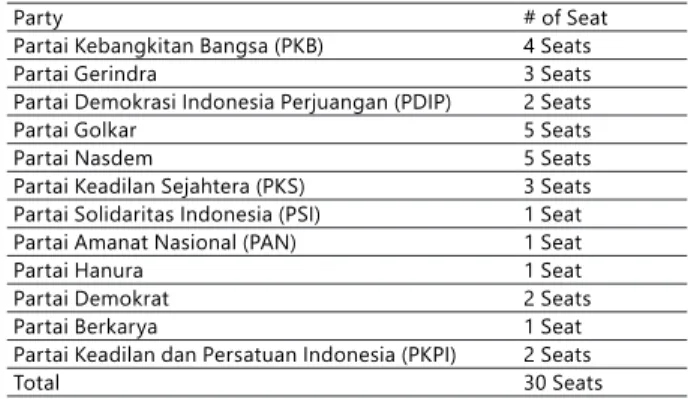
In this section, we explicate how the weak party institutionalization in South Halmahera, a derivative of the party institutions at the national level, significantly shaped Bahrain Kasuba’s failure to get the support of 20% of the DPRD seats, which was needed to run for a second elec- tion. The parties examined in this study were the parties associated with Bahrain Kasuba since he became regent in 2015, PKS and Hanura, and the parties associated with Bahrain Kasuba’s candidacy process in 2020, PKPI (2 seats), Gerindra (3 seats), and Berkarya (1 seat). The follow- ing are the details of the seat share for the South Halmahera Regency DPRD for 2019-2024.
Table 2. Number of Seats Acquired in DPRD South Halmahera (2019-2024)
Party # of Seat
Partai Kebangkitan Bangsa (PKB) 4 Seats
Partai Gerindra 3 Seats
Partai Demokrasi Indonesia Perjuangan (PDIP) 2 Seats
Partai Golkar 5 Seats
Partai Nasdem 5 Seats
Partai Keadilan Sejahtera (PKS) 3 Seats Partai Solidaritas Indonesia (PSI) 1 Seat
Partai Amanat Nasional (PAN) 1 Seat
Partai Hanura 1 Seat
Partai Demokrat 2 Seats
Partai Berkarya 1 Seat
Partai Keadilan dan Persatuan Indonesia (PKPI) 2 Seats
Total 30 Seats
Source: KPUD South Halmahera 2019
In the theoretical framework section, we have briefly reviewed Main- waring and Scully’s (1995) four indicators to test the strength or weak- ness of party institutionalizations: the stability of competition between parties, parties’ ideological ties with cadres and grassroots, legitimacy from the public, and solidity as an organization. We analyzed each of Mainwaring and Scully’s (1995) variables for political party institution- alization to understand the impact of the party on the incumbent’s
curse in the candidacy process. We used two variables—that happen- ing in the case of South Halmahera —to show the weaknesses of party institutionalization: the parties’ ideological ties to cadres and grassroots and solidity as an organization.
First is the ideological ties between the party, its cadres, and the grassroots. The first indication that such ideological ties were absent came from Bahrain Kasuba’s relationship with his two former parties, PKS and PKPI. In 2018, a factional split arose in the North Maluku PKS party when two PKS cadres and leaders, brothers Abdul Ghani Kasuba and Muhammad Kasuba, contested the North Maluku governor election (Mulyadi 2020). PKS could not manage the split, leading to one of the cadres, Abdul Ghani Kasuba, leaving PKS. Abdul Ghani left PKS, which had a conservative Islamic ideology, and moved to PDIP, which leaned towards nationalist populism in ideology to fulfill its electoral interests. It meant that a conservative Islamic ideology was not Abdul Gani’s primary consideration in choosing a party. Likewise, PDIP had put aside ideology in recruiting its candidates for the regional elections.
We included an analysis of the split between Abdul Ghani and Mu- hammad Kasuba in this article because it was the starting point for Bah- rain Kasuba’s conflict with PKS. This party had nurtured him since he began his political career. In the 2018 North Maluku governor election, Bahrain Kasuba had, indeed, supported Abdul Ghani Kasuba, who ran under the PDIP party (Fajar 2020). Bahrain Kasuba’s decision to support Abdul Ghani was not motivated by ideological reasons and had caused his removal from the chairman position in the South Halmahera PKS DPD. Later, Bahrain Kasuba decided to leave PKS.
What happened next also confirmed the ideological absence in the relations between parties and cadres. After leaving PKS, Bahrain Ka- suba was recruited and appointed as the Chairman of the DPK PKPI of South Halmahera. The difference in ideological branding between Bahrain Kasuba, a former PKS member with a conservative Islamic ideology, and the PKPI, which put forward nationalism, was insignifi- cant in the recruitment process. The Bahrain Kasuba’s appointment
as the Chair of the DPK took place without an internal regeneration process to ensure that cadres employ an ideology and political platform in line with the party. The main reason behind this appointment was pragmatic politics, as Bahrain Kasuba was still sitting as the Regent of South Halmahera (Mulyadi 2020).
The ideological foundation also lacked the candidacy process car- ried out by the PKPI and the Berkaya Party, with very fluid dynamics and a short time frame. A few months before the 2020 regional election, Bahrain Kasuba collaborated with Lutfi Machmud as running mates in the South Halmahera regional election. The pair was promoted by PKPI (2 seats), Gerindra (3 seats), and Berkarya (1 seat). The support of 6 DPRD seats is sufficient to meet the 20 percent threshold in the South Halmahera regional election, which is six seats. Bahrain obtained PKPI’s support after he was appointed as the ChairmanChairman of the South Halmahera PKPI DPK two years earlier.
Meanwhile, support from the Berkarya Party came from their visit to Tomi Suharto in Jakarta. Finally, he obtained Gerindra support through his deputy Lutfi Machmud, who was a Gerindra cadre (Ikram 2021).
From an ideological perspective, PKPI, Gerindra, and Berkarya did not share a robust and common ideology. The three parties were not even in the same coalition in 2015. Consequently, the coalition, which lacked ideological common ground and was established in a short time, did not last long. The letter of party support that Bahrain Kasuba obtained so quickly was also easily lost in the last days of the regent and deputy regent candidate registration at the South Halmahera KPUD.
In July 2020, the Ministry of Law and Human Rights canceled the management of the Berkarya Party DPP led by Tomi Suharto and ap- proved the Muchdi’s Purwoprandjo’s management of the party. Candi- dacy studies have found that candidacy in Indonesia is centralized and relies on the decisions of the general ChairmanChairman (Aspinall and Berenschot 2019). It also happened at Berkarya’s South Halmera chapter. Not long after, the ChairmanChairman of the Berkarya DPP, Muchdi, withdrew Berkarya’s support for the Bahrain-Lutfi pair and shifted the party’s support to Usman-Ali Bassam (antaranews.com 2020).
By losing Berkarya’s support, Bahrain-Lutfi only had five seats. Bahrain’s burden grew heavier when on August 20, 2020, Lutfi Machmud died from Covid-19 and was buried in Jakarta. The departure of Berkarya and the passing of Lutfi Machmud changed the candidacy’s political dynamics significantly. Bahrain did not decide on Lutfi’s replacement until the final days of candidate registration.
Instability also occurred within PKPI. On September 3, 2020, or just three days before the closing of registration, Bahrain Kasuba received a letter informing his removal from the position as ChairmanChairman of the PKPI DPK (antaranews.com 2020). Days later, PKPI withdrew its support from Bahrain Kasuba and shifted it to Ali Bassam’s partner, Bahrain Kasuba’s cousin. These two events show no ideological factor in Bahrain Kasuba’s candidacy with PKPI and Berkarya. The relationship between PKPI and Bahrain Kasuba–PKPI cadres–also seemed to have no ideological ties because of the short period in which recruitment and dismissal.
Second is the solidity of the party as an organization. Towards the close of the registration period for regent candidates, a controversy arose between Bahrain Kasuba and PKPI, who were acting as his supporting party. PKPI had suddenly unilaterally withdrawn its nomination for Bahrain Kasuba. This withdrawal happened after PKPI removed Bah- rain Kasuba from his position as DPD PKPI South Halmahera. Howev- er, Bahrain Kasuba believed that he still deserved the PKPI nomination based on their letters of nomination. The unsolved problem between PKPI and Kasuba peaked on the last day of candidate registration. On that day, there was a dualism in PKPI’s nomination, as PKPI issued two letters of recommendation for both Bahrain and another candidate Usman-Ali Bassam. The following was the PKPI statement behind the removal of Bahrain:
“One reason PKPI did not nominate Bahrain Kasuba was that he did not meet the requirements to pass from the registration stage to the administrative stage. At first, we gave him the opportunity and even wrote an official letter to him [asking him to] complete the file.
However, he did not respond, so we decided not to let him pass,”
Reno Banjar, Secretary of the North Maluku PKPI Provincial DPP (antaranews.com, September 4 2020; translated).
Behind the reasons for mal-administration above, the North Maluku PKPI DPP, since 2019, had been disappointed with Bahrain’s behavior, which was considered a violation of the party’s code of ethics. Bahrain had instructed PKPI cadres and PKPI legislators in South Halmahera to support legislative candidates outside PKPI (antaranews.com, Septem- ber 4 2020). However, people closest to Bahrain suspected Muhammad Kasuba was involved in turning away PKPI’s nomination from Bahrain to Usma-Ali Bassam. The same thing happened behind the shift in Berkarya’s nomination of Bahrain to Usman-Ali Bassam (Ikram 2021).
Muhammad Kasuba, the Chairman of the National Executive Board of PKS for Development in Eastern Indonesia, had a solid network in Jakarta. To a local media, Bahrain expressed his suspicions about Muhammad Kasuba’s interference behind the change of political posi- tion of the Berkarya and PKPI. Through lobbies with as many parties, Bahrain Kasuba also suspected that Muhammad Kasuba was struggling to garner support for Usman-Ali Bassam (kumparan 2020). He was well aware of the centralized nature of Indonesia’s political parties and that the general boards in Jakarta had prerogatives to determine the candi- dates that parties’ regional chapters promote (Ikram 2021). PKPI’s view that Bahrain Kasuba failed to follow the party’s nomination procedure and the controversy that ensued shows that as a party, PKPI did not have a consolidated organization that was not solid enough in terms of organizational procedures.
At the end of this section, we note that the weak institutionalization of parties, particularly PKS, PKPI, and Berkarya, in South Halmahera had been characterized by (1) the neglect of the ideological relationship between parties and cadres; (2) the weakness of the party’s organiza- tional instruments in controlling the behavior of cadres; and (3) po- litically pragmatic coalitions between parties which lacked ideological
ties. The accumulation of the three above situations may have “cursed”
incumbent Bahrain Kasuba long before the 2020 regional elections.
Competitive Factionalism within Parties and the Kasuba’s Family
On Saturday, September 6, 2020, at around 23:30 WIT or 30 minutes before the registration for regent and deputy regent candidates was closed, Bahrain Kasuba’s running mate and deputy regent candidate Muchlis Sangaji visited the KPUD accompanied by the Chair and Sec- retary of Gerindra’s South Halmahera chapter. There was something strange about the Muchlis’s arrival. Bahrain Kasuba, the regent candi- date between the pair, did not come to the KPUD (mediaindonesia.
com 2020). Bahrain Kasuba’s absence was due to problems related to his coalition and failure to meet the 20 percent threshold. On the clos- ing day of the registration, Bahrain Kasuba-Muchlis Sangaji only had a nomination letter from Gerindra. PKPI had canceled its recommen- dations after the dualism of nomination given to Bahrain Kasuba and Ali Bassam Kasuba.
Meanwhile, Berkarya had officially withdrawn support a few months earlier. Due to the Bahrain Kasuba not attending KPUD and the lack of party support, Bahrain and Muchlis had unquestionably failed to run in the 2020 South Halmahera regional elections. With the failure of Bahrain-Muchlis, only two pairs of candidates, Helmi Umar Muchsin- La Ode Arfan and Usman Sidik-Hasan Ali Bassam Kasuba participated in the 2020 South Halmahera regional election (Muhammad Kasuba’s biological son). With the support of nine political parties (21 DPRD seats), Usman-Ali Bassam won the 2020 South Halmahera regional election (Fajar 2020).
In contrast, Bahrain Kasuba, the incumbent regent of South Halma- hera (2015-2020), failed in the candidacy process. Why did the Bahrain- Muchlis pair, who initially had six seats from Gerindra 3 seats, PKPI 2 seats, and Berkarya Party 1 seat, suddenly lose the nomination of PKPI and the Berkarya Party? In this section, we describe the second cause of Bahrain Kasuba’s failure in his candidacy, the competitive factional-
ism within the parties, which coincided with factionalism within the Kasuba family, which was the dominant political elite in North Maluku.
Boucek (2009) says competitive factionalism occurs when conflicts of interest between factions within the party are not resolved through communication, resulting in fragmentation and division. Under the 20 percent threshold rule, competitive factionalism makes it even more difficult for candidates to gain party support. During the political pro- cess leading to the candidacy for the 2020 regional elections, Bahrain Kasuba experienced three incidents of intra-party factionalism. These happened when he was a PKS cadre when he suddenly lost Berkarya’s support and during the controversy concerning the dualism in PKPI’s support. Bahrain Kasuba also experienced factionalism within the Ka- suba family. As the Kasuba family’s political background is intertwined with PKS, our explanation of the Kasuba family’s intra-family factional- ism is merged with the factionalism in PKS.
The first competitive factionalism occurred within the Kasuba fam- ily when the two Bahrain Kasuba uncles, Abdul Ghani Kasuba and Muhammad Kasuba, jointly ran for the 2018 North Maluku regional election (Nur 2020). Muhammad Kasuba, who was in a higher position within the party, managed to obtain PKS’s support. On the other hand, Abdul Ghani had to leave and run with PDIP. Abdul Ghani Kasuba then won the 2018 North Maluku Regional Election and became gov- ernor for the 2019-2023 period. The first factionalism coincided in two arenas: the political party arena and the family arena.
Muhammad Kasuba’s losses led to further factionalism within the Kasuba family. Since being promoted by PDIP, Abdul Gani was auto- matically dismissed from his position as Chairman of the PKS DPW, and his status as a cadre was also revoked. Bahrain Kasuba was removed from his position as Chairman of the DPD PKS South Halmahera.
Tensions between Abdul Ghani and Bahrain’s camps with Muham- mad Kasuba’s camp continued ahead of the 2019 presidential election when Abdul Ghani and Bahrain campaigned for Jokowi-Ma’ruf Amin.
It made PKS reaffirm that Abdul Ghani was no longer a PKS cadre.
The following is the statement of Suhud Aliudin, PKS’s Director for Candidacy:
“This needs to be clarified, Abdul Ghani is no longer a PKS cadre.
So, whatever his (Abdul Ghani) decision to support the incumbent in the 2019 presidential election, it is not PKS’s business. Because he has joined PDIP, Gani’s status as a PKS cadre is automatically revoked. That is a fact you need to know.” (mediaindonesia.com, September 11 2018; translated)
Competitive factionalism within the Kasuba family continued until the 2020 South Halmahera regional elections. Abdul Gani had for long shown full support for Bahrain Kasuba. At the same time, Muham- mad Kasuba also had declared long ago that PKS and Hanura would entrust his son, Ali Bassam Kasuba, to run as a deputy regent candi- date alongside Usman Siddiq. With the ability and the right lobbying strategy, Muhammad Kasuba succeeded in forming a large coalition to nominate Usman and Ali Bassam: PKS (3 seats), Golkar (5 seats), PKB (4 seats), PDIP (2 seats), PAN (1 seat), Demokrat (2 seats), and PSI (1 seat) (Syarif 2020).
The second competitive factionalism within the PKPI involved Bahrain Kasuba as a cadre. Several months before candidate registra- tion, Bahrain Kasuba, by pairing up with Lutfhi Machmud, who was a Gerindra cadre, was able to obtain support from PKPI (2 seats), Gerin- dra (3 seats), and Berkarya (1 seat). Although small, this coalition was initially sufficient to meet the minimum threshold for regency and deputy regent candidate nominations in South Halmahera, which was 6 DPRD seats. Unfortunately, as Aspinall and Berenschot (2019) argue, the dynamics of party nomination for the prospective candidates could not be considered final until the prospective candidates receive a let- ter of nomination signed by their supporting parties’ chairperson and the candidates and their parties come to the KPUD for registration. In this case, Bahrain Kasuba’s status as ChairmanChairman of the party regional broad could not ensure PKPI’s nomination for him.
Towards the closing of the registration date for the prospective regent and deputy regent of South Halmahera, PKPI withdrew its nomina- tion for Bahrain Kasuba and his running mate and shifted it to Usman Siddiq-Ali Bassam (Ikram 2021). Surprisingly, because Bahrain was still in possession of PKPI’s recommendation letter, Bahrain’s running mate and Usman Siddiq-Ali Bassam brought recommendation letters from PKPI for their registration at the KPUD, causing a dualism of nomi- nation. However, because Bahrain did not attend the registration and the Chairman of PKPI DPK, who was present, confirmed that they nominated Siddiq-Ali Bassam, the KPUD decided that PKPI’s nomina- tion letter for Bahrain Kasuba was no longer valid as an administrative document (Ikram 2021).
In official statements, PKPI said its decision was caused by PKPI’s disappointment with Bahrain Kasuba, who did not follow the regis- tration procedure within the party. However, according to one of the successful teams for Bahrain Kasuba and his running mate, the revo- cation of PKPI’s nomination was motivated by rational-pragmatic con- siderations. Since Berkarya transferred their nomination from Bahrain to Siddik and Ali Bassam, Bahrain Kasuba only had support from 5 seats, which does not meet the minimum threshold. Seeing the lack of support for Bahrain Kasuba, PKPI did not want to nominate a failed candidate for the regional election because it could potentially drive away rent-seeking opportunities and access to public resources. Hence, PKPI acted rationally by shifting its nomination to Usman Siddiq and Ali Bassam (Ikram 2021).
Third, Bahrain Kasuba was a victim of competitive factionalism within the Berkarya Party. Before July 2020, Bahrain Kasuba-Lutfi Mahmud had gained nomination from Berkarya, which was led by Tommy Suharto then. Unfortunately, in July 2020, the Ministry of Law and Human Rights annulled Tommy Suharto’s leadership and autho- rized Major General (Ret.) Muchdi Purwopranjono as the party’s na- tional general ChairmanChairman. After Muchdi took over Berkarya’s leadership, the party withdrew its nomination for Bahrain Kasuba and transferred it to Usman Siddiq and Ali Bassam Kasuba (Mulyadi 2020).
Based on Berkarya’s intra-party factionalism and its impact on Bahrain’s candidacy, this study confirms Epsein’s (2009) study that argued that weakly institutionalized parties are also characterized by poor party governance, lack of regeneration, and weak representation in politi- cal competition. The weakly institutionalized party also does not have bargaining power when building coalitions (Epsein 2009). In this case, because the party only has one seat in the DPRD, the Berkarya Party decided to become the tail of the largest coalition (20 of 30 DPRD seats which consist of PKB, PKS, Golkar, PDIP, Democrat, PKPI, PKPI, PAN) to nominate Usman Siddiq-Ali Bassam.
The competitive factionalism within PKS, PKPI, and Berkarya—re- garding nomination for the incumbent Bahrain Kasuba—and the in- ternal factionalism within the Kasuba family demonstrate our second argument on the incumbent’s curse from a factionalism perspective.
Competitive factionalism occurs when conflicts of interest between fac- tions within the party are not resolved by communication mechanisms, leading to factions and divisions (Boucek 2009). The entire fragmen- tation that occurred—internal to the Kasuba family, internal to PKPI and Berkarya—was caused by electoral interests which were short-term, dynamic, and pragmatic. The factionalisms that contributed to Bahrain Kasuba’s failure to run for a second term in the 2020 regional elections serve as further evidence of the weak party institutionalization in South Halmahera.
CONCLUSION
This article has attempted to discuss the incumbent’s curse in the can- didacy process, which has been largely neglected due to assumptions that the candidacy phase is no different from the election phase in terms of its nature of case, approach, and conclusions. This study ar- gues that the difference between candidacy and election lies in targets, mechanisms, and political processes. In the election stage, voters deter- mine the candidate’s success. Therefore, the target of the candidate’s campaign is voters. While in the candidacy stage, the party chairman determines whether the incumbent is nominated or not for their sec-
ond term election. For the incumbent with a disharmonious relation- ship with the party chairman, their way to being nominated will be difficult. A conflict with a political party could cause the incumbent electoral condemnation, even before competing in the election. The case is proven in Bahrain Kasuba’s case.
This target difference means that there are also significant dif- ferences in the political mechanisms and processes determining the incumbent’s success or failure factor between the two. The political mechanisms and processes in the current candidacy process in Indo- nesia, in a specific situation, could ease the way for the incumbent—if he has a harmonious relationship with the party elite–but in other situ- ations, it could also make it difficult for the incumbent if in conflict with the party elite.
Our study discovered that the incumbent’s curse is caused by the weak institutionalization of political parties, which is marked by the ab- sence of ideological ties between the party and its cadres and the party’s weak solidity as an organization. Weak party institutionalization may also be caused by factionalism within the party. In Bahrain Kasuba’s case, intra-party factionalism, which also intersected with factional- ism within the Kasuba family (the dominant political elite in North Maluku), took place based on fluid, dynamic, and short-term electoral interests. Our findings cannot be used to predict the future dynamics of party factions in South Halmahera. Nevertheless, we found that in Indonesia’s political candidacy, it is likely for competitive fragmentation and breaks to happen.
This research leaves a question and more work for study studies.
Our question is, “what are the advantages or disadvantages for regional incumbents who run for re-election as independent candidates?” The situation may differ for incumbents who won their first term through political parties and then ran for re-election as an independent candi- dates. For incumbents and newcomers, independent candidacy may be much more complicated than if done via the party route. However, in a weak party institutionalization like Indonesia, the independent pathway
may result in better options for regional head candidates because the process is more democratic.
Finally, the incumbent’s curse in South Halmahera’s candidacy occurred locally. We are not yet sure whether this could be used to generalize that the incumbent’s curse occurs widely in Indonesia. In 2020 alone, there were at least four other regional head incumbentswho suffered the same fate: Mirna Annisa in Kendal, Irfendi Arbi in Li- mapuluh Kota, Soekirman in Serdang Bedagai, and Yuslih Ihza Ma- hendra in East Belitung (Utama 2020). Nevertheless, by employing an institutional approach, this study article has introduced two variables that cause the incumbent’s curse in the candidacy stage: party and factionalism. Thus, to find out other possible variables, we need more comprehensive research to find general patterns of incumbency curse in the candidacy process.
R EF ER ENCES
Aji, Wisnu. P. 2020. “Faksionalisme dalam Pemilihan Kepala Daerah:
Studi Kasus Kekalahan Petahana dalam Pilkada Kabupaten Bantul 2015”. Undergraduate Thesis, Universitas Gadjah Mada. Retreived from http://etd.repository.ugm.ac.id/penelitian/detail/196138 Amsari, Feri. 2019. “Menjerakan Pelaku “Uang Mahar” Pemilu”. Jurnal
Anti Korupsi 5 (June): 97–110. doi: 10.32697/integritas.v5i1.412 Ansolabehere, S., and James M. Snyder. 2002. “The Incumbency Ad-
vantage in U.S. Elections: An Analysis of State and Federal Offices, 1942–2000.” Election Law Journal 1 (June): 315–38.
Aspinal, Edward, and Mada Sukmajati. 2015. Politik Uang di Indonesia:
Patronase dan Klientelisme pada Pemilu Legislatif 2014. Polgov:
Yogyakarta
Aspinal, Edward, and Ward Berenschot. 2019. Democracy for Sale:
Pemilu, Klientelisme dan Negara di Indonesia. Jakarta: Yayasan Pustaka Obor Indonesia
Boucek, Francoise. 2009. “Rethinking Factionalism: Typologies, Intra- Party Dynamics, and Three Faces of Factionalism.” Party Politics 15 (June), 455-85. https://doi.org/10.1177%2F1354068809334553
Buehler, Michael, and Paige Tan. 2007. “Party-Candidate Relationships in Indonesian Local Politics: A Case Study of the 2005 Regional Elections in Gowa, South Sulawesi Province.” Indonesia 84 (Octo- ber): 41–69. http://www.jstor.org/stable/40376429
Deni, Aji. 2020. “Faksionalisasi Partai-Partai Politik di Maluku Utara (Studi Kasus Terhadap PPP, PAN, dan PKS)”. Doctor Thesis, Uni- versitas Muhammadiyah Yogyakarta. Retrieved from http://reposi- tory.umy.ac.id/bitstream/handle/123456789/35821/1.%20Sampul.
pdf?sequence=1&isAllowed=y
Epstein, Daniel J. 2009. “Clientelism Versus Ideology: Problems of Party Development in Brazil.” Party Politics 15 (May): 335–55. https://doi.
org/10.1177%2F1354068809102250
Fajar. 2020. “Interview with loyalist of Bahrain Kasuba.” Interview by Krisna Rettob. November 26, 2020.
Gerring, John. 2016. Case Study Research: Principles and Practices (Second Edition). Cambridge: Cambridge University Press
Hadiz, Vedi R. 2018. “Imagine All the People? Mobilising Islamic Popu- lism for Right-Wing Politics in Indonesia.” Journal of Contemporary Asia 48 (February): 566–83. https://doi.org/10.1080/00472336.2018.
1433225
Hazan, Reuven Y., and Rahat, Gideon. 2010. Democracy Within Par- ties: Candidate Selection Methods and Their Political Consequenc- es. Oxford: Oxford University Press.
Ikram. 2021. “Interview with the Head of Bappilu PKPI’s party.” Inter- view by Krisna Rettob. February 4, 2021.
Khabibi, Ikhwanul. 2016. “Hanya Selisih 18 Suara, Pilkada Halma- hera Selatan Harus Dihitung Ulang.” Detik.com, January 23. https://
news.detik.com/berita/d-3124668/hanya-selisih-18-suara-pilkada- halmahera-selatan-harus-dihitung-ulang
Klasnja, Marko, and Rocio Titiunik. 2013. “Incumbency in Weak Party System: Evidence from Brazil.” Unpublished Manuscript University of Michigan. Retrieved from http://citeseerx.ist.psu.edu/viewdoc/do wnload?doi=10.1.1.1063.4712&rep=rep1&type=pdf
Klasnja, Marko. 2016. “Increasing Rents and Incumbency Disadvan- tage.” Journal of Theoretical Politics 28 (June): 225–65. https://doi.
org/10.1177%2F0951629815586873
Klasnja, Marko. 2017. “The Incumbency Curse: Weak Parties, Term Limits and Unfulfilled Accountability.” American Political Sci- ence Review 111 (February): 129–48. https://doi.org/10.1017/
S0003055416000575
Kumparan.com. 2020. “Pengamat Politik: Dukungan Gubernur terha- dap Petahana Halsel Bentuk Kekecewaan.” Kumparan.com, Augst 13. Retrieved from https://kumparan.com/ceritamalukuutara/penga- mat-politik-dukungan-gubernur-terhadap-petahana-halsel-bentuk- kekecewaan-1tzkh1W9Kfk
Lay, Cornelis, Hasrul Hanif, Ridwan, and Noor Rohman. 2017. “The Rise of Uncontested Elections in Indonesia: Case Studies of Pati and Jayapura.” Contemporary Southeast Asia 39 (December): 427–48.
https://www.jstor.org/stable/44684049
Lee, David S. 2008. “Randomized Experiments from Non-Random Selection in the U.S. House Elections.” Journal of Econometrics 142 (February): 675–97. https://doi.org/10.1016/j.jeconom.2007.05.004 M. Nur, Diana. 2020. “Interview with Bahrain Kasuba’s Winning Team
Member.” Interview by Krisna Rettob. November 25, 2020.
Mainwaring, Scott, and Timothy Scully. 1995. Building Democratic Institutions: Party Systems in Latin America. Stanford: Stanford University Press.
Malut Kabar Daerah. 2020. “Pendukung BK-Masih Demo KPU Halma- hera Selatan.” September 15. Retrieved from https://malut.kabardae- rah.com/2020/09/15/pendukung-bk-masih-demo-kpu-halmahera- selatan/
Moore, Aaron A., R. M. McGregor, and Laura B. Stephenson.
2015. “Paying Attention and the Incumbency Effect: Voting Be- havior in The 2014 Toronto Municipal Election.” Internation- al Political Science Review 35 (November): 85–98. https://doi.
org/10.1177%2F0192512115616268
Muksin, Dafrin, Titin Purwaningsih, and Achmad Nurmandi. 2019.
“Praktik Dinasti Politik di Aras Lokal Pasca Reformasi: Studi Kasus Abdul Gani Kasuba dan Ahmad Hidayat Mus pada Pilkada Provinsi Maluku Utara.” Jurnal Wacana Politik 4 (Oktober): 133–144. https://
doi.org/10.24198/jwp.v4i2.25336
Mulyadi, S. Awal. 2020. “Interview with Bahrain Kasuba’s Winning Team Member.” Interview by Krisna Rettob. November 27, 2020.
Nurlinah, Rizkika L. Darwin, and H. Haryanto. 2019. “Incumbency Disadvantages and Populism in Indonesian Local Elections: Case Studies of Banda Aceh and Takala.” PCD Journal 7 (June): 57–82.
Prasetyo, Wegik. 2019. “Optimalisasi Bekerjanya Pengungkapan Dana Kampanye sebagai Strategi Pencegahan Politik Uang.” INTEGRI- TAS Jurnal Antikorupsi 5 (June): 15-27. doi: https://doi.org/10.32697/
integritas.v5i1.336
Purwaningsih, Titin, and Bambang E. C. Widodo. 2020. “The Interplay of Incumbency, Political Dynasty and Corruption in Indonesia: Are Political Dynasties The Cause of Corruption in Indonesia?.” Revista UNISCI 53 (May): 158–176. DOI:10.31439/UNISCI-89
Sartori, Giovanni. 2005. Parties and Party Systems: A Framework for Analysis. Cambridge: Cambridge University Press.
Seeberg, Merete B., Michael Wahman, and Svend E. Skaaning. 2018.
“Candidate Nomination, Intra-Party Democracy, and Election Vio- lence in Africa.” Democratization 25 (January): 959–97. https://doi.
org/10.1080/13510347.2017.1420057
Svolik, Milan W. 2013. “Learning to Love Democracy: Electoral Ac- countability and the Success of Democracy.” American Journal of Political Science 57 (July): 685–702. https://www.jstor.org/sta- ble/23496647
Syarif, Rosiana. 2020. “Member of Gerindra Party of South Halma- hera”. Interview by Krisna Rettob. December 3, 2020
Titiunik, Rocio. 2011. “Incumbency Advantage in Brazil: Evidence from Municipal Mayor Elections.” University of Michigan Working Pa- per. Retrieved from https://jonnyphillips.github.io/FLS6415/Class_7/
Tituinik_2011_RDD.pdf
Utama, Felldy. 2020. “5 Petahana Gagal Maju, Mirna Anisa Cuma Bisa Pasrah.” Inews.id, September 8. Retrieved from https://www.inews.id/
news/nasional/5-petahana-gagal-maju-pilkada-mirna-annisa-cuma- bisa-pasrah
Wiandi, Juwansyah. 2019. “Analisis Kekalahan Petahana (Studi Keka- lahan Basuki Tjahaja Purnama-Djarot Saiful Hidayat pada Pilkada DKI Jakarta Tahun 2017).” Undergraduate Thesis, UIN Syarif Hi- dayatullah Jakarta. Retrieved from https://repository.uinjkt.ac.id/
dspace/bitstream/123456789/46374/2/JUWANSAH%20WIANDI- FISIP.pdf