Bullet 1, revised first sentence: Molecular profiling in BTCs: Comprehensive molecular profiling is recommended for patients with inoperable or metastatic BTC who are candidates for systemic therapy. Treatment with liposomal irinotecan plus fluorouracil and leucovorin for patients with previously treated metastatic bile duct cancer: the randomized clinical phase 2b NIFTY trial. Footnote j added: For patients with disease refractory to standard therapies or for whom standard treatment options are not available.
CheckMate 848: A randomized, open-label, phase 2 trial of nivolumab in combination with ipilimumab or nivolumab monotherapy in patients with advanced or metastatic solid tumors with high tumor mutation burden [abstract]. Pancancer efficacy of pralsetinib in patients with RET fusion-positive solid tumors from the phase 1/2 ARROW trial. Efficacy and safety of entrectinib in patients with NTRK fusion positive (NTRK-fp) tumors: pooled analysis of STARTRK-2, STARTRK-1 and ALKA-372-001.
Higher yields may be seen in patients with T3 or higher tumors, poorly differentiated tumors, or with a cholecystectomy with positive margins. Diagnostic laparoscopy should also be considered in patients with any suspicion of metastatic disease on imaging not undergoing percutaneous biopsy.1. Prognostic value of jaundice in patients with gallbladder cancer from the AFC -GBC-2009 study group.
18F-fluorodeoxyglucose positron emission tomography (18FDG-PET) for patients with biliary tract cancer: systematic review and meta-analysis.
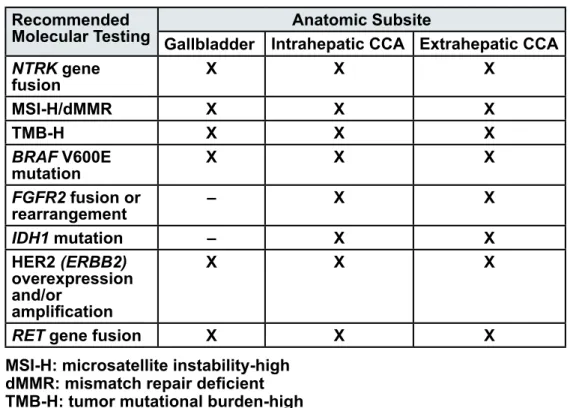
Recommendation: Testing for NTRK fusions is recommended for patients with unresectable or metastatic gallbladder cancer, intrahepatic CCA, or extrahepatic CCA. Recommendation: Testing for MSI or MMR deficiency is recommended in patients with unresectable or metastatic gallbladder cancer, intrahepatic CCA, or extrahepatic CCA. Testing for TMB is recommended for patients with unresectable or metastatic gallbladder cancer, intrahepatic CCA, or extrahepatic CCA based on clinical benefit observed over advanced solid tumors.
Recommendation: Testing for BRAF V600E mutations is recommended for patients with unresectable or metastatic gallbladder cancer, intrahepatic CCA, or extrahepatic CCA. Recommendation: Testing for FGFR2 fusions or rearrangements is recommended in patients with unresectable or metastatic intrahepatic or extrahepatic CCA and should be considered in patients with unresectable or metastatic gallbladder cancer. Recommendation: Testing for HER2 (ERBB2) overexpression/amplification is recommended for patients with unresectable or metastatic gallbladder cancer, intrahepatic CCA, or extrahepatic CCA.
Recommendation: Testing for RET fusions is recommended for patients with unresectable or metastatic gallbladder cancer, intrahepatic CCA, or extrahepatic CCA. Germline alterations in patients with biliary tract cancer: A spectrum of important and previously underappreciated findings.
Pemigatinib 27
Gemcitabine, cisplatin, and nab-paclitaxel for the treatment of advanced biliary tract cancers: a phase 2 clinical trial. Capecitabine compared with observation in resected biliary tract cancer (BILCAP): a randomized, controlled, multicenter, phase 3. FOLFOX second-line chemotherapy versus active symptom control for advanced biliary tract cancer (ABC-06): a phase 3, open-label, randomized, controlled trial.
A phase 2 trial of regorafenib as a single agent in patients with chemotherapy-refractory, advanced, and metastatic biliary tract adenocarcinoma. Entrectinib in patients with advanced or metastatic NTRK fusion-positive solid tumors: integrated analysis of three phase 1-2 trials. Efficacy of pembrolizumab in patients with high noncolorectal microsatellite instability/mismatch repair-deficient cancer: Results from the phase II KEYNOTE-158 study.
Dabrafenib and trametinib in patients with biliary tract cancer with a BRAFV600E (ROAR) mutation: a phase 2 open-label, single-arm, multicenter basket trial. Dabrafenib and trametinib in patients with tumors harboring BRAFV600E mutations: results of the NCI-MATCH H trial subprotocol. Pertuzumab and trastuzumab for HER2-positive metastatic biliary tract cancer (MyPathway): a multicenter, open-label, phase 2a, multibasket study.
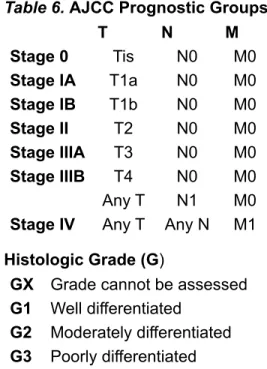
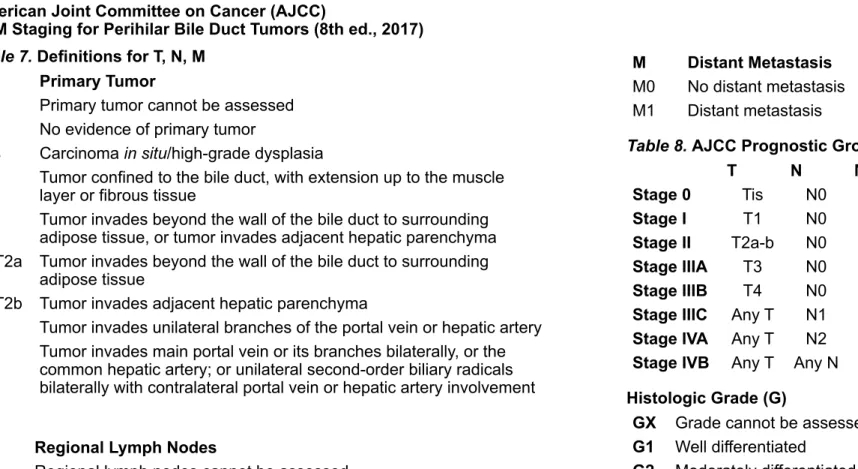
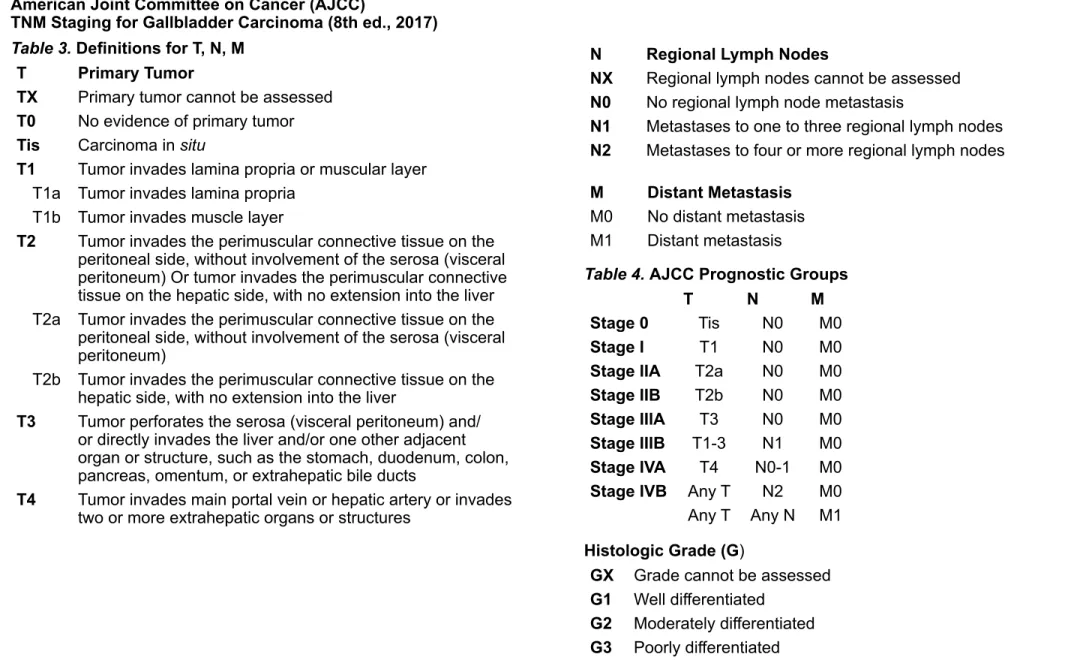
T2b Tumor invades the perimuscular connective tissue on the liver side, with no extension into the liver. T4 Tumor invades main portal vein or hepatic artery or invades two or more extrahepatic organs or structures. T3 Tumor invades unilateral branches of the portal vein or hepatic artery T4 Tumor invades main portal vein or its branches bilaterally, or the.
T1 The tumor penetrates the wall of the bile duct to a depth of less than 5 mm T2 The tumor penetrates the wall of the bile duct to a depth of 5–12 mm. T3 Tumor invades bile duct wall to a depth greater than 12 mm T4 Tumor involves celiac axis, superior mesenteric artery and/or. The NCCN Clinical Practice Guidelines in Oncology (NCCN Guidelines®) for Biliary Tract Cancer are the work of members of the NCCN Biliary Tract Cancer Guidelines Committee.
Guidelines Update Methodology
Hepatobiliary cancers are highly lethal cancers, including a spectrum of invasive carcinomas arising in the liver (hepatocellular carcinoma [HCC]), gallbladder, and bile ducts (intrahepatic and extrahepatic . cholangiocarcinoma [CCA]). In 2023, it is estimated that 41,210 people in the United States will be diagnosed with liver cancer and intrahepatic bile duct cancer and an additional 12,220 people will be diagnosed with gallbladder cancer or other BTC.1 Approximately 29,380 deaths from liver or intrahepatic bile duct cancer and 4510 deaths due to gallbladder cancer or other BTC are expected. The types of BTCs covered in these guidelines include: gallbladder cancer, and intrahepatic and extrahepatic CCA.
By definition, the NCCN guidelines cannot cover all possible clinical variations and are not intended to replace good clinical judgment or individualization of treatments. While not explicitly stated at every decision point of the guidelines, participation in prospective clinical trials is a preferred treatment option for BTCs.
Literature Search Criteria
Sensitive/Inclusive Language Usage
Gallbladder Cancer
However, these markers are not specific for gallbladder cancer, and CA 19-9 may also be elevated in patients with jaundice from other causes. Cholecystectomy combined with liver resection and lymphadenectomy is associated with improved survival for patients with T2 or higher tumors. For patients with a suspicious mass detected by imaging, the guidelines recommend cholecystectomy plus en bloc liver resection, and.
However, caution should be exercised in patients with biliary obstruction as drainage is not always feasible and may be dangerous. In patients with unresectable or metastatic gallbladder cancer and jaundice, biliary drainage is an appropriate palliative procedure and should be. Intrahepatic CCA may be detected incidentally as an isolated intrahepatic mass on imaging.82 In contrast, patients with.
In patients with refractory disease, direct visualization of the bile duct with guided biopsies is the ideal technique for the workup of CCA. Additionally, RT with concurrent fluoropyrimidines is included as an option for patients with refractory disease. Systemic therapy or enrollment in a clinical trial are preferred options for patients with metastatic intrahepatic CCA.
A retrospective analysis of 525 patients with intrahepatic CCA showed that patients who received a combined regimen of HAI and another. Complete resection with negative margins is the only potentially curative treatment for patients with resectable disease. Surgery is contraindicated in patients with distant metastatic disease in the liver, peritoneum, or distant lymph nodes beyond the porta hepatis (or pancreatic head for distal tumors).
Although not routinely used in all patients undergoing resection, the panel's consensus is that in patients with hilar CCA, preoperative management. In patients with unresectable or metastatic disease, biopsy is recommended to confirm the diagnosis before initiating further treatment. In addition, RT with concomitant fluoropyrimidine or palliative RT are also included as options for patients with unresectable disease.
Adjuvant Chemotherapy and Chemoradiation for Biliary Tract Cancers
In patients with unresectable or metastatic disease, biliary drainage should be considered using surgical bypass (although rarely used) or ERCP or PTC, usually with biliary stent placement.178-181. The panel encourages continued clinical research in this area, and referral of patients with unresectable disease to a transplant center with a United Network for Organ Sharing-approved protocol for transplantation of CCA should be considered. In two small RCTs, the combination of PDT with biliary stent placement was reported to be associated with long-term OS in patients with inoperable CCA.191,192.
Furthermore, these studies often combined patients with gallbladder and bile duct cancer (with some exceptions), which is problematic since the biology of these tumors is completely different. Despite the challenges associated with accruing large numbers of patients with BTC for randomized phase III trials, it is widely recognized that efforts should be made to conduct such studies in which individual disease entities are evaluated separately. Data supporting adjuvant chemotherapy in patients with resected BTC have come from two randomized phase III trials.
In the phase III BILCAP study, 447 patients with completely resected CCA or gallbladder cancer were randomized to receive adjuvant capecitabine or observation.195 RFS was significantly greater for patients in the capecitabine arm in both the intent-to-treat analysis (24, 4 vs. The results of this study support the suggestion that patients with gallbladder cancer undergoing resection may gain survival benefit from adjuvant chemotherapy. In the Phase III PRODIGE 12-ACCORD 18 study, 196 patients with R0 or R1 resected BTC were randomized to receive only GEMOX or surveillance.199 No statistically significant differences were found between the study arms for RFS and OS.
Negative survival outcomes were also found in a phase III study from Japan that evaluated the efficacy of gemcitabine monotherapy (compared to observation) in 226 patients with resected extrahepatic CCA.200. Retrospective studies have concluded that adjuvant chemotherapy or chemoradiation after R0 resection could improve OS in selected patients with T2 or T3 tumors and lymph. In patients with cancer of the gallbladder or extrahepatic bile ducts, those who have undergone R0 resection and who have negative regional nodes or those with carcinoma in situ at the periphery may be followed with systemic therapy (preferred), clinical examination (in preferred), observation alone, or fluoropyrimidine-based chemoradiation (category 2B for patients with gallbladder cancer).
Apart from the fact that gemcitabine monotherapy is not recommended for patients with resected extrahepatic CCA (based on the negative results of a phase III Japanese trial200), the recommendations in the NCCN. Patients with gallbladder cancer or extrahepatic CCA with resected, positive margins (R1) or gross residual local disease (R2) or patients with intrahepatic CCA with residual local disease (R2) after resection should be evaluated by a multidisciplinary team to review available treatment options on a case-by-case basis to case. For patients with R1 margins or positive regional nodes, the optimal treatment strategy has not been established, but the options are systemic therapy (preferred), clinical trial (preferred), or.
Treatment for Advanced Biliary Tract Cancers