Masduki Masduki <[email protected]>
[302] Submission Acknowledgement
1 pesan
Ramzi Murziqin <[email protected]> 26 Januari 2021 08.36 Kepada: Masduki Masduki <[email protected]>
Masduki Masduki:
Thank you for submitting the manuscript, "THE “TERAS DAKWAH” (DAKWAH TERRACE) MOVEMENT PROGRAM:
THE PHILOSOPHY AND DAKWAH ACTIVISM CHARITY-BASED IN YOGYAKARTA" to Jurnal Ilmiah Peuradeun.
With the online journal management system that we are using, you will be able to track its progress through the editorial process by logging in to the journal web site:
Submission URL: https://journal.scadindependent.org/index.php/jipeuradeun/authorDashboard/submission/624 Username: masduki
If you have any questions, please contact me. Thank you for considering this journal as a venue for your work.
Ramzi Murziqin
________________________________________________________________________
Jurnal Ilmiah Peuradeun
St. Tgk. Pulo Dibaroh, No. 26, Kp. Baru, Baiturrahman Sub-district, Banda Aceh City 23242, Aceh, Indonesia.
Official E-mail: [email protected] | website: www.journal.scadindependent.org
Masduki Masduki <[email protected]>
[peuradeun] Your Article Send to Pre-Review
1 pesan
Ramzi Murziqin <[email protected]> 8 Maret 2021 00.03 Balas Ke: Ramzi Murziqin <[email protected]>
Kepada: Masduki Masduki <[email protected]>
Article ID: 624 Dear Author:
Your submission to the Jurnal Ilmiah Peuradeun with the title, "THE “TERAS DAKWAH” (DAKWAH TERRACE) MOVEMENT PROGRAM: THE PHILOSOPHY AND DAKWAH ACTIVISM CHARITY-BASED IN YOGYAKARTA,"
has now been submitted for pre-review by editorial.
You can monitor the progress of your paper stages process directly in your account, and each stage will be notified to you about the progress of your paper. We hope you can be patient for a predetermined time of the process. If you have any questions, please do not hesitate to contact us.
Thank you for considering this journal as a venue for your work.
Best Regards, Ramzi Murziqin
SCAD Independent, Aff. Ar-Raniry State Islamic University, Indonesia [email protected]
________________________________________________________________________
Jurnal Ilmiah Peuradeun
St. Tgk. Pulo Dibaroh, No. 26, Kp. Baru, Baiturrahman Sub-district, Banda Aceh City 23242, Aceh, Indonesia.
Official E-mail: [email protected] | website: www.journal.scadindependent.org Jurnal Ilmiah Peuradeun, Your Intellectual Nutrition...
Masduki Masduki <[email protected]>
[peuradeun] Editor Decision
3 pesan
Tabrani ZA <[email protected]> 4 Desember 2021 13.21
Kepada: Masduki Masduki <[email protected]>
Article ID: 624
Dear Masduki Masduki (Author):
Thank you for submitting your paper to Jurnal Ilmiah Peuradeun.
It is a very interesting topic. Although we appreciate the work you have put into the paper, we have determined that your paper needs several developments in order to be considered for publication in the Jurnal Ilmiah Peuradeun.
There are several points of view that should be considered in particular which may construct the paper.
After Editorial Board and Reviewers inspect and review your manuscript, we have reached a decision regarding your submission about " The “Teras Dakwah” (Dakwah Terrace) Movement Program: The Philosophy and Dakwah Activism Charity-Based in Yogyakarta".
Our decision is: Revisions Required
We have received comments and decisions from reviewers for your manuscript. Your manuscript should be pending publication due to some minor revisions which may construct your manuscript. Attached are the overall comments of the peer reviewer about your manuscript (Please see editor and reviewer notes in the attached file).
Please revise your manuscript. The Deadline for revision and re-submit of the manuscript is within two weeks from the date of the notice. And then, please make a Table of Corrections to make it easier for editors to assess your revised manuscript. The Table of Corrections contains the reviewer's comments, your revision, and the page. You can see the Table of Correction format on the journal's website, in the author's guidelines section. The Table of Corrections is sent with your revised manuscript as a separate file. Please make sure the revision that you submitted has been in the JIP Template and has followed the JIP author's guidelines. If you have any questions, please do not hesitate to contact us.
Thank you for your contribution and cooperation.
Best Regards, Tabrani ZA
SCAD Independent Research Institute, Indonesia [email protected]
--- Reviewer A:
---
1. Are the title, abstract and keywords appropriately reflect the content of the paper?
Please provide your comments in detail in the comments section (if any).
2. Are the aims, objectives, novelty and the significance of the study are clear? And is the main issues discussed in this paper very important and in accordance with the novelty?
Please provide your comments in detail in the comments section (if any).
Yes
3. Is the paper sufficiently broadly and critically review the relevant scientific literature on the topic?
Please provide your comments in detail in the comments section (if any).
4. Is the research methodology or approach to problem-solving that used was relevant, detail and clear?
Yes
5. Is the research findings clearly and comprehensibly presented? And did the authors conducted data presentation and interpretation were valid and reasonable?
Yes
6. Is the discussion relevant to the research findings? and is the author(s) clearly express and explain their own professional viewpoints?
Yes
7. Are the conclusions are clearly and comprehensively? Especially in terms of the author’s critical evaluation of research findings.
Yes
8. Are the references used relevant and up to date? and does it match the citations in the article?
Yes
9. Are there other existing papers related to this paper?
Please provide your comments in detail in the comments section (if any).
Yes
10. Are the papers quality, structure, and grammar excellent and perfectly crafted?
Good
Are there any parts of the manuscripts that should be reduced or omitted? Please give your suggestions or some points of view to which may construct, including the strengths/ weaknesses of this paper.
Your introduction is too long. Please focus more on the problem you want to study. also define the problem gap clearly. The abstract must be synthesis from the content. Please pay more attention to the coverage of an abstract. Abstract between 150-200 words. Five points in the abstract must be present, please review the journal template. The research design must be clear. In addition, we noticed that your methods are lacking detail on how exactly the study was performed. Please bear in mind that readers must be able to recreate your study from the level of detail that you give. For instance, for qualitative studies involving interviews and focus groups. The conclusion needs to discuss comprehensively. That section needs to synthesis comprehensively, especially in terms of the author's critical evaluation of research findings, must explain your contribution to knowledge. Correspondence of conclusions with results is highly recommended. Need more current references that dis cuss a similar topic thus makes the research well supported. Please add references up to date! You need additional references from international journals, and then we recommend that you quote several related articles from this journal.
You need to improve the structure and grammar. Extensive editing should be undertaken, since some errors in some parts of sentences in order to make sure zero errors. Please adjust the overall writing of references using APA Style 7th Edition. If you are using APA style, the in-text citations must use APA style. For citations and references, it is mandatory to Use the Mendeley App.
---
--- Reviewer B:
---
1. Are the title, abstract and keywords appropriately reflect the content of the paper?
Please provide your comments in detail in the comments section (if any).
2. Are the aims, objectives, novelty and the significance of the study are clear? And is the main issues discussed in this paper very important and in accordance with the novelty?
Please provide your comments in detail in the comments section (if any).
3. Is the paper sufficiently broadly and critically review the relevant scientific literature on the topic?
Please provide your comments in detail in the comments section (if any).
4. Is the research methodology or approach to problem-solving that used was relevant, detail and clear?
5. Is the research findings clearly and comprehensibly presented? And did the authors conducted data presentation and interpretation were valid and reasonable?
6. Is the discussion relevant to the research findings? and is the author(s) clearly express and explain their own professional viewpoints?
7. Are the conclusions are clearly and comprehensively? Especially in terms of the author’s critical evaluation of research findings.
8. Are the references used relevant and up to date? and does it match the citations in the article?
9. Are there other existing papers related to this paper?
Please provide your comments in detail in the comments section (if any).
10. Are the papers quality, structure, and grammar excellent and perfectly crafted?
Are there any parts of the manuscripts that should be reduced or omitted? Please give your suggestions or some points of view to which may construct, including the strengths/ weaknesses of this paper.
---
________________________________________________________________________
Jurnal Ilmiah Peuradeun
St. Tgk. Pulo Dibaroh, No. 26, Kp. Baru, Baiturrahman Sub-district, Banda Aceh City 23242, Aceh, Indonesia.
Official E-mail: [email protected] | website: www.journal.scadindependent.org Jurnal Ilmiah Peuradeun, Your Intellectual Nutrition...
2 lampiran
A-624-99Z_Article Text-2769-1-4-20210521.doc 2625K
B-Reviewer Comment Paper ID 624.pdf 423K
Masduki Masduki <[email protected]> 5 Desember 2021 16.14
Kepada: Dony Arung <[email protected]>
[Kutipan teks disembunyikan]
2 lampiran
B-Reviewer Comment Paper ID 624.pdf 423K
Masduki Masduki <[email protected]> 10 Desember 2021 07.38
Kepada: Imron Rosidi <[email protected]>
[Kutipan teks disembunyikan]
2 lampiran
A-624-99Z_Article Text-2769-1-4-20210521.doc 2625K
B-Reviewer Comment Paper ID 624.pdf 423K
Editorial Office:
St. Tgk. Pulo Dibaroh, No. 26, Kp. Baru, Baiturrahman Sub-district, Banda Aceh City 23242, Aceh, Indonesia.
Reference Number:
10.26811/624 Aceh, Indonesia: December 03, 2021 All Reviewer Comment
Round: 1 Paper ID: 624 Decision Status: Revisions Required Title of Paper The “Teras Dakwah” (Dakwah Terrace) Movement Program: The
Philosophy and Dakwah Activism Charity-Based in Yogyakarta
Dear Authors/Contributors,
Thank you for submitting your paper to Jurnal Ilmiah Peuradeun. We appreciate your submitting your paper to this journal and thank you for giving us the opportunity to consider your work.
We have to admit, it is a very interesting topic. Although we appreciate the work you have put into the paper, we have determined that your paper needs several developments in order to be considered for publication in the Jurnal Ilmiah Peuradeun. Several points of view should be considered in particular which may construct the paper. After Editorial Board and Reviewers inspect and review your manuscript, we have reached a decision regarding your submission, our decision is: Revisions Required.
We have received comments and decisions from reviewers for your paper. Overall paper content is sufficient. However, there are some mistakes that need to be changed to construct the paper:
A. We ask each of our authors to write their methods section in a stepwise fashion such that anyone else could use the same procedures/plan that used. Therefore, we suggesting that you reorganize this section to show your progression through data gathering and analysis. We suggesting an outline below and each section should have an associated heading:
1. Please identify what type of method inquiry you used. Give your rationale for selecting this design in general and your particular design choice in particular, and discuss how these choices are appropriate to answer the question under study.
2. Include a full discussion of how your participants were identified and recruited, and then discuss how these data sources were selected.
3. Please explain every step of data generation and collection and provide a rationale for each of your research decisions (please cite the literature that you used as a guide). Make sure to tell us exactly what constitutes data in your study.
4. Clearly describe each step of your analysis of the data. You may present each step in terms of it from both a conceptual and operational perspective (please cite the literature that you used as a guide). Include also a full discussion (including relevant literature) of every step you took to ensure rigor and trustworthiness.
5. Tell us how you are going to organize your results and how that is derived from your analysis.
B. In the results section, we expect to see exemplary evidence from your data to
support your findings. Referring indirectly to your actual data or only paraphrasing
your data weakens your arguments and assertions as to what your findings are. To
address this concern, for each finding, please make the three data analysis
components clear:
Editorial Office:
St. Tgk. Pulo Dibaroh, No. 26, Kp. Baru, Baiturrahman Sub-district, Banda Aceh City 23242, Aceh, Indonesia.
1. For component one, the quality, please define what you mean by the finding.
Without this definition, we don’t know what you mean by your finding’s qualities.
2. For component two, the data, please introduce the excerpt you suggest evidence the finding’s quality. Without the data, we have no evidence upon which to judge your representations of the data’s qualities. It is also important we know the source of the data.
3. For component three, the analysis, please explain how the data represents the qualities of which you claim it signifies because your analytical comments should bring the relationship between the quality asserted and the excerpt presented transparent and coherent making your claims clearly evidenced by the data. Without your testimony, the exhibit must speak for itself, which is not good practice in qualitative or quantitative data analysis.
So, for each section, please first define the distinction being presented and then after each excerpt, please explain how you see the talk evidencing the qualities you claim it represents.
As you follow this three-step process, you might find you only need to use one example to evidence your assertions. Each example provided should be an exhibit for one or more quality analyzed, but listing a series of excerpts exhibiting the same quality does not contribute to the findings; the practice just makes the paper longer. If, however, there are many different qualities to be evidenced, then you should present one example per quality being asserted along with the data-supported analysis articulating each your assertion.
C. The Overall Comment of the Reviewer:
1. The abstract must be synthesis from the content. Please pay more attention to the coverage of an abstract.
2. In the introduction, emphasize the novelty of the studies conducted.
3. The need to justify the aims and objectives should be stated in the introduction.
The authors need to discuss the significance of the study.
4. The research design must be explained, that section must be clear.
5. You must separate the results that you achieve with the discussion.
6. You must explain the important points of your findings so that there is a correlation with the discussion. The analysis of the paper must be clear and comprehensive. The author must be explained research findings in the specific sub-topic. Strengthen statements or findings with data evidence from the data collection techniques used. In the discussion section, compare the findings with the latest theories or findings from international studies.
7. The conclusion needs to discuss comprehensively. That section needs to synthesis comprehensively, especially in terms of the author's critical evaluation of research findings, must explain your contribution to knowledge.
Correspondence of conclusions with results is highly recommended.
Editorial Office:
St. Tgk. Pulo Dibaroh, No. 26, Kp. Baru, Baiturrahman Sub-district, Banda Aceh City 23242, Aceh, Indonesia.
8. Need more current references that discuss a similar topic thus makes the research well supported. Please add references up to date! You need additional references from international journals, and then we recommend that you quote several related articles from this journal.
9. You need to improve the structure and grammar. The extensive editing should be undertaken, since some errors in some parts of sentences in order to make sure zero errors.
10. Please adjust the overall writing of references using APA Style 7th Edition. If you are using APA style, the in-text citations must use APA style. For citations and references, it is mandatory to Use the Mendeley App or Zotero;
11. Please look back and adjust it again with this journal template.
12. Please revise your paper, and send it to us immediately.
Please revise your manuscript.
The Deadline for revision and re-submit of the manuscript is within two weeks from the date of the notice. If you need additionaltime please contact us via the official email of JIP. And then,
please make a Table of Corrections to make it easier for editors to assess your revised manuscript. The Table ofCorrections contains the reviewer's comments, your revision, and the page. You can see the Table of Correction format on the journal's website, in the author's guidelines section. The Table of Corrections is sent with your revised manuscript as a separate file.
Please make sure the revision that you submitted has been in JIP`s Template and has followed the authors' guidelines of JIP. If you have any questions, please do not hesitate to contact us.
Thank you for your contribution and cooperation.
Best Wishes, Ramzi Murziqin Editor in Chief
THE “TERAS DAKWAH” (DAKWAH TERRACE) MOVEMENT PROGRAM: THE PHILOSOPHY AND DAKWAH ACTIVISM CHARITY-
BASED IN YOGYAKARTA
Abstract
This article contributes for the discourse of dakwah and charity in Indonesia, especially in social institution of Teras Dakwah in Yogyakarta.
In this context, the discourse about dakwah and charity has not been much studied by previous scholars. Most studies on dakwah focus on figure, institution, oral and written dakwah, social media and others. The main research proposed is why and how the Teras Dakwah is involved in the charity practices both local and regional domain. The research data are obtained based on netnographic study. This research shows that the involvement of the Teras Dakwah in dakwah activism-based charity is influenced by the uncertainty discourse of social guarantee from government in which in turns the Teras Dakwah is involved in providing the religious social service both local areas in Yogyakarta and regional areas outside Yogyakarta.
Keywords: Dakwah, Charity, Social Media
A. Introduction
“TD IS MOVING. Yesterday morning, the TD Movement team quickly responded to the floods in the Bantul and surrounding areas.
Alhamdulillah,. morning food was distributed to residents there, precisely in the Mojolegi Region, Karangtengah, Imogiri, Bantul. Until now the condition is still not conducive, clean water is still needed, bathing needs, itching drugs, wind oil, lighting/candles, baby needs, baby & the elderly food as well as school equipment. Tthis afternoon at 13:00 God willing we return there to give aids back. Please you still has the opportunity to donate Bantul Flood by transferring to BSM 44111 33333 accounts. Confirmation is done through 085320307766.”
Quoted text above is taken from the caption of @terasdakwah Instagram account when distributing its charity program in the Village of Karangtengah, Imogiri, Bantul, an area affected by flooding in last several months. In the Instagram post dated 19 March 2019, it shows how the dakwah terrace was involved in community social services in Bantul. In turn, the involvement of the Dakwah Terrace in social activism is an interesting topic to be discussed in this paper.
This article discusses the dakwah movements that lead to social services in Indonesia. The study of Islamic dakwah in Indonesia has been widely written by a number of scholars; starting from studies of dakwah that focus on movement or community (Hasan, 2007; Kailani, 2012; Triantoro, 2018), dakwah media (Schulz, 2012; Sofjan, 2012; Sofjan & Hidayati, 2013;
Sunarwoto, 2012), and studies on propaganda that emphasize the figure of an ustaz (dai) (Hoesterey, 2008; Watson, 2005; Weng, 2018) .
Hasan, for example, discusses the Salafi propaganda movement. In his study, Hasan points out that the success of the Salafi propaganda in Indonesia is marked by the appearance of bearded young Muslims by wearing robes, turbans and pants over ankles (isbal). At the same time Salafi women appear wearing wide dark shirts with a face covering cloth (veil/niqab). They are demoted to returning to the early teachings of Islam, combating heresy and khurafat (Hasan, 2007).
In contrast to Hasan, who focuses on the propaganda of the Salafis, the study conducted by Najib Kailani examines the Tarbiyah Islamic movement which focuses on literacy, namely the Lingkar Pena Forum (FLP). In his study, Kailani points out that the popularity of the FLP among
young Indonesian Muslims coincides with the discourse of Islamic publications which at the time is developing rapidly. Then the popularity of FLP among young Indonesian Muslims is due to their ability to package Islamic messages with popular cultural symbols. In addition, the success of FLP also coincides with anti-secular pop magazine discourses such as Hai, Aneka Yess, Gadis, and others, which show images of Islamic women not wearing hijab (Kailani, 2012).
Unlike the study conducted by Hasan and Kailani, the study conducted by Dony Arung Triantoro discusses the stretching of the contemporary dakwah movement in Yogyakarta, the Dakwah Terrace. This previous research is to discuss the emergence of the Dakwah Terrace movement in the long course of the history of the Islamic dakwah movement in Indonesia. Then he finds the significance of the appearance of the Dakwah Terrace which is caused by the contestation among local religious authorities in packaging religious messages (Triantoro, 2018).
The above studies, ranging from studies conducted by Hasan, Kailani, to Triantoro, put the discussion of dakwah in aspects of his movement. While other studies such as the study by Sunarwoto, for example, talks about how the MTA (Majelis Tafsir al-Qur’an) in Surakarta uses radio as a means of spreading his message. Ustaz Ahmad Sukino, or known as the leader of MTA in Surakarta massively uses the radio to deliver his fatwas in the question and answer program on the radio (Sunarwoto, 2012). Just like Sunarwoto who emphasizes radio media, a study conducted by Dorothea E Schulz also explores how sound effects mediated by radio have succeeded in building images and lecturer authorities in Mali (Schulz, 2012).
In contrast to Sunarwoto and Schulz who emphasize radio media, a study conducted by Dicky Sofjan emphasizes television media. She investigates how popular female preachers in Indonesia, Mamah Dedeh conducts her dakwah on television, especially in the Mamah and Aa programs, and Heart to Heart with Mamah Dedeh on ANTV. The programs that are held by Mamah Dedeh are successful in attracting housewives, especially those who are members of the Taklim Assembly. The success of Mamah Dedeh's program is because she is able to represent the image of a mother who has the ability of religious knowledge and success in running the household (Sofjan & Hidayati, 2013).
In contrast to the above studies, the study group on other dakwah emphasizes more on the aspect of figures. Studies conducted by Hew Wai Weng, for example, discusses the dakwah conducted by Felix Siauw.
Weng's study shows that Felix Siauw built his authority through visual aesthetics on social media in the form of text, images and videos, which are able to target young Muslims, especially in spreading the idea of Hizbut Tahrir Indonesia (HTI) (Weng, 2018). Then a study conducted by James B.
Hoesterey investigates how Aa Gymnastiar re-appealed his authority after being caught in a polygamy case (Hoesterey, 2008). In contrast to Hoesterey, a study conducted by CW. Watson focuses on the popularity of Gym in exercising its authority as a popular speaker in Indonesia (Watson, 2005).
In contrast to the focus of existing scholarship studies, this paper will examine the propaganda activism that focuses on the social service of the community (charity). The focus of this study is discussed through case studies at the Dakwah Terrace institute in the city of Yogyakarta. The Dakwah Terrace actively holds Islamic studies in Yogyakarta. They facilitate young Muslims in Yogyakarta to increase their Islamic knowledge through invited clerics. Islamic studies conducted by the Teras Dakwah are very diverse, ranging from the study of religion, economics to issues such popular teen romance and others (Triantoro, 2018). Later, the Teras Dakwah is also actively involved in providing social assistance services to people in Yogyakarta and other cities in Indonesia as shown in the caption quote above.
This paper argues that charity-oriented propaganda activism is a new propaganda trend in the dynamics of the Contemporary Islamic dakwah movement in Indonesia. In addition, this paper shows that current charity practices are not only carried out by philanthropic institutions such as the National Amil Zakat Agency (BAZNAS), Amil Zakat Institutions (LAZ), Dompet Dhuafa, Ummat Care Justice Post (PKPU) or alms communities such as Alms node, Alms Street and Alms Group, which is very massive in Yogyakarta.
Specifically this article discusses three questions. First, why is the dakwah movement involved in the discourse of generosity in Indonesia?
Second, how is the Dakwah Terrace involved in the practice of charity in the
local realm and other regional areas? Third, how does the Dakwah Terrace promote the idea of charity through social media?
To answer these questions, the structure of this paper is divided into five parts. In the first part, this article explains the background that is the focus of this paper. The second part explains the discourse of generosity in Indonesia and the current involvement of dakwah movements. The third section discusses how the Dakwah Terrace carries out philanthropic programs. Fourth, this article examines how the Dakwah Terrace uses social media as a means of promoting the idea of charity and building image. In the last part, this paper provides conclusions and recommendations for the future study.
B. Method
This paper is a netnographic study. Referring to Robert V. Kozinet (2010), netnography is the collection of data by following and tracing activities in an online space. Specifically, the research data was obtained through social media of Instagram of @terasdakwah account and Facebook, in the form of image posts, videos, captions and others. In addition, the data of this study are also obtained based on previous research conducted by the researchers. Then the researchers discuss the research findings in the academic discourse regarding preaching and charity written by previous scholars. After the research findings are dialogued with theoretical arguments from previous scholars, in the end this study finds significant arguments, be they criticizing, corroborating or having new discoveries from previous scholars.
C. Result and Discussion
1. The Terrace of Dakwah in the Landscape of Islamic Generosity in Indonesia
The significant development of the emergence of Islamic philanthropic institutions in Indonesia can be examined during the Soeharto era. The development ideology promoted by the New Order shows that the Soeharto government paid attention to the handling of poverty in Indonesia, especially at the end of its leadership, between 1997-1999. In the span of two years (1997-1999), the poverty rate in Indonesia has increased from 15% to 33% (Sakai, 2012).
During the Soeharto era, the task of handling poverty was left to the National Development Planning Agency (Bappenas), without involving the private sector. The government's emphasis in dealing with social welfare issues at the time lay in the economic growth strategy. However, in turn this strategy was unable to deal with the brunt of the monetary crisis at the end of Suharto's leadership. Since then, the government has begun to change its strategy to tackle the problem of poverty in Indonesia, namely through Direct Cash Assistance (BLT), collateral for staples, and subsidies for staples (Daly & Fane, 2010). Later in the 2000s, the government began providing health insurance, also known as ASKES. However, these programs only reach 30 percent of the poor in Indonesia (Morrel , 2010).
The rise of poverty and the inability of the government to provide social security to the community became an important factor in the emergence of philanthropic organizations during the New Order and reformation. During the New Order era, President Soeharto appreciated the formation of the National Amil Zakat Agency (BAZNAS), to collect zakat funds among Indonesian Muslims (Salim, 2008). Non-governmental Islamic charity institutions have also emerged, such as Dompet Dhuafa, Community Care Justice Post (PKPU), Rumah Zakat and zakat fund management, initiated by two mainstream Islamic organizations such as Nahdlatul Ulama (NU) and Muhammadiyah. Later, the zakat initiative communities began to mushroom in big cities such as the Simpul Alms, Alms group, Street Alms and others.
A number of scholars underline that the emergence of philanthropic institutions as above in order to fill the vacuum and uncertainty of social service guarantees from the government (Benthall, 1999; Sakai, 2012;
Retsikas, 2014). However, this argument needs to be examined again, is it true that the emergence of these philanthropic institutions is merely helping the government in providing social security to the community or there is another trend that Sakai calls because of the Muslim middle class and above who are trying to display their Islamic identity to the public sphere (Sakai, 2012).
In the midst of Islamic philanthropic organizations for struggling to serve and assist the poor with their respective service models, one of the Dakwah movements in Yogyakarta, Dakwah Terrace participated in responding to social welfare issues in the local, Yogyakarta and outside
region of Yogyakarta. Dakwah Terrace is a religious social institution based in the Nitikan Village, Yogyakarta. The name of the Dakwah Terrace is taken from the place of study, which is on the terrace of the house.
Philosophically, the choice of the name “Dakwah Terrace,” because the word “terrace” shows flexibility, simplicity and not binding. In this case, ordinary people who do not have a strong Islamic religious background or people who want to study Islamic religious knowledge are not “reluctant, inferior” or “rigid” to join the Dakwah Terrace, so that in the end the Dakwah Terrace can become a unifying place for the Ummah across the harokah (Triantoro, 2018).
Through the initiative of Akhid Subiyanto and his colleagues, in 2011, the Dakwah Terrace began to hold religious studies in a 2.2 x 12 meter terrace. The religious study is routinely carried out every Wednesday by adopting the Islamic Community Boarding School (PMJ) propaganda pattern (Triantoro, 2018). In the Instagram story @terasdakwah, the Teras Dakwah claims that they always do the Koran recitation every Wednesday under any circumstances. In the story it says:
“There was also a time when Mount of Kelud in East Java erupted big, the Jogja Abu rain was quite thick, and jogja was covered in dust everywhere, Jogja almost paralyzed its activities. But our study is not low! Wushh, TD continues to conduct a study 2 days after the first ash rain if I remember correctly on February 18, 2014. In a make shift situation and after the yard was cleaned of dust we still held a Wednesday study, even though the congregation was not as usual but it still proceeded. Masyaallah, so it moved, why does it keep getting to the point of 'ngotot' but there's a study, isn't it just a day off? Yes, for us it is a matter of practicing istiqomah, when there is a rhyme that there is always a study, then no matter what if God still gives permission to conduct a study, we will do as much as we can”
(https://www.instagram.com/stories/highlights/18008603026069 459/?Hl=en).
Based on the story above, the paradigm built by the Dakwah Terrace is the paradigm of thinking "istiqomah." In turn, that paradigm brought the Dakwah Terrace to an active dakwah movement to date. From year to year, the enthusiasm of the community to attend religious studies in the Dakwah Center is increasing. In 2011-2012, the number of worshipers who attended was only between 3-5 people. Then in 2013, 50-70 people attended the
study. On February 22, 2014, Teras Dakwah decided to become a legal entity as a religious social institution engaged in community propaganda by notarial deed No. 02/22-Feb-2014. Thanks to this legal entity, Teras Dakwah can legally raise funds to develop its institutions from donors (Triantoro, 2018).
The programs initiated by the Dakwah Terrace are very diverse.
Ngaji Teras, for example, this program is routinely carried out every week.
The study themes raised also varied from the themes of religious studies, young people, economics, mysticism and others. The themes of this study are packaged with popular narratives such as the title study of Married, Unmatched Mate, There is Dakwah on the Terrace of Love, Asking Ustaz, The Power of Giving, Blessing Will Not Be Swapped Like Snap Clasps, Let be Pious but Funky and others. In addition to the Teras Ngaji program, Teras Dakwah also initiates Creative Ngaji programs such as workshops and talkshows that discuss how to do business on the Internet, film surgery, Thibbun Nabawi treatment and others (Triantoro, 2018).
As a religious social institution, Teras Dakwah does not only initiate programs in the form of religious studies, but also actively engages in social service programs in the community. The next part will discuss the idea of a charity initiated by Teras Dakwah.
2. Dakwah Terrace and its Charity Ideas: Local and Trans-local
As seen in the caption of Instagram @terasdakwah account in the introduction to this article, this paper has shown how the involvement of the Dakwah Terrace in the efforts of social services, especially in responding to communities affected by floods in Bantul district, Yogyakarta and other affected areas in Indonesia. As reported in the news in a number of online mass media, seconds.com, for example, explaines that on 17 March 2019 several regions in Bantul and Yogyakarta districts were rained down with heavy rain all day. This has caused a number of rivers to overflow and flood people's homes. One of the areas hard hit by this flood was Imogiri, Bantul, because of its geographical location which is close to the Oya River and other small rivers (detik news, 2019 ).
In an Instagram post @terasdakwah that was uploaded on March 19, 2019, a number of volunteers who were part of the TD Mobile movement distributed donations in the form of staples to the community in
the Mojolegi, Karangtengah, Imogiri, Bantul regions. This matter shows that the philanthropic activities initiated by the Dakwah Terrace are included in the charity-based missionary activism. A number of scholars equate the term charity with traditional philanthropy, namely philanthropic activities to help disadvantaged people who are direct and short-term in fulfilling urgent needs (Fauzia, 2016).
This is different from generosity activism promoted by modern social service institutions such as Dompet Dhuafa, for example. Generosity activism promoted by Dompet Dhuafa tends to emphasize the practice of modern philanthropy, namely philanthropic activities that are empowering, mentoring and long-term in nature like the empowerment of Bawang farmers in the Kulim area, Pekanbaru, Riau, the Dayun Livestock Village program, the empowerment program for goat farmers in Pangkalan Village, Dayun Village, Dayun District, Siak Regency. These programs showcase the practice of modern philanthropy. Although in other programs, Dompet Dhuafa is also involved in charity activism, for example helping flood victims in Kampar, Riau, humanitarian assistance for Rohingya and others.
However, the tendency of philanthropic institutions such as Dompet Dhuafa is more on modern philanthropic activism (The Drafting Team of Dompet Dhuafa Annual Report, 2018, 2019).
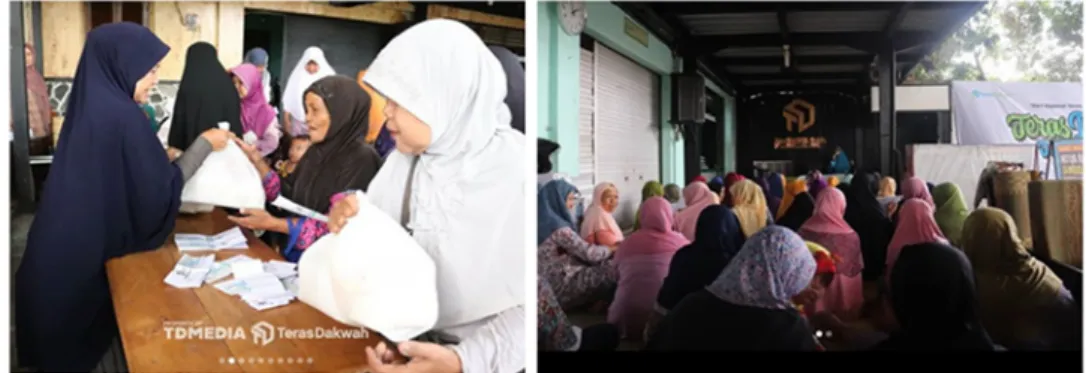
Charity-based propaganda activism carried out by the Dakwah Terrace can also be seen from the food distribution program for the elderly, widows, and poor people. In the first post posted on September 7, 2018, the food distribution program was called the Friday alms blessing. In this post, elderly Muslim women were seen listening to tausyiah before receiving food assistance from the Dakwah Terrace, as shown in Figure 1 .
Figure 1. Sedekah Jumat Barokah Programme for Elderly, Widow, Poor, and Dhuafa
In addition to charity-based propaganda activism in the form of direct assistance in areas affected by the disaster and direct assistance for the elderly, widows, poor and disadvantaged, the Teras Dakwah through the Teras Qurban program slaughtered sacrificial animals in the Samigaluh area, Kulonprogo, Yogyakarta. The program is carried out in collaboration
between the Dakwah Terrace and the Tameng Dakwah community, a Dakwah community in the Kulonprogo area, Yogyakarta. In their Instagram post, Teras Dakwah said that before the slaughtering event, they invited the community to join a study.
Starting from the basic food distribution program for widows to the Terrace of Sacrifice program, it shows that the Dakwah Terrace packed its missionary mission with charity -based activism . This is demonstrated through the way it channels its charity programs. In contrast to other philanthropic institutions which tend to provide direct social assistance, the Dakwah Terrace actually starts its charity program with religious studies with the community.
Some of the above charity programs are charity programs distributed in the local realm of Yogyakarta. The Dakwah Terrace is also involved in responding to socio-economic problems outside the Yogyakarta regions.
The Teras Dakwah with its tagline TD Moving was actively also involved in providing assistance to the victims in Lombok. One program that was touted massively was the construction of the mosque.
Based on the researchers netnographic work, the mosque development program was mostly posted by Teras Dakwah through its Instagram account. The argument developed by Teras Dakwah about why it made a charity program, which led to the construction of the mosque, was to strengthen the Islamic faith of the people in Lombok and others after the earthquake. Furthermore, in the aftermath of a disaster the community usually experiences challenges of faith, which one of the citizens mentioned in the comment room is the emergence of Christianization discourse.
Therefore, to answer that challenge, a mosque is needed as a means to strengthen the faith of the people in Lombok and others.
“Why Musholla (Small Mosque)? In order to maintain the Aqeedah of Muslims there today, there are many challenges after the earthquake, not only logistical but also Ruhiyah needs to be considered, Aqidah must remain upright despite the disaster. Residents will continue to maintain prayers, children's Qur’an learning activities will not stop, and the center of community activities is centered in this Musholla.”
(https://www.instagram.com/p/BnASO7yntSO/?Utm_source=ig_
web_copy_link).
One of the @terasdakwah Instagram account posts describes how they built a mosque in the area affected by the Lombok earthquake. By bringing a team of volunteers from Yogyakarta and synergizing with the community and other local dakwah communities, Teras Dakwah built many mosques made of lightweight steel. Charity program funding in the form of the construction of the mosque was obtained through the donors of the Dakwah Terrace and community contributions. In addition to funding, the naming of the mosque is also very diverse. For the mosque which was built by the Dakwah Terrace itself and is a new mosque construction, for example, it was named the Dakwah Terrace Mosque. However, the construction of mosques in collaboration with certain communities or companies, do not use the name of the Dakwah Terrace. As a collaboration between the Dakwah Terrace and the Friends of the Hijrah community, for example, the mosque they built was named the Silaturahim Mosque. Then the mosque builder in the Murpayung Daya, Sigar Penjalin Village, North Lombok, for example, the mosque was built by the Dakwah Terrace in collaboration with the international company Herba Penawar Al Wahida (hpa), a halal product company led by Mr. Haji Ismail bin Haji Ahmad in Malaysia. The mosque was formed by the collaboration of the two communities named the An-Nur Mosque. Then the Qomarul Huda Mosque in Cupek, Tanjung, North Lombok, this mosque was built by the Dakwah Terrace and Waroeng Steak and Shake.
Later, the earthquake and tsunami that struck Palu, Central Sulawesi, became the next concentration of Dakwah Terrace, to carry out charity-based missionary activism in the same pattern as in Lombok. They massively held a mosque construction there. In an Instagram
@terasdakwah post, uploaded on December 26, 2018, they featured a temporary mosque building, the Al-Abrar Mosque that was built in collaboration with the Dakwah Terrace and the One Care community. Then in an Instagram post @terasdakwah that was uploaded on February 26, 2019, Teras Dakwah showed its charismatic activism that led to the formation of a new devotional space in Voro Loro, Alindau Village, Sindue Tobata District, Donggala, Central Sulawesi. The post not only shows the construction of the mosque carried out by the Dakwah Terrace with other dakwah communities as before. However, according to the post's caption,
Teras Dakwah said that in the last 15 years, at that location, a mosque had never been built.
“Alhamdulillah ... Get together! Ar Rahman Mosque in Dusun V Loro, Desa Desa Alindau, Sindue Tobata District, Donggala, Sulawesi. This location from the city of Palu, is about 2-3 hours. With the epicenter of the earthquake yesterday was about 20 km away. In this location there is no mosque. Alhamdulillah, after 15 years, I didn't hear the call to prayer, starting today, it was heard again, the prayer time is 5 days”
(https://www.instagram.com/p/BuV_dJDlIZr/?Utm _source=ig_web_copy_link).
The above caption shows that the mosque construction program initiated by the Dakwah Terrace in turn was not only a charity activity, but also opened a new devotional space outside the Yogyakarta region. In addition to carrying out charity activism in the form of physical assistance, Teras Dakwah also helps the community in the form of strengthening Islamic values. In an Instagram post @terasdakwah, Teras Dakwah shows recitation activities led by Ustaz Awan Abdullah, a cleric from Yogyakarta who often fills studies on the Dakwah Terrace. He is also a caregiver of Majelis Taman Surga, a household counseling and taaruf community in Yogyakarta. According to Teras Dakwah, the strengthening of Islamic values needs to be given to people affected by the earthquake disaster in Lombok, so that they are able to face the calamity that is happening.
In a global context, Teras Dakwah is involved in channeling its charity program to Palestine. In a post, Dakwah Terrace showed photos of several Palestinian children accompanied by their parents receiving help from Dakwah Terrace which was represented by the Sahabat Al-Aqsa community, a Dakwah community in Indonesia focused on providing assistance to the Palestinian people, as seen in Figure 2.
Figure 2. Aid Distribution of Dakwah Terrace for Palestina
Charity-based propaganda activities carried out by the Dakwah Terrace above, ranging from direct assistance in the form of staples for widows, the poor and the underprivileged (in the Alms Friday Barokah program) or assistance for Palestine, sacrifice, construction of mosques/mushala (small mosque) to strengthening Islamic values (spiritual support) illustrates a deep philosophy. At least from these programs,
Dakwah Terrace has philosophical concepts including: First, the charity program as a dakwah concept, which is a paradigm to form or strengthen the piety of the Islamic community, especially people in the affected areas.
This is because in essence preaching is an effort to invite people to reach the ultimate level of piety. Second, the charity program as a concept of compassion. This concept is packaged in the slogan “Sharing Taste,
Sharing happiness, and Sharing Smiles”
(https://www.instagram.com/p/BvexTMklZYI/). Third, the charity program as a concept of happiness, which by the Dakwah Terrace is called Sharing Happiness (https://www.instagram.com/p/BvVgV7clEkb/). Fourth, the charity program as a concept of expediency, or among the activists of the Dakwah Terrace known by the tagline “Migunani Kagem Umat” (benefits for the people) (https://www.instagram.com/p/ Btuw7IFFalC/). For more details, see table 1 below.
Table 1 Charity philosophy on Terrace Dakwa's charity program No. Charity Behavior Philosophy of Generosity
1. Construction of Mosque/Mushala
As a dakwah concept to form or strengthen the piety of the Islamic community, especially the people in the affected areas.
2. Direct Help
Alms Barokah Friday
As a concept of compassion
(compassion) in the slogan “Sharing Taste, Sharing Happiness and Sharing Smiles.”
3. Humanitarian Aid for Palestine
As a concept of happiness, known as Sharing Happiness
4. Spiritual support As a concept of benefits known as the tagline “Migunani Kagem Umat”
(benefits for the people).
3. The Dakwah Terrace and Social Media: Means of Constructing and Promoting Its Charity Idea
The Dakwah Terrace massively uploaded posters inviting citizens to help disaster victims in various regions, both local and outside the Yogyakarta regions. The posters are interestingly packaged and illustrate the condition of the affected area, as shown in Figure 3.
Figure 3. Karitas Poster of Dakwah Terrace
Images displayed by the Dakwah Terrace above illustrates what is called by Benedict Anderson (2006) with terms imagined communities which brings the audience as if they were in the community. In the context of Anderson, the newspaper (newspaper) can unite the people of the nation- state (nation-state ) in different regions.
In addition, the pictures above are accompanied by a caption that tells the situation in several places affected by the disaster. For Bantul-Jogja Floods, for example, the poster is accompanied by the following captions :
“Innalillahi wainnailaihi raji'un on the night of March 17, 2019, 2 days of rain almost all day made some areas of Yogyakarta affected by flooding due to overflowing river water, even some landslides. Until now the amount of losses is still not recorded perfectly, still in the process of evacuation & data collection. Until March 18, 2019, there have been subsides but there are still many areas that have been flooded, TD with our efforts tries to help and
channel aid to the victims as much as we
can...”(https://www.instagram.com/p/BvJjYJeF4he/?utm_source = ig_web_copy_link).
The above caption further strengthens what Anderson calls the imagined communit. By displaying images that seemed to be brought to the situation of the disaster area with the support of the story line of the situation there, the writer assumes the poster is able to create an imagined community in the landscape of community generosity in Indonesia.
In addition to posters, Dakwah Terrace also promoted the idea of his charity in the form of a short video. Video of the construction of the House of Tahfidz of Teras Dakwah in Dusun Sire, North Lombok, for example, this video shows the activities of Muslim children who are reciting Qur'an. Then the founder of Teras Dakwah, Akhid Subiyanto explained the activity. In the video that is approximately one minute long, Akhid said:
“Assalamualaikum bro, here I am in the North Lombok Dusun Sire. And these children (while pointing at the children who are reciting) are our potential that God willing will later fill in the House of Tahfidz of Dakwah Terrace that we are building. And they became pioneers, pillars of our
dakwah in north Lombok. Insha Allah. We hope that this alms can become a
charity for all ladies and gentlemen.
thanks”(https://www.instagram.com/p/BwhJjONlr80/?Utm_ source= ig _web_copy_link)
Then at the end of the video, the Dakwah Terrace lists account numbers for donors. This short video uploaded on April 21, 2019 received the attention of citizens. One of the citizens @tatyakemayuningsih asked again the account number that can be used to distribute donations. This shows that social media is very likely to promote the idea of charity in the current era.
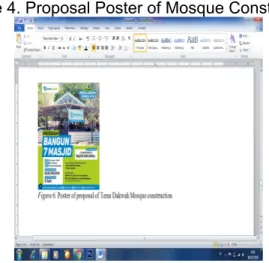
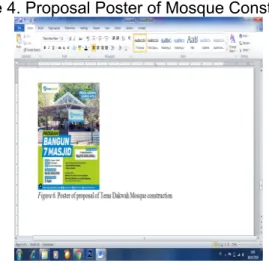
The Dakwah Terrace uses social media to disseminate the details of charity proposal. They explained the materials for making the mosque, the size of the mosque to be built and the costs needed to build a mosque in Lombok. In addition, Dakwah Terrace also explained the time needed to build a mosque in Lombok. Then they also include the account number for donations, as shown in figure 4.
Figure 4. Proposal Poster of Mosque Construction
In contrast to the charity proposal poster above, in a short video uploaded to its Instagram account, Teras Dakwah used its charity program to get involved in political discourse in Indonesia recently. The video uploaded on April 20, 2019 featured two Teras Dakwah volunteers who were calculating the cost of building the mosque. In addition, this 51-second video is titled “Real Quick Count” caption. In the video, a volunteer calculates the budget for financing mosque construction materials at a cost of 54 million. Meanwhile, another volunteer said that the calculation done by his best friend was wrong and very fast. He also likened the miscalculation to the budget as the calculation of the Quick Count.
The matter above shows that the Dakwah Terrace responds to the discourse of politics in Indonesia. In that year the discourse of politics in Indonesia, especially the presidential election, has experienced very significant voter fragmentation. It could be said that there was resistance from the two big camps, between the Jokowi and Prabowo camps. To the authors’ knowledge, based on fieldwork on the Dakwah Terrace, the researchers follow religious studies filled by Ustaz Haikal Hasan, an ustaz affiliated with the Indonesian Ulema Council Fatwa Guard (GNPF-MUI) and is very “vocal” to voice support for Prabowo. In the study, political narratives were strongly conveyed by Ustaz Haikal. Therefore, the researchers assume that the video upload with the caption of the Real Quick Count also shows how the Dakwah Terrace is trying to get involved in the Quick Count issue submitted by the Election Commission (KPU). The Quick Count results issued by KPU have become a controversial issue in the community these days. The Dakwah Terrace also voiced the error, mainly by utilizing its charity program in Lombok.
In an effort to promote the idea of charity, the Dakwah Terrace also uses reward narratives for those who want to finance the construction of mosques in areas affected by the earthquake and tsunami. In a video posting on the account instagram @terasdakwah, Kang Ruslan, a commander of the Teras Dakwah mosque construction said:
“We, as representatives of Dakwah Terrace and Muslim United say many thanks to all the people who have united to build the mosque. In a hadith it is mentioned, that whoever builds a mosque even if it is only as big as an
anthill, Allah will make a house in
Heaven”(https://www.instagram.com/p/BuVW-fzlj8w/?utm _source=ig_web_copy_link).
This shows what is called by Marcel Mauss as awarding the prize economic theology, the activity of generosity. It believes that everything we are given will result in a reward in the next life. The gift is not lost, but instead will develop and increase (Mauss, 2002).
Teras Dakwah, not only promotes its ideas of charity, it also uses social media to build its mage as a professional missionary institution in packaging charity programs . It massively uploaded its charity activities to gain public trust. In the charity program in Lombok, for example, Dakwah Terrace uploads videos of its journey from the departure at the airport, arriving at the destination airport, to completing the construction of the mosque. Teras Dakwah uploaded a video of the departure of Teras Dakwah volunteers to Lombok. In this 1 minute video features the journey of the Dakwah Terrace to Yogyakarta's Adi Sutjipto Airport. Then it shows the volunteers being checked-in, boarding the plane, until arriving at Lombok Airport. In the video recorded at Lombok Airport, Akhid said:
“Assalamualaikum, my friends, thank God, we are with the Teras Dakwah team. The TD Mobile has arrived in Lombok this morning healthily and smoothly. And we will go directly to our post, in Dusun Sire, Tanjung District, North Lombok with Ustaz Awan Abdullah. Yo wis, assalamualaikum.”
(https://www.
instagram.com/p/Bm0pDnKnb5O/?utm_source=ig_web_copy_lin).
Then during the mosque construction process, Teras Dakwah also uploaded photos and videos to its Instagram account @terasdakwah. In a video, a Teras Dakwah volunteer recounts the development of a mosque in northern Lombok.
“Assalamualaikum warahmat ullahi wabarakatuh. Alhamdulillahirobbil alamin, currently, the second day of the construction of the mosque in Tanjung Island, KLU, North Lombok. Currently, team 2 is working on roofing and pillar casting. Lets Pray that today the team will not be constrained by
the weather.”
(https://www.instagram.com/p/BvbYMZhlo8A/?Utm_source=ig_web_copy_li nk)
Almost all of the distribution activities of charity uploaded by Dakwah Terrace into their social media accounts, especially Instagram, as shown in Figure 5.
Figure 5. Departure, Making, and Distribution of Dakwah Terrace Aid
The explanation in this sub-chapter shows that the Dakwah Terrace is very professional in using social media as a means of promoting the idea of charity and building image in the online space. Through the TD Media Team, which is driven by young Muslims in Teras Dakwah, the Teras Dakwah charity programs are packaged in an interesting and “political” way.
In addition, social media is an important concern for the Dakwah Terrace.
This can be seen from some preaching study program focusing on the media such as the study entitled “Medsosku my gun” which was held on 27 April 2019. The study program entitled “Me + He Islamic Journalism Islam and the Role of Young Generation,” was held on February 6, 2019 and so on. In fact, when the Dakwah Terrace conducts monthly evaluations, one of
the focuses of Dakwah Terrace is on strengthening the media, primarily to realize Dakwah 4.0. With the 4.0 dakwah model, it hopes to be involved in combating heretical thoughts, evil narratives and hoaxes in cyberspace (https://www.instagram.com /p/Bv89FNMltb7/).
E. Conclusion
Through case studies on the Dakwah terrace in Yogyakarta, this paper concludes that the mission is now no longer limited to oral missionary activity and propaganda. However, in its development, Dakwah also led to the activities of Islamic generosity (charity). The Dakwah Terrace involvement in charity programs has shown that the missionary movement is able to compete with the Islamic charitable institutions such as Dompet Dhuafa, Simpul Sedekah and Sedekah Rombongan.
Social media has become the main vehicle for the Dakwah Terrace to promote the idea of its charity and build its image as a professional social institution. The whole process of his charity is echoed through interesting uploads in its Instagram media account. In turn, it succeeded in bringing its charity programs into social media trends.
Through this study, the authors recommend for future studies to see the significance of the dakwah movement in Islamic political discourse in Indonesia. Although, in this study, little was touched, but not yet deeply enough. To the authors’ knowledge, studies that carry out about on contemporary dakwah movements and Islamic politics or political Islam do not yet exist. Therefore, this has the opportunity to enrich the study of dakwah in Indonesia.
Bibliography
Anderson, B. R. O. (2006). Imagined communities: reflections on the origin and spread of nationalism (Rev. ed). London; New York: Verso.
Benthall, J. (1999). Financial Worship: The Quranic Injunction to Almsgiving.
The Journal of the Royal Anthropological Institute, 5(1), 27.
https://doi.org/10.2307/2660961
Daly, A., & Fane, G. (2010). Anti-Poverty Programs in Indonesia. Bulletin of Indonesian Economic Studies, 38(3), 309–329.
https://doi.org/10.1080/00074910215535
Detiknews. (2019). “Hujan Deras Air Sungai di Bantul Meluap.” In https://news.detik.com/berita-jawa-tengah/d-4471553/hujan-deras- air-sungai-di-bantul-meluap.
Fauzia, A. (2016). Filantropi Islam: Sejarah dan Kontestasi Masyarakat Sipil dan Negara di Indonesia (E. Mushoffa, Trans.). Yogyakarta:
Gading Publishing.
Hasan, N. (2007). The Salafi Movement in Indonesia: Transnational Dynamics and Local Development. Comparative Studies of South Asia, Africa and the Middle East, 27(1), 83–94.
Hoesterey, James B. (2008). “Marketing Morality: The Rise, Fall and Rebranding of Aa Gym.” Fealy, G., & White, S. (Eds.). (2008).
Expressing Islam: religious life and politics in Indonesia. Singapore:
Institute of Southeast Asian Studies.
Kailani, N. (2012). Forum Lingkar Pena and Muslim Youth in Contemporary Indonesia. Review of Indonesian and Malaysian Affairs, 46(1), 33–53.
Kozinet, R. V. (2010). Netnography: Doing Ethnographic Research Online.
Singapore: SAGE Publications.
Mauss, M. (2002). The Gift: the Form and Reason for Exchange in Archaic Societies. London and New York: Routledge Classics.
Morrell, E. (2010). “Balancing Livelihoods, limited options and the State:
Alleviating Poverty in Critical Environments,” in H. Cao & E. Morrell (eds), Regional Minorities and Development in Asia. Oxford and New York: Routledge.
Retsikas, Konstantinos. (2014). Reconceptualising Zakat in Indonesia.
Indonesia and the Malay World, 42(124), 337-357.
Sakai, M. (2012). Building a partnership for social service delivery in Indonesia: state and faith-based organisations. Australian Journal of Social Issues, 47(3), 373–388. https://doi.org/10.1002/j.1839- 4655.2012.tb00254.x
Salim, A. (2008). The Shift in Zakat Practice in Indonesia: From Piety to an Islamic Socio-Politica-Economic System. Chang Mai: Silkworm Books.
Schulz, D. (2012). Dis/Embodying Authority: Female Radio “Preachers” and the Ambivalences of Mass-Mediated Speech In Mali. International
Journal of Middle East Studies, 44(01), 23–43.
https://doi.org/10.1017/S0020743811001231
Sofjan, D. (2012). Gender Construction In Dakwahtainment: A Case Study of Hati ke Hati Bersama Mamah Dedeh. Al-Jami’ah: Journal of Islamic Studies, 50(1), 57–74.
Sofjan, D., & Hidayati, M. (2013). Religion and Television in Indonesia:
Ethics Surrounding Dakwahtainment. Geneva: Globethics.net.
Sunarwoto. (2012). Radio Fatwa: Islamic Tanya-Jawab Programmes on Radio Dakwah. Al-Jami’ah, 50(2), 239–278.
Tim Penyusun Laporan Tahunan Dompet Dhuafa Riau. (2018). Annual Report 2017. Dompet Dhuafa Riau.
Tim Penyusun Laporan Tahunan Dompet Dhuafa Riau. (2019). Annual Report 2018. Dompet Dhuafa Riau.
Triantoro, D. A. (2018). Dakwah dan Kesalehan: Studi Tentang Gerakan Teras Dakwah di Kota Yogyakarta. Jurnal Masyarakat & Budaya, 20(2), 273–286.
Watson, C. W. (2005). A Popular Indonesian Preacher: The Significance of Aa Gymnastiar. Journal of the Royal Anthropological Institute, 11, 773–792. https://doi.org/10.1111/j.1467-9655.2005.00261.x
Weng, H. W. (2018). The Art of Dakwah : Social Media, Visual Persuasion and the Islamist Propagation of Felix Siauw. Indonesia and the Malay World, 46(134), 61–79.
https://doi.org/10.1080/13639811.2018.1416757
Masduki Masduki <[email protected]>
[peuradeun] Your Revisions Not Yet Appropriate
1 pesan
Syahril Elvhantuny Syahril <[email protected]> 21 Desember 2021 16.28 Balas Ke: Syahril Elvhantuny Syahril <[email protected]>
Kepada: Masduki Masduki <[email protected]>
Article ID: 624 Dear Authors:
After we checked, we found that you have not yet completely revised your article entitled " The “Teras Dakwah”
(Dakwah Terrace) Movement Program: The Philosophy and Dakwah Activism Charity-Based in Yogyakarta"
base on the suggestions of the reviewers.
We have seen the revision of your paper, but it seems that the revised paper you submitted is not final, because there are still comments from reviewers and there are colors in your paper. You don't need to add color to your paper, but please revise it using the latest template that you can download on this journal's website, and make sure your revision is final, and there are no more reviewers' comments on your paper.
Immediately send us your revision, no later than 1 week after you receive this notification.
Thank you for your contribution and cooperation.
Regards, Editor
________________________________________________________________________
Jurnal Ilmiah Peuradeun
St. Tgk. Pulo Dibaroh, No. 26, Kp. Baru, Baiturrahman Sub-district, Banda Aceh City 23242, Aceh, Indonesia.
Official E-mail: [email protected] | website: www.journal.scadindependent.org Jurnal Ilmiah Peuradeun, Your Intellectual Nutrition...