Business: Theory and Practice Volume 20, 2019, Pages 196-207
Islamic Stock Market and Sukuk Market Development, Economic Growth, and Trade Openness (The Case of Indonesia and Malaysia)
Muharam, H., Anwar, R.J., Robiyanto, R.
1. Submission to the Business: Theory and Practice, tanggal 21 Januari 2019
2. Review Process Completed (Minor revisions), tanggal 19 Maret 2019
3. Accepted to the Business: Theory and Practice, tanggal 26 Maret 2019
4. Editing Completed to the Business: Theory and Practice, tanggal 29 Maret 2019
5. PDF Proof Uploaded to the Business: Theory and Practice, tanggal 2 April 2019
6. Manuscript Published to the Business: Theory and Practice, tanggal 4 April 2019
#33223 Acknowledgement
Inbox
Business: Theory and Practice [email protected] via M p o e n n , s J o an ft. 2 n 1 e , t 2019, 12:51 PM to me, journals
Dear Mr Harjum Muharam:
Thank you for submitting the manuscript #33223 "Islamic Stock Market and Sukuk Market Development, Economic Growth, and Trade Openess (The Case of Indonesia dan Malaysia)" to Business: Theory and Practice. You can keep track of its progress through the manuscript's URL:
http://goto.arphahub.com/kvF5VEGtJTB3
You can also view all manuscripts with which you are associated either as submitting author, or reviewer, or editor by clicking on the My tasks button on the journal's homepage, after login.
Thank you for considering Business: Theory and Practice as the venue for your work.
Business: Theory and Practice Editorial Office [email protected]
http://btp.press.vgtu.lt/
Powered by ARPHA Journal Publishing System
PLEASE DO NOT FORWARD THIS EMAIL AS IT CONTAINS YOUR PERSONAL
AUTO LOGIN LINK.
Review Process Completed (Minor revisions)
Inbox
Business: Theory and Practice [email protected] via T p u e e n , s M o a f r t. 1 n 9 e , t 2019, 3:06 PM to me
Dear author,
please find the review reports online,
please revise the paper according to the reviewers comments, please resubmit the paper as soon as possible.
Thanks Best regards
Dear Mr Harjum Muharam:
We are pleased to inform you that the review process of your manuscript #33223
"Islamic Stock Market and Sukuk Market Development, Economic Growth, and Trade Openess (The Case of Indonesia dan Malaysia)" has been completed and the editorial decision is: Minor revision.
The revised version should be submitted as manuscript text in DOC, DOCS, ODF or RTF formats corrected by using Track Changes tools. Additional or supplementary files, figures and references can also be added or replaced at this point.
Authors must address all critiques of the referees in a response letter to the editor and
submit it along with the revised manuscript through the online editorial system. Please
copy all comments into one document and add your response behind each critique
using different formatting to allow easy following of your response. In case a response
letter is not submitted by the authors, the editor has the right to reject the manuscript
without further evaluation.
We expect your revised version within 7 days, by 26/03/2019, if not sooner. Please kindly inform us if you will need more time to submit the revised version.
Once again, thank you for choosing Business: Theory and Practice as the venue for your work.
Business: Theory and Practice Editorial Office [email protected]
http://btp.press.vgtu.lt/
Powered by ARPHA Journal Publishing System
PLEASE DO NOT FORWARD THIS EMAIL AS IT CONTAINS YOUR PERSONAL
AUTO LOGIN LINK.
Accepted
Inbox
Business: Theory and Practice [email protected] via T p u e e n , s M o a f r t. 2 n 6 e , t 2019, 2:24 PM to me, pressoffice, dissemination
Dear author,
we would like inform You that your paper is accepted, and will be published as soon as possible.
Best regards
Dear Mr Harjum Muharam:
We are pleased to inform you that the review process of your manuscript #33223
"Islamic Stock Market and Sukuk Market Development, Economic Growth, and Trade Openess (The Case of Indonesia dan Malaysia)" has been completed and it was accepted for publication.
We expect that even in cases when the revised version is accepted in the form it has been submitted, there can be some small last-minute changes required or
recommended. Please note that reviewers and editor might have also made comments and Track/Change corrections in your manuscript, that you have also to check and consider!
We shall expect your final version within 3 days, by 29/03/2019, if not earlier. Additional or supplementary files can also be replaced at this point with corrected versions.
Once again, thank you for choosing Business: Theory and Practice as the venue for your work!
Business: Theory and Practice Editorial Office [email protected]
http://btp.press.vgtu.lt/
Powered by ARPHA Journal Publishing System
PLEASE DO NOT FORWARD THIS EMAIL, IT CONTAINS YOUR PERSONAL AUTO
LOGIN LINK.
[Business: Theory and Practice] Manuscript #33223: Copy Editing Completed
Inbox
Business: Theory and Practice [email protected] via p F e ri n , s M o a f r t. 2 n 9 e , t 2019, 6:21 PM to me
Dear Mr Harjum Muharam:
This is an automated message to inform you that the copy editing process of your manuscript #33223 "Islamic Stock Market and Sukuk Market Development, Economic Growth, and Trade Openess (The Case of Indonesia dan Malaysia)" has been
completed.
Please carefully check and respond to the Copy editor's comments and corrections, if any, and confirm through the online editorial system that the manuscript is ready for layout within 3 days, by 01/04/2019, if not sooner.
Business: Theory and Practice Editorial Office [email protected]
http://btp.press.vgtu.lt/
Powered by ARPHA Journal Publishing System
PLEASE DO NOT FORWARD THIS EMAIL AS IT CONTAINS YOUR PERSONAL
AUTO LOGIN LINK.
[Business: Theory and Practice] Submission #33223: 1st PDF Proof Uploaded
Inbox
Business: Theory and Practice [email protected] via penso A f p t r .n 2 e , t 2019, 1:15 PM to me
Dear Mr Harjum Muharam:
The proof (in PDF format) of your manuscript #33223 "Islamic Stock Market and Sukuk Market Development, Economic Growth, and Trade Openess (The Case of Indonesia dan Malaysia)" has been uploaded on the Business: Theory and Practice website for checking.
Please read through the proof carefully and mark all errors by using Sticky Note and Text Edit tools of Acrobat. Alternatively, you could upload a list of your corrections in a text file (e.g. DOC or RTF), specifying the exact page, paragraph and line of each correction and suggested text for replacement. Sending a list of corrections through email is possible, but not encouraged as it may cause unnecessary delay in processing your manuscript.
We expect an upload of your corrections on the journal's website within 3 days, by 05/04/2019, if not sooner. Please kindly inform us if you need more time for checking the proofs.
Business: Theory and Practice Editorial Office [email protected]
http://btp.press.vgtu.lt/
Powered by ARPHA Journal Publishing System
PLEASE DO NOT FORWARD THIS EMAIL AS IT CONTAINS YOUR PERSONAL
AUTO LOGIN LINK.
[Business: Theory and Practice] Submission #33223:
Manuscript Published
Inbox
Business: Theory and Practice [email protected] via penso A f p t r .n 4 e , t 2019, 4:03 PM to me
Dear Mr Harjum Muharam:
We are pleased to inform you that your paper #33223 "Islamic stock market and sukuk market development, economic growth, and trade openess (the case of Indonesia dan Malaysia)" was published in Business: Theory and Practice, doi: 10.3846/btp.2019.19.
We recommend announcing the paper to your personal contacts or groups of interest (e.g. through email newsletters, Twitter, Facebook, Mendeley or other networks) and by linking it to relevant websites to expedite distribution and dissemination of your
publication.
Once again, thank you very much for considering Business: Theory and Practice as a publication venue for your work.
Business: Theory and Practice Editorial Office [email protected]
http://btp.press.vgtu.lt/
Powered by ARPHA Journal Publishing System
ISLAMIC STOCK MARKET AND SUKUK MARKET DEVELOPMENT, ECONOMIC GROWTH, AND TRADE OPENESS (THE CASE OF INDONESIA DAN MALAYSIA)
Harjum Muharam (0000-0002-4627-9997)1, Resi Junita Anwar2, Robiyanto Robiyanto (0000-0003-3565-1594)3
1, 2 Faculty of Economics and Business, Universitas Diponegoro, Semarang 50241, Central Java, Indonesia
3 Faculty of Economics and Business, Satya Wacana Christian University, Salatiga 50711, Central Java, Indonesia E-mails: 1[email protected] (Corresponding author); 2[email protected]; 3[email protected]
Received day month year; accepted date (use style Received dates, or Alt + Ctrl + R)
Abstract. This study scrutinizes the two-way relationship between economic growth and the Islamic stock market and sukuk (sharia based fixed income securities) market development. This study also scrutinizes whether trade openness influences economic growth, and the development of the Islamic stock market and sukuk market. VAR (Vector Auto Regressive), VECM (Vector Error Correction Model), and a Granger Causality Test used to test the hypothesis. Using Indonesia and Malaysia as the sample countries and from February 2008 to December 2017 period. This study showed that there is a bi-directional causality between the Islamic stock market and the sukuk market in Indonesia and Malaysia.
This study also found that bi-directional causality between the Islamic stock market and sukuk market with economic growth only occurs in Indonesia, while unidirectional causality and the significant effect of trade openness is found in Malaysia. For the limitations, this research only focused on two countries and only delved into the corporation sukuk market.
Keywords: Islamic stock market, Sukuk, Economic growth, Trade openess, VECM.
JEL Classifications: F10; G10; G19.
Funding
This research received no specific grant from any funding agency in the public, commercial, or not-for-profit sectors.
Author contributions
Harjum Muharam and Resi Junita Anwar conceived the study and were responsible for the design and development of the data analysis. Harjum Muharam and Resi Junita Anwar were responsible for data collection and analysis. Harjum Muharam, Resi Junita Anwar and Robiyanto Robiyanto were responsible for data interpretation. Harjum Muharam, Resi Junita Anwar and Robiyanto Robiyanto wrote the first draft of the article.
Disclosure statement
Authors declare that there is no conflict of interest.
ISLAMIC STOCK MARKET AND SUKUK MARKET DEVELOPMENT, ECONOMIC GROWTH, AND TRADE OPENESS (THE CASE OF INDONESIA DAN MALAYSIA)
Received day month year; accepted date (use style Received dates, or Alt + Ctrl + R)
Abstract. This study scrutinizes the two-way relationship between economic growth and the Islamic stock market and sukuk (sharia based fixed income securities) market development. This study also scrutinizes whether trade openness influences economic growth, and the development of the Islamic stock market and sukuk market. VAR (Vector Auto Regressive), VECM (Vector Error Correction Model), and a Granger Causality Test used to test the hypothesis. Using Indonesia and Malaysia as the sample countries and from February 2008 to December 2017 period. This study showed that there is a bi-directional causality between the Islamic stock market and the sukuk market in Indonesia and Malaysia.
This study also found that bi-directional causality between the Islamic stock market and sukuk market with economic growth only occurs in Indonesia, while unidirectional causality and the significant effect of trade openness is found in Malaysia. For the limitations, this research only focused on two countries and only delved into the corporation sukuk market.
Keywords: Islamic stock market, Sukuk, Economic growth, Trade openess, VECM.
JEL Classifications: F10; G10; G19.
Introduction
The Islamic financial system, especially the Islamic financial market, is an alternative for the conventional financial system, which has a high level of volatility. The Islamic financial market refers to the Islamic principles, which operationally are usually in line with Islamic concepts. Besides offering wider access to companies to develop their businesses, the Islamic principle also protects related parties from exploitation, fraud, and unfairness between payoffs in conducting transactions. The rapid developments in the Islamic financial market are generally caused by the high increase in global sukuk issue value, whether government bonds or corporate bonds. Global sukuk issued have increased by about 272 times since 2001, from USD1.17 billion to become USD318.5 billion by the end of 2016 (IFSB, 2017). Malaysia is in the first position as the country with the highest sukuk issue value at USD38,968 million, followed by Indonesia in the second position with a sukuk issue value of USD14.363 million (ICD, 2017).
Islamic stock market developments and global sukuk market developments do not always go in the same direction. For instance, in 2016, the outstanding global sukuk experienced an increase of 6.06 percent to become USD318.5 billion [2015: USD300.3 billion]; while in the same year the Islamic stock market capitalization experienced a reduction of 4.5 percent to become USD22,120.4 billion [2015: USD23,181.8 billion]; similarly, certain Islamic stock markets and government sukuk markets have shown different movements from year to year.
According to Ahmed and Mmolainyane (2014), financial market development has a significant role in an economy‘s growth. Hence, in Islamic financial industry, it is also necessary to look at the relationship between stock market development, sukuk market development, and economic growth. In the conventional financial industry, much research has been conducted to see the relationship between stock market development, bond market development, and economic growth, but the research results show inconsistencies. Baele, Bekaert, and Inghelbrecht (2010); Bansal, Connolly, and Stivers (2014); Chiang, Li, and Yang (2014) stated that in the last two decades, the stock-bond relationship has changed dramatically, from being generally positive to being dominant negative. The negative relationship between stocks and bonds is due to the presence of the flight-to-quality phenomenon. This can be defined as an investor behavior or habit that shifts risky investments to safer investments. This phenomenon encourages investors to diversify between asset classes.
Investors believe that the cross market relationship causes an increase in the probability of a financial contagion during a crisis period. Then during a financial crisis, it will influence a country‘s stock market to affect another country‘s stock market, which causes diversification in the international stock market to be less effective. Then investors will prefer to have assets with fixed returns like bonds as an alternative (Bordo & Murshid, 2001). A different opinion was revealed from research results by Patoda and Jain (2012); Wanyama (2017) who stated that there is a unilateral positive relationship between bond market development and stock market development. Meanwhile, according to Muharam and Setyowati (2017), there is no relationship, whether unilateral or bidirectional between stock market development and bond market development in several countries.
Much research has been conducted related with the conventional financial market and economic growth, and the research results generally support the growth-nexus theory. Enisan and Olufisayo (2009); Marques, Fuinhas, and Marques (2013);
Pradhan, Arvin, Hall, and Bahmani (2014) stated that there is a bi-directional relationship between stock market development and economic development. Meanwhile, according to Olweny and Kimani (2011), there is only a one- directional relationship between economic growth and stock market development, meaning that the stock market has a positive influence towards economic growth (supply leading hypothesis).
Likewise, previous research related with the relationship between the bond market and economic growth has varying results. Pradhan et al. (2015) conducted research on bond market development and economic growth in 20 countries. The research results revealed that in several cases, the bond market had a positive effect on economic growth (supply-leading hypothesis). In another location, it was discovered that economic growth influenced the bond market (demand-leading hypothesis). Next, it was also found that there was a reciprocal relationship between economic growth and bond market development (feedback hypothesis).
In the Islamic financial industry, research was also conducted to see the relationship between Islamic financial market development and economic growth. Research carried out by Said and Grassa (2013) revealed that economic growth has a positive influence on sukuk market development. On another side, sukuk market development also has a positive influence towards economic growth. Istiqomah (2012) stated that Islamic stock market development has a positive correlation towards economic growth. Nevertheless, research which looks at the relationship between the Islamic stock market and sukuk market is still very limited (Alam, Hassan, & Haque, 2013; Aloui, Hammoudeh, & Hamida, 2015;
Naifar, Hammoudeh, & Al dohaiman, 2016; Wahyudi, Nofendi, Robiyanto, & Hersugondo, 2018). Moreover, there is no known previous research which specifically studied the relationship between sukuk market development and Islamic stock market development, whether by looking at one-directional relationship or bi-directional relationship. Therefore, further research is needed to see the relationship between Islamic stock market development and sukuk market development. It is also necessary to examine the relationship between the two markets with economic growth.
The purpose of this research is to look at the bi-directional (causality) relationship between Islamic stock market development, sukuk market development, and economic growth of a country. In addition, an examination is also conducted to find the relationships of the three variables with the level of trade openness of each country. According to Rajan and Zingales (2003) as well as Said and Grassa (2013), trade openness has a positive effect towards stock market development, bond market development, as well as sukuk market development through improvements in offers and requests (Endogenous Growth Theory). The countries chosen for the sample are Indonesia and Malaysia, as both countries have the biggest sukuk issue values in the world.
This is the first known research to examine the bi-directional (causality) relationship between the Islamic stock market development and the sukuk market development. It is also the first research to connect trade openness with the Islamic stock market. This research attempts to see whether there is a flight-to-quality phenomenon in the Islamic financial market, as well as tries to develop the Finance-growth Nexus Theory literature and the Endogenous Growth Theory literature to the Islamic financial industry.
1. Review of Literature
1.1. “Flight-to-quality” Phenomenon
In literature related with the stock market and bond market, there is a ―flight-to-quality‖ phenomenon, which explains that investors tend to shift their capital from risky investments like stocks to safer investments like bonds. This opinion is supported by Baur and Lucey (2009); Durand, Junker, and Szimayer (2009); Guler and Ozlale (2005); Robiyanto (2018a, 2018b, 2018c); Robiyanto, Wahyudi, and Pangestuti (2017a, 2017b). Their research results revealed that during a financial fluctuation period (financial crisis), investors tend to switch from high risk assets (like stocks) to safer assets (bonds). Mustafa, Samsudin, Shahadan, and Yi (2015) researched about whether there was a flight-to-quality between a conventional financial market and a sukuk market. The research results showed that when conventional stock market volatility increases, investors tend to move to the sukuk market, as it is considered safer.
1.2. Finance–Growth Nexus Theory
According to research conducted by Handriani and Robiyanto (2018); Ngare, Nyamongo, and Misati (2014), the stock market has a positive influence towards economic growth. This is referred to as the ‗supply leading‘ hypothesis in developing the financial sector. This hypothesis states that the stock market causes economic growth, because the stock market stimulates the movement of unused funds to become productive and useful finances towards a country‘s economy.
This opinion is also supported by research conducted by Atje and Jovanovic (1993); Yartey (2007), as well as Ho and Iyke (2017).
Next, in the Finance-growth Nexus Theory, there is another argument called the ‗demand following‘ hypothesis.
According to this viewpoint, developments in the financial sector are stimulated by economic growth. Developments in the financial sector are facilitated by real economic sector growth (Robinson, 1952; Romer, 1990). The argument is that when a country‘s economy grows and develops, the surplus will be collected and then will improve the financial market, including the stock market. This statement is supported by research conducted by Marques et al. (2013); Pradhan et al.
(2014). The third viewpoint is the ‗feedback‘ hypothesis. This perspective states that there is a bi-directional relationship between financial developments and economic growth with the relationship characteristic dependent on the stage of economic growth (Levine, 1997; Luintela & Khan, 1999; Schumpeter, 1912).
Research on the sukuk market that was carried out by Said and Grassa (2013) conveyed that economic growth has a positive influence on the development of the sukuk market. On another side, research done by Smaoui and Nechi (2017) revealed that economic growth has a positive influence towards sukuk market development.
1.3. Endogenous Growth Theory
Next, literature revealed the advantages of trade openness towards the financial market in two ways. First, trade openness stimulates financial market growth by increasing the demand towards financial products and services. This demand is increased due to an increase in income risk and volatility that is related with trade openness (Mohd, Low, Nor, & Ghazali, 2013; Newbery & Stiglitz, 1984; Svaleryd & Vlachos, 2002; Vazakidis & Adamopoulos, 2009). Second, trade openness is beneficial for financial market growth through increasing stock market offers (Braun & Raddatz, 2005; Rajan &
Zingales, 2003). The stock market and sukuk market will be more developed in an economy that tends to be more open, because when the level of openness of an economy is high, access towards foreign financing from foreign investors will be easily obtained. Therefore, it will increase sukuk market development and Islamic stock market development. Said and Grassa (2013) discovered that trade openness has a positive and significant influence towards sukuk market development in Indonesia, Brunei,Saudi Arabia, Malaysia, Bahrain, Kuwait, Qatar, UAE, Pakistan, and Gambia.
2. Data
The data used in this research was from monthly time series data that consisted of Islamic stock market capitalization, outstanding corporation sukuk, gross domestic product (GDP) value, as well as export and import values from May 2011 – December 2017 for Indonesia and from March 2008 – December 2017 for Malaysia. The data sources in this research were obtained from the Bloomberg Database, the Indonesia Financial Service Authority website, and FAST Bank Malaysia.
3. Variables
Four variables were used in this research, including Islamic stock market development, sukuk market development, economic growth, and trade openness. The Islamic stock market development (PPSA) was proxied by a country‘s Islamic stock market capitalization, which can be formulated as follows:
Where:
𝑃𝑃𝑃𝑃𝑃
𝑃𝑃𝑃 =
𝐾𝐾𝑃𝑃𝑃𝑃𝑃𝑃𝑡𝑡 − 𝑘𝑘𝐾𝐾𝑃𝑃𝑃𝑃𝑃𝑃𝑡𝑡−1
𝐾𝐾𝑃𝑃𝑃𝑃 𝑃𝑃𝑡𝑡−1
𝐾𝐾𝑃𝑃𝑃𝑃𝑃𝑃𝑡𝑡 = t month Islamic stock market capitalization 𝐾𝐾𝑃𝑃𝑃𝑃𝑃𝑃𝑡𝑡−1 = t-1 month Islamic stock market capitalization
The variable sukuk market development (PPS) is proxied by outstanding corporation sukuk, which is formulated as follows:
Where:
𝑂𝑂𝑂𝑂𝑃𝑃𝑡𝑡 = t month outstanding corporation sukuk
𝑃𝑃𝑃𝑃
𝑃𝑃 =
𝑂𝑂𝑂𝑂𝑃𝑃𝑡𝑡 − 𝑂𝑂𝑂𝑂𝑃𝑃𝑡𝑡−1
𝑂𝑂𝑂𝑂𝑃 𝑃𝑡𝑡−1
𝑂𝑂𝑂𝑂𝑃𝑃𝑡𝑡−1= t-1 month outstanding corporation sukuk
The variable economic growth (PE) is proxied by the gross domestic product (GDP) value growth, which is formulated as follows:
Where:
𝑃𝑃𝑃𝑃
=
𝑃𝑃𝑃𝑃𝑃𝑃𝑡𝑡 − 𝑃𝑃𝑃𝑃𝑃𝑃𝑡𝑡−1
𝑃𝑃𝑃𝑃𝑃 𝑃𝑡𝑡−1
𝑃𝑃𝑃𝑃𝑃𝑃𝑡𝑡 = t month real gross domestic product value 𝑃𝑃𝑃𝑃𝑃𝑃𝑡𝑡−1 = t-1 real gross domestic product value
This is similar with the variable trade openness which is proxied by the trading ratio growth (number of exports and imports) towards a country‘s gross domestic product, which is formulated as follows:
Where:
𝑂𝑂𝑂
𝑂 =
𝑂𝑂𝑂𝑂𝑡𝑡 − 𝑂𝑂𝑂𝑂𝑡𝑡−1
𝑂𝑂𝑂𝑂
𝑡𝑡−1
𝑂𝑂𝑂𝑂𝑡𝑡 = trading ratio towards t month gross domestic product
𝑂𝑂𝑂𝑂𝑡𝑡−1 = trading ratio towards t-1 month gross domestic product
4. Analysis Method
First, an interpolation of the quarterly data was done to become monthly data towards the gross domestic product of Indonesia and Malaysia. Likewise, with the market development data and economic growth data, it was calculated before the analysis process was conducted. Next, a stationarity analysis was done towards the data used in this research. A stationary test was used with an Augmented Dickey-Fuller statistics (Dickey & Fuller, 1979). Then the long-term relationships between variables were examined by using a cointegration test that was developed by Johansen and Juselius (1990). Next, the relationships between variables were seen by using a Vector Auto-Regressive (VAR) analysis or a Vector Error Correction Model (VECM) if the stationary data was in the first difference level and there was cointegration between variables. Finally, the Granger causality test was carried out to see the directions of relationships between variables.
4.1. Unit Root Test
Before conducting an analysis using time series data, it is first necessary to see whether the time series data is stationary at the same level or not (Robiyanto & Ernayani, 2018; Suganda, Sumargo, & Robiyanto, 2018). An Augmented Dickey- Fuller (ADF) test was done to see whether there was a root unit or not in the time series data used in this research.
4.2. Johansen Cointegration Test
The results of the cointegration test can be found by comparing the trace test value and maximum-Eigen value test with the critical value (Robiyanto, 2017; Wang & Chueh, 2013). Cointegration occurs when the trace test value and max-Eigen value test are bigger than the critical value.
4.3. Vector Error Correction Model (VECM)
If the stationary data is at the first difference level and there is cointegration between variables, then an analysis is conducted by using the Vector Error Correction Model (Engle & Granger, 1987). In contrast, the VAR method is used if the variables are not cointegrated with each other (Granger, 1969). The VECM method is used to see the short-term and
long-term relationships between endogen variables in Islamic stock market development, sukuk market development, and economic growth. It also looks at the influence of trade openness on the three endogen variables.
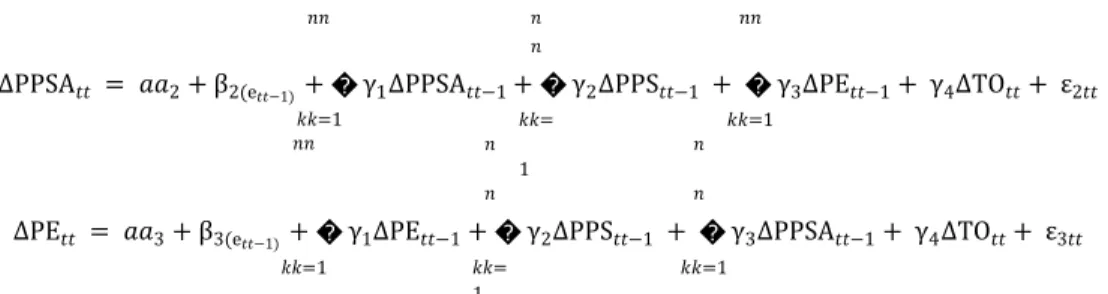
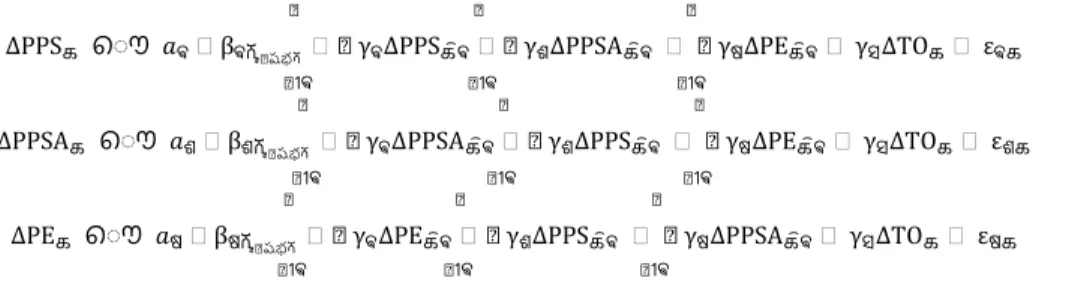
The equations of the VECM model are stated as follows:
𝑛𝑛 𝑛
𝑛
𝑛𝑛
∆PPS𝑡𝑡 = 𝑎𝑎1 + β1(e𝑡𝑡−1) + � γ1 ∆PPS𝑡𝑡−1 + � γ2 ∆PPSA𝑡𝑡−1 + � γ3∆PE𝑡𝑡−1 + γ4∆TO𝑡𝑡 + ε1𝑡𝑡
𝑘𝑘=1 𝑘𝑘=
1
𝑘𝑘=1
𝑛𝑛 𝑛 𝑛
𝑛𝑛
∆PPSA𝑡𝑡 = 𝑎𝑎2 + β2(e𝑡𝑡−1) + � γ1 ∆PPSA𝑡𝑡−1 + � γ2 ∆PPS𝑡𝑡−1 + � γ3∆PE𝑡𝑡−1 + γ4∆TO𝑡𝑡 + ε2𝑡𝑡
𝑘𝑘=1
𝑛𝑛 𝑛
𝑛 𝑘𝑘=
1
𝑛 𝑛
𝑘𝑘=1
∆PE𝑡𝑡 = 𝑎𝑎3 + β3(e𝑡𝑡−1) + � γ1∆PE𝑡𝑡−1 + � γ2∆PPS𝑡𝑡−1 + � γ3∆PPSA𝑡𝑡−1 + γ4 ∆TO𝑡𝑡 + ε3𝑡𝑡
𝑘𝑘=1 𝑘𝑘=
1
𝑘𝑘=1
∆PPS𝑡𝑡 is the level of sukuk market development at a certain period, ∆PPSA𝑡𝑡 is the Islamic stock market development at
a certain period, and ∆PE𝑡𝑡 is the level of economic growth at a certain period.
4.4. The VECM Granger Causality Test
The causality relationships between the variables of Islamic stock market development, sukuk market development, and economic growth were researched using the Granger causality framework. The Granger causality equations that were developed from the VECM framework are listed as follows:
𝑝𝑝 𝑝
𝑝 𝑝𝑝
∆PPS𝑡𝑡 = 𝛽𝛽0 + � 𝛽𝛽1𝑗𝑗 ∆𝑃𝑃𝑃𝑃𝑃𝑃𝑡𝑡−𝑗𝑗 + � 𝛽𝛽2𝑗𝑗 ∆PPSA𝑡𝑡−𝐽𝐽 + � 𝛽𝛽3𝑗𝑗 ∆PE𝑡𝑡−𝑗𝑗 + µ1𝑡𝑡 𝑗𝑗=1
𝑝𝑝 𝑗𝑗=0
𝑝𝑝 𝑗𝑗=0
𝑝𝑝
PPSA𝑡𝑡 = 𝛽𝛽0 + � 𝛽𝛽1 𝑗𝑗 ∆𝑃𝑃𝑃𝑃𝑃𝑃𝑡𝑡−𝑗𝑗 + � 𝛽𝛽2𝑗𝑗 ∆PPSA𝑡𝑡−𝐽𝐽 + � 𝛽𝛽3𝑗𝑗 ∆PE𝑡𝑡−𝑗𝑗 + µ1𝑡𝑡 𝑝𝑝 𝑗𝑗=1
𝑝 𝑝
𝑗𝑗=0
𝑝 𝑝
𝑗𝑗=0
PE𝑡𝑡 = 𝛽𝛽0 + � 𝛽𝛽1 𝑗𝑗 ∆𝑃𝑃𝑃𝑃𝑃𝑃𝑡𝑡−𝑗𝑗 + � 𝛽𝛽2𝑗𝑗 ∆PPSA𝑡𝑡−𝐽𝐽 + � 𝛽𝛽3𝑗𝑗 ∆PE𝑡𝑡−𝑗𝑗 + µ3𝑡𝑡
𝑗𝑗=1 𝑗𝑗=0 𝑗𝑗=0
5. Results
5.1. Unit Root Test Results
The test results of the stationary data in Indonesia and Malaysia can be seen in Table 2. Based on Table 2, it was found that none of the variables were stationary at level 1(0), whether at a significance level of 1%, 5%, or 10%. Then a unit root test was conducted at level 1(1). The unit root test of ADF 1(1) revealed that the data used in this research was stationary at the first difference 1(1) level. This means that the data was integrated in order 1. Then for the next research, data was used which was transformed in the first difference. For variables that were not stationary at the level, then there was a big possibility that there would be cointegration or long-term relationships between variables (Robiyanto &
Ernayani, 2018). Therefore, further research was done to see whether there were long-term relationships (cointegration) between the variables used in the research.
Table 2. Augmented Dickey-Fuller (ADF) Test Results Malaysia
Variable Prob. first difference
ADF t-statistic level ADF t-statistic Prob.
PPSA -9.814598*** 0.0000 -8.651597*** 0.0000
PPS -10.41717*** 0.0001 -10.54909*** 0.0000
PE -3.024374 0.1305 -11.36764*** 0.0000
TO -13.89034*** 0.0000 -7.685270*** 0.0000
Indonesia
Variable Prob. first difference
ADF t-statistic level ADF t-statistic Prob.
PPSA -8.547421*** 0.0000 -10.17676*** 0.0000
PPS -11.31635*** 0.0001 -7.712835*** 0.0000
PE -2.385577 0.3837 -14.04581*** 0.0000
TO -9.786483*** 0.0000 -6.577121*** 0.0000
Source: Secondary data, processed.
***significant at the 1% significance level
Long-term
Cointegrating Eq: CointEq1
DPPS(-1) 1
DPPSA(-1) 2.391528***
[ 4.30135]
DPE(-1) -3.316443**
[-2.57743]
5.2. Johansen Cointegration Test Results
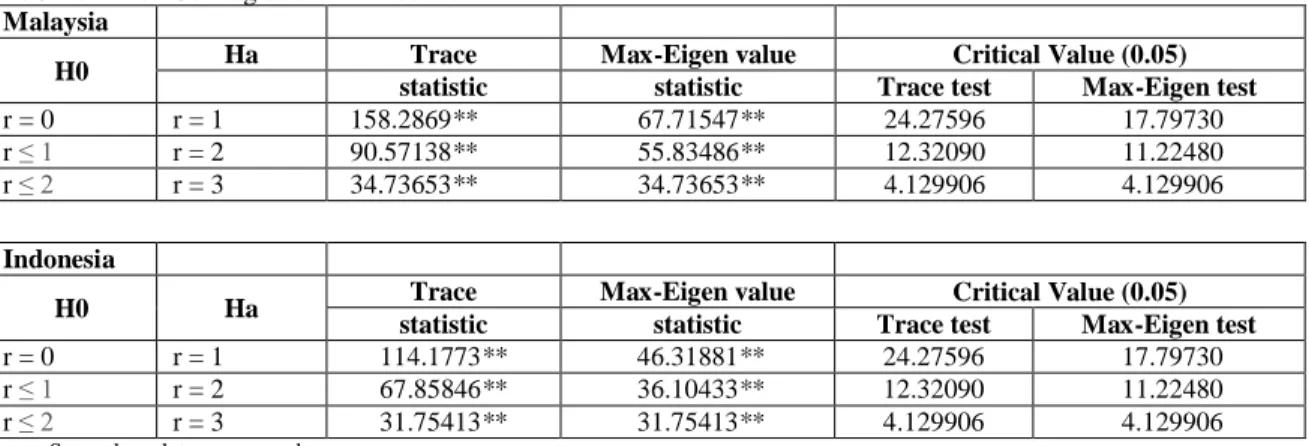
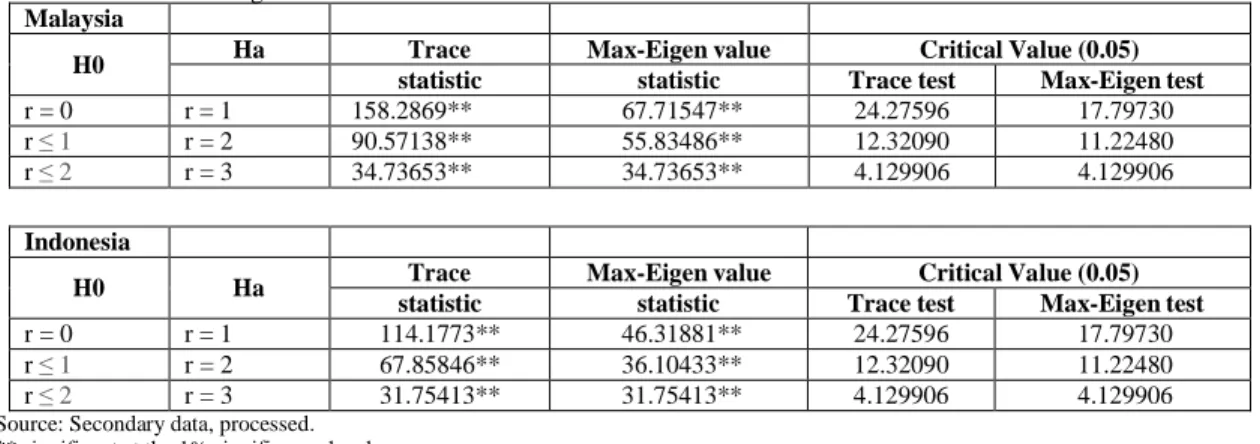
A cointegration test for variables in Indonesia was performed by adding lag 6, and for Malaysia it was done by adding lag 3. The cointegration test results of the related variables in the two countries are shown in Table 3. Based on the cointegration test results in Table 3, it was found that whether in Indonesia or Malaysia, the trace test and Max-Eigen test significantly rejected the hypothesis (H0) r=0, r ≤ 1, r ≤ 2 at a 5% significance level. Then it accepted Ha r = 1, r = 2, and r = 3. This indicates that there were three cointegration equations between the variables researched. Therefore, it can be stated that there are long-term relationships (cointegration) between Islamic stock market development, sukuk market development, and economic growth in Indonesia and Malaysia.
Table 3. Johansen Cointegration Test Results Malaysia
H0 Ha Trace Max-Eigen value Critical Value (0.05)
statistic statistic Trace test Max-Eigen test
r = 0 r = 1 158.2869** 67.71547** 24.27596 17.79730
r ≤ 1 r = 2 90.57138** 55.83486** 12.32090 11.22480
r ≤ 2 r = 3 34.73653** 34.73653** 4.129906 4.129906
Indonesia
H0 Ha Trace Max-Eigen value Critical Value (0.05)
statistic statistic Trace test Max-Eigen test
r = 0 r = 1 114.1773** 46.31881** 24.27596 17.79730
r ≤ 1 r = 2 67.85846** 36.10433** 12.32090 11.22480
r ≤ 2 r = 3 31.75413** 31.75413** 4.129906 4.129906
Source: Secondary data, processed.
** significant at the 1% significance level
The Max-Eigen value test indicates 3 cointegrating eqn(s) at the 0.05 level.
5.3. Vector Error Correction Model (VECM)
Since there was stationary data at the first difference level and cointegration between variables, to see the relationships between sukuk market development, economic growth, and trade openness, a Vector Error Correction Model method was used (Engle & Granger, 1987). The VECM test results for Malaysia and Indonesia are revealed in Table 4. and Table 5.
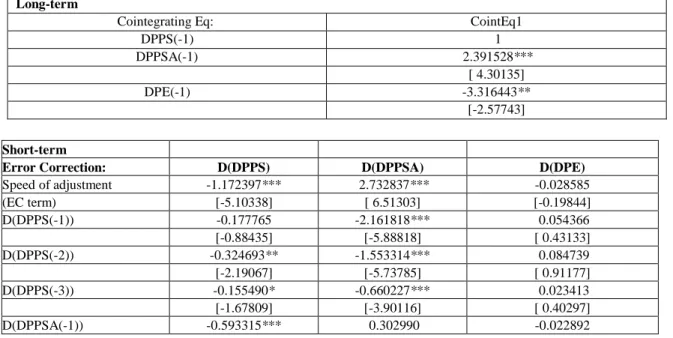
The VECM test results in Malaysia reveal that for the long-term, economic growth in the first lag is 0.57726 (<1.66), which does not have a significant influence towards sukuk market development. This means that long-term, the increase or decrease of economic growth will not influence sukuk market development. On another side, Islamic stock market development is -6.89104 (<1.66), which has a significant and negative influence on sukuk market development. This means that an increase in Islamic stock market development of 1 percent will be followed by a reduction in sukuk market development of 6.89 percent.
Table 4. Vector Error Correction Model Estimation for Malaysia
Short-term
Error Correction: D(DPPS) D(DPPSA) D(DPE)
Speed of adjustment -1.172397*** 2.732837*** -0.028585
(EC term) [-5.10338] [ 6.51303] [-0.19844]
D(DPPS(-1)) -0.177765 -2.161818*** 0.054366
[-0.88435] [-5.88818] [ 0.43133]
D(DPPS(-2)) -0.324693** -1.553314*** 0.084739
[-2.19067] [-5.73785] [ 0.91177]
D(DPPS(-3)) -0.155490* -0.660227*** 0.023413
[-1.67809] [-3.90116] [ 0.40297]
D(DPPSA(-1)) -0.593315*** 0.302990 -0.022892
[-4.48342] [ 1.25354] [-0.27588]
D(DPPSA(-2)) -0.340822*** -0.028981 -0.022933
[-3.58255] [-0.16679] [-0.38444]
D(DPPSA(-3)) -0.144604*** 0.010486 0.013773
[-2.75056] [ 0.10920] [ 0.41780]
D(DPE(-1)) 0.167107 -0.183613 -0.679380
[ 1.13073] [-0.68023] [-7.33128]***
D(DPE(-2)) -0.015178 0.168721 -0.254437**
[-0.08886] [ 0.54082] [-2.37566]
D(DPE(-3)) -0.326493** -0.308817 -0.439558***
[-2.22762] [-1.15360] [-4.78284]
DTO 0.034726* 0.026485 0.028476**
[ 1.85287] [ 0.77372] [ 2.42309]
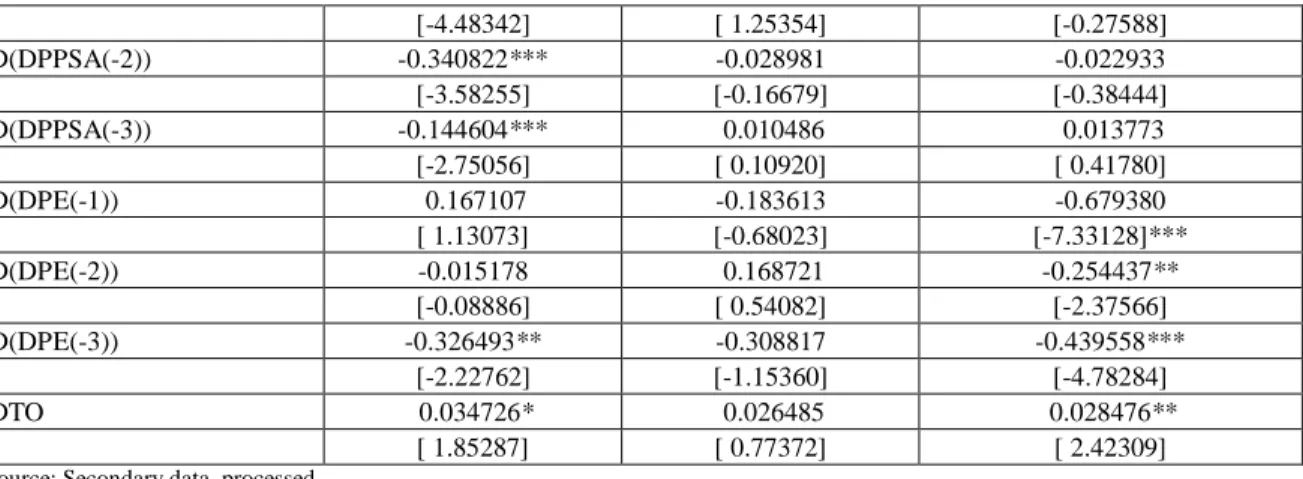
Source: Secondary data, processed.
***, **, * sequentially show a significance level of 1%, 5%, and 10%*
D is the first-difference, while [ ] is the t-statistic.
In the short-term, sukuk-market development has a negative influence towards Islamic stock market development, and Islamic stock market development also has a significant and negative influence towards sukuk market development in all periods in Malaysia. It was found that economic growth does not have a significant influence towards Islamic stock market development, and the Islamic stock market also does not significantly influence economic growth. Next, it was discovered that in Malaysia, economic growth has a significant and negative influence towards sukuk market development. Then trade openness was seen to have a positive influence towards sukuk market development and economic growth, but it does not have a significant influence towards Islamic stock market development.
Table 5. Vector Error Correction Model Estimation for Indonesia Long-term
Cointegrating Eq: CointEq1
DPPS(-1) 1
DPPSA(-1) 2.391528***
[ 4.30135]
DPE(-1) -3.316443**
[-2.57743]
Short-term
Error Correction: D(DPPS) D(DPPSA) D(DPE)
Speed of adjustment -3.468079 -0.864287 0.149129
(EC term) [-4.55378] [-3.28745] [ 2.76530]
D(DPPS(-1)) 1.679239** 0.812942*** -0.135544***
[ 2.35438] [ 3.30173] [-2.68375]
D(DPPS(-2)) 1.038197 0.764012*** -0.103665**
[ 1.65661] [ 3.53151] [-2.33600]
D(DPPS(-3)) 0.642040 0.603538*** -0.076204**
[ 1.21150] [ 3.29901] [-2.03065]
D(DPPS(-4)) 0.283552 0.368940** -0.049492*
[ 0.68874] [ 2.59595] [-1.69766]
D(DPPS(-5)) -0.060516 0.193542* -0.032746*
[-0.22678] [ 2.10097] [-1.73291]
D(DPPS(-6)) -0.117846 0.029387 -0.013603
[-0.91728] [ 0.66262] [-1.49522]
D(DPPSA(-1)) 6.932915*** 0.517754 -0.334422***
[ 4.07384] [ 0.88131] [-2.77511]
D(DPPSA(-2)) 5.726256*** 0.178607 -0.292947***
[ 3.85181] [ 0.34803] [-2.78279]
D(DPPSA(-3)) 4.424228*** 0.187323 -0.232296**
[ 3.54482] [ 0.43478] [-2.62843]
D(DPPSA(-4)) 3.373433*** 0.145454 -0.167550**
[ 3.36273] [ 0.42001] [-2.35864]
D(DPPSA(-5)) 2.135894*** 0.020800 -0.077853
[ 3.02678] [ 0.08539] [-1.55802]
D(DPPSA(--6)) 1.042581*** 0.045548 -0.032473
[ 2.79993] [ 0.35434] [-1.23158]
D(DPE(-1)) -8.054813*** -2.837314*** -0.322241*
[-3.28553] [-3.35255] [-1.85621]
D(DPE(-2)) -5.508150** -2.313687*** -0.094845
[-2.23373] [-2.71799] [-0.54317]
D(DPE(-3)) -3.947268* -1.145853 -0.283823*
[-1.68918] [-1.42045] [-1.71524]
D(DPE(-4)) -0.869535 -1.268407* -0.082255
[-0.42002] [-1.77486] [-0.56111]
D(DPE(-5)) 0.432760 -1.508480** 0.055079
[ 0.22848] [-2.30710] [ 0.41067]
D(DPE(-6)) 1.053731 -0.981097* -0.271034
[ 0.64567] [-1.74146] [-2.34534]
DTO -0.144022 0.023604 5.30E-05
[-1.40356] [ 0.66635] [ 0.00730]
Source: Secondary data, processed.
***, **, * sequentially show a significance level of 1%, 5%, and 10%
D is the first-difference, while [ ] is the t-statistic.
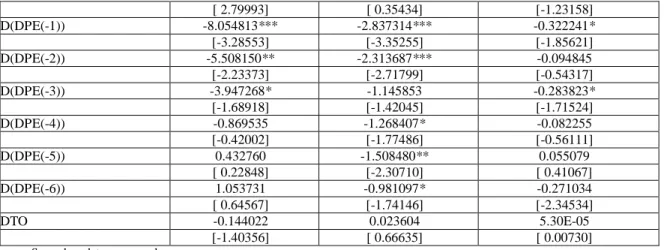
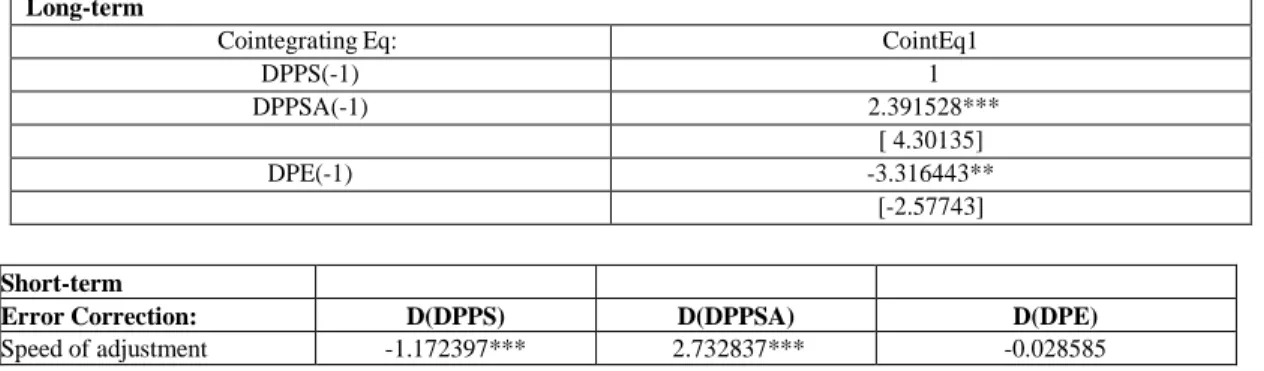
In Indonesia, the VECM test results reveal that long-term, economic growth in the first lag is -2.57743 (>1.66), which has a significant and negative influence on sukuk market development of -3.316443. This implies that long-term, an increase of economic growth of 1 percent will reduce Indonesia‘s sukuk market development by 3.3 percent. On another side, Islamic stock market development of 4.30135 (> 1.66) has a significant and positive influence on sukuk market development. This means that an increase in stock market development of 1 percent will be followed by an increase of Islamic stock market development of 2.39 percent.
In the short-term in Indonesia, sukuk market development has a significant and positive influence towards Islamic stock market development from period 1 to period 5, and Islamic stock market development has a significant and positive influence towards sukuk market development from period 1 to period 5. Economic growth has a significant and negative influence towards Islamic stock market development. Likewise, Islamic stock market development has a significant and negative influence towards economic growth. Next, it was revealed that economic growth has a significant and negative influence towards sukuk market development in Indonesia. Similarly, sukuk market development has a significant and negative influence towards economic growth. Trade openness was found to not have a significant influence, whether towards sukuk market development, Islamic stock market development, or economic growth in Indonesia.
5.4. VECM Short-run and Long-run Granger Causality Results
A causality relationship will be difficult to estimate when using the VAR model, if the variables used are cointegrated with each other (Engle & Granger, 1987). Therefore, in this research, a causality test was done with the Granger Causality- Block Exogeneity Wald test, which was developed from the Vector Error Correction Model (VECM). In the VECM framework, the short-term and long-term causality relationships can be researched.
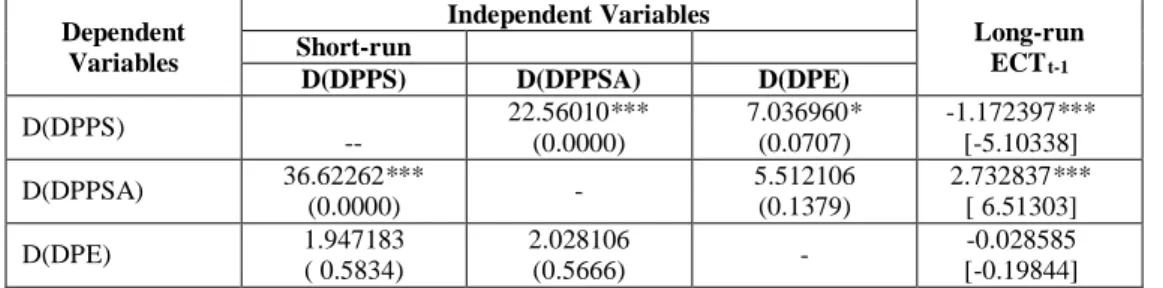
Table 6. reveals the Granger causality test results for Malaysia. From this table, it was discovered that the correction term (ECT) t-statistic value, the PPSA p-value, and PE are significant in the PPS equation. This means that in the short-term or long-term, sukuk market development is caused by Islamic stock market development and economic growth. Next, it was found that the coefficients correction term (ECT) and PPS are significant in the PPSA equation, which means that whether short-term or long-term, Islamic stock market development is caused by sukuk market development. Meanwhile, in the PE equation, no significant coefficients were found, whether in the PPS variable, the PPSA variable, or the correction term (ECT) coefficient.
Table 6. VEC Granger Causality-Block Exogeneity Wald Test Results for Malaysia Dependent
Variables
Independent Variables
Long-run ECT t-1
Short-run
D(DPPS) D(DPPSA) D(DPE)
D(DPPS)
--
22.56010***
(0.0000)
7.036960*
(0.0707)
-1.172397***
[-5.10338]
D(DPPSA) 36.62262***
(0.0000) - 5.512106
(0.1379)
2.732837***
[ 6.51303]
D(DPE) 1.947183
( 0.5834)
2.028106
(0.5666) - -0.028585
[-0.19844]
***, **, * sequentially show a significance level of 1%, 5%, and 10%
The p-value is shown in ( ), and [ ] is a t-statistic.
D = first difference, while PPS = sukuk market development equation.
PPSA = Islamic stock market development, while PE = economic growth.
Table 7. VEC Granger Causality-Block Exogeneity Wald Test Results for Indonesia Dependent
Variables
Independent Variables
Long-run ECT t-1
Short-run
D(DPPSA) D(DPPSA) D(DPE)
D(DPPS)
--
18.05283***
(0.0061)
13.17998**
(0.0403)
-3.468079***
[-4.55378]
D(DPPSA) 19.23307***
(0.0038) - 19.61919***
( 0.0032)
-0.864287***
[-3.28745]
D(DPE) 10.70536 *
(0.0979)
10.87406*
(0.0923) - 0.149129***
[ 2.76530]
***, **, * sequentially show a significance level of 1%, 5%, and 10%
The p-value is shown in ( ), and the t-statistic is shown in [ ].
D = first difference, while PPS = sukuk market development equation.
PPSA = Islamic stock market development, while PE = economic growth.
Then it can be concluded that in Malaysia, there is a two-way causality relationship between sukuk market development and Islamic stock market development, whether short-term or long-term. There is a one-way causality relationship from economic growth to sukuk market development for short-term and long-term. Next, neutrality (no causality) was discovered between Islamic stock market development and economic growth.
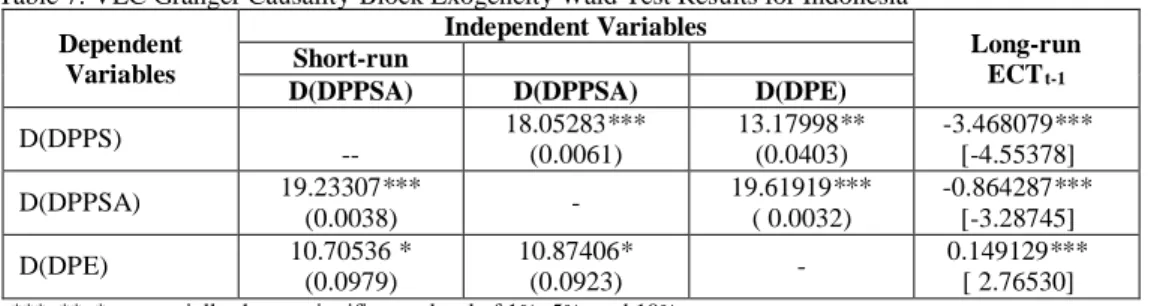
Table 7. provides the results from the Granger causality test for Indonesia. It was revealed that the p-value and t-statistic value of the correction term (ECT) all have significant variables at the 1%, 5%, and 10% levels in the three equations.
Therefore, it can be concluded that in Indonesia, there is a two-way causality relationship between Islamic stock market development and sukuk market development, whether short-term or long-term. Then it was discovered that there is a two- way causality relationship, short-term and long-term, between Islamic stock market development and economic development. There is also a two-way causality relationship, short-term and long-term, between sukuk market development and economic growth.
6. Results and Discussion
6.1. Relationship between Sukuk Market Development and Islamic Stock Market Development
From the VECM estimation results of Table 5 and Table 6, it can be concluded that there is a two-way relationship or reciprocal relationship between both markets. Islamic stock development has an influence towards sukuk market development, and the sukuk market has an influence towards the Islamic stock market development. These results are supported by the Granger causality test, which demonstrates that there is a two-way causality relationship (bi-directional causality) between Islamic stock market development and sukuk market development in Indonesia and Malaysia, whether short-term or long-term.
However, between the two countries, there is a difference in the relationship direction. In Indonesia, the Islamic stock market and sukuk market have a positive relationship. Meanwhile, in Malaysia, both markets have a negative relationship.
The sukuk market has a negative relationship towards the Islamic stock market in Malaysia, showing that the sukuk market and stock market move in opposing directions. Therefore, it can be said that in Malaysia the Islamic capital market has a flight-to-quality phenomenon. These results are in line with previous research conducted by Mustafa et al. (2015), who found a flight-to-quality phenomenon in the Malaysian sukuk market. Meanwhile, in the Indonesian Islamic capital market, no flight-to-quality phenomenon is found.
6.1. Causality Relationship between Economic Growth and Islamic Stock Market Development
There is a two-way causality relationship (bi-directional causality), short-term and long-term, between Islamic stock market development and economic growth in Indonesia. These results are supported by previous research carried out by Enisan and Olufisayo (2009); Marques et al. (2013); Pradhan et al. (2014) in the conventional financial industry.
Different with the Growth Nexus Theory, in the Islamic financial market, it was revealed that there is a negative two-way relationship between stock market development and economic growth. The economic growth, which has a negative influence towards stock market development in Indonesia, depicts that investors prefer the Islamic financial industry when the economy is in recession. On another side, the Islamic stock market also can retard economic growth, because there is a lack of savings due to the financial capital accumulation externality, as well as ownership which spreads also
has a negative effect towards company management, including public company performance that will slow down economic growth (Bhide, 1993; Newbery & Stiglitz, 1984).
Different results were revealed in Malaysia, where there is neutrality, meaning there is no relationship, whether one- directional or two-directional, between Islamic stock market development and economic growth. These results are supported by studies conducted by Pradhan et al. (2015) as well as Muharam and Setyowati (2017), who revealed that there is a neutrality relationship between economic growth and stock market development in the countries researched.
6.2. Causality Relationship between Sukuk Market Development and Economic Growth
It was discovered that there is a two-directional relationship or bi-directional causality between sukuk market development and economic growth in Indonesia. Meanwhile, in Malaysia, there is only a one-way relationship (one-directional causality), meaning economic growth causes sukuk market development. The research results show there is a negative influence between sukuk market development and economic growth in Malaysia, which supports the existence of the flight-to-quality phenomenon in the Islamic financial industry. When the economy is in a recession, volatility in the financial market will increase. This will encourage investors to switch their investments to safer instruments to reduce the associated risks. In a situation like this, investors tend to choose an investment with fixed revenue like bonds or sukuk.
This opinion is also supported by research conducted by Baur and Lucey (2009); Durand et al. (2009); Mustafa et al.
(2015).
6.3. Relationship of Trade Openness towards Islamic Stock Market Development
From the test conducted, it was found that trade openness does not have a significant influence towards Islamic stock market development in Indonesia and Malaysia. These research results are contradictory with previous studies done by El-Wassal (2016); Ho and Iyke (2017), in which their research results showed that trade openness has a positive effect towards stock market development.
Then it was revealed that trade openness does not have a significant influence towards sukuk market development and economic growth in Indonesia. However, in Malaysia, it was discovered that trade openness has a significant and positive influence towards sukuk market development and economic growth. When the export and import values of Malaysia experience an increase, it will increase the sukuk market development and economic growth in the country. These results are in line with previous research conducted by Said and Grassa (2013) in the Islamic financial industry, and studies by Bhattacharyay (2013); Braun and Raddatz (2005); Grossman and Helpman (1994); Rajan and Zingales (2003) in the conventional financial industry.
Trade openness which does not show a significant influence in Indonesia can be due to the small trade openness index in Indonesia (foreign trade ratio towards PDB). In 2016, the trade openness index of Indonesia was 37, while in the same year, the trade openness index of Malaysia reached 129 ("World Bank Indicators," 2018).
CONCLUSION AND POLICY IMPLICATIONS
The VECM estimation results convey that in Indonesia, Islamic stock market development has a positive influence towards sukuk market development, and sukuk market development has a positive influence towards Islamic stock market development. Meanwhile, in Malaysia it was found that there is a flight-to-quality phenomenon, where there is a reciprocal relationship between the stock market and sukuk market with a negative influence.
The economic growth variable has a significant and negative influence towards the Islamic stock market development variable, and the Islamic stock market has a significant and negative influence towards economic growth in Indonesia.
Meanwhile, in Malaysia there was no significant influence found between variables. Next, in Indonesia, economic growth has a significant and negative influence towards sukuk development, and sukuk market development also has a negative influence towards economic growth. Then in Malaysia only economic growth shows a significant and negative influence towards sukuk market development. Trade openness was discovered to have a significant and positive influence towards sukuk market development and economic growth in Malaysia (Endogenous Growth Theory). Meanwhile, in Indonesia trade openness does not have a significant influence towards Islamic stock market development, sukuk market development, or economic growth.
The VECM Granger causality test estimation results found that in Indonesia, there is two-directional causality between Islamic stock market development and sukuk market development; there is two-directional causality between economic development and stock market development; and there is two-directional causality between sukuk market development and economic growth. Next, in Malaysia, it was discovered that there is two-directional causality between Islamic stock
market development and sukuk market development; there is a one-directional relationship between economic growth and sukuk market development; and there is neutrality (no causality) between Islamic stock market development and economic growth.
These research results indicate that the policy decision makers should recognize the current differences in the relationship between the Islamic financial market and economic growth in an effort to sustain development. In building a portfolio in the Islamic financial market, investors also must pay attention to the influences between markets, keeping in mind that there are varying influences in different countries. Then the economic condition of a country can cause a shift in the Islamic stock market and sukuk market, so that investing can become an economic condition as a cornerstone in investment decision making, in order that risks can be reduced. Seeing that trade openness has a positive influence towards sukuk development and economic growth in Malaysia, the government needs to consider a policy to increase overseas trading, so that economic growth and sukuk market development can be achieved.
For the limitations, this research only focused on two countries and only delved into the corporation sukuk market. Future research should try to add sample countries and expand research to sovereign/state sukuk markets.
References
Ahmed, A. D., & Mmolainyane, K. K. (2014). Financial integration, capital market development and economic performance: Empirical evidence from Botswana. Economic Modelling, 42, 1-14.
doi:10.1016/j.econmod.2014.05.040
Alam, N., Hassan, M. K., & Haque, M. A. (2013). Are Islamic bonds different from conventional bonds? International evidence from capital market tests. Borsa Istanbul Review, 13(3), 22-29. doi:10.1016/j.bir.2013.10.006
Aloui, C., Hammoudeh, S., & Hamida, H. B. (2015). Co-movement between sharia stocks and sukuk in the GCC markets:
A time-frequency analysis. Journal of International Financial Markets, Institutions and Money, 34, 69-79.
doi:10.1016/j.intfin.2014.11.003
Atje, R., & Jovanovic, B. (1993). Stock markets and development. European Economic Review, 37(2-3), 632-640.
doi:https://doi.org/10.1016/0014-2921(93)90053-D
Baele, L., Bekaert, G., & Inghelbrecht, K. (2010). The Determinants of Stock and Bond Return Comovements. Review of Financial Studies, 23(6), 2374-2428. doi:10.1093/rfs/hhq014
Bansal, N., Connolly, R. A., & Stivers, C. (2014). The Stock-Bond Return Relation, the Term Structure‘s Slope, and Asset-Class Risk Dynamics. Journal of Financial and Quantitative Analysis, 49(03), 699-724.
doi:10.1017/s0022109014000258
Baur, D. G., & Lucey, B. M. (2009). Flights and contagion—An empirical analysis of stock–bond correlations. Journal of Financial Stability, 5(4), 339-352. doi:10.1016/j.jfs.2008.08.001
Bhattacharyay, B. N. (2013). Determinants of bond market development in Asia. Journal of Asian Economics, 24, 124- 137. doi:10.1016/j.asieco.2012.11.002
Bhide, A. (1993). The hidden costs of stock market liquidity. Journal of Financial Economics, 34(1), 31-51.
doi:https://doi.org/10.1016/0304-405X(93)90039-E
Bordo, M. D., & Murshid, A. P. (2001). Are Financial Crises Becoming More Contagious?: What is the Historical Evidence on Contagion? In C. S. & F. K.J. (Eds.), International Financial Contagion. Boston, MA: Springer.
Braun, M., & Raddatz, C. (2005). Trade Liberalization and the Politics of Financial Development. In World Bank Policy Research Working Papers 3517.
Chiang, T. C., Li, J., & Yang, S.-Y. (2014). Dynamic stock–bond return correlations and financial market uncertainty.
Review of Quantitative Finance and Accounting, 45(1), 59-88. doi:10.1007/s11156-013-0430-4
Dickey, D. A., & Fuller, W. A. (1979). Distribution of the Estimators for Autoregressive Time Series With a Unit Root.
Journal of the American Statistical Association, 71(366), 427-431.
Durand, R. B., Junker, M., & Szimayer, A. (2009). The flight-to-quality effect: a copula-based analysis. Accounting &
Finance, 50(2), 281-299. doi:10.1111/j.1467-629X.2009.00320.x
El-Wassal, K. A. (2016). Understanding the Growth in Emerging Stock Markets. Journal of Emerging Market Finance, 4(3), 227-261. doi:10.1177/097265270500400302
Engle, R. F., & Granger, C. W. J. (1987). Co-Integration and Error Correction: Representation, Estimation, and Testing.
Econometrica, 55(2), 251-276.
Enisan, A. A., & Olufisayo, A. O. (2009). Stock market development and economic growth: Evidence from seven sub- Sahara African countries. Journal of Economics and Business, 61(2), 162-171.
doi:10.1016/j.jeconbus.2008.05.001
Granger, C. W. J. (1969). Investigating Causal Relations by Econometric Models and Cross-spectral Methods.
Econometrica, 37(3), 424-438. doi:10.2307/1912791
Grossman, G. M., & Helpman, E. (1994). Endogenous Innovation in the Theory of Growth The Journal of Economic Perspectives, 8(1), 23-44.
Guler, B., & Ozlale, U. (2005). Is there a flight to quality due to inflation uncertainty? Physica A: Statistical Mechanics and its Applications, 345(3-4), 603-607. doi:10.1016/s0378-4371(04)01060-x
Handriani, E., & Robiyanto, R. (2018). Investment Opportunity and Industrial Growth in Indonesia. International Journal of Business and Society, 19(2), 295-312.
Ho, S.-Y., & Iyke, B. N. (2017). On the causal links between the stock market and the economy of Hong Kong.
Contemporary Economics, 11(3), 343-362.
ICD. (2017). Islamic Finance Development Indicator Report 2017: Thomson Reuters.
IFSB. (2017). Islamic Financial Services Industry Report 2017. Kuala Lumpur, Malaysia: Islamic Financial Services Board.
Istiqomah. (2012). Dinamika Interaksi antara Variabel Moneter dan Pasar Modal Syariah Terhadap Pertumbuhan Ekonomi Indonesia. In Working Paper.
Johansen, S., & Juselius, K. (1990). Maximum likelihood estimation and inference on cointegration - with applications to the demand for money. Oxford Bulletin Economis and Statistics, 52(2), 169-210.
doi:https://doi.org/10.1111/j.1468-0084.1990.mp52002003.x
Levine, R. (1997). Financial Development and Economic Growth: Views and Agenda. Journal of Economic Literature, 35(2), 688-726.
Luintela, K. B., & Khan, M. (1999). A quantitative reassessment of the finance–growth nexus: evidence from a multivariate VAR. Journal of Development Economics, 60(2), 381-405. doi:https://doi.org/10.1016/S0304- 3878(99)00045-0
Marques, L. M., Fuinhas, J. A., & Marques, A. C. (2013). Does the stock market cause economic growth? Portuguese evidence of economic regime change. Economic Modelling, 32, 316-324. doi:10.1016/j.econmod.2013.02.015 Mohd, N. H. H., Low, S.-W., Nor, A. H. S. M., & Ghazali, N. A. (2013). FDI and Economic Growth — Does the Quality
of Banking Development Matter? Gadjah Mada International Journal of Business, 15(3), 287-303.
doi:10.22146/gamaijb.5472
Muharam, H., & Setyowati, D. (2017). Kausalitas Perkembangan Pasar Saham, Perkembangan Pasar Obligasi, Pertumbuhan Ekonomi, dan Investasi Langsung Asing. In Working Paper.
Mustafa, N. N. S., Samsudin, S., Shahadan, F., & Yi, A. K. J. (2015). Flight-to-Quality between Stock and Bond Markets:
Pre and Post Global Financial Crisis. Procedia Economics and Finance, 31, 846-855. doi:10.1016/s2212- 5671(15)01178-8
Naifar, N., Hammoudeh, S., & Al dohaiman, M. S. (2016). Dependence structure between sukuk (Islamic bonds) and stock market conditions: An empirical analysis with Archimedean copulas. Journal of International Financial Markets, Institutions and Money, 44, 148-165. doi:10.1016/j.intfin.2016.05.003
Newbery, D. M. G., & Stiglitz, J. E. (1984). Pareto Inferior Trade. The Review of Economic Studies, 51(1), 1-12.
doi:10.2307/2297701
Ngare, E., Nyamongo, E. M., & Misati, R. N. (2014). Stock market development and economic growth in Africa. Journal of Economics and Business, 74, 24-39. doi:10.1016/j.jeconbus.2014.03.002
Olweny, T. O., & Kimani, D. (2011). Stock market performance and economic growth: Empirical evidence from Kenya using causality test approach Advances in Management & Applied Economics, 1(3), 153-196.
Patoda, R., & Jain, K. (2012). Assimilation between Bond and Stock Market. Global Journal of Management and Business Research, 12(20).
Pradhan, R. P., Arvin, M. B., Hall, J. H., & Bahmani, S. (2014). Causal nexus between economic growth, banking sector development, stock market development, and other macroeconomic variables: The case of ASEAN countries.
Review of Financial Economics, 23(4), 155-173. doi:10.1016/j.rfe.2014.07.002
Pradhan, R. P., Zaki, D. B., Maradana, R. P., Dash, S., Jayakumar, M., & Chatterjee, D. (2015). Bond market development and economic growth: The G-20 experience. Tékhne, 13(1), 51-65. doi:10.1016/j.tekhne.2015.09.003
Rajan, R. G., & Zingales, L. (2003). The great reversals: the politics of financial development in the twentieth century.
Journal of Financial Economics, 69(1), 5-50. doi:10.1016/s0304-405x(03)00125-9
Robinson, J. (1952). The Generalization of the General Theory, in the Rate of Interest and Other Essays. London:
Macmillan.
Robiyanto, R. (2017). The Analysis of Capital Market Integration in ASEAN Region by Using the OGARCH Approach.
Jurnal Keuangan dan Perbankan, 21(2), 169-175.
Robiyanto, R. (2018a). Gold VS Bond: What Is the Safe Haven for the Indonesian and Malaysian Capital Market? Gadjah Mada International Journal of Business, 20(3), 277-302. doi:https://doi.org/10.22146/gamaijb.27775
Robiyanto, R. (2018b). Indonesian Stock Market‘s Dynamic Integration with Asian Stock Markets and World Stock Markets. Jurnal Pengurusan, 52, 181-192. doi:10.17576/pengurusan-2018-52-15
Robiyanto, R. (2018c). Testing of the Gold's Role as a Safe Haven and Hedge for Sharia Stocks in Indonesia. Al-Iqtishad:
Jurnal Ilmu Ekonomi Syariah, 10(2), 255-266. doi:10.15408/aiq.v10i2.6527
Robiyanto, R., & Ernayani, R. (2018). Capital market integration in some ASEAN countries revisited. Jurnal Manajemen, 22(2), 205-222. doi:http://dx.doi.org/10.24912/jm.v22i2.359
Robiyanto, R., Wahyudi, S., & Pangestuti, I. R. D. (2017a). Testing Commodities as Safe Haven and Hedging Instrument on ASEAN's Five Stock Markets Jurnal Ekonomi Kuantitatif Terapan, 10(2), 231-238.
doi:10.24843/JEKT.2017.v10.i02.p11
Robiyanto, R., Wahyudi, S., & Pangestuti, I. R. D. (2017b). The volatility–variability hypotheses testing and hedging effectiveness of precious metals for the Indonesian and Malaysian capital markets. Gadjah Mada International Journal of Business, 19(2), 167-192. doi:10.22146/gamaijb.26260
Romer, P. M. (1990). Endogenous Technological Chan. Journal of Political Economy, 98(5), S71-S102.
Said, A., & Grassa, R. (2013). The Determinants of Sukuk Market Development: Does Macroeconomic Factors Influence the Construction of Certain Structure of Sukuk? Journal of Applied Finance & Banking, 3(5), 251-267.
Schumpeter, J. A. (1912). The Theory of Economic Development. Cambridge, MA: Harvard University Press.
Smaoui, H., & Nechi, S. (2017). Does sukuk market development spur economic growth? Research in International Business and Finance, 41, 136-147. doi:10.1016/j.ribaf.2017.04.018
Suganda, T. R., Sumargo, I. K., & Robiyanto, R. (2018). Superstitious behavior and stock returns: The case of Javanese traditional calendar. Kasetsart Journal of Social Sciences. doi:10.1016/j.kjss.2018.08.008
Svaleryd, H., & Vlachos, J. (2002). Markets for risk and openness to trade: how are they related? Journal of International Economics, 57(2), 369-395. doi:https://doi.org/10.1016/S0022-1996(01)00153-2
Vazakidis, A., & Adamopoulos, A. (2009). Financial Development and Economic Growth: An Empirical Analysis for Greece. American Journal of Applied Sciences, 6(7), 1410-1417.
Wahyudi, S., Nofendi, D., Robiyanto, R., & Hersugondo, H. (2018). Factors affecting return on deposit (ROD) of sharia banks in Indonesia Business: Theory and Practice, 19, 166-176. doi:https://doi.org/10.3846/btp.2018.17 Wang, Y. S., & Chueh, Y. L. (2013). Dynamic Transmission Effects between the Interest Rate, the US Dollar, and Gold
and Crude Oil Prices. Economic Modelling, 30, 792-798.
Wanyama, D. W. (2017). Effect of stock market development on the growth of corporate bond market in Kenya.
International Journal of Finance (IJF), 2(2).
World Bank Indicators. (2018). Retrieved from
http://www.worldbank.org/?CID=ECR_GA_worldbank_EN_EXTP_AM2018&gclid=EAIaIQobChMIsJv2_6 GL3gIVCK6WCh0HfgGVEAAYASAAEgIHGvD_BwE
Yartey, C. A. (2007). Well-developed Financial Intermediary Sector Promotes Stock Market Development: Evidence
from Africa. Journal of Emerging Market Finance, 6(3), 269-289.
doi:https://doi.org/10.1177/097265270700600303
ISLAMIC STOCK MARKET AND SUKUK MARKET DEVELOPMENT, ECONOMIC GROWTH, AND TRADE OPENESS (THE CASE OF INDONESIA DAN MALAYSIA)
Harjum Muharam (0000-0002-4627-9997)1, Resi Junita Anwar2, Robiyanto Robiyanto (0000-0003-3565-1594)3
1, 2 Faculty of Economics and Business, Universitas Diponegoro, Semarang 50241, Central Java, Indonesia
3 Faculty of Economics and Business, Satya Wacana Christian University, Salatiga 50711, Central Java, Indonesia E-mails: 1[email protected] (Corresponding author); 2[email protected]; 3[email protected]
Received day month year; accepted date (use style Received dates, or Alt + Ctrl + R)
Abstract. This study was conducted in order to analyse the two-way relationship between the Islamic stock market and sukuk market development, and economic growth. this study also analyses whether trade openness influences the development