Leadership and the Entrepreneur: ‘‘ I ’ m right Behind You Leading the Way ’’
After working through this chapter you should be able to:
& Understand the role of entrepreneur as leader
& Identify the behavioural attributes of entrepreneurial leadership style
& Recognize the entrepreneurial role changes as hospitality firms develop
& Understand the role of teams in the growing hospitality firm
INTRODUCTION AND DEFINITIONS
Entrepreneurial success can be attributed to a number of factors including expert knowledge of a technical field together with a sound understanding of markets and the behaviour of competitors. Good fortune is also something which differentiates mediocre enterprises from their successful counterparts (see Chapter 11 for a discussion). However, capitalizing on this knowledge, cognisance and luck requires a long-term entrepreneurial perspective and a recognition that consistent high performance depends on a collective effort rather than that of a single‘heroic’founder. In other words, successful small to medium-sized hospitality enterprises must have effective leadership. Interest- ingly despite the hyperbole surrounding such entrepreneurs as Richard Bran- son, Anita Roddick, Donald Trump and others, the role of entrepreneur and leader are not always synonymous. History attests to a number of failures which could be attributed to poor leadership skills. Making the transition from an insular creator or innovator to an inspirational and consistent motivator of people is a challenge which some fail to manage.
As small hospitality firms grow, the role of the founder needs to develop accordingly. No longer can the entrepreneur rely on an intuitive or even haphazard style of management that may well have been appropriate in the
CHAPTER 10
213
early stages when the organization was small and had few staff. Most growth models (Greiner, 1972; Churchill and Lewis, 1983; Scott and Bruce, 198) acknowledge that the role of the founder needs to change as the business develops and grows. For example, Churchill and Lewis group these changes into founder’s goals, management and strategic and operational ability. The emphasis of each depends on the entrepreneur’s attributes and the develop- mental stage or size of the firm. To lead a growing hospitality firm effectively the founder must now begin to consider their role as one of facilitator and team leader rather than an entrepreneurial‘hero’.
According to Burns (2001) leaders should have the ability to establish a vision and generate ideas so followers understand the firm’s challenges, its values and where it needs to be within a certain time frame. They are respon- sible for ensuring their firms work as a unified whole in pursuit of a common goal by providing appropriate guidance to followers who are motivated in their place of work (Yukl, 2006). Leaders must also be able to undertake long-term strategic planning so that the firm can achieve its aims or satisfy its vision.
Strategies may be planned or emergent. If the latter, leaders must be able to spot the successful ones and exploit them.
Several definitions of leadership exist but that cited by Daft (2005) serves the purpose of this book adequately as it helps to clarify of what leadership is comprised:
‘‘Leadership is an influence relationship amongst leaders
[entrepreneurs] and followers who intend real changes and outcomes that reflect their shared purpose’’(p. 5).
This contemporary idea of leadership is something quite different to earlier versions which considered it to be a one-way power and control relationship between superiors and subordinates. ‘New’ leadership actively seeks and embraces change rather than one person maintaining a status quoin order to keep their position of power. Moreover, change is viewed as something constructive and a reflection of the shared purpose of all involved irrespective of organizational position; with the purpose aimed at sharing a vision created by the leader (and in some cases the followers). Ultimately we can see that entrepreneurial leadership has a strong visionary dimension with a significant people or‘follower’focus.
Key point 10.1
To lead a growing hospitality firm effectively the founder must consider their role as one of facilitator and team leader rather than an individual entrepreneurial‘hero’.
This chapter explores the concept of leadership by introducing some key historical and contemporary developments in the field. It continues by out- lining the transition from founder to leader whilst the firm is growing with a focus on‘people’and team leadership skills. Here, we are less concerned with how this happens, as this is discussed elsewhere in the book, but what the founder needs to do in order to lead the growth effectively. Finally, organiza- tional culture is discussed in an attempt to highlight its overarching influence and importance to the area of leadership in small to medium-sized hospitality organizations.
Making a racket by Colin Morris
David Lloyd, as they say, knows his own mind. Indeed, he is on intimate terms with it. He thinks The City is‘‘full of crooks’’, Hull’s sports fans don’t know what’s good for them and the All England Lawn Tennis and Croquet Club should tear up its hallowed turf in favour of a more modern surface or risk becoming irrelevant on the world tennis stage and he’s not shy about sharing such wisdom. So much so, that the Guardian recently quipped:‘‘A legend in his own change of ends, Lloyd should do British tennis a favour and keep it buttoned.’’
Having spent an afternoon with the man I can tell the Guardian, and anyone else who cares- that this is as likely as unearthing a multi-grand slam winner who is British.
I met Lloyd in his uber-posh Wisley Golf and Country Club near Waking, where the suburbs of south London give way to the green rolling hills of Surrey. It is impressive. Words like rarefied, stunning and immaculate come to mind- and that’s just the gravel on the drive leading up to the clubhouse.
Once inside, a front-office employee with cut-glass accent directs me to the lounge where I may await Mr Lloyd’s arrival. In front of me lies the splendour of the club’s superb 18thgreen –inside is the kind of drinking establishment you would expect to find in a middle England inspired heaven. But the conversation in the room isn’t about birdies and bogeys but about David Lloyd’s involvement in the troubled Clubhaus venture, a golf course chain that he studiously backed away from that is now facing the scrutiny of the DTI–with Lloyd crying foul from the sidelines.
My eavesdropping is interrupted by the man himself. All smiles, a quick handshake and then a brisk walk to an empty conference room for a more’private conversation’. Despite a pronounced limp, Lloyd walks way too fast. The obvious starting point is David Lloyd Leisure– the fitness chain he created 20 years ago, spread throughout England with great success and sold on to brewer Whitbread. He continued to work in partnership with the brewer for a while, but eventually the relationship turned sour. Indeed, it doesn’t take long for the legendary Lloyd pugnatiousness to surface and, as if on cue, he delivers a scathing assessment of corporate Britain:‘‘Big companies are all the same–they make sure all the directors have a chauffeur driven car–but that’s not in the shareholders’interest.’’
The former British tennis number one rates Whitbread’s handling of David Lloyd Leisure as sub-par. He wasn’t happy with the way Whitbread handled its staff, treating them as
Introduction and Definitions 215
‘‘numbers instead of people’’and was even more displeased with what the brewer saw as an acceptable bottom line.‘‘They (Whitbread) were happy with an 11 per cent return on the business (when I ran it) we wouldn’t get out of bed for less than 15. I told Whitbread‘You’ve got this great business–why don’t you step back and let me make you money’?’’. Lloyd finally sold out to the brewer in 1995 to go his own way.‘‘I used to enjoy going to work but when I went to work (after Whitbread came in) I hated it. They were destroying a great business and I couldn’t stand it.’’So much for pulling your punches. Lloyd may have left his leisure business behind, and his name with it a situation that he admits‘‘bothers me sometimes’’–but he wasn’t about to sit around his country club hideaway and sulk. He hung on to his tennis school along with a variety of interests managed under the umbrella of David Lloyd Associates and remained a central figure in British tennis.
Tim Henman was an early protege and Lloyd led both him and Greg Rusedski when he was captain of England’s Davis Cup team. It didn’t work out particularly well and Lloyd was replaced with Roger Taylor last year. Outside tennis, Lloyd kept himself busy with a variety of ventures, most notably his involvement in Clubhaus which has turned messy–and a dabble in pro sports that doesn’t involve fuzzy balls when he strode into Hull and snapped up the city’s professional sports trinity of Hull City Football Club along with Rugby Leaguers Hull Kingston Rovers and Hull FC The Hull dream was typical of efforts to wring money from lower echelon football clubs in the late 90’s–but with some twists only David Lloyd could provide.
He scooped up Hull City Football Club and its Boothferry Park ground with the team on the brink of financial ruin, along with the city’s two bitterly divided rugby clubs.
The plan was deceptively simple, instead of three clubs playing from three different run-down grounds Lloyd would build one modern stadium where the gate receipts from all three teams would keep the clubs and stadium humming, while the various real estate deals around the grounds would line Lloyd pockets. The x-factor, the one thing Lloyd hadn’t figured into to his equation, was the intractable nature of the average English sports fan. In Hull, Lloyd finally bumped heads with a constituency as stubborn, headstrong and opinionated as himself.‘‘It seemed really simple and logical,’’reflects Lloyd.‘‘Trouble is, between the two different sides (Hull RFC and Hull KR) there is war. Fans wouldn’t cross to the other side of the city to watch their team. They would rather stay in a leaking stadium with asbestos in the roof and no hot food than cross to the other side of town (and into enemy territory) to a nice new stadium.’’
Unable to link the three teams under a rainbow of harmony, Lloyd was eventually forced to sell his stake in 1998–with Hull City on the brink of Football League elimination. Ironically, Hull City Football Club and rugby leaguers Hull FC will share a stadium from 2003 after all.
Atypical to the end, Lloyd put in almost £1 million of his own cash to leave Hull City debt free.
But it hasn’t been all bad news for Lloyd–in fact even the bad news has been good. Lloyd was involved with the golf and country club chain Clubhaus in its infancy and was excited about the prospects of the business. But when it came time to stump up his own cash Lloyd performed due diligence and didn’t like what he saw when the company opened up its books.
‘‘An entrepreneur is not a gambler. He’ll put his cash and his head on the line but you have to put controls in as well because, after all, it’s a dream. They (Clubhaus) had a good idea but they tried to make everything too big, too fast with lots of paper and no cash.’’
Months after Lloyd backed away from the company, Clubhaus is labouring under debts of
£105 million and is facing an inquiry by the DTI into its bookkeeping. In a bid to stay afloat Clubhaus, a publicly traded company, has swapped outstanding bonds for equity in the company–effectively waylaying its shareholders. The move incensed many who owned shares, including Lloyd and Eddie Shah, the former newspaper tycoon who is reported to be writing a novel about the debacle.
While Lloyd holds no grudges with management at Clubhaus,‘‘They were nice guys’’, he was outraged by the equity-for-bonds swap and is even more furious that investigating bodies don’t want to look at the due diligence he performed on the company long before its troubles came to light.‘‘The City is a rip-off in a lot of ways, which is sad. There’s punters out there who don’t know what’s going on and auditors need to be taken to task. We are talking about people’s life savings in some cases.’’Perhaps- but not in the case of David Lloyd himself, who’s exposure to Clubhaus was minimal.
Lloyd has kept his powder dry for another venture into, you guessed it, the leisure centre business. Next Generation, which has seen Lloyd teaming up with his son Scott, was launched three years ago but is currently in the throes of a significant rollout. The venture has seen Lloyd move away from the mass market to concentrate on the more discerning customer. Clubs are often built in the exclusive suburbs where land is more expensive, are more spacious and contain unusual features such as children’s gyms, cinemas, homework rooms and creches. Indeed, Lloyd is planning to spend £50 million on just four clubs this year at London’s Maida Vale, Bristol, York and Dartford. With a further ten clubs planned for the next three years, this is quite a hefty initial outlay, but he has managed to secure backing for the venture from the Bank of Scotland, Royal Bank of Scotland and a number of private investors. Understandably, he hasn’t sought to raise any funds through the City.
Questions
1. What leadership characteristics does this entrepreneur display?
2. What style (s) of leadership does this entrepreneur display?
3. Discuss what impact his early sporting career is likely to have had on his business perspectives.
4. Identify and discuss issues of organizational culture amongst the companies mentioned in this article.
5. Identify and comment on some of the business decisions made by this entrepreneur.
Reproduced with permission, Hospitality, July/August, 2002, pp. 38–40.
LEADERSHIP THINKING
The emergence of leadership theories could hardly be described as proactive. In a business sense they have evolved due to shifts in the socio-economic climate in which they were positioned originally. Daft (2005) summarises the major
Leadership Thinking 217
approaches as Great Man, Trait, Behavioural, Individualized, Contingency, Influence and Relational. A discussion of each appears below.
Great man theories (early 1900s – 1950s)
Leaders are always male heros and born with universal natural leadership qualities which inspire and influence others to obey unquestioningly. Many hundreds of traits have been identified such as creativity, self-confidence, risk- taking propensity, intelligence, drive and so on. Despite a consensus that traits and leadership effectiveness are difficult to predict in all situations, traits remain popular with some being identified as powerful predictors of leadership behaviour (Bass and Stogdill, 1990).
Trait theories (1940s to present)
Rooted in the above theory whereby early researchers sought to identify spe- cific traits which would predispose individuals to become great leaders. Some traits are now recognised as having a role in predicting whether someone is likely to be an effective leader but a robust and reliable list of such traits is yet to be identified.
Behaviour theories (1940s and 1950s to present)
Research here focuses on what an individual does rather than who they are by dint of traits. Similar to trait theory effective and ineffective leadership is defined by behavioural differences between these two extremes. This school coined the terms‘autocratic’and‘democratic’. Essentially, the autocrat pre- fers centralized power being derived from position, controlling rewards and coercion. The equal and opposite is the democrat who prefers to delegate authority, encourages others to participate and relies on followers’knowledge.
A significant contribution to the field was that of Tannenbaum and Schmidt (1958) who recognised that leadership style is dynamic and exists at any point along the autocratic (or‘boss-centred’) and democratic (or‘subordinate-cen- tred’) leadership scale. The extreme points of the continuum are characterized by managers making decisions and announcing them with no consultation to one where managers encourage followers to work with a degree of autonomy within defined limits.
Other seminal studies on leadership behaviour include the ‘Ohio State Studies’ from where the exclusive terms ‘Consideration’ and ‘Initiating Structure’styles emerged. The former concerns the sensitivity with which the leader treats followers, for example, are their ideas and feelings respected? The initiating structure style focuses more on the work task
and the extent to which the leader directs followers toward a designated objective. Other related studies were conducted at the University of Michi- gan with similar outcomes. On this occasion, leadership behaviour was classified as ‘Employee-centred’ or ‘Job-centred’. These studies differed from the Ohio-based research in that both behaviours could be adopted by leaders simultaneously.
Another behavioural contribution adding to that of the former two studies was that of Blake and Mouton (1978). Their Leadership Grid shown in Figure 10.1summarizes the tenets of their leadership theory.
Like the Ohio and Michigan State studies, the grid features two continua with concern for people and concern for results as their focus. Research suggests that entrepreneurs may be both people and results oriented simulta- neously. Five leadership styles are shown in the figure with the universal‘high high’or‘team management’being the preferred approach in most situations.
However, the assumption here is that leaders use the same leadership style with all followers.
Reflective practice
1. In your opinion, is it possible for leaders to have high concern for results and for people?
2. Which of the above five styles of leadership would be most appropriate for:
& A fast-food restaurant
& A fine dining restaurant
& A motel
& A busy small city hotel
& A busy small resort hotel
Individualized Leadership
Yammarinow and Danserau (2002) contend that an individualized leadership style is more effective whereby the leader strikes a different relationship with each individual in the firm. Daft (2005) considers this to be based on‘Dyadic theory’or two-person exchanges where each party give and receives from the other. Leaders are said to provide a sense of self-worth for the follower (amongst other things) and the follower offers a commitment to the job and the firm. Ultimately this individualized exchange can be extrapolated more broadly to build cross company networks. However, this style of leadership ultimately results in the creation of two overall groups of followers; an‘in’and an‘out’group. Much like the existence of a two tier hospitality labour force
Leadership Thinking 219
(year-round and seasonal workers), the in groups enjoys preferential treatment and quality exchanges with their leader whereas the out group do not. Instead the pattern of exchanges is more likely to be based on coercion and formal authority.
FIGURE 10.1 The leadership grid.
Adapted from: Blake and Mouton (1978).
Contingency theories (late 1950s to present)
Given the equivocal nature of results from the above constructs, situations and contexts were then identified as variables most likely to impact on lead- ership behaviour. Simply, researchers proposed that situations can be effec- tively managed by analysis and a subsequent change in leadership behaviour to match the requirements of the context. Contextual variables may be grouped into categories of:
& The work environment;
& The external environment; and
& The characteristics and tasks of followers.
Contingency theories hold that effective leadership styles depend on their fit with the context or the situation and the requirements of the followers. In short, there is no universal optimum way to lead, it very much depends on other issues. The basic assumption here is that leaders have the ability to diagnose situations and behave accordingly. Based on the trait theorists notion of concern for task and concern for people, a leader who has a high concern for tasks will focus on short-term planning, task clarification and monitoring.
Alternatively, a focus on people or relationship behaviours will optimise beha- viours including support provision, recognition for work done well, empow- erment and so on. Several contingency models exist with some differences between them however, they all agree that appropriate leadership depends on situational characteristics. The main contributors to this field are Fiedler, Hersey and Blanchard, House (Path-goal theory) and Vroom-Jago.
According to Fiedler (1954) situations are characterized by three elements:
& Quality of leader–follower relations–working atmosphere (trust,
respect, confidence in leader);
& Task structure–extent of definition, clear goals and instructions; and
& Position power–over followers, planning, directing, rewarding,
punishing.
The possible configurations of situations using these three criteria vary from
‘favourable’where leader–member relations are healthy, leader position power is strong and task structure is high to‘unfavourable’situations where relations are poor, position power is weak and task structure is low. For this approach to be successful, the leader must first understand where they fit along the rela- tionship/task scale and then see whether the situational elements (relations, position power and task structure) are favourable or unfavourable. There are various instruments available to diagnose leadership style. One example linked to Fiedler’s theory is known as the Least Preferred Co-worker scale (LPC). The
Leadership Thinking 221
scale used is a form of semantic differential with adjectives including efficient vs. inefficient; open vs. guarded; gloomy vs. cheerful and so on. If the entrepre- neur uses positive words to describe the least preferred co-worker she is a
‘relationship-oriented’ leader. If negatives are used then the entrepreneur is deemed‘task-oriented’. Like most instruments, the LPC has its critics.
Hersey and Blanchard’s (1982) model focuses on the characteristics of followers as the main situational elements. Essentially, an effective leadership style must consider the nature and state or prior development of followers.
Follower development is divided into four overall characteristics shown in Figure 10.2.
The model suggests that when workers are at a low state of readiness as they have poor ability and skills (or may even be unwilling to take responsi- bility), a telling style of leadership works best. This would be where the hospitality entrepreneur has codified a set of instructions for a food server in the delivery of say a Cappuccino coffee. At the other extreme, where followers are well educated and are willing to accept responsibility for their own behav- iour, a delegating style of leadership is most appropriate. This model is simpler than Fiedler’s as one only has to consider followers rather than other situa- tional variables.
Key point 10.2
Effective leadership depends on a diagnosis of followers’state of readiness and instigation of the appropriate style.
Other contingency constructs include Path-Goal Theory (PGT) (House, 1971) where it is incumbent on the leader to increase follower
FIGURE 10.2 A situational theory of leadership.
Adapted from: Daft (2005, p. 91).
motivation by clarifying what they must do in order to receive rewards. She is also responsible for increasing meaningful rewards for followers. The main difference between this contingency theory and that of Fiedler is that PGT suggests leaders change their behaviour to match the situation. These beha- viours are classified as supportive, directive, achievement-oriented and par- ticipative. Situational contingencies here are follower characteristics (similar to those of Hersey and Blanchard) and the work environment which is classi- fied according to the presence of task structure, nature of formal authority system and the follower work-group characteristics (education and quality of relationships) (Daft, 2005, pp. 93–100).
Essentially, all contingency theories consider how the situation impacts on leadership behaviour. Being able to identify and understand how tasks, fol- lowers and other contextual variables interact, allows the hospitality entre- preneur to adopt an appropriate leadership style.
Influence theories (1960s to present)
These constructs explore the two-way process of‘influence’between leaders and followers. Charisma and visionary leadership fall into this category where- by an individual emerges as a leader based on their behaviour (rooted in personality). These inquiries attempt to identify charismatic behaviour and the context giving rise to the phenomenon. This approach has much in com- mon with the earlier‘Great Man’theories of leadership.
Relational theories (1960s to present)
These models look at how leaders and followers interact and influence each other (not to be confused with Influence theories). This perspective regards leadership as a shared process whereby followers become engaged meaning- fully in the process, highlighting the key role played by interpersonal relation- ships. These tenets are enshrined in both‘Transformational’and ‘Servant’ leadership theories. The former is alleged to develop followers in to leaders.
The second considers the leader as the servant of others rather than the controller or directors of followers.
Adapted from: Daft (2005, pp. 23–25).
Reflective practice
1. Think of an entrepreneur known to you and consider how useful the above theories are in explaining their behaviour.
2. 1 How would you measure the success of an entrepreneur in the hospitality industry?.
Leadership Thinking 223
FOUNDER TO LEADER
The following questions and answers were abstracted from three interviews conducted with hospitality leaders in the UK.
Stan Counsell–Consultant to the hospitality industry and owner of an environmental certification business–UK
What’s the best aspect of your work?
Helping others to achieve their objectives
What’s the biggest lesson you’ve learned in business?
Tenacity will usually overcome adversity What do you think makes a good manager?
An ability to get the job done, while paying attention to the needs of the team as well as individuals. Being able to plan for the expected and cope with the unexpected Joanna Chugh–Cluster finance director Marriot Hotels–UK
Name three qualities that define a good manager?
Leadership, discipline and drive What’s the best aspect of your job?
Watching people I’ve recruited and trained do well for themselves. I am delighted to see my team move on to bigger and better positions
How would you describe your management style?
I enjoy training and coaching and always try to be non-prescriptive. I want to give the team around me the opportunity to step up to the challenge and make decisions for themselves.
Decision-making is a skill that all future managers need to sharpen and practice. I try and instil in my team to bring me their solution, along with their problem and we can talk about it.
Andrew McKenzie–Managing Director–Donnington Valley Hotel and Spa.
Name three qualities that define a good manager?
Fairness, openness, clarity and humour.
What’s the best aspect of your job?
Being amazed by most of the great young people who work with me.
How would you describe your management style?
Open, fair, clear and happy.
Adapted from:Hospitality, February 2004, p. 25, Dec, 2007, p. 70, March, 2008, p. 70.
Whilst the thrust of questions is management focused, the answers from the three leaders reveal their main approaches to leadership. All would appear to be based on a modern style which values empowerment, equity and a delight in the success of followers.
The modern view of leadership results from ‘enlightened’ thinking, a greater understanding of what motivates people and an acknowledgement that one should do what is morally and ethically appropriate when dealing
with people; it is also rooted in plain good business sense. There is little doubt that the world is now in a constant state of ever increasing change. Indeed, Daft (2005) considers that predictability is a thing of the past. Instead it has been replaced by random events much espoused by chaos theorists (for exam- ple, see Gleick, 1987). It is therefore in the best interest of entrepreneurs to take note that such significant events require a new leadership approach.
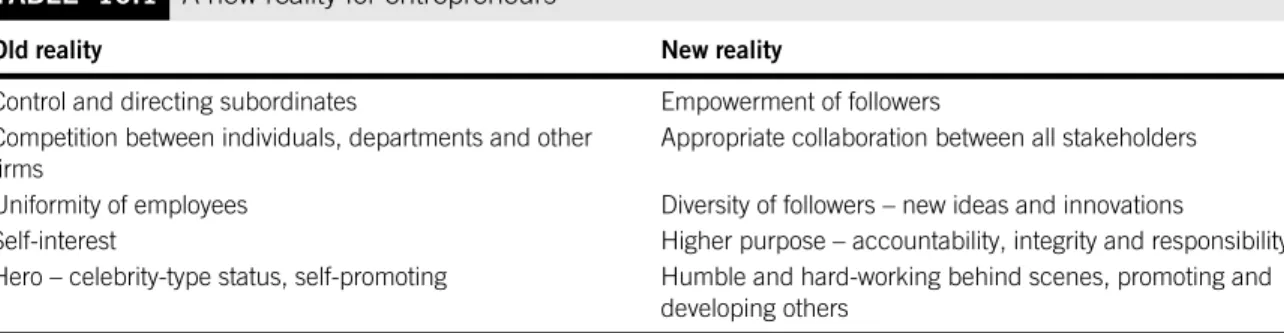
Table 10.1shows a summary of responses to these circumstances.
In the current environment hospitality entrepreneurs must either use or develop personal skills and qualities to establish a compelling and shared vision or direction for the business. They must be able to motivate and inspire all employees to embrace external or internally generated change and establish a culture of integrity (Daft, 2005). This is different to the entrepreneur as a manager where concern is targeted at administrative and procedural efficiency and effectiveness through organizing, planning, directing, controlling and so on. Obviously both are important roles and in small hospitality firms the founder will be expected to occupy them both to a lesser or greater degree depending on context. Indeed it is difficult to imagine a situation where they do not coexist. However during later stages of growth, sound team leadership is essential if the firm is to succeed.
Stages of growth have already been discussed elsewhere in this book and so we will not be discussing them at length here. However, the transition of a business founder to team leader (and player) is an essential part of this process and the entrepreneur must be able to behave in an appropriate manner accord- ing to the stage of growth the firm is experiencing. For example, as an hospi- tality firm matures the founder should begin to think as a team leader rather than a lonely‘crisis manager’and seek to employ individuals with sound team management skills despite the contextual difficulties inherent in the
TABLE 10.1 A new reality for entrepreneurs
Old reality New reality
Control and directing subordinates Empowerment of followers Competition between individuals, departments and other
firms
Appropriate collaboration between all stakeholders Uniformity of employees Diversity of followers–new ideas and innovations
Self-interest Higher purpose–accountability, integrity and responsibility
Hero–celebrity-type status, self-promoting Humble and hard-working behind scenes, promoting and developing others
Adapted from: Daft (2005, p. 8).
Founder to Leader 225
industry.1Zimmerer and Scarborough (2002) offer some guidance by discuss- ing management styles and matching them with organizational growth.
Table 10.2suggests that team leadership skills become increasingly important through growth and especially during the‘Entrepreneur-to-employee’s stage.
Similarly, Frederick, Kuratko, and Hodgetts (2007) discuss the changing role of the founder during the firm’s growth stages through the decision- making process. They explain that entrepreneurs typically face certain risks depending on which stage of growth the firm has reached. These stages are matched by a certain‘type’of entrepreneur:
I. Entrepreneurial genius–new company, enthusiastic founder with little interest in anything other than the firm’s success;
II. Benevolent dictator–founders act as parents surrendering no autonomy to followers;
III. Dissociated director–founders may feel alienated as they begin to realize that followers do not want to depend on them to make all TABLE 10.2 Guiding management styles for growing hospitality firms
Style Details
Craftsman &One person does everything
&Focus on quality
&Minimal operating expenses
&Limitations on growth unless others are employed
Classic &Other employees involved to exploit opportunities
&Delegation limited
&Tight control regime operated by founder
Entrepreneur-plus-employee &Shift from entrepreneur only to team working with significant delegation of responsibilities to trusted others
&Team members must be ready for this change and to accept extra responsibilities
Partnership &Sharing responsibilities with new partners or shareholders
&Skills must be complimentary
&Increased potential for disagreements between main players
Adapted from: Zimmerer and Scarborough (2002, pp. 502–503).
1In the SME sector of the hospitality industry this is easier said than done for a number of reasons including the job insecurity seasonality bestows. Another key challenge is a lack of career structure within independent hotels. A reasonable strategy would be to offer incentives linked to the continuing success of the entrepreneurial hotel. What could be offered really depends on the context, stage of growth of the firm, whether the individual hotel is linked with others informally or in the form of a joint venture and so on.
decisions, however, many will still work at an operational hands on level despite this. At this point, a key decision must be made whether to grow further or remain the same. A decision to grow will necessarily mean that founders must operate more strategically and delegate responsibilities to others; and
IV. Visionary leader–leadership used to position hospitality firm strategically for sustainable growth. Founders at this level tend to be removed from day-to-day operations, communicate openly with followers and adopt a more transformational style of leadership.
Adapted from: Fredericket al.(2007, p. 458).
Once again the founder as leader becomes important during a latter stage of organizational development.
Key point 10.3
Leaders now operate in a‘new reality’characterized by empowerment, leaders and followers rather than control and direction of subordinates.
ENTREPRENEURIAL LEADERS
According to Fredericket al.(2007), entrepreneurial leadership is the most important factor in managing high growth ventures successfully. Drawing on the work of Ireland and Hitt (1999) they also hold that‘strategic leadership’is most effective for fast growing entrepreneurial organizations. Using Ireland, Hitt and Hoskisson (2001) they choose to define entrepreneurial leadership as:
‘‘. . .the entrepreneur’s ability to anticipate, envision, maintain flexibility, think strategically and work with others to initiate changes that will create a viable future for the organization’’(p. 468).
Given the near celebrity status of often cited entrepreneurs such as Conrad Hilton and Lord Forte and the mythology surrounding their suc- cesses, it is often assumed that they are also effective leaders; this is not necessarily the case. Whilst some evidence suggests that entrepreneurs and leaders have many characteristics in common (see Dubrin and Dalglish, 2003) there are some differences. For example, Dalglish and Evans (2000) consider a key difference to be the way leaders deal with interpersonal relationships. A common reason for many individuals to opt for an en- trepreneurial lifestyle is because of their dislike of working closely with and taking orders from others. This is not an ideal characteristic on which to
Entrepreneurial Leaders 227
base effective leadership. On the other hand, the hospitality industry is awash with small or lifestyle firms employing only one or two family members. In this instance, dealing with others and delegating responsibil- ity may not be an imperative. These small organizations tend to rely on the entrepreneur replicating their family leadership role as partner or parent which is often autocratic.
However, in a growing hospitality firm entrepreneurs must overcome their communication shortfalls because the role of leader relies on the ability to motivate and inspire followers toward a well-communicated and shared vision. Moreover, if the small hospitality business is to grow significantly, the entrepreneur’s ability to apply these skills externally through networking, seeking alliances, partnerships and joint ventures is also crucial.
Notwithstanding the various contributions made to the field of lead- ership by competing theories, there exist several desirable behaviours about which commentators agree. Zimmerer and Scarborough (2002) note that today’s workforce is altogether more knowledgeable and sophisti- cated than at any other time in history. their expectations are there- fore similarly urbane. Figure 10.3 provides a summary of these desirable behaviours.
Burns’ (2001) perspective of behaviours common to both leaders and entrepreneurs is not dissimilar to the above and includes:
& Stamina;
& Commitment and dedication;
& Opportunism;
& Ability to bounce back;
& Motivation to excel; and
& Tolerance of risk, ambiguity and uncertainty.
Do these behavioural tendencies then give rise to an identifiable leadership style amongst hospitality entrepreneurs? The question is difficult to answer.
In practice it is difficult to be overly prescriptive because small business owners and contexts differ wildly. Leadership styles are wide and varied even outside the entrepreneurial context. Instead, it would be fair to say that styles of leadership are driven by a combination of contextual and personal factors (this is the major tenet of the contingency theorists). Typically, the hospitality entrepreneur is viewed as single-minded, driven, hard-working (and expects the same of others) and, to some extent, charismatic (Dubrin and Dalglish, 2003). Whilst charisma is difficult to categorize exactly, it is rooted in an array of variables including personality traits, culture, contextual variables and situations.
Reflective practice
1 Consider three leaders that have been described as charismatic. To what extent were their personal circumstances and/or world events responsible for their leadership style?
According to these authors entrepreneurial leadership style emerges from various configurations of the characteristics shown inFigure 10.4.
Once again we see recognizable behavioural characteristics in common between the perspectives of Zimmerer and Scarborough (2002), Burns (2001) and the above authors. For example all contain characteris- tics or equivalent of achievement, commitment, enthusiasm and so on.
FIGURE 10.3 Behaviours for effective leadership.
Adapted from: Zimmerer and Scarborough (2002, pp. 485–487).
Entrepreneurial Leaders 229
However, we can also see some typical behavioural weaknesses amongst entrepreneurs.
Key point 10.4
Entrepreneurial leadership is the most important factor in managing high growth ventures successfully.
If the founder is not skilled in such areas these abilities must be ac- quired otherwise the firm may either become unsuccessful or enjoy only limited growth. An area entrepreneurs typically have difficulty with is developing interpersonal empathy and communication. It is also the case that as firms grow management becomes difficult so the founder must also consider delegating responsibility to other capable people. The adage that to be successful means surrounding oneself with a talented team of people could not be truer than when the lifestyle firm moves into rapid growth phase. So what can the hospitality entrepreneur do to improve their ability as leader? The obvious answer of ‘skills acquisition’ is rather glib but, resources permitting, this is exactly what must be done. However, these skills may be ‘borrowed or ‘purchased’ by recruiting individuals who already possess the desired behavioural attributes. It is therefore vital that the hospitality entrepreneur creates an appropriate framework for this to take place. Second, an organizational culture should be established which will reinforce and maintain these behaviours. As firms grow there is a consensus that entrepreneurs should adopt a team leadership approach and the following section introduces the idea of teams in the small hospi- tality firm.
Reflective practice
1. Think of an entrepreneur known to you. How would you describe their behavioural characteristics.
2. A successful entrepreneur may not necessarily be an effective leader. Why do you believe this to be the case?
TEAMS
There is much discourse in the literature concerning teams and groups, that is, what are they; are they the same; if not, how are they different? In short, teams and groups differ according to the degree of interdependence individual
Teams 231
members enjoy when engaged in work. Group members tend to work inde- pendently of each other whereas teams rely heavily on members integrated outputs in order to complete the overall task successfully. Jobs can be designed with groups or teams in mind. For example traditionally, restaurant kitchens used a team of chefs each having a part to play in the production of a menu item. In the small hospitality firm these individual tasks are often combined and undertaken by a single person for reasons of cost saving (amongst others).
In any event, whether the entrepreneur chooses to classify employees as a team or a close working group makes little difference in terms of providing effective leadership.
Clegg, Kornberger and Pitsis (2008) define a team as:
‘‘Two or more people psychologically contracted together to achieve a common organizational goal in which all individuals involved share at least some level of responsibility and accountability for the outcome’’
(p. 92).
Essentially, a team leader needs to achieve inter-member harmony and cohesion whilst optimizing productivity. In service industries, productivity is difficult to define but essentially concerns transferring inputs into outputs at the lowest possible cost (Robbins, 2005, p. 27). This is no easy task and is doomed to failure if the members are haphazardly assembled. All other things being equal, members of the management team need to have complimentary rather than competing skills. They also need to be heterogeneous to capitalize on their differing perspectives but not so different that they have absolutely nothing in common.
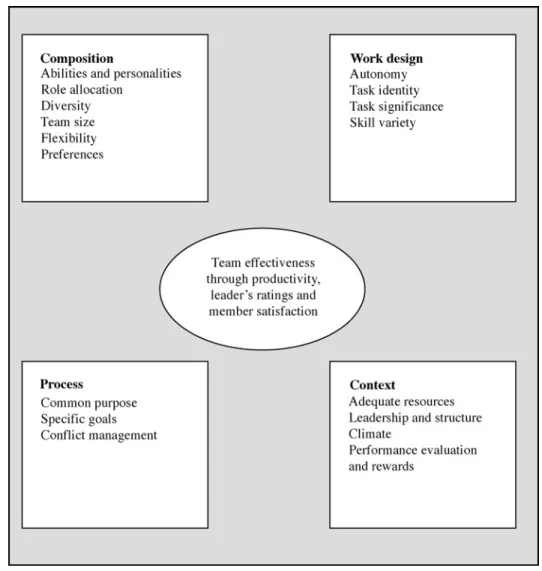
After reviewing the evidence, Robbins (2005) concludes that team effec- tiveness depends on a number of factors. They are summarised below in Figure 10.5.
To build an effective team, entrepreneurial leaders should consider:
& Communicating clear performance standards, setting the tone for such
early on such as at the first meeting;
& Creating a compelling context;
& Setting clear rules for team member behaviour and abide by them
yourself;
& Ensuring team is supplied with appropriate information about the task
in hand;
& Giving feedback regularly both formal and informal;
& Making sure members have complimentary skills and abilities;
& Ensuring team’s activities resonate with the overall strategy of the
hospitality firm;
& Being able to identify conflict and the emergence of political behaviour within the team and dealing with the situations promptly; and
& Encouraging creativity and risk-taking.
Adapted from Katzenbach and Smith (1993); and Hultman (1998).
Obviously the degree to which each of these actions is pursued depends on the contextual specifics of each situation. Clearly structural issues of context process and work design have a key role in the effectiveness of hospitality
FIGURE 10.5 A model of team effectiveness.
Adapted from: Robbins (2005, p. 278).
Teams 233
management teams (although work design variables seem more appropriate for operational activities). Scant attention to any of them could result in disaster but if a management team has an inappropriate composition, no amount of content, structure or process will remedy the situation. There has been much research attention on the composition of teams (for example, see Margerison and McCann, 1990; Stevens and Campion, 199). All author- ities agree that individuals should be selected carefully to obtain the optimum mix of skills and abilities. In a practical sense, management team members almost always occupy more than one role. This is especially the case in small hospitality firms where the management team may only number between two to four individuals. These managers have the difficulty of occupying multiple roles.
Reflective practice
1. Team working is often held as an effective way of operating an hospitality business. Can you give some examples when this may not necessarily be the case?
The pioneering work of Belbin (1981) helps to identify and explain what these roles are. There has been subsequent research but much still retains the tenets of the earlier author’s work. Belbin identifies nine key roles played by members of management teams. In no particular order they are classified as:
& The plant–creative and solves challenging problems but tends to get
too absorbed in their role to communicate effectively;
& The shaper–thrives on pressure and has a strong drive but may be
tactless and provocative;
& The team-worker–cooperative and diplomatic but may be prone to
indecisiveness;
& The implementer–reliable, conservative and practical but may resist
change;
& The resource investigator–explores opportunities and develops
contacts but quick to lose interest in an idea;
& The co-ordinator–clarifies the teams goals and delegates effectively but
may be seen as offloading too much of their own work;
& The monitor evaluator–judges accurately and has a strategic focus but
may not inspire others;
& The specialist–self-motivated and provides rare skills but has ability to
focus too much on minutiae; and
& The completer finisher–conscientious and delivers on time but may worry unnecessarily and be reluctant to delegate.
Adapted from Belbin (1981).
Reflective practice
1. Consider a small hospitality firm employing only four people including the owner. Which of Belbin’s team roles would you consider essential for such an operation?
As discussed previously in this chapter team working is the ideal approach for hospitality firms when growing and developing. However, even with the best intention, teams will have difficulty prevailing when they are not sup- ported by an appropriate organizational culture. Culture has been described as the‘social glue’which holds organizational practices together. The following section discusses what it is, how it is established and applies to hospitality firms.
CULTURE
Organisational culture may be viewed from two perspectives (Legge, 1995).
That is, organizations either‘have’it or organisations actually’are’it. The former is a structural view and the second holds that culture is separate from any framework imposed by management and is best described as a root system of meanings (Gregory, 1983). One can see immediately that if culture is
‘objective’or a summary of organisational values it is manageable. Conversely if we adopt the second perspective, culture is now an outcome of social inter- action. As such, it may only be possible to describe or interpret it. This is not to say that management has no impact on organisational culture, just that all members of the organisation have their own constructions of reality. In prac- tice, both espoused and spontaneous cultures exist alongside each other so managers should have an understanding of how the latter impacts on the former.
Reflective practice
1. Think of two dissimilar small or medium-sized hospitality business known to you or that you have identified through a literature/desk search. Describe the culture that each appears to have and how you came to that decision.
2. What impact has the founder had on the organizational culture?
Culture 235
If the entrepreneurial leader fails to establish an appropriate culture, fol- lowers will begin to form one of their own. Situations like these are all too common in the hospitality industry, particularly in the unaffiliated sector where some entrepreneurs fail to identify, create and reinforce a common set of values for followers. This may not be so important where the firm is small employing only a handful of people as its culture often tends to be an extension of the founders beliefs and attitudes. Such a small group of followers may not always need a formal and organized set of core values but employers will nonetheless have expectations of behaviour. Moreover, communicating these may not be overly difficult as the channels are likely to be short and direct. Usually, they are encapsulated in items like job descriptions, recruit- ment and selection protocols and by virtue of being in close proximity to the founder for most of the time. However, as the organization grows, communi- cation channels become more complex and there is an increased chance of
‘drop out’and misunderstanding. In other words, the effective proliferation of these values to others becomes more difficult. The hospitality entrepreneur must not assume that all followers will share her values, beliefs and attitudes.
Indeed, the nature of the hospitality labour market and characteristics of the industry present extra challenges for the entrepreneur. Any attempt to create an organizational culture must account for the fact that much hospi- tality work is unskilled, temporary, seasonal or part-time with reduced bene- fits and working conditions. Levels of labour turnover are extremely high in some sectors and ‘tipping’ is still an accepted way for some employers to justify low pay. Traditionally, management is autocratic and despotic and union membership is low. There is also a mindset shared by some employees in the seasonal tourist sector that hospitality employment is not a‘serious’job only to be tolerated until something better turns up. Finally, some workers view hospitality jobs as little more than an opportunity to enjoy a paid holiday.
These are significant contextual factors which if ignored will seriously under- mine any attempt to create a positive organizational culture.
ORGANIZATIONAL CULTURE: WHY BOTHER?
Why is the establishment of an organizational culture so important? Some argue that a strong culture is a replacement for company policies and proce- dures. Peters and Waterman (1982) claim that culture replaces the need for formal protocol because everyone knows exactly what needs to be done.
Robbins (2001) defines organisational culture as:
‘‘A common perception held by the organisation’s members; a system of shared meaning’’(p. 510).
In an organizational sense, culture is tricky to define because it is com- prised of so many things but is often described as a code of conduct which governs the way people act and think in the work place. In service industries and particularly in small hospitality firms, culture can have a significant impact on success or failure. The most effective entrepreneurs recognize the role played by workers in service delivery and the potential impact that they have every time they interact with customers. A leader’s ability to create and maintain (and change if necessary) an appropriate service-oriented culture for their business is therefore important.
According to Robbins (2001) organizational cultures are based on several characteristics shown inFigure 10.6.
The position of individual firms along the‘low’/‘high’scale for each char- acteristic has driven others to create cultural typologies. For example, Handy (1990) conceptualises four different, but not exclusive, types of‘power’,
‘role’, ‘task’and ‘person’. The power culture is often found in small firms where much is based on trust, empathy and personal communication. The role culture tends to be present in larger firms and where there are strict controls, bureaucracy and a strong sense of positional power. Leaders, by definition, have authority within hospitality organizations. Their authority can be either conferred by dint of their official role and status or emergent from the degree of respect they receive from followers. French and Raven (1960) classify five sources of power into:
& Legitimate–authority granted by individual’s position within the firm
where followers simply accept the formal authority of that person;
& Reward–authority to bestow; and
& Coercive–authority to withhold or punish.
These are conferred by position power defined by the firm’s policies and procedures. The remaining two sources of power are ‘Expert’ and
‘Referent’ power and are based on the entrepreneur’s special knowledge and or their personal characteristics. Ideally, the leader’s sources should be expert and referent as they stem from followers’ respect and admiration.
The positional sources of power tend to be less about effective leadership but more about an individual’s role within the firm. Founders should bear in mind that the accomplishment of the organization’s goals requires more that leadership based on positional power. Handy’s task culture charac- terises firms who are project or matrix oriented and the person culture has a focus on the person where autonomy is enjoyed where control is agreed by mutual consent.
Founders should be aware that if left unchecked their firms may begin with a task culture but end up with a power culture especially if the entrepreneur
Organizational Culture: Why Bother? 237
has difficulty delegating. In turn, this culture may morph into a role culture where job titles become more important that the job itself.
Other typologies also exist but all basically tell a similar story, for example, Deal and Kennedy (1982) refer to cultures of:
& Macho;
& Work hard/play hard;
& Bet-your-company; and
& Process.
FIGURE 10.6 Primary characteristics of organisational culture.
Adapted from: Robbins (2001, pp. 510–511).
Armed with the knowledge that all organizational cultures are subject to key influences and that all can be described along continua defined by basic characteristics we can begin to think about what makes for a suc- cessful culture. After reviewing the evidence, Zimmerer and Scarborough (2002) argue that entrepreneurial firms need to focus on the following principles:
& Respect for work life balance through flexible scheduling, job sharing,
part-time work, on site day care and so on;
& A sense of purpose through defining the hospitality firm’s vision and
communicating it clearly to everyone;
& Promoting a sense of fun in the workplace;
& Valuing and pursuing diversity in the work place to build strength
through use of different skills, talents and abilities of followers;
& Promoting a high sense of ethical and moral responsibility in the work
place;
& Use of participative management styles consistent with new
transformational leadership approaches; and
& Retain a life long learning environment in order to attract, motivate and
retain followers.
Key point 10.5
The elements affecting the formation of organisational culture are philosophy of founders, selection criteria and socialisation to founders’mindset.
Similarly based on the earlier work of Timmons (1999), Burns (2001) considers that a desirable entrepreneurial organizational culture is based on six dimensions:
& Extent to which employee’s are committed to organizational goals;
& Extent to which they feel recognized and rewarded for good
performance;
& Degree to which org goals, policies and procedures and understood;
& Degree to which high standards are expected;
& Extent to which employees feel responsible for goal achievement
without excessive monitoring; and
& Extent to which a sense of team cohesion is present.
Organizational Culture: Why Bother? 239
How do we know what kind of culture an hospitality organization has?
Cultural artefacts are relatively easy to identify in a firm and may include dress code, use of ‘company language’2 and the physical appearance of a building such as that used by various fast-food restaurants internationally.
Other facets of culture are more subtle and therefore less easily observed.
Schein (1985) explains the differences between the observable and non- observable factors through levels of culture. For example, dress code exists at level one (artefacts and creations) whereas values and basic assumptions are ‘invisible’ or ‘taken for granted’. An example of Schein’s level two (values) would be why work groups behave as they do, for example, is it permissible to call the employer or managers by first name? The extent to which members hold these behavioural values and norms as unquestionable determines whether the organisational culture is‘strong’or‘weak’. Level three concerns basic and tacit assumptions that determine how members perceive, think, and feel. This stage represents that which is taken for granted by the group or that which is so deeply rooted it enters the uncon- scious. If a strong team culture is to be established and sustained success- fully by the founder, this is the level at which training and socialisation procedures should focus.
So how does the hospitality entrepreneur establish and sustain an appro- priate organizational culture? Robbins (2001) considers the following to be important (Figure 10.7):
& Philosophy of founders–early culture formation when firm first
established; founder’s vision easily imparted to all members; for example, original Forte and Marriott groups union-busting and paternalistic culture is a philosophy of both Charles Forte and Bill Marriott; founders able to influence‘espoused’or formal culture but not actual/informal or‘culture-in-practice’;
& Selection criteria–staff hired in founders’image; other human
resource practices such as training and reward systems linked similarly;
& Top management–behave in a manner which supports original
philosophy; rituals and physical symbols which reinforce key values, norms and goals; and
& Socialization–to founders’mindset, success perceived as linked
directly with founding philosophy; self–perpetuating, sustained by
2The Disney corporation is a prime example where staff are referred to as‘cast members’ and jobs become‘performances’(Zimmerer and Scarborough, 2002).
legends of how firm began which justifies present behaviour or culture in the past, for example Conrad Hilton, Richard Branson; use of company‘language’, for example in many hotels staff from different departments are often referred to by use of acronyms or other terms (KPs–kitchen porters or stewards; food service staff may be labelled, rather disparagingly, as‘plate carriers’by chefs).
Adapted from Lashley and Lee-Ross (2003).
SUMMARY
There is a tendency to believe that successful entrepreneurs make good leaders. Whilst there are individuals who excel in both roles there are also others for whom leadership is something more of a challenge. Effective lead- ership requires certain abilities and skills, for example, does the entrepreneur have the capacity to analyse and diagnose work contexts and situations before behaving in the capacity of leader?
Many theories exist all having their own perspective on the best way to lead organizations. In the main they are complimentary with the possible excep- tion of the newer postmodern constructs which regard leaders as stewards and servants. In short the leadership role here becomes inverted to the extent that followers become leaders andvice versa. Nonetheless, founders of small and growing hospitality firms need to grasp and use this knowledge and that afforded them by experience and good fortune if they are to be both notable entrepreneurs and leaders.
Whilst firms stay small (and many do in the hospitality industry) the requirement for the business founder to grow and develop into an effective leader is of lesser importance than when firms move from the lifestyle type into the entrepreneurial firm. During the transition, there are a number of
FIGURE 10.7 Key elements affecting the formation of organisational culture.
Adapted from: Robbins (2001, p. 523).
Summary 241
behavioural characteristics which are essential for robust leadership. These include respecting and supporting employees, embracing change, leading by example, creating an appropriate culture, communicating effectively and so on. However, evidence suggests that entrepreneurs are not particularly adept at interpersonal relations and communication. These are two key areas which must be addressed as firms grow and employ more people otherwise the hospitality business is likely to be compromised. Indeed, as the firm grows most commentators agree that the entrepreneur must adopt a team approach to running the company. To do this well requires the establishment of good interpersonal relationships and effective communication amongst and be- tween the team.
Thus, the founder must have a basic understanding of organizational culture and the levels at which it manifests itself and how to affect and maintain core values through:
& establishing and perpetuating through selection criteria;
& embodiment through the management team; and
& socialization.
She must also be aware of some important environmental and labour market characteristics likely to influence organizational culture such as
‘tipping’, temporary, casual and part-time working, attitudes of some hospi- tality workers and so on. Finally, the founder must be clear that if little attempt is made to espouse an official culture another version will surely fill the void.
In many instances this ‘culture in practice’ will impact negatively on the organization.
Case:Simon Says. . .. By Michael Fahy
It wasn’t really surprising to learn that Simon Woodroffe had once been a stage designer for Rod Stewart and The Moody Blues. After all with his cultivated sideburns and trademark yellow suede boots, the 50 year old entrepreneur looks as if he has just walked in from the latest Spinal Tap video. To describe Woodroffe as flamboyant would be an understatement, but the founder and chairman of YO! Sushi argues that business needs a dash of colour. He thinks we should all dream a little more too, so long as we have the courage of our convictions and follow them.
I’ve yet to meet the person who, even at the risk of their own financial security, went out to do what they dreamed of and regretted it, regardless of success or failure. It has certainly worked for him. After leaving school with only three‘O’levels he became a roadie and eventually found himself sitting in the same rooms as Stevie Wonder, the Rolling Stones and others.
Seizing the opportunity, he set about convincing them that their stage shows needed fireworks, trapeze wires and other cunning stunts. He then established a company to deliver