LEGAL AND REGULATORY ISSUES OF ISLAMIC FINANCE IN TURKEY:
A QUALITATIVE DISCUSSION
Murat Yaş
Institute of Islamic Economics and Finance, Marmara University, Turkey e-mail: [email protected]
Submitted: 21 March 2023 - Last revised: 17 August 2023 - Accepted: 25 August 2023
This study aims to explore issues related to Islamic financial regulations in Turkey through the use of semi-structured interviews. A total of 12 respondents were involved, including regulators, members of the Central Advisory Board (CAB), the Advisory Board of Islamic Financial Institutions (IFIs), and managers from IFIs in Turkey. The results highlight consistent calls for the establishment of an act for the Participation finance industry. This act is seen as a means to ensure tax neutrality, reinforce norm hierarchy, prevent the imitation of conventional financial products, and mitigate Shari’ah non-compliance risk. Additionally, our empirical findings emphasise the importance of enhancing stakeholder engagement, clarifying roles, establishing a robust organizational structure, and enhancing transparency and independence for regulatory authorities. Improved regulatory governance is crucial for enhancing regulatory outcomes. Lastly, the study underscores the need for standardised guidelines for PFIs and emphasises the significance of their voluntary implementation.
Keywords: Islamic Finance, Regulation, Law, Challenges, Recommendations
Abstract
I. INTRODUCTION
Turkey has a long history with the Islamic finance industry, known as Participation Finance, dating back to the 1980s. The market share of Participation Banks (PBs), which are Turkish Islamic banks, has grown from 2.4% (US$6.8 billion) in 2005 to 8.6% (US$57 billion) in 2022. In 2010, Kuveyt Türk Participation Bank introduced the first leasing certificate (Sukuk) facility, raising US$100 million in lease certificates. As of 2022, Sovereign Sukuk issuances totalled approximately US$8 billion, while Sukuk issuance by Participation Banks reached approximately US$9 billion. Although there were no Islamic funds a decade ago, the total number of Islamic investment and pension funds reached 93 in 2021, with a market share of 5.6% (US$16 billion)
in 2022. The private pension reform played a crucial role in the development of the Islamic fund market.
The establishment of state-owned Participation Finance Institutions and the development of a regulatory framework have been catalysts for the expansion of the Islamic finance industry over the last decade. While a special law for the Participation Finance Industry is currently unavailable, the Finance Office of the President of the Republic of Turkey (CBFO) has recently launched its Participation Finance Strategy Document, expressing Turkey’s willingness to establish a Participation Finance Act. The aim is to eliminate regulatory obstacles, facilitate the development of the Islamic financial system, and address the industry’s unique needs 1.
Turkey currently has a sophisticated regulatory framework for Participation Finance. The Banking Regulation and Supervision Agency (BRSA) regulates both participation and conventional banks under the same Banking Law and implementing regulations. The Capital Markets Board (CMB) regulates corporate Sukuk, while the Ministry of Treasury and Finance (MTF) regulates Sovereign Sukuk (lease certificates). Participation Insurance and Participation Pension Firms are regulated by the Insurance and Private Pension Regulation and Supervision Agency (IPPRSA).
Participation Finance Institutions in Turkey operate within a civil law system based on codified laws, with an emphasis on secularism in the constitution that leads to frequent avoidance of the use of Arabic and Shari’ah/Islamic terms for Islamic financial products and services. Consequently, the development of the Participation Finance Industry has faced challenges due to different interpretations of secularism in the constitution among political parties. This has led to debate among policymakers on creating a suitable and comprehensive legal and regulatory framework for the industry 2.
Thus, this study examines the development of legal and regulatory efforts in Turkey’s Participation Finance Industry by investigating current issues and challenges. The research objectives are achieved through semi-structured interviews conducted with 12 respondents including regulators, Islamic
1 CBFO. 2023. “Participation Finance Strategy Document.” https://www.cbfo.gov.tr/sites/default/
files/2022-11/participation-finance-strategydocument-2022-2025-holistic-transformation.pdf.
2 Murat Yas, Hakan Aslan, and Mucahit Ozdemir, “Modern History of Islamic Finance and a Strategic Roadmap for Its Development in Turkey,” in Turkish Economy (Cham: Springer International Publishing, 2018), 213–38, https://doi.org/10.1007/978-3-319-70380-0_10; Murat Yaş and Ahmet Faruk Aysan, “Central Advisory Board and the New Shariah Governance Framework for Islamic Banks in Turkey,” in Shariah Governance in Islamic Banking Institutions (London: Routledge, 2023), 65–79, https://doi.org/10.4324/9781003324836-4; Semiha Topal, “Everybody Wants Secularism — But Which One ? Contesting Definitions of Secularism in Contemporary Turkey,” no. 44 (2012): 1–14, https://doi.org/10.1007/s10767-011-9114-z.
finance experts, members of the Central Advisory Board (CAB), the Advisory Board of Participation Financial Institutions (PFIs), and managers from PFIs in Turkey. The empirical results highlight the need for increasing stakeholder involvement, improving role clarity, developing a robust organizational structure, enhancing transparency, and furthering independence to enhance regulatory governance in Participation finance. Additionally, there is a constant demand for a Participation Finance Act to ensure tax neutrality, strengthen the hierarchy of norms, prevent conventional financial product mimicry, and reduce Shari’ah non-compliance risk. The research also emphasises the importance of unified guidelines for PFIs and their voluntary implementation.
Islamic financial regulations play a vital role in the sustainable growth and stability of Islamic Financial Institutions (IFIs).3 As a result, there is a growing body of literature focusing on Islamic financial regulations in various countries, including Australia,4 Nigeria,5 Indonesia,6 the UAE,7 Mauritius,8 Malaysia,9 and South-eastern Europe.10
Recently, Yaş and Aysan11 investigated issues and challenges regarding the new Shari’ah Governance Framework in Turkey. However, there is still limited literature on Islamic financial regulations in Turkey. Examining regulatory and
3 Xingjian Li et al., “The Effect of Revenue Diversification on Bank Profitability and Risk during the COVID-19 Pandemic,” Finance Research Letters, no. December 2020 (2021): 101957, https://
doi.org/10.1016/j.frl.2021.101957; Christos Alexakis and Alexandros Tsikouras, “Islamic Finance:
Regulatory Framework – Challenges Lying Ahead,” International Journal of Islamic and Middle Eastern Finance and Management 2, no. 2 (2009): 90–104, https://doi.org/10.1108/17538390910965121;
Rihab Grassa and Kaouthar Gazdar, “Law and Islamic Finance : How Legal Origins Affect Islamic Finance Development ?,” Borsa Istanbul Review 14, no. 3 (2014): 158–66, https://doi.org/10.1016/j.
bir.2014.05.001.
4 Abu Umar Faruq Ahmad and M. Kabir Hassan, “Legal and Regulatory Issues of Islamic Finance in Australia,” Managerial Finance 2, no. 4 (August 2009): 305–22, https://doi.org/10.1108/
mf.2008.00934jaa.001.
5 Zakariya Mustapha, Sherin Binti Kunhibava, and Aishath Muneeza, “Legal and Sharī’ah Non- Compliance Risks in Nigerian Islamic Finance Industry: A Review of the Literature,” International Journal of Law and Management 63, no. 2 (2021): 275–99, https://doi.org/10.1108/IJLMA-03-2020-0075.
6 Nur Dyah Nastiti and Rahmatina Awaliah Kasri, “The Role of Banking Regulation in the Development of Islamic Banking Financing in Indonesia,” International Journal of Islamic and Middle Eastern Finance and Management 12, no. 5 (November 2019): 643–62, https://doi.org/10.1108/IMEFM-10-2018-0365.
7 Andrew Henderson, “Limiting the Regulation of Islamic Finance: Lessons from Dubai,” Law and Financial Markets Review 1, no. 3 (2007): 213–20, https://doi.org/10.1080/17521440.2007.11427881.
8 Varsha Mooneeram-Chadee, “The Regulation of Islamic Banking in Mauritius,” ISRA International Journal of Islamic Finance 12, no. 2 (2020): 265–80, https://doi.org/10.1108/IJIF-09-2019-0139.
9 Younes Soualhi and Said Bouheraoua, “Islamic Finance Law and Regulations in Malaysia: A Macro Maqāsidic Approach,” ISRA Research Paper, 2019, 46.
10 Asim Jusic and Ashraf M. Ismail, “Islamic Finance in the Western Balkans: Prospects and Regulatory Challenges,” Arab Law Quarterly 26, no. 2 (2012): 193–210, https://doi.org/10.1163/157302512X628332.
11 Yaş, Murat, and Ahmet Faruk Aysan. 2023. “Central Advisory Board and the New Shariah Governance Framework for Islamic Banks in Turkey.” In Shariah Governance in Islamic Banking Institutions, 65–79.
London: Routledge. https://doi.org/10.4324/9781003324836-4.
legal issues in the Turkey provides valuable lessons and roadmaps for both Muslim minority and Muslim majority countries with a particular focus on secularism and ambitions to develop a legal and regulatory infrastructure for the Islamic finance industry as well as becoming hubs for it.
This study contributes to the existing literature in several ways. First, it investigates the most recent issues, challenges, and impacts of Participation Finance Regulations in Turkey, adding to the existing literature. Second, it is the first study of the regulatory and legal issues surrounding Islamic finance in Turkey to employ a qualitative method and use semi-structured elite interviews.
Third, the study highlights the significant role of regulatory governance in Islamic financial regulations, which is a unique contribution. Finally, the study gathers data through perspectives of market participants and regulators regarding theoretical debates about Islamic financial regulation. This research fills a gap in the literature by investigating the development and understanding specific types, processes, and dimensions of Islamic financial regulations at the national and international levels.
This paper is structured as follows: Section two reviews the related literature.
Section three presents the data and methodology. Section four discusses the findings on regulatory governance, the legal and regulatory framework, and international standards and regulations. Finally, section five presents the conclusions and policy recommendations.
II. LITERATURE REVIEW
A significant body of literature has focused on the importance of establishing a robust regulatory framework to mitigate risk of legal and Shari’ah non- compliance and ensure the sustainable growth of the Islamic finance industry.
Kok, Akwei, Giorgioni, and Farquhar conducted semi-structured interviews, and the results indicated the need for a comprehensive regulatory framework governing the Islamic financial system.12
Similarly, Taktak and Zouari suggested that the Tunisian government should create a comprehensive regulatory framework for its Islamic financial industry, accompanied by special incentives to promote financial investment in Islamic finance.13 Uddin and Mohiuddin investigated the challenges of Islamic social
12 Kok et al., “On the Regulation of the Intersection between Religion and the Provision of Financial Services: Conversations with Market Actors within the Global Islamic Financial Services Sector,”
Research in International Business and Finance 59, no. September 2021 (2022): 101552, https://doi.
org/10.1016/j.ribaf.(2021):101552.
13 Neila Boulila Taktak and Sarra Ben Slama Zouari, “Tunisia Islamic Finance: Overview and Future Prospects,” Journal of Islamic Accounting and Business Research 5, no. 1 (2014): 2–14, https://doi.
org/10.1108/JIABR-02-2014-0007.
finance in Bangladesh and found that a weak regulatory and policy environment had significantly hampered the true potential of Islamic finance.14 Mustapha et al. analysed the Shari’ah non-compliance risk in Nigeria’s Islamic banking industry and emphasised the need for tailored Shari’ah-based regulations, as well as corresponding governance and oversight, to ensure legally safe and Shari’ah-compliant Islamic finance practices there.15
Many researchers highlight the importance of harmonizing Islamic finance standards and regulations to foster the global development of the industry.
Smolo and Habibovic argue that cross-border transactions face obstacles due to disagreements among Shari’ah scholars on fundamental rules and principles.16 Although organizations like AAOIFI, IFSB, and IIFM aim to address this issue, there is still room for improvement. Similarly, Kok et al.
contend that nuanced regional interpretations of Shari’ah create barriers to harmonization.17 Similarly, Ahmed, Mohamad, and Kashi emphasis that the internationalisation of Islamic finance markets necessitates the adoption of consistent, harmonised, and stringent regulatory standards.18
There is a crucial debate surrounding whether harmonised standards in Islamic financial practices hinder innovation within the industry. Empirical evidence from Kok et al. suggests that complete standardisation may be unfavourable as it could stifle innovation and continuous improvement in the Islamic finance industry.19 Taktak and Zouari also argue that major sub-sectors of Islamic finance should be developed to provide customers with a wide range of financial services and Shari’ah-compliant investment products.20 Jusic and Ismail discuss that legal reforms should reduce the costs associated with financial innovation in equity-based Islamic financial products.21
Several scholars have examined the relationship between regulations and taxation in Islamic finance. Uddin and Mohiuddin and Ahmad and Hassan
14 Uddin, T. A., & Mohiuddin, M. F., “Islamic Social Finance in Bangladesh: Challenges and Opportunities of the Institutional and Regulatory Landscape,” Law and Development Review, 13(1) (2020): 265–319.
https://doi.org/10.1515/ldr-2019-0072.
15 Zakariya Mustapha, Sherin Binti Kunhibava, and Aishath Muneeza, “Legal and Sharī’ah Non-Compliance Risks in Nigerian Islamic Finance Industry: A Review of the Literature,”
International Journal of Law and Management 63, no. 2 (2021): 275–99, https://doi.org/10.1108/
IJLMA-03-2020-0075.
16 Smolo, Edib, and Elmin Habibovic, “Barriers to Growth of Islamic Finance: Issue of Standardisation.”
Islamic Banking & Finance: Principles, Instruments & Operations, no. May (2012): 717–37. https://
doi.org/10.1016/j.frl.2021.101957.
17 Kok et al., “On the Regulation.”
18 Ahmed, Mohamad, and Kashi, “Does an Islamic Finance Industry.”
19 Kok et al., “On the Regulation.”
20 Taktak and Zouari, “Tunisia Islamic Finance.”
21 Jusic and Ismail, “Islamic Finance.”
highlight that the trade and asset-based nature of Islamic financial products often leads to double taxation or unfair taxation of Islamic financial products and institutions.22 Therefore, Ahmed, Mohamad, and Kashi suggest that the enforcement of a uniform tax framework is essential to ensure fair competition between conventional and Islamic financial institutions.23
III. DATA AND METHODOLOGY
The study investigates the issues and challenges related to the legal and regulatory framework of the Participation Finance Industry in Turkey. A qualitative case study approach was employed to achieve the research objective. The use of a qualitative method allows researchers to understand the motivations, reasons, and actions that quantitative data may fail to capture (Myers, 2019). In this study, the qualitative method was chosen for its potential to generate comprehensive explanations and discussions concerning the expected functions of the legal and regulatory framework for the Participation finance industry in Turkey.
Semi-structured questions were utilised during the interview sessions to explore the roles and functions of Participation Finance Regulations in Turkey.
Similar methods have been employed by Alam et al.24, Taktak and Zouari25, Kok et al.26, Oseni27, and Uddin and Mohiuddin28 to investigate issues and challenges related to Islamic finance standards and regulations. The semi-structured questions focused on issues and challenges regarding the legal and regulatory framework for the Participation finance industry, regulatory governance, and relations with international standard-setting bodies. Employing semi- structured questions during the interviews facilitated open discussion between the researcher and participants, enabling a deeper understanding on the issues and challenges and generating recommendations for Participation Finance Regulations in Turkey.
Regarding the selection of interviewees, purposive sampling allowed researchers to choose the most relevant participants based on their knowledge
22 Uddin and Mohiuddin, “Islamic Social Finance,”; Ahmad and Hassan, “Legal and Regulatory Issues.”
23 Ahmed, Mohamad, and Kashi, “Does an Islamic Finance Industry.”
24 Alam, Md Kausar, Hasri Mustafa, Md Salah Uddin, Md Jahirul Islam, Marjea Jannat Mohua, and Md Farjin Hassan. “Problems of Shariah Governance Framework and Different Bodies: An Empirical Investigation of Islamic Banks in Bangladesh.” Journal of Asian Finance, Economics and Business 7 (3).(2020): 265–76. https://doi.org/10.13106/jafeb.
25 Taktak and Zouari, “Tunisia Islamic Finance.”
26 Kok et al., “On the Regulation.”
27 Oseni, Umar “The Law and Regulation of Franchising in Malaysia’s Islamic Finance Industry:
Problems, Prospects and Policies.” Global Journal Al-Thaqafah 6 (2). (2016): 37–45. https://doi.
org/10.7187/gjat11220160602.
28 Uddin and Mohiuddin, “Islamic Social Finance.”
and capacity for addressing the research objectives.29 However, later on in the process, a few participants were added to the sample using the snowballing technique. Malterud, Siersma, and Guassora emphasised that the size of a sample with sufficiently relevant information is determined by the study’s goals, sample specificity, application of known theory, dialogue quality, and analysis approach.30
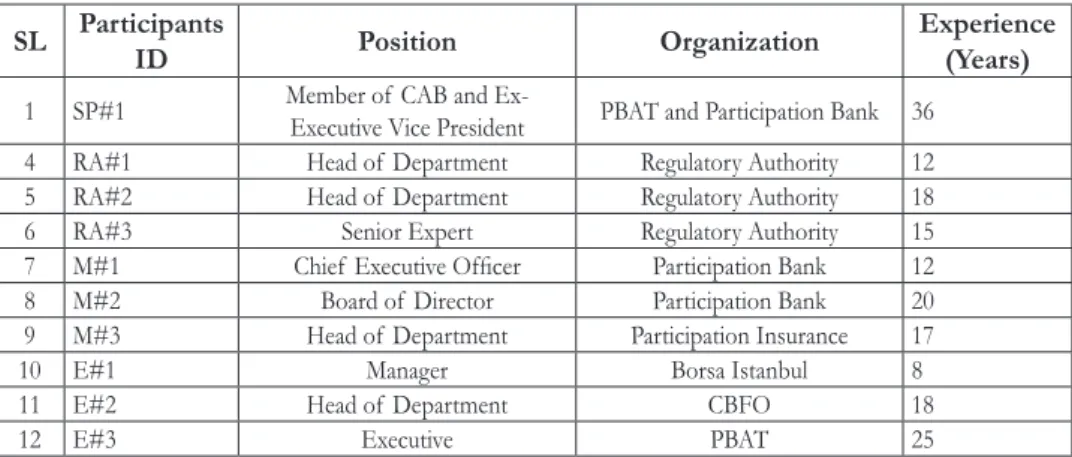
Empirical studies have reached saturation with a range of 9-17.31 Considering the key stakeholders in the Islamic finance industry in Turkey, 12 participants for semi-structured interviews were deemed sufficient to capture the diversity, depth, and nuances of the legal and regulatory issues of Islamic finance in Turkey. The semi-structured interviews were conducted with 12 individuals, including members of the Advisory Board and Advisory Committees, managers from Participation Finance Institutions (PFIs), and regulatory bodies. The interviewees had direct involvements with PFIs, the legal and regulatory framework, regulatory governance, and international standard-setting bodies. Table 1 provides a detailed list of the interviewees and their affiliations.
29 Palinkas, Lawrence A., Sarah M. Horwitz, Carla A. Green, Jennifer P. Wisdom, Naihua Duan, and Kimberly Hoagwood. “Purposeful Sampling for Qualitative Data Collection and Analysis in Mixed Method Implementation Research.” Administration and Policy in Mental Health and Mental Health Services Research 42 (5): 2015. 533–44. https://doi.org/10.1007/s10488-013-0528-y.
30 Malterud, Kirsti, Volkert Dirk Siersma, and Ann Dorrit Guassora. “Sample Size in Qualitative Interview Studies.” Qualitative Health Research 26 (13): 2016. 1753–60. https://doi.
org/10.1177/1049732315617444.
31 Hennink, Monique, and Bonnie N. Kaiser. “Sample Sizes for Saturation in Qualitative Research:
A Systematic Review of Empirical Tests.” Social Science & Medicine 292 (January (2022): 114523.
https://doi.org/10.1016/j.socscimed.2021.114523.
SL Participants ID Position Organization Experience (Years)
1 SP#1 Member of CAB and Ex-
Executive Vice President PBAT and Participation Bank 36
4 RA#1 Head of Department Regulatory Authority 12
5 RA#2 Head of Department Regulatory Authority 18
6 RA#3 Senior Expert Regulatory Authority 15
7 M#1 Chief Executive Officer Participation Bank 12
8 M#2 Board of Director Participation Bank 20
9 M#3 Head of Department Participation Insurance 17
10 E#1 Manager Borsa Istanbul 8
11 E#2 Head of Department CBFO 18
12 E#3 Executive PBAT 25
Table 1: Background of Interviewees
The interviews lasted between 45 and 70 minutes. Prior to the interviews, the respondents were consented to recording. It was assured that their identities would remain anonymous and would not be disclosed publicly. To protect the privacy of the interviewees, code names were used, such as “RA”
(regulatory authority) for regulators from CMB, BRSA, and IPRRSA, “SP”
(Shari’ah practitioners) for members of Advisory Committees and CAB,
“M” (Managers) for managers of Participation Finance Institutions, and “E”
(Experts) for Islamic finance experts from CBFO, Borsa Istanbul, and PBAT.
IV. FINDINGS AND DISCUSSIONS A. Regulatory Governance
1. Role Clarity
Role clarity is critical for regulatory bodies to comprehend and efficiently fulfil their functions.32 A regulator’s role should be clearly defined in terms of their objectives, functions, and coordination with other authorities. There can be disharmony among regulatory bodies and a lack of clarity with regard to their roles and responsibilities among them to certain extent. The interviews indicated that regulatory authorities should carefully identify potential overlaps and gaps with other regulators and provide a clear procedure through healthy communication with other regulatory bodies for improving outcomes of regulatory decisions. RA#1 stated that:
The impact of regulations extends beyond a single legislation, often involving multiple institutions responsible for each legislation. Consequently, collaborative efforts among these institutions are imperative to reach joint decisions. However, in our country, there is a tendency for individuals or institutions to claim credit for the work of others, leading to the possibility of neglecting the contributions and concerns of other institutions. This fragmented approach to task management poses several challenges. It can result in the emergence of new problems or the failure to address existing ones when developing standards. Consequently, revising these standards at a later stage becomes an additional challenge. [RA#1]
2. Organizational Structure
Interviewees were quick to point out that an organisational structure for regulatory bodies is essential for the development of robust Participation Finance Standards and Regulations. It is implausible to expect all regulatory staff to be involved in Participation Finance Regulations due to the distinct
32 Phoebe Friesen, Barbara Redman, and Arthur Caplan, “Of Straws, Camels, Research Regulation, and IRBs,” Therapeutic Innovation & Regulatory Science 53, no. 4 (July 2019): 526–34, https://doi.
org/10.1177/2168479018783740.
characteristics of PFIs. Therefore, interviewees (RA#1 and RA#2) suggested that developing standards and regulations explicitly for PFIs, should be the responsibility of specific staff in the regulatory authorities to reduce overlaps and regulatory burdens. However, there were polarised opinions on the matter of whether a distinct department for Participation Finance should be established within each regulatory body or not. RA# 3 summarised that:
Islamic capital markets are regarded as a cross-cutting issue and hence, there is no specific/single department on Participation finance regulation and supervision at the CMB. However, in the related departments, some staff spend more time on this area when compared to their colleagues. So, it has not been considered necessary to form a separate organizational unit for Participation finance regulation and supervision at the CMB. [RA#3]
RA#2 added that:
in 2021, the Participation Finance Department was established in the CBFO and the Central Bank. In addition, the opening of this unit in other regulatory institutions came to the fore. This is a good practice, and I expressed my views in 2015 that Participation finance departments should be established in other regulatory bodies as well. [RA#2]
In establishing a Participation Finance Department, one interviewee highlighted that a satisfactory budget and appointment of qualified experts are necessary for a well-functioning department. E#1 stated:
During the Karadağ period, Islamic finance came to the fore in the corporate vision, but over time, the department was removed from the vision. At that time, the Islamic finance department was established, but its budget and staff were weak. It lasted 3-5 months and then dissipated.
[E#1]”
3. Transparency and Independence
The findings align with previous literature 33, and emphasise the importance of enhancing transparency and independence in decision-making processes.
Interviewees provide important insides regarding the complex relation among political appointments, transparency, and independence of regulatory bodies.
SP#2 clarified that:
On occasion, significant regulations, such as those concerning the establishment of the CAB, are crafted in a secretive manner, lacking in transparency with a weak legal foundation. [SP#2]
33 OECD, The Governance of Regulators, OECD Best Practice Principles for Regulatory Policy (OECD, 2014), https://doi.org/10.1787/9789264209015-en.
M#1 added:
The PBAT’s Central Advisory Board holds a unique position. Its formation is influenced by political factors, as the central authority designates its members. The BRSA is currently involved in the appointment process.
However, the CAB lacks diverse perspectives and representation from different opinions and sects such as the Hanafi and Shafii schools of thought.
The inclusion of diverse opinions is crucial for improved governance.
Unfortunately, appointments made solely by central authorities can impede the desired diversity. [M#1]
SP#3 specified that:
The PBAT is responsible for making the appointment, as the BRSA lacks the authority to do so. However, the BRSA does have the authority to grant approval. Nevertheless, the BRSA states, “You must appoint these individuals and not others.” This scenario entails a political appointment, which may lead to various drawbacks when politics becomes overly involved in decision-making within a particular organisation or position.
[SP#3]
Interviewees (SP#2, SP#3, and M#1) expressed that political appointments in regulatory bodies deteriorate regulatory governance and institutional performance. Miller 34 also showed that programmes managed by political appointees are associated with lower performance scores than programmes managed by career professionals. Thus, political patronage within these bodies hampers transparency and independence, raising obstacles to the establishment of a robust regulatory framework for Participation Finance.
4. Engagement
Regulators need to systematically engage with the stakeholders through institutionalised procedures and mechanisms consistent with transparent practices.35 The interviews highlighted the needs for greater engagement with stakeholders to improve the operation and outcomes of the regulatory bodies.
Specifically:
(Developing Standards and Regulations for the participatory financial sector) Has to be a policy of the state. The more its stakeholders are engaged, the faster the sector will develop. Not only with the participation
34 Susan M Miller, “The Relationship Between Short-Term Political Appointments and Bureaucratic Performance: The Case of Recess Appointments in the United States,” Journal of Public Administration Research and Theory 25, no. 3 (July 2015): 777–96, https://doi.org/10.1093/jopart/muu037.
35 Eko Nur Surachman et al., “Evaluation of Sovereign Sukuk as a Government Fi Nancing Instrument with Stakeholder Theory : A Moving Forward Policy from Indonesia ’ s Experience” 14, no. 2 (2022):
315–38, https://doi.org/10.1108/JIABR-03-2022-0066.
of academicians and the sector. This work should be owned and led by the state and regulatory institutions. [M#2]
RA#1 added that:
The practice of making legislation without healthy consultation has occurred recently. [RA#1]
Secondly, regulatory capture presents a significant challenge for the effective governance of the financial sector 36. Two interviewees (RA#2 and M#1) also voiced concerns about regulatory capture. Thus, they proposed enhancing engagement mechanisms to mitigate potential conflicts of interest among stakeholders and to address the perception that a regulatory body may be influenced by special interests.
Sometimes regulations can be implemented without prior consultation with relevant stakeholders. For instance, there have been cases where concerns regarding tax abuse by participation banks led to sudden changes in the leasing transaction tax, increasing it from 1% to 18%. Unfortunately, many stakeholders became aware of this significant alteration through official gazette notifications, without prior engagement or consultation. [RA#2].
Embracing a democratic approach is crucial in the development of standards and regulations. In certain cases, adopting person-oriented approaches has resulted in the creation of unique standards and regulations that primarily benefit specific institutions and individuals within the participation banking sector in Turkey. [M#1]
5. Decision Making and Predictability
Embracing a decision-making model by clear allocation of decision-making and other responsibilities within an organizational structure is to ensure robust and predictable regulatory decisions 37. However, the findings suggest that adopting a realistic decision-making model is more appropriate for expediting the implementation of regulations and standards, as well as addressing the immediate needs of PFIs. This approach proves more effectivity than relying on a relatively idealistic decision-making model during the initial stages. SP#2 addressed this stating that:
It is imperative to develop a methodology of standardisation that guides the process. One approach would be to conduct a comprehensive
36 He Wei Ping, “Regulatory Capture in China’s Banking Sector,” Journal of Banking Regulation 14, no. 1 (January 2013): 80–90, https://doi.org/10.1057/jbr.2012.9.
37 Jon Stern and Stuart Holder, “Regulatory Governance: Criteria for Assessing the Performance of Regulatory Systems,” Utilities Policy 8, no. 1 (March 1999): 33–50, https://doi.org/10.1016/S0957- 1787(99)00008-9.
standardisation workshop spanning a year, aimed at addressing the “How”
and “What” aspects of standard issuance. The starting point should involve acknowledging existing practices, despite the inherent challenges.
Failure to account for these practices may result in the release of unrealistic standards that do not align with the realities of the industry, essentially creating a utopian standard. [SP#2]
E#2 added that:
Turkey boasts world-class experts and academics who possess the necessary expertise to draft standards and regulations. However, a well- defined institutional process is crucial to ensure the acceptance of these standards and regulations by the relevant authorities. It is worth noting that while the standard publishing process in Turkey typically takes three months, it can extend to two to three years within the IFSB. Therefore, careful consideration should be given to determine a reasonable timeframe for the development and implementation of these standards, addressing the question of “How long should a reasonable time be?” [E#2]
E#3 also stated that:
Regulations ought to be developed through adherence to a project calendar that incorporates inter-institutional coordination. [E#3]
B. Legal and Regulatory Framework
1. The Constitution of the Republic of Turkey and its Compatibility with Islamic Law
Legal foundations and their ability to adopt and implement Islamic law are crucial matters for the development of a robust regulatory framework and sustainable growth of Islamic finance industry.38 The Turkish Constitution stands as the highest legal authority in the nation, complemented by primary legislation embodied in Acts of Parliament, as well as subsidiary regulations or guidelines established by the statutory bodies to implement the Acts of Parliament. While the principles of Turkish secularism and the division between state and religion were initially introduced in the 1937 constitution,
38 Rihab Grassa, M. Kabir Hassan, and Arja H. Turunen-Red, “Chapter 11 Political Islam, Democracy, and Islamic Finance Development,” 2018, 223–37, https://doi.org/10.1108/s1569-376720180000019012;
Rihab Grassa, “Legal Origin, Institutional Quality, and Islamic Finance Development: Does Shari’a Matter?,” Law and Development Review 13, no. 2 (September 2020): 345–69, https://doi.org/10.1515/
ldr-2020-0053; Rodney Wilson, Legal, Regulatory and Governance Issues in Islamic Finance (Edinburgh University Press, 2012), https://doi.org/10.1515/9780748645060; Grassa and Gazdar, “Law and Islamic Finance : How Legal Origins Affect Islamic Finance Development ?”
the emphasis on laicism intensified leading up to the constitution of 1982, following a period marked by military rule.
The question of secularism has long been a subject of contention in Turkey due to the absence of clearly defined parameters for laicism within the constitutional framework. While a strain of authoritarian secularism during the republican era until the 2000s interpreted laicism as the preservation of religious freedom coupled with the exclusion of religion from the public domain, the approach to secularism and religious liberty adopted by the AKP (Justice and Development Party) has engendered increased prominence of religious communities and institutions within the public sphere.39 During the 1980s and 1990s, Islamic banks functioned as Special Finance Institutions (SFIs), whereas after 2005, they transitioned into Participation banks along with augmented government involvement in the Islamic finance industry.
Consequently, a respondent (SP#3) asserts that the divergent interpretations of secularism within the Turkish constitution by different political parties result in either a conducive or inhibitory legal landscape for the advancement of the Participation finance industry. Specifically:
From 1993 to 2003, Islamic banks faced numerous challenges, including the prohibition of bank branching, the imposition of various obstacles, the exclusion of participation banks from public tenders, non-acceptance of their checks and bills, and the cessation of credit lines. However, subsequent to 2005, these issues were effectively addressed, leading to a resolution of the problems. Furthermore, a noteworthy development occurred as the government assumed an active role in the sector. [SP#3]
While there exists a degree of flexibility for alternative interpretations of the constitution and legislative acts that could foster the expansion of the Participation Finance Industry, the presence of ambiguity within the constitution and laws occasionally hinders regulatory authorities from effectively responding to the legal challenges faced by the industry. This, in turn, impedes their ability to enact specific regulations aimed at addressing these challenges. RA#1 stated that:
The BRSA displays a sense of confusion. It acknowledges the potential challenges and complexities that may arise from creating regulations for Islamic finance and Shariah governance within the framework of a secular
39 Tolga Köker, “The Establishment of Kemalist Secularism in Turkey,” Middle East Law and Governance 2, no. 1 (2010): 17–42, https://doi.org/10.1163/187633610X12538730567080; H. Albayrak, “Religious Pluralism and Religion-State Relations in Turkey,” Religions 10, no. 1 (January 2019): 61, https://doi.
org/10.3390/rel10010061; Topal, “Everybody Wants Secularism — But Which One ? Contesting Definitions of Secularism in Contemporary Turkey.”
constitution. The prevailing mindset among regulatory institutions exhibits a reluctance to proactively engage in the formulation of new legislation for the advancement of Participation finance, as they prefer to maintain their existing comfort zones and avoid involvement in such endeavours. [RA#1]
2. Islamic Finance Legal Framework as a Subset of the Conventional Framework
The legal framework governing Islamic finance in Turkey operates within the confines of the broader legal framework of conventional finance. Our research findings indicate the existence of a crucial debate surrounding the efficacy and adaptability of the current Islamic finance legal framework, which functions as a subset of the conventional framework, in effectively addressing the specific requirements of Participatory Financial Institutions (PFIs). Numerous participants emphasized the robustness of Turkey’s legal infrastructure, particularly in terms of its Commercial Code, Banking Law, Insurance Law, and Capital Markets Law.
However, the interviewees (RA#1, M#1, and E#3) frequently concurred that while the present legal framework may offer practicality, it is fundamentally inadequate for the comprehensive development and long-term sustainability of a fully operational Participation Finance System. One notable contributing factor to this observation is the lack of harmonisation in legal provisions, which fail to align with the inherent nature and unique characteristics of Islamic finance contracts. RA#1 specified that:
Our legal system does not pose any obstacles. We have the Code of Obligations, the Commercial Code, and the Insurance Law in place. These laws can accommodate exceptions if necessary. Alternatively, it is also feasible to develop a separate law. However, I maintain that the optimal approach lies in recognising exceptions within the relevant laws themselves.
[RA#1]
M#1 agreed by stating that:
Turkey possesses a robust and all-encompassing Commercial Code. Given the impracticality of applying Islamic law directly in Turkey, a gateway is being established within the legal system. Currently, there is no government agency solely dedicated to addressing the needs of participation banks.
[M#1]
E#3 added that:
While we operate under the provisions of the Commercial Code, it does not have an equivalent counterpart in Islamic law. Consequently,
we encounter instances of Shari’ah non-compliance. Recognising the challenges associated with amending existing laws, we are actively seeking alternative solutions to address these issues. [E#3]
M#3 likewise stated that:
Turkey has a well-established Insurance Law along with the codes of Commerce and Obligations. These laws do not pose barriers to Participation Insurance. Furthermore, there exists a Cooperatives Law that applies to the establishment of a Participation Insurance Company as a cooperative. However, many companies choose to transition to joint- stock companies after their initial establishment as cooperatives due to the incompatibility of the Cooperatives Law with Participation Insurance. The cooperation structure is more ideally suited for sectors such as agriculture and construction, in theory making it a more appropriate choice for Participation Insurance. [M#3]
Secondly, our finding reveals that regulatory bodies, ministers, and the parliament often resort to omnibus bills as means to address evident legal issues faced by PFIs, serving as interim measures until the establishment of a dedicated, robust, and comprehensive legislative infrastructure. However, this approach has resulted in an unstructured legal framework for PFIs, as these omnibus bills frequently fall short of addressing the necessary legal enhancements demanded by the industry. M#1 specified that:
Unfortunately, the challenges faced by Participation Banks have been historically addressed through the utilisation of omnibus bills—a fast but inherently weak method of providing solutions. Consequently, the legal infrastructure governing the sector has become fragmented and disorganized. It is imperative that a comprehensive and tailored law be enacted to meet the specific needs of the industry. [M#1]
SP#3 reiterated that:
The issuance of omnibus bills often leads to a state of disorder and disarray, reminiscent of a disorganised and chaotic assortment. [SP#3]
3. Non-Compliance with Islamic Principles
The challenge posed by the absence of a robust Shari’ah governance mechanism within the legislative infrastructure has garnered considerable attention in the realm of Islamic financial regulations literature. The establishment of an enhanced Shari’ah governance framework is widely recognised as a
critical component of a comprehensive Islamic regulatory framework.40 Two interviewees (SP#2 and RA#2) consistently emphasised that, within the Turkish legal system, the presence of underdeveloped laws, uncertainties surrounding Shari’ah governance, and issues of enforceability constitute significant legal gaps within the Participation Finance Sector. Although recent efforts have been made to enhance the Shari’ah governance mechanism in Turkey, these challenges persist. SP#2 stated that:
The Central Advisory Board for Shari’ah governance was established through a mention within a sentence of the BRSA regulation, with most of the specific details being determined by the decision of the Participation Banks Association of Turkey (PBAT). In essence, the establishment of the board occurred within a legal framework that could be perceived as fragile, akin to being connected by a thin thread to the existing laws. [SP#2]
Likewise, RA#2 indicated:
The current state of affairs in Turkey, shaped by the coup constitution, has resulted in certain challenges regarding the implementation of Shari’ah standards. As a consequence, the adoption and application of Shari’ah standards have remained discretionary rather than mandatory. [RA#2]
4. Conventional Financial Product Mimicry
A large body of literature argues that because Islamic financial institutions (IFIs) are subjected to the same legal framework as conventional financial institutions, there arises a significant concern that Islamic financial products and activities may closely resemble their conventional counterparts. 41 This viewpoint is also strongly echoed by multiple interviewees. Interviewees (E#1, SP#3, and RA#2) assert that the resemblance of Islamic financial instruments to their conventional counterparts poses challenges in terms of accounting entries and taxation. Furthermore, the imitation of conventional financial instruments by Participation Financial Institutions (PFIs) raises doubts about the Islamic legitimacy of Participation Finance practices, thereby exacerbating Shari’ah non-compliance and reputational risks. RA#2 pointed out that:
When both Participation banks and conventional banks operate under the same legislative framework, they gradually lose their distinctiveness. An instance of this convergence was observed when a Participation bank was
40 Ahmad and Hassan, “Legal and Regulatory Issues,”; Mooneeram-Chadee, Varsha. “The Regulation of Islamic Banking” : Mustapha, Kunhibava, and Muneeza, “Legal and Sharī’ah Non-Compliance Risks,”
41 Ahmad and Hassan, “Legal and Regulatory Issues of Islamic Finance in Australia.”; Mustapha, Kunhibava, and Muneeza, “Legal and Sharī’ah Non-Compliance Risks,”; Kok et al., “On the Regulation.”
found engaging in repo transactions. When questioned about this practice, they justified it by stating that the legislation permitted them to do so.
[RA#2]
For another example, regarding accounting standards, SP#3 stated that:
The accounting standard employed in Islamic finance is International Financial Reporting Standards (IFRS). While IFRS utilises the term
“interest” in its entries, Participation banks substitute it with “profit rate”. Additionally, for Wa’ad contracts, derivative entries are necessary.
In essence, the terminology utilised in Islamic finance diverges from conventional practices. As a result, it becomes imperative that not only accounting standards but also all standards and regulations be tailored to reflect these differences. [SP#3]
Likewise, E#1 voiced concern that:
Our ability to engage in practices is constrained by the provisions explicitly stated in the Capital Market Law. While the Capital Market Law serves as a comprehensive legislative framework, it encounters challenges in terms of harmonisation with standards. This raises the question of whether the financial products should conform to the existing laws or if the laws should be adjusted to accommodate the specific requirements of the products.
[E#1]
5. Taxation
Islamic finance faces several legal obstacles that contribute to its relatively higher operating cost compared to conventional finance. The asset- backed nature of Islamic financial transactions often attracts higher taxes.42 Interviewees further argued that the absence of specific definitions and terms pertaining to Participation Finance Products and Services in the Banking Act has resulted in various interpretations of participation banks’ activities under Turkish Commercial Codes and The Tax System. Consequently, numerous amendments have been introduced to the existing legislation with the aim of enhancing tax neutrality. In this regard, many interviewees express support for providing fair tax treatment to Participation Financial Institutions (PFIs) for their products and services. RA#2 argued that:
There is no distinction in the taxation treatment between participation banks and conventional banks. [RA#2].
42 Ahmad and Hassan, “Legal and Regulatory Issues of Islamic Finance in Australia.”; Mooneeram- Chadee, Varsha. “The Regulation of Islamic Banking.”
E#3 stated that:
Occasionally, tax issues may emerge within the context of participation banks. In such instances, the relevant adjustments and arrangements are typically made by public institutions and the relevant regulatory bodies, including the MTF. [E#3]
SP#3 indicated that:
Previously, there have been calls for tax reductions in the interest of fairness. If participation banks and conventional banks operate under equal tax conditions, there should be no tax-related issues. The Banking and Insurance Transactions Tax is not differentiated for participation banks compared to conventional banks. In the event that participation banks face a higher tax burden than conventional banks, addressing the matter with the MTF can lead to a swift resolution. [SP#3]
RA#1 argued:
No tax issues… In cases where over-taxation occurs, the MTF will take appropriate measures to deduct the excess tax amount. [RA#1]
An interesting facet of the findings from the interviews related to taxation shows that the existing tax system has resulted in Participation Financial Institutions (PFIs) imitating conventional financial products to circumvent additional tax burdens. Interviews have revealed that the tax system is primarily tailored for conventional banks. However, due to the trade-oriented nature of their operations, PFIs are better suited to be classified as commercial companies rather than finance companies. Consequently, a heated debate has ensued regarding whether regulatory bodies should treat the taxation of PFIs as that of a finance company or a trading company. Taxation thus emerges as one of the most intricate challenges in the realm of regulations and standards for PFIs. For example, M#1 stated that:
The alignment between banking law and commercial law is apparent, yet both face challenges primarily related to taxation. The specific issue arises in relation to value-added tax (VAT), which poses difficulties due to the nature of transactions based on buying and selling. To address this problem, financing invoice has been employed as a workaround, although even this practice faces reservations from Shari’ah scholars. The government maintains a stringent approach to taxation, yet notable deficiencies exist in tax regulations specifically tailored to Participation Banks. [M#1]
SP#3 recognised the role of the taxation statement saying:
In the past, taxes were paid on two separate sales transactions. However, currently, it appears that customers are perceiving their purchases from the bank are exempted from value-added tax (VAT) payments. As a result, the similarity between the products offered by banks and those obtained by customers has become more pronounced. This convergence in taxation has played a role in shaping the resemblance between the products. [SP#3]
RA#1 addressed this dilemma by opining that:
Participation Banks express their preference to maintain their banking status while engaging in trading activities, yet they request that this trading aspect not to be categorised as conventional trade. On the other hand, the MTF acknowledges that while conventional banks provide financing, participation banks indeed engage in trading. The MTF offers its support, indicating that if participation banks define themselves as commercial establishments, it will facilitate the reduction of their costs by adjusting the value-added tax (VAT) accordingly. [RA#1]
SP#2 addressed that the taxation system inhibits business practices, stating that:
At present, taxation does not have a detrimental impact. However, when conducting real Murabaha transactions, additional tax costs may arise. The Murabaha standard encourages genuine trading, which can be challenging to achieve in practice. Those involve in developing the standard sometimes overlook taxation issues and fail to address the sector’s temporary solutions.
[SP#2]
M#2 also addressed the tax issue, saying:
Significant challenges persist in the area of taxation. The absence of specific provisions regarding taxation for Participation Banking Mechanisms in the Tax Law, Commercial Code, and Law of Obligations leads to the application of taxes based on the most similar products available. This poses a considerable issue, as products like Wakalah are perceived as derivative products, despite their distinct nature. Tax laws in Turkey are consistently regulated with a focus on the conventional banking system, leaving Participation Banks to grapple with finding solutions to these taxation problems. Furthermore, the acceptance of products such as financial leasing and Musharakah as legitimate Participation Bank products has faced hurdles, exacerbating the taxation issues encountered. [M#2]
Three interviewees (RA#3, RA#2, E#1) highlighted Turkey’s position as a prominent global hub for the Islamic Finance Industry, it is crucial to introduce enhanced tax incentives that foster the growth of the sector. Recognising the rising demand for skilled professionals in the IFSI, tax relief measures can be implemented for Participation Finance Studies accredited by regulatory bodies at local institutions of higher education. Additionally, providing tax incentives for the issuance of Islamic securities, establishment of Islamic funds, and development of Takaful companies can accelerate the progress of Islamic Capital Markets (ICMs) and the Takaful sector, both of which are still in their nascent stages of development. Such tax incentives would promote the advancement of the IFSI and bolster Turkey’s standing as a global centre for Islamic finance. RA#3 stated that:
In a bid to facilitate companies’ access to finance and mitigate their financial burdens, the Capital Markets Board (CMB) introduced a significant 50%
reduction in registration fees for capital market instrument issuances, including Sukuk, in 2016. [RA#3]
RA#2 spoke about incentives, stating that:
In order to provide support for participation banks, it is essential to establish specific incentives. For instance, participation banks could be granted incentives related to branch opening fees. Moreover, allowing zakat contributions to be tax deductible would be beneficial. To address the human resource requirements, reducing the tax burden on training costs for personnel would prove advantageous. These targeted incentives would contribute to the growth and development of participation banks in a more favourable and supportive environment. [RA#2]
E#1, focused on incentives through the tax system, stating that:
In order to pursue the strategic growth objectives of Islamic capital markets, it is imperative to introduce tax incentives. The provision of certain incentives has already been initiated. [E#1]
6. Hierarchy of Norms
While the existing literature on Islamic financial regulations does not extensively delve into the significance of normative hierarchies, our primary findings from interviews indicate that weak or absent connections among the constitution, acts, communiques, decrees, and regulations pertaining to Participation Financial Institutions (PFIs) give rise to substantial legal obstacles. Although regulatory bodies may issue communiques and regulations for PFIs, they may not align with the superior norms. This disparity between participation finance regulations, communiques, and superior norms can result in notable challenges
concerning the enforceability of standards and regulations for PFIs. RA#2 stated that:
The development of standards necessitates the establishment of robust legislative infrastructures. Laws should be in alignment with the constitution, while regulations must adhere to the laws. Overlooking this hierarchical structure of norms and issuing regulations without a solid legal foundation leads to regulations with weak legal infrastructures. When questioned about the basis of such regulations, responses like “I did it and it happened” do not suffice, as the law does not operate in such a manner.
[RA#2]
SP#2 also stated that:
The laws in Turkey are fundamentally incongruent with the principles and practices of participation banking. Although some sub-legislation and regulations exist to address Participation Financial Institutions (PFIs) and their operations, the absence of corresponding provisions in the actual laws leads to legislative conflicts. This restrictive situation hampers regulatory bodies when attempting to develop relevant regulations and standards.
Instances arise where certain practices are mandated by regulations, yet prohibited by law, resulting in a regulatory framework that is internally contradictory. [SP#2]
E#2 spoke to the need for specific legislation, stating:
Participation Financial Institutions (PFIs) have not been governed by specific legislation thus far. The integration of participation finance into the legal framework is a novel experience for the industry. This process presents additional challenges as it has the potential to conflict with the existing laws. Therefore, it requires careful and comprehensive handling to ensure that any conflicts are addressed, and a harmonious legal framework is established. [E#2]
7. A Specific Act for Participation Finance
There is a growing body of literature on how the absence of specific legislation dedicated to Islamic finance industry has led to stagnation of the industry in different countries.43 The absence of dedicated legislation for Islamic finance
43 Neila Boulila Taktak and Sarra Ben Slama Zouari, “Tunisia Islamic Finance: Overview and Future Prospects,” Journal of Islamic Accounting and Business Research 5, no. 1 (2014): 2–14, https://doi.
org/10.1108/JIABR-02-2014-0007; Mustapha, Kunhibava, and Muneeza, “Legal and Sharī’ah Non- Compliance Risks in Nigerian Islamic Finance Industry: A Review of the Literature”; Ahmad and Hassan, “Legal and Regulatory Issues of Islamic Finance in Australia.”
is frequently linked to increased costs44, Shari’ah non-compliance risks,45 and overall impediments to the sustainability of IFIs.46 Our interview findings reinforce this notion, highlighting the challenges faced by PFIs due to an Islamic finance framework functions within the framework of conventional finance. Issues such as non-compliance with Islamic principles, imitation of conventional financial products, and the lack of a normative hierarchy pose significant obstacles for PFIs. Consequently, the development of a specific act governing Participation Finance becomes crucial for the continuous growth and advancement of the industry in Turkey. M#2 stated:
Participation banking is currently defined within the existing banking law as a pragmatic approach to accommodate the unique requirements of Islamic financial practices, which lack in a direct equivalent in current legislation. To address this disparity and provide a more suitable legal framework, it becomes imperative to take a step forward, such as enacting the Participation Finance Law. [M#2]
Emphasizing how specific legislation is necessary, SP#3 stated:
Certain standards and regulations in Islamic finance contradict provisions outline in the Law of Obligations and the Commercial Law. For instance, the presence of late payment interest contradicts the principle of interest- free transactions. Unfortunately, the power to amend these conflicting provisions is limited. To address this issue comprehensively, it is crucial to introduce corrections at the intersections of various legal fields where Islamic law intersects with civil law. Furthermore, it is essential to establish separate legislation specifically tailored to banking and insurance, recognizing their unique characteristics. While the capital markets sector allows for more flexibility and may require minor adjustments, other areas require a more focused and dedicated approach to ensure legal coherence and compliance with Islamic principles. [SP#3]
RA#2 likewise called for legislative action, stating that:
In this proposed legislation, we strongly emphasise the expeditious implementation of regulations pertaining to Islamic finance, capital markets, and investment funds. [RA#2]
44 Ahmad and Hassan, “Legal and Regulatory Issues of Islamic Finance in Australia.”
45 Mustapha, Kunhibava, and Muneeza, “Legal and Sharī’ah Non-Compliance Risks.”
46 Ahmed, Mohamad, and Kashi, “Does an Islamic Finance Industry.”
8. Financial Innovation
The existing literature offers substantial evidence regarding the significance of defining the boundaries of Islamic finance standards and regulations to facilitate ongoing innovation within the Islamic financial sector.47
Concerning the role of defining limits of regulations and standards on the development of new products, our findings largely confirm those from the existing literature.48 Fundamentally, interviewees argued that over- regulation and complete standardisation can preclude Islamic financial innovation. However, our findings expand on the existing literature in terms of emphasizing seeking the balance between Shari’ah non-compliance risk and Islamic financial innovation. Otherwise, tax regulations and standards in Islamic finance industry could lead to a loss of credibility for Islamic financial products. M#2 indicated that:
Too centralised and stringent regulations and standards can impede the progress of innovations within the Islamic finance industry. It is crucial to strike a careful balance in order to prevent potential abuses. For instance, while certain banks are able to utilise and enhance products for Tawarruq, others face limitations in doing so. This scenario is observed not only in Malaysia and the Gulf countries but also requires global efforts to establish a balanced approach that fosters growth and consistency in the industry.
[M#2]
RA#1 emphasised the need to avoid overregulation, arguing that:
Extremely detailed procedures are neither beneficial nor appropriate in the context of Islamic finance. For example, Participation Insurance can take the form of a joint-stock company or a cooperative. Imposing a singular practice or model as a standard would impede the diversity of Islamic financial practices and hinder innovation within the industry. [RA#1]
47 Aminath Amany Ahmed, Azhar Mohamad, and Aghilasse Kashi, “Does an Islamic Finance Industry Need a Unification of Standards? A Qualitative Discussion,” Arab Law Quarterly 31, no. 4 (2017):
336–62, https://doi.org/10.1163/15730255-12313031; Kok et al., “On the Regulation of the Intersection between Religion and the Provision of Financial Services: Conversations with Market Actors within the Global Islamic Financial Services Sector,” Research in International Business and Finance 59, no. September 2021 (2022): 101552, https://doi.org/10.1016/j.ribaf.2021.101552; Adel Mohammed Sarea and Mustafa Mohd Hanefah, “The Need of Accounting Standards for Islamic Financial Institutions: Evidence from AAOIFI,” Journal of Islamic Accounting and Business Research 4, no.
1 (April 2013): 64–76, https://doi.org/10.1108/17590811311314294; Ahmad and Hassan, “Legal and Regulatory Issues of Islamic Finance in Australia”; Jusic and Ismail, “Islamic Finance in the Western Balkans: Prospects and Regulatory Challenges.”
48 Kok et al., “On the Regulation of the Intersection between Religion and the Provision of Financial Services: Conversations with Market Actors within the Global Islamic Financial Services Sector”;
Soualhi and Bouheraoua, “Islamic Finance Law and Regulations in Malaysia: A Macro Maqā’idic Approach.”
C. International Standards and Regulations
1. Universally Acceptable Standards and Regulatory Framework
There is a long-standing debate on the necessity and boundaries of unified standards and regulatory framework for Islamic financial industry in the theoretical and empirical literature 49. There are two key findings concerning the establishment of universally acceptable standards and regulatory frameworks. Firstly, the interviewees consistently expressed the view that regulatory authorities in Turkey should adopt universally accepted standards and regulatory frameworks. By doing so, they can save time and resources, leverage global best practices, address contradictions and inconsistencies prevalent across Islamic financial markets, facilitate greater integration into the global Islamic financial markets, and position Turkey as a prominent hub within the Islamic financial industry. RA#2 discussed steps to enhance the standards for Islamic finance, stating:
Rather than investing efforts in creating independent standards in each country, the development of common standards for accounting, such as IFRS and BASEL, has been considered appropriate. These widely recognised standards ensure consistency and facilitate harmonisation across different jurisdictions, promoting efficiency and effectiveness in the financial industry. [RA#2]
M#2 discussed international standards of foreign owned banks, reiterating:
Foreign-owned Islamic banks operating in Turkey are actively involved in Participation Banking activities and express the need for standards and rules that align with their practices in their home countries. Therefore, it is crucial to make arrangements in accordance with international standards to accommodate the requirements and expectations of these banks. [M#2]
Secondly, interviewees highlighted the importance of establishing unified standards and regulations based on the essential rules and principles of Islamic financial practices that have gained global consensus. This aligns with previous studies conducted by Ahmad et al. and Kok et al..50 Interviewees emphasised that global standards and regulations should provide the necessary flexibility for Islamic finance, allowing for a diverse range of products that can be
49 Jusic and Ismail, “Islamic Finance in the Western Balkans: Prospects and Regulatory Challenges”;
Kok et al., “On the Regulation of the Intersection between Religion and the Provision of Financial Services: Conversations with Market Actors within the Global Islamic Financial Services Sector”;
Ahmed, Mohamad, and Kashi, “Does an Islamic Finance Industry Need a Unification of Standards?
A Qualitative Discussion.”
50 Ahmed, Mohamad, and Kashi, “Does an Islamic Finance Industry,”; Kok et al., “On the Regulation.”