WHEN LIFE GIVES YOU LEMONS: COMPARING TWO DIFFUSION METHODS FOR A PSYCHOLOGICAL SCREENING TOOL IN THE MEDICAL FIELD
By Jessica Tran
A thesis submitted to the faculty of The University of Mississippi in partial fulfillment of the requirements of the Sally McDonnell Barksdale Honors College.
Oxford, MS May 2019
Approved by
_____________________________
Advisor: Dr. John N. Young _____________________________
Reader: Dr. Danielle J. Maack _____________________________
Reader: Dr. Rebekah Smith
ACKNOWLEDGEMENTS
This thesis would not have been possible in the slightest without the unwavering support of a number of incredibly magical individuals. I owe my deepest gratitude to my advisor Dr. John Young, who sat with me, laughed with me, and most importantly encouraged me throughout this entire process. Thank you for convincing me to not believe in those phony personality-type quizzes and to believe in myself instead. You have changed my perception on learning entirely, and for that, I will be forever grateful.
I gratefully acknowledge the contributions and advice from my two readers, Dr.
Danielle Maack and Dr. Rebekah Smith. Thank you for letting me sit in your respective offices and procrastinate writing this thesis.
I am forever indebted to the Honors College administration for being my support system through not only this process but also my college tenure. You all make Ole Miss feel like home. I would especially like to thank Dr. Jennifer Parsons for always having a listening ear. Your friendship has brought me immense joy, and it is a privilege to know you. Also, Penny and Scotty, thank you two for letting me sit in your offices and
complain about my broken computer. I fixed it by the way.
Finally, it is a pleasure to thank my two best friends Galina Ostrovsky and Rachel Winstead who have given me the more than necessary distractions from the stresses of college. Thank you for believing in me even when I did not believe in myself. I am better person for knowing you both.
Actually, I would also like to thank Toyo Japanese Sushi Bar & Hibachi for giving me a home away from home.
ABSTRACT
E.M. Rogers’ Diffusion of Innovation Theory is used to explain the process of how an idea or technology gains momentum and spreads through a particular population.
The result of the diffusion is called adoption, meaning that over time the group has changed their initial behavior (i.e. using the new technology, purchasing and performing new behavior, etc.). There is considerable evidence for successful use of this theory in various fields. The study investigates the theory using a new psychological screening technology. A solicitation to hear information about the tool was presented to 19
physicians who were separated into two randomized groups, each group receiving one of two initial solicitation messages. One message was crafted to enunciate key elements of Diffusion of Innovation Theory and the other was more generic (i.e., not designed to specifically enhance the likelihood of diffusion). The results indicate that the
hypothesized method of diffusion, the one following the theory’s tenets, was more successful in soliciting responses to the initial email. Potential interpretations of the results include the significance of affinity to group membership as a predictor of how easily an innovation will be adopted and diffused throughout a population, and that the choice of language for communication assists in determining perceptions of the solicitor.
TABLE OF CONTENTS
INTRODUCTION………...………1
Diffusion of Innovations in Healthcare……….….…11
Diffusion and Mental Health Screening………...….14
Current Study………...……..17
METHODS………..………..19
RESULTS……….….22
DISCUSSION………23
REFERENCES……….….27
INTRODUCTION
There are multiple factors involved in the adoption of an idea or technology, which have been thoroughly examined in construction of the Diffusion of Innovation Theory (Rogers, 2003). Although the process of disseminating ideas, technologies, or general innovations is often thought of as mainly an active, planned process, it is actually much more complex and often informal. Rogers recognized that decisions to adopt new things involve both active and passive processes, many of which occur slowly and are shaped by societal norms and values. He distinguished between dissemination, an active process of attempting to convince someone of the utility of adopting an innovation, and diffusion, a more passive process that is typically more predictive of collective adoption decisions. The model is based on understanding four main constructs (each of which is reviewed in more detail below): 1) innovation; 2) communication channel; 3) time; and 4) social system.
An innovation is an idea, behavioral change, or physical object that is believed to be new to a targeted individual or population. There are five primary elements that each partly determines the likelihood of adoption of any specific innovation (i.e., relative advantage, compatibility, complexity, trialability, and observability). Relative advantage is defined as the degree to which an innovation is perceived as better than the idea it supersedes. This subjective aspect is measured in terms that matter to the targeted population. Economic advantage, social prestige, and convenience are all commonplace values that contribute to an innovation’s rate of adoption. There are no guidelines to constitute these values, however, so each individual or group has their own relative advantages depending on particular perceptions and needs (Rogers, 2003). In terms of
healthcare practices, such as those examined in this study, relative advantages may or may not include consideration of research evidence supporting the use of a particular approach. Thus, the means through which these innovations are diffused/disseminated may be different depending upon the perception of the targeted end-user. For example, during the 16th century’s Age of Sail, a medical mystery occurred on the fleets of naval ships. Crew members were dying of a then mysterious disease called scurvy. This disease destroys the body’s connective tissues, causing lethargy, blotchy skin, rotting gums, and reopening of old wounds. If left untreated, the result is usually death. As we now know as a result of modern medical research, the culprit of this disease is the absence of vitamin C (also known as ascorbic acid) in the diet (Carpenter, 1988). In reference to relative
advantage, Captain James Lancaster demonstrated the benefits of adding vitamin C when he performed an experiment on four of the ships he was commanding. To one ship, he introduced the routine of giving three teaspoons of lemon juice to each crew member daily. The other three ships were used as controls in the experiment. During the halfway point of the voyage, 40% of the sailors on the control ships died of scurvy, but the ship that implemented the daily regimen of lemon juice rations had no deaths (Berwick, 2003). The relative advantage of adding lemon juice to the crew members’ diets was high due to the clear result that the behavioral change increased survival rates during voyages.
The next element, compatibility, relates to pre-existing values and practices in comparing the innovation to the established experiences of the potential adopter. The extent to which the adopter finds the innovation compatible to past needs and current stresses is vital to the understanding of possible adoption. The adopter must perceive that the innovation has the capacity to address issues that are currently believed to be
problems within his/her phenomenological context. Similarly, the potential adopter must perceive the problem as significant enough to demand time and energy to solve. Relating the compatibility element to the scurvy case mentioned above, the three tablespoons of lemon juice was easily added to sailors’ meals during scheduled eating times, so the crew members did not have much of a difference in behavioral practices (and thus
compatibility was high).
Complexity is a measure of the degree to which the targeted individual or group views the innovation as difficult to use or understand. The simplicity and understood ease of the innovation is an important aspect because new ideas that are simpler to understand in comparison to existing ideas or solutions are more likely to be either adopted as a solution to a problem or to replace a more complex strategy. When the adopter is required to personally develop new skills and understandings, the likelihood of adoption is
globally lessened. When Captain James Lancaster implemented the new lemon juice daily routine, he made it simplistic by giving each member an explicit number of teaspoons and a specific time that the juice be administered. These instructions were simple and easy to understand, so the entirety of the crew was able to abide by them with little effort.
Trialability is the degree to which the innovation can be experimented with before making a definitive adoption decision, which sometimes requires substantial resources on the part of the adopters. When an innovation is available to the adopter as modifiable and able to be readily at hand is important because this represents less uncertainty to the individual or group considering the change. Even when the addition of lemon juice to the crew’s diet worked wondrously, no one else more broadly seemed to take advantage of
the evidence. The study was repeated 146 years later by a British Navy physician named James Lind. He did a randomized trial of six treatments for scorbutic sailors, and once again, citrus fruits proved to be effective against the deadly scurvy disease (Kodicek &
Young, 1969).
Observability is the degree to which the results of innovation implementation are visible to others. Results with clear beneficial outcomes in terms of providing solutions for widely shared problems are more likely to be discussed in conversation and increases the odds of the diffusion/dissemination process more broadly. Further, the more respected and influential the individuals are who visibly show support or use of the innovation, the greater the likely adoption rate among their social groups of influence. This aspect of the diffusion process has been studied extremely closely across numerous disciplines with the same convergent result: innovations are more likely to be adopted when
communicated through key opinion leaders (Dearing, 2009). Once Dr. James Lind repeated his studies on the effects of vitamin C on scurvy, the British Navy fleets took 48 more years to require citrus fruits become a part of the crew members’ diets on all naval ships, after which point scurvy essentially disappeared completely among this group.
Meanwhile, Dutch pirates adopted the standard of keeping large quantities of citrus fruits, especially limes, aboard each vessel rather readily after observing noticeable benefits to their members on their own ships (Ronald L. Ives, n.d.). Seeing the benefits of this change for the majority of British Naval units and Dutch Pirates, the British Board of Trade still took another 70 years to adopt the behavioral change -- totaling the elapsed time since Lancaster’s study to universal policy on scurvy prevention to 264 years (Grypma, Haverkamp, Little, & Unützer, 2006). The British Board of Trade were highly
resistant to change, even after over two centuries of successful scurvy prevention.
Applying the Diffusion of Innovation Theory principles to this example, their reluctance may partly be due to the association of pirates to the preventative measures of the disease.
During the 17th and 18th centuries, pirates were notoriously known to be brutal, ruthless murderers and thieves who would plunder the vessels of unsuspecting British Naval fleets and destroy their peaceful towns (Johnson, 2002). Even though the majority of the British Naval units were thriving after the addition of vitamin C, the remedy may not have been taken into high regard due to not wanting to engage in practices associated with a vilified out-group. The negative social status of pirates was likely to deter the established British Board of Trade from creating a formal policy on the matter (even though the British naval fleets were a part of their own social sphere).
Rogers’ concept of a communication channel is the mode through which
information is passed between individuals. This can include mass media channels such as television, radio, and interactive social media, as well as more direct and informal face- to-face contact with different individuals. The latter channel consumes more time to convey a message, but it is often more effective in persuasion due to peer influence and the social structure of relationships (as outlined above). In a social system, the degree to which individuals who tend to associate and bond with each other and their affinity for group membership tend to predict how easily an innovation will be adopted and diffused throughout the population. For example, individuals solicited to help with an honors thesis project may be more likely to do so when reminded of their affiliation with the institution supporting his or her project. This affinity for group membership plays a role in the uncertainty reduction theory, meaning that the sense of connection between
people/groups of people bridges the gap between risk and reward (Lapinski & Rimal, 2005).
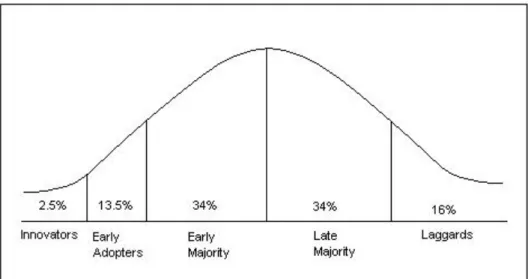
Time is another necessary element in understanding the process of diffusing an innovation decision. The influence of time can be most clearly seen in the graph of adopter categorization on the basis of innovativeness as shown in Figure 1.
Figure 1. The graph includes five groups, each group having their own attitude and propensity to adopt an innovation. Adapted from Diffusion of Innovations by E. M.
Rogers, 2003, Free Press: Collier Macmillan. Copyright [2003] by The Free Press.
The first group (2.5%) include the innovators who consist of a small number of people who are often dubbed as “visionaries.” They are the fastest in adopting the innovation, and in fact have often contributed to its discovery. This initial group is generally willing to take risks, and often comprises young, sociable people with financial liquidity. The next group are the early adopters (13.5%) who become interested in the innovation once its benefits become more apparent. They have a high degree of opinion leadership among the other adopters and serve as a bridge between the innovators (who
do not generally enjoy opinion leadership status) and the rest of the population. This group usually includes those who consider social prestige as one of their main
considerations for innovation adoptions. They have a natural desire to be “trend setters”
and are often well connected and well informed. These traits also often indicate that they are likely to be more socially respected, meaning they are the ones to whom others turn for opinions.
The next group is termed the early majority (34%), who tend to adopt innovations after a delayed, variable amount of time, which is always significantly longer than that of the innovators and early adopters. These people are typically pragmatists and usually unlikely to change their typical practices without solid proof of an innovation’s benefits.
They are influenced by the “trend setters” and opinion leaders but are wary of fads that may cause an innovation to rapidly become obsolete. The early majority usually consist of individuals who are younger in age, have a higher social status, are more socially progressive, and have financial stability. These people tend to be attracted to innovations that will help them maintain their position in their social system (Rogers, 2003). A relevant example of opinion leaders controlling public opinions and behaviors can be seen in Jimmy Carter’s international campaign to eradicate Guinea worm disease. This is an often-neglected tropical disease that is caused by a parasitic nematode roundworm.
The mode of transmission is contaminated, stagnant water that contains the larvae of the Guinea worm. Once the parasite reaches the infected person’s abdomen, the larvae begins to mature and grow in incubation. The worm grows within the body and slowly emerges through the person’s skin. This incapacitating disease hinders the mobility of the infected which renders them unable to care for themselves for long periods of time. The Carter
Center and its partners spearheaded the production of a filtering straw-like device that was able to ensure that drinking water was free of water fleas that carried the parasitic larvae. A personal unit of this device costs approximately $5.00, and its availability due to philanthropic groups has nearly eradicated the disease -- set to be the second human disease in history to be eradicated after smallpox. This unprecedented feat did not come easily, however. The Guinea worm is the subject of considerable mythology in that the worms have been viewed as messages from ancestors and products of witchcraft (Reisigl, 2017). These beliefs were to be respected, and the opinion leaders who held the social power in the rural areas of Africa were witch doctors. They profited from the barbaric, arcane treatments for those infected with the parasite. Change did not appear in these areas until Jimmy Carter and his team traveled to these infected villages to talk to the doctors and health ministers. He used his status as the former president of the United States to educate villagers on the disease and promote the use of water-purifying tools (Moran-Thomas, 2013).
The late majority (34%) are those who adopt an innovation after the average person. This group contains skeptics of the innovation who tend to be below average in terms of social status and/or less financially resourced. It is also important to note that they have very low opinion leadership relative to the rest of the previous groups. The late majority are conservatives who dislike risk and are comfortable with conventionality. The main driver of this group in the adoption process is their fear of not fitting in with the majority of everyone else, thus their adoption decisions occur after an innovation has diffused to the point of normality (i.e., greater than half the population is already using it).
The final group, who are typically more socially conservative than the late majority, are somewhat pejoratively termed the laggards (16%). The people in this category hold out until the bitter end and typically adopt innovations only when there is little or no choice. They generally have limited opinion leadership and few connections to cultures, ideas, or practices beyond a very narrow sphere of their own day-to-day
environment. These individuals tend to be more advanced in age, lowest in terms of social status, and have the least financial resources available. Individuals who belong to this category have an aversion to change and are focused on more traditional methods.
Figure 2. The blue curve represents the five categories of adopters. The percentages in each of the categories are very similar to the proportions found in a normal bell-curve.
The yellow curve represents the market share of the innovation which ends at 100%
saturation after all the participants in the system adopt the innovation. Reprinted from
“The 5 Customer Segments of Technology Adoption” by ondigitalmarketing.com. 2012- 2018.
Each of the five groups is affected by communication channels, which can often be multifaceted and context dependent. The channel through which information about an innovation is communicated is often important and has generally been distinguished in research literature as either mass media or interpersonal in nature. Mass media refers to the medium that is intended to reach a large audience but is necessarily less personalized on that basis. This is the primary channel of communication when information is desired to reach the vast majority of the general public. Common forms of mass media are magazines, radios, newspapers, television, and the internet (in particular social media, which somewhat crosses the boundary of these two broad categories to describe
communication channels). The general public relies on mass media communications in order to stay up to date with political issues, social issues, and entertainment.
Alternatively, interpersonal communications are the face-to-face exchanges between individuals or small groups that occur throughout everyday life. These are nearly
ubiquitous to the human condition and are often influenced by behavioral principles that offer specific predictions for the role of peer influence.
Peer influence is central to Diffusion of Innovation Theory, so much so that it is typically seen as the key driver of adoption decisions and societal change (at least when considering innovations of a large enough magnitude to have a population-level impact).
Peers have the opportunity to affect the individual behaviors and social interactions of those in their social networking communities, and smaller groups of individuals have their own key opinion leaders for particular issues. (For example, if your computer breaks you probably have a friend or colleague you ask for help, because you know he/she has knowledge in this area. You would not necessarily ask this same person for fashion
advice, however, because you likely have a different social group with whom you would communicate about these issues.) The theory assumes that the diffusion of the innovative process begins with a small group of early innovators, and from these people, the
innovation gets spread within their immediate social network. The major reason for this diffusion is the positive reinforcement received through interpersonal communication with peers, which is a reciprocal process for everyone involved. People tend to form more solid convictions when influenced by others in their peer networks, which in turn allows them to believe that they have a decreased chance of risk simply due to the fact that someone they are familiar or close with uses the innovation. This causes a snowball-like effect in that once that new group of people begin to use the technology, they become part of the innovation web. The more people who are using the innovation, the more likely the chance of mass adoption. This creates a change in former behaviors and
practices within the population, and to the degree other factors described above align with adoption decisions, potentially also offers a prediction of the speed of diffusion.
Diffusion of Innovations in Healthcare
Disseminating/diffusing innovations in healthcare is often a slow process even though the medical field claims to be saturated in evidence-based innovations. This is evident in the depiction of how long it took British sailors (who were, at the time, the most technologically sophisticated sailors on the planet) to adopt a simple change to avoid a life-threatening condition. Similarly, there is a major gap between the knowledge that has been uncovered through modern scientific research and the applied practices of healthcare providers. Unfortunately, the failure of not quickly implementing the results of
scientific studies into clinical practice is costly and harmful to not only the professional medical field, but also those who are affected by it (i.e., everyone). To put this claim into perspective, America spends approximately 40% more money per capita for health care than any other country - $3.5 trillion in 2018 alone - and yet it ranks 27th in infant mortality and overall life expectancy (Berwick, 2003). Clearly, improvements in both fiscal efficiency and implementation are possible in reviewing even these coarse statistics.
Changing clinical practice is an arduous task considering innovations imply the learning and implementing of new knowledge. These new behaviors require energy and time to incorporate into a routine environment, but the unlearning of old and outmoded knowledge often demands more attention and specific motivation to change. Terms such as “creatures of habit” and “resistant to change” have been used to describe healthcare providers, and these categorizations can be supported through the measurable 17-year time lag from conceptualization of new healthcare interventions to their use in practice (Nilsen, Roback, Broström, & Ellström, 2012).
Although many studies address the difficulties of innovation adoption, an equally pressing issue is the unlearning of old and deep-rooted knowledge. This is principally the opposite of diffusion in that the adopter has to de-implementate, de-adopt, and de-diffuse.
In a study based in an academic tertiary care facility, physicians were interviewed about their experiences on change in the medical field. The findings include two factors that are primarily socially centered. The first factor was that a change in practice would disturb the established status quo equilibrium of the hospital, and the second factor was that physicians would likely struggle to establish a new equilibrium that incorporated the
change, which may or may not challenge the attending providers’ previous contextual knowledge (Gupta, Boland, & Aron, 2017).
If these unlearning barriers are overcome and a given innovation has a chance to get adopted in a clinic or a hospital, studies show that the rate of adoption to other parts of the organization may occur slowly or sometimes not at all. This can be seen in a study discussing Cesarean birth delivery. In this study, a collaborative improvement model was used in medical practice with the goal of bridging the gap between current knowledge and the actual provision of care. A few obstetricians and nurses in a community hospital safely reduced their Cesarean delivery rates from 26% to 15% due to the implementation of a new policy. This policy entailed a strict protocol for the reduction of admission of false labor and for low-risk patients with less than 4 centimeters of cervical dilation. The thought process behind this protocol was based on the link that hospital admission for these subgroups of pregnant women can lead to anxiety, which would then lead to the unnerving feeling that something should be done to accelerate the process (Flamm, Kabcenell, Berwick, & Roessner, 1997). The reduction in Cesarean delivery only occurred with the obstetricians and nurses in the hospital directly affected by the policy, however, and the rate remained high among others in the broader service system who did not follow the new protocol (Berwick, 2003). Even though experimental data exist that have been shown to improve the quality of care for patients, it proves difficult to gain momentum for greater implementation and employment of the innovation.
Change may be continuous or sporadic, just as it can happen with ease or as a rare occurrence. Because changes in healthcare innovations occur rapidly, they are less likely to be predictable (Dowd, Shearer, & Davidhizar, 1998). Using the principles of the
Diffusion of Innovation Theory is thus pertinent for facilitating use of existing evidence- based approaches in clinical practice. The more research that exists on diffusion methods, the greater the ability to exchange the unpredictability of this process for one that is more methodical (and thus more successful).
Diffusion and Mental Health Screening
Another important topic germane to the current study is the disconnect between primary healthcare providers and the identification of issues pertaining to mental illnesses like depression, anxiety, and substance use. Primary care physicians are defined as those who provide first contact to a person with an undiagnosed health concern. While the primary care physician may be able to treat a variety of ailments with medications, historically, they are often not the most qualified provider to attend to specific concerns such as behavioral health issues. This is often the reason why primary care physicians must refer their patients to secondary care physicians who are more specialized in the patient’s area of concern. Many people with underlying behavioral problems nonetheless go to their primary care physicians in order to receive routine check-ups and seasonal visits during the year (Funk, Saraceno, Drew, & Faydi, 2008). Patients are often
evaluated for physical maladies, while their behavioral problems are left undetected. This leaves the patients at risk for the problems to persist and progress. Added onto this, it is not uncommon for people to have biases toward mental health symptoms, which reduces the rate of disclosure from the patient side and diagnosis from the provider side. Beyond stigma, these biases can also include demographic factors such as race, gender, and coexisting medical conditions. For example, African Americans, men, and patients
younger than 35 years of age are generally less likely to have mental health symptoms detected, whereas patients with diabetes or hypertension often have their symptoms over- detected or interpreted (Borowsky et al., 2000). Different detection strategies that
mitigate these biases and increase detection across all groups of people would thus be useful to employ (particularly in primary care settings).
The current popularly used screening tools available to health care providers are the Patient Health Questionnaire-9 (PHQ-9), the Patient Health Questionnaire-2 (PHQ-2), and the Generalized Anxiety Disorder (GAD-7) screeners (Kroenke, Spitzer, Williams, &
Lowe, 2009). The PHQ-9 is a self-administered version of the PRIME-MD diagnostic instrument that is used for common mental disorders. The PHQ-9 is a depression tool, meaning it specifically screens its user for depressive symptoms. The tool scores each of the 9 DSM-IV criteria on a scale from “0-3” with 0 as “not at all” or 3 as “nearly every day.” PHQ-9 scores of 5, 10, 15, and 20 represent mild, moderate, moderately severe, and severe depressive symptoms, respectively (Kroenke, Spitzer, & Williams, 2001). The PHQ-2 comprises the first two questions of the PHQ-9 and serves as an even briefer method of screening for depression (which may be more desirable for use in busy clinical settings or as a small part of a comprehensive health questionnaire). The PHQ-2 is
focused on the frequency of depressed mood and anhedonia over the past two weeks, and the scoring scheme is the same as the PHQ-9. Even though the PHQ-2 is shorter, the tool still is able to produce similar results when compared against the PHQ-9 in primary care and obstetrics-gynecology samples (Kroenke, Spitzer, & Williams, 2003). The PHQ-2 has a 97 percent sensitivity and 67 percent specificity in adults, whereas the PHQ-9 has a 61 percent sensitivity and 94 percent specificity in adults (Maurer, 2012). The GAD-7 is
a similar, practical tool, but focuses on self-report of anxiety in the general population. It contains 7 items and has a similar scoring scheme as the PHQ-2 and the PHQ-9 (Jordan, Shedden-Mora, & Löwe, 2017).
These tests have limitations in that the measures are frequently used but tend to only identify individuals at the highest level of risk for symptoms of depression and anxiety. Thus, in general practitioner-identified patients, the benefit of the screening tools is often less evident (Muntingh et al., 2013). For example, the PHQ-9 is recommended for identification of emotional and behavioral symptoms across specialties, but it focuses only on depression and excludes other common health issues such as anxiety, trauma- related distress, and substance abuse. Although the PHQ-9 has a briefer option – the PHQ-2 – there still exists the lack of general applicability that leaves a large gambit of behavioral issues undetected. Additionally, there are more effective options for general psychological screening than those currently in use, and as such the medical community would be a prime outlet to receive information about these innovations.
The creation of a rapid, efficient, and effective psychological screening instrument would increase detection of these mental health disorders, which would ultimately improve the healthcare system in terms of overall patient health, smooth integration of primary and secondary care, and cost efficiency. A locally developed software for this purpose offers a psychological screening tool that focuses on 11 distinct areas of psychological dysfunction. The instrument is an electronic self-report assessment that consists of algorithms to which the 11 categories span. Utilizing publicly available symptom- and diagnostic-level data from the National Comorbidity Study (NCS), the tool applies a machine-learning technique to create a type of decision tree model (Sutton,
2005). This means that the test is dynamic in that each question set is individualized toward the user’s previous answers. This efficiently and accurately predicts and facilitates the path of questions that the user will benefit the most from answering. The predictive ability and optimal scoring methods for each set of questions allowed the application to establish cutoffs indicative of likely diagnosis in each of the 11 categories. Each question set of each category contains around 2 to 5 items with the initial question in each set applying to all respondents. The tool’s validity and utility as a screening device was examined in the emergency department of a large medical center. The study concluded that the screening tool is valid for efficiently assessing a variety of common behavioral health conditions in the context of emergency medical settings (Sattler, Bentley, &
Young, under review).
Current Study
The benefits of integrating mental health into primary healthcare are significant, but studies on the diffusion of efficient and comprehensive psychological screening tools in these clinical environments are rather inconclusive and in their early stages. Therefore, the current study examines a method of disseminating information about a psychological screening tool for use in medical settings that was constructed following the Diffusion of Innovation Theory. This method was contrasted against a more generic message that contained the same information but was less personalized and targeted to the key aspects of diffusion reviewed above. The study sought to make real contact with real practicing physicians (most of whom worked in primary care or hospital settings), and the main dependent measure was response from these providers. The channel chosen to contact
the medical providers was email, due to the ease of communication and accessibility to both the researcher and the providers. According to the Diffusion of Innovations Theory, the more personalized email that was designed to account for the elements of successful diffusion was expected to have a higher rate of responses, while the generic, control email was expected to have few to no responses.
Methods
Participants. A total of 19 medical care providers associated with the Sally McDonnell Barksdale Honors College participated in this study (i.e., all were alumni of the Honors College). Participants were recruited through a list of alumni who now work as practicing physicians in the area that was provided by the Honors College. Institutional review board approval was obtained prior to commencing the study.
Design. Two emails containing different solicitations were created and participants were randomly assigned to receive only one version. The first email (Group 1, below) was constructed to facilitate social affinity and diffusion according to the Diffusion of
Innovation Theory. The second email (Group 2, below) was intended to be more generic and served as a control for the experiment.
Email Group 1:
Dr. __________,
My name is Jessica Tran, a senior biochemistry major from Hattiesburg, MS. I am a part of the Sally McDonnell Barksdale Honors College, and my thesis involves researching a method of doing brief psychological screening in medical settings. I received your contact information from the Dean of the Honors College, Doug Sullivan Gonzalez, and he recommended you as a potential resource. I would love to come talk to you about the tool and possibly enlisting your help for my research (which would entail minimal time and would not disrupt your normal clinical procedures). I am available MWF after 1:00
PM and T/TH after 12:00 PM. Please let me know if you are interested in helping me with this project, and if so, I will schedule a meeting through your office manager.
Thank you, Jessica Tran
Email Group 2:
Hello,
My name is Jessica Tran, and I am a biochemistry major with minors in biology, math, and psychology. I am currently in the process of applying to medical schools and completing my senior thesis, which involves research on a method of doing brief psychological screening in medical settings. The tool being examined has been used in hospital environments such as the University of Mississippi Medical Center’s Epic system, and I am interested in its uses in clinical settings versus hospital settings. I would love to come talk to you about my study and possibly enlisting your help for my research (which would entail minimal time and would not disrupt your normal clinical
procedures). I am available MWF after 1:00 PM and T/TH after 12:00 PM. Please let me know if you are interested in helping me with this project, and if so, I will schedule a meeting through your office manager.
Thank you, Jessica Tran
Each email was sent individually within minutes of each other, and follow-up emails were sent two and a half weeks later. A total of 10 participants were randomized to Group 1, and 9 participants were randomized to Group 2. Responses from providers were recorded as the dependent measure, and the time and date of communications were noted.
When no response was received from a given provider, this was also recorded.
Results
The data recorded indicated that 4 out of the 10 participants in Email Group 1 responded to the email and agreed to a meeting, and only 1 out of the 9 participants in Email Group 2 responded and agreed. None of the participants in the study who received a two-week reminder email responded to this second solicitation. A chi square test of the rate of responses between groups was not significant (p = 0.065); however, given the small sample size this was not unexpected. The trend in the direction of significance, even with the small sample size, could be interpreted in combination with the 400%
magnitude of differential response between groups as encouraging and potentially substantiating future research.
Discussion
The aim of this study was to compare two diffusion methods for a psychological screening tool in the medical field using the principles of Everett Rogers’ Diffusion of Innovation Theory. The results were generally consistent with predictions, in that a message designed to remind recipients of their affinity for a particular group (i.e., the Honors College) produced more positive responses than a similar communication that was more generic. In Email Group 1, the email contained specific language that was aimed to engender the recipient recalling a feeling of camaraderie. Including keywords such as institutional affiliations (i.e., Sally McDonnell Barksdale Honors College), familiar names (i.e., Douglass Sullivan Gonzalez), and familiar areas (i.e., Hattiesburg, MS) allowed the reader to create associations that connected him or her to the solicitor. In Email Group 2, the email intentionally contained generic wording that minimally
contained associations that would cultivate a feeling of connection. The language of Group 2’s email was conventional, which was hypothesized to reduce the response rate.
Although differences in response rates between the groups were not statistically
significant, the sample size ensured that contrasts were underpowered (and even with this the outcome approached statistical significance). The absolute differences between groups were also large (i.e., 4:1), which provided at least nominal support for the utility of the diffusion-specific message.
Following up with the responses from the initial email, I was able to schedule and attend a meeting with one of the physicians who replied. At the beginning of the meeting, the topic of the three keywords arose. For the majority of the talk, we discussed topics tangential to the original connection establishers. For example, after the Honors College
was mentioned, the physician drew a connection to her friend who she studied with during her undergraduate years. She then mentioned how they were both in sororities, which allowed me to continue the group association since I am also affiliated with a Greek organization. The conversation progressed to my future plans, and I informed her that I will be attending her alma mater (the University of Mississippi Medical Center) in the fall. With the seemingly continuous connections and branches, the atmosphere of the meeting grew lighter and more relaxed. I pitched the psychological screening tool to her, and while she was extremely receptive to my explanations and willing to test out the tool, she was not interested in using the tool in her particular practice as she worked in an infertility clinic. She did, however, suggest I reach out to some of her colleagues in the area who practice more general medicine.
When I explained the two different emails to the physician, she specifically said,
“I used to believe everything was based on what you know, but after years of school and life, none of that matters. What matters is who you know.” Although anecdotal, her statement was extremely salient and supportive of the ideas behind this study, in that she implied that group affiliations increase the likelihood of idea diffusion. Another
interaction with a different provider also yielded similar results supportive of the Diffusion of Innovation Theory. Dr. Young, who helped create the tool, has been
attempting to reach out to a local Oxford, MS hospital for months in order to test the tool in their facilities, but he and his colleagues have not been receiving responses. When I randomized the groups for the emails, however, an emergency department physician in this particular hospital was a part of Email Group 1, and I received a positive response within an hour of sending the message.
The preliminary results of this study could serve as a foundation for future examinations by presenting a potentially successful method to communicate new innovations to healthcare providers (such as a psychological screening tool). Given the research on the limitations of existing psychological screening tools mentioned in the introduction, a successful method of encouraging adoption of a new, more efficient tool could be very useful. For example, the integration of screening tools into primary care sectors of the medical field is critical for a fuller patient-care profile, which could result in better overall health outcomes (Luoma, Martin, & Pearson, 2002).
Despite moderately positive results, the study was not without limitations. First, the group of 19 participants were pooled from a select subset of physicians who were all associated with the Sally McDonnell Barksdale Honors College. The limited quantity of participants restricted the results in terms of ability to extrapolate to the overall
population. Smaller sample sizes considerably reduce the power of a study and increase margins of error (Faber & Fonseca, 2014). The data gathered, however, are still viable on the basis of a trend toward significance, as well as a large difference between absolute response rates. Similarly, qualitative interpretation of extended communications with two providers also provided ancillary support (at least in terms of encouraging future study).
In conducting this study, I gained direct experience with implementing tests of ideas that I have found fascinating for years. The opportunity for contact with actual medical providers also offered a more salient understanding of the way that principles of diffusion can affect healthcare practices, system organization, and opportunities for aspiring medical providers. For example, learning that social factors such as group mentality play such a significant role in not only the adoption and diffusion of
innovations but also the perception of the innovation itself was striking to me. This knowledge is invaluable because as I continue to pursue a future in the medical field, I must grasp an understanding of the significance of communication and the successful methods of influencing specific practices. After completing this project, I have the impression that communication with patients, other providers, healthcare systems, and the general public are all critical to competence as a practicing physician. More broadly, as I continue my path to becoming a physician, this study has compelled me to
consistently question “Why?” or “How?” to many commonplace practices that surround me (particularly when entrenched practices or viewpoints appear non-optimal in terms of promoting public health or positive treatment outcome for any individual patient).
Continuing to cultivate this skeptical nature will hopefully allow me the opportunity for growth and to “double-check” behaviors and ideas that may be in need of review.
References
Adam Sattler, MA, John P. Bentley, PhD, & John Young, PhD. (n.d.). Validation of a brief screening instrument for adult psychopathology.
Berwick, D. M. (2003). Disseminating Innovations in Health Care. JAMA, 289(15), 1969.
https://doi.org/10.1001/jama.289.15.1969
Borowsky, S. J., Rubenstein, L. V., Meredith, L. S., Camp, P., Jackson-Triche, M., &
Wells, K. B. (2000). Who is at risk of nondetection of mental health problems in primary care? Journal of General Internal Medicine, 15(6), 381–388.
https://doi.org/10.1046/j.1525-1497.2000.12088.x
Carpenter, K. J. (1988). The History of Scurvy and Vitamin C. Cambridge University Press.
Dearing, J. W. (2009). Applying Diffusion of Innovation Theory to Intervention Development. Research on Social Work Practice, 19(5), 503–518.
https://doi.org/10.1177/1049731509335569
Dowd, S. B., Shearer, R., & Davidhizar, R. (1998). Helping staff cope with change.
Hospital Materiel Management Quarterly, 20(1), 23–28.
Faber, J., & Fonseca, L. M. (2014). How sample size influences research outcomes.
Dental Press Journal of Orthodontics, 19(4), 27–29.
https://doi.org/10.1590/2176-9451.19.4.027-029.ebo
Flamm, B., Kabcenell, A., Berwick, D., & Roessner, J. (1997). Reducing Cesarean Section Rates While Maintain- ing Maternal and Infant Outcomes. In-Stitute for Healthcare Improvement.
Funk, M., Saraceno, B., Drew, N., & Faydi, E. (2008). Integrating mental health into primary healthcare. Mental Health in Family Medicine, 5(1), 5–8.
Grypma, L., Haverkamp, R., Little, S., & Unützer, J. (2006). Taking an evidence-based model of depression care from research to practice: making lemonade out of depression. General Hospital Psychiatry, 28(2), 101–107.
https://doi.org/10.1016/j.genhosppsych.2005.10.008
Gupta, D. M., Boland, R. J., & Aron, D. C. (2017). The physician’s experience of
changing clinical practice: a struggle to unlearn. Implementation Science : IS, 12.
https://doi.org/10.1186/s13012-017-0555-2
Johnson, C. (2002). A General History of the Robberies and Murders of the Most Notorious Pirates: From Their First Rise and Settlement in the Island of Providence to the Present Year. Psychology Press.
Jordan, P., Shedden-Mora, M. C., & Löwe, B. (2017). Psychometric analysis of the Generalized Anxiety Disorder scale (GAD-7) in primary care using modern item response theory. PLoS ONE, 12(8). https://doi.org/10.1371/journal.pone.0182162 Kodicek, E. H., & Young, F. G. (1969). Captain Cook and Scurvy. Notes and Records of
the Royal Society of London, 24(1), 43–63. Retrieved from JSTOR.
Kroenke, K., Spitzer, R. L., & Williams, J. B. W. (2001). The PHQ-9. Journal of General Internal Medicine, 16(9), 606–613. https://doi.org/10.1046/j.1525-
1497.2001.016009606.x
Kroenke, K., Spitzer, R. L., & Williams, J. B. W. (2003). The Patient Health
Questionnaire-2: Validity of a Two-Item Depression Screener. Medical Care, 41(11), 1284–1292. Retrieved from JSTOR.
Lapinski, M. K., & Rimal, R. N. (2005). An Explication of Social Norms.
Communication Theory, 15(2), 127–147. https://doi.org/10.1111/j.1468- 2885.2005.tb00329.x
Luoma, J. B., Martin, C. E., & Pearson, J. L. (2002). Contact With Mental Health and Primary Care Providers Before Suicide: A Review of the Evidence. American Journal of Psychiatry, 159(6), 909–916.
https://doi.org/10.1176/appi.ajp.159.6.909
Maurer, D. M. (2012). Screening for Depression. American Family Physician, 85(2), 139–144.
Moran-Thomas, A. (2013). A Salvage Ethnography of the Guinea Worm: Witchcraft, Oracles and Magic in a Disease Eradication Program. Retrieved from
http://princeton.universitypressscholarship.com/view/10.23943/princeton/978069 1157382.001.0001/upso-9780691157382-chapter-011
Muntingh, A. D., De Heer, E. W., Van Marwijk, H. W., Adèr, H. J., Van Balkom, A. J., Spinhoven, P., & Van der Feltz-Cornelis, C. M. (2013). Screening high-risk patients and assisting in diagnosing anxiety in primary care: the Patient Health Questionnaire evaluated. BMC Psychiatry, 13(1), 192.
https://doi.org/10.1186/1471-244X-13-192
Nilsen, P., Roback, K., Broström, A., & Ellström, P.-E. (2012). Creatures of habit:
accounting for the role of habit in implementation research on clinical behaviour change. Implementation Science : IS, 7, 53. https://doi.org/10.1186/1748-5908-7- 53
Reisigl, J. (2017, August 23). Dr. Donald Hopkins helped wipe smallpox from the planet.
He won’t rest until he’s done the same for Guinea worm disease. Retrieved April 7, 2019, from Atlanta Magazine website:
https://www.atlantamagazine.com/health/dr-donald-hopkins-helped-wipe- smallpox-from-the-planet-now-hes-after-guinea-worm-disease/
Rogers, E. M. (1983). Diffusion of innovations (3rd ed). New York : London: Free Press ; Collier Macmillan.
Ronald L. Ives. (n.d.). THE LOST DISCOVERY OF CORPORAL ANTONIO LUIS: A Desert Cure for Scurvy on JSTOR. Arizona Historical Society, 11(2), 101–114.
Sutton, C. D. (2005). Classification and Regression Trees, Bagging, and Boosting. In Handbook of Statistics, 24, 303–329. https://doi.org/10.1016/S0169-
7161(04)24011-1