In particular, we find that the scaling exponent α between diffusivity and macromer molecular weight (D ≅ Md-α) is significantly lower than expected for Rouse-like diffusion. The diffusivity of a variety of macromers of different molecular weight was also measured in photopolymerized intercalated networks.
Reaction Kinetics of Photopolymerized Macromer-matrix PDMS
List of Tables
Introduction
- History and background of photopolymers
- Use of elastomers as photopolymers
- Motivation and objectives
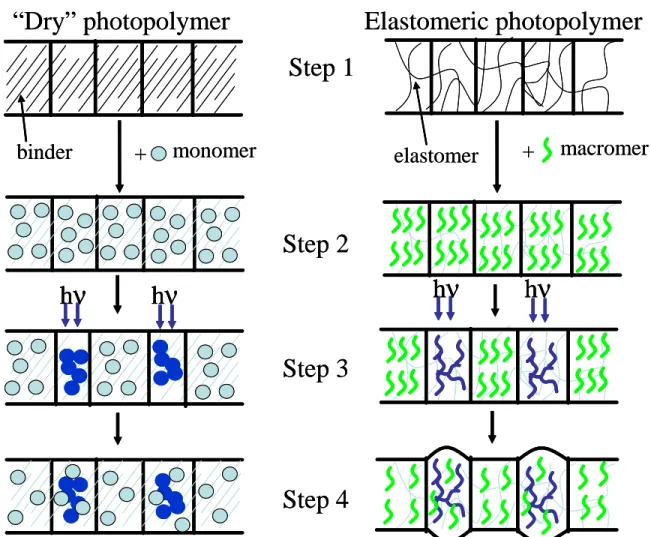
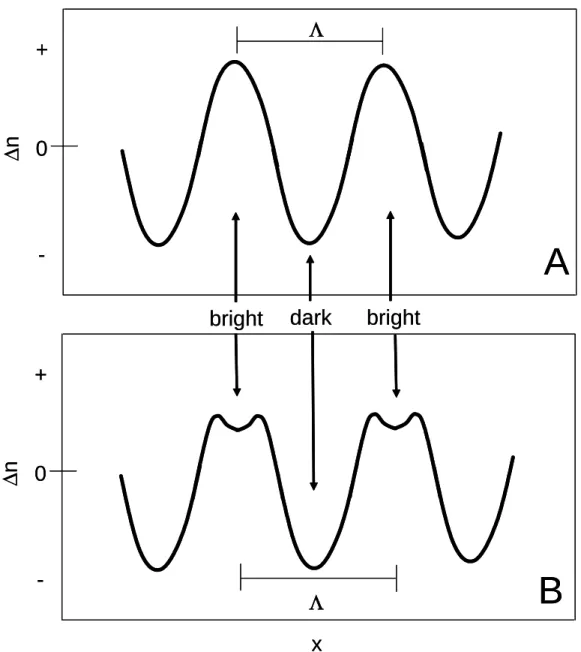
As the monomer reacts, it also contracts in volume by up to 20% and the photopolymer density and refractive index in the polymerized region increase. A combination of changes in shape and refractive index allows significant spatially resolved adjustment of the optical properties in photoelastomers.
Step 1
- Figures
- References
- Introduction
- Experimental section
- Materials
- Analysis of molecular weight for precursor molecules
- Matrix preparation
- Swelling and modulus measurements
- Results and discussion
- Polydispersity of precursor molecules
- Completeness of cure
- Curing moduli for different crosslinker : endgroup ratios
- Curing moduli and scaling behavior for networks with initial diluent
- Comparison of ideal network behavior with synthesized model networks
- Conclusions
- Tables
- Figures
- References
- Introduction
- Experimental Section
- Synthesis of photopolymerizable macromer
- Characterization of macromer synthesis product
- Preparation of photopolymerizable macromer doped network
- Photopolymerization of macromer swollen in PDMS matrix
- Experimental methods to determine extent of cure
- Rheological measurements
- Turbidity measurements
- Static light scattering
- Results and Discussion
- Physical property characterization of macromers
- Extent of cure for photopolymerized macromer
- Modulus changes interpenetrating photopolymerized networks
- Turbidity measurements
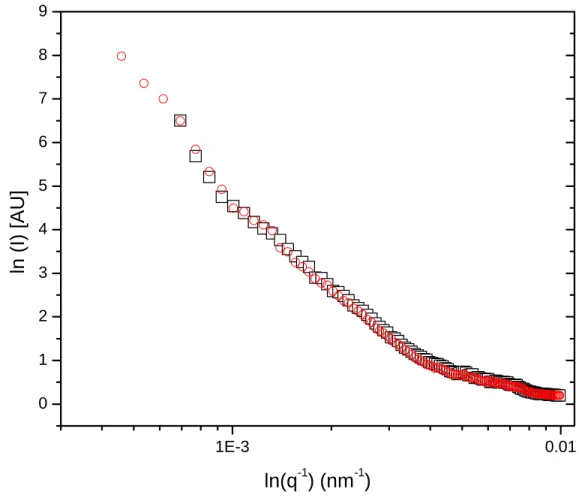
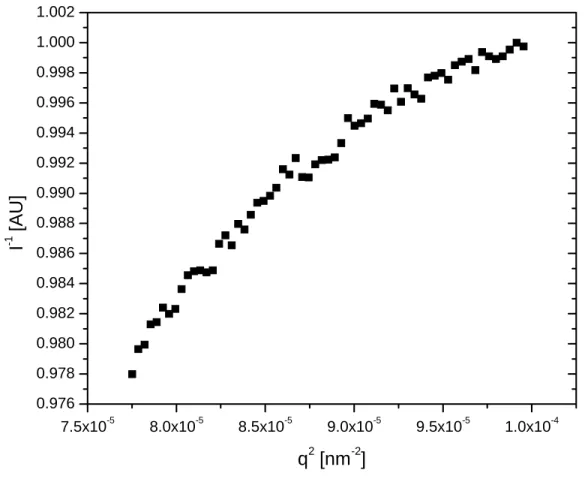
- Static light scattering measurements
- Conclusions
- Tables
- Figures
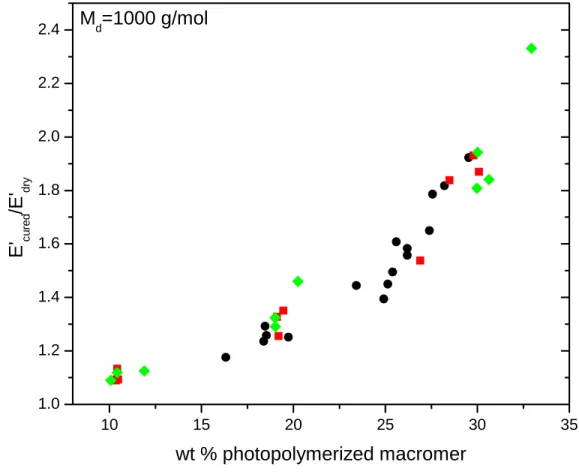
- M d =1000 g/mol
- References
- Introduction
- Experimental section
- Preparation of swollen sol-gel systems
- Photopolymerization of macromer swollen model networks
- Swelling measurements and gravimetric analysis
- Rheological measurements on swollen and nonswollen gels
- Results and discussion
- Storage modulus dependence on degree of equilibrium swelling
- Scaling behavior for partially swollen networks
- Swelling behavior in photopolymerized macromer swollen networks
- Change in interaction parameter based on molecular weight and phenyl containing analogues
- Conclusions
- Tables
- Figures
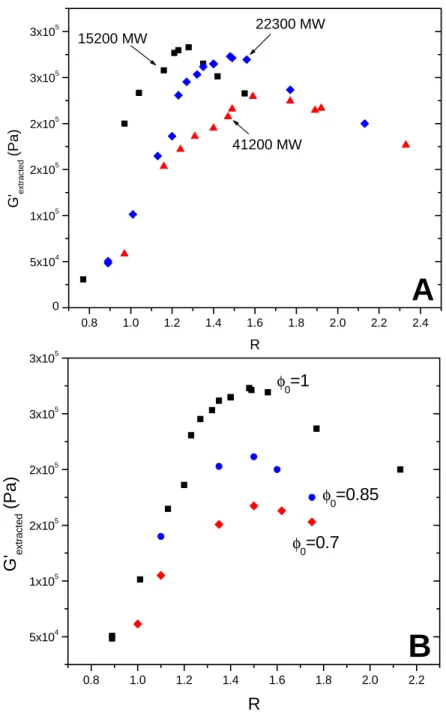
Sivisailam, K., Scaling behavior: Effect of precursor concentration and precursor molecular weight on the modulus and swelling of polymeric networks. The horizontal line is the modulus expected if all strands were of the entangled molecular weight. The initial network modulus of the dry matrix, E'dry, is determined by the molecular weight of network precursors, Mh, and polymer volume fraction at preparation, φ0.
1000 g/mol of macromer is swollen in model networks of different precursor molecular weight and φ0, or polymer volume fraction at preparation. Three sets of precursor network chains with different molecular weights are used to elucidate equilibrium swelling behavior for different macromer formulations. Examining Equation 4.8, it becomes clear that the scaling behavior between the prepared network modulus and the final equilibrium swelling ratio must be independent of both the molecular weight of the network precursor chains and the volume fraction of the polymer.
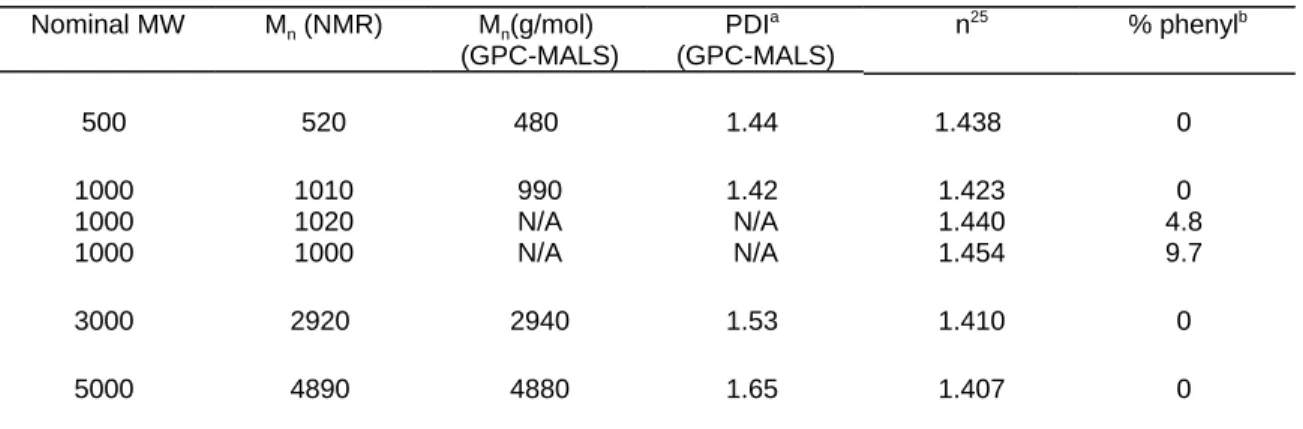
This is expected due to the relatively large size of the methacrylate end caps compared to the total molecular weight of the oligomer. At a molecular weight of 500 g/mol, half of the weight molecule consists of non-siloxane. The degree of equilibrium swelling is independent of both the molecular weight of the network precursor and, in the range we investigate, the volume fraction of the polymer at preparation.
OK, Effect of swelling on spatial inhomogeneity in poly(acrylamide) gels formed at different monomer concentrations. acrylamide) gels formed at different monomer concentrations. Oppermann, Swelling behavior and mechanical properties of end-linked poly(dimethylsiloxane) networks and randomly cross-linked end-linked poly(dimethylsiloxane) networks and randomly cross-linked polyisoprene networks. Heuert, Investigation of swelling behavior in poly(dimethylsiloxane) rubber meshes using NMR and compression measurements.
Introduction
It has been reported that the self-diffusion rate, or the rate of diffusion of a penetrant in a network of the same molecular weight, scales with α = 1.5 to 2.0 in PDMS.5, 26, 27 Sorption kinetics were used to determine the rate of diffusion and diffusers had a polydispersity index (PDI) of. This suggests that reptation can occur to some extent even for diffusers considerably lower than the molecular weight of entanglement. Depending on the initial reaction conditions, trapped entanglements or elastically ineffective chains can change the network modulus; the molecular weight between compounds can differ significantly from that of the precursor materials.
Since previous work used melt-prepared grids, it is likely that trapped entanglements will be significant and the molecular weight between crosslinks will be overpredicted. Because there is a lack of consensus in the literature on the effects of permeant molecular weight and molecular weight between network junctions, we examine the diffusion behavior specific to our system. Four permeant molecular weights are blown into a series of networks of varying modulus and the rate of diffusion is calculated from the time it takes to reach.
Diffusion rates in interpenetrating networks (IPNs) are also investigated to see if microstructure changes diffusion rates.
Experimental section
- Preparation of swollen sol-gel systems
- Photopolymerization of macromer swollen model networks
- Diffusion measurements using gravimetric analysis
- Rheological measurements of cured and uncured sol-gel systems
Well-characterized model networks are therefore necessary for appropriate determination of scaling behavior between D and Mc. Precursor α−ω vinyl chains are catalytically crosslinked with tetrakis(dimethylsiloxy)silane at 35 °C at an R value (ratio of crosslinker silane functionality to vinyl end group functionality) resulting in the highest modulus. After short times (< 48 hours) no macromer is visible on the surface of the sol-gel systems for all networks and all macromer molecular weights.
Dry networks, both pure PDMS model networks and photopolymerized intercalated networks, were swollen to equilibrium with different molecular weights of acrylate end-capped macromer. Samples approximately 1 mm thick and 8 mm in diameter were immersed in macromer of different molecular weight and phenyl content at 35 °C. To analyze the effect of selective adsorption, or molecular weight sieving behavior, bidisperse solutions of two different molecular weight macromers were allowed to diffuse into a network.
Ex situ rheological measurements were performed on a rheometric scientific RSA III in a simple tension geometry under oscillatory mode.
Results and discussion
- Changes in diffusivity with penetrant molecular weight and network modulus
- Effects of intercalated networks and phenyl sidegroup incorporation
- Bimodal macromer molecular weight distributions
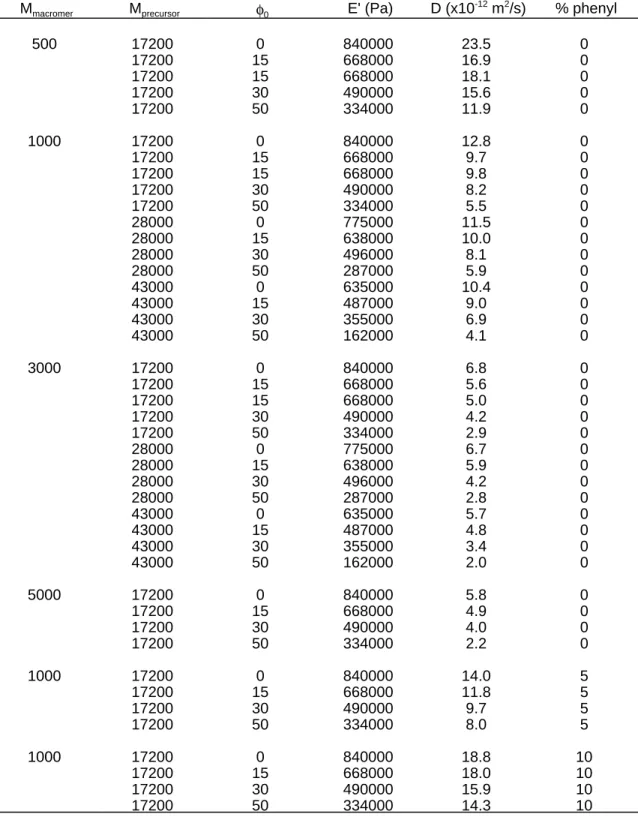
The measured diffusion rates for this set of samples are plotted against the diffusing molecular weight on a log-log plot (figure 5.2); each data set is for a specific network module. The lower α values we obtain can be explained by differential diffusion rates for different molecular weight species of a polydisperse penetrant. Since diffusion rates are calculated at Mt/M∞ <0.5 for mass uptake experiments and lower molecular weight species of the polydisperse penetrant diffuse preferentially into the network at early times, α <1.
This is likely due to prior use of network precursor molecular weight instead of measured crosslink density to determine scaling behavior. Figures 5.4A and 5.4B show diffusivity versus host network modulus; Figure 5.4A shows the diffusion rates of macromer 500 g/mol, 3000 g/mol, and a 50:50 (w/w) mixture of both molecular weights. If no molecular seeding is present, the diffusion rate of the bimodal system should maintain the same relative distance between 500 g/mol and 3000 g/mol regardless of the lattice modulus.
A similar trend in terms of molecular targeting behavior is seen in Figure 5.4B, where a bimodal mixture of 1000 g/mol and 3000 g/mol macromers is used as penetrant and relative diffusivity decreases with decreasing network modulus.
Conclusions
However, the systematic shift in diffusivities is positive rather than negative because the 1000 g/mol macromer has greater equilibrium swelling than the 3000 g/mol. The trends in diffusion rates also corroborate the previous analysis that significant molecular sieving is present for our macromers when distributed in tightly bound networks. When matching the data at early times, the slope of the line can be used to calculate the diffusion coefficient.
Decreasing slopes with decreasing network modulus indicate that molecular sieving is less important for loosely cross-linked networks. Increasing slopes with increasing molecular weight (and increasing PDI) suggest that molecular sieving is taking place. As the network crosslinking density increases, the mixture diffusions diverge further from the diffusivity of Mn = 3000 g/mol and approach more closely that of the lower ones.
Kubo, T., Diffusion of single chains in polymeric matrices measured by pulsed field gradient NMR: crossover from Zimm to Rouse-type Diffusion. Ando, A study of self-diffusion of molecules in polymer gels by pulsed gradient spin-echo H-1 NMR. Semlyen, Self-diffusion and spin relaxation in linear and cyclic melt blends of polydimethylsiloxane.
Introduction
In many systems, vitrification of samples stops the reaction between 40 and 60% reactive group conversion.3, 8-11 This is undesirable for most applications because unreacted species have the potential to leach or cause long-term changes in the material properties. In contrast to methacrylate monomer systems, the kinetics of multifunctional methacrylates with a midblock spacer, or “macromers,” have not been well studied. If the center block is of a material, such as siloxane, that is well above the glass transition temperature, material effects such as vitrification will not play an important role in the polymerization kinetics and the.
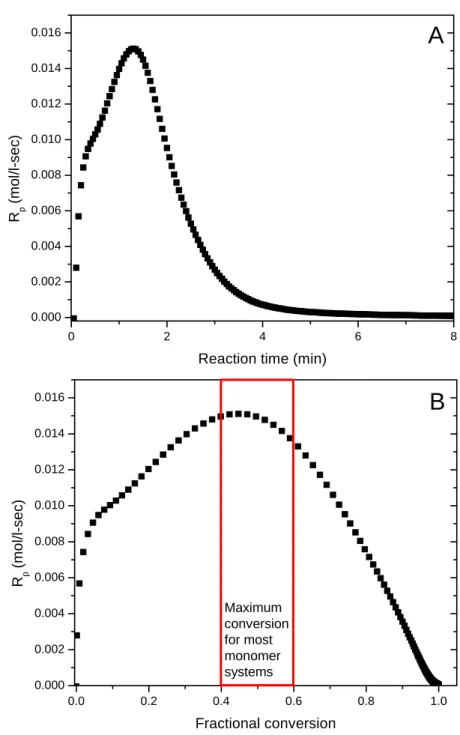
In this chapter, we investigate the reaction kinetics of four different molecular weights of bifunctional macromer with flexible siloxane midblocks. To elucidate the termination kinetics, the irradiation is stopped at partial conversion and the reaction rate decay is observed. Analysis of the propagation and termination rates allows us to compare the overall polymerization kinetics of methacrylate endcapped macromers with those of methacrylate monomers used in the literature.
Several striking features, such as full macromer conversion and chain length-dependent termination processes, exist for these materials.
Experimental section
- Preparation of photopolymerizable PDMS systems
- Photopolymerization of macromer swollen networks and melts
- Photo differential scanning calorimetry (DSC)
After a short time (< 6 hours for DSC pans, < 24 hours for 1 mm x 8 mm samples), no macromer is visible on the polymer surface for any macromer molecular weight. This mixed sol is then placed in 40 µl stainless steel calorimetry pans and left for 1 hour before photocalorimatic polymerization. Macromer swollen in model networks is cured using controlled exposure times and intensities at 365 nm.
A 500 W Oriel Hg-Xe arc lamp is equipped with an interference filter (5 nm HWHM with maximum transmission at 365 ± 0.5 nm) and is used as a collimated emission source. The light source was a mercury arc lamp and a narrow wavelength band centered at 365 nm was obtained with a monochrometer. Different series of samples were run: pure macromer, macromer swollen in a cured PDMS network, and macromer well mixed with PDMS melts of different molecules.
The total reactant mass of the macromer was between 10 and 20 mg; larger amounts were used for the higher molecular weight macromer.
Results and discussion
- Effects of oxygen inhibition in radical macromer polymerization
- Salient characteristics of macromer photopolymerization
- Reaction rate schemata
- Comparison of photopolymerization rates in gel and melt
- Macromer concentration and reaction rate
- Effects of irradiation intensity and photoinitiator content
- Reaction rate comparison for different molecular weight macromer
- Determination of propagation and termination constants
Kurdikar and Peppas derived a viscosity-based value of φ for DMPO; this value is expected to be between 0.3 and 0.5 for our systems.18 Due to the. At high monomer concentrations or low initiation rates, termination occurs mainly between two propagating radicals (Rt:m,n=kt:m,n[Mm•][Mn•]); at low monomer concentrations or very high initiation rates, propagating radicals can end up with initiator or primary radicals (Rt:A,n=kt:A,n[A•][Mn•]). It is important to note that this kt is the average value for all propagating radicals.
Although the reaction rate is linear in macromer concentration, it only increases by 1/2 the power of the initiation rate. Thus, if primary radical termination occurs in our system, we expect the reaction rate to scale with [M]2 instead of [M]. The analysis methods used in Section 6.3.5 for variable power-law dependence are also inefficient because the reaction paths have completely different shapes.
The only unknown is the value kp/kt1/2, which can be evaluated from Rp and conversion at each point in the reaction trajectory.
Conclusions
Tables
All samples are 30% macromer in a short-chain PDMS melt, irradiated at an intensity of 6.2 mW/cm2, and have 0.25% photoinitiator by total sample weight. Fractional conversion plotted against reaction time for multiple irradiation intensities as determined by extraction experiments. Irradiation intensities are changed by three orders of magnitude while keeping macromer (30% by weight, 1000 g/mol) and photoinitiator content (1% by total weight) constant.
0.25% DMPO 0.08% DMPO
Bowman, Propagation and termination kinetics of crosslinking photopolymerizations studied using electron paramagnetic resonance spectroscopy in conjunction with near IR spectroscopy. Bowman, An investigation of chain length-dependent termination and reaction-diffusion-controlled termination during the free radical photopolymerization of multivinyl monomers. Fouassier, Holography as a tool for mechanistic and kinetic studies of photopolymerization reactions - a theoretical and experimental approach.