A LINGUISTIC STUDY OF KENYAN POLITICAL PARTY NAMES, SYMBOLS, COLOURS AND SLOGANS
MOSES JAMES OLENYO MALANDE C82/10410/2008
A THESIS SUBMITTED IN FULFILLMENT OF THE REQUIREMENTS FOR THE AWARD OF THE DEGREE OF DOCTOR OF
PHILOSOPHY IN ENGLISH AND LINGUISTICS OF KENYATTA UNIVERSITY
NOVEMBER, 2018.
ii
DECLARATION
This thesis is my original work and has not been presented for a degree at any University or for any other award
Signature……… Date………
Moses Olenyo James Malande
SUPERVISOR:
I confirm that the work reported in this Thesis was carried out by the candidate under my supervision
Signature……….. Date………
Dr. Lilian I. Vikiru
Pan African Christian University
Signature……… Date………
Dr. Hilda U. Kebeya Kenyatta University-Kenya
iii
DEDICATION
This thesis is written with uttermost respect to and in loving memory of all living and fallen patriots who fought gallantly with some paying the ultimate price to realize the Kenyan multipartyism. Some of these fallen patriots now silently colour marked or unmarked eternal homes countrywide. Such sacrifices make a KPP research possible. Secondly, this thesis is written in memory of all teachers at Ikumba primary school and Chavavo secondary school whose collective drive, trust and investment started me off in the world of academia.
iv
ACKNOWLEDGEMENTS
I honour and praise God who strengthened my every step ever since I began this research in August 2008. Many thanks go to my very able and esteemed supervisors, Dr. Kebeya and Dr. Vikiru, for patiently midwifing this research. To Hilda, Brenda-Tracey, Hilarious, Sasha, Ariel, Isaac and Stacy thanks for your love, patience, and understanding more so for constantly reminding me ‗this thesis was a family project.‘ To my prayerful and ever-encouraging mum-Flora Malande-I say ‗Sande muno!‘ My spiritual parents Mzee Eliakim and Mama Esta, bros Rev. Steve and Dr. Ombeva, sisters Margy, Janet and Joy I say ‗Embwo muno!‘ My role-model and Dad Hastings (RIP), I invite you to smile from the other world. I put on record my appreciation to the staff of the Department of English of Kenyatta University led by the gracious Dr. Nthiga, resourceful Dr Mwangi and secretary Frasha, my research assistants and respondents, my boyhood friends Dr. Alex and Dr. Stanley Kevogo, The Kekenas, The Ombevas, The Masiolos, niece Abigail Simwa, all my Pastors, my dear Christian congregation of PEFA-Tarang‘anya. Special mention and gratitude goes to The Senates, my dearest colleague lecturers and my lovely students of ST. Augustine University of Tanzania, Stella Maris Mtwara University College-Tanzania, Lukenya University-Kenya and The University College of Arts and Social Sciences-Asmara University-The State of Eritrea for creating a supportive network and sounding boards that enabled me accomplish this task. I offer thanks to Prof Mwenda Mukuthurwa (RIP) of Maasai Mara University and CHAKAMA- CHAKITA for giving me an opportunity to test my ideas on East African political discourse. Lastly to anyone else that stood by my side throughout my academic safari I say thank you very much.
v ABSTRACT
This thesis is a linguistic study of KPP names, KPP symbols, KPP colours and KPP slogans. It establishes that linguistic resources are used by political operators in design of the KPP tools. This is achieved by deliberately manipulating language at the phonological, morphological, lexical, syntactic, semantic, sociolinguistic and textual levels. These linguistic manipulations realise KPP mixed code names, sense relations, associative meanings, political discourses, abbreviations manipulations etc.
Given its broad nature, this study is anchored on several theories including critical discourse analysis as it applies to political discourse, the semantic field theory, the symbolic interaction theory, the semiotics theory, the X-bar theory, the revised B and K universal theory and Whorfian linguistics relatively theory. Finally, the study employed a mixed methods approach which entails both qualitative and quantitative data obtained from the non-probability samples. Interviews, observation and archival (documentary reviews) methods are applied as tools for data collection. Data analysis is done using the MS-Excel 2010, matrix language frame (MLF), SPSS, and content analysis. This research finds a clear phonological, lexical, syntactic, sociolinguistic-code mix- and semantic manipulation of language in the crafting, designing, choosing and deployment of KPP names, symbols, slogans and colours thus necessitating an arrival at valid and appropriate findings and conclusions upon which research recommendations and generalisations are made.
vi
ABBREVIATION
ADJ Adjective
AP Agano Party
APK Alliance Party of Kenya
ARK Alliance for Real Change
CCM Chama Cha Mwananchi
CCU Chama Cha Uzalendo
CONJ Conjunction
CP Conservative Party
CS Code Switching
DET Determiner
DP Democratic Party of Kenya
FGD Focus Group Discussion
FORD-ASILI Ford-Asili
FORD-KENYA Forum for Restoration of Democracy-Kenya
FORD-P Ford-People
FP Farmers Party
FPK Federal Party of Kenya
GNU Grand National Union
vii
KANU Kenya African National Union
KADU-ASIL Kenya African Democratic Union-Asili
KPP Kenya Political Party-Parties or a Coalition of Parties KNC Kenya National Congress
KII Key Informants Interview
KSC Kenya Social Congress
KENDA Kenya National Democratic Alliance
LPK The Labour Party of Kenya
MGPK Mazingira Greens Party of Kenya
MDP Maendeleo Democratic Party
MLF Matrix Language Frame (MLF) Model
MP Mwangaza Party
MP Muungano Party
MSM Mkenya Solidarity Movement
MSS Mzalendo Saba Saba Party
NAPK National Agenda Party of Kenya
ND New Democrats
N Noun
NLP National Labour Party
viii
NDM National Democratic Movement
NPK National Party of Kenya
NARC National Rainbow Coalition
NFK New Ford Kenya
NVP The National Vision Party
ODM Orange Democratic Movement
PICK Party of Independent Candidates of Kenya PNU Party of National Unity
POA Party of Action
PPK Peoples Party of Kenya
PDP Peoples Democratic Party
PDU Party of Democratic Unity
PPK Progressive Party of Kenya
PPPK Peoples Patriotic Party of Kenya
PREP Preposition
RBK Restore and Build Kenya
RLP Republican Liberty Party
RC Republican Congress Party of Kenya
SAFINA Safina
ix
SDP Social Democratic Party of Kenya
SPK Shirikisho Party of Kenya
SSP Sisi Kwa Sisi Party
SA Standard Arabic
TIP The Independent Party
TNA The National Alliance
UDFP United Democratic Forum Party
UDM United Democratic Movement
UPK Unity Party of Kenya
URP United Republican Party
WDM-K Wiper Democratic Movement- Kenya
77 Saba Saba Asili
x
DEFINITION OF KEY TERMS
Code mixing The use of free and bound morphemes from different codes in the same sentence while code switching was used as a cover term for both code changing and code mixing.
Connotative The hidden or associative meanings of KPP names, slogans, and symbols
Denotative The literal meaning of KPP names, slogans, colours and symbols
Eclecticism A conceptual approach that draws upon multiple theories, styles, or ideas to gain complementary insights into a subject, or applies different theories in particular cases.
Key informants interview Individuals who possess crucial, substantial as well as substantive information on a given issue
Onomatopoeia KPP vocal icons designed to replicate the sounds that certain things, action, or movements are perceived to make.
Onomastics The linguistic study of names and naming trends
Political Party KPP groups, coalitions, alliances or organizations that seek to place candidates in office under a specific label
Sense Relations Lexical semantics relationships that exist between KPP names
Slogan KPP political-linguistic statements designed to produce an emotional connection between the voter and politician.
xi
Symbol KPP linguistic or semiotic sign/image that stands for something in an arbitrary convention-based way. It implies all KPP names, slogans, colours and symbols even though each is studied separately in the present study
xii
TABLE OF CONTENTS
DECLARATION... ii
DEDICATION... iii
ACKNOWLEDGEMENTS ... iv
ABSTRACT ... vi
ABBREVIATION ... vi
DEFINITION OF KEY TERMS ...x
TABLE OF CONTENTS ... xii
CHAPTER ONE: INTRODUCTION ...1
1.0 Introduction ...1
1.1 Background of the Study ...1
1.2 Kenyan geography and political history ...6
1.3 Statement of the Problem ...9
1.4 Research Objectives ...10
1.5 Research Questions ...10
1.6 Research Assumptions ...11
1.7 Significance of the Study ...11
1.8 Scope and limitation of the study...15
1.9 Conclusion ...16
CHAPTER TWO: LITERATURE REVIEW AND THEORETICAL FRAMEWORK ...18
2.0 Introduction ...18
2.1.0 Literature Review ...18
2.1.1 Matrix Language Frame, Code switching and Code mixing ...18
2.1.2 Speech Act ...25
xiii
2.1.3 Methodology ...27
2.1.4 Political Discourse...28
2.1.5 Symbols, slogans and colours ...35
2.1.6 Language and Ethnicity ...38
2.1.7 Political Parties ...41
2.1.8 Theories...42
2.1.9 Semantics ...61
2.1.10 Onomastics ...65
2.1.11 Noun phrase and The X-bar syntax ...71
2.2.0Theoretical Framework ...76
2.2.1 Symbolic Interaction Theory ...76
2.2.2 Critical Discourse Analysis ...78
2.2.3 Semiotics Theory...79
2.2.4 Matrix Language Frame (MFL) Model ...82
2.2.5 Berlin and Kay‘s university and The Sapir-Whorf‘s linguistic relativity ...83
2.2.6 Semantic Field Theory ...88
2.2.7 X-Bar Theory ...93
2.2.8 Speech Act Theory ...95
2.3 Conclusion ...96
CHAPTER THREE: RESEARCH METHODOLOGY ...98
3.0 Introduction ...98
3.1 Research Design...98
3.2 The Study Area ...99
3.3.0 Sample and sampling techniques ...99
3.3.1 Focus Discussion Group (FDG) ...100
xiv
3.3.2 Key Informants Interviews (KII) ...101
3.4.0 Methods of Data collection ...101
3.4.1 Personal Interviewing ...102
3.4.2 Archival Method ...102
3.4.3 Observation ...103
3.5 Data Analysis ...104
3.6 Data Management and Ethical Considerations ...104
3.7 Conclusion ...105
CHAPTER FOUR: LINGUISTIC ANALYSIS AND FINDINGS IN KPP NAMES ...106
4.0 Introduction ...106
4.1.0 Presentation of data on KPP names ...106
4.2.0 The semantics of KPP names ...112
4.2.1 The semantic field of KPP names ...112
4.2.2 KPP Name as a sense relation ...118
4.3.0 The linguistic (syntactic) structure of KPP names. ...121
4.3.1 KPP headwords that are Post-Modified (Post modification) ...127
4.3.2 KPP headwords that are Pre modified (Pre-modification) ...129
4.3.3 KPP Intra-phrase headword modification ...132
4.3.4 A KPP NOUN ONLY headword (no modifiers) ...133
4.3.5 KPP that share a vocabulary ...133
4.4.0Linguistic Manipulation of KPP Abbreviations ...136
4.5 KPP aabbreviations distortions ...146
4.6.0Code Mixing in KPP Names (Mixed Code Data) ...148
4.6.1 Analysing KPP names into Codes ...148
4.6.2 The Mixed code data ...158
xv
4.6.3 The linguistic motivations behind KPP name code mixes...163
4.6.4 Matrix Language Frame analysis of the KPP mixed code data ...164
4.7 Conclusion ...165
CHAPTER FIVE: LINGUISTIC ANALYSIS AND FINDINGS IN KPP SYMBOLS ...167
5.0 Introduction ...167
5.1 Data Presentation on KPP symbols...167
5.2.0 The Linguistic structure and types of KPP symbols ...184
5.3 KPP symbols as semantic fields ...187
5.4 KPP symbols connotative meanings ...194
5.5 Linguistic manipulation in KPP symbol design ...204
5.6 Conclusion ...208
CHAPTER SIX: LINGUISTIC ANALYSIS OF KPP SLOGANS AND COLOURS ...209
6.0 Introduction ...209
6.1.0Linguistic structure and type of KPP slogans ...209
6.1.1Linguistic of KPP slogans ...209
6.1.2.0 Types of KPP slogans ...213
6.1.2.1 Spur of the moment or offshoot slogans ...213
6.1.2.2 Authorised, ceremonial, official or formal slogans ...213
6.1.2.3 Regional or ethnic slogans ...213
6.1.2.4 Individual slogans ...214
6.1.2.5 Individual cum party slogans-Dual slogans ...214
6.1.2.6 Public or communal slogans ...214
6.1.3 Political discourse and semiotics input in KPP slogans design ...215
6.1.4 KPP Slogan listing and identification ...216
xvi
6.1.5 Linguistic manipulation in KPP slogans ...220
6.2.0KPP Colours Findings...224
6.2.1 Data presentation on KPP colours ...225
6.2.2 Connotative meanings in KPP colours ...229
6.2.3 The National colour observation and her impact on KPP colouring .235 6.3 Conclusion ...239
CHAPTER SEVEN: VOTERS’ EXPOSURE TO KPP TOOLS ...240
7.0 Introduction ...240
7.1 Presentation and discussion of respondents data ...240
7.2 Conclusion ...262
CHAPTER EIGHT : SUMMARY, CONCLUSIONS AND RECOMMENDATIONS ...263
8.0 Introduction ...263
8.1 Summary of the Findings ...263
8.2 Research Conclusion ...266
8.3 Research Recommendations ...267
8.4 Conclusion ...268
REFERENCES ...269
APPENDIX 1 INTERVIEW CHECKLISTS ...284
APPENDIX 2 FDG INTERVIEW SCHEDULE ...285
APPENDIX 3 KII PROFILE AND CHECKLIST ...286
APPENDIX 4 IEBC LIST OF REGISTERED KPP...317
APPENDIX 5 RESEARCH AUTHORISATION ...321
APPENDIX 6 NACOSTI PERMIT………..322
1
CHAPTER ONE INTRODUCTION 1.0 Introduction
This chapter gives a background-context and history-on the study of KPP names, symbols, colours and slogans, then states the research problem, highlights the objectives of the study, research questions and research assumptions. The chapter too highlights the significance, the scope and the limitations of the study.
1.1 Background of the Study
The Kenyan 2010 constitution demands that every registered KPP, command an active membership base, have elected officials and hold annual national delegates‘
conferences, present yearly audited financial accounts, have a name, a slogan and a symbol. According to ECK (1997:54), ―The ballot papers must bear the names and symbols of all political parties participating in an election.‖ Political parties have responded to this context in terms of their organization (in choice of name, symbol, colour and slogan), finances, leadership, strategies (some linguistic in nature), ideologies and policies. Change in this factors force parties to continually adapt, nurture, and reaffirm their ties to particular electorates-voters. ―At a minimum, then, ethnocultural, socio-economic, urban-rural, and regional factors have provided the context for a voter-party interaction (Bickerton and Alain (2004:240).‖
The question is how political parties coalesce. Gallagher et al (1992) has developed a comprehensive study of political parties in western and transitional democracies.
They came up with three main characteristics by means of which we might define political party families namely: shared ‗genetic origins‘ (leftists), formal links to
2
similar parties across national boundaries often on ideological backgrounds (right or centre) and shared approaches to policy (other party families).
―Kenya is a primary arena for competition, power and influence (2015:142)‖and the dialectics of African political process versus the much touted liberal democracy and its institutions is problematic (Luwanda, 2009). Any political action is couched in an environment of reciprocity which dictactes its symbolic and instrumental value.
Notably Omollo and Barasa (2008:10) opine ―Kenyans do not just vote for members of their local communities (and political parties), they do so with expectations of rewards and favours.‖ Political party electioneering often lead violence ‗causing panic and anxiety among people and makes vulnerable to (political and linguistic) manipulation and exploitation (ibid Omollo and Barasa).‘
KPP tools such as names, slogans, colours and symbols are appropriated using language. Within the social semiotics theory, the KPP name, the KPP slogan, the KPP symbol (image), the KPP colour constitutes ‗a set of linguistic signs‘ (Martin and Ringham, 2000:1-13). Studying these signs from a linguistic perspective forms the basis of this research.
Language is an important variable in power relations between dominant (politicians) and subordinate (voters) groups. Language is considered a powerful tool deliberately employed by politicians to influence the electorate. Politicians utilize phonological, morphological, syntactic, semantic, pragmatic and textual devices to achieve their goal (David, 2014). A politician who can manipulate language to their advantage easily wins over voters. Malande and Masiolo (2013) observe that an East African politician has the ability to invent, re-invent, shift, twist and manipulate multilingual terms thus highlighting the inter-connectedness between language and politics in East
3
Africa. This is possible granted that politics is very largely the use of language (see Chilton, 2004) and ―questions of language are basically questions of power‖ Chomsky (1979:119). Butt (2004) makes a similar albeit somewhat stronger claim that the very use of language is ideological. He argues that the use of language necessitates choices between different modes of meaning. It is precisely these multilingual, political, syntactic, semantic and ideological choices that inform the creation and selection of Kenyan political party tools and are made at all levels of language [such as semantic (names, colour, slogans and symbols), syntactic (as in name and sloganeering), lexical (KPP abbreviations) and so on of language] that are used by Kenyan political actors to attain maximum political effect.
Competition amongst the Kenyan political parties is often spiced by effective mobilization tools central to which is language. Rozina and Karapetjana (2009) observe that linguistic manipulation and political discourse is primarily focused on persuading people to take specified political actions or to make crucial political decisions-such as shifting allegiance from one KPP to another by changing slogans, phrase expansion and deletions, abbreviations distortions, use of cultural symbols and meaningful colours. English and Kiswahili languages grant Kenyan politicians linguistic resources necessary for crafting and then selling KPP tools to unsuspecting voters granted ―a Kenyan politician is a master of deception (language manipulating) and will cover their tracks with genius‖ (Malande, 2013b).
In an ideal situation, a 5-year cycle Kenyan general election presents voters with an opportunity to choose between competing candidates sponsored by participating KPP.
Such parties use names, symbols, colours, slogans, policies and manifestos as tools for identification to potential voters. This calls for a conscious and deliberate
4
manipulation of language by many a political party in order to gain an unassailable advantage over their competitors. To this end, voters are mobilized on the basis of a common culture (by use of native languages and idioms, colour, abbreviation distortions, diglossic tendencies, metaphors and symbols), language (use of names, vernacular/Creole languages and slogans) as well as habitation of a common territory.
This manipulation of language /names/colour/slogans/ symbols/ local metaphor has been embodied in the choice of names, slogans, colours and symbols by Kenyan political parties. This research examined how KPP names, symbols, colours and slogans are deliberately crafted (linguistically manipulated) to convey certain meanings and on how they convey these politically desirable meaning e.g. religious KPP names (such as ‗SAFINA‘, ‗AGAPE‘, etc.-that are designed to evoke/trigger a spiritual sentiment). The effect of these linguistic manipulations is captured in respondents‘ attitudes in chapter ahead.
KPP slogans crafters use a particular language to create impressions, alter perceptions, elicit emotional responses, and make demands and pressure oppositions.
The ambiguity of slogans enables them to serve as verbal (conversation) bridges for one meaning to another and induce individuals and groups to interpret them according to their own perceptions and needs. Generally slogans use a language that simplifies complex problems and situations while demanding instant corrective actions. Many slogans are unique and are readily identifiable with specific social movements or social movement organizations (political parties inclusive). Examples of KPP slogans that have been crafted using alliteration as a linguistic style include: ‗kusema na kutenda‘ (Kiswahili for ‗To Say and To Act‘), ‗chungwa moja maisha Bora‘
(Kiswahili for ‗One Orange Better Life‘). This study identified, investigated and then
5
established the linguistic strategies- alliteration, assonance, antithesis, and framing- employed in the KPP slogans formation.
Multiplicity of symbols that inform KPP are not only diverse but numerous for symbols signify for something in an arbitrary convention-based way. Wheras KPP names, KPP colours, KPP slogans qualify to be symbols, this study considers the images presented alongside KPP names as the KPP symbols. 118 KPP symbols are thereby identified, grouped and studied using four sign types (see Dobrovolsky, 2005) alongside the semiotics and semantics field framework. Efforts have been made to unearth not only the semantics but the political discourses inherent in the KPP symbols.
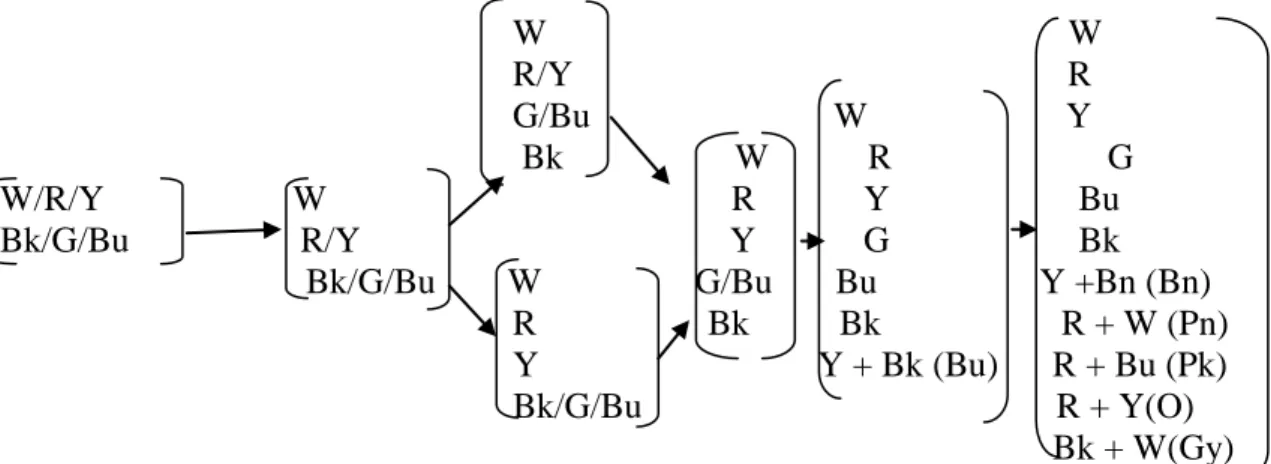
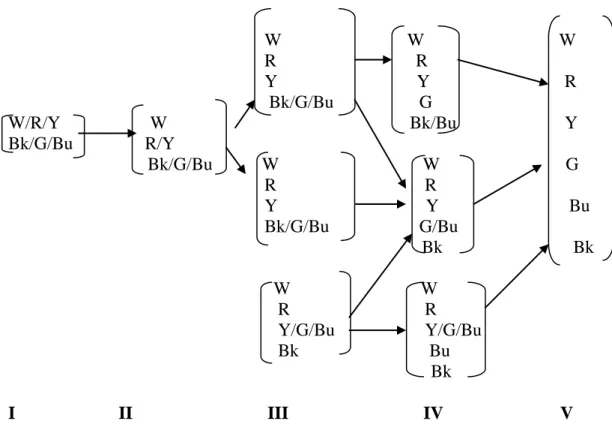
Colour features prominently as a KPP tool during Kenyan political campaigns. This research examines KPP colour deployment and visibility (using respondent listing), their meaning and whether or not they determine voters‘ party choice. As presented later, this research discovered an existing relationship between the KPP colours and the Kenyan national flag colours of black, white, red and green thus positing the national colour hypothesis.
This thesis involved both extensive and intensive linguistic study of Four KPP tools namely names, symbols, slogans and colours. Though interdependent, each largely requires her own set of theories for a detailed study. These theories are qualified and discussed under chapters or sections on significance, scope, limitations, literature review and theoretical framework.
Lastly, an elaborate research methodology obtained both the qualitative and the quantitative data on the KPP names, KPP symbols, KPP colours and KPP slogans.
The data is presented, analysed and discussed coming up valid and appropriate
6
findings upon which research conclusions, generalisations and recommendations are made.
1.2 Kenyan geography and political history
Kenya is located in Eastern Africa with its geographical borders to the south east touching the Indian ocean, to the south lies the mount Kilimanjaro; to the west is the lake Victoria-the largest fresh water lake in the world and the mount Elgon, Kenya‘s arid and semi-arid north east and entire north lies the approaching Sahara desert and the lake Turkana to the north west. Notably other geographical marvels such as the Great Rift Valley and the equator almost evenly split Kenya in to two. Kenya shares boarders with South Sudan and Ethiopia to the north, Somalia to the east whereas Tanzania and Uganda to the south and west respectively. Kenya was occupied then colonized by the British from 1890-1963. After a bloody war-led by the maumau insurgents-she gained her internal self-government (Madaraka) on June 1, 1963 before becoming a republic on December 12, 1964. There are two levels of independent yet interdependent governments-the Governor led county and the president‘s led national governments. These two governments‘ leaders are elected using universal suffrage. Kenya has 47 political and administrative counties.
Kenya‘s experiment with multiparty politics has been a flip flop exercise often dictated by the political interest of the president or the political party in power. Since 1963-2015, 118 KPP have been in operation at different times; currently (2015), only 44 KPP have been registered by the Kenya Political Party Registrar.
At independence in 1963, Kenya had two main parties namely KANU-made up of pro-republican big tribes and or unitary state and KADU made up of pro-federalism smaller tribes. The two parties went head to head in the first 1963 independence
7
elections. KANU won this election thus making Jomo Kenyatta the first indigenous Prime Minister in 1963 and later the president in 1964. Mr. Kenyatta cajoled KADU into dissolution and later in 1967 blunted opposition by imprisoning key opposition leaders and outlawing their party-KAU. His government-allegedly stifled, killed and imprisoned many political opponents. Under the law-on paper Kenya was then a multi-party state but a de-jure one party state in practice all through Jomo Kenyatta‘s presidency (1964-1979) and the early years of Moi‘s presidency. After the attempted coup-de-tat in 1982, President Daniel arap Moi sensationally signed into law bills that made Kenya a one party state. Political oppression continued until 1992. Thanks to international and local pressure, Mr. Moi hurriedly convened a KANU National Delegate‘s Conference (NDC) in which they reintroduced multiparty politics and inserted presidential term limits.
A consequence of the expanded political space that was generated by the advent of multi-partysm has been the rise of many ethnic/ region based parties. During electioneering periods, voting along tribal lines has become an unpleasant reality. It is the norm for leaders seeking national political office to rally and galvanize their ethnic group‘s support before reaching out to other communities. KPP during the multiparty era have thus been formed, registered, deployed and later disintegrated- along ethnic lines. Frequent disagreements over poll results and or a desire to protect voting blocs have culminated into ethnic conflicts and mass displacements during or after elections (like the case of 1991-1992 and then a horrendous repeat in 2007- 2008). This has given credence to ethnicity as the most dominant determiner of National level political alliances or coalitions-a common parlance in Kenyan political discourse is that power and leadership is negotiated and determined by what(numbers)
8
you bring to the table. This implies that the larger the size of your ethnic voting bloc, the bigger the allocation, position and share in coalition building.
As shown in respondents‘ responses, KPP are personal properties that are constructed in the image of its chieftain. Such personality-based as opposed to issue based KPPs have thus resulted into creation of many small parties that often have very short life spans. The quest for power by individuals and or groups has seen voters mobilised on the basis of a common culture, a common language and as well as habitation of a common territory. Inter and intra-ethnic alliances such GEMA (Gikuyu, Embu and Meru Alliance), KAMATUSA (Kalenjin, Masaai, Turkana and Samburu), KK (Kikuyu and Kalenjin) or loose alliances such as Western Alliance, Mt Kenya, rift valley and coastal groupings have coalesced into numerous coalition parties. These groupings and alliances (often guided by the politics of the day) largely determine the inter-ethnic and intra-ethnic voting behavior.
In general, while ethnic groups might be in solidarity at national level, KPP are usually torn apart by internal struggles owing to power plays. Occasionally, these parties and alliances die or mutate into new units at every other election cycle. Such mutation and death are studied as a semantic sense relation in this study.
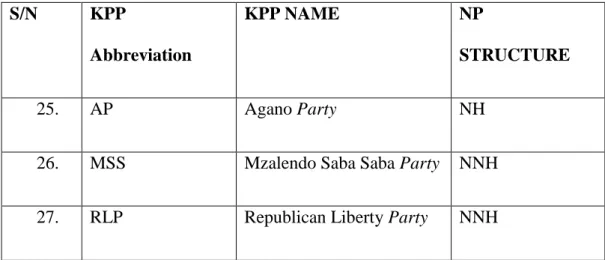
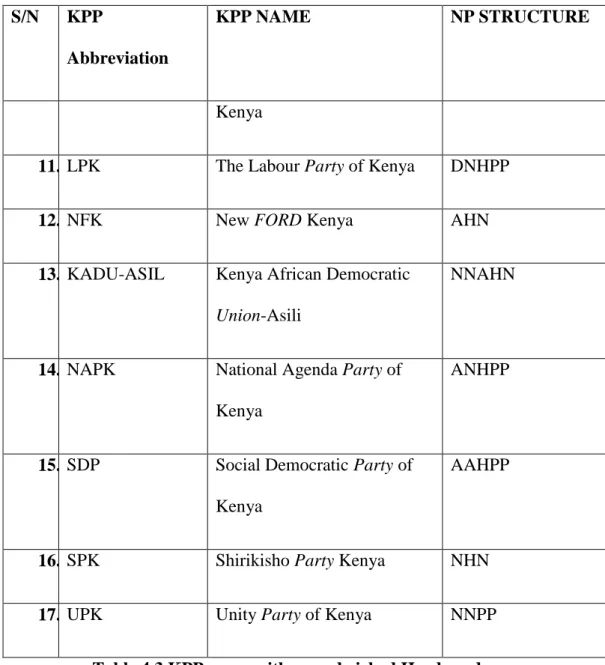
While KPP politics revolves around personalities, they still provide a significant democratic space in that when some politicians miss nomination on any party‘s electoral ticket, they may jump into another KPP thus granting voters a variety of choices. Many a KPP have therefore given birth (or mutated) into smaller entities thus providing a chance for a sense relation study on their existence. A good example is a hyponymy study on KPP‘s FORD which disintegrated into FORD-KENYA, FORD- ASILI and FORD-PEOPLE. Whereas FORD KENYA split into FORD KENYA,
9
New FORD Kenya, NDP, SDP, SAFINA, etc. This research examined the prevalence of such sense relation patterns amongst the KPPs for these parties share (a) similar genetic history or ‗mothers‘. For example, the ‗FORD‘ derivatives given above exhibit a hyponymous relationship.
Mostly, KPP name formation is semantically motivated. KPP meanings are derived and or relate to some sort of existing phenomenon; like the case of ‗SAFINA‘
(Kiswahili word for ‗ARK‘), ‗AGAPE‘ (is Hebrew word for ‗LOVE‘), and so on.
Other KPP names originate from manmade (such as vehicles) as well as natural phenomena (such as crops), social- political activities and so on. FORD (Forum for Restoration of Democracy) in as much as its acronym might have been manipulated to connote the legendary American FORD car; a vehicle whose reliability and class is second to none. Such examples others are depict political discourse and a language manipulation at play and are examined under KPP abbreviations manipulations.
1.3 Statement of the Problem
The strategy that a Kenyan politician applies in the creation of KPPs that easily attracts voter attention was an area of concern to this study. KPP names, KPP symbols, KPP colours and KPP slogans construction is often realised using many different elements central to which is language. Language-linguistics provides resources upon which KPP tools creators assign political ideology-meaning. The choice of an appropriate language (like English or Kiswahili) and the correct linguistic resource therefore becomes a necessity in the construction of KPP tools that are easily marketable to voters. The study, therefore, investigates, identifies and examines how KPP tools creators meticulously influence language use at the phonological, morphological, syntactic, semantic, pragmatic, discourse and
10
sociolinguistic levels resulting into linguistic manipulation at the structural design, phrase expansions, phrase deletions, semantics, mixed code data, sense relations, associative meanings, political discourses, abbreviations manipulations etc. Another area of concern is whether voters have an adequate knowledge of KPP tools. Towards this end, the voters‘ level of exposure to KPP tools is examined with the researcher calling for a convention to govern the creation, design, choice and deployment of KPP tools.
1.4 Research Objectives The objectives of this study are to:
i. Determine the semantics obtainable in Kenya political party names, symbols, colours and slogans.
ii. Highlight and describe the linguistic structure of Kenya political party names, symbols, colours and slogans.
iii. Establish the linguistic motivations or situational factors behind the choice of Kenya political party names, symbols, colours and slogans.
iv. Investigate the level of voters‘ exposure to Kenya political party names, symbols, colours and slogans.
1.5 Research Questions
To achieve this, the study was guided by the following research questions:
i. Which semantics obtain in the Kenya political party names, symbols, colours and slogans?
ii. Which linguistic structures obtain in the Kenya political party names, symbols, colours and slogans?
11
iii. What are the linguistic motivations or situational factors behind the choice of the Kenya political party names, symbols, colours and slogans?
iv. What is the level of voter‘s exposure to Kenya political party names, symbols, colours and slogans?
1.6 Research Assumptions
i. Semantics obtain in the Kenya political party names, symbols, colours and slogans.
ii. Kenya political party names, symbols, colours and slogans have a definite linguistic structure.
iii. Linguistic motivations or situational factors inform the choice of the Kenya political party names, symbols, colours and slogans.
iv. Voters demonstrate a significant level of exposure to Kenya political party names, symbols, colours and slogans.
1.7 Significance of the Study
A study on names is generally called onomastics with its subsets such as: toponyms for place names, anthroponyms for personal names, ethnonyms for nationalities or ethnic groups and glottonyms for languages. No name is given for political party name studies the area of concern for the current study. Significantly, this study coins polinyms to describe political party onomastics, thus important in the study of political onomastics.
This study provides the first single volume archival or library on 118 KPP names, KPP symbols, KPP colours and KPP slogans. This is an important library for students on KPPs in diverse fields. This study suggests a need for a convention (law) to govern choice, creation and selection of KPP tools.
12
The study provides additional knowledge on anthropological linguistics. In Africa, anthropological linguists have generated a lot of data on naming patterns and name meanings as espoused in local or native-African languages. Such studies by Malande (2012, 2011 and 2006), Batoma (2009), Légere (2008 and 2004), Agyekum (2006), Guma (2001), etc. have largely looked at people, plant and place names. Those studies have established a socio-cultural and morpho-semantic basis as the sole motivation behind names and naming in African languages. Secondly, the studies examined naming as a phenomenon in individual local-native-African languages (monolingual context) but not inter linguistic (languages-native and non-native or bilingual context spoken in Africa). This study, however, examines a new research area i.e. Kenya political party names.
A number of KPP names have a mixed code i.e. are generated using both Kiswahili and English vocabularies. The question of code mixing in KPP names is relevant granted the diglossic attitude and ‗multilingual culture in Kenya‘ (Malande, 2013a).
In such situations, language as both a constructor and a reflection of social identity becomes more complex in bilingual communities where more than one language is involved, and those languages and cultural-ethnic values and identities bear unequal social prestige. A case in point is the diglossic tendencies amongst speakers of two Kenyan official languages-English and Kiswahili. The study, alive to this fact, significantly examines cases of deliberate language manipulation in the design and or crafting of such mixed data names and determines that this strategy is meant to appeal to the political sense of unsuspecting voters.
In addition to this, studies on Kenyan politics and international politics have centered largely on political discourse, political rhetoric and political speech. Such studies have
13
majorly looked at warfare, judicial, genre, vocation, public activism, gender, campaigning and referendum discourse as used by political operators‘ thus ignoring semantics and political discourses inherent political institutions such as party names, party symbols, party colours and party slogans-a gap this study fills.
We have recent political discourse studies on Kenyan political scene including Malande & Masiolo (2013a, 2013b, and 2013c), Habwe (2010), Ngonyani (2006), Oduori (2002), King‘ei (2002), Wairagu (2001), etc. These studies have complemented numerous global researches by linguists such as Rozina & Karapetjana (2009); Caldas-Coulthard and Coulthard (1996); Fairclough (1992a, 1995a);
Fairclough and Wodak (1997); Fowler et al. (1979); van Dijk (1993b, 1997); Chilton (2004 and 1985[ed],); Chomsky (1979); Butt (2004) etc. As aforementioned, none of these studies tackled political party names, the party symbols, the party colours and the party slogans. Colour has long been considered a semantic universal yet KPP colours have not received much attention in the form of study. To address this shortcoming and within the context of this research, we have gone beyond the traditional cultural meanings of colours by looking at the national colours- state- colours-linking and associating them with KPP colours. This research observes that KPPs draw their own colours from the national pool of colours hence the national colour hypothesis/observation whose premise is to link and or associate KPP colours with state-colours.
In addition to meanings and political discourses in KPP names, party symbols, colours and party slogans and the KPP mixed code data, this study addresses the lexical (sense) relations amongst political party names, KPP abbreviation distortions and manipulation, KPP colour semantics, voters‘ attitudes towards KPP, etc. In addressing
14
this, this study hopefully addresses a major theoretical puzzle (problem) on whether linguistic theories are useful in analysing political phenomena such as a political party name, slogan, colour and symbol.
Linguistic manipulation is a distinctive feature of Kenyan political rhetoric, and it is based on the idea of persuading people, i.e. it either persuades people to take political actions or support a Kenyan political party and or an individual contestant. In every other regular 5-year Kenyan election cycle, new forms of linguistic manipulation appear. Thus, the language applied in KPP political discourses uses a broad range of rhetorical devices at the phonological, lexical, semantic, pragmatic, syntactic, and textual levels. This is widely captured in KPP name, KPP symbol, KPP slogan and KPP abbreviations coinage. The need to identify, highlight, profile and analyse such linguistic occurrences informed the duty and spirit of this thesis.
A majority of KPPs are seasonal and with a life span of one election. KPPs are normally organised around one popular leader who in turn may coalesce his /her party with like-minded fellows thus forming a grand coalition of parties whose goal is to win an election. Many a times when the next 5 years election cycle appears, new KPP entities come up. This makes it imperative to study them. This study profiles/records and studies these KPP names, symbols, colours and slogans examining their crafting, build-ups and break-ups as linguistic phenomena. This thesis provides a semantic and political discourse study of KPP thereby unearthing the linguistic manipulations at play in naming of these entities. The study thus provides a linguistic account of the formation of the names, choice of symbols, colours and slogans for KPPs. The research examines KPP formation, break ups and KPP coalition building as a semantic phenomenon within lexical semantics‘ sense relations framework thus
15
providing additional knowledge to the field of syntax, political discourse and semantics.
This study categorises the KPP names in to semantic fields. A significant number of KPP names and slogans are formed using vocabularies from one or two languages.
This in itself enriches an area in sociolinguistics called code mixing. Such linguistic motivations at play in such KPP code mixes are highlighted in this study.
KPP symbols are studied as a semiotic sign. Its conventional and connotative meaning analysed. This in itself provides additional knowledge on the study of semiotics theory.
The place of symbols and slogans in man‘s daily life cannot be over-emphasised. Yet, despite the fact that man is basically a symbol using organism; its role in KPP campaigns hasn‘t been thoroughly investigated from a linguistic point of view. This research endeavored to address this omission.
Finally this study examines the extent to which voters are exposed to KPP names, symbols, colours and slogans clearly emphasising the need for voter education.
1.8 Scope and limitation of the study
A study on KPPs can involve diverse areas such as political organisation, political financing, parliamentary strength, political membership, political science, etc. The current study, however, delimits itself to a Linguistic study in Kenyan political party names, symbols, colours and slogans and on how language is manipulated in their naming, crafting and design (code mixes) to determine this tools. Efforts have been made to objectively, empirically and theoretically operate within these confines. This
16
has been possible through a mixed approach that qualifies both a versatile theoretical framework and a workable research methodology.
Owing to financial and time constraints, the researcher did not travel around Kenya looking for respondents but delimited this study to a non-probability representative sample of respondents based in Nairobi but originally residents of other Kenyan regions. Their views are generalized as views of Kenyans voters.
On the issue of research data, the research delimited itself to political party names, slogans, colours and symbols obtained from respondents‘ data, IEBC‘ data, The Kenya Gazette data and RPP data.
The researcher was cautious since several KPP have multiple symbols and slogans.
The case was intriguing and complex given that individual (elections) contestants- candidates have their own personal symbols and slogans which they use side by side with their sponsoring KPPs slogans and symbols. Examples of such individual contestants include: ‗hummer‘ (for ODM‘s Raila Odinga) and ‗hustler‘ (URP‘s William Ruto) respectively. Some of the KPP Symbols include flags, plants and vegetation, farming tools, transportation tools which are used alongside KPP slogans such as ‗saba saba‘ (Kiswahili for seven-seven); ‗Maisha bora zaidi‘ (Kiswahili for better life); etc. The researcher took deliberate efforts to isolate and then analyse KPP and individual candidates-contestants‘ symbols and slogans separately.
1.9 Conclusion
This section places the study of Kenya political party names, symbols, colours and slogans into its appropriate linguistic and historical contexts. It further explains the place of language in the creation of KPP tools. To create these KPP tools, linguistic resources are manipulated at the phonological, morphological, syntactic, semantic,
17
pragmatic, sociolinguistics and discourse levels giving rise to mixed code names, sense relations, associative meanings, political discourses, abbreviations manipulations etc.
18
CHAPTER TWO
LITERATURE REVIEW AND THEORETICAL FRAMEWORK 2.0 Introduction
This chapter is made up of Literature Review and Theoretical Framework. Literature Review is on methodology, code mixing, code switching, theoretical framework, MLF, semantics (sense relations and semantic fields), political parties, symbols, slogans, colour, Onomastics (names), noun phrases, theories and political discourse.
Theoretical Framework involves the four major theories that have informed the study namely: Critical Discourse Analysis, The Symbolic interaction Theory, Semiotics Theory, The Matrix Language Frame (MLF), The revised B and K universal theory and Whorfian Linguistics relatively theory.
2.1.0 Literature Review
This section deals with sources that informed this study. Literature is reviewed on methodology, code mixing, code switching, theoretical framework, MLF, semantics (sense relations and semantic fields), political parties, symbols, slogans, colour, Onomastics (names), and political discourse
2.1.1 Matrix Language Frame, Code switching and Code mixing
Abuhakema (2013) in his study on Code switching and code mixing in Arabic written advertisements provides concrete evidence that advertisements in the Jordanian and Palestinian contexts exhibit linguistic elements that might be unique to such contexts (and maybe beyond) and have sociolinguistic, anthropological, cultural and pedagogical implications. The identifiable patterns of code switching and/or code mixing that the study reveal/ show that both Standard Arabic (SA) and the
19
vernaculars are acceptable and are used in the language of advertisements. SA is still the most used variety. Arabic dialects are increasingly penetrating ads as a literary genre. English is also used as a sign of prestige, modernity and sophistication. Thus the line between what is standard and what is prestigious becomes more blurry, and equating prestige with standardization becomes a questionable assumption. The study examined social class, age, religion, and the nature of products advertised influenced the variety used and to establish whether code switching, code mixing or both are acceptable. In the area of vernacular use, there are aspects and expressions that are used more than others. Context and appealing to audiences can be decisive considerations in using such aspects and expressions. It is important to investigate how those audiences perceive what and how the language is used in these ads, and whether copywriters take such perceptions into account. Abuhakema‘s codes/
languages mirror the KPP mixed data situation on diglossia that is both the choice of language and the place of English on one side and Kiswahili and Kenyan vernaculars on the other side defining the KPP naming trends.
The Ogechi (2002) study attempted to determine the matrix language (ML) and the speech processes in a trilingual code switching (CS) involving Ekegusii, Kiswahili, English and Sheng in Kenya. Ogechi‘s study hypothesised that:
1) Trilingual participants who share a first language and speak the same second and third languages can produce both trilingual and bilingual CS CPs who‘s ML can be L1, L2 or L3.
2) There is a tendency for composite bilingual and trilingual CS due to the impact of the L1 in structuring L2 and L3.
20
3) The complexities of speech processing and congruence matching between the switched morphemes and their equivalents in the participating codes make overt trilingual CS CPs negligible. The hypotheses were tested on 520 CS CPs recorded during 330 minutes of naturally occurring CS speech. Of these CS CPs, 18 were trilingual CS CPs compared to 502 bilingual CS CPs. These data were analysed using Myers-Scotton's Matrix Language Frame model.
The investigation revealed unique ML patterns in CS from Africa in general and Kenya in particular. For instance, it came out that it was not always that Ekegusii as the interactants' L1 was the ML; rather, Kiswahili and English were in some instances the ML. This was attributed to the effect of language policy in Kenya's system of education where English is the language of instruction while Kiswahili is a taught and examined subject since 1984. Thus instances of Kiswahili ML were only seen in the trilingual CS of those participants who were taught and examined in the Kiswahili subject at primary and secondary school levels. The study also realised five unique patterns of composite CS. First, there were trilingual CS CPs with surface morphemes from Ekegusii-Kiswahili-English and a corresponding trilingual ML. Then, there were four patterns of bilingual composite CS CPs. The study concluded that the minuscule number of trilingual CS could be attributed to the complexities involved in processing a CP with three codes. A code switched morpheme in one code only surfaces after competing with equivalents from other codes. The higher the number of morpheme counterparts the less the number of CS CPs. Thus in trilingual CS a switched morpheme competes for selection with equivalents from two other participating codes.
21
On Code switching Nathan Ogechi makes salient points while quoting several books.
Ogechi‘s views as well as his sources were found relevant to the current study.
Ogechi (2002) opines that
―code is synonymous with ―language‖ or ―speech variety‖ owing to the problem of clearly delimiting ―language‖ and ―dialect ―Codeswitching‖ is commonly defined as the alternating use of two or more codes in the same conversational event or speakers who use ―two languages alternatively in different contexts.‖ CS scholars such as Grosjean (1982) and Myers-Scotton (1993a/1997) have clarified Haugen‘s definition of CS to include the use of more than one code or language in a conversation or speech act that could involve a word, a phrase, a sentence, or several sentences. Therefore, CS can take place between sentences (inter-sentential switching) and within sentence boundaries (intra-sentential switching). Code mixing was defined as the use of free and bound morphemes from different codes in the same sentence while code switching was used as a cover term for both code changing and code mixing. Some scholars, notably Appel & Muysken (1987) and Muysken (2000) still use the term code mixing but as a cover term for all types of CS. However, most studies use the term code switching to refer to the phenomenon of code switching in language contact.‖ Ogechi (2002) draws a thin line between code switching and code mixing.
The study on code mixing within KPP names takes the use of morphemes from more than one source language in the same NP as code mixing. This is necessary granted that KPP names are more of Noun phrases than they are sentences.
Rene & Muysker (1987:117-126) observe that code mixing has been studied in considerable detail since about 1970, from a sociolinguistic point of view (why do people switch between languages?), from a psycholinguistic point of view (what
22
aspects of their language capacity enable them to switch) and from a linguistic point of view (how do we really know that they are really switching and have not simply introduced an element from another language into their linguistic system?) Many outsiders see code mixing as a sign of linguistic decay, unsystematic result of not knowing at least one of the languages involved very well.
Rene & Muysker (1987:117-126) identify three types of switches:
a) Tag-switches involve an exclamation, a tag, or a parenthetical in another language than the rest of the sentence. The tags etc. serve as emblem of the Bilingual character of an otherwise monolingual sentence hence called emblematic switching
b) Intra-sentential switches occur in the middle of a sentence. This type of intimate switching is often called code mixing
c) Inter-sentential switches occur between sentences, as their name indicates.
Rene & Muysker, using the functional model suggested, switching can be said to have the following functions:
1) Referential function often involves lack of knowledge of one language or lack of facility in that language on a certain subject. Certain subjects maybe more appropriately discussed in one language, and the introduction of such a subject can lead to a switch. In addition, a specific word from one of the languages involved may be semantically appropriate for a given concept. Hence all topic- related switching may be thought of as serving the referential function of language. Most bilingual speakers are conscious of referential function: they switch for lack of a word for it in another language making the language chosen
23
more appropriate for a given subject. In Kenya switching across English, Kiswahili and vernacular languages is common. (examine switching on KPP names and KPP slogans)
2) Switching also serves a directive function in that it involves the hearer directly.
This being directed at the hearer can take many forms. One is to exclude certain persons present from a point of conversation. The opposite is to include a person more by using her or his language. A person may have joined the participants in an interaction. All participant-related switching can be thought of as serving the directive function of language use. Eg many parents try to speak a foreign language when they do not want their children to understand what is being said.
3) Poplack (1980) in particular has stressed the expressive function of code switching. Speakers emphasise a mixed identity through the use of two languages in the same discourse. Speakers emphasize a mixed identity through the use of two languages in the same discourse
4) Often switching serves to indicate a change in tone of the conversation, and hence a phatic function. Also called metaphorical switching.
5) The metalinguistic function of code switching comes into play when it is used to comment directly or indirectly on the languages involved. One example of this function is when speakers switch between different codes to impress the other participants with a show of linguistic skills. Many examples of this can be found in the public domain: performers, circus directors and market sells-people.
6) Bilingual language usage involving switched puns, jokes, etc. can be said to serve the poet function of language.
24
Rene & Muysker views and ideas on inter-sentential switches, intra-sentential switches and functional component have been heavily borrowed and adopted in the analysis of KPP name code mixes.
According to Myers-Scotton (1993a/1997), the Matrix Language Frame (MLF), is used to analyse instances of code mixing and code switching. The matrix language (ML) is the language that sets the grammar of the sentence containing switches. The syntax of the ML is active in CS (CM) and it sets the frame of the switched projection of the complementiser (CP) while the syntax of the embedded language (EL) is dormant. The EL only contributes the inserted single words or phrasal elements onto the ML-framed CP.
In 'Comparing Code switching and Borrowing, Myers-Scotton argues that borrowing and code switching need to be seen universally as related processes. According to the MLF Model, code switching occurs everywhere within a frame which is set by the matrix language. The term matrix refers to the language in which the majority of morphemes in a given conversation occur. The languages from which material enters a matrix language are referred to as embedded. Central to MLF theory is the idea that content (often nouns, verbs, etc.) and system (articles, inflections etc.) morphemes in the embedded language are accessed differently by the matrix language. The concern of MFL is with the basis for distinguishing which singly occurring embedded language lexemes are borrowings from those that are code switches, in light of the fact that both borrowed and code switched forms behave the same way morpho- syntactically in the matrix language. Myers-Scotton's MLF model posits structural constraints which account for both borrowings and code switches. Particularly important here is the point that code switching and borrowing should not be seen as
25
distinct processes. Myers-Scotton explores four hypotheses. Among them is the hypothesis that matrix language + embedded language [EL] constituents conform to the morpheme order of the matrix language and, in ML + EL constituents, articles and inflections (system morphemes with non-lexical information) come from the matrix language. Another hypothesis proposed, the Blocking Hypothesis, holds that EL content morphemes that are not congruent with stored lemmas (lexical information in a mental lexicon is blocked from appearing in ML + EL constituents. Embedded language forms which cannot be accounted for by the blocking hypothesis are subject to an embedded language trigger hypothesis. And, finally, an E1 Hierarchy Hypothesis predicts that peripheral and formulaic embedded language constituents may occur with relative freedom in a matrix language. Myers-Scotton's model based on these hypotheses provides a principled basis for considering both borrowing and code switching Processes to be part of a single continuum to core borrowings to actual instances of code switching.
The gap
In the context of this KPP study, the Myers-Scotton's model provides an appropriate analysis tool that was applied to great effect. All the code mixes are appropriately identified, analysed and discussed using the MLF. Using examples KPP name code mixes, this study however deviates from Myers-Scotton's model by establishing that code switching, code mixing and borrowing are different.
2.1.2 Speech Act
Schiffrin (1995:89-90) Speech Act Theory as an approach to discourse ideas were borrowed in the examination of slogans. ‗Schiffrin discusses the central ideas of speech act theory as formulated by the philosophers Austin and Searle and then
26
applies these ideas to a particular set of speech acts. The essential insight of speech act theory is that language performs communicative acts. In searles (1969:21) words:
―The hypothesis that the speech act is the basic unit of communication, taken together with the principle of expressibility [whatever can be meant can be said], suggests that there are a series of analytic connections between the notion of speech acts, what the speaker means, what the sentence (or other linguistic element) uttered means, what the speaker intends, what the hearer understands, and what the rules governing the linguistic elements are.‖ Speech act theory is therefore concerned with what people
‗do‘ with language-with the functions of language. Language can be used for speech acts because people share rules that create acts: utterances ‗count as‘ successful and non-defective performances of speech acts when they fulfill certain conditions
By focusing upon meanings of utterances as acts, speech act theory offers an approach to discourse analysis in which what is said is chunked (or segmented) into units that have communicative functions that can be identified and labeled. Although we can describe such acts in different ways (e.g. realisations of constitutive rules, as the product of form function relations, as the outcome of different textual and contextual conditions) the import of such acts for discourse is that they both initiate and respond to other acts. Acts specify (to a certain degree) what kind of response is expected:
they create options for a next utterance. Mapping between one form and multiple functions thus gives our exchanges a certain degree of flexibility: if we do not respond to one possible speech act interpretation of what someone has said to us, we may respond to another. This flexibility has an important analytical consequence: it means that a single sequence of utterances may actually be the outcome of a fairly wide
27
range of different underlying functional relationships. This study exposes such flexibilities in KPP slogans.
2.1.3 Methodology
Dornyei (2011:19-20) focuses on applied linguistic research by identifying three main types of primary data namely: Quantitative data which is most commonly expressed in numbers (for example, the score of a language aptitude test or the number of times a student volunteers in class). Secondly, we have Qualitative data which usually involves recorded spoken data (for example, interview data) that is transcribed to textual form as well as written (field) notes and documents of various sorts. Lastly, we have Language data which involves language samples of various lengths, elicited from the respondent primarily for the purpose of language analysis (for example, a recorded language task or a solicited student essay that is to be submitted to discourse analysis). Language data is often subsumed under qualitative data in the literature, but it is useful to separate the two data types. Due to the different nature of qualitative and quantitative data, different methods have been developed in the past to collect and analyse them, leading to the differentiation between two research paradigms, 'qualitative research' and 'quantitative research'. We should note here that the terms qualitative and quantitative are overstated binaries: ‗a more constructive approach is to view qualitative and quantitative research as a matter of degrees or a continuum rather than a clear-cut dichotomy‘ whose methodologies aren‘t necessarily mutually exclusive, and therefore introducing a third research approach: 'mixed methods research'. This-is a new and vigorously growing branch of 'research methodology, involving the combined use of qualitative and quantitative methods with the hope of offering the best of both worlds: Thus, in this thesis we break down the barriers
28
between qualitative and quantitative methodologies as much as is practical and highlight the manifold ways of combining them to best effect as mixed methods research on KPP names, KPP symbols, KPP slogans and KPP colours.
Milroy (1987) suggests the use of an in-depth investigation using a small number of reliable speakers (respondents or informants). To this end, the researcher avoided people who could be marginal to the community, and could thus convey inaccurate or incomplete information thus interfere with the acceptance of the researcher by other members of the group‖ (Saville –Troike, 1997). In view of this, the researcher purposefully selected and interviewed adult informants with varied ages, sexes, marital status, occupation, educational backgrounds and social status which ‗are significant variables among the informants‘ (Kebeya, 1997). Before each and every session began, the researcher thoroughly explained the purpose of the research i.e. to unearth linguistic manipulations in KPP names, symbols, colours and slogans. The idea of a study on a political issue, which they have participated in (as voters), boosted the morale and interest of the informants in this research. The researcher was open to new ideas, information, and patterns which could emerge in the course of interviewing, and ―to differences between ‗ideal‘ and ‗real‘ culture, as reflected in statements of belief or values and in actions, respectively‖ (Saville - Troike, 1997).
2.1.4 Political Discourse
According to Tepavacevic (2014), political language has a distinct and definable structure and style evident in the vocabulary, grammar, textual and intertextual features of discourse. These characteristics are useful in identifying and describing political discourse. Additionally, the function of political discourse can be
29
extrapolated from the text. This study sought to characterize aspects of political discourse in Kenya political party names, symbols, slogans and colours.
Martínez (2013) opines that the world is a linguistic construction and that every language is a metalanguage. Martínez‘s article aims at deconstructing social reality by questioning the concept of the individual upon which it is mainly built and delves into deeper levels of language that goes beyond the realm of consciousness, culture and will trying to discover close links between Grammar and Politics. Furthermore, the article accepts Language creates reality by means of its semantic vocabulary (on one hand, Language is constructing reality and on the other it deconstructs it). What we understand as Society is an abstract construction which consists of the imposition of concepts and numbers upon something that was ―there‖ but remained undefined.
Martinez‘s quotes Whorf or García Calvo, things of this world (such as KPP)- including individuals of this human society-come into existence as long as they are baptized with a word (name/symbol) and analysed into theoretical components.
There is always this requirement of abstract knowledge which is, nevertheless, accompanied by the need to find something concrete, a direct contact with the physical or natural world, what we could refer to as ―matter‖, a common substance shared by all things that is constantly changing in everlasting flux. Furthermore, Language, the blessed Language can open for us a new dwelling of real communion, where ―I‖ am continually becoming ―you‖ in the act of speaking, and ―you‖ are constantly becoming ―I‖. Finally, Martínez (2013) doubts the power of the Word (name) as a source of authentic revolutionary action against the Science of Reality, and as an instrument of the soul´s dissolution by intimating that it is time to stop living on false illusions for we do not know who we are or where we are. Indeed,
30
honest research into elemental grammar can carry out a psychoanalytic task which has direct political and social consequences. Martínez therefore argues for the place of the mind in socio-political decision making an area that has been taken care of by Symbolic interaction theory in this research.
Moreover, Habwe (2010) observes that Kenyan political speech animation can be a tricky affair since partisan, biased and other varied interests have to be served.
Dialogue is a very central strategy for engaging the Kenyan audience. Besides being used as a monitoring device of populist ideas by popular speakers, it is used as a tool of coercing the audience into agreement. The audience on their part uses it to influence the topics of the speech animator. Yet the pragmatic strategies and particularly the use of dialogue is common to all the areas. The speakers exhibit a lot of skill in using language in a more implicit way and with high characteristic of context dependency. For the purposes of this study, Habwe‘s conclusion that language used across Kenya is largely similar, clearly tallies with this‘ research stated view that language variety amongst KPP is an insignificant variable. Habwe notes that political rallies are not a focus of completely new information but rather a focus of ideas which even the audience is aware of. The speech making therefore demands a lot of tact, strategy and even genius to engage the audience in a way that is meaningful and one that would not lead to reprisal from the high handed government of the day and from the audience which the politician has to appease by talking about what they want and in a way they want ie for political expediency.
The implied information can also enable the Kenyan speaker to vary his intentions of his speech when challenged to do so. This research, li