
Due to the significant amount of funds needed to achieve national development goals, especially those for national strategic projects as set out in the National Medium-Term Development Plan (Rencana Pembangunan Jangka Menengah Nasional/RPJMN), the Government of Indonesia uses various potential sources of funding from among other external loans. In accordance with the Minister for Development Planning/Head of the Danish Building Agency No. 4/2011 on the procedure for planning, proposals, assessment, monitoring and evaluation of projects financed by external loans and grants, external loans are used in accordance with the principles of transparency, accountability, efficiency, effectiveness , prudence, non-political ties and national security priority. The list of medium-term planned external loans or Daftar Rencana Pinjaman Luar Negeri Jangka Menengah (DRPLN-JM/Blue Book) has been published in early 2015.
However, due to fluctuations in both the fiscal situation and the general situation of the country during the period, some changes (redesign, addition or omission) of the listed projects have been needed. In particular, 2018 has marked the occurrence of natural disasters in Indonesia, such as the earthquake in West Nusa Tenggara, the earthquake, tsunami and liquefaction phenomenon in Central Sulawesi and the Sunda Strait tsunami at the end of the year. These incidents certainly prompt the need for changes or modifications to the DRPLN-JM which is allowed under Government Regulation Number 10/2011 on Procedures for the Procurement of Foreign Loans and Grants.
In May 2019, 6th revision of DRPLN-JM was issued under the decision of the Minister for National Development Planning/Head of the National Development Planning Agency Number KEP. With the issuance of the DRPLN-JM th revision, it is expected that line ministries, agencies, local governments and SOEs use the document as a guideline in the preparation and further process just so that the proposed projects can be implemented on time.
INTRODUCTION
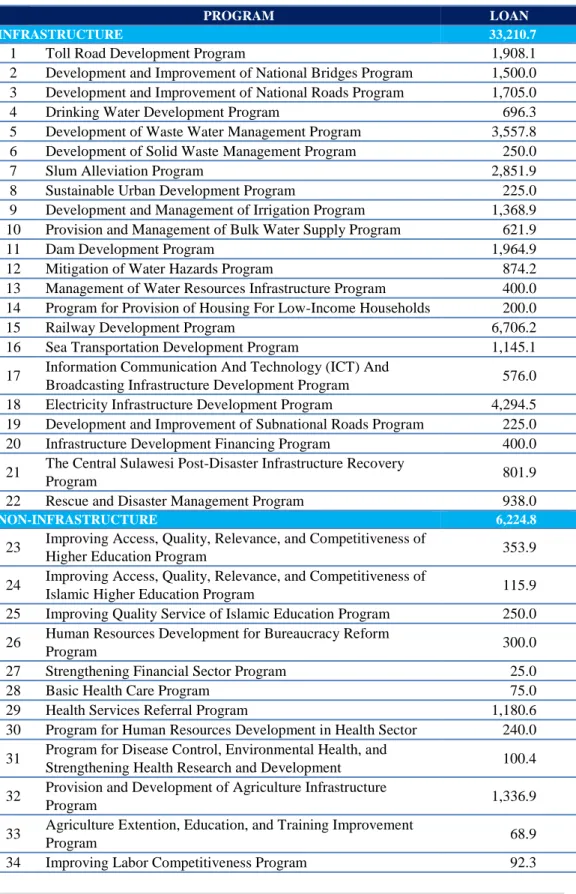
DRPLN-JM 2015-2019 is presented using the programmatic approach (PBA) format, through which a group of external loan projects with similar results are grouped into one program. The PBA is intended to increase the efficiency of the absorption of external loans by focusing more on achieving the results of the project that arose from the RPJMN. Therefore, with this approach, it is possible to easily identify the links between the use of external loans and the objectives of RPJMN.
In this context, project redesigns/changes/additions are allowed, provided they are still consistent with the program's results and do not exceed the loan amount defined in the program's ceilings. Project redesigns/changes/additions are then presented in the annual planning document called Foreign Loan Priority Plans or Daftar Prioritas Pinjaman Luar Negeri/DRPPLN, popularly known as the Green Book.
DRPLN-JM 2015–2019
Improving the quality of medical education through the development of the PTN hospital and Research Center at Lampung University. Ar-Raniry Islamic State University (UIN Ar-Raniry) Aceh Phase II Project Development. Development of the Faculty of Medicine - Health Sciences and Graduates of the University of the Islamic State of Alaudin, Makassar Project.
Udvikling af Maritime National Science and Technology Park (NTSP) i Northern Penajam Paser and Revitalization Infrastructure Marine Survey.
PROJECT DIGESTS
Improving water security is one of the national development goals in the Medium-Term National Development Plan. This program will support the Indonesian Government and communities to better manage and mitigate flood risks caused by overflowing rivers, rain and volcanic eruptions, and reduce the level of economic and social losses caused. Furthermore, the Government through the creation of Geothermal Sector Infrastructure Funds (PISP) whose management was mandated to PT.
Most bureaucracy reform strategies are covered in the Human Capital Development Plan (HCDP), including scholarship programs to strengthen bureaucracy reform in central government institutions. A mandate of the National Medium-Term Development Plan 2015-2019 is the construction of a system of Positive Land Registration, which among other things is manifested in the form of land mapping infrastructure and the implementation of systematic model land registration. The increase in data center capacity is a manifestation of service and land management as a whole throughout the territory of the Archipelago State of the Republic of Indonesia (NKRI).
Based on Presidential Regulation of the Republic of Indonesia Number 9 of 2016, the Government of Indonesia introduced one card policy; however, the implementation of this policy was not fast enough to achieve the transaction condition to support the analysis of planning by means of approaches above. In addition, the state of spatial data of land, especially the completeness of spatial data plots is still severely lacking, the covered areas of the land certified in 2015 only reached 12.5 percent of the land area of non-forested area. Accelerating the provision of large-scale base maps covering the entire country of Indonesia that will be used as a reference in thematic map production by all stakeholders for geospatial-based decision-making processes at all levels of government, as well as in various aspects of people's lives.
Upgrade the existing NSDI facilities and user applications, and improve the geoportal and ICT system to increase accessibility and speed; This component is designed to consist of 4 (four) sub-components as follows: (i) facilitating capacity building in the field of village potential processing, (ii) developing a market for village potential processing, (iii) developing BUMKam (village-owned business entity) to support the processing of village potentials and (iv) strengthening cooperation with the banking sector and third parties for the sustainability of the processing of village potentials. 4) Development of communication, networking and knowledge exchange of the program. Collaboration has been established with the banks or third parties in developing the activities related to the potential of the village.
Rehabilitation of roads in the hammer town and construction of tsunamis in 1 and 2 b. Reconstruction of the Kalawara-Kulawi road. Reconstruction of the ring road in Palu City 1 and 2 f. Slope management and raising of the Tambu-Tompe section. Restoring the state of infrastructure in affected places and anticipating the impact of the earthquake in the future.
Education in the Ministry of Religious Affairs (MoRA) is an integral part of the education system in Indonesia. Generally, the education policy in the MoRA follows the National Education Policy and is listed as one of the priorities of national education in the Sustainable Development Goals (SDGs and National Development Goals or Rencana Pembangunan Jangka Menengah (RPJMN) 2020-2024). The major problem facing education under the MoRA is the low quality of education caused by the low available budget.
That is why additional budget is needed to improve the quality of education managed by the MoRA.