First of all, I would like to express my gratitude to Allah SWT., who has blessed me with good health and ability to do this thesis as the final project. Sandi Ferdiansyah, M.Pd, my advisor, who has guided, advised and supported me in conducting the research and writing this thesis. I am very grateful to all those who have contributed to the successful completion of this thesis.
An-Nida Farrahillah, 2023: Representation of local culture of high school English textbooks in Indonesia: an analysis of cultural aspects framework Keywords: representation of local culture, English textbooks, cultural aspects framework. Therefore, this study aimed to explore the representation of local culture in English textbooks for 9th grade middle school students, using Yuen's framework of cultural aspects: products, practices, perspectives, and persons.
- Research Background
- Research Question
- Research Objective
- Research Significances
- Definition of Keyterms
The research had several objectives, including determining the representation of the local (Islamic and Saudi) culture in the TESOL textbooks by analyzing the portrayal of cultural values. The finding of the study revealed that the predominant aspect of culture presented in the textbooks is related to cultural practices. Another study, by Mahdi Dahmardeh and Sung-Do Kim published in 2021, entitled "An analysis of the representation of cultural content in English coursebooks".
In addition, the study examined the content of the textbooks using four cultural aspects: perspectives, products, practices and persons. This study has the potential to improve the English teachers' understanding of the importance of cultural materials in English language learning.
Previous Studies
Therefore, it can be assumed that the research investigated the representation of all cultural categories, including source/local culture. The fifth study was conducted by Mahdi Dahmardeh and Sung-Do Kim, titled "An analysis of the representation of cultural content in English coursebooks" published in 2020. The research findings revealed that the representation of culture was mostly based on the source culture , and dominated by the cultural aspect of perspectives.
This research examined the representation of ELT textbooks from inner, outer and extended circle countries. Journal of Articles by Zia Tajeddin and Maryam Pakzadian (2020) ―Representation of Internal, External and.
Theoretical Framework
- English Textbook
- Culture
- Culture Representation
In this study, the local culture refers to the researcher's culture, namely Indonesian culture. Therefore, the representation of local culture involves the use of language as a means of conveying the meaning and interpretation of local culture. Therefore, the representation of Indonesia's local culture refers to the display or portrayal of Indonesian culture.
Local culture can be represented through different media, one of them is English Textbook. When analyzing local culture in English textbooks, the researcher can analyze the cultural content from different aspects.
29
- Research Design
- Data Sources
- Data Collection
- Data Analysis Procedures
- Trustworthiness
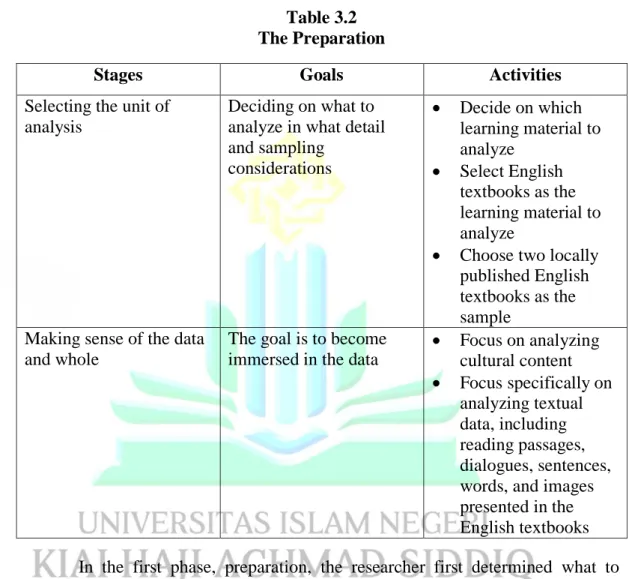
The researcher analyzed the cultural aspects of the local culture, including reading passages, dialogues, sentences, words and images presented in the textbooks. After that, the researcher coded the representation of local culture using the cultural aspect framework developed by Yuen (2011), which includes four categories: products, practices, perspectives and people. Focus especially on analyzing textual data, including reading passages, dialogues, sentences, words and images presented in English textbooks In the first stage, preparation, the researcher first determined what to analyze.
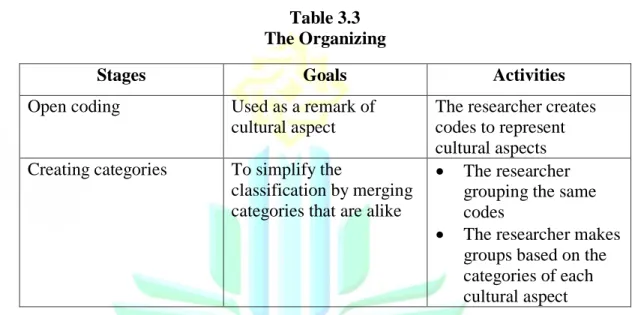
The researcher then determined that the analysis would specifically focus on cultural content contained in the textbooks. During the second phase of the research, which was the organizing phase, the researcher used an open coding technique to identify and mark cultural aspects found in the English textbooks analyzed. These categories helped the researcher to distinguish between the different cultural aspects and ensure that the data is properly organized and easy to understand.
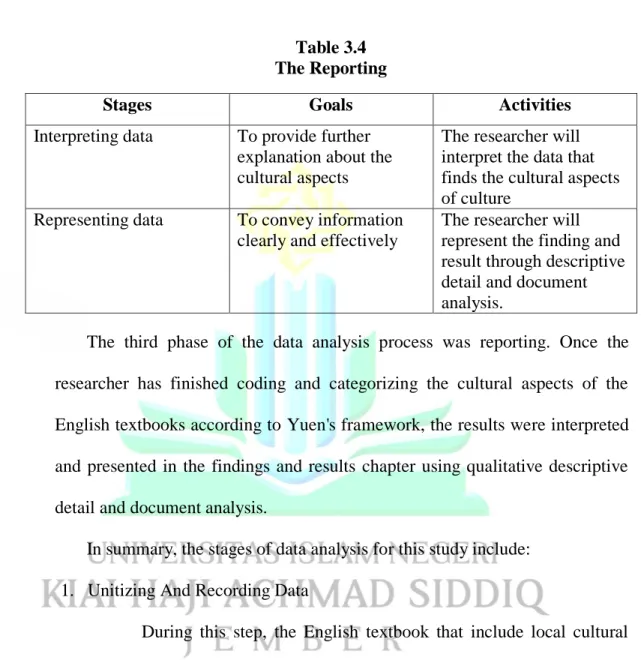
After the researcher has finished coding and categorizing the cultural aspects of the English texts according to Yuen's framework, the results were interpreted and presented in the findings and results chapter using descriptive qualitative details and document analysis. To create a systematic coding scheme for the cultural aspects of products, practices, perspectives, and persons in the content analysis, the researcher creates a coding manual. After coding aspects of local culture, the researcher groups similar codes and creates categories based on each aspect.
After collecting the data based on codes and categories, the researcher interpreted the data. In this step, the researcher provided further explanation about the cultural aspects represented in the local culture. The researcher used two types of triangulation to investigate the cultural aspects in the portrayal of local culture in English textbooks.
Findings
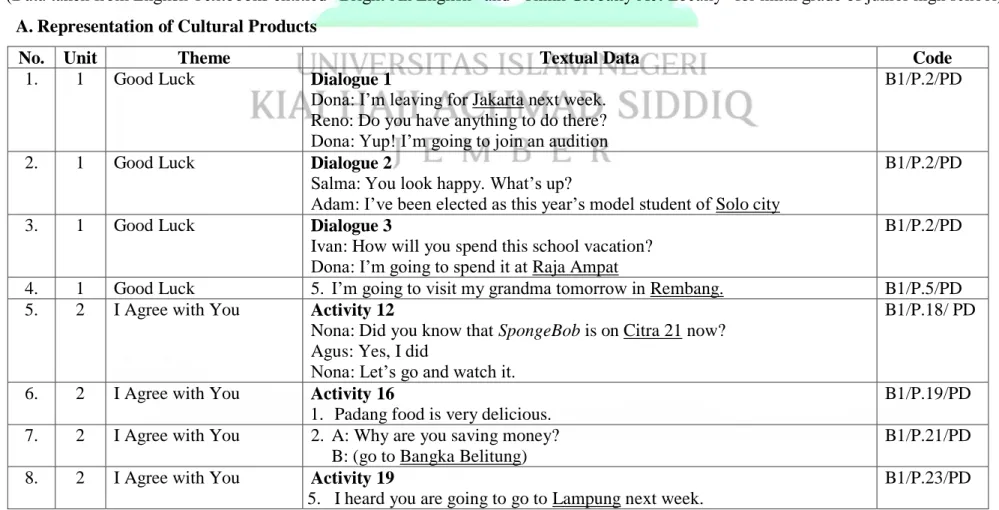
In order, numbers 1-3 are textual data in the form of a sentence, a reading passage and a dialogue. Perspectives of local culture are presented in the form of sentences, dialogues or reading passages. In Table 4.3, the interpreted representations of Indonesian culture in terms of perspectives are presented in the form of textual data.
In the second part, the textual data is presented in the form of a reading. The persons of local culture in the textbooks appear in the form of words, sentences or dialogues. It can therefore be considered a representation of local culture in the aspect of persons.
In the teaching text, the religions of the local culture in the form of textual data present the religious practice. Religions of local culture in the textbook appear in the form of reading passages. Below is an explanation of how the religious aspect represents local culture in the form of textual data.
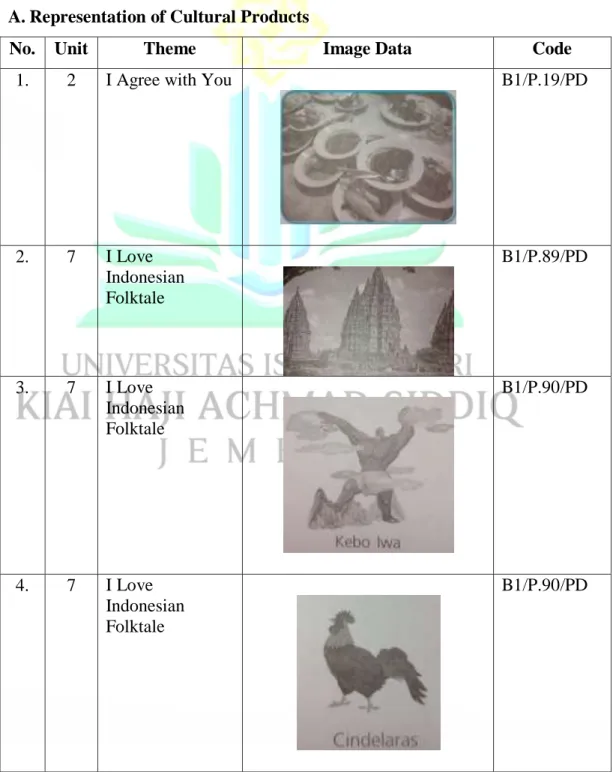
The following is the explanation of how the product aspect represents local culture in the form of image data. While in the first textbook titled "Bright An English", the researcher did not find any local practice in the form of image data. The following is the explanation of how the practice aspect represents local culture in the form of image data.
Below it is explained how the people aspect represents local culture in the form of image data. Below it is explained how the aspect of religion represents local culture in the form of image data.

Discussion
This is in accordance with Lee & Li's (2019) study which reveals product aspect as the aspects most depicted in their research. Furthermore, they mentioned some examples of the products, including tourist attractions, architectural structures, cuisine, native animals and literature. Furthermore, in the perspective aspect, local culture is represented by values such as the importance of family ties and the perspective of prioritizing safety and security, especially in relation to management.
The findings of the perspective perspective in this textbook are supported by a previous study by Dahmardeh & Kim (2020), who mention that cultural perspectives can be encompassed by values and beliefs. However, in textbooks, unknown individuals are more exposed than well-known personalities as representatives of the Indonesian people. According to Yuen (2011), one of the cultural persons can appear through unknown people.
In the first English textbook, the cultural representation in the form of image data was found only in the product aspect. It is presented by pictures of local Indonesian cuisine (Gudeg, Padang food, es teler, kerupuk, and more);. However, during the analysis of the English textbooks, the researcher identified several cases depicting religious practice and religious diversity.
Based on the findings and discussion, it is clear that the two selected English textbooks primarily emphasize the product aspect as the dominant aspect in representing local culture. It is demonstrated that although there are efforts to portray local culture in English textbooks, there are significant differences in the amount and types of data for each cultural aspect. Furthermore, adding the religious aspect to the analysis of cultural representation in the English textbooks for Junior high school in Indonesia reveals a deeper layer of cultural diversity.
Conclusion
However, during the analysis of the English textbooks, the researcher identified several cases that depict religious practice and religious diversity in Indonesia. In order to effectively teach English as a foreign language, especially in the context of Indonesia, it is crucial to include local cultural elements in English textbooks. By including a representation of the local culture, students can develop a better sense of multicultural awareness and appreciate the uniqueness of their own culture as well as the cultures of others.
This research provides insights into the representation of local culture in English textbooks for junior high schools in Indonesia. The findings serve as a basis for further development in English language teaching that takes into account the cultural diversity in Indonesia. However, despite the efforts to reflect local culture according to Yuen's (2011) cultural aspects, there are significant variations in the amount and types of data for each cultural aspect in the two selected textbooks.
Suggestions
As this research has certain limitations, further studies involving different volumes, levels and publishers of English textbooks can be conducted. The Representation of Multicultural Values in an EFL Textbook Approved by the Indonesian Ministry of Education and Culture: A Critical Discourse Analysis. Lemper' in a banana leaf is steamed or cooked on a very hot grill or grill.
Harry: “It is worn by men and women at ceremonial events such as weddings and funerals. Last night she (make) a lot of cupcakes for the Papuan community that gathered in the community hall. Deciding on aspects of Yuen culture to use in presenting local culture through cultural aspects in selected textbooks.
The choice of the data in the selected textbooks that would be analyzed based on Yuen framework of cultural aspects.