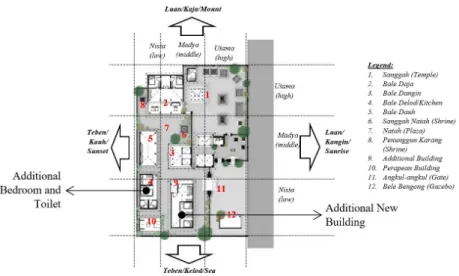
The positions of the building are based on their level in the spatial structure of the Sanga Mandala. Bale Dangin is in the direction of kangin (luan/utama) and is used for traditional ceremonial or ritual activities. Paon is in the direction of kelod kauh (teben/nista) which serves as kitchen and bedroom.
The direction of orientation and function of building units shows the concepts of utama and nista as a spatial hierarchy in the lowland Balinese ethnic house building plan that translates into luan and teban orientations. The ethnic Balinese houses in the lowlands consist of nine areas (sanga mandala) which are intended for temples, Bale Daja, Bale Dangin, Bale Dauh and Bale Delod, Paon (kitchen), as well as other supporting buildings such as building units - usually sons who have been married and live with their parents, Perapean (the social identity for the Pande caste) and Jineng - as the living identity of a farming family. Therefore, Bale Dangin occupies the zoning in the direction of the lion (Kangin/sunrise direction), while the concept of teben is identified with physical activities such as the kitchen or Bale Delod, Bale Dauh and other supporting buildings that occupy areas in the direction of Teben (Kauh and Kelod).
Luan and Teben's Conception Based on Building Unit Orientation
Synthesis: Contemporary Concepts of Luan and Teben
The Bale Daja and the Bale Dauh are conceptually separate buildings, but in the field both are located in one building towards Kaja Kauh. The description implies that the concept of luan and teben is not completely symmetrical in its application, but is asymmetrical based on the condition of the site and the change in the number of inhabitants in one plot. It can be concluded that the concept of luan and teben evolves in the contemporary context, while the central and contemplative aspects of luan and teben are retained in the design of Balinese ethnic neighborhoods that undergo a developmental dynamic.
CONCLUSION
Retrieved from https://media.neliti.com/media/publications/266335-ruang-ideal-bali-dalam-tekanan-globalisa-aac486da.pdf. Treatise on the concept of balance between Sakala and Niskala spaces in ethnic Balinese homes. Sanga Mandala is a concept that divides the layout of Balinese lowland houses into nine zones.
The intersection of two main axes, the ritual axis and the natural axis, forms the concept of Sanga Mandala. Over time, the realization of Sanga Mandala in the form of buildings and zoning plans underwent a transformation in response to the increase in the number of household members, the modern mentality of the citizen and the tendency to follow contemporary trends. Zoning changes that still follow the rules of traditional Balinese architecture are zones with sacred and ritual functions.
With the development of modern mindset of the citizen, we can find those phenomena in Denpasar. This study aimed to investigate the meaning of luan and teben on Balinese ethnic house layout in Denpasar. There is an interesting phenomenon related to the meaning of luan and teben in modern life.
The results showed that there was a pattern of meaning on luan and teben in the conception of zoning, transformation of spaces and buildings, orientation of building mass, and a pattern of meaning emerged in zoning and ritual functions as the most important part. in the living space layout of Balinese ethnic houses in the middle of Denpasar development. Keywords: Balinese ethnic houses, contemporary luan and teben, luan and teben orientation, luan and teben zoning.
INTRODUCTION
There is an increase in support space and the joining of two buildings into one building. The increase in building mass as a result of the increasing number of family members in one of these residential homes. In the transformation of the spatial layout of Balinese ethnic houses in Denpasar at macro and micro levels, great attention is still paid to the zoning of Sanga Mandala.
The addition of new spatial functions occurs mainly in Bale Daja, Bale Delod and Bale Dauh, while Bale Dangin does not experience additional functions. Adding spatial functions to the original building in the form of a bedroom or bathroom. Usually, the increase in construction size is a consequence of the increase in the number of family members, especially sons who are married and still living at home.
This mass increase occurs in luan or nista (the direction of kelod and kauh). From the description above, it can be interpreted that the perception of luan and teben is the orientation and zoning of the Sanga Mandala in the spatial layout of Balinese ethnic houses in Denpasar, which is still maintained as an orientation cosmology. The study aimed to interpret the concepts of luan and teben on the spatial layout and building mass of Balinese ethnic houses in Denpasar.
The variables studied were the zoning of the building masses, the changes in space in the layout of the Balinese ethnic house and the orientation of each building mass through the Sanga Mandala approach, the concepts of luan and tebe, Tri Hita Karana and the development of Balinese ethnic houses in Denpasar.
RESEARCH METHODOLOGY
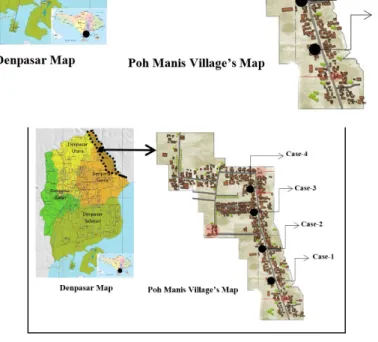
The locus of this research is in East Denpasar by taking 4 (four) case studies of ethnic Balinese residential areas.
RESULTS AND DISCUSSION
Layout Conception of Balinese Ethnic Houses in The Lowlands
Jineng or granary is a storage area for harvesting crops in the community with a wet and dry farming system with its position in the direction of delod (teben/nista). The pig pen is in the delod (teben/nista) which is designated as a place to keep pigs. Looking from the formation of the spatial structure of the Sanga Mandala, which is created by two ritual and natural axes, each of which has a luan and teben orientation, the mass of buildings is in the direction of the luan Sanggah (shrine) , Bale Daja and Bale Dangin, while those lying in the direction of the teben are Bale Dauh and Bale Delod.
Parents are interpreted as someone who is respected and important in the family, so their place is in Bale Daja. The concept of Guru Rupaka was also aimed at ancestor who has given birth and guided a child to adulthood (Putra, Alfyananda Kunia Sumarmi & Singgih, 2018). While the ritual activities of "people" (wedding, Otonan/Balinese birthday, funerals) have meaning as a manifestation of "mental value" held in Bale Dangin.
Ritual (psychological) activities performed in Bale Dangin as the direction of the ritual axis, according to Rosada's statement that the concept of Luan and Teben has several orientations, namely the earth axis/natural axis (Kaja/Lion-Kelod/teben) and the ritual. axis (Kangin/Luan-Kauh/teben) (Rosada; . Hariski, 2016). So it can be said that the direction of Kaja and Kangin means lion (utama) which is interpreted in the form of ethnic Balinese residential architecture with Bale Daja and Bale Dangin. Activities such as the reception of guests and the residence of unmarried boys is a physical element and social relations held in Bale Dauh.
The other physical activity is "cooking", which is why the Bale Delod is part of the direction of teben.

Conception of Luan and Teben Based on Balinese Ethnic Houses
Bale Dangin which facilitates religious ritual activities such as weddings, birthdays and funerals are interpreted as spaces for ritual activities for people. It is different from the Sanggah or ethnic Balinese house shrine that is explained above, while a form of ritual activity for God.
Luan and Teben's Conception Based on Space and Building Transformation
Transformation in the form of amalgamation or addition of building units in a single house still makes use of consideration of luan and teben concepts. This means that the transformation only takes place in building units that have a correlation with human living space and tend towards the direction of the teben or nista. The pattern of the building units in the concept of Sanga Mandala forms a "central pattern" visible from the front of each building to the center (natah/plaza).
In the case investigated, the concept of natah (plaza) is seen very strongly on the side of each building facing the central space (natah), characterized by a transition space (verandah) to reinforce the direction of the building . I Kadek Merta Wijaya 11 From the description above, to determine the direction of the luan and. The concepts of luan and teben can also be understood by the direction of sunrise and sunset and the direction of the mountain (as a natural orientation common in Bali).
The concepts of luan and teben form the axis of dichotomous opposition in the orientation system of primary value and contempt in Hindu-Balinese society. The direction of luan and teben is not a symmetrical concept, but asymmetrical or in the sense that the zoning system is flexible. The luan direction indicates the side facing Kaja and Kangin, and conversely the tebena direction is the side facing Kelod and Kangin.
It can be concluded that luan and teben are not entirely on the symmetrical axis where Bale Daja in the Utamaning Madya (luan), nor are the Bale Delod in Nistaning Madya, Bale Dangin in Madyaning Utama and Bale Dauh in Madyaning Nista. General provisions of luan and teben mean that provisions of luan for Bale Daja and Bale Dangin can still be tolerated if they are the opposite of the Bale Delod and Bale Dauh, therefore it is rated as luan. The position and orientation of this shrine serve as a starting point in determining the luan and teben of the Balinese ethnic dwellings in the lowlands.
The dynamics of its development is that the concept of luan and teben are still an integral guide to the structure of the Balinese ethnic house amid its contemporary development.