SMITHSONIAN MISCELLANEOUS COLLECTIONS VOLUME
143,NUMBER
1LOCOMOTOR MECHANISMS
OF BIRDS
By
FRANK
A.HARTMAN
Department of Physiology The Ohio State University
Columbus, Ohio
^ii« ifcv^
per\
"^esr
yon(Publication 4460)
CITY OF WASHINGTON
PUBLISHED BY THE SMITHSONIAN INSTITUTION
JUNE
30, 1961SMITHSONIAN MISCELLANEOUS COLLECTIONS VOLUME
143,NUMBER
1LOCOMOTOR MECHANISMS
OF BIRDS
By
FRANK
A.HARTMAN
Department of Physiology The Ohio State University
Columbus, Ohio
(Publication 4460)
CITY OF WASHINGTON
PUBLISHED BY THE SMITHSONIAN INSTITUTION
JUNE
30, 1961PORT CITY PRESS, INC.
BALTIMORE, MD.# U. S. A.
LOCOMOTOR MECHANISMS OF BIRDS
By FRANK
A.HARTMAN
Department of Physiology
The Ohio State University, Columbus, Ohio
INTRODUCTION
Ornithological literature
abounds
in descriptions of the habitsand
activities of birds, while anatomical studies are less
common and
are related mostly totaxonomy. Attempts
to correlate structure with function in birds are few, yet this is a very intriguing subject for study since birds areamong
themost
activemembers
of the animalkingdom.
This is reflected in their high rate of metabolismand
ele- vated temperature. Their versatility is great; they can fly, run, or swim,some performing
all these activities, while others are limited to one or two.However,
certain species excel in locomotion in the air,on
the land, or in the water.We
note the explosive flight of the grouse, the graceful glide of the swallow, the soaring of the vulture, the poise of thehummingbird,
the racing of the roadrunner,and
the diving of the loon. Their skill can be seen, their speed can be measured, but the relativepower
involved escapes us.Actual
measurement
of these activities is necessarily limited, since the confinement requiredwould
defeat its goal, but the muscles can beweighed
asan
indication of their potential capacity.The
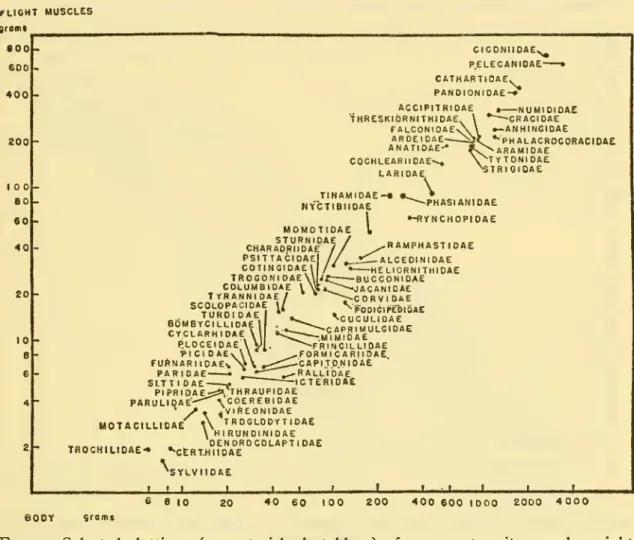
flightmuscles can serve as a
measure
ofpower
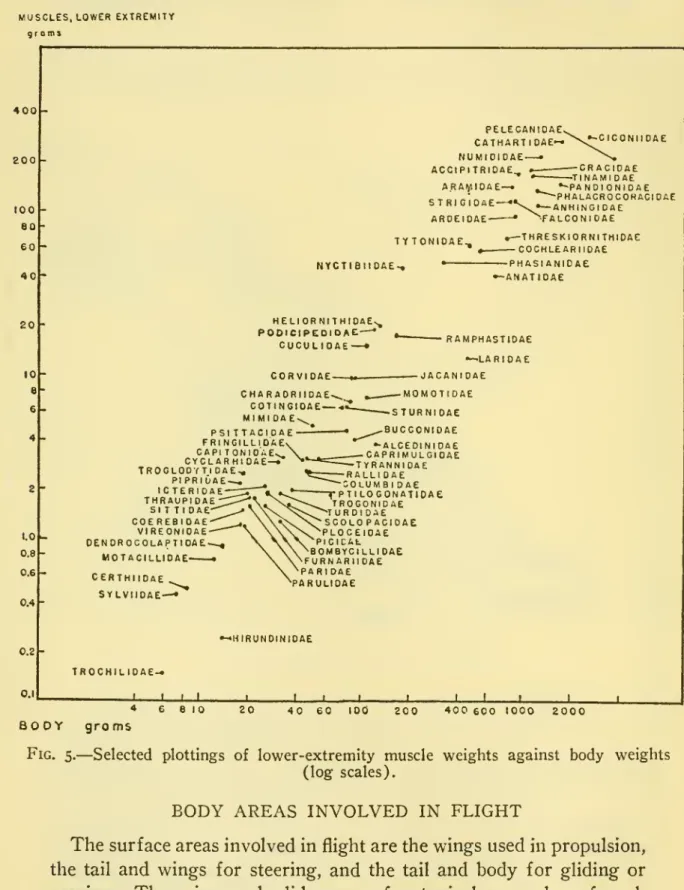
in the air. Likewise muscles of the lower extremities represent thepower
for terrestrial or aquatic locomotion, while heart weights bear a direct relation to the ability to sustain activity.The
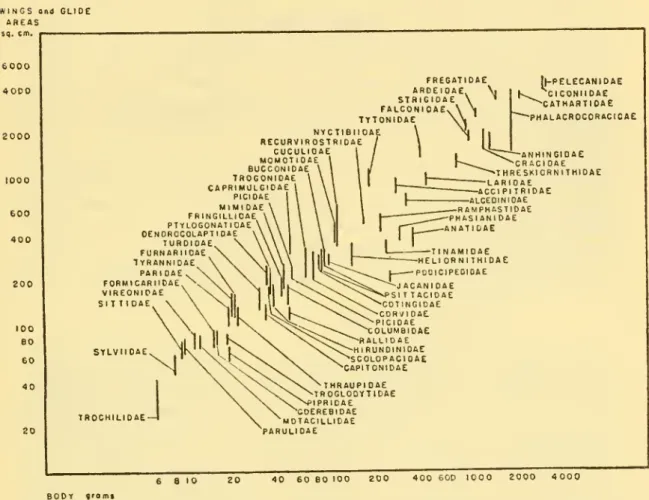
areas of the wings, tail,and
total gliding surface are measures of the airlift,and
the relation of length to breadth of thewing shows
the adaptation for lift or glide.The
superficialand
deep layers of the pectoralis,which
constitute 48 to68
percent of all flightmuscles, are
most
essential in depressing thewing
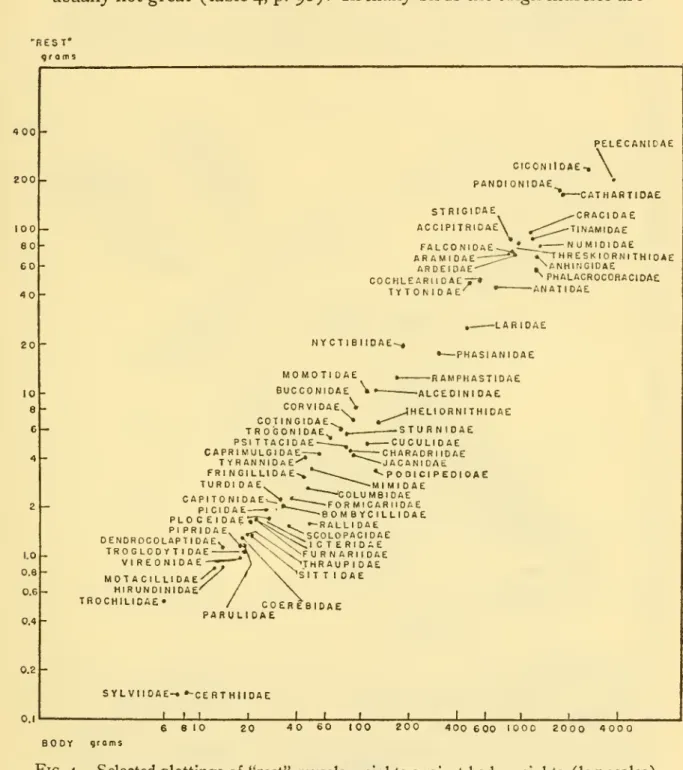
or lifting the body, while the supracoracoideus raises the wing.The
remainder of the flight muscles (grouped in the master list, table 1 (pp. 38-87),under
the heading "Rest") play their part in controllingwing movement.
Little accurate information about the relative size of muscles has been available. General statements
have
beenmade
such as thatby
SMITHSONIAN MISCELLANEOUS COLLECTIONS, VOL. 143, NO. 1
2 SMITHSONIAN MISCELLANEOUS COLLECTIONS
VOL. I43Aymar
(1935, p. 57) : "a pigeon's pectoral muscleswhich
raiseand
lower thewing
are asmuch
as50
percent of the entire bird."How-
ever, Fisher (1946)
made
careful comparisons of thevolumes
of the individual locomotor muscles of vultures preserved in alcohol.For
the present study I selected certain groups of muscles used in loco-
motion and weighed them
in the fresh condition. In addition, the areas used in lift or glide have been determined.METHODS
All specimens
were
keptin waterproof plasticbags to prevent dryinguntil
weighed
at the field station. Small birdswere weighed on
a torsion balance of 120 grams' capacity.Larger
oneswere weighed on
Chatillon spring balances, themost
sensitive one for the weight involved beingused: 6,000 grams' capacitywith24
grams' sensitivity;
500
grams' capacity with 10 grams' sensitivity;and 250
grams' capacity with 5 grams' sensitivity.The
birdwas
spread outon
a sheet of paper tacked to adrawing
board.A
careful outline of the spread wings, tail,and body was
traced.
The
lengthand median
width of thewing were
also deter-mined
for the calculation of the aspect ratio ( tttJ
.
Areas were
ob- tained laterby
a compensating polar planimeter.The buoyancy
index2,
—
:was
calculatedby
the formula, , since area is two-Vbody
weightdimensional
and
weight isthree-dimensional(George and
Nair, 1952).After skinning the areas involved, the pectoralis stiperficialis, supra- coracoideus, the rest of the flight muscles (called "rest") except those along the carpus, metacarpus,
and
phalanges,and
finally all the muscles of the lower extremitieswere removed by means
of scalpeland
scissors
and
then weighed. (If therewas any
delay before weighing, the dissected muscleswere
kept in a moist chamber.)These
muscleswere weighed on
both sidesfrom
at least200
birds, but thereafter the muscleson one
side onlywere
weighed, since thetwo
sidesproved
to be identical within the limits of error of dissection.The
weights of smaller muscle groups have been determined in afew
species.Thus
the shoulder,
upper and
lower arm,and
upperand
lower leg muscleshave
been separated.Doubling
these values gave the totals used in calculations.Heart
vesselswere trimmed
close to theorgan and
both sides cut open,any
remaining blood beingremoved by
contact with blotting paper.Weighing was
carried outon
the torsion balance oron
aNO. I
LOCOMOTOR MECHANISMS OF
BIRDS— HARTMAN
3Roller-Smith balance with a capacity of 1,500 milligrams
and
a sensi- tivity of 0.02 milligram.Only
healthy adult birdswere
used, except for afew immature
specimenswhich
arementioned
in the text.Nomenclature
is based largelyon
Peters' check list (1931-1951)and on
the check list of theAmerican
Ornithologists'Union
(1957) forNorth American
passerine species.The
values obtainedwere
listed in tables. Inour
earlierwork some
of the muscleswere
not weighed,which
accounts for the lack of complete data insome
species.The
text figures
make
comparison of typical values in each family, those precededby an
asterisk in the table being represented.Material for this
work was
collected in Florida, Maine, Ohio,and Panama. Panamanian
birdswere
collected during the periodJanuary
throughMarch
at the following stations :Juan
Mina, Canal Zone,on
theRio Chagres
;Rio La Jagua
in thePacora
marshes, in the Province ofPanama
east ofPanama
City; Cerro Copete (elevation 7,000 ft.)above Boquete,
and
the finca "Palo Santo" near the village of ElVolcan
(4,250 ft. above sea level), in the Province of Chiriqui.Florida birds
were
collected at different seasonson Lake
Okeechobee,around
the islands of the Gulf Coast,and on
the prairiesand ham- mocks
of the peninsula.Ohio
birdswere
obtainedfrom
the central part of the State,and Maine
birdswere
collected at or nearLake Kezar
in the southwestern part of the State.Most
specimenswere
obtained in themorning
before 11 o'clock.ACKNOWLEDGMENTS
I
am
verymuch
indebted to Richard Archbold, of theArchbold
Biological Station, Florida, forhis personal assistance in the collection of material,
and
for the use of the facilities of the Station. InPanama
the studies in the CanalZone were
based at theJuan Mina
Field Station of the
Gorgas Memorial
Institute through thegood
offices of Dr. Carl Johnson, the director.
The La Jagua Hunt
Club permitted the use of their facilities forwork
in theopen
country near theRio La
Jagua. PabloBrackney
kindly granted our party the use of a cottage at "Palo Santo,"and
the late TollefMonniche
aided uson
our expeditionson
Cerro Copete above Boquete. AloisHartmann
also permitted us to stay at his place in western Chiriqui.The
late Dr.James
Zetek, then ResidentManager
of the CanalZone
BiologicalArea on Barro
Colorado Island,was
very helpful at all times with advice. I wish to thank Dr.Alexander Wetmore
for the identification ofsome
of thePanamanian
birdsand
for a critical reading of the manuscript.Many
of themeasurements and
calculationswere
carried4 SMITHSONIAN MISCELLANEOUS COLLECTIONS
VOL. I43 outby
Carl Albrecht,Kent
Bruno,Barbara
Caldwell,David
Gillespie,Elmer
E.Hartman, Donald
Neal,and Kenneth
Teague. This studywas
aidedby
grantsfrom
theComly-Coleman Fund and
theGraduate
School of theOhio
State University.RESULTS
Data on more
than360
species in70
families are included in thisreport.
The
muscle weights are calculated as percent ofbody
weight.The wing and
other areas are given as cm.2 pergram
ofbody
weight.Glide area is the area included in wings, tail,
and
body.In the master list (table 1, pp. 38-87) the
number
of individuals in a species isshown
in parentheses, with themean
valuesand
standard error of the means, or the individual values are given if less than three.Sexes are separated for
body
weightsand
for other determinationswhere
the differencesbetween
sexes are significant; otherwise the data of thetwo
sexes are combined.Although
the datafrom
a single indi- vidualmay
not be representative of a species, they have been includedif the species is sufficiently interesting.
Before embarking on
a consideration of the muscles Iwish
to call attention to certain species inwhich
there is a significant difference inbody
weightbetween
the sexes.Those
inwhich
males are larger are : Podiceps dominicus,Casmerodius
albus, Gallus gallus,Aramus
guarauna,
Porphyrida
martinica,Columba
speciosa, Brotogeris jugu-laris,
Crotophaga
major,Crotophaga
ani,Crotophaga
sulcirostris,Nyctidromus
albicollis,many
trochilids, Centurus rubricapillas,Cen-
hirus chrysauchen, Dendrocinclahomochroa,
Sittasomusgriseicapillus,Xiphorhynchus
guttatus, Anabacerthiastriaticollis,Manacus
vitellinus, Fluvicola pica, Cyanocitta cristata,Parus
carolinensis,Parus
bicolor,Parula pitiayumi,
many
icterids,and Arremonops
conirostris. In the following species the females are larger: Jacana spinosa,Tyto
alba,Speotyto cunicidaria, Cotinga ridgwayi, Corapipo leucorrhoa,
Thryo-
thorus modestus,and
Selasphorus scintilla.Let
usnow
consider the distinctive values in each familyand
their possible relation to habits (table 1).Tinamidae. — The
tinamous aremost
unusual birds, possessingextremely large flight muscles (37 to
40
percent of thebody
weight, ofwhich
the pectoralis is 63 percent)and
large leg muscles (13 to 17 percent) but the smallest heart (0.19 to 0.25 percent) of all birds.The
pectorals are so large that they extendbeyond
the keel of the sternum. In Crypturellus thesternum
issubmerged
7 to8 mm.
below the bulging pectorals.The same
condition is present inNothocercus
NO. I
LOCOMOTOR MECHANISMS OF
BIRDS— HARTMAN
5and
inTinamus, where
thesubmergence may
reach9
to 10mm. The wings
are small(buoyancy
index, 2.86 to 3.14)and
broad (aspect ratio, 1.49 to 1.62).The wing
area pergram
of flight muscles is19 cm.2 in
Tinamus and 36
cm.2 in Crypturellus.Nothocercus
possesses smaller pectoralis muscles(P<o.oi)
but larger lower- extremity muscles thanTinamus and
Crypturellus.The
muscles are in keeping with the habits—
these birds run along theground
or flyexplosively for short distances, the small heart preventing
more
prolonged effort.Podicipedidae. —
Grebes aremost
proficient inswimming and
diving, using their feet in the process
(Van Tyne and
Berger, 1959).Their flight muscles are very small, being only 14 percent of the
body
in Podiceps dominicus. This species,
which
weighs only a littlemore
than one-third asmuch
asPodilymbus
podiceps, possesses almost double thewing
area of the latter. Podiceps dominicus also has a lower aspect ratio (2.51compared
to 2.91).The
tails are insignificant in both species.The
leg muscles are large, being 16 percent inPodiceps
and
18 percent in Podilymbus.The
leg position is ideal forswimming
but causesan awkward waddling
gait in walking.The
heart is
moderate
in size in both species (1.00 to 1.05 percent).Pelecanidae.
— The
clownishbrown
pelican starts ratherawkwardly
with slow, sweeping
wing
strokes,continuingwithfrequent soaringand
sailing or,
on
a gentle breeze, gliding gracefully just above the water.The male
has relatively larger flightand
leg muscles than does the female, butcompared
to the cormorant, the flight muscles are but alittle larger while the legs are less than half the size.
His wings
are moderately large (1.34cm.2 per g. of body;buoyancy
index, 4.38) but very long (aspect ratio, 3.75), enablinghim
toskim
over the water with ease.Phalacrocoracidae. — The cormorant
prefers to diveand
swim,since that is his
method
of obtaining food.He
is a rapidswimmer,
using only his feet according to Selous (see Bent, 1922), holding hiswings
motionless. In the air he is aheavy
flier (flight muscles, 17 per- cent;buoyancy
index, 3.27), slowly flapping hiswings
after themanner
of a heron.His
legs are large (muscles are 11 percent of the body), but because of their position,on
land he isawkward,
though less helpless than the grebe.Anhingidae. — The
anhinga, like the cormorant, obtains his foodby
divingand swimming,
using his feet only, withwings
slightly folded or slightlyexpanded and
steering with his tail,which
can be spread as a rudder (Bent, 1922).However,
unlike the cormorant he6 SMITHSONIAN MISCELLANEOUS COLLECTIONS
VOL. 143is a graceful, rather powerful flier, having
somewhat
larger flightmuscles (19 percent)
and wings (buoyancy
index, 3.7) but smaller legs (8.6 percent).Fregatidae.
— The
man-o'-war,one
of themost
graceful birds in the air, soarsmuch
of the time, steeringby
his scissors tail, but he can also fly rapidly to overtake another bird.His wings
are very large(buoyancy
index, 5.55)and
extremely long (aspect ratio, 3.5 to 4.4), but his pectoralis plus supracoracoideus muscles aremoderate
(13 to17 percent).
Ardeidae. — The
large leg muscles of the herons are useful forwading and
stalking prey.The members
of this familyshow
a con- siderable range in equipment, but thewings
of all are rather long (aspect ratio, 2.00 to 2.66)and
large(buoyancy
index, 3.68 to 5.28),and
all have large flight muscles (20 to 25 percent) exceptIxobrychus
(13.89 percent).They
vary asmuch
in flight as in muscular equipment.Some,
like the great blue heron,make an awkward
starton
thetakeoffby
vigorouswing
strokes, but onceunderway
the long, slow strokes carrythem
majestically through the air.
The
black-crowned night heron differsfrom
other herons in having a flightmore
gull-like, being strongerand
swifter with quickerwing
strokes. This is notdue
to the size of thewing
muscles, since they areno
larger.The
least bittern hasan awkward
fluttering flight for a short distance, preferring to escapeby
walking or climbing.However, on
long flights he appears strongand
rather swift despite small flight muscles.The
hearts of all heronsare rather small (0.57 to 0.83 percent).
The
hearts of the Florida subspecies of Butorides virescens are heavier(P<o.05)
than those of thesame
species collected inPanama.
This is also true for individuals of Florida caerulea
and Ixobrychus
exilis
from
thetwo
localities.The
hearts(P<o.oi) and
pectoraland
supracoracoideus muscles(P<o.o5)
of Tigrisoma lineatum are larger than thesame
features inHeterocnus
mexicanus.Cochleariidae.
— The
boat-billed heron is similar to the true herons in the size of its flight equipment. It is interesting to note that inan immature
Cochlearis, at a timewhen
thebody had
almost attained adult weight, the flight muscleswere
less than half the weight of those in the adult, while the leg muscleswere
nearly the weight of the adult's.The
heart of theimmature was
also verymuch
smaller than that of the adult.The
early development of the leg muscleswas
alsoshown
in ayoung Heterocnus mexicanus (250
g.). In this bird the legswere
half-grown (muscles 5.88 percent of thebody)
while theNO. I
LOCOMOTOR MECHANISMS OF
BIRDS— HARTMAN
7flight muscles
were
littlemore
than one-tenth the value of those of the adult (2.28 percent). Likewise,an immature male Podilymbus
podiceps thathad
attained the weight of the adult (450 g.) possessedflight muscles (7.58 percent)
somewhat
less than those of the adult, while the legswere
the size of those of the adult (18.9 percent).The wing
featherswere
just emerging.Ciconiidae.
— The wood
ibis springs powerfully into the airand
flies higher
and
higher until almost out of sight,when
he sails grace- fullyon
motionlesswings
inwide
circles.His
flight muscles aresomewhat
larger (27 percent ofbody) and
hiswings narrower
(aspectratio, 2.85) than in
most
herons, but his legs are about thesame
size (10.9 percent).Threskiornithidae. — The
white ibis walksand
climbs nimblyand
swims
well.He
flies with strong, rapid strokes, varied with occasional periods of sailing.There
is nothing unusual about his measurements.Anatidae. — Both
the pintail{Anas
acuta)and
blue-winged teal{Anas
discors) are fast fliers with fairly large hearts (1.23and
1.15percent respectively)
and
large flight muscles (31.36and
29.2 per- cent).They
springupward from
the waterand
getunderway
at once.The
whistling of the teal'swings
is probablydue
to the rapidwing
beats, since thewings
are small for the weight(buoyancy
index, 2.84).The
lesser scaup{Aythya
affinis),a rather laborious but steadyflier, has a
buoyancy
index of 2.62. Its heart is smaller than that ofOxyura
dominica(P<o.05) and Anas
acuta(P<o.oi). The
heart of Cairina, in the domesticated form, is smallest of all.The
flightmuscles of the
male
Cairina are smaller(P<o.oi)
than those of the female, while the reverse is true for the legs.The
supracoracoideus in ducks is about one-third that of the "rest" group. Cairina possesses the largest legs of all ducks studied.Cathartidae.
— The
flight ofCoragyps
is inferior to that of Ca-thartes.
He
has smallerwings(P<o.oi) and
flight muscles(P<o.o5)
a larger heart
and
legs(P<o.oi,), and
broader wings. Differences are alsoshown between Panama and
Florida vultures.The
hearts of FloridaCoragyps (P<o.o5) and
Cathartes(P<o.oi)
are larger than those of thePanama
species.Accipitridae.
— Among
the hawks, Elanoides is unsurpassed in beautiful maneuverings.With
his longwings
(aspect ratio, 3.40)and
forked tail he soars aloft to sportamong
the clouds.The
speedyaccipiters fly
by
a series of quick flappings followedby
short periods of rapid sailing. In contrast theButeo
flight isheavy
but powerfuland
graceful. Buteogallus anthracinus is similar in flight.8 SMITHSONIAN MISCELLANEOUS COLLECTIONS
VOL. I43The
hearts of the Accipitridae are relatively small, rangingfrom
0.40 to 0.81 percent.
The
flight muscles ofmost
ofthem
are ofmoderate
size,Chondrohierax and
Spizaetus being exceptions.The most
strikingfinding is therelativelysmall size of the supracoracoideus (only 0.39to 0.56 percent of thebody
).The
legs, exceptin Elano'ides, are fairly large,and
thewings
are fairly long.These
characteristics indicategood
fliers but little ability to sustain activity for long periods, unlessby
soaring.The
muscles of the lower extremities ofmany hawks
are relatively large,and
those of theupper
extremities are not small. Severalhawks
are strong fliers, although they frequently soar.Pandionidae. — The
muscles of the osprey resemble those of the Accipitridae, but the legs are smallerand
the heart is larger than inmost
of the latter.Falconidae.
— The
hearts of falcons are a little larger than those ofhawks, ranging
from
0.53 percent (Micrastur) to 1.11 percent (Poly- borus).The
supracoracoideus is alsosomewhat
larger than in hawks.The wings
arenarrower
in species that are fast fliers.The
flightand
leg muscles of Micrastur semitorquatus are larger than those of Micrastur ruficollis, while the
wings
aremuch
smaller; yet thebuoyancy
index is about the same.Cracidae.
—
In the Cracidae, represented in our studyby
the chest- nut-winged chacalaca (Ortalis garrula)and
the blackguan
(Chae-mepetes
unicolor), the flight muscles are moderately large (23 to26
percent), with the supracoracoideus of fair size (2 to 3 percent).These
birds areheavy
fliers withwings
rathermoderate
in size (buoy-ancy
index, 3.66)and
broad (aspect ratio, 1.38 to 1.51) ; the leg muscles are large (15.7 to20
percent), while the heart is small (0.48 to 0.62 percent).Phasianidae. — The
phasianids are very interesting.Three
species of quail, natives of widely different parts of the world, possess very large flight muscles(Cotumix,
25.6 percent; Odontophorus, 29.4 per- cent; Colinus, 34.3 percent)and
large supracoracoideus (5.66 percent;5.89 percent; 7.16 percent), with a "rest" nearly the size of the latter (4.46 percent; 6.17 percent; 5.53 percent).
But
the heart ofCotumix
is about three times the sizeof thatof the other
two
species (1.00 per- centcompared
to 0.34 percentand
0.38 percent).The
lower extremi-ties are large (muscles 12.16percent, 16.38percent,
and
14.6percent), but thewings
are small(buoyancy
indices, 2.38, 3.10, 2.62). It should be noted that the aspect ratio ofCotumix
is higher than that of other phasianids (2.15 ascompared
with 1.56and
1.74).The
powerful musculature for flight indicates great bursts of speed although theNO. I
LOCOMOTOR MECHANISMS OF
BIRDS— HARTMAN 9
species with small hearts
would
have limited endurance. Coturnix, with a larger heart, can sustain the flight required in its long migra-tions. In the domesticated Gallus gallus (white leghorn) the flight
muscles
and wings
aremuch
smaller than in the quail; otherwise the values are similar.However,
the males aremuch
larger than the femalesand
have larger legs(P<o.oi) and
hearts(P<o.oi). Our
specimens of Coturnix
were
raised in captivity, but they have not been subjected to selective breeding as has Gallus.Numididae. — Numida
meleagris, although domesticated, has values similar to those forsome
of the quails except that the heart is about twice the sizeand
thewings
aresomewhat
smaller.Aramidae. — The
limpkin{Aramus
guarauna), a slowand
infre-quent flier, alternating
wing
beats with sailing, has fairly large flightmuscles (21 to 24 percent),
wings
with abuoyancy
index of 3.59,and
large leg muscles (16 percent). Like the rail, he can travel rapidlyon
the ground.His
wings are fairly long (aspect ratio, 2.2 to 2.9).Rallidae.
— Many
rails diveand swim
readily but fly feebly,and
after a short flight,
drop
to theground and run
swiftly.Thus
their flight muscles are small (12 to 17 percent),and
their hearts aremoderate
in size, rangingfrom
0.58 to 0.65 percent. Inmost
species the legs are large, especially so inAramides
cajanea (24.8 percent).An immature
Laterallus albigularis weighing 20.75grams
possessed a heart 0.70 percent of body, a pectoralis of only 0.61 percent (adult 7.0 percent),and
lower extremity muscles of 2.51 percent (adult 17.4 percent).The
flight of the purple gallinule (Porphyrulamar-
tinica) ordinarily
seems weak and
labored, buton
long flights it is fairly swift.Both
gallinules run with great speed.The
coot (Fulica americana) is amore
vigorous flier than the gallinules.Heliornithidae.
— The
finfoot (Heliornis fulica) resembles therail in all his proportions.
He swims much and
dives to escape, al-though he is a fairly strong flier for short distances.
A young
female weighing 76.05grams
possessed a heart 0.68 percent of the body, flight muscles only 8.07 percentcompared
to 17.64 percent for the adult,and
lower extremities 9.31 percent ofbody
(adult, 15 percent).Jacanidae.
— The
jagana,which
spendsmuch
time running overlily pads,
swimming
if need be, has legmusclessomewhat
smaller than those in rails (10 to 12 percent).He
hoversmuch
in flying, using his rather largewings (buoyancy
index, 3.64).Charadriidae.
— The
plovers are swift runnersand
strong fliers.Such
activity is supportedby
a large heart (1.36 percent), large flight muscles (29 percent),and
lower extremities ofmoderate
size(7.88 percent).
10
SMITHSONIAN MISCELLANEOUS COLLECTIONS
VOL. I43Scolopacidae. —
Likewise, the sandpipers, as they runup and down
the beach or fly swiftly to
new
hunting grounds, use a fairly large flight apparatus (flight muscles, 23 to 32 percentand
hearts, I to 1.54 percent)and
small tomoderate
lower extremities (4.5 to9
percent).Recurvirostridae.
— The
birds in thisgroup
are similar to theother shore birds, being equipped for strong flight.
Laridae.
— The
flight apparatus of gullsand
terns differs in con- formity with their respective habits.The
slow-flying gulls,which
soarmuch,
possess rather small hearts (0.85 percent),moderate
flight muscles,and moderate
lower extremities (5 to6
percent), while themore
active terns,which
dash aboutand
dive for fish,have
larger hearts (0.84 to 1.08 percent), flight muscles about the same,and
lower extremities only half the size of those in gulls.Rynchopidae. — Skimmers
are almost identical with terns withrespect to their equipment; they are swift
and
dextrous as theyplow
the surface of the water for food.
Columbidae. — Doves and
pigeons can be divided intotwo
groups according to heart size. In onegroup
hearts rangefrom
0.28 to 0.56 percent of thebody;
in the other,from
0.93 to 1.29 percent.Those
of the firstgroup
are Leptotila cassini, Leptotila rujinucha,Geotrygon
costaricensisand Geotrygon
chiriquensis, while all other species including Leptotila verreauxi, are in the second group.We
are unable to explain the differences
between
thetwo
species of the genus Leptotila.The
contrast in muscle valuesbetween
Leptotila cassiniand
Leptotila verreauxi, both collected at sea level, is striking.The
heart of verreauxiis larger(P<o.oi),
while the pectoral muscles of cassiniare larger(P<o.oi
).The
heartof Columbigallinapasserini of Florida is larger than that of Columbigallina talpacoti(P<o.05)
of
Panama;
the heart of Claravis pretiosa is larger(P<o.oi)
than that of Claravis mondetoura.The
flight muscles of all pigeons are almost as large in proportion (31 to44
percent) as those in tinamous,and
the supracoracoideus is as large or nearly as large as the "rest"group.
The wings
are quite large(buoyancy
ratio, 3.0 to 3.65), the legs small tomoderate
(4.5 to 7.8 percent).Both
the wildand
domesticated species ofColumba
are powerful long-range fliers, while Columbigallina flies but short distances.Psittacidae.
—
Parrots are usually strong fliersand make good
use of their legs.The
female Brotogeris is larger than the male. Allhave
fairly large hearts (1.03 to 1.52 percent)
and
large flight muscles (25 to28
percent).The
supracoracoideus is one-third to one-halfNO. I
LOCOMOTOR MECHANISMS OF
BIRDS— HARTMAN
IIof the "rest" group.
Wings
of fair size givethem
abuoyancy
index of 3.2 to 3.7,and
the lower extremities are ofmedium
size (5.5 to 7.8 percent).The
proportions of domesticated Melopsitticus are similar to those of the wildforms
except that thebuoyancy
index islower (2.84).
Cuculidae. — Some
cuckoos fly very little,and we have
studiedonly those that
do more
flying. In these, thepower
of flight varies considerably.The
hearts (0.50 to 0.94 percent) indicate little staying power.The
flight muscles are verymoderate
(14 to20
percent), supportingwings
of a highbuoyancy
index (3.7 to 4.4)and
alow
aspect ratio (1.3 to 1.8), enablingthem
to fly only slowly.The
tailsare large,
and
the lower extremities are of considerable size (muscles, 7 to 15 percent).Anis
flywitha series of steadywing
beats alternating with short sails.The
flight resemblessomewhat
that of the Florida jay, being slowand
glidingand
rather labored.The
heartsand
flightmuscles are smaller in
Piaya
cayana(P<.oi) and Crotophaga
ani(P<o.oi)
in specimens collected at sea level than in thesame
species collected at 4,300 feet elevation.Tytonidae. — The
barnowl (Tyto
alba)may
begrouped
with thetypical owls with respect to muscle values, although he has a larger
wing
thanmost
of the others.Strigidae.
— Owls
are able to fly quietly, as theirwings
are soft,very large
(buoyancy
index, 4.24 to 5.11),and
broad (aspect ratio, 1.8 to 2.J).The
flight muscles aremoderately powerful (19 to 27 per- cent),and
the hearts are small tomedium
(0.31 to 0.89 percent), the largest beingfound
in theburrowing owl
(Speotyto cunicularis).Nyctibiidae.
— The wings
of the Nyctibiidaeand
Caprimulgidae are as large as, or larger than(buoyancy
index, 4.36 toS-^)*
those of owls but with a very high aspect ratio (2.20 to 3.4).The
smallerheart (0.58 percent) of the potoo (Nyctibius griseus) is in keeping with his
more
limited activity, since hemakes
but short flights in his forays for insects, in contrast with thecaprimulgids (0.78 to 1.12 per- cent),which sweep
the air in sustained flight.Caprimulgidae. — The pauraque (Nyctidromus
albicollis), with a longer tarsusand
larger leg muscles (8.28 percent) thansome
othercaprimulgids, is
more
activeon
its feetand
can run swiftly.Trochilidae.
— The hummingbird
isthe acrobatamong
birds— none
equals
him
in speedy maneuverability.He
hoversand
fliesforward
orbackward
at will.Of
his large flight muscles, the pectoralis plus the supracoracoideus constitute a large proportion.Many
speciesshow
sex differences,and
in these species the muscles of themale
are12
SMITHSONIAN MISCELLANEOUS COLLECTIONS
VOL. I43always larger than those of the female.
Never
has the reverse beenfound
in the 25 species that Ihave
examined. This sex difference applies to the heart in several species,and
in Amasilia edward, Amazilia tzacatl,Lampomis
castaneoventris,and
Selasphorus scintillait applies to the heart
and
pectoralis-supracoracoideus. Hearts rangefrom
1.65 to 3.25 percent of the body, pectoralis-supracoracoideusfrom
21.7 to 33.1 percent.The
supracoracoideus, rangingfrom
6.6 to 12.2 percent, is the largest of all birds studied.The
"rest" is small, rangingfrom
1.75 to 4.79 percent,and
leg muscles are very small, being only a littlemore
than 1 percent.Wings
rangefrom
3.11 to 5.70 cm.2 pergram;
tailfrom
1.57 to 2.95 cm.2 pergram; and
buoy- ancy indexfrom
1.31 to 3.09.Trogonidae. — Trogons make
short, rapid flightsamong
the trees to catch insects. Their flight muscles (29 to 32 percent) are slightly larger than those of nightjars. Their hearts are also larger (1.05 to 1.29 percent), but thewings
are smaller(buoyancy
index, 3.68 to 3.91)and much
wider (aspect ratio, 1.9 to 2.1) for flightamong
foliage. Like the nightjars, their legs are small (2.4 to 3.1 percent).
The wings and
glide areas ofPharomachrus, Trogon
massena,and Trogon melanurus
are smaller than those of the other three species of trogons measured.Alcedinidae. — The
fairly largewings (buoyancy
index, 3.09 to 3.68) enables the kingfisher to fly swiftly in short flights.The
hearts of these birds are large, especially in the smaller species (1.02 to 1.35 percent).The
flight muscles (24.5 to26
percent) are about the size of those in the nightjars,and
the legs aresmall (2.48 to3 percent).Momotidae. — Motmots
perch for long periods in one place (lower extremities6
percent). Their flight is undulating, theirwings
are large(buoyancy
index, 3.85)and
broad (aspect ratio, 1.70),and
theyhave
long, ornamental tails.The
small hearts are indicative of limited activity (0.39 to 0.49 percent).Bucconidae. — Although most
species of puffbirds are sedentary, they sally forth occasionally to capture insects (flight muscles,24
to28
percent;buoyancy
index, 3.4 to 3.56). Their lower extremities are ofmoderate
size (4 percent),and
their hearts are small 0.45 to 0.58 percent).Capitonidae. —
Barbets areweak
fliers (flight muscles, 18.7 per- cent) but have large lower extremities (9.4 percent)and
largerhearts (0.74 percent) thando
the puffbirds, although they also remain in one spot for a long time.Ramphastidae. — The
restlessly active toucans areweak
fliers(flight muscles,
20
to 23 percent; hearts, 0.62 to 0.81 percent), butNO. I
LOCOMOTOR MECHANISMS
OF BIRDS— HARTMAN
13 theyhave
large lower extremities (9 to 12 percent).Specimens
of Pteroglossus torquatusfound
at sea level are smaller(P<o.o5
for males,and P<o.oi
for females)and
have a smaller heart(P<o.oi)
than those of Pteroglossus frantzii obtained at 4,300 feet above sea level. Pectoralis plus supracoracoideus musclesshow
corresponding proportions in thetwo
species.Picidae.
— The
woodpecker, aptly called "carpintero"by
Spanish- speaking natives, devotesmuch
of his time to chiseling holes in tree trunks for food or nest.His
legs (6 to 11 percent)and
his heart (0.81 to 1.41 percent) are fairly large. Sizable flight muscles (22 to29
percent)and
largeand
broadwings (buoyancy
index, 3.39 to 4.25;
aspect ratio, 1.62 to 2.07) give
him
thepower
for his characteristic undulating flightmarked by
a series of graceful dips.The
largestwoodpeckers
studied, of thegenus
Phloeoceastes, possessed the small- estwing and
glide areas but the largest legs.The downy woodpecker
flies rapidly, the pileated woodpecker, slowly but vigorously, at times, like a crow, otherwise in short swings
and
dips like other woodpeckers.Dendrocolaptidae. — Woodhewers,
like the woodpeckers, climb trees in search of food, frequentlymaking
short, strong flights to anew
tree,where
the quest is repeated.The
hearts are large (1.10 to 1.48 percent) in the smaller speciesand
ofmedium
size (0.65 to 0.93 percent) in the others.The
pectoralis plus supracoracoideus muscles are larger in themale
than in the female inXiphorhynchus
guttatusand
Lepidocolaptes affinis(P<o.oi). The
legs are similar in size to those of the woodpeckers.The buoyancy
index is large(3.65 to 4.20).
Furnariidae.
—
In the ovenbirds there is awide
variety of habits,ranging
from
those of terrestrial species to those of species that climb trees, bracing with the tail. Flight isweak
to strong (flight muscles, 16 to30
percent),and
thewings
are large(buoyancy
index, 3.0 to 4.0).As might
be expected, the muscles of the lower extremities are large (8 to 13 percent).The
heart muscles aremoderate
(mostly1.0 to 1.16 percent) except in Anabacerthia (1.49 percent)
and Automolus
(1.48 percent).
Formicariidae. —
Like the ovenbirds, antbirdsmay
be arboreal or terrestrial. Allhave
large muscles in the lower extremities (8 to 14 percent) but small tomedium
flight muscles (16 to 23 percent) except for Formicarius (30.5 percent).As
in other birds that flyamong
close vegetation, theirwings
arelarge(buoyancy
index, 3.15 to 3.75)and
broad (aspect ratio, 1.45 to 1.59). Hearts rangefrom
0.58 to 1.26 percent.
14
SMITHSONIAN MISCELLANEOUS COLLECTIONS
VOL. I43 Pipridae.— Among
the manakins, Corapipoand
Schiffornis have a high heart value of 1.50 percent,compared
to 1.06 percent forManacus and
1.11 percent for Pipra. Inview
of the practice of dancingon
the part of the male, larger leg muscles than in the femalemight
be expected. In Corapipowe found no
great difference, but inManacus
the leg muscles of themale were
larger than those of the female (11.91 percentcompared
to 8.42 percent).Moreover,
the leg muscles ofManacus were
larger than those of other manakins.Lowe
(1942) mentions that the pectoralis
and
thigh muscles of themale
are very well developed.Cotingidae. — The
cotingas, birds of the forest, are peculiar to thewarmer
parts of the Americas. Arboreal in habit, they possess strong flightequipment
formovement among
the tree tops (22 to 33 percentflight muscles;
buoyancy
index, 3.28 to 4.83; aspect ratio, 1.65 to 2.00).The
hearts are large (i.ii to 1.45 percent)and
the legs moderately so (5.15 to 8.18 percent).Tyrannidae. — The
tyrant flycatchers constitute one of the largest families ofAmerican
birds (365 species, according toVan Tyne and
Berger).Those found
south toPanama
are mostly arboreal, dartingfrom
a strategic perch to capture insects.There
is great variation in their musculature, heart size rangingfrom
0.71 to 1.88 percentand
flight muscles
from
16 to 33 percent.Large and
broadwings
(buoy- ancy index, 3.39 to 4.71 ; aspect ratio, 1.46 to 2.05) give greatmaneu-
verability.
The
muscles of the lower extremitiesshow
considerable range (3 to 7.35 percent). Their adaptations for catching prey or for bold attacks in defense of territory are quite varied.The
genusTodirostrum
in proportion to its size hasmuch
larger muscles of the lower extremitiesand
smaller flight muscles thando
othermembers
of the family.
Hirundinidae. — As
swallows spendmuch
time in the air, their legs are very small, being used only for perching (lower extremity muscles, 1.80 to 2.84 percent), yet their flight muscles are not unusu-ally large (19.7 to 25 percent). All except
Progne have
very large,narrow wings (buoyancy
index,4+
; aspect ratio, 2.3 to 2.6)and
fairly large tails.
Corvidae. — The
jay family contains the largest passerine birdsand
some
of themost
aggressive ones.Although
fairly strong fliers (flight muscles,20
to 25 percent;buoyancy
index, 3.4 to 4.7), they use their feet extensively in walkingand
manipulating food (lower extremity muscles, 10 to 15 percent). Their hearts are ofmoderate
size (0.85 to 1.0 percent).NO. I
LOCOMOTOR MECHANISMS
OF BIRDSHARTMAN
15
Paridae.
—
Titmice display restless, acrobatic activity; they use theirfeet to hold prey. Their hearts are large (1.35 to 1.49 percent), the flight muscles (23 to
27
percent)and
leg muscles (7 percent) fairlyso.
They
areweak
fliers,and
thewings
are typical of perchers.Sittidae.
— The
nuthatches are similar to the titmice in muscular proportions butsomewhat
different in habits.They
not onlyhop
over the bark looking for food, but the red-breasted nuthatch also catches insects in the air like a flycatcher.Certhiidae.
— The
creepers aregood
fliers, possessing large hearts(1.48 percent)
and
largewings (buoyancy
index, 4.22)and
tails(2.35 cm.2 per g.)
Troglodytidae. — The members
of the fairly large family ofwrens
are
weak
fliersand do much
runningaround
in exploring for foodand
in other activities ; asmight
be expected, their leg muscles are large (10 to 13 percent). Hearts (0.86 to 1.19 percent), flight muscles (16 to20
percent),and wings (buoyancy
index, 3 to 3.39) aremoderate
in size.Mimidae. — Mockingbirds and
thrashersshow
valuesmuch
like those ofwrens
but have smaller leg muscles (8.0 to 9.7 percent). Al-though
partly arboreal, they alsodo much
feedingon
the ground.Turdidae. — The
aboveremarks
concerning theMimidae
applyalso to the thrushes, except that the latter possess large flight muscles (20 to
36
percent).Sylviidae.
— The
smaller gnatcatchersmay
also be described inmuch
thesame way
as the wrens, above.Motacillidae.
— Although
the pipits are terrestrial in their habits,running about rapidly, their leg muscles are of only
moderate
size (6 percent).They
are powerfuland
swift fliers, having fairly large flight muscles (28 percent), large, broadwings (buoyancy
index, 3.66;aspect ratio, 1.77),
and
large hearts (1.57 percent).Bombycillidae. — Waxwings
have flightpower
similar to that of the pipits, but theirwings
aresomewhat
smaller(buoyancy
index, 3.29)and narrower
(aspect ratio, 2.13). Their hearts are large(1.54 percent).
Ptilogonatidae.
— The
silky flycatcher (Ptilogonys caudatus) has a large heart (1.33 percent)and
a highbuoyancy
index (3.80).Laniidae.
— The
loggerhead shrike (Lanius ludovicianus)makes
brief, swift flights through the air to seize a victim, but his muscles are
moderate
in size.Sturnidae.
— The common
starling (Sturnus vulgaris) is a veryactive bird with rather small,
narrow wings (buoyancy
index, 3.17;l6
SMITHSONIAN MISCELLANEOUS COLLECTIONS
VOL. 143 aspect ratio, 2.19)and
fairly large legs (7.76 percent). In short flightshe appears slow
and
feeble, buton
long journeys he flies stronglyand
swiftly.
Cyclarhidae. — Concerning
peppershrikes itneed
only be noted that they have large leg muscles (9.46 percent)and
that their flight isdeliberate
and
weak.Vireonidae. —
Vireos, feeding mostlyamong
the leaves, aremoder-
ately
endowed
with muscles: heart, 1.06 to 1.43 percent; flight muscles, 21 to 25 percent; leg muscles, 5.89 to 7.63 percent.They
do, however, have large
wings (buoyancy
index, 3.44 to 3.88).Coerebidae. —
Honeycreepers, being quick in the air, have flightmuscles ranging
from
23 to34
percentand
large hearts (1.25 to 1.44 percent). Theirwings
are large(buoyancy
index, 3.37), but their legs are onlymoderate
in size (muscles, 5 to8
percent).Parulidae.
— Although
thewood
warblers rangefrom
the treetops(black-throated green warbler) through lower levels of the forest (magnolia warbler) to the
ground (Kentucky
warbler), their flight musclesdo
not differ greatly, as their activities in the air are similar.These
muscles are not large, ranging mostlyfrom 20
to 25 percent of the body, withmany around
22 percent.The wings (buoyancy
index, 3.27 to 4.16)and
tails are large,making
the glide area as high as 10 cm.2 pergram
insome
species.The
muscles of the lower extremi-ties are largest in Basileuterus (9 to 10 percent)
and
aslow
as 5 per- cent in others.The
hearts rangefrom
0.95 to 1.39 percent.Ploceidae.
— The
housesparrow
{Passer domesticus) is typical ofmany
small perchers; large heart (1.39 percent)and
flight muscles (25.4 percent) ;wings
designed for quick takeoff(buoyancy
index, 3.05; aspect ratio, 1.88) ;and moderate
lower extremities (muscles, 6.47 percent).Icteridae.
—
Icteridsshow
characteristics similar to those given above: hearts, 0.85 percent in Sturnellamagna
to 1.2 percent in Icterus galbula; flight muscles, 19 percent inAmblycercus
to 28 per- cent in Leistes;buoyancy
index, 3.13 for Sturnellato 4.4 for Cacicus;aspect ratio, 1.31 for
Amblycercus
to 2.03 for Psarocolius; lower extremities, 7.46 percent for Icterus spurius to 15.2 percent for Amblycercus.Thraupidae. — Thraupids show
a greater range in heart size thanthe fringillids, Rhodinocichla possessing the smallest (0.63 percent), the
male Habia
rubica the largest (1.46 percent). Flight muscles alsoshow
asomewhat
greater range: 1 percent in Chlorospingusand
29
percent in Thraupis.Buoyancy
index likewise runsfrom
2.82 inNO. I
LOCOMOTOR MECHANISMS OF
BIRDSHARTMAN
IJTanagra
to 3.98 in Habia, while the aspect ratio is only 1.47 in Rhodinocichla but reaches 1.89 inPiranga
rubra.The
muscles of the lower extremities arefrom
5.19 percent inTanagra
luteicapilla to 11.36 percent in Rhodinocichla.Fringillidae.
—
This almostworldwide group
of birds, feedingeverywhere
that seeds are to befound from
theground
to the treetops,shows
a great range of locomotor equipment. Their hearts varyfrom
0.60percentin Pezopetes to 1.57 percent in themale
Saltatormaximus, and
flight musclesshow
as great a range (19.5 to29
percent).The buoyancy
index of the wings rangesbetween
3.09and
3.72, the aspect ratiobetween
1.42 to 1.88.The
highest values for muscles of the lower extremities aremore
than twice as high (13.2 percent) as the lowest (5.43 percent).After this survey of the variations in the families, let us
compare
the locomotor organs individually.
HEARTS
Since the heart limits the activities of a bird, it is proper to consider
it first.
Whatever
the size of a musculature, it cannot act for long without an adequate circulation.Thus
the tinamou, with its tremen- dous breast muscles but very small heart, canmake
only short flights.On
the other hand, birds with only amoderate equipment
of muscles can fly for long periods if they possess large hearts. It is this relation- shipbetween
the heartand
the locomotor muscles thatwe
wish to deal with primarily, but there are other factorswhich
alsomust
be con- sidered, namely, sex, season, latitude,and
altitude.Sex.
— Whenever
there is evidence of sex difference in the relativeweight of the heart, the sexes are separated for consideration. In the following species the hearts are heavier in the
male
than in the female:
Gallus gallus, Phaethornis guy,
Anthracothorax
nigricollis, Chlorostil- bon canivetii,Damophila
julie, Amazilia edward, Amazilia tzacatl,Elvira chionura,
Lampornis
castancoventris, Selasphorus scintilla,Sittasomus griseicapillus, Cranioleuca erythrops, Anabacerthia striati- collis, Mitrephanes phaeocercus,
Thryothorus
modestus,Habia
rubica,Habia
fuscicauda, Saltatormaximus, and
Pipilo erythrophthalmus.Heavier hearts in males
may
also hold for other species, but thenumber
of individuals available is not always sufficient to settle the question.Seasonal variation.
— A
difference in relative heart size is noted inl8
SMITHSONIAN MISCELLANEOUS COLLECTIONS
VOL. I43 certain Florida birds collected inJune
ascompared
with those obtained in the winter months, asshown
in table 2 (p. 88).Latitude.
— A
difference in heart size is noted in afew
species col-lected in Florida
compared
with thesame
or closely related species obtained inPanama,
the hearts of Florida birds being larger.These
species are Butorides virescens,
Coragyps
atratus, Cathartes aura,and
Sturnellamagna.
Altitude.
— Larger
hearts are present insome
species at higher alti-tudes
when compared
with other species of thesame
family at loweraltitudes.
Specimens
ofCrotophaga
aniand Piaya
cayana obtained at4,500 feet
have
larger hearts than those of thesame
species obtained at sea level(P<o.oi).
In general the smaller birds
have
relatively larger hearts than largebirds.
The