All rights reserved. The Southern Baptist Theological Seminary has permission to reproduce and disseminate this document in any form by any means for purposes chosen by the Seminary, including, without limitation, preservation or instruction.
TEACHING THE REDEMPTIVE STORY OF THE BIBLE TO INCREASE BIBLICAL LITERACY AT BRAINARD
AVENUE BAPTIST CHURCH IN COUNTRYSIDE, ILLINOIS
__________________
A Project Presented to the Faculty of
The Southern Baptist Theological Seminary
__________________
In Partial Fulfillment
of the Requirements for the Degree Doctor of Ministry
__________________
by
Eric Timothy Brown May 2022
APPROVAL SHEET
TEACHING THE REDEMPTIVE STORY OF THE BIBLE TO INCREASE BIBLICAL LITERACY AT BRAINARD
AVENUE BAPTIST CHURCH IN COUNTRYSIDE, ILLINOIS
Eric Timothy Brown
Read and Approved by:
__________________________________________
Brian J. Vickers (Faculty Supervisor)
__________________________________________
Joseph C. Harrod
Date______________________________
I dedicate this project to my loving wife, Clarissa, and to my three sons, Thomas, Grant, and Andrew.
May your love for the Bible increase as you see the beauty of the story.
iv
TABLE OF CONTENTS
Page
LIST OF FIGURES ... vi
PREFACE ... vii
Chapter 1. INTRODUCTION ...1
Context ...2
Rationale ...4
Purpose ...6
Goals ...6
Research Methodology...7
Definitions and Limitations/Delimitations ...8
Conclusion ...9
2. HOW THE BIBLE ITSELF EXPOSES THE NEED FOR BIBLICAL LITERACY ...11
Biblical Literacy Helps Christians Read the Bible Rightly ...13
The Book of Acts: Examples of the Apostles Demonstrating Christ- Centered Reading of the Scriptures ...23
Conclusion ...36
3. THE ROLE OF HABITS IN DEVELOPING BIBLICAL LITERACY ...37
Christians Must Actively Fight against the Nemesis of Digital Distraction ...38
Christians Must Develop Habits That Lead to Clear and Sustained Thinking ...41
Christians Must Actively Work to Develop Habits of Sound Bible Reading ...48
v
Chapter Page
Conclusion ...57
4. DEVELOPMENT AND IMPLEMENTATION OF TEACHING THE REDEMPTIVE STORYLINE OF THE BIBLE TO INCREASE BIBLICAL LITERACY ...58
Development of the Sermon Series ...58
Implementation of the Sermon Series ...61
Evaluation of the Sermon Series ...62
5. PROJECT EVALUATION ...64
Evaluation of the Purpose of the Project ...64
Evaluation of the Goals of the Project ...65
Strengths of the Project ...78
Weaknesses of the Project ...78
What I Would Do Differently ...79
Theological Reflections ...80
Personal Reflections ...81
Conclusion ...81
Appendix 1. BASICS OF THE BIBLICAL STORYLINE SURVEY ...82
2. SERMONS PREACHED JANUARY-APRIL 2021 ...86
BIBLIOGRAPHY ... 155
vi
LIST OF FIGURES
Figure Page
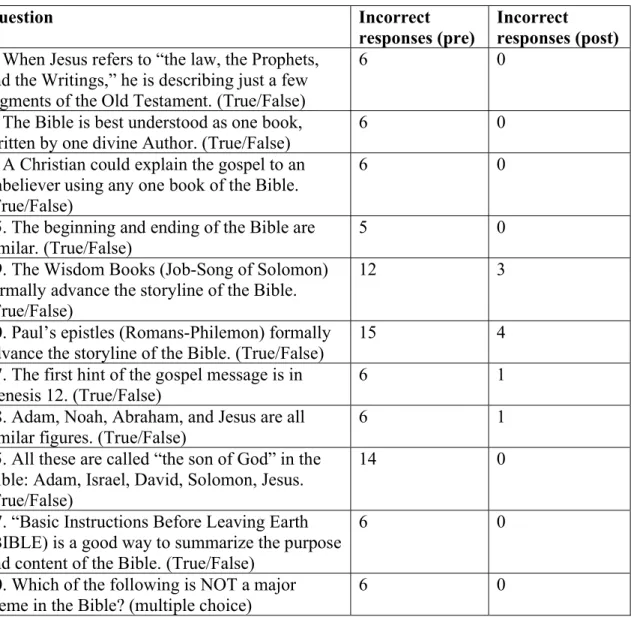
1. Frequently Missed Questions ……… 66
2. Similarities Between New Beginnings in the Bible’s Story ………. 67
3. How the Bible is Arranged ……… 69
4. Improvement from Pre to Post Survey ………. 74
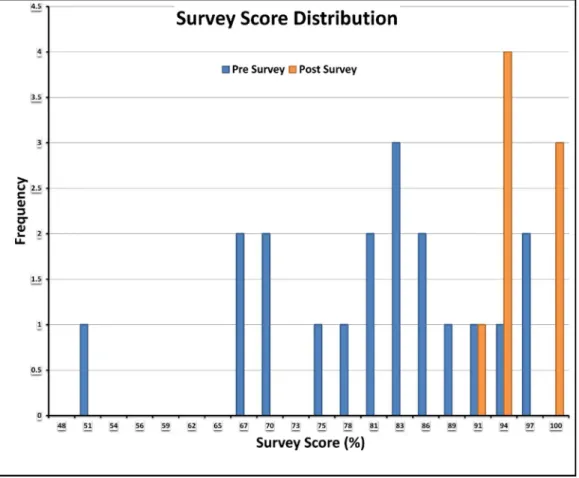
5. Survey Score Distribution ……… 75
6. Paired Respondent Survey Scores ……… 76
7. Paired Respondent Survey Scores ……… 76
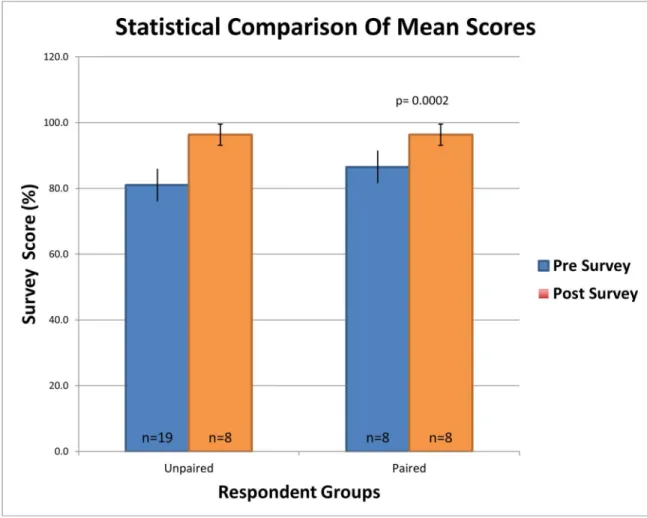
8. Statistical Comparison of Mean Scores ……… 77
vii PREFACE
Countless individuals have influenced my life, my ministry, and my
understanding of the Bible in ways that surely affected the development of this project without me even realizing it. Beyond those people, however, numerous wonderful people made direct contributions that I wish to acknowledge.
My parents exposed me (and my six siblings) to the gospel, discipled me, and gave me their blessing and encouragement in pursuing theological education toward gospel ministry.
During high school, college, and seminary, Shawn Albert and Nelson McGeoch invested unfathomable amounts of time in me while showing me the foundation of a healthy church in their unflinching commitment to the sufficiency of Scripture. They did this in their personal discipleship as well as in their careful weekly preparation of sermons and Bible studies.
The undergraduate and seminary faculty of Bob Jones University, especially Randy Jaeggli, Gary Reimers, and Layton Talbert, graciously invested in me, mentored me, and modeled humility and kindness in all their interactions. Dr. Jaeggli has been a father-figure to me for over a decade and exudes generosity and joy.
Jim Hamilton and Michael Lawrence were two of the people, whether they realized it or even knew who I was, who compelled me to write my project on Biblical Theology. Their love for the storyline of the Bible (and the God of the story) was clear in their writing and their preaching (especially in the case of Jim Hamilton) and teaching (in the case of Michael Lawrence, who taught my first seminar in this program).
Tim Brittain, Jon Cheek, Kellen Funk, and Aaron Menikoff read the drafts of
viii
my sermons for this project and gave insightful feedback. Their comments made my sermons better, kept me motivated each week, and served our church family well. They have all been friends for many years and I admire each of them for their faithfulness to Christ and the church.
Don Burnett proved that a friend in need is a friend indeed. After months of guilt and discouragement with lack of progress on this project, he got me on track and kept me there until I finished just before the deadline.
Brian Vickers patiently waited (and waited) for me to send him content, and then gave valuable feedback that immensely improved this project. His encouragement down the stretch was life-giving.
The elders of Anniston Bible Church (2014-2020) and Brainard Avenue Baptist Church (2020-present) shepherded me while I also sought to shepherd them. Both churches and groups of elders encouraged me in my continuing education and were a delight to serve.
My beloved wife Clarissa and my charming sons Thomas, Grant, and Andrew have given me more than I can begin to imagine. They let me sneak into my office to read and write for hours on end and made me feel loved and appreciated when I returned.
Finally, how do I thank the eternal God for his saving grace, his unfailing kindness, and his preserving faithfulness? May his grace sustain my faith and my ministry until I come to the end of the story in “the city that has foundations, whose designer and builder is God” (Heb 11:10).
Eric Brown
Countryside, Illinois May 2022
1 CHAPTER 1 INTRODUCTION
First-time visitors to a large city like Chicago are often overwhelmed by the scope of the city, and by the unfamiliar sights, sounds, and smells that they encounter at every turn. After obtaining a detailed map, though, they know what landmarks to look for and how to get to them. Eventually, after several hours or days of touring the city, sights begin to look familiar and the visitors can begin to locate where they are, at least
relatively. Compare that sparse knowledge and awareness, however, with that of a veteran tour guide or taxi driver. He knows multiple ways to get from one location to the next, knows what side streets will help him avoid congested traffic, and can navigate his guests while talking to them in an educated way about the city at the same time. The difference between the tourist and the tour guide is time, experience, and dedication to the task.
This analogy is similar to the experience of those who are Bible-reading novices and those who have devoted years to learning the Bible as if it were a printed map. Teaching church members to navigate the terrain of the Bible fluently is one of the primary goals of a church. As such, the leadership of Brainard Avenue Baptist Church is committed to leading the church toward being a healthy church. No church, however, is healthy if its leaders and members are not able to understand the map that is the overall storyline of the Bible. For this reason, Brainard Avenue Baptist Church seeks to increase biblical literacy in every member, so that they will glorify God with their lives, worship him wholeheartedly, and effectively serve him through Christ-centered living.
2 Context
Brainard Avenue Baptist Church (BABC) possesses many strengths, as evidenced by the priority placed on expository preaching, Christ-centered worship services, biblical counseling, and pursuing the glory of God in every part of its ministry.
The church has the reputation amongst other believers of being serious about the gospel, the Scriptures, worship, and helping people in their sin and suffering. Like every other church, however, BABC is beset by a number of weaknesses. Perhaps at the root of many of those weaknesses is a lack of understanding of Scripture’s overarching coherent
message and storyline. Most Christians at BABC (and probably in general) are not able to articulate the Bible’s storyline satisfactorily or see and describe how one passage
connects to or interprets another—which, for the purpose of this project, is how I define biblical literacy. Many members at BABC lack biblical literacy; while they possess a basic familiarity with Bible stories (or poems, prophecies, etc.) and even their locations in the canon, most are unable to identify why those stories are included or how they connect to the Bible’s storyline and themes.
This weakness in biblical literacy at BABC manifests in many ways. First, many members struggle to read the Bible regularly, particularly the Old Testament. In asking individuals why they do not read their Bibles more often, the answer often comes down to a lack of understanding of what they are reading. When they do make time to read, perhaps they will read a Psalm or a part of an epistle or a familiar story from the gospels. But they often neglect large sections, such as Old Testament narrative or the latter prophets. Related to and indicative of this weakness is the way that many Christians at BABC view the Bible as a collection of small stories and principles to live by, but are not able to discern an overarching storyline that ties all of Scripture together. The fact that the Bible feels like a foreign city to many members, in that they do not understand how its various parts cohere, often leads members to feel less confident in their ability to
3
engage meaningfully in Bible study groups or to discuss how they are growing spiritually in conversations with one another.
Second, for many in the congregation, the lack of biblical literacy results in hesitancy in evangelistic efforts in the community. The gospel message—that Jesus Christ came to earth to save rebellious sinners, and to make all things new—is the sum message of the whole Bible. To articulate this good news on the spur of the moment with a stranger at a coffee shop or with a neighbor over a shared meal, however, requires more than mere familiarity with the Romans Road. It requires some reasonable degree of a working understanding of biblical theology. Biblical illiteracy, I argue, results in a hesitancy to share the gospel of Jesus Christ.
Another weakness related to and, I would argue, resulting from biblical illiteracy is a general lack of ability to have routine, helpful, biblical conversations about sin and suffering with one another. Many people are quick to dispense a Bible verse or spiritual platitude about obvious sin habits or difficult trials without first considering whether they have heard enough information, whether the person they are talking to was looking for an encouraging reminder or rather a listening ear, and without first asking whether the advice they are eager to share is more culturally conditioned than scripturally rooted. As a result, feelings often get hurt, relationships are occasionally fractured, and biblical truth and wisdom frequently fail to be passed effectively from generation to generation.
Similar to this problem is the common Christian practice of proof-texting positions due to the inability to make sound, biblical-theological arguments. Of course, it is a positive situation when a Christian can give a verse or a few verses of support to show that marriage is between one man and one woman, for instance, or to defend the truth that salvation is found in Jesus Christ alone. But how much stronger of an argument can Christians make when they show that the whole Bible, not just individual sentences, supports those claims? The Bible provides holistic answers to reveal that there is a
4
Christian way of thinking about particular social issues. The wide-spread inability to argue theologically rather than merely proof-texting is one more piece of evidence that biblical literacy is lacking at BABC.
Finally, biblical illiteracy reveals itself through a subtle devaluation of the sufficiency of Scripture. Rather than looking to the Bible for the answers to life’s
problems, many Christians at BABC tend to overemphasize the role of government (such as through the influence of Supreme Court decisions) or look to secular solutions to resolve their concerns.1 Simply put, many Christians at BABC are imbibing the worldview of the secular society rather than that of the Bible.
The elders of Brainard Avenue Baptist Church have sought to address this problem in various ways, such as through the regular means of expository preaching and promoting quality theological resources. But these efforts have only scratched the surface in addressing biblical illiteracy.
Rationale
Biblical literacy is in crisis. This is true at Brainard Avenue Baptist Church, as it is throughout America as a whole. A weakness this large and significant can seem overwhelming. With intensive effort over several months, however, Brainard Avenue Baptist Church saw measurable growth in biblical literacy.
At its most basic level, I am defining biblical literacy as the ability to read the Bible accurately and draw relevant connections between one part of the Bible and another.2 The biblically literate believer can properly place the various pieces of
1 The faith that is required to view these secular challenges from a Christian perspective is especially possible, I argue, for those who have developed a biblical framework through increasing in biblical literacy.
2 I am making a distinction in this project between biblical knowledge, as important as that is, and biblical literacy. Someone who knows the books of the Bible in order, can recite the Ten
Commandments, and can even tell someone where to find stories such as Gideon’s fleece and David’s sin with Bathsheba might possess biblical knowledge and still lack biblical literacy as defined here. Someone can know all of those facts without knowing how to navigate their Bible in a way that makes them better disciples, evangelists, or church members. In other words, it is possible that even an unbeliever can be
5
Scripture—with their differing purposes, contexts, and genres—into the unified story of redemption that God has revealed in history and through his word.
Elders of a church in this situation cannot neglect this problem or treat it lightly. A failure at this level will result in BABC not fulfilling its purpose as a church of glorifying God, loving each other as a family, and reaching the world with the gospel.
Many reasons point to the need for this project.
First, members at BABC should all be able to see how the Bible connects to Jesus (Luke 24:27, 44; John 1:45; 5:39), which is difficult without being biblically literate. If every passage in some way either anticipates the gospel, or describes the gospel, or explains the implications of the gospel, then Christians must learn to see that reality on every page of the Bible. This is precisely the way Jesus read and spoke about Scripture (Luke 24:13-35).3
Second, Christians are commanded to meditate on the Bible (Josh 1:8; cf. Ps 1:2).4 Meditation involves working over a passage from many different angles, and biblical literacy leads to richer, more satisfying meditation.
Third, as those commanded to share the message of the Bible with others (Matt 28:19-20; cf. Ps 78:4), members of BABC must know that message well.5 Biblical
literacy increases the understanding and motivation needed to proclaim the gospel to unbelievers confidently and persuasively.
strong in Bible knowledge, but it is almost unfathomable that an unbeliever could be biblically literate.
3 As Chapter 2 will demonstrate, the way a passage connects to or points to Christ and the gospel varies significantly. There is no “one-size-fits-all” approach to Christ-centered Bible reading. Some passages have a straighter or brighter line to the gospel. Reading individual portions of the Bible with the whole biblical story in view (the canonical context, as some describe it) is essential.
4 While Joshua 1:8 was addressed specifically to an individual in a particular historical context, the New Testament itself suggests that its message is for all Christians (Rom 15:4; 2 Tim 3:16).
5 I understand Jesus to be referring to the message of the gospel (which is itself the message of the whole Bible, when read with a zoomed-out lens) when he says to “make disciples . . . [by] teaching them all I have commanded you” (Matt 28:19-20). He is not simply referring to individual portions of his teaching ministry, as if the imperatives are the only parts his disciples are to teach to the nations.
6
Fourth, biblical literacy protects Christians from committing doctrinal errors and holding heretical views (as 1 John and Jude, among other New Testament epistles, were written to address). On the other side of the coin, it is also necessary for a defense of the faith (1 Pet 3:15).6
Finally, a renewed emphasis on biblical literacy will make Bible intake more desirable and fruitful. Believers are commanded to grow, and Bible intake is one of the primary means by which Christian growth happens (1 Pet 2:2). Thus, this emphasis will have profound effects on the spiritual growth of the individuals and families of BABC.
Knowing the message of the Bible, and making legitimate connections to the overall message from any given passage, will also make them better disciple-makers and better disciples themselves.
Purpose
The purpose of this project was to increase biblical literacy among the members of Brainard Avenue Baptist Church in Countryside, Illinois by teaching the redemptive story of the Bible.
Goals
To accomplish this purpose, this project focused on executing three related goals.
1. The first goal was to assess a group of adults at BABC on their current understanding (literacy) of the Bible and, particularly, its storyline and themes.
2. The second goal was to develop a ten-week sermon series for increasing biblical literacy at BABC.
3. The third goal was to increase biblical literacy by means of teaching the developed
6 One could argue that ancient heretics such as Arius, or modern-day false teachers such as Bart Ehrman, were or are biblically literate. They certainly had (or have) a tremendous degree of biblical knowledge. This is where the distinction between knowledge and literacy (as I conceive of it) is crucial. At issue is the ability to read the Bible accurately (as Jesus and the Apostles did and taught others to do), not simply knowing the most information possible.
7 sermon series.
These goals cumulatively worked to ensure that the project was successfully implemented and will have lasting effects at BABC. Definitive research methodology demonstrates the effectiveness of the goals.7
Research Methodology
Three goals determined the effectiveness of this project. The first goal was to assess a group of adults at BABC on their current understanding of the Bible and, particularly, its storyline and themes. This goal was measured by writing and
administering a survey to the adults who were in the worship services. Prior to the first sermon, members of BABC completed a Basics of the Biblical Storyline (BBS) survey.8 This survey assessed the ability of each member to identify the storyline in various passages and connect a given passage with various elements of the storyline. This goal would be considered successfully met when thirty members completed the BBS and the results were compiled electronically.
The second goal was to develop a ten-week preaching series for increasing biblical literacy at BABC. The curriculum taught members to read the Bible with
understanding and accuracy—it provided them with the map they need to move from one location in the Bible to the next. The curriculum traced the biblical storyline from
multiple angles, through what are often considered the four acts of the drama of
Scripture: creation, fall, redemption, and new creation. An additional element provided suggestions for fighting distraction so that Christians can maximize their time in Bible
7 All of the research instruments used in this project were performed in compliance with and approved by The Southern Baptist Theological Seminary Research Ethics Committee prior to use in the ministry project.
8 See appendix 1. The average adult Sunday attendance at Brainard Avenue Baptist Church is 40.
8
reading and study, since tracing the redemptive storyline requires focused concentration.9 This goal was measured by the expert panel who utilized a rubric to evaluate the biblical faithfulness, teaching methodology, scope, and applicability of the curriculum. This goal would be considered successfully met when a minimum of 90 percent of the evaluation criteria met or exceeded the sufficient level. If the 90 percent benchmark was not initially met, the material would be revised until it met the standard.
The third goal was to increase biblical literacy by means of preaching the developed sermon series. This preaching took place in the normal Sunday morning worship services. This goal would be measured by administering a pre and post survey which would be used to measure the change in biblical literacy. This goal would be considered successfully met when the t-test for dependent samples demonstrated a positive statistically significant difference in the pre and post survey scores.
Definitions and Delimitations
The following definitions of key terms will be used in this ministry project:
Biblical literacy. I am defining biblical literacy as the ability to read the Bible in a way that is accurate historically and canonically, and to draw relevant connections between its various parts, particularly between the OT and NT.10
Biblical theology. Brian Rosner defines biblical theology as
theological interpretation of Scripture in and for the church. It proceeds with historical and literary sensitivity and seeks to analyze and synthesize the Bible’s teaching about God and his relations to the world on its own terms, maintaining sight of the Bible’s overarching narrative and Christocentric focus.11
9 See chapter 3. The basic idea here is that one of the primary obstacles to biblical literacy in this era of history is the disruptive effect of hand-held devices, computers and television. Through a restructuring of personal and family habits, Christians will be far more likely to engage with and meditate on Scripture with greater clarity, depth, and comprehension. I make applications to this theme in sermons frequently.
10 I consider biblical literacy as the fruit of the discipline of Biblical Theology. (Exegetical Theology, Systematic Theology and Historical Theology are intricately linked to biblical literacy as well.) The concern is that Christians know not just what the Bible says but what the Bible means.
11 Brian S. Rosner, “Biblical Theology,” in New Dictionary of Biblical Theology, ed. T.
9
Perhaps more simply, Michael Lawrence adds that
biblical theology is about reading the Bible, not as if it’s sixty-six separate books, but a single book with a single plot—God’s glory displayed through Jesus Christ.
Biblical theology is therefore about discovering the unity of the Bible in the midst of its diversity. It’s about understanding what we might call the Bible’s
metanarrative.12
Peter Gentry and Stephen Wellum, leaning on the work of Rosner, argue that biblical theology
is concerned with the overall message of the whole Bible. It seeks to understand the parts in relation to the whole. Biblical theology is interested not merely in words and word studies but also in concepts and themes, as it traces out the Bible’s own storyline on the Bible’s own terms, following the plotline to its culmination in Christ.13
Two delimitations will be placed on the project. First, this preaching will take place in a worship service of roughly forty members, but also possibly taught in a small- group Bible study at a time that allows members with challenging work schedules (or are involved in other ministries such as the nursery) to participate. Second, the teaching element of the project will be confined to a twelve-week timeframe. This will give adequate time to prepare and preach the curriculum and to conduct the post-series survey after the sermon series is completed.
Conclusion
For the person struggling to move from one point in the Bible to another, or to get from what is seemingly a small alleyway (a less-familiar passage) to a major highway (the gospel message), a well-developed understanding of the storyline of the Bible
provides the surest and smoothest path. The categories of creation, fall, redemption, and
Desmond Alexander and Brian S. Rosner (Downers Grove, IL: IVP, 2000), 10 (italics removed from original).
12 Michael Lawrence, Biblical Theology in the Life of the Church (Wheaton, IL: Crossway, 2010), 15.
13 Peter J. Gentry and Stephen J. Wellum, Kingdom Through Covenant: A Biblical-Theological Understanding of the Covenants, 2nd ed. (Wheaton, IL: Crossway, 2018), 45. Italics original.
10
new creation saturate every book and genre of Scripture, and many passages actually teach about or allude to more than one of those categories. Nothing can replace the time and effort that are required to develop well-worn paths to the Bible’s thoroughfares. But churches can and must provide the basic road map of the story of redemption to enable members to grow in biblical understanding. By clearly and persistently teaching the story of redemption, Brainard Avenue Baptist Church can help its members to grow in biblical literacy.
11 CHAPTER 2
HOW THE BIBLE ITSELF EXPOSES THE NEED FOR BIBLICAL LITERACY
Reading the Bible is one of the most vital disciplines for the Christian life. It is a book of supreme importance, but also a book with some inherent challenges and of some difficulty to understand, especially some parts more than others. Many believers, for instance, can regularly be confused and discouraged by what they read and by an inability to comprehend it. Long lists of unusual names can leave readers bored. It can be difficult to know what to obey, and to know how what they read applies directly to Christian living today.
Whether for a new believer or someone who has followed Jesus in a healthy church for many years, Christians can struggle to know what part of the Bible to read first (or next). Is every part of the Bible of equal importance? If not, what parts should readers focus on?
The Bible deserves the Christian’s highest level of interest, examination, and investment of time and energy. It is a collection of 66 books, written over the span of about 1500 years in a variety of places by dozens of human authors, all under the inspiration of the Holy Spirit. These 66 books demonstrate a remarkable level of unity despite the diversity of audiences and cultures represented by each book.
That being said, Christians struggle to know how God intends for them to read the Bible. That goes for reading the Bible as a whole, as well as for reading individual passages. Some read the Bible as primarily about themselves. Some read passages allegorically when a straight-forward understanding of the text is better. At the other
12
extreme, some refuse to see that some passages are clearly intended to be understood metaphorically or figuratively, and instead read nearly every passage with rigid literalism.
Then there are the habits of some Christians who read the Bible as a collection of wise sayings, as an instruction manual for how to receive God’s greatest blessings in life, or as merely a prophetic timeline.
The Bible itself, however, tells Christians how they should read Scripture.
Foremost, Christians must read the Bible with an eye to seeing how the whole Bible is telling the story of a loving, Triune God who created the world and everything in it, including mankind himself. But man rebelled against his maker, resulting in God cursing the world. God the Son, Jesus, came to earth to redeem mankind and to restore all things.
In the end, all will be made right, and God will receive eternal praise from his people in a new heaven and new earth.
With that general storyline in mind, then, Christians must read the Bible with a lens to how the person and work of Jesus Christ is the solution to man’s problem of sin and rebellion.1 Every passage, in both the Old and New Testaments, is in some way connected to the gospel of Jesus. The way one portion of Scripture connects to or reveals the gospel may be clearer than the way another passage does, but Christians who invest the needed time and effort are able to reflect thoughtfully on how a passage relates to the gospel.
Why should Christians pursue the goal of personally reading the Bible well, when it would be so much easier to let pastors or other mature Christians do it for them?
Is it not enough that Christians read the Bible in the first place? Is it asking too much to require that all Christians read the Bible in a certain way, or should pastors just be thankful that the average Christian reads the Bible at all? The answer is that, whether
1 This paragraph and the one preceding it both state this argument as an imperative. While the Bible itself does not give this command, due to the nature of the Bible as a whole, I believe it is appropriate and necessary for Christians to consider the Bible as a story that has necessary implications to all of life.
13
explicitly or implicitly, the Bible itself calls Christians to read, comprehend, and synthesize the Bible accurately and thoroughly.
Biblical Literacy Helps Christians Read the Bible Rightly (Luke 24:13-35)
It could sound almost arrogant to hear that Christians can read the Bible
“rightly,” because that word obviously implies that Christians can read the Bible
“wrongly” as well. How can there possibly be a wrong way to read the Bible?
Christians can err in Bible reading in multiple ways. Christians should not read the Bible as a collection of wisdom sayings or as a personal instruction manual. More specifically, the Bible is rightly understood when Christians read it and interpret it first and foremost as a story. It may be more than a story in some parts, but Scripture is never less than a metanarrative. It is not, however, only a story to tell—it is also a story
Christians inhabit and in which they are personally engaged. But when considering the Bible as a story, perhaps the single most important element is reading the Bible with an eye on the person and work of Jesus as the heart of the story. To read the Bible any other way is to read the Bible deficiently. Christians must understand the whole Bible “in light of Jesus and the gospel and the kingdom inaugurated in His coming.”2 This is where Luke 24 comes into focus.
Luke 24 recounts the day when Jesus was raised from the dead (vv. 1-7) and his followers began to hear reports that he was no longer in the tomb (vv. 8-12). Verse 13 describes that two disciples were walking from Jerusalem to Emmaus, and as they journeyed they were emotionally distressed. As they progressed down the road, however, Jesus himself joined with them and entered the conversation.
2 David M. King, Your Old Testament Sermon Needs to Get Saved: A Handbook for Preaching Christ from the Old Testament (Chicago: Moody, 2021) 13.
14
Readers of this passage may marvel that these two disciples, who surely knew and spent time with Jesus, would be so blind that they would not recognize who their new walking companion was. But verse 16 is describing more than just a physical struggle they had to recognize this man. Theologically, the verse is subtly describing a work of God. Luke records that “their eyes were kept from recognizing him.”3 This statement is an example of what theologians often call a divine passive—in other words, while the text does not explicitly refer to God, the action Luke describes only makes sense as being a work of God.4 He is the one who kept their eyes from recognizing Jesus; they were experiencing a spiritual reality, not just a physical one. Why would God do this? Darrell Bock argues that “one purpose of the verse is to show the reality of Jesus’ bodily
resurrection. Luke tells the story with dramatic flair, as the reader knows more about the situation than those who experienced the event—at least at this point. Part of the drama is when and how they will realize who their discussion partner is.”5
Jesus entered into the conversation and asked them what they are talking about, though he almost certainly knew.6 Luke, who in his gospel account regularly describes the emotions of his characters, paused in verse 17 to note that these two followers “stood still, looking sad.” Perhaps this question was salt in the wounds for people whose entire
3 Unless otherwise noted, all Scripture quotations come from the English Standard Version.
4 Bock agrees that the most likely reason they did not recognize him was that “God [concealed]
this information,” as opposed to the problem being “the disciples’ own blindness” or seeing “Satan at fault.” Darrell L. Bock, Luke, vol. 2 (9:51-24:53), Baker Exegetical Commentary on the New Testament (Grand Rapids: Baker, 1996), 1909.
5 Bock, Luke 9:51-24:53, 1910. Stein expresses the same sentiment: “This lack of recognition allowed Jesus to teach the necessity of his death and resurrection and to show how this was the fulfillment of Scripture.” Robert H. Stein, Luke, The New American Commentary, vol 24 (Nashville: Broadman, 1992), 610.
6 Of course, it is unclear how much Jesus knew in his resurrected body. Was he still bound by human weakness at this point, so that any knowledge he had was a direct work of the Holy Spirit? It seems unlikely that he resumed his omniscience as the Son of God until his ascension. But what is clear is that, though these two men “do not know the identity of this fellow traveler, yet they are astonished that he does not know of recent events; in fact, Jesus is the only one who is genuinely ‘in the know.’” Joel B. Green, The Gospel of Luke, New International Commentary on the New Testament (Grand Rapids: Eerdmans, 1997), 486.
15
lives had been thrown into confusion and sorrow over the past few days. These men were simply incredulous that someone would not have heard about “the things that [had]
happened” in Jerusalem that weekend.
When Jesus provoked them to elaborate on what they had in mind, they answered him clearly and robustly.
Who Was Jesus? (vv. 19-24)
Cleopas and the other disciple understood that Jesus was “of Nazareth,” which brings the reader back to Luke 4:16-30 and his initial sermon in his hometown. They also knew that he was “a prophet mighty in deed and word,” referring to both his miracle working and his stunningly clear, compelling, and convicting sermons (again, cf. Luke 4).
That he was a prophet “before God and all the people” underscores the significance of his ministry in the eyes of these men—they had anticipated that Jesus was the “prophet like Moses” foretold in Deuteronomy 18:15-18.
The disciples continued to describe what they understood of Jesus. He was
“delivered up to be condemned to death” (v. 20) and he was crucified. All of this was stunning because, as they expressed, “we had hoped that he was the one to redeem Israel”
(v. 21). These men shared common expectations for the Messiah, but as Jesus will shortly describe, they were misunderstood, or at least short-sighted, expectations. Nothing they said was wrong; they simply did not go far enough. Green observes, “What is lacking in their interpretation of Jesus’ significance . . . is the understanding that, as God’s prophet, Jesus must fulfill the destiny of the prophets: rejection, suffering, and death.”7
7 Green, The Gospel of Luke, 487.
16 The Things Concerning Himself
(vv. 25-27)
In his response, Jesus describes these men by several terms. He said they were
“foolish,” a term that readers should not understand as derogatory or harsh, but one that simply addresses the men’s short-sightedness in their understanding of the Scriptures.
The fact that they are “slow of heart to believe all that the prophets said” draws out this deep-seated “failure to orient themselves fully around Jesus’ teaching, not to their need merely for remedial education.”8 It was not that they had merely failed to memorize a chart or list of vocabulary terms. Their problem was far deeper and more significant.
They had failed to connect the dots that were all over their Scriptures written by the prophets.9 The main truth they had missed was that the Messiah would have to suffer, and only then would he “enter into his glory” (v. 26).
At that point Jesus shattered the preconceptions of the disciples and constructed an entirely new paradigm. He showed that in both the books of Moses (Genesis through Deuteronomy) and the books of the prophets (Joshua through the Book of the Twelve, according to the Hebrew arrangement of the Bible), the whole Old
Testament is only rightly understood when it is read as anticipating and foretelling the person and work of Jesus himself.
Important to grasp is the note that “he interpreted to them.” This simple phrase highlights that right interpretation is crucial, and it also assumes what is generally
8 Green, The Gospel of Luke, 488.
9 The most natural understanding of the identification of “the prophets” in v. 25 is to see them as Isaiah, Jeremiah, and the other canonical writing prophets. Rebecca McLaughlin, in her apologetic work Confronting Christianity, sees a reference here to the women who saw Jesus earlier that morning (v. 10- 11). Based on the larger context of what she is writing, she seems to understand this reference to the
“prophets (who) have spoken” as a way that Luke elevates women. This is not to say that Luke does not elevate women in his gospel account; that point is indisputable. What is disputable is that “the prophets” of whom Jesus speaks are the women who came to the empty tomb that morning and then went and told the disciples that Jesus was risen. It is far more likely, and a far clearer reading contextually, to assume that Jesus is referring to the same “Prophets” as he does later in Luke 24:44 rather than to the female disciples these men had encountered earlier that day. Perhaps part of the confusion is that the ESV capitalizes
“Prophets” in v. 44 but not in v. 25, possibly because of considerations such as the one McLaughlin raises.
Rebecca McLaughlin, Confronting Christianity: 12 Hard Questions for the World’s Largest Religion (Wheaton, IL: Crossway, 2019), 138.
17
obvious, that it is possible to misinterpret the text. In other words, not every reading of a text is guaranteed to be correct! Christians must read the Bible in a certain way—again, must read “rightly,” to use previous terminology—or what they conclude from their Bible will fall short of its Holy Spirit-intended meaning.
But the larger point is that “in all the Scriptures,” Jesus is at the heart of a correct reading. That is not to say that his person and work is described in every passage in the same way, but that every part of Scripture is ultimately about him and his restoring work. As Joel Green insightfully notes, “what has happened with Jesus can be understood only in light of the Scriptures, yet the Scriptures themselves can be understood only in light of what has happened with Jesus.”10 Stein similarly remarks, “Jesus did not designate which prophets or where these prophets spoke of him. For Jesus and the Evangelists ‘all’ the prophets ‘everywhere’ spoke of him.”11
Though this passage is lacking in detail and leaves significant questions
unanswered (Did Jesus teach a specific method? What passages did he use as examples?), this textual unit from Luke 24 is at the heart of reading the whole Bible rightly. Luke records no hermeneutical checklist nor an extended outline of Jesus’s commentary (the only outline he provides is simply “Moses” and “the prophets,”), but the apostle does give the basic framework Christians need. Luke will later provide, in the book of Acts, both brief and extended examples of interpreting the Scriptures through a Christological framework. But the message is clear: if readers miss Jesus, they miss what they are supposed to be seeing. Quite simply, “all of the Scriptures have their fulfillment in a Messiah who suffers.”12
10 Green, Gospel of Luke, 485.
11 Stein, Luke, 612.
12 Green, Gospel of Luke, 488.
18 Burning Hearts (vv. 28-35)
In the next scene in the passage, these men were so astonished at what this fellow journeyman had taught them that they could not bear the thought of ending the conversation abruptly, so they invited him to spend the night with them. Luke describes that as they sat around the table that evening with Jesus, these disciples had their next life-altering experience. As verse 31 describes, “their eyes were opened”—another divine passive. The Lord was the one who opened their eyes, just as the Lord had been the one in verse 16 who “kept (them) from recognizing him.”13 This was a spiritual
understanding, not merely a physical one. Stein addresses misunderstandings of what is happening here: “Attempts to explain this recognition as due to their identification of Jesus’ voice, his unique blessing, his special way of breaking bread, seeing the holes in his hands, seeing a gesture of some sort peculiar to Jesus should be rejected. Luke gave no hint of this.”14
After this stunning moment, Jesus vanished, and the men began to relive the events of the day. They grasped at words to explain what the experience of hearing Jesus interpret the message of the Bible was like. They expressed the moment, in verse 32, as having “burning” hearts. That Jesus “opened the Scriptures” is a picturesque metaphor for explaining and interpreting the Scriptures in the way Jesus did in verses 25-27.15
What becomes clear in this passage is that these disciples were not yet
“biblically literate” (and by implication, neither were any of the others). They may have known the Old Testament passages, but they missed what they were really about. The moral of the story, in one very important sense at least, is that Christians are not biblically
13 Bock agrees that this verse is the answer to the dilemma earlier in the passage. “Luke uses language that reverses what was said about their lack of recognition in 24:16.” Bock, Luke 9:51-24:53, 1920.
14 Stein, Luke, 613.
15 Anecdotally, this is an appropriate way for Christians to pray before reading the Bible themselves (or for pastors to pray for their congregation before preaching), that the Holy Spirit would open their eyes to the truth in the text (cf. Ps 119:18).
19
literate if they fail to recognize that a passage is describing the glory and ministry of Jesus in some facet. Granted, the path to preaching the gospel in Psalm 19, as one example, is not the same as the path to preaching the gospel in Psalm 22, or even Psalm 23, but that does not mean a legitimate path does not exist.
Possible Ways for Preaching Christ from Psalm 19
In light of Jesus’s teaching in Luke 24, someone teaching or preaching from Psalm 19 could faithfully preach the gospel in a variety of ways. For one, a teacher could connect Psalm 19:1-2 with Hebrews 1:1-4, where the author declares that Christ is the fullest revelation of the glory of God and the clearest way in which God has
communicated with man. He could also point to Psalm 19:11, that in keeping God’s commands “there is great reward,” but then remind the listeners that no one has ever kept God’s law except Christ, who has perfectly fulfilled the law through his active obedience.
A third relatively straight path to the gospel is in verse 13: believers are “innocent of great transgression” only through Christ’s atoning sacrifice on the cross.
Luke 24 as a Lens
Christians may rightly ask whether it is legitimate to read Luke 24 as a lens for the rest of the Bible. Should Christians truly “see Jesus” in every passage, or is this a forced interpretation? First, it should be noted that criticism of a Christ-centered
hermeneutic can be valid and necessary. It is indeed possible for Bible readers seemingly to look for Jesus behind every bush and under every rock and so do injustice to the message of the text.
Just because that danger exists, however, does not mean that Bible readers should avoid seeking to legitimately connect each passage in some way to the message of Jesus Christ as the center of divine revelation. As Jason DeRouchie helpfully argues,
“Many Old Testament teachers suggest that we should approach Jesus’ Bible as though
20
Jesus hadn’t come. Yet this was never God’s intent. Like any good mystery novel, reading the last chapter forces us to rethink the entire plotline.” He later adds, “We must read the Old Testament as Christians and not as though Christ had not come, for this is how the divine author intended us to read his Book. Once Luke and John, Paul and Peter encountered the resurrected Christ, they could not help but read their Old Testament in the knowledge of Christ’s person and work.”16
The crucial element in this process is making connections legitimately. Perhaps one of the best guides in recent decades on making legitimate hermeneutical connections to the gospel, particularly from the Old Testament, is Sidney Greidanus. He lays out seven distinct ways to preach Christ from the Old Testament, summarized below.17
1. The way of Redemptive-Historical Progression 2. The way of Promise-Fulfillment
3. The way of Typology 4. The way of Analogy
5. The way of Longitudinal Themes 6. The way of New Testament References 7. The way of Contrast
DeRouchie helps clarify how Christians can rightly read the Old Testament with a Christ-centered perspective. “This kind of Christ-centrality does not require that we think every Old Testament passage is about Christ,” he writes. “But it does
16 Jason S. DeRouchie, How to Understand and Apply the Old Testament: Twelve Steps from Exegesis to Theology (Phillipsburg, NJ: P&R, 2017), 366.
17 Sidney Greidanus, Preaching Christ from the Old Testament: A Contemporary Hermeneutical Method (Grand Rapids: Eerdmans, 1999), 227.
21
necessitate that we consider how every one points to him.”18 He also elaborates on the necessary ingredients for faithfully interpreting a text in a Christ-centered way: they are
“humility, prayerfulness, and solid biblical interpretation that draws on the cultural- historical setting, the linguistic data, the immediate literary context, and the broader canonical context of every passage we consider.”19
Just as Greidanus provides seven ways to preach Christ from the Old Testament, DeRouchie also identifies seven ways Christians can “encounter and
ultimately proclaim Christ and the gospel from the Old Testament.” His list is provided below in summary form.20
Christ fulfills the Old Testament by:
1. Standing as the physical embodiment of YHWH.
2. Bringing us the righteousness to which the Old Testament bears witness.
3. Supplying us the power to love and thus fulfill the law.
4. Operating as the object of direct Old Testament messianic predictions.
5. Serving as the climax of all salvation-historical trajectories.
6. Both similarity and contrast.
7. Functioning as the antitype of all types.
With these ways in mind, if someone is studying a passage and is struggling to identify a way in which that portion of Scripture relates to the gospel, it is possible the problem is that the person is looking at the passage with too narrow of a focus. Zooming
18 DeRouchie, How to Understand and Apply the Old Testament, 481.
19 DeRouchie, How to Understand and Apply the Old Testament, 481.
20 See DeRouchie, How to Understand and Apply the Old Testament, 482-89 for details on each way to proclaim Christ.
22
out from the details of the text may help provide a different framework, such as a theme in the broader context or from an analogous passage in the New Testament.
When studying a passage in a difficult book of the Bible, such as Ezekiel or Jeremiah, books that are overwhelmingly about the judgment that God brings on sin, an appropriate connection to the gospel is that we, too, deserve the unmitigated wrath of God, but it is averted in Christ’s atonement. Similarly, the obedience that a passage demands is only available to those who depend on the grace of Christ available to
believers because of his resurrection. Only when Christians have been glorified and are in the presence of God in the New Jerusalem will they no longer face the effects of the curse and the temptation to sin.
Bryan Chapell has sought to make these hermeneutical principles especially clear in the context of preaching. Whereas some may seek to find some reference to the cross or the blood of Jesus in every passage, Chapell contends, “A message is Christ- centered not because it makes creative mention of an aspect of Jesus’ life or death but because it discloses an aspect of God’s redeeming nature (evident in the text) that is ultimately understood, fulfilled, and/or accomplished in Christ.”21 He acknowledges that
“vast portions [of the Bible] make no mention” of Christ, but the way we see all of Scripture “center on Christ’s work” is by “learning to see all of God’s Word as a unified message of human need and divine provision.”22
Chapell contends that “the entire Bible is Christ-centered because his redemptive work . . . is the capstone of all of God’s revelation of his dealings with his people. Thus, no aspect of revelation can be thoroughly understood or explained in isolation from some aspect of Christ’s redeeming work.”23
21 Bryan Chapell, Christ-Centered Preaching: Redeeming the Expository Sermon, 2nd ed.
(Grand Rapids: Baker, 2005), 15.
22 Chapell, Christ-Centered Preaching, 20.
23 Chapell, Christ-Centered Preaching, 276.
23
The point of Luke 24:13-35 is that Christians do not interpret the Bible rightly if they do not identify how a particular passage exposes the need for Christ, predicts or describes the work of Christ, or extols the results of the work of Christ. Chapell
emphasizes, “Christ-centered preaching rightly understood does not seek to discover where Christ is mentioned in every text but to disclose where every text stands in relation to Christ.”24 To avoid grievous errors in understanding a passage, Christians must exert effort to identify legitimate ways the passage proclaims the gospel of Jesus Christ.
The Book of Acts: Examples of the Apostles Demonstrating Christ-Centered Reading
of the Scriptures
How did the apostles respond to the teaching of Jesus in Luke 24? Did they get the message? And ultimately, how would readers know if they did? Simply, by the way the apostles wrote, and by the way they preached.
The book of Acts provides ample evidence that indeed the apostles got the message loud and clear, and then they went on to teach others to read the Bible the same way. The apostles grasped Jesus’s teaching and sought to compel their readers and hearers to see that Jesus is the center of Old Testament revelation.
At least three characters in the story of Acts reflect that Jesus’s thesis in Luke 24 was clearly grasped: Peter, Paul, and Apollos. The following section demonstrates how those three preachers incorporated their understanding of the Old Testament into their teaching and preaching opportunities to convince their hearers that Jesus is the one their Bible (the Old Testament) was anticipating.
24 Chapell, Christ-Centered Preaching, 279, emphasis original.
24 Acts 2:14-36: The Arrival of the Spirit Proves That Jesus Is the Messiah
The Day of Pentecost was one of the most significant events in human history.
It marked the beginning of a new era in which the hints that the Kingdom of God was being restored now give way to clear, full-forced bursts of Kingdom life. The promise of Jesus that God would send a “Helper” (John 14:26) came into fulfillment. Peter
recognized that what was happening that day in Jerusalem was also “what was uttered through the prophet Joel” (2:16). Through the indwelling of the Holy Spirit, God’s people were now themselves temples (1 Cor 6:19). In one moment of Spirit-wrought power, everything changed for God’s people.
The apostle Peter responded to the comments and confusion in the crowd that day by preaching the first recorded sermon in the book of Acts. Peter’s sermon is
naturally divided into three sections, separated by the three terms with which he directly addresses his audience: “Men of Judea and all who dwell in Jerusalem” (v. 14); “Men of Israel” (v. 22); and “Brothers” (v. 29). In the first section, Peter denies the suggestion that those speaking in foreign languages were drunk (v. 13), and explains that what was happening was fulfilling the prophecy of Joel. He quotes an extended portion of Joel 2:28-32. Not every detail of Joel’s prophesy was fulfilled in the events at Pentecost.
Rather, Pentecost was in a sense the first-fruits of that passage being fulfilled. As Brian Vickers asserts, “Joel’s apocalyptic vision is not localized but final and all-encompassing as God’s ultimate judgment falls on the world. . . . This [the events of v. 19-20] is a scene of ultimate finality, the end of what began at Pentecost.”25 But mercifully, those who respond to the powerful outworking of God’s plan in repentant faith, by calling on “the name of the Lord,” will be rescued in God-glorifying salvation (v. 21).
25 Brian J. Vickers, The Acts of the Apostles, in ESV Expository Commentary, vol. 9, John- Acts, ed. Ian M. Duguid, James M. Hamilton, Jr., and Jay Sklar (Wheaton, IL: Crossway, 2019), 358.
25
The second unit of the sermon observes that Jesus had been killed by “lawless men” (v. 23), but that God had raised him from the dead—an act that Peter observes was in direct fulfillment of Psalm 16:8-11. Peter’s use of Psalm 16 is significant. As Vickers aptly states, “Psalm 16 is not simply a handy example but according to Peter was pointing all along to the recent events.”26 Peter goes to great lengths to demonstrate that David was not and could not have been talking about himself when he wrote Psalm 16. Rather, he was looking ahead to a future fulfillment by the Messianic King. When Jesus rose from the dead in the power of God, David’s prophetic Psalm was fulfilled.
Finally, the sermon’s third unit consists of Peter explaining why he interprets Psalm 16 the way he does. In doing so, he also quotes Psalm 110:1 to prove that “God has made [Jesus] both Lord and Christ.” The flow of Peter’s thought is as follows: the Spirit came because Jesus had died, was resurrected, and ascended to heaven. The fact the Spirit came proves that Jesus was the Messiah. If the Spirit had not come (in fulfillment of Joel 2), there would be good reason to doubt that Jesus was the Messiah. But since the Spirit had come, Peter’s audience must take that as evidence that Jesus truly is God’s Anointed One, and should respond in repentant faith.
Acts 3:11-26: Peter’s Sermon in Solomon’s Portico
In this passage in Acts 3, Peter gave his audience the unvarnished truth, and used the miracle he performed to show people that their only hope was in the God who can work miracles. From what Peter said after performing a miracle of healing, one could say that Peter had grasped the message of Jesus’s own words in Luke 24. He used that thorough understanding of the Bible to demonstrate the power and glory of Jesus.
In the first ten verses of Acts 3, Peter and John interact with a man outside the temple who was lame from birth and was begging for money. Instead of meeting that
26 Vickers, Acts of the Apostles, 359.
26
temporal need, Peter acknowledges that he did not have what the man was asking for.
Instead, he states that he could offer something that the man was surely not expecting. In verse 6, Peter famously says, “I have no silver and gold, but what I do have I give to you.
In the name of Jesus Christ of Nazareth, rise up and walk!”
The man was immediately healed and walked around rejoicing in this truly amazing gift. All those who saw him that day were astonished at this miracle. But Peter did not perform this wonder for that man’s benefit alone. He was eager to use the
opportunity to address the crowd, give an overview of God’s history with his people, and call sinners to repentance.
The message he preached (3:11-26). In verses 11 through the end of the chapter, Peter summarizes Israel’s history as a means of evangelizing the unbelievers who were there that day. The content of his sermon demonstrated how deeply ingrained the message of the Bible was in his mind. He did not have simply a few verses
memorized and a chart in his pocket to help him tell sinners how to “accept Jesus into their hearts.” Rather, Peter had a thorough understanding of how the whole Bible held together with Jesus at its center and God’s glory as its end.
In verse 12, Peter wonders why his audience was surprised, and why they assumed that it was in their own power that he and John healed the lame beggar. In verse 13, he takes his Jewish audience back to the book of Genesis, and says that the God of Abraham, Isaac and Jacob is the one responsible for this miraculous healing, as he is the one who “glorified his servant Jesus.”27
Peter then puts the responsibility for Jesus’s death on the hands of these Jewish people. In verse 13, he says they handed him over, disowned, and denied the one who
27 Bruce draws a clear connection between Jesus’s glorification and the apostles’ miracle: “The cripple had been healed because Jesus had been glorified. From His place of exaltation He had endowed His disciples with power to act in His name, and to perform mighty works such as He had performed in the days of His bodily presence among them.” F. F. Bruce, Commentary on the Book of the Acts, New
International Commentary on the New Testament (Grand Rapids: Eerdmans, 1979), 88.
27
was Holy and Righteous, and “asked for a murderer” in his place. He was “the Author of life” (v. 15), killed by sinful men, but raised from the dead by God himself.
In those few verses alone, Peter lays out the facts of the gospel message. He identified who Jesus was, and no one there that day would have denied the historical facts that Peter listed. They were commonly known facts, so that only a fool would have argued with Peter about whether the events he recounted were true. They had seen them with their own eyes; they had participated in killing Jesus themselves.28
The credit for the miraculous healing should only go to Jesus, Peter states in verse 16. Only faith with him as the object can have that kind of effect.29 In verse 17, Peter for the second time calls his audience “brothers,” or fellow Israelites (cf. v. 12). In doing so, he is showing them that he is not against them, but that he is eager for their spiritual well-being. He acknowledges that what they did to Jesus was done “in ignorance,” by assuming that Jesus was a lunatic rather than Lord.30
The mystery of the gospel, Peter insists, is that through the sinful acts of rebellious and spiritually blind people, God’s eternal purpose was accomplished. All that God had foretold through the Old Testament prophets, which in Peter’s mind were from Joshua through the Book of the Twelve, was fulfilled when Jesus suffered in his final days (v. 18).31 What sinful men had meant for evil, God had meant for good, and the
28 As Bock elaborates, “It was the Jerusalem Jews’ corporate act that prevented Pilate from releasing Jesus (see Acts 4:27). Thus here we have an elaboration on the charge against the Jewish audience in 2:22-23. The Jewish leaders may have started the process, but the crowd approved it.” Darrell L. Bock, Acts, Baker Exegetical Commentary on the New Testament (Grand Rapids: Baker, 2007), 170.
29 Readers may note that the passage does not actually describe the man as having faith.
Marshall gives a plausible explanation: “We are not told in the story that the man displayed faith, but the way in which he praised God after his cure could well imply this; alternatively, the faith might be that of Peter. In any case, any suggestion that there was something magical about the miracle is deliberately ruled out.” I. Howard Marshall, Acts, Tyndale New Testament Commentaries (Downers Grove, IL: IVP Academic, 1980), 98.
30 The “lunatic” language is based on C. S. Lewis, Mere Christianity (New York:
HarperCollins, 2001), 52.
31 In discussing which prophets Peter may have had in mind, Marshall comments, “we should probably think primarily of the teaching about the suffering of God’s Servant (Isa. 53), and also of other passages in the prophets and the Psalms which may have been taken as typological or prophetical of the
28
death of Jesus did nothing to interfere with God’s divine plan of redemption. Rather, it furthered God’s plan.
In verse 19, Peter immediately calls the men and women in his audience to turn to God in repentance.32 The result of such a turn will be that their sins would be “blotted out,” they would receive “times of refreshing” from the Lord, and he would return. At that time God will restore all things (v. 21). Peter again invokes the Old Testament prophets, who spoke often of the Day of the Lord and the rich blessings of seeing the New Creation take full effect.
Peter’s brief illusions to the prophets in verse 18 and in verse 21 demonstrate his foundation of biblical literacy. Once again, he was not merely quoting a prearranged list of data. He was composing, on the spot, a masterful summary of the teaching of the entire Bible. By maintaining a comprehensively biblical worldview, he knew where the world began (Gen 1-2), and where the world would end (Rev 21-22). He knew that it all centered on the person of Jesus for the glory of God. He knew that history was aiming at the full restoration of God’s beautiful creation. And he was zealous in his evangelism for his fellow Israelites, and in his appeal that sinners would turn to God for the refreshing grace of Jesus, because he was so fully convinced of the Bible’s teaching. His biblical literacy convinced him that all of God’s promises to his people were coming to pass in Jesus Christ (cf. 2 Cor 1:20).
In vv. 22 and 23, Peter recounts Moses saying (in Deut 18) that God will provide another prophet like himself. He goes one step further, showing that “anyone who does not listen to him will be completely cut off from their people,” an allusion to
sufferings of the Messiah (Jer. 11:19; Dan. 9:26; Zech. 13:7; Pss. 22, 69); this would give us material from three of the four books of the ‘latter prophets’ (Isaiah, Jeremiah, and the book of the Twelve; omitting Ezekiel) and also from the Psalms.” Marshall, Acts, 99.
32 The forgiving mercy of God is apparent in Peter’s application, that these sinners can be saved despite “their acquiescence in the murder of their true Messiah. . . . Their sins would be wiped out, even that sin of sins which they had unwittingly committed in clamouring for the death of the Author of life. Here, surely, is the heart of the gospel of grace.” Bruce, Acts, 90.
29
Leviticus 23:29. Peter understood that to be “cut off” from the people of God is to be eternally separated from God. As Bock describes, “The remark warns of total judgment for failing to respond to the person and work of Jesus, who is the prophet like Moses.
Peter declares that those who fail to respond will have no place among God’s people.”33 This is true both for Jew (in Peter’s original audience) and Gentile, as together in the church they constitute the true people of God.
As his sermon continues Peter alludes to the books of Samuel, and to Samuel himself, as part of the prophetic witness that have spoken of what are now the last days.
He sees the promises to Abraham in Genesis 12 fulfilled in Jesus, who by his work on the cross brings the blessings of salvation to all nations.
Summarizing Peter’s sermon. In the span of what takes less than five minutes to read aloud, Peter concisely stated the message of the entire Old Testament.
Granted, what Luke recorded in Acts 3 may have been a summary of a much larger sermon on Peter’s part.34 But regardless of whether that is the case or not, the point is the same: Peter knew his Bible, and he knew it very well. He could maneuver from any one point in the Old Testament to any other point while demonstrating that the message of the Bible is all about God receiving glory in saving his people and judging his enemies, all of which is accomplished through the person and work of Jesus.35
33 Bock, Acts, 179.
34 Walter L. Liefeld addresses this possibility indirectly: “We can affirm that there is a normal tendency to preserve elements that express one’s special concerns. This is an aspect of redaction criticism that few would deny. As with the Gospels, we should not be surprised if an author chooses to preserve from his sources data that contain especially appropriate components. Such selection hardly implies that the concert of these sources is unreliable or historically inaccurate.” Walter L. Liefeld, Interpreting the Book of Acts (Grand Rapids: Baker, 1995), 66-67.
35 Describing the content of Peter’s entire sermon, Bock summarizes, “Acts 3 preaches Jesus from the Torah. Here is the promised seed-servant-prophet-leader like Moses who is the Author of life.”
Bock, Acts,182. Peter preached this way because he saw that the whole Old Testament was about Jesus—
because he was reading the Bible rightly. For an expansion on the theme of God’s glory as the center of the whole Bible, see James M. Hamilton, God’s Glory in Salvation through Judgment: A Biblical Theology (Wheaton, IL: Crossway, 2010).